Showing posts sorted by date for query coal deaths. Sort by relevance Show all posts

Wednesday, September 06, 2023

New silica-dust exposure limits aim to protect coal miners from black lung disease; data may not support that promise

The CDC encourages miners to get screened for black-lung
disease; the severest type is on the rise. (CDC graphic)
A proposed federal solution for preventing black-lung disease in coal miners may overlook thousands of deaths, and its regulation would not be enough to push mine operators to change tactics, report Howard Berkes of Public Health Watch and Justin Hicks of Louisville Public Media. "After decades of delay, the federal Mine Safety and Health Administration is finally getting serious about overexposure to silica in the nation’s mines," they write. "The agency is proposing a silica-dust exposure limit twice as tough as it is now. MSHA would also directly regulate excessive silica exposures, something it hasn’t previously done, making citations and fines possible for putting miners at risk."

Black lung "has been a known threat to coal miners for over a century — it’s taken the lives of tens of thousands of Americans since 1968. While black lung became less common through the 1990s, it’s on the rise again. Now, even middle-aged miners have been diagnosed with advanced stages of the disease," reports Allen Siegler of Mountain State Spotlight. "Severe black lung continues to disproportionately affect central Appalachia; from 2019 to mid-2023, nearly 30% of Americans diagnosed with progressive massive fibrosis at federally-funded black lung clinics were West Virginians, according to the Black Lung Data and Resource Center at the University of Illinois. That trend is widely attributed to more frequent exposures to silica dust. . . . Grinding quartz creates silica dust, which is 20 times more toxic than coal dust alone."

How effective MSHA's proposed measures would be is uncertain. "An investigation by Public Health Watch, Louisville Public Media and Mountain State Spotlight shows that the plan’s purported benefits understate the silica risk to coal miners and the urgent need for immediate action," Berkes and Hicks report. 

Siegler reports, "Independent analyses of MSHA’s own coal-mine dust samples show its previous silica-dust exposure limits failed to adequately protect miners for decades. An investigation by NPR and PBS Frontline in 2018 analyzed MSHA’s data and found 21,000 instances of overexposure to silica dust since 1986. . . . While the proposed rule, in its current form, does require regular dust sampling, much of its effectiveness will depend on mining companies sampling their own mines and reporting it accurately and honestly."

Tuesday, August 22, 2023

Do you have to leave Appalachia to find opportunity? One woman did and wants the region to receive more attention

Melissa Smith, center, left her Appalachian home behind
in search of a better life. (Melissa Smith photo via Fox News)
An upbringing surrounded by drug use, crime and poverty made one woman leave her Appalachian home in search of opportunity. She compares the region's problems to intercity issues, reports Teny Sahakian of Fox News. "Melissa Smith, 26, managed to leave her family and her hometown behind four years ago to build a better life, but she fears communities like hers will continue to rot without more attention. National media outlets report daily about the rampant crime and drug use afflicting major cities across the country. But Smith feels the Appalachia region as a whole doesn't get the same level of consideration, causing them to suffer in silence as they face similar issues."

Smith told Sahakian, "I just pray that something could be done, some opportunities could be created, rehabs could be made more readily available, and these people can get help and realize that there is a better life. But at the moment, it's just not talked about. Nobody talks about it." Sahakian reports, "Smith's grandmother raised her and her siblings in a trailer park in Corbin, Kentucky. Her mother, who struggled with drug addiction, was in and out of jail for most of her childhood. . . . Most of the kids she grew up with had at least one parent addicted to drugs. . . . Smith said she recently watched a YouTube video that featured interviews with Black Americans living in a poor area of California. She was shocked to hear how similar their stories were to her own."

The first wave of the opioid epidemic hit Appalachia during the 1990s and continued to gain steam through the 2000s when coal mine closures happened in quick succession. Smith said the pairing "ignited a cultural and economic downward spiral in rural areas across Kentucky, West Virginia, Tennessee and other states in the region," Sahakian writes. "Although the entire nation is facing a drug crisis, Appalachia is disproportionately impacted, according to the Appalachian Regional Commission. In 2020, overdose deaths of people ages 25 to 54 were 61% higher in the region compared to the rest of the country."

"Smith said many kids she grew up with are now either on drugs, in jail or dead from an overdose and that methamphetamines, rather than opioids, have become the drug of choice ravaging her community," Sahakian reports. "Most families rely on welfare checks or selling drugs to get by, she said, and with only one factory remaining in her town, the ability to work hard and improve one’s life seems impossible. . . Between 2001 and 2021, employment in Appalachia only grew 1.5% compared to 12% for the rest of the U.S., according to the Bureau of Labor Statistics." Smith told Sahakian: "They really don't have the opportunity to kind of improve or pull themselves up by their bootstraps."

Thursday, July 27, 2023

'Residents said they didn't realize how much they depended on the paper until it was gone,' AP reports from news desert

The final story remains posted on the paper's website.
When a rural newspaper closes, it leaves more than an empty building; it leaves an indelible hole where a sense of community and shared information used to thrive. McDowell County, West Virginia, pop. 19,000, is one of those places.

The Welch News, the only newspaper and "The Spirit of McDowell County," closed in March, and the town's residents miss it, reports Leah Willingham of The Associated Press. "Residents suddenly have no way of knowing what's going on at public meetings, which are not televised, nor are minutes or recordings posted online. Even basic tasks, like finding out about church happenings, have become challenging. The paper printed pages of religious events and directories every week, and that hasn't been replaced."

More than 2,000 newspapers have closed or disappeared in mergers since 2005, and most have been weeklies, which in rural areas provide profound connections, with their sharing presence like a heartbeat and their closings like deaths. In mountainous McDowell County, "Residents live miles apart in hollers connected by winding roads and no interstate access, leaving people isolated. Cell and internet service is inconsistent, or nonexistent, and there are no locally based radio or television stations," Willingham reports. "Residents said they didn't realize how much they depended on the paper until it was gone." The county is the state's poorest, "with some of the lowest graduation and life expectancy rates in the nation."

McDowell County (Wikipedia)
Sarah Hall, the first Black prosecutor elected in McDowell County in the 1980s, said it's tragic when any community loses its newspaper. But for communities like hers, it's detrimental." Hall told Willingham: "We're in a unique situation because our community is unique. We have no other substantial way of communicating." Willingham wriotes, "It bothers Hall not to know about decisions county commissioners are making with taxpayer money. She misses the legal notices the paper published informing residents about developments like utility rate increases. With the school year set to start, she's worried families won't know about a ministry program in early August providing free school supplies," Willingham explains. "Local crises, like the desperately needed upgrade of water and sewer systems, are going unreported. And there is no one to keep disinformation in check, like when the newspaper published a series of stories that dispelled the rumors of election tampering at local precincts during last year's May primaries."

Once the self-proclaimed "Heart of the Nation's Coal Bin," the Cumberland Mountains county has "lost big-box stores, schools, thousands of jobs and people. But it still had its newspaper — one that tracked government spending, published elections, spelling-bee and basketball-game results and spreads with color photos and biographies of every member of the graduating class," Willingham reports. When the paper closed, no local service replaced it, leaving residents to rely on unverified social-media sources or coverage from "national outlets that focus on the poverty rate, opioid use, infrastructure woes and the declining coal industry," Willingham adds. "The paper was a vital platform for residents to tell their story from their perspective — a lifeline for a community that's often been misrepresented and misunderstood."

Tuesday, February 14, 2023

Advocacy group asks Interior Department to investigate connection of Kentucky flood deaths to surface coal mining

Screenshot of Kentuckians for the Commonwealth interactive map; streamflow is generally NW
Four inches of rain in a single hour. And the rain just kept on falling. Now, "A Kentucky advocacy group is calling on the federal government to launch an investigation into whether a legacy of surface coal mining in Eastern Kentucky exacerbated the catastrophic, deadly flooding the region faced last July," Liam Niemeyer reports for Kentucky Lantern. "Kentuckians For The Commonwealth, a progressive, grassroots organization known for lobbying on environmental issues, made public Monday a letter it was sending to federal surface-mine regulators. The letter not only requests an investigation into whether a relationship exists between surface coal mining and the severity of floods but also calls on federal officials to investigate a state agency charged with inspecting surface coal mines."

"At least 44 deaths have been attributed to the floods by the governor's office," reports Connor Griffin of the Louisville Courier Journal. The group's letter to the U.S. Department of the Interior, which includes the Office of Surface Mine Reclamation and Enforcement, "pointed out the proximity of 35 flood-related deaths, and one missing person, to land that has been used for mining. Even after reclamation, strip-mined land often cannot absorb flood runoff as it would naturally." 

KFTC accuses the Kentucky Department of Mine Reclamation and Enforcement "of failing to properly investigate complaints and requests for inspection, even after Eastern Kentuckians filed more than 100 of them with the regional office in Hazard after the floods hit." In response, the state Energy and Environment Cabinet "defended its record of mining-regulation enforcement, and cited its extensive work on the ground in the hours and days following the floods, and said the Division of Abandoned Mine Lands responded to 400 complaints of flooded areas in the months after," but said it "would welcome any DOI analysis of any surface mining contribution to the flooding."

Tuesday, December 13, 2022

In many states, opioid settlement funds going to local governments do not reflect communities' extreme losses

Rural America was the first to herald the incoming opioid crisis: "In the 1990s, misleading marketing by opioid companies helped drive up prescription rates, particularly in coal, lumber, and manufacturing towns across Appalachia and Maine," report Aneri Pattani and Rae Ellen Bichell of Kaiser Health News. "As painkillers flooded communities, some residents became addicted. Over time, they started using heroin and fentanyl, and the deadly epidemic spilled into suburbs and cities across the nation."

Now that settlements of lawsuits over the epidemic are being paid out, the award calculations in many states seem skewed against rural areas gaining a share that reflects their losses. Pamlico County, North Carolina, pop. 12,000, is an example Pattani and Bichell cite: "Over the past decade, it’s had the highest rate of opioid overdose deaths in North Carolina. . . . Now, the county is receiving money from national settlements with opioid manufacturers and distributors to address the crisis. But by the time those billions of dollars are divided among states and localities, using formulas partially based on population, what trickles down to hard-hit places like Pamlico County can be a trifling sum."

The disparities are born out in the numbers. They report, "Out of one multibillion-dollar national settlement, Pamlico County is set to receive about $773,000 over nearly two decades. By contrast, Wake County, home to the capital city of Raleigh, is set to receive $36 million during the same period, even though its opioid overdose death rate for the past decade ranked 87th in the state."

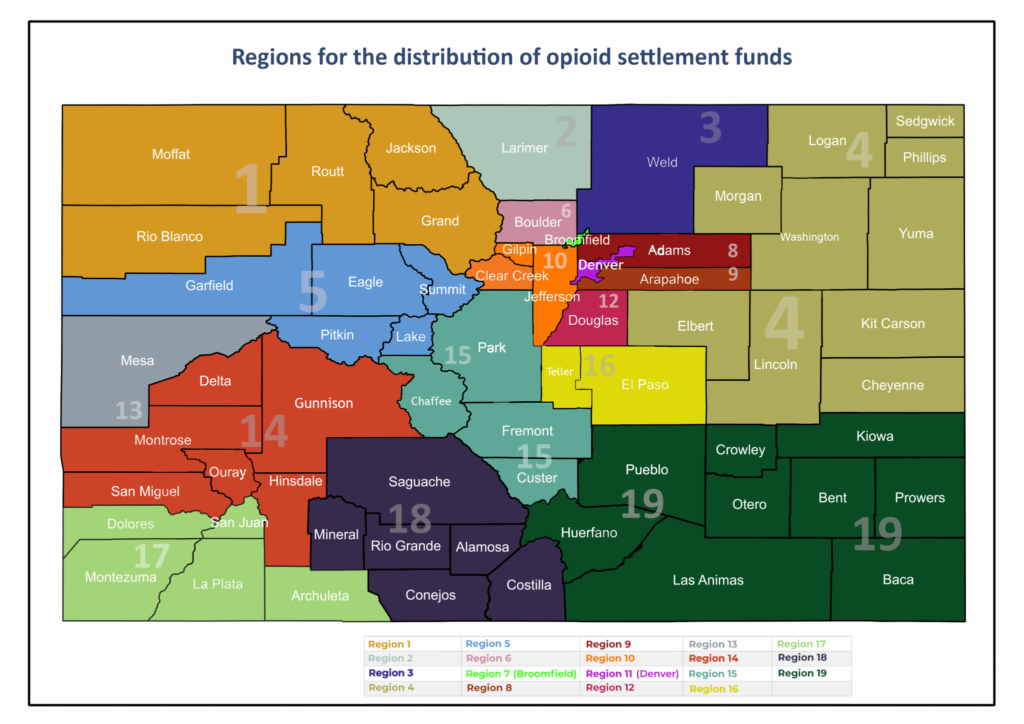
Some states do it differently. Pennsylvania considers "opioid-related hospitalizations and first responders’ administration of naloxone, an overdose reversal medication," Kaiser reports. "When that formula left 11 rural counties without 'enough money to make an impact,' the state decided each county would receive a minimum of $1 million over the 18-year settlement period, said Glenn Sterner, an assistant professor at Penn State who helped develop the state formula and co-authored a paper on it. In Colorado, pooling funds is built into the state’s model for managing opioid settlement money. The lion’s share of funds is going to 19 newly formed regions, about half of which comprise multiple counties."

Many rural communities are grateful for any financial assistance and are working creatively to make the most of what they do receive, Pattani and Bichell write. "But others worry such an approach misses an opportunity to use that money to make a difference in rural communities that have been disproportionately affected for decades."

Friday, July 29, 2022

Quick hits: Why libraries are a boon to rural areas; rural opportunity in CHIPS bill; rural LGBTQ+ Americans face greater health care barriers; latest on flooding in Kentucky

Here's a roundup of stories with rural resonance; if you do or see similar work that should be shared on The Rural Blog, email us at heather.chapman@uky.edu.

At least 16 people have died from catastrophic flooding in Eastern Kentucky, and more deaths are likely to be confirmed, Gov. Andy Beshear says. Read more here.

Many cities and small towns see a huge economic opportunity in just-passed House bill that would create incentives for domestic manufacture of computer chips. Read more here.

Libraries are a boon to rural society, and more important than ever during the pandemic, retired journalist Keith Roysdon writes for The Daily Yonder.

LGBTQ+ Americans in rural Appalachia face greater barriers to accessing health care, according to a recent survey of providers. That's partly because of many providers may not be familiar with unique LGBTQ+ health concerns, or willing or able to address them. Some patients may be reluctant to seek care because of stigma. Read more here.

In the rural West, 'self-reliance' can take a heavy toll on mental health. Read more here.

West Virginia has blocked five major financial institutions, including Goldman Sachs and JPMorgan, from doing business with the state because they have stopped supporting the coal industry, which has become less profitable in recent years. Read more here.

Friday, May 14, 2021

First-of-its-kind study links air pollution from farms, mainly livestock, estimating nearly 18,000 U.S. deaths a year

Washington Post graphic breaks out estimates produced by study; click on it to enlarge.
Air pollution from farms is responsible for 17,900 deaths per year in the United States, according to a first-of-its-kind report in the Proceedings of the National Academy of Sciences.

"Animal agriculture is the worst emitter, researchers say, responsible for 80 percent of deaths from pollution related to food production," Sarah Kaplan reports for The Washington Post. Gases associated with manure and animal feed produce small, lung-irritating particles capable of drifting hundreds of miles. These emissions now account for more annual deaths than pollution from coal power plants. Yet while pollution from power plants, factories and vehicles is restricted under the Clean Air Act, there is less regulation of air quality around farms."

Meat industry representatives questioned the study. National Pork Producers Council spokesperson Jim Monroe said in an email to the Post that the findings were "highly suspect" and that the study "irresponsibly draws conclusions based on modeling and estimates." Monroe cited a 2019 study that found significant reductions in ammonia content from pig farms, Kaplan reports.

Jason Hill, lead author of the report, said this is the first major report to link specific foods to air-pollution deaths. "While greenhouse gases cause the same amount of warming no matter where on the planet they’re produced, the health effects of air pollution are dependent on atmospheric chemistry, local weather, and the size and health of communities living nearby," Kaplan reports. "Only with advanced new air-quality models has it become possible to pinpoint the consequences of pollution produced hundreds of miles away."

Friday, April 16, 2021

Overcrowding, lack of resources spur rural-jail death spike

An inmate in the Boyd County Detention Center in Catlettsburg, Ky., died of withdrawal symptoms. (Google Maps image)
America's smallest jails have some of the highest death rates in the nation, spurred by overcrowding and lack of resources, Katie Rose Quandt reports for The Atlantic.

"Across the country, an average of roughly three people died each day in local jails of all sizes in 2016, according to the Bureau of Justice Statistics — a rate that is almost certainly an underestimate. A disproportionate number of those deaths happen in America’s smallest jails," Quandt reports. "Mortality rates were highest in jails holding a daily average of fewer than 50 people between 2000 and 2012, the last period for which BJS reported mortality by jail size; suicide rates were inversely correlated with jail size from 2000 to 2007. Small-to-midsize jails tend to have fewer resources to provide adequate mental-health and medical care, suicide prevention, and drug treatment—services that many people entering jails need. They also often have less oversight and are more overcrowded than their larger counterparts. In many ways, small institutions are the most troubling example of America’s epidemic of preventable deaths in jails—and they are also the least likely to draw public attention."

Jail deaths are almost certainly underreported, not least because many jails routinely release prisoners who are near death, said Jasmine Heiss, director of the Vera Institute of Justice’s "In Our Backyards" initiative, which studies rural incarceration trends.

Recent criminal-justice reforms have led to slow declines in the overall incarcerated population since its 2008 peak, but that's mostly been in state and federal prisons along with large urban jails. "The opposite is true, however, in the rest of the nation’s 3,134 local jails, which are operated by counties or cities and typically hold people who are awaiting trial or serving short sentences," Quandt reports. "Over the same time frame, jail populations shot up 27 percent in rural areas, and 7 percent in small-to-midsize cities."

One reason for rural jail population spikes: even overcrowded jails are increasingly taking in populations from elsewhere to make money. "Roughly 80 percent of jails around the country rented out bed space in 2013 to other counties, federal agencies like the U.S. Marshals Service and U.S. Immigration and Customs Enforcement, or state prison systems. This especially bloats jail populations in rural areas: In 2013, 46 percent of people in rural southern jails were being held for other jurisdictions," Quandt reports. "This trend has completely changed the landscape of local jailing in states like Kentucky. . . . Instead of de-carcerating, the state farms out half its prison population to county jails for $31.34 a day, leaving people serving multiyear sentences in small jails with worse access to programs, services, and health care. . . . Around the country, state departments of corrections limiting their intake during the pandemic have become yet another contributor to growth in jail populations."

Many Kentucky counties seem to be trying to replace coal-related jobs with incarceration jobs, according to Judah Schept, a professor at Eastern Kentucky University who studies rural incarceration. "You have counties becoming reliant on jail infrastructure," he told Quandt. "You have folks who live there anticipating work opportunities at jails and prisons, because coal employment is gone. And you have increasing numbers of people actually going into jail."

"Sometimes, when small counties build massive jails with the intention of housing state and federal detainees, this increased bed space can actually enable more local incarceration," Quandt reports, citing a rural sheriff's quote in a Vera Institute report: "They said, 'If you build it, they will come,' And that’s what happened. The judges knew there was room, so they threw them in jail."

Overcrowding "can mean less programming, fewer services, unsafe conditions, and more time locked down in cells. These problems coincide with other structural difficulties confronting small jails," Quandt reports. That can affect officer retention, the availability of rehabilitative programs, and health-care services.

But jails increasingly serve as first-line resources for mental health, addiction and homelessness in infrastructure-poor rural communities, according to Heiss. "In the absence of broader societal support systems, incarceration has become the catch-all solution in areas hit hard by poverty, unemployment, and the meth and opioid epidemics," she told Quandt.

A Vera Institute data analysis "found that smaller counties are less likely to have resources for programs like pretrial services and diversion programs that keep people out of jail," Quandt reports. "They also use pretrial detention at a higher rate than many jails in bigger cities." About two-thirds of the U.S. jail population is awaiting trial (many because they can't afford bail), compared to 50% before 1993. About 75% of people reported to have died in jail between 2006 and 2016 were awaiting trial.

But pretrial detention doesn't seem to keep the public safer. "A Prison Policy Initiative analysis of bail reforms around the country found that releasing more people before trial does not lead to more crime," Quandt reports. "Pretrial detention does, however, keep people in dangerous and overcrowded jails, instead of allowing them to await trial safely from home."

The story illustrates rural jail disparities with the story of Christopher Hall, a Kentuckian who died in early 2019 from withdrawal symptoms while awaiting trial in the Boyd County Detention Center. Because of previous jail deaths, the county jailer had resigned and the newly elected successor began his tenure just weeks before Hall's death. A corrections expert who analyzed the jail's logbooks said the new jailer had inherited a broken system and hadn't had time to fix the jail's problems. But, Quandt writes, "some structural problems—overcrowding by the courts, an unequal society that often uses incarceration as a solution to mental illness and addiction—cannot be fixed by any one jail or jailer."

Friday, June 19, 2020

Quick hits: PG&E pleads guilty to 84 deaths in 2018 fire

Here's a roundup of stories with rural resonance; if you do or see similar work that should be shared on The Rural Blog, email us at heather.chapman@uky.edu.

North Dakota is in an economic crunch because of pandemic fallout on oil and agriculture. That bodes ill for other less financially stable states. Read more here.

Nurse shortages in rural areas can hinder covid-19 fight. Read more here.

Murray Energy's bankruptcy still casts a shadow on coal's economic viability. Read more here.

Rural Oregon leaders consider revolt against covid-19 stay-at-home orders. Read more here.

PG&E pleads guilty to 84 felony counts of involuntary manslaughter from deaths that happened during the November 2018 Camp Fire. Read more here.

Blackjewel LLC has filed suit against its former president, claiming he transferred $34 million to a family business and a family-run subsidiary trust about six months before the company filed for bankruptcy. Read more here.

Tuesday, February 18, 2020

EPA poised to roll back mercury pollution regulation, but power sector isn't interested

The Environmental Protection Agency is about to finalize a rollback on a rule that has cut emissions of mercury and other toxins, but the power industry mostly doesn't want it. Coal executives lobbied for the change, but coal makes up a diminishing share of the energy sector. "The changes could give a boost to struggling coal companies, while hamstringing future efforts to limit mercury emissions from the nation’s power plants," Juliet Eilperin and Brady Dennis report for The Washington Post.

"Exelon, one of the nation’s largest utilities, told the EPA that its effort to change a rule that has cut emissions of mercury and other toxins is 'an action that is entirely unnecessary, unreasonable, and universally opposed by the power generation sector,'" Eilperin and Dennis report. An environmental policy manager at the company told the Post that the industry had complied with the rule long ago, and that the sector was much cleaner as a result.

"The agency plans to declare that it is not 'appropriate and necessary' for the government to limit harmful pollutants from power plants, even though every utility in America has complied with standards put in place in 2011 under President Barack Obama. While it will technically keep existing restrictions on mercury in place, it means the government would not be able to count collateral benefits — such as reducing soot and smog — when it sets limits on toxic air pollutants."

The rule, known as the Mercury and Air Toxics Standards, aims to reduce exposure to a powerful neurotoxin that can damage the brains of children and fetuses. Emissions of the neurotoxin declined 85 percent between 2006, when states began to curb mercury from coal plants, and 2016, when the MATS rule took full effect, Eilperin and Dennis report.

The Obama administration said the benefits would ultimately outweigh the costs: the industry might spend up to $9.6 billion each year to comply with the regulation, but the U.S. as a whole would save $37 billion to $90 billion by preventing deaths and illnesses. The industry ended up paying about $3 billion annually to implement the rule, but the Trump administration has said the cost-benefit analysis still doesn't justify the rule, and accused the Obama administration of using creative math to pass a burdensome regulation, Eilperin and Dennis report.

Andrew Wheeler, the current EPA Administrator under President Trump, insinuated that the rule's real reason was to hurt the coal industry in a recent interview. "The 2011 requirements did more to hasten the closure of coal-fired power plants than any other regulation adopted under Obama," Eilperin and Dennis report. "Facing the first-ever limits on these pollutants, companies across the country chose to switch to natural gas or renewable energy rather than invest in costly new pollution controls.

Wednesday, January 29, 2020

TVA must do more to generate clean energy, write energy analyst and former environmental reporter

As part of his "Green New Deal" plan, Democratic presidential primary candidate Bernie Sanders wants the Tennessee Valley Authority to shut down all its fossil fuel-burning plants and generate electricity solely from renewable sources. TVA currently operates six coal-fired power plants, 17 natural gas plants, and one diesel generator site. The rest of its power comes from nuclear, hydroelectric, solar, wind and biogas.

That may seem fanciful, but two writers say in The New York Times that it's not a bad idea for TVA focus on clean energy generation. Justin Gillis is a former Times environmental reporter; Jameson McBride is an energy analyst at the Breakthrough Institute, an environmental research center.

TVA, which sells power across parts of seven states, has a history of polluting waterways and property by improperly storing the toxic coal ash generated by its coal-fired power plants, they write: "In December 2008, an immense spill of coal ash at a TVA plant in Kingston, Tenn., polluted a nearby river and caused millions of dollars of property damage. The TVA had failed to carry out elementary safety measures, and the lead cleanup contractor was found negligent in court. Many workers on the cleanup have fallen ill and close to 40 have died; how much responsibility the contractor bears for the deaths is still being contested in court."

Though TVA is moving away from coal, and generates the lion's share of its electricity from nuclear power, Gillis and McBride write that the federal utility is moving too slowly to build more wind and solar generators. The modest solar buildout the agency's has adopted will result in higher electric bills for TVA customers than those who buy from other producers, they believe.

The biggest problem is that TVA has no central boss to drive change; just board members appointed by the president. "So the agency, long dominated by a conservative engineering mind-set, has gotten little pressure from Washington to move faster on the energy transition. But it is starting to get pressure from the other direction: cities that buy power wholesale and resell it to their citizens. Memphis, for instance, is considering pulling out of the TVA system and cutting its own deals for clean power," Gillis and McBride write.

TVA already has some of the lowest emissions in the country, but it could achieve much more in short order if it wanted to, they write: "The backwardness of the TVA on this issue is not just a national embarrassment; it is a betrayal of the agency’s own progressive legacy as one of the signature creations of the New Deal. The next president, whether Mr. Sanders or somebody else, needs to shake up the TVA board and demand that the agency become a leader, not a laggard, in battling the climate crisis."

Thursday, January 02, 2020

Trump administration stops probing most bird deaths, even discourages protective measures and death reporting

Dozens of bird-preservation efforts have been dropped since Trump administration officials changed enforcement policy for the Migratory Bird Treaty Act of 1918. They called it a clarification, but it has had dire consequences for birds, their advocates say.

"Across the country, birds have been killed and nests destroyed by oil spills, construction crews and chemical contamination, all with no response from the federal government, according to emails, memos and other documents," Lisa Friedman reports for The New York Times. "Not only has the administration stopped investigating most bird deaths, the documents show, it has discouraged local governments and businesses from taking precautionary measures to protect birds."

Essentially, the update ends legal consequences for businesses or other entities that kill birds, as long as the deaths were accidental. "In nearly two dozen incidents across 15 states, internal conversations among Fish and Wildlife Service officers indicate that, short of going out to shoot birds, activities in which birds die no longer merit action," Friedman reports. "In some cases the Trump administration has even discouraged local governments and businesses from taking relatively simple steps to protect birds, like reporting fatalities when they are found."

The Western Energy Alliance, an oil-and-gas trade association, put a bird-law fix at the top of a wish list sent to then-Interior Secretary Ryan Zinke. WEA president Kathleen Sgamma said the Obama administration had "weaponized" the law to hurt the industry. Six months after WEA's memo, the Trump administration announced the change.

FWS spokesman Gavin Shire "said in a statement that other federal laws like the Endangered Species Act remain on the books. The Trump administration, he said, 'will continue to work cooperatively with our industry partners to minimize impacts on migratory birds,'" Friedman reports. Some state and local governments and companies are still acting voluntarily to protect birds. 

"Habitat loss and pesticide exposure already have brought on widespread bird-species declines. The number of adult breeding birds in the United States and Canada has plummeted by 2.9 billion since 1970," Friedman reports.

"Migratory birds are important ecological and economic drivers," Brittany Patterson reports for Ohio Valley ReSource, a public-radio consortium. "Each year, birders spend an estimated $41 billion on trips and equipment. Birds are the proverbial 'canary in the coal mine,' and also literal ones. As ecological indicator species they inform us when environmental conditions have changed."

Friday, June 21, 2019

Clean Power Plan replacement a boon to coal-fired plants

The Trump administration has finalized a replacement for President Obama's Clean Power Plan that aims to help the coal industry by easing emissions restrictions on coal-fired power plants. Environmental Protection Agency chief Andrew Wheeler signed the measure Wednesday, and said he expects more coal plants to open as a result. "But one state, New York, immediately said it would go to court to challenge the action, and more lawsuits are likely," Ellen Knickmeyer reports for the Associated Press.

Coal state lawmakers and industry representatives applauded the move because they believe federal regulation, not market forces, are to blame for the coal industry's decline, Knickmeyer reports.

The move is one of the biggest environmental regulatory rollbacks done by the administration, and comes as the EPA's own scientists warn that the air pollution triggered by the rule will result in the deaths of 300 to 1,500 people each year by 2030, Knickmeyer reports. EPA data also shows that, after decades of improvement, air pollution in the U.S. has gotten noticeably worse since President Trump took office, Seth Borenstein and Nicky Forster report for the AP.

Friday, May 24, 2019

Study points the finger at rock dust as likely cause of increased black-lung disease in Appalachian coal miners

"New mining methods that churn up silica-laden rock are likely responsible for the surge of black-lung disease that has afflicted hundreds of miners across Central Appalachia in recent years, according to new research presented at the American Thoratic Society’s annual meeting this week," Will Wright reports for the Lexington Herald-Leader.

That's nothing new to people familiar with the reporting of Howard Berkes, now retired from NPR, but the study is the fclosest thing yet to scientific confirmation of the phenomenon. Robert Cohen, co-director of the Black Lung Center of Excellence, led the research.

Black-lung disease is caused by inhaling dust created by mining and transporting coal. The dust once came mainly from coal, but silica dust from cutting through the rock above and below coal seams is now the leading cause of the disease, because the thick seams have been mined. Mining thinner seams produces a larger ratio of rock dust to coal dust.

In 2014 the U.S. Mine Safety and Health Administration required mine operators to provide better dust sampling and allow less dust, but "dust" encompassed both coal and silica. Cohen said his research confirms that current regulations are inadequate and poorly enforced. "He also advocated that federal regulators should give silica its own regulatory designation, rather than rolling it into the existing coal-dust rule," Wright reports.

Cohen's project consisted of two studies. "The first examined tissue samples from 376 dead coal miners who participated in the National Coal Workers Autopsy Study. If found that the proportion of black lung primarily caused by silica increased from 24 percent before 1990 to 40 percent after 1990. Another 30 percent of cases were caused by a mix of coal dust and silica dust," Wright reports. 

The second study examined cause of death data for more than 34,000 miners and found that a higher percentage are dying from black lung than previous generations. "Black lung has contributed to the deaths of more than 76,000 miners since 1968, and while just 5 percent of miners had black lung in the late 1990s, that rate jumped to more than 20 percent in 2017, according to a National Institute for Occupational Safety and Health study published last year." Cohen's research also found that more younger miners are affected by the disease these days.

Tuesday, August 21, 2018

Trump replacement for Clean Power Plan rolls back anti-coal rules, at its predicted price of more premature deaths

President Trump announced in West Virginia today the details of his new "Affordable Clean Energy" rule, which replaces President Obama's "Clean Power Plan." The new rule would help the coal industry by giving states more power to achieve lower emissions goals, but acknowledges that it would lead to more health problems and deaths.

Under ACE, states have three years to develop their own plans to reduce emissions to federal target levels, which are much less ambitious than those in Obama's CPP. It also allows states to establish emissions standards for coal-fired power plants. The Environmental Protection Agency "estimates that the measure will affect more than 300 U.S. plants, providing companies with an incentive to keep coal plants in operation rather than replacing them with cleaner natural gas or renewable energy projects," Juliet Eilperin reports for The Washington Post.

"Trump administration officials say the Clean Power Plan, in its effort to reduce carbon emissions, illegally tried to force electric utilities to use greener energy sources," Lisa Friedman reports for The New York Times. "The new plan, they said, would achieve many of the benefits sought by the Obama administration but in a way that is legal and allows states greater flexibility." The plan would take effect after a 60-day comment period.

EPA's impact analysis acknowledges that the plan will allow more emissions of carbon dioxide and other pollutants than under the Obama plan. In the regulatory scenario that it deems most likely, EPA "predicts its plan will see between 470 and 1,400 premature deaths annually by 2030 because of increased rates of microscopic airborne particulates . . . which are dangerous because of their link to heart and lung disease as well as their ability to trigger chronic problems like asthma and bronchitis," Friedman reports. "The Trump administration analysis finds that own its plan would see 48,000 new cases of exacerbated asthma and at least 21,000 new missed days of school annually by 2030 because those pollutants would increase in the atmosphere rather than decrease."

The premature mortality estimates come from a Harvard University study that "formed the backbone of federal air pollution regulations," but EPA is considering a separate rule that would restrict the use of studies for which raw data, including identifying personal details, can't be published. "Scientists overwhelmingly oppose the move, pointing out that participants in long-term health studies typically agree to take part only if their personal health information won’t be made public," Friedman notes. Because the Harvard study and many others are based on confidential health records, the EPA would not have to use them and in future studies would be able to claim a far lower estimated number of premature deaths from the energy plan, Friedman reports.

Wednesday, March 14, 2018

Study: 'Deaths of despair' on the rise across the country

"Death due to alcohol, drugs, suicide, and interpersonal violence – sometimes characterized as 'deaths of despair' are on the rise in the U.S., particularly among white males, reversing a centuries-long improvement in life expectancy," F. Perry Wilson reports for MedPage Today.

In the most detailed study yet on the topic, published yesterday in the Journal of the American Medical Association, researchers from the University of Washington found that these deaths aren't distributed evenly around the country. Though overdose deaths are not disproportionately rural overall, a trio of maps in the article shows that Appalachian coal country is in particularly bad shape, with more OD deaths per capita than almost anywhere else in the country. The mortality rate has increased fifty-fold there and in a few other hotspots across the country. And the amount of opioids prescribed per person is extremely high.

Self-harm is much more prevalent in Western states, but has increased greatly since 1980 in not just Western states, but in other Midwestern rural areas and the Dakotas. Deaths due to interpersonal violence are concentrated in the South, especially in the Mississippi Delta region, the Black Belt, rural Alaska, and around Indian reservations in the Dakotas and the Southwest. The greatest increase in interpersonal violence deaths has been in the Mississippi Delta, but also in Fremont County, Wyoming, on which sits most of the Wind River Indian Reservation. The reservation has been noted in the past for having a high suicide and crime rate.

In general the high rate of variation in deaths of despair suggests that different factors are at play in different areas, which means that a one-size-fits-all approach to fixing it would be unwise, Perry writes.
Overdose deaths per 100,000 people (Washington University map; click on the image to enlarge it)

Friday, January 05, 2018

Coal deaths surged in 2017, one year after record low

Coal mining deaths surged to 15 deaths in 2017, after a historical low of eight deaths in 2016. Eight of this year's deaths were in West Virginia, two were in Kentucky, and one each occurred in Alabama, Colorado, Montana, Pennsylvania and Wyoming. West Virginia has had the most coal mining deaths of any state in six of the past eight years, including 2010, when 29 miners died in an explosion at the Upper Big Branch mine.

"Eight coal mining deaths this year involved hauling vehicles, and two others involved machinery. None were attributed to an explosion of gas or dust, which was to blame for the Upper Big Branch disaster," the Associated Press reports. And according to data from the Mine Safety and Health Administration, "seven of the eight U.S. coal mining fatalities in the first half of 2017 involved miners with one year or less experience at the mine, and six involved miners with one year or less experience on the job. In June, MSHA announced an initiative focusing on less experienced miners, including improved mine operators' training programs."

But as retired miner Gary Bentley pointed out, the initiative may have limited impact because some mines may be deliberately encouraging unsafe practices to save money, and MSHA officials sent to observe and train new miners can't cite mines for safety violations they see.

Overall coal mining fatalities are far below where they used to be, clocking in under 20 for the fourth straight year. That's compared to 1966, when there were 233 deaths, and 100 years ago when there were 2,226 deaths. The MHSA says the lower numbers are due to the far fewer coal mining jobs available and tougher mining safety rule enforcement. It's possible that the uptick in deaths could be related to the temporary bump in coal production in 2017.

"According to the Energy Information Administration's weekly estimates, U.S. coal output increased 8.9 percent in the 52 weeks ending Dec. 23, the latest available. Production in West Virginia rose 16 percent, including 25 percent in coal-rich southern West Virginia. Wyoming, the top coal-producing state, saw a 10.7 percent increase," The AP reports. "The U.S. had about 92,000 working miners in 2011, compared with about 52,000 in 2016, the lowest figure since the EIA began collecting data in 1978. The 2017 numbers aren't yet available."

Wednesday, December 27, 2017

Coal's decline made Wyo. and W.Va. top percentage losers in population in 2017; Idaho had most gain

The decline of the coal industry made the top two coal-producing states, Wyoming and West Virginia, lose more of their population this year than any other state, the Bureau of the Census estimates.

"Those two, and others in the lower echelon, have something in common: resource dependence," notes Andew Van Dam of The Washington Post. "That helps explain why the state went from the fourth-fastest growing in 2012 (D.C. was first that year) to rock bottom in 2017." Wyoming's loss was entirely from its residents moving out; its births outnumbered its deaths; that was not the case in West Virginia, which lost its status as No. 1 coal state to Wyoming decades ago.

Both states suffer from the resource curse, "in which natural-resource wealth actually harms developing countries because it crowds out important long-term investments in infrastructure, education and industrialization," Van Dam writes. "Resource-dependent states may see a population recovery in 2018 thanks to a partial recovery in energy prices, but that does nothing to break their cycle of dependence on global commodity markets." He contrasts Wyoming with its neighbor, Idaho, which was the fastest-growing state this year, followed by Nevada, Utah and Washington.

The story has three good charts, one showing the growth or loss rankings of each state by decade since 1900; another with the percentages of state gross domestic product in 2016 that came from mining, including oil and gas (20.29 percent in Wyoming, 11.52 percent in West Virginia); and the sources of population growth or loss: migration from other states, migration from abroad, and net births and deaths (indicated by different colors). Here's an emendated screenshot of the bottom of that chart, showing the states that lost population (as shown by the horizontal black lines to the left of the chart's vertical axis; Wyoming's line shows that it lost almost 1 percent of its population this year):
Here's a screenshot of the top three-fifths of the first chart, with the states ranked by this year's estimated growth:

Sunday, September 03, 2017

Ex-coal executive nominated to head MSHA

President Trump's pick to head the federal mine-safety agency is David Zatezalo, who "repeatedly clashed with federal regulators when the Obama administration Labor Department tried to step up industry-wide enforcement in the wake of the worst U.S. coal mining disaster in a generation," Ken Ward Jr. reports for the Charleston Gazette-Mail.

The White House announced a long list of appointments Friday night that included Zatezalo to be assistant secretary of labor for mine safety and health, subject to Senate confirmation, which would make him the boss of the Mine Safety and Health Administration. It said Zatezalo retired in 2014 as chairman of Rhino Resources, where he had been president, CEO and chief operating officer.

In 2010 and 2011, "The company had a series of run-ins with MSHA over safety and health conditions at mines in West Virginia and Kentucky" when the Obama administration was strengthening enforcement following 29 deaths at a West Virginia mine. MSHA accused Rhino of a pattern of violations, "a long-unused MSHA tool for cracking down on repeat violators of safety and health standards," Ward notes. "Rhino improved and MSHA backed off, but the company’s safety performance quickly deteriorated again, prompting a second pattern of violations letter."

Meanwhile, MSHA blamed a death at a Rhino mine in Kentucky on the company’s inadequate efforts to control mine walls, and it paid $44,500 in fines. Earlier in 2011, at another Rhino mine in Kentucky, "MSHA had taken the unusual action of seeking a federal court injunction against the company when it discovered mine employees giving advance notice of an agency inspection to miners working underground," Ward writes. A judge granted a restraining order.

United Mine Workers of America President Cecil Roberts said through a spokesman, “It is my hope that Mr. Zatezalo will take the tough stance on enforcement that is needed to reign in the rising level of serious injuries and fatalities. We look forward to meeting with him and sharing ideas on how to best protect the nation’s miners and reduce the number of fatalities,” which have been rising.

The White House release said, "Zatezalo began his mining career in 1974 with Consolidation Coal Co. [now Consol Energy] as a UMWA laborer, became a foreman and subsequently general superintendent for Southern Ohio Coal Co. and General Manager of American Electric Power’s Windsor Coal Co. He later rose to be vice-president of operations of AEP’s Appalachian mining operations. Mr. Zatezalo also worked in Australia for Broken Hill Proprietary, Ltd. as a general mine manager. Mr. Zatezalo is a mining engineering graduate from West Virginia University."

Friday, August 04, 2017

Death rate in coal mines jumps; feds blame new miners; old miner points to greed and politics

"Deaths in U.S. coal mines this year have surged ahead of last year's, and federal safety officials say workers who are new to a mine have been especially vulnerable to fatal accidents," Dylan Lovan reports for The Associated Press. "But the nation's coal miner's union says the mine safety agency isn't taking the right approach to fixing the problem."

In 2015, top MSHA officials met with miners in the Gibson
North mine at Princeton, Ind. (AP photo by Timothy Easley)
Ten coal miners died in mines in the first seven months of this year, but only eight died during all of 2016. The Mine Safety and Health Administration says it is "sending officials to observe and train miners new to a particular mine on safer working habits," Lovan reports, but the United Mine Workers of America points out that inspectors on such visits can't cite mines for violations they see. "To take away the inspector's right to issue a violation takes away the one and only enforcement power the inspector and the agency has," UMWA President Cecil Roberts said in recent letter to agency, part of the Department of Labor.

The uptick in fatalities was reported July 31 by Gary Bentley, a retired miner, in The Daily Yonder. Relatively few miners have written about their experiences underground, so Bentley's occasional contributions to the Yonder give valuable insight. He writes:
   As an underground miner, I do know that miners often put themselves at risk with no pressure or persuasion from the company. I have done it more times than I can count, but I was lucky enough to not suffer any serious injuries. I also know that as market values change and profits begin to dwindle, many companies become more lax with safety initiatives and often have to reduce the amount of preventative maintenance done on equipment. All of that does result in an increased likelihood for accidents. I also know that many times mine managers would work out deals with state and federal inspectors to avoid fines and tickets, and sometimes to completely avoid a safety inspection at all. The industry is corrupt from the top down, and it’s no news for anyone who has worked in it.
   The problem now is our political climate. We are seeing a steep decline in the coal market values and demand. There are companies cutting benefits to miners and cutting cost wherever possible to continue earning a profit. Now there are politicians and lobbyist groups working to cut environmental and safety regulations in an attempt to keep the coal companies in business, making a profit, and, in turn, keeping that black gold flowing into their political campaigns and pockets.
Tim Loh of Bloomberg has a story about the uptick, with an example of a Kentucky miner who died at a mine that was found to have several violations. With the story is this chart (click to enlarge):