Showing posts with label predators. Show all posts

Tuesday, October 08, 2024

Flora & Fauna: Flightless eagle mystery solved; beware of black-legged ticks; secret lives of plants; Pesto the Penguin

Bald eagle that was captured and believed to be ill. (Photo by
Wilson's Creek National Battlefield via The Guardian)
People thought this raptor was wounded because he couldn't fly. As luck would have it, this bird was not ill, but he had gobbled up his Thanksgiving dinner early. "Wildlife officials in Missouri rescued what they thought was an injured and flightless bald eagle, only to discover it had gorged itself on a roadkill raccoon and was 'too fat to fly,'" reports Richard Luscombe of The Guardian. "The eagle was released, completely healthy and full of energy, after a short period of 'rehabilitation' at the zoo’s wildlife hospital."
 
Among stretches of corn and beans in Midwestern Iowa, swaths of pollinator-loving plants and flowers grow. These "prairie strips" were sown by farmers and "they are part of a growing movement to reduce the environmental harms of farming and help draw down greenhouse gas emissions," reports Cara Buckley of The New York Times. "While giving fauna a much-needed boost and helping to restore the land. . . .The aim is to reduce nutrient runoff from cropland, and help birds and bees."

Black-legged ticks are small, wingless, bloodsucking arthropods that spread diseases, such as lyme and babesiosis, by latching onto wildlife or human hosts. "Lyme is the most commonly reported illness spread by ticks," reports Kevin Loria of The Washington Post. "But it is far from the only one: The black-legged ticks that carry Lyme can spread at least six different illnesses. Babesiosis is a parasitic illness, spread by Babesia microti parasites, which can live inside black-legged ticks. . . . It can be serious, especially for people who are immunocompromised."
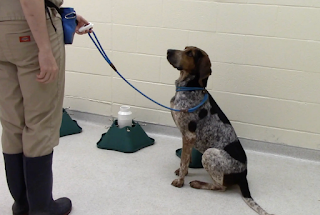
Runnels the hound dog, reporting for duty.
(Texas A&M photo via Ambrook Research)
Livestock can die from bovine respiratory disease, which is notoriously difficult to detect. To help farmers avoid the pain and expense of losing cattle, scientists are exploring how canines can help identify BRD. "At Texas A&M University, a cross-discipline pilot study set out to discover whether working dogs, with their superior olfactory senses, could be used as early BRD detectors," reports Jesse Hirsch of Ambrook Research. "After many trials. . . researchers got up to 82% accuracy with one dog, and 65% with the other. But. . . the dogs didn’t fare nearly as well when given only two chances to distinguish between a BRD-infected swab and a clean one." 

Kate McCulloh
Flora have secret lives of their own. Although they can't ambulate, they find ways to move, morph and adapt to everything humans and Mother Nature "hurl their way," writes Kate McCulloh, an associate professor of botany at the University of Wisconsin. "Their complex physiology responds to each of these threats in often quite subtle ways. The solutions that plants employ differ among species, varying with the climate in which those species evolved."

Colorado mountain lions should be protected from hunts, writes Dan Ashe, a former director of the U.S. Fish and Wildlife Service, in his opinion for Writers on the Range. "Emerging science tells us that these apex predators aren’t the enemy, they’re allies. They are likely providing an important ecosystem service in checking the spread of chronic wasting disease, CWD, an existential threat to healthy deer and elk populations, by targeting animals weakened by the disease." Mountain lions should be left alone to "do their job as predators."
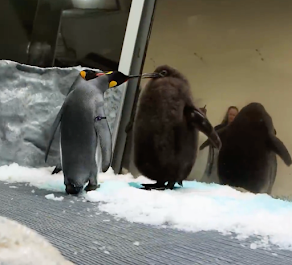
Pesto and his "short" parents. (Sea Life
Melbourne Aquarium photo via CNN News)

Taller and decidedly fluffier than his parents, "Pesto" the baby king penguin is adorable and famous. "Photos of Pesto – who is 90 centimeters tall (about three feet) – towering over his parents have gone viral online. He has also provided opportunities for people to learn more about penguins," reports Lilit Marcus of CNN News. "Although most people recognize the adult black-and-white birds, king penguins are born covered in brown feathers. Once they learn how to swim, they will begin shedding those feathers – a process known as fledging. . . . Pesto’s biological father, Blake, is one of the aquarium’s oldest and largest penguins. But he’s being raised by Tango and Hudson, younger penguins whom Sea Life keepers wanted to try out as parents."

Wednesday, October 25, 2023

The return of the mighty grizzly has Westerners seeking guardians and defense strategies

A stuffed cub and female grizzly bear at a Montana Fish and
Wildlife station. (Photo by John Stember, The New York Times)
In states where the grizzly bear population is increasing, residents are finding strategies to cope with the fierce predator's return. "Grizzly bears are a daily concern for residents in the northern Rockies. The bears no longer live only in the remote high country, in parks, wilderness and surrounding areas," reports Jim Robbins of The New York Times. "Instead, they have increasingly moved into the valleys and prairies to reclaim portions of their old realm."

Known as rugged livestock protectors, Anatolian shepherds
have been adopted by many Westerners. (AKC photo)
One option Westerners have turned to is owning Anatolian shepherds, a breed known for its watchful, protective nature paired with a muscular, agile body, which makes it a formidable match for any predator -- even grizzlies. Natalie Thurman, owner of Apex Anatolians, "markets the dogs primarily to people who raise livestock, [but] she also sells them to people with children," Robbins writes. Thurman told him: "We have gray wolves, grizzly and black bears here. . . . We just had a grizzly bear in the creek a hundred yards from here. . . .[Anatolian owners] take them on hikes, they take them camping. . . .They tell you when a bear is coming. I can replace livestock, but you can't replace a human child."

Active grizzly populations can be deadly and destructive. "They wander onto golf courses, break into homes, stalk chicken coops and raid cornfields," Robbins explains. "Montana and Wyoming are home to about 2,100 grizzlies, by far the most in the lower 48 states, with a much smaller population in Idaho."

In general, black bears avoid people. Grizzlies are
another story. (Photo by Roadsendnaturalist)
Black bears are also common in the West, but their response to humans is different than grizzlies. "They are generally bigger and more defensive, especially when surprised or when their cubs seem threatened," Robbins adds. "A black bear will usually scramble off, but a grizzly will more often stand its ground."

In response to the added threat of grizzly encounters, "Sales of bear spray, which contains capsaicin, the chemical that gives peppers their spicy heat, are booming," Robbins reports. "Many hikers, picnickers, ranchers and hunters — just about anyone who spends time outdoors in bear habitats — pack bear spray these days." Awareness of bear activity is also a defense. "Fall is when the possibility of conflicts peaks. Bears become especially ravenous — a period called hyperphagia — when they are driven to eat far more than they do the rest of the year, to bulk up fat reserves to live on during several months of hibernation."

"And so a grand experiment is underway to manage the human world in such a way that an apex predator and people in a large urban and suburban complex surrounded by large swaths of public land can coexist with few conflicts," Robbins writes. "The future of the bear is at stake, experts say. Although there is a lot of support for bears in the region, attacks on livestock and people can undermine it."

Wednesday, January 12, 2022

If you see a snowy owl, that doesn't mean it's starving

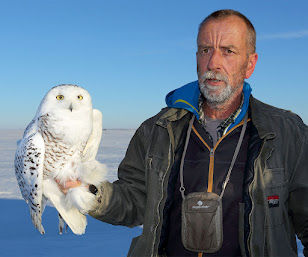
Martin Stoffel of Saskatchewan is one of two owl banders 
who provided data for the research. (Photo by Daniel Dupont)
You may see a snowy owl this month. Given the weather, you may think it's starving. It's probably not, according to research by according to University of Sas­katchewan scientist Karen Wiebe.

Many snowy owls spend winter in southern Canada and the northern U.S. "They pop up in odd places—hunkering down on haystacks in farm fields, just off the runways at airports, atop light poles in grocery store parking lots—to the de­light of birders and Harry Potter fans," writes Erica Cirino of All About Birds. "It’s also common for some people to feel anxiety over the snowies, believing them to be hungry vagrants." For example, a TV station in Michi­gan’s Upper Peninsula "re­ported that the owls’ southern travels were 'linked to food supply' and that 'Snowy owls often arrive in Michigan weakened and starving.' That first statement is often true, but the second is generally not true."

Wiebe and graduate student Alexander Chang published research in August that showed "most snowy owls wintering in southern Canada ap­peared to be doing just fine," Cirino reports. "Indeed, many of the owls actually put on weight over the winter by increasing their subcutaneous fat stores (fat that accumulates under the skin on birds’ chests and beneath their wings and is used for both insula­tion and energy)." Other studies have found likewise. At Logan International Airport in Boston, Norman Smith of Massachusetts Audubon says he’s banded more than 700 snowies since 1981. He has not experienced a single year where hatch-year owls have showed signs of starvation due to lack of food."

All About Birds is a publication of the Cornell Lab of Ornithology.

Friday, May 28, 2021

Black vultures bedevil farmers, but are protected by treaty, so farmers are supposed to get permits to kill them

Vultures surrounded a cow with a newborn calf in West Kentucky. They were chased off in time. (Photo via Farmer's Pride)

Though black vultures play an important role in the food chain as scavengers, they’re also predators, and bedevil livestock producers by killing or maiming healthy animals. Laws intended to protect birds are complicating the situation, Toni Riley reports for The Farmer’s Pride in Kentucky:

Bourbon County farmer Cyndi Steele found she had to apply for a permit to allow her to kill more vultures than the law normally allows. Vultures are protected by the international Migratory Bird Treaty Act, but in 2015 Kentucky launched a pilot program that allowed each farmers to get a permit to dispatch five vultures, in order to protect their livestock. The state caps total allowed kills at 1,500.

"Steele said a representative of the federal agency told her to stay home and protect her livestock. Producers told her to use the common practice of 'Shoot, shovel and shut up.' The problem finally resolved itself when she purchased new guard dogs, a solution she said was expensive but effective," Riley reports. "The purchase made sense, however, when she compared the cost to losing $10,000 worth of show and breeding animals over a six-week period."

Riley notes, "The black vultures . . . are not the same birds commonly known as turkey vultures. Black vultures are pack hunters and like a fresh kill, while the turkey vulture is content with carrion or a carcass. The black vulture is smaller and stockier and has a black head and white tips on its wings. In-flight it flaps more and doesn’t glide like the larger turkey vulture with its longer wingspan."

The U.S. Fish and Wildlife Service has a program offering permits for killing black vultures. It began in 2015, "with Kentucky being allocated 350 'takes,' with five per producer," Riley reports. "The number of individual takes had to be quickly amended to three because the number of permit requests was great. Since then, the number of takes allowed in Kentucky has increased to 1,500."

Tuesday, November 17, 2020

Wolves may help curb chronic wasting disease among deer through the 'predator cleansing effect'

A wolf near a hot spring in Yellowstone National Park in Wyoming
(Associated Press photo by Jacob W. Frank of the National Park Service)

Chronic wasting disease is an increasing threat to deer, elk and moose, but gray wolves in Yellowstone National Park (and possibly elsewhere) may be a valuable tool in helping slow its spread, according to preliminary data from a research project.

"Researchers are studying what is known as the predator cleansing effect, which occurs when a predator sustains the health of a prey population by killing the sickest animals," Jim Robbins reports for The New York Times. "If the idea holds, it could mean that wolves have a role to play in limiting the spread of chronic wasting disease, which is infecting deer and similar animals across the country and around the world. Experts fear that it could one day jump to humans."

The possible benefit to humans is something to keep in mind as the federal and state governments consider protections for wolves. In the recent election, Coloradans approved restoration of gray wolves to public lands. Meanwhile, the Interior Department issued a final rule in October removing Endangered Species Act protections from gray wolves.

Friday, October 30, 2020

Interior Department issues final rule removing Endangered Species Act protections from gray wolves, numbering 6,000

A gray wolf and pups in California's Lassen National Forest (U.S. Forest Service trail camera photo via Washington Post)

"The Trump administration announced Thursday that it is stripping gray wolves of their Endangered Species Act protections in the Lower 48 states, ignoring an outcry from conservation groups and scientists who say the animals will be slaughtered as a result and might not survive," Darryl Fears reports for The Washington Post. "Under a final rule expected to go into effect early next week . . . state wildlife agencies will assume control of managing an estimated 6,000 wolves, mostly in three Midwestern states — Michigan, Wisconsin and Minnesota." An estimated 1,800 are in other states.

“After more than 45 years as a listed species, the gray wolf has exceeded all conservation goals for recovery,” Interior Secretary David Bernhardt said in announcing the decision by the Fish and Wildlife Service. Fears reports, "The population is up from 1,000 when gray wolves were listed as endangered starting in 1967, officials said. But their population is still so depleted that thousands of acres of historical wolf habitat in Utah, Colorado and Maine is uninhabited by any wolves, conservationists said."

This is "the second time in the last decade that federal wildlife officials have tried to remove gray wolves from the endangered species list, where they say the animals no longer belong now that they’re thriving in the wild," notes Anna Phillips of the Los Angeles Times. "Like the previous attempt, which took place under the Obama administration, this latest effort is expected to face legal challenges."