Showing posts with label privacy. Show all posts

Friday, May 08, 2026

Quick hits: No.1 favorite ice cream; ousting rogue drones; big find by NASA's Curiosity Rover; some good news

Farm Journal graphic, from IDFA National Ice Cream & Frozen Novelty Trends Survey

It's dark and rich and back in the top spot. "Chocolate is back at No. 1 among U.S. ice cream flavors, with butter pecan gaining ground and richer options continuing to rise in popularity, according to a new survey," reports Taylor Leach of Farm Journal. "After briefly ceding the No. 1 spot to vanilla in 2024, chocolate has reclaimed the lead in 2026." Michael Dykes, the International Dairy Foods Association president, told Leach, "Americans’ love for ice cream is as strong as ever." 

The Conversation graph, from Energy Information Administration data
After weeks of surging gasoline prices with no end in sight, some Americans might be wondering what all goes into the cost of a gallon of gas. Robert I. Harris, an energy economist, breaks down gas prices for The Conversation. "The price of a retail gallon of gas is the sum of four things: the cost of crude oil, refining, distribution and marketing, and taxes. . . . In nationwide figures from January 2026, crude oil accounted for about 51% of the pump price, refining roughly 20%, distribution and marketing about 11% and taxes about 18%." Harris adds that since crude oil is the biggest component of gasoline, when its price spikes on the global market, gas prices go up. 

Indiana farmers didn't appreciate drones hovering over
their livestock. (Photo by B. Dittrich, Unsplash)
In rural Indiana, some farming families are "leaning on the law" to keep unwanted drones off their lands, reports Greg Weaver of Indiana Capital Chronicle. "Hoosiers in rural Indiana say drones are unlawfully tracking deer for poachers, inexplicably flying around chicken coops, and increasingly making people uneasy." Although many Indiana farmers considered shooting down the snooping drones, they learned that wasn't legal. "So they’ve found other ways to combat the rascals. . . . Farmers fearful that drones might be spreading disease among livestock recently persuaded the Indiana General Assembly to pass a law that prohibits the devices from being used to harm or harass farm animals."

When it comes to serving up energy for hungry grids in rural Virginia, sometimes smaller is better. "The Blue Ridge Power Agency, which serves a string of nonprofit utilities in central and western Virginia, is set to go live this summer with a collection of five batteries of about 5 megawatts each," reports Elizabeth Ouzts of Canary Media. By comparison, larger batteries are typically at least 10 megawatts; however, both sizes aim to store energy when it's less expensive and plentiful. Blue Ridge Power's new batteries will "help two rural electric co-ops and the city of Salem’s utility save money" by releasing battery-stored energy "when high demand on the grid spikes prices." Unlike their larger cousins, smaller batteries are cheaper and faster to build.

NASA's Curiousity Rover spends its time exploring Mars and 
sending information back to Earthlings. (NASA image)
It's hard to be more remote than exploring for signs of life on Mars, which is what the Curiosity Rover spends its time doing. "New research published in Nature Communications details Curiosity’s latest find — never-before-seen organic compounds, including one with a structure similar to DNA precursors," reports Jake Currie for Nautilus. NASA geologist Amy Williams told Nautilus, "The same stuff that rained down on Mars from meteorites is what rained down on Earth, and it probably provided the building blocks for life as we know it on our planet." To send all those compounds back to Earth, Curiosity had to conduct a full orchestra of experiments. The Curiosity also goes by "the little robotic chemist that could."

Suicide deaths among younger Americans dipped by 11% from earlier projections. 
(Graph by Vishal R. Patel, MD,  Michael Liu, MD,  and Anupam B. Jena, MD)

And now, some really good news: "The rate of suicides among young people in the United States dropped 11% below projections, decreasing most sharply in states with a higher volume of answered 988 calls, a new study has found, reports Ellen Barry of The New York Times. The study's results, published in a research letter in The Journal of the American Medical Association (JAMA), found that 4,372 more adolescents and young adults, ages 15 to 34, are alive today than previously projected. The study's data suggests that the federal government’s 988 suicide prevention hotline rollout, which launched in 2022, is having a positive impact among younger Americans.

Thursday, October 19, 2023

Government officials have 'unqualified access to private land;' hunters sue to change Open Fields doctrine

The Open Fields doctrine has allowed government officials access
to private land. (Photo by Institute for Justice via Farm Journal)

Sometimes private land isn't private, and in states such as Pennsylvania, the question, "How much power does the government claim on private land?" is answered by a court ruling, reports Chris Bennett of Farm Journal. On Sept. 29, a "court ruled against two hunting clubs in their lawsuit accusing the Pennsylvania Game Commission of private property rights violations. . . . In its ruling, the Commonwealth Court of Pennsylvania noted the government's absolute power to 'roam private land without consent, warrants, or probable cause.'"

The hunting clubs, Pitch Pine and Punxsutawney sued PGC "after game wardens consistently entered club lands without permission or warrant, and secretly monitored club members, including photo collection via installation of a hidden game camera," Bennett writes. "The wardens' behavior, the lawsuit asserted, was a direct violation of Pennsylvania's state constitution, which explicitly protects 'persons, houses, papers, and possessions.'"

The Open Fields doctrine allows state and federal officials "unqualified access to private land" without requiring a warrant to "enter or surveil private land," Bennett reports. "The Commonwealth Court detailed the alarming powers and 'unfettered discretion' assumed by the government via Open Fields: To ensure their members' privacy, the Hunting Clubs have posted their properties with no trespassing signs and have installed gates at all entrances to exclude nonmembers and intruders. However, the Entry Statutes empower game wardens with unfettered discretion to enter upon and roam private land without consent, warrants, or probable cause."

"Six states place state constitutional authority above the Open Fields doctrine: Mississippi, Montana, New York, Oregon, Vermont, and Washington," Bennett writes. The Institute for Justice represents Pitch Pine and Punxsutawney is appealing the decision. "Arguments before the Pennsylvania Supreme Court should take place in 2024, with a decision likely in 2025. IJ is litigating similar Open Fields cases in Virginia and Tennessee about warrantless intrusions on private land."

(For more on Open Fields, see How Much Ag Property Is Protected From a Warrantless Search?)

Monday, August 21, 2023

Kansas newspaper and police chief disagree over how a journalist obtained documents that led to raid

Wikipedia map, adapted
“The police chief who led the raid of a Kansas newspaper alleged in previously unreleased court documents a reporter either impersonated someone else or lied about her intentions when she obtained the driving records of a local business owner,” according to an Associated Press report.

The records were obtained through a state website. Bernie Rhodes, an attorney representing the Marion County Record, and newspaper reporter Phyllis Zorn deny doing anything illegal.

The AP reported that Marion Police Chief Gideon Cody wrote in an affidavit that “downloading the document involved either impersonating the victim or lying about the reasons the record was being sought.” Zorn said she obtained the information from the website. “Not to my knowledge was anything illegal or wrong,” she said, according to the AP.

Cody led an Aug. 11 raid on the newspaper that seized computers, personal cellphones and a router, according to the AP. The items were released last Wednesday after a prosecutor determined there wasn’t sufficient evidence to justify the seizure.

The raid led to widespread criticism from journalists and news organizations.

According to the AP report, “Some legal experts believe the Aug. 11 raid violates a federal privacy law that protects journalists from having their newsrooms searched.”

UPDATE: The state Revenue Department said Zorn's search was legal, the Kansas City Star reports, quoting spokesman Zach Denney: “As long as the requestor has the required information, this information is public record and available online.” Zorn said her tipster provided that information.

Tuesday, July 25, 2023

Oklahoma publisher who caught officials in racist, violent talk is losing his top reporter: son who took on the sheriff

The reporter who some officials of a rural Oklahoma county would like to kill, according to his newspaper's surreptitious recording of their discussion at a county commission meeting, is leaving his family's newspaper, citing threats and stress, Paige Wiliams reports for The New Yorker.
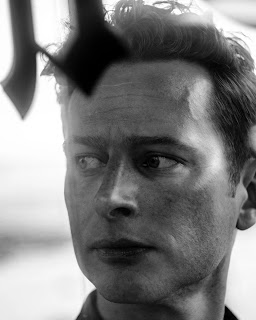
Chris Willingham, photographed through the paper's
window. (Photos: Joseph Rushmore for The New Yorker)
Chris Willingham is the son of Bruce and Gwen Willingham, who own the McCurtain Gazette in Idabel, Okla. The paper has a history of taking on McCurtain County officials, and Chris did a series of stories about irregularties in the office of Sheriff Kevin Clardy. One said 53 crime reports were missing, including “a shooting, a rape, an elementary school teacher being unknowingly given marijuana cookies by a student and a deputy allegedly shooting out the tires” of a car. The headline: “Sheriff regularly breaking law now.” 

Sheriff's Capt. Alicia Manning "was investigating several suspected pedophiles," Williams reports. "Manning told a TV news station that 'possibly other people in the community' who were in a 'position of power' were involved . . . and referred to Chris as 'one of them.' Without citing evidence, she accused him of trading marijuana for videos of children. Chris, stunned, suspected that Manning was just looking for an excuse to confiscate his phone. But when he started to lose music students, and his kids’ friends stopped coming over, he feared that rumors were spreading in the community. . . . He developed such severe anxiety and depression that he rarely went out; he gave his firearms to a relative in case he felt tempted to harm himself."

Chris and his wife Angie had "suppressed the occasional urge to leave the Gazette, knowing that they would be hard to replace," Williams writes, but now it was clearly an option. On March 6, he sued Manning and Clardy in federal court for “slander and intentional infliction of emotional distress.” They denied the allegations, and Manning's response said that whatever distress Chris suffered was within the limits of what “a reasonable person could be expected to endure.”

"On the day that Chris filed his lawsuit, the McCurtain County Board of Commissioners held its regular Monday meeting . . . Bruce, who has covered McCurtain’s commissioners for more than 40 years, suspected the board of discussing business not listed on the agenda—a potential misdemeanor—and decided to try to catch them doing it. . . . As they neared the end of the listed agenda, Bruce slipped a recording device disguised as a pen into a cup holder at the center of the conference table." When the room was vacated left hours later, "He went back inside, pretended to review some old paperwork, and retrieved the recording device."

In the three-and-a-half-hour recording, other officials come in, startig with Clardy and Undersheriff Larry Hendrix. Commission Chair Mark Jennings said the 2024 race for sheriff would have several candidates who “don’t have a goddamn clue what they’re getting into, not in this day and age.” Formerly, he said, the sheriff could “take a damn Black guy and whup their ass and throw ’em in the cell. . . . Take ’em down there on Mud Creek and hang ’em up with a damn rope. But you can’t do that anymore. They got more rights than we got.”

Manning came in and "continually steered the conversation to the Gazette," Williams reports. She "talked about the possibility of bumping into Chris Willingham in town: 'I’m not worried about what he’s gonna do to me, I’m worried about what I might do to him.' A couple of minutes later, Jennings said, 'I know where two big deep holes are here, if you ever need them.' 'I’ve got an excavator,' the sheriff said. "Well, these are already pre-dug,' Jennings said. He went on, "I’ve known two or three hit men. They’re very quiet guys."

Editor-Publisher Bruce Willingham in his "clutterbucket of an office"
Williams writes, "Bruce took the tape to the Idabel Police Department. Mark Matloff, the district attorney, sent it to state officials in Oklahoma City, who began an investigation." On April 15, the Gazette reported the conversation under the headline, “County officials discuss killing, burying Gazette reporters.” The next day, Gov. Kevin Stitt demanded that Clardy, Manning, Hendrix and Jennings resign; only Jennings did. The sheriff’s department said the recordign was illegal and “altered.” Chris Willingham told Williams that he reduced the background noise in the audio file before his father took it to the police. Oklahoma Press Association Executive Director Mark Thomas said two of the three commissioners were present and had no expectation of privacy.

"People wanted to hear the recording, not just read about it, but the Gazette had no website," Williams reports. "The Willinghams published an oversized QR code on the front page of the April 20 issue, linking to a Dropbox folder that contained the audio and Angie’s best attempt at a transcript. They eventually put Chris’s articles online. In a rare move, the 17-member board of the Oklahoma Sheriffs’ Association voted unanimously to suspend the memberships of Clardy, Manning, and Hendrix. . . . [Idabel Mayor Craig] Young was among those who hoped that Gentner Drummond, the attorney general, would depose the sheriff 'so we can start to recover.' But on June 30, Drummond ended his investigation," saying that the conversation was “inflammatory” and “offensive,” but not criminal. But Chris's latest story reports that Manning is under FBI investigation.

Williams ends her story this way: "Bruce and Gwen worried that the ongoing stress would drive Chris and Angie away from the Gazette — and from McCurtain County. Sure enough, they’re moving to Tulsa. Angie told me, 'We’re 40 years old. We’ve been doing this half our lives. At some point, we need to think of our own happiness, and our family’s welfare.' Bruce protested, but he couldn’t much blame them."
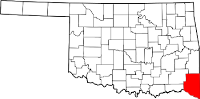
McCurtain County (Wikipedia map)
Williams' story has some observations about hard-nosed rural newspapering: "Bruce Willingham once wrote, 'We are aggressive about protecting the public’s access to records and meetings, because we have found that if we don’t insist on both, often no one else will.' . . . The Gazette exposed a county treasurer who allowed elected officials to avoid penalties for paying their property taxes late, and a utilities company that gouged poor customers while lavishing its executives with gifts. 'To most people, it’s Mickey Mouse stuff,' Willingham told me. 'But the problem is, if you let them get away with it, it gets worse and worse and worse.'

"In a small town, a dogged reporter is inevitably an unpopular one. It isn’t easy to write about an old friend’s felony drug charge, knowing that you’re going to see him at church. When Chris was a teenager, his father twice put him in the paper, for the misdemeanors of stealing beer, with buddies, at a grocery store where one of them worked, and parking illegally—probably with those same buddies, definitely with beer—on a back-road bridge, over a good fishing hole.

"Among law-enforcement sources, 'Chris was respected because he always asked questions about how the system works, about proper procedure,' an officer said. Certain cops admired his willingness to pursue uncomfortable truths even if those truths involved one of their own." Another unnamed officer told her. "If I was to do something wrong—on purpose, on accident—Chris Willingham one hundred per cent would write my butt in the paper, on the front page, in bold letters."

And one last revelation: Bruce and Gwen Willingham "rent several cabins to vacationers in Hochatown . . . a resort area known as the Hamptons of Dallas-Fort Worth," three hours away. Chris told her, “If we didn’t have tourism to fall back on, we couldn’t run the newspaper. The newspaper loses money.”

Tuesday, April 18, 2023

Newspaper's publication of surreptitious recording of Okla. officials' racist, threatening remarks brings calls for ousters

Part of the latest front page of the McCurtain Gazette-News (Image from "The Rachel Maddow Show," MSNBC)
Bruce Willingham, publisher of the McCurtain Gazette-News in southeast Oklahoma, said he left a voice-activated recorder inside the county commissioners' meeting room March 6 because he suspected they were "continuing to conduct county business after the meeting had ended, in violation of the state's Open Meeting Act," The Associated Press reports. What the recorder picked up, and the newspaper's reporting of it, has created a firestorm.

"Oklahoma’s governor is seeking the resignation of four county officials after a newspaper’s audio recording apparently captured some of them complaining about two of the paper’s journalists and knowing hit men and where two holes are dug," AP's Sean Murphy reports. "It also appears to capture one of the four making racist comments about Black people."

Protesters called for the officials' resignations at Monday's county
commission meeting. (Photo: Christopher Bryan, Southwest Ledger)
Republican Gov. Kevin Stitt called Sunday for the resignations of Sheriff Kevin Clardy, sheriff’s Capt. Alicia Manning, Commissioner Mark Jennings and Jail Administrator Larry Hendrix. Idabel Mayor Craig Young and state Rep. Eddy Dempsey, who represents the county, echoed Stitt's call, and "More than 100 people gathered outside the McCurtain County Courthouse in Idabel on Monday, with many of them calling for the sheriff and other county officials to resign," AP reports.

In the newspaper's transcript of the recording, Clardy, Manning and Jennings appear to discuss Bruce Willingham and his son Chris, a reporter for the paper. Jennings tells the other officials, “I know where two deep holes are dug if you ever need them,” and Clardy responds, “I’ve got an excavator.” Jennings adds that knows “two or three hit men” in Louisiana who are “very quiet guys.” At another point, "Jennings also appears to complain about not being able to hang Black people, saying 'They got more rights than we got'," AP reports.

Dempsey told The Oklahoman, “Being from southeast Oklahoma, I don’t honestly think it was serious, but you still can’t take things like this lightly. You live in a glass bubble when you become a politician. I hope this gets resolved quickly. All my life we always say we don’t get enough recognition in southeast Oklahoma, but we don’t need this kind of recognition.”

AP reports, "Bruce Willingham said he believes the local officials were upset about 'stories we’ve run that cast the sheriff’s office in an unfavorable light,' including the death of Bobby Barrick, a Broken Bow, Okla., man who died at a hospital in March 2022 after McCurtain County deputies shot him with a stun gun. The newspaper has filed a lawsuit against the sheriff’s office seeking body camera footage and other records connected to Barrick’s death."

Willingham told AP he has given his recordings to the FBI and the state attorney general, and has talked with federal investigators. Before that, "I talked on two different occasions to our attorneys to make sure I wasn't doing anything illegal," he said. Joey Senat, a journalism professor at Oklahoma State University, "said under Oklahoma law, the recording would be legal if it were obtained in a place where the officials being recorded did not have a reasonable expectation of privacy," AP reports. The Oklahoman reports, "The audio released online matches some of the quoted material in the story, but The Oklahoman has not yet independently verified who the speakers were in the recordings." AP said likewise. The sheriff's office says the recording was illegal. (UPDATE, May 18: Oklahoma Press Association Executive Vice President Mark Thomas said in The Oklahoma Publisher, “These public officials, including two of three county commissioners, were meeting in a public space. There is no expectation of privacy in a public space.  That’s why people are allowed to have video doorbells that show activity on a street, or dash cams in their car, or even pull out a camera and record things they see on the street.”)

Jonathan Edwards of The Washington Post reports that Willingham sued county commissioners, the sheriff’s office, Clardy and Manning in federal court, accuding them of slander. "His suit followed years of reporting on the sheriff’s department for the Gazette-News. In November 2021, the newspaper ran the first article in what would be an eight-part series about misconduct in the sheriff’s office, according to the lawsuit. Over the next five months, the newspaper exposed several instances of alleged misconduct in the sheriff’s office based on interviews with current and former employees, including homicide evidence that had been tainted, questionable hirings of employees with no previous law enforcement experience and an investigation into who in the sheriff’s office was leaking information, the suit says. In an effort to plug the leak, Clardy threatened to fire any of his employees who spoke with Willingham, and Manning told deputies she would get search warrants for their cellphones, it alleges." The suit claims Manning defamed Willingham "by telling someone that the reporter had traded marijuana for child pornography," Edwards reports, and insinuating that he had been convicted of having child pornography and sexually abusing a child.

Wednesday, June 15, 2022

What’s happened to nuts and bolts of public-safety news?

By Jim Pumarlo

Crime and public safety are garnering more headlines across the country. Law enforcement and racial disparities in the criminal justice system are under increasing scrutiny. Newspapers play a key role in examining the dynamics in their own communities.

But what’s happened to police logs, the most basic of public safety reporting? Where are the regular records of traffic citations, thefts, property damage, burglaries and much more?

Police logs easily generated the most calls during my tenure as editor of the Red Wing (Minn.) Republican Eagle. Traffic citations probably topped the list. Nobody likes being linked to a police report, whether it’s something as common as speeding or a citation that carries greater stigma, such as a DWI.

We regularly connected with local law enforcement. We routinely reviewed all initial complaint reports. The documentation was part of the menu of public records that readers expected to see in our newspaper.

We also believed the information was valuable to readers in terms of public safety. Is a neighborhood experiencing a rash of vandalism? Are DWIs on the rise? Should residents be on the lookout for another scam artist? Are certain crosswalks particularly dangerous? Has a neighborhood become a haven for narcotics? Is there a pattern to a rash of business burglaries?

No doubt, traffic citations are among the most worrisome and embarrassing to the violators. A youth is afraid he’ll lose his job. A teacher is concerned how she can explain a speeding ticket to students. An elderly woman is flustered by her first-ever ticket. A coach dreads facing his players after getting ticketed for a DWI.

Adding to the frustration – and often anger – of the accused is the lag time between when a ticket is issued and when the court disposes of a case. The delay can be weeks, or even months, depending on circumstances.

We believed both reports were newsworthy. For example, police might break up a neighborhood disturbance and issue several tickets. The community should be apprised immediately. It’s equally newsworthy to follow a case to see what penalties are assessed.

With the increased level of crime across the country, it’s discouraging to see many newspapers put fewer resources – or, at minimum, less effort – into monitoring police logs. For those reports that are published, one must ask in many instances: What’s the value?

Some newspapers simply copy and paste an agency’s computer printout. It may provide a glimpse of a department’s activity – but little else. No names. No addresses. The reasons for a call are nondescript: driving complaint, narcotics, domestic, traffic stop, noise, suspicious. No indication if arrests were made.

Some newspapers will translate the logs into their own reports, but the vagueness is alarming. A bike theft on Bush Street. A local business reports a padlock broken and items stolen. An employee theft on the 14000 block of Dellwood Drive. Again, what’s the value?

Most glaring is the anonymity of the reports – the lack of the five Ws and H of basic journalism. Reports are meaningless and do nothing to alerting a neighborhood, a community to public-safety issues.

Law enforcement undoubtedly is spoon-feeding information, selectively deciding what they believe is in the best interests of the public. They give little attention to the fact that most of the nuts and bolts of police reports – names, addresses, specifics of call – is classified as public by law. Their rationale? Adhering to their own rules makes their jobs easier; they won’t get the angry phone calls asking why they released the information to the newspaper.

Even more discouraging is that many editors apparently share a similar sentiment. They don’t press for substantive details. Their rationale? "Let’s keep the reports vague and not rile readers."

The dangers to this lack of aggressive reporting are obvious.

First, computer logs likely are transmitted electronically with little or no contact with anyone at the newspaper. Reporters do not develop any relationship with folks at the cop shop. They miss the opportunity to pick up and follow up on spot news, in-depth reports, feature stories and other substantive content for the newspaper.

Second, law enforcement will soon consider it standard operating procedure: Give the newspaper as scant reports as possible. That unfortunately is what many departments are taught. I well recall an officer in my hometown who became the primary contact on our daily rounds. He had just returned from training at the FBI Academy at Quantico, Va. His marching orders were very clear, as he was proud to tell us: Give the newspaper only the information he believed should be shared. We regularly challenged him, reminded him what the law dictated, and we eventually got the information – but it was an ongoing struggle.

Readers frequently asked that a public record be withheld. It might be a marriage license, divorce proceeding or ambulance run, but tickets were most commonly the concern. Some reasons were had more merit than others.

In the end, though, each person was seeking special treatment. Each was asking the impossible because our policy was that we could not pick and choose. Going down that path would place us in the position of being judge and jury – to determine that one person’s plea was more worthy than another’s. And we’d never know all the facts.

The simplest and fairest policy is to treat all public records as just that – public – in the belief that openness serves the greater number of people over the greatest period of time. At its foundation, police logs provide a pulse of public safety in a community.

Jim Pumarlo writes, speaks and provides training on community newsroom success strategies. He is author of Journalism Primer: A Guide to Community News Coverage; Votes and Quotes: A Guide to Outstanding Election Coverage; and Bad News and Good Judgment: A Guide to Reporting on Sensitive Issues in Small-Town Newspapers. He can be reached at www.pumarlo.com and welcomes comments and questions at jim@pumarlo.com.

Monday, October 12, 2020

Confidential data shows thousands of undisclosed coronavirus cases in Illinois at schools, prisons, meatpacking plants and more

"Newly obtained confidential statewide data shows that coronavirus outbreaks in workplaces, schools and prisons are driving Illinois’ rising cases — and many of these outbreaks have never been made public," according to a joint investigation by Georgia Gee with Columbia University's Stabile Center for Investigative Journalism, Derek Kravitz with Columbia's Brown Institute for Media Innovation, and Sky Chadde with the Midwest Center for Investigative Reporting

State health officials said they refused to release the locations of many outbreaks because of state and federal laws meant to protect the identity of infected people. The same thing could be happening in other states.

Columbia's Documenting Covid-19 project and the Midwest Center obtained the internal data from the state health department, which covered four days between July and September, as part of an open-records request. The data gives detailed information and case counts for nearly 2,600 separate cases across the state. Federal, state and county prisons and jails are the single largest source of infections. That's largely driven by the Cook County Jail in Chicago, but there have been significant outbreaks at other prisons in rural areas such as Robinson Correctional Center in Crawford, Gee, Kravitz and Chadde report. Such outbreaks brought the total of prison cases to at least 3,500 as of Sept. 30—nearly double the figure reported by the Marshall Project and The Associated Press.

Monday, March 02, 2020

Farmers irate after company, maybe using private data, tries to rent the land they farm and sublet it by online auction

Midwestern farmers are furious after a new company tried to rent their farmland out from under them and sublet it through online auctions, possibly using privileged data to target the best farmland, Dan Charles reports for NPR.

Not all farmers own the land they till: about half of Midwest farnland is owned by landlords, and 81 percent aren't farmers, or even local, Charles notes. Many are investors, some foreign.

Still, farmer-landowner contracts can last for decades, and can feel personal. So, many farmers were upset when they heard that Chicago-based company Tillable recently sent thousands of letters to landowners, offering cash up front to rent land that was already being farmed. The venture-capital-backed company wanted to rent the land and then sublet it to the highest bidder online, Charles reports. CEO Corbett Kull told Charles he thinks Tillable can be a farmland version of AirBnB.

But Parker Smith, who grows corn and soybeans outside Champaign, Ill., sees it a different way. "They're reaching out to our landlords, that we have relationships with, to sort of go behind the farmer's back," he told Charles.

The farmers already renting the land are upset for other reasons. Some use equipment that collects data about their operations, and they pay a company called Climate Corp. to manage and interpret that data. But last fall, Tillable and the Climate Corp. announced a partnership, making some farmers suspect that Tillable had used Climate data to target the most productive farmland for cash offers.

A few weeks ago, farmers started sharing suspicions about the partnership on Twitter. Kull denies that Tillable used Climate data, but the hubbub prompted the companies to cancel their partnership. "Kull says this is not a major blow to Tillable's plans to expand. But the controversy could have one lasting effect. Parker Smith says that he never worried about his farm data before, and who might be able to to see it. Now, he and a lot of other farmers probably will," Charles reports.

Tuesday, April 03, 2018

Rural Ore. weekly Malheur Enterprise wins Investigative Reporters & Editors award for 'Deadly Decisions' package

The Malheur Enterprise, a rural weekly in Vale, Oregon, with a circulation of 2,000, won a 2017 Investigative Reporters & Editors Award in the Freedom of Information category for its "Deadly Decisions" package about a state hospital's release of a man later arrested for murder. Editor Les Zaitz and his staff beat out packages from bigger publications like ProPublica, the Kansas City Star, and Zaitz's old paper The Oregonian, from which he retired in 2016.

The annual IRE Awards have recognized outstanding investigative reporting since 1979. Investigative Reporters & Editors is a grassroots nonprofit organization dedicated to improving the quality of investigative reporting since its inception in 1975.

Deadly Decisions is a "classic David-meets-Goliath triumph," IRE judges wrote. "The small staff at this weekly newspaper in Oregon won a public records battle with the state agency that sued the newspaper to block release of documents. The newspaper launched a GoFundMe drive to raise money for a lawyer to defend the journalist. In the end, the documents were released after the governor stepped in. The paper's tenacity led a public affirmation of the state's commitment to openness. This work is proof that you don’t need a large staff and deep resources to move the needle on open records."

Deadly Decisions was also the runner-up for a Scripps Howard Award in the Distinguished Service to the First Amendment category.

Wednesday, June 07, 2017

Small weekly in rural Oregon wins battle for records when governor intercedes on its behalf

Les Zaitz (Poynter photo)
The publisher of a weekly newspaper in rural Vale, Oregon, won his battle to release records about a murder suspect who had earlier admitted feigning insanity to avoid prison, when the governor ordered a recalcitrant state agency to turn over the documents.

Les Zaitz of the Malheur Enterprise, circulation 2,000, and his reporters discovered Anthony Montwheeler "had a criminal background stretching back 25 years; he previously kidnapped his former wife and 3-year-old son; and — most importantly — he was released by Oregon officials just 23 days before the latest crimes,' reports Benjamin Mullin of The Poynter Institute. "But Zaitz knew he was looking at one of the biggest stories of his career when the team discovered that Montwheeler had avoided a seven-year prison sentence by convincing a psychologist that he was mentally ill. Then, years after he was confined to a mental hospital, he was released by the state Psychiatric Security Review Board when he admitted to faking his mental illness."

Zaitz got an audio recording of the board's meeting and wrote a story, but the board refused to release 15 exhibits it used in making its decision. The state attorney general, who has the power to require agencies to release documents, ordered it do do so, but it refused and planned to file a lawsuit to block the release. Zaitz set up a defense fund through the Oregon Newspaper Publishers Association.

Then Gov. Kate Brown "took the rare step of intervening in the case, calling the review board's lawsuit 'plain wrong' and ordered the records released," Mullin recounts. "No one requesting public records should be at risk of being sued by a state agency," Brown wrote. "I believe the public is best served by bringing this matter to an end now, rather than after a lengthy and costly litigation."

Zaitz is offering refunds to those who donated to the defense fund. "If they do not want their money returned, it will be used to create a new fund at ONPA, one aimed at helping the state’s small newspapers," the Bend Bulletin reported in an editorial.

Tuesday, March 14, 2017

Are text messages between public officials public? It depends on the state, or maybe the judge

Are text messages between public officials on their private phones subject to disclosure under your state open-records law? It depends on what state you're in, and the answer could change, a lawyer who has researched the issue told open-government advocates in Washington, D.C., Tuesday night.

Helen Vera, a associate with the firm of Ropes & Gray, was among the presenters at a Sunshine Week event of the D.C. Open Government Coalition at the National Press Club. Just like us, Vera said, "State and local officials are texting all the time." And, she added, making new law as they go along.

Some states consider text messages "transitory" and not subject to records laws in the same way that emails are. Vera cited a court case in Colorado, in which a judge found that the Basalt Mayor Jacque Whitsitt didn't violate the law by erasing text messages between her and Town Manager Mike Scanlon. "The lawsuit targeted Whitsitt for not turning over texts that she exchanged with Scanlon, and that Scanlon provided as part of the open-records request," Scott Condon of The Aspen Times reported. "The DA determined that no criminal charges were warranted."

Vera noted new apps that can automatically delete text messages.
Vera said "the vast majority" of state laws clearly provide access to text messages, and in other states, attorneys general have issued opinions to that effect, some of them binding. But in practice, she said, laws and policies don't guarantee access. Prolonged litigation can examine retention policies and issues such as use of personal devices and the definition of "possession" in a records law. She said some states are requiring public officials to forward to the government any text messages they have regarding public business.

"It's a very sort-of-ripe issue and we expect to continue to see that this is an issue that's litigated," Vera said. She warned that new applications such as Telegram give texters the ability to have their messages automatically deleted. One, Confide, uses the slogan "Your off the record messenger."

Friday, August 05, 2016

Tough pilot requirements, other concerns will slow growth of drone journalism, expert says

By Al Cross
Institute for Rural Journalism and Community Issues

MINNEAPOLIS -- The use of drones for journalism is likely to be limited mainly to large news organizations for a while because of the requirements for a license to pilot unmanned aircraft, and adoption may be slow, an expert in the field said during a session at the national journalism educators' convention Thursday.

University of Nebraska professor Matt Waite with drones
Matt Waite, a journalism professor at the University of Nebraska, said he sees "a culture of caution in newsrooms," which don't want to be test cases in an area of law that remains largely untested by courts. He said unmanned aircraft are "a gray area a lot of media attorneys are uncomfortable with."

Waite is holding an overbooked "bootcamp" next weekend to prepare about 60 would-be drone pilots for the Federal Aviation Administration exam. He said the test material includes "a lot of minutiae" that are unrelated to unmanned aircraft. "It is a lot of stuff, and I'm afraid it is going to chase off too many journalists."

But he said as more organizations use drones and an insurance market for them is stabilized, that will encourage more usage. The images available are amazing, said Katie Culver, a professor of journalism ethics at the University of Wisconsin.

Culver said that in debates over drones, news organizations haven't been as aggressive as they should be in speaking up for their First Amendment right to gather news and information.

Waite, Culver and Jacksonville University journalism professor Courtney Barclay appeared at the annual convention of the Association for Education in Journalism and Mass Communications in Minneapolis. They discussed not only the legalities surrounding unmanned aircraft, but the ethics.

"Ethics has to start with safety," Waite said, noting that the recently issued federal regulations prohibit flying drones over people.

Culver said she fears many newsrooms will "default to technological determinism" and do what the technology allows, limiting their ethical thinking to possible consequences: What happens if X happens? She said newsrooms are aware of privacy concerns but tend to think of them more in legal terms than ethical terms, and many are more concerned about "getting what is interesting to the public rather than what's in the public interest."

An important question, Culver said, is "What are drones going to do to our credibility as journalists?" She said there is "pretty widely documented public suspicion of civilian drones," with about two-thirds of the population saying they will make things worse and one-third expecting better.

Culver suggested that news organizations follow the example of the Gannett Co. newspapers in Wisconsin and discuss the issue with "focus groups" of citizens.

Waite said most people probably don't know that anyone can legally take and publish a picture of anyone on a street, but state laws may eventually prohibit such photography or video from unmanned aircraft below a 500-foot altitude. "It's important for journalists to understand that use of that technology may be transformative in the public's mind."

Jane Kirtley of the University of Minnesota, moderator of the panel, said some state "ag-gag" laws designed to shield agricultural operations from public scrutiny have been extended to include drones.

Waite said, "Agriculture is talking out of both sides of sides of their mouth," wanting few restrictions on drones for farming but blocking others from flying over farms without permission, as was attempted in the Nebraska legislature.

He said agriculture is much more important to the unmanned-aircraft industry than journalism is: "I've often described journalism as the bug speck on the windshield when it comes to drones."

Tuesday, March 08, 2016

Apple chief, at center of controversy over privacy, forged his moral ideals growing up in rural South

Apple chief executive Tim Cook—an openly gay man, a champion for gay rights, and a native son of the rural South—is at the heart of a controversy, having refused to assist the FBI in unlocking an iPhone belonging to one of the San Bernardino terrorists. Cook's childhood growing up in the 1960s in rural Robertsdale, Ala. (Best Places map) forged his current ideals about right and wrong and the need for privacy, especially from the government, Todd Frankel reports for The Washington Post.

Cook was instilled with a sense of right and wrong at an early age, Frankel writes. "In the early 1970s, he was riding his new 10-speed bicycle at night along a rural road just outside Robertsdale when he spotted a burning cross. He pedaled closer. He saw Klansmen in white hoods and robes. The cross was on the property of a family he knew was black. It was almost more than he could comprehend. Without thinking, he shouted, 'Stop!' The group turned toward the boy. One of them raised his hood. Cook recognized the man as a local deacon at one of the dozen churches in town, but not the one attended by Cook’s family. The man warned the boy to keep moving." Cook said at a speech in 2013, “This image was permanently imprinted in my brain and it would change my life forever."

Tim Cook (Mashable photo)
When he was 16 "Cook won an essay contest sponsored by a rural electric company and, as part of the prize, met Alabama Gov. George Wallace, the segregationist who resisted the federal government’s attempts to integrate the state’s public schools during the ’60s," Frankel writes. Cook said in a speech that shaking Wallace's hand was "a betrayal of my own beliefs . . . It felt wrong. Like I was selling a piece of my soul.” During the same trip, Cook met President Jimmy Carter at the White House. He said the difference between the two men was impossible to miss: “One was right and one was wrong.”

In 2011, when he took over Apple, Cook began advocating "for gay rights and to change laws in states such as Alabama, where employees can be fired for being gay," Frankel writes. "He criticized states with 'religious freedom' laws that seemed to him to sanction some forms of discrimination. Last December, shortly before the fate of a terrorist’s iPhone would explode onto the national scene, he accepted the Ripple of Hope award from the Robert F. Kennedy Center for Justice and Human Rights. In his speech, Cook talked about learning to 'take a stand for what is right, for what is just.' And when the terrorist’s iPhone case erupted last month, Cook returned to that 'moral sense' he learned back in Robertsdale."

In a letter to customers, Cook "wrote that 'it would be wrong' for Apple to be forced to create a backdoor to its security system," Frankel writes. Cook wrote, “We feel we must speak up in the face of what we see as an overreach by the U.S. government” The Justice Department "has accused Apple of focusing on 'a perceived negative impact on its reputation.'" Cook responded in an interview with ABC News by saying, “Some things are hard, and some things are right, and some things are both. This is one of those things.”

Monday, February 01, 2016

Farm sector anxiously awaiting drone regulations

Federal Aviation Administration regulations on unmanned aerial vehicles will play a large part on how drones are used in agriculture and whether or not it will be worth it to use the devices, Jim Patrico reports for DTN The Progressive Farmer. "The agency has struggled to formulate regulations for an industry that has expanded exponentially over the last years. Indications are that FAA finally will post rules for commercial UAV operators this summer." In December, FAA said that recreational drone users would have to register their aircraft with the government, but the agency has continually delayed releasing regulations. (Wheat farmer and UAV expert Robert Blair sets up a plane for flight.)

"It's clear to observers that commercial users can expect more stringent rules," Patrico writes. "Some in the industry forecast that commercial UAV operators—including farmers—would have to undergo training and be licensed. The first set of regulations will be for those who use UAVs only for taking photos and videos, insiders speculate. Later regulations will cover other UAV application—spraying crops, for instance. These are likely to be tight and require yet more training."

"Some companies and individuals already have FAA Section 333 exemptions, which allow them to fly UAVs for some commercial purposes," Patrico writes. "But along with exemptions comes bookwork. Anyone with an exemption has to file a Notice to Airmen (NOTAM) with the FAA at least 72 hours before a flight. The NOTAM must specify when, where and why the UAV will fly. If for some reason the flight does not happen when planned—say the weather doesn't cooperate—a new NOTAM is required."

Robert Blair, an Idaho farmer who has been a pioneer in UAV applications for agriculture "questioned whether many farmers really would be able to justify the personal time and effort necessary to get the most benefit from UAV technology," Patrico writes. Blair said farmers would likely have to hire someone to implement drone technology, mostly because they wouldn't have the know-how or time to work with the vehicles.

He also said having a drone can be expensive, Patrico writes. "Blair said, farmers should expect to pay $20,000 or more for a vehicle, sensors and software. He expects fixed-wing configurations will be the choice of professionals because they can carry a bigger payload and can stay aloft longer" to cover ground at a quicker pace. (Read more)

Sunday, January 17, 2016

Shootdown of drone in Kentucky prompts federal lawsuit that could lead to clearer privacy rules

When a Kentucky man with a shotgun brought down a drone near his home last summer, it set off a dispute that "could settle an issue that experts say has never before been addressed by the courts: the conflict between a homeowner’s right to privacy and the federal government’s exclusive sovereignty over the skies," Andrew Wolfson reports for The Courier-Journal in Louisville.

Charges against "drone slayer" Willie Merideth of Hillview, above, were dismissed but the owner of the drone, John David Boggs, has filed suit for damages and what he calls “clarity to protect the right to fly responsibly without fear of being shot at.” He wants U.S. District Judge David J. Hale to resolve the “boundaries of the airspace surrounding real property, the reasonable expectation of privacy as viewed from the air, and the right to damage or destroy an aircraft in flight.”

Wolfson reports, "Merideth also says he looks forward to the court’s resolution of where private property ends and the open sky begins. Boggs’ Nashville lawyer, James Mackler, a former Army Blackhawk helicopter pilot who specializes in drone law, says much is at stake, including for companies like Amazon, which plans to deliver packages to customers via drones that would touch down on their lawns." Mackler todl Wolfson, “If every property owner has a right to take a shot at them, that pretty much ends that business model.”

States and local governments that want to regulate drones are clashing with the Federal Aviation Administration, which "says it has sole authority over the national airspace while Kentucky law gives landowners the right to use force necessary to prevent trespassing," Wolfson writes. "The Supreme Court hasn’t addressed the issue since 1946 when it ruled that a North Carolina farmer could assert property rights up to 83 feet in the air -- and win compensation for military aircraft that were flying so low they were disturbing his cows and chickens. But that was long before the advent of drones, which are now used for everything from law enforcement to land surveys, from search and rescue to wildlife tracking. Best Buy offers 50 models just for photo hobbyists, while more than 50 companies produce 155 models in the U.S., with wingspans ranging from six inches to 246 feet."

The Academy of Model Aeronautics, which was founded in 1936 and says it has 175,000 members, "says it welcomes guidance from the federal courts but that states already have enough laws on the books that make harassment and peeping a crime. The Muncie, Ind.,-based group says its policies already ban members from flying directly over unprotected people or houses or flying near an airport," and notes that a 2012 federal law "bars drones and model aircraft owners from interfering with other aircraft and says they must be operated within direct sight of the owner," Wolfson reports.

Monday, January 11, 2016

FAA's assertion of authority over drones rankles local officials, who cite urban-rural differences

University of Georgia photo
The Federal Aviation Administration is headed for clashes with local and state officials over drones, over which the FAA claims exclusive authority. "Local and state lawmakers, concerned about the safety and privacy risks that drones pose, have been passing rules about the machines at a rapid pace . . . with many of the regulations placing tough restrictions on areas to fly and clamping down on the use of drones to snoop on neighbors," but now the FAA says many local or state rules wouldn't stand up to court challenges because Congress gave it power over aviation, reports Cecilia Kang of The New York Times.

"The intervention of the FAA is now frustrating local lawmakers, who complain that the agency wants them to back off their own rules—even as it is seen as too lenient on drone users," Kang writes. "Lawmakers said the agency’s drone rules did not go as far as many states and municipalities that are explicitly banning flights within cities and over homes, strengthening privacy protections and imposing steep criminal and financial penalties on violators. As a result, some state and city officials are digging in to defend their own drone regulations."

In that battle, local officials are opposed by tech companies, which "want a light touch by regulators to help give their drone efforts the widest possible latitude," Kang reports. "Companies such as Amazon and Google have hired dozens of lobbyists over the last year to visit aviation committees on Capitol Hill, explaining their plans to deliver packages and create entirely new segments of entertainment and sports."

Daniel R. Garodnick, one of the New York City Council members who proposed an ordinance to ban most drone flights in the city, require users to get licenses and insurance, and make violations criminal misdemeanors, says the FAA rules fail to distinguish between urban and rural areas. “New York City is different from the cornfields of Iowa,” he said. “That should be obvious to everyone.”

Monday, November 23, 2015

Task force gives FAA drone registration proposal; should require most drone owners to register

The Unmanned Aircraft Systems (UAS) Registration Task Force, a group consisting of 25 members, on Saturday delivered recommendations to the Federal Aviation Administration for a process for registering drones. FAA "will consider their recommendations and the public comments as we develop an Interim Final Rule on registration, which will likely be released next month and go into effect shortly thereafter," Michael Huerta, FAA chief, wrote in a blog post. "This step will be followed by another opportunity for the public to comment as we move toward issuing a final rule on registration."

Alan Levine of Bloomberg writes: "Owners of all but the smallest toy drones will have to register them with the U.S. government before the end of the year if the Obama administration adopts proposals issued by a task force it appointed. Registration—designed to make it easier for authorities to track down the growing numbers of illegal flights—should be free, easy to complete online and permit multiple devices on an owner’s filing, the task force is proposing, according to three people familiar with its recommendations who weren’t authorized to speak about it."

The report, which is not expected to be released to the public until some time this week, "would require drone operators to register on a website or via a phone app if they own UAS weighing as little as 8.8 ounces (250 grams), and attach their registration number to their drones," David Morgan reports for Reuters. "Two sources said the drone registry could ultimately provide an alternative to the more laborious, paper-based process for registering manned aircraft for both recreational and commercial drone users. Commercial operators are currently required to register their drones through the manned aircraft process on a case-by-case basis. Registration of commercial drones will be addressed in final FAA regulations expected early next year."

Tuesday, October 20, 2015

Recreational drone users will soon be required to register aircraft with government

Recreational drone users will be required "to register their aircraft with the government for the first time in an attempt to track rogue flying robots that are increasingly posing a threat to aviation safety," Craig Whitlock reports for The Washington Post. The basic details of the registration system still need to be worked out but could be in place within two months, U.S. Department of Transportation Secretary Anthony Foxx and Federal Aviation Administration Administrator Michael Huerta announced on Monday.

Foxx and Huerta said a task force will be created composed of 25 to 30 representatives from Unmanned Aerial Vehicle and manned aviation industries, the federal government and other stakeholders, Sara Wyant reports for Agri-Pulse. "The group will advise the department on which aircraft should be exempt from registration due to a low safety risk, including toys and certain other small UAV. The task force also will explore options for a streamlined system that would make registration less burdensome for commercial UAV operators."

Foxx told reporters, “Registering unmanned aircraft will help build a culture of accountability and responsibility, especially with new users who have no experience operating in the U.S. aviation system. It will help protect public safety in the air and on the ground.” Huerta added, “Registration will help make sure that operators know the rules and remain accountable to the public for flying their unmanned aircraft responsibly. When they don't fly safely, they'll know there will be consequences.”

Under current rules drone operators are not supposed to fly above 400 feet or within five miles of an airport, but FAA has been mostly powerless to enforce the rules, leading some states to create their own regulations. Fear of unregulated drone use has been widespread. In June 2014, the National Park Service banned drones in all parks and areas it manages. In August 2014, a tourist crashed a drone into Yellowstone National Park. Also in August 2014 drones were banned over the Appalachian Trail and in parks in Utah and Colorado, and a drone was reported flying over an NFL game. In July, a rural Kentucky man shot down a drone flying over his house.

Thursday, September 10, 2015

Inactivity by FAA leading states to create own regulations on commercial drone use

While the Federal Aviation Administration sits on its hands about official commercial drone regulations, several states have been "eager to pass their own policies on unmanned aerial vehicles (UAVs), mandating everything from where drones can be flown to whether law enforcement can use them to gather evidence," Sarah Breitenbach reports for Stateline. "But advocates for the technology, which is growing in popularity both commercially and among hobbyists, say legislatures are overstepping their authority and hamstringing an industry ripe for growth." (Free Lance-Star photo by Peter Cihelka: Joshua Olds launches a drone during a precision farming demonstration in August in Bruington, Va.)

"According to the Association for Unmanned Vehicle Systems International (AUVSI), an industry-supported group, at least six states—Florida, Minnesota, Nevada, North Dakota, Oregon and Virginia—have passed legislation restricting the commercial use of drones," Breitenbach writes. "Another eight have restrictive legislation pending, and 45 states considered at least 156 bills relating to drones this year," FAA in February drafted limits on drones, but final rules could still be two or three years away. It is currently illegal to fly commercial drones in the U.S., but FAA has granted more than 1,000 exemptions for businesses to use the aircrafts.

Michael Drobac, executive director for the Small UAV Coalition, said that "drones are being used in a rapidly growing number of industries," Breitenbach writes. "FAA estimated as many as 7,500 small commercially operated drones could be in use by 2018 if the necessary regulations are put in place. The devices can be used by realtors to showcase properties, by utility companies to safely inspect cellphone towers and high-voltage power lines, and by farmers to monitor crops."

Tom McMahon, a spokesman for AUVSI, said regulating how drones can be used is unnecessary because "existing state-level policies on privacy, trespassing and harassment can be used to address illegal acts committed with drones," Breitenbach writes. He told her, "It’s a new technology, but don’t restrict the technology. Instead, prosecute the person who is using the technology maliciously.” (Read more)

Friday, July 31, 2015

Rural man shoots down drone flying over his house; said it was an invasion of privacy

A rural Kentucky man, saying a drone hovering near his home on Sunday was an invasion of privacy, shot it down with a shotgun, Ryan Cummings reports for WDRB 41 in Louisville. Hillview (Best Places map) resident William H. Merideth "was arrested and charged with first degree criminal mischief and first degree wanton endangerment. He was booked into the Bullitt County Detention Center and released on Monday."

The owner of the drone, who estimated its cost at $1,800, said he was taking photos of a friend's house, Cummings writes. But Merideth, whose teenage daughter was in the backyard laying out by the pool, said he saw the drone as as threat. Merideth told Cummings, "I went and got my shotgun, and I said, ‘I’m not going to do anything unless it’s directly over my property.' Within a minute or so, here it came. It was hovering over top of my property, and I shot it out of the sky. I didn't shoot across the road; I didn't shoot across my neighbor's fences; I shot directly into the air."

Incidents such as this have led some to fear that unregulated drones use could  lead to "a modern version of the Wild West" in the skies. In June 2014, the National Park Service banned drones in all parks and areas it manages. In August 2014 a tourist crashed a drone into Yellowstone National Park. Also in August 2014 drones were banned over the Appalachian Trail and in parks in Utah and Colorado, and a drone was reported flying over an NFL game. FAA in February drafted limits on drones, but final rules could still be two or three years away.