Diesel prices in the United States have continuously hit all-time highs in September. As of Sept. 10, diesel costs $5.98 on average, $2.31 more than when the U.S. and Israel began their war on Iran in February, reports Tik Root for Grist.
The surge in diesel prices comes just before November's midterm elections, and as domestic inventories are at their lowest since 1982.
Farmers and truckers who use more diesel in autumnal harvest seasons will be significantly impacted. Though most Americans don’t buy diesel, they still pay for it. The cost of diesel used to cultivate crops and transport those harvests to market is linked to the grocery prices one sees at the store.
“Early on, much of the cost increase gets absorbed along the supply chain through existing freight contracts and retailer margins,” David Ortega, a professor of food economics and policy at Michigan State University, told the Associated Press. “But as contracts reprice and fuel surcharges take hold, more of that cost makes its way to the grocery store.”
This year, the Strait of Hormuz — through which 10% of imported diesel travels — was closed by Iran, which caused prices to surge. The last time gas prices soared this high was when Russia invaded Ukraine in 2022, which also shut Russia out of the global diesel market.
Apart from higher prices for farmers and at grocery stores, a challenging winter is likely. Heating oil is essentially diesel, Root writes, and “the millions of U.S. households that still rely on it can expect unprecedented bills.”
Showing posts with label gas prices. Show all posts
Showing posts with label gas prices. Show all posts
Friday, September 11, 2026


Friday, June 05, 2026
Gas prices are high, and inflation has continued to climb. How do Trump voters feel about his performance so far?
 |
| Many Americans say that gas prices may impact their midterm election choices. (Photo by GG, Unsplash) |
So how do those voters feel now? Tim Balk, Rachel Richardson and Sam Easter of The New York Times asked some Trump voters how they feel about their vote now and how their opinion of his leadership so far might influence their midterm election choices. Some edited selections of their opinions are shared below.
Adele Wilson, 30, of Ada Township, Mich., population 14,400
When asked about gas prices, Wilson told the Times, "Last time I filled up I was like, ‘Oh, this hurts.’" Wilson, a dental assistant, believes "Trump’s second term has been unsuccessful," the Times reports. "She called the war a 'horrible idea.' She was unsure how she would vote in the midterms, she said, but she had already ruled out voting for JD Vance or Marco Rubio in the 2028 presidential race."
Matt Yerkes, 74, of New Richmond, Ohio, population 2,730
Yerkes, who is retired, told the Times he thinks Americans' current economic strain is "temporary and needed.” Overall, he agrees with the war with Iran. The Times reports, "He said he disliked the president’s personality, but added, 'I agree with essentially everything he does from a policy standpoint.'"
Luke Stanley, 28, of Hermon, Maine, population 6,500
"Stanley, who owns a metal fabrication company, said he did not 'necessarily' support the war, and suggested he would like the president to change his approach," the Times reports. "But he said that business had been good for him overall during the president’s second term." He told the Times that continued high gas prices might sway his choice in the midterm elections.
Wednesday, May 27, 2026
Trump may see high gas prices as 'peanuts,' but they are squeezing lower-income Americans the most
 |
| Photo by Yassine Khalfalli, Unsplash |
And while many Americans might agree that wallet-draining gas prices are preferable to horrific global outcomes, the war is costing poorer Americans a higher percentage of their income than it is wealthier Americans.
"For households in the bottom quarter of the income distribution — those earning roughly $40,000 a year or less — commuting fuel costs now consume an average of about 4% of their income," report Julie Z. Weil and Federica Cocco of The Washington Post. "For households in the top quarter, earning $100,000 or more, the same costs amount to less than 1%."
Lower-income workers get squeezed from all sides when gas prices increase. "They tend to live farther from their jobs, in areas with little or no public transit, and are more likely to drive older, less fuel-efficient vehicles," the Post reports. For most, working from home is not an option, leaving them unable to escape the need to buy gas — no matter the price. The only other option is to skip work, doctor's appointments or social outings that require a car fueled by gas.
The more than 40% increase in gas prices from May 2025 to the present has left some lower-income Americans facing tough choices. Debbie Zambrana, who lives on a fixed disability income, used to help her son out by driving his children to school events. Weil and Cocco write, "For the first time, she recently told him that she could only drive them if he covered the fuel."
With gas prices recently reaching $4.50 a gallon, there is little low-income workers can do to help themselves — even when they budget carefully. "Personal finance experts commonly advise that people shouldn’t spend more than 10% of their after-tax income on commuting expenses," Weil and Cocco add. "Spending 4% of income on gas alone can quickly throw everything out of whack."
Friday, May 15, 2026
Survey: Seniors, rural residents and renters face the 'devasting impact' of inflation
 |
Rising gas and grocery costs hit lower-income Americans |
Even before the Iran war, seniors and rural families were struggling to afford basics such as groceries, gas and rent. With the Strait of Hormuz closure, more Americans are under financial strain, but the higher costs hit lower-income people and families harder.
Data released by the U.S. Census Bureau's American Community Survey shows "certain groups of Americans are falling behind financially, with seniors, renters and people living outside metropolitan areas facing particular hardships," reports Stephanie Liebergen of Scripps News. The survey gathers demographic, social and economic data on Americans over five-year time spans.
Between 2020 and 2024, the "poverty rate for seniors rose in more than 800 counties when compared to the five years before, according to the survey," Liebergen writes. "Inflation wiped out almost all income gains for older Americans during this period."
Rural Americans' finances also lost ground because of lower or stagnant wages. Liebergen explains, "The median household income in large metro areas is 30% higher compared to households in rural communities, according to the new data." Renters, who tend to fall into lower income brackets, also got pinched.
Eric Pachman, a data expert who analyzed the survey's results, told Scripps, "What the story really is, and what's really hitting me very hard right now, is the devastating impact of inflation on people at lower income brackets."
The survey does not include details on the 2025 tariff wars and the 2026 Iran war. Those two impacts have driven inflation higher, leaving more Americans spending a higher percentage of their incomes on gas and groceries.
Consumer prices across the U.S. rose at the "fastest rate since May 2023 last month, as sharp increases in energy costs caused by the war in the Middle East," reports Lydia DePillis of The Wall Street Journal. "Average gasoline prices are above $4.50 per gallon, while diesel prices have nearly doubled. . . .Grocery costs rose 2.9% since last April."
Friday, May 08, 2026
Quick hits: No.1 favorite ice cream; ousting rogue drones; big find by NASA's Curiosity Rover; some good news
 |
| Farm Journal graphic, from IDFA National Ice Cream & Frozen Novelty Trends Survey |
It's dark and rich and back in the top spot. "Chocolate is back at No. 1 among U.S. ice cream flavors, with butter pecan gaining ground and richer options continuing to rise in popularity, according to a new survey," reports Taylor Leach of Farm Journal. "After briefly ceding the No. 1 spot to vanilla in 2024, chocolate has reclaimed the lead in 2026." Michael Dykes, the International Dairy Foods Association president, told Leach, "Americans’ love for ice cream is as strong as ever."
 |
| The Conversation graph, from Energy Information Administration data |
 |
| Indiana farmers didn't appreciate drones hovering over their livestock. (Photo by B. Dittrich, Unsplash) |
When it comes to serving up energy for hungry grids in rural Virginia,
sometimes smaller is better. "The Blue Ridge Power Agency, which serves a
string of nonprofit utilities in central and western Virginia, is set
to go live this summer with a collection of five batteries of about 5
megawatts each," reports
Elizabeth Ouzts of Canary Media. By comparison, larger batteries are
typically at least 10 megawatts; however, both sizes aim to store energy
when it's less expensive and plentiful. Blue Ridge Power's new
batteries will "help two rural electric co-ops and the city of Salem’s
utility save money" by releasing battery-stored energy "when high demand
on the grid spikes prices." Unlike their larger cousins, smaller
batteries are cheaper and faster to build.
 |
| NASA's Curiousity Rover spends its time exploring Mars and sending information back to Earthlings. (NASA image) |
 |
| Suicide deaths among younger Americans dipped by 11% from earlier projections. (Graph by Vishal R. Patel, MD, Michael Liu, MD, and Anupam B. Jena, MD) |
And now, some really good news: "The rate of suicides among young people in the United States dropped 11% below projections, decreasing most sharply in states with a higher volume of answered 988 calls, a new study has found, reports Ellen Barry of The New York Times. The study's results, published in a research letter in The Journal of the American Medical Association (JAMA), found that 4,372 more adolescents and young adults, ages 15 to 34, are alive today than previously projected. The study's data suggests that the federal government’s 988 suicide prevention hotline rollout, which launched in 2022, is having a positive impact among younger Americans.
Friday, April 03, 2026
Reporter tips: Spiking gas prices unify many Americans; the general misery offers a multitude of story possibilities
 |
| Gas prices in Holden, Maine, after Russia invaded Ukraine in early 2022. (Photo by GG, Unsplash) |
"Whatever you think of the war in the Middle East, people’s patriotism is being eclipsed by anxiety over fuel prices," reports Joseph A. Davis for the Society of Environmental Journalists. "That means the whole crisis is an opportunity to report on the environmental implications of burning petroleum. . . . It makes a big difference in people’s lives.”
For the most part, lamenting over eye-popping fuel prices -- and what some Americans are doing to cope -- isn't a partisan conversation. Community reporting can bring those stories to light. Davis writes, "People who live in rural and western areas may have to drive long distances daily. Many commercial truck drivers are independent entrepreneurs who pay for fuel out of their own pockets."
Local reporting can remind readers about more recent gasoline price spikes and share some history on how older generations weathered previous gas crunches and steep inflation. In the spring of 2022, Russia's invasion of Ukraine caused gas prices to spike to levels similar to today's prices. Davis adds, "In July 2008, crude prices peaked at over $150/barrel, higher than even today, due to several factors, including Mideast tensions. They had previously peaked in late 1973 in response to a Mideast war and the Arab oil embargo."
At some point, there will likely be an opportunity to report on energy resources and the future of energy in your community, region or the nation.
Davis' story ideas and reporting resources are shared below.
- If you are in a rural area, visit feed and fertilizer stores, and ask farmers how fuel prices affect them. Ask about fertilizer prices, too.
- Go to local car dealers (ideally ones that sell both gas vehicles and EVs). Talk to customers, salespeople and managers about whether interest in EVs is going up.
- If you live in a region, such as the Northeast or Alaska, where people still use fuel oil for heating, talk to customers and suppliers about how people are responding to higher fuel prices.
- Most states use fuel taxes to fund transportation infrastructure. Talk to your state legislators about any proposals to reduce fuel taxes.
- Beyond the steep prices at the pump, many Americans are facing historically high utility bills. Is there anything your community can learn from surrounding communities to help lower bills?
- Price trackers: AAA, GasBuddy and the Energy Information Administration
- Consumer Energy Alliance: A nonprofit that advocates for lower energy prices for consumers
- U.S. Oil & Gas Association: An industry trade group that lobbies for oil and natural gas producers
- National Consumers League: A nonprofit that educates consumers about vehicle mileage standards, among other things
Tuesday, June 10, 2025
E.V. charging stations help fuel mega gas station growth. Not every town wants one.
 |
| Sheetz location in Romulus, Mich. (Sheetz photo via WXTZ News in Detroit, Mich.) |
"As battery-powered cars become more common on roadways, more gas stations are installing chargers alongside old-fashioned pumps," reports Kevin Williams of The New York Times. "E.V. charging takes time, so gas station operators are turning their stores into shopping centers where people can spend time — and money — while they wait for cars to charge."
Area residents have a range of reactions when they hear their community is being considered as a mega gas station location. "The sheer size of the businesses has turned off some communities that don’t want the heavy traffic, bright lights and 24/7 activity," Williams explains. "When communities object to Sheetz’s moving in, the company isn’t fazed. . . . It knows there are communities that want its business."
Restaurants in small to mid-sized cities have pushed against mega gas stations because they offer extensive food menus and may even include a drive-thru. Williams reports, "Craig Dunaway, the chief operating officer of Penn Station East Coast Subs, said his restaurant chain was fending off gas station businesses like Sheetz."
The city of Farmington Hills, Mich., which has roughly 86,000 residents, "rejected Sheetz’s proposal this year to take over a space once occupied by Ginopolis, a restaurant that called Elizabeth Taylor and Bob and Delores Hope its customers, after several contentious meetings," Williams writes. But the smaller town of Romulus, Mich., welcomed the development.
Jeremy Taylor, a long-time Romulus resident, enjoys what Sheetz offers. He told Williams, "It’s been a long time since we’ve had something this good in Romulus. There’s nothing out here.”
Tuesday, August 13, 2024
Some inflated costs may be going down, but weary Americans can't control the prices of many necessities
 |
| When U.S. families sit down to do the budget, some costs aren't negotiable. (Adobe Stock photo) |
While some citizens have made grocery store swaps, some have cut "luxuries" such as eating out or trimming kids' extracurricular activities. Still, Americans have costs such as housing, insurance and child care that are at historical highs but are also necessities. "In the Consumer Price Index, shelter costs — a measure of rent and the equivalent cost to homeowners, as well as lodging away from home and household insurance — have risen more than 13% in two years," Torry and Wright explain. "Child care costs have risen 6.4% over the past two years. . . . Because daycare bills can be as big as rent or a mortgage, even a relatively small increase can feel like a lot."
Getting to work to make money often means car ownership and the overhead that goes with it. "The cost of transportation services, which includes vehicle insurance and repair, has jumped more than 18% in the past two years, according to the CPI," the Journal reports. "An increasing number of cash-strapped Americans are choosing to drive without car insurance."
Single mom Jasmine Moore's experiences mirror that of many American workers. "Moore missed a payment on her auto insurance about six months ago. Now her monthly bill has doubled," Torry and Wright add. "She canceled her son’s math tutoring sessions and instead tutors him herself. Instead of Publix, she opts for discount grocery stores and food pantries." Moore told the Journal, "I have middle-class pay, but I feel like I’m lower income.”
Friday, June 17, 2022
Over 90% of rural heartland bankers surveyed say a recession is more likely than not within the next 12 months
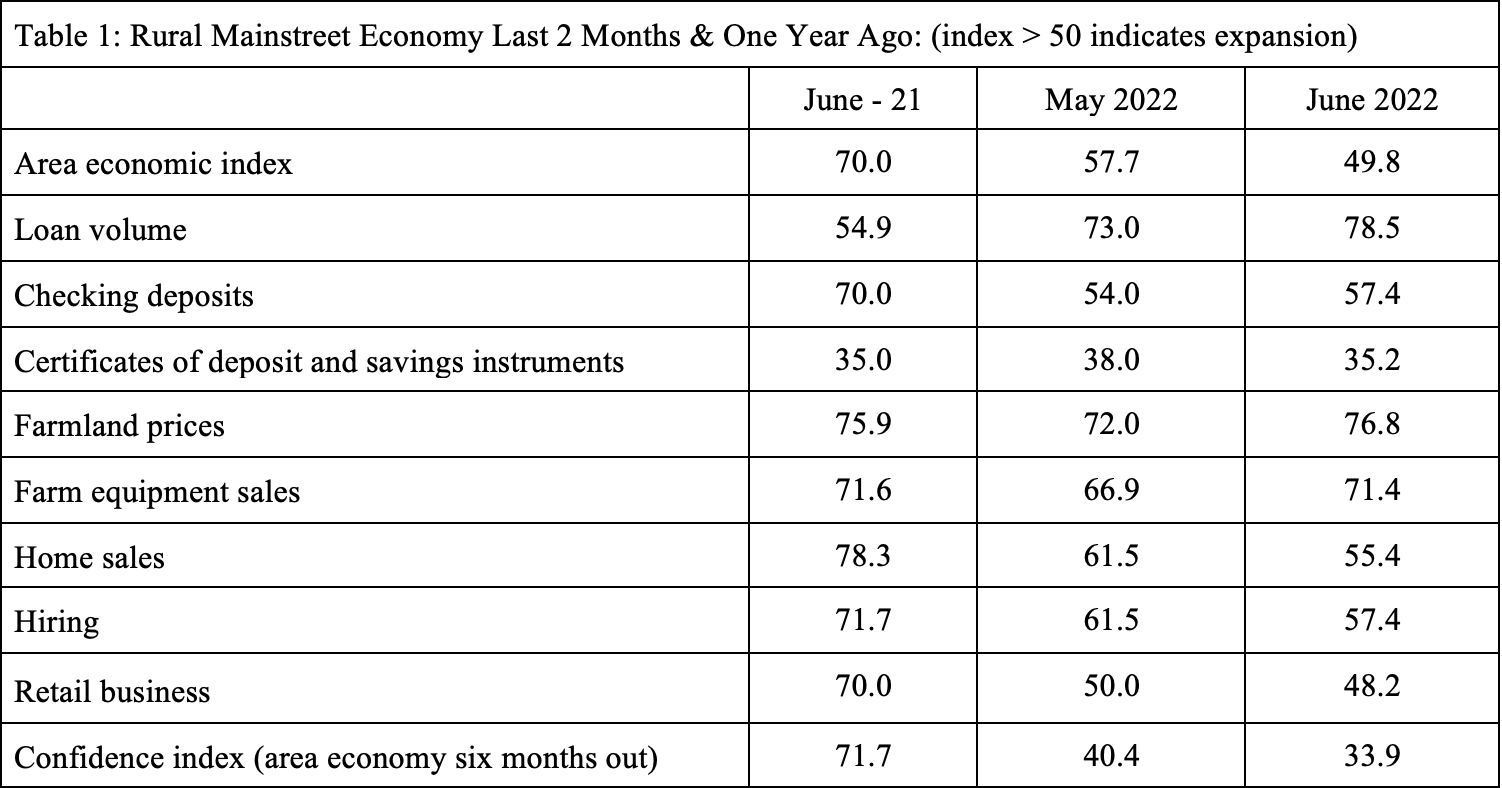 |
| Creighton University chart compares current month to last month and year ago; click here to download it and chart below. |
"Much like the nation, the growth in the Rural Mainstreet economy is slowing. Supply chain disruptions from transportation bottlenecks and labor shortages continue to constrain growth," writes Creighton University economist Ernie Goss, who compiles the index. "Farmers and bankers are bracing for escalating interest rates — both long-term and short-term."

Monday, April 18, 2022
An Appalachian county illustrates how higher gas prices are hitting rural communities hard, from work to groceries
 |
| Owsley County, Kentucky (Wikipedia map) |
In southeastern Kentucky, "The surge in prices has rippled throughout the region, where people already have to drive far to commute to work or school, visit family and run their businesses," Corinne Boyer reports from Owsley County, one of the nation's poorest, for Eastern Kentucky University's WEKU-FM.
Fuel distributor Bob Riley, who serves Owsley County's gas stations, told Boyer the higher costs mean stations hit their credit limit sooner and can't buy as much gas from him. Riley hits his own credit limit sooner, restricting the amount of supply he can have on hand.
Increased fuel prices drive up prices on goods, too, Riley told Boyer: "It also has a big effect on that hot dog you just brought at Kroger's and the produce, all your goods because everything's—at some point in the distribution chain—carried by a truck."
Commuting for college or work has become more prevalent "as population and investment declines in rural parts of the country," Boyer reports. Some people have had to cut back on work hours because they can't afford to drive far away to work at a low-wage job.
Megan Warner, who works at the Owsley County Library, said many city dwellers may not understand what it's like to live in a rural area where jobs don't pay well and housing is limited. "People tell you a lot, too, that you just need to get out there and work hard," Warner told Boyer. "It's hard to work hard when they basically just push you down with all these high prices that probably aren't going to get any lower anytime soon."
Dee Davis, president and founder of the Whitesburg-based Center for Rural Strategies, suggested ways policymakers could help rural communities if gas prices remain high: "Minimum wage can go up. It has been too low, too long. And we can make earned income tax credits permanent."
Two weeks ago, President Biden announced the release of a million barrels of oil per day from the nation's Strategic Petroleum Reserve. Last week, he announced that E15 fuel, which contains more ethanol, will be available for sale this summer.
Wednesday, April 28, 2021
Summer may bring fuel shortages due to tanker-truck driver shortage, could raise farming costs and inhibit tourism
Gasoline may be in short supply at the pump this summer. There's plenty of crude oil and gasoline, but refineries can't find enough qualified tanker-truck drivers to get it to the gas stations.
"According to the National Tank Truck Carriers, the industry's trade group, somewhere between 20% to 25% of tank trucks in the fleet are parked heading into this summer due to a paucity of qualified drivers. At this point in 2019, only 10% of trucks were sitting idle for that reason," Chris Isidore reports for CNN. "Drivers left the business a year ago when gasoline demand ground to a near halt during the early pandemic-related shutdowns."NTTC executive vice president Ryan Streblow told Isidore that driver shortages have been a long-standing issue, but the pandemic "metastasized it" and caused it to grow "exponentially."
Oklahoma tanker-truck executive Holly McCormick cited another factor: "We're also working with an aging work force. Many said 'I might as well take it as a cue to retire.'" She also said the shutdown of many driver schools early in the pandemic disrupted the pipeline of new drivers who would have taken many retirees' places. "And then there's a new federal clearinghouse that went online in January 2020 to identify truck drivers with prior drug or alcohol violations or failed drug tests, which knocked about 40,000 to 60,000 total drivers out of the national employment pool," Isidore reports.
Truck drivers have been in short supply for about 25 years, a problem that has grown more acute in the past five years or so. But tanker-truck driving is more specialized, requiring extra certification and training. "And while the jobs are more attractive than some long-haul trucking jobs that can keep drivers away from home for days or weeks at a time, it is strenuous, difficult work," Isidore reports, adding that a gas shortage and higher prices could raise farming costs and grocery prices, and, if vacationers can't afford to hit the road, that could hurt rural areas that depend on tourism.
Friday, July 17, 2020
Wyoming budget hammered by coal decline, pandemic-spurred drop in oil and gas production and prices
Coal production and jobs have been declining for years, hurting local economies that depend on it. Meanwhile, the pandemic triggered a worldwide drop in energy demand, which meant bottoming out oil and gas production and prices. At the epicenter of both trends sits Wyoming.
Right now, minerals are directly responsible for about two-thirds of the state's revenue. The state's Republican governor, Mark Gordon, said at a press conference Wednesday that one-third of the state's income is gone, that he has no way to raise revenue, and that he must make cuts in order to balance the budget, Lucia reports. He rejected a suggestion that the state could dip into its rainy day fund: "That might last for about a year, and then we have nothing to fall back on."
Friday, December 19, 2014
The decline in oil prices could be a major concern for some energy-dependent states
While many people are probably happy to see a steep drop in prices at the local gas station—the price of crude oil is just above $55 per barrel, down from $105 on July 1—falling oil prices are a concern for some energy-dependent states, Niraj Chokshi reports for The Washington Post. A decline in prices "has already forced officials to revise revenue predictions and, if
the price remains low for long, could force lawmakers to
make substantial budget changes as legislatures reconvene next year."
 Alaska, more than any other state, stands to lose as a result of the falling prices, Chokshi writes. Moody’s Investors Services, the credit rating agency, said in a statement: “Alaska is far more vulnerable than any other U.S. state to the global, political, economic and other factors affecting oil supply and demand,
as well as to local conditions influencing production.” (Fitch graphic)
Alaska, more than any other state, stands to lose as a result of the falling prices, Chokshi writes. Moody’s Investors Services, the credit rating agency, said in a statement: “Alaska is far more vulnerable than any other U.S. state to the global, political, economic and other factors affecting oil supply and demand,
as well as to local conditions influencing production.” (Fitch graphic)
Moody’s analyst Emily Raimes told Chokshi, “This is sort of a big enough bump, we believe, that it could potentially bring Alaska’s rating down if the oil prices continue at this low level and if the state is not able to respond to it in a way that does something other than draw down their reserve."
In addition to Alaska, Louisiana, New Mexico and North Dakota also could feel the impact of lower prices, warns Fitch, another credit ratings agency, Chokshi writes. "In Alaska, energy-related tax revenue accounted for about 92 percent of unrestricted general fund revenue in the 2013 fiscal year. In New Mexico, they accounted for about 17 percent. In Louisiana, 13.5 percent. Despite producing the largest share of crude oil in 2013, oil tax revenue in Texas accounted for well below 10 percent of overall general fund." (Read more)
Alaska, more than any other state, stands to lose as a result of the falling prices, Chokshi writes. Moody’s Investors Services, the credit rating agency, said in a statement: “Alaska is far more vulnerable than any other U.S. state to the global, political, economic and other factors affecting oil supply and demand,
as well as to local conditions influencing production.” (Fitch graphic)Moody’s analyst Emily Raimes told Chokshi, “This is sort of a big enough bump, we believe, that it could potentially bring Alaska’s rating down if the oil prices continue at this low level and if the state is not able to respond to it in a way that does something other than draw down their reserve."
In addition to Alaska, Louisiana, New Mexico and North Dakota also could feel the impact of lower prices, warns Fitch, another credit ratings agency, Chokshi writes. "In Alaska, energy-related tax revenue accounted for about 92 percent of unrestricted general fund revenue in the 2013 fiscal year. In New Mexico, they accounted for about 17 percent. In Louisiana, 13.5 percent. Despite producing the largest share of crude oil in 2013, oil tax revenue in Texas accounted for well below 10 percent of overall general fund." (Read more)
Monday, July 21, 2014
Rural town opens city-run gas station, selling cheaper gas from local refinery to lower prices

Somerset is able to supply residents with the gasoline because the city purchases gas from a hometown supplier, Continental Refining Co., Schreiner writes. "The city purchased a fuel storage facility for $200,000 a few years ago. Now, up to 60,000 gallons of regular unleaded gas can be stored there for the retail business."
The local refinery has struggled to stay open because of competition with Marathon Oil Corp., which makes most of the gas consumed in Kentucky. Marathon has paid haulers of Southern Kentucky oil extra incentives to take oil 172 miles away to a Marathon refinery near the West Virginia border, instead of to the shorter distance to Somerset.
While townspeople have responded positively to the station, there are plenty of critics, Schreiner writes. Convenience store owner Duane Adams called the move a slap in the face that could hurt his business. He told Schreiner, "They've used the taxpayer money that I have paid them over these years to do this, to be against us. I do not see how they can't see that as socialism."
But Girdler, a Republican in his second term, "said the city isn't looking to put anyone out of business," Schreiner writes. He told Schreiner, "We don't care if we don't sell a drop of gasoline. Our objective is to lower the price." A local economic-development coordinator told Schreiner that Somerset gas prices are often 20 to 30 cents a gallon higher than in nearby towns, and Girdler said many visitors to nearby Lake Cumberland "fuel up elsewhere, costing Somerset millions of dollars in retail sales," Schreiner reports.
Friday, May 09, 2014
America's federal transportation money is inside a broken system that badly needs fixing
"America has a transportation funding problem. And if Congress doesn't fix it this summer, it could start doing some real damage," especially in rural areas, Lydia Depillis reports for The Washington Post. "Most big transportation projects -- bridge repairs, new highways,
intercity rail -- are paid for with a stack of local, state, and federal
funds. The problem for funding is that Americans are actually using less gas
than they used to -- both because they aren't driving as much, and cars
are getting more efficient. Meanwhile, Congress hasn't raised the gas
tax from 18.4 cents per gallon since 1994, which is now far behind what
it was then when you take inflation into account."
Instead of raising the tax, or finding some other funding mechanism, Congress has "simply plugged the hole with multi-billion-dollar transfers from the general fund," financed by other taxes, Depillis writes. "The last authorization, a $19.5 billion chunk granted in 2012, expires at the end of this September -- at which point, unless Congress acts, the federal contribution for hundreds of state projects will drop to zero."
"According to calculations by the advocacy group Transportation for America, it could amount to a loss of $46.8 billion compared to current funding levels," which would lead many states to put the brakes on planned projects, Depillis writes.

The White House recently "sent Congress a $302 billion, four-year plan that shifts more money into transit over highways, and relies on corporate tax reform to create new revenue streams," Depillis writes. "But the Senate Environment and Public Works Committee has announced its intention to craft a bill that essentially maintains current funding levels."
States are already experimenting with a few new ideas, including a vehicle-miles-traveled tax, which "would assess fees for the distance you drive rather than the amount of fuel you use (which is a way to make sure electric and hybrid car drivers pay their share for road wear and tear)," Depillis writes. "It's also possible to tweak the gas tax in a way that it responds to increases in transportation costs. Others think it would make more sense to devolve transportation funding to the states entirely, which would free them of the sclerotic congressional process and allow metropolitan areas to be more agile and creative with their transit projects." (Read more)
Instead of raising the tax, or finding some other funding mechanism, Congress has "simply plugged the hole with multi-billion-dollar transfers from the general fund," financed by other taxes, Depillis writes. "The last authorization, a $19.5 billion chunk granted in 2012, expires at the end of this September -- at which point, unless Congress acts, the federal contribution for hundreds of state projects will drop to zero."
"According to calculations by the advocacy group Transportation for America, it could amount to a loss of $46.8 billion compared to current funding levels," which would lead many states to put the brakes on planned projects, Depillis writes.

The White House recently "sent Congress a $302 billion, four-year plan that shifts more money into transit over highways, and relies on corporate tax reform to create new revenue streams," Depillis writes. "But the Senate Environment and Public Works Committee has announced its intention to craft a bill that essentially maintains current funding levels."
States are already experimenting with a few new ideas, including a vehicle-miles-traveled tax, which "would assess fees for the distance you drive rather than the amount of fuel you use (which is a way to make sure electric and hybrid car drivers pay their share for road wear and tear)," Depillis writes. "It's also possible to tweak the gas tax in a way that it responds to increases in transportation costs. Others think it would make more sense to devolve transportation funding to the states entirely, which would free them of the sclerotic congressional process and allow metropolitan areas to be more agile and creative with their transit projects." (Read more)
Thursday, November 14, 2013
How long is the average commute in your area?
The Census Bureau's American Community Survey in 2011 found that 18.3 million American workers lived in rural areas, with 1.4 million, or 7.1 percent, traveling at least 60 minutes one-way to work. New York Public Radio has compiled an interactive map that shows average commute times in most ZIP codes. To view the map, click here. Here's a piece of it, from Cumberland, Md., to Washington, D.C.:
 The Natural Resources Defense Council, an environmental group, found that rural commuters spend the most money on gas, averaging $4,272 per year, compared to $3,347 for suburban residents, $2,180 for urban residents, and $1,857 for those who work at home, Quentin Fottrell reports for The Wall Street Journal. (Read more) (National Household Travel Survey graphic)
 It takes workers in Maryland longer to get to work than employees in any other state, while people in South Dakota have the shortest commute to work, Melissa Maynard reports for Stateline. The average commute time in Maryland in 2012 was 31.9 minutes, while the average commute in South Dakota was 16.7 minutes. The national average was 25.4 minutes. The number of people driving to work alone rose from 75.5 percent to 76.3 percent from 2008 to 2012. More people are working from home, with the number going up from 4.1 percent to 4.4 percent. (American Community Survey map)


Tuesday, October 15, 2013
EPA reportedly in favor of scaling back biofuel blending requirement, to no more than 10 percent
While the Environmental Protection Agency has said 15 percent ethanol is safe for cars, a leaked proposal by EPA shows to supports scaling back biofuel blending requirements to 10 percent next year, a move that's good news for oil refineries and bad news for proponents of biofuels, who "have argued for years that the blend wall is
largely a fiction constructed by an oil industry that doesn't want to
cede any more share of a shrinking U.S. gasoline market," Cezary Podkul reports for Reuters. Most car warranties only cover up to 10 percent ethanol, and most service stations don't sell the 15 percent blend for fear of legal risks.
"If approved, the proposed cut in the biofuel mandate in 2014 to 15.21 billion gallons from 18.15 billion would mark an historic retreat from the ambitious 2007 Renewable Fuels Standard law that charted a path toward ever-greater use of clean, home-grown fuel, which the biofuel industry counts on to underpin bank loans and new factories," Podkul writes. There are already threats of lawsuits. Bob Dinneen, president of the Renewable Fuels Association, an industry group, told Podkul, "Let me be clear: any plan to roll back the targets ... under the guise of addressing the blend wall would be patently unlawful."
The EPA is standing behind a 2007 Congressional general waiver built into the law that allows the agency to reduce ethanol volume "if enforcing the law were to cause economic hardship; or if it were simply not feasible due to 'inadequate domestic supply'," Podkul writes. While ethanol supply is not a problem, last year's drought "prompted a waiver petition from several state governors and food producers concerned about the soaring price of corn, the main ingredient for domestic ethanol production. EPA denied the request. This year, with the blend-wall concerns forcing a jump of almost 2,800 percent in the cost of credits used to enforce the ethanol mandate, the agency itself is proposing for the first time to use a waiver, citing a lack of usable fuel." EPA says in its draft proposal, "We interpret the term 'inadequate domestic supply' as it is used under the general waiver authority to include consideration of factors that affect consumption of renewable fuel." (Read more)
"If approved, the proposed cut in the biofuel mandate in 2014 to 15.21 billion gallons from 18.15 billion would mark an historic retreat from the ambitious 2007 Renewable Fuels Standard law that charted a path toward ever-greater use of clean, home-grown fuel, which the biofuel industry counts on to underpin bank loans and new factories," Podkul writes. There are already threats of lawsuits. Bob Dinneen, president of the Renewable Fuels Association, an industry group, told Podkul, "Let me be clear: any plan to roll back the targets ... under the guise of addressing the blend wall would be patently unlawful."
The EPA is standing behind a 2007 Congressional general waiver built into the law that allows the agency to reduce ethanol volume "if enforcing the law were to cause economic hardship; or if it were simply not feasible due to 'inadequate domestic supply'," Podkul writes. While ethanol supply is not a problem, last year's drought "prompted a waiver petition from several state governors and food producers concerned about the soaring price of corn, the main ingredient for domestic ethanol production. EPA denied the request. This year, with the blend-wall concerns forcing a jump of almost 2,800 percent in the cost of credits used to enforce the ethanol mandate, the agency itself is proposing for the first time to use a waiver, citing a lack of usable fuel." EPA says in its draft proposal, "We interpret the term 'inadequate domestic supply' as it is used under the general waiver authority to include consideration of factors that affect consumption of renewable fuel." (Read more)
Wednesday, August 07, 2013
EPA finalizes Renewable Fuel Standard percentages in four categories; backs off some goals
The Environmental Protection Agency's "final 2013 overall volumes and standards require 16.55 billion gallons
of renewable fuels to be blended into the U.S. fuel supply (a 9.74
percent blend)," Derrick Cain reports for Agri-Pulse, a Washington newsletter. "The
rule reduces the targets of cellulosic biofuels and advanced biofuel
based on current production, gives refineries and importers four more
months to comply with the 2013 targets, and signals that the EPA will
reduce targets in 2014 to address 'blend wall' concerns."
"The EPA standard specifically requires: biomass-based diesel (1.28 billion gallons; 1.13 percent), advanced biofuels (2.75 billion gallons; 1.62 percent), and cellulosic biofuels (6 million gallons; 0.004 percent)," Cain reports. "The 6 million mark for cellulosic biofuels was reduced from a proposed 14 million level among concerns there would not be enough of the fuel to meet that level."
The announcement has drawn mostly rave reviews. Sen. Tom Carper (D-Del.), chairman of the Senate Subcommittee on Clean Air and Nuclear Safety, told Cain, “I have long supported the goals of Renewable Fuel Standard, incentivizing environmentally-friendly options that move our country away from foreign fossil fuels, while safeguarding our energy security. I also strongly believe that as we make investments in renewable fuels to lower our dependency on foreign oil, we must ensure that we don’t have an adverse impact on the environment or our economy.”
Tom Buis, chief executive officer of ethanol producer Growth Energy, told Cain, “We look forward to closely reviewing the final rule and we strongly support increasing levels of renewable fuel into our nation’s fuel supply. The RFS continues to be a resounding success, helping create jobs in America that cannot be outsourced, revitalizing rural economies across the country in addition to reducing our dependence on foreign oil and improving our environment, all while providing consumers with a choice and savings at the pump.”
Danny Murphy, president of the American Soybean Association, said the updated volumes for 2013 will allow “promising growth” of the biodiesel industry, Cain writes. Anne Steckel, vice president of federal affairs for the National Biodiesel Board, said the EPA’s decision will help consumers, create jobs, and reduce emissions. She told Cain, "With nearly 1.1 billion gallons of production last year, the biodiesel industry produced enough fuel to fill 87 percent of the total advanced requirement in 2012."
There is some opposition from groups, such as the Feed Food Fairness Coalition. The group said, “This is just another example of the inflexibility of the RFS mandate, which is imposing numerous unintended consequences, not the least of which is higher food prices for small businesses in the food chain. “The Feed Food Fairness coalition will continue to advocate for a complete repeal of the RFS to put an end to this failed experiment which has helped no one except a small group of special interests, while needlessly harming livestock farmers, food chain businesses and consumers.” (Read more) To read the full report click here.
"The EPA standard specifically requires: biomass-based diesel (1.28 billion gallons; 1.13 percent), advanced biofuels (2.75 billion gallons; 1.62 percent), and cellulosic biofuels (6 million gallons; 0.004 percent)," Cain reports. "The 6 million mark for cellulosic biofuels was reduced from a proposed 14 million level among concerns there would not be enough of the fuel to meet that level."
The announcement has drawn mostly rave reviews. Sen. Tom Carper (D-Del.), chairman of the Senate Subcommittee on Clean Air and Nuclear Safety, told Cain, “I have long supported the goals of Renewable Fuel Standard, incentivizing environmentally-friendly options that move our country away from foreign fossil fuels, while safeguarding our energy security. I also strongly believe that as we make investments in renewable fuels to lower our dependency on foreign oil, we must ensure that we don’t have an adverse impact on the environment or our economy.”
Tom Buis, chief executive officer of ethanol producer Growth Energy, told Cain, “We look forward to closely reviewing the final rule and we strongly support increasing levels of renewable fuel into our nation’s fuel supply. The RFS continues to be a resounding success, helping create jobs in America that cannot be outsourced, revitalizing rural economies across the country in addition to reducing our dependence on foreign oil and improving our environment, all while providing consumers with a choice and savings at the pump.”
Danny Murphy, president of the American Soybean Association, said the updated volumes for 2013 will allow “promising growth” of the biodiesel industry, Cain writes. Anne Steckel, vice president of federal affairs for the National Biodiesel Board, said the EPA’s decision will help consumers, create jobs, and reduce emissions. She told Cain, "With nearly 1.1 billion gallons of production last year, the biodiesel industry produced enough fuel to fill 87 percent of the total advanced requirement in 2012."
There is some opposition from groups, such as the Feed Food Fairness Coalition. The group said, “This is just another example of the inflexibility of the RFS mandate, which is imposing numerous unintended consequences, not the least of which is higher food prices for small businesses in the food chain. “The Feed Food Fairness coalition will continue to advocate for a complete repeal of the RFS to put an end to this failed experiment which has helped no one except a small group of special interests, while needlessly harming livestock farmers, food chain businesses and consumers.” (Read more) To read the full report click here.
Tuesday, September 04, 2012
Drought's short-term impact on food prices pales in comparison to global, long-term factors
The massive drought that hindered much of the Midwest's food production caused food prices to rise this summer, and they will probably rise more, but Science Daily reports much broader factors will have a longer and heavier impact on rising food costs than any U.S. drought.
Food marketing professor John Stanton told Science Daily that price increases from drought are short-term, while increasing demand from the rest of the world for crops including corn will affect prices for years. "The biggest cost in a box of corn flakes isn't the corn," Stanton says. "It's everything from the price of oil to transport the product to the marketing and the packaging. So something like the cost of oil will have a much more lasting effect on the price of your cereal than the supply of crops." (Read more)
Food marketing professor John Stanton told Science Daily that price increases from drought are short-term, while increasing demand from the rest of the world for crops including corn will affect prices for years. "The biggest cost in a box of corn flakes isn't the corn," Stanton says. "It's everything from the price of oil to transport the product to the marketing and the packaging. So something like the cost of oil will have a much more lasting effect on the price of your cereal than the supply of crops." (Read more)
Thursday, June 14, 2012
The ethanol slowdown has begun; corn prices expected to decline at least 20 percent
After a visit to Walhalla, N.D., where Archer Daniels Midland Co. had just closed an ethanol producing plant that was the town's largest employer, Mark Peters writes in The Wall Street Journal that America's ethanol boom is stalling. Further, Peters reports that "the effects are starting to spread across a Farm Belt that had grown accustomed to soaring growth." Annual U.S. production of ethanol more than tripled from 2005 to 2011, driving up crop prices and pumping money into rural communities from Nebraska to North Dakota.
Now, the demand for the corn-based fuel additive appears to have topped out. The amount used in gasoline is near federal mandates, and gasoline consumption is declining. According to the U.S. Energy Information Administration's May forecast, after 15 straight years of growth, ethanol production this year will fall slightly and will be roughly flat next year. (Most of the story is behind a paywall.)
"The ethanol industry expanded based partly on expectations that gas consumption would keep rising, and that ethanol's share of that would continue to grow," Peters writes. "Instead, gas demand this year is projected to be 6.7 percent below its peak in 2007, and efforts to expand ethanol's share face challenges." U.S. plants now face excess capacity, producing less than 14 billion gallons of ethanol a year, with capacity of 14.7 billion gallons, according to the Renewable Fuels Association, an ethanol trade association.
What does this mean for farmers? Writes Peters: "The slump is weighing on prices American farmers get for corn, which rose to record highs in recent years based partly on ethanol demand. The ethanol industry now consumes about 40 percent of corn produced in the U.S., up from around 14 percent in 2005. The Agriculture Department projects corn prices for this year will decline at least 20 percent to an average of $4.20 to $5 a bushel, partly because of flat demand from ethanol producers."
"The ethanol industry expanded based partly on expectations that gas consumption would keep rising, and that ethanol's share of that would continue to grow," Peters writes. "Instead, gas demand this year is projected to be 6.7 percent below its peak in 2007, and efforts to expand ethanol's share face challenges." U.S. plants now face excess capacity, producing less than 14 billion gallons of ethanol a year, with capacity of 14.7 billion gallons, according to the Renewable Fuels Association, an ethanol trade association.
What does this mean for farmers? Writes Peters: "The slump is weighing on prices American farmers get for corn, which rose to record highs in recent years based partly on ethanol demand. The ethanol industry now consumes about 40 percent of corn produced in the U.S., up from around 14 percent in 2005. The Agriculture Department projects corn prices for this year will decline at least 20 percent to an average of $4.20 to $5 a bushel, partly because of flat demand from ethanol producers."
Subscribe to:
Posts (Atom)