Showing posts with label logging. Show all posts

Tuesday, July 21, 2026

'Harm' under Endangared Species Act now means direct harm, not indirect, such as habitat loss; many states object

Protection of northern spotted owls in the Pacific Northwest
under the Endangered Species Act led to the end of logging
in their habitat. (U.S. Fish and Wildlife Service photo by Tom Kogut)
"The Trump administration is removing protections from the key places where endangered species live, saying states can keep the areas safe, but experts say states aren’t equipped for the task," Alex Brown reports for Stateline.

On July 10, the administration finalized regulations redefinng the word "harm" in the Endangered Species Act, to make it cover only cases where endangered animals are directly harmed. That ruled out such actvities as "logging projects that would cut old-growth trees where owls build their nests, and agriculture operations that diverted water from streams where salmon return to spawn," Brown explains.

A 2019 study of animals added to the Endangered Species List from 1975 to 2017 "found that only 17 percent of them faced threats from direct killing, while 81 percent faced habitat loss," Brown reports. The change means “You can destroy the resources a species requires as long as you don’t do it when the species is at home,” Karrigan Börk, a law professor and director of the Center for Watershed Sciences at the University of California Davis Institute of the Environment, told Brown.

"In public comments after the rule was initially proposed, wildlife agency leaders from both liberal and conservative states said the change would be a blow to their conservation efforts," Brown reports. "Wildlife officials in Arizona, Georgia, Louisiana, New Mexico, New Jersey, Vermont and Wyoming also expressed concern about the loss of habitat protections, as did the Association of Fish & Wildlife Agencies, a nonprofit that represents state wildlife managers. Of the public comments reviewed by Stateline, only Alaska’s wildlife agency leader offered wholehearted support for the change. . . . Even if states were to pass laws and invest in programs to protect wildlife habitat, they would be unable to enforce those measures on federal land."

Federal officials said the change would let states "manage wildlife without burdensome federal regulations," Brown writes.  "But legal experts and wildlife veterans say that almost no states have endangered-species laws on the books that allow state officials to prevent habitat destruction in the name of saving wildlife. . . . Many wildlife experts also noted that state wildlife agencies are already underfunded as it is. Taking on the massive regulatory system that prevents developers and extractive industries from destroying critical habitat would require far more resources than those agencies have available. A coalition of environmental groups and tribal nations have filed lawsuits challenging the federal rollback."

Tuesday, July 29, 2025

Northwestern timber industry hopes to revive as Trump administration eyes tariffs, more logging in national forests

Northwestern timber looks for a comeback.
(Photo by Spurwing, Unsplash)
Despite decades of decline, the U.S. northwestern lumber industry is hoping that changes under the Trump administration will revive the industry. "Sawmills have been closing across the Pacific Northwest over the past 30 years," reports Ryan Dezember of The Wall Street Journal. "Owners of the remaining mills have high hopes that President Trump will deliver relief by increasing logging in national forests and raising trade protections against Canadian exports."

Historically, northwestern timber harvesting has been a boom or bust industry for more than a century, with the government stepping in at times to prevent overlogging. In 1994, President Bill Clinton helped pass the Northwest Forest Plan, which "reduced logging on federal lands. In practice, there has been even less logging than the plan prescribed," Dezember explains. "Owners of the remaining mills have high hopes that President Trump will deliver relief by increasing logging in national forests."

Along with harvesting restrictions, cheaper Canadian lumber imports added to the region's timber decline, which has the Trump administration considering timber tariffs. Even if those specific tariffs aren't levied, an ongoing trade dispute is expected to increase Canadian lumber duties to "more than double in the coming weeks to about 34% for most producers," Dezember explains. 

Location of Skamania County in 
Washington. (Wikipedia photo)
While the anticipated duties on Canadian timber or even additional tariffs on its imports can help the area's lumber companies over the next few months, changing federal logging restrictions will take time and planning. "Boosting the federal timber harvest could take years and be impeded by litigation and red tape," Dezember reports. "Regional Forest Service supervisors have been directed to map five-year plans to contribute to a 25% increase in the overall volume of timber harvested from national forests to satisfy Trump’s call for greater wood production."

The slow bleed of logging jobs from the region hasn't just meant lost incomes; it has translated into community budget cuts. Skamania County, Washington, serves as an example. The county is "80% federal forestland and a further 10% or so is controlled by the state," Dezember writes. "That means that the county earns tax revenue on most of its territory from timber receipts, which have slowed to a drip. Recent budget cuts forced the local school district to lay off teachers and close two of its four schools."

Friday, November 01, 2024

Hardwood logging in Appalachia is 'hanging on by a thread.' China, tariffs and U.S. economics all play a part.

A logger in West Virginia posing with a large tulip poplar log.
(National Park Service photo)
Since American colonial times, Appalachians have logged the region's vast forests and run sawmills to prepare cut wood for use, but the industry has been hampered by multiple economic setbacks and faces an uncertain future, reports Paul Kiernan of The Wall Street Journal. "The industry has been in decline for decades. A series of shocks since 2018 has accelerated the decline: a trade war with China, a collapse in exports due to Covid, China’s real-estate slump, and falling U.S. home building." The downturn has had a domino effect on loggers, sawmill workers, truckers and manufacturers.

Once a robust economic sector in Appalachia, logging businesses have closed due to poor market demand and high operational costs. "Roughly two dozen sawmills in the region have gone out of business in the past year or so. . . .The Eastern U.S.’s hardwood production has fallen to its lowest level in records going back to 1960," Kiernan explains. "Workers’ compensation insurance is too expensive for many sawmills to directly employ loggers."

Where two decades ago harvesting hardwood trees was profitable, trade, particularly with China, has decimated U.S. logging businesses and jobs. "Appalachian hardwoods supported thriving manufacturing facilities in nearby towns and cities," Kiernan writes. "North Carolina’s furniture plants, for instance, employed nearly 80,000 workers in 1999, shortly before China’s accession to the World Trade Organization opened the U.S. to Chinese imports. Within 10 years, that number had fallen to 35,000, with most of the jobs shipped overseas."

While some political agendas support protective tariffs, that may not be an easy solution. "Trump says tariffs will bring back manufacturing jobs. Yet the North Carolina furniture business currently employs under 30,000 workers, 20% fewer than when Trump imposed tariffs on China, including on furniture," Kiernan explains. "A worrisome trend for sawmills in recent years is that China has been reducing its imports of finished lumber from the U.S."

Appalachia already has economic worries and the shrinking hardwood industry has added to them. Kiernan adds, "Closing sawmills will accelerate the decline of communities already faced with aging populations and outward migration."

Friday, January 13, 2023

Born to chop and saw, he dissed it; now he aims to be king of lumberjacks in 'original extreme sport' sort of like golf

Jason Lentz (Photo by Natalie Ivis, The New York Times)
How can a man can fall into a life he never wanted? Jason Lentz didn't want the life of a competitive lumberjack when his family tried to thrust upon him: "He certainly fought against it," reports Reid Forgrave of The New York Times. "His father and his grandfather and his great-grandfather, who had worked the Great Depression-era logging camps in Oregon, were all elite lumberjacks. And Jason didn’t want to do it. In fact, he hated it."

Growing up in Webster County, West Virginia, Lentz saw how lumberjacking hurt his family: "Jason hated that lumberjacking took his dad [Mel] away for as many as 11 months a year, barnstorming the country and world in search of competitions and their measly winner’s checks. He could make $500 or $1,000 at a show, but the winnings didn’t amount to much when set beside the cost of equipment and travel," Forgrave writes. "For a time, Mel worked a lumberjack show at Sea World Ohio, while Jason, his mother and his little sister scraped by in West Virginia. Jason blamed the sport for his growing up poor — poor even by the standards of one of the poorest counties in one of America’s poorest states." Jason told the Times, "I didn't want to be anything like him."

Right out of high school Jason dissed lumberjacking and focused on basketball, Forgrave reports, but when his post-college overseas basketball opportunity vanished, Jason was poor and lost. "Then his father put him in touch with a friend who had a job for Jason doing lumberjack exhibitions at Chimelong Paradise, an amusement park in Guangzhou, China," Forgrave notes. "Reluctant to follow in his dad’s steps but out of options, he flew to the other side of the world. There, out from under Mel’s shadow, Jason Lentz was free to find his own path. It led him right back to his father."

In China and then around the world, Lentz found his place as powerhouse lumberjack, "That brute strength is the advantage that Lentz, who is roughly the size of an NFL tight end, holds over virtually all his opponents in the Stihl Timbersports Series, which are the biggest-money events in the sport," Forgave reports. Stihl series calls lumberjacking "the original extreme sport." And for those who may think it's all about brute strength, Forgrave explains: "Lentz and other lumberjacks often compare their sport to golf: Power comes from hip torque instead of arm strength; precision comes from producing a repeatable swing. As in golf, the difference between really good and a champion often depends on mental strength: being able to forget one bad swing and move on to the next."

Mel and Jason Lentz (Natalie Ivis, NYT)
Forgrave recounts Jason's progress and regress: "Lentz did not do well at the 2022 Stihl Timbersports U.S. Championships in Little Rock, Ark. In 2021, he established himself as the best lumberjack in the world, winning pretty much every big event, including his first Stihl world title (which his dad won six times). He has a plan for 2023. He plans to head to Australia in January, where he will spend a few months training. . . . . The Australia portion of his 2023 season will end in April at the Sydney Royal Easter Show, known as the 'Wimbledon of Woodchop.' He thinks he has a chance to win the single-buck title in Australia. Only one American has ever won that title in Sydney: Mel Lentz."

Jason Lentz, 37, told Forgrave, “It’s the maturity thing. It’s like golf. My next 10 years, 13 years — those are going to be my prime.”

Tuesday, January 10, 2023

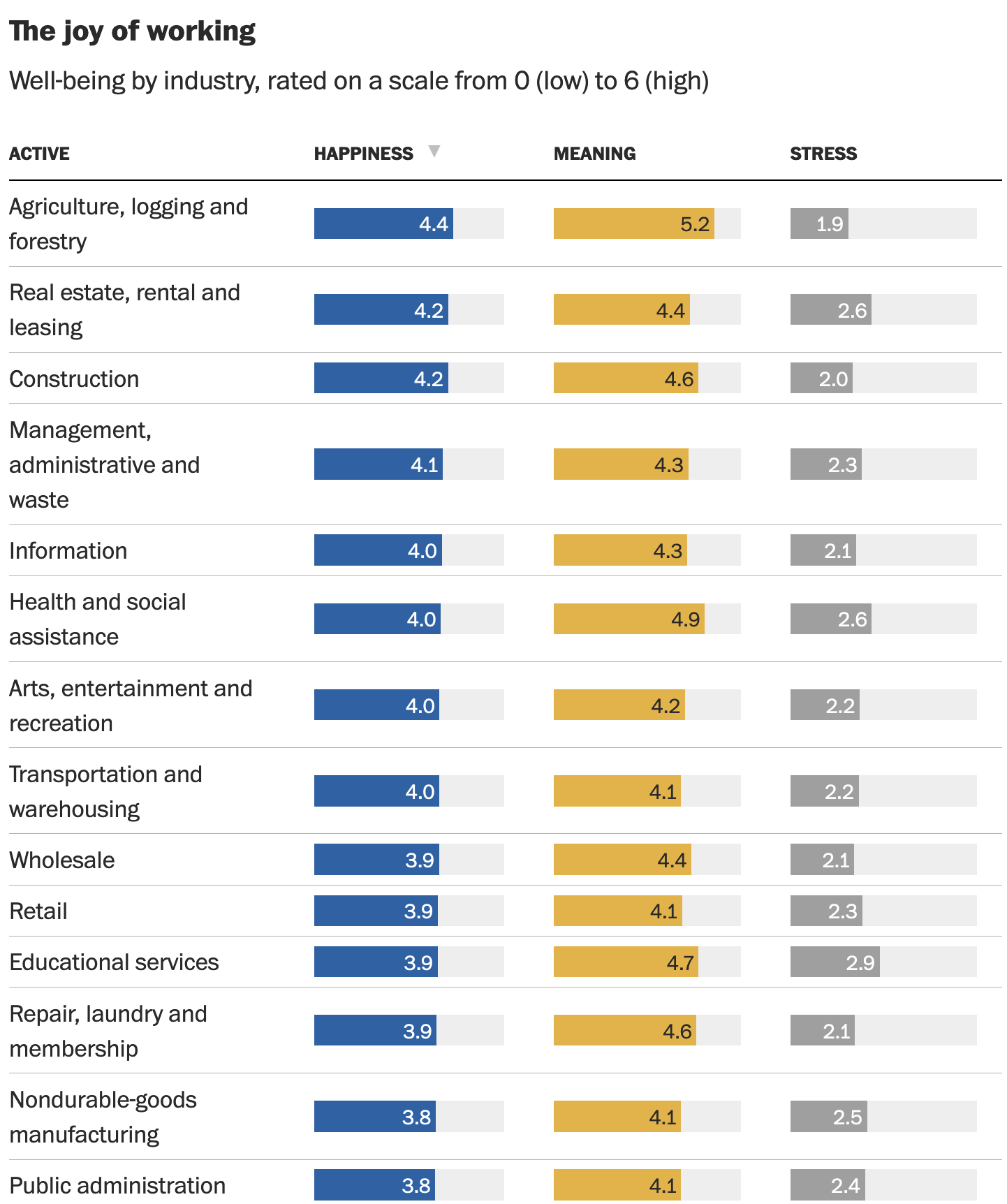
America's forests and its farms are where you find the nation's happiest, least stressful, most meaningful jobs

(Graph by The Washington Post, data from Bureau of Labor Statistics)
Naturalist and ecological thinker John Muir wrote, “The clearest way into the universe is through a forest wilderness.” A new analysis agrees: "Envy the lumberjacks, for they perform the happiest, most meaningful work on earth. Or at least they think they do. Farmers, too," writes Andrew Van Dam of The Washington Post. "Agriculture, logging and forestry have the highest levels of self-reported happiness — and lowest levels of self-reported stress — of any major industry category, according to our analysis of thousands of time journals from the Bureau of Labor Statistics’ American Time Use Survey."

Why would bonding with trees create joy? Van Dam explains: "Researchers across the social and medical sciences have found a strong link between mental health and green space or being outdoors. Even seeing a tree out your window can help you recover from illness faster. So imagine the boost you get from being right next to said tree — even if, like our friend the lumberjack, you’re in the process of chopping it down."

The Post's analysis compares being at work with being in nature: "We found that while your workplace looms as the single most stressful place in the universe," Van Dam writes. "The great outdoors ranks in the top three for both happiness and meaning — only your place of worship consistently rates higher."

Leslie Boby, whose work supports forest-focused outreach across 13 Southern states, told Van Dam that a forester's sense of fulfillment comes from more than being outside: "There’s a point where you are now planting trees that you are not going to see harvested. It speaks to something larger than yourself. … Your work is living on, and someone else will benefit from your efforts in a tangible way.”

Monday, August 29, 2022

Carbon market opening up for smaller forest landowmners

Forester Sarah Hall-Bagdonas talks with Sara Velazquez and Dan
Nelson. (Reuters photo by Carey Biron via The Daily Yonder)
Major rural landowners and philanthropies such as The Nature Conservancy are active players in the carbon market, which pays them for not cutting trees, which use carbon dioxide, the leading greenhouse gas. That's been more difficult for small landowners, but now the American Forest Foundation has a landowners with as little as 30 acres, and such programs are likely to be boosted by the climate bill recently signed by President Biden, reports Carey Biron for the Thomson Reuters Foundation.

Two landowners in the Family Forest Carbon Program are Sara Velasquez and Dan Nelson, who bought 55 acres of forest in northeast Pennsylvania to build their home. "Just after they purchased the land in 2019, however, the pandemic forced them both out of work, raising concerns about how to pay the annual taxes on the land," Biron reports. Neighbors who see logging as "free money up in the woods" asked them about that, but "Now they think they have found a different solution."

The credits that Velasquez and Nelson get under a 20-year contract for preventing "climate-changing emissions will in turn be sold to help corporations such as outdoor outfitter REI move toward their 'net zero' emissions goals," Biron writes. "Velazquez and Nelson, in turn, receive cash that helps them cover their tax payments, plan for revitalizing the forest and, for now, stay away from logging."

Private companies are also in the game. "NCX, which uses satellite imagery and artificial intelligence to gauge carbon-storage potential on small land holdings. It then sells carbon credits," Biron reports. "Since last year, the company has enrolled nearly 2,500 U.S. landowners who hold over 4 million acres, with a median size of around 200 to 400 acres per landowner, it said."

The climate bill has "$450 million to push private landowners toward forest-management practices with climate benefits, according to the nonprofit American Forests. The bill includes a particular focus on underserved communities and family forest owners," Biron notes.

Thursday, June 09, 2022

Northern California county is 'a Democratic bobbing alone in a sea of red,' writes political reporter who went to see why

Alpine County in California (Wikipedia)
Alpine County, California, pop. 1,200, "is as rural as rural California gets," writes Los Angeles Times political reporter Mark Z. Barabak. But it votes "along the same lines as Los Angeles, Sacramento, San Francisco and other urbanized blue bastions," making it "a Democratic speck bobbing alone in sea of red."

To find out why, Barabak went to the county just before the recent primary election. He found several answers, including: It's a lightly populated place (California's least populous county) that became popular with "back to nature" migrants ("With so few people, it didn’t take much beyond word of mouth to help turn Alpine from red to blue"); it has a significant number of Native Americans; and perhaps "Democrats moving in and Republicans moving out as people seek to live among like-minded partisans," a phenomenon described in the 2008 book The Big Sort: Why the clustering of like-minded America is tearing us apart.

And what about the economy, often a determiner of a place's politics? "There is a bit of cattle ranching. There was once some logging. But that dried up long ago, just like the silver mines," Barabak reports. "So there was never the raging battle over natural resources that took place in other rural California counties, turning many residents against the Democratic Party and others foes derided as tree-huggers."

Thursday, October 28, 2021

Study finds agricultural workers 34% more likely to die by suicide than general working-age population

A recently published study found that agricultural workers are an estimated 34% more likely to die from suicide than the total working-age population. The researchers sought to better discern suicide risk among rural residents in general and those in the farming, fishing, forestry and logging industries in particular. Though previous studies have shown these populations are at a higher risk of suicide, the authors of this study believe poor sampling and the relative rarity of suicide may have skewed the numbers. 

Researchers from the University of North Carolina at Charlotte and the University of Kentucky analyzed 29 years worth of data from the National Center for Health Statistics' Mortality-Linked National Health Interview Survey. Here are some of the key takeaways they found:
  • The age-adjusted suicide mortality rate per 100,000 people was 22.3 for farmers and farm managers; 28.7 for those in the farming, forestry and fishing industries overall; 15.3 across all other occupations; and 16.1 among rural residents in general.
  • The overall age-adjusted rate for farmworkers was 21.6. It was 28.3 among rural farmworkers and 17.1 for city-dwelling farmworkers.
  • Age-adjusted results show that forestry and fishing workers have a higher suicide risk than all other occupations. 
The researchers note that the agriculture, forestry and fishing industries employ about 2.3 million Americans, and that they are among the nation's lowest-paid workers, with a median annual salary of about $27,000. Low socioeconomic status is linked with increased suicide rates, possibly contributing to the elevated risk among such workers, they wrote. 

Notably, the study includes data from 1986 through 2017. But over the past few years, poor agricultural conditions and the pandemic have worsened mental health and suicide rates among farmers and rural residents.

Friday, March 05, 2021

Quick hits: Solutions needed for overdue utility bills; Maine 'hackathon' aims to boost rural economic recovery . . .

Here's a roundup of stories with rural resonance; if you do or see similar work that should be shared on The Rural Blog, email us at heather.chapman@uky.edu.

Abandoned oil wells are polluting air and groundwater; who's going to clean it up? Read more here.

Maine and six North Atlantic countries are hosting a 48-hour virtual brainstorming competition offering cash and business-development opportunities for big ideas related to rural economic recovery. Read more here.

Medicare Advantage enrollees living in rural areas are more than twice as likely to switch to traditional Medicare as urban dwellers, according to a new study. Read more here.

Commentary: As Americans, especially poor and people of color, struggle to pay water bills, solutions are past due—especially since utility shutoff moratoriums expire soon. Read more here.

A report from a nonprofit discusses how to attract young people to rural upstate New York (and, by extrapolation, many other areas with similar economies). Read more here.

Scientists are testing a novel treatment that could help fight citrus greening. Read more here.

A federal proposal to change how the federal government classifies metropolitan and nonmetropolitan counties could have big economic implications for rural America. Read more here.

Study: people who live near fracking wells are routinely exposed to harmful chemicals. Read more here.

U.S. agriculture faces new international trade challenges. Read more here.

Oregon's logging industry says it can't afford new taxes, but lumber prices and profits are soaring. Read more here.

Wednesday, December 02, 2020

Trump administration to protect whitebark pine trees due to climate change, beetles and lethal fungus infection

A dead whitebark pine tree near Jackson Hole, Wyo. (Associated Press photo by Mead Gruver)

"Climate change, voracious beetles and [a lethal fungal] disease are imperiling the long-term survival of a high-elevation pine tree that’s a key source of food for some grizzly bears and found across the West, U.S. officials said Tuesday," Matthew Brown reports for The Associated Press. The Fish and Wildlife Service will publish a proposal in the Federal Register today to protect the whitebark pine tree as a threatened species under the Endangered Species Act.

The whitebark pine's habitat spans more than 80 million acres across seven Western states and Canada, the largest geographic area of any other tree listed as an endangered species. But more than half of all standing whitebark pines are already dead, according to a 2018 Forest Service Study, Dino Grandoni reports for The Washington Post

"The decision to declare the tree endangered due to climate change is an unusual one for an administration that often dismisses that threat," Grandoni reports. And, the listing may have "implications for loggers who would have to work around the protected pine on U.S. Forest Service land. About 88 percent of the tree’s range in the United States is on land managed by the federal government."

Fish and Wildlife isn't protecting specific habitats as necessary to the tree's survival because the agency argues the fungus is the threat, not habitat decline.

Friday, September 25, 2020

Quick hits: fires spark conspiracy theories, threaten Oregon timber economy; lack of students hurts college towns

Here's a roundup of stories with rural resonance; if you do or see similar work that should be shared on The Rural Blog, email us at heather.chapman@uky.edu.

Small college towns feel the financial pain from the lack of students. Read more here.

Montana officials struggle to get rural residents counted in the census. Read more here.

The decision to shorten the census schedule came from outside the Census Bureau, according to the Commerce Department's inspector general. Read more here.

Conspiracy theories about Western wildfires, including claims that some were started by antifa arsonists, are making things harder for emergency responders. A Facebook official discusses the company's efforts to remove misinformation about the fires and their broader attempts to quell the spread of misinformation online. Read more here.

Oregon's timber economy faces an uncertain future after record wildfires. Read more here.

In slumping energy states, plugging abandoned wells could provide an economic boost. Read more here.

Friday, August 28, 2020

Agribusinesses got 1.5% of Paycheck Protection Program's forgivable loans; among them, dairy was the top sector

The 10 agribusiness sectors that got the most PPP funding. (Part of a Midwest Center for Investigative Reporting chart; click the image to enlarge it or click here for the complete and interactive version.)
"A very small percentage of businesses in the agriculture industry received Paycheck Protection Program, or PPP, loans, which were intended to help keep people employed as the economy convulsed during the coronavirus pandemic," Samuel Trilling and Pramod Acharya report for the Midwest Center for Investigative Reporting. "Of the agricultural companies that did receive loans, dairies received the most."

But even though the dairy sector won out among agribusinesses with the PPP, agribusinesses received only 1.5% of PPP funds. About half of the program's loans went to four industries: construction (13%); health care and social assistance (12.7%); professional, scientific, and technical services (12.7%); and manufacturing (10.4%), Trilling and Acharya report after analyzing federal data released in July.

Wednesday, July 08, 2020

Timber communities in Oregon suffer as Wall Street funds glean profits and tax revenue from private forest lands

"Falls City is an Oregon town built by the timber industry. Its surrounding forests are still being logged. But Falls City isn't seeing the profits. It's been that way ever since corporate timber changed the rules," says the caption for this video.

Rural logging communities in Oregon are suffering as profits and tax revenue have been siphoned by Wall Street investment funds’ growing control of private forest lands, reports ProPublica, in partnership with Oregon Public Broadcasting and The Oregonian.

In Falls City, a town of about 1,000 in the Coast Range, "More trees are cut in the county today than decades ago when a sawmill hummed on Main Street and timber workers and their families filled the now-closed cafes, grocery stores and shops selling home appliances, sporting goods and feed for livestock," report Tony Schick of OPB, Rob Davis of The Oregonian, and Lylla Younes of ProPublica. "But the jobs and services have dried up, and the town is going broke. The library closed two years ago. And as many as half of the families in Falls City live on weekly food deliveries from the Mountain Gospel Fellowship."

“You’re left still with these companies that have reaped these benefits, but those small cities that have supported them over the years are left in the dust,” City Manager Mac Corthell told a reporter.

"Wall Street real estate trusts and investment funds began gaining control over the state’s private forest lands" while public attention was focused on environmental rules that limited logging on federal lands, the reporters write. "They profited at the expense of rural communities by logging more aggressively with fewer environmental protections than in neighboring states, while reaping the benefits of timber-tax cuts that have cost counties at least $3 billion in the past three decades. . . . Half of the 18 counties in Oregon’s timber-dominant region lost more money from tax cuts on private forests than from the reduction of logging on federal lands."

Monday, June 15, 2020

Unusual USDA order opens door to more grazing, logging and development in national forests and national grasslands

Agriculture Secretary Sonny Perdue "ordered the U.S. Forest Service to expedite environmental reviews on its land, paving the way for more grazing, logging and oil development on public lands," Rebecca Beitsch reports for The Hill.

Perdue announced the order Friday during a visit to Montana, a state where "ranchers, miners, and oil and gas workers have long argued for increased access to public lands," Beitsch reports. It's also one of the states with a U.S. Senate race that could help switch control of the chamber to Democrats.

The order came in the form of "an unusual memo" to Forest Service Chief Vicki Christiansen that "lacks the formal letterhead or signature typical with such documents, and mainly sets broad goals for the Forest Service rather than laying out any specific policy directives," Beitsch reports.

Randi Spivak, director of the Center for Biological Diversity's public lands program, said the order would not only hurt the environment, but said it was essentially a political stunt meant to help Sen. Steve Daines, R-Montana, who is relying heavily public-lands issues in his campaign to defend his seat against former Montana governor Steve Bullock, Beitsch reports.

The U.S. Senate recently passed a bill to fully and permanently fund the Land and Water Conservation Fund at $900 million annually. The move was seen as an effort to help Daines and fellow Republican senator Corey Gardner of Colorado in their re-election bids.

Wednesday, January 29, 2020

Proposed protections for whopper crawdads could tighten regulations on Central Appalachian mining, logging

With adults that top 7 inches, the Big Sandy crayfish is one
 of the largest "crawdads." (US Fish & Wildlife photo)
"A threatened species of crayfish could receive new protections under a proposal submitted Tuesday by the U.S. Fish and Wildlife Service that might lead to new regulations on coal mining, logging and other development in Eastern Kentucky," Will Wright reports for the Lexington Herald-Leader.

Under the proposal, 362 miles of waterways in Appalachian areas of Kentucky, Virginia and West Virginia would be designated as "critical habitat" for the Big Sandy crayfish, a species listed as threatened in 2016 under the Endangered Species Act, Wright reports. The proposal also seeks protections for the endangered Guyandotte River crayfish, native to southern West Virginia. The proposal notes that critical-habitat designations are granted to areas that are essential to the conservation of threatened and endangered species that may need extra protection.

The proposal names mining, logging and natural-gas drilling as some of the species' biggest threats. A spokesman for the FWS said it is working with coal companies "to address the conservation of both species," Wright reports. "The public can submit official comments through March 30."

The proposal was spurred by a 2018 lawsuit against FWS by the left-leaning Center for Biological Diversity, an organization that often sues the federal government over proposed changes to the Endangered Species Act. The organization alleged the agency hadn't designated critical habitats for the crayfish within the timeline required by the act.

Zack Crouch, the at-risk species biologist for the Kentucky Department of Fish and Wildlife Resources, said granting the crayfish extra protections wouldn't prevent development, but would require developers who receive federal funding or permits to consult with FWS to ensure that their actions won't harm the species' habitat, Wright reports. 

Monday, July 29, 2019

Governors discuss strategies to help rural economies

At last week's annual meeting of the National Governors Association in Salt Lake City, leaders from across the nation discussed innovative ways to boost flagging economies in rural areas.

"Rural America is too vast and varied to paint with a single brush. Many rural areas are thriving. Still, it’s clear that overall, the rural economy is falling far behind major metropolitan counties," Alan Greenblatt reports for Governing. "Urban areas enjoy an outsized share of the nation’s economic growth, while 30 percent of rural ZIP codes have experienced downward mobility over the past decade. Only one in five small counties has added businesses, on net, since the Great Recession."

Rural areas also lag metropolitan areas in population growth, educational attainment, and workforce participation as well. South Dakota Gov. Kristi Noem noted that "We educate a lot of these students and then they leave to take jobs . . . That's probably been our biggest challenge."

Nathan Ohle of the Rural Community Assistance Partnership noted that rural jobs have historically been involved in extraction of resources, meaning harvesting crops, mining, and logging, for instance, Bethany Rodgers reports for The Salt Lake Tribune.

Many governors have championed initiatives with similar themes, including broadband expansion, building workforce housing, and expanding Medicaid, but no single approach can work because different rural economies are based on different things like tourism or agriculture. Brian Depew, executive director of the Nebraska-based Center for Rural Affairs, suggested that it's smarter to spend more money on education and health care than on broadband or housing, Greenblatt reports.

"All these factors mean that spreading prosperity to more rural areas remains a thorny challenge that will take a considerable amount of time to work through," Greenblatt reports. "Scott Hamilton, executive director of the Appalachian Regional Commission, told governors the job was like building a cathedral in Europe, with the person laying down the cornerstone perhaps not living to see the end result." Among the suggestions: let rural leaders take a larger role in developing economic development plans. Also, listen to rural residents when they say what they need and help rural leaders shoulder the burden, Greenblatt reports.

Wednesday, June 05, 2019

Logging safety issues examined in academic journal

An academic journal has devoted a special issue to the dangers in the logging and forestry industries.

It's a big problem: "The United States is the top timber-producing nation in the world, but that distinction comes with a cost: Harvesting timber is America’s most dangerous occupation. Over the past decade, an average of 66 loggers died each year, at a fatal injury rate more than 30 times the all-industry average," Scott Heiberger writes for the National Farm Medicine Center. "Loggers’ work is physically demanding. It is carried out in remote locations amidst unpredictable weather and rough terrain. Loggers deal with massive weights and irresistible momentum of falling, rolling, and sliding trees and logs. Most injuries involve trees and other falling objects."

The current issue of the Journal of Agromedicine is all about health and safety issues in the timber and forestry industries. That includes immigrant workers, technology, injury data collection, regional logging systems, firefighting, tree planting, and pruning, Heiberger writes. Read the 13 articles here.

Thursday, May 30, 2019

Native American and non-native rural residents team up to defend lands from what they see as threats to environment

Zoltan Grossman's examples of environmental alliances between Native Americans and non-natives
Rural areas tend to be conservative, but in places with Native Americans who are empowered by treaty rights, they "are beginning to shift the values of their white neighbors toward a populism that cuts across racial and cultural lines to challenge large corporations," Zoltan Grossman writes on The Conversation. "By teaming up to defend the place they all call home, they are protecting their lands and waters for all."

Grossman is a geographer who wrote about the relationships between tribes and rural non-Native farmers, ranchers, and fishers in his book Unlikely Alliances: Native Nations and White Communities Join to Defend Rural Lands. The two were once mostly at odds. "Ever since Native Americans began to reassert their treaty rights to harvest fish, water and other natural resources, starting in the 1960s in the Pacific Northwest, a far-right populist backlash from some rural whites has sparked racial conflicts over those resources," Grossman writes. "But starting in the late 1970s, some Native nations across the country joined with their rural white neighbors — including people who had been their adversaries in treaty conflicts — to block threats to rural lands and waters, such as mining, pipeline, dam, nuclear waste and military projects."

That partnership has shown up this decade in groups such as the Cowboy Indian Alliance, which opposed the Keystone XL oil pipeline. More recently, fishing groups and Native nations in the Pacific Northwest are teaming up to oppose coal and oil export terminals and advocate for restoring fish habitats damaged by development. "The mostly white working-class residents of former logging towns in the area, who have strongly opposed timber industry regulations, have worked more easily with local tribes than with urban environmental groups to protect their local economy from fossil fuels," Grossman reports.

Non-native rural residents have found that sovereign tribal nations can more easily take fights to the federal level in a way that state and local governments can't. And Native Americans may be more motivated to fight because the survival of their cultures depends on winning. "They can’t simply move away from environmental hazards, because they have harvesting rights only within their treaty territory, and their identities and cultures are rooted in a particular place," Grossman reports.

Monday, April 22, 2019

Nature Conservancy buys 100,000 acres in Ky. and Tenn.; timbering, mining will continue; mineral estate is separate

Nature Conservancy map
The Nature Conservancy announced today that a timber company has sold it 100,000 acres of forest land in the Cumberland Mountains of Kentucky and Tennessee that will continue to be logged for timber -- and mined for coal, because only the surface of the property is changing hands, not the mineral estate.

Tyler Whetstone of the Knoxville News Sentinel asked Terry Cook, Tennessee director for the national nonprofit organization, about the likelihood of mining. He writes, "Cook downplayed this possibility and said if there was mining on the property, it would be on a “very small percentage” and said TNC would work with the company to restore the land." Reclamation of mined land is required by federal law, but the quality of reclamation varies with state regulation and landowner attitudes. The Nature Conservancy said it would try to minimize the impact of mining, Matt Mencarini reports for the Louisville Courier Journal.

David Phemister, Kentucky director of The Nature Conservancy, "would not comment on what percentage of the purchase price was financed by carbon offsets," through which industries mitigate their carbon pollution by financing projects that absorb carbon, WDRB-TV in Louisville reports. "He said the land is privately owned and the seller was a single client of Jackson, Miss.-based Molpus Woodlands Group."

The Nature Conservancy said the tract, called Ataya, would be one of its largest conservation and ecological restoration projects in Central Appalachia, and its research has shown the Cumberland Mountains to be "one of the nation’s most important corridors for animal migration as the region’s climate changes," Whetstone reports. Like the Great Smoky Mountains to the southeast, they "are especially crucial because the varying elevations and topography provide habitat diversity for birds and dozens of mammals. That all of that is preserved in mostly one large chunk of land is a plus, Cook said."

The group said it would work with local communities to support opportunities for outdoor recreation and nature-based tourism, among other things. “It’s not going to be set up as a preserve that keeps people out, but we’re going to work with our local partners and the communities,” Cook said. “The public will have access to it.” The property will link to three publicly owned preserves: Kentucky Ridge State Forest, the North Cumberland Wildlife Management Area in Tennessee, and Cumberland Gap National Historical Park in the two states and Virginia.

Tuesday, January 15, 2019

Trump order to prevent wildfires may not help much, and would increase logging on public land

President Trump's recent executive order, meant to prevent wildfires, would dramatically increase logging on public land, Sara Sorcher reports for The Washington Post.

The order, issued the Friday before Christmas, "instructs the secretaries of agriculture and interior to consider harvesting a total of 4.4 billion board feet of timber from forest land managed by their agencies on millions of acres, and put it up for sale. The order would translate into a 31percent increase in forest service logging since 2017," Darryl Fears and Juliet Eilperin report in another story for the Post. "In addition to removing trees, Trump asked his secretaries to remove forest brush and debris that help fuel fires from more than 4 million acres and treat another 1.5 million acres to control tree-destroying pests."

Some experts say such actions won't help very much. Jennifer Balch, a fire ecologist and professor at the University of Colorado Boulder, told Sorcher in an email that, while treating federal forests near homes is sensible, it won't help with the huge wildfires out West. Hot and dry weather is the biggest problem, she said, and that problem will continue to get worse in the future.

The Trump administration wants the logging to continue even though the U.S. Forest Service is closed for the duration of the federal shutdown and can't do the more effective work of clearing the dry brush that helps wildfires spread, Sorcher notes.