Showing posts with label broadcasting. Show all posts

Friday, August 18, 2023

News-media roundup: Wash. papers held out for right buyer; W.Va. public-media chief quits; Ariz. news lobbies merge

Leavenworth and Chelan County,
Washington (Wikipedia map)
The publisher of four weekly papers in north-central Washington kept "them going, barely, until new owners were found to revive them," reports Brier Dudley, free-press editor of The Seattle Times. After declining several offers, Carol Forhan sold the Leavenworth Echo, the Cashmere Valley Record, the Lake Chelan Mirror, the Brewster-based Quad City Herald and the monthly Wenatchee Business Journal to Terry Ward and Amy Yaley. Ward, a former reporter and longtime newspaper manager and publisher, told Dudley, “I think there’s a strong opportunity for a long life ahead of them.” Dudley writes, "That’s refreshing to hear from the new owner of newspapers that barely survived a plunge in business during the pandemic."

TV has challenges too: For the first time, broadcast and cable TV viewers now account for less than half of television usage in the United States "even as the prices of streaming services rise," CNBC reports on Nielsen’s monthly streaming report, The Gauge. "Usage among pay-TV customers fell to 29.6% of TV, while broadcast dropped to a 20% share during the month. Streaming made up nearly 39% of usage in July, the largest share reported since Nielsen’s first time reporting the monthly numbers in The Gauge in June 2021. . . . Year-over-year, pay-TV viewership was down 12.5%, while broadcast was down 5.4%."

West Virginia Public Broadcasting's executive director has quit after a year on the job, "the latest sign of upheaval at a news outlet recently shaken by a reporter’s allegation that she was fired for writing an unfavorable story about a division of the state health department," reports John Raby of The Associated Press. "Butch Antolini, former communications director for Gov. Jim Justice," gave no reason for his resiugnation in a letter to WVPB's board. Eddie Isom, chief operating officer and director of programming, was named interim director.

Arizona news-media trade groups merge: Following the lead of some other states, the Arizona Broadcasters Association and the Arizona Newspapers Association are merging to create the Arizona Media Association. I wish they had followed the examples of Ohio and Pennsylvania and named it the News Media Association, since the public increasingly has difficulty distinguishing among news media, social media and other forms of digital media. --Al Cross, director emeritus, Institute for Rural Journalism and Community Issues

Sunday, June 18, 2023

North Country Public Radio wins 3 Sigma Delta Chi awards; coverage of wildfires, prisons, Uvalde shooting also win

A disabled mother and daughter in northern New York lived
in this tent and in their car. (North Country Public Radio)
Several of the Sigma Delta Chi Awards for excellence in journalism, announced Saturday night by the Society of Professional Journalists, had rural resonance.

The rural media standout was North Country Public Radio, based in Canton, the seat of St. Lawrence County, New York. Its report on affordable housing, or the lack of it, won the award for public service in radio, and its report on uninspected housing for dairy workers won the award for small-market radio feature reporting. NCPR also won the contest's new award for regional political reporting with its profile of U.S. Rep. Elise Stefanik, chair of the House Republican Conference, whose district coves most of NCPR's coverage area, where it has 33 transmitters.

A prison in rural Illinois was the topic of "How the newest federal prison became one of the deadliest," a two-part story by NPR and The Marshall Project, which advocates criminal-justice reform. The package won the award for radio investigative reporting. The Intercept's five-part report on the effect of global warming and climate change on prisons and inmates won the award for science, environment or climate reporting.

Coverage of two major wildfires won awards. CBS's "60 Minutes" won the award for television investgative reporting for “What Happened at Grizzly Flats,” a California town destroyed by a mismanaged forest ifre; and KUSA-TV of Denver won the award for TV documentaries in large markets for “The story behind the Marshall Fire” near Boulder. 

Also in broadcasting, Virginia Public Media won the award for small-market television feature reporting for its story on black descendants of Thomas Jefferson; Scripps News and the Center for Investigative Reporting won the award for narrative podcast or radio documentary for their six-part "Inside the global fight for white power;" and NPR won the radio feature reporting award for interviews with the mother of one of the victims of the 2012 Sandy Hook, Conn., school shooting.

Journalism about the mass shooting at Robb Elementary School in Uvalde, Texas, last spring, received two SDX awards. KPRC-TV in Houston won for deadline reporting, and the San Antonio Express-News won the large-market editorial award for its "Standing with Uvalde" series. David Plazas of The Tennessean won the smaller-market award for a collection of editorials. Jake May of the Flint Journal was a double winner for feature photo and small-circulation breaking-news photo.

Other awards of general interest included:
Fact checking: Glenn Kessler of The Washington Post for "The truth about Hunter Biden."
Washington correspondence: Nick Grube of Honolulu Civil Beat, for coverage of Hawaii's congressional delegation.
Editorial cartooning: Michael Ramirez, Las Vegas Review-Journal (small markets), and Gary Markstein, Creators Syndicate.
Magazine writing: Lizzie Presser of ProPublica and The New York Times Magazine for "I was never ready for this," a profile of a teenager from Copperas Cove, Texas, who became the mother of twins after a judge refused to let her get an abortion.
General column writing: Melinda Henneberger of The Sacramento Bee, for five columns.

Friday, June 09, 2023

To regular listeners of NPR, Wade Goodwyn needed no introduction, with his rich, deep Texas bass; he's dead at 63

Wade Goodwyn (NPR photo)
Wade Goodwyn, whose deep, rich Texas bass made him one of the most distinctive voices on the national radio landscape, died Thursday of cancer. He was 63.

"For more than 25 years, Wade reported on his home state of Texas and the southwest United States," Debbie Elliott reports for NPR, which counted Goodwyn as part of its National Desk. "A profile once described his voice like "warm butter melting over barbecued sweet corn." But Goodwyn argued that his writing is what really mattered. And he was right. If his voice pulled you in, his way with words kept you listening."

NPR CEO John Lansing said, "From the first words of one of his stories, you always knew you were being taken on a journey by a master of our craft. You were in for a true treat, whatever the subject matter." Elliott cites this line from his coverage of Hurricane Rita in 2005: "In Louisiana, you hug your NASCAR teddy bear when the big blow comes, even if you're a barrel-chested National Guardsman."

"Goodwyn was a history major at the University of Texas, a natural field of study for the son of noted historian Lawrence Goodwyn, who had been active in the civil rights movement and wrote books on grassroots populism," Elliott recounts. While working as a political organizer in New York City, Wade was "so absorbed by the voices and stories he heard" on WNYC that "decided to pursue a freelance public radio career back home in Texas (where the rents were more affordable). He started freelancing for NPR, and was assigned in 1993 to cover a high-profile story — the standoff between the federal government and cult leader David Koresh in Waco."

Elliott adds, "Wade had a bit of a cult following among listeners who loved the way only he could spin a tale, ever eager to share Texas cultural gems and bits of forgotten history and folklore like a remembrance of sharpshooter Joe Bowman, who Wade said 'was so good with a single-action revolver, he could turn an aspirin into powder at 20 yards ... could take a playing card, set it on edge, and peel it in two with a single bullet.'"

Wednesday, May 24, 2023

Ford does a U-turn; all its vehicles will still have AM radio

Photo by Caleb White, Unsplash
If you were looking at buying a new Ford vehicle, especially if you travel out yonder, you will probably be glad to learn that Ford Motor Co. has changed its tune on AM radio and will include it in all its cars, trucks and SUVs, reports Tom Krisher and Wyatte Grantham-Philips of The Associated Press. "CEO Jim Farley wrote in social media postings Tuesday that the company is reversing a decision to scrub the band after speaking with government policy leaders who are concerned about keeping emergency alerts that often are sounded on AM stations." Farley wrote on Twitter, "We've decided to include it on all 2024 Ford and Lincoln vehicles. For any owners of Ford's EVs without AM broadcast capability, we'll offer a software update."

"The move comes after a bipartisan group of federal lawmakers introduced a bill Wednesday calling on the National Highway Traffic Safety Administration to require AM in new vehicles at no additional cost. . . . . Sen. Edward Markey, D-Mass., one of the bill's sponsors, said eight of 20 major automakers including Ford, BMW and Tesla have pulled the band from new vehicles," Krisher and Grantham-Philips write. The Kentucky Broadcasters Association reports, "Sponsors of the 'AM for Every Vehicle Act' cited public safety concerns, noting AM's historic role in transmitting vital information during emergencies, such as natural disasters, especially to rural areas."

Amplitude-modulation radio continues to have a dynamic public presence. "With tens of millions of listeners, it serves as a vital lifeline to the public and a critical source of community news and exchange of diverse ideas," KBA reports. "The National Association of Broadcasters commends Ford for this commitment, which will keep Americans safe and informed, particularly in times of emergency. . . . In light of Ford's announcement, NAB urges other automakers who have removed AM radio from their vehicles to follow Ford's lead and restore this technology in the interest of listeners and public safety. . . . Supporters of the AM Radio for Every Vehicle Act. . . are helping to shine a light on the need to keep this critical service in all cars."

Friday, May 19, 2023

ABC News spent a year in Uvalde, Texas, after the school shooting; its report is on the air tonight and Hulu tomorrow

Nicco Quiñones of ABC News films inside the home of Jerry and Veronica Mata. Their daughter Tess, pictured on the wall, was one of 19 students shot and killed in Uvalde, Texas, last May. (Photo by Jenny Wagnon Courts/ABC News via AP)
By David Bauder
Associated Press

After most mass shootings that capture the public’s attention, national news organizations will send reporters for a few days, a week maybe, before moving on. There’s always another community, another tragedy.

ABC News tried something different after 19 elementary school students and two teachers were shot and killed in Uvalde, Texas, last May. The journalists stayed.

For a year, ABC kept a team in Uvalde. The result is a nuanced portrait of what happens over time to a suffering community, as seen in the two-hour documentary, “It Happened Here — A Year in Uvalde,” that airs Friday on ABC and Saturday on Hulu.

“What we discovered has been profoundly moving and inspiring and, we hope, useful,” said ABC News President Kim Godwin.

The story’s richness is in the details: There are the children’s rooms left undisturbed since May 24, 2022, the brush a parent can’t give up because it contains a dead girl’s hair, the survivor made upset by the sound of a block of ice being cracked, and the once-carefree boy who worries a lot. And we see a father who sits at his daughter’s grave each night to talk to her.

There are those who lived but deal every day with survivor’s guilt, and there’s the mother who torments herself for not letting her daughter come home with her after a morning awards assembly.

Uvalde County (Wikipedia map)
ABC’s idea was born out of a desire to bring something new to stories that have taken on a numbing familiarity. “I don’t think that any community should be defined by a tragedy that befalls it,” said Cindy Galli, executive producer of ABC’s investigative unit.

A core team of about a dozen people were assigned to the project, a significant commitment at a time when ABC News, like many other news organizations, is cutting staff. The team, with reporters John Quiñones, Maria Elena Salinas and Mireya Villarreal, rotated in and out depending on other assignments.

The project enabled the journalists to get to know community members and build trust by talking to them without cameras running all the time, she said.

“One of the aspects of being in a small community is that we would run into people at Starbucks or the grocery store,” Galli said. “They knew that we were there and knew that we were there for the long haul.”

That was important to families dealing with their grief, said Kimberly Rubio, whose daughter Lexi was killed in the attack. Rubio was featured in a segment early in the film, talking about how she uses time spent jogging to reflect upon what happened to her daughter.

“It also helped that it wasn’t different reporters all the time,” Rubio said. “I had two that I worked with. It made it much easier for me to be vulnerable.”

The ABC team filed more than 200 stories during its time in Uvalde, Galli said. Their presence enabled them to break news, such as when Quinones got the first interview with a woman falsely accused of leaving a door open at the school that the killer used for access.

Questions about why it took police more than an hour to enter the affected classrooms kept Uvalde in headlines longer than most mass shootings. ABC’s access deepened the documentary’s narrative retelling of the story, with recordings of a chilling 911 call from a trapped girl pleading for a police response to the gunman.

“I had a pencil,” said Arnie Reyes, a teacher injured that day whose recovery is followed by ABC. “It’s not the same battle.”

The documentary talks about tensions in Uvalde between affected parents and people who supported school administrators and police. That aspect of the story points out a hole in the ABC team’s reporting, although it’s not necessarily their fault: The network had trouble getting people in law enforcement and their supporters to talk.

Lexi’s dad, Felix Rubio, eventually resigned his job as a deputy police officer, explaining that he couldn’t go back to work with people who didn’t rush into the school to try and save the children.

The film also traces the growing activism of Kimberly Rubio and 10-year-old Caitlyne Gonzales in seeking legislation to prevent future school shootings.

John Quiñones (ABC News photo)
“There are vital details, nuances that are missed, when we as reporters parachute in and out” of a story, Quinones said.

The extended assignment meshed with how Quiñones likes to report such stories. He doesn’t see the point of reporters trying to force themselves on people when they don’t want to talk. There were times when he had to step away, like when a family he’d been talking to learned that their child might have survived if police had moved more quickly.

The entire experience was eye-opening for the network, Galli said. Following the Uvalde team’s lead, an ABC digital team is spending time in Buffalo, where 10 people were killed in a mass shooting, also in May 2022.

Quiñones, a Mexican American who grew up in nearby San Antonio, said the extended Uvalde assignment has been the most powerful story he’s ever been involved in.

“There’s no doubt in my mind that this is the kind of story that will live with me forever,” he said.

Friday, May 12, 2023

News-media roundup: Washington state helps local media; States Newsroom opens its 33rd outlet there . . .

Rob Manch of WFMZ-TV in Allentown, Pa., investigated a coal-mine fire. See below. (WFMZ image via Poynter)

Washington’s legislature has approved $2.4 million over two years to support eight journalists a year, paid $55,000 each, through a fellowship program to be run by Washington State University," Rebuild Local News reports. "Half of the fellows will be graduates of the university. Crucial program details on how the fellowships and participating newsrooms will be chosen, and by whom, are still being drafted. Gov. Jay Inslee also signed a provision eliminating the “the business and operations” tax for newspapers for 10 years. The bill did not benefit digital-only news sites unless they once printed a newspaper."
•
States Newsroom, the largest network of state-based nonprofit news outlets, has launched the Washington State Standard as its 33rd outlet. It has content-sharing agreements with independent newsrooms in 10 additional states. The editor in chief will be Bill Lucia, former executive editor of Route Fifty, an online news journal that covers trends, challenges and emerging issues in states and localities.
•
America's Newspapers, a trade association, has released what it calls "the first national research project dedicated to how readers consume local news and advertising in nearly a decade." Among the findings: Only 22% of readers are 65 or older, and 71% have lived in the community for more than five years. Length of residency has long been a predictor of newspaper readership.
•
Amaris Castillo of The Poynter Institute reports how Rob Manch and Kaylee Lindenmuth of WFMZ-TV in Allentown, Pennsylvania, investigated and reported on one of the state's many underground coal-mine fires. “Towns like Shenandoah and Centralia tend to get forgotten in the state, and in the national discourse,” Manch told Castillo. “And someone’s gotta be their voice, right? Someone’s got to talk about things that affect them.”
•
A recent survey from More in Common and the American Press Institute 
Accentuate the positive: "U.K.-based newsletter The Know has 50,000 subscribers, mainly women, with a 46% open rate and an audience that is growing 10% each month," the American Press Institute reports. "Chief executive Lynn Anderson Clark says her goal with the daily newsletter is to combat news avoidance. Each email starts with a positive news story, followed by coverage of top stories written in a way that won’t leave readers despondent. For example, when covering the February earthquake in Syria and Turkey, the newsletter focused on how the world rallied around to help instead of death tolls. The Know also has a referral rewards program that awards increasingly generous gifts the more a reader invites friends."
•
Florida Gov. Ron DeSantis' "push to rewrite defamation law and challenge press rights failed to advance beyond a committee vote" in the Florida Legislature, The Washington Post reports. "Opposition came from an unexpected sector: conservative media and lawmakers. When it came to backing what First Amendment experts and journalists called a radical rewriting of press freedom laws, DeSantis-friendly outlets responded with a rare show of resistance from media companies that by and large support the governor’s agenda."

Friday, May 05, 2023

Local broadcast news has issues, too: Sinclair closes five of its newsrooms; all the markets have other TV stations

TV NewsCheck image
Sinclair Broadcast Group is closing five of its local newsrooms. The company will "cease all local news broadcasts after layoffs eliminated most or all of their respective news teams in two weeks," reports Michael Stahl of TV NewsCheck. "The affected stations are WNWO, Toledo, Ohio; KTVL, Medford, Ore.; KPTM, Omaha, Neb.; WGFL, Gainesville, Fla.; and KPTH, Sioux City, Iowa. . . . . Instead of regularly scheduled local news, starting May 15, the stations will air The National Desk, programming that, according to a Sinclair statement, 'provides real-time national and regional news from Sinclair's television stations across the U.S.'. . . . Recent layoffs in Sinclair newsrooms have not been limited to these five stations ending all-local news broadcasts."

The markets with these closures have other TV stations, but as one former employee noted to Stahl, "It's a huge blow to a very vulnerable group of people. . . . Some of the most impoverished citizens in the country. . . . Free local news is paramount for many of our elderly and poor to stay aware, safe and educated. Information is power, and we just turned the lights off for many."

Sinclair, which has a large rural audience, did not announce the number of employees laid off. "Some of them may be reassigned to other positions within the company," Stahl explains. "According to a local digital publication in Oregon, Medford Alert, Sinclair is expected to reveal more details about the layoffs prior to the news broadcast changeover." One former news team member told him, "I'm still in shock and just really sad. . . .We were all in a room together when a person from Sinclair announced news was not meeting ratings expectations and, therefore, not appealing to high-dollar sponsorships."

The closings appear to be fallout from Sinclair's overall financial struggles. "Diamond Sports Group, a regional sports broadcast company owned by Sinclair, filed for Chapter 11 bankruptcy," Stahl reports. "According to a CBS News report from March 15, Diamond 'is negotiating a new agreement that will eliminate most of its roughly $8.67 billion debt.' . . . CBS blamed much of Diamond's financial woes on the Covid-19 pandemic, which shut down professional sports for a time in 2020. . . . . Local news is also paying the price." One axed employee told Stahl, "Very valid issues and complaints have been brought up against major corporations for doing the things that they're doing right now within the news business. . . . To know that there is a big story out there right now. . . . and not be able to [report it] is a challenge because the public deserves to know. I have my hands tied. It's painful."

Monday, May 01, 2023

Some car makers drop AM radios; stations react with PR campaign, citing AM's roles in communities, public safety

Retro is on at 12 noon on WLSD. (Image via WLSD website)
AM radio is being threatened with extinction. It stands for "amplitude modulation," most definitely not "automobile makers."

"As auto manufacturers expand their electric vehicle offerings, many new models will ship without AM radios," reports Matt Busse of Cardinal News in southwest Virginia. "Broadcasters and some public officials are pushing back, arguing AM radio is vital for distributing public safety information during emergencies."

Busse writes, "There are more than 130 AM radio stations in Virginia, including more than 60 operating in Southside, Southwest and the Alleghany Highlands. Now, those AM stations and others around the country face a new challenge: Some carmakers say they won't include AM radios in new vehicles, citing the availability of other listening options as well as interference between AM radio signals and the increasingly complex electronic systems such as those found in electric-only vehicles."

Radio station WLSD [named for Wise, Lee, Scott and Dickenson counties] serves as Busse's example: "Broadcasting at 1,000 watts on 1220 AM since it first signed on in 1953 [before the psychedelic drug LSD became widely known], WLSD has weathered numerous storms [including] competition such as satellite radio and digital streaming services." Adam Sturgill, the station's staff engineer and program director, told Busse, "We're providing a service still yet to the community. That's really what it's about, is doing the local ball games and being there for events in the towns and communities, so that's the one thing that helps keep it going."

"This month, the National Association of Broadcasters announced a public-relations campaign with a website, www.DependonAM.com, which features materials such as suggested scripts for radio stations to read on the air touting the importance of AM," Busse reports. "The NAB highlighted efforts by politicians such as Sen. Ed Markey, D-Mass., and Rep. Josh Gottheimer, D-N.J., to keep AM radios in vehicles." Markey told Busse, "Although many automakers suggested that other communication tools – such as internet radio – could replace broadcast AM radio, in an emergency, drivers might not have access to the internet and could miss critical safety information."

Simultaneous broadcasting is an option. Busse reports, "Gary Burns owns 3 Daughters Media, which operates multiple AM stations. . . . he noted many AM stations, including his, already simultaneously broadcast on FM, a move encouraged by the Federal Communications Commission through its "AM Revitalization" effort." Burns told him, "The FCC, in anticipation of diminishing AM listenership, has made avenues available to the AM broadcast to see that their message can still get out."

Despite tech-savvy listeners and more options, Busse reports, "In many parts of the WLSD listening area, it can be difficult to stream anything on a phone in the car, Sturgill said. . . . Broadcast radio keeps motorists both entertained and informed, especially during situations such as severe storms that might knock out other forms of communication. . . . Sturgill, noted that the car manufacturers' recent decision is just the latest challenge AM radio has faced." Sturgill told Busse, "I don't think it's an attack on AM radio. . . . I think it's just a technical problem."

Thursday, April 27, 2023

Report for America adds 60 more corps members, at least 16 with rural beats or employers; they will start in July

Sofi Zeman, a graduate of the Missouri
School of Journalism, is going to Uvalde.
The latest class of Report for America corps members includes several with rural beats and employers. Texas got several new reporters; three will be shared by the Longview News-Journal, the Tyler Morning Telegraph and the Marshall News Messenger, and the Uvalde Leader-News, which became known for its coverage of the school shooting there, gets a reporter to cover education, safety and crime. "The People-Sentinel in Barnwell, S.C. ... will open a bureau in a nearby county that no one’s covered in 10 years," Sam Kille of RFA reports. The members will start work in July.

Philanthropically funded, RFA pays "up to half of a corps member’s salary, while its local sustainability team trains newsroom partners to raise the other half from local funders," Kille writes. "Report for America has now matched more than 600 journalists with local newspapers, public radio stations, digital platforms, and television outlets, since its launch in 2017."

The new corps members with rural beats or employers include:
Adrianna Adame, Buffalo's Fire, indigenous democracy in North Dakota
Destini Ambus, Longview News-Journal, Tyler Morning Telegraph and Marshall News Messenger, health challenges in Northeast Texas
Caleb W. Barber, The Mitchell Republic/Forum News Service, rural issues and the South Dakota legislature
Carly Berlin, Vermont Public and VT Digger, housing and infrastructure
Henry Brannan, VPM News/WMRA, Harrisonburg, Va., rural health care
Elijah de Castro, The People-Sentinel, Barnwell, S.C., rural communities in the Low Country
Jordan Green, Longview News-Journal, Tyler Morning Telegraph and Marshall News Messenger, under-served communities
Lucille Lannigan, Albany Herald, rural communities in southwest Georgia
Andrew M. Lusk, KUCB, Unalaska, regional reporting in the eastern Aleutian Islands
Stephen Marcantel, The Acadiana Advocate, rural communities in southern Louisiana
Nikolai Mather, WHQR, Presque Isle, Maine, the rural "safety net"
Carlos Nogueras, Texas Tribune, Permian Basin communities
Jordan Rusche, Tioga Tribune, rural communities in northwest North Dakota
Daniel Schmidt, Ouray County Plaindealer, Ridgway, Colo., local government accountability
Samuel Shaw, Longview News-Journal, Tyler Morning Telegraph and Marshall News Messenger, rural to urban transformation
Isabella Weiss, WVIA Public Media, Pittston, Pa., rural governments
Sofi Zeman, Uvalde Leader-News, education, safety and crime

Current corps members who have rural beats include:
Laura Harbert Allen, 100 Days in Appalachia, religion in Appalachia
Macon Atkinson, Post and Courier, Charleston, S.C., presidential primary from a rural perspective
Leo Bertucci, Victoria (Texas) Advocate, the local energy industry
Dustin Bleizeffer, WyoFile, energy in Wyoming
Riley Board, KDLL, Kenai, effects of state budget policies on rural Alaska communities
Aaron Bonderson, Nebraska Public Media, portraits of Nebraskans, especially rural and of color
Bobby Brier, NJ Spotlight News, mental health issues, especially affecting rural New Jerseyans
Sierra Clark, Traverse City Record-Eagle, indigenous communities in northern Michigan
Monica Cordero Sancho, Midwest Center for Investigative Reporting, environmental impact of Iowa fertilizer (Mississippi River Basin Project)
Colleen Cronin, ecoRI News, environmental issues in rural areas
Amy Diaz, WFDD, Winston-Salem, education in the Piedmont and mountain North Carolina
Alex Driehaus, Valley News, West Lebanon, N.H., and White River Junction, Vt., photography
Connor Giffin, Louisville Courier Journal, pesticide runoff and climate change (MRB project)
Sofia Gratas, Georgia Public Broadcasting, rural health care in the "stroke belt"
Theo Greenly, KUCB, Unalaska, regional reporting in the eastern Aleutian Islands
Lucy Grindon, North Country Public Radio, low-income families in rural northern New York
James Hanlon, The Spokesman-Review, Spokane, rural eastern Washington
Ellen Heffernan, Mountain State Spotlight, rural and community reporting in West Virginia
Rachel Hellman, Seven Days, Burlington, challenges and opportunities in Vermont's small towns
Isabel Hicks, Bozeman Daily Chronicle, the future of agriculture
Teresa Homsi, WCMU Public Radio, environmental concerns in rural Michigan
Jamie Jiang, North State Public Radio, Chico, Calif., wildfires and their aftermath
Chloe Johnson, Minneapolis Star Tribune, land use, water and wildlife (MRB Project)
Laura Kebede, Institute for Public Service Reporting at the University of Memphis, civil rights cold cases in Tennessee
Emily Kenny, Spectrum News, digital coverage of farming and food production in upstate New York
Tash Kimmell, KCAW, Sitka, Alaska, coverage of Sitka and surrounding communities
Cami Koons, Kansas City PBS, rural issues in Missouri
Sarah Lapidus, The Arizona Republic, rural communities in southern Arizona
Lacey Latch, The Arizona Republic, rural life in northern Arizona
Michael Livingston, Interlochen Public Radio/Traverse City Record-Eagle, rural northern Michigan
Jayme Lozano, Texas Tribune, community reporting in the Panhandle and South Plains
Grant McLaughlin, The Commercial Dispatch, Columbus, Miss., economic and workforce issues in rural Mississippi
Sarah Michels, Bowling Green Daily News, community reporting in southern Kentucky
Xcaret Nuñez, KOSU, Oklahoma agriculture and rural issues
Santiago Ochoa, Yakima Herald-Republic, rural health care in Yakima County
Theo Peck-Suzuki, WOUB Public Media, Athens, Ohio, childhood poverty in southeast Ohio
Michael Symonds, WMUK, Kalamazoo, Mich., rural meets metro
Phoebe Taylor-Vuolo, WSKG , Vestal, N.Y., rural health care in New York state
Graycen Wheeler, KOSU, rural Oklahoma water issues

Friday, April 21, 2023

Award-winning NPR affiliate struggles with state university overseers about investigative reporting on public figures

Rural West Kentucky has "an award-winning public radio news department struggling with administrators, particularly Murray State University President Robert 'Bob' Jackson, about investigative reporting involving state lawmakers and other public figures and institutions," reports WPSD-TV in Paducah. Examples:

When WKMS asked the local health department for Covid-19 case numbers, "including case counts from the university," Jackson somehow learned about it and called a Zoom meeting with the provost and station manager Stan Lampe, who resigned last June.

That was soon after reporter Liam Niemeyer, now at the Kentucky Lantern, sought security video showing  District Judge Jamie Jameson "walking around the courthouse in his underwear early in the morning," WPSD reports. Lampe testified before the Kentucky Judicial Conduct Commission, which removed the judge from office: "I felt as though . . . someone was attempting to influence me or exercise some leverage over me because of the power they hold." WPSD reports, "Lampe said he was subsequently ordered by administrators he believed were acting on Jackson's orders to provide a written explanation."

Lampe, the station's former news director, testified that he was not punished "but the public radio station had received ... changes in their budgetary allocation as you would see lawmakers contact university officials in the event that their — if, if the university official, I can't speak for that person, but I can say the station — not necessarily me, but the station — could receive some negative blowback from the administration."

In November, after Jackson spoke to the Paducah Rotary Club, "WPSD tried to speak with him about the incident involving his and Jameson's conversation and the possible WKMS story. Jackson refused to answer multiple questions before getting into the back seat of a car and being driven away. At the time of this interview, the university had not provided a statement to WPSD. Emails we obtained after the Kentucky attorney general said Murray State violated the law by withholding them reveal that Jackson's opinion about WKMS’s reporting was well known to administrators."

Business Dean David Eaton wrote, "Dr. Jackson gets complaints in regards to the 'investigative' nature of some of the news . . . along the lines of ‘We're not The New York Times.’ And this seems to be the nature of the complaints that are coming to him. … I think this may be tied to a perception of FOIA requests that ‘reporters stir up trouble.’ Or inconvenience. Or maybe shed light in places people don't want it ... which is a legit function of journalism. . . . Clearly, WKMS is not simply a publicity arm of Murray State." Eaton mentioned reporting of a lawsuit against a nonprofit headed by state Sen. Danny Carroll, R-Paducah.

Niemeyer reported, but the station never aired, a story about another legislator's Twitter feed, "which Niemeyer characterized as 'about tweets showing nudity, sex acts and other sexual content that were "liked" by state Sen. Jason Howell's Twitter account'." Howell's district includes Murray. The Lantern ran the story. In pursuing it, Niemeyer told a MSU public-relations excutive that Lampe had "called me at my desk right before we had planned to publish the story and told me to kill it. He told me he couldn't guarantee that my job would be protected if the story ran."

Niemeyer said in the email that News Director Rachel Keller "says the Twitter account story being killed was a part of multiple incidents during her tenure as news director where [she] and/or Lampe faced pressure from university administration or public figures in the community regarding stories that the station published or reporting the station pursued."

Friday, March 24, 2023

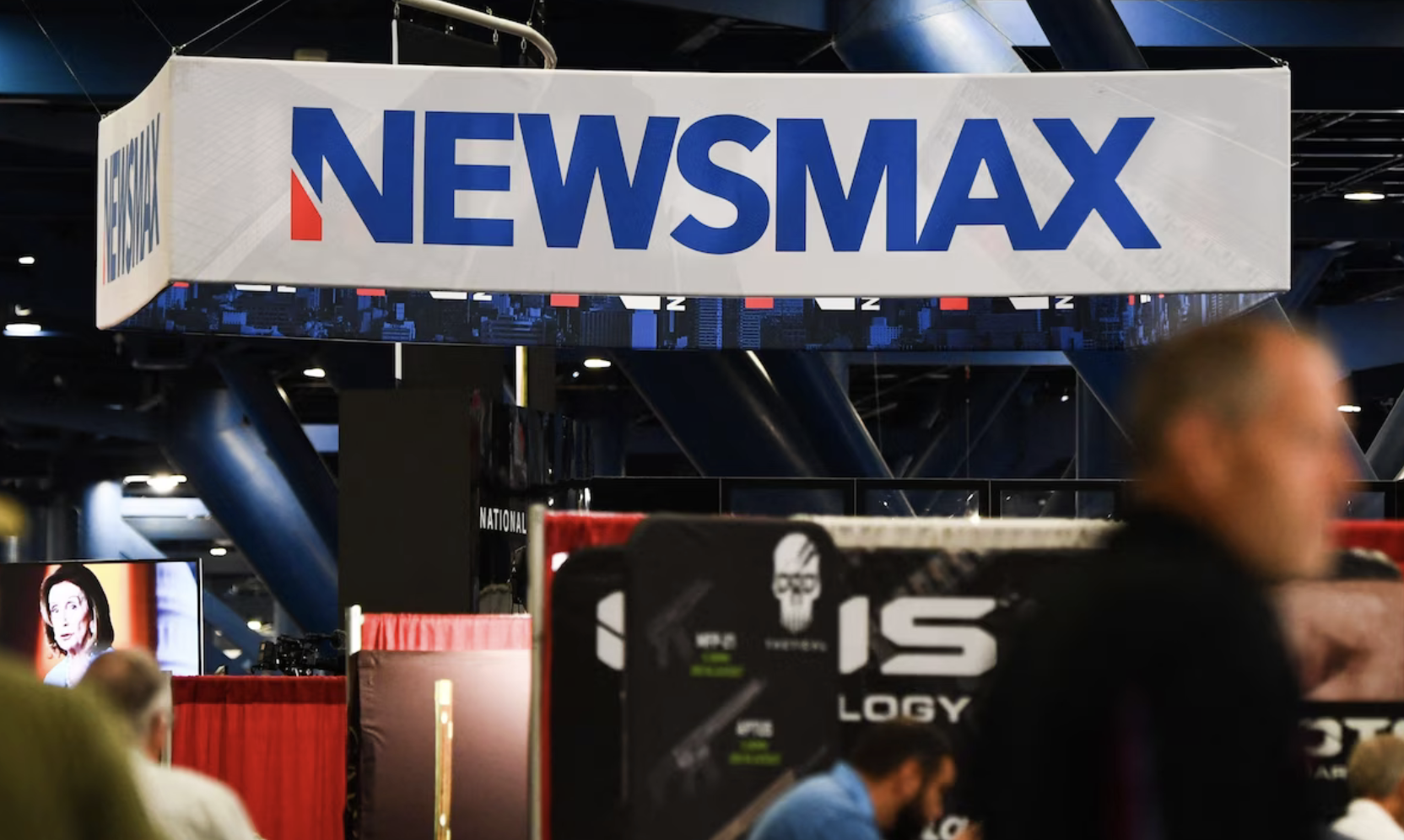
After political clamor, DirecTV will air Newsmax again

Photo by Patrick T. Fallon via Getty Images
After political jib-jabs in Washington, DirecTV will restore Newsmax to its lineup. "DirecTV dropped Newsmax in January over what it described as strictly a business matter — disagreement over Newsmax's demand that it receive fees for being aired by DirecTV, as other channels typically are," reports Paul Farhi of The Washington Post. "But the issue quickly became political; several dozen House Republicans signed a letter suggesting that DirecTV was shutting down a conservative voice and demanded that it be restored. . . . Some Republicans who rely on Newsmax for interviews and favorable television exposure called for the House to investigate the channel’s 'deplatforming'."

DirectTV said that their "'successful negotiation with Newsmax was based on economics and protecting our customers from higher costs — not politics or ideology,'" Farhi writes. "Newsmax founder and CEO Christopher Ruddy commended DirecTV, saying it 'clearly supports diverse voices, including conservative ones.'. . . DirecTV, which reaches about 13 million subscribers, said its programming would return without additional cost to customers."

Newsmax reaches around 50 million households via cable, but "distribution by DirecTV is important because it gives the network another broad platform to sell advertising," Farhi reports. "DirecTV had said in its negotiations with Newsmax that it was willing to continue carrying the channel without paying a cash fee for it. . . . Newsmax, however, held out for compensation, arguing that other channels receive it. . . . DirecTV did not release terms of the multiyear agreement."

Farhi explains, "Newsmax has often veered to the right of Fox News in its coverage and commentary. . . . Its ratings spiked at the end of 2020, after Trump expressed his dismay with Fox News's coverage of his false claims that the presidential election was stolen. Newsmax continued to emphasize Trump's narrative, winning disaffected Fox viewers. . . . After its brief post-election surge in popularity, Newsmax's viewership began to wane as President Biden assumed office. It averaged 184,000 viewers during prime-time hours, according to Nielsen figures, ranking it far behind Fox (2.4 million), MSNBC (1.2 million) and CNN (735,000)."

Thursday, March 02, 2023

Fox News hosts seem to make the case that they acted with malice, Mississippi Press Association executive opines

By Layne Bruce

The first time I recall hearing the phrase “absence of malice” was from a film of that title released in 1981 starring Paul Newman and Sally Field.

Newman plays a liquor wholesaler falsely accused in the disappearance of a local union leader and whose life is wrecked when the news hits the papers. Field is the reporter who’s manipulated by a corrupt district attorney who wants to squeeze Newman for information about another case.

It’s a convoluted work of fiction, but it’s one of my favorite movies about journalism and what can go wrong when people motivated by careerism forget that their actions can have very real and dramatic consequences for many people around them.

Layne Bruce
After studying journalism in college, I came to understand “absence of malice” as a legal term that also represents an incredibly high burden of proof that must be met by litigants who claim they’ve been defamed by the press.

When a plaintiff sues a media outlet for defamation, they must prove that whatever inaccuracies the outlet reported were borne of actual malicious intent. In other words, the defendants in such cases must act intentionally and spread false information knowingly.

That must be provable. It’s difficult to do, and it’s one of the cornerstone protections of freedom of the press in this country.

But if we were going to write a screenplay based on the defamation lawsuit filed against Fox News by Dominion Voting Systems for the reporting of false claims of fraud in the 2020 presidential election, it wouldn’t be a drama; it would have to be a farce. It seems like a black comedy of lies, hubris, and gaslighting.

A cursory review of text messages entered into the record and recently made public between Fox News personnel leaves little doubt the producers and hosts knew claims against Dominion that aired repeatedly on the network and sister channel Fox Business were bogus.

Marquee hosts Tucker Carlson, Sean Hannity, Laura Ingraham, and others engaged in numerous conversations about the veracity of the claims against Dominion and even the sanity of the lawyers pressing the conspiracy theories on air and in daily press conferences.

“No serious lawyer could believe what they were saying,” Ingraham says in the text messages. “Sidney Powell is a bit nuts,” she wrote in another. That did not keep the network from repeatedly putting Powell, a key lawyer at the center of the scandal, on air to regurgitate nonsense about alleged fraud, krakens, and other incoherent conspiracy theories.

That Fox News allowed this, and in so doing spread the toxicity to millions of viewers daily, goes a long way to addressing a heretofore almost unattainable bar of proving malice.

And by putting their private thoughts into texts while engaging in the apparent fiction of “just asking questions” on air, the hosts have exposed the network to a potentially landmark—and hugely expensive—judgment against it.

They’ve single-handedly lowered the bar for proving malice.

Wall Street Journal columnist Bill Galston on The Bulwark’s “Beg to Differ” podcast laid out four points necessary to prove malicious intent and reckless disregard to a jury:
  • A false statement purported to be fact. The text messages prove network personnel knew the claims of voter fraud by Dominion were bogus.
  • Publication or communication of the false statement to a third party. Fox hosts did this nightly for weeks to viewers numbering in the millions.
  • Fault amounting to “at least negligence.” Galston contends the repetition of falsehoods over network air was not just reckless disregard, but a “deliberate lie” motivated by fear the network would alienate its audience if it debunked the conspiracies.
  • Damages must be sustained to the reputation of the plaintiff. This may the easiest claim to prove. How many of us had heard of Dominion as a company before it was dragged into the contrived effort to throw the 2020 election results into doubt?
“If this isn’t a slam dunk case after the revelations that came out because of the (disclosure of the text messages), I don’t know what is,” Galston concluded.

This is by no means the first time Fox News’ dirty laundry has been aired in public. But it is for sure the first time the network has been so nakedly exposed to potential damages that might have a lasting effect on its business practices.

If malice has not been proven in this case, I’m with Galston—I’m not sure it could ever be proved. Whatever the ultimate decision, the case will be taught in future media law classes.

And I can’t wait to see the movie.

Layne Bruce, a former journalist, is executive director of the Mississippi Press Association. His email address is lbruce@mspress.org.

Monday, February 13, 2023

NPR does deep dive at West Virginia Public Broadcasting, finds CEO (governor's ex-flack) making editorial decisions

West Virginia Public Broadcasting's recent dismissal of a part-time reporter who angered state officials was "part of a years-long pattern of mounting pressure on the station from Gov. Jim Justice's administration and some state legislators," reports NPR media reporter David Folkenflik. "Since 2017, politicians have sought to eliminate state funding. The governor appointed partisans hostile to public broadcasting to key oversight positions. And the station's chief executive has intervened repeatedly in journalistic decisions."

CEO Carl "Butch" Antolini
WVPB Chief Executive Carl "Butch" Antolini denied "any hint of political interference in coverage," Folkenflik reports, quoting him: "A lot of the information that has been reported or disseminated is either partially or completely inaccurate." Folkenflik notes, "The statement was the only response Antolini or any West Virginia Public Broadcasting official would give NPR News for this story, despite repeated questioning." Later, Folkenflik notes that when he began inquiring, WVPB removed from its website all references to NPR.

"Allegations of serious political pressure on state-funded stations are rare," Folkenflik reports. "More than a third of West Virginia Public Broadcasting revenue comes directly from the state. Outside West Virginia, there are currently eight NPR member stations licensed to state entities, according to NPR. Many others are licensed to state universities." But WVPB "plays an outsized role in the local media landscape" in a state where "vast natural resources and wealth sit alongside abject poverty," because "the news industry has hit hard times." WVPB's 2021 annual report says it served 684,000 television viewers each month and 91,000 radio listeners each week, and other materials said its website got 1.6 million page views in 2022.

When Gov. Jim Justice took office in 2017, he tried to end all state funding of WVPB, but the legislature only cut 10 percent. The news director at the time said two senior officials "pressed the newsroom to stop covering Justice's business travails," Folkenflik reports. The officials didn't reply to his queries. After two CEOs came and went, the job went to Antolini, a former executive editor of The Register-Herald in Beckley, who had been Justice's spokesman. He was hired by a new governing board named by Justice, including "a top lobbyist for the West Virginia Chamber of Commerce" who had been a director of "a conservative think tank that has characterized state funding on West Virginia Public Broadcasting as 'wasteful' spending," and another lobbyist and "top adviser" to controversial coal operator Don Blankenship, Folkenflik reports.

When state Senate President Craig Blair questioned the dismissal of the part-timer who reported abuse of residents in state nursing homes, Antolini told his news director to get Blair on the air immediately, "saying Blair misspoke or was uninformed," and said he would review the news director's questions before the interview. Blair wouldn't cooperate. Folkenflik's story ends, "According to two people with direct knowledge of its activities, the legislature's commission on special investigations — a joint committee of the House and Senate — has launched hearings behind closed doors about the political pressures besetting the station."

Friday, January 20, 2023

Flooded Eastern Kentuckians seek higher ground, which coal firms own; radio station and others tell story of recovery

Logo for WEKU series
The record flash flooding in Eastern Kentucky last July has prompted a search for higher ground on which people can live and remain in the region. That's one upshot of an ambitious, collaborative reporting series that began on WEKU, the public radio station of Eastern Kentucky University, this week.

The "Rise" series is about "present realities and future prospects" in the 13 affected counties, host Tom Martin says: "As extreme weather seems to become more frequent, how will efforts to prevent future losses of life and property affect a mountain culture characterized by deep, strong ties to place, family and neighbors? Will enough people remain in the region to keep local tax bases above water for the resources they need to respond when crisis strikes?"

There is a strong consensus that housing is the immediate need, with many people still in temporary housing, Martin reports. Mike Harrison of First Christian Church in Pikeville, said he expects that it will take "two or three years to get people back to normal."

With $37,000 the maximum grant avalable from the Federal Emergency Management Agency, not enough to build a home, many residents are being urged to relocate, but many don't want to leave the region: "This is my home, my everything," one woman said. "I just want people know we still need help, and we're deserving people."

From their devastated hollows, residents look up, to ridgetops and reclaimed surface coal mines, where new neighborhods could be built. But such places generally lack utilities, and most of them are owned by coal and landholding companies that have demonstrated little if any interest in making it available for housing. Kentucky River Properties, former Kentucky River Coal, is the largest landowner in the four hardest-hit counties, lawyer Joe Childers told WEKU. The company has donated $500,000 to housing-development nonoprofits that are building and rehabbing homes.

Rebuilding in Knott County, Kentucky (Photo by Jeanne Marie Hibberd)
Some landowners recently donated 75 acres for a new housing development, which encouraged Gerry Roll, president of the Foundation for Appalachian Kentucky: "If this gives even a handful of people in our region some hope there is a better time ahead, there is a better opportunity coming, that gives me joy."

Gov. Andy Beshear said donations are still needed for relief and recovery and the state is "in active negotiations in every county" to find land for housing. UPDATE, Jan. 24: Beshear announced another high-ground development, on 50 acres near Hazard.

"Rise" is produced with the help of several other newsrooms that pay attention to Appalachia: Sam Adams of The Mountain Eagle in Whitesburg, Bill Estep of the Lexington Herald-Leader, Anya Slepyan and Joel Cohen of The Daily Yonder, Jared Bennett and Justin Hicks of the Kentucky Center for Investigative Reporting, Alexa Beyer of West Virginia's Mountain State Spotlight and Katie Myers of WMMT, the Appalshop radio station in Whitesburg.

UPDATE: The second segment "focuses on a pre-existing housing shortage made far worse by the destruction and damage of the flood; flood-insurance issues; floodplain mapping; leadership exhaustion and stress; and the work of some of the key non-profit organizations in the region," WEKU says. "The episode is capped by a Chris Begley essay about the nature of mountain communities and how this event is forcing difficult change." Feb. 18: The final segment asks important questions: "While still adjusting to such heavy loss and amid much uncertainty, Eastern Kentuckians are giving careful consideration to the future. In addition to addressing the immediate need for housing on higher ground, that future includes preparing for the possibility of more frequent extreme weather. Is this a turning point? Or just another turn on the curvy road ahead? Residents demonstrate the most important key to a strong community is knowing how to show up for your neighbors."

Thursday, January 12, 2023

News-media roundup: Oregon paper closes; broadcasters worry about police radio encryption; others should too

UPDATE, Jan. 31: Newspapers from other Oregon towns are now in "an old-fashioned newspaper war" to serve Jackson County, reports Brier Dudley of The Seattle Times.
Jackson County is on the California border. (Google map)
The Medford Mail-Tribune, which went digital-only last fall, announced Wednesday that Friday would be its last day of publication. "The Mail Tribune’s closure will result in a dramatic loss of news coverage for the biggest population center in southern Oregon. Jackson County, where Medford is the county seat, is home to nearly 224,000," The Oregonian reports. "Travis Moore, publisher of the Daily Courier, a newspaper serving Grants Pass and the surrounding area, said Wednesday that his company would move to hire some Mail Tribune journalists and expand its coverage in nearby Jackson County."


"Police departments across the country are encrypting their radio scanner communications with an increased and frightening urgency," the Radio Television Digital News Association tells its members. "Though encryption is not a new issue, it is rapidly accelerating . . . These encryption policies look different from department to department — with some opting for a delayed release of information, others decrypting for media personnel, and many choosing to encrypt communications entirely. Was there a moment where your lack of access to radio communications led to a loss of real-time information sharing? Has your newsroom been impacted by scanner encryption? Why is it important to keep this resource available to the public, including journalists? Help us build our case by sharing your newsroom’s experience with encryption. Read more about police encryption and RTDNA's approach here."

PR for journalism: “Even if the media industry takes urgent steps like diversifying newsrooms and empowering local media, the populist media bashing won’t go away. Ignoring it is not a sustainable way forward,” Cambridge University Ph.D. student Ayala Panievsky writes for Nieman Lab. “Journalists must start campainging for journalism. . . . promote and explain journalism as a flawed-yet-necessary social institution. As media-savvy journalists should know, vague arguments about 'saving democracy' or 'checks and balances' won’t do; they’re too abstract and carry little sentimental resonance for many.”

Seek solutions: "It is not enough for stories to expose problems to societal problems; they should explore how people tackle those problems," Lauren Kessler writes for Nieman Storyboard, promoting the concept of solutions journalism, as defined by the Solutions Journalism Project: “rigorous, evidence-based reporting on the responses to social problems,” the mission of which is “to transform journalism so that all people have access to news that helps them envision and build a more equitable world.” Or, as the late Molly Ivins said, “Listen to the people who are talking about how to fix what’s wrong, not the ones who just work people into a snit over the problems. Listen to the people who have ideas about how to fix things, not the ones who just blame others.”
Constructive Institute table, adapted by The Rural Blog, shows forms of journalism and their differences.

Friday, January 06, 2023

Santos story illustrates demise of local news ecosystem; lots of commentary, but 'No one is ... being paid to run down tips'

The fact that a Long Island weekly's revealing coverage of congressional candidate and now Rep.-elect George Santos wasn't picked up by other news outlets until after the election illustrates the demise of the local news ecosystem, writes Steven Waldman of the Rebuild Local News Coalition.

“If this had run 25 years ago, it would have been gobbled up,” Grant Lally, the publisher and owner of the North Shore Leader, told Waldman. “There’d have been 20 follow ups from Newsday and other publications and the weeklies.” But the weeklies that once served Long Island towns have "mostly merged into larger chains, and many don’t even have editorial offices in the covered towns anymore," Waldman reports. "Another part of this case, though, is the attention economy."

Steven Waldman
Waldman explains, "Succeeding in media today requires doing good journalism and then building your own audience for it, and the North Shore Leader didn’t successfully disseminate their scoop. They didn’t mention their story on their Facebook or Instagram accounts (not updated since 2021), nor did they tweet about it, though that stems more from them not having a Twitter account. Which isn’t really surprising since the paper doesn’t have anyone working social media hard—in part because they’ve shrunk." Lally told him, “We lost half our advertising during Covid and most of it really hasn’t come back.”

Because "the local media ecosystem is compromised, even when someone manages to get a good story, the rest of the system can’t amplify it or pursue it," Waldman writes. "If a small paper broke a story, it would be picked up by a bigger paper, or The Associated Press, which would prompt the TV stations and radio stations to dive in. Now the hyperlocal small newsrooms rarely do investigative work, and when they do, the bigger players don’t pay attention. And in smaller communities, the weekly papers are the entire foodchain, so their demise is even more consequential."

There are stil more than 6,000 weeklies, but many of them, and some dailies, are “ghost newspapers . . . slim papers full of wire copy, press releases and ads," Waldman notes. "One consequence of this hollowing out is that voters have little to no information on which to base their choices in local elections. This would seem to be a fairly significant problem for, you know, democracy. And ironically, the more local the election, the worse the coverage is likely to be. But the harm goes much deeper. Other studies show that areas with less local news have more corruption, fewer competitive elections, less resident involvement in PTAs, and even lower bond ratings. . . . There’s now evidence that the decline of local news exacerbates polarization, too. Studies show, for instance, that in areas with less coverage, voters are less likely to split their tickets. That’s because the vacuums created by the contraction of local news are filled largely by national cable TV, radio, and social media. The contraction of local news accelerates the nationalization of politics while at the same time, we have less of the kinds of information that binds together communities—everything from obituaries to high-school sports. And as "many communities have moved from good information, to no information, to deceptive information, a new wave of “pink slime” sites—often set up by political activists—to impersonate traditional news sites while actively promoting particular candidates or businesses."

Waldman, who runs Report for America, notes the book, News Hole, by media scholars Danny Hayes and Jennifer Lawless, who wrote that most discussions about the problems of democracy “don’t account for the most dramatic change in the civic life U.S. communities have experienced in the last 20 years: the decimation of the local news media.” He promotes his coalition's main cause, the proposed Local Journalism Sustainability Act, which would give tax credits to newsrooms to pay local journalists, to small businesses that advertise in local news outlets and to consumers who purchase local news: "Perhaps Rep. Santos could co-sponsor the bill."

Screenshot from CNN
UPDATE, Jan. 7:
On his Saturday morning CNN program, Michael Smerconish said "mythomanic" Santos also benefited from a late redistricting that turned the formerly Democratic district into a marginally Republican one and left little time for other Republicans to organize a primary campaign. But his six-minuite segment is mainly about the "systemic failure that is only getting worse" in local news. He concluded, “George Santos is what you get when everyone with a laptop is a wannabe journalist, but no one is left being paid to run down tips, and that should make all of us nervous. The next time you hear about the closure of a newspaper, or the scaling back of a newsroom, think about George Santos and how many more like him might be getting away with something.”

Monday, January 02, 2023

News-media roundup: PBS aims to rebuild trust in news media, look at whole country; Nader starts a weekly . . .

"Don’t blame traditional media for being put under the pressure of cataclysmic change and struggling, blame those in leadership for not telling you clearly what was happening," writes Darrell Ehrlick, editor of the Daily Montanan (published by States Neswsroom) and former editor of the Billings Gazette. "Journalists are taught repeatedly that the story – whatever they’re covering – is not about them. . . . Decades of being told that the story is never about journalists or journalism has given publishers and corporate owners just enough leverage to remain silent on what is going on within the company."

The new anchors of "PBS NewsHour," Amna Nawaz and Geoff Bennett, feel “an obligation to do good journalism, and to build back hopefully the trust that the audience has been losing in the overall media industry,” Senior Executive Producer Sara Just told The Wrap. Bennett, who has been PBS's chief Washington correspondent and anchor of its weekend news show, said he hopes to to take “a deeper look at the messaging and the agenda of the Democratic and Republican parties and how that intersects with the greater country” and help viewers understand that “politics is more than just what happens in Washington. . . . It’s what’s happening across the country.”

Consumer advocate Ralph Nader is helping launch a weekly newspaper to eliminate what he calls a “news vacuum” in the small Connecticut town where he lives and five surrounding towns, the Hartford Business Journal reports. The pilot edition of the Winsted Citizen "is slated for publication in early 2023," the HBJ reports. The name is a shorter version of the daily evening paper that served the town of 7,700 until 1984, when it was merged with Hearst Corp.'s Torrington Register to create The Register Citizen. Nader told that paper that the editor and publisher will be Andy Thibault, who teaches journalism and communication at the University of New Haven.