Showing posts with label school boards. Show all posts

Tuesday, January 16, 2024

Do party endorsements change school board elelctions? An analysis of 10 states looks at board elections and outcomes

In 2023, most school board election winners did not have party endorsements. (Ballotpedia graph)

School board elections are primarily non-partisan, but some include candidates with party endorsements, which may provide "helpful information regarding candidates' stances and policy positions," Ballotpedia reports. However, endorsements and party affiliations can shift an election's focus onto narrow issues, which can change voter experience and election outcomes.

Ballotpedia covered every 2023 school board election and endorsements in 10 states: Colorado, Kansas, Ohio, Oklahoma, Minnesota, Pennsylvania, South Dakota, Virginia, Washington and Wisconsin, which held 5,254 elections for 8,758 school board seats.

Democratic candidates had the most endorsements, and "among the top 10 endorsers, seven were liberal, and three were conservative," Ballotpedia reports. "The top liberal endorsers had a 68% win rate in contested elections, on average, compared to a 48% win rate among the top conservative endorsers."

"Most winning candidates received no endorsements," Ballotpedia analysis showed. "Of the 8,758 seats up for election, candidates with no endorsements won 73%, followed by liberal candidates with 15%, and conservative candidates with 11%."

Separate from endorsements, candidates can have party affiliations. Of the 10 states covered, Ballotpedia "identified that Democratic and Republican wins primarily came from districts where those parties made up a majority or plurality of voters. This remained the case both in Pennsylvania, where school board elections are partisan, and in Kansas, Oklahoma, and South Dakota, where candidates' party affiliations do not appear on the ballot."

To read more analysis accompanied by descriptive graphs and national maps by Ballotpedia, click here.

Thursday, December 14, 2023

Rural county in Idaho highlights the 'tug-of-war between education professionals and extremist culture warriors'

Priest River, where the West Bonner County School District is headquartered, spans Lake
Pend Orielle in the North Idaho panhandle. (Photo by Joan Morse, The Hechinger Report)

As extremists aimed to gain school board leadership positions in an Idaho community, moms with diverse backgrounds in West Bonner County tried to keep public schools in the hands of community members versus outsiders with political agendas, reports Laura Pappano for The Hechinger Report, which covers education. "The national infection facing public schooling — the tug-of-war between education professionals and extremist culture warriors — has brought chaos and damage to West Bonner County. After this past school year ended, the superintendent acknowledged that 31 percent of teachers, counselors, and education leaders left the district, and scores of parents pulled their children, opting for homeschooling, online learning, or enrolling in another district."

Community dramas over Covid-19 vaccines and masks, English curricular choices, and LGBTQ+ issues have played out in West Bonner. "Some people overlook school board skirmishes, seeing them as trivial. For (Candy) Turner, (Dana) Douglas, and many in the West Bonner County School District, they are anything but. It’s not about Democrats versus Republicans (Turner is a registered Democrat; Douglas is 'a proud conservative Republican). It’s about the viability of public education in their community," Pappano writes. "What has happened in West Bonner County offers a warning to public school supporters elsewhere. Douglas, Turner, and others are fighting to restore normalcy to an institution that should not be up for grabs — but is."

Extremist Facebook rage and heated personal debates undid a community that once thrived with care, Pappono reports. "People filled in the gaps when it came to local needs, from sending groceries home with some children over weekends to teachers helping students brush their teeth or spending extra hours with struggling readers," Pappano explains. "But that spirit is now being tested by extremists who see a soft target in a stressed school district."

While the county's school dramas have unfolded over the last couple of years, some normalcy has been restored -- but only through a determined group of community members willing to fight. Margaret Hall, the current school board chair who faced a far-right challenger, told Pappano: “We’ve been the canary in the coal mine. What has to happen is people have to wake up and decide, ‘We don’t want someone to come in and tell us what we want. We want to decide ourselves.'"

Wednesday, November 01, 2023

Alabama newspaper reporter, publisher arrested and charged with revealing grand jury secrets

A publisher and reporter at an Alabama newspaper have been arrested and accused of illegally disclosing grand jury information about the local school district.

Atmore News Publisher Sherry Digmon and reporter Don Fletcher were arrested on Oct. 27 by deputies from the Escambia County Sheriff’s Office. A Facebook post by the newspaper said that they were released on bonds of $10,000.

According to the post: “The charges against Digmon, also the District 6 representative on the Escambia County Board of Education, and Fletcher stem from an article published in the October 25 edition of Atmore News” about an investigation into “the possible misallocation or misappropriation of federal Covid money paid to seven former school system employees.

“That edition also contained a sidebar article reporting that Digmon’s phone and the phone of District 4 school board member Cindy Jackson had been seized by sheriff’s deputies, who served search warrants against the two, each of whom voted against a new contract for Superintendent of Education Michele McClung.”

Atmore News photo
The Committee to Protect Journalists called on local authorities to drop the charges immediately and investigate why the two were arrested. “They should not be prosecuted for simply doing their jobs and covering a matter of local interest, such as the allocation of school board funds,” said Katherine Jacobsen, CPJ’s U.S. and Canada program coordinator. “Journalists play a crucial role in their local communities. Arresting them creates a chilling effect and is a gross misuse of taxpayer funds.”

The Atmore News also reported that Veronica “Ashley” Fore, the county school system’s payroll and insurance bookkeeper, was arrested on similar charges, though the report stated “the reasons behind Fore’s arrest were not known.”

According to the Committee to Protect Journalists, “The charge of revealing grand jury secrets is a felony under Alabama Criminal Code Section 12-16-215, according to court documents reviewed by CPJ, and carries a penalty of between one to three years imprisonment and a fine of up to $5,000.”

In August, police officers raided the offices of the Marion County Record in Kansas and seized computers and other materials such as cell phones, accusing the newspaper of identity theft and unlawful use of a computer. The raid attracted national and international attention and was condemned by many journalists and free press advocates. 

The local county attorney later concluded that there was not enough evidence to warrant the raid, and a judge ordered the materials to be returned to the newspaper. The Record had been investigating the police chief’s employment history at the time of the raid, though police said that reporting was unrelated to their search. The police chief has since resigned his position.

Thursday, October 05, 2023

It's Banned Book Week, and First Amendment advocates push back by training citizens how to fight bans

Photo via PEN America
Banned Book Week is this week, and First Amendment advocates are pushing to stem the tide of books removed from library shelves. "In the last few years, there has been an unprecedented wave of book bans and censorship spurred by parents and conservative groups to target books that center the LGBTQ+ community, Black history and diverse stories," reports Ariana Figueroa of The Kentucky Lantern. "During the 2022-23 school year, book bans occurred in 153 districts across 33 states, according to the PEN America report."

According to PEN, 3,300 books were banned during the 2022-2023 school year, up 33% from the prior year. To counter the dramatic increase, PEN "launched online training for students to fight book bans, and more recently, teamed up with bestselling authors to fight against book bans in Florida and across the country," Figueroa writes. "Some of those authors include Judy Blume, Ruby Bridges, Suzanne Collins, Michael Connelly, Gillian Flynn, Amanda Gorman, Nikki Grimes, Daniel Handler, Khaled Hosseini, Casey McQuiston, James Patterson, Jodi Picoult and Nora Roberts, among others."

Lawmakers have also entered the fray, with some supporting bans and others criticizing bans as free speech violations. In September, the U.S. Senate Judiciary Committee "held a hearing to discuss the consequences of book bans, but senators ultimately decided it was not Congress' role to intervene," Figueroa reports. "The White House in June announced that the Department of Education Office for Civil Rights would appoint a coordinator to counter the massive wave of book bans across the country.. . . However, the department has not responded to multiple requests from States Newsroom asking about the hiring status of the new coordinator. . . . One state, Illinois, became the first state to pass a law outlawing the banning of books."

Moms for Liberty, an organization formed in 2021, is often the force behind many book bans, Figueroa explains. The group generally "'targets local school board meetings, school board members, administrators, and teachers to push right-wing policies,' as reported by Media Matters. Moms for Liberty has about 300 chapters across 47 states."

States and the number of books they have banned from July 2022 – June 2023 include:
Arkansas - 4 books; California - 1 book; Colorado - 8 books; Florida - 1,406 books; Georgia - 4 books;
Idaho - 25 books; Indiana - 3 books; Iowa - 6 books; Kansas - 7 books; Kentucky - 3 books; Maine - 13 books; Massachusetts - 1 book; Michigan - 39 books; Minnesota - 1 book; Missouri - 333 books; Nebraska - 6 books; New Hampshire - 1 book; New Jersey - 3 books; New York - 6 books; North Carolina - 58 books; North Dakota - 27 books; Oklahoma - 2 books; Oregon - 38 books; Pennsylvania -
186 books; South Carolina - 127 books; South Dakota - 2 books; Tennessee - 11 books; Texas - 625 books; Utah - 281 books; Virginia - 75 books; West Virginia - 2 books; Wisconsin - 43 books
Wyoming - 15 books

Monday, October 02, 2023

Opinion: Appointed county school board grants itself 'sole authority' over library content; some residents push back

A sign on a road in Hanover County, where a battle is underway over a
push for an elected school board. (Photo by Greg Sargent, Washington Post)
America is no stranger to censorship, with the first U.S. book ban dating back to 1637. Some counties, such as Hanover County, Virginia, have a long history of the practice, writes Greg Sargent in his opinion for The Washington Post. In 1966, its school board removed To Kill a Mockingbird from shelves, and this year, it "removed at least 20 books after granting itself sole authority over library content. Last spring, it renamed a school christened after a Black historical figure," but some residents are resisting the bans in what is shaping up to be "A nasty fight in a rural Virginia school district."

In response, the "Hanover Citizens for an Elected School Board" is campaigning to "take away county officials' power to appoint school board members, who are otherwise insulated from public accountability. Unelected boards are rooted in the state's Jim Crow past, as they were sometimes used to keep Black residents out," Sargent writes. "The case for an elected board in Hanover County, which stretches from Richmond's suburbs into outlying rural areas and backed Donald Trump in 2020 by 26 points, is strong. . . . It is one of only a dozen school boards in the state that are still appointed — and it's the largest among those."

"More residents started joining the push for elected boards last spring. First, the board voted to give itself sole authority over book-banning decisions for school libraries — and then promptly started nixing books from circulation, including several with LGBTQ+ themes," Sargent adds. "Liberal-leaning Kelly Merrill, a University of Richmond professor with a transgender teenager, said she was angered when the school board voted against accommodations for trans students."

"This saga goes back a century. At the Virginia Constitutional Convention of 1901-1902, delegates shut down a proposal for elected school boards after opponents made clear they believed that would give too much 'negro' control over the schools. . . . In the 1950s, the General Assembly retaliated against Arlington County's board (the only one at the time that was permitted to elect members) by revoking that status in favor of appointments. This ratified the idea of appointed boards as a bulwark defending segregation," Sargent writes. 

Historian Peyton McCrary told Sargent, "Appointed boards were part and parcel of how the Jim Crow system operated in Virginia." Sargent adds, "In Hanover, liberals and even some conservatives are mindful of that dark past. This fall, if residents vote to give themselves the power to hold school board members accountable moving forward, it will be another step toward repudiating it."

Sunday, October 01, 2023

Democracy depends on newspapers, and the big threat is outside metro areas, newspaper chain executive warns

Bill Ketter with his Wells Key award from SPJ and fellow CNHI
executives Matt Gray, left, and Jim Zachary (Photo by Al Cross)
By Al Cross
Director emeritus, Institute for Rural Journalism, University of Kentucky

LAS VEGAS, Nev. – The future of democracy depends on newspapers, and “The greatest threat to democracy is in the small towns and cities of America,” the top news executive of one of the country's largest newspaper chains said Saturday in accepting the Society of Professional Journalists’ top award.

William Ketter, CNHI’s senior vice president for news, was awarded the Wells Key for service to SPJ, of which he has been a member for 62 years, since he was a student at the University of North Dakota.

“Newspapers and democracy go hand in glove,” said Ketter, who guided the Lawrence Eagle-Tribune of Massachusetts to the 2003 Pulitzer Prize for breaking news reporting and was president of the American Society of Newspaper Editors in 1995.

“Democracy is dying. It is absolutely dying,” Ketter declared, saying that school boards and local governments are being taken over by “far right” activists, largely unchallenged. He said many local newspapers, weakened by the loss of advertising and circulation, can’t handle “some of the anti-press attitudes that are being fostered in America.”

Ketter decried the efforts of local governments to get state legislatures to weaken laws that require local governments and other entities to run paid public-notice advertisements in local papers. “Those notices are what help small-town newspapers, and in small cities, survive,” because they can no longer depend on retail advertising, Ketter said, noting that in some places, governments have stopped placing the ads in newspapers whose coverage they don’t like.

“It’s not just about newspapers, it’s about democracy,” Ketter said. “The two are tied together.”

Ketter said he was glad to see the SPJ Foundation exploring an effort to see how it might funnel contributions to community news media or otherwise help them. He is on the foundation's board.

Like other speakers at SPJ’s annual awards banquet, Ketter said he was inspired by others who were recognized, including the late Jeff German, a Las Vegas Review-Journal reporter who was murdered – allegedly by a public official he was investigating. The official is now on trial. Outgoing SPJ President Claire Regan said it was “the first time in modern American history that a sitting public official was charged with the murder of a journalist over news coverage.”

Pulitzer winner Dana Priest of the University of Maryland and The Washington Post, one of the newest SPJ fellows, said “I can’t tell you how inspired I have been to be here,” away from “the East Coast media bubble. . . . You guys are heroes because you keep government on their toes.”

Thursday, August 24, 2023

Fact-checking the first presidential debate of the 2024 race

The first debate of the 2024 presidential race, among eight Republicans, featured some claims that were false or "misleading at best," CNN reports.

Florida Gov. Ron DeSantis said the federal government locked down the economy during the pandemic while Florida "kept our state free and open," when in fact he "imposed significant restrictions" at the start of the pandemic, CNN's Daniel Dale said on the cable channel's post-debate report. The restrictions were imposed by states, not by the then-President Trump.

Former Vice President Mike Pence said the Trump-Pence administration spent money "to backfill on the military cuts of the Obama administration," but that's misleading, CNN’s Haley Britzky writes: "While military spending decreased under the Obama administration, it was largely due to the 2011 Budget Control Act, which received Republican support and resulted in automatic spending cuts to the defense budget." Pence, an Indiana congressman at the time, voted for the law.

Former South Carolina Gov. Nikki Haley said Trump, who did not participate in the debate, added $8 trillion to the national debt. The figure is accurate, but "The increase in the debt during any president’s tenure is not the fault of that president alone," CNN notes. "A significant amount of spending under any president is the result of decisions made by their predecessors – such as the creation of Social Security, Medicare and Medicaid decades ago – and by circumstances out of a president’s control, notably including the global Covid-19 pandemic under Trump."

U.S. Sen. Tim Scott of South Carolina said the Biden administration is calling “parents that show up at school board meetings . . .  domestic terrorists.” That is false, CNN’s Hannah Rabinowitz writes: "The claim stems from a 2021 letter from the National School Boards Association asking the Justice Department to 'deal with' the uptick in threats against education officials and saying that 'acts of malice, violence, and threats against public school officials' could be classified as 'the equivalent to a form of domestic terrorism and hate crimes'." Attorney General Merrick Garland issued a memo encouraging federal and local authorities to work together against such harassment campaigns "but never endorsed the 'domestic terrorism' notion," Rabinowitz writes.

Trump, who counter-programmed the debate with an online interview, "did not receive any pushback from pundit Tucker Carlson after promoting false statements about the 2020 election," reports Dominic Mastrangelo of The Hill.

Saturday, August 19, 2023

Ark. publisher wins open-government battle with school board over secret meeting with superintendent candidate

Challenging officials for breaking open-government laws "can involve determination and courage on the part of a community journalist. But, in the end, that is indeed a major responsibility at times for a committed local publisher," says the latest Arkansas Press Association Publisher Weekly.

Tamara Johnson (APA photo)
APA reports on the history of Tamara Johnson, editor and publisher of the daily Times-Herald in Forrest City, who filed a complaint last September with the Palestine Police Department "against the Palestine-Wheatley School Board for holding a secret meeting to interview a candidate for the position of interim superintendent at the St. Francis County school." The local prosecutor refused the case, and local judges recused themselves, but the city attorney of Forrest City, the county seat, agreed to prosecute before a retired circuit judge. After months of negotiation, the sides agreed that board President Derrick Boileau would plead "no contest," get six months’ probation and undergo mandatory training from the Arkansas School Boards Association, along with the other six board members.

"Johnson said the secret meeting occurred after several problems the newspaper had with the board concerning its methods of operation," APA reports. "This involved such actions as creating confusion on meeting dates and agenda items. 'I told them this has got to stop,' Johnson said. 'I originally thought we had a good relationship with the president and the board. What I really wanted all along was for them to take some training on the Freedom of Information Act.'"

Palestine in St. Francis County, Arkansas
(Wikipedia map)
"The board president failed to contact the newspaper concerning the meeting with the superintendent prospect and held the session across the street from the school in a shop owned by one of the board members," APA reports. "The newspaper obtained a photo of vehicles of board members parked in front of the shop during the meeting. . . . Johnson was disappointed with the actions of the school board in light of what she considers a solid level of trust developed with readers and institutions in the St. Francis County area during her almost 33 years at the Times-Herald. . . . She has been married 31 years to Rob Johnson, who is manager of the local radio station."

Wednesday, March 08, 2023

North Carolina lawmakers push for more partisan school board elections; labels may limit unaffiliated candidates

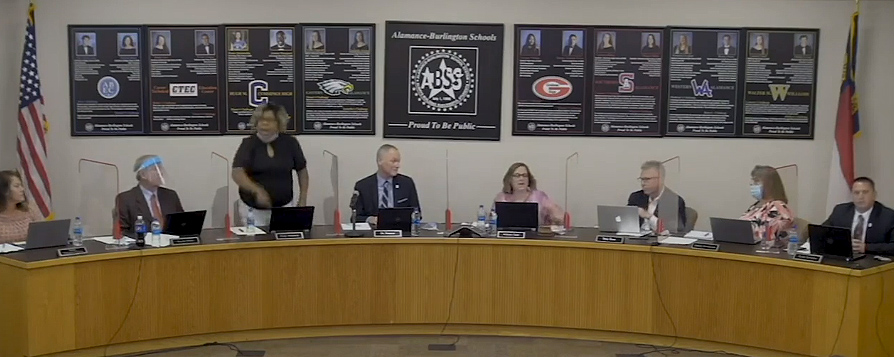
Some North Carolina school board meetings have become shouting matches. In this one, an Alamance County board member stood to yell and make a point. (Still from video by Loumay Alesali, UNC Media Hub)

Bit by bit, "North Carolina lawmakers have nearly tripled the number of partisan school boards across the state over the last decade — often over the objections of school board members themselves," reports Kyle Ingram of the UNC Media Hub. “It’s a move some board members say is turning their school system from a hyperlocal, traditionally apolitical governing board into a contentious microcosm of national political debates." Republicans in several other states are arguing for partisan school-board elections. 

Ingram uses Craven County as an example where partisan labels were introduced in 2022. Commenting on board meetings since the partisan change, Carr Ipock, a registered Democrat who has served on the school board for over 30 years, told Ingram, "There was more focus on national agenda items than there was on ‘What can we do to make the school system better?'" Ingram adds, "Republican legislators argue that partisan elections help voters make more informed decisions by giving them an idea of a candidates’ philosophy via their party identification."

Craven County is on the southeast coast. (Graphic by Emily Pack) 
In North Carolina, "More than 1 in 3 school boards now elect their members in partisan elections — 10 years ago, it was 1 in 10.  . . . In the 2022 midterms, nearly 3 in 4 partisan school boards elected more Republicans than Democrats," Ingram reports. Chris Cooper, a political scientist at Western Carolina University, told Ingram, “In the short run, it makes it more likely that conservative policies will carry the day in school boards . . . In the long run, it builds a farm team of Republicans who might one day want to run for higher office.”

Partisan boards make it harder for unaffiliated candidates to run and win, Ingram reports. Blair Craven, chair of the Henderson County Board of Education, has served as an unaffiliated member of the board since his first election in 2016. Craven told Ingram, "In my seven years of being on the school board, I’ve never made a decision that I believe is Republican in nature or Democratic in nature."

Ingram writes, "In February, the Republican-led Henderson County Board of Commissioners passed a resolution asking the legislature to make the school board partisan. Craven and the other members of the board said they were never contacted about it." Craven told Ingram, “I’m a huge fan of information for voters. But I believe if the only information you have on a school board election is whether someone has an 'R' or a 'D' or an 'I' by their name, then you’re not doing your homework.” Ingram notes, "If the bill passes, Craven’s reelection prospects become more difficult. Either he switches to an official party or gathers thousands of signatures to appear on the ballot as an unaffiliated candidate.

Tuesday, December 06, 2022

Misbehaving teachers move from district to district and state to state with relatively little scrutiny

Teachers who have committed sexual misconduct are able to move from district to district and state to state without close checking by school administrators and state governments, and the issue appears to have been widely ignored.

In Kentucky, the Lexington Herald-Leader "found that over a five-year period, the top reason the majority of teachers voluntarily gave up their licenses or had them revoked or suspended was due to sexual misconduct," report the paper's Beth Musgrave and Valarie Honeycutt Spears. Despite some teachers eventually leaving the profession, many are allowed to move to multiple teaching posts without consequences for prior abuse even when the abuse resulted in suspensions.

Take the case of Kentucky teacher Jason Earlywine who was "a physical education and health teacher, was disciplined for sending a student more than 1,700 voice or text messages in 2011 and 2012 and for other inappropriate conduct while a teacher at Paris Independent School District," Musgrave and Spears write. "He eventually left the district and got a job at West Jessamine High School in 2019. Students said in the first several months on the job that Earlywine made inappropriate comments to female students. . . . according to Kentucky Education Professional Standards Board documents."

Kentucky does not have enough prevention policies or training that would help keep possible abusers out of the school system and prevent those that do gain access from traveling from school to school. "Kentucky teachers receive training on sexual harassment but has no requirement that they undergo training on sexual abuse or appropriate boundaries between teachers and students," Musgrave and Spears report. "33 states and the District of Columbia mandate that training."

Kentucky is not alone. Many states that struggle to prevent the hiring or discipline of teachers who act inappropriately with students. In Cabell County, W.Va., a gym teacher faced charges for sexually abusing multiple students. "The alleged incidents happened from August 2019 through January of 2022, according to the criminal complaint," says Eric Fossell for WSAZ-TV. "It also states that an administrator with Cabell County Schools told investigators that Miles had been reprimanded before for similar allegations. That administrator asked Miles in a letter to refrain from 'jovial touching of students' or the matter would be referred to the superintendent."

A Montana school district was sued in 2020, "over its hiring of a teacher and coach who was accused of sending sexual messages to the student," reports The Associated Press. The suit said the teacher "had a pattern of inappropriate behavior toward underaged girls and that the school district was negligent in hiring him. . . . Botsford had been fired from a different high school in 1999 after two girls reported him for inappropriate contact. . . . Centerville Supt. Jan Cahill investigated the reports and found Botsford had 'unethical and immoral relationships' with at least three students, the lawsuit said."

While laws can be passed, it's up to school boards and administrators to set policies and stop abuse. For instance, the Montana legislature passed the "Creating a student safety accountability act" in May of 2019, but it did it keep the teacher from continuing his pattern of abuse.

Friday, November 04, 2022

In rural Arkansas, parents angry over sexual abuse and a cover-up knew where to turn: their local weekly newspaper

L-R: Al Cross, director, Institute for Rural Journalism; Ben Gish, The Mountain Eagle, Whitesburg, Ky.; Publisher Ellen Kreth and General Manager Shannon Hahn, Madison County Record, with institute's Tom and Pat Gish Award for courage, integrity and tenacity in rural journalism. (Photo: Yung Soo Kim, University of Kentucky School of Journalism and Media)

When older boys on a junior-high basketball team put younger players through an initiation ritual that included sexual abuse, and school officials tried to cover it up, angry parents knew where to go: their local weekly newspaper, the Madison County Record of Huntsville, Ark. The paper's pursuit of the story won it the Tom and Pat Gish Award for courage, integrity and tenacity in rural journalism from the Institute for Rural Journalism and Community Issues (publisher of The Rural Blog), which was presented last night in Lexington, Ky.

“This story wouldn’t let us go, and we weren’t about to let it go, either,” Publisher Ellen Kreth said as she and General Manager Shannon Hahn accepted the award.

Kreth said of school officials, “Their first order of business was to cover it up . . . The parents’ first order of business . . . was to contact the Madison County Record. They trusted the newspaper; they knew they could trust us to tell the story. Most importantly, they also knew they could trust Shannon. She lives in the community and has children in the school, and they knew they could come to her.”

The paper didn’t name any students involved, but focused on how officials handled the allegations, reducing or rejecting the recommended punishment for the violators. It reported the district’s failure to immediately report the allegations, as required by law, and multiple open-meetings violations of the Arkansas Freedom of Information Act. Its reporting prompted an investigation; special open-meetings training for the school board, which didn’t do it in the time required; a lawsuit by a parent alleging violations of Title IX of the Education Amendments of 1972, which ban sex-based discrimination in any school that gets federal funding; the board’s admission of liability in that suit; the electoral defeat in May of three of the four board members who sought re-election; the charging of the superintendent and coach with first-degree failure to report; and their resignations.

“They never attacked the facts that we reported, because they knew that they were true, but . . . they attacked our role in the community,” Kreth said. “They said we shouldn’t report the allegations, that we were harming the victims, and that we should also be quiet about it. During multiple school-board meetings, the board members attacked the paper, saying our job was to promote the school, not report on it. We were to be their public-relations department. And that’s the one area I think about this whole story in the context of rural journalism that screams the loudest to me. The most common comment, but also the most surprising, was “I can’t believe a local newspaper would cover something like that.”

Noting the Institute’s maxim that “Rural people deserve good journalism as much as urban dwellers,” Kreth said, “We always believed our role in this story and in our community is telling the facts, telling the story, digging in deep and piecing the facts together. This story was built on trust” among the paper and the parents of the victims. “It was built on filing FOIA request after FOIA request and then literally pasting text messages . . . that were exchanged between school board members. They sent them all out of order, so we spent 12 hours cutting and pasting them so we could build our timeline.”

And through it all, the paper's staff remained part of the community: “We shook hands with everyone who would throw darts at us,” Kreth said. “In the same editions where we ran those Title 9 stories, we still had school lunch menus, church news, obituaries, library news, city council coverage; we told people where to get their Covid vaccines, and we also reported on Decoration Day at local cemeteries. That’s what rural journalism is to us: the good, the bad, the ugly and every single thing in between.”

Board members who sought re-election “were soundly defeated at the polls,” Kreth said. “Sometimes democracy works to support journalism, right?” That line won applause from the crowd of 160, which also saw Chris and Allison Evans of The Crittenden Press in Marion, Ky., get the Al Smith Award for public service through community journalism by Kentuckians.

Friday, July 01, 2022

Quick hits: Many fireworks displays canceled; fewer of us drink milk; rural Texas students fight local book bans

Here's a roundup of stories with rural resonance; if you do or see similar work that should be shared on The Rural Blog, email us at heather.chapman@uky.edu.

Communities across the nation are canceling their Independence Day fireworks displays because of wildfire hazards, supply-chain issues and worker shortages. Read more here.

In a town near Uvalde, Texas, teachers have carried weapons since 2013. Parents say they feel safer. Read more here.

An LGBTQ high school student in rural Texas organized students to fight the local school board's book bans. Read more here.

A recent study says that lack of water costs families, communities and the U.S. economy $8.58 billion each year. Read more here.

Bird-flu outbreaks are slowing down, but the U.S. Department of Agriculture is urging poultry farmers to be ready for a possible resurgence in the fall. Read more here.

Consumption of fluid cow's milk is continuing a downward trend that is proving difficult to reverse, according to a new USDA report. Read more here.

Tuesday, April 26, 2022

General anti-vaccine sentiment gaining new momentum amid opposition to coronavirus vaccination for children

Opposition to requiring coronavirus vaccines for children has breathed new life into a movement to eliminate all childhood vaccine mandates, or at least limit the application of such requirements.

More than 65 bills to limit or eliminate mandatory childhood vaccinations have been introduced in 25 states this year. "In Missouri, for example, legislators are considering a measure exempting private school students from vaccine requirements. In Louisiana, a bill in the House would prohibit vaccinations on school property and at school-sponsored events," Sandy West reports for Kaiser Health News. "All states require specific childhood vaccinations for illnesses such as polio, measles, and mumps, but exemptions vary. They all allow exemptions for people with medical concerns, 44 states allow religious exemptions, and 15 allow philosophical exemptions, according to 2021 data from the National Conference of State Legislatures."

Anti-vaccine activism isn't new, but public-health experts say the movement has gained ground amid fears surrounding the coronavirus vaccine. Anti-vaccine sentiment once relied on long-debunked theories that vaccines cause autism, but in recent years "the movement began to shift its focus to align more with the populist ideology of 'individual freedoms' put forward by Second Amendment advocates and the tea party," West reports.

That dovetails with a rising tide of conservative activists who have sought to influence policy in libraries, county governments and school boards to statehouses, under the banner of liberty.

However, general anti-vaccine efforts aren't entirely grassroots. The similarity of anti-vaccine bills from state to state "raises red flags to vaccine advocates because it suggests that a coordinated effort to dismantle vaccine requirements and public-health infrastructure is underway," one expert told West.

It's unclear how much traction anti-vaccine-mandate bills will get. Most people support childhood vaccine mandates, but the issue is increasingly getting tangled up in the political minefield surrounding coronavirus vaccinations. Some politicians say they're hoping cooler heads will prevail.

Kansas state Rep. John Eplee, a Republican and family physician, said he voted against a state mask mandate in hope of defusing tensions, but supports childhood vaccination mandates. "While Eplee hopes the 'passions' inflamed by Covid die down with distance from the early days of the pandemic, he’s concerned that voters have forgotten the damage done by vaccine-controllable diseases, making them susceptible to disinformation from determined anti-vaccine activists and the politicians among their ranks," West reports.

"I hate to see human nature play out like that," Eplee told West. "But if people are vocal enough and loud enough, they can swing enough votes to change the world in a not-so-good way for public health and vaccinations."

Monday, April 04, 2022

Ever more partisan, vicious school-board races in Wisconsin (on ballot tomorrow) may presage nasty races nationwide

"Voters in Wisconsin and three other states head to the polls Tuesday in what are some of the nation’s earliest school board elections this year. In a harbinger of what voters across the country will see in coming months, many of the traditionally nonpartisan school board races have become increasingly polarized. Outsiders who have traditionally stayed out of local races are now trying to influence school board contests across the country, using tactics more typical of elections with higher stakes," Megan O'Matz reports for ProPublica. "Republicans, and particularly the wing of the party that still supports former President Donald Trump, have come to see local races as a way to energize their base and propel voters to the polls — part of what some leaders have called a 'precinct strategy.' Sen. Ron Johnson, the Wisconsin Republican, last year encouraged residents to 'take back our school boards, our county boards, our city councils'."

School-board races in Wisconsin have been a bit partisan in the past, but have mostly centered on local taxation and education issues, O'Matz reports: "Today, school board elections are more heated and personal — framed in terms of saving schools, saving children and saving America. Also mentioned: Covid-19 protocols, critical race theory, equity, 'divisive curriculum,' library book bans and parental rights. Parents, who during the pandemic saw their children struggle with remote learning and other issues, are demanding more control over school management and curriculum decisions. The backlash against mask-wearing by students has played neatly into conservative themes of parental freedom."

Former Trump adviser Steve Bannon warned on his podcast last May that concerned parents would revolt against the "cultural Marxism" being introduced in schools, O'Matz notes. "The path to save the nation is very simple," Bannon said. "It’s going to go through the school boards."

In Wisconsin and elsewhere, "School board members and other school officials have quit without finishing their terms, saying that the anger directed their way has made serving untenable. Others have declined to run for reelection," O'Matz reports. "Some political observers and academics worry that the politicization of local offices will make it harder to deliver essential school services."