Showing posts with label trash. Show all posts

Monday, September 26, 2016

500,000 U.S. homes lack sewage disposal systems; problem especially bad in rural Black Belt

Lowndes County, Alabama
(Wikipedia map
)
About 500,000 U.S. homes—mostly in poor, rural areas—lack basic plumbing, Sabrina Tavernise reports for The New York Times. Numbers are especially high in some areas of the Black Belt, "so called more for its soil than its demographics." In Lowndes County, Alabama, one of the poorest counties in the nation, only half the population is on municipal sewers and a University of South Alabama survey found that "about 35 percent of homes had septic systems that were failing, with raw sewage on the ground. Another 15 percent had nothing."

Many residents are unable to afford to pay thousands of dollars for septic systems, Tavernise writes. Another problem is that the hard clay soil in this county is bad for burying things—in particular, septic tanks. Lacking a septic tank, many residents instead run a plastic pipe from their toilet under their yards and into the woods behind their houses.

Parrish Pugh, an official with the Alabama Department of Public Health, said the problem with that is that state law "forbids the use of 'insanitary sewage collection,' and the responsibility for that rests squarely with the homeowner," Tavernise writes. "Resisting is not only illegal, but could have health consequences: Raw sewage can taint drinking water and cause health problems." He told Tavernise, “My parents had a pipe that ran into the woods, and that’s good enough for me. But we didn’t know as much about disease back then. People are more educated nowadays. They are more concerned.”

Tavernise writes, "The state health department begs, cajoles, and eventually cites people who have problems and do not fix them. In the early 2000s, the authorities even tried arresting people. That prompted a public outcry and the practice soon stopped, but one person spent a weekend in jail and others were left with criminal records. The department cited about 700 people in the 12 months that ended in March, often because someone complained."

Friday, August 05, 2016

Rural Oregon residents say plan to close garbage transfer stations could lead to illegal dumping

Hundreds of residents in rural areas of Lane County, Oregon (Wikipedia map) have expressed concern that a county proposal to save money by closing rural transfer stations will inconvenience rural residents and lead to an increase in illegal dumping, Saul Hubbard reports for The Register-Guard. The Lane County Board of Commissioners proposed closing eight of the counties 16 garbage transfer stations in an attempt to trim $1.5 million in annual costs from the county’s waste management system. The stations are where rural residents who don’t have doorstep garbage service take their trash and recyclables.

Several commissioners responded Tuesday to public complaints by stressing that the transfer stations need to remain open, Hubbard writes. Instead of closing the stations, they have suggested raising "garbage tipping and recycling rates at all 16 transfer stations, including the heavily used Glenwood Central Receiving Station, while holding steady the rates at the county’s Short Mountain landfill, where many commercial haulers take trash."

"That strategy essentially would require ­anyone who uses a transfer station to help cover the extra cost of keeping all 16 stations open," Hubbard writes. "County staff calculated that rates at all 16 transfer stations would have to increase by 11.3 percent, or an extra $8.64 per ton, to generate $500,000 in new annual revenue."

Wednesday, January 13, 2016

California county paying thousands of dollars each year to clean up large trash items from rural roads

A familiar story is rearing its ugly head in Northern California, where rural roads in Sonoma County—about an hour north of San Fransciso—have become dumping grounds for people looking to discard large trash items like mattresses, refrigerators, furniture and even a boat, Julie Johnson reports for The Press Democrat. "Most Fridays, a Sonoma County probation crew drives around collecting large items discarded illegally along the county’s picturesque rural roads." Janine Crocker, a staffer with the Sonoma County roads department, told Johnson, "They’re all over the county. It’s everywhere." (Democrat photo by Christopher Chung: Trash dumped on a road in front of a Sonoma County rural business)

The county pays nearly $11,000 each year to discard items properly at the dump, Johnson writes. "In 2009, the county posted signs and six motion-detector surveillance cameras in the worst spots with a $500,000 grant from the California Integrated Waste Management Board to catch violators. It also started a website, which has since been deactivated, to educate the public about illegal dumping." At the time, the county estimated the total cost of "cleaning up the steady stream of trash being dumped along waterways and roads was $250,000 per year." A current estimate was not available. (Read more)

Thursday, October 29, 2015

Rural Upstate New York landowner fighting back against illegal dumping on his property

Dumped trash has been a longtime problem in rural areas. One rural Upstate New York resident, upset that a 200 to 300 pound stainless steel canister was dumped over a guardrail into a creek on his property, has had enough, David Figura reports for Syracuse.com. Property owner Tom Adessa, who serves as the town constable for the towns of Skaneateles and Spafford, "is offering a reward 'of at least $500' for the arrest and conviction of the individual" who dumped the canister on his land. (Adessa photo: The illegally dumped canister)

Adessa, who said there is no evidence that the canister is leaking anything into the creek, told Figura, "Neighbors have told me individuals over the years have dumped deer carcasses, sheep carcasses, garbage, old signs and beat up ladders down there. The truth is, it's an absolutely beautiful ravine, and I hate to see something like this happen. I'm just not going to take it." He said "it's going to take a winch to get out of the creek, which is about 50 to 60 feet below the road. He said he'll have to rappel down with ropes into the ravine to reach it." (Read more)

Thursday, July 30, 2015

Not intimidated by Big Water, Park Service to keep encouraging parks to ban disposable bottles

National Park Service officials said this week that even if Congress bows to pressure from water-bottling firms and threatens to cut off federal money to parks for banning disposable plastic water bottles, the Park Service will continue to encourage parks to halt water bottle sales, Lisa Rein reports for The Washington Post. (Park Service photo: water refilling station at Denali National Park in Alaska, which no longer sells bottled water)

National Park Service allowed its parks to replace sales of disposable water bottles with refillable ones in an attempt to reduce trash. That move didn't sit well with water-bottling firms, who lobbied Congress to block the move, resulting in an amendment to a House spending bill that would kill the policy. About 20 parks have switched to refilling stations.

"Park officials say they have such strong support for these bans that they would go it alone with help from friends and allies: the nonprofit groups that donate to park projects and the companies that have been selling the bottled water in the first place," Rein writes. Shawn Norton, the Park Service’s branch chief for sustainable operations and climate change, told Rein, “We believe there are plenty of workarounds. We believe our friends groups and our concessionaires will step up if needed to fill this need.” (Read more)

University of Kentucky biology grad kayaking Mississippi River to document water quality

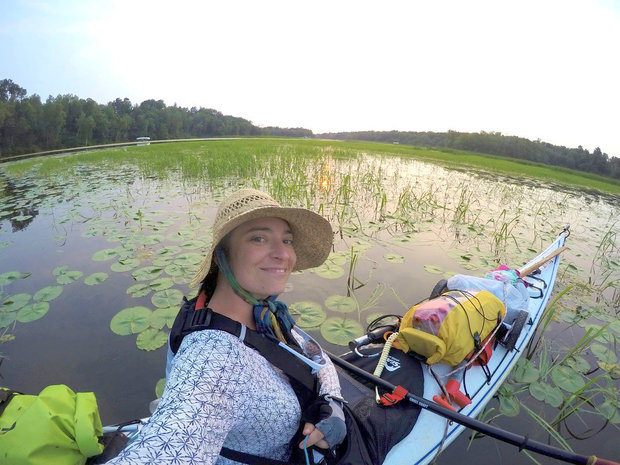
A University of Kentucky biology graduate is a little more than one month into a three month kayaking trip to traverse the Mississippi River in "an effort to educate people about water quality in America's lakes, rivers and oceans," Will Wright reports for the Lexington Herald-Leader. Alyssum Pohl, who began her journey on June 25, "will take water samples, document litter and help clean up beaches along the way. She'll submit some of her data to the Adventurers and Scientists for Conservation, and she'll use some of it to write scholarly articles. She'll also share the data with each of the 10 states she travels through." (A selfie of Pohl on her journey)

Pohl is documenting her 2,500-mile trip on a blog, "Paddle On!," where she writes that she picks up an average of two to eight pieces of trash per day. As of July 19, only two days had passed during which she didn't see any trash.

"She said she has been surprised by the lack of trash in the water but disappointed by the amount of litter at campsites," Wright writes. She told him, "Every little bit of pollution . . . it all goes somewhere, and it all matters." Water samples Pohl collects will be compared with those of John Sullivan, a retired Wisconsin Department of Natural Resources biologist who canoed the Mississippi River in 2012 and 2013.

Thursday, July 16, 2015

Park Service tries to cut trash by banning disposable bottles; Big Water lobby fights back

In an attempt to reduce trash and litter in national parks, the National Park Service is allowing parks to stop selling disposable bottles and instead have visitors refill reusable ones with public drinking water, Lisa Rein reports for The Washington Post. But water-bottling firms that brings in billions of dollars a year and employs thousands, have stepped in to block the parks from banning the plastic pollutants—and the industry found an ally on Capitol Hill to add a little-noticed amendment to a House spending bill that would kill the policy." (NPS photo)

"As environmental groups and local officials campaign for a sales ban to reduce park waste and carbon emissions, the titans that manufacture Deer Park, Fiji, Evian and 200 other brands of water packaged in disposable plastic have mounted a full-court lobbying campaign on Capitol Hill to stop the Park Service’s latest effort at sustainability," Rein writes.

Chris Hogan, vice president of communications for the International Bottled Water Association, which represents 200 bottlers, told Rein, “This is a prominent, misleading attack on bottled water that has no justification." Big Water's campaign claims the move by the park service is promoting an unhealthy lifestyle, because it's leading to more visitors choosing to drink soda, instead of water.

Park Service Director John Jarvis "issued a memo to the system’s 408 parks, national monuments and historical sites, allowing them to eliminate sales of disposable plastic water bottles," Rein writes. "The bottles were clogging the waste stream, he wrote in 2011, eating up recycling budgets at a lot of parks." About 20 parks have sworn off water sales, but the number could be higher, because parks are not required to notify headquarters when they change their policies on concessions. (Read more)

Wednesday, June 18, 2014

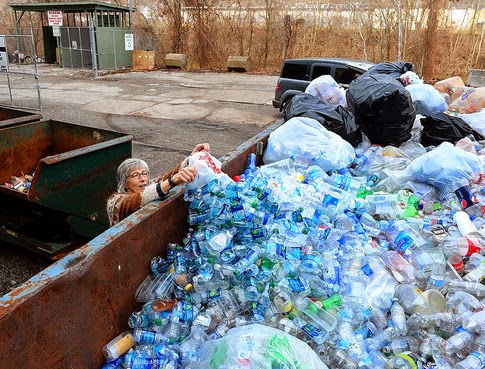
Recycling remains rural problem; W.Va. chemical spill sent millions of plastic bottles to landfills

Recycling bottles during West Virginia spill.
Photo: Chip Ellis, The Charleston Gazette
The January chemical spill that tainted drinking water in much of West Virginia, forcing residents to rely on bottled water, illustrated the lack of recycling in much of rural America. The vast majority of the millions of plastic bottles used after the spill ended up in landfills, Valerie Bauerlein reports for The Wall Street Journal.

Only 36 percent of West Virginia residents have curbside recycling, and in 2011 the Charleston area recycled less than 1 percent of its eligible plastic, compared to 30 percent nationally. "Many small towns and rural counties struggle to offer recycling services, especially with tight government budgets, limited access to recycling processors and wide fluctuation in the market for recyclable materials," Bauerlein writes. "Only half the population of Mississippi has access to drop-off or curbside programs. Some small cities, such as Lynn Haven, Fla., eliminated recycling programs because there were no nearby processing centers." (WSJ graphic)

The main reason rural areas lack access to recycling is that dumping trash is quicker and easier than recycling. "Shawn Lindsey, a recycling expert who advises the not-for-profit Center for Rural Strategies, said some towns cannot get vendors to bring in recycling containers because it takes weeks to fill a bin, tying up a company asset and providing an insufficient return," Bauerlein writes. Meanwhile, Lindsey said dumping trash in a place like Athens, Tenn., where he works, costs about $20 a ton, while it can cost more than $100 a ton in some urban areas.

Some people are optimistic that rural recycling has a bright future, with technological advances like automated bin-lifting trucks and optical sorters that will make it cheaper, Bauerlein writes. Mississippi was recently "awarded $1 million in grants to four communities seeking to build 'hub-and-spoke' networks, which could pool their collection to make recycling financially viable, according to the Mississippi Department of Environmental Quality." But the best solution, advocates say, is to make recycling free and easy for everyone. (Read more)

Tuesday, March 04, 2014

Some rural recycling centers struggle to stay open

Recycling can be problematic in rural America because it lacks the population density to make pickup practical, and in many areas there is a tradition of disposing of trash on your own land. Some rural recycling centers in states like Indiana are losing money and struggling to remain open, Laura Lane reports for the Bloomington Herald Times: "Despite hard work, years of promotion and increased citizen participation, money continues to leach from many small-town recycling ventures."

In Owen County (orange on map), where the center has been losing money for four years, the 2013 budget was $100,000, but income was onlky $40,000, Lane reports. In Brown County, budget cutbacks have forced solid-waste facilities to close on Mondays. A recycling center in Greene County has lost money five straight years, and could run out of money before the end of the year. Employee Tony Thomas told Lane, "We used to, years ago, be able to break even, but not anymore." (Greene County is directly below Owen County. Brown County is two counties west of Owen.)

The problem is that recycling just doesn't bring in much money, with newspapers going for a penny a pound, and businesses that collect trash charging $1 or $2 per bag, Lane writes. The solution, some say, is to stop the service. That's not good news for people like Owen County Interim director John Reeves, who lives in a remote rural area, who has no trash service at his home, and takes his trash to recycling centers. He told Lane, "I don't know what will happen. We are taking it a week and a month at a time. Nobody wants to close the recycling center, but it doesn't look like there is anything we can do to keep it open. But we keep trying." (Read more) The Herald Times is subscription only, but some stories can be accessed by clicking here.

Wednesday, December 18, 2013

Amid protests from gun advocates, BLM reverses ban on recreational shooting in national monument

In another example of the power gun advocates have over government officials, Emily Guerin reports for High Country News about the failed attempt by managers of the Sonoran Desert National Monument to ban recreational shooting on its 487,000 acres. The Bureau of Land Management reversed the decision after receiving complaints from Washington, D.C.-based hunting and shooting advocates who toured the monument. (Photo: A bullet-ridden sign at the monument)

Former monument manager Rich Hanson banned shooting because of the damage caused by shooters, Guerin writes. "In just one cleanup, he and his staff gathered 12,000 pounds of bullet-riddled oil drums, fast-food garbage and computer monitors. 'Slob shooters,' as Hanson, who retired last spring, calls them, have also harmed the very resources he was sworn to protect – amputating saguaro [cactus] limbs, shattering rock faces and splintering the trunks of palo verde, mesquite and other desert trees. Visitors to monument wilderness areas or the popular Anza National Historic Trail often pass unsightly roadside dumps."  

Wilderness Society attorney Phil Hanceford, who sued the BLM over its reversal in September, told Guerin, "This is not just turning a blind eye to someone else's science. It's looking straight at their own science and completely disregarding their own recommendation." High Country News is subscription only, but can be accessed by clicking here.

After the tour, John Tomke, chair of the Wildlife and Hunting Heritage Council, wrote a letter to BLM Director Robert Abbey, saying: "When then-[Interior] Secretary Bruce Babbitt recommended BLM keep management of the SDNM, it was understood that these special landscapes would remain open to the traditional recreational activities that had taken place for decades. Recreational shooting is one of those traditional activities. Dispersed recreational shooting is a valued recreational activity unto itself and is also a gateway into more formal shooting sports and hunting. Recreational shooting is a critical element in the process of becoming a hunter and shooting sports enthusiast, and given the importance of hunting and recreational shooting in the funding of wildlife conservation in America it is imperative that we do all we can to further recruitment and retention of hunters and recreational shooters." Tomke argued that there aren't enough public shooting areas in the Phoenix area for the number of recreational shooters who live there, better clean-up plans could be instituted, and the monument has enough room for specific shooting-only areas, or re-routing hiking trails to accommodate shooters. (Read more)

Wednesday, December 19, 2012

States compost roadkill, as farmers do dead stock

"Roadkill disposal is a serious problem nationally, as stricter environmental regulations close burial pits, landfills run out of space, and many rendering plants shut down," Eliza Murphy of High Country News reports. The problem can be a burden in rural areas, where roadkill is more likely to occur. But a pilot program in Oregon, in which roadkill is composted, could provide a national solution. (HCN photo: Working compost site in Oregon)

Composting is becoming a popular alternative for disposal of roadkill, as Montana, Washington and New York already have working composting sites. It cost the Oregon Department of Transportation $11,600 to develop its site in the eastern part of the state and get permits in 2010. It cost just $6,500 a year to operate the site. About 500 deer, and hundreds of other miscellaneous animals, have been "transformed into nutrient-rich soil conditioner" so far in Oregon. The project might eventually create enough compost to use for roadside planting. But right now, it only produces enough to keep the compost starter pile sustained, Murphy writes. Still, the site is successful enough to remain the official method for roadkill disposal in eastern Oregon, a very dry and rural place.

"This works just like a regular compost at home," ODOT's Michael Bennett told Murphy. "You put the carcass on a pile, keep it moist and aerated for several months, and it cooks and decomposes." When roadkill arrives, workers place it on a layer of wood chips close to another carcass to create more heat. They sprinkle it with a layer of starter compost, then another layer of wood chips, then they turn it for months until it's all decomposed. Some farmers and ranchers all over the country use the method for disposing of dead livestock. (Read more)

Wednesday, June 27, 2012

Trash-cams spotting rural dumpers; one stream is known for fly fishing and abandoned recliners

A man is caught dumping trash at an illegal site
by a hidden camera purchased by the
Juneau Parks and Recreation Department
It's not a new problem but it's an ugly one. And tranquil, open, lush rural landscapes take the biggest hit when people think they've got nowhere else to put their trash. In Southeast Alaska, law enforcement has had just about enough. So they installed hidden cameras on roads with the most popular dumpsites, reports Kyle Hopkins of the Anchorage Daily News. One of those roads, Hopkins writes, "winds through an area north of Juneau known for world-class fly fishing and abandoned recliners." Bob Dilley, lead community services officer for the Juneau Police Department, explained that officers "get tired of digging through piles hoping to find a scrap of paper with somebody's name on it." Post-trash-cams: A five-arrest spring.

Illegally dumping more than a square foot of litter is a minor offense in the Southeast Alaska city and borough, punishable by a $200 fine. Hopkins, whose story is a primer on how to do this kind of community reporting, writes: "The people cited so far look like any cross section of Alaskans. Guys in ball caps and hoodies driving big pickups. A man in a Land Rover. An SUV full of young women. The Daily News, through a public records request, obtained footage involving all the closed littering cases originating between April 9 and May 15. All five people shown in the footage had paid their fines as of June 12, according to the Juneau Police Department. Littering falls under Anchorage public-nuisance laws with fines ranging from $50 to $300 for a first offense and $200 to $600 for a second offense."

Other towns and counties around the country began experimenting with litter cams earlier this year, at about the same time as Juneau, Hopkins finds. The Delaware Natural Resources Department has used hidden cameras to catch litterers since 2009. County supervisors of Henry County, Va., population 54,000, voted this year to approve $5,000 for the purchase of game cameras to catch people illegally dumping trash.,saying the detritus is bad for tourism, bad for business. Meanwhile, notes Hopkins, the trend is growing. Lorain County, Ohio, sheriffs recently bought solar-powered litter cameras. And local news reports indicate that litterers better be on the lookout for trash cams in Stephenville, Newfoundland, and in the Municipal District of Foothills in southern Alberta.

Wednesday, July 09, 2008

High metal prices help clean up Eastern Kentucky

"Skyrocketing costs of scrap metal have created a silver — or should we say steel — lining to economic and environmental woes. Collecting scrap not only brings in extra money, but also encourages citizens to clean up unsightly refuse," Anna Tong writes for the Lexington Herald-Leader. "The effects are magnified in Eastern Kentucky, a region with a chronic problem of improper disposal — or no disposal at all — of junk cars and appliances. Now, the prospect of getting fast cash is motivating a mass clean-up of litter, traditionally the work of prison inmates and environmentalists."

Gerald Hines, solid waste coordinator in Pulaski County, on the edge of the rugged Cumberland Plateau in Southern Kentucky, said the county is “50 percent cleaner” in recent months. “In our lifetime, scrap may not be as high again as it is now.” The Institute of Scrap Recycling says iron and steel sorted by processors fetched $520 a ton in May, way up from $100 five years ago, mainly because of demand from fast-growing China and India. One dealer with three yards in Eastern Kentucky is paying initial sellers $180 a ton. He pays $2 to $4 a pound for copper.

There's a downside, of course. "There have been numerous cases of individuals who've been arrested for stealing everything from manhole covers to copper wiring to sell," Tong notes. (Read more) Herald-Leader photo by Brad Luttrell: Levi Chaffins, right, waited for Junior Watkins, on top of truck, and Larry Spencher to finish unloading at Mister Metal Recycling in Salyersville, Ky., on June 25.

Thursday, March 06, 2008

Ky. budget crisis imperils environmental programs, including rural trash cleanup; cig tax hike proposed

Kentucky is facing a state budget crisis that "could mean more litter along roadsides, slower cleanup of dumps and less successful reclamation of strip-mined land. And there could be fewer people to maintain the state's network of nature preserves and keep track of rare plants and animals," reports The Courier-Journal.

The economic slowdown, combined with irresponsible budgeting by past governors and legislatures, prompted Democratic Gov. Steve Beshear to propose a budget that would cut the state's two main environmental agencies "20 percent and 25 percent next year. That's significantly more than some other state operations," writes Jim Bruggers, the Louisville newspaper's environmental reporter.

Kentucky has many small, poor counties, and the cuts would exacerbate a litter problem in their rural areas. (Bruggers photo shows a roadside dump.) "For many counties in Kentucky, especially rural ones, the only funding for litter pickup comes from the state," he writes. "Without it, there will be more dumping left unattended, said Wade Johnson, director of solid waste management for Woodford County and chairman of the Solid Waste Coordinators of Kentucky."

Beshear has proposed casinos as an alternative to tax increases, but the prospects for that idea are cloudy at best. Tonight he reversed himself and endorsed raising the state cigarette tax to $1 a pack from 30 cents. (Read more)

Tuesday, July 31, 2007

Virginia's first environmental court is making a dent in a mountain county's litter problem

"Virginia’s first court dedicated to environmental cases has flourished in Wise County since its October 2006 beginning," reports the Coalfield Progress. "The people of the county are finally starting to see that trash-related offenses are being taken seriously, county litter control and recycling coordinator Greg Cross said."

Cross told reporter Bonnie Bates that more people are testifying against those charged with littering because they are tired of trash littering the county. "So far, eight people have been convicted for illegal dumping, six have been convicted for trash accumulation, one was convicted for littering and one was convicted for having an illegal junkyard," she writes. "Judgments in these cases ranged from $5,000 to $200."

Cross said he tries to settle many of the trash accumulation offenses outside court, and if offenders don't comply, they are charged in environmental court, which the district judge holds once a month and has a 100 percent conviction rate. "Punishment for the offenses includes a judgement, being ordered to clean the mess and ordered to not commit the same crime again," Bates writes. (Read more)