Showing posts with label open government. Show all posts

Friday, March 14, 2025

Sunshine Week runs all this week: Event celebrates open government and offers plenty of free promotional materials.


Sunshine Week, an annual event highlighting the importance of open government and freedom of the press, starts on Sunday.

Now in its 19th year, this year's events run from March 16-22. National Freedom of Information Day is March 16, the birthday of James Madison, the fourth president of the United States and father of the First Amendment.


The Sunshine Week site offers free, promotional materials, including Zoom backdrops in English and Spanish, sample social media posts, op-eds, editorial cartoons, Sunshine Week logos, and a step-by-step Freedom of Information Act (FOIA) graphic. The website also features freedom of information resources with print and video explanations and the legislative history of FOIA.

Sunshine Week is coordinated by the Joseph L. Brechner Freedom of Information Project at the University of Florida’s College of Journalism and Communications. It is supported by the John S. and James L. Knight Foundation and a growing list of public and private endorsers.

Explore Sunshine Week here

Friday, March 07, 2025

Opinion: The strongest argument for openness in government: Facts quell rumors

Jim Pumarlo
As youths we all likely tried to hide bad behavior from our parents. The truth inevitably surfaced, and we bore the brunt of punishment. Lesson: Be up front with circumstances and repercussions typically are minimized.

Newspapers should communicate the same lesson to public officials who try to keep secret what they deem sensitive or unwelcome news: Be forthright. Make it standard procedure to volunteer the news and minimize rumors.

Newsrooms work tirelessly to deliver on the “public’s right to know,” and for good reason. In the words of David Bordewyk, executive director of the South Dakota NewsMedia Association: Open government is essential to good government.

The public’s right to know was the thrust behind the SDNA’s support for a bill that passed this year’s Legislature to require all public boards to review the open meetings laws once a year, Bordewyk writes. “Keeping an eye on government and informing readers about public meetings are among the most important jobs for community news media organizations.”

Government transparency often centers on open records and open meetings laws, Bordewyk notes, acknowledging that laws can be confusing and lead to misunderstandings. So why not require an annual refresher course? It’s a great idea, one that should be pursued by other state press associations if it’s not already on the books.

At the same time, newspapers should not wait for the often lengthy and zigzag path of a worthy idea to reach the finish line. Why not initiate meetings with local officials to review and explore the intricacies of open meeting and data practices laws.

Newspapers certainly should stand on the letter of the law when seeking access to public information and meetings. Two other points should be stressed.

First, advance requests based on the spirit of openness – no matter what the law dictates. Challenge public officials to place themselves in the position of friends and neighbors seeking answers from City Hall. Would they be satisfied with “no comment”?

Second, underscore the value of setting benchmarks for community conversation. Meeting in secret or withholding information only fuels rumors. If gossip has reached the newspaper, those affected can rest assured it has circulated broadly, especially fueled by social media. At a minimum, hearsay exaggerates the facts. At worst, the whispers promote blatant falsehoods.

The opportunity to deliver facts straight from the source is one of the strongest arguments editors can present to those otherwise hesitant to share information. Citizens still may dismiss statements as a “company line,” but parameters have been set for community discussion.

The premise of openness should be delivered to the private sector as well. Companies and individuals are not subject to the same laws as public bodies, but they ought to be aware that their news is equally important to the community and often travels more quickly than a city council vote.

Conflicts over the public’s right to know often focus on a specific meeting or particular document. Officials also should be reminded of the value of everyday openness.

I vividly recall the “news” passed along by my photographer when I sat behind the editor’s desk. Word had reached his son’s elementary school that a teacher at the middle school had lost all his fingers in a lab experiment. We promptly tracked a story for that day’s edition. The superintendent set the record straight. The teacher lost a fingertip and all was handled very calmly and professionally.

Our first inquiry, however, went to the school principal. She refused comment, charging us with sensationalism. A few minutes later she called and canceled her subscription without even seeing our report. I’ll stand by our decision to pursue and publish the story. I’m certain we prevented a lot of misinformed table talk at dinners that evening.

I applaud Bordewyk and his association for securing legislation to require all public boards to review the open meetings laws once a year. In tandem, I encourage newspapers to pursue meetings to orient public officials on the laws. Nothing is more important in newspaper missions than to preserve and advance the public’s right to know.

Editors too often find themselves demanding information in confrontation. Seize the opportunity to structure these meetings as an effort to reach a common understanding.

Jim Pumarlo is former editor of the Red Wing Republican Eagle (Minn.). He writes, speaks and provides training on community newsroom success strategies. He is author of “Journalism Primer: A Guide to Community News Coverage,” “Votes and Quotes: A Guide to Outstanding Election Coverage” and “Bad News and Good Judgment: A Guide to Reporting on Sensitive Issues in Small-Town Newspapers.” He can be reached at jim@pumarlo.

Tuesday, July 02, 2024

Opinion: Will the public be notified of water problems? EPA and states often let the information be obscured.

John Galer
The following is a column by John Galer, chair of the National Newspaper Association and publisher of The Journal-News in Hillsboro, Illinois.

If you are aware of the Marion County (Kansas) Record, it is probably because you winced at the dings and dents inflicted upon the First Amendment when the local police department conducted a raid on the Record’s offices in 2023. Publisher Eric Meyer stood up to the police with a civil liberties lawsuit, put his paper out in spite of the harassment from law enforcement and reminded audiences all over the country about the importance of community newspapers.

What you might not know is that the Record is at it again — this time exposing the damage to the public’s right to know when water quality public notices are entrusted to self-reporting on government websites.

Ironically, the Record is in the same state whose attorney general recently gave Wichita — the state’s largest city — the ability to eliminate its newspaper notices and instead publish on the city’s website.

How well does this self-reporting work? We need only to look to the EPA’s and state agencies’ reporting requirements for water quality.

EPA used to require a newspaper notice. Then it “modernized” its methodology and set up a three-tied communications system for alerting the public to drinking water problems. The new guidance now doesn’t even mention newspapers. For immediate risks to human health, the only requirement for use of news media is a mention to broadcast media (remember them—they are the ones who no longer have local reporters in a majority of their markets.) Presumably, this notification would be through a press release. Translation: free media. Presumably, the broadcast outlet would be free to ignore it or forget to read their email to pick it up in the first place.

The water agency also can post the notice in “conspicuous locations.” We are remembering a recent public health experience when most people didn’t go outside their homes. We wonder which “conspicuous locations” would have served then. Hand delivery of notices to persons served by the water system is also allowed. We are betting that is a rare occurrence.

How well does this new system work?

Not so well, according to EPA’s inspector general. Agencies responsible for issuing public notices failed to meet requirements about 6,000 times per year on average. As a result, citizens were not notified that the Safe Drinking Water Act passed by Congress in 1974 was not being followed. In short, people might have been drinking polluted water, unaware.

After the debacles in Flint, Michigan, where taxpayers had to foot millions of dollars in damages and legal fees for drinking water problems — per the existence of polyfluoroalkyl substances (PFAS) in water near key military bases in North Carolina and Georgia — a person might think water quality would be higher on enforcing agencies’ agendas.

Back to Marion, Kansas.

The notice used by the city water authorities was a copy of a compliance report included in water bills. But one month, the report didn’t show up. Meyer went on the hunt. He was met with defensiveness and accusations, according to his news story. Finally, he found a mention in one water bill of an internet address for a water quality report. And it turned out a link to the report was on the city website. But, lo, when Meyer followed the link, he got a “Forbidden” notice. He reported a series of deflections by city official: they couldn’t get testing supplies from a vendor, tests were not really required because it had stopped using one disinfectant after its injectors failed. On and on.

To Meyer’s credit, he doesn’t let the ire of city administrations stop him. We hope his readers love his temerity and that his readers find out what they need to know about their local water. Meanwhile, we hope the Kansas attorney general gets a wake-up call.

What’s wrong with this picture?

As with all of the wishful thinking that goes into removing newspaper public notices and requiring the public’s business to be posted on some obscure website, the ability of the public to educate itself gets washed away. If Marion County’s 11,000-some residents had at least been given a shot at real public notice, they might have found the water was bad. Or that it was safe. Either way, they could have found out. But EPA let the water authorities off the public notice hook. And now the state has allowed its attorney general to further the error in Wichita.

The problem is that lack of notice removes, in Marion’s case, some 11,000 private attorneys general who might have chosen to hold their government accountable. But none the wiser, they could not.

What will it take? As in all defenses of liberty, eternal vigilance. We can never give up on the right to know.

Friday, May 10, 2024

Eric Meyer and Marion County Record, Kansas paper raided by police chief it was investigating, win Tom and Pat Gish Award for courage, integrity and tenacity in rural journalism

Eric Meyer with his weekly newspaper
Eric Meyer and the staff of the Marion County Record in Marion, Kansas, are the winners of the 2024 Tom and Pat Gish Award for courage, integrity and tenacity in rural journalism, presented by the Institute for Rural Journalism at the University of Kentucky.

Meyer and his weekly newspaper have become a touchstone for freedom of the press since August 2023, when local police raided his office and his home and confiscated computers, reporters’ notes and cell phones, ostensibly investigating charges of identity theft and illegal use of a computer. It didn’t take long for some motives to be apparent: city officials’ desire to punish the newspaper for its investigation of the police chief’s questionable employment background and its reporting on the mayor’s alleged ethics violations and other activities. A few weeks later, the chief was suspended, and three days later, he resigned.

Five days after the raid, the county attorney withdrew the warrants signed by a local judge, saying they were “legally insufficient,” and the confiscated items were returned. But in the meantime, Meyer’s 98-year-old mother, Joan Meyer, collapsed and died after telling journalists that she was upset and stressed by the raid of her home and the paper where she had worked for 50 years. She said, “These are Hitler tactics, and something has to be done.”

The raid, perhaps unprecedented, sparked international outrage at a time when local newspapers are struggling. Eric Meyer said soon after the raid, “If we don’t fight back, and we don’t win in fighting back, it’s going to silence everybody.” Since then, he and his staff have continued to show the courage, tenacity and integrity often required to deliver good journalism in rural areas. The Record “is uncommonly aggressive for its size,” The New York Times reported. “Meyer said that the newspaper, which has seven employees, has stoked the ire of some local leaders for its vigorous reporting on Marion County officials.”

That profile fits those of other Gish Award winners, including the first winners and the award’s namesakes: Tom and Pat Gish, who published The Mountain Eagle in Whitesburg, Kentucky, for more than 50 years. Their son and successor, Ben Gish, is on the award selection committee. He said of Meyer, “Given today’s political climate, what happened to him in Kansas almost certainly will happen at some other small-town paper when another unfit person wins that county's sheriff’s race.”

Meyer’s family bought the Marion County Record in 1998 to keep it from being sold to a chain. His father, Editor Bill Meyer, had worked there since 1948, and won the Eugene Cervi Award of the International Society of Weekly Newspaper Editors in 2002. Eric Meyer returned to his hometown to run the paper during the Covid-19 pandemic after working as a reporter for the Milwaukee Journal and teaching journalism at the University of Illinois.

"Eric Meyer and other journalists at the Marion County Record covered their community with courage, tenacity and integrity long before a shocking police raid brought them international attention,” said Benjy Hamm, director of the Institute for Rural Journalism. “But the raid and its aftermath revealed to a much larger audience that the Marion County Record could not be intimidated, denied or defeated in its pursuit of the truth."

Meyer will receive the Gish Award Oct. 10 in Lexington, Ky., at the annual Al Smith Awards Dinner of the Institute for Rural Journalism. The keynote speaker will be Campbell Robertson, who covers Kentucky, Ohio, Pennsylvania, Delaware, Maryland and Virginia for The New York Times and is based in its Washington Bureau. For updates see RuralJournalism.org.

Other Gish Award winners have been the Ezzell family of The Canadian Record in the Texas panhandle; Jim Prince and Stanley Dearman, current and late publishers of The Neshoba Democrat in Philadelphia, Miss.; Samantha Swindler of The Oregonian for her work at The Times-Tribune in Corbin, Ky., and Jacksonville Daily Progress in Texas; Stanley Nelson and the Concordia Sentinel in Ferriday, La.; Jonathan and Susan Austin of the Yancey County News in North Carolina; the late Landon Wills of the McLean County News in Kentucky; the Trapp family of the Rio Grande Sun in northern New Mexico; Ivan Foley of the Platte County Landmark in northwestern Missouri; the Cullen family of the Storm Lake Times-Pilot in northwest Iowa; and Les Zaitz of the Malheur Enterprise in eastern Oregon. In 2019, the award went to three reporters whose outstanding careers revealed much about the coal industry in Central Appalachia: Howard Berkes of NPR; Ken Ward Jr., then with the Charleston Gazette-Mail; and his mentor at the Gazette, the late Paul Nyden. In 2020 the award went to the late Tim Crews of the Sacramento Valley Mirror; in 2021 to the Thompson-High family of The News Reporter and the Border Belt Independent in Whiteville, N.C.; in 2022 to Ellen Kreth and the Madison County Record of Huntsville, Ark.; and in 2023 to Craig Garnett of the Uvalde Leader-News in Texas.

Tuesday, March 05, 2024

Next week is Sunshine Week. Get ready to showcase how journalism works to preserve open government.

Sunshine Week begins this Sunday, March 10, with multiple ways to highlight how journalists support open government as watchdogs and First Amendment advocates. As Americans face another election cycle, it's an impactful time to remind all citizens that good reporting dynamically supports our democratic process.

Among Sunshine Week's tools, are a social media kit, logos, and timely promotions. If you are writing a news story, editorial or column about freedom of information, tips from the Society of Professional Journalists are also available.

The week's offerings include in-person and online events and activities, including a Sunshine kick-off by the Department of Justice and a panel discussion to raise awareness of Sunshine Laws sponsored by the League of Women Voters of Kansas City/Jackson-Clay-Platte Counties.

Sunshine Week was launched in 2005 by the American Society of News Editors, now the News Leaders Association. This year's events are supported by a growing list of partners, including Brechner Freedom of Information Project, Muckrock, the Society of Professional Journalists and the Radio Television Digital News Association.

Thursday, November 02, 2023

As access to public records erodes, more records are deliberately concealed from the public

Successful efforts to obtain public records are
down 18%. (Photo by Wesley Tingey, Unsplash)
While Florida's change in public records access may be more dramatic than some, it marks "a steady erosion of public records laws in a number of states," report Katherine Barrett and Richard Greene of Route Fifty. "North Carolina’s budget bill, for example, recently included language that changes previous open records laws to exempt current and former legislators from any requirements to share documents they create while in office and to give lawmakers the power to decide whether a record should be made public, archived, destroyed or sold."

"The ability of people to get records that are supposed to be made publicly available has been 'deteriorating terribly,' according to David Cuillier, director of the Brechner Freedom of Information Project at the University of Florida," Route Fifty reports. "In fact, a nonprofit organization called MuckRock, which consults with people and organizations in their efforts to get public records, has found that about 10 years ago such efforts were successful about half the time. Today, that’s down to about 18%." Megan Rhyne, executive director of the Virginia Coalition for Open Government, told Route Fifty: "There has been a consistent move to conceal more and more records from the public. Some states have done so at a different rate than others, but we see this in many of them.”

The lack of access isn't limited to journalists "who have historically been able to serve as watchdogs over government by making Freedom of Information Act requests to get the documents necessary to fully report an article," Barrett and Greene write. “Though journalists often use FOIA, the majority of requesters are not reporters." Michael Morisy, co-founder and chief executive officer of MuckRock, told Route Fifty: “In many places, they are commercial requesters, like businesses that need information in order to make informed proposals for procurement. Then there are think tanks and universities."

Often referred to as "sunshine laws," most states have open records laws, but they can be weakened through exemptions. Barrett and Greene explain: "This has been the case in Florida, which long had a reputation as one of the most open states in the country. Its first sunshine laws were enacted in 1909, one of the first such pieces of legislation in the country. That law has been chipped away with increasing speed since the mid-1990s, and today it has about 1,200 exemptions and at least a dozen more are added almost every year. Of course, some of the exemptions, like access to individuals’ Social Security numbers, make good sense, but many are far more troublesome, like those protecting the governor’s past travel records."

Friday, September 15, 2023

News-media roundup: Ark. sunshine; Okla. local-news study; week-long series on Neb. paper's role in community

Open-government advocates in Arkansas quashed efforts to carve large loopholes in the state's Freedom of Information Act, in a special session Gov. Sarah Huckabee Sanders called to do that and to make secret information about her security arrangements. The latter measure passed. Rejected were open-records exemptions for attorney-prepared documents and the "deliberative process" leading to "governmental decisions and policies" and attorney-prepared documents, and a change that would have "made it harder for people to recover legal fees for lawsuits filed under" the act, reports Neal Farley of the Arkansas Democrat-Gazette. Another rejected bill "would have shielded 'records reflecting communications between the governor or his or her staff and the secretary of a cabinet-level department'." The outcome showed "the power of citizen action," writes longtime FOI leader Sonny Albarado, editor of the Arkansas Advocate.

Counties in study (To enlarge the map, click on it.)
"Oklahomans statewide primarily rely on social media and local word of mouth for local news," and "rarely subscribe to local newspapers," media and political-science professors say in a study report after interviewing 352 news consumers in seven diverse counties in the state. The study is the "first qualitative observational study of both news deserts and under-served metro communities statewide in Oklahoma," says the Oklahoma Media Center, a nonprofit that funded the work by Rosemary Avance, assistant professor in the media school at Oklahoma State University, and Allyson Shortle, associate professor of political science and co-founder of the University of Oklahoma’s Community Engagement and Experiments Lab. They say "Small-town residents express more trust in local news when a local person is in charge of it."

"Final edititon of the Norfolk Daily News," trumpeted the main headline in the Aug. 17 edition of the Nebraska paper. "Or is it?" a subhead teased. Under it Kent Warnecke wrote, "The primary role of a headline is to attract a reader’s attention. Chances are, the headline on this story did just that. To be clear, this is NOT the final edition of the Norfolk Daily News. The Daily News will be published tomorrow, next week and into the future. But that isn’t the case elsewhere in the nation, and, as a result, it’s not an exaggeration to say our freedom as citizens is at risk." The story was part of a week-long "Protect the Pillar" series, referring to the news media as the fourth pillar of democracy. One story noted the demise of 16 Nebraska newspapers since 2004. Looks like good material for National Newspaper Week, Oct. 1-7.

Saturday, August 19, 2023

Ark. publisher wins open-government battle with school board over secret meeting with superintendent candidate

Challenging officials for breaking open-government laws "can involve determination and courage on the part of a community journalist. But, in the end, that is indeed a major responsibility at times for a committed local publisher," says the latest Arkansas Press Association Publisher Weekly.

Tamara Johnson (APA photo)
APA reports on the history of Tamara Johnson, editor and publisher of the daily Times-Herald in Forrest City, who filed a complaint last September with the Palestine Police Department "against the Palestine-Wheatley School Board for holding a secret meeting to interview a candidate for the position of interim superintendent at the St. Francis County school." The local prosecutor refused the case, and local judges recused themselves, but the city attorney of Forrest City, the county seat, agreed to prosecute before a retired circuit judge. After months of negotiation, the sides agreed that board President Derrick Boileau would plead "no contest," get six months’ probation and undergo mandatory training from the Arkansas School Boards Association, along with the other six board members.

"Johnson said the secret meeting occurred after several problems the newspaper had with the board concerning its methods of operation," APA reports. "This involved such actions as creating confusion on meeting dates and agenda items. 'I told them this has got to stop,' Johnson said. 'I originally thought we had a good relationship with the president and the board. What I really wanted all along was for them to take some training on the Freedom of Information Act.'"

Palestine in St. Francis County, Arkansas
(Wikipedia map)
"The board president failed to contact the newspaper concerning the meeting with the superintendent prospect and held the session across the street from the school in a shop owned by one of the board members," APA reports. "The newspaper obtained a photo of vehicles of board members parked in front of the shop during the meeting. . . . Johnson was disappointed with the actions of the school board in light of what she considers a solid level of trust developed with readers and institutions in the St. Francis County area during her almost 33 years at the Times-Herald. . . . She has been married 31 years to Rob Johnson, who is manager of the local radio station."

Tuesday, July 25, 2023

Oklahoma publisher who caught officials in racist, violent talk is losing his top reporter: son who took on the sheriff

The reporter who some officials of a rural Oklahoma county would like to kill, according to his newspaper's surreptitious recording of their discussion at a county commission meeting, is leaving his family's newspaper, citing threats and stress, Paige Wiliams reports for The New Yorker.

Chris Willingham, photographed through the paper's
window. (Photos: Joseph Rushmore for The New Yorker)
Chris Willingham is the son of Bruce and Gwen Willingham, who own the McCurtain Gazette in Idabel, Okla. The paper has a history of taking on McCurtain County officials, and Chris did a series of stories about irregularties in the office of Sheriff Kevin Clardy. One said 53 crime reports were missing, including “a shooting, a rape, an elementary school teacher being unknowingly given marijuana cookies by a student and a deputy allegedly shooting out the tires” of a car. The headline: “Sheriff regularly breaking law now.” 

Sheriff's Capt. Alicia Manning "was investigating several suspected pedophiles," Williams reports. "Manning told a TV news station that 'possibly other people in the community' who were in a 'position of power' were involved . . . and referred to Chris as 'one of them.' Without citing evidence, she accused him of trading marijuana for videos of children. Chris, stunned, suspected that Manning was just looking for an excuse to confiscate his phone. But when he started to lose music students, and his kids’ friends stopped coming over, he feared that rumors were spreading in the community. . . . He developed such severe anxiety and depression that he rarely went out; he gave his firearms to a relative in case he felt tempted to harm himself."

Chris and his wife Angie had "suppressed the occasional urge to leave the Gazette, knowing that they would be hard to replace," Williams writes, but now it was clearly an option. On March 6, he sued Manning and Clardy in federal court for “slander and intentional infliction of emotional distress.” They denied the allegations, and Manning's response said that whatever distress Chris suffered was within the limits of what “a reasonable person could be expected to endure.”

"On the day that Chris filed his lawsuit, the McCurtain County Board of Commissioners held its regular Monday meeting . . . Bruce, who has covered McCurtain’s commissioners for more than 40 years, suspected the board of discussing business not listed on the agenda—a potential misdemeanor—and decided to try to catch them doing it. . . . As they neared the end of the listed agenda, Bruce slipped a recording device disguised as a pen into a cup holder at the center of the conference table." When the room was vacated left hours later, "He went back inside, pretended to review some old paperwork, and retrieved the recording device."

In the three-and-a-half-hour recording, other officials come in, startig with Clardy and Undersheriff Larry Hendrix. Commission Chair Mark Jennings said the 2024 race for sheriff would have several candidates who “don’t have a goddamn clue what they’re getting into, not in this day and age.” Formerly, he said, the sheriff could “take a damn Black guy and whup their ass and throw ’em in the cell. . . . Take ’em down there on Mud Creek and hang ’em up with a damn rope. But you can’t do that anymore. They got more rights than we got.”

Manning came in and "continually steered the conversation to the Gazette," Williams reports. She "talked about the possibility of bumping into Chris Willingham in town: 'I’m not worried about what he’s gonna do to me, I’m worried about what I might do to him.' A couple of minutes later, Jennings said, 'I know where two big deep holes are here, if you ever need them.' 'I’ve got an excavator,' the sheriff said. "Well, these are already pre-dug,' Jennings said. He went on, "I’ve known two or three hit men. They’re very quiet guys."
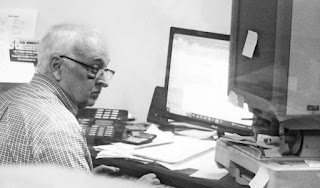
Editor-Publisher Bruce Willingham in his "clutterbucket of an office"
Williams writes, "Bruce took the tape to the Idabel Police Department. Mark Matloff, the district attorney, sent it to state officials in Oklahoma City, who began an investigation." On April 15, the Gazette reported the conversation under the headline, “County officials discuss killing, burying Gazette reporters.” The next day, Gov. Kevin Stitt demanded that Clardy, Manning, Hendrix and Jennings resign; only Jennings did. The sheriff’s department said the recordign was illegal and “altered.” Chris Willingham told Williams that he reduced the background noise in the audio file before his father took it to the police. Oklahoma Press Association Executive Director Mark Thomas said two of the three commissioners were present and had no expectation of privacy.

"People wanted to hear the recording, not just read about it, but the Gazette had no website," Williams reports. "The Willinghams published an oversized QR code on the front page of the April 20 issue, linking to a Dropbox folder that contained the audio and Angie’s best attempt at a transcript. They eventually put Chris’s articles online. In a rare move, the 17-member board of the Oklahoma Sheriffs’ Association voted unanimously to suspend the memberships of Clardy, Manning, and Hendrix. . . . [Idabel Mayor Craig] Young was among those who hoped that Gentner Drummond, the attorney general, would depose the sheriff 'so we can start to recover.' But on June 30, Drummond ended his investigation," saying that the conversation was “inflammatory” and “offensive,” but not criminal. But Chris's latest story reports that Manning is under FBI investigation.

Williams ends her story this way: "Bruce and Gwen worried that the ongoing stress would drive Chris and Angie away from the Gazette — and from McCurtain County. Sure enough, they’re moving to Tulsa. Angie told me, 'We’re 40 years old. We’ve been doing this half our lives. At some point, we need to think of our own happiness, and our family’s welfare.' Bruce protested, but he couldn’t much blame them."
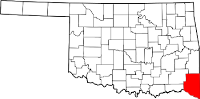
McCurtain County (Wikipedia map)
Williams' story has some observations about hard-nosed rural newspapering: "Bruce Willingham once wrote, 'We are aggressive about protecting the public’s access to records and meetings, because we have found that if we don’t insist on both, often no one else will.' . . . The Gazette exposed a county treasurer who allowed elected officials to avoid penalties for paying their property taxes late, and a utilities company that gouged poor customers while lavishing its executives with gifts. 'To most people, it’s Mickey Mouse stuff,' Willingham told me. 'But the problem is, if you let them get away with it, it gets worse and worse and worse.'

"In a small town, a dogged reporter is inevitably an unpopular one. It isn’t easy to write about an old friend’s felony drug charge, knowing that you’re going to see him at church. When Chris was a teenager, his father twice put him in the paper, for the misdemeanors of stealing beer, with buddies, at a grocery store where one of them worked, and parking illegally—probably with those same buddies, definitely with beer—on a back-road bridge, over a good fishing hole.

"Among law-enforcement sources, 'Chris was respected because he always asked questions about how the system works, about proper procedure,' an officer said. Certain cops admired his willingness to pursue uncomfortable truths even if those truths involved one of their own." Another unnamed officer told her. "If I was to do something wrong—on purpose, on accident—Chris Willingham one hundred per cent would write my butt in the paper, on the front page, in bold letters."

And one last revelation: Bruce and Gwen Willingham "rent several cabins to vacationers in Hochatown . . . a resort area known as the Hamptons of Dallas-Fort Worth," three hours away. Chris told her, “If we didn’t have tourism to fall back on, we couldn’t run the newspaper. The newspaper loses money.”

Wednesday, June 28, 2023

News-media news: Future Journalists of America in Oregon; Community Newspaper Week in Nebraska; a job posting . . .

Senior Adri Jolie: “FJA has given me the opportunity
to become a better journalist and to find self-expression
while self-reflecting on the type of media I consume.” 
High-school students in central Oregon have completed their first year in the Future Journalists of America program hosted by The Bulletin in Bend and created by the Fund for Oregon Rural Journalism, a nonprofit founded by EO Media Group, the newspaper's parent company. "The nonprofit’s mission is to stem the decline in Oregon journalism through innovative programming and advocacy," the Bulletin's Jody Lawrence-Turner reports. The teens "learned how to practice quality journalism in rural and metro newsrooms," and gained media literacy through lessons provided by The News Literacy Project, "and designed and launched a digital publication where they’ve published dozens of stories and podcasts," the Bulletin reports. "The two-year program not only inspires youth to pursue a career in journalism, it’s also a path to increasing newsroom diversity and sharing skills for sustaining a digital publication. It demonstrates journalism is evolving to adapt to the digital age, not dying, and there are multiple paths to a career in journalism." The three graduating seniors in the program will study journalism in college. Of the 16 active in the program, four were students of color.

This is Community Newspaper Week in Nebraska, and the McCook Gazette took the opportunity to remind its readers why local journalism is important: "Newspapers provide small communities with a dedicated source of local news, promote community engagement and unity, preserve local history, support local businesses, and ensure that information reaches all residents. Their role in keeping communities informed, connected, and empowered cannot be overstated."

The bipartisan Protect Reporters from Exploitive State Spying (PRESS) Act has been reintroduced in Congress, CNN reports: "The legislation, which passed the House last year but did not get a vote in the Senate, would safeguard journalists in two important ways. First, it would prevent the government from compelling reporters from being forced to disclose their sources. Second, it would ensure that important data held by a third party, such as a phone or internet company, cannot be seized without notice and providing the ability to challenge the move in court."

Foothills Forum, the foundation that supports reporting at the Rappahannock News in northern Virginia, is seeking a full-time general-assignment reporter, "which will be a significant addition to their current small group of part-time contributors," News Publisher Dennis Brack tells The Rural Blog. Click here for the job posting. Here's a profile of the weekly's new editor.

Monday, June 26, 2023

Weekly editors give Minnesota's Reed Anfinson top award; Oregon's Bagwell has top editorial; 11 other writers honored

Reed Anfinson
Reed Anfinson, a longtime leader in rural journalism and community newspapers, won the International Society of Weekly Newspaper Editors' top prize, the Eugene Cervi Award, at the group's annual conference in Reno, Nevada, Saturday night.

Steve Bagwell of The News-Register in McMinnville, Oregon, won ISWNE's Golden Quill for editorial writing; he and 11 other weekly editors were in the group's Golden Dozen for editorials. Those are detailed on The Rural Blog tomorrow.

The Cervi Award, named for the crusading editor of the old Rocky Mountain Journal, recognizes an editor who consistently acts with the conviction that “good journalism begets good government,” with consistently aggressive reporting of local government, and has had a career of outstanding public service through community journalism that adhered to the highest standards of the craft, with the deep reverence for the English language that was the hallmark of Cervi’s writing.

Anfinson is co-owner of the Swift County Monitor-News in Benson, Minn., The Stevens County Times in Morris, Minn.; and the Grant County Herald in Elbow Lake, Minn., and partner in a printing plant. After graduation from the University of Minnesota, he worked for the Minnesota House and a congressional campaign, returning to Benson as Monitor-News editor in 1978. In 1996, he bought his brother's half-interest and became sole owner. He and his wife, Shelly, purchased the Grant County Herald in 2014 and the Stevens County Times in 2019. He  served as president of the Minnesota Newspaper Association and the National Newspaper Association, the main lobby for rural newspapers, and is again on the NNA board. He won NNA's 2019 James O. Amos Award for a career of distinguished service and leadership to the community press and the newspaper’s community, the 2003 Al McIntosh Distinguished Service to Journalism Award, MPA's highest honor; and First Amendment awards from the Minnesota Coalition on Government Information and St. Cloud State University. He was vice president of the old Minnesota News Council and is research chair of the Minnesota Center for Rural Policy and Development, which does research on the challenges of rural Minnesota. He has served on local economic-development groups and continues to cover city, county, school and hospital meetings, as well as laying out pages and writing columns.

Anfinson was nominated by MPA Executive Director Lisa Hills, who wrote, "Reed exemplifies the best in journalism and serves as an inspiration to others. . . . He is recognized as a respected expert and spokesman for community journalism, often appearing on public television or being interviewed by reporters for stories regarding community newspapers [but] his main focus has always been, covering and informing readers about their local government bodies and community."

Former NNA president Robert Williams seconded: "Reed’s valor in standing up to the money and power that controls many small towns proves his commitment to the values so many journalists, like Eugene Cervi, stood for. I know of no other editor who better deserves an award representing the worthwhile goals Mr. Cervi sought to achieve. Our nation would be in far better shape if every community could be so fortunate to have an editor with the wisdom, vision and ideals Reed Anfinson demonstrates through his newspaper every week."

Benson Mayor Jack Evenson wrote that Anfinson "upholds journalistic excellence" and "strives to ensure that this area engages in fact-based, researched debate rather than what is popular or learned through hearsay. . . . The effort he puts into every issue is evidenced through the sheer number of stories and their high quality when compared to other small-town papers."

Anfinson clearly has done a good job of helping local officials understand the role of a community paper. He recalls how longtime city manager Rob Wolfington, now retired, concluded a list of introductions at a City Council meeting, looking across four rows of empty chairs at him and saying, "And the newspaper, representing the people of Benson."

Monday, June 19, 2023

N.Y. Times spotlights local officials' use of public-notice ads as weapons, but doesn't explain that state laws differ

At a time when local newspapers rely on advertising revenue from publishing public notices required by law, more local governments are moving the notices from newspapers to punish them for "aggressive coverage of local politics," reports Emily Flitter of The New York Times. Richard Karpel, the executive director of the Public Notice Resource Center, told Flitter “It’s gotten worse over the years in terms of trying to use contracts and laws to lash out at newspapers.”

Flitter cites several examples, primarily The Reporter in Delaware County, New York, but does not make clear that the Empire State is one of many that allow public officials to use public-notice ads as a weapon. Many other states require the notices to be published in the newspaper with the largest proven circulation in the officials' jurisdiction, largely eliminating their discretion.

Lawyers told Flitter that it's unconstitutional for governments to punish anyone for their viewpoints, but "Sometimes, it is hard to prove that a local government is revoking a contract because of its unhappiness about a newspaper’s coverage. But other times, the rationale has been more or less explicit." Flitter cites the case of the Wet Mountain Tribune in Custer County, Colorado, which lost the county's public notices after it reported that its new public-health director had questionable educational credentials.

She doesn't note, as Northwestern University did in reporting on the case last year, that the ads went to "a nine-year-old partisan newspaper called the Sangre de Cristo Sentinel even though the Tribune submitted the low bid." But she has an update: "The paper’s publisher, Jordan Hedberg, sued the county in the fall for violating the paper’s First Amendment rights. A federal judge encouraged the two sides to negotiate. In December, the county agreed to reinstate The Tribune’s contract for four years and to pay the paper $50,000 in damages and lawyers’ fees."

UPDATE, July 11: "New York isn’t the only place where public officials sometimes seek to retaliate against those they perceive as enemies," the Public Notice Resource Center says. But the state’s folkways and traditions, along with its arcane and antiquated public notice statutes, often result in the chaotic administration of the law.

Newspapers, take note: How to make the most of public notices, now a very important part of your revenue

By the Public Notice Resource Center and the Institute for Rural Journalism

Along with open-meeting and freedom-of-information laws, public notice is an essential element of the three-legged stool of open government. The purpose of public notice is to prevent official actions from occurring in secret, and they have become an essential element in newspapers' revenue mix. But local officials and others keep lobbying state legislatures to cut back on paid notices.

Opponents argue that public notices should move from newspapers to the internet, so the local notices that run in your printed editions also need to run, with no addiitonal charge, on your website – not just the statewide sites that many state newspaper associations maintain (sometimes as a legal requirement). Notices should never be behind a paywall.

If a public-notice ad has news value, write a story about it or at least direct readers to it via social media. If a public notice plays a role in a story, mention it – taking the opportunity to draw attention to the importance of notice publication in news media. To make sure this happens, designate someone to read the public notices in each publication.

Promote the effectiveness of public notices in your paper. “Delinquent taxes roll in – after debtors’ names are published” is an easy headline to imagine.

Promote public notices in your paper with house ads in print and online – with social media, rack cards, etc. Mention them in editorials and columns throughout the year. Maintain relationships not only with notice clients, but also legislative representatives.

Notices should be easy to find. Give them a home-page link. Don't bury them in “classifieds. Rethink your Public Notice section: use visual section headers; publish contact information of public-notice personnel; use headlines to break up groups of notices, and subheads. Create an index of notices, and create a glossary of public notice terms; it's an informative filler.

Don’t take public notice for granted. Treat public notice clients like customers. Help the buyers of public notices – your customers – meet statutory requirements. This is not always easy, but you need to be an expert to truly serve your client. You will provide value to clients and set yourself apart from potential competitors. This can be specially important for private-party clients, but local governments need help too.

Notices must be readable. The type size should be the same as main news. Each notice should be distinguishable from the surrounding text. They should appear in the paper as if we care whether or not people read them. Public notices are news.

Finally, accuracy is paramount. When newspapers mess up a notice, fail to publish it ,or publish it at the wrong time, that provides ammunition for those who want to stop paying for them.

Sunday, June 18, 2023

Public employees' freedom to talk with journalists depends on widely varying local and state policies and court rulings

Reporting on police, fire and other government services can be difficult in states that increasingly limit the ability of public employees to speak freely with journalists.

The disparity was brought to light by Andrew Wolfson of the Louisville Courier Journal, who began his story by noting the law in several other states, then writing, "No court in Kentucky has ever ruled that restricting public employees' speech violates the First Amendment, which leaves local and state agencies free to gag the very people who may know best whether those agencies are doing their jobs."

Wolfson notes, "Researchers at the University of Florida’s Brechner Center for Freedom of Information have found that courts in at least 20 jurisdictions have thrown out rules restricting public employees from spilling information to news outlets, on the grounds they violated the free speech rights of those workers. He gives some examples:

"In Connecticut and Nevada, courts have struck down rules requiring state troopers to get permission before talking to reporters, saying they violated the First Amendment. In Texas, a federal appeals court invalidated a sheriff’s policy forbidding comments to reporters on any topic 'that is or could be of a controversial nature.' . . . In Michigan, a federal district court struck down an ordinance with criminal penalties that required firefighters to send all media inquiries to the fire chief."

Wolfson reviewed 35 Kentucky agencies' policies and "found that 70% restrict or prohibit employees from talking to news outlets − some in ways that legal scholars say are unconstitutional," he reports. The state community-college system tells employees to refer news-media calls to the marketing and communications unit, even if faculty are called about topics not related to the system.

Tuesday, April 18, 2023

Newspaper's publication of surreptitious recording of Okla. officials' racist, threatening remarks brings calls for ousters

Part of the latest front page of the McCurtain Gazette-News (Image from "The Rachel Maddow Show," MSNBC)
Bruce Willingham, publisher of the McCurtain Gazette-News in southeast Oklahoma, said he left a voice-activated recorder inside the county commissioners' meeting room March 6 because he suspected they were "continuing to conduct county business after the meeting had ended, in violation of the state's Open Meeting Act," The Associated Press reports. What the recorder picked up, and the newspaper's reporting of it, has created a firestorm.

"Oklahoma’s governor is seeking the resignation of four county officials after a newspaper’s audio recording apparently captured some of them complaining about two of the paper’s journalists and knowing hit men and where two holes are dug," AP's Sean Murphy reports. "It also appears to capture one of the four making racist comments about Black people."

Protesters called for the officials' resignations at Monday's county
commission meeting. (Photo: Christopher Bryan, Southwest Ledger)
Republican Gov. Kevin Stitt called Sunday for the resignations of Sheriff Kevin Clardy, sheriff’s Capt. Alicia Manning, Commissioner Mark Jennings and Jail Administrator Larry Hendrix. Idabel Mayor Craig Young and state Rep. Eddy Dempsey, who represents the county, echoed Stitt's call, and "More than 100 people gathered outside the McCurtain County Courthouse in Idabel on Monday, with many of them calling for the sheriff and other county officials to resign," AP reports.

In the newspaper's transcript of the recording, Clardy, Manning and Jennings appear to discuss Bruce Willingham and his son Chris, a reporter for the paper. Jennings tells the other officials, “I know where two deep holes are dug if you ever need them,” and Clardy responds, “I’ve got an excavator.” Jennings adds that knows “two or three hit men” in Louisiana who are “very quiet guys.” At another point, "Jennings also appears to complain about not being able to hang Black people, saying 'They got more rights than we got'," AP reports.

Dempsey told The Oklahoman, “Being from southeast Oklahoma, I don’t honestly think it was serious, but you still can’t take things like this lightly. You live in a glass bubble when you become a politician. I hope this gets resolved quickly. All my life we always say we don’t get enough recognition in southeast Oklahoma, but we don’t need this kind of recognition.”

AP reports, "Bruce Willingham said he believes the local officials were upset about 'stories we’ve run that cast the sheriff’s office in an unfavorable light,' including the death of Bobby Barrick, a Broken Bow, Okla., man who died at a hospital in March 2022 after McCurtain County deputies shot him with a stun gun. The newspaper has filed a lawsuit against the sheriff’s office seeking body camera footage and other records connected to Barrick’s death."

Willingham told AP he has given his recordings to the FBI and the state attorney general, and has talked with federal investigators. Before that, "I talked on two different occasions to our attorneys to make sure I wasn't doing anything illegal," he said. Joey Senat, a journalism professor at Oklahoma State University, "said under Oklahoma law, the recording would be legal if it were obtained in a place where the officials being recorded did not have a reasonable expectation of privacy," AP reports. The Oklahoman reports, "The audio released online matches some of the quoted material in the story, but The Oklahoman has not yet independently verified who the speakers were in the recordings." AP said likewise. The sheriff's office says the recording was illegal. (UPDATE, May 18: Oklahoma Press Association Executive Vice President Mark Thomas said in The Oklahoma Publisher, “These public officials, including two of three county commissioners, were meeting in a public space. There is no expectation of privacy in a public space.  That’s why people are allowed to have video doorbells that show activity on a street, or dash cams in their car, or even pull out a camera and record things they see on the street.”)

Jonathan Edwards of The Washington Post reports that Willingham sued county commissioners, the sheriff’s office, Clardy and Manning in federal court, accuding them of slander. "His suit followed years of reporting on the sheriff’s department for the Gazette-News. In November 2021, the newspaper ran the first article in what would be an eight-part series about misconduct in the sheriff’s office, according to the lawsuit. Over the next five months, the newspaper exposed several instances of alleged misconduct in the sheriff’s office based on interviews with current and former employees, including homicide evidence that had been tainted, questionable hirings of employees with no previous law enforcement experience and an investigation into who in the sheriff’s office was leaking information, the suit says. In an effort to plug the leak, Clardy threatened to fire any of his employees who spoke with Willingham, and Manning told deputies she would get search warrants for their cellphones, it alleges." The suit claims Manning defamed Willingham "by telling someone that the reporter had traded marijuana for child pornography," Edwards reports, and insinuating that he had been convicted of having child pornography and sexually abusing a child.

Friday, March 17, 2023

News-media roundup: A.I. journalism arrives; a Sunshine Week victory; hope for the future in a volunteer writer . . .

Community journalism produced by artificial intelligence has arrived, and it's scary, warns Reed Anfinson of Minnesota's Swift Coutny Monitor-News. He cites a Poynter Institute article by Alex Mahadevan and writes, "Deceiving the reader is going to become A.I.-assisted child’s play. Where does that leave citizens of a representative democracy who depend on trusted information to assess those elected to serve their needs?"

The Trust Project announces that its seal of approval has been added to several more news sites "as need for trustworthy news reaches crisis." They include its first tribal-nation site, Osage News; its first entirely health-focused site, MindSite News, which focuses on mental health; and Eye on Ohio, Investigate Midwest and the Texas Tribune.

Kirsten Lane
When high-school junior Kirsten Lane volunteered to write for the weekly Hickman County Times in Centerville, Tenn., Editor and Publisher Brad Martin welcomed her, "because folks who like to write are few." He reports that Lane "is polite, a good speller, writes clean sentences, can ask a question, makes focused photographs, meets deadline requirements and offers to go above and beyond. . . . Even if she doesn't go into a writing field, she will know about newspaper writing ... a cousin to efficiency, attentiveness and the ability to analyze. You may not think those abilities are important, and that this nation's future will simply develop on the sentence-by-sentence creations entered into hand-held devices every few seconds. I must say, good luck with that."

Sunshine Week, the annual promotion of open government, saw "a huge victory" in Arkansas, reports Arkansas Publisher Weekly, from the Arkansas Press Association. A bill to ease less-than-quorum meetings of boards "was rejected in a voice vote at the end of an all-day hearing," before and after the House's floor session. "After testimony from eight FOIA advocates representing APA, the Arkansas FOIA Coalition, the legislature-appointed FOIA Task Force and other groups and individuals, several lawmakers asked [the sponsor] to pull the bill down and negotiate an agreement with the APA and other FOIA groups. She adamantly refused, and the House panel rejected the measure as several FOIA advocates cheered." The Arkansas Advocate has details.

Editor Tammy Shaw
When Paxton Media Group eliminated a reporter's position at The Sentinel-News in Shelbyville, Ky., James Mulcahy quit as editor and reporter Tammy Shaw was named to replace him. In her first column as editor, she writes, "Last week I talked to an official at a local meeting, and they asked if the company was winding down the paper, one employee at a time. Not in the least. . . . This paper is more than one or two people, no matter how great the loss. It has lasted a very long time and will continue as long as there is support in the community."

Muckrack's "State of Journalism 2023" reports after surveying more than 2,200 journalists: Two-thirds say their work has been affected by economic uncertainty; about half considered leaving Twitter, but only 28% say they plan to spend less time on the social network this year; they also say they plan to spend more time on YouTube, LinkedIn and TikTok.

Thursday, March 09, 2023

Sunshine Week begins Sunday; it's a good time to promote journalism as the public's watchdog on governments

Sunshine Week, which promotes open government and the role of the news media in preserving it, begins Sunday, March 12. At a time when trust in news has faded, it's an opportunity for journalists and their paymasters to promote journalism's role as the public's watchdog on government.
 
Sunshine Week was launched in 2005 by the American Society of News Editors, now the News Leaders Association. This year, it has a new partner, the Society of Professional Journalists.

SPJ has long promoted March 16 (a Thursday this year) as Freedom of Information Day because it is the birthday of James Madison, chief author of the First Amendment: "Congress shall make no law respecting an establishment of religion, or prohibiting the free exercise thereof; or abridging the freedom of speech, or of the press; or the right of the people peaceably to assemble, and to petition the government for redress of grievances."

Most of the First Amendment was written to keep government accountable to the people through speech, publication, assembly and petition. Accountability requires transparency, so we can know what government is doing. States and the federal government do that through open-records and open-meetings laws, and those laws are used as much or more by the general public as by journalists.

To deliver such knowledge to the public, NLA and SPJ want as many journalists and news organizations as possible to participate in Sunshine week by doing news stories, editorials, columns, cartoons and graphics and sharing them with contact@sunshineweek.org. You can participate on social media by tweeting @SunshineWeek or using #SunshineWeek.

News stories can explain open-government laws and how to use them, and point out other stories that were made possible by those laws. Editorials and columns can argue for open government but also address citizens' concerns about the news media and encourage letters to the editor, social-media discussions and other dialogue and engagement with the public.

Sunshine Week also encourages news organizations to hold Freedom of Information Day or Sunshine Week events, and has an events calendar for them. If your organization is holding an event and you would like it to appear on the calendar, fill out the interactive form on the Sunshine Week website.

News-media roundup: As 3 big Ala. papers stop printing, trade group reminds state it has plenty; Gannett has cut almost 1/2 its workers and 127 weekly papers, seeks bids

Screenshot of interview; for video, click here.
Kyle Hopkins of the Anchorage Daily News, who won a Pulitzer Prize with ProPublica for exposing failures of Alaska's criminal-justice system, including lack of attention to disappearance of Native women, inspired "Alaska Daily," ABC's Thursday-night series. Mike Blinder of Editor & Publisher interviews him.
 
When three major newspapers in Alabama (Birmingham, Huntsville and Mobile, owned by Advance Publications) stopped publishing print editions recently, it probably made many people in the state wonder about the future of their local papers. Felicia Mason, executive director of the Alabama Press Association, says in a column distributed to members, "Alabama newspapers are alive and printing. . . . Alabama has 109 paid circulation newspapers that have a print edition at least every week." She also cites "a recent market study, conducted by the independent research firm Coda Ventures, reports 3.2 million, or 81%, of Alabama adults rely on newspapers every month for local news and advertising [and] that among consumers who plan to shop for specific products and services, the targeted reach of newspapers is unrivaled." Mason also says community papers have "news you cannot get from any other news source," are focused on making communities "stronger and safer," hold governments accountable, and provide public forums. And she didn't even mention Sunshine Week!

Since GateHouse Media bought Gannett Co. and adopted its name, it has shed nearly half its workforce, report Sara Fischer and Kerry Flynn of Axios. They say that "underscores just how much pressure the country's largest newspaper company is facing as it tries to appease stockholders and remain independent. The company "also has pushed to reduce its number of markets. It dropped its number of local-focused websites by 117, and it decreased its number of weekly newspapers by 127, according to regulatory filings." CEO MIke Reed said in a call about last month's earnings report that Gannett "would entertain bids on any of our markets."

NiemanLab table from Alliance for Audited Media data
UPDATE:
"The scale of local-news destruction in Gannett's markets is astonishing," reads the NiemanLab headline over a story by Joshua Benton, who reports a higher job-cut figure: "Gannett has eliminated 59% of its jobs in four years. It’s as if, instead of merging America’s two largest newspaper chains, one of them was simply wiped off the face of the earth." And Gannett's big papers have lost substantially more circulation than similar papers, Benton reports, with some tables that show combined print and digital circulation. UPDATE, March 14: Gannett says the Benton misinterpreted the Alliance for Audited Media data and has requested a correction. 

Philanthropically funded States Newsroom, which has 37 state-based nonprofit news outlets, will be the new home for Stateline, the 25-year-old Pew Research Center news service that reports and analyzes trends in state policy. Stateline reporters will continue their work, a press release says.

Ralph Nader has pulled his financial backing for a printed newspaper in his hometown of Winsted, Connecticut, and it's the second time he's done that, Bob Sillick of Editor & Publisher reports.

The International Women's Media Foundation has published A Guide to Protecting Newsrooms and Journalists Against Online Violence, which recommends policies and best practices for newsrooms to protect staff members who are targeted simply for doing their jobs. The IWMF says, "Online violence poses a constant threat to journalists, resulting in serious implications for press freedom, including self-censorship. This abuse disproportionately affects women and diverse journalists who are often reluctant to speak out for fear of jeopardizing their careers." The guide includes case studies from "a wide range of newsrooms," IWMF says.

Monday, March 06, 2023

Paxton TV station files suit to get records on university's interference with reporting by its award-wining radio station

Radio station is in Murray; TV station is in Paducah.
WPSD, the only TV station in Paducah, Kentucky, has filed suit against Murray State University to get records "related to the university's attempts to interfere with reporting by WKMS, a National Public Radio-affiliated station operated by Murray State," the station reports.

"Kentucky Attorney General Daniel Cameron previously ruled that the university violated the Kentucky Open Records Act when it improperly involved the preliminary-records exemption and when it refused to search for some records, claiming the request was unreasonably burdensome. That ruling also summarily rejected Murray State's contention that the First Amendment somehow protected administrators' emails simply because they may be related to WKMS, a news gathering operation."

MSU President Bob Jackson "demanded through two other high-ranking administrators a written explanation" from the station for its reporting on the local circuit judge, who had called Jackson to complain. The Kentucky Judicial Conduct Commission recently ousted the judge, saying he had "improperly used his position seeking to kill an unflattering story," write WPSD reporter Todd Faulkner and News Director Perry Boxx.

Chad Lampe, who was manager of the station and its former news director, told the commission "that the incident was a contributing factor to, and acceleration of, his departure from the station and the university," WPSD reports. In 2021, WKMS News's reporting on toiugh issues, including university matters, won it the Al Smith Award for public service through community journalism from the Bluegrass Chapter of the Society of Professional Journalists and the Institute for Rural Journalism and Community Issues, publisher of The Rural Blog.

WPSD also filed a request "seeking documents relating to other incidents involving Jackson and others," the station reports. "The request sought records about university attitudes, including those of Murray State Board of Regents leadership, about the radio station's investigative reporting efforts and the 'mission and purpose of WKMS.' We also seek records regarding the university’s simultaneously ongoing attempt to retain accreditation for the school's journalism department. Monday's lawsuit said MSU again provided improperly heavily redacted documents."

WPSD is the only TV station owned by Paxton Media Group, which is headquartered in Paducah and owns about 125 newspapers, ranking it fifth among U.S. newspaper owners.