"An Associated Press review of every potential case of voter fraud in the six battleground states disputed by former President Donald Trump has found fewer than 475 — a number that would have made no difference," AP's Christina Cassidy reported in December 2021. At the request of the Institute for Rural Journalism at the University of Kentucky, AP agreed in 2021 to allow weekly newspapers that are not AP subscribers to republish the story and its sidebars with details on individual states, if they alos include links to it and the sidebar. (The institute publishes The Rural Blog; if you have republished the AP material, please email al.cross@uky.edu.)
A digest of events, trends, issues, ideas and journalism from and about rural America, by the Institute for Rural Journalism, based at the University of Kentucky. Links may expire, require subscription or go behind pay walls. Please send news and knowledge you think would be useful to benjy.hamm@uky.edu.
Wednesday, November 15, 2023
Facebook, Instagram allow ads saying election was stolen; AP allows weeklies to use its story debunking the claim
"An Associated Press review of every potential case of voter fraud in the six battleground states disputed by former President Donald Trump has found fewer than 475 — a number that would have made no difference," AP's Christina Cassidy reported in December 2021. At the request of the Institute for Rural Journalism at the University of Kentucky, AP agreed in 2021 to allow weekly newspapers that are not AP subscribers to republish the story and its sidebars with details on individual states, if they alos include links to it and the sidebar. (The institute publishes The Rural Blog; if you have republished the AP material, please email al.cross@uky.edu.)
Tuesday, June 27, 2023
TV critic says how we cover lies is the biggest media issue; Poynter writer says it's lack of resources to cover local news
![]() |
| Media writer Tom Jones speaks as TV critic Eric Deggans listens Tuesday. (Poynter Institute photo by Mel Grau) |
"Deggans cited the challenges to fact-based truth as the No. 1 problem that journalists face today," Poynter's Ren LaForme reports. "Solutions are sparse. CNN anchor Kaitlan Collins attempted to fact-check Trump live during the network’s infamous town hall in May, only for Trump to steamroll her, leveraging the audience of supporters for momentum.
LaForme writes, "As the 2024 presidential election cycle ramps up, news media aren’t doing themselves any favors by covering politics in the same broken ways they have in the past, Poynter senior media writer and event co-speaker Tom Jones said. . . . From his point of view, dwindling resources in local news is the most pernicious issue in news media."
“What’s going on at school boards? City councils? There are fewer and fewer reporters to cover them,” Jones said. “We’re trying to do the same things with a lot less. … These are hard-working journalists, but we can’t cover everything. And it affects each and every one of us.”
Wednesday, March 22, 2023
Pro-Russian Twitter accounts spread false information preying on 'legitimate concerns' after Ohio train disaster
![]() |
| Drone photograph of Feb. 6 Norfolk Southern freight train derailment in East Palestine, Ohio (Photo by Gene Puskar, The Associated Press) |
One posting cried, "'Biden offers food, water, medicine, shelter, payouts of pension and social services to Ukraine! Ohio first! Offer and deliver to Ohio!' [The account] boasts 25,000 followers and features an anonymous location and a profile photo of a dog," reports Klepper. "One video features ex-President Donald Trump's remarks about the train derailment, complete with Russian subtitles."
"The accounts were identified by Reset, a London-based nonprofit
that studies social media's impact on democracy, and shared with AP, " Klepper explains. After the accounts were identified, "Zignal Labs, a media intelligence firm, conducted a study. . . . At first, the derailment received little attention online, but mentions grew steadily; Zignal found a time lag that gave pro-Russia voices time to try to shape the conversation. . . . the accounts received an extra boost from Twitter itself. . . . . Musk replaced it [Twitter's Blue check mark verification system] with Twitter Blue. Under the program, Twitter Blue users can write and send longer tweets and videos. Their replies are also given higher priority on other posts."
Felix Kartte, a senior advisor at Reset, told Klepper, "With no one at home in Twitter's product safety department, Russia will continue to meddle in U.S. elections and in democracies around the world." Kartte noted Reset's "findings indicate Twitter is allowing Russia to use its platform like a bullhorn."
Friday, March 17, 2023
News-media roundup: A.I. journalism arrives; a Sunshine Week victory; hope for the future in a volunteer writer . . .
Community journalism produced by artificial intelligence has arrived, and it's scary, warns Reed Anfinson of Minnesota's Swift Coutny Monitor-News. He cites a Poynter Institute article by Alex Mahadevan and writes, "Deceiving the reader is going to become A.I.-assisted child’s play. Where does that leave citizens of a representative democracy who depend on trusted information to assess those elected to serve their needs?"
The Trust Project announces that its seal of approval has been added to several more news sites "as need for trustworthy news reaches crisis." They include its first tribal-nation site, Osage News; its first entirely health-focused site, MindSite News, which focuses on mental health; and Eye on Ohio, Investigate Midwest and the Texas Tribune.
![]() |
| Kirsten Lane |
![]() |
| Editor Tammy Shaw |
Thursday, February 16, 2023
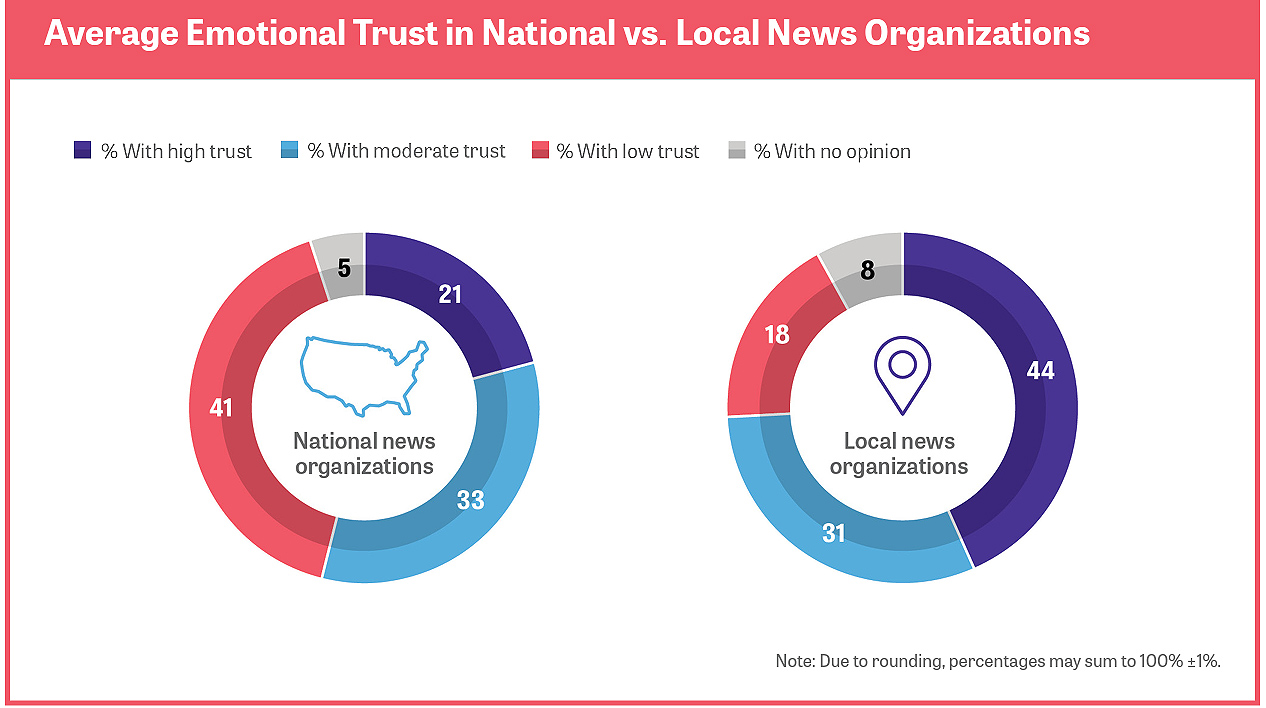
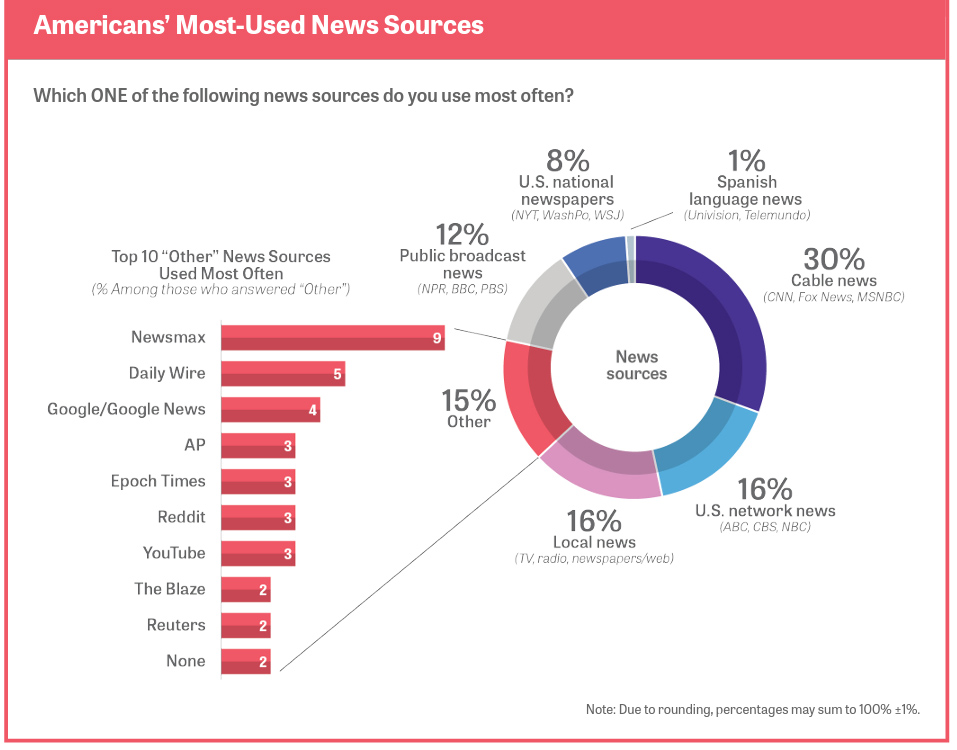
Dismal report on public trust in news is not so bad for local news, but has many warning signs – and some guidance
![]() |
| Graphs by Gallup Inc. from Knight Foundation report; click any image to enlarge |
Tuesday, January 31, 2023
Appalachian nonprofit's sex education was too sexy for some; sort of harassment that stopped it is seen nationwide
![]() |
| Education group's logo |
In 2012, a sex-education group called Sexy sex ed began offering workshops to Appalachian youth that focused on a comprehensive sex-education approach. Godoy visited with an educator who was hosting a table at a community art festival in Big Stone Gap, Virginia, pop. 5,206. The table was filled with educational materials and condoms with the group's theme of "CONSENT" emboldened on products. The non-profit group touts a "cheeky, irreverent" approach to sex ed among young people. But this was Sexy sex ed's last event for the foreseeable future:
"The barrage of harassment started in March when conservative activist Christopher Rufo criticized the group on Twitter, among other platforms. He accused the group of offering summer workshop courses for children that discussed graphic sexual practices. Other conservative activists also weighed in." The educator, whom Godoy identified only as Shaylan, said those attacks misrepresented what they taught and to whom: "They put their own spin on it to make it seem as if we were posting an in-person summer camp with five-year-olds, when in reality, the summer camp was virtual. And nobody under the age of 16 attended the summer camp."
Rufo told NPR in an email that the group was “doing something that was 'way outside the mainstream' and "Sixteen-year-olds are still minors and that the group has a very different definition of age appropriate than most parents."
Nora Gilperin of Advocates for Youth, a national health-rights nonprofit, told Goday that it has seen a surge in harassment and disinformation campaigns against sex education providers since last spring. Gilperin said, “One strategy is to take what is being taught out of context. . . Now many sex educators are afraid to share even basic information like where to get contraception."
Harvard University physician Rebecca Ralston, a native of Appalachian Tennessee who has studied sex education, told Ralston, "The more serious implications here are that people are not going to be using birth control appropriately or at all. . . so for those who do not want to become pregnant. . . they will have very few options."Wednesday, January 04, 2023
On this Friday, Jan. 6, it might be good to remember a speech on another Jan. 6 that defined America's purpose
![]() |
| Michael Bugeja |
"Excerpts from Roosevelt’s speech are eerily reminiscent of the dangers we face today, from emergent sectarianism in the U.S.; to the billionaire class of the privileged few; to dictatorial regimes of Russia, China and North Korea; and, finally, to the criminal desolation of the Ukrainian war. Democracy was being assailed, Roosevelt said, “either by arms, or by secret spreading of poisonous propaganda by those who seek to destroy unity and promote discord.” Bugeja notes that Donald Trump raised about $250 million "to 'Stop the Steal' and combat election fraud, but the bulk of that reportedly was diverted to other uses, including $40 million to Make America Great Again Inc., a super PAC allied with Trump’s election bid.
Roosevelt's State of the Union address is best known for the Four Freedoms that he said the U.S. wanted to see all over the world: the freedoms of expression the worship, and freedom from want and fear of military aggression. "This is how Jan. 6 should be commemorated, a day when journalists remind the public about the greatness of democratic ideals and the necessary commitment required from the electorate to sustain them," Bugeja writes. "On Jan. 6, 2021, America lost its moral order and nearly its democracy. Unless journalists remind the world about our 'unity of purpose' — in commentary, articles, documentaries, podcasts and more — fears about 'the forgotten episode' will come true."
Thursday, December 29, 2022
Long Island weekly revealed George Santos as a fake when he was a candidate, but no other news media took heed
![]() |
| Rep.-elect George Santos (Photo via North Shore Leader) |
![]() |
| 3rd District, with Leader office marked (Wikipedia map, adapted) |
In October, the Leader said in an editorial, “This newspaper would like to endorse a Republican for U.S. Congress, but the GOP nominee, George Santos, is so bizarre, unprincipled and sketchy that we cannot. … He boasts like an insecure child — but he’s most likely just a fabulist — a fake.” The endorsment went to Democrat Robert Zimmerman, who promised a bipartisan approach like that of retiring Democratic Rep. Tom Suozzi, who lost in this year's primary for governor.
The Post's Ellison writes, "It was the stuff national headlines are supposed to be built on: A hyperlocal outlet like the Leader does the leg work, regional papers verify and amplify the story, and before long an emerging political scandal is being broadcast coast-to-coast. But that system, which has atrophied for decades amid the destruction of news economies, appears to have failed completely this time. Despite a well-heeled and well-connected readership — the Leader’s publisher says it counts among its subscribers Fox News hosts Sean Hannity and Jesse Watters and several senior people at Newsday, a once-mighty Long Island-based tabloid that has won 19 Pulitzers — no one followed its story before Election Day."
“We expected it to pop a lot more than it did,” owner Grant Lally (who had run for the seat in 1994, 1996 and 2014) told Ellison, adding that Zimmerman didn't make enough of the endorsement and failed to push the Leader's revelations into Newsday or the Times. Zimmerman told Ellison that there were “many red flags that were brought to the attention of many folks in the media” but that “frankly a lot of folks in the media are saying they didn’t have the personnel, time or money to delve further” into the story. “This experience has shown me just how important it is for everyone to support local media.”
The Leader bills itself as "The leading news source for Long Island's Gold Coast," but Ellison reports most of its staff "works part time and holds down other jobs to pay the bills." Lally told her, “Nobody can survive on local papers alone.”
Monday, December 05, 2022
Opinion: Partisan 'pink slime' publications have outsize impact in rural areas due to shortage of reliable local news
The Aspen Institute
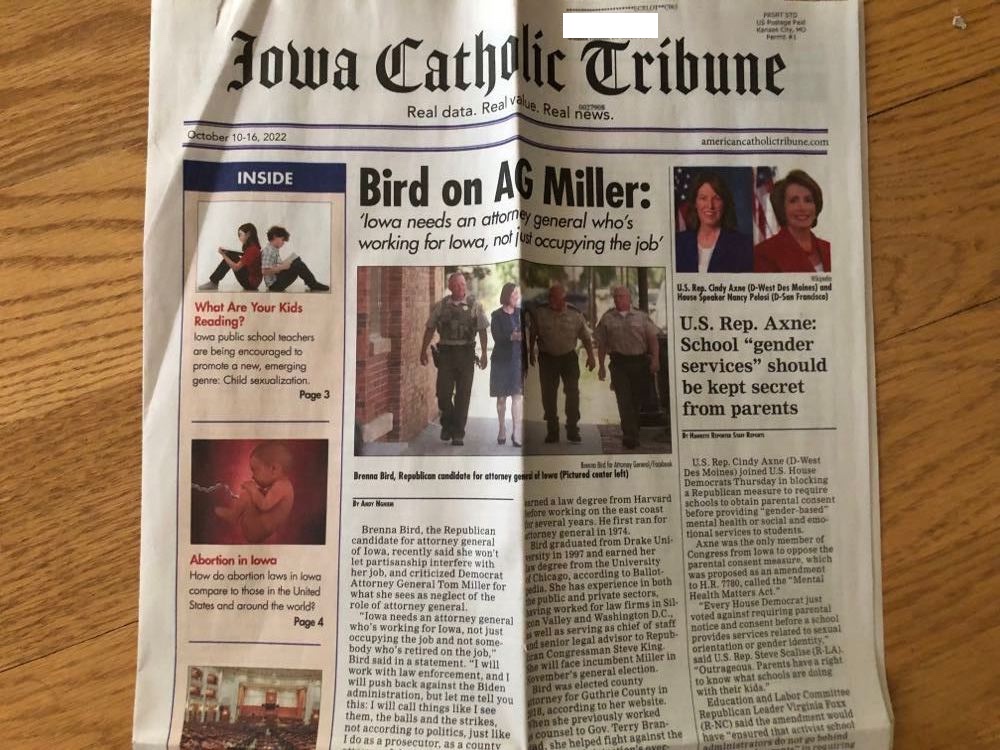
In late October 2022, two weeks before Election Day, voters in Iowa woke up to the Iowa Catholic Tribune in their mailbox.
Under the masthead read “Real data. Real value. Real news.” But the Iowa Catholic Tribune was not a real newspaper from the Catholic Diocese of Des Moines, as some voters thought at first glance. In fact, it was not a newspaper at all. It was the product of Metric Media, a conservative organization that produces countless fake news publications like the Iowa Catholic Tribune around the country.
![]() |
| Image, with address redacted, from BleedingHeartlaand.com |
Similar newspapers popped up in other battleground states and sowed confusion among voters. In Arizona, Nevada, Pennsylvania, Michigan and Iowa, Catholic organizations rushed to make clear that they were not publications from the Catholic Church.
"Pink slime," partisan propaganda masquerading as legitimate news outlets, is proliferating around the United States. Driven by ideologically motivated operatives, pink slime exploits our flailing trust in media for political gain. Private Facebook groups and other social media then amplify the false claims, filling the gap of reliable information with websites that often walk a fine line between something resembling reality and conspiracy theory.
Pink slime worsens our trust in information and poisons our democracy. While we know independent fact-based local news is its antidote, it is unfortunately in shorter supply. In the last two decades, 25 percent of all newspapers have shuttered, and one in five Americans live in a “news desert” with little access to reliable local news. Nowhere is this more pronounced than in rural America.
News deserts, pink slime and social media all contribute to a growing crisis of trust – in each other, in institutions and especially in journalism. Last month, a Gallup poll found that only a third of Americans trust the mass media to report the news “fully, accurately and fairly.” Confidence in newspapers and television news has fallen to record lows. This is even more pronounced in rural areas, where 57 percent say that when they do receive local news, whether on television or online, it does not cover where they live.
Rural communities have suffered the most from these trends. While national news organizations have made earnest attempts to fill the void in stories covering rural America, they often fall flat and report on these communities as if the reporters ventured into a foreign land. The 2016 presidential election was the prime example. After Donald Trump was declared the victor, national reporters swarmed small towns hunting for the “missing” voters who eluded their coverage. But according to a study from the Aspen Institute’s Community Strategies Group, their well-intentioned overcorrection exacerbated existing distrust between rural communities and the national news.
The researchers found that when national reporters reached out to rural journalists and community leaders to write on politics and rural life after the election, they often sought preconceived avatars to feature in their coverage, like the “out-of-work coal miner” or “the Trump voters who regretted their decision.” Even when local voices tried to push them in a more authentic and nuanced direction, the national media kept coming back to these narrow identities to advance a reductive, pre-baked narrative.
Quick-turnaround “parachute journalism” like this earned the skepticism that rural people have toward national news media. Without a robust local news source or trust in national reporters, pink slime often finds a more receptive audience in these communities online.
We need to change course. For the sake of democracy, we must all prioritize restoring a robust local media that serves the needs of every community – and all of those communities’ citizens, especially Black, brown, and indigenous people. There is no silver bullet, and this will need to be a long-term effort. As the Aspen Institute’s Commission on Information Disorder found, the solutions must come from every sector of society.
Promising initiatives are budding around the country, but we need more of them. Philanthropy-fueled initiatives like Report for America and the American Journalism Project can help rebuild newsrooms. Civic and media literacy courses led by schools and libraries can prepare the next generation to decipher fact from fiction. Communities that have seen their news downsized can collaborate to establish nonprofit outlets as the Ohio Local Information Initiative has. Businesses can fund and sustain these efforts at the local level. National media organizations can partner with homegrown news efforts to tell national stories from the local perspective, as public radio often does.
Most importantly, we need local news written by people from the community, for the community.
Our ability to solve the biggest societal challenges, and the very preservation of democracy, is predicated on our ability to rebuild a news ecosystem that earns our trust. Each of us has a role to play, and we urge everyone to work with your neighbors to build your own community-driven solution to it.
Vivian Schiller is executive director of Aspen Digital, the Aspen Institute project aimed at empowering policymakers, civic organizations, companies, and the public to be responsible stewards of technology and media in the service of an informed, just, and equitable world. Schiller has been president and CEO of NPR, global chair of news at Twitter, general manager of NYTimes.com and chief digital officer of NBC News. Bonita A. Robertson-Hardy is co-executive director of the Aspen Institute’s Community Strategies Group.
Friday, November 18, 2022
Election results slow the election-denier movement, giving common sense some traction; Arizona the prime example
A review of candidate revealed "341 candidates running on a platform of election denial," they write. "All in all, the statistics for election deniers are far worse when it comes to swing states. Almost all of the successes were in red or deep-red states. In purple places, including Michigan and Wisconsin, (not to mention blue ones) the election deniers running for statewide office were wiped out, with the sole remaining undetermined attorney general race in Arizona." It also helped that elections around the nation ran smoothly, as The New York Times reports.
When races are tighter, tensions run deeper and common sense and cool heads are needed, so election officials can do their jobs without interference, Kamarck and Eisen write: "Not all election deniers are equal. The statewide offices, and secondarily, the state legislators, have more power to affect election administration than do members of Congress. And the prospect of election deniers in office is much more dangerous in swing states. . . which is why the election denier movement, while not limited to swing states, had its greatest appeal among Trump’s followers in states where the 2020 presidential election was close. Following his loss in the 2020 election, Donald Trump fought hard to create doubts about the vote in an effort to affect the choice of electors and the Congress—which is why passage of the Electoral Count Act is so important." Parts of the 1887 law laying out the process for Congress to count electoral votes are vague, and a revision is pending in the Senate.
Thursday, November 03, 2022
Lawyer for broadcasters warns about last-minute attack ads
While broadcasters and cable companies can't censor ads, except the online versions, "some have taken that to mean that broadcasters have no fear of liability for any political ad," Oxenford writes. "That is not true. Broadcasters do theoretically have the potential for liability if they run an ad from a non-candidate group either knowing that ad to be false, or by continuing to run a false ad after being put on notice that the ad was false and ignoring that notice."
Oxenford advises, "Stations should ask the sponsor of any attack ad for documentation backing up their claims, review the supporting material to see if it in fact backs up the claims made, and consult with their attorneys to determine if it is likely actionable. There are often no clear answers, so broadcast companies need to talk to their attorneys and make their own assessment of the risk of liability for continuing to run a third-party ad claimed to be untrue."
Monday, September 12, 2022
Ex-professor spreading election fraud claims in small towns; 'It sounds authoritative if you don't know much'
![]() |
| David and Erin Clements and ousted Otero County Commissioner Couy Griffin in New Mexico (Wash. Post photo by Paul Ratje) |
David Clements, 42, was an assistant professor teaching business law at New Mexico State University until he was fired last October for refusing to wear a mask in class, Annie Gowen reports for The Washington Post. He had been active in politics too, and had served "as a county Republican chair and as an unsuccessful Republican primary candidate for the U.S. Senate in 2014. Later, he served as the vice chair for legal affairs of the state’s Libertarian party." Clements increasingly embraced conspiracies about election fraud, alienating former friends and colleagues.
After his dismissal, "Clements, who has no formal training or background in election systems, spent months crisscrossing the back roads in his home state of New Mexico in a battered Buick, trying to persuade local leaders not to certify election results," Gowen reports. "His words had an impact: In June, officials in three New Mexico counties where he made his case either delayed or voted against certification of this year’s primary results, even though there was no credible evidence of problems with the vote." One, Otero County Commissioner Couy Griffin, was removed from office for his role in the Jan. 6 attack on the Capitol.
"Clements has taken his message nationwide, traveling to small towns in more than a dozen states, with a focus, he said, on places that are 'forgotten and abandoned and overlooked'," Gowen reports. "His crusade to prove that voting systems can’t be trusted has deepened fears among election experts, who say his meritless claims could give Trump allies more fodder to try to disrupt elections in November and beyond."
Gowen adds, "Clements is one among a tightknit circle of Trump supporters who travel the country as self-appointed election fraud evangelists. They embrace the instructions of leaders like former Trump adviser turned podcaster Stephen K. Bannon, who has urged election deniers to run for local races and sign up to be poll workers in what he calls his 'precinct-by-precinct' takeover strategy. Like others preaching the gospel of election fraud, Clements has attracted a large following online, where he mixes conspiracies with Christian nationalist and sometimes violent rhetoric. He has appeared on Fox News and on Bannon’s podcast. He’s dined with Trump and Mike Lindell, the chief executive of MyPillow and high-profile election fraud conspiracist."
Independent election security experts have examined Clements' claims and call the allegations baseless and misleading. Kevin Skoglund, president and chief technologist of the nonpartisan Citizens for Better Elections, told Gowen: "Their reports on election fraud are a jumble of conspiracy theories and full of errors. They are wrong about voting technology, election processes, certification, and legal requirements. . . . They even quote me and cite my work on voting systems with modems and internet connectivity, but I disagree with every conclusion they draw from my work."
Nevertheless, said Susan Greenhalgh, senior adviser on election security for the nonprofit Free Speech For People, audiences listen to Clements because "It sounds good and people believe it, because it sounds authoritative if you don’t know much."
Thursday, August 11, 2022
Election security webinar for Ky., N.C., Tenn., Va. and W.Va. set Aug. 18; agency issues guide to digital election threats
Topics of the webinar will include cybersecurity, cyber safety, disinformation, misinformation, and crisis response. Scheduled speakers are:
- Sarah Mojarad, lecturer, USC Viterbi School of Engineering
- Clifford Neuman, director, USC Center for Computer Systems Security
- Dave Quast, adjunct faculty, USC Annenberg School of Communications and Journalism
- Marie Harf, international elections analyst, USC Election Cybersecurity Initiative
- Maurice Turner, election security analyst, USC Election Cybersecurity Initiative
- Michael Coden, associate director, cybersecurity, MIT Sloan School of Management
Meanwhile, the Cybersecurity and Infrastructure Security Agency has released a guide to digital threats facing election officials and how to mitigate them. The Cybersecurity Toolkit to Protect Elections "aims to help election administrators and their staffs protect themselves against threats including phishing, ransomware, email scams, denial-of-service attacks and other vectors that could potentially disrupt the voting process or confuse voters," StateScoop reports.
Wednesday, July 27, 2022
Misinformation undermines democracy; what to do about it?
Misinformation "deliberately aimed at disrupting the democratic process . . . confuses and overwhelms voters," they write. "Throughout the 2020 election cycle, Russia’s cyber efforts and online actors were able to influence public perceptions and sought to amplify mistrust in the electoral process by denigrating mail-in voting, highlighting alleged irregularities, and accusing the Democratic Party of engaging in voter fraud. The 'big lie' reinforced by President Trump about the 2020 election results amplified the Russian efforts and has lasting implications on voters’ trust in election outcomes."
"Darrell West, vice president and director of governance studies at Brookings, argues that the news media has a major role to play in combatting fake news and sophisticated disinformation campaigns," they write. "West argues that the government should invest in media literacy so that voters can identify false information and stop its spread. Brookings offers ways to tackle the problem, including:
- Myth busting: Some states are moving forward in educating the public by providing specific fact-checks on election information: New Mexico, North Carolina, Connecticut and California. Colorado has cybersecurity experts to monitor sites for misinformation about election processes.
- Education: Digital Informers at Howard University "think the best way to combat misinformation is through community engagement and educational efforts, including using trusted sources in the community to talk to individuals about what they believe. Then, those perspectives, if false, can be countered with factual information from people with respect in their community.
- News literacy: "More long-term efforts focus on the next generation of voters: middle-school and high-school students who are highly susceptible to misinformation given how much time they spend on social media platforms and given that they have not yet developed the ability to sort out misinformation from factual content on-line. . . . Illinois was the first state to require news literacy courses to be offered at every high school. . . . Colorado now requires media literacy standards in schools, and the state provides technical assistance.
Wednesday, June 29, 2022
Election deniers mostly lose in GOP primaries Tuesday
![]() |
| Tina Peters (Associated Press photo) |
The epicenter was Colorado. "In races where the outcome was a tossup, election deniers fared poorly," reports Jesse Paul of The Colorado Sun. "Indicted Mesa County Clerk Tina Peters fared so poorly that she was slated to come in third in the Republican secretary of state’s primary to an Australian immigrant who lives in Yuma County and was making his first foray into politics. Peters, who claimed Tuesday night without evidence that she was the victim of election fraud, was even set to lose in her home county." The winner was Pam Anderson, "a former county clerk who previously led the state clerks’ association and defends the state's mail-in elections system," Steve Peoples of The Associated Press reports.
Also defeated in Colorado was state Rep. Ron Hanks, who "had also promoted lies about the last presidential election" and attended Trump's Jan. 6, 2021 rally, AP reports. He lost to Joe O'Dea, who now faces Democratic U.S. Sen. Michael Bennet. The Sun notes, "Tens of thousands of unaffiliated voters cast ballots this year in Colorado’s Republican primaries, far more than" in 2018,when more races were contested.
On the other hand, in a rural-Illinois contest of incumbents matched up by redistricting, "First-term Rep. Mary Miller, who campaigned alongside Trump over the weekend, defeated five-term Rep. Rodney Davis, who was considered more moderate," AP reports. "The primary victory all but ensures Miller will return to Congress for another term, given the heavy Republican advantage in her 15th Congressional District, which is the most Republican district in the state. Miller won just days after describing the Supreme Court’s reversal of Roe v. Wade as 'a victory for white life.' A spokesperson later said she had intended to say the decision was a victory for a 'right to life'."
Tuesday, June 28, 2022
Podcaster's rise and Colorado primary today illustrate increasing comfort with violent rhetoric on the right wing
![]() |
| Joe Oltmann (Photo: Olivia Sun, Colorado Sun/Report for America) |
Some Democrats are promoting Republican election deniers, thinking them easier to beat. "Democrats are behind some of the ads promoting more conservative Republican candidates for U.S. Senate, Colorado governor and the 8th Congressional District," Sandra Fish reports for The Colorado Sun. "The strategy has been criticized by some Democrats, who warn that it could backfire by raising the profile of election deniers and potentially adding fuel to their movement." The triangulating is spurring "a wave of campaign finance complaints and raising ethical questions about some of the political maneuvering," Fish reports.
Sunday, June 12, 2022
Movement started by Trump has created a sort of parallel U.S., where suspicion rules and trust is for the like-minded
![]() |
| Angela Rubino with the shredded records she retrieved (Photo by Michael S. Williamson, The Washington Post) |
"Six years into the grass-roots movement unleashed by Donald Trump in his first presidential campaign, Angela Rubino is a case study in what that movement is becoming. Suspicious of almost everything, trusting of almost nothing, believing in almost no one other than those who share her unease, she has in many ways become a citizen of a parallel America — not just red America, but another America entirely, one she believes to be awash in domestic enemies, stolen elections, immigrant invaders, sexual predators, the machinations of a global elite and other fresh nightmares revealed by the minute on her social media scrolls. She is known online as 'Burnitdown.'
"She is also among the people across the country willing to do whatever they can to ensure that the imagined enemies of the United States are defeated in the 2022 midterm elections and beyond. From school boards to state houses to Congress, their goal is to take political territory, and for evidence that this is possible, they look to northwest Georgia Rep. Marjorie Taylor Greene, whose first-time candidacy two years ago defined the fringe of the Republican Party and who is now running for reelection as one of its standard bearers."
There are people like Angela Rubino in your county. Are you writing about them? Might be a good idea. So far Rubino has "managed to rally enough people to get the county election board ousted, replacing its members with those who believed that the 2020 election was stolen. She was part of a group called the Domestically Terrorized Moms that was pressing the local school board to get rid of a curriculum they believed to be grooming children for sexual predators."
McCrummen spent a lot of time with Angela Rubino, and her story is a deep dive into places many would rather not go. Ignore them at your peril. --Al Cross, Institute for Rural Journalism and Community Issues
Tuesday, April 05, 2022
News media roundup: How to reach audiences that mistrust the news; media literacy podcast; a fact-checker's toolkit
![]() |
| Six cues used to make snap judgements about whether to trust a news source (Trust in News Project graphic) |
Here's some recent news about media literacy, misinformation, and disinformation:
A fact-checker for Snopes discusses how she tells real news from fake and shares the toolkit she and colleagues use. Read more here.