Showing posts with label World War II. Show all posts

Friday, July 11, 2025

As international grain sales dry up, Kansas farmers also face the loss of Food for Peace and other programs

Congressman Bob Dole of Kansas, standing, was a dedicated advocate for
the Food for Peace Act. (University of Kansas, Dole Archives photo)

Rich rivers of wheat have grown on the Kansas high plains for nearly 200 years. In 1953, a Kansas farmer believed he could help ease Cold War tensions by providing some of his surplus grain to a hungry world. President Dwight D. Eisenhower, another Kansan, endorsed the idea and created a program to support it.

"Food for Peace has sent sacks of grain stamped 'From the American People' to more than four billion people in 150 countries around the world," reports Elizabeth Williamson of The New York Times. "Now it is effectively dead."

In February, the head of the Department of Government Efficiency, Elon Musk, ended the program when he cut the U.S. Agency for International Development, which had administered it. Williamson writes. "Kansas’s Republican lawmakers tried to save it but failed to persuade President Donald Trump, who last month proposed cutting the entire 2026 budget for Food for Peace as well as another food aid program dear to Kansans, the McGovern-Dole International Food for Education and Child Nutrition program," which began in 2003.

With Food for Peace fading, many Kansas farmers are hurting. "It was the latest blow to farmers, particularly in Kansas, where about 80% of those on the high plains voted for Trump and agriculture makes up almost half of the state’s economy," Williamson explains. Instead of a more competitive market for their crops, which Trump campaigned on, Kansas farmers are sitting on grain and facing tariffs that have choked off import sales.

The Pawnee County Co-op in Larned, Kan., is "owned by its farmers, and is one of the biggest brokers of high plains wheat. Before Trump took office in January, the co-op sold half its grain abroad, to European, Asian and African buyers," Willaimson adds. "Now the co-op’s foreign sales are 'zero,' said Kim Barnes, its chief financial officer. . . .The co-op was stuck with 1.5 million bushels of grain sorghum after Trump started his tariff war with China."

Tom Giessel, a retired farmer, is disappointed with this administration. He told Williamson, "These people really don’t know the story of Food for Peace and the roots of it. . . . Farmers shipping grain to where people were hungry — that we did these kinds of things is really what made America great.”

Friday, June 14, 2024

Opinion: Keeping D-Day remembrance alive throughout this year's elections can help Americans support democracy

Omaha Beach 116th Regimental Combat Team Memorial
in Normandy, France. (Adobe Stock photo)

The 80th anniversary of D-Day occurred about a week ago, but how many Americans stopped to think about using that day's massive human undertaking as a sounding board for this year's elections? In his opinion for The New York Times, Garrett M. Graff encourages Americans to look at what the country accomplished together during the World War II years and use it as our North Star to guide how we support our democracy through this year's election cycle.

"Day by passing day, the Greatest Generation is coming toward its end. D-Day, June 6, 1944, had more than two million Allied personnel on the move across Operation Overlord, and today, perhaps a few thousand veterans remain," Graff writes. "As we mark the final passing of those who won that war, it's easy to get caught up in gauzy romanticism and lose sight of how the Axis powers unified the free world against them and showed Americans, specifically, what we are capable of."

As Americans follow this year's elections and prepare to vote, "it's worth asking what we are doing with the legacy that the Greatest Generation defended and bequeathed to us. . . . A story of hard-fought rights and bloodily defended liberties that each generation of Americans has handed down to the next," Graff says. "We now face the very real question of whether America will embrace a vision of a country less free and less democratic, more divided and more unequal. It would be a step backward unlike almost anything else in American history."

Consider D-Day's planning and execution. It was "a titanic enterprise, perhaps the largest and most complex single operation in human history — an effort to launch a force of more than a million men across the English Channel on more than 3,000 planes and more than 7,000 ships; to methodically transport entire floating harbors, a herculean secret project known as the Mulberries, as well as 300,500 gallons of drinking water and 800,000 pints of blood plasma, a stockpile carefully segregated, as mandated at the time, between white and Black donors."


What do we, as Americans, have in common with the soldiers and support personnel from 1944's Allied invasion? "Across the next few months, we will be hearing a lot of argument about what America is and what it isn't," Graff writes. "There's a simpler answer to that question than many would like to admit: What we'll fight for is who we are. And, as we look ahead, we must decide if we're still as willing today to fight for democracy as the generation who stormed Normandy was 80 years ago."

Monday, July 31, 2023

Oppenheimer film becomes toehold for residents downwind from test site to be added to federal compensation program

The 1945 explosion at the Trinity test site in New Mexico
(Associated Press photo via The Washington Post)
The summer movie blockbuster Oppenheimer doesn't mention the first atomic bomb's profound health effects on residents, animals and soil close to and downwind from the test site in southern New Mexico. Residents known as "downwinders" are using the film to boost their last-ditch efforts for coverage by the Radiation Exposure Compensation Act of 1990, a which "compensates people sickened by presumed exposure to radiation from aboveground nuclear tests," report Karin Brulliard and Samuel Gilbert of The Washington Post. "The Senate wants to compensate them, but the House is reluctant."

The Trinity site sits bout 60 miles northwest of Tularosa, N.M., pop. 2,600. "It was chosen in part for its supposed isolation. Nearly half a million people lived within a 150-mile radius," Brulliard and Gilbert write. "Manhattan Project leaders knew a nuclear test would put them at risk, but with the nation at war, secrecy was the priority. Evacuation plans were never acted upon. The military concocted a cover story: The boom was an explosion of an ammunition magazine. . . . Surviving downwinders and their relatives say, there is a legacy of serious health consequences that have gone unacknowledged for 78 years."

Downwinders have formed consortiums to advocate for compensation. "Locals hope that the Hollywood glow may elevate their long quest to be added," the Post reports. The Manhattan Project had numerous test sites, and RECA has paid more than $2.5 billion to some downwinders and "on-site participants," but New Mexico residents have never been included. New Mexico Sen. Ben Ray Luján (D) and Sen. Mike Crapo (R) of Idaho "have pressed for years to expand RECA to include people who lived in their and other states during test periods. The Senate took up the amendment for the first time and passed it. Approval by the House remains uncertain, with some members contending the cost is too high. The program will expire next May without further action."

Fallout from the testing's massive blast "fell for days, on areas where people grew their own food, drank rainwater collected in cisterns and cooled off in irrigation canals that made the arid region fertile," the Post adds. According to a new study, "The fallout floated to 46 states, Mexico and Canada within 10 days. In 28 of 33 New Mexico counties, it estimates the accumulation of radioactive material was higher than required under the federal compensation program."

"RECA does not require claimants to establish causation, only to show that they or a relative had a qualifying disease after working or living in certain locations during specific time frames," the Post reports. "Bernice Gutierrez, who was born eight days after the test, and lived in Carrizozo, directly east of the Trinity site said she, her eldest son and daughter and 20 other family members have battled cancer." Gutierrez asked: "What has made us different than the other people given compensation?"

Friday, February 04, 2022

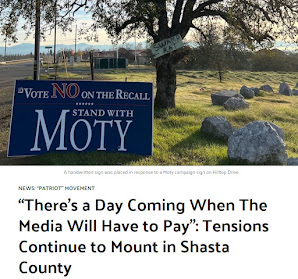
Militia appears to have won Northern California county in recall vote; one leader threatened journalists on podcast

Screenshot from Shasta Scout story about militia podcast
A far-right militia in Shasta County, California, appears to have won its bid to oust a Republican county supervisor in a recall election, but the vote tally is close enough that final, certified results could be weeks away, David Benda and Damon Arthur report for the Redding Record Searchlight.

Militia members recently collected enough signatures to force a recall vote Tuesday for three supervisors, and apparently enough votes to out Supervisor Leonard Moty, a lifelong Republican and former Redding police chief. "With all 23 precincts reporting Tuesday night, recall supporters had 52.78% of the 'Yes' vote, while 47.22% of voters cast ballots against the effort to remove Moty from office. The tally remained unchanged on Wednesday," Benda and Arthur report.

As of Thursday evening, nearly 2,000 votes remained uncounted, and the elections office said it will continue receiving ballots from the post office through next Tuesday. "Moty is expected to continue serving as chair of the Board of Supervisors at next Tuesday's meeting, as elections workers continue to count mail-in ballots," Benda and Arthur report. Moty said in a statement that the recall was funded by "an out-of-state millionaire who is seeking revenge against the county" and that it had "done nothing more than sow hate and division in our community."

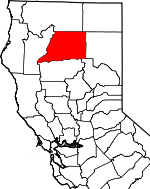
Shasta County (Wikipedia map)
Militia types have become increasingly bold since the beginning of the pandemic, threatening local news media and announcing the home address of the county health officer. They have a podcast with a nationwide audience and have said they want their actions to be a template for other counties. In a Jan. 13 episode, the host compared journalists to Nazi war criminals and showed a photo purporting to show journalists being hung after the Nuremburg trials, Annelise Pierce reports for the Shasta Scout. Militia leader Woody Clendenin said on the podcast, "What a lot of folks don’t know is some of the folks hung that day were the media because they had helped cover up the crimes and the lie. And I think in our own country there’s a day coming that the media will have to pay, in one way or another."

The photo, which Facebook labeled false, actually shows Nazi war criminals being hung in Ukraine, Reuters reports. The Holocaust Encyclopedia reports that the Nuremberg defendants included the head of the radio division of the German propaganda ministry and the editor of a racist, anti-Semitic newspaper, who was the only "media" member executed, Agence France-Presse reports.

Friday, May 28, 2021

Retired rural editor ruminates about what Memorial Day meant for the Greatest Generation

Mychal Wilmes
An essay from retired Agri News managing editor Mychal Wilmes takes a look at Memorial Day and what it meant for Americans in a rural Midwestern town during World War II. 

The newly created federal War Production Board held a well-attended meeting at the high school urging local farmers to increase food production for the war effort, and local Extension Service experts and mechanics showed farmers how to better repair their implements, Wilmes writes for Ag Week.

"The war, which would claim the lives of 6,300 Minnesota and 1,929 North Dakota service members, remained front and center in hearts and minds. Farmers and their families were indeed part of what is called the 'Greatest Generation,'" Wilmes writes. "They reached adulthood in pre-World War I, cheered the Doughboys who boarded trains that eventually took them to European battlefields, and believed the conflict would lead to the end of all war."

Thursday, May 27, 2021

Documentary on rural soldier's heroism and campaign to get him the Medal of Honor is returning to TV this weekend

Lt. Garlin Murl Conner
A year ago today, on Memorial Day 2020, Kentucky Educational Television premiered a documentary about a soldier from one of the most isolated places in America who repeatedly put his life on the line for his country – but quietly returned to his very rural life and wasn’t fully honored for his heroism until 73 years later.

"From Honor to Medal: The Story of Garlin M. Conner," will air again on KET's Kentucky Channel at 8/7 p.m. ET/CT Monday, May 31, and is available online at www.ket.org.

The hour-long documentary tells the story of one of the most decorated soldiers of World War II, who received the nation’s highest military decoration only after a 20-year campaign by his widow and friends.

Their campaign ended in June 2018, at the White House, when then-President Trump presented the medal to Pauline Conner, who still lives on their small farm near Albany, just down the road from their son Paul. Soon she plans to deliver his military memorabilia to the Third Infantry Division museum at Fort Stewart, Ga., where there is a Murl Conner Room, next to the Audie Murphy Room.

The two soldiers are a study in commonality and contrasts. Murphy, a son of Texas sharecroppers, won the Medal of Honor for his heroism in northeastern France on Jan. 26, 1945. He returned to the U.S. as perhaps the most decorated American soldier of the war, and became a major movie star.

Conner, who knew Murphy, earned the medal the day before and just a few miles away, but in the fog of war only got the Distinguished Service Cross. He returned to a creekside farm in Southern Kentucky's Cumberland River valley with no electricity or running water. Like most soldiers, he rarely talked about his exploits, which included suffering many wounds and earning four Silver Stars.

Only after Conner died in 1998 was his story told – first by a rank stranger who became his greatest advocate and inspired others to join his campaign to get Conner the Medal of Honor. Led by a neighbor who wouldn’t take no for an answer, they struggled for 20 years to break through Army bureaucracy, losing at every turn – but remaining inspired by Conner’s examples of determination and resolve.

Conner, fresh out of a hospital for a serious wound, volunteered to be a forward observer for artillery that was needed to stop a German attack – an attack that came so close he finally called in artillery on his own position. His commanding officer said he should receive the highest possible medal, but the officer was wounded the next day and didn't follow up.

The follow-up came decades later, from Richard Chilton, a Green Beret veteran from Genoa City, Wisconsin, who met Conner and learned his story while researching the service of his uncle, who died at Anzio under Conner’s command; and from Walton "Chip" Haddix of Albany, Ky., who took up the campaign begun by Chilton and wouldn't take no for an answer. The Army finally relented.

The documentary was produced by Lexington filmmaker Jeff Hoagland and the Institute for Rural Journalism and Community Issues at the University of Kentucky. It was sponsored by private donors and the Veterans Trust Fund of the Kentucky Department for Veterans Affairs, a state agency that assisted the Conner team's legal efforts at the direction of then-Commissioner Heather French Henry, whose cause was veterans when she was Miss America.

Trailers for the documentary are online at honortomedal.us, along with information about Murl Conner and some of the major players in the effort to get him the Medal of Honor. The program has been aired by public TV stations in other states; check local listings for broadcasts outside Kentucky. DVDs of the documentary are available from the Institute for $29.95, by emailing al.cross@uky.edu.

Wednesday, May 20, 2020

Ky. soldier’s heroism, and 20-year campaign to recognize it with Medal of Honor, are subjects of documentary to air on Kentucky TV at 8 p.m. ET Monday, May 25 – Memorial Day

Lt. Garlin Murl Conner, 1945
As Americans honor patriotic sacrifice on Memorial Day, Kentucky Educational Television and perhaps other state networks will premiere the story of a Kentucky soldier who repeatedly put his life on the line for his country – but wasn’t fully honored for it until 73 years later.

"From Honor to Medal: The Story of Garlin M. Conner," airing on KET at 8/7 p.m. ET/CT Monday, May 25, tells the story of one of the most decorated soldiers of World War II – who received the nation’s highest military award, the Medal of Honor, only after a 20-year campaign by his widow and friends.

Their campaign ended June 26, 2018, at the White House, when President Trump presented the medal to Pauline Conner, who still lives on their small farm near Albany, just down the road from their son Paul. She said in a speech at the Pentagon the next day, "This is what Murl would want me to say: God bless these United States of America."

Murl Conner served more than two years in the Third Infantry Division, suffering many wounds and earning four Silver Stars. On Jan. 25, 1945, he volunteered to be a forward observer for artillery that was needed to stop a German attack – an attack that came so close he finally called in artillery on his own position, offering his life for his country.

Conner survived that day in a ditch in the French province of Alsace, and came home to a Kentucky farm with no electricity or running water. He had a family, gave them a good life, and was a leader of his fellow farmers and veterans. He suffered in body and mind from his Army service, but said very, very little about it.

Only after Conner died in 1998 was his story told – first by a rank stranger who became his greatest advocate and inspired others to join his campaign to get Conner the Medal of Honor. Led by a neighbor who wouldn’t take no for an answer, they struggled for 20 years to break through Army bureaucracy, losing at every turn – but remaining inspired by Murl Conner’s battlefield examples of determination and resolve.

In the end, in an amazing turn of events, they won. And now their story is being told, along with the story of Lt. Conner, who now may be the most decorated American soldier of World War II.
"He was a combination of Kit Carson and Davy Crockett," says Walton Haddix of Albany, who took up the campaign begun by Richard Chilton, a Green Beret veteran from Genoa City, Wisconsin. He met Conner and learned his story while researching the service of his uncle, who died at Anzio under Conner’s command.

"He cared about his men more than anybody I ever knew," Chilton says. "If you want to save your life, go out with Murl. Don’t go out with anybody else."

The documentary was produced by Lexington filmmaker Jeff Hoagland and the Institute for Rural Journalism and Community Issues at the University of Kentucky. Al Cross, the executive producer and Institute director, says: "I grew up in Albany and knew Murl Conner, but like almost everyone else in town, I had no idea of his war record, and when my brother David said I should do this documentary, I immediately agreed."

The one-hour documentary was sponsored by private donors and the Veterans Trust Fund of the Kentucky Department for Veterans Affairs, a state agency that assisted the Conner team's legal efforts at the direction of then-Commissioner Heather French Henry, whose cause was veterans when she was Miss America.

She says in the documentary, "Just to know that you are part of this great mission that has lasted so long, and that you could at some point in your future, tell your kids, tell your grandkids, that once upon a time you were part of this fight . . . "

Trailers for the documentary are online at honortomedal.us, along with information about Murl Conner and some of the major players in the effort to get him the Medal of Honor. Check local listings for possible broadcasts outside Kentucky.

Friday, January 24, 2020

New documentary by Institute for Rural Journalism recounts 20-year fight to honor WWII soldier with Medal of Honor

Garlin Murl Conner
Seventy-five years ago today, a Kentucky soldier who had been in combat for more than two years, suffering many wounds and earning four Silver Stars, offered the ultimate sacrifice – calling in artillery on his forward position in order to save his battalion.

That soldier’s heroism, and the 20-year campaign to recognize it with the Medal of Honor, are recounted in “From Honor to Medal: The Story of Garlin M. Conner,” an hour-long documentary coming soon from the Institute for Rural Journalism and Community Issues at the University of Kentucky (which publishes The Rural Blog).

A trailer and a “teaser” for the documentary are online at honortomedal.us, along with information about Conner and some of the major players who worked hard to get him the nation’s highest military honor. It was a long time coming.

Conner—“Murl” to friends and family—survived that horrible day in a ditch in the French province of Alsace, and came home to a farm with no electricity or running water near Albany, Ky. He had a family, gave them a good life, and was a leader of his fellow farmers and veterans. He suffered in body and mind from his Army service, but rarely talked about it.

Only after Conner died in 1998 was his story told – first by a complete stranger who became his greatest advocate and inspired others to join the campaign to get the Medal of Honor for him. Led by a neighbor who wouldn’t take no for an answer, they struggled for 20 years to break through Army bureaucracy, losing at every turn – but remaining inspired by Conner’s battlefield examples of determination.

In the end, in an amazing turn of events, they won. And now their story is being told, along with the story of Lt. Conner, who, it turns out, may have been the most decorated American soldier of World War II.

The documentary, which highlights the rurality of Conner's life, is sponsored by private donors and the Veterans Trust Fund of the Kentucky Department for Veterans Affairs, which assisted the Conner team’s legal efforts at the direction of then-Commissioner Heather French Henry, who has championed veterans since her tenure as Miss America 20 years ago.

The film is written and directed by Jeff Hoagland of Lexington, who has helped produce, write and edit documentaries that have appeared on KET, the American Heroes Channel (formerly the Military Channel) and the National Geographic Channel. The associate producer is Janet Whitaker, formerly of KET and the Institute for Rural Journalism and Community Issues. The institute’s director, UK School of Journalism and Media Professor Al Cross, is executive producer.

Friday, July 01, 2016

Rural areas lost 1.1 million veterans in 2007-14

Members of the armed services come disproportionately from rural America, but most don't return when they leave. The count of rural veterans continues its rapid decline, despite an overall increase in the number of veterans since 9/11, says a report by the Economic Research Service of the U.S. Department of Agriculture(USDA graphic)

In 2014, 3.4 million veterans lived in rural areas, down from 4.5 million in 2007, "despite an influx of more than 100,000 post-9/11 veterans over the same period." The biggest decline is among World War II veterans, whose numbers dropped by 400,000 in rural areas from 2007-2014. Numbers are expected to continue to decline, "as the newest veteran cohorts have overwhelmingly returned to urban areas and the current rural veteran population ages."

The rural share of rural World War II veterans declined to 16.8 percent in 2014 from 20.2 percent in 2007, Tim Marema reports for the Daily Yonder. "Nationally, about 1.6 million WW2 veterans died from 2007 to 2014, according to a report published by the World War 2 Memorial in New Orleans. Most of the living WW2 vets are in their 90s now, according to the report. Only 700,000 of the 16 million Americans who served in the war are still living." The rural share of Korean veterans dropped to 18.8 percent from 21.4 percent, and that of Gulf War veterans dropped to 13.4 percent from 16.2 percent. (Read more)

Wednesday, May 21, 2014

Memorial Day and D-Day anniversary are good times to publish and air stories about veterans

With Memorial Day and the 70th anniversary of D-Day approaching, it's a good time for newspapers to reflect on veterans and the local, state and national heroes who served our country. The Indiana University School of Journalism has some great resources for media outlets needing a jump start on the two historic dates, including access to columns written by World War II correspondent Ernie Pyle (right) immediately following the June 6, 1944 attack on Normandy. Pyle was killed in 1945 by Japanese gunfire.

Here are three columns by Pyle, as provided by the International Society of Weekly Newspaper Editors: A Pure Miracle; The Horrible Waste of War; and A Long Thin Line of Personal Anguish.

ISWNE asks that if editors using the material to consider adding a paragraph about the Ernie Pyle World War II Museum in Dana, Ind. Donations can be made through the museum website by clicking here. More stories by Pyle can be found by clicking here. Additional questions can be directed to Stephen Key of the Hoosier State Press Association by clicking here.

Friday, June 08, 2012

Coal supporters confront EPA in Central Appalachia

Industry supporters, left, confront mining
foes and state official between hearings.
(Photo by Chris Anderson)
This week marked the first time that members of the Environmental Protection Agency under the Obama administration visited Eastern Kentucky for an open, public forum, reports Chris Anderson of the Appalachian News Express in his story about two EPA hearings on surface-mining permits.

Yesterday was a chance for hundreds of people in the Central Appalachian coalfield "to be heard by a government agency that many feel is attacking their way of life," Anderson writes. EPA had announced its plan to veto 36 surface mining permits in the region, on grounds that they would cause too much water pollution. The meetings to discuss the government's controversial stance drew members of both sides of the mountaintop-removal coal mining debate, with Anderson reporting that those in support of mining far outnumbered those against it.

Miners spoke passionately about jobs and said President Obama was trying to ruin their livelihoods. Mine operators, like Don Gibson of Arch Coal, urged the meeting's participants to make their voices heard in November. Ama Bentley, an employee of Appalachian States Analytical Laboratory, argued that regional water quality is actually improved by coal mining in some places, and she and others said more harm is done by lack of proper sewerage.

Anderson notes that "a handful of environmental activists . . . spoke in favor of the EPA’s blocking of the issuance of the permits." They included Matt Wasson of the Appalachian Voices group, who countered pro-industry arguments about jobs by noting Appalachian coal jobs have actually increased since 2009. He said the coal industry's troubles are not the doing of EPA, but factors such the industry’s inability to compete with cheap natural-gas prices. "He also blasted Eastern Kentucky leaders for failing to expand the region’s economy."

The later the evening got, the less civil was the discourse. Anderson reports that "Roger Warton, who claimed to represent several pro-coal groups from West Virginia, told the EPA officials that those in attendance at the meeting were just as adamant about 'whipping somebody’s butt' as the soldiers who stormed beaches on D-Day in World War II. He also alluded to the possibility that the EPA officials would not be allowed to leave Charleston, W.Va., if they traveled there to fly out of the region." (Anderson's story is behind a paywall.)

Sunday, September 23, 2007

Rural Minnesota publisher's poignant homefront columns play a key role in 'The War'

The columns of a rural newspaper publisher who "poignantly tried to explain the unexplainable to his neighbors" play a key role in "The War," the documentary that began on PBS tonight.

Al McIntosh ran the Rock County Star Herald in Luverne, Minn., at 4,600 the smallest of the four towns that provide the focus for the personal lenses through which filmmaker Ken Burns tells the story. Burns, the leading producer of historical documentaries, said finding McIntosh's columns was "in some ways ... the single greatest archival discovery that we have ever made."

The opening segment of the film quoted a McIntosh column about a local woman in London who had seen her friends killed in the blitz, and when she came home and looked out over the peaceful countryside from her family's front porch, she found it hard to believe that the rest of the world was at war. That's a paraphrase; we weren't recording. Trust us, McIntosh's writing was better than ours.

McIntosh would have played a smaller part in the program "had it not been for Tom Hanks, who encouraged Burns to use more in the film," and asked to read his words for the film, Steve Gansen of MBI Publishing Co. told the Star Herald's Lori Ehde. The company recently published McIntosh's wartime writings in in a book, Selected Chaff, taken from his column, "More or Less Personal Chaff." (Read more) For excerpts of his wartime columns, click here.

"Luverne was about as far away from the action as any place in America, but each day the war’s reality grew closer and closer," says a PBS press release. McIntosh reported "on war bond drives, victory gardens, rationing of essential commodities and the difficulties families faced trying to keep their farms going with so many young men in the armed forces," and chronicled "the travails of every family in town," says the guide to each episodes. Even as victory neared, he cautioned his readers to keep their heads down and keep working “until there is no doubt of victory any more” because “lots of our best boys have been lost in victory drives before.”

McIntosh wrote inspiring words, and his career was an inspiring one for rural journalists. He was a North Dakota native and University of Nebraska journalism graduate who worked at one of the Lincoln dailies and turned down jobs at the Kansas City Star and The Washington Post to fulfill his dream of running his own, small-town paper. In 1949, he was president of the Minnesota Newspaper Association, which gives an annual Al McIntosh Distinguished Service to Journalism Award. He sold his paper in 1968 and died in 1979.

The first button on the Star Herald's home page is "THE WAR." Burns gave the Star Herald an interview last month, and came to town Sept. 6 for a premiere of the documentary. "Some ... say the fact that Luverne is part of such a historically significant film is the biggest thing to happen here since the Cardinal basketball team won the state championship in 1964," Ehde wrote in that week's advance story.