Showing posts with label epidemiology. Show all posts

Monday, March 20, 2023

More states impose poultry quarantines to stop bird flu; scientists explain why it could pose a threat to humans

Centers for Disease Control and Prevention graphic
As the U.S. continues to experience the largest bird-flu epidemic on record, and more flocks are quarantined, "scientists are closely watching the outbreak" to determine the threat to humans, reports University of Colorado biology profssor Sara Sawyer. "Many virologists are concerned that this virus could spill over to humans and cause a new human pandemic."

In Pennsylvania, "207 poultry flocks in eastern Lancaster County and western Chester County that supply live bird markets" have been quarantined, reports Philip Gruber of Lancaster Farming. "A wave of farms in the live market system have tested positive for avian influenza, and others have tried to manage sick birds on the farm without reporting them to the state, State Veterinarian Kevin Brightbill told industry members. Brightbill said, “That is the kind of misguided thinking that can result in, frankly, a massive outbreak in Lancaster County and loss of all of our flocks."

Lancaster County (Wikipedia)
Gruber writes, "Brightbill said at least five farm owners have told him they had been dealing with sick birds for the past month but hadn’t mentioned this to the state. Farmers have been trying to control the disease by culling sick birds and not moving birds off the farm, but Brightbill said that's not enough. . . . The current virulent strain of avian influenza is adapted to waterfowl. The U.S. requires all flocks infected with avian influenza to be killed to prevent the disease from spreading."

In November, "Arizona, Mississippi, and South Carolina reported their first highly pathogenic avian flu outbreaks in poultry flocks, part of expanding activity involving the Eurasian H5N1 strain that has now affected poultry in 46 states, with poultry losses soon to pass a record set in 2015," reports Lisa Schnirring for the University of Minnesota's Center for Infectious Disease Research and Policy. "The Arizona Department of Agriculture said that officials have quarantined the affected locations, where depopulation is under way. The virus had been previously detected a few times in waterfowl found dead in Arizona."

Scientists are watching how H5N1 mutates to gauge its threat to humans. In Colorado, Sawyer and her collegaues Emma Worden-Sapper and Sharon Wu did a Q and A; here's an edited summary:

1. Is this virus a serious threat to humans? The virus is highly pathogenic to birds, meaning that infections often cause extreme symptoms, including death. But its impact on humans is complicated. There have been relatively few human infections detected – fewer than 900 documented globally over several decades – but about half of those infected individuals have died. The good news about H5N1 for humans is that it currently doesn’t spread well between people. Most people who have contracted H5N1 have gotten it directly from interacting with infected poultry – specifically chickens, turkeys, ducks and geese, which often are raised in close quarters on large commercial farms.

Photo via Lancaster Farming
2. Why is this outbreak suddenly getting so much attention? H5N1 is causing the largest “bird pandemic” ever recorded. A certain viral variant that arose in 2020, called H5N1 2.3.4.4b, is driving this outbreak. In agricultural poultry flocks, if a few birds test positive for H5N1, the whole flock is killed regardless of symptoms or infection status. The Biden administration is considering vaccinating farmed poultry flocks, but the logistics could be quite complicated.

The second reason for increased attention is that H5N1 is now infecting more bird and mammalian species than ever before. The virus has been detected in a broad array of wild birds and in diverse mammals, including badgers, black bears, bobcats, coyotes, ferrets, fisher cats, foxes, leopards, opossums, pigs, skunks and sea lions.

The third and most worrisome reason that this virus is getting so much press is that H5N1 now seems to be transmitting well between individuals of at least one mammalian species. In late 2022, mammal-to-mammal spread occurred in Spain in farmed minks. H5N1 spread very efficiently between the minks and caused clinical signs of illness and death in the mink populations where it was detected.

3. Here’s the key question: If H5N1 can achieve spread in minks, why not humans? We are also mammals. It is true that the farmed minks were confined in close quarters, like chickens on a poultry farm, so that may have contributed. But humans also live in high densities in many cities around the world, providing the virus similar tinder should a human-compatible variant arise.

4. Why don’t we make a vaccine just in case? With avian influenza viruses, it is not possible to make effective human vaccines in advance, because we don’t know exactly what the genetics of the virus will be if it starts to spread well in humans. . . . Right now, the best way people can protect themselves from H5N1 is to avoid contact with infected birds. For more information about prevention, especially for people who keep domesticated birds or are bird-watching hobbyists, the Centers for Disease Control and Prevention has a list of guidelines for avoiding H5N1 and other bird flu viruses.

Friday, February 10, 2023

Bird flu impact may go beyond eggs; shows signs of spreading among mammals; vaccine for poultry to be tested

The U.S. is experiencing a record outbreak of bird flu, a virus that is currently deemed a low risk to humans, but has hiked prices of eggs and poultry. The Biden administration is weighing whether to vaccinate poultry against the disease and it appears that the virus can spread among mammals. 

Bird flu spread among minks at a farm in Spain. (Nature photo) 
"The virus is primarily a threat to birds," Emily Anthes reports for The New York Times, "but infections in mammals increase the odds that the virus could mutate in ways that make it more of a risk to humans, experts say," 

Anthes reports that a new variant of the H5N1 virus has "taken an unusually heavy toll on wild birds and repeatedly spilled over into mammals, such as foxes, raccoons and bears, that might feed on infected birds." 

More recently, it has infected farmed minks, which scientists describe as a "new and troubling development," pointing to an outbreak in Spain where the virus appeared to spread from mink to mink and had an unusual mutation that might be a sign of adaptation to mammals, Anthes reports, adding that experts say the mink outbreak is no cause for panic, but highlights the need for more proactive surveillance.  

Your Local Epidemiologist Katelyn Jetelina reports that the risk of bird flu in humans is "currently very low," citing research from the Centers for Disease Control and Prevention, which tracked the health of more than 5,190 people who have been exposed to infected birds in 2022 and only one human case was reported. The Times reports "fewer than 10 known cases in people since December 2021, and there have been no documented instances of human-to-human transmission, according to the CDC."

Federal scientists are gearing up to test the first vaccines in poultry against the bird flu as a way to counter the growing oubreak, Alexander Tin reports for CBS News. The Biden administration has not yet greenlighted the use of these vaccines. Officials told Tin that one of the concerns about issuing these vaccines is that it could make it harder to export American poultry products.

The virus is spread from an infected bird's nasal secretions, saliva and fecal droppings. 

USDA says properly prepared and cooked poultry and eggs should pose no risk to consumers. 

"Right now you don’t need to do anything, unless you’re in close contact with birds. A person’s level of risk is dependent on duration and intensity of exposure. In other words, a person with one chicken in their backyard is at much lower risk than someone at a poultry farm," Jetelina writes. "Those around wild birds, such as at parks, lakes, rivers, or other waterways, need to exercise caution, including wearing PPE, washing hands, and changing clothes. If you have backyard poultry, wear a mask and wash your hands. Also, monitor the health of your flock, especially if they come in contact with other wild birds."

Thursday, February 02, 2023

Expert opinion: 'The new normal cannot fall back to a pre-Covid normal; we must be bigger, better and smarter'

By Katelyn Jetelina
Your Local Epidemiologist

On Monday the World Health Organization’s Emergency Committee gave official word that they voted to renew the Public Health Emergency of International Concern. They are likely teeing up for “the end” in 2023. The U.S. is far more confident in “the end” of the national emergency. On Monday, the White House announced that they are ending it in mid-May.

An inflection point is clearly on the horizon, albeit with uncertainty. This leads to legitimate questions: Are we still in an emergency? What will the future hold? What happens next?

Are we still in an emergency? There is no “level of disease” that defines a pandemic or emergency. Even if there was an objective metric, the reality is that this isn’t determined through epidemiology alone. Where we, as a society, place SARS-CoV-2 in our repertoire of threats is a collective decision—a psychological, cultural, and political decision. Every day we consciously (or subconsciously) decide how much risk and suffering we are willing to accept: How many people get the booster? How many people wear a mask? How many people order free antigen tests? How many deaths, and among whom, are we willing to accept?

This has sparked an intense tug-of-war among scientists, leaders, and the public throughout the pandemic: a push towards “normalcy” from some and push back towards “urgency” from others. All individuals and societies fit somewhere on this spectrum. And one’s position may (and perhaps should) change with time.

How did winter play out? How we fared this winter gives us a good idea as to whether we are still in “emergency” phase in the U.S. We essentially had two tests:

How well did our immunity hold up against a constantly changing Omicron? According to varying hospitalization models from early fall, the 2022-23 winter played out as a best-case scenario for Covid-19. Even the best-case scenario, though, led to a peak of 48,000 hospitalizations.
Projections of hospitalizations, from CDC's Advisory Committee on Immunization Practices meeting on Sept. 1, 2022

Could our hospital systems handle the stress of a novel virus on top of the “normal” respiratory viruses? We hadn’t previously seen the impact of all of them at the same time. In addition, health-care workers are increasingly burnt out, and hospitals are increasingly understaffed. Given all of this, hospitals did okay this winter. Pediatricians were drowning, particularly because of a massive RSV wave. Emergency rooms were overcrowded with sickness. But a Covid-19 emergency declaration wouldn’t necessarily help with either of these. Hospitals were not overwhelmed with adults because of our immunity wall, and I’m increasingly convinced there was viral to viral interaction—in other words, we didn’t see all three viruses peak at the same time.

Given this, I agree that we are not in an emergency phase in the U.S. An emergency declaration was appropriate when we had rational hope that transmission could be interrupted on a population level and when we needed extreme measures to prevent collapse of healthcare systems. We are past this. Continuing the emergency would not be constructive given public sentiment and lack of funding anyway. As one epidemiologist told me, “If it’s always an emergency, nothing’s an emergency.”
What will the future hold?

If we end the emergency, it begs the question: What phase are we in?

I don’t believe we are in an endemic phase— a state of predictability. I think we are on our way, and Covid-19 will eventually fall into seasonal patterns. But this will likely take years. Until then, we will be in an awkward space between pandemic and endemic. Epidemiologists don’t have an official word for this phase. WHO flu risk management people would probably call this the “transition” phase.
Graph from World Health Organization pandemic risk management guide

We will continue to see the virus ebb and flow—it will mutate, we will get waves, people will continue to miss work and daycare, and people will continue to be hospitalized and die, particularly those over 65 years and immunocompromised. The end of an emergency does not mean the end of disruption or suffering.

Deaths from Covid-19 are projected for 2023; data from CDC, here

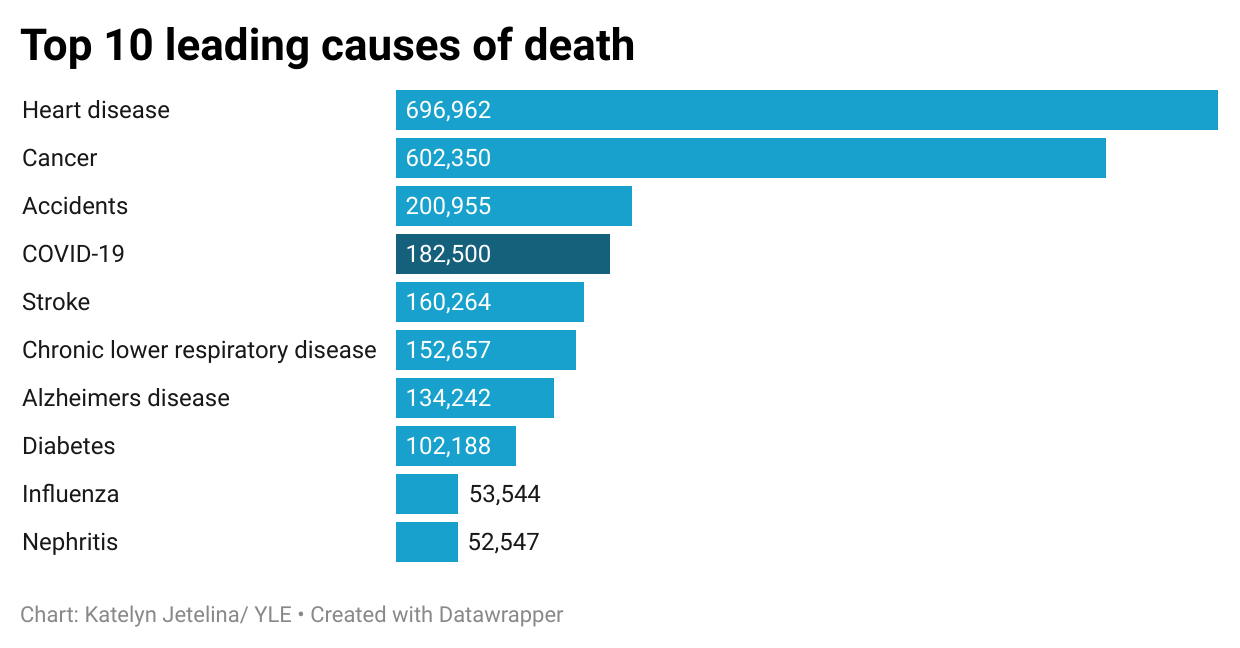
Today, roughly 500 Americans are dying each day from Covid-19. At this rate, SARS-CoV-2 will be the fourth leading cause of death in the U.S. in 2023—about triple the threat of influenza.

What happens next?

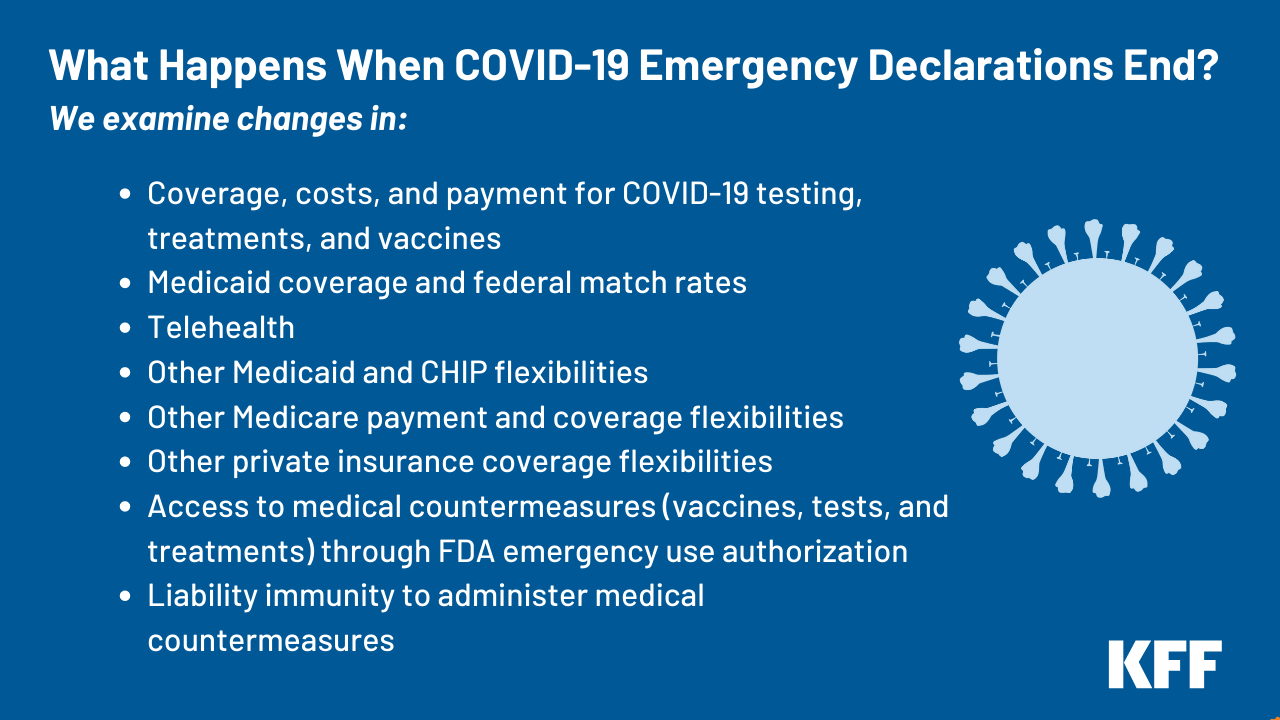
Unraveling the public-health emergency may get messy. It will certainly take time (hence the 3 month lag time). The Kaiser Family Foundation outlined the implications nicely:


This does not impact the Emergency Use Authorization of vaccines and therapeutics from the FDA. In other words, these will still be available.

HOWEVER, the ending of funding for testing and vaccines is a real cause for concern. Once our free supply is out, everything will be privatized. Pfizer announced its vaccine will cost $130 per dose. Insurance will have to cover it, like the flu vaccine. This will, no doubt, fuel deep inequities in the U.S. And it is part of a much larger, deeply flawed system of pharmaceutical profiteering that this country hasn’t got the ethical fortitude to address yet.

Our work is not done: Most importantly, the end of the emergency doesn’t mean our work is done. There is no infectious disease more insidious or with greater impact on global mortality, morbidity, and health care systems than Covid-19.

As individuals, we still need to get vaccinated. We still need to leverage antigen tests. We need to invest in better filtration and ventilation. We still need to protect the most vulnerable.

As public-health officials, we must decide the minimum structure needed moving forward. Invest in wastewater monitoring. Continue to report hospitalizations (and get better at it). Commit to transparent and effective communication. Vaccine innovation is needed.

As a society, we MUST put real energy, innovation, and investment into repairing and strengthening our health and public health systems. The new normal cannot fall back to a pre-Covid normal. We must be bigger, better, and smarter. This means the very notion of for-profit healthcare needs to be fixed. In public health, we must figure out how to get out of the cycle of panic and neglect through preparation. We are LESS prepared for the next pandemic, given loss of trust, polarization, changing information echo-systems, and mis/disinformation.

Sadly, I’m starting to see denial and wishful thinking. I hope this changes as it will definitely not be another 100 years before the next pandemic emerges to grip the globe in a choke hold.

Bottom line: In the U.S., the end of the emergency is coming. I agree with this decision, but this certainly isn’t the end of Covid-19 or public health threats. In fact, this end is the beginning. We have our work cut out for us.

Katelyn Jetelina is a California epidemiologist and biostatistician who says she writes her newsletter on Substack as a way to translate public-health science for everyday use, helping people to make evidence-based decisions. She is a consultant to several organizations, including the CDC.

Wednesday, December 07, 2022

Epidemiologist says the dreaded triple-demic is here, with RSV, flu and Covid-19 cases all rising together

 
Centers for Disease Control and Prevention map

With national rates of influenza, Covid-19 and respiratory syncytial virus (RSV) all rising, the "dreaded and much anticipated triple-demic is finally here," epidemiologist Katelyn Jetelina writes in her newsletter, Your Local Epidemiologist. 

RSV is a common virus that usually causes mild, cold-like symptoms. And while most people recover in a week or two, it can be serious for infants and older adults.

The weekly Centers for Disease Control and Prevention influenza-like illness (ILI) surveillance, which includes a tally of patients that go to the doctor with a fever and a cough and/or a sore throat is a general indication of the climate of respiratory health in the United States. The report does not include laboratory confirmed flu cases. 

The ILI map for the week ending Nov. 26 shows that every state except for four have either a high or a very high ILI activity level. "This level is truly unprecedented; we’ve never seen such high levels of ILI activity at this time of year," she writes. 

Hospitalizations for respiratory illness are also on the rise. On Monday, CDC Director Rochelle Walensky said: “Hospitalizations are the highest now than they have been in the past decade.” 
Jetelina points out that while ILI surveillance offers an overall view of respiratory illness in the U.S, surveillance for specific diseases also exist, but is imperfect. 

RSV: CDC data shows that RSV continues to rise, although we may be seeing the first signs of peaking on a national level, Jetelina reports. She adds that this is expected given that the positivity rate for RSV tests have already clearly peaked. 

Flu: "Flu cases are increasing and increasing fast," Jetelina writes. She notes that flu hospitalizations are lagged, but increasing. "We expect hospitalizations to continue to rise in weeks to come," she writes. 

As Inside Medicine reported, for the first time during the pandemic, flu hospitalizations overtook Covid-19 hospitalizations last week. "This may be a one-off occurrence since Covid-19 hospitalizations are increasing now, too, but it is noteworthy," she writes. 

Jetelina adds that epidemiologist are hopeful that the U.S. flu season will follow what has happened in the Southern Hemisphere (Australia specifically) where there has been a high number of flu cases but a moderate level of hospitalizations. 

Covid-19: "Covid-19 is on the rise across the globe due to the combination of seasonal changes, behaviors changes, and the variant soup. In the U.S., all signs point to the beginning of a wave. For example, SARS-CoV-2 in wastewater is rapidly increasing across all regions," she writes. 

"One major concern is the rapid rise in hospitalizations among older adults, which has exponentially increased 28% in the past two weeks," Jetelina writes. "This is partly (or wholly) due to abysmal vaccination rates—only 1 in 3 adults over the age of 65+ have their fall Covid-19 booster. A public health failure. Without a recent booster, many people are technically vaccinated but not protected." 

Bottom line, she concludes: "This viral season is like no other. . . .  I’m especially concerned for hospital systems, kids under 5, and adults over the age of 65, as they are at highest risk." 

She adds, "There’s a lot we can do: mask, test before seeing loved ones, get that airflow moving, stay home when you’re sick. The least you can do for a healthy season is get a flu and fall Covid-19 booster. If you haven’t gotten one yet, it’s never too late." 

Jetelina is a California epidemiologist and biostatistician who says she writes the newsletter on Substack as a way to translate public-health science for everyday use, helping people to make evidence-based decisions. She is also a consultant to a number of organizations, including the CDC. 

Monday, September 26, 2022

The pandemic isn't over, but it's under control, experts say

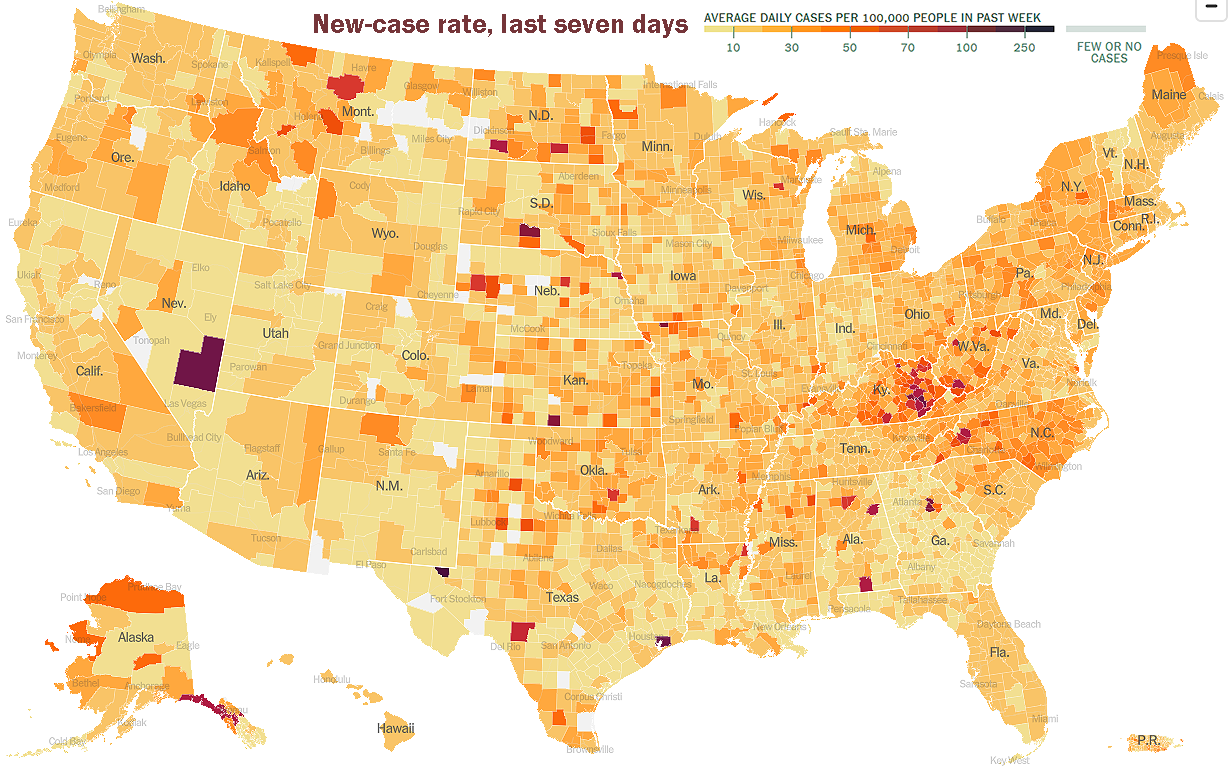
New York Times map, adapted by The Rural Blog; for the interactive version and data, click here.

Last Sunday, CBS broadcast a "60 Minutes" interview with President Biden in which he said "The pandemic is over." It clearly wasn't in Central Appalachia and some other rural areas, and Biden administration officials spent much of last week trying to walk back and clarify the president's statement. Today, The New York Times' map showing new-case rates in the last week looks much the same, but experts tell Politifact and Kaiser Health News that the pandemic is under control.

Lou Jacobson and Jeff Cercoine of Politifact write for KHN, "PolitiFact has been tracking a campaign promise Biden made in 2020 that is closely related, but distinct, from what Biden told '60 Minutes.' During the presidential campaign, Biden said, 'I’m never going to raise the white flag and surrender. We’re going to beat this virus. We’re going to get it under control, I promise you.' Biden is on safer linguistic ground with his promise to get Covid 'under control' than saying 'the pandemic is over'."

Public-health experts debate whether it's over, "or whether it realistically can ever be," Jacobson and Cercone report. "There is no official arbiter for making that decision, and the word “over” suggests a finality that is not well suited for describing a pathogen that will exist in some form indefinitely. However, we found broad agreement among infectious-disease specialists that the pandemic by now is 'under control.' . . . Life for many Americans is much closer to the pre-pandemic norm, with virtually all schools open, concerts and restaurants well attended, and travel back to its typical level. . . . The level of U.S. deaths from Covid is lower today than it has been during most of the pandemic, and it has been that way since the spring. Notably, the number of 'excess deaths' is also down. That’s a metric that gauges how many more deaths are occurring beyond the long-term average for that time of year. . . . Hospitalization has held steady recently at some of the lowest rates of the pandemic. And even this level may overstate the virus’s impact; routine testing upon admission often detects cases that are asymptomatic and largely coincidental to the reason a patient is admitted."

But “under control” doesn’t mean minimal cost, say some experts, such as Babak Javid, an associate professor in the division of experimental medicine at the University of California, San Francisco: “The degree of protection afforded by the current vaccines available, especially to the most vulnerable, is of limited duration, and nonfatal outcomes from Covid can still have knock-on consequences to the population health.” That's called “long covid,” and it affects nearly one in five Americans who have had Covid-19.

"'Under control' suggests progress on keeping further spread within modest limits," Jacobson and Cercone conclude. "It does not mean that people haven’t lost loved ones or felt continuing effects from the virus; clearly, they have." And that's especially true in some rural places.

Sunday, September 18, 2022

Biden says pandemic is over, but that's not so in Appalachia

New York Times map, adapted by The Rural Blog; for the interactive version and county list, click here.

Screenshot of Times' top 20, labeled; click it to enlarge
President Biden said in an interview telecast on CBS's "60 Minutes" Sunday night, “The pandemic is over. We still have a problem with Covid. We’re still doing a lot of work on it. It’s – but the pandemic is over.” Not everywhere, Mr. President.

A widely accepted definition of a pandemic is the widespread presence of a disease over a wide geographic area, affecting a significant portion of the population. That leaves plenty of gray area, but it’s clear that there is still a pandemic in Central Appalachia, which consists primarily of West Virginia and Eastern Kentucky, and some other rural areas around the nation.

The Mountain State ranks first in the nation for the rate of new cases in the last seven days, and on The New York Times county-level map, Eastern Kentucky is redder than West Virginia. As a whole, Kentucky ranks ninth among the states; a week ago, it ranked first.

Chambers County, Texas, across Trinity Bay from Houston, ranks first on the Times list. The next six, and 15 of the top 20, are in Central Appalachia. After that come Athens County, Ohio; Upshur County, W.Va.; and Boyd and Greenup counties in Kentucky. Several other West Virginia and Kentucky counties are in the Times' list of the top 100.

More broadly, an end-of-pandemic declaration "is hard to believe given an average of 400 Americans are dying each day," writes Katelyn Jetelina in her Your Local Epidemiologist newsletter. "But, as I’ve written before, the 'end of a pandemic' isn’t purely epidemiological, but also physiological, cultural, political, and moral. Essentially we’re collectively deciding where we place SARS-CoV-2 in our repertoire of threats. To me, this winter will be a true test as to whether we are still in an 'emergency' phase, at least if we define this by deaths, hospitalizations, and health-care capacity," as opposed to infection rates and "long Covid," examined in this report from Kentucky Health News.

Friday, October 15, 2021

Rural coronavirus infection and death rates still dwarf metro rates; Georgia, Idaho have highest non-metro death rates

New coronavirus infections, in ranges by county, Oct. 3-9
Map by The Daily Yonder; click the image to enlarge it or click here for the interactive version.

New coronavirus infections in non-metropolitan counties fell about 12 percent during the week of Oct. 3-9, marking the third consecutive week of falling rates, and Covid-19 deaths dell 14% in non-metro counties and 12% in metro counties, Tim Murphy and Tim Marema report for The Daily Yonder. Overall, the rural infection rate was about two-thirds higher than the metropolitan rate as of Oct. 9, while the rural death rate was 89% higher.

Some states' rural areas fared better than others. Rural counties in 12 states had higher infection rates last week than two weeks ago, led by Nevada's 84% increase. "Other states that saw double-digit percentage increases in rural infection rates were New Hampshire, Colorado, Pennsylvania, Massachusetts, Connecticut, North Dakota, and Montana," Murphy and Marema report. "States that reduced their rural infection rates by more than 30% were Nebraska, Alaska, Texas, Alabama, Georgia, Florida, West Virginia, and Maine."

Among the Yonder's interactive features is a chart comparing metro and non-metro infection and deaths rates by state. It's sortable by column; this screenshot shows the top 25 states by non-metro death rates. Nevada has the highest infection rate.

Screenshot of chart by The Daily Yonder; click here for the interactive version.

Friday, July 02, 2021

Quick hits: Libraries lining up 'digital navigators' for telehealth; FactCheck delves into origin of the coronavirus

Here's a roundup of stories with rural resonance; if you do or see similar work that should be shared on The Rural Blog, email heather.chapman@uky.edu.

"Digital navigators" may soon be available at rural libraries to help residents access telehealth services. Read more here.

Many rural communities are celebrating Pride day/week/month for the first time. Read more here.

FactCheck.org says it has "a detailed and authoritative piece" from its science editor, who has a Ph.D. in immunology from Yale University, about the origins of the coronavirus in China.

Wednesday, June 23, 2021

An epicenter of the Delta variant in the West shows its threat; hospitals are filling up there and in rural Missouri

The threat of the stronger Delta variant of the coronavirus among unvaccinated Americans is being illustrated in several states and areas such as Grand Junction, Colorado, which has become an epicenter of its spread in the rural West.

Mesa County (Wikipedia map, adapted)
“At this point nationally, we see that about 10% of cases are due to this Delta variant, but here in Colorado it’s about 40%, and here in Mesa County it’s approaching 100%,” State Epidemiologist Rachel Herlihy told locals on a Tuesday visit to Grand Junction. “In addition, it causes more severe illness, so we’re seeing double the hospitalization rate with this Delta variant.”

"State officials have targeted the county in their efforts to step up vaccination rates. But while they have identified a variety of ways, they are still looking for more," reports Charles Ashby of the Grand Junction Daily Sentinel. "Gov. Jared Polis came to town Tuesday to ask area medical officials and business leaders for ideas on how to do more, especially now that the Delta variant of the virus accounts for nearly all of the new infections."

Polis told the locals, “Mesa County is an epicenter for the Delta variant, and we also have some of the lowest vaccination rates in the state . . . We want action before it hurts the economy and hurts more people or fills up your hospitals, which are already rapidly approaching being full.”

Only 40 percent of Mesa County's eligible residents are fully vaccinated, and 44% are partially vaccinated. The county's hospitals are 95% full, Dasha Burns of NBC News reports from Grand Junction: "It seems like a case of deja vu," resembling the crisis of the early pandemic.

Elsewhere, "The new strain is already taxing hospitals in rural Missouri, and caseloads and hospitalizations are on the rise in states such as Arkansas, Nevada and Utah, where less than half of the eligible population has received a vaccine," The Washington Post reports.

Vaccines work against the Delta variant, but not enough people are vaccinated, physician and medical-school professor Dhruv Khullar warns in The New Yorker: "People who’ve been fully vaccinated can, by and large, feel confident in the immunity that they’ve received. But those who remain susceptible should understand that, for them, this is probably the most dangerous moment of the pandemic."

Wednesday, January 13, 2021

Rural America saw record levels of new coronavirus cases and deaths last week; see Daily Yonder's interactive map

Rates of new coronavirus infections, Jan. 3-9
Daily Yonder map; click the image to enlarge it; click here for the interactive version.

Rural America saw record numbers of new coronavirus infections and Covid-19 deaths in the first week of the year, "showing that a slight respite over the holidays was the result of interruptions in test reporting, not waning strength in the pandemic," Tim Murphy and Tim Marema report for The Daily Yonder. Nonmetropolitan counties reported 232,239 new infections Jan. 3-9. "That’s a 35% increase from the previous week, when numerous states fell behind in daily coronavirus reports because of Christmas and New Year’s Day holidays. Covid-19-related deaths also set a record in rural counties last week, at 4,084." Metropolitan counties also saw record-breaking new infections last week.

Click here for more data, charts, and insights from the Yonder, including an interactive map with the latest county-level data.

Friday, July 03, 2020

Interactive map from Harvard uses new coronavirus cases in last seven days to estimate risk level by county

Screenshot of interactive map shows counties' risk indicated by color; for the interactive version, click here.
How much is your county at risk from the coronavirus? A new mapping tool from Harvard University estimates that, based on the number of new cases per 100,000 people in the previous seven days.

“The public needs clear and consistent information about covid risk levels in different jurisdictions for personal decision-making, and policymakers need clear and consistent visibility that permits differentiating policy across jurisdictions,” Danielle Allen, director of Harvard's Edmond J. Safra Center for Ethics, said in a news release.

The map is color-coded but interactive, allowing users to see the data behind the colors, which are:
  • Green: Less than one case a day per 100,000 people, and containment is on track. Use contact tracing and testing to monitor.
  • Yellow: One to nine cases a day per 100,000 people, indicating community spread and the need for rigorous testing and tracing.
  • Orange: 10 to 24 cases a day per 100,000 people, showing “accelerated spread,” and stay-at-home orders are advised
  • Red: 25 or more a day cases per 100,000, meaning the county is at a “tipping point” and stay-at-home orders are necessary to contain the virus.