Showing posts with label telecommunications. Show all posts

Friday, October 10, 2025

Quick hits: Using a pay phone; hated Halloween candy; oral health is part of overall health; dude ranches for all

Finding and using a pay phone is a modern curiosity.
(Photo by Darin Epperly, Flatwater Free Press)
Smartphones may be the way of today, but pay phones still exist, and a call can cost a mere quarter. "Lane Handke called his wife to tell her he was bringing home the shelves they needed to finish their cabinet. The call cost him 25 cents," reports of Kevin Warneke of Flatwater Free Press. "Then, he phoned a friend just to say hello. . . . Handke made his calls from a pay telephone standing outside the Pierce Telephone Co. building. He felt drawn to this pay phone by curiosity. Pulled toward it by nostalgia." He told Warneke, “I hadn’t used a pay phone in decades. People were looking and wondering what I was doing. I thought it was kind of cool.”

While wind, solar, nuclear and fossil fuels are all part of the U.S. energy grid, geothermal power may be the next source to enter the mix. "The promise of new engineering techniques for geothermal energy – heat from the Earth itself – has attracted rising levels of investment to this reliable, low-emission power source that can provide continuous electricity almost anywhere on the planet," writes geophysicist Moones Alamooti for The Conversation. "That includes ways to harness geothermal energy from idle or abandoned oil and gas wells. . . . In the first quarter of 2025, North American geothermal installations attracted $1.7 billion in public funding – compared with $2 billion for all of 2024."

Do you know which Halloween candies are the most
disliked? (Adobe Stock photo)
As Halloween gets closer, adults and kids out shopping are met with store shelves packed with chewy eyeballs, glow-in-the-dark worms, bat-shaped candy bars, corn that's not real corn, and festive fall packaging. But some people find the  sweet, sticky world of Oct. 31 candy disgusting -- so much so, there's a list of the 10 most despised Halloween candies. Guesses go here.

Oral health and overall health are closely linked, and some "practitioners think dentistry should no longer be siloed," reports Lola Butcher for Knowable magazine. "Dentistry and medicine have operated as parallel fields: Dentists take care of the mouth, physicians the rest of the body. That is starting to change. . . . Dental hygienists have started working in medical clinics; physicians and dentists have started a professional association to promote working together; and a new kind of clinic — with dentists and doctors under one roof — is emerging. . . . The list of connections between oral health and systemic health — conditions that affect the entire body — is remarkable."

Triangle X Ranch, inside Grand Teton National Park, has been in the Turner family for nearly a century. 
(
Triangle X Ranch photo via The New York Times)
Saddle up or relax at one of these six dude ranches. "All-inclusive guest ranches let you connect with nature, as well as your inner cowpoke, on the trail, around the campfire and under the starry skies," reports Ruffin Prevost for The New York Times. Whether honing horse skills, seeking majestic views, or simply wanting to leave technology and stress behind by heading out to the American West, Prevost's list offers suggestions and resources for a rural getaway.

Here a seed, there a seed, everywhere a company selling or consolidating to sell seeds. "Keeping track of [seed] brands — especially corn and soybeans — can be daunting," reports of Chris Torres of Farm Progress. "Knowing who owns what can provide crucial insights into what companies are behind the brands you buy, how they source and develop genetics, and what sorts of technology may be available to you." A compact seed chart and a listing of university variety seed trials are found here.

Each piano was tuned slightly differently to produce 11,000 Strings.
(Photo by Stephanie Berg via the Smithsonian)
When 100 pianos at the Hailun piano factory in China were all played together to test their performance before being shipped out, conductor Peter Paul Kainrath was there to experience the "massive sound," reports Ella Feldman for Smithsonian magazine. "The cacophonic scene left Kainrath so inspired that he called Austrian composer Georg Friedrich Haas to discuss its potential. . . .The next morning, Haas told Kainrath that if he brought him 50 pianos, he would compose a piece. The resulting composition is Haas’ 11,000 Strings."

Friday, May 09, 2025

PBS and NPR executives pledge to push back 'very hard' against White House efforts to end taxpayer support

PBS’s Paula Kerger
PBS and NPR leaders say they are exploring legal options to protect their services from President Trump's executive order barring them from receiving taxpayer dollars through the Corporation for Public Broadcasting.

PBS’s chief executive, Paula Kerger, "told CBS News’s Face the Nation that Republican-led threats to withdraw federal funding from public broadcasters had been around for decades but are 'different this time,' reports Edward Helmore of The Guardian. NPR’s CEO Katherine Maher agreed and said that both services will be "'pushing back very hard, because what’s at risk are our stations, our public television, our public radio stations across the country.'"

The White House maintains that taxpayer dollars should not support biased broadcasting. Helmore writes, "The order added: 'Which viewpoints NPR and PBS promote does not matter. What does matter is that neither entity presents a fair, accurate, or unbiased portrayal of current events to taxpaying citizens.'"

NPR’s Katherine Maher
As the battle ensues, services to many rural Americans would be the first affected. Helmore reports, "Maher said in an April interview with NPR that rural stations would see the biggest impact. 'You could see some of those stations really having to cut back services or potentially going away altogether.'" NPR radio has historically been one place rural Americans turned to for emergency alerts and safety directions.

PBS stations in rural areas could also face shortfalls and possible cuts. Helmore adds, "A fact sheet from PBS says on average federal funds make up 15% of their revenue, but a funding cut would be especially acute for smaller and rural stations."

It's uncertain how Trump's executive order will be implemented. "The CPB’s budget is already approved by Congress through 2027, and in a statement to The New York Times, CPB’s president, Patricia Harrison, said the agency was not subject to the president’s authority," Helmore reports. “'Congress directly authorized and funded CPB to be a private non-profit corporation wholly independent of the federal government,' she said."

On the whole, the CPB spends "more money on less populated states," reports Alex Curley of Current. "We can also say that, despite a few blue-leaning outliers like the District of Columbia and Vermont, public media stations in states that voted Republican in the last Presidential election tended to get more Community Service Grants, or CSG money, per person than in states that voted Democrat."

The CPB awards money through its Community Service Grants, or CSGs.
(Graphic by Alex Curley, Current, from CPB data)

Tuesday, April 01, 2025

U.S. Supreme Court looks poised to allow $8 billion for rural and low-income broadband and phone services

The Supreme Court building in Washington, D.C.
(Adobe Stock photo)

The U.S. Supreme Court seems likely to approve continued funding for an $8 billion program for broadband and phone service maintenance and expansion in rural and poor parts of the U.S., reports Mark Sherman of The Associated Press. In what is considered a "new test of federal regulatory power," justices are "reviewing an appellate ruling that struck down as unconstitutional the Universal Service Fund, the tax that has been added to phone bills for nearly 30 years."

of CNN reports, "A conservative 'consumer awareness group' challenged [USF] as an unconstitutional 'delegation' of the power of Congress to levy taxes. What’s worse, the group argues, a private entity calculates the amount of money that must be contributed. . . . .The Supreme Court has not invoked the non-delegation doctrine – or the idea that Congress cannot delegate its authority – since the 1930s. It has, for decades, permitted delegations under certain conditions."

The court seem sympathetic to communities that receive USF dollars. Sherman reports, "Liberal and conservative justices alike said they were concerned about the potentially devastating consequences of eliminating the fund that has benefited tens of millions of Americans."

Should the conservative-led court uphold USF funding, the ruling will be a departure from its ongoing efforts to "rein in" federal agencies, Sherman writes. "The Trump administration, which has moved aggressively to curtail administrative agencies in other areas, is defending the FCC program."

Consumer Research calls USF "a 'nightmare scenario' in which Congress has set no limits on how much the FCC can raise to fund the program," Sherman reports. “'Predictably, the USF tax rate has skyrocketed. It was under 4% in 1998 but now approaches 37%,' lawyers for the group wrote."

Congress established the Universal Service Fund in 1996. "Telecommunications companies contribute billions to that fund – a cost that is passed on to consumers – to pay for programs like E-Rate, which lowers the cost of high-speed internet for libraries and schools."

The court's decision is expected in June.

Tuesday, October 08, 2024

In North Carolina mountain towns, residents went 'old-school' to communicate; it's a model for other communities

Mountain communities in North Carolina used the old-fashioned town meeting to
share information, food and other post-hurricane resources. (Black Mountain, N.C. town photo)

In post-Hurricane Helene North Carolina, small mountain communities found communicating hard, so they resurrected the town meeting. "Spotty phone service was just one of the many problems facing western North Carolina and the surrounding region, where floods and landslides turned some communities into rubble," reports Jacey Fortin of The New York Times. "Being cut off from the modern world left many residents feeling frustrated and alone. So they turned to methods that have been out of date for a century or more."

Residents of Black Mountain, N.C., "pitched in to make signs alerting their neighbors to the daily gatherings, using posters, markers, wooden boards, spray paint, and anything else they could get their hands on," Fortin explains. "About 1,000 people turned out for daily updates in the town square." Other small towns used town squares as food distribution hubs. The town gatherings also "provided a much-need sense of community amid the widespread destruction."

In Banner Elk, N.C., a Blue Ridge Mountain town, connectivity was unreliable, so they relied on word of mouth to share information. Lora Elder, a Banner Elk volunteer, told Fortin, “It’s a very old-school method, but that’s how the word’s been getting spread.” Even as internet and cell service slowly return to these areas, their impromptu town meeting model is an example for other rural communities to use during disasters.

Friday, April 12, 2024

Comparing U.S. broadband coverage using two different maps shows 'stark contrasts' in representation

Photo by Possessed Photography, Unsplash
Two separate broadband maps give different pictures of how the service is offered throughout the U.S. "Using the results of 'broadband audits' across the United States, Ready.net has collected geographic data, information about available internet speeds, and demographic data to determine areas that are 'likely or arguably' underserved or unserved," reports Brad Randall of Broadband Communities. The results offer a "stark contrast" with the Federal Communication Commission's reported data.

Ready.net "establishes the ground truth of America's broadband reality," Randall writes. "Compared to the FCC's National Broadband Map, the Ready.net interactive map displays the U.S. as a patchwork of served, underserved, and unserved locations."

Location comparisons show how the maps differ. In Hyde County, North Carolina, pop. 4,600, the FCC's map "reports 100% coverage of fixed broadband services, the Ready.net map reports a county that is 81.7% unserved and 18.1% underserved," Randall reports. "Similarly, in Wilkinson County, Mississippi, pop. 8, 600, 90.7% of the county is listed as unserved despite the county's 100% coverage representation on the FCC's National Broadband Map for fixed broadband."

According to Ready.net data, the most underserved and unserved states are as follows:

  1. Alaska (36.6%)
  2. Montana (29.1%)
  3. West Virginia (26.3%)
  4. Wyoming (22.8%)
  5. Vermont (21.3%)
  6. Idaho (20.7%)
  7. Mississippi (19.9%)
  8. New Mexico (18.6%)
  9. Wisconsin (18.4%)
  10. Louisiana (17.3%)

Tuesday, December 19, 2023

FCC rescinds SpaceX funding for broadband services in rural America; decision affects customers in 35 states

Elon Musk, Chief Executive Officer of SpaceX 
(Photo by 
Gonzalo Fuentes, Reuters)

The Federal Communications Commission has refused to reinstate SpaceX's roughly $900 million in rural broadband subsidies, which were to be used to provide high-speed internet services to rural customers in 35 states. The work was scheduled to be handled by the company's satellite internet unit Starlink to improve rural internet access. "The FCC said the decision impacting Elon Musk's space company was based on Starlink's failure to meet basic program requirements," reports David Shepardson of Reuters. "And that Starlink could not demonstrate it could deliver promised service after SpaceX had challenged the 2022 decision."

"The FCC had rescinded the funding in August 2022 based on speed-test data after Starlink had agreed to provide high-speed Internet service to 642,000 rural homes and businesses in 35 states," Shepardson writes. Jon Brodkin of Ars Technica reports, "The [August rejection ruling] called Starlink a 'nascent LEO [low Earth orbit] satellite technology' with recognized capacity constraints.' The FCC questioned Starlink's ability to consistently provide low-latency service with the required download speeds of 100Mbps and upload speeds of 20Mbps."

SpaceX filed a reply to the denial, saying the company was "deeply disappointed and perplexed by the Commission's decision to exclude SpaceX's Starlink from the Rural Digital Opportunity Fund. This decision directly undermines the very goal of RDOF: to connect unserved and underserved Americans. Starlink is arguably the only viable option to immediately connect many of the Americans who live and work in the rural and remote areas of the country where high-speed, low-latency Internet has been unreliable, unaffordable, or completely unavailable, the very people RDOF was supposed to connect."

The two Republican commissioners on the five-member FCC "dissented from the decision, saying the FCC was improperly holding SpaceX to 2025 targets three years early and suggesting the Biden administration's anger toward Musk was to blame," Shepardson reports. "Musk said in a post on X the FCC decision 'doesn't make sense. Starlink is the only company actually solving rural broadband at scale! They should arguably dissolve the program and return funds to taxpayers, but definitely not send it (to) those who aren't getting the job done.'"

Wednesday, December 13, 2023

States work to prepare for 'substantial' federal broadband funding; some are further along than others

Values are in millions of dollars. (Map by The Conversation US, CC-BY-ND, from NTIA data)
It has been two years in the making, but the federal government is about to funnel $42.5 billion for broadband to states as part of the Broadband Equity, Access, and Deployment Program signed in 2021. "The program aims to ensure that broadband access is available throughout the country," writes Brian Whitacre for The Conversation, a journalism platform for academics. 

The awards are big, with 19 states receiving more than $1 billion, and the "average award across the 50 states is $817 million," Whitacre explains. Once federal money is sent to states, they can begin their internal contracting processes, which, from start to finish, will take several years. "States are also in something of a race with one another: The first ones to the funding can get money to the private sector, which can begin hiring from the limited pool of technicians capable of installing fiber optic cables."

The BEAD program aims to connect an estimated 11.8 million locations, which includes "households and businesses, both rural and urban that are considered either unserved or underserved," Whitacre adds. "Each state's plans for how to get broadband service to those locations must be approved by the overseeing organization, the National Telecommunications and Information Administration. States' initial proposals can be viewed online." Proposals must outline contingency and affordability planning.

(Map by The Conversation US, CC-BY-ND, from NTIA data)
To track each state's progress, the federal government recently released a dashboard, Whitacre writes. "The dashboard includes eight steps each state or territory must complete before getting the first 20% of its promised allocation. As of Nov. 15, 2023, most states had completed four of the process’s eight steps. Only three states – Louisiana, Nevada and Virginia – had finished six or more steps. Notably, Louisiana and Virginia had broadband offices up and running for at least three years prior to the passage of the infrastructure legislation in 2021."

Tuesday, November 28, 2023

Rural residents pay more for Internet access, but federal dollars might make the service more affordable

Rural residents pay more for Internet access. (BroadbandNow graph
from WWAMI Rural Health Research Center via The Daily Yonder)
Part of the Infrastructure Investment and Jobs Act includes a goal of spending billions of dollars to make broadband available for every American. But even if broadband is available "everywhere," will everyone be able to afford it?

State broadband offices are gaining access to their "first chunk of the $42.5 billion that will be doled out over the next five-plus years as part of the Infrastructure Act's Broadband Equity Access and Deployment program," reports Brian Whitacre of The Daily Yonder. When it comes to access, "Rural advocates have high hopes for the BEAD program, [but] there is also a requirement for states to describe how their plan to award funds will address broadband affordability."

Rural residents need access and affordability. "The most recent data show dramatic rural–urban gaps in broadband access and adoption (percent of households signing up for broadband)," Whitacre reports. "It's widely recognized that affordability plays a large role in why households remain offline. But because there is no federally collected data on the broadband price that includes both rural and urban areas, very few studies have been able to quantify the price differences across these geographies."

BroadbandNow (an independent broadband availability website) has uncovered that information. The company "went through the painstaking process of gathering pricing data from over 4,000 terrestrial broadband providers in late 2020 and compiled them into a Zip code-level database that is publicly available," Whitacre reports. 

The data show that "in late 2020, the average monthly cost of a . . . broadband connection was nearly $13 higher in rural Zip codes. In many ways, this is expected. After all, rural areas tend to have dramatically fewer options for connecting – and there is a good argument that this 'competition gap' is driving higher prices," Whitacre writes. "But the BroadbandNow data also allows us to break out urban vs. rural prices based on the number of providers available in a Zip code."

While BroadbandNow data illustrates the competition gap, BEADS affordability requirements will help mitigate those expenses for rural families. Whitacre writes, "States are generally going to be spending [BEAD] money in locations without another viable high-speed option, which by itself should decrease consumer costs in those locations. . . Beyond this, all BEAD funding recipients are required to "offer at least one low-cost broadband service option for eligible subscribers." Many states are interpreting this as offering an option for $30 per month or less, so that it would be fully covered by the Affordable Connectivity Program monthly subsidy."

Friday, September 29, 2023

FCC tug-of-war over 'net neutrality' is back; having only 'one game in town' is harder on rural areas

FCC Chairwoman Jessica Rosenworcel commenting on internet services.
(Photo by Matt McClain, The Washington Post)
After a six-year stalemate, the swinging vine of net neutrality is back as the Federal Communications Commission looks to improve internet provider services for consumers. "The push comes amid widespread grievance with internet service providers — a reflection, some regulators say, of monopoly power wielded by a short list of providers," reports Eva Dou of The Washington Post. In rural areas, the pain of only one internet company is deep because customers can complain about service or connection but have nowhere else to go, and their providers can afford to ignore their historically low customer service ratings.

The debate over internet providers is underscored in its history. In 2014, when the FCC "asked the public to comment on how to regulate internet providers, such as Comcast and Verizon, it received more than a million responses. Aggrieved customers crashed the commission's website," Dou writes. In 2015, the FCC moved to take control with "the landmark 2015 decision — known as 'net neutrality' — to regulate internet service as a public utility, akin to water or electricity. . . . [It gave] the FCC broad oversight over internet service providers, including ensuring they did not discriminate or charge unreasonable rates." In 2017, the Trump administration repealed the rule.

Now, the FCC is set "to reinstate net neutrality as the law of the land. The agency argues that restoring the rule will improve consumers' experience with internet providers — including by enabling it to better track broadband service outages and network reliability," Dou reports. FCC Chairwoman Jessica Rosenworcel said in a speech Tuesday that due to high costs of entry into the market, there is often only one high-speed broadband provider in some parts of the country. 'That provider might be the only game in town,' she said. 'You need a referee on the field looking out for the public interest.'"

The reinstatement process will take months. "If the FCC gives the green light at its Oct. 19 monthly meeting, the agency will embark on a new rulemaking process with public comment," Dou adds. Tim Wu, a Columbia University Law School antitrust expert "who coined the phrase' net neutrality' in the early 2000s, said one new consideration this time around is the rise of 'Big Tech' — a term 'that didn't exist 20 years ago.'. . . While the early debate had been just about the power of internet providers, the makers of internet applications such as Google and Amazon are now vastly powerful, making it important that internet providers don't tip the scales toward one of them unfairly." Wu told Dou: "Among other things, [internet service providers'] neutrality is important to prevent making Google and Amazon unassailable."

Monday, July 17, 2023

Telecom companies left a network of lead-clad cables, endangering communities; cable workers first to be exposed

Graphic by Mark Nowlin, Seattle Times, from Public Health of Seattle-King County, CDC, NIH
"Get the lead out" is a solid health warning. "Tens of thousands of workers at American Telephone & Telegraph and its successor companies were exposed to lead on the job over many years. Current and former workers say they often felt left in the dark about their exposure and how to stay safe," report Shalini Ramachandran, Coulter Jones, Susan Pulliam and Thomas Gryta of The Wall Street Journal. "Some of the workers have neurological disorders, kidney ailments, gastrointestinal issues and cardiovascular problems, illnesses that can be linked to lead exposure. There's no way to determine what triggered specific ailments. Doctors say no amount of lead is safe."

Lead's presence in cables, glass or industrial supplies harms more than the handler. "The lead, which those workers handled for decades, is a potential health risk for communities across the U.S. The cables sheathed in the toxic metal are the subject of a Wall Street Journal investigation that has detailed how AT&T, Verizon and other telecom giants left behind a sprawling network of cables, many of which are leaching lead into the environment. Children are especially vulnerable to the effects of lead exposure," the Journal reports. "AT&T dismissed 'anecdotal, non-evidence-based linkages to individuals' health symptoms,' saying those symptoms' could be associated with a vast number of potential causes.' Verizon said it has 'a robust safety and health program to provide training, materials and resources and that workers can get lead testing at any time at no cost."

Tommy Steed, who is now 74 years old, provided the Journal with an object example. He "removed lead underground cables. . . said he often vomited after eating breakfast. He said he never got his blood test results from Nynex, now part of Verizon, despite repeated requests. The state health department later provided them, showing high levels of lead: 'Steed's blood-lead level was 43 micrograms per deciliter in May 1988 and 39 micrograms two months later, according to New York health department records. The average level for the U.S. population at the time was 2.8 micrograms per deciliter, according to the Centers for Disease Control and Prevention.'. . . Nynex' didn't try to get me any remedial help,' said Steed, now chairman of the Association of BellTel Retirees, which advocates for former workers."

"A study conducted in the 1970s at New York's Mount Sinai Hospital of 90 Bell System cable splicers showed 'a high lead content in their blood, with 10 'in danger of suffering medical and/or physical deterioration if they continue on their jobs,' according to letters among union officials. A small study last year of lead in Verizon workers' bones showed that exposures continued," the Journal reports. "AT&T and Verizon declined to comment on the studies."

Thursday, June 29, 2023

States with many rural people do well in broadband grants

When the Biden administration announced $2.5 billion in grants for expansion of high-speed internet service this week, states with large rural populations fared well, as expected, because the need for broadband is greatest in rural areas.

"Texas is slated to receive the most money, $3.3 billion, followed by California at $1.9 billion and Missouri at $1.7 billion from funding that targets rural or remote areas," reports Valerie Yurk of Roll Call. "Alabama, Georgia, Louisiana, Mississippi, Michigan, North Carolina, Virginia and Washington are also among the states that will receive over $1 billion each. The state-by-state allocations also show the benefits for heavily Republican states even as GOP members of Congress criticize Biden and Democrats for spending in the first two years of the administration. Congress provided the internet funding in a 2021 law when both chambers were controlled by Democrats. States that voted for former President Donald Trump in 2020 will get 56 percent" of the total.

States are to get their formal notices of allocation tomorrow, the Department of Commerce’s National Telecommunications and Information Administration said in a press release. They will have have 180 days to submit proposals for use of the money. The allocations were driven by the Federal Communications Commission's recently revised map of broadband service. "The FCC map shows about 8.5 million unserved broadband serviceable locations across the U.S.," Yurk reports. "That leaves about 7 percent of the U.S. unserved, according to senior White House officials."

Alaska ranked first in funding per person, and per rural person, with just over $1 billion. West Virginia was second per person and seventh per rural person, with $1.2 billion. Wyoming, the state with the least population, was third in both measures with nearly $348 million. A full list appears below, ranked by funds per rural person in the 2020 census. (Click image to enlarge)

Table by The Rural Blog from census and NTIA data; for a larger, clearer image, click on it.

Monday, June 26, 2023

Feds announce $42.5 billion in broadband grants to states

President Biden "announced Monday how nearly $42.5 billion in Broadband, Equity, Access and Deployment funds will be divided among states and territories, marking the federal government’s single-biggest investment in high-speed internet access," Lindsay McKenzie of StateScoop reports. "The BEAD allocations have been a long time coming, with states waiting for months to learn exactly how much funding they will receive from the $42.45 billion program."

White House Chief of Staff Jeff Zients set the stage in a conference call with reporters last week, comparing the funding to the 1936 Rural Electrification Act, which he said “helped transform rural America, and importantly demonstrated that government can get things down for people.” Internet access is now a “must-have,” much as electricity was nine decades ago.

The funding to each state was determined by the Federal Communications Commission's broadband availability maps, the accuracy of which "has been called into question, but senior administration officials said Friday that these maps have been instrumental in determining where high-speed internet access is available in the U.S. and where it is not," McKenzie reports.
Advertise

Monday, May 08, 2023

The FCC is supposed to prevent environmental harm from communications technology but often ignores its mandate

Ilustration by Klaus Kremmerz, ProPublica
Beyond regulating television and radio communications, The Federal Communications Commission has an often forgotten mandate, "to ensure that technology doesn't damage the environment," reports Peter Elkind of ProPublica. "When companies want to add new cell phone towers, build on protected land or launch satellites, the agency typically does little or nothing. . . . The agency's ecological role originated in the National Environmental Policy Act. The law requires federal agencies to assess whether projects they've authorized will cause harm."

The FCC "allows companies to decide for themselves whether their projects require environmental study. . . . . And if the companies break the rules, they're expected to report their own transgression. Few do." Elkind writes. The lax approach has had harmful and potentially disastrous outcomes. For instance, "A 120-foot cellphone tower intended for use by AT&T and T-Mobile [was built]. . . .The site, as the tower company later acknowledged, destroyed some of the nesting habitat of the Puerto Rican nightjar, a tiny endangered songbird. . . . Fewer than 2,000 are believed to be alive today. . . . In Silicon Valley, a space startup pursued plans to equip thousands of satellites to use mercury fuel in orbit."

The FCC has real-time effects on humans and wildlife, Elkind writes: "As it presides over a nationwide buildout for 5G service, which will require 800,000 new 'small cell' transmitters, those perched on street poles and rooftops, often near schools, apartments and homes. But even with this massive effort underway, as ProPublica previously reported, the FCC has refused to revise its radiation-exposure limits, which date back to the era of flip phones. In addition, the agency has cut back on the environmental reviews that it requires while also restricting local governments' control over wireless sites."

In areas where infrastructure projects have started or are planned, residents have pushed back, but considering the FCC's history, it's an uphill battle, Elkind reports: "Hundreds of conflicts have erupted across the country, triggered by citizens fearing risks to their health from wireless radiation, harm to their property values, damage to the environment and the destruction of treasured views. . . . Environmentalists are routinely infuriated by the FCC's stance. . . . In 2014, the FCC hired its first full-time environmental lawyer, Erica Rosenberg. Her mission was an afterthought at the agency." She told Elkind, "Everybody was set on deployment. These environmental laws just got in the way. . . . It was just the culture of the place. Nobody cared." She quit in 2021.

Friday, May 05, 2023

Local broadcast news has issues, too: Sinclair closes five of its newsrooms; all the markets have other TV stations

TV NewsCheck image
Sinclair Broadcast Group is closing five of its local newsrooms. The company will "cease all local news broadcasts after layoffs eliminated most or all of their respective news teams in two weeks," reports Michael Stahl of TV NewsCheck. "The affected stations are WNWO, Toledo, Ohio; KTVL, Medford, Ore.; KPTM, Omaha, Neb.; WGFL, Gainesville, Fla.; and KPTH, Sioux City, Iowa. . . . . Instead of regularly scheduled local news, starting May 15, the stations will air The National Desk, programming that, according to a Sinclair statement, 'provides real-time national and regional news from Sinclair's television stations across the U.S.'. . . . Recent layoffs in Sinclair newsrooms have not been limited to these five stations ending all-local news broadcasts."

The markets with these closures have other TV stations, but as one former employee noted to Stahl, "It's a huge blow to a very vulnerable group of people. . . . Some of the most impoverished citizens in the country. . . . Free local news is paramount for many of our elderly and poor to stay aware, safe and educated. Information is power, and we just turned the lights off for many."

Sinclair, which has a large rural audience, did not announce the number of employees laid off. "Some of them may be reassigned to other positions within the company," Stahl explains. "According to a local digital publication in Oregon, Medford Alert, Sinclair is expected to reveal more details about the layoffs prior to the news broadcast changeover." One former news team member told him, "I'm still in shock and just really sad. . . .We were all in a room together when a person from Sinclair announced news was not meeting ratings expectations and, therefore, not appealing to high-dollar sponsorships."

The closings appear to be fallout from Sinclair's overall financial struggles. "Diamond Sports Group, a regional sports broadcast company owned by Sinclair, filed for Chapter 11 bankruptcy," Stahl reports. "According to a CBS News report from March 15, Diamond 'is negotiating a new agreement that will eliminate most of its roughly $8.67 billion debt.' . . . CBS blamed much of Diamond's financial woes on the Covid-19 pandemic, which shut down professional sports for a time in 2020. . . . . Local news is also paying the price." One axed employee told Stahl, "Very valid issues and complaints have been brought up against major corporations for doing the things that they're doing right now within the news business. . . . To know that there is a big story out there right now. . . . and not be able to [report it] is a challenge because the public deserves to know. I have my hands tied. It's painful."

Monday, March 13, 2023

Rural broadband has an old-fashioned obstacle: utility poles

Utility poles near Socorro, New Mexico, where a dispute over their use for high-speed internet service has left two elementary schools without high-speed service for several years. (Photo by Ramsay de Give, The Wall Street Journal)

As the United States launches its largest effort ever to get broadband to rural areas, "an old-fashioned obstacle stands in the way: utility poles," reports Ryan Tracy of The Wall Street Journal. "The poles are owned by electric or phone companies that often aren’t getting public money to build out broadband, triggering skirmishes that some internet providers blame for slowing needed upgrades. Disputes involving utility poles have gummed up broadband projects in Kentucky, Michigan and South Carolina. One squabble in Socorro, N.M., left two elementary schools without high-speed internet for several years."

Pole owners, such as AT&T and rural electric cooperatives, "say they accommodate other lines on their poles as long as they are fairly compensated for 'make ready' costs, such as replacing old poles or moving existing wires," Tracy reports. "Internet providers who don’t own poles, such as Charter Communications, counter that utilities often drag their feet in allowing access or pad their fees."

Charter, which uses the Spectrum brand and has a 24-state rural expansion plan that would use $1.2 billion in federal subsidies, is leading a campaign to get the Federal Communications Commission and states "to shift more pole-replacement costs to utilities," Tracy reports. "Pole owners are pushing back, saying that raising utilities’ costs could lead to more disputes and delays."

The New Mexico schools wanted to attach about 23 miles of cable to poles of Socorro Electric Cooperative, which said 189 of the 341 poles would need to be replaced because they "weren’t strong or tall enough to accommodate the new wires," which would cost $765,450, about $200,000 more than its initial estimate, Tracy reports. An evaluation funded by Socorro County described the poles as “collectively the worst poles we’ve seen anywhere.” Now the schools have decided to put the wires underground. Socorro Electric CEO Joseph Herrera told Tracy, “The poles are adequate for electric service. The ratepayers of electricity should not be burdened with the cost of upgrading to accommodate fiber.” Tracy notes that some co-ops are "potential competitors" with companies that want to use their poles.

Charter and other internet providers want to change rules that generally require them to pay if new poles are needed, saying that gives pole owners a free pole. "It is also lobbying state or federal governments to pay for new poles and create faster systems for resolving disputes," Tracy reports. "Jonathan Spalter, president of the trade group USTelecom, whose members include AT&T, said Charter should have anticipated pole-replacement costs when it accepted public funds."

Wednesday, March 08, 2023

U.S. Government warns about cyber-attacks; National Newspaper Association alerts members and gives steps

The National Newspaper Association is alerting members that the Federal Bureau of Investigation and the Cybersecurity and Infrastructure Security Agency have released a joint Cybersecurity Advisory.

"NNA members have reported being attacked by the advised ransomware," the association says, giving steps the agency suggests you take: 

Prioritize remediating known exploited vulnerabilities.
Train users to recognize and report phishing attempts.
Enable and enforce multi-factor authentication.

You may also wish to read this article by TechCrunch that breaks down the advisory.

"Since approximately September 2022, cyber criminals have compromised U.S. and international
organizations with a Royal ransomware variant," the Cybersecurity Advisory release explains. "Royal actors disable antivirus software and exfiltrate large amounts of data before ultimately deploying the ransomware and encrypting the systems. Royal actors have made ransom demands ranging from approximately $1 million to $11 million USD in Bitcoin. . . . Royal actors have targeted numerous critical infrastructure sectors including, but not limited to, manufacturing, communications, health care and public health care and education."

Monday, March 06, 2023

Little-watched Newsmax wants DirecTV to pay to carry it

Newsmax, which has appealed to viewers who think Fox News isn't sufficiently supportive of President Trump or whatever they define as conservatism, wants DirecTV to pay a fee to carry its signal. Negotiations broke down in January, Newsmax got dropped, and now is going political.

"DirecTV has balked at that proposal, saying the costs would be passed down to its subscribers, a small percentage of whom watch Newsmax," Tom Kludt reports for Vanity Fair magazine. "On Jan. 13, the network sent a memo to Republicans in Congress spelling out the network’s arguments against DirecTV."  A week later, more than 40 House Republicans including third-ranking Rep. Elise Stefanik, wrote DirecTV and its owners, AT&T and TPG Capital (70% and 30%, respectively, asserting that the company "is moving to de-platfform Newsmax."

"Newsmax is wielding real clout among a newly empowered Republican Party fixated on allegations of deplatforming and censorship," Kludt writes. "A week after Newsmax was dropped, 18 Republicans took to the floor of the House of Representatives to rail against DirecTV, characterizing a garden-variety carriage dispute as something far more dystopian." Appearing on Newsmax last Friday, Oversight Committee Chair James Comer suggested again  that he might hold hearings on the dustup, saying “We’re all huge fans of Newsmax” and he had told DirecTV and AT&T “to get this worked out—or else.”

"Newsmax has insisted that it is only seeking a modest fee of fewer than 10 cents a subscriber per month, but DirecTV says that it would amount to 'tens of millions of dollars'," Kludt reports. "The company, which laid off about 10% of its management workforce last month, has argued that it can’t justify paying a fee for Newsmax at a time when the industry is facing headwinds from cord-cutting and rising programming costs."

Meanwhile, "Newsmax’s audience has plummeted since the wild post-election period" when it took some of Fox's audience, Kludt reports. "The network averaged 119,000 viewers in prime time last month, according to Nielsen, down from 206,000 the year before and 327,000 in January 2021.

Thursday, February 16, 2023

Dismal report on public trust in news is not so bad for local news, but has many warning signs – and some guidance


By Al Cross
, Director and Professor
Institute for Rural Journalism and Community Issues, University of Kentucky

The national headline on stories about the latest poll on the news media and democracy were about its finding that half of Americans believe national news organizations deliberately "mislead, misinform or persuade the public to adopt a particular point of view through their reporting," as Associated Press media writer David Bauder put it. "In one small consolation," Bauder reports, "Americans had more trust in local news."

For people in local news, it's not a small consolation. The survey by Gallup and the Knight Foundation, of 5,593 Americans aged 18 and older between May 31 and July 21, 2022, shows a much higher level of trust in local news organizations, driven in large measure by a belief that they care about the impact of their reporting; 53% agreed with that statement and 19% disagreed with it. "The biggest differentiator is that the public feels local news organizations care about the impact of their reporting while national news does not," Knight says in its report.

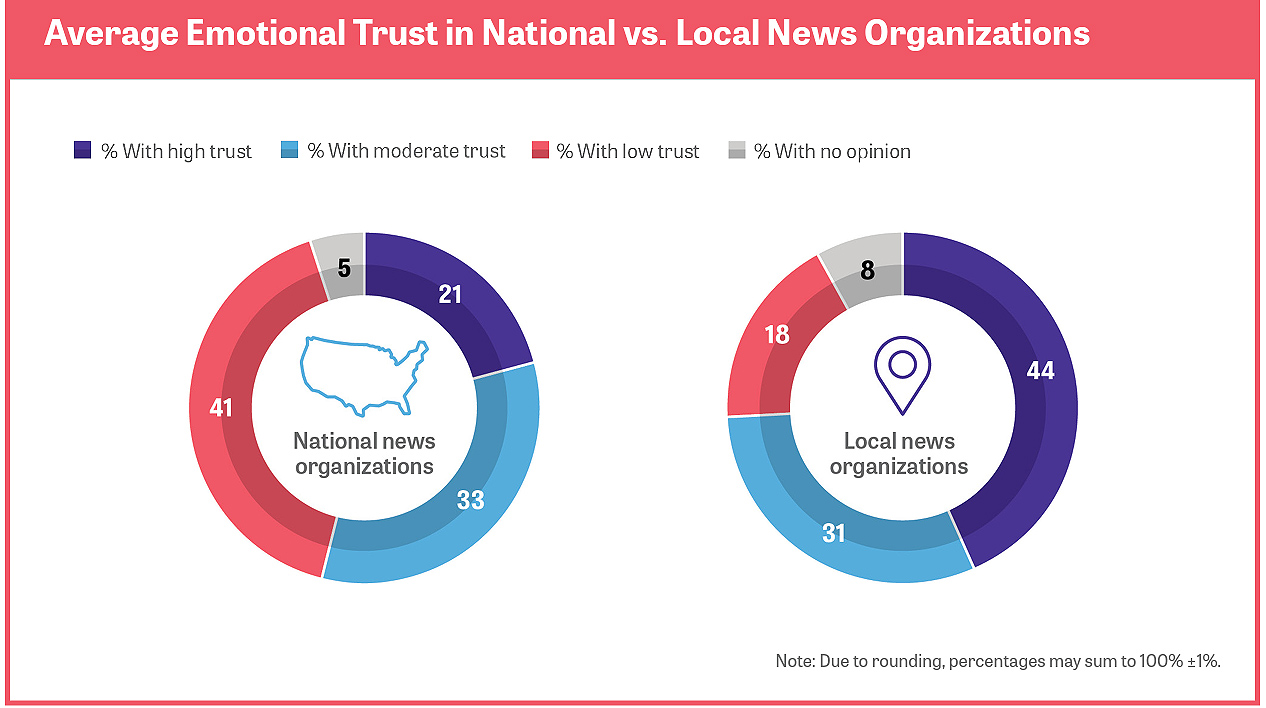
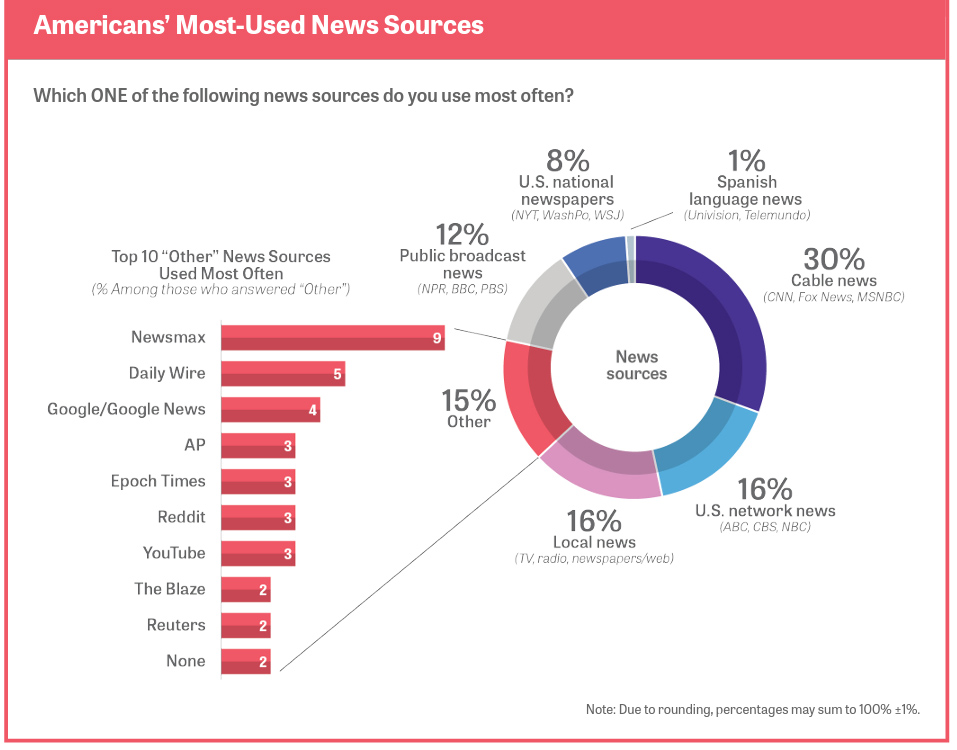
Graphs by Gallup Inc. from Knight Foundation report; click any image to enlarge
"While past investigation of trust in news has focused on issues of transparency and credibility, recent research has emphasized the affective or emotional aspects of trust — that is, how trust in news is related to how people feel about news outlets," Knight repots. "Emotional trust in news is driven by the belief that news organizations care, report with honest intentions and are reliable. More than twice as many Americans report high emotional trust in local news than in national news; 44% have high emotional trust in local news organizations, compared with 21% who have high emotional trust in national news organizations. . . . Greater emotional trust in local news is consistent across various demographic groups. Variation in levels of emotional trust in local news organizations is less pronounced across demographic groups. For example, 31% of Republicans and 58% of Democrats express high levels of emotional trust in local news — a narrower gap than with emotional trust in national news. This finding is consistent with findings from previous Gallup/Knight studies."

So, Americans trust their local news organizations, but do they really know them? The poll found that 65% agreed with the statement "In general. most local news organizations have the resources and opportunity to report the news accurately and fairly to the public," but the question left much to be desired. Most Americans are not familiar with "most local news organizations," and many if not most of those organizations are having difficulty reporting as much news as they once did or would like to do. Accuracy and fairness are essential, but audiences notice gaps in coverage, and that could have been measured, too.

Bauder describes one other hopeful finding: "If Americans believed local news organizations didn’t have the resources or opportunities to cover the news, they would be more likely to pay for it." Knight reports, "Americans who think local news organizations lack the resources and opportunity to report the news accurately and fairly are more likely to pay for news. . . . Among those who agree, 23% report having paid for news in the past. This percentage nearly doubles (45%) among those who disagree. Those who say local news organizations do not have the resources and opportunity to report the news accurately and fairly are more than twice as likely to be willing to pay for news in the future as those who agree (32% vs. 14%, respectively). These findings mirror previous Gallup/Knight research on local news, which found that Americans who are exposed to information about the financial challenges of local newspapers are more likely to donate to a nonprofit organization that supports local journalism."

Knight says journalists need to go beyond emphasizing transparency and accuracy to show the impact of their reporting on the public. That recommendation is directed to national news organizations, but it's good advice for local news organizations, too. And the study reaffirms that they need to do that online, because that's where most of the audience is. The poll found that 58% of Americans in mid-2022 reported getting most of their news online, up from 46% in 2019. Television was named by 31%, down 10 points from 2019. Only 3% named printed newspapers or magazines, down from 5%.

Another interesting finding, described by Bauder: "The ability of many people to instantly learn news from a device they hold in their hand, the rapid pace of the news cycle and an increased number of news sources would indicate that more Americans are on top of the news than ever before. Instead, an information overload appears to have had the opposite effect. The survey said 61% of Americans believe these factors make it harder to stay informed, while 37% said it’s easier." That finding doesn't differentiate between national and local news, but the poll seems to confirm a trend pointed out by many observers, that people are paying less attention to local news than they once did. Local news providers must give them reasons to seek it out, make it easy to do so, and make clear its value.

Thursday, January 12, 2023

News-media roundup: Oregon paper closes; broadcasters worry about police radio encryption; others should too

UPDATE, Jan. 31: Newspapers from other Oregon towns are now in "an old-fashioned newspaper war" to serve Jackson County, reports Brier Dudley of The Seattle Times.
Jackson County is on the California border. (Google map)
The Medford Mail-Tribune, which went digital-only last fall, announced Wednesday that Friday would be its last day of publication. "The Mail Tribune’s closure will result in a dramatic loss of news coverage for the biggest population center in southern Oregon. Jackson County, where Medford is the county seat, is home to nearly 224,000," The Oregonian reports. "Travis Moore, publisher of the Daily Courier, a newspaper serving Grants Pass and the surrounding area, said Wednesday that his company would move to hire some Mail Tribune journalists and expand its coverage in nearby Jackson County."


"Police departments across the country are encrypting their radio scanner communications with an increased and frightening urgency," the Radio Television Digital News Association tells its members. "Though encryption is not a new issue, it is rapidly accelerating . . . These encryption policies look different from department to department — with some opting for a delayed release of information, others decrypting for media personnel, and many choosing to encrypt communications entirely. Was there a moment where your lack of access to radio communications led to a loss of real-time information sharing? Has your newsroom been impacted by scanner encryption? Why is it important to keep this resource available to the public, including journalists? Help us build our case by sharing your newsroom’s experience with encryption. Read more about police encryption and RTDNA's approach here."

PR for journalism: “Even if the media industry takes urgent steps like diversifying newsrooms and empowering local media, the populist media bashing won’t go away. Ignoring it is not a sustainable way forward,” Cambridge University Ph.D. student Ayala Panievsky writes for Nieman Lab. “Journalists must start campainging for journalism. . . . promote and explain journalism as a flawed-yet-necessary social institution. As media-savvy journalists should know, vague arguments about 'saving democracy' or 'checks and balances' won’t do; they’re too abstract and carry little sentimental resonance for many.”

Seek solutions: "It is not enough for stories to expose problems to societal problems; they should explore how people tackle those problems," Lauren Kessler writes for Nieman Storyboard, promoting the concept of solutions journalism, as defined by the Solutions Journalism Project: “rigorous, evidence-based reporting on the responses to social problems,” the mission of which is “to transform journalism so that all people have access to news that helps them envision and build a more equitable world.” Or, as the late Molly Ivins said, “Listen to the people who are talking about how to fix what’s wrong, not the ones who just work people into a snit over the problems. Listen to the people who have ideas about how to fix things, not the ones who just blame others.”
Constructive Institute table, adapted by The Rural Blog, shows forms of journalism and their differences.

Thursday, December 15, 2022

New FCC broadband map faulted by telehealth advocates; it's easier to challenge, but the deadline is Jan. 13

The Federal Communications Commission's new maps of high-speed internet service in the U.S. may be "a step in the right direction" but it leaves much to be desired, telehealth advocates say.

They told senators Thursday that the maps. which will guide Infrastructure Investment and Jobs Act funding for internet expansion, "need to be significantly revamped -- as some communities are entirely missing from the maps -- to ensure the unserved and underserved are accurately represented," Cara Smith reports for Inside Telehealth. They want the FCC to extend the Jan. 13 deadline for comments.

"A government official told Inside TeleHealth that navigating the FCC maps also were confusing, so individual community members may have significant challenges navigating the data," Smith reports. "Even if the maps are corrected in time, lawmakers and stakeholders still worry about instances of fraud, waste and abuse from contractors receiving funding to construct broadband in unserved or underserved areas."

Smith notes that the Government Accountability Office, the bipartisan auditing arm of Congress, has "called for the White House to synchronize the over 100 federal programs that aim to expand broadband access to rural areas and other locations with limited or no access to internet, and to ask for congressional help if necessary. Without a national plan, GAO said, the federal government could miss the chance to expand internet access and increase access to essential services, like telehealth."

The new map is still based on reports from telecommunications companies, but at a more granular level, Robert Gallardo, director at the Purdue Center for Regional Development, told Kristi Easton of The Daily Yonder. "That’s the same glitch that we had before, which is providers reporting on their own,” he added. “Now you can go in and challenge that availability, but it does require a little bit of prep time, meaning you can see the options you have to challenge the availability piece.”

To challenge the map, "One has to include either a bill from the provider or include a screenshot from the website that shows the package is not available for that address," Eaton reports. "The worry, according to Gallardo, is that challenging the map takes some technology know-how that not everyone may have. And the deadline to challenge for this map is Jan. 13."