Showing posts with label methane. Show all posts

Friday, January 17, 2025

Earth's methane levels began to spike in 2020; a new study may have uncovered the 'culprit.'

Wetlands and cow stomachs have similar
environments. (Adobe Stock photo)
In 2020, Earth's methane levels started to climb the charts at an inexplicable rate, putting the planet on a crash course with greenhouse gases that could eventually heat oceans and land to life-threatening temperatures, reports Shannon Osaka of The Washington Post. Researchers have been baffled by the cause -- until now. Scientists say a study released last month reveals why methane levels are spiking.

"The culprits, scientists believe, are microbes — the tiny organisms that live in cows’ stomachs, agricultural fields and wetlands," Osaka writes. "That could mean a dangerous feedback loop — in which these emissions cause warming that releases even more greenhouse gases — is already underway."

Sylvia Michel, lead author of the paper published in the Proceedings of the National Academy of Sciences, told Osaka, "The changes that we saw in the last couple of years — and even since 2007 — are microbial." Oska adds. "The new paper points to microbes as the biggest source of the methane spike."

In clarifying the source of rising methane levels, the study ruled out fossil fuels and geological causes. Stanford University professor Rob Jackson, who is part of the Global Methane Budget, explained how cow stomachs and swampy places are alike. He told Osaka, "Methane forms biologically in warm, wet, low-oxygen environments. The wetlands of a rice paddy and the gut of the cow are all similar.”

Microbe methane output may be a chemical reaction to a warming planet. Osaka reports, "Michel says it’s too early to say whether this is the beginning of a vicious cycle. 'Are these coming from human-caused changes in freshwater systems, or are they a kind of scary climate feedback?' she said. 'I want to be careful about what we can and cannot say with this data.'"

Tuesday, May 28, 2024

Bit by bit, these young adults are working to close methane-leaking orphaned wells

The Youth Climate Initiative is partnering with the Well Done Foundation
to plug orphaned wells. (Donor website photo)
With thousands of orphaned oil and gas wells left unplugged and leaking methane into the air, where does one start to correct the problem? Some teenagers in North Carolina have an answer -- close them down one at a time.

Mateo De La Rocha told his family that he wanted to be a garbage man when he grew up. "In La Paz, Bolivia, his home city at the time, trash piles were everywhere. In De La Rocha's eyes, the local sanitation worker was the only person cleaning up pollution," reports Delger Erdenesanaa of The New York Times. After De La Rocha's family relocated to the U.S., he ended up in an Advance Placement environmental science class. . . . "Where he realized that the methane from these abandoned wells was an issue [where individuals] could potentially make a difference. He invited his classmates Sebastian Ng and Lila Gisondi to join him."
Location of Cuyahoga Valley
National Park in Ohio (Wikipedia)

Being an environmental sanitation worker is a tall order, so the three teens dubbed themselves the "Youth Climate Initiative" and dug into orphaned well problems and possible solutions. "After more research, the trio connected with a nonprofit organization called the Well Done Foundation that plugs orphaned wells," Erdenesanaa writes. "The organization was founded by Curtis Shuck, an oil and gas industry veteran. . . .The students in North Carolina agreed to sponsor the 45th, an orphaned oil well on a horse farm in Ohio, near Cuyahoga Valley National Park."

Once the Youth Climate Initiative had a partner and their site, "They raised money in small increments over the course of about three months," Erdenesanaa explains. "The students also persuaded the Reimer Family Climate Crisis Fund, a small family foundation based in Austin, Texas, to match their donations. The $11,000 the students raised will cover approximately 15 percent of the project's total cost. Well Done will cover the rest of the cost through other donations and sponsors."

While one plugged well isn't going to save the environment, for the Youth Climate Initiative, it's a great start. Erdenesanaa adds, "Now that final exams, sports tournaments and prom are out of the way, De La Rocha, Ng and Gisondi plan to raise money to plug a second orphaned well this summer."

To view photos of the students' project as it unfolded, click here.

Monday, April 17, 2023

'Upwards of 18,000' cattle die in dairy-farm explosion and fire in Texas Panhandle; investigators still looking for cause

The fire was the worst for cattle in Texas history.
(Photo from Castro County sheriff)
Last week's explosion and fire at a Texas Panhandle dairy resulted in "The deadliest fire involving cows in nearly a decade," report Jayme Lozano-Carver and Erin Douglas of The Texas Tribune. "The fire started Monday night at South Fork Dairy Farm in Dimmitt, about 66 miles south of Amarillo. . . . One person was trapped inside the dairy farm but was rescued by first responders."

"The Castro County Sheriff's office reports upwards of 18,000 head of dairy cattle perished in the blaze," reports Lisa Foust Prater of Successful Farming. "That was about 90% of the farm's total herd. . . . Sheriff Sal Rivera said witnesses reported an explosion that spread into a massive fire throughout the building where the cattle are held."

Texas Agriculture Commissioner Sid Miller told the Tribune, "This was the deadliest barn fire for cattle in Texas history, and the investigation and cleanup may take some time. . . .The impact of this fire may influence the immediate area and the industry itself. Once we know the cause and the facts surrounding this tragedy, we will make sure the public is fully informed — so tragedies like this can be avoided."

A honey wagon/vacuum truck (Wikipedia photo)
Rivera told Prater, "Investigators are trying to determine if it's machinery called a honey wagon that sucks out the manure and water. . . . It may have ignited possibly methane gas." Often the cause of coal mine explosions, methane explosions occur when a buildup of methane gas contacts a heat source and there is not enough air to dilute the gas level below its explosion point. . . . 65% of cow manure is methane.

Carver and Douglas report, "In 2019, Texas authorized the facility to more than double the number of cattle allowed on-site from 11,500 to up to 32,000, according to a permit with the Texas Commission on Environmental Quality. . . .The state also authorized the facility to increase its manure production by more than 50% in that expanded permit. . . . The 18,000 cows killed represent just a fraction of the 625,000 dairy cows in Texas. Large amounts of cattle have died in Texas before. During Winter Storm Goliath in 2015, 35,000 cattle froze to death. . . . The state fire marshal’s office is conducting the investigation."

Wednesday, April 12, 2023

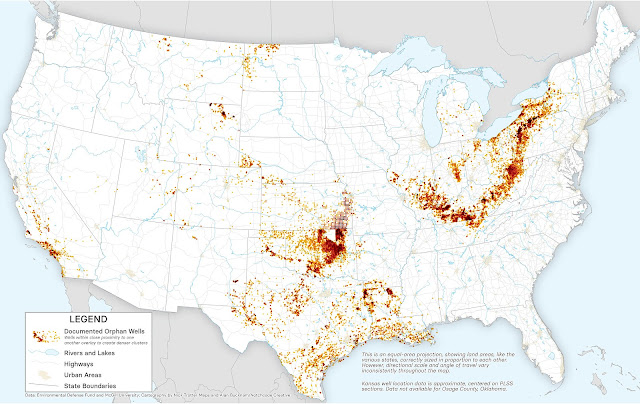
'Orphan' gas and oil wells are found 'everywhere,' as the federal government aims to plug these hidden polluters

Adapted screenshot of interactive map that has data by county; for the interactive version click here.

Workers cap an orphaned well in Louisiana.
(Photo by Cooper Neill, The Washington Post)
On its own, an orphaned oil or gas well (named so because often no viable owner exists) has little impact the planet; however, across the U.S., there are thousands of unplugged wells that "collectively account for a significant source of the potent greenhouse gas" and pollute water, notes Brady Dennis of The Washington Post. "Congress set aside an unprecedented $4.7 billion to fund the idea in late 2021. . . . Dedicating billions of dollars to target the most troublesome wells around the country has the potential to result in significantly fewer toxic substances, such as arsenic and benzene, polluting groundwater."

Dennis joined the Tolbert Construction crew in the piney woods of Louisiana to understand the "find-and-plug-well" process: "Merely locating orphan wells can be arduous, and plugging them is tedious, time-consuming and expensive. To follow a crew like Tolbert's is to understand how the work is a mixture of sweat, science and improvisation. They must navigate swampy roads or thick forests with heavy equipment to access the wells, remove miles of steel piping, set underground plugs to prevent fluid from flowing, fill straw-like holes with cement, remove the well head, and restore the land to something resembling normal. The whole endeavor takes days and can cost $30,000 to plug a single well — and sometimes far more."

Attempting to count abandoned wells is like counting stars. "The wells are everywhere. They're in backyards and buried under thorny thickets in suburban woods. Rusted pipes rise from the farmland of Texas and New Mexico, from an Amish community in Kentucky, from the bayous in Louisiana and the dense forests in Pennsylvania and Ohio," Dennis writes. "They have been found under sidewalks and driveways, houses and apartment buildings — and in at least one Wyoming schoolyard."

Adam Peltz, a director and senior attorney at the Environmental Defense Fund who has worked on the issue for years, told Dennis, "We really only know where a fraction of them are. We are only scratching the surface on this." Dennis reports, "According to its most recent national inventory, the Environmental Protection Agency estimates the actual number of abandoned wells around the country could be in the millions and that the methane that leaks from them each year accounts for nearly 3 percent of the U.S. total."

Dennis explains, "Curtis Shuck, a former oil and gas executive, founded a nonprofit known as the Well Done Foundation, whose work has been funded primarily by philanthropic donors and corporate sponsors. . . . His foundation also has backed a carbon accounting methodology that, if adopted by the American Carbon Registry, could offer an incentive for businesses that want to offset emissions. Already, the nonprofit is plugging or monitoring wells in about a dozen states and has plugged 25 wells so far, with plans to keep expanding."

"Louisiana is home to more than 4,500 orphaned wells . . . . there are high hopes for the months ahead," Dennis reports. "With the federal money flowing, the state and its contractors have already plugged more than 100 wells this year, and some workers say 500 or more might be possible depending on the weather and any problems they encounter. Patrick Courreges, a Louisiana Department of Natural Resources spokesman, told Dennis, "We want to show bang for the buck."

Wednesday, March 15, 2023

Despite aggressive rules to limit N.M. gas flaring, it goes on

Incomplete combustion in a flare, as pictured, generates
more emissions. (Photo from WildEarth Guardians)

“Laws without enforcement are just good advice.” --Attributed to Abraham Lincoln

In New Mexico, when Michelle Lujan Grisham became governor in 2019, she issued an aggressive executive order that "set a goal of reducing the state’s greenhouse-gas emissions by 45 percent from 2005 levels by 2030," reports Martha Pskowski of Inside Climate News. "In May 2021, New Mexico’s Energy, Minerals and Natural Resources Department adopted new rules that prohibit routine flaring and venting and require operators to achieve a 98% gas-capture rate by 2026." But state records from December and January "show venting and flaring increasing, not decreasing. According to the division, from November to December 2022 flaring increased 39 percent and venting increased 161 percent."

Delaware Basin is a rich section of the Permian Basin.
(Map by C. Cunningham, Albuquerque Journal)

Pskowski visited Carlsbad, N.M., in the heart of the Permian Basin, the nation's most productive oil patch, to see examples of how methane regulation is failing. "Transmission lines and flare stacks dot the horizon. . . . One flare sent off dark smoke, a sign that it wasn’t burning efficiently," Pskowski explains. "Flares are designed to eliminate methane from natural gas. But unlit flares and inefficient combustion mean that flaring still emits large amounts of methane, a potent greenhouse gas . . . . The Environmental Defense Fund’s Permian MAP project found that the Permian was the highest methane-emitting oil and gas basin in the nation. . . . advocates say that in the absence of rigorous state field enforcement, companies are continuing wasteful methane flaring and venting."

Environmental advocates aren't the only ones who have noted the lack of compliance. "Recent flyovers by the federal Environmental Protection Agency, independent monitoring by environmental advocates and NASA satellite imagery have documented significant methane releases," Pskowski adds. "To date, only two companies have been fined for unauthorized flaring since the rules went into effect. . . . industry watchdogs warn that counting on operators to self-report flaring and venting is a failing strategy." A state spokesman "said that the agency relies on inspections, audits and internal reviews to verify the data companies report. But its capacity for on-site inspections is severely limited. Funds are allocated for only 14 inspectors statewide, with two of those positions currently vacant."

After viewing videos of apparently bad flaring, Pskowski contacted four companies involved. "In one case, the company acted," and another said it "eliminated routine flaring at its U.S. operations in 2022 and met the 98 percent gas capture rules," she reports, adding that other companies didn't respond to her requests for comment. 

Wednesday, February 22, 2023

Oil and gas industry has failed to keep pledges to limit methane emissions; 'There's no excuse,' world agency says

Screen grab from thermographic video shows what appears to be
methane leaking from stacks. (James Turitto, Clean Air Task Force handout)
"In 2022, the global energy industry released into the atmosphere some 135 million tons of methane," report Gloria Dickie and Kate Abnett of Reuters. But "The fossil-fuel industry is failing to tackle methane emissions despite its pledges to fix leaking infrastructure, according to a report by the International Energy Agency. 'There is just no excuse,' IEA Executive Director Fatih Birol said, adding that 'emissions are still far too high and not falling fast enough, especially as methane cuts are among the cheapest options to limit near-term global warming.'" Methane has much more greenhouse-gas effect than carbon dioxide, but dissipates in the atmosphere much more quickly.

Methane is the main component of natural gas, so if captured it can be sold as fuel. "The IEA said methane emissions from oil and gas alone could be reduced by three-quarters with existing technologies and modest investment of less than 3% of the $4 trillion windfall income gained by oil and gas companies worldwide last year," Reuters reports. "The economic incentives to make those reductions were huge last year," IEA's Chief Energy Economist Tim Gould told Reuters. "We had record natural-gas prices in many markets around the world. There was an extremely strong economic incentive to bring methane to market."

Over 100 companies "have pledged to cut global methane emissions by at least 30% from 2020 levels by the end of this decade . . . although major emitters, including China and Russia, have not," Reuters notes. "Dozens of oil companies have also voluntarily committed to reduce emissions." Georges Tijbosch, CEO of MIQ, which offers a methane-emissions certification standard, told Reuters, "There are a lot of pledges around, but what you need is a forcing mechanism."

"National Oceanic and Atmospheric Administration physical scientist Lori Bruhwiler said rapid cuts to methane emissions are important, but deep carbon dioxide emission reductions must accompany them if the world is to avoid global warming exceeding 1.5 Celsius (2.7 Fahrenheit) and unleashing more severe impacts," Reuters reports. Should the industry fails to address methane release, Bruhwiler added, "Will this make it tougher for us to meet 1.5? Absolutely."

Friday, September 02, 2022

Quick hits: An ode to 'leather britches'; webinar on covering methane Sept. 7; communities repurpose shuttered prisons

Here's a roundup of stories with rural resonance; if you do or see similar work that should be shared on The Rural Blog, email us at heather.chapman@uky.edu.

A beloved community theater company in a Colorado mountain town has found a way to survive the pandemic and thrive. Read more here.

Twenty-one states have partly or fully closed prisons and other correctional facilities since 2000; local leaders have found creative ways to repurpose the buildings as apartments, office space, whiskey distilleries, and even movie studios. The moves have served to strengthen the communities and their economies. Read more here.

The presence of Asian longhorned ticks has been confirmed in 17 states across the U.S. That's of particular concern to cattle producers since the ticks carry a highly transmissible disease called Ikeda that is sometimes fatal to cattle. Read more here.

The Rural Health Information Hub has a newly updated resource guide on rural home health services. Read more here.

The Society of Environmental Journalists will host a free Sept. 7 webinar to discuss the latest science, data, and policy initiatives around methane, tips on covering methane, and ways to track methane in your local region or around the world. Read more here.

The Daily Yonder offers up a contemplation of the love-em-or-hate-em Appalachian dish called shuck beans or leather britches. Read more here.

Three weeks after the Federal Communications Commission spiked rural broadband funding for Starlink and LTD Broadband, the agency has authorized an extra $800 million from the Rural Digital Opportunity Fund for six providers to build out broadband in over 350,000 locations in 19 states. Read more here.

Friday, August 26, 2022

Interior announces first phase of grants to stop methane leaks from oil and gas wells, totaling $560 million; rural jobs!

Advocates of measures to fight climate change argue that the actions will create jobs, but most of those are likely to be in urban areas that have advanced manufacturing. But one aspect of the infrastructure bill that Congress passed this spring seems likely to do more for rural areas.

That is the $4.7 billion that the bill appropriated for plugging old oil and gas wells that are leaking methane, a potent greenhouse gas. The Interior Department announced Thursday that 24 states will share the money. "Thursday’s funding is part of a phase-one investment of $1.15 billion," The Hill reports. "Officials say there are more than 129,000 abandoned oil and gas wells across the country."

In Kentucky, which is estimated to have up to 14,000 unplugged or leaking wells, the state will get $25 million to plug up to 1,200 in the first phase, and estimates that the work will create 180 jobs. "Kansas has more than 2,300 wells and Oklahoma has about 1,196" in the first phase, Brad Drees of The Hill reports. "Six states, including California, Mississippi and West Virginia, will begin measuring methane emissions at wells they plug up and remediate."

Thursday, June 23, 2022

Natural-gas storage fields' faulty equipment leaks methane


"Infra" is Latin for "under," but "infrastructure" often seems to mean mainly things on the surface: roads, rails, runways, etc. People are aware of pipelines, sewers, etc., but they don't think about them because they don't see them. Most people are probably not aware of one of the largest elements of energy infrastructure: giant, deep underground caverns where natural gas is stored for later use. And most surely don't know that some of those storage fields leak the main component of natural gas: methane, a potent greenhouse gas.

Phil McKenna of Inside Climate News tells us about that with the help of Alex Rozier of Mississippi Today, and their object example is the Petal Gas Storage Field in southeast Mississippi, which "emits the greenhouse gas equivalent of 87,000 automobiles—more than any other gas storage facility in the United States." Created by watering a salt dome and pumping out the brine in 1951, it is in the first underground salt dome carved out for gas storage, and it is the leakiest. It's only the 41st largest storage field, but emits three and a half times as much methane as the next biggest leaker, also owned by Gulf South Pipeline and parent firm Boardwalk Pipeline Partners.

"Gulf South and Boardwalk have begun to curb emissions at the Petal facility, cutting them in 2020 by nearly 50 percent of what they were in 2019, a year when Petal’s emissions were more than five times larger than any other underground gas storage facility in the country. Boardwalk executives said they slashed emissions again, this time by 54 percent, in 2021," McKenna and Rozier report. "EPA has not yet verified Petal’s 2021 emissions. . . . The Petal facility’s emissions do not violate any state or federal laws, but they call into question the ability of the oil and gas industry to voluntarily curb its own climate pollution. Emissions from the transmission and storage sector account for approximately 25 percent of the total methane emissions from the natural-gas industry. A draft rule proposed by the EPA last November includes what would be the first mandatory methane emission reductions for existing gas transmission and storage facilities."

The Federal Energy Regulatory Commission says methane is not toxic, but health experts say it is often accompanied by volatile organic compounds and toxic gases. Petal Alderman Gerald Steele, whose ward includes the gas field, "expressed surprise that the Petal plant’s emissions were the highest from such facilities in the nation," Rozier and McKenna report. "He said that the company is an important financial contributor to the city through its employment and tax contributions." The reporters say the leaks come from faulty equipment, not the geology of the infrastructure, and their story has useful diagrams that explain.

Tuesday, May 03, 2022

1/2 of methane emissions in U.S. come from low-producing oil and gas wells, which EPA may not regularly monitor

"Low-producing oil and gas wells are to blame for roughly half of the methane emitted from all U.S. well sites, despite making up 6 percent of the country’s total production, according to new research published this week," Carlos Anchondo reports for Energy & Environment News. "The study, published in Nature Communications, is the first comprehensive look at low-production well-site emissions nationwide, researchers said. The paper found that low-producing or 'marginal' wells emit methane at a rate 6 to 12 times higher than the national average — releasing some 4 million metric tons of the potent greenhouse gas a year."

But the draft methane rules released by the Environmental Protection Agency in November say smaller wells don't have to be regularly monitored. That's a mistake, according to lead author Mark Omara, a scientist with the Environmental Defense Fund. There are about half a million low-producing wells in the U.S., he said, and they have the same environmental impact as 88 coal-fired power plants. "Omara said methane emissions from low-producing well sites can come from sources that are common throughout oil and gas operations, including both intentional vented emissions as well as unintentional emissions like those from equipment malfunctions," Anchando reports. "Marginal wells produce less than 15 barrels of oil equivalent per day, according to the study."

Petroleum lobbyists and sympathetic regulators have protested that regulating marginal wells will be overburdensome to operators, but EDF says its research found that about 75 percent of marginal wells are owned by large companies with ample resources, Anchando reports.

Thursday, March 17, 2022

April 7 webinar will provide information about new federal infrastructure funds for plugging orphan oil and gas wells

Environmental Defense Fund map locates abandoned oil wells. To enlarge any image, click on it.

The National Conference of State Legislatures is hosting a webinar series that can help you study up on policy issues that can affect your readers (along with its target audience of state legislators). The webinars are free, and will be recorded for those unable to attend. 

"Orphaned No More: Federal Oil and Gas Well Reclamation" is the first in the series, and starts at 3 p.m. E.T. on April 7. From the website: "States across the country face a backlog of orphaned oil and gas wells, which can continue to emit methane and other pollutants if left unaddressed or improperly sealed." They also pose safety risks. "However, the costs of plugging and reclaiming oil and gas well sites often exceeds the amount available for reclamation. Further, many older wells have long been abandoned, and their owners no longer exist. It is often unclear who can or should be responsible for paying the plugging and reclamation costs. Recognizing these challenges, Congress included $4.7 billion for orphaned well plugging, remediation and restoration in the federal infrastructure bill. This webinar will educate state legislators on this new program, how their states can obtain funding and their options for directing these funds to meet their states’ needs and reclamation priorities." Register here.

Tuesday, March 01, 2022

Leaky gas system and major meat processors more issues than cows' methane, says livestock farmer and dairy expert

Cows at O'Daniel's Foxhollow Farm (Photo by Kendra Lynne)
People are more concerned than ever about climate change and greenhouse-gas emissions. Much of that comes from the oil and gas industries, but some stakeholders worry about cow burps. That's silly, Kris O'Daniel writes for the Louisville Courier Journal. O'Daniel, a Denmark native who operates a farm with her husband near Springfield, Ky., has a master's degree in dairy science and engineering and worked for the United Nations Food and Agricultural Organization.

"Natural gas made up 37 percent of U.S. electricity generation in 2021, but there are no reliability standards for pipelines moving energy," O'Daniel writes. "That’s because the fossil fuel industry, supported by congressional conservatives, is opposed to legislation directing the Federal Energy and Regulatory Commission to develop reliability and cybersecurity standards for natural gas and other pipelines. The Transportation Security Administration oversees it. The Fossil fuel industry finds any regulation a waste of taxpayers’ money. Contrary to natural gas leaks, cattle’s methane belching is accounted for. But their unique ruminating ability to digest feed from which humans cannot benefit adds value and turns simple forage into high-quality human food. The methane and manure from grazing livestock are sequestered and part of the carbon cycle. That’s how nature is designed."

Also, O'Daniel notes, grazing animals, including cattle, can contribute to healthy ecosystems. "Byproducts from processing food for humans are part of livestock forage, thereby reducing what is going to landfills. Landfills are the third-largest emitter of methane, so taking away ruminating livestock would dramatically increase methane from landfills," she writes. "Incorporating alternative industrial by-products like 'spent grain from distilleries' with high sugar and protein content reduces methane belching. It is a valuable feed input and a win-win as it further reduces waste going to landfills."

O'Daniel says cattle only hurt the environment when they're finished in concentrated animal feeding operations, which benefit big meat processors but can hurt farming communities and farmers.

"A conversation on improving agriculture is needed, but it’s not beef versus beans or cheese versus corn," O'Daniel writes. "We need a transformation based on bio-diverse farming principles, restoring and regenerating soil as we use it. Cropped lands producing corn and soybeans would benefit from livestock eating crop spills, reducing hazardous fertilizers and restoring the soil."

Monday, February 28, 2022

Oil and gas industries release far more greenhouse gases than government data accounts for, investigation finds

University of Arizona photo
U.S. oil and gas operators release much more greenhouse gas than previous data suggests, a new investigation shows.

"Over much of the last decade, oil and gas operators in Texas and a dozen other U.S. states have flared, or burned off, at least 3.5 trillion cubic feet of natural gas, according to an analysis of satellite data by the Howard Center for Investigative Journalism" at Arizona State University, Laura Kraegel, Mollie Jamison and Aydali Campa report for Inside Climate News. "That’s the greenhouse gas emissions equivalent of nearly 42 million cars driving for a year. The industry has also directly released unknown amounts of gas into the atmosphere through a process called venting. Between them, flaring and venting release a noxious cocktail of carbon dioxide, methane and other pollutants."

Government auditors have warned for nearly two decades that inadequate data collection has obscured the amount of greenhouse gases released by flaring and venting, "but regulators are largely unaware of the amount of gas being flared and vented, the Howard Center found. It’s a blind spot that’s developed under limited federal oversight and a patchwork of state regulations, lax enforcement and inconsistent data collection," Kraegel, Jamison and Campa report. "The satellite flaring volumes calculated by the Howard Center, with the guidance of scientists who pioneered and used the methodology, far exceed the total reported to regulatory agencies in the 13 states designated by the U.S. Energy Department as having the most active flaring. They also far surpassed the total published by the Energy Information Administration, the U.S. Energy Department analytics agency that says it gets its data from the states."

The story is the first in a four-part series by the Howard Center about the flaring and venting of natural gas by oil and gas companies in more than a dozen states across the country.

Tuesday, December 14, 2021

Abandoned oil and gas wells, coal mines, hurt environment and locals' health; infrastructure funds earmarked to help

Map of documented abandoned wells from Environmental Defense Fund report; to enlarge, click on it or go here.

Coal, oil and natural gas have been major economic drivers in many rural areas, but these extractive industries have in many cases damaged the environment, and in some health of nearby residents, and too often failed to clean up after themselves. Federal funding can make a dent in the problem.

"In Pennsylvania, underground mine fires burn and iron-laden, acidic water pours into rivers from abandoned mine shafts. In New Hampshire, the iconic sugar maple is threatened by soil damage lingering from coal-induced acid rain," James Bruggers reports for Inside Climate News. "In Florida, a young mother obsesses over air and water pollution from a vast pile of coal ash stored by her local utility. And in Kentucky, the multi-billion dollar cost of reclaiming abandoned mines . . . far exceeds the amount of surety bonds left behind by an increasing number of bankrupt coal companies. "

Many states don't require coal companies to buy enough bonds for reclamation. That means bankrupt companies often leave rural places to pay for the cleanup themselves or suffer the environmental consequences. "Across Appalachia, mountaintop removal and other forms of surface mining have scarred an area of more than 2,300 square miles in Kentucky, West Virginia, Virginia and Tennessee. Nationwide, over a million acres of land used by still operating, idle or abandoned mines need to be cleaned up and reclaimed," Bruggers reports.

Meanwhile, there are more than 2 million inactive, unplugged oil and gas wells scattered across the U.S., according to a recently published map from the Environmental Defense Fund. Such wells often poison groundwater and leak the potent greenhouse gas methane. The Environmental Protection Agency estimates that the wells could leak as much methane per year as 5 million cars. The EDF's map shows 81,000 abandoned wells that are documented as having no owner.

Cleaning up abandoned fossil fuel sites is cost-prohibitive for states. It costs an average of $25,000 to $475,000 to close each oil or gas well. And a recent report found that it will cost as much as $9.8 billion to reclaim coal mines in Central Appalachia. On the upside: the recently signed infrastructure bill included $16 billion to clean up abandoned mines and old oil and gas wells.

Tuesday, November 02, 2021

New rules would limit methane emissions from oil and gas

"The Biden administration unveiled a sweeping set of policies Tuesday to cut emissions of methane, a potent greenhouse gas, from oil and gas operations," The Washington Post reports. It marks "the first time the federal government has moved to comprehensively tackle the seepage of methane across U.S. oil and gas infrastructure." 

Dino Grandoni and Steven Mufson of the Post provide background: " Methane, a main component of natural gas, is the world’s second-largest contributor to climate change among greenhouse gases. Although it dissipates more quickly than carbon dioxide, it is 80 times more powerful during the first 20 years after it is released into the atmosphere."
 
The Environmental Protection Agency's proposed rules, which could become final at the end of 2022, would "establish standards for old wells, impose more frequent and stringent leak monitoring, and require the capture of natural gas found alongside oil that is often released into the atmosphere," the Post reports. "The oil industry has opposed federal methane regulations in the past, but many major companies have come to embrace them rather than face a patchwork of state rules."

The rules would require most operators to use infrared cameras or other instruments four times a year to spot and plug leaks of invisible methane from compressor stations, "as well as sites the agency suspects are leaking more than three tons of methane annually," the Post reports. "The EPA is also set to restrict the venting of natural gas found in oil wells, known as associated gas, requiring operators to route the gas to a pipeline when possible. . . . For the first time, older oil and gas wells, which are most prone to leaks, will have to curb methane. The new proposal will require states to develop their own methane rules for existing wells that are in line with federal guidelines, while the EPA will regulate all new wells."

At the global climate summit in Scotland, more than 80 nations said they had signed a pledge to limit methane, "but some of the largest methane emitters still haven’t signed the pledge, including Russia and China," the Post notes. "Climate scientists say the world desperately needs drastic cuts in methane emissions to prevent catastrophic warming. . . . Plugging methane leaks is not just good for the health of Earth’s climate system. It also decreases the accumulation of toxic and smog-forming chemicals around oil drilling sites that makes the air difficult and dangerous to breathe."

Tuesday, August 24, 2021

Permian Basin wells leak huge amounts of methane; plugging them could help slow climate change

A tank battery near Big Spring, Texas, spews methane through an open hatch, visible only with infrared cameras. (Photo and video by Sharon Wilson; image on right is a screenshot of the video, in which the gas emission is more apparent.)

A recent United Nations climate report stressed the need to cut back fossil-fuels emissions to stave off the worst effects of climate change. A Harvard University postdoctoral student's research found that one measure could go a long way toward doing that: find and plug methane leaks in hydraulic fracturing wells in Texas and New Mexico, Zachary Mider reports for Bloomberg Businessweek.

Yuzhong Zhang, now at Westlake University in China, found that fracking operations in the Permian Basin were dumping 2.9 million metric tons of methane into the air each year, enough to negate most of the environmental gain from burning natural gas instead of coal. "By one measure, that cloud of gas is contributing as much to global warming as Florida—every power plant, motorboat, and minivan in the state," Mider reports. "Identifying and plugging these leaks could do more to slow climate change than almost any other single measure. Unlike carbon, methane breaks down relatively quickly in the atmosphere. That means efforts to curtail it can pay off within a generation."

Permian Basin (Bloomberg map)

One recent estimate found that reducing human-caused methane emissions could stave off nearly one-third of the global warming expected in the next few decades without having to cut overall consumption or invent new technology. That would involve plugging leaky wells and reducing emissions from other sources such as landfills and cattle feedlots, Mider reports. But plugging Permian oil and gas wells could offer the biggest payoff for the least money.

Though companies such as BP have significantly reduced their emissions, state and federal laws haven't really forced drillers to take action. That's changing, little by little. A federal methane rule, which applied to a limited number of oil facilities, was restored this year after being gutted by the Trump administration. "Now the Environmental Protection Agency is crafting a rule that would apply to more wells," Mider reports. 

And "Senate Democrats plan to include a 'methane polluter fee' in their $3.5 trillion budget resolution that would hit energy producers that vent or burn off excess methane and compressors used to pressurize and transport natural gas," Ximena Bustillo reports for Politico's Weekly Agriculture.

At the state level, the New Mexico Environment Department is phasing in limits on flaring and methane. Texas has not taken significant action on either front, Mider reports.

And, as Inside Climate News notes, Texas is diverting one-third of the money meant for clean-air initiatives to widening highways in order to reduce congestion. Vehicle licensing and sales fees and surcharges generate as much as $250 million a year for that fund. The state has about $2 billion in unspent funds meant to mitigate air pollution.

Friday, April 30, 2021

Because of pandemic, Appalachia unseated the Permian Basin as the biggest methane-emitting region in 2020

The Appalachian Basin surpassed the Permian Basin of Texas and New Mexico to became the biggest source of methane emissions in the U.S. last year, according to analytics firm Kayrros. That's largely because falling energy demand hit the Permian a little harder than Appalachia: emissions fell by 20 percent in Appalachia and 26% in the Permian in 2020, Jamison Cocklin reports for Natural Gas Intel. It's the first time methane emissions from coal have been comprehensively quantified.

"Kayrros said recent data show emissions from fossil fuel production in the Appalachian Basin hit 3 million tons (Mt) in 2019 and 2.4 Mt in 2020," Cocklin reports. "Excluding emissions from coal mines, emissions from natural gas produced largely from the Marcellus, Utica and Upper Devonian shales declined from 1.9 Mt in 2019 to 1.4 Mt in 2020. Methane from oil and natural gas production in the Permian declined from 2.7 Mt to 2.0 Mt over the same time." Some of the methane is from oil and gas, but some is from coal. It's tricky to figure out the source of Appalachian methane emissions since coal, gas and oil extraction sites are intermingled throughout the basin. 

The analysis shows "Large methane emissions cannot simply be considered as an unavoidable side effect of production but rather the avoidable consequence of various factors such as insufficient or poorly maintained infrastructure for natural gas gathering, processing, and transportation," World Oil reports

The report coincides with the Senate vote this week to restore regulation of methane emissions, as well as a major United Nations report calling for deep cuts in methane emissions to slow global warming.

Thursday, April 29, 2021

Senate votes to revert methane rules to Obama era; research says cutting its emissions could slow warming

The Senate voted 52-42 Wednesday voted to restore regulation of methane emissions, rolling back a Trump administration rule. "The bill would reinstate the 2012 and 2016 Oil and Natural Gas New Source Performance Standards set by the Obama administration," Valerie Volcovici reports for Reuters. Oil companies such as BP and Shell have signaled support for the measure, which now goes to the House. It passed the Senate under "a 1996 law that allows Congress to reverse federal rules implemented in the last days of a past administration with a simple majority," Volcovici notes.

Along with Senate Democrats and independents, three Republicans voted for the measure: Susan Collins of Maine, Lindsey Graham of South Carolina and Rob Portman of Ohio. Majority Leader Chuck Schumer said the measure would help the Biden administration reach its goal of halving U.S. greenhouse-gas emissions over the next decade, Volcovici reports. Environmental Protection Agency Administrator Michael Regan "said in a recent interview that new methane rules, due by September, would likely exceed the goals of Obama-era regulations and play a significant role in helping the United States achieve its near-term climate goals."

The vote "comes ahead of the release of a major United Nations report next week that will call for deep cuts in methane emissions to slow the rate of global warming and keep it beneath a threshold agreed by world leaders," Volcovici reports.

Moving quickly to cut methane emissions could slow global warming by as much as 30 percent, according to research recently published in the journal Environmental Research Letters. According to the study, "a full-scale push using existing technologies could cut methane emissions in half by 2030. Such reductions could have a crucial impact in the global effort to limit warming below 2 degrees Celsius (3.6 degrees Fahrenheit) compared to preindustrial levels — a central aim of the Paris climate accord," Brady Dennis and Steven Mufson report for The Washington Post. "In human terms, that could translate into fending off the most severe sea level rise, preventing more profound damage to animal habitats and ecosystems, and delaying other extreme climate impacts."

Thursday, November 19, 2020

Unlikely alliance of Farm Bureau, environmental groups, Farmers Union aims to reduce agriculture's carbon footprint

"The American Farm Bureau Federation, the country's largest and most powerful agricultural lobbying group, has long pushed against climate legislation and worked closely with the fossil-fuel industry to defeat it," Georgina Gustin reports for Inside Climate News. "But on Tuesday, the Farm Bureau announced it had joined an unlikely alliance of food, forest, farming and environment groups that intends to work with Congress and the incoming Biden administration to reduce the food system's role in climate change and reward farmers when they lower their greenhouse-gas emissions."

The Food and Agriculture Climate Alliance was founded in February by four groups than now co-chair it: Farm Bureau, the National Council of Farm Cooperatives, the National Farmers Union (in some ways a liberal Farm Bureau) and the Environmental Defense Fund. The group now includes the Food Industry Association, the National Alliance of Forest Owners, the National Association of State Departments of Agriculture, and the Nature Conservancy. The Russell Group, a Washington lobbying firm, is coordinating. The groups' leaders of the groups acknowledge they won't always agree, but told Gustin that they believe they can find common ground.

In the Tuesday announcement, the group unveiled 40 policy proposals on its wish list that could be carried out through legislation, executive order, agency-level policy, and/or voluntary cooperation from farmers and agribusinesses. "The group's recommendations range across six broad categories, including soil health, food waste and agriculture research, Gustin reports. "They include a proposal to give tax credits to farmers who can prove that they've stashed carbon in their soils and a USDA-led 'carbon bank' that would set a minimum amount that farmers would be paid for cutting greenhouse-gas emissions."

All that doesn't address larger issues such as "overuse of synthetic fertilizers and the continued expansion of large-scale animal feeding operations and their excess manure," Ben Lilliston, director of rural strategies and climate change at the Institute for Agriculture and Trade Policy, told Gustin. "Voluntary, incentive-based approaches are important, but as long as this industrial system of production is in place, it will be difficult to get deeper traction at the speed with which is needed to meet the climate crisis." Click here for the group's full list of policy proposals.

Monday, November 09, 2020

Purina to launch pet food with protein from bugs, Asian carp

Nestle Purina PetCare is launching a new line of cat food and dog food made with larvae of black soldier flies, and plans to offer other lines soon based on Asian carp. It's all part of a push to find protein from cheaper, more sustainable sources.

The Beyond Nature's Protein line will hit stores in Switzerland this month, and the company plans to expand to other European markets, Jaclyn Diaz reports for NPR. Purina spokesperson Lorie Westhoff said the company will offer U.S. customers an insect-based dry dog food in January, sold online only, along with several other formulas using protein alternatives such as Asian carp, an invasive species.

Purina "is embracing what the company views as a growing trend among consumers seeking protein alternatives for their cats and dogs, company representatives told NPR," Diaz reports. "A desire to be more environmentally conscious drives the consumer change, as does a perceived health benefit from a diet that substitutes meat."

The United Nations has warned that it will be increasingly difficult to find cheap, reliable protein sources as the world's population grows and resources are stretched, and recommends insects as a meat alternative. That could help with global warming too, the UN says, since meat production is responsible for releasing large quantities of the greenhouse gas methane, Diaz reports.

Scientists have had their eyes on fly larvae for a while now. "That’s because of the black soldier fly larva’s remarkable ability to transform nearly any kind of organic waste — cafeteria refuse, manure, even toxic algae — into high-quality protein, all while leaving a smaller carbon footprint than it found," Christopher Ingraham reports for The Washington Post. "In one week, a soldier fly colony of modest size can turn a ton of waste into 100 pounds of protein and 400 pounds of compost . . . In one year, a single acre of black soldier fly larvae can produce more protein than 3,000 acres of cattle or 130 acres of soybeans."

Asian carp could be a promising source for pet-food protein too. State and federal agencies have spent more than $600 million since 2004 trying to halt the spread of the invasive species, but they're having a hard time figuring out what to do with all the fish. A pioneering public-private program in Kentucky pays anglers for carp and auctions the catches online, mostly to Chinese buyers.