Showing posts with label protests. Show all posts

Tuesday, April 07, 2026

'No Kings' protests in rural Minnesota highlight changes in some residents' opinions

Faribault residents Matthew, left, and Sarah said they wanted to protest
local ICE activity. (Photo by Betsy Froiland,The Daily Yonder) 
Immigration and Customs Enforcement raids, cost of living increases and the U.S. war in Iran have moved some rural Minnesotans to speak out for change. "Minnesotans in small towns across the state joined the third wave of nationwide ‘No Kings’ protests Saturday, March 28," reports Betsy Froiland of The Daily Yonder.

Although some rural residents protested the Trump administration's immigration policies in October, many didn't feel called to action until ICE conducted aggressive raids and searches in smaller Minnesota towns, such as Faribault, Windom and St. James in early 2026.

Protesters from all three towns "reported escalated ICE activity in their communities in recent months," Froiland explains. "Many told stories of neighbors arrested, local businesses shuttered, and fear spreading in their schools and workplaces."

While the number of protesters who lined the streets of their respective towns was small, their growing numbers and repeated presence mark a change in areas that voted for President Donald Trump in 2024.  

"Some protesters wondered what happened to due process, like Travis McColley, a lifelong Republican who joined the protest in Faribault," Froiland reports. McColley told the Yonder, “People who have been in the community for years who are going through an asylum process are getting grabbed."

Beyond ICE activities, rural Minnesotans also protested against the war in Iran, cost of living increases and overall frustration with Washington. Froiland writes, "Faribault protester Norm Kokes, a ‘No Kings’ protester and a U.S. military veteran, worried about how the war would impact the world economy."

A St. James protester told Froiland, “I’m dissatisfied that billionaires are trying to run our country, and they’re not going to do anything for the common people."

In some places, protesters were met by counter-protesters driving by or standing across the street. Froiland adds, [Some] "revved their engines and gave middle fingers." Despite the difference in opinions, the protests remained non-violent.

Friday, May 03, 2024

Student journalists get on-the-ground training at campus protests; some were beaten and threatened with arrests

Student journalist face tough crowds and strict policing
while reporting on campus protests. (Adobe Stock photo)

Amid angry crowds of their peers and responding law enforcement, student journalists are tasked with reporting on campus protests, leaving them in an uncomfortable fray where safety isn't guaranteed. "They're immersed in the story in ways journalists for major media organizations often can't be," report David Bauder and Christine Fernando of The Associated Press. "They face dual challenges — as members of the media and students at the institutions they are covering."

Even as the crisis heated up, student journalists worked to report on it -- even when their efforts were thwarted. AP reports, ". . . a student-run radio station broadcast live as police cleared a building taken by protesters on the Columbia University campus, while other student journalists were confined to dorms and threatened with arrests."

Some student reporters learned first-hand how dangerous angry crowds can become. Bauder and Fernando report, "Ordered by police to leave the scene of a UCLA campus protest after violence broke out, Catherine Hamilton and three colleagues from the Daily Bruin suddenly found themselves surrounded by demonstrators who beat, kicked and sprayed them with a noxious chemical."

Despite the attack, Hamilton, 21, remains adamant that she will continue to report on the protests. She told AP: “While it was terrifying. . . the experience confirmed for me the importance of student journalists because we know our campus better than any outside reporter would. It has not deterred me from wanting to continue this coverage.”

Chris Mandell, a student journalist at Columbia University, was covering the story, but his reporting was stymied by law enforcement. "Even though he wore a badge identifying him as a member of the press, police ordered him and other reporters for the Columbia Daily Spectator into a dormitory," AP reports. "When he tried to open the door, Mandell said he was told he’d be arrested if he did it again."

For young journalists, this is a rough training ground. "Students [face] grappling with complicated editorial decisions for some of the first times in their careers," write Bauder and Fernando. "They confront the awkwardness of reporting on their peers and the challenge not to get swept up in emotion."

Josie Stewart, managing editor for content at Ohio State’s Lantern, told AP: "Every journalist has to balance ethical concerns, but it is more difficult when you’re staring someone in the face in class.”

Here are some of the student publications covering the protests as referenced by AP:

Thursday, March 31, 2022

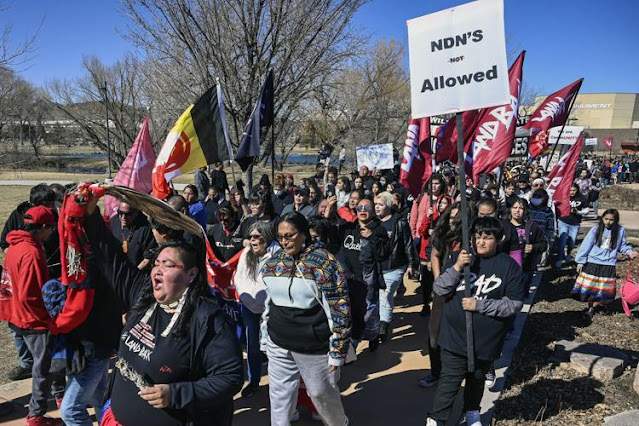
Rapid City hotel owner gets big backlash after banning all Native Americans in the wake of a recent shooting

Hundreds of protesters marched in Rapid City, South Dakota, on March 23, angered at the Grand Gateway Hotel's ban on Native Americans after a recent shooting. (Rapid City Journal photo by Matt Gade)
 A hotel owner in Rapid City, South Dakota, is seeing widespread backlash after barring all Native American customers in the wake of a shooting two weeks ago.

It started March 19 when a Native American teen was seriously injured in a shooting at the Grand Gateway Hotel. The next day, owner Connie Uhre posted on Facebook that Native Americans would no longer be allowed in the hotel or the bar and casino attached to it, Sindhara Bonnet reports for the Rapid City Journal. Native Americans are 10 percent of the city's population.

Within days, the indigenous advocacy group NDN Collective sent two members to attempt to book rooms at the hotel. Both were denied service. The group then filed a federal civil rights class action lawsuit against the Retsel Corp., the hotel's parent company which Uhre owns, saying the company had violated the members' legal rights, Bonnet reports.

Meanwhile, the entire staff of the bar and many of the hotel's employees quit after word got out about the ban, Arielle Zionts reports for South Dakota Public Radio.

Connie Uhre's now-deleted Facebook comments,
as tweeted by Mayor Steve Allender
A little over a week after the shooting, several Sioux tribes collaborated in posting what they called a trespassing notice and a cease-and-desist order on the front window of the hotel. The notice, signed by the leaders of the Oglala Lakota, Cheyenne River, Crow Creek, Rosebud, and Standing Rock Sioux, "states the Great Sioux Nation made an investigation that showed the hotel and Uhre are in violation of the April 29, 1868 Treaty with the Sioux," Bonnet reports. "The notice further states the Great Sioux Nation can, without further notice and liability, take possession, destroy, or remove the property at the owners' expense."

The tribal leaders weren't done. In a statement, they said the tribes "are prepared to boycott the entirety of Rapid City, boycott the hotel and its subsidiaries, pressure the Rapid City Council to revoke the hotel's business license, discuss moving the Lakota Nation Invitational elsewhere, move the Black Hills Pow Wow to another location, file hate-crime charges against the owner, push ordinance tax for mental health, address the open-carry law, create a rating system on businesses to track quality of service to Indians and serve the notice of trespassing," Bonnet reports.

Nick Uhre, Connie Uhre's son and the hotel's manager, told SDPR that the hotel isn't accepting any new bookings right now because they're receiving threats of violence, Zionts reports. Nick Uhre is also in hot water with the public after sending an email out to area hospitality managers alerting them about the shooting, encouraging them to stop paying taxes, and blaming a rise in crime on a MacArthur Foundation-funded program that aims to reduce jail misuse and overuse in Pennington County. His mother responded with an email proposing a ban on all Native Americans since "We do not know the nice ones from the bad natives . . . so we just have to say no to them!!"

Other hoteliers responded to the email chain with horror, calling the email "disgusting" and "racist." Mayor Steve Allender also distanced himself from the Uhres in a tweet, saying that "neither the shooting or Grand Gateway’s response to it reflect our community values." 

Nick Uhre got no warmer a reception after appealing to Gov. Kristi Noem, asking her in an email to remove the mayor from office, Nathan Thompson reports for the Journal. Noem's communications chief said the office can't comment on the issue because of the civil suit, but said Noem "is opposed to all racial discrimination – there is no room for racial discrimination in South Dakota."

Thursday, April 08, 2021

How protests in rural North Carolina county almost 40 years ago brought environmental racism to nation's attention

Protests against dumping carcinogen-contaminated soil in Warren County, North Carolina, in 1982 (Photo by Ricky Stilley)

A long, detailed Washington Post story recounts how protests in a North Carolina farming town in 1982 spurred the first use of the term "environmental racism," an issue that has since gained increasing nationwide attention, more so recently.

"Protests had erupted over North Carolina’s decision to dump 40,000 cubic yards of soil contaminated with cancer-causing chemicals in a poor Black farming community in Warren County, and [Ben] Chavis was a leader of the revolt," Darryl Fears and Brady Dennis report for the Post. When a state trooper pulled Chavis over on a pretext and arrested him, Chavis said, "This is environmental racism."

Warren County, N.C.
(Wikipedia map)
"The term stuck, and now — nearly 40 years after Chavis spoke the words that have come to define decisions by governments and corporations to place toxic pollution in communities of color — the issue has risen from the fringes of the American conservation movement to the heart of President Biden’s environmental agenda," Fears and Dennis report. Biden has made environmental justice a key part of his plans to fight climate change and has named Native Americans and African Americans to key administration and advisory posts. 

"Systemic racism has long influenced where major sources of pollution are located within communities. Beginning in the early 20th century, White government planners in many municipalities drew redlining maps that identified Black and Latino neighborhoods as undesirable and unworthy of housing loans. Heavy industry was permitted to cluster in those places, adding a toxic dimension that persists today," Fears and Dennis report. Today, Black people are much more likely to live near a plant or factory, and almost four times more likely than White people to die from pollution exposure. 

Poverty among Black and Latino Americans is also correlated with poorer Covid-19 outcomes. "More than half of all in-hospital deaths from the start of the U.S. outbreak through July 2020 were of Black and Latino patients, according to researchers at Stanford and Duke universities. Black patients were far more likely to require ventilation," Fears and Dennis report. 

Texas Southern University professor Robert Bullard, who wrote Dumping in Dixie: Race, Class and Environmental Quality, told the Post: "If your ZIP code is buried with garbage, chemical plants, pollution … you’ll find there are more people that are sick, more diabetes and heart disease. . . . Covid is like a heat-seeking missile zeroing in on the most vulnerable communities."

Tuesday, March 02, 2021

Some Republican lawmakers spread misinformation about Capitol riots, coronavirus pandemic

Many Republican lawmakers are spreading false or misleading information about the Jan. 6 Capitol riots and the coronavirus pandemic, highlighting journalists' critical role in keeping the story straight for the public.

"A legion of conservative activists, media personalities and elected officials are seeking to rewrite the story of what happened at the Capitol on Jan. 6, hoping to undermine the clear picture of the attack that has emerged from video and photo evidence, law enforcement officials, journalistic accounts and the testimonials of the rioters themselves: that a pro-Trump mob, mobilized by the former president’s false claims of a stolen election, stormed the seat of American government to keep Trump in power through violent means," Mike DeBonis and Jeremy Barr report for The Washington Post. "Six weeks after the attack, some are taking advantage of fading memories and unanswered questions to portray the riot in a different, more benign light. The effort comes as federal authorities begin prosecuting scores of alleged marauders, congressional committees seek to plug obvious security failures, and lawmakers consider establishing an outside commission to examine the matter."

Sen. Ron Johnson, R-Wis., for example, "spent much of his allotted time reading a firsthand account from Jan. 6 suggesting the violence was perpetrated by a small cadre — including left-wing extremists — who were out of character in an otherwise jovial crowd," DeBonis and Barr report. "The campaign to minimize or deny the events of Jan. 6 has been weeks in the making, with the efforts to muddy the waters about what happened and who participated taking shape on pro-Trump television networks while rioters were still on the grounds of the Capitol." Other popular talking points include casting doubt on whether the rioters were armed and seeking to validate the rioters' motivations.

The misinformation campaign, including widespread attempts from conservative news media and lawmakers to pin the blame on House Speaker Nancy Pelosi, is an attempt to "deflect attention from Trump’s central role in stoking the fundamental motive for the riot — the false claim that the November election was stolen from him," DeBonis and Barr report.

Meanwhile, many Republican state lawmakers are promoting misinformation about the coronavirus pandemic. "In their own comments or by inviting skeptics to testify at legislative hearings, some GOP state lawmakers are using their platform to promote false information about the virus, the steps needed to limit its spread and the vaccines that will pull the nation out of the pandemic," Julie Carr Smyth and Becky Bohrer report for The Associated Press. "In some cases, the misstatements have faced swift backlash, even getting censored online. That’s raised tough questions about how aggressively to combat potentially dangerous misinformation from elected officials or during legislative hearings while protecting free speech and people’s access to government."

Wednesday, February 24, 2021

More than 160 Confederate symbols removed or renamed after racial justice protests, more than in previous 4 years

"More than 160 Confederate symbols were removed from public spaces or renamed last year after the death of George Floyd, more than in the previous four years combined, a watchdog group said on Tuesday," Neil Vigdor and Daniel Victor report for The New York Times. "The Southern Poverty Law Center, which has campaigned for the removal of Confederate statues and monuments, released the findings as part of a report on the status of the symbols."

Widespread racial-justice protests spurred a renewed push to remove Confederate statues from public spaces, redesign flags that incorporated the Confederate battle flag, ban its display, and rename schools or other public buildings named after Confederate figures.

That push stalled in many rural areas of the South due to local sentiment and state historic-preservation laws that make it difficult. But Virginia, which had the highest share of remaining Confederate statues last summer, "led the way in the number of symbols that were removed last year with 71, followed by North Carolina with 24 and then Alabama and Texas with 12 each, the report said," Vigdor and Victor report.

"Still, many remain standing. An NPR investigation found that while some 60 Confederate monuments came down across the U.S. between May and October, localities moved to protect 28 of them during that same period, from Delaware to Florida to Arizona," Rachel Treisman reports for NPR.

Tuesday, January 12, 2021

Police demands for unpublished images of riots at Capitol and elsewhere could put journalists in a difficult position

A door at the U.S. Capitol after Wednesday's riot. Getty Images.
Law enforcement agencies investigating last week's riot at the U.S. Capitol will likely demand that news organizations and individual journalists who covered the event turn over their unpublished photos and videos. That may put journalists in a sticky spot, especially since there is no shield law at the federal level, Poynter Institute senior faculty member Al Tompkins writes. And in states without shield laws, local protests could pose issues for journalists.

National Press Photographers Association General Counsel Mickey Osterreicher said journalists may face backlash for fighting to hold onto unpublished media. The public may not understand why journalists would resist such a demand, but Osterreicher noted that compliance could endanger journalists as a whole. "Police and prosecutors do not get to see our notes or our unpublished work. We do not want to be seen as an arm of law enforcement," he told Tompkins. "It puts journalists in a dangerous position when police wanted to see photos of protestors. It puts journalists in an even more dangerous position than just covering a dangerous story. If protestors think the journalists are creating evidence for the police, protestors target the journalist." That could apply to protests at the state and local level as well.

Still, Osterreicher noted that journalists he's spoken to agree it's important to identify the rioters in order to hold them accountable and to explore allegations that the rioters were infiltrated by left-wing or anarchist organizations. Many news organizations are voluntarily publishing extra images and videos to help others identify rioters, from USA Today to local newsrooms and networks. "Local news organizations and networks have also begun identifying rioters who have local ties," Tompkins reports.

The NPAA board of directors published a memo on Friday asking prosecutors to go after rioters who attacked journalists on Wednesday: "To do our jobs, photojournalists must be on the front lines to record the news. The threats, violence and aggression toward visual journalists are unconscionable acts that erode our democracy and our country’s First Amendment rights."

Monday, January 11, 2021

Local police around the country face heat for attending Capitol protest, riot; hacked Parler data could help ID them

"Police officers and at least one police chief from departments across the United States are facing termination, suspension or other discipline for their proximity to or alleged involvement in a chaotic gathering in Washington on Wednesday that ended in a riot at the U.S. Capitol and left five people dead," Kim Bellware reports for The Washington Post.

Some officers at the protest and/or the riot are from rural areas or small towns. For example, Police Chief David Ellis of Troy, N.H., has been criticized for his presence at the protest, though Ellis has denounced the rioting and treatment of Capitol police, Mia Summerson reports for the Keene Sentinel

Jason Riddle, a former corrections officer and mail carrier from Keene, was also present that day. "Riddle said he went to D.C. to participate in the protest, believing the election had been stolen from Trump. But despite being among those who entered the Capitol, and posting photos on Facebook, he described the violence he witnessed inside as 'chaos,'" Summerson reports. Riddle posted on Facebook that he plans to run for local office soon.

Two off-duty police officers from Rocky Mount, Va., were identified in riot photos, sparking a Black Lives Matter protest Sunday, Luanne Rife, Mike Allen and Karen Dillon report for The Roanoke Times. The officers have been placed on paid administrative leave while their department investigates.

Journalists soon may be able to see whether local law enforcement or other prominent local figures were at the protest or riot, or whether they were advocating violence online. A hacker reportedly archived almost all posts made on Parler Jan. 6, the day of the riot, Dell Cameron reports for Gizmodo. The hacker got virtually all of the content, including posts, deleted posts, the personal information required to register for an account, direct messages, and videos posted by users with GPS coordinates embedded in the data files. That identifies the whereabouts of posters who made the videos.

Protests weren't limited to Washington, D.C.: many protested state and local governments

The protesting and (in some cases) invasion of government offices wasn't limited to Washington, D.C. last week. Protests were held in state capitals across the nation, along with some protests on the local level. A local government meeting in Shasta County, California, was overrun with protesters the day before the Capitol riots. The Shasta County incident sheds a spotlight on the views of many rural residents who didn't make the road trip to Washington, but agreed in principle with many of the Capitol protesters.

"The Shasta County Board of Supervisors had planned to meet virtually Jan. 5 because of an uptick in coronavirus cases. The supervisors’ chambers in Redding were closed. Seats had been removed. The public speakers’ microphone was disabled," Hailey Branson-Potts reports for the Los Angeles Times. "But, in protest, a newly elected supervisor unlocked the doors. In poured dozens of people, unmasked, to vent their fury. Three supervisors attending virtually watched from afar as threats flew amid the speeches."

In rural, northern California, an increasingly conservative region where many want to secede and form a new state called Jefferson, "the kind of anger and distrust of the government that Trump has fomented is on full display," Branson-Potts reports. "In some ways, the rhetoric in that officially closed county government facility carried a hint of the rage that would boil over 2,800 miles away when pro-Trump rioters stormed the U.S. Capitol the next day . . . Among the president’s supporters in Washington last week were men carrying the yellow-and-green State of Jefferson flag with its pair of Xs, called a 'double cross,' that represent a sense of rural abandonment."

Such protests and riots will likely happen again "because some residents believe there is great political utility in making government officials believe that potential violence could become all too real."

"In Shasta County, where Trump beat Biden by 33 percentage points, the supervisors’ meetings have become a prime venue for outrage. Accusations of treason and socialism are commonplace. So, too, is talk of revolution and civil war," Branson-Potts reports. 

"When the ballot box is gone, there is only the cartridge box. You have made bullets expensive. But luckily for you, ropes are reusable," Timothy Fairfield, 44, told the Shasta County supervisors last week. 

Carlos Zapata, who also attended the meeting, told Branson-Potts: "We have to make politicians scared again . . . If politicians do not fear the people they govern, that relationship is broken."

Supervisor Leonard Moty, a former Redding police chief, said local residents have becoming increasingly blatant about threatening government employees since the pandemic began, including announcing the home address of the county health officer: "They politicized the virus. The pandemic. You saw a culmination of it by a president who incited a whole group of people to march to the Capitol and do bad things. I think we have a number of people in this county who follow his voice. Who knows what they will do?"

Thursday, January 07, 2021

Fact-checking what's been said about the Capitol riot

Rumors and misinformation are thick on the ground after yesterday's events at the Capitol (which leadership at The Associated Press says may be called a riot or insurrection). Here's fact-checking:

Before the riot, President Trump held a rally a mile and a half from the Capitol and gave a speech full of falsehoods about election fraud, FactCheck.org reports. Trump falsely claimed that Pennsylvania had 205,000 more ballots than it had voters. But that figure comes from a flawed, partisan analysis based on incomplete and inaccurate data, FactCheck reports. He made numerous other repeatedly debunked false claims about excessive, fraudulent and illegally counted ballots in Pennsylvania, Georgia and Arizona, which you can read about here. Trump also falsely claimed that Vice President Mike Pence could reject Electoral College results.

Trump encouraged his supporters at the rally to walk to the Capitol. The march soon turned destructive, leaving four people dead and forcing members of Congress, staff and journalists to flee as rioters broke windows, ransacked offices, and stole Capitol property.

Here is fact-checking on the siege from PolitiFact:
  • Some commentators and legal experts have called the riot sedition. By federal law, sedition is when two or more people conspire to "overthrow, put down, or to destroy by force the Government of the United States … or to oppose by force the authority thereof, or by force to prevent, hinder, or delay the execution of any law of the United States, or by force to seize, take, or possess any property of the United States contrary to the authority thereof."
  • Some Trump supporters claimed on social media that those who stormed the Capitol were antifa activists in disguise. But there's no evidence of that, and multiple videos and photographs taken on the scene feature well-known Trump supporters such as Jake Angeli. The Washington Post has a full-scale story knocking down that notion.
  • Rep. Matt Gaetz (R-Fla.) said Trump "explicitly called for demonstrations and protests to be peaceful." Trump told his supporters "I know that everyone here will soon be marching over to the Capitol building to peacefully and patriotically make your voices heard." But Trump also said during his speech, "You'll never take back our country with weakness. You have to show strength and you have to be strong. We have come to demand that Congress do the right thing."

Tuesday, October 06, 2020

Rural Black Appalachians push for racial justice

A Hazard, Ky., vigil honored Breonna Taylor's memory after the grand-jury decision in her killing. (Photo by Courtney Kilburn)

"Months after a wave of anti-police brutality and Black Lives Matter demonstrations stretched into rural, largely White areas, the organizing persists in pockets of Central Appalachia. Young and old are sharpening their political voices and strengthening alliances across races," April Simpson reports for Stateline. "Their work, however, serves as an example of the challenges organizers face in pushing for racial justice in areas where people of color are few."

There are relatively few Black residents in Central Appalachia (and younger Black people often leave for the cities when they grow up), so they're often ignored by the mainstream media and white residents. And there are few non-white people in local political leadership. So it can be difficult to talk about racism in a mostly-white community, Simpson reports.

Ierusha Martin, a 65-year-old resident of Middlesboro, Kentucky, said racism is still alive and well in some areas. "We still do the good ol' boy system: not what I know, but who I know," Martin told Simpson. "So that is a terrible disadvantage for African-American people for the simple fact that we were not a part of the good ol' boy system, OK? A person of stature does not give us a recommendation, then we're left out."

Some older Black Appalachians are hesitant to engage in racial-justice work and protests because, after decades of seeing the personal and professional consequences of sticking their necks out, they prefer to keep to themselves and not make waves, one organizer told Simpson.

But progress is happening. In Pennington Gap, Virginia, near Middlesboro, Jill Carson is the vice-mayor, the first Black woman to hold the office. She and her husband lead anti-racism workshops, have created an Appalachian African-American Cultural Center, and are reaching out to local white pastors to encourage them to address racism with their congregations, Simpson reports.

Younger Black Appalachians and white allies have been organizing marches, vigils in memory of Breonna Taylor, and trying to create open dialogue and cross-racial alliances, Simpson reports.

The article is Simpson's last for Stateline. Later this month she will join the Center for Public Integrity, one of the nation's oldest nonprofit newsrooms. "I will miss covering rural issues, but I look forward to building on what I’ve learned to cover my new beat, racial equity," she told The Rural Blog.

Monday, August 31, 2020

Protests heating up across the country; 'heavily armed' crowds clash in Texas town over Confederate statue

Paul Benson, who was attending a July 26 rally for Democratic candidate Hank Gilbert in Tyler, Texas, was attacked by Blue Lives Matter protesters. Benson says he was trying to keep counter-protesters away from the speakers at the rally.
Photo by Sarah A. Miller, Tyler Morning Telegraph, via The Associated Press)

Protests nationwide are becoming increasingly violent, "rattling communities facing a toxic mix of partisanship and guns ahead of the 2020 election," Tim Craig reports for The Washington Post. The demonstrations are mainly about police brutality, and began after the death of George Floyd, but often encompass a wider range of left-versus-right issues such as Confederate statues.

"People on both sides of the United States’ political and cultural divide have been filmed exchanging punches, beating one another with sticks and flagpoles, or standing face-to-face with weapons, often with police appearing to be little more than observers," Craig reports, citing two days in Texas.

On July 25 in Weatherford, pop. 25,250, heavily armed counter-protesters clashed with demonstrators who wanted a Confederate statue removed from the grounds of the iconic Parker County Courthouse, Craig reports. Many counterprotesters were out-of-towners from far-right groups, Weatherford Police Chief Lance Arnold said he believed. He said large crowds are often mobilized online by "fake social media accounts" posting inflammatory and often false information.

"The country’s hostile political climate has challenged local police departments, especially in small towns unaccustomed to dealing with protests and large crowds of people who hold opposing political views," Craig reports. "Police agencies face accusations that they are not doing enough to protect social-justice and anti-brutality protesters."

A video still shows Hank Gilbert campaign manager Ryan Miller getting punched
during a protest in Tyler, Texas. (Photo provided to Tyler Morning Telegraph)
The next day and two and a half hours away, in Tyler, pop. 107,000, Democratic activists held an event meant to register new Democratic voters, promote the campaign of Hank Gilbert (who is battling highly conservative U.S. Rep. Louie Gohmert) and protest the deployment of federal agents to demonstrations, Craig reports. But the rally turned violent after hundreds of conservative counterprotesters, many with military-style rifles, showed up and began pushing and hitting people. Nancy Nichols, 65, said a man punched her in the chest, and said others pinned her husband against the city's war memorial. Two men punched Gilbert's campaign manager, Ryan Miller, several times and allegedly stole his cell phone. A recently released video captured the assault, John Anderson reports for the Tyler Morning Telegraph.

"It seems like we as a country have moved right past the discussion phase of things and now we just are at the stage of conflict, being at odds, distrust and disbelief,” Arnold told Craig. "This is not who we are, and it’s almost like we are living in a different time and a different place."

Thursday, July 23, 2020

Push to remove Confederate statues stalls in rural areas

Map and legend by The Washington Post, enhanced by The Rural Blog; for a larger version, click on the image.
In the wake of protests about racism and police brutality over the past few months, at least 63 Confederate statues nationwide have been taken down by protesters or removed by local officials, but that's mostly happened in liberal, urban areas. Rural communities are far less likely to push for their removal, according to an exclusive tally kept by The Associated Press. For instance, "North Carolina still has at least 69 monuments on public land. Of those, 56 are in counties that voted for President Donald Trump in 2016; 52 are in towns of fewer than 20,000," AP's Rebecca Santana and Jonathan Drew report.

According to the Southern Poverty Law Center, more than 700 Confederate statues remain standing, many in the rural South, with the largest shares in Georgia and Virginia. The AP list shows that 2020 has been one of the busiest years yet for removal of such statues.

"Still, in a sign that the removal movement might be spreading, local governments in several less populous areas of Mississippi, Louisiana and South Carolina have recently approved removals but not yet taken down the monuments," Santana and Drew report.

Laws in some Southern states, counties and communities may make removing the monuments difficult, Bonnie Berkowitz and Adrian Blanco report for The Washington Post.

Thursday, July 16, 2020

Rural Virginia teen holds second Black Lives Matter march after cross burnt in his front yard

Travon Brown (megaphone) led a second Black Lives Matter march through Marion, Va., July 3. (Washington Post photo by Earl Neikirk)
Communities across the nation have seen demonstrations and marches in recent weeks protesting racial injustice and police brutality, and many have been held in small towns. Though news coverage of rural protests has been largely positive, it's worth noting that not all have gone without friction.

Travon Brown, 17, led a Black Lives Matter march on June 13 in Marion, a town of 6,000 in western Virginia near the Tennessee border with a 10 percent Black population. That night, a neighbor burned a cross in his front yard. "When Travon came home the next day, he saw the charred cross in the driveway, surrounded by police tape, and felt both sad and defiant," Michael E. Miller reports for The Washington Post. "When his family had moved to Marion seven years earlier from the majority-Black city of Vicksburg, Miss., he’d been stunned by the Confederate flags on his block and the small noose left on the porch of their house when they moved in. The protests were a chance for Marion to finally change, he felt. Instead, the cross burning showed just how stuck in the past it was."

A white neighbor, James Brown, ran to help when Travon's mother, Briggette Thomas, discovered the burning cross. But on June 26, the police arrested Brown for the crime. Thomas told Miller she was in shock, and said their families had once been close, but had had a falling out about a year ago. Even though Brown confessed quickly, Travon's family was repeatedly harassed in person and online and subjected to false rumors, including one that his mother was a drug dealer.

After the cross-burning, Travon vowed to hold another protest, "but as the day of the second protest drew nearer, the personal attacks gave way to something darker in Facebook groups with names like 'Smyth County Militia' and 'Virginia Patriots Group'" in which some threatened violence, Miller reports.

The July 3 demonstration attracted hundreds of counterprotesters, many from out of town who came armed and with Confederate flags to rally around the town's Confederate monument. Dozens of police officers also came to town in an attempt to preserve the peace. "And at the center of it all was Travon, who in a few short months had gone from preparing for his high school track season to leading the largest civil rights march in Marion in a generation to being targeted with an apparent hate crime," Miller reports.

Travon was nervous about giving his speech to the crowd of about 300, but quickly found his voice, Miller reports. "This is our chance, young people," Travon said. "Y’all complain about the laws? Go change those laws. You don’t have to destroy anything. You don’t have to tear down statues."

During the march, some counterprotesters shouted or chanted insults at the protesters, but at the end of the march, Travon found words that had perhaps a bigger impact on the counterprotesters: "Travon began shouting 'I love you' across the divide, and soon all the protesters were shouting it and the faces opposite them were momentarily quiet and confused," Miller reports.

Tuesday, June 23, 2020

Rural lawyer, 50 years on, offers ideas on police reform

Larry Webster
After 50 years of working as a criminal-law attorney in far Eastern Kentucky, Lexington Herald-Leader columnist Larry Webster offers insight on rural law enforcement and suggestions for what must change, in light of the thousands of recent demonstrations against police brutality and systemic racism.

Some of the best people he's ever known are police officers, but he's also known a few bad eggs, including one officer "who was hell-bent on killing somebody someday, and one day did," Webster writes. "Everybody knew he would kill, but how do you get rid of such a person? I have presented cases to juries of handcuffed old men being beaten in public by uniformed officers, of shootings without cause done by law officers, and have yet to get a single vote from one of those jurors against the police. This enables the occasional policeman who would cross the line. The fact that juries are afraid of the police also means that a very few horrible cops can embarrass the rest by public murder."

Webster suggests two fundamental changes to law enforcement, but warns that they're not quick fixes. "First, police must quit honoring their unwritten code of silence by which it assumed that one policeman will not tell on another. That is dishonorable and should be taught as such. That code instantly makes any bystanding cop an accomplice to a crime being committed by another policeperson," Webster writes. "Secondly, they have got to quit arresting people for piddly stuff."

Friday, June 19, 2020

Confederate monuments are coming down, but more than 700 remain, and removing them may be legally tricky

Map and legend by The Washington Post, enhanced by The Rural Blog; for a larger version, click on it.
More than 70 of the nation’s Confederate monuments have been removed since the 2015 shooting in Charleston, S.C.—some by local governments and some by protesters—and almost a third of them have come down in the weeks since George Floyd’s death. But around 700 monuments remain, “along with hundreds of names on roads, schools, parks and the like,” Bonnie Berkowitz and Adrian Blanco report for The Washington Post.

Georgia and Virginia have the largest share of remaining monuments, with more than 100 each. Many were built decades after the Civil War, even outside Confederate states, as a show of support for Jim Crow laws, and at least 35 new monuments have been dedicated since 2000. Though the monuments have attracted debate and legal issues for decades, the recent spike in attention has prompted many city leaders to remove the monuments, Berkowitz and Blanco report.

However, “laws in some states make removing Confederate symbols extremely difficult, including in South Carolina, where a law written in 2000 requires two-thirds of legislators have to approve any removal,” Berkowitz and Blanco report. “An Alabama law restricting Confederate removals was enacted in 2017, and it is unclear whether or how the recent removals square with it.”

In his first story as a New York Times reporting fellow, rural reporter Will Wright looks at the problem of where to take Confederate monuments that local governments no longer want.

Thursday, June 18, 2020

'Militias' push back against some rural anti-racism protests with intimidation, threats and maybe help of police

"The demonstrations against racial injustice and police brutality that have convulsed major metropolitan areas, from Minneapolis to Miami, have also made their way into small-town America, redrawing the geography of the Black Lives Matter movement," Isaac Stanley-Becker reports for The Washington Post. "But the activists spearheading unlikely assemblies in rural and conservative corners of the country have faced fierce online backlash and armed intimidation, which in some places is unfolding with the apparent support of local law enforcement."

The notion of rural protests might shake up the popular image of rural America as a conservative, white monolith, but about 21 percent of the rural U.S. is non-white, and many small-town residents are liberal, especially the younger ones, April Simpson reports for Stateline.

"Over 3,000 towns have held some form of protest, an explosion of political expression with far-reaching consequences," John W. Miller reports for The Daily Yonder. "Remarkably, they’re breaking out in counties Donald Trump carried by over 40 points and attracting explicit support from liberals and Trump supporters."

Some people Miller interviewed said they believed the protests are gaining popularity because of the brutality of Minneapolis resident George Floyd's death at the hands of the police, and because of the bipartisan spirit of the protests.

Many rural protests have not seen overt intimidation or had any trouble with local law enforcement. Chris Dyson, 21, organized recent peaceful protests in downtown Punxsutawney, Pa., pop. 5,800—the first such protests in the town famous for its Groundhog Day tradition, Miller reports. There was some backlash online, someone used the n-word, and one threw a beer can, but that's about it.

Punxsutawney Police Chief Matt Conrad, 33, said he's agreed to meet with Dyson to talk about ways to improve racial tolerance in town, and said he stopped by every day to talk to the protesters. "I left an olive branch for us to create something together," Conrad told Miller. "There’s enough division in this country."

Friday, June 12, 2020

Editor/publisher of small Missouri paper steps down after running cartoon he acknowledges as 'racially insensitive'

William Miller was 87 when he accepted the Eugene Cervi Award
from the International Society of Weekly Newspaper Editors at
the University of Maryland on July 1, 2017. (Photo by Al Cross)
William Miller Sr., longtime editor and publisher of the weekly Washington Missourian, stepped down after 67 years on Wednesday after the outrage following his decision to run a syndicated cartoon he now acknowledges is "racially insensitive." Washington, pop. 13,892, is just west of St. Louis, in Franklin County.

Michael Cavna of The Washington Post writes: "In the cartoon, by Tom Stiglich of Creators Syndicate, a light-skinned woman screams, 'Help!! Somebody call 911!' A darker-skinned man who is attempting to snatch her purse says: 'Good luck with that, lady. … We defunded the police,' a reference to a proposal that some activists have put forward to reform law enforcement."

After the cartoon ran, two of Miller's daughters, Missourian co-owners and editorial staff members Susan Miller Warden and Jeanne Miller Wood, published a message apologizing to readers. Warden and Wood said they had no knowledge that the cartoon would be published and said they were "just as outraged and horrified" as the staff and community. Both resigned in protest that day, Sarah Teague reports for the St. Louis Post-Dispatch.

Miller published a post later that day apologizing for "poor judgment" and saying he had intended only to highlight his opinion that "defunding police departments in the aftermath of George Floyd’s senseless killing is not the answer to resolving the racial inequities and injustices that have occurred in policing in this country." Miller promised the paper would no longer run cartoons by Stiglich.

At some point that day, Miller resigned. The next day, the Missourian announced that a third daughter, Tricia Miller, was the paper's new interim editor and publisher. She recently retired as publisher of the St. Louis Business Journal after 33 years with that publication.

Monday, June 08, 2020

Racial justice protests happening in rural areas too

Chad Jones of Holland, Ark. (photo provided)
Thousands of communities, some in foreign countries, have held demonstrations over the past week to protest the deaths of George Floyd, Breonna Taylor, and other people of color at the hands of law enforcement, as well as general racial and ethnic inequality. But such protests aren't limited to big cities: some are happening in small towns.

Some are college towns, like State College, Pa., and Morehead, Ky.; such communities tend to have younger and more liberal residents, Alisha Ebrahimji reports for CNN. Others are smaller, agrarian communities like Holland, Ark., pop. 552. Local farmer Chad Jones staged a one-man protest recently because he wanted to show that "not all small towns come with small minds."

"Demonstrators marched and chanted for racial justice in Corbin, Morehead, Barbourville, Richmond and many more Kentucky cities and towns," the Lexington Herald-Leader reports. Corbin had "a notorious incident in October 1919 in which a white mob forced scores of black people out of town." In Midway, between Lexington and Frankfort, dozens of locals drew anti-racism messages on sidewalks Saturday, the Midway Messenger reports.

Hundreds of residents in small, politically conservative towns in southern Illinois have protested in recent days. As one protester said: "We don’t want Franklin County to be known for its racism. This is more about bringing the community together more than anything else," Molly Parker reports for The Southern Illinoisian.

In Ontario, Oregon, pop. 11,366, hundreds came out for a protest Thursday where local educators, organizers, and government officials gave speeches and shared stories about their experiences with ethnic and gender inequality, Rachel Parsons reports for the Malheur Enterprise.

Tuesday, June 02, 2020

76 journalists attacked covering riots, mostly by police, according to database that tracks threats to journalists

"At least 19 journalists have been arrested, 36 journalists shot at by police with projectiles, and 76 journalists have been assaulted during the period of May 28 through 31 while covering protests throughout the US," Justin Boggs reports for Scripps. "Of the 76 reported assaults on journalists, 80% were by police, either through physical encounters or being shot at" with non-lethal rounds.

The figures have been compiled by U.S. Freedom Tracker, which maintains a database of threats to the news media's right to report. That includes physical attacks, damage to equipment, denials of access, subpoenas or legal orders, arrests, and "chilling statements". Though most of the threats and violence against journalists covering the riots has been urban, the database is one to watch, and often lists rural journalists.

"The group said on Monday that it generally documents 100 to 150 'press freedom violations' per year in the US. In just four days, that number is well over 100," Boggs reports. That figure could increase in coming days as the group investigates other incidents.