Showing posts with label printing. Show all posts

Friday, July 18, 2025

Quick hits: Visit the last linotype machine newspaper; 'app store accountability' law; memoir celebrates snail mail delivery; small town battle over Buc-ee's


While other papers have transitioned to computer technology, the Saguache Crescent remains the country's last linotype machine newspaper, reports Jared Ewy for The Daily Yonder. While other newspapers use keyboards, this small-town Colorado paper continues to use heat and metal to produce the news, just as it has since 1882. "News outlets from around the world have come to visit and pay tribute to the century-old linotype machine," Ewy reports. "At the Crescent, a keystroke sends us through time and into an America dominated by heavy, hot industry. When even the words were made of molten labor. Letters and characters are hammered with Steampunk gusto on different-sized mattes and assembled into information."

In a bid to protect minors from downloading apps with questionable content, Louisiana became the third state "to pass what it described as an 'app store accountability' law, joining Texas and Utah in instituting such legislation," reports Christ Teale of Route Fifty. The bill requires app stores conducting business in Louisiana to "identify when users are children and obtain parental consent before apps can be downloaded." Louisiana's law also requires app stores to include age-appropriate ratings and "prevents them from enforcing terms of service on minor users without parental consent."

The U.S. Postal Service and its brave mail carriers helped shape the nation, and some would contend, it's part of the glue still holding the country together. "The Postal Service is America’s first miracle and among its most endangered, threatened by private delivery services, email, texting and the pensions owed to retired carriers," writes David Von Drehle for The Washington Post. "Memoirist Stephen Starring Grant offers a highly personal, utterly charming tribute to this American treasure in his new book, Mailman. . . .The Postal Service, he convincingly argues, is far from outdated; it is the embodiment of an indivisible nation."

A drama pitting anti-sprawl conservation against a beaver-booming, mega-gas station continues to unfold in the small western town of Palmer Lake, Colorado. "Emotions have boiled over in Palmer Lake since the Texas-based Buc-ee’s chain — featuring a grinning beaver mascot — targeted undeveloped land along Interstate 25 for a new outlet: a 74,000-square-foot store with 60 gas pumps and parking for nearly 800 cars, open 24 hours a day," reports Jim Carlton of The Wall Street Journal. "It has become an epic battle over the soul of the American West — and it has descended into accusations of harassment, slashed tires, crude name-calling and vicious private texts made public."

Thousands of American children have type 1 diabetes, which, when treated, can mean a lifetime of carrying equipment and a list of activity restrictions that can make kids feel self-conscious. To help ease some of those challenges, Mattel released a Barbie with the disease. "The latest Barbie slays in a chic blue polka-dot crop top, ruffled miniskirt, chunky heels and an insulin pump. She is the brand’s first doll with type 1 diabetes," reports Brenda Goodman of CNN News. "Dollmaker Mattel worked with Breakthrough T1D, formerly known as the Juvenile Diabetes Research Foundation, to design the doll, which aims to represent the roughly 304,000 kids and teens living with type 1 diabetes in the United States . . . . The new Barbie comes with an insulin pump, a glucose monitor and snacks to help her control her blood sugar."

With all the business of life, it's still important to take time to look up and see what going on in our skies. On the mornings of July 21 and 22, the Moon, Venus and Jupiter will provide a beautiful scene "with the crescent Moon and Venus, plus several bright stars. And if you have a clear view toward the horizon, Jupiter is there too, low in the sky," writes Preston Dyches for NASA. During the entire month of July, the Eagle constellation, Aquila, "appears in the eastern part of the sky during the first half of the night. Its brightest star, Altair, is the southernmost star in the Summer Triangle, which is an easy-to-locate star pattern in Northern Hemisphere summer skies."


Thursday, August 31, 2023

News-media roundup: Family owners cry foul as Alden firm buys Scranton-area papers; Gulban buys Delphos group

MediaNews Group, owned by Alden Global Capital, has bought four newspapers in and around Scranton, Pennsylvania, and the family owners of the paper, minority stockholders, don't like it. Times-Shamrock Communications is selling the Scranton Times-Tribune, The Citizens' Voice in Wilkes-Barre, The Republican Herald in Pottsville, The Standard-Speaker in Hazleton, and several less-than-daily papers and pressrooms. The sale does not include the firm's radio or billboard operations, or its building. "The family that started Times-Shamrock—the Lynetts—have been producing newspapers since 1895 in Scranton," WNEP reports, along with a blistering statement from family members:

". . . Alden does not reflect the business principles we feel are consistent with the stewardship of any newspaper. The sale was driven by a majority of our shareholders. We understand the fears about our ability to remain competitive. We recognize the underlying concerns about the newspaper industry’s revenue and audience declines, and the desire of many of the shareholders to leave the painful decisions to cut costs, coverage and employees in someone else’s hands. We remained confident and hopeful that our current board of directors and management team would have been able to lead us through the industry’s headwinds more effectively and humanely than a hedge fund like Alden. The willingness to sell a company steeped in integrity and family tradition—and staffed by loyal, bright, compassionate employees—to a company with such a devastating reputation in the industry runs against everything we believe in. . . . A newspaper is much more than just a business. It is the only business explicitly protected by the Constitution. It is a local institution and expected to track government spending, keep an eye on politicians, advocate for the voiceless, ask tough questions, cover local sports and businesses, and record the milestones in readers’ lives. Newspapers ... are the only true local watchdog with a large newsroom and resources capable of providing in-depth, verified news and investigative reporting on a large scale in any community. Most family newspaper sale announcements bear some variation of stock language regarding the new owner's ability to ... 'continue to provide strong local reporting' and "maintain the legacy' of the selling family. Sadly, we feel that none of that will be true in our case."

A much more amicable sale: Delphos Herald Inc., one of the older family-owned newspaper chains, has sold its eight papers in Ohio and Indiana and its commercial printing plant to CherryRoad Media. Six of the papers are in northwest Ohio and are based in Delphos: the Delphos Herald, the Van Wert Times Bulletin, the Putnam County Sentinel, the Putnam County Vidette the Paulding Progress and the Ada Herald. Also sold were the Monroe County Beacon, a stand-alone weekly in Woodsfield, Ohio, and the Register of Lawrenceburg, Indiana, in the state's southeast corner. Company President Roberta Cohen said her father, Murray Cohen, who died in December 2021, started the chain in 1962: "I can entrust our long-held newspapers to a company that shares the same vision and values that my sister Jennifer Shneiderman and I have and that my father had." CherryRoad owner Jeremy Gulban said he would keep the printing plant, his second bought in short order: "While the newspaper industry looks to embrace the digital future, we realize there is a need to keep printing newspapers."

Thursday, February 09, 2023

A photographer searches for democracy in rural America and tries to tell us 'what's lost when newspapers close'

Former home of the newspaper in Dodge City, Kansas (Photos by Jonathan Ariaz,, Fourth Estate project)
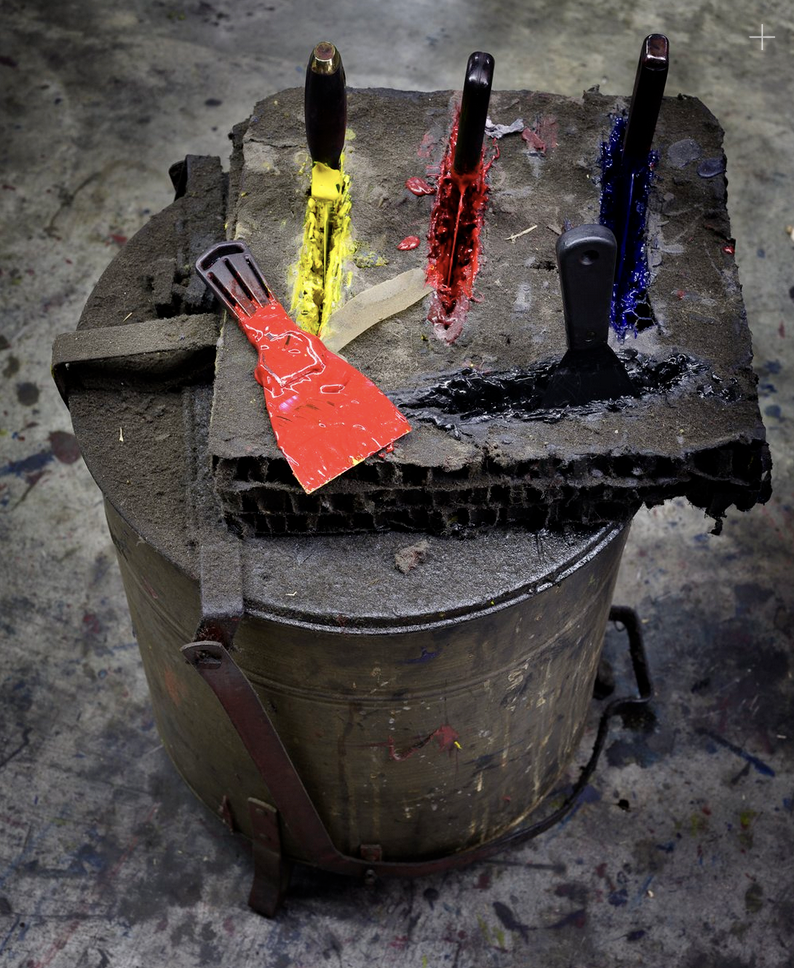
Ink knives at the Russell County News, Russell, Kan.
In the United States, credible news sources, such as newspapers, function to safeguard democracy by: promoting inclusion and participation, informing the electorate, supporting basic rights and helping citizens manage the agenda. Within that framework, it makes sense that "Leading up to the 2020 presidential election, photographer Jeremiah Ariaz, who wanted to make images that showed what democracy looked like in rural America traveled across the country . . . . visiting campaign offices, main streets, protest sites and sometimes, newspapers," reports Kristen Hare of The Poynter Institute, a nonprofit that supports media literacy and journalism ethics.

Ariaz's first stop was "Main Street in Sublette, Kansas. He was standing with his camera and tripod when a man approached him, asked what he was doing, and invited the photographer to stop by his office," Hare writes. "The man thought he had something Ariaz might be interested in." Ariaz told Hare, “It ended up being the local newspaper office.”

Hare writes: "Kenneth Bell showed Ariaz the newspaper’s archives and the newsroom’s abandoned darkroom. Immediately, Ariaz realized how what he was seeing in the Haskell County Monitor-Chief tied in with the bigger questions he had about democracy and rural America. . . . In 2022, Ariaz took a sabbatical from his full-time job as a professor of art and headed back to his native Kansas. He visited 115 newspapers – closed, moved and still publishing."

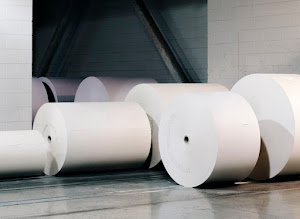
Paper rolls at The Morning Sun, Pittsburg, Kansas
Ariaz's tour helped him track and illustrate the history of local newspapers. Noting that the U.S. is losing about two newspapers a week, Hare writes, "While we’ve seen growth in some of the local for-and nonprofit online newsrooms working to fill the gaps left when newspapers close, Ariaz’s project, titled Fourth Estate, offers a different frame for what’s lost when newspapers close."

“I have to feel that something is missing when that ability for a citizen to engage is lost,” Ariaz told Hare. Newspapers that were still alive "were very much a part of the community in both the physical way in their presence but also their ability to engage with the public."

Ariaz's traveled to "publications that were still open and explained what he was trying to capture. Most invited him in. Many worried about what would happen to their archives and the community’s history if they closed," Hare writes. "Ariaz tried to visit bigger newspapers in bigger Kansas towns, but he couldn’t get ahold of anyone inside the newsrooms or inside the buildings themselves. Ariaz said that it felt like the people who own and run them were far away and unconcerned with the communities they were supposed to be serving." In many cases his photos reflect the fact that the newspapers no longer have pressrooms but hang on to their relics.

Friday, November 04, 2022

Newspapers are in a battle for the truth and they must innovate to win it, weekly publisher says in accepting award

Chris Evans of The Crittenden Press in Marion, Ky., spoke after receiving the Al Smith Award for public service through community journalism by Kentuckians, which he shared with his wife, Allison Mick-Evans. They own the weekly newspaper in Crittenden County, pop. 9,000. (Photo by Yung Soo Kim, University of Kentucky School of Journalism and Media)

The loss of community newspapers "has left our country ripe for an invasion of mistruth," and the remaining newspapers must adapt to the digital age to survive, an innovative weekly editor-publisher told an audience of journalists and their supporters Thursday night in Lexington, Ky.

Chris Evans and his wife, Allison Mick-Evans, of The Crittenden Press in Marion, Ky., received the Al Smith Award for public service through community journalism from the Institute for Rural Journalism and Community Issues (publisher of The Rural Blog) and the Bluegrass Chapter of the Society of Professional Journalists. The award citation mentions that the Press was an early adopter of online journalism and uses it frequently to serve Crittenden County, pop. 9,000.

Evans recalled a statement attributed to World War II Japanese Admiral Isoroku Yamamoto: "You cannot invade [the] mainland United States. There would be a rifle behind every blade of grass."

"We are losing community newspapers, one blade of grass at a time," Evans said. "Losing those town criers has left our country ripe for an invasion of mistruth. Study after study has found that the most trusted media are local.  . . . Forces that are eroding national trust in media can be blamed on two things. One if that blurred line between commentary and news, and No. 2 is that there is a decline in rural journalism. Myths are finding a foothold in our society because there isn't a journalist in every county and every parish in the country. There's not a journalist behind every blade of grass.

"Friends, we are being disarmed by a natural ally: the Information Age. In days gone by, we were a nation of small-town newspapers: trusted local sources of information that helped debunk lies and exaggerations. Part of the reason The Big Lie and fake news prevail is our society today is because we have lost the voice of truth, the voice behind every blade of grass. Well-trained journalists who made mom-and-pop ink one of the strongest collective corporations in America are fading. They're fading from our Main Streets, our courthouses and from our city halls. A newspaper in every town was the underpinning of America's First Amendment and the freedom of information. An armed journalist behind every bush is the caretaker of truth."

Evans quoted from the Gospel according to Luke: "To those whom much is given, much is expected." He wears the quote on his wrist.

"As journalists we have been given the keys to a powerful platform," he said. "Our industry, our presentation of the truth, is deeply rooted in American culture, but it is changing. The trust we have given must not be taken for granted. Much is expected of us, and we have an obligation to see that it long endures. Our power rests on our ability to innovate and persevere. To do that, we are going to have to morph into something a bit different. . . . The internet has given us a new, less expensive mode of delivery. Now, I am not proposing that we all stop our presses today, but we have to embrace the future. We cannot be too stubborn or too proud. Honestly, the same innovation that has bloodied our noses can be repackaged and deployed as community news. . . . We're reluctant to admit the truth because we have always printed newspapers. . . . We just have to convince ourselves and our advertisers to go with us. We do not need to convince our readers. They're already there. 

"As the town crier, we've got to have the loudest voice, but right now we're being muffled by social media. We have to create our own platform, pool our resources and figure out whether it's an app or a network or something else, but our model must change. I don't know that anyone in the newspaper industry has really figured out how to make that move. . . . If we don't find a way to change our model . . . we're going to die. . . . We must keep community-based reporting behind every blade of grass, or we are going to lose that war on truth. We have to do it with reporting, podcasting, webcasting, livestreams or whatever else we can package as trusted content and sell it. . . . We are simply going down with the ship rather than getting on a lifeboat that exists right before our eyes."

Noting that he has coached over 40 years, Evans said a coach has to ask before a game, "What will I do in the heat of the moment when what I am doing is not working? We have to be able to adapt. To be a winner you must have a plan and a backup plan. . . .What is your plan? I'd like to know. What's our plan? My question and my challenge to all of us in the business of community journalism is this: Are we going to keep making buggy whips or are we going to analyze, adapt and overcome? How do we keep a reporter behind each blade of grass? I welcome your input, because I want to know what people are thinking. We are all in this together, and together we can find a way forward."

Thursday, November 03, 2022

News-media roundup: 3 top Ala. papers to go all-digital; Gannett loses money again, but digital gains drive stock up

"One of the nation’s biggest publishers has decided to stop printing Alabama’s three largest newspapers and make them digital-only," reports Alexandra Bruell of The Wall Street Journal. She calls it "the latest in a long string of local paper closures," but the Birmingham News, the Huntsville Times and the Press-Register of Mobile aren't closing, only ending their print operations. They are owned by Advance Publications, a 24-paper chain that aggressively cut back printing of the Times-Picayune in New Orleans. Its main identity is NOLA.com, and the Alabama papers are branded AL.com. "The company will keep publishing individual e-editions for each paper that will still charge subscribers," Bruell reports. "AL.com doesn’t have a paywall."

The company "doesn’t plan to stop producing printed newspapers in its other regions next year, said Caroline Harrison, CEO of Advance Local. She didn’t rule out the possibility in the future," Bruell reports. "The organization also owns newspapers in other areas including Oregon, New Jersey and New York." Harrison said, “Where print continues to be profitable we’re all in.”

Tom Bates, president of the Alabama division told Bruell, “The print side of our business does not make economic sense in Alabama.” Bruell notes, "The print readership of all three papers has been shrinking rapidly, according to the Alliance for Audited Media. Their expected combined circulation of about 30,000 early next year is a fraction of the 260,000 the papers boasted just a decade ago, Mr. Bates said." He said Advance has no plans to lay off journalists. The printing operation has 110 employees, including 74 employees in production and 36 people in sales, operations and circulation.

Gannett Co., the nation's largest newspaper publisher, lost money for the second straight quarter, it said in a quarterly earnings report this morning. The firm "reported a net loss of $54.1 million in the three months ending Sept. 30, compared with net income of $14.7 million in the same period a year earlier. The company expects a total net loss of $60 million to $70 million this year, an outlook it had forecast previously," reports USA Today, its flagship. "The latest results come after a 'challenging' second quarter, which was followed by Gannett laying off roughly 400 employees, or 3% of its U.S. workforce, to trim costs."

Despite losing money after forecasting a profit, Gannett's stock rose this morning because it reported record digital marketing revenue, Seeking Alpha reports. It had risen 11.5% by midday, Poynter reports. The company's digital marketing solutions core platform revenue was $118.7M, "up 5.3% year-over-year, SA reports. "Digital-only paid subscribers rose 28.5% to 1.98M at the end of Q3 2022. Average revenue per user reached $2,511 during the quarter."

Newspaper sales: Ohio's AIM Media Midwest has bought The Bryan Times and the Northwest Signal, both dailies, from Christopher Cullis and Bryan Publishing. AIM said it had re-hired all current employees and promoted president Sally Heaston to publisher, a news release said.

Cherry Road Media, which has built itself largely on buying Gannett papers, has bought the Star-News of McCall, Idaho. The company now owns 79 papers in 14 states. The Star-News was owned for almost 50 years by Central Idaho Publishing, a partnership of  Tom and Tomi Grote of McCall and A.L. "Butch" Alford Jr. of Lewiston, who is senior publisher/editor of Tribune Publishing Co., which owns The Lewiston Morning Tribune and the Moscow-Pullman Daily News, among other assets, a release said.

Wednesday, March 09, 2022

Trucker shortage and Canadian blockade threaten newsprint supply, especially for smaller, rural newspapers

Newsprint rolls (Photo by David Kasnic, The Washington Post)

"A shortage of truckers and blockade bottlenecks have put a crimp on newsprint deliveries to the nation’s newspapers," Buck Ryan, associate professor of journalism at the University of Kentucky, reports for The Rural Blog.

“The newsprint situation is severe,” Brett Wesner, chair of the National Newspaper Association and publisher of 15 titles in Oklahoma, Texas and New Mexico, told Ryan.

The crunch appears to come from a backlog caused by the blockade by Canadian truckers to protest pandemic restrictions.

“There are too few trucks and truck drivers in the market, so deliveries to newspaper printers are often delayed or unpredictable,” Tony Smithson, a regional director of printing operations for Adams Publishing Group, a major community newspaper company, said on his NNA blog in December.

This week, Smithson told Ryan, “One supplier recently told us that they had lined up only 76 trucks and drivers for the 872 loads they had planned to ship. That illustrates the scope of the challenge.”

Most U.S. newsprint comes from Canada, so the backlog was worsened by Canadian truckers' blockage to protest pandemic restrictions, said Kentucky Press Association Executive Director David Thompson, North America's longest-tenured newspaper-association executive: “The Canadian truck convoy was part of the problem for a while, but there is just a shortage of truckers right now.”

Southeastern Kentucky publisher Jay Nolan worried this week that he wouldn't have newsprint for the 14 papers, eight of them his own, that print at his London plant. “Just got word our paper truck is now scheduled to arrive March 14. That’s three days before disaster of having zero paper in stock,” he wrote Tuesday. “Worst supply situation I’ve seen in my 40 years in the industry.”

Nolan said small, rural papers are more threatened by the shortage because most of their printers are independently owned "or have newsprint agreements with only one or two mills," not the cooperative. "Some have limited storage capacity. As the paper market gets tighter, trucking delays make just-in-time delivery more problematic." He listed several contributing factors for the shortage, including:

  • A decline in demand for newsprint caused mills to close or convert their machines to other types of paper. The pandemic further crushed demand as newspapers closed.
  • With fewer mills making newsprint, producers are running near capacity.
  • As the pandemic rose, Covid-19 diminished the ability of providers to fully staff remaining producing plants: “Classic supply/demand/production bottleneck.”
  • Increased regulations have dramatically raised requirements and training for someone to get a Class A commercial driver's license, causing a national shortage of truck drivers. Gasoline price increases have hurt the trucking industry even further.
  • Delays in getting produced paper picked up for shipment has filled mill warehouses and shipping docks to a saturation point.

Nolan is not optimistic the situation will improve soon. “Recently, I was told lack of storage capacity is now hampering production,” he said. “Also, mills are running at such high capacity level, maintenance is curtailed. Now, any breakdown of machinery pushed too hard stops production.”

For Ryan's full story, click here.