Showing posts with label California. Show all posts

Tuesday, May 12, 2026

Flora & Fauna: Wildlife and people agree on best mating sounds; eat your oats; 5.6 million bees found underground

Male zebra finch calls attract mates. Female zebra finches and human study participants
agreed on which males had the best calls. (Photo by Raina Fan via The Conversation)

When researchers compared which animal sounds, such as bird calls, frog croaks or cricket chirps, wildlife seemed to like best alongside which ones people preferred, 
the "results were striking," writes animal behavior expert Logan S. James for The Conversation. "Across our dataset, including animals separated from human beings by hundreds of millions of years of evolution, people tended to agree with the animals about which sound was more pleasant. . . . People particularly agreed with animals when it came to what researchers call 'adornments': the extra trills, chucks, clicks and flourishes that animals can add to their calls. These sounds were more appealing to both animal and human listeners alike." 

When a snow avalanche pummels an outdoor recreationist's spot, there's little people can do to find those buried under heavy piles of snow. That's when avalanche dogs are called to the scene. "Dogs play an essential role when an avalanche strikes," reports Christine Chung of The New York Times. "Their powerful noses help guide rescuers to people buried in the snow, saving critical moments that can mean life or death." Potential avalanche dogs are chosen for a very specific set of interests, skills and breed stamina, and their training starts when they're just a few months old. For avalanche dog handlers, training takes years. Click here to read about "Baggs," a golden retriever puppy from Wyoming who was once the runt of her litter. She's now a rockstar avalanche-dog-in-training.

Beta-glucan is what makes oats especially 
healthy. (Photo by Roman Matveev, Unsplash)

Among all the whole grains commonly eaten, oats may offer the most benefits. "Many studies have found that oats lower LDL cholesterol, or the 'bad' cholesterol that increases your risk of heart attack and stroke," reports Simar Bajaj of The New York Times. "Much of this effect comes from beta-glucan, a type of fiber that thickens the contents inside the gut, trapping cholesterol-rich bile acids and carrying them out of the body." Oat fiber also helps people maintain normal blood sugar levels, which "can be particularly beneficial for people with Type 2 diabetes."

What's not to like about bitter greens? For many people, pretty much everything, because bitter and astringent foods taste gross. But humans didn't always avoid bitter fruits and vegetables; in fact, they were once a regular part of our ancestors' diet. "Much of the produce on grocery store shelves has grown mild or sweet in flavor, designed to appeal to a mass consumer palate," reports Joti Heir of Offrange. "That sits in high contrast to the complex tastes of wild, ancestral crops." Emerging food science reveals how bitter foods contain "compounds that provide a small challenge to the brain, and with that, activate neural pathways that result in enhanced cognition." There's even research "showing the potential of using bitter compounds to treat Alzheimer’s Disease."

Rebounding salmon populations along the Golden Coast are good news for commercial fishing operations and seafood lovers. "Federal fishery managers voted to open waters off the coast of California to commercial salmon fishing for the first time since 2022," reports Sophie Austine of The Associated Press. More recent drought-ending wet winters have helped salmon populations recover. "The federal council has said forecasts for Chinook and coho salmon off the West Coast look promising this year, though the season will open with some restrictions."


Miner bees are important pollinators that live in 
underground nests. (Photo by C. Lewallen via USFS)
Bees are commonly known for their constant busyness and for living in outdoor hives. But in fact, 70% of native bees don't live in outdoor hives; they live in underground nests. Researchers recently discovered 5.6 million burrowing bees "revealing just how abundant some understudied pollinators are," reports Margherita Bassi for Smithsonian magazine. "The team estimated that in 2023, between 3.1 million and 8 million of the bees emerged from the ground in the Ithaca cemetery, with the average estimate being 5.56 million. For comparison, Manhattan’s population is about 1.7 million people." 

Friday, May 01, 2026

A 10-year solar project in California aims to 'harvest the sun'


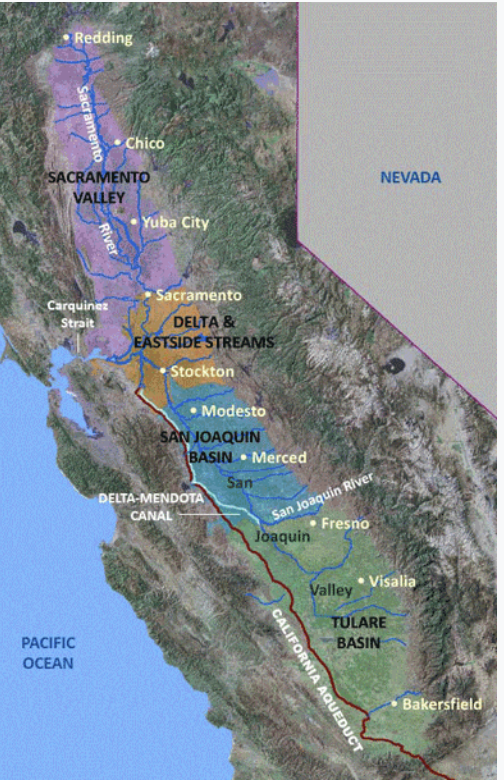
The Valley Clean Infrastructure Plan delivers economic value to growers, 
local governments and residents. (Map by Binh Nguyen, Canary Media )

Directors of the largest agricultural water agency in the U.S. are creating a plan to save California farmland from a decades-long water crisis, reports Jeff St. John for Canary Media.

The Valley Clean Infrastructure Plan will transform 136,000 acres of farmland that's no longer irrigable into 21 gigawatts of battery-back solar power, enough to power nine million houses, St. John explains.

The planned build will be the largest project not just in California or the U.S., but in the world, said Jeff Fortune, a third-generation farmer and the board president of the Westlands Water District.

The plans were approved in December, and the project may take 10 years or more, St. John reports. 

"The way we look at it is a new crop," a fifth-generation farmer and another director of the district, Jeremy Hughes, told St. John. "We're harvesting the sun and producing electricity."

In the next 20 years, the state will require four to five times as much new clean energy as the project will provide, according to another director, Ross Franson. 

Tuesday, December 02, 2025

A rural hospital in California closes after federal officials strip 'critical access' designation it has held since 2000

Glenn Medical Center in Willows, California 
(Glenn Medical Center photo)
After more than 70 years of serving its rural community in Willows, California, Glenn Medical Center closed its doors following the loss of its "critical access" designation, which had allowed the hospital to receive higher federal reimbursements that helped it remain open.

To qualify as a "critical access" hospital, a medical center needs to be at least 35 miles from the next closest hospital. Glenn Medical Center was 32 miles from "the nearest neighboring hospital under a route mapped by federal officials," reports Jessica Garrison of the L.A. Times. "Though that distance hasn’t changed, the federal government has now decided to enforce its rules." The hospital was awarded its critical access status in 2000.

The loss of Glenn Medical Center leaves the surrounding farming community without emergency care, "eliminates 150 jobs and puts rural residents at risk of preventable deaths," Garrison writes.

Rural hospitals across the state are already at risk of closure. Peggy Wheeler, vice president of policy of the California Hospital Association, told Garrison, "It’s like the beginning of a tidal wave. I’m concerned we will lose several rural hospitals, and then the whole system may be at risk.”

Before Glenn Medical Center's designation was stripped, Glenn County officials and hospital administrators worked for months to persuade federal officials to grant an exception.

Now that the hospital is closed, many community members fear what will happen to older residents in need of immediate care, injured farm workers or victims of car accidents along nearby Interstate 5. Glenn County Supervisor Monica Rossman told Garrison, "People are going to die."

Tuesday, June 17, 2025

U.S. Forest Service chief says it is ready for fire season; some staff disagree

USFS Chief Tom Schultz talk with Region 4 employees in Utah.
 (USFS photo via Route Fifty)
Despite shedding 5,000 employees in early 2025, the United States Forest Service leadership feels sufficiently staffed for this year's wildfire season, which started near the beginning of June, peaks in mid-summer and trickles down in late October. "USFS says it’s ready for fire season after asking separated employees to come back," reports Eric Katz for Route Fifty. "But employees say the losses have been 'crippling.'"

U.S. Forest Service Chief Tom Schultz admitted that staffing cuts and retirements had left shortages "though he said efforts to bring some of those employees back to work and shift others around to fill 'critical positions' will ensure its readiness," Katz explains. At a Senate Appropriations Committee meeting, Schultz reassured lawmakers that USFS is prepared.

While 2025 USFS staffing levels for firefighters and some deployment teams are comparable to those from 2024, they are just two parts of the operation. An entire team of fire experts, or "red card" holders, support firefighters behind the scenes, and both firefighters and red card holders "depend on support personnel who have left the agency in large numbers," Katz reports. USFS employees who actively fight fires rely on support staff for paychecks, supply purchases and contract management.

Schultz told Senate members that 1,400 [red card] employees will return for the upcoming fire season. He added that the USFS had "reassigned between 600 and 700 employees to move laterally to serve in critical areas," Katz writes. Schultz didn't comment on which areas would supply staff for the lateral move.

Even with the return of experienced key personnel, some active USFS firefighters don't think it will be enough. One firefighter told Katz, "We are not ready. The institutional knowledge of older people who left and the numbers of skilled people who left from all disciplines is crippling.”

Steve Guitierrez, a long-time federal firefighter who represents his colleagues through the National Federation of Federal Employees, told Katz, "I find it difficult to make that without all those employees that we will be fully staffed for this fire season. We were already low on numbers to begin with.” 

Friday, May 16, 2025

Quick hits: Racing cars with a 'twist;' egg prices slide; lower tariff for 'happy nut;' bird flu cases slow; PFAS trial

The Gary Wilson Jr. 2009 Toyota Yaris heads down the track. (Photo by Sam Wolfe, NPR)

Camden, S.C., may only have 7,800 people, but it hosts a raucous event where residents and visitors are treated to cars with bad rap sheets and crazy detailing. "The race cars roll into downtown like an old-fashioned circus . . . . A Honda Civic has a lawnmower, squirrels and flamingoes on its roof," reports Bill Chappell of NPR. "They're all here for the local installment of 24 Hours of Lemons, an endurance car race with a major twist: The cars can't cost more than $500. The series bills itself as 'racing for real people.' The 24 Hours of Lemons races started more than 15 years ago in California. There are now 23 races each year, from coast to coast."

Good news! Sort of. "The average price for a dozen Grade A eggs declined to $5.12 last month after reaching a record $6.23 in March," reports Dee-Ann Durbin of The Associated Press. "It was the first month-to-month drop in egg prices since October 2024. Overall, the average price of eggs of all sizes fell 12.7%, the steepest monthly decline since March 1984. . . . Still, retail egg prices remain near historic highs."

California farmers grow millions of pounds of
pistachios a year. (Adobe Stock photo)
U.S. farmers aren't the only ones grateful for a break from extreme U.S.-China tariffs -- Chinese pistachio lovers are also rejoicing. "Chinese consumers crave pistachios for their taste and health benefits, referring to them in a way that translates to 'happy nuts,'" reports Jim Carlton of The Wall Street Journal. "Since 2017, the value of U.S. pistachios shipped into China has shot up 20-fold from $42 million to $842 million last year, accounting for almost a third of the $3 billion crop."

Dairy trade between the United States and the United Kingdom has historically been skewed in the UK's favor; however, the new negotiation framework announced by the Trump administration "marks a crucial turning point as the U.S. seeks a level playing field with global dairy exporters," reports Karen Bohnert of Dairy Herd Management. "According to Gregg Doud, president of the National Milk Producers Federation, achieving a robust trade agreement with the UK is a vital step in correcting the current imbalances in the dairy trade."

Chickens, farmers and farm workers enjoy a reprieve from bird flu infections. (MedPage Today photo)

While not entirely explainable, "detections of H5N1 avian influenza have slowed in both animals and humans, but continued surveillance is warranted, Centers for Disease Control and Prevention researchers said," reports Kristina Fiore of MedPage Today. "Someone questioned whether there was seasonality to H5N1. . . .Todd Davis, PhD, chief of the virology at the National Center for Immunization and Respiratory Diseases, said any seasonality noted in other countries 'primarily corresponds to migratory bird patterns.'"

The first PFAS, or "forever chemicals," personal injury trial will focus on plaintiffs who allege they developed kidney cancer from firefighting foam. "The trial, set for Oct. 20, could include up to three individuals who claim their exposure to per- and polyfluoroalkyl substances (PFAS) in aqueous film-forming foams (AFFF) caused their cancer," reports Pat Rizzuto of Bloomberg Law. "In [an] effort to manage the nearly 10,000 personal injury cases that are part of the Aqueous Film-Forming Foams Products Liability Litigation MDL 2873, Judge Richard M. Gergel, with the U.S. District Court for the District of S.C., established three batches of cases involving different illnesses."

Friday, March 29, 2024

Both of California's legislative leaders hail from rural backgrounds -- it's a first in more than 50 years

Coast Redwood Forest
(Wikipedia photo)
Rural people and issues often get politically sidelined, but some of that dynamic has changed in California. "It's the first time in more than 50 years that both of California's legislative leaders hail from rural districts," reports Camille Von Kaenel of Politico. "Rural interests accustomed to being on the outskirts of Sacramento policymaking are enjoying the view from the inside and are hoping to make a mark — particularly on climate and environmental policies."
North Coast California
(Wikipedia map)

Senate leader Mike McGuire from Healdsburg, pop. 11,300, represents the state's North Coast district, which is replete with redwood forests, salmon fisheries and Sonoma County wineries. Assembly Speaker Robert Rivas' district covers the Central Coast, also known as the "salad bowl" of America, where he grew up in farmworker housing. Von Kaenel notes, "The last time both leaders hailed from rural districts was in 1969, when Democrat Hugh Burns of Fresno County led the Senate and Republican Bob Monagan of San Joaquin County led the Assembly."

Central Coast California
(Wikipedia map)
For Chris Lopez, the chair of the Rural County Representatives of California, which includes 40 of California's 58 counties, "The representation alone is powerful," Von Kaenel reports. Lopez told her, "When Robert was sworn in as speaker, having a mariachi on that floor playing music spoke to my heart. It wasn't just about having a Latino, but having a Latino who grew up rural in farmworker housing."

Von Kaenel writes, "They're careful to emphasize they're representing everyone, including their urban counterparts." McGuire said in a recent statement: "No matter if you live in Eureka or Encino, the priorities are similar. While I'll always have country roots, I'm going to fight like hell to lift up every Californian, no matter if you live in the big city or a one-traffic-stop-light town."

Friday, December 15, 2023

California wants to use electric school buses statewide; leaders of rural schools don't think that's realistic

Students board a diesel school bus at Lassen High
School. (Photo by Irfan Khan, Los Angeles Times)

Electric school buses might be an environmentally friendly transportation solution for more urban California, but its rural education leaders don't think the technology is safe or reasonable. "In California's vast northern rural school districts, with their mountain passes and long, snowy winters, the typical electric bus' range is not nearly enough," reports Hailey Branson-Potts of the Los Angeles Times. "Yet California is pushing schools to get rid of their air-polluting diesel buses. Gov. Gavin Newsom signed legislation requiring all newly purchased or leased school buses in California to be zero-emission starting in 2035. Rural school districts can have up to 10 additional years to fulfill the requirement if they can prove the vehicles are impractical for their routes and terrain."

Wikipedia map
Rural educators do not think EV technology will match their needs even with the added 10 years. Lassen Union High School is located in Susanville, a remote town in corner of northeast California. District Superintendent Morgan Nugent told Branson-Potts: "The last thing we want to do is have kids stuck on the side of the road in a dead electric bus. Especially in the snow. We want to do our best for our environment. We live up here in the mountains. We want to see our resources protected. But we have to be realistic."

"In a state facing wildfires, droughts, extreme heat and other deadly consequences of the climate crisis, California lawmakers and air regulators have implemented some of the world's most aggressive electric-vehicle mandates, to be phased in over the next two decades," Branson-Potts reports. "But here in California's conservative northern reaches, residents say that urban Democrats like Newsom are failing to acknowledge the limitations of electric vehicles in rural areas. . . . Going electric will be tough for all rural residents, considering the long distances they drive on lonely roads. For the humble yellow school bus, the hurdles are even greater, as are the consequences of running out of juice in the middle of nowhere."

While rural California educators often support clean energy, they also accept that it may not be possible. Gabi Newman, a coach at Lassen High, told Branson-Potts, "I like that we're looking at ways to use renewable energy. I just don't know how practical it will be for us." Branson-Potts reports, "At the Lassen Union High School District, officials say their four battery-powered buses can go at most 93 miles on a full charge in peak weather conditions. The buses mostly stay parked."

Tuesday, September 19, 2023

Op-ed argues that the popular narrative about rural Californians is false; in fact, rural communities are doing well

Lounging dairy cows in Kern County (Photo by Brian van der Brug, L.A. Times)
Many rural Californians don't fit the current narrative of conservative, angry Americans who feel left behind. Elizabeth Currid-Halkett and Marley Randazzo encourage readers to take a closer look at how rural is socially and politically defined and what that might mean more broadly for rural America in their Op-Ed for the Los Angeles Times, "Rural California isn't what you think it is."

A popular rural narrative, they contend, is that rural Californians voted for Trump in 2020, because "they are poor, angry and feel left behind by the political establishment and educated urban elites." But, scrutiny dispelled much of this storyline. "In fact, many rural areas in California are doing well economically. Also, their vote for Trump is misunderstood. With Trump again a viable presidential contender, politicians, policymakers and the public should shift their lens upon rural areas."

A more "nuanced" approach that reconsiders what many thought was rural California or even rural America would bring more understanding. "Rather than dismissing rural Americans and assuming their politics, we ought to take the time to understand these complex communities. Our country's future depends on it," Currid-Halkett and Randazzo write.

They note researchers and government policy writers use dozens of ways to define rural; however, "most folks think of places beyond the city limits, layered with farms, dirt roads and humble main streets," but in California, that's not the case. "Much of Fresno County may appear to Angelenos as rural with its expansive farmland. However, Fresno has an urban population of about 900,000, meaning the county qualifies as a medium-sized metropolitan area according to Department of Agriculture standards."

Nor does living in rural California mean barely scraping by. "Our analysis of recent census data reveals that rural Californians are substantially more likely than their urban counterparts to own their own home and be employed," Currid-Halkett and Randazzo add. "Rural California's unemployment rate is 3% compared with 4.2% for metro areas. Against the backdrop of a housing crisis, homeownership in rural California is more than 70%, while just 55% for our cities."

Political opinions about rural residents are also riddled with misconceptions. "Although Trump won 10 of California's 13 rural counties in 2020, the data show that some rural margins were razor thin," they note. "Over the past five years, one of us spoke to dozens of Americans, finding that not only are rural Americans not angry at liberal elites living in cities but that they share many of the same values. When asked about democracy, equality, immigration and other important issues of our time, rural Americans were in line with what their urban counterparts expressed. They conveyed, however, a wariness toward being told what they should think and say."

Wednesday, June 07, 2023

Some of the poorest Americans, in California's San Joaquin Valley, get help from a trio of effective reformers

From left, Phoebe Seaton, Veronica Garibay, Sandra Celedon
(Photo by Devin Oktar Yalkin, The New York Times)

California's San Joaquin Valley is the agricultural backbone of the nation's top ag state, but along its swaths of rural glory is Fresno, a city and county divided: "On the Southside, they've hollowed out a crater of neglect, and this is where neighborhoods of Latino, Black and Hmong residents live in some of the worst concentrated poverty in America," reports Mark Arax of The New York Times. "In the span of 15 miles, from the wealthy subdivisions and megachurches of the Northside to the meth-fueled hustle of the Southside, life expectancy drops 20 years. Just beyond downtown, the wide swath of urban poverty finally gives way to the mad plantings of vineyards and orchards. Venture deep enough into Fresno County, and you'll find, tucked inside the bounty like a great shame, rural poverty of the most abject kind."

"Last summer, I picked up the shrinking local newspaper, The Fresno Bee, and saw the return of a force a half-century dormant. Three reformers, all women, were messing with the gravity of things. In the name of environmental justice, Sandra Celedon, Veronica Garibay and Phoebe Seaton advocated for neglected neighborhoods, mobilizing residents who had never been mobilized before. . . A shift in power and public spending was occurring not only in Fresno but also in small towns and rural settlements throughout the valley," Arax writes. "In Los Angeles or San Francisco, agitation of this sort was the usual jostle. Here, civic leaders saw it as a subversive force. A local supervisor accused the trio of peddling climate-change beliefs that did not align with the 'values of Fresno County.' A Northside City Council member called them 'poverty pimps' for rallying low-income families opposed to industrial polluters in their backyards."

The three had a history of successful challenges to the area's status quo of treading on their disadvantaged. "They advocated for state legislation that forced the citrus town Exeter to extend its water to the sticks of Tooleville," Arax explains. "Or when they helped secure an $8 million grant to build a multifamily apartment complex in the farmworker town Lamont. . . . But now Garibay and Seaton were teaming up with Celedon to kill an initiative called Measure C, a $7 billion sales tax to fund highways and roads across Fresno County for the next 30 years. . . . The public hearing to unveil the latest version of Measure C . . . did not go as expected. Southside and rural Latinos, old and young, filled the small meeting room and two adjoining chambers and spilled into the hallway. They had come to deliver a message that Measure C shorted their side of town, ignored the hardships of rural communities and put more money in the pockets of the same wealthy Northsiders. . . . But they never got a chance to speak. There weren't enough Spanish-language headsets to go around, for one thing."

During follow-up hearings, politicians made minor financial concessions. "Southside and rural residents weren’t buying it. The extra money wouldn’t begin to make up for the broken sidewalks, potholed streets, flood-prone roads and buses that did not run from rural towns to city hospitals," Arax reports. "Celedon, Garibay and Seaton didn’t trust that far-right Republicans on the county board of supervisors would direct enough of the revenue to forgotten communities. And who knew what the rural mayors and council members might do with their bigger slices."

Eventually, Measure C made it to the ballot box. "This past fall, the women and their organizers went at it again, rallying support against Measure C, the sprawl-inducing tax," Arax writes. "They knocked on the doors of Southside voters and ventured deep into the Northside, too. They were surprised by how their message resonated across the divide. Northsiders told them the previous Measure C's hadn't improved the quality of their lives either. . . . On Election Day, 58 percent of the county voted in favor of the measure, well shy of the necessary two-thirds. Civic leaders, for their part, have vowed to bring Measure C back."

Thursday, May 04, 2023

Secret of sushi's success, from a Southern California farm

Los Angeles Times photo
A little meme said, "It's not all about avocado toast anymore; it's all about protein bowls and sushi; sushi is always in." But why? It's the rice, reports Daniel Miller of the Los Angeles Times: "Koda Farms played a key role in the spread of sushi in Los Angeles in the 1960s, said Atsuko Kanai, daughter of Noritoshi Kanai, who helped popularize the cuisine in the Southland. Without Kokuho Rose, the farm's special strain of medium-grain rice, his sushi gambit might have failed. Atsuko, whose father visited Koda Farms in 1963 and struck a distribution deal to wholesale the Kokuho Rose rice to L.A. restaurants, told Miller, "There were a few things that made sushi possible — No. 1 and most pivotal was the rice Koda Farms … [made. It was] a more palatable rice that could be served in sushi."

"Launched in 1962, Kokuho Rose was developed by Koda Farms in conjunction with rice breeder Arthur Hughes Williams. The heirloom variety, Koda said, crossed a California medium-grain rice with a Middle Eastern long-grain to create a new, higher-quality medium-grain offering," Miller explains. "The rice was a revelation: Until the invention of this medium-grain strain, what had been available to make sushi in California was 'tasteless, couldn't retain moisture, and would get brittle as it cooled down,' said Anthony Al-Jamie, editor in chief of the Japanese culture magazine Tokyo Journal."

One might not have happened without the other. "It isn't just Atsuko Kanai who has touted the significance of Koda Farms' contribution to L.A.'s sushi supply chain. Al-Jamie said that the creation of Kokuho Rose was 'essential' to the spread of sushi across the region," Miller reports. "Without the heirloom rice, Al-Jamie said, 'I don't think [sushi] would have taken off' when it did. . . . In more recent years, Koda Farms' rice has won acclaim from chefs and food publications. In 2020, Sunset magazine dubbed it the 'Holy Grail of California Rice.'. . . But, in a twist, Kokuho Rose is no longer a sushi bar staple, with chefs now preferring short-grain rice. In the 1980s, Koda said, more Japanese short-grain rice became available in the U.S. market, which may explain the change. That rice, she said, is 'more sticky' than Kokuho Rose, and 'it seems to be a preference' among sushi chefs."

Monday, April 10, 2023

As the Sierra snowpack thaws, Califonia braces for flooding disasters; the area produces a fourth of the nation's food

Houses partly underwater after the San Joaquin River
flooded in March. (Photo by Fred Greaves, Reuters)
It's spring in California, and the Sierra Nevada snowpack is beginning to melt, but where will all the water go? "Across California's long, flat, usually parched and dusty Central Valley, farmers and residents are used to waiting for water to come. But not like this," report Brianna Sacks and Brady Dennis of The Washington Post. "The snowpack, more than 230 percent of normal, will melt, sending a massive amount of water into the vulnerable, low-lying valley below — and toward flood control systems that in many cases are woefully unprepared to handle it."

The Central Valley (Wikipedia)
The valley lies between the Coast Ranges and the Sierra Nevada. "The possible slow-moving disaster looming above the Central Valley — a densely populated agricultural powerhouse that produces a fourth of the nation's food — has the potential to cause billions in loss and damage," Sasks and Dennis write. "[It will] affect tens of thousands of residents, many of them farmworkers and families with low incomes who have already this year endured significant flooding and sodden crops."

Jeffrey Mount, a senior fellow at California's Water Policy Center, told the Post, "We knew this type of sprawling disaster was coming, and it's the rural communities who get very little help, struggle to rebuild, and then get hit again." The Post reports, "California's water history and issues are complex. Agricultural companies, the Army Corps of Engineers and the state have all been key players in planning and funding projects in areas they deemed most worthwhile to protect. As a result, more rural, disadvantaged and predominantly Latino communities with little political clout have seen far less investment, experts said."

Karla Nemeth, director of the state Department of Water Resources, told the Post the state has been working on an "extraordinary plan needed to move an extraordinary amount of water." Sacks and Dennis report, "For many communities across the valley, there is not much they can do about the looming catastrophe except wait."

The extent of water damage depends on the snowmelt's pace. Andy Bollenbacher, a meteorologist with the National Weather Service in California, told the Post, "It's difficult to speculate when this will happen. . . .There's no real good analog, especially because there's so much water up there." The Post reports, "Ideally, the snowpack will melt slowly over the spring and summer. But so-called 'rain on snow' events, or a scorching and extended heat wave, could send catastrophic amounts of water racing toward communities downstream."

The Post explains, "California has always had problems managing for floods, said Jay Lund, a professor of engineering at the University of California because protecting profitable crops from drought usually takes precedent. . . . The melting snow, however fast it arrives, will probably bring more than a colossal amount of water to the valleys below the Sierra Nevada. It will also bring with it renewed questions about how California should deal with similar winters of the future and the weather extremes that are becoming more common."

Wednesday, April 06, 2016

Merle Haggard, working man's poet who hugely influenced American music, dies on 79th birthday

Haggard at the Opry, 2003 (Tennessean photo by Alan Poizner)
"Merle Haggard, the working man’s poet, an architect of the Bakersfield Sound, and a fiercely independent artist who influenced country music like few others, died Wednesday in California," Juli Thanki reports for The Tennessean. "He had just turned 79 years old, and had been in failing health for some time, leading to the diagnosis of double pneumonia and subsequent cancellation of several concert dates," two at the Ryman Auditorium, birthplace of the Grand Ole Opry.

"Haggard recorded 40 No. 1 country singles, and wrote some of the genre’s most revered classics, which have been recorded by Dolly Parton, Emmylou Harris, The Byrds, Vince Gill, The Grateful Dead, and countless others," Thanki writes. His life, "which took him from a San Quentin prison cell to the Country Music Hall of Fame, was a truly American success story. . . . The Haggard family lived in a converted railroad car in Oildale, Calif., and while they were poor, they weren’t destitute like many of the Okies who went west."

Haggard had “a string of hits that are now an integral and beloved part of the country music canon, including "Sing Me Back Home," "Hungry Eyes," "Workin' Man Blues" and "Mama Tried." . . . Other songs that weren’t released as singles, including “Today I Started Loving You Again" (perhaps the Haggard song most-covered by other artists) and "Irma Jackson," about an interracial romance, display Mr. Haggard’s depth as an artist,” Thanki notes.

“The plainspoken power of his lyrics touched listeners across generations. In 1969, Mr. Haggard released a career-changing song, "Okie From Muskogee," about the values of small-town life. Co-written with Roy Edward Burns, it spent four weeks atop the country charts and crossed over to the pop charts as well. “Okie” was followed by another hard-nosed single, 1970’s “The Fightin’ Side of Me.” Both became signature songs for Mr. Haggard, and after the songs were released, he rarely, if ever, left a stage without playing them.

“Throughout his career, Mr. Haggard wore his influences on his sleeve. He released tribute albums honoring two of his favorite artists, Jimmie Rodgers and Bob Wills, and his 1983 version of "That’s the Way Love Goes," which was co-written by another artist he admired, Lefty Frizzell, spent 21 weeks on the charts and earned him a Grammy for Best Male Country Vocal Performance. Just as Mr. Haggard studied the works of his musical heroes, contemporary acts look to him: stars like George Strait and Miranda Lambert have cited him as influences, and Eric Church recorded a song called "Pledge Allegiance to the Hag."” (Read more)

Wednesday, March 04, 2015

Geography and lack of services, not coverage, main health issue for residents in small Calif. town

In Hayfork, Calif., the biggest obstacle for receiving health care is not a lack of health coverage but poverty and the availability of care, Daniela Hernandez writes for Kaiser Health News. The nearest clinic is in Mad River, about 30 miles down a mountain road. "We're down to the remnants of the medical personnel. It just came to the point where if I needed to deal with anything important I just felt much more comfortable going over to Mad River," Jeff Clarke, a 58-year-old with chronic Lyme disease, told Hernandez.

Hayfork is one of 170 and one of about 3,500 nationwide "medically underserved" communities. Medically underserved areas typically have "too few primary care providers, high infant mortality, pervasive poverty or a significant elderly population," Hernandez writes. According to the National Rural Health Association, almost 25 percent of the U.S. population lives in rural areas, but only 10 percent of physicians work there.

Dr. Early Mercill, 91, was Hayfork's only doctor for
more than 30 years. (Photo by Heidi de Marco/KHN).
For decades, Hayfork had a general practitioner and a pharmacist. Dr. Earl Mercill, who often made house calls in the middle of the night and provided care for free when patients couldn't afford it, retired years ago, and now doctors rotating from Weaverville once or twice per week run his clinic. When they're not available, physicians' assistants run it, and patients have to travel by helicopter to get to a hospital when an emergency occurs.

Traveling to the clinic is difficult because many people don't have a good car to drive or may even be unable to afford gas. "The median household income in Hayfork is about $34,000 per year, well below the statewide figure of about $60,000, according to the American Community Survey," Hernandez reports.

Specialists such as dentists and psychiatrists are very difficult to find in the Hayfork area. "In cities, you have places like outpatient programs for these types people to go every single day," said Julie Bussman, a psychology at the Mad River clinic. "It's a real hardship for people who are severely mentally ill to live out here because there's not a lot of resources." Bussman moved back to Minnesota in August, and now there isn't a psychologist for miles. (Read more)

Sunday, July 28, 2013

If a big newspaper has little local-news competition from television, it can be a community newspaper

By Al Cross
Director, Institute for Rural Journalism and Community Issues

When my former assistant Amy Wilson told me last year she was headed back to the Orange County Register, and informed me of the goings-on there, I said, "It sounds like America's largest community newspaper." A few days ago Rory Carroll of The Guardian wrote in his report on the Register, "Staff call it America's biggest community newspaper."  The reasons Rory suggested were different than mine, but they are complementary, and all may be necessary for our near-identical appellations to be true -- and for Aaron Kushner and Eric Spitz, owners of the Register for one year now, to be successful.

The staff's description of the paper was embedded in this Guardian passage: " . . . the key is local news, especially topics such as faith, schools, sports, food and crime. It has about 30 photographers, including trainees. . . . It runs 175 weekly reports, with colour photos, of high school sports – everything, girls and boys, football, baseball, basketball, hockey, tennis. A separate section covers high school arts. The paper also offered full subscribers a 'golden envelope' allowing them to donate $100 of advertising to their favourite charity."

My description of the Register (circulation 130,000, Sundays 300,000) is based not only on its local focus, but its strong grip on the local-news franchise in Orange County, a market of 4 million people that gets scant coverage from the Los Angeles TV stations and, probably, the Los Angeles Times. If people in Orange County want a lot of news about Orange County, they pretty much have to read the Register, one of its 28 geographic-based weeklies or, soon, the new daily paper that Kushner and Spitz are planning in Long Beach.

The Register's circumstances probably mean that its bold experiment (doubling the size of its news staff to 360, for example) can't be replicated at most metropolitan papers, but it does demonstrate that market-to-market differences provide opportunities for experimentation and exploitation -- and that the skills of community and rural journalism can serve large newspapers, too. For the rest of Rory's story, click here.

Monday, June 18, 2012

Innovative program for veterans teaches Marines how to farm, and how to market what they produce

Marine Master Sgt. Ruben Villarreal, right, holds a sage plant as part of the Veterans Sustainable Agriculture Training Program, a six-week course that teaches service members and veterans about entrepreneurship and agriculture. He's learning to make tea and market it. “We’re looking at capturing a market that hasn’t been addressed. The purpose behind that and sage tea is to raise money, or seed capital, to allow and empower other veterans of Iraq and Afghanistan wars,” Villareal told Gretel Kovach of The U-T San Diego, formerly the San Diego Union-Tribune. (U-T photo by Charlie Neuman)

VSAT is aimed “to provide them the opportunity to go out there, start up a business, be entrepreneurs, be employers instead of employees, drive the market, create jobs, and continue making America what it is, and that is great and free, Villareal saidMarine veteran Colin Archipley and his wife, Karen, started the program five years ago on their organic farm above Escondido, Calif. With some funding from the Department of Veterans Affairs, they've focus more lately on active-duty service members preparing to leave the service. The intensive, six-week, 270-hour course is now operated in partnership with California State University San Marcos. Veteran benefits and donations are available to cover the $4,500 cost, writes Kovach.

One of the most successful graduates is Mike Hanes, a former Force Recon Marine and Iraq combat veteran who struggled to adjust after he left the service in 2004, notes Kovach. "For about two years while he attended college, he was homeless. 'After class at night, I’d crawl into a bush' in Balboa Park, he said. He graduated in 2009 from San Diego State University but still lacked the business know-how and network to turn his hot sauce recipe into a marketable product. He graduated from VSAT in February and now his Dang! hot sauce is sold in 12 local Whole Foods stores." (Read more.)

Thursday, May 17, 2012

Newspaper series focuses on water crisis looming for 30 million dependent on the Colorado River

The West is fast running out of water. Its lifeblood, the Colorado River, reports Utah's Deseret News, "is being hemorrhaged by cities, by farms and ranches, by power plants and by the more than 30 million people who depend on its water in the United States and another 6 million people in Mexico." (Photo of the Colorado River in Southern Utah by Tom Smart)

In a three-part series aimed at explaining the extent of the crisis, reporter Amy Joi Donoghue writes that this year's flows "are near historic lows with runoff about a third of average, pushing the seven states that share the river toward another year of drought." And, continues Donoghue, "Those stresses are further trumped by the dire predictions provided by the agency managing the Colorado River system, forecasting demand far outstripping supply during the next 50 years, reaching crisis levels within two decades. It reveals a coming tug-of-war over water resources that may pit state against state in the fight for new development, jobs, housing and force an answer to one of the West's most enduring questions: Who is entitled to the water?" (Read more)

More problems facing the region is offered by Jodi Peterson, writing in The Goat Blog on the High Country News website:
1) A U.S. Geological Survey study predicts that within 15 years, the population in the region served by the river will increase to 45 million.
2) By 2050, climate change will warm the basin and dry out its soil to an extent not seen since the 1930s Dust Bowl.
3) By the end of this century, the basin will see a 20 percent decrease in runoff, thanks to warming temperatures and earlier spring runoff.
4) Snowpack across the basin was well below average this year, less than half of normal.
Severe, even record-setting drought is foreseen for Utah, Wyoming, Colorado and New Mexico. (Read more)

Tuesday, February 08, 2011

Rural California court has trouble finding certified language interpreters for minority population

In rural Humboldt County, Calif., a shortage of court-certified interpreters is slowing justice and costing the courts. Thadeus Greenson of The Times-Standard reports that the county courts are having to look abroad to find interpreters. Interpreting for the court differs from translating because interpreters must speak the translations and be very accurate on the spot. In Humboldt County, the court system spent about $92,000 of its $6.8 million budget last year on interpreter expenses, and that doesn't include costs like wasted staff time and empty courtrooms when an interpreter can't show up, or other complications cause a hearing to be canceled.

The expenses, however, are a small price to pay to ensure everyone gets their constitutional right to a fair trial, Humboldt County District Attorney Paul Gallegos told Greenson. "What we want to do is make sure anyone who comes through our legal system is given fundamental rights, and that is to know what they are accused of, to know their rights as an accused person and to have an opportunity to meaningfully and effectively challenge the state's evidence."

Spanish-speaking court-certified interpreters are in greatest demand, but the courts also need more exotic language-speakers from time to time. About 8 about of Humboldt County residents speak a language other than English at home, according to the U.S. Census. Interpreting for the courts is not an easy job to get. To become court certified, a potential interpreter must pass both a written and an oral exam in the language. Of the hundreds who take the tests annually, about 2 percent pass both. (Read more)

Thursday, February 03, 2011

Another town struggles with Wal-Mart's arrival

Tehachapi, Calif., population just over 12,000, is "the latest in a long line of rural communities grappling with how to maintain their small-town character while at the same time encouraging business growth." Walmart wants to come to town.

The local planning commission approved a site plan that would allow the retail giant to build a 165,000-square-foot supercenter and would create 300 jobs with an average hourly wage of $12.28. Christopher Zehnder, a member of Tehachapi First, a group organized to keep Walmart out of town, said of the newest store, "There's natural growth and then there's negative growth, like a cancerous tumor in the human body," he said. "This is like a cancer." Opponents fear the new Walmart will kill local stores and "a little bit of its soul," writes Courtney Edelhart for the Bakersfield Californian.

City officials seem to be supporting Walmart. Mayor Ed Grimes said competition is good for local retailers. "I've heard these arguments in every city Walmart has gone to," he said. "I think whether they fail is up to the people. Nobody's forcing you to shop there. If you like local stores, support them. If I were a business owner, I'd be fighting like heck to make my business more attractive and grow." Wal-Mart spokeswoman Amelia Neufeld said, "You need only drive by any of our other stores to see how Walmart fosters opportunities for other businesses. Walmart stores are actually a magnet for growth and development."

Charles Fishman, author of "The Wal-Mart Effect," said the concerns of opponents are not unfounded. Fishman says that generally Wal-Mart shoppers are buying things they usually buy, so they will just switch to the lowest possible price for the items. "I don't believe that local shops have a right to survive," Fishman said. "They have a right to compete for your business like anyone else. They're never going to be able to compete on price, but they can compete on service or selection or quality." (Read more)

Friday, December 10, 2010

Rural detention center for youth may be closed

A juvenile justice facility in rural California is in danger of being closed, reports Marisa Lagos of the San Francisco Chronicle. The plan to close the Preston Youth Correctional Facility in rural Amador County would "kill an entire county," because it is one of the largest employers in the area, said Assemblywoman Alyson Huber, D-El Dorado Hills, who is fighting the closure.  (Photo by Brant Ward for the San Francisco Chronicle. Guard Dennis Miller surveys Preston in 2001.)

California is trying to "plug a $25.4 billion budget gap," writes Lagos, and closing Preston would save the state $30 million this fiscal year, officials estimate. Preston is the oldest of of five juvenile facilities in California and houses just 224 youths of 1,300 juvenile offenders in the state. Most of the youths there are hours away from their families. By most accounts, the building is in terrible condition.  Sumayyah Waheed, who runs a campaign at an Oakland civil rights group, called Preston a "dungeon" and rattled off a litany of incidents that have occurred there, including suicides and the use of Mace by guards. "Preston is also the most remote, the furthest away from youths' families," she said. "Everyone has to ask their family to travel ... it's really a burden."

The facility employs about 450 people in a county with just 38,000 residents and a 12.4 percent unemployment rate, reports Lagos. Department of Corrections and Rehabilitation spokesman Bill Sessa said closing Preston is a budget decision, noting that the Department of Juvenile Justice was ordered to cut $39 million from its budget this fiscal year and has already closed eight facilities this decade. The agency is working to place Preston's employees in other corrections facilities within communting distance. (Read more)

Wednesday, February 10, 2010

Case against tomato company is harbinger of feds' new focus on illegal practices in agriculture, food

A possible tomato monopoly is the latest target in the federal government's increased scrutiny of the food sector. Federal prosecutors in Sacramento allege that SK Foods of Monterey, Calif., used more than $330,000 in bribes from 1998 to 2008 to subvert competition and nail down deals to sell the company's tomato paste, peppers and other products, P.J. Huffstutter of the Los Angeles Times reports. The investigation comes on the heels of federal looks into dairy distributors, egg producers, citrus firms and seed developers.

"Behind the push are growing concerns that, as the industry becomes increasingly consolidated, the public's grocery bills are getting bigger in part from corrupt or monopolistic practices among food processors, distributors or farmers," Huffstutter writes. Next month the Justice Department and the Department of Agriculture will hold meetings about lack of competition in the dairy, grain, livestock and poultry sectors. Christine Varney, who leads the administration's antitrust team, promised during her confirmation hearings that agriculture would be a focus.

"Nearly 95 percent of all tomatoes grown in the U.S. are processed by four companies in California," Huffstutter reports. Justice Department investigators say what they uncovered at SK Foods during a 20007 investigation of the California tomato industry was "a scheme designed to trick food makers into buying a lesser-quality tomato paste (which had been mislabeled to appear of a higher grade) and then shut out rivals on deals with big processors and supermarket chains," Huffsutter writes. (Read more)