Showing posts with label aquaculture. Show all posts

Friday, March 07, 2025

Quick hits: AI gets an 'F' in language; more on eggs; barndominium battles; gift economies; dam removal benefits

AI earns an "F" in language. "AI flunks language tests that take grammar out of the equation," writes Rutvik Desai for The Conversation. "I’m a researcher who studies language and meaning. My research group developed a novel benchmark that can help people understand the limitations of large language models [that are used by AI] in understanding meaning." Word pairings are oddly challenging for AI to grasp. Read why here.

The incredible edible egg also busts budgets. (Adobe Stock photo)

Eggs are a cooking and baking staple, but at their current prices, using eggless recipes is a way American shoppers can save some cash. From chicken meatballs to shrimp in purgatory to peanut butter chocolate chip cookies, these recipes don't have eggs. Don't feel like learning a new recipe to avoid eggs? Here's a list of egg substitutes.

There's a lot to learn about raising
chickens. (Unsplash photo)
Some Americans love eggs so much, they aren't ready to avoid them or try to replace them. Instead, they've decided to take a crack at raising their own chickens. "After living through a pandemic and struggling with ongoing high grocery prices (particularly rising costs for poultry and eggs), many people are ready to make a change for themselves," reports Patrick Kuklinski for Modern Farmer. "Starting a journey in keeping poultry can be overwhelming – there’s a lot to learn, and some breeds have easier requirements than others." To find out what you need to know to raise your own flock, click here.

The barndominium battle being waged in this small lakeside town is becoming more common in rural places. "In Victoria, Minn., dozens of neighbors "signed a petition to reverse city approval for a plan for a five-bedroom house with a 6,000-square-foot garage — big enough to hold at least 20 cars and maybe a pickleball court," reports Joe Barrett of The Wall Street Journal. "But sometimes one homeowner’s dream garage is another’s backyard nightmare, sparking lawsuits, zoning battles and moratoria on mammoth man caves."

The book opens with the author, Indigenous botanist Robin Wall Kimmerer, "picking ripe serviceberries from laden bushes, surrounded by songbirds who also are filling up on the fruit. . . .The plant supports many species wherever it grows," writes Jennifer Weeks in her review of Kimmerer's newest book The Serviceberry: Abundance and Reciprocity in the Natural World. . . . "From this abundance, Kimmerer launches into her central point: Gift economies, centered on giving and re-giving, are all around us, and are a powerful counterpoint to market economies."

Small dam removal can make a big difference for freshwater plants and wildlife that once thrived along the East Coast. "More than 30,000 small dams currently block river tributaries from Maine to Maryland," reports Lela Nargi for Yale Environment360. "New initiatives to remove them are aimed at restoring natural flows, improving habitat for aquatic life, and reopening thousands of river miles to migratory fish, from shad to American eels."

Wednesday, September 20, 2023

Flora and fauna: Terrier sniffs out turtles; mow less and pick more flowers; vultures threaten livestock; snap-pea science

Dory searches a leatherback nesting site for the exact location of eggs.

(Walt Disney World Resort courtesy photo via National Geographic)

One terrier can sniff out turtles in a single bound. She "identified 560 sea turtle nests from three species," reports Elizabeth Ann Brown of National Geographic. Named "Dory," this pup's success rate is considered "shocking. . . and could be a game changer." Dory has joined the ranks of "'conservation sniffers' who help scientists get a more complete picture of sea turtle nesting habits."


Did you know that the snap pea was invented? "You'd be forgiven for thinking that sugar snap peas have occurred naturally forever," reports Korsha Wilson of Saveur. "But this specific breed was invented by Dr. Lamborn in 1979, after years of trying to create a commercially viable snow pea with a smoother, straighter pod."


Wildflowers attract insects and butterflies. (Courtesy
photo, Natalie Gilliard via The Washington Post)
Mow. Water. Mow. Water. The cycle can take a toll on summer hours. One couple solved their mowing angst by planting a wildflower garden, reports Cathy Free of The Washington Post. "Growing a wildflower meadow or planting other alternatives to grass is part of a movement to use fewer resources, foster community relationships and help reverse the loss of insects."

Over the past few decades, the eastern monarch population "has dropped precipitously." What were once vast butterfly flocks have dwindled -- "at least somewhat connected to the loss of milkweed plants, where the butterflies lay their eggs," reports Ethan Freedman of Ambrook Research. "The benefits of new habitats planted near agricultural fields might outweigh the risk of pesticide exposure in monarch butterflies — but don't assume that's true for all insects."

Scarabaeus viette (Wikipedia)
This little six-legged creature is a hard-working farmers' helper. "The formidable dung beetle is one of many insects that help process cow pies and maintain balance in your pasture," reports Michael Johnson of Ag Week. "The presence of beetles, which eat and carve out caverns through the drying dung, means that the dung is being processed. . . . That's important on these pastures. . . . Rancher Thomas Stattelman understands that microorganisms are important. He does not use any commercial fertilizer and has not sprayed any chemical on the pastures in the last six years. He said he uses no fly control, either."

Black vultures will kill and eat newborn livestock.
(Photo by Noppadol Paothong, Mo. Dept. of Conservation)
Often considered bug and seed-eaters, many birds are actually carnivores. "Ranchers across the Great Plains are battling black vultures, a federally protected bird that has a reputation for killing newborn livestock," reports Xcaret Nuñez of KOSU in Oklahoma. "While the birds play a major ecological role, their expanding population is becoming a big nuisance for producers. . . . Black vultures aren’t an easy bird to scare away, and because they’re protected by the Migratory Bird Treaty Act, producers can’t legally kill the scavenger bird without federal permission."

Wednesday, July 27, 2022

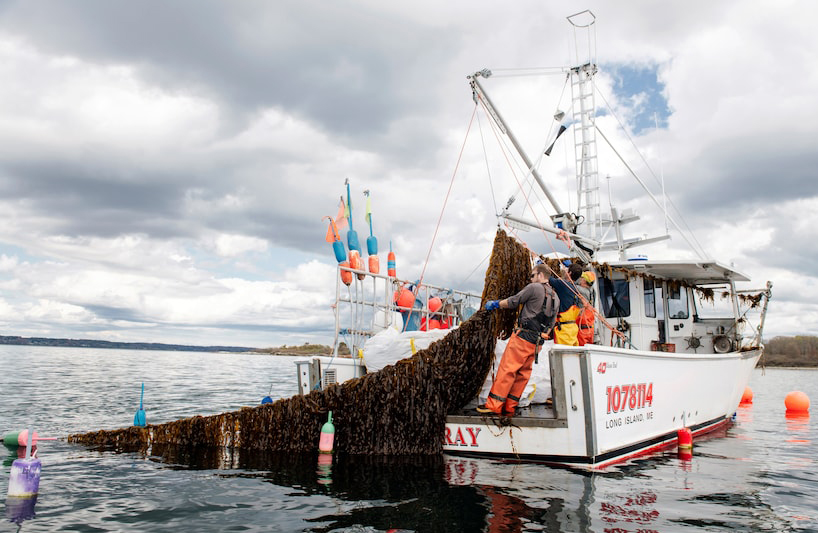
As warming waters drive lobster north, Mainers raise kelp

Justin Papkee, a partner farmer with Atlantic Sea Farms, hauls up kelp lines with the help of his crew, Jim Ranaghan and Chris Papkee, off Long Island, Maine, last year. (Photo by Nicole Wolf via The Washington Post)

"Seaweed is Maine's new cash crop," as the lobster industry adjusts to climate change, Kathy Gunst reports for The Washington Post. In the fall, lobster fishers "plant tiny kelp seeds on the 1,000-foot-long ropes, and by late spring, attached to each one is close to 6,000 pounds of fresh sugar kelp. The seaweed is harvested, flash frozen and used to make kelp cubes for smoothies, as well as seaweed salad, seaweed kraut and more."

The switch from lobster to kelp is the result of rising temperatures. "The Gulf of Maine is warming faster than 96 percent of the world’s oceans — increasing at a rate of 0.09 degrees per year," Gunst reports. "These warming temperatures have forced the lobster population to migrate north seeking colder waters, and the impact on Maine fishermen has been profound." The industry is also growing in Alaska.

The big player in Maine's kelp industry is Atlantic Sea Farms, which works with 27 partner farmers who brought in just under 1 million pounds this year. "The company’s products are now sold in more than 2,000 stores across the country, as well as in restaurants and college cafeterias," Gunst reports. "In 2021 the company was responsible for 85 percent of the line-produced seaweed in the country."

Kelp farming has environmental benefits, ASF President Briana Warner told Gunst: “There’s so much carbon in the air, and when carbon hits the ocean surface the ocean absorbs it and changes the pH and degrades shellfish. Seaweed absorbs the carbon and nitrogen in the water. When you harvest seaweed you are removing carbon with it and leaving behind a healthier body of water.” She said mussels planted on ropes after a kelp harvest have stronger shells thanks to the removal of excess carbon.

Wednesday, July 06, 2022

Midwestern fish farms face marketing, processing obstacles

Food costs are going up, and so is fish and seafood consumption in the U.S. That sounds like a good omen for Midwestern aquaculture farms, but "Many fish producers say they face challenges getting their produce to consumers in the region," reports Casey Smith  of The Associated Press.

Experts say the Midwest could be an aquaculture powerhouse, but the number of fish farms in the region fell from 336 to 271 over the past decade. "This could be because the region has historically relied on wild-caught seafood, said Amy Shambach, an aquaculture marketing outreach associate with the Illinois-Indiana Sea Grant. Seafood produced in the Midwest also must compete with cheaper, imported seafood," Smith reports. Higher production costs might also be to blame. 

"Stagnant fish farming in the Midwest aquaculture industry has national implications, Shambach said. With global seafood consumption expected to increase by 100-170 billion pounds by 2030, the growing seafood trade deficit means more fish will need to be farm-raised, opening the door for Midwestern farmers to meet demand," Smith reports. There is plenty of local demand, restauranteurs say, but the lack of local fish processors is a problem, Smith reports.

Friday, January 04, 2019

Series explores rural water quality issues – supply, quality, management and more – in the Upper Midwest

"The land near Wisconsin's Little Plover River didn't used to be much good for farming – until center-pivot irrigation," the StarTribune reports. "Since then, the river's base flow has drastically diminished." (StarTribune photo by Aaron Lavinsky)
Josephine Marcotty of the StarTribune in Minneapolis has written an outstanding three-part series on rural water quality in the Upper Midwest called "Water Pressure." Essentially, Minnesota, "a state renowned for its abundant water, confronts a difficult new fact of life," Marcotty reports. "It may no longer be able to guarantee what its residents have always taken for granted: Clean drinking water, industrial and agricultural growth, and many thousands of healthy lakes and streams."

Part one explores efforts by the town of Cold Spring, population about 4,500, to balance the needs of residents and a local brewery, and those of farmers who use fertilizer that can pollution. When Cold Springs Brewing Co. expanded in 2012 and needed more water, that threatened a nearby trout stream and triggered a "statewide political fight," Marcotty reports, one which could happen again if there's a drought or the brewery wants to expand again, which it hopes to do.

Part two details how more than 80 residents from rural Wisconsin sued one of the most powerful players in the state's agriculture industry, Central Sands Dairy, alleging that its irrigation and manure-spreading practices have depleted and polluted drinking water and caused the death of an infant. "A young mother in the tiny town of Nekoosa lost an infant daughter to a fatal brain malformation that has been associated with high levels of nitrate, a fertilizer byproduct found in the community’s drinking water," Marcotty writes. "Her tragedy led to a community well testing program this year, which found that 40 percent of the homes had nitrate concentrations that, like hers, were far above the legal limit.

Lewis & Clark Regional Water System
(StarTribune map by Ray Grumney)
Part three looks to the future, holding up the nonprofit Lewis & Clark Regional Water System as a model for how communities, states and the federal government can cooperate to supply areas with limited groundwater. The system consists of 337 miles of underground pipes that carry water drawn from a South Dakota aquifer to 20 cities, towns and utilities in three states (Minnesota, South Dakota, and Nebraska) and soon, Iowa.

The project, in the works for over 25 years, is a solution dreamed up after predictions that the area would eventually run out of water. The proposal faced many challenges along the way; it was too risky for many communities to gamble on, required a great deal of cooperation among communities that did sign on, needed nearly $590 million in state and federal subsidies, and relies on South Dakota water laws to protect the water in the aquifer.

The project could be a national example. Federal and state officials have long encouraged consolidation of small water systems that are prone to problems.

Thursday, December 20, 2018

USDA seeks info on aquaculture and irrigation practices

If you irrigate your crops or sell aquaculture products, Uncle Sam wants your input. In fact, he requires it. The Department of Agriculture's National Agricultural Statistics Service is conducting two studies as follow-ups to the 2017 Census of Agriculture to get more detailed info on irrigation and aquaculture practices.

The 2018 Census of Aquaculture was mailed Dec. 17 to farmers who said on their 2017 Census of Agriculture forms that they produced and and sold more than $1,000 aquaculture products such as baitfish, food fish, crustaceans and mollusks. That doesn't include wild-caught aquatic products.

The Census of Aquaculture was last conducted in 2013 and 2005; it provides industry-specific data for government, agribusiness, trade association, and producer stakeholders to make decisions about the aquaculture industry's sustainability and growth. Response to the survey is mandatory, and all individual information will be kept confidential. The deadline to respond is Jan. 14.

On Jan. 3, NASS will mail the 2018 Irrigation and Water Management Survey (formerly called the Farm and Ranch Irrigation Survey) to a sample of producers who reported on the 2017 Census of Agriculture that they irrigate crops. The survey is the only comprehensive source of information about U.S. irrigation practices, and response is mandatory. All individual information will be kept confidential, and the deadline to respond is Feb. 15.

Producers can respond to the questionnaires online, by mail, or by phone. The results for both studies are scheduled for release in fall 2019. Visit the Census of Agriculture page for more information.

Friday, March 09, 2018

Minnesota governor has plan to protect water from pollution by nitrate fertilizers; apparently first in Mississippi watershed

Star Tribune map; click on the image for a larger version.
"In an effort to stem the rise of nitrate pollution in rural Minnesota, Gov. Mark Dayton on Tuesday laid out a plan to balance farmers’ use of fertilizer with the protection of groundwater and drinking water supplies," Josephine Marcotty reports for the Star Tribune in Minneapolis.

The plan follows a year of debate among farmers, environmentalists and other interested parties on how to best address the problem of nitrate contamination in drinking water. High nitrates levels have been found in dozens of municipal water systems and one-tenth of private wells, especially in southeastern and central parts of the state.

 Nitrate run-off in the Mississippi River, which originates in Minnesota, feeds a yearly algae bloom in the Gulf of Mexico that sucks oxygen out of a lengthy swath of water along the coast, killing some aquatic life. In Minnesota, nitrates in drinking water can cause the potentially fatal "blue baby syndrome" and other health conditions.

"Yet curbing farm chemicals is not easy in a state where agriculture contributes $19 billion annually to the economy — much of it tied to the 800,000 tons of fertilizer farmers use on some 16 million acres," Marcotty reports. Dayton's proposal is apparently the first by the governor of a state in the Mississippi River watershed. This will be the first time the state has attempted to regulate farmers' use of fertilizer. The state already restricts the use of phosphorus on lawns.

In the newest version of the plan, released by Dayton and Agriculture Commissioner Dave Fredrickson, farmers' use of nitrogen fertilizers would be limited by both voluntary and mandatory means, especially in the fall and winter when nitrates are most likely to leach into groundwater because there are no crops to soak them up. Exceptions to the rule would be made for crops that require fall nitrogen, and for areas where there are few crops or the soil isn't prone to nitrate leaching.

Republican legislators panned the new version, calling it a "reactionary re-branding of a vastly unpopular rule" in a statement. The public will be encouraged to give opinions about the plan at public meetings to be scheduled this summer.

Thursday, July 27, 2017

In an unprecedented move, Commerce Secretary Wilbur Ross overrules a fish-catch limit

Summer flounder
(Boston Globe illustration)
Earlier this month, Commerce Secretary Wilbur Ross dismissed a report from the Atlantic States Marine Fisheries Commission that concluded that New Jersey was violating a conservation plan for summer flounder, also called fluke. "The decision, which effectively allows New Jersey to harvest more summer flounder, marked the first time the federal government had disregarded such a recommendation by the commission, and it drew a swift rebuke from state officials along the East Coast," David Abel reports for The Boston Globe.

Congress established the multi-state commission 75 years ago to manage fishing in order to maintain a sustainable supply. The commission lowered catch limits after it found that that summer flounder were being overfished, based on government surveys that found their population was down almost 25 percent since 2010. "If the population falls another 14 percent, reaching a critical threshold for the ability of the fishery to rebuild, commissioners will be required by their rules to reduce quotas drastically or implement a region-wide moratorium on catching fluke," Abel reports.

New Jersey, a member of the commission, proposed an alternative plan, but the commission rejected it after its scientists said that plan would result in nearly 94,000 more fish being caught. Ross, who oversees the National Oceanic and Atmospheric Administration, overruled the commission and allowed New Jersey to go ahead with its plan. Members of the commission, fishing officials, and regional NOAA officials were furious. "They said it was unprecedented for a commerce secretary to make a decision without seeking their input," Abel reports. "Such rulings are routinely vetted by NOAA’s regional officials and scientists, who review the commission’s recommendations and then prepare the agency’s response, they said."

New Jersey fishermen argue that the commission's recommended limits would have made it difficult to catch and keep any fluke other than the large females that replenish the flounder population.

The broader impact of the decision remains unknown. Some fishing officials worry that Ross' decision sets a precedent for states to reject the commission's findings and appeal to the federal government whenever they don't like what they're hearing. And if summer flounder are overfished to the point where the population can't rebuild itself, that could impact the marine ecosystem and the coastal economies that rely on it.

Tuesday, June 27, 2017

Well owners: register for five free webinars

The National Ground Water Association is offering five free webinars in the coming months to help household water well owners with common issues such as drought, turbid water, disinfection, maintenance and planning.

The one-hour webinars will be presented by experts in an easy-to-understand format for laymen and will include time for questions and answers. Here's a handy list:


Drought and Your Water Well
July 25, 11 a.m. EST.
Presenter: Gary Hix, CWD/Pl, In2Wells LLC, Tucson, Arizona.
Click here to register.

This webinar explores how drought and other unrelated reasons affect water well productivity. The lesson also provides guidance on what well owners can do. Gary Hix is a registered geologist, certified well driller and pump installer and a past president of the Arizona Water Well Association.


Water Well System Components Vital to Water Quality
August 8, 11 a.m. EST.
Presenter: Denis Crayon, CHST, Summit Drilling Company, Bridgewater, New Jersey.
Click here to register.

This webinar describes water well system components that protect water from certain harmful contaminants, and what well owners should do to stay on top of related maintenance. Denis Crayon, a water well system professional, is on the board of directors for the National Ground Water Association.


Turbid Well Water and What to Do About It
August 15, 3 p.m. EST.
Presenter: Richard Thron, MGWC, Mantyla Well Drilling Inc., Lakeland, Minnesota.
Click here to register.

Well owners will learn some of the causes for turbid water (water with suspended matter in it), why they should be concerned and what to do to protect or improve the water quality. Richard Thron is a president and owner of his company and a former president of the National Ground Water Association.


Shock Chlorination: What You Should Know
August 23, 3 p.m. EST.
Presenter: Jeffrey Williams, MGWC/CVCLD, Spafford and Sons Water Wells, Jericho, Vermont.
Click here to register.

This webinar explains why shock chlorination is a procedure best done by experienced water well system professionals to achieve effective well system disinfection. Jeffrey Williams is vice president of his company an a former president of the National Ground Water Association.


Planning for a Water Well
September 6, 11 a.m. EST.
Presenter: Mark Layten, CWD/Pl, Kickapoo Drilling Company, Downs, Illinois.
Click here to register.

This webinar examines important considerations for those getting a water well for the first time or a replacement well. Mark Layten is a member of the Illinois Association of Groundwater Professionals and the National Ground Water Association.


In addition to these webinars, well owners can view other recorded webinars here, and free online well owner lessons here.

Wednesday, March 06, 2013

Keeping it real: Fishers fight to stop federal approval of genetically engineered salmon

Fishers in Alaska fear that the introduction of genetically engineered salmon into the marketplace could damage their businesses and have a drastic effect on the quality of the product available to consumers.

AquaBounty, a Massachusetts-based company with a lab on Prince Edward Island in Canada and growing facilities in Panama, is awaiting a decision from the Food and Drug Administration
on whether it can sell genetically engineered salmon to U.S. consumers.

An FDA study concluded that eating the genetically engineered salmon is as safe as eating conventional Atlantic salmon and found no environmental harm in farming the fish. AquaBounty wants its fish to be labeled as Atlantic salmon. They say the nutritional and biological composition is identical to Atlantic salmon, and therefore doesn’t require additional labeling based on its method of production.

Fishers in Alaska fear that the genetically engineered fish would threaten their livelihood. "The threat may not be immediate, but I think down the line there could be some repercussions," fisherman Kim Hubert told McClatchy Newspapers. "We’ve had a lot of issues with labeling, and the ability (of consumers) to choose and know where the fish come from: what kind of stocks, whether they’re farmed or wild fish."

Lawmakers and lobbies in Western states are fighting the proposal for genetically engineered fish, and at the very least, are asking that labels be required. “We just think it’s really deficient on the food front,” said Patty Lovera, assistant director of Food & Water Watch. “What do we really know about allergies? What do we know about nutrition profile? That stuff’s really sketchy in that application that they put in. And we’d like to see a lot more of that, considering you’re going to eat the whole thing.” (McClatchy-Tribune graphic)


Thursday, February 10, 2011

NOAA proposes first federal aquaculture guidelines

Yesterday the National Oceanic and Atmospheric Administration unveiled the federal government's first policy guidelines for aquaculture. The guidelines pave the way for "farm-raised seafood to be produced in federal waters as long as the operations do not threaten wild fish stocks or saltwater ecosystems," Cornelia Dean of The New York Times reports. In 2009, farmed fish and shellfish passed wild-caught stocks as the major source of seafood worldwide, Dean writes. NOAA estimates that the U.S. imports 84 percent of the seafood consumed in the country with half of that produced through aquaculture. Public comment on the guidelines is open until April 11.

"While shellfish aquaculture is common in state waters, which typically extend to three miles offshore, most fin fish farmed in the United States are freshwater plant-eating fish like tilapia," Dean writes. "There has been little farming of saltwater fin fish." NOAA allowed an aquaculture plan for the Gulf of Mexico Fishery Management Council to proceed in 2009 because the agency said in the absence of a federal policy they had no grounds to block the gulf plan. NOAA officials told Dean that plan would be re-evaluated in light of the new guidelines. The guidelines call for more research on "alternate feeds" and call for a ban on stocking fish farms with non-native fish. (Read more)

Wednesday, November 26, 2008

Struggling Miss. catfish farmers may raise algae

Catfish farmers in Mississippi have struggled in the last few years, due to the combination of high food and fuel prices and foreign competition. Many are abandoning the business altogether, choosing to enter the biofuels market by transforming their catfish ponds into farms for algae.

Arizona-based PetroSun is hoping to lease the unused ponds from farmers, The Associated Press reports. Proponents say that algae-based fuel is an attractive alternative to other biofuels because, unlike ethanol, it does not rely on food sources. Neither would it decrease the number of catfish ponds. Algae farming "is not problematic because the ponds they are looking at are out of production," said Andy Whittington, president of the Mississippi Biomass Council. "The catfish market hasn't been what it needs to be, and there are a lot of ponds going out of production now." (Read more)

Friday, November 21, 2008

Tobacco-settlement spending for agriculture in Ky. to get more oversight; N.C. expands investments

The Kentucky Agricultural Development Board pledged yesterday to do a better job of overseeing the spending of grants it awards from the state's share of the national tobacco settlement. But board members "also said they cannot micromanage or guarantee the success of every project," and should continue to take some risks, reports Greg Hall of The Courier-Journal.

The comments came in the board's discussion of a University of Kentucky study of $209 million in spending from the 1998 settlement, from 2001 through 2006. In 2000, the state legislature allocated half the state's share of the settlement to improvement of the state's agricultural economy. It placed priority on helping tobacco farmers find other sources of income, anticipating the end of the federal tobacco program of quotas and price supports, which was repealed in 2004.

The study concluded that the money has helped about 50,000 current and former tobacco growers. "It is clear that these investments have led to broad market improvements," the researchers wrote. Markets for 148 products were created or expanded, "primarily through investments in livestock and horticulture projects plus marketing promotion." The most common investment was in beef-cattle farming; Kentucky is the leading Eastern cattle state. But entrepreneurs have created more than 500 new products, from salsa to industrial glue, with the program's help.

The study wasn't all good news. Researchers found that the transition from tobacco to something else was far easier in the large and medium-scale farms in Western and Central Kentucky than in the smaller farms in hilly Eastern Kentucky, one of the nation's poorest areas.

Some major investments, such as a Western Kentucky fish-farming cooperative, failed. But the researchers said the board "should continue to fund ‘risky’ new ventures which stimulate new markets, expand the value chain, and encourage value-added processing." They said some failures "still resulted in advancements in new enterprises, new on-farm technology, production of new crops, and contract marketing." Hall reports, "Board member Sam Lawson said he hoped the report wouldn't result in the panel being so conservative that it never funded an ultimately unsuccessful program." (Read more)

The researchers said the Governor's Office of Agricultural Policy, which acts as staff to the board, "appears to lack the staff necessary to fully utilize information" from reports filed by grant recipients or to oversee all projects. "Relatively too much staff time was involved in feasibility analysis versus project monitoring." For a 4.8mb PDF of the study, click here.

The other state to earmark half its tobacco-settlement money for rural-related purposes was North Carolina, the state that produces the most tobacco and had the second largest number of tobacco farmers, after Kentucky. The Tar Heel State created a foundation to invest the money and spend the earnings on grants to help the economies of tobacco-growing counties. The Golden LEAF foundation "has increasingly dangled big bait for corporate prizes," reports Emery Dalesio of The Associated Press. "This year, it opened its vault by committing $100 million to build an aircraft parts plant." The acronym stands for Long-term Economic Advancement Foundation. "We'll continue to do more high-quality manufacturing," foundation President Dan Gerlach told AP. "We're going to do more on health care." (Read more)

The other state that is using tobacco-settlement money to help the economies of tobacco-growing areas is Virginia. The state uses 40 percent of its share for health programs; the remainder "is overseen by a commission that awards grants for education and economic development projects in tobacco-dependent communities. The commission also makes payments to farmers to compensate for a decline in tobacco quotas," reports The Associated Press and Michael Sluss of The Roanoke Times. In 2005, the Commonwealth "sold nearly $450 million in bonds backed by a 25 percent share of the state's overall settlement payments. Proceeds from the bond sale fund an endowment that is used primarily for technology and economic development projects." The major expenditure has been $80 million to bring broadband service to Southwest and Southside Virginia and other rural areas of the state. (Read more)

Thursday, November 20, 2008

New standard for organic fish is quickly criticized

"For the first time, a federal advisory board has approved criteria that clear the way for farmed fish to be labeled 'organic,' a move that pleased aquaculture producers even as it angered environmentalists and consumer advocates," write Julie Eilperin and Jane Black of The Washington Post. Opponents of the move argue that it will cheapen the organic label because it would allow farmed fish to be fed 25 percent non-organic material while other industries must use 100 percent organic material.

The organic fish standard is the result of a long process and confusing process. Many fish species are carnivorous and live in nets in the ocean where they feed on small fish, which makes a 100 percent standard difficult to meet.

Many fear that the standard, created by the National Organic Standards Board, will damage the existing organic standard for some consumers. Critics point out that consumers of organic meat products expect the animals to be fed with 100 percent organic feed, as indicated by a recent Consumers Union poll, "in which 93 percent of respondents said fish labeled organic should be produced with 100 percent organic feed; 90 percent said organic fish farms should be required to recover waste and not pollute the environment," Eliperin and Black write.

The standard also looks to protect certain fish species that have dwindled as the fish farming industry has boomed. Environmentalists are concerned because the standard does not attempt to prevent fish waste and disease from polluting the ocean. (Read more)

Friday, December 14, 2007

Fish farms endanger wild salmon off Canada coast

Fish farms are bringing nearby wild salmon populations dangerously close to extinction, according to a new study published in today's issue of the journal Science. It found that the farms bring young wild salmon into contact with parasitic sea lice and that could mean a 99 percent collapse in some populations over the next four years.

The study used data from the Broughton Archipelago, a group of islands about 260 miles northwest of Vancouver. Here, young salmon must travel past miles of fish farms to reach the sea. Along the way, they pick up the sea lice. Adult salmon can handle the parasite in small amounts, but the thin-skinned young are especially vulnerable.

“If nothing changes, we are going to lose these fish,” lead author Martin Krkosek, a fisheries ecologist from the University of Alberta, said in a news release. “Salmon farming breaks a natural law,” said co-author Alexandra Morton, director of the Salmon Coast Field Station, located in the Broughton. To read the full report, go here.