Showing posts with label electricity. Show all posts

Tuesday, August 04, 2026

Nuclear reactors, abandoned industrial sites seen as part of the solution to accommodate data centers in rural America

    
An experimental nuclear reactor in rural Kansas will be
placed one mile underground, avoiding hulking facilities
like the one above. (Unsplash photo by Lucas Lahotsky)

The race to build data centers for artificial intelligence has caused a stir in rural communities across the nation. Companies hoping to build these massive facilities are facing debates in local government bodies about tax revenue and job creation, along with pushback from residents concerned with the potential for rising electric rates, water availability and noise pollution.

Now the debate has expanded to the use of nuclear power. The Wall Street Journal reports plans for a nuclear reactor to be installed a mile underground in the granite near tiny Parsons, Kansas, population 9,600. 

Deep Fission, a company founded by father and daughter entrepreneurs in California, created the experimental process and raised $150 million to make it happen. 

The project is one of many encouraged by the Trump administration to create more nuclear energy to satisfy the country’s “soaring electricity demand, much of it driven by data centers.” The innovation in the Parsons project is that the reactor is deep underground and can become operational fairly quickly.

According to the WSJ report, “The key to the plan is avoiding the need for hulking containment buildings. Instead, the mile-deep hole will provide the necessary pressure, cooling and containment.” A single reactor will serve about 12,000 homes, but the inventors are planning “100 or more,” producing enough power for a data center.

Developers of data centers are facing resistance from rural communities where hundreds of acres of pristine farmland are being proposed as sites. That has the industry looking for alternatives, like abandoned factories. And in Western Kentucky, a former nuclear power plant is being considered for a hyperscale data center.

The Kentucky Lantern reports that the Department of Energy plans to transform a portion of the site near Paducah into a “1.8 gigawatt data center” that is “part of a larger strategy by the Trump administration to turn former Cold-War era federal sites into hubs for data centers and energy production.”

The story by Liam Niemeyer also listed dormant industrial sites across the state being considered for data centers. The list includes a former aluminum smelter, an abandoned steel mill, an electrical transmission infrastructure from inactive coal mines, and industrial parks that have power built in but have not been able to recruit industry to use it.

The director of the Hancock County Industrial Foundation explained the situation there. “Manufacturing is what we’re hoping for (to replace the smelter),” said Mike Baker. He said in 2022, when the smelter closed and 600 jobs were lost, data centers were not on anyone’s radar. “I don’t think anybody even knew what a data center was.” But now, a former industrial site that still has power makes it an attractive possibility for the growing AI industry.


Friday, March 06, 2026

Rural towns provide land, workforce and a unique energy supply to support a new type of nuclear power plant

The Natrium facility divides nuclear and nonnuclear sections of the plant, which leads to more
reliable energy output at lower cost. (TerraPower design graphic)

TerraPower plans to build smaller nuclear power plants in declining coal towns across the U.S., and it needs land, a reliable workforce, and a uniquely enriched uranium to get the job done. Rural towns more than 1,500 miles apart will provide all three for the first reactor.

Kemmerer, Wyoming, is providing the site, many of the workers, and infrastructure supports for TerraPower's first power plant, called Natrium, which recently became "the first new commercial reactor to receive federal approval in nearly a decade," reports Brad Plumer for The New York Times.

The federal permit allows the company to begin construction on Natrium's nuclear components. "The company had already broken ground on the site in 2024 and had begun building the non-nuclear parts of the plant," Plumer explains. Natrium is slated to go online in 2031, just a couple of years before the town's coal plant is expected to be retired.

The plant's designs are novel and will allow smaller, less expensive reactors to be built; however, when the company broke ground on its Kemmerer plant, it didn't have an American supplier for the reactor's unique enriched Uranium known as HALEU.

At the time, only Russia was making HALEU. As TerraPower searched for a solution, a uranium enrichment facility in the rural town of Piketon, Ohio, said it could step up to produce HALEU before the reactor went online.

TerraPower is now "partnering through a memorandum of understanding with Centrus, a company in Ohio, that will likely be the first in the U.S. to make the fuel on a commercial scale," reports of Caitlin Tan of Wyoming Public Radio

Tuesday, February 24, 2026

Maine lawmakers consider a moratorium on data center developments as more towns reject proposals

Maine lawmakers are considering a moratorium 
on data center builds. (Photo by I. Quick, Unsplash)
As data center developers target parts of rural New England for their sprawling compounds, advocates for Maine want answers to questions "about electricity prices, grid reliability, and impact on water resources," reports Julia Tilton of The Daily Yonder. Several Maine communities rejected data center proposals, in part, because Mainers already pay some of the highest electrical rates in the country.

As lawmakers examine the pros and cons of data centers, "one idea floating around Maine’s statehouse is to impose a moratorium on data center development," Tilton explains. "How Maine navigates these challenges could be a model for the rest of New England, which shares an aging electric grid and faces a similar set of circumstances."

Currently, Maine lawmakers are "considering LD 307, a resolution bill that would establish a data center coordination council to provide input and evaluate policy options for data center development in the state," Tilton reports. Passing a state moratorium would prevent larger data center projects from obtaining permits or building until the moratorium ends.

Not all Maine lawmakers agree that a moratorium is the best option. Matt Harrington, a Republican of York, Maine, voiced concerns "that a moratorium 'would harm' a data center development in his district, which includes several towns in the state’s more urban southern region," Tilton writes. Lawmakers suggested they could grant the data center in Harrington's district an exemption.

Questions about the state's grid and its capacity to "feed" data centers without raising residents' utility bills remain a concern. Seth Berry, executive director of Our Power, a Maine-based nonprofit organization advocating for energy democracy, favors the moratorium. He told Tilton, "There are just so many unknowns. We really have to slow this down and step back and look at this massive new development, preferably as a region.”

Tuesday, February 10, 2026

U.S. grid needs operators to plan now with a blend of energies including batteries, gas and coal


North American Electric Reliability Corporation graph

Fueled by increased demand and shrinking power options, the U.S. electricity grid is headed toward a reliability crisis. "Tens of millions of people face a growing risk of blackouts over the next five years, according to an annual assessment by the North American Electric Reliability Corporation, a nonprofit organization that works closely with federal regulators," reports Brad Plumer of The New York Times.

As AI data center builds have continued to demand more grid power, many "utilities are retiring older coal- and gas-burning plants and aren’t adding enough generation to dependably meet growing demand," Plumer explains. The report lists regions in Texas, the upper Midwest, the Mid-Atlantic region and the Pacific Northwest as most "at risk of electricity shortfalls."

How electricity is produced is at the heart of electricity reliability and a contentious point of national political debate. "President Trump has said that policies to fight climate change and promote wind and solar energy have weakened the reliability of electric grids, since wind turbines and solar panels can’t run at all hours," Plumer writes. But renewable energy advocates say that "Trump administration efforts to hinder wind and solar projects are depriving the grid of a fast-growing source of power."

Battery build-outs can help regional power operators create a more resilient grid that can meet demand even during extreme heat or cold snaps. "In MISO, a grid spanning 15 states in the Midwest and South, more than one-third of coal plants are set to retire by 2030," Plumer reports. "But the grid operator recently instituted a plan to speed up the connection of new gas plants and batteries over the next five years."

The report offers a list of recommendations for operators to start planning now, including "speeding up permitting processes for new power plants and transmission lines, and policies to ensure that large new sources of demand, such as data centers, don’t overwhelm the grid," Plumer adds. "It also suggests that utilities and grid operators should be careful about shutting down older coal and gas plants too quickly."

An interactive session about rural communities and AI data centers is scheduled for March 4

While many rural residents may know that a large AI data center can bring potential gains and losses to their communities, many details remain unclear. To address potential knowledge gaps and help rural residents stay informed, the Rural Assembly is offering a 90-minute interactive session, “What Rural Communities Need to Know about AI Data Centers,” that clarifies disputed issues about data mega builds and their potential impact on smaller communities.

Date & time: March 4, 2 p.m. EST
Register here.

The session will cover:

  • Who pays for all the electricity a data center will need during construction and once the build is completed?
  • What community agreements can and cannot secure.
  • How federal and state politics and legislation on data center development are evolving.
  • Tools communities can use to maintain local decision-making power, including zoning and permitting strategies, rate class separation, and transparency demands. 
  • This online Zoom event will begin with hearing from attendees about what their community has already heard or experienced.

The session will wrap up with a small group discussion about concrete next steps. Whether you’re facing a proposal now or want to prepare before developers arrive, attendees will gain a clearer picture of how the AI boom can impact their neighborhoods and learn the leverage points available to rural communities.

Tuesday, February 03, 2026

Wind farm projects are 'teetering on the brink,' despite soaring electricity demand

Wind power is being blown over by opposition from local residents, who don't like the look of turbines, and the Trump administration, which ended federal tax credits and has worked to stall federal permitting approvals. Without robust growth in wind power, experts are doubtful the U.S. will be able to meet future electricity demand.

In states that were once turbine-friendly, "new wind project developments are teetering on the brink, despite growing power demand," report Dan Gearino and Anika Jane Beamer of Inside Climate News. "Even Iowa, the nation’s most wind-powered state, is 'closed for business,' experts say."

Graph by Paul Horn, ICN, from Energy Information 
Administration data 
Although the Trump administration's resistance to offshore wind farms may be more familiar to Americans, the administration's weakening of land-based or 'onshore' wind development will have a much larger impact on the nation's power grid. Gearino and Beamer write, "In 2024, the most recent full year for which data is available, wind energy produced 7.7% of the nation’s electricity, more than any other renewable source."

Atin Jain, an energy analyst for the research firm BloombergNEF, told ICN, "U.S. onshore wind is in its weakest shape in about a decade, not because the technology has stopped being competitive, but because the policy and, to an extent, the macro-environment have turned sharply against it."

During the early to mid-2010s, many Iowa landowners and local governments welcomed wind farm developments and the significant revenue they generated. Opposition from residents was sporadic and generally ineffective, but "in the late 2010s, something changed," Gearino and Beamer explain. "In both Iowa and nationwide, wind energy projects began to face local opposition that was more aggressive and better organized than before."

The era of growth in Iowa’s wind industry "is almost certainly nearing its end," ICN reports. "The resistance comes almost entirely from the local level. . . . Roughly 58 of Iowa’s 99 counties now have rules designed to limit wind power development, including many of the counties with the strongest wind resources."

How to stay safe when it's cold and there's a power outage

Photo by S. Modak, Unsplash
Whether it's 32 degrees or -5 degrees, prolonged exposure to cold air takes a toll on the human body. For rural residents living in remote areas far from help, or in regions not accustomed to colder temperatures, knowledge about coping with cold, including proper clothing, and supplies for extended power outages can save lives, reports Devi Shastri of The Associated Press.

Cold can be stealthy. "Some of the most dangerous situations happen when the temperature is low for a long time, even 30 to 40 F," Shastri writes, "In these situations, long-term cold exposure taxes the body, driving up blood pressure and working the heart." A person who is shivering needs to be warmed as soon as possible.

Drinking plenty of water helps people stay warm. Drinking alcohol isn't advised because it can make people feel warmer than they are.

Wearing layers of dry clothes, especially dry socks, is one of the best ways to help the body trap heat. "The North Carolina Department of Emergency Management suggests wearing warm, loose-fitting, lightweight clothing in many layers that are easy to add or remove," Shastri reports. "It also recommends covering your mouth with scarves to protect the lungs from directly breathing in extremely cold air."

Smaller spaces will stay warmer. If you're waiting for the heat to come back on, move into a smaller room. Some sources even suggest pitching a tent in a room and climbing into a sleeping bag to add heat.

Check on your neighbors. "Young children, older adults and people with chronic health conditions such as diabetes and high blood pressure are the most at risk when it’s cold," Shastri adds. "Community awareness is key during dangerous cold spells. Many don’t realize they need help until someone asks."

Wednesday, January 21, 2026

As residential electricity costs climb, big users pay less

Between 2022 and 2024 residential electricity costs 
increased by 10%. (Photo by J. Maculan, Unsplash)
After years of wallet-draining food inflation, many Americans must now contend with soaring home electric bills. "Since February 2020, electricity prices have increased by an average of 40% across the country," reports Shannon Osaka of The Washington Post. Overall, the brunt of the increased costs is being paid by residential customers even when they aren't the biggest users.

Many utilities have increased rates to fund needed infrastructure builds, but residential customers are paying more than commercial users. Osaka writes, "Residential electricity costs rose by 10% between 2022 and 2024. Commercial users, spanning everything from small corner stores to giant, energy-sucking data centers, have seen rates increase just 3%."

Building and repairing the poles, wires and transformers required for residential electricity delivery is costly and isn't generally needed by large commercial users, which is one reason many residential customers pay higher rates. Oska notes, "The average electricity price at the end of 2024 was 16 cents per kilowatt-hour for homes and apartments, and just 13 cents for commercial customers."

While infrastructure costs explain some of the difference in electrical prices, a complex system of lobbying goes on behind the scenes to determine how much a business will pay for electricity. Osaka reports. "In theory, each group is supposed to pay an amount that aligns with the cost to bring them power — but in practice, different groups can lobby for lower prices."

Charles Hua, executive director of PowerLines, a group that works to lower electricity costs for consumers across the country, told Osaka, "Residential consumers feel like they don’t have a voice in our utility regulatory system." Osaka adds, "Utilities often sign special contracts with data center customers that place them outside standard pricing agreements."

Some states are working to prevent data centers from shifting their expansion costs onto residential customers. Osaka reports, "Virginia recently established a new class for data centers and other huge users of electricity, with agreements in place to make sure the data centers pay for more of the grid upgrades required."

Tuesday, December 02, 2025

Higher energy prices and older residences mean more rural residents will struggle to stay warm this winter

Many rural residents will struggle to afford heat this winter. 
(Photo by Nadine Marfurt, Unsplash)

Rural residents can struggle to pay their utility bills during the winter months because they face barriers to conserving heat, such as living in older homes or apartments that can be drafty and lack energy-saving features. They are also more likely to have limited access to aid programs designed to help Americans afford energy while avoiding utility debt.

Roughly 80 million Americans have trouble paying their monthly heat and electricity bills. "Now, as the cost of energy climbs, experts say more people are at risk of energy insecurity and poverty, defined by the struggle or inability to keep up with electric, heating, and cooling bills," reports Julia Tilton of The Daily Yonder

As electricity and gas rates continue to increase across the U.S., the number of rural residents who can't afford their utility bills has soared. "In the South and Appalachia, rates of severe utility debt were nearly twice as high as of June 2025, per analysis from the Century Foundation economic think tank," Tilton reports. "With winter approaching, home heating costs are expected to outpace inflation."

Maria Castillo, a senior associate on the electricity team at energy think tank RMI, told Tilton, "Who we understand as experiencing energy poverty is unfortunately expanding because of the affordability pressures brought on by rising prices and the volatility of gas prices."

While many rural families qualify for federal utility support through the Low-Income Home Energy Assistance Program, completing LIHEAP paperwork can prevent rural residents from accessing energy aid.

Katrina Metzler, the executive director for the National Energy and Utility Affordability Coalition, told Tilton, "If they’re having trouble affording their utility bills, can they also afford gasoline to get in the car and drive many miles, however many it might be, to reach the office where assistance is available and complete the application?” 

Friday, November 21, 2025

Data center developments offer plenty of community reporting opportunities

U.S. data center infrastructure, with the relationship between the data center locations, transmission infrastructure and fiber optic networks. (NREL map, click to enlarge)

While rural areas may receive an economic boost from data center development in their community, the sprawling energy and water needs that AI hubs require can impact an entire region.

Data centers are a "relatively new kind of industrial infrastructure that environmental journalists may want to pay attention to," writes Joseph A. Davis for the Society of Environmental Journalists.

In areas that experience extremes of heat or cold, power-hungry AI can strain local electrical grids that may already be struggling to meet daily demand for local businesses and homes.

In addition to energy-gobbling, data centers also require enormous amounts of fresh water. Many communities across the U.S. are grappling with ongoing droughts and depleted aquifers. A data center build could leave its community thirsty.

According to Davis, here are story ideas to consider and ways to gather information:
  • Find the data center(s) nearest you. Ask the PR people for a tour. There are helpful maplike resources from the National Renewable Energy Labs, Datacenters.com and Visual Capitalist.
  • What is the power situation in your data center region? Do you ever have brownouts or energy conservation requests during AC season? Talk to your nearby electric utilities about load management.
  • What zoning and permits do your burgeoning data centers need in order to build and operate? Have they got all the approvals they need? Did local authorities make any concessions to usual rules? Tax breaks?
  • Where does the cooling water for your local data center, if any, come from? Are permits needed? What happens to the water that is discharged, and what are the heat effects on aquatic systems?
  • How many jobs will be created during the construction of the data center? How many jobs after it is operating? Can local people fill them?
  • Is your planned data center creating its own power plants to operate? Are they fossil-fueled? Green-powered? Nuclear? What are the environmental consequences?
Reporting resources:
  • Data Center Coalition: This trade and lobbying group calls itself “The Voice of the Data Center Industry.”
  • Utility companies: Power for many data centers comes from local electric utilities. Check in with your local utilities to see what requirements they have imposed (or waived) for the data center. Here’s a starting list.
  • Zoning or planning boards: Siting of industrial facilities often requires approval from such bodies, or city and county councils. Find out what actions are pending and go to the meetings.
  • Public utility commissions: Every state has a PUC that regulates local utilities. Check in with your PUC to see if your data center meets requirements. Here’s a list.

Tuesday, July 29, 2025

Opinion: As the Trump administration puts the brakes on clean energy support, many rural farmers will feel the loss

Solar panels can help cut energy costs for farm operations like dairies. 
(Photo by S. Patrick, Portland Herald, Getty via The Conversation CC)
Wind and solar power add grid support and help farmers maintain steady incomes when weather, bugs or market upheavals make farming less profitable. Particularly for rural communities, taxes generated by renewable energy help local budgets pay for schools, roads and health care. "But some of that opportunity is now at risk as the Trump administration cuts federal support for renewable energy," writes Paul Mwebaze in his opinion for The Conversation.

In areas with wind turbines, farmers lease their land in return for payments. "Those historically were around $3,000 to $5,000 per turbine per year, with some modern agreements $5,000 to $10,000 annually, secured through 20- to 30-year contracts," Mwebaze explains. Roughly a third of the $3.5 billion paid out on wind turbine leases goes to rural landowners.

Solar energy adds to a farmer's bottom line by providing cheaper electricity throughout an agricultural operation. "Farmers use rooftop panels on barns and ground-mounted systems to power irrigation pumps, grain dryers and cold storage facilities, cutting their power costs," Mwebaze writes. 

In some rural communities, renewable energy is the "largest new source of economic activity, helping stabilize local economies otherwise reliant on agriculture’s unpredictable income streams," Mwebaze adds. The Iowa turbine blade factory, TPI Composites, serves as an example of how clean energy stimulates rural manufacturing. TPI "just reopened its plant in Newton, Iowa. Tax benefits in the 2022 Inflation Reduction Act helped boost [the industry] and the jobs and local tax revenue they bring in."

The Trump administration has "rolled back many clean energy incentives. It phased down tax credits for distributed solar projects, particularly those under 1 megawatt, which include many farm‑scale installations, and sunsets them entirely by 2028," Mwebaze explains. "It also eliminates bonus credits that previously supported rural and low‑income areas."

Renewable energy is one way the federal government could continue to invest in rural America, providing energy for communities and generating a reliable income source for farmers and smaller municipal budgets. "I believe homegrown renewable energy offers a practical path forward," Mwebaze writes. "Wind and solar aren’t just fueling the grid; they’re helping keep farms and rural towns alive."

Friday, June 20, 2025

Analysis: Consumer utility bills may climb as data centers get special deals

Getty Images Plus image via The Conversation, CC

At a time when U.S. consumers are getting squeezed from all sides, the idea that average Americans may pay higher electric bills so mega-companies such as Google and Meta can get special discounts for their energy-guzzling data centers may sound unfair, but it could be true, write Ari Peskoe and Eliza Martin in their story for The Conversation.

"In our paper Extracting Profits from the Public, we explain how utilities are forcing regular ratepayers to pay for the discounts enjoyed by some of the nation’s largest companies," they write. “And [we] identify ways policymakers can limit the costs to the public."

While most utilities are sanctioned monopolies, their foundation lies in shared costs. "Splitting the utility’s costs among all consumers made perfect sense when population growth and economic development across the economy stimulated the need for new infrastructure," Peskoe and Martin write. "But today, in many utility service territories, most of the projected growth in electricity demand is due to new data centers.

When data centers are the impetus for a utility having to build more supporting infrastructure, the normal way power utilities pay for their expansion no longer works. They explain, "If state regulators allow utilities to follow the standard approach of splitting the costs of new infrastructure among all consumers, the public will end up paying to supply data centers with all that power."

A Meta data center in Louisiana provides a good example. "By our calculations, [the center will use] twice as much energy as the city of New Orleans," Peskoe and Martin add. "Entergy, the regional monopoly utility, is proposing to build more than $3 billion worth of new gas-fired power plants to meet the data center’s energy demand. … Entergy is proposing to include the costs in rates paid by all customers."

Instead of billing Meta $3 billion for its infrastructure needs, Entergy is working on a separate contract with Meta, with rates the general public won't see. Peskoe and Martin write, "Entergy has asked state regulators to keep key terms of the contract secret, and only a redacted version of its application is available online."

The fact that there are many secret deals isn't much of a secret; however, what's in the deals remains protected. "Our research, reviewing nearly 50 public utility commission proceedings about data centers’ power needs across 10 states, uncovered dozens of secretive contracts between utilities and data centers," Peskoe and Martin explain. "Unlike Louisiana, most states require utilities to submit to the public utility commission their one-off deals with data centers, but they allow utilities to conceal the pricing terms from the public."

Is anything being done to address the issue? "Many state legislatures are noticing these problems and working to figure out how to address them," they add. "Several recent bills would set new terms and conditions for future data center deals that could help protect the public from data center energy costs."

Tuesday, June 17, 2025

Cooling off from summer sizzle will cost nearly 4% more this year

A hose may be the cheapest way to cool off
this summer. (Photo by J. Tyson, Unsplash)
Summer sun and heat might be good for beachgoers, but climbing summer temperatures will mean spiking power bills for U.S. consumers. Reasons for ballooning energy costs include higher natural gas prices, grid upgrade costs passed on to utility customers and increased domestic demand.

"Electricity prices across the country have increased 4.5% in the past year, topping the 2.2% jump in the price of groceries," reports Jennifer Hiller of The Wall Street Journal. "Consumer prices rose 2.4% in May from a year earlier."

Whether U.S. consumers flip on fans or crank the air, most will pay roughly 4% more "because of a jump in natural gas prices, the largest source of power generation," Hiller explains. "Natural gas deliveries to power plants will cost about 50% more from June through September than last year."

That's painful. "The higher bills are putting a strain on the wallets of consumers who are already stretched thin by rising costs for food, shelter and insurance," Hiller writes. "The average household power bill will reach $784 for the combined period from June to September."

Many Americans started the summer months already behind on their electrical bills. "Mark Wolfe, the executive director at the National Energy Assistance Directors Association, said one of every six U.S. households is behind on their electricity or natural gas bills," Hiller reports. "Customers owed gas and electric utilities more than $24 billion in late payments as of March."

Despite the pinch consumers are bound to feel, several utility companies are asking regulators to approve rate increases. "In Florida, NextEra Energy’s Florida Power & Light is asking regulators to let it increase rates between 1% and 5% a year through 2029," Hiller adds. "About $9.3 billion in additional electricity costs will begin trickling down to customers in the PJM Interconnection, the country’s largest grid operator and wholesale electricity market."

In some markets, AI data centers are "stressing the grid." In other places, increased demand is partially driven by electric vehicles. "Across the U.S., the growing pains are sparking fights over how to pay for upgrades and costs," Hiller reports. "The power industry also warns that a rollback of the clean-energy tax credits offered under the Inflation Reduction Act would push electricity prices higher, too."

Friday, April 04, 2025

HHS fires staff dedicated to helping low-income Americans pay for utilities: 'There's nobody left to do anything'

About 17% of U.S. households spend more than one-
tenth of their income on energy. (Adobe Stock photo)
A recent staffing purge of Low Income Home Energy Assistance Program employees at the Department of Health and Human Services may leave millions of low-income Americans unable to pay their utility bills. "The Trump administration abruptly laid off the entire staff running a $4.1 billion program to help low-income households across the United States pay their heating and cooling bills," reports Brad Plumer of The New York Times. The loss of assistance could burden millions of poorer rural residents who already spend a disproportionate amount of their incomes on energy bills when compared to their more urban counterparts.

It's unclear how a program that routinely helps roughly 6.1 million Americans can continue to offer assistance without any employees to administer payments. Mark Wolfe, executive director of the National Energy Assistance Directors Association, which works with states to secure funding from the program, told Plumer, “They fired everybody. There’s nobody left to do anything. Either this was incredibly sloppy, or they intend to kill the program altogether.”

While most of the 2025 funds have been paid, a remaining $378 million hangs in the balance. Plumer explains, "Congress had approved $4.1 billion for the program for fiscal year 2025, and about 90% of that money had already been sent to states in October to help households struggling with high heating costs." The $378 million could help lower-income residents pay for summer air-conditioning bills, but LIHEAP disbursements seem unlikely without program staffing.

The firings angered several Democratic lawmakers. Plumer reports, "Representative Jared Golden, a Democrat who represents a largely rural district in Maine that voted for President Trump, wrote in a social media post, 'What efficiency is achieved by firing everyone in Maine whose job is to help Mainers afford heating oil when it’s cold?'" Senator Edward Markey, a Massachusetts Democrat, referred to the LIHEAP staff eliminations as "sabotage."

A study published last year in The Economic Journal "found that roughly 17% of U.S. households spend more than one-tenth of their income on energy, a threshold that researchers often define as a 'severe' energy burden," Plumer adds. "The study also found a strong relationship between energy affordability and winter mortality."

Tuesday, January 21, 2025

Trump declared a national 'energy emergency,' but what does that mean?

In one of his first acts as president, Donald Trump declared a national "energy emergency." But the order and its implementation is "a presidential first, and it's unclear what exactly it would entail," reports Camila Domonoske of NPR. Below is a brief synopsis of what Domonoske knows about the "unprecedented action."

A national emergency gives the president "additional powers," Domonoske explains. "A Trump administration official speaking on condition of anonymity said the 'national energy emergency will unlock a variety of different authorities that will enable our nation to quickly build again, to produce coal and natural resources, to create jobs, to create prosperity, and to strengthen our nation's national security.'"

According to the Brennan Center, "which has researched emergency powers, statutes grant the president the authority to suspend some environmental regulations or impose restrictions on crude oil exports," Domonoske writes. "No president has ever declared a national energy emergency.'"

The U.S. has plenty of fossil fuels available and a glut of global supply could depress energy prices. Domonoske reports, "The U.S. is a net exporter of fossil fuels, producing more oil and gas than any other country in the world. . . . Many analysts currently project that the world as a whole is facing a near-term oversupply of oil and natural gas."

However, the pressure on the U.S. electrical grid is a worry. "Trump dd not specifically focus on this concern in his speech, but he could use emergency authorities to try to keep open power plants that are slated to close for economic or environmental reasons," Domonoske adds. "He has historically expressed support for coal plants in particular."

During his inaugural speech, Trump said, "'We will bring prices down," Domonoske reports. "On the campaign trail he repeatedly promised to lower energy prices by 50%. . . . That's an improbable target, analysts say. . . . Policy changes can influence prices at the pump and electricity prices, and a smaller decrease in costs is certainly in the realm of possibility. But it's not simple."

Friday, December 20, 2024

Southern timber owners could benefit from plan to create electricity and carbon credits by burning wood chips

The U.S. Pine Belt is filled with fast-growing Loblolly
pines. (Reddit map)
 
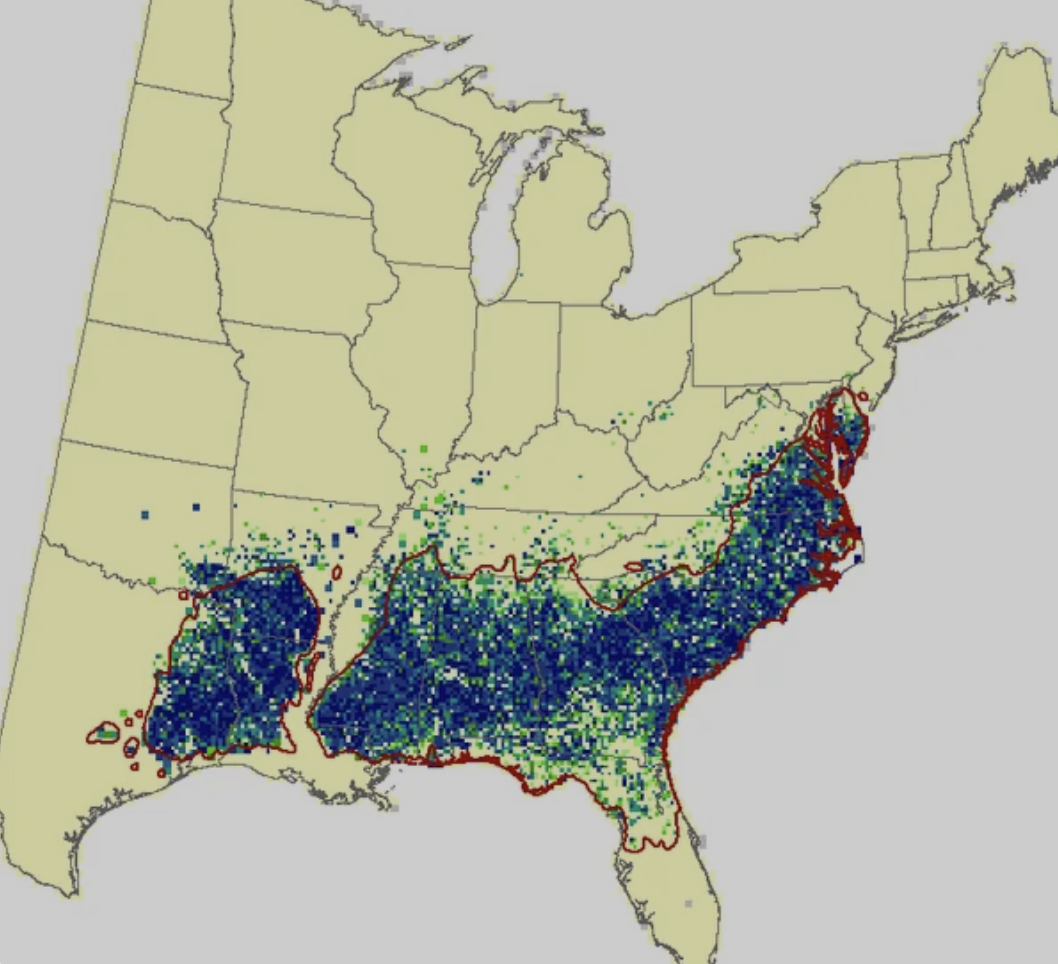
United Kingdom power producer Drax is scouting locations in America's Pine Belt to "build electricity generators fueled by burning wood chips," reports Ryan Dezember of The Wall Street Journal. "The plants’ exhaust will be piped underground instead of out of smokestacks, which generates lucrative carbon credits for which Drax is already lining up buyers." The company plans to sell its electricity to data center companies looking to fuel their artificial intelligence operations.

The plan could be an economic game changer for the U.S. South "where pulp and paper mills have closed and left timber growers without buyers for those trees unfit for making lumber or poles," Dezember explains. "Biomass power has long been dangled before Southern timberland owners as a potential solution to the glut of pine that has depressed prices and complicated harvests."

Drax's UK facility "burns pellets of compressed sawdust in a converted coal-fueled power plant," which fuels roughly 5% of the country's electricity. It already runs several U.S. pellet mills that fuel its UK operation, Dezember writes. The planned U.S. plant will be a BECCS, short for bioenergy with carbon capture and storage. The company plans to provide 24/7 renewable energy for AI data centers.

Drax is pinpointing locations that have all the elements it needs, which include a "confluence of carbon dioxide pipelines, pine plantations and a short wait to connect to the grid," Dezember reports. "It has options on properties and expects to announce a location for the first plant in 2025."

The company has sought timber managers who will manage forests without stressing their ecosystems, and it "plans to buy wood only from properties managed for timber production, not old-growth stands," Dezember explains. "Nor will the plants need the wood to be ground down to dust and pressed into pellets, which are made to facilitate ocean shipping. The U.S. power plants will only need the wood chipped into small pieces."

Tuesday, September 03, 2024

In a global first, a nuclear power plant in tiny Covert Township, Michigan, will be restarted to produce energy

Holtec Palisades is an 800-megawatt facility that is being prepared for a second chance.
(Holtec Palisades photo)

Covert Township, Michigan, has a way to make more green electricity than most small towns could ever dream up. The quiet community of 2,510 people is home to the Palisades Nuclear Generating Plant, which was closed in 2022, but has been given the green light to reopen, reports Eric Niiler of The Wall Street Journal. "When it reopens, Palisades will become the first decommissioned nuclear plant anywhere to be put back to work."

The Palisades Nuclear plant may look like a 1970s relic, but the federal government and the state of Michigan are working together to finance the reactor's second life. The reasons to reignite the plant are simple: "Soaring demand . . . and billions on offer in state and federal loans and tax subsidies for nuclear energy in infrastructure and green power investment programs, "Niiler explains. "Nuclear-produced electricity is also seen as more consistent than wind or solar."

Wikipedia map
The residents of Covert and surrounding areas have had mixed responses to reopening plans. "Beyond Nuclear filed a petition last week asking the federal Nuclear Regulatory Commission for a hearing to make their case against the restart of the plant," reports Dustin Dwyer of Michigan Public Radio. "Despite the opposition. . . The plan to restart Palisades has gotten broad support from local leaders. . . .The Covert Township board passed a resolution supporting the restart, and so has the city council in nearby South Haven."

Meanwhile, the company in charge of the Palisades' return to power, Holtec, has "experience only in decommissioning nuclear reactors. Restarting and operating Palisades would be its first such job," Niiler reports. Adam Eastridge, a senior operations manager for Holtec, told Niiler, "Being the first to restart a decommissioned nuclear plant, everybody is looking at us. We don’t let that distract us.”

Friday, June 14, 2024

When electrical companies shut off electricity for wildfire prevention, nursing homes can be caught unaware

Nursing homes are often forgotten during emergencies.
(Adobe Stock photo)
As climate change worsens extreme weather, some electric companies are opting to cut power as a wildfire prevention tool. The loss of electricity to entire regions, sometimes with little notice, has left some nursing home facilities scrambling for power during inclement weather.

With the increasing prevalence of preemptive power cuts, "nursing homes are being forced to evaluate their preparedness," reports Kate Ruder for KFF Health News. "But it shouldn't be up to the facilities alone, according to industry officials and academics: Better communication between utilities and nursing homes, and including the facilities in regional disaster preparedness plans, is critical to keep residents safe."

In the country's western half, nursing homes are particularly vulnerable and less likely to be prepared. "More than half of the nursing homes are within 3.1 miles of an area with elevated wildfire risk, according to a study published last year," Ruder explains. "Yet, nursing homes with the greatest risk of fire danger in the Mountain West and Pacific Northwest had poorer compliance with federal emergency preparedness standards than their lower-risk counterparts."

While the federal government mandates that nursing facilities have disaster preparedness plans, those plans don't always "include contingencies for public safety power shut-offs, which have increased in the past five years but are still relatively new," Ruder reports. "And nursing homes in the West are rushing to catch up."

Debra Saliba, director the University of California's Anna and Harry Borun Center for Gerontological Research, said "making sure nursing homes are part of [broader] emergency response plans could help them respond effectively to any kind of power outage," Ruder writes. "Too often, nursing homes are forgotten during emergencies because they are not seen by government agencies or utilities as health care facilities, like hospitals or dialysis centers, Saliba added.'"

Tuesday, May 14, 2024

An aluminum smelter hasn't been built in the U.S. in 45 years; proposed sites are in Kentucky and Ohio

Smelting furnaces in an aluminum plant
(Adobe Stock photo)

Aluminum is versatile, abundant and light, and it is in hundreds of commercial items, including appliances, zippers, golf clubs and indoor furniture. Despite its excellent manufacturing properties, the raw material has production drawbacks — its smelters use loads of electricity and the fossil fuels used to create that electricity harm the environment, reports Maddie Stone of Grist. However, in the United States, the way aluminum is made may soon change. Century Aluminum Company, a global aluminum producer, is negotiating with the Department of Energy for up to $500 million in grant money to build a new aluminum smelter.

Promoted as the "green aluminum smelter," the facility would be "the nation's first new aluminum smelter in 45 years, which could double the amount of virgin, or primary, aluminum the country produces while emitting 75% less CO2 than older smelters, thanks to increased efficiency and the use of renewable electricity," Stone writes. "The grant, which is awaiting finalization, is a 'huge vote of confidence and a shot in the arm' for the industry, said Annie Sartor, the aluminum campaign director at Industrious Labs, a nonprofit focused on industrial decarbonization."

Protecting the environment while supplying the U.S. with tons more aluminum means the production process matters for aluminum, which requires extreme amounts of electricity. Rebecca Dell, an industrial decarbonization expert with the nonprofit ClimateWorks, told Stone, "We're talking about truly eye-watering amounts of electricity. . . . The first, most important thing to do is to use clean electricity."

Creating a climate-friendly smelter means Century Aluminum must find a site to support its clean energy demands. "According to the DOE, Century Aluminum's preferred site is in Kentucky, a state with lackluster clean energy credentials," Stone writes. "Sartor says she expects a plant of this size to require 'somewhere in the neighborhood of a gigawatt' of power.'" Sartor added, "The only way that will happen is if gargantuan amounts of clean energy get built in Kentucky. . . . There's no other way around this."

While Kentucky is the favored location, Century Aluminum hasn't decided. "Locations within the Ohio and Mississippi River basins are also reportedly under consideration," Stone reports. "Dell believes that brings an interesting political dimension to the project because Century Aluminum expects the smelter to create more than 1,000 full-time union jobs and another 5,500 construction jobs."

Tuesday, April 30, 2024

When smartly planned, windfarms can be adaptable, efficient and incorporate crops, a new study says

Wind turbines take up only 5% of the land.
(Adobe Stock photo)
Instead of hogging up large expanses of usable land, wind farms can "grow" among crops or infrastructure needs. "The huge structures topped with massive rotating blades only take up five percent of the land where they've been built," reports Allyson Chiu of The Washington Post. "The rest of the space can be used for other purposes, such as agriculture, according to a study published recently in the peer-reviewed journal Environmental Science and Technology. . . . .This means developers could fit turbines in places that are often perceived as unsuitable for a wind farm."

Intelligent planning can help wind turbines work with the land and regional needs. Sarah Jordaan, the study's principal investigator, told Chiu, "Use of existing infrastructure, multiple use of landscapes — all these things. . . can really contribute to solutions in areas where wind power is acceptable to the local people."

The study highlighted best practices for wind farm builds. Chiu reports, "Wind farms that piggybacked on existing infrastructure, such as roads, disrupted less land and were about seven times more efficient than projects constructed from the ground up, according to the study."

While many experts agree that improving wind turbine placement and integration into surrounding land needs is helpful, wind farms will still face opposition for other reasons, including visual impact on landscapes, noise, and bird and bat deaths.

Despite challenges, many U.S. citizens "appear to support renewable energy projects, including wind turbines," Chiu writes. "A Washington Post-University of Maryland poll conducted last year reported that large and bipartisan majorities of Americans said they wouldn't mind fields of solar panels and wind turbines being built in their community."