Showing posts with label climate change. Show all posts

Friday, February 06, 2026

Snow drought in Western states adds to regional water supply worries and takes a toll on winter tourism

Western states rely on winter snowpack for community
and farming water supplies. (Photo by Lamar, Unsplash)
Unlike most of the country, Western states are experiencing warmer-than-normal winter temperatures and haven't had enough snow to replenish water needed for drier months or sustain winter tourism, which helps to fuel their economy.

"An extreme snow drought and unusually warm weather are keeping skiers off the mountains, snowmobilers off the trails and water out of the rivers across much of the West," reports Jim Robbins for The New York Times.

Much of the West relies on thawing winter snowpack to provide water for residents, irrigation, trout streams and reservoirs throughout the year.

The lack of snowpack in the Colorado Rockies and the Colorado River Basin "adds to the 26-year-long megadrought in the region, which has led to extremely low levels in the two largest reservoirs on the Colorado River," Robbins explains. "Colorado is having its warmest winter since 1895."

The reason for the drastic change in snowfall and temperature between the last few years and this year "isn’t easily explained," Robbins adds. "Scientists have found that it is difficult to attribute the snow drought entirely to climate change."

Skiing tourism in Oregon has been particularly hard hit because there's been so little snow. Presley Quon, a spokesperson for Mt. Bachelor, a ski resort near Bend, Ore., told the Times, "It’s been a really rough season for ski resorts." Robbins adds, "Last year at this time, Mt. Bachelor had 109 inches of snow at its base; this year it has 27 inches."

At higher elevations, snowpack inches are at a more normal level; however, the runoff most communities rely on for water "comes from the middle and lower elevations, which cover a far greater area than the land at higher altitudes," Robbins explains. 

Despite the abysmal snowfall thus far, there's still time for snowpack levels to rebound. Robbins adds, "February, March and often April are the months when most of the snow usually falls in the mountains."

Friday, October 31, 2025

Flora & Fauna: Delightful Federal Duck Stamps; pumpkin history; bats for bug control; the incredible shooting plant

The simple genius behind duck stamps has supported conservation for over 90 years. (Adobe Stock photo)

Undeniably adorable when waddling on land, elegant and playful while paddling in water and given to showstopping, streamlined moves while flying: Ducks give artists so many reasons to love them. Among those artists, there is a special group -- realist wildlife painters vying to win the Federal Duck Stamp award, which many artists consider a "career pinnacle achievement, comparable to the Oscars or the Grammy’s," writes Kim Kobersmith of The Daily Yonder. The simple genius behind duck stamps has supported conservation for more than 90 years. "Duck hunters over 16 years old are required to purchase the stamp annually. . . . Ninety-eight percent of stamp proceeds go directly to add protected land to the National Wildlife Refuge System. In its 91-year history, the duck stamp has raised $1.2 billion and conserved 6 million acres across the country." The Fish and Wildlife Service website features the nation's Federal Duck Stamp gallery

How pumpkins evolved from a humble staple to a "spicy fall obsession" is a tale that began 9,000 years ago in ancient Mexico, writes extension specialist and horticulturist Shelley Mitchell for The Conversation. "I educate the people about the plant’s storied history and its prominence today." Mitchell explains that Native Americans grew pumpkin crops "even before [they grew] corn and beans." Being completely edible, pumpkins are a versatile crop, and early American settlers learned that growing them in North America was easier than in Europe. Read Mitchell's full history about this adaptable member of the squash family here.

A bat researcher measures the ears of a 'chatty' evening bat.
(Photo by Michael Minasi, KUT News)
An orchard filled with stink bugs, mosquitoes and dusty moths is an evening bat's dream dinner. "The tiny brown bats fill the Texas skies each night, and collectively eat tons of insects. They’re essential for farms – including where these researchers are working: Swift River Pecans," reports Michael Marks for Harvest Public Media. "The orchard’s owner, Troy Swift, hosted the researchers so they could collect more information on the species that visit his 266-acre property . . . Swift decided to forego using pesticides on part of his pecan orchard and just let the bat population handle the bugs this year."

An autumn road trip through rural Maine is one way to find the rarest and most coveted apples. "As leaf-peepers flood the state, apple-obsessives also fan out to find oddball specimens that range from rare heirlooms to never-before-tasted seedlings," writes Jen Rose Smith for The Wall Street Journal. "As an amateur fruit fanatic myself, I’ve long wanted to taste my way through Maine’s apple underground. . . along the state’s 3,500-mile coastline." Read Smith's complete apple adventure here.

A great blue heron stands in a restored stream that was once a cranberry bog. 
(Photo by C. Jackson, The Living Observatory via Inside Climate News)
Rising temperatures in Massachusetts have left some cranberry farmers unable to grow the state's signature crop. Instead of continuing to grow cranberries in a climate no longer suited for them, some area farmers are using state assistance to "transform their bogs into wetlands, ensuring the land remains protected," reports Nicole Williams of Inside Climate News. "The shift, called a green exit strategy, has been developed by state agencies and conservationists and driven in part by farmers finding tougher competition from regions with colder climates and younger vines."

American witch hazel plants use internal 'spring' pressure to shoot
their seeds at alarming speeds. (Snapshot via bioGraphic video)
 
As an understory shrub native to the eastern U.S., the American witch hazel (Hamamelis virginiana) plant may sound boring, but it has secret powers. "For centuries, Indigenous peoples in eastern North America have brewed 'magic water' by boiling bark from the twiggy shrub and using it to treat all manner of maladies," writes Katie Garrett for bioGraphic. "Perhaps the plant’s strangest trait is how it spreads its seeds. As winter approaches, they fire their glossy black seeds across the forest floor with audible pops — sometimes launching the start of a new generation as much as 10 meters (33 ft) away from the parent plant."

Tuesday, September 16, 2025

Mobile home dwellers in rural desert towns face extreme temperatures

Photo by Patrick Reichboth,Unsplash
Extreme heat in the summer and cold in the winter pose risks for mobile home residents in Madras, a rural desert town in Oregon, Claire Carlson of The Daily Yonder reported

Data from the U.S. Department of Housing and Urban Development (HUD) shows that 15% of houses in rural areas are manufactured or mobile homes.

Because many of the homes are old, they are often “less energy efficient and can have issues like mold and other dangerous health hazards,” Carlson wrote.

These poor living conditions can be deadly: 20% of deaths during the 2021 heat dome in Oregon were among mobile home residents. And it is only expected to get worse with climate change.

Nonprofits such as the Energy Trust in Oregon help to replace old, manufactured homes with new ones built to withstand the extreme temperatures.

However, according to Professor Patricia Solís from Arizona State University, “there are probably around 175,000 mobile and manufactured homes that are older in the state that need to have some kind of weatherization done to it.”

She believes the solution lies in tackling two issues: the affordable housing crisis and climate change. But it would require government investment in building more manufactured homes. 

Solís’ reasoning is that manufactured homes are less expensive, would provide affordable housing and can be outfitted with energy-efficient technology to adapt to the climate. 

Friday, September 12, 2025

Scientists 'drill, baby, drill,' and find freshwater deep beneath the ocean floor off the North Atlantic coast

The U.S. already faces a freshwater crisis, brought on by drought, higher temperatures, overuse and pollution. But a scientific dig into the North Atlantic seafloor more than 50 years ago could offer a surprising solution. "It found, of all things. . . fresh water," report Calvin Woodward, Carolyn Kaster and Rodrique Ngowi of The Associated Press

Fast forward to this summer, when researchers were following up on the past discovery. "A first-of-its-kind global research expedition [is] drilling for fresh water under the salt water off Cape Cod," AP reports. Researchers pulled thousands of water samples from what is now "thought to be a massive, hidden aquifer stretching from New Jersey as far north as Maine."

Do these freshwater troves exist in coastal areas around the globe? Scientists agree that it's likely that the aquifers exist in shallow salt waters around the world. Even so, the "secret fresh water" comes with a litany of challenges, from how to get it to the surface without harming surrounding marine life to questions about who owns it.

As data centers and record heat in some areas rapidly slurp up fresh water, researchers and world leaders are motivated to finance a different kind of drilling. AP reports, "No one globally had drilled systematically into the seabed on a mission to find freshwater."

Under-ocean water samples are being analyzed to discover where they came from, how old they are and what microorganisms thrive in water hidden under the ocean. The discovery and sampling are so dramatic that some scientists are ecstatic. Geophysicist Rob Evans, whose 2015 expedition helped point the way, told AP, “There’s a ton of excitement that finally they’ve got samples.”

Friday, August 01, 2025

When temperatures sizzle, outdoor laborers often continue to work; a new OSHA rule could help keep them safe

To help outdoor workers stay healthy amid U.S. heat waves, last year the country took steps "towards protecting millions of workers from the impacts of extreme heat on the job," reports Frida Garza of Grist. In July 2024, the Occupational Safety and Health Administration published "its first-ever draft rule to prevent heat illness in the U.S. workforce."

OSHA's proposed rule would "require employers to provide access to water, shade, and paid breaks during heat waves," Garza writes. "In the U.S., the Environmental Protection Agency estimates that 986 workers died from heat exposure on the job from 1992 to 2022, or about 34 per year."

While the Trump administration has sought to undo several workplace regulations, the drafted heat protection rule has moved forward. "The agency is currently in the middle of soliciting input from the general public about the proposed policy."

Some labor experts say the proposal is moving through the process quickly, but labor advocacy groups "focused on workers along the food supply chain, say workers have waited too long for basic life-saving protections," Garza reports. "Even in a best-case scenario, regulations would not be on the books for another 12 to 14 months." In some cases, it takes several more years for a rule to be fully implemented.

Given the lengthy timeline, several advocacy groups are working to educate employers and give outdoor workers a voice in public forums. The group "WeCount" in South Florida "has spearheaded multiple campaigns to draw public attention to how sweltering temperatures impact outdoor workers in the region, including plant nursery workers," Garza explains. "WeCount members are trying to publicize the risks that agricultural workers take on."

Getting consumers to care about their workforce enough to take action is one of the best ways outdoor employees can lobby for heat protections. Garza reports, "The Fair Food Program, first established by tomato pickers in 2011 in Florida, has won stringent heat protections for farm workers in part by building strong support for laborers’ demands among consumers."


Friday, June 06, 2025

National Weather Service hiring to cover field offices left shorthanded after DOGE cuts

The NWS was understaffed as spring storms hit towns in
the central-eastern U.S. (Photo by G. Johnson, Unsplash) 
After facing public backlash over unstaffed or understaffed field offices, the National Weather Service is back in hiring mode. "Erica Grow Cei, a National Weather Service spokesperson, says the new hires will fill positions at field offices where there's 'the greatest operational need,'" reports Greg Allen of NPR. The National Weather Service has been short-staffed since the Trump administration terminated 600 NWS employees in early 2025.

The NWS plans to hire around 125 people to fill positions that will help rebalance workloads and return some services to the field. Tom Fahy, legislative director with the union that represents NWS employees, told Allen, "The positions' categories are meteorologist, hydrologist, physical scientist and electronic technicians." Electronic technicians maintain and repair the sensitive radar equipment used to predict severe weather.

Following the staffing cuts, some NWS field offices "were no longer staffed around the clock," Allen reports. "Some also cut back on weather balloon launches, critical tools in gathering data needed for local and national forecasts, according to the National Weather Service."

The loss of vital employees throughout tornado season and heading into hurricane season left the NSW scrambling to cover high-risk areas. Mary Glackin, a former undersecretary at the National Oceanic and Atmospheric Administration, told Allen, "We're in the middle of a severe weather season, and I know that's put quite a strain on the system. It's not a good time to be understaffed."

Filling the NWS positions will take time. Allen writes, "Glackin expects it will be September at the earliest before many of the positions are filled. And she notes, after the cuts earlier this year, NWS is short several hundred positions."

Tuesday, April 08, 2025

EPA cuts may leave rural towns with even fewer resources to combat extreme weather

Hills Creek Valley in Oakridge, Ore. EPA funds were
earmarked for wildfire smoke management. (Adobe Stock photo)

The Environmental Protection Agency cut $1.5 billion in DEI and Environmental Justice grants intended to help rural western communities combat ongoing extreme weather such as flooding, smog, drought and melting permafrost. Joshua Partlow and Amudalat Ajasa of The Washington Post report, "Residents and local organizations in these communities say the funding cuts undermine what little defense there is against growing climate threats."

The EPA initiated the cuts after President Trump "issued an executive order calling for federal grants to be terminated if they provide funding for programs that 'promote or take part in diversity, equity and inclusion initiatives' or 'environmental justice initiatives,'" Partlow and Ajasa explain. "The recipients include nonprofit organizations, Native American tribes, cities, counties and universities across the country."

Each community planned to use the funds to address a unique set of environmental challenges. Some Alaskan villages sought funding to deal with ongoing coastal flooding brought on by melting permafrost, while Native American tribes needed dollars to address pollution, and mountain towns in the Pacific Northwest looked to use the money to assist with wildfire smoke problems. The lost support means all of these regions will have fewer resources to plan for and work through climate events.

Sarah Altemus-Pope, executive director of South Willamette Solutions, a nonprofit that helps communities with forest management, told the Post, "These were dollars that were going to really make a difference to people who are financially without the means to do this work to protect their health."

South Willamette Solutions held part of a $1 million EPA grant that would have helped seal homes against wildfire smoke in tiny Oakridge, Oregon, but the grant money was terminated. The Post reports, "The money, stemming from the Inflation Reduction Act, was intended for work on about 30 homes. The work included installing grates on attic vents to keep embers out and sealing doors and windows to keep out smoke."

FEMA moves to close its popular Building Resilient Infrastructure and Communities program

BRIC grants helped communities of all sizes prepare
for natural disasters. (Adobe Stock photo)
Despite the ongoing reality of extreme weather hitting communities around the U.S., the Federal Emergency Management Agency plans to end its Building Resilient Infrastructure and Communities program.

"In an internal FEMA memorandum, the Trump administration announced its plans to dismantle that program — the biggest climate adaptation initiative the federal government has ever funded — even as disasters incur hundreds of billions of dollars worth of damages across the United States," report Zoya Teirstein and Jake Bittle of Grist. The billions of dollars BRIC grants provided were used to help cities, counties and states prepare for natural disasters before they strike.

BRIC was created in 2018, during Donald Trump's first term and its first round of funding was "launched in 2020, when Trump was still in office, and in 2023, the program awarded close to a billion dollars to scores of communities, states, and tribal nations across the country," Grist reports. "In January, before Trump began his second term, the agency opened its fiscal year 2024 notice of funding, with $750 million in matching grants made available to applicants from areas that received a major disaster declaration within the past seven years."

Commenting on BRIC's failure to meet the program's objectives, a FEMA spokesperson told Grist, "BRIC was yet another example of a wasteful and ineffective FEMA program. It was more concerned with climate change than helping Americans affected by natural disasters.”

BRIC's focus "on equity is what may have marked it for demolition — the Trump administration has been systematically dismantling Biden-era efforts to infuse equity into governmental programs and direct more climate spending toward underrepresented groups," Teirstein and Bittle explain.

From building culverts to protecting substations from flooding, the popular program helped communities complete practical but often expensive disaster preparation projects. Teirstein and Bittle write, "In fiscal year 2023, FEMA received more than 1,200 subapplications across all 50 states, 35 tribes, five territories, and Washington, D.C., totaling more than $5.6 billion in requests. It was able to provide less than a fifth of the money requested."

It's uncertain if current grants can be lawfully terminated. "A looming question is whether FEMA can yank grants that are being funded with money appropriated by Congress," Grist reports. "The 2021 Infrastructure Investment and Jobs Act, also known as the bipartisan infrastructure law, allocated approximately $6.8 billion to FEMA for community-wide mitigation efforts, with a portion of this funding directed to the BRIC program."

Friday, March 07, 2025

Residents and ranchers in Canadian, Texas, are still recovering a year after the Smokehouse Creek Fire

Heavy smoke crossing a road on the Smokehouse Creek Fire on Feb. 27, 2024. (Wikipedia photo)

It has been a year since the Smokehouse Fire burned millions of acres across the Texas Panhandle. The blaze took the lives of three people, killed thousands of cattle and left a trail of scorched earth that was once bucolic lands.

In Canadian, Texas, a town of 2,300 residents in the Panhandle's northeast corner, where the fire decimated thousands of acres, residents are still working through the disaster's trauma and what the town's future might look like, reports Jayme Lozano Carver of The Texas Tribune. "As resilient as Canadians are, they are coping through trauma — and have been for a long time. The latest fire challenged residents to once again find a way to recover — mentally, physically, and financially."

Wendie Cook, a Canadian council member, told Carver, "It feels as if there’s a shadow. We all know it’s coming. Some days it’s just harder to take in than others.” Carver adds, "It’s difficult to focus on the future when you’re haunted by the past. Black scorch marks cover the splintered trees for miles. . . .Bundles of melted chairs and broken glass are scattered outside what was a community center."

Most of the time when communities are hit by natural disasters, they can begin clean-up and recovery processes immediately. That's not an option for Canadians. Carver explains, "Visitors can't go to Lake Marvin Lodge, a community center that once sat in the Black Kettle National Grasslands Park. The damage from the fire hasn’t been cleaned up. . . . It’s federal property, and local officials are not allowed to rehabilitate it."

Even as life goes on, it isn't the same Canadian. It was "business as usual two weeks ahead of the one-year anniversary of the wildfires," Carver writes. "Ranchers in the Panhandle were getting ready for the annual bull sale. . . There were about 217 people there, but a big portion of the usual customers were absent. James Henderson, a Memphis rancher told Carver, "Our customers lost a lot. So they weren’t here to buy bulls. They don’t need bulls, they don’t have any fences.”

Friday, January 31, 2025

Seeking the safety of higher ground, Kentucky builds new homes on its abandoned mountaintop mines

Coal mining can leave land with a "lunar surface"
atmosphere. (Adobe Stock photo)
Kentucky families looking for respite from repeated flooding look to make mountaintop mines their new home. "In 2022, apocalyptic flooding swept across eastern Kentucky," reports Austyn Gaffney of The New York Times. "Now, instead of rebuilding in the floodplain, the state is permanently lifting residents onto safer land."

Kentucky is two years into a $800 million plan to reinvent long stretches of barren land left behind from mountaintop strip mining into neighborhoods perched away from valley flooding. "Seven communities across four counties have been designed for 665 brand-new properties," Gaffney writes. "Fourteen houses have been completed and about a dozen people have moved into two communities."

Kentucky isn't the only state exploring climate migration. It has "already reached places like Louisiana, where low-lying communities like the Isle de Jean Charles are being forcibly abandoned," Gaffney explains. The state's mountaintop relocation approach "is the largest known housing project on reclaimed mine sites in the country."

Strip-mined mountaintops offer the safety of higher elevation and flat ground for construction. "Mark Arnold, a landscape architect who designed five of the high-ground sites. . .plans to incorporate the place-based culture of floodplain communities," Gaffney writes. "His vision — small clusters of houses, eventually enveloped by reforested land — would emphasize the importance of family and neighborliness."

Even with the benefits the new community offers, some residents may find it hard to leave the land their families have lived on for generations. "It can be difficult to adjust to life on higher ground," Gaffney reports. "But residents want to escape future floods and keep their families safe."

Tuesday, January 28, 2025

More U.S. homeowners no longer have home insurance, 'leaving them exposed to financial ruin'

National Association of Insurance Commissioners and Federal Insurance Office, Department of the Treasury map

Whether it's tornadoes, wildfires, torrential rains, flooding or atmospheric rivers, extreme weather has carved a path of destruction across the United States. The collective losses caused drastic increases in home insurance costs, leaving some Americans unable to pay, "threatening what is, for many people, their most valuable asset," report Christopher Flavelle and Mira Rojanasakul of The New York Times.

New government data shows how increasing numbers of Americans have "given up on paying their insurance premiums, leaving them exposed to financial ruin," Flavelle and Rojanasakul explain. "The rising cancellation rates are part of a broader trend captured by the Treasury Department, which analyzed information for 246 million insurance policies issued by 330 insurers nationwide from 2018 through 2022."

How and when home policies get dropped depends on a variety of factors. For instance, some homeowners don't have a bank or lien-holder, so they can take the risk and drop their insurance. When policyholders fails to pay their premiums, their insurance company will cancel their policy for non-payment. Other homeowners lose coverage when their insurance company refuses to renew their policy. Without home insurance, homeowners are exposed to possible financial ruin and homelessness.

The rates of cancellations and nonrenewals "are increasing, and those increases are most pronounced in high-risk areas," the Times reports. "In more than 150 ZIP codes around the country, insurers canceled at least 10 percent of home insurance policies in 2022, the most recent year for which numbers are available because homeowners failed to pay their premiums."

While the new information doesn't explain why homeowners have stopped paying for their insurance, "Nellie Liang, the Treasury Department’s under secretary for domestic finance, said her team viewed it as an indicator of families facing growing financial stress worsened by climate change," Flavelle and Rojanasakul write. 

Friday, January 17, 2025

Earth's methane levels began to spike in 2020; a new study may have uncovered the 'culprit.'

Wetlands and cow stomachs have similar
environments. (Adobe Stock photo)
In 2020, Earth's methane levels started to climb the charts at an inexplicable rate, putting the planet on a crash course with greenhouse gases that could eventually heat oceans and land to life-threatening temperatures, reports Shannon Osaka of The Washington Post. Researchers have been baffled by the cause -- until now. Scientists say a study released last month reveals why methane levels are spiking.

"The culprits, scientists believe, are microbes — the tiny organisms that live in cows’ stomachs, agricultural fields and wetlands," Osaka writes. "That could mean a dangerous feedback loop — in which these emissions cause warming that releases even more greenhouse gases — is already underway."

Sylvia Michel, lead author of the paper published in the Proceedings of the National Academy of Sciences, told Osaka, "The changes that we saw in the last couple of years — and even since 2007 — are microbial." Oska adds. "The new paper points to microbes as the biggest source of the methane spike."

In clarifying the source of rising methane levels, the study ruled out fossil fuels and geological causes. Stanford University professor Rob Jackson, who is part of the Global Methane Budget, explained how cow stomachs and swampy places are alike. He told Osaka, "Methane forms biologically in warm, wet, low-oxygen environments. The wetlands of a rice paddy and the gut of the cow are all similar.”

Microbe methane output may be a chemical reaction to a warming planet. Osaka reports, "Michel says it’s too early to say whether this is the beginning of a vicious cycle. 'Are these coming from human-caused changes in freshwater systems, or are they a kind of scary climate feedback?' she said. 'I want to be careful about what we can and cannot say with this data.'"

Quick hits: Fast food's big-priced burgers; last-mile broadband; mapping the universe; the 'Siberian Express'

Once upon a time, fast food burgers were budget-
friendly. (Adobe Stock photo)

Fast food: reliable, tasty, cheap and right around the corner... or so you thought. While fast food is readily available, your bank account might not be prepared for the ever-increasing prices for the simplest of meals. "Late last year, customers labeled several popular restaurants as "overpriced," "expensive," and a "rip-off" in a national survey," said Megan Schaltegger for Delish. With the most expensive fast food basic burger ringing in at $12.89, the idea of cheap may have gone out the drive-through window.

U.S. farmers have the stinky and expensive job of managing "the hundreds of billions of pounds of waste produced by America’s dairy cows," reports Kenny Torrella of Vox. "Biodigesters," also known as "biogas," are the so-called panacea some farmers are using to turn cow poop into energy profits. However, "biodigester critics say that, at best, the process is a costly and inefficient use of America’s precious climate funding."

E-BRIDGE will help last-
mile projects. (A.S. photo)

Attract new business, support what already exists, and broaden the economic scope for communities. These are what are to come with increased broadband access in rural areas that was recently signed into law. “The E-BRIDGE Act removes hurdles for broadband projects under Economic Development Administration grants, including difficult last-mile efforts that often delay rural broadband deployment,” wrote Justin Harclerode in the Transportation and Infrastructure Committee’s press release. Luckily the Act has been gaining support since its introduction on March 23, 2023. “In some cases, just completing that ‘last mile’ is what stands in the way of connecting people to a job they need. The E-BRIDGE Act will help spur projects that attract jobs and businesses to expand economic development and opportunity in rural and poor communities,” said Chairman Sam Graves.

Siberia is vast and frigid.
(Wikipedia photo)
A blast from "the coldest place on earth is set to blanket much of the U.S. . . temperatures could fall even lower than the previous round of cold," reports Tyne Morgan of Farm Journal. "We’re bracing for what’s called the 'Siberian Express.' What exactly is the Siberian Express? It’s when arctic air spills into the U.S., and it can have multiple sources, including Arctic Canada, Alaska, and in this case, Russia’s Siberia region, which is home to the coldest place on earth.

During his presidential term, Jimmy Carter had solar panels installed on the White House roof. He wanted the country to embrace a national energy plan based on conservation. While his vision did not come to pass -- Ronald Reagan had the panels removed in 1986 -- the life of the solar panels continued, reports Austyn Gaffney of The New York Times. "They were picked up at a bargain price by a small college in Maine, where they continued to generate power for years, and eventually ended up scattered around the United States and China. . ." 

It may look like a giant trumpet, but NASA's SPHEREx will create a colorful and dynamic
map of the universe. (NASA photo via The Conversation)

Space exploration fans around the globe will be treated to "a slate of exciting space missions in 2025," reports Zhenbo Wang for The Conversation. "NASA’s Commercial Lunar Payload Services initiative aims to deliver science and technology payloads to the Moon using commercial landers. . . . .NASA has several CLPS missions planned, including deliveries by companies Astrobotic, Intuitive Machines and Firefly Aerospace. In February 2025, NASA plans to launch SPHEREx. . . . [It] will create a comprehensive map of the universe by surveying and collecting data on more than 450 million galaxies along with over 100 million stars in the Milky Way."

Friday, January 10, 2025

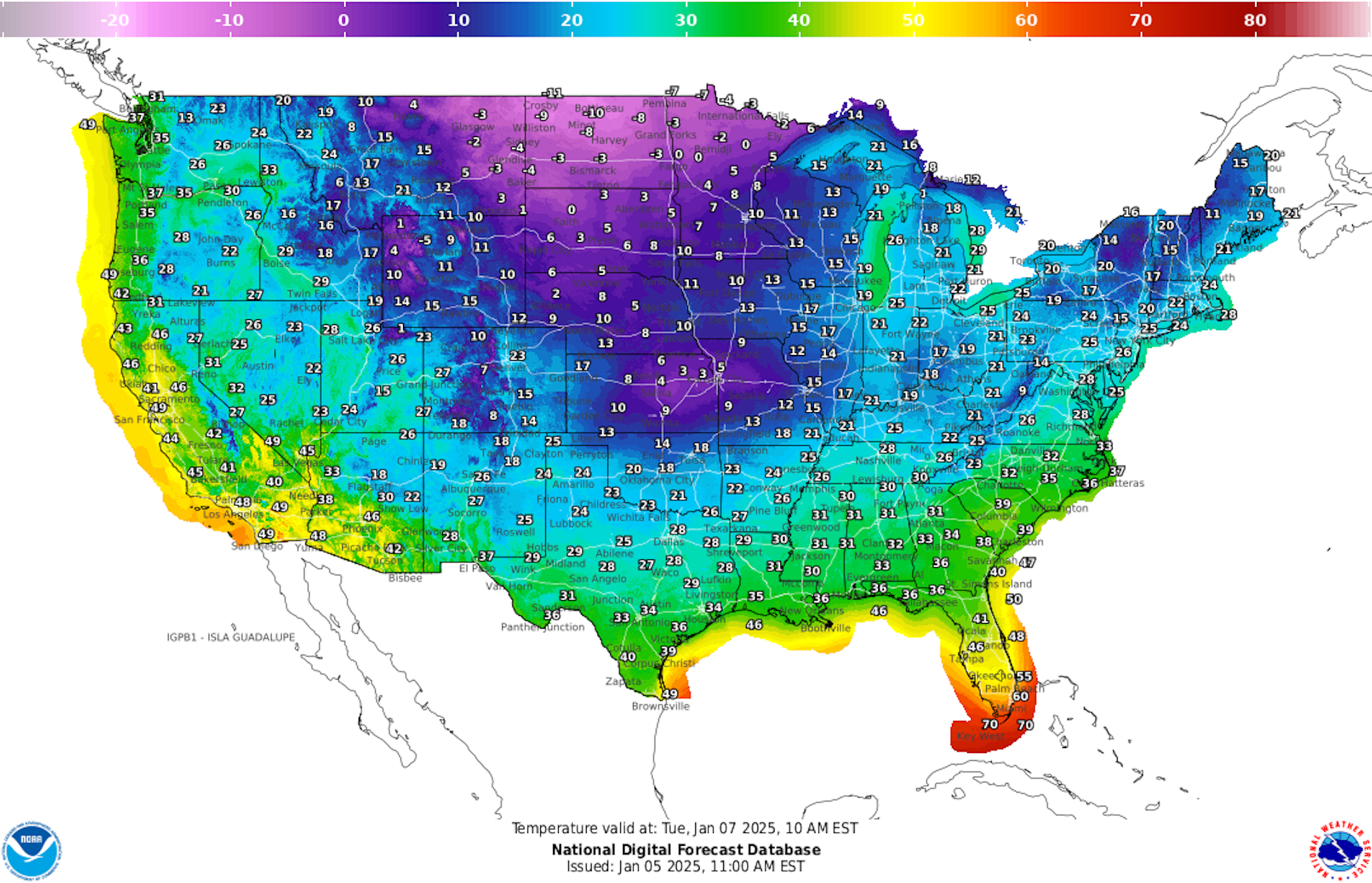
Is the weather really abnormally cold? That depends on which years are used as a baseline for 'normal.'

When winter fills the air with cold and bone-chilling gusts, and ice and snow bow down even the sturdiest looking of evergreen branches, it's easy to think that the weather is so much colder than normal. But is it? Using what's "normal" compared to what isn't normal can be confusing. "While temperature forecasts are important to help people stay safe, the comparison to normal can be quit misleading," writes Richard B. Rood for The Conversation. "That’s because what qualifies as normal in forecasts has been changing rapidly over the years as the planet warms."

Who determines what normal temperatures are? "One of the most used standards for defining a science-based normal is a 30-year average of temperature and precipitation," Rood explains. "Every 10 years, the National Center for Environmental Information updates these normals, most recently in 2021."

Over the past century, the planet's temperatures have increased. Rood writes, "Because global temperatures are warming, what’s considered normal is warming, too. So, when a 2025 cold snap is reported as the difference between the actual temperature and normal, it will appear to be colder and more extreme than if it were compared to an earlier 30-year average."

How U.S. temperatures considered normal have changed over the decades. Each 30-year period is compared to the 20th-century average. (NOAA Climate.gov graphic via The Conversation)
To get a better picture of our warming planet, "NASA scientists use 1951-1980 as a baseline," Rood explains, "The reason becomes evident when you compare maps. For example, January 1994 was brutally cold east of the Rocky Mountains. If we compare those 1994 temperatures to today’s normal – the 1991-2020 period – the U.S. looks a lot like maps of early January 2025’s temperatures: Large parts of the Midwest and eastern U.S. were more than 7 degrees Fahrenheit below normal, and some areas were much colder. . . . But if we compare January 1994 to the 1951-1980 baseline instead, that cold spot in the eastern U.S. isn’t quite as large or extreme."

Despite global warming, cold air outbreaks will continue, "but as the Arctic and the rest of the planet warm, the most frigid temperatures of the past will become less common," Rood adds.

Friday, November 08, 2024

Forty-eight states face moderate drought, which affects groundwater supplies, agriculture and river transportation

Drought caused this sunflower crop to fail.
(Adobe Stock photo)
This summer's scorching heat may be over, but across the United States a lack of soil-absorbed rainfall has left most states facing drought conditions. "More than 150 million people in the country – and 149.8 million in the 48 contiguous states – are in a drought this week. That is about a 34% increase since last week and an over 150% increase since last month," reports Marina Dunbar of The Guardian. Drought is present in every state except Alaska and Kentucky, in fact, this is the greatest number of states in drought in U.S. Drought Monitor history.

Drought conditions aren't just about lack of rainfall, they "are driven and exacerbated by abnormally high temperatures that can quickly suck moisture from the atmosphere and the earth," Dunbar explains. "Droughts can occur even when there is slightly more rain than usual, depending on the frequency of rainfall. If there is a lot of rain all at once, it’s difficult for the water to be properly absorbed into the ground."

National Integrated Drought Information System data

When droughts occur, groundwater supplies get tapped, which can take weeks, months or centuries to replenish. "According to the National Integrated Drought Information System, droughts will increase an area’s reliance on groundwater. Groundwater provides more than 40% of the water used for U.S. agriculture and domestic water supplies. Increased pumping during droughts can reduce the future availability of those supplies."

Meanwhile, dry conditions have a domino effect on water sources, agriculture production and commodities trading. "Low water levels on rivers and other waterways [can cause] ports and other water-borne transportation to become limited due to a reduction in available routes and cargo-carrying capacity, which increases transportation costs. . . That cost increase is ultimately transferred to consumers, who see it in the form of higher-priced products, groceries and other commodities."

Friday, November 01, 2024

Driverless tractors are already operating on some U.S. farms. Automation offers benefits, but farm workers worry.

A mechanical engineer walks with a sustainable agricultural
robot. (Photo by ThisisEngineering, Unsplash)

The harvest is plentiful and the workers are robots. That's the plan for some U.S. farms. "A growing number of companies are bringing automation to agriculture. It could ease the sector’s deepening labor shortage, help farmers manage costs, and protect workers from extreme heat," report Melina Walling of The Associated Press and journalist Ayurella Horn-Muller. "Automation could also improve yields by bringing greater accuracy to planting, harvesting, and farm management."

Florida farmer Jeremy Ford was tired of wasting water and using fossil fuel-run equipment to care for his crops, so he turned to an automated underground system, "that uses a solar-powered pump to periodically saturate the roots of his crops, saving 'thousands of gallons of water,'" Walling and Horn-Muller explain. "Although they may be more costly upfront, he sees such climate-friendly investments as a necessary expense — and more affordable than expanding his workforce of two."

What about automated harvesting? "On some farms, driverless tractors churn through acres of corn, soybeans, lettuce and more. Such equipment is expensive, and requires mastering new tools, but row crops are fairly easy to automate," AP reports. South Dakota farmer Frank James along with his family members, "swear by tractor 'autosteer,' an automated system that communicates with a satellite to help keep the machine on track. . . [but] requires human oversight to work as it should."

While some agriculture stakeholders have pushed back against automation, some farmers look to the technology's potential to increase profitability and decrease business headaches. Walling and Horn-Muller report, "Will Brigham, a dairy and maple farmer in Vermont, sees such tools as solutions to the nation’s agricultural workforce shortage. Since 2021, Brigham’s family farm has been using Farmblox, an AI-powered farm monitoring and management system that helps them get ahead of issues like leaks in tubing used in maple production."

Robotic farm tools may make caring for crops during extreme heat more efficient without putting human workers at risk. "Extreme heat, drought and intense rainfall have made labor-intensive corn detasseling even harder," Walling and Horn-Muller write. 

Even with its benefits, automated farming may affect farm worker employment. "Automation can be a 'tactic, like a strategy, for bosses, so people are afraid and won’t demand their rights,' said Luis Jimenez, a New York dairy worker. Robots, after all, 'are machines that don’t ask for anything,' he added. 'We don’t want to be replaced by machines.'"

Editor's note: This story was a collaboration between The Associated Press and Grist.

Will this winter be as mild as last winter? Experts give national 2024-2025 outlook predictions.

The 2024-2025 winter outlook map shows the greatest chances for cooler conditions
in the Pacific Northwest. (NOAA map via Dovers)

In most parts of the country, last year's winter was mild. So mild, in fact, Wisconsin snowmobile enthusiasts dubbed it the "lost winter" because there was so little snowfall, reports Cheyenne Kramer of Drovers. "But according to Eric Snodgrass, senior science fellow at Nutrien Ag Solutions, the consensus is that the months ahead are going to look a lot different."

Snodgrass believes that "this winter brings about a 75% chance for La Niña to develop, which is when the trade winds across the equatorial Pacific are strong. With La Niña in the forecast, the National Oceanic and Atmospheric Administration is predicting wet conditions in the north and dry, warm weather in the south," Kramer adds. "Department of Agriculture meteorologist Brad Rippey says La Niña can also bring chances for extreme cold events."

One of the gains agribusiness advocates hope to see this winter is enough moisture to balance regional droughts. Snodgrass told Kramer, "The best winters for agriculture are the ones we hate and remember as being terrible — we get good, hard freezes and plenty of moisture comes in. If we don’t see that, we get into a situation where we become very dependent on spring rains and may have a conversation about 2025 drought risk.”

The 2024-2025 winter outlook map for precipitation shows wetter-than-average conditions
likely across the Great Lakes region (NOAA map via Drovers)

The increase in droughts across southern U.S. tiers is worrisome, and this winter may not improve that problem. Northern areas are predicted to receive more moisture. Rippey told Kramer, "While much of the north will have the opportunity for relief from this growing drought. . . . We are expecting a generally warmer- and drier-than-normal winter across the entire southern tier of the United States. . . . That does include important winter wheat production areas in the southern Great Plains. There’s not much reserve right now in terms of soil moisture."

If rain and snowfall are to help drought regions, timing is everything. Rippey told Kramer, "It’s important to start getting moisture before it gets too cold. When you go into a cool season like this with limited soil moisture, if the cold air comes in too quickly, you freeze the soils before you get moisture, which can limit the absorption of rain and snow into those soils." Kramer adds, "the timing of when La Niña really starts to take effect will be important as well."

Friday, October 25, 2024

Researchers are modifying the DNA of corn seeds to reduce pollution and dependence on fertilizer .

Pivot Bio's microbes help nourish corn seeds in the ground and reduce their need for
chemical fertilizers. The process has a lot of unanswered questions. (Privot Bio graphic)

In a novel approach to stemming agriculture's contribution to climate change, researchers are altering bacterial DNA, so that corn seeds require less chemical fertilizer to thrive, reports Eric Lipton of The New York Times. "Globally, the manufacture, transportation, and use of chemical fertilizer is responsible for pollution with the equivalent planet-warming power of about 1 billion metric tons of carbon dioxide each year. That’s more than the combined releases from all the coal-burning power plants in the U.S."

Research on genetically modified bacteria that is sprayed on corn seeds and then planted in the U.S. corn belt is ongoing. If successful, it could revolutionize how plantings are nourished throughout their growth cycle while helping reduce carbon emissions. Lipton writes, "Just five years after they were introduced, the seeds are being used on 5% of American corn crops."

The sprayed seeds are produced by Pivot Bio, a California-based company, which "estimates that last year, its treated seeds prevented the release of an estimated 706,000 metric tons of carbon dioxide equivalent — comparable to the greenhouse gasses from burning 1.5 million barrels of oil," Lipton reports. "But it’s also producing intense pushback."

The alteration of bacteria and its application to corn seeds has some organic farming groups up in arms and "manufacturers of chemical fertilizer are also raising doubts about the new industry player," Lipton adds. "Pivot’s own advisers concede there are unanswered questions." David Kanter, a Pivot adviser who teaches environmental studies at New York University, told Lipton, "We have rarely created a solution to an environmental problem that doesn’t create other unforeseen consequences down the line."

Meanwhile, other companies are creating their own hubs of fertilizer-replacement research. "The goal is to supplant as much as half the fertilizer used today," Lipton reports. "Companies, including Ginkgo Bioworks and BioConsortia, are developing their own versions. Academics at M.I.T. and other universities are trying to make further advances. . . . At this point, scientists don’t believe they can completely eliminate the need for chemical fertilizer."

Friday, October 04, 2024

Simply adding ground limestone to rivers and oceans could decrease global warming, but the challenges are many

Rivers
naturally
deliver
carbon
to
the
ocean,
preventing
it
from
entering 
the
atmosphere.
(CarbonRun graphic)
Scientists aim to fight global warming by adding ground limestone to oceans and rivers, report Brad Plumer and Raymond Zhong of The New York Times. The Earth's water sources "contain carbon dioxide that is constantly escaping into the air, where it traps heat and warms the planet. Adding limestone converts some of that carbon dioxide into a stable molecule that instead stays underwater and washes into the sea, where it should remain trapped for thousands of years."

Oceans already play a big part in removing carbon dioxide from the atmosphere. "By speeding up that process, scientists believe even more carbon could be packed into those watery depths," the Times reports. "One idea is known as alkalinity enhancement, which involves adding limestone, magnesium oxide or another alkaline substance to rivers and oceans, changing their chemistry in a way that makes them soak up more carbon dioxide."

The company, CarbonRun, is putting the new science to the test, with its first limestone silo under construction in Nova Scotia. Later this year, "the machine will grind up limestone inside a tall green silo and release the powder into the nearby West River Pictou, creating a chalky plume that should dissolve within minutes," Plumer and Zhong explain. With the addition of powdered limestone, the water will do the rest. "Scientists estimate that similar methods deployed in oceans could remove billions of tons per year."

Despite its promise, the technology faces challenges from nature and unanswered questions. While dumping ground limestone in a river may be successful, full-scale drops into oceans would be more complex and require massive amounts of ground limestone. The Times reports, "toying with ocean chemistry also carries unknown risks. Some environmental groups worry that even early experiments with these techniques could threaten fish and other aquatic life."

To mitigate environmental pushback, CarbonRun’s founders are "proving that adding limestone to rivers doesn’t just take carbon out of the air — it can also safely benefit local ecosystems," Plumer and Zhong add. "It’s relatively straightforward for CarbonRun to show that adding limestone to rivers converts some carbon dioxide into a stable bicarbonate. . . .The harder part is mining and moving the limestone cheaply."

Friday, September 20, 2024

Drought causes transportation headaches along the Mississippi River for the third year in a row

Bridge near Vicksburg, Miss., and a pusher tug headed up
the Mississippi River. (Photo by Justin Wilkens, Unsplash)
A drying Mississippi River is causing transportation headaches and delays for the third year running in what scientists suggest could be a long-lasting change. "Extreme drought conditions in the Midwest are drawing down water levels on the Mississippi River, raising prices for companies that transport goods downstream and forcing governments and business owners to seek alternative solutions," reports Kristoffer Tigue of Inside Climate News. "The situation could signal an emerging reality for the region, scientists say, as climate change alters the planet’s weather patterns."

Despite Hurricane Francine's water dump in the Ohio Valley, Mississippi River levels have dipped since mid-July, which slows traffic. "Load restrictions force barge operators to limit their hauls, which squeezes their profit margin," Tigue explains. "Barge rates from St. Louis reached $24.62 a ton in late August and $27.49 per ton by the following week, according to the Department of Agriculture."

Moving cargo via the Mississippi River is more "efficient pound for pound than ground transportation, business groups say, and gives the U.S. an edge in a competitive global market," Tigue reports. "According to the Waterways Council, a trade association for businesses that use the Mississippi River, a standard 15-barge load is equivalent to 1,050 semi trucks or 216 train cars—meaning domestic farmers and other producers can save significant time and money moving their goods by boat."

Too much rainfall or not enough causes river transportation backups, and over the past several years, weather fluctuations in the Midwest have swung between the two. Drought conditions at harvest time are particularly troublesome. Tigue writes, "While it’s typical for water levels on the Mississippi to drop during the fall months, Mike Steenhoek, executive director of the Soy Transportation Coalition, said the recent years of drought have been a real wake-up call for farmers to diversify their supply chains."

If there's a little good news, it's that this year's drought headaches are not as extreme as those from 2023, when the Mississippi dipped to record lows. Tigue reports, "Deb Calhoun, senior vice president of the Waterways Council, chalks that up to proactive efforts this year by companies and federal agencies, like the Army Corps of Engineers, to mitigate transportation disruptions."