Showing posts with label abandoned mines. Show all posts

Wednesday, October 04, 2023

In the shadow of the coal industry, the Mountain Valley Pipeline runs into resistance in Appalachia

The Daily Yonder graphic

The long relationship between Appalachian people and energy industry representatives was barely forged before it started to fracture due to misrepresentation and unscrupulous contracts pushed by coal representatives, reports Hannah Wilson-Black of The Daily Yonder. More recently, Mountain Valley Pipeline representatives have come calling, and wiser Appalachians are not all-in for their contracts or pipeline.

"When speculators and early corporations first came to the hollers of Central Appalachia's coal country in the late 1800s, they wanted to buy landowners' mineral rights — not the rights to their farmland, but to the coal underneath," Wilson-Black writes. "Knowing that these landowners were subsistence farmers who had little money and were not fluent in legal language or the going price of coal, the land agents offered to buy mineral rights for as little as fifty cents an acre. Or, as West Virginian community organizer Maury Johnson put it, for 'a little bit of nothing and a Christmas turkey.'"

MVP representatives first approached West Virginia and southwest Virginia landowners in 2014, "seeking 'right-of-way' easement agreements that would allow the pipeline to go through private property without requiring purchase of the land itself. Johnson, a resident of Monroe County, was one such landowner," Wilson-Black reports. "An analyst sent by the company asked to survey his farm, and Johnson agreed — with the stipulation that he accompany the surveyors. . . . Johnson claimed that when he followed the surveyors around, he watched them omit the existence of springs or dangerous karst formations on his property in their reports, and said the surveyors would only note the geographic obstacles when he drew attention to them."

Sunset in Monroe County, W.Va., one of the counties the MVP
pipeline passes through. (Photo by Hannah Wilson-Black)
Johnson and Arietta DuPre, who also lives in Monroe County, told Wilson-Black that MVP representatives employed some of the same undervalue-offer tactics coal companies used years ago. Johnson told her: "A lot of people, they've never dealt with this. They don't know what they're doing. I didn't know what I was doing. They [MVP representatives] say, 'We'll give you X amount of dollars, this is the best you're going to get."

Johnson found a way to protect his property. Wilson-Black reports, "He retained an eminent domain attorney who negotiated a higher price for his easement based on 'real impacts to the property,' as he put it. This allowed him to avoid a protracted — and expensive — court battle with MVP. He was also able to stipulate, through his final contract, which crops or chemicals MVP must use to restore the land."

As the pipeline build continues, landslides and explosions remain a top concern to residents who fear a repeat of the Leach XPress Pipeline explosion in Marshall County, West Virginia, where "a fireball burned for several hours after an 83-foot section of the pipeline burst into flames, releasing more than $430,000 worth of natural gas," Brittany Patterson reported for West Virginia Public Broadcasting. Land shift was blamed for the explosion, which left a crater in the ground and a stark reality burned into Appalachian communities.

Tuesday, October 18, 2022

Large coal firms shed mine-cleanup responsibilities by selling old mines to smaller firms less able to do reclamation

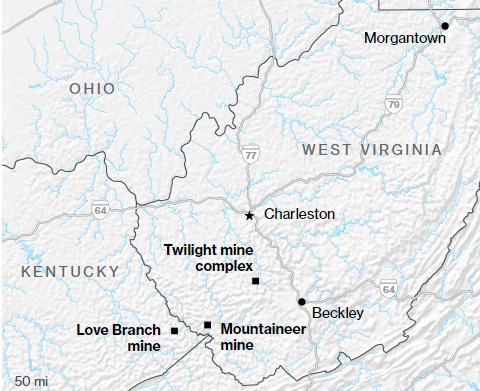
Some mines owned by Lexington Coal (Bloomberg)
Facing bankruptcy and looking to avoid the cost of mine cleanup, larger coal companies offload older mines in need of reclamation onto smaller companies with little resources, reports an investigation by Bloomberg and NPR. Those smaller companies often can't foot the bill for reclaiming the old mine land, "raising the risk that taxpayers, rather than industry, will eventually be stuck with the cost."

The unreclaimed mines are also hazards to the environment and local communities. A man who lived near the Love Branch mine near the Kentucky border with West Virginia told the news organizations that red water running off from the mine flooded his property, causing him to fall through his floor and ruining his septic system. Lexington Coal Co., the company that owns the mine some in West Virginia, has the second-most violations of any coal operator in the country this year. Lexington acquired the mines from Alpha Metallurgical Resources, one of the largest coal companies in the U.S. 

Since 2015, when an industry-wide downturn pushed Alpha and other large coal companies into bankruptcy, the company has transferred more than 300 mining permits to smaller companies like Lexington. It also shed its pension and health-care obligations, went through bankruptcy, and saw its share price increase over 700% since 2016, Bloomberg and NPR report. 

Bloomberg graph
Of the 232 mostly idle mining permits that Alpha transferred to Lexington Coal, only 41 have been cleaned up, the investigation found. The company has also only authorized the release of about 13% of the reclamation bonding needed to pay for restoring the mines.

Friday, September 16, 2022

Quick hits: Studies confirm ivermectin doesn't work on Covid; how community journalism helps keep Vt. together...

Here's a roundup of stories with rural resonance; if you do or see similar work that should be shared on The Rural Blog, email us at heather.chapman@uky.edu.

The Federal Communications Commission is redrawing long-criticized broadband connectivity maps, but it looks like the new ones will omit agricultural structures. That could make rural areas look more connected than they are, and leave farmers without broadband where they need it. Read more here.

Here's a good explainer on how ranked choice voting works, and how it helped Democrat Mary Peltola win a House seat in Alaska. Read more here.

How community journalism helps keep Vermont together. Read more here.

The United States is becoming a 'developing country' on global rankings that measure democracy and inequality. Read more here.

The verdict is in on ivermectin. Repeated, reputable clinical trials show that the drug doesn't help Covid-19 patients, according to FactCheck.org. Read more here.

An invasive fungus virtually wiped out the American chestnut about a century ago. Now a nonprofit group is trying to repopulate reclaimed surface coal mines in Appalachia with a hybrid version of the species. Not only would that bring back a once-popular tree, it could help rural communities and the environment in many ways. Read more here.

Rural entrepreneurs report growing anxiety. Read more here.

The Christian majority in the U.S. could fade in coming decades, models predict. Read more here.

Friday, May 13, 2022

Quick hits: Some rural right-wingers converting to Russian Orthodoxy; Silas House remembers Naomi Judd

Here's a roundup of stories with rural resonance; if you do or see similar work that should be shared on The Rural Blog, email us at heather.chapman@uky.edu.

In a recently aired segment, right-wing cable network One America News Network admits there was no widespread voter fraud by Georgia election workers in the 2020 presidential election. The segment appears to be part of the recent settlement of a defamation lawsuit two election workers brought against the network. Read more here.

A new generation of female country music singers is bringing new listeners to the genre and gathering critical acclaim, but old-guard industry insiders and fans are pushing back against them and questioning whether they're "country" enough. A new book from journalist Marissa Moss contrasts the phenomenon against a well-researched history of country music. Read more here.

One Michigan farm is a cautionary tale of the dangers of PFAs (often called "forever chemicals") and the sewage sludge fertilizer that brings them to farms. Read more here.

"She had the most beautiful handwriting, and she often dotted her i’s with hearts. Naomi loved dogs, and bodies of water, and Mary Oliver poems," writes Kentucky author Silas House in a moving and intimate tribute to his friend, the late Naomi Judd. Read more here.

An abandoned mine reclamation project is making some headway in Appalachia, but many long-term challenges remain. Read more here.

Some right-wing Americans—including in rural West Virginia—are converting to Russian Orthodoxy, drawn to its conservative stances on social issues. A scholar who researched the phenomenon (and wrote a book about it) noted that converts tend to admire Russian president Vladimir Putin, and show sympathy toward white nationalism and authoritarian government. Read more here.

Republican primary candidates are increasingly trying to dodge journalists, even barring them from free and public campaign events. Read more here.

The Rural Health Information Hub has updated toolkits and information guides on rural suicide prevention and rural oral health.

If you want a slice of rural life in the Upper Midwest, visit a Cenex station, writes a columnist and musician. Read more here.

Wednesday, January 05, 2022

New movement calls damage from abandoned coal mines 'ecocide,' framing it as a harm to rural people

Bankrupt coal companies often fail to reclaim abandoned mines, leaving cash-strapped rural communities to suffer devastating environmental consequences. A growing coalition of activists is calling such a move "ecocide" and wants to make it and other widespread ecological damage a crime before the International Criminal Court, James Bruggers reports for Inside Climate News. Such a declaration would have no legal bearing, since the United States isn't a member of the ICC, but the notion could help frame such "crimes against nature" in terms of the harm they do to people—especially the rural residents who live nearby and suffer the worst consequences.

The damage from abandoned mines could last millennia, according to Duke University ecologist Emily Bernhardt, who has studied Appalachian strip mines and the long-term impacts of coal mining for nearly two decades. "There are coal mines from the Roman Empire that are still emitting acid pollution," she told Bruggers.

Coal companies buy bonds that are supposed to cover the cost of reclamation if they go bankrupt or suffer a disaster. But many states don't require them to buy enough to do the job, and coal companies are increasingly leaving rural communities holding the bag. The phenomenon is rampant in Central Appalachia: "Mountaintop removal and other forms of surface mining have scarred an area of more than 2,300 square miles in Kentucky, West Virginia, Virginia and Tennessee," Bruggers reports. "Nationwide, over a million acres of land used by still operating, idle or abandoned mines need to be cleaned up and reclaimed—a job President Biden’s new $1.2 trillion infrastructure bill can only begin to address."

A recent report found that it will cost as much as $9.8 billion to reclaim coal mines in Central Appalachia. The infrastructure bill passed in November reauthorized the Abandoned Mine Land Program and allocated $11.3 billion to clean up abandoned mines.

Tuesday, December 14, 2021

Abandoned oil and gas wells, coal mines, hurt environment and locals' health; infrastructure funds earmarked to help

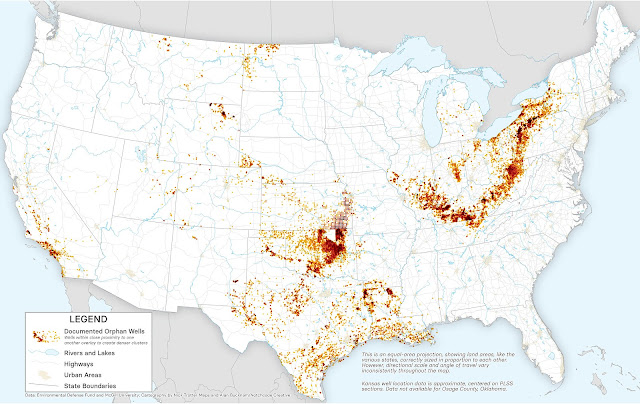
Map of documented abandoned wells from Environmental Defense Fund report; to enlarge, click on it or go here.

Coal, oil and natural gas have been major economic drivers in many rural areas, but these extractive industries have in many cases damaged the environment, and in some health of nearby residents, and too often failed to clean up after themselves. Federal funding can make a dent in the problem.

"In Pennsylvania, underground mine fires burn and iron-laden, acidic water pours into rivers from abandoned mine shafts. In New Hampshire, the iconic sugar maple is threatened by soil damage lingering from coal-induced acid rain," James Bruggers reports for Inside Climate News. "In Florida, a young mother obsesses over air and water pollution from a vast pile of coal ash stored by her local utility. And in Kentucky, the multi-billion dollar cost of reclaiming abandoned mines . . . far exceeds the amount of surety bonds left behind by an increasing number of bankrupt coal companies. "

Many states don't require coal companies to buy enough bonds for reclamation. That means bankrupt companies often leave rural places to pay for the cleanup themselves or suffer the environmental consequences. "Across Appalachia, mountaintop removal and other forms of surface mining have scarred an area of more than 2,300 square miles in Kentucky, West Virginia, Virginia and Tennessee. Nationwide, over a million acres of land used by still operating, idle or abandoned mines need to be cleaned up and reclaimed," Bruggers reports.

Meanwhile, there are more than 2 million inactive, unplugged oil and gas wells scattered across the U.S., according to a recently published map from the Environmental Defense Fund. Such wells often poison groundwater and leak the potent greenhouse gas methane. The Environmental Protection Agency estimates that the wells could leak as much methane per year as 5 million cars. The EDF's map shows 81,000 abandoned wells that are documented as having no owner.

Cleaning up abandoned fossil fuel sites is cost-prohibitive for states. It costs an average of $25,000 to $475,000 to close each oil or gas well. And a recent report found that it will cost as much as $9.8 billion to reclaim coal mines in Central Appalachia. On the upside: the recently signed infrastructure bill included $16 billion to clean up abandoned mines and old oil and gas wells.

Wednesday, August 11, 2021

Infrastructure bill has provisions for abandoned mine and well reclamation, dangerous dam removal, and more

The infrastructure package the Senate passed Tuesday has plenty in it for rural America. The Rural Blog has previously reported on this, but some parts of the huge bill are still coming to light. 

The package allocates $11.3 billion to help clean up abandoned mines, nearly double the $6 billion the Abandoned Mine Reclamation Fund has received in the past 15 years (see p. 1776 of the bill) but short of the estimated $20 billion (click here for state estimates) needed for total clean-up costs.

The package also has $4.7 billion for plugging and reclaiming abandoned oil and gas wells on federal, state and tribal lands (p. 1744). States can apply for competitive grants of up to $25 million for the purpose. Well and mine operators must post bonds meant to cover clean-up costs, but they're often inadequate, and rural governments are frequently stuck with the bill when companies go under.

The mine funding will be spread over 15 years and will go to 25 states and three tribes: Alabama, Alaska, Arkansas, Colorado, Illinois, Indiana, Iowa, Kansas, Kentucky, Louisiana, Maryland, Mississippi, Missouri, Montana, New Mexico, North Dakota, Ohio, Oklahoma, Pennsylvania, Tennessee, Texas, Utah, Virginia, West Virginia, Wyoming, and the Crow, Hopi and Navajo.

Dam safety also gets attention in the bill: It creates and funds a $553 million grant program for hydroelectric dam owners to make them safer and more efficient. And it would provide $1.6 billion for government agencies to remove dangerous dams. 

The package calls on the Transportation Department's Build America Bureau to establish a Rural and Tribal Assistance Pilot Program to provide technical, financial and legal assistance to rural and tribal governments' infrastructure projects. The pilot program is meant to last five years, and is funded as follows: $1.6 million for fiscal year 2022, $1.8 million for FY 2023, $2 million for FY 2024, $2.2 million for FY 2025, and $2.4 million for FY 2026.

Wednesday, July 14, 2021

Report: Appalachia needs billions to clean up old mines

Unreclaimed and partially reclaimed acreage for all current
mine permits in Appalachia (Appalachian Voices map)
A new report found that it will cost Appalachian states billions to clean up abandoned coal mines, much more than the now-bankrupt coal companies were required to provide for the purpose.

"It will cost from $7.5 billion to $9.8 billion to reclaim 633,000 acres of just coal mines that have been closed or idled since 1977 across seven Appalachian states, according to the report from environmental nonprofit Appalachian Voices," Mike Tony reports for the Charleston Gazette-Mail. "That’s twice as much as the $3.8 billion in total bonds available to those states, according to the report."

"The report’s author, Appalachian Voices senior program manager Erin Savage, said in a teleconference Wednesday that Appalachian state environmental regulators need to do far more to address the shortfall poised to grow as more coal companies declare bankruptcy, ditch their reclamation obligations and leave state bonding systems on the hook," Tony reports.

"Lack of reclamation can be a burden and hazard to coal communities, Savage said [during the teleconference]. They pointed to Blackjewel, a bankrupt coal company that was once the nation’s sixth-largest coal producer," Liz Moomey reports for the Lexington Herald-Leader. "In March, a bankruptcy judge approved Blackjewel’s plan to abandon or transfer its mining permits, but the majority of their Kentucky permits have either not been transferred to other coal companies or have no interested buyer and are likely to be abandoned."

After the Blackjewel ruling, Sierra Club senior attorney Peter Morgan said he feared the case might signal a trend in which bankrupt coal companies "dump their coal mine cleanup obligations onto communities and taxpayers who simply don’t have the money to pick up the tab."

Rebecca Shelton, policy director at the Appalachian Citizens' Law Center, echoed Morgan, Moomey reports. "We are really worried that this bankruptcy is a harbinger of what’s to come if no action is taken to ensure that bonding is sufficient to cover reclamation cost in all currently permitted mine sites," she said when presenting the report to state lawmakers last week.

During the teleconference, Savage said state agencies haven't taken bond shortfalls seriously enough, but said Blackjewel's bankruptcy might serve as a warning to other states, especially as the coal industry continues declining and more companies go bankrupt, Moomey reports.

Monday, May 17, 2021

Abandoned mine cleanup in Appalachia might be twice as expensive as thought, but little federal money is left to do it

Cleaning up abandoned mine lands in Appalachia might be twice as expensive as previously thought, but there's little federal money available to do it. 

"The federal AML inventory estimates that the cost of cleaning up all abandoned mine land – land that was mined before the passage of the Surface Mine Control and Reclamation Act in 1977 – is $11 billion," Anya Slepyan reports for The Daily Yonder. "But a new report from the Ohio River Valley Institute shows the cost is more than double what the federal inventory previously claimed: $26 billion."

The 1977 law was the first major federal effort to regulate environmental impacts of coal mining. It "required that coal companies set aside money to pay for the restoration of all land permitted after the law’s implementation. The law also designated any land mined prior to 1977 as abandoned mine land, and set up a fund to reclaim these sites by collecting a small fee on each new ton of coal produced," Slepyan reports. "The AML fund has collected a total of $11.496 billion, of which only $2.23 billion remains." 

The new report shows that's not enough. "According to the report, of the 1.2 million acres designated as abandoned mine land, only 27% has been cleaned up since the 1970s," Slepyan reports. "The cost of reclaiming the remaining 850,000 acres is an estimated $26.3 billion, a price that will only increase if sites are left to degrade for decades more." Unreclaimed mine lands pose a significant environmental and financial threat to local communities, she writes.

Wednesday, April 07, 2021

Biden's infrastructure plan includes $16 billion to clean up old oil and gas wells, abandoned mines

"President Joe Biden’s $2.3 trillion plan to transform America’s infrastructure includes $16 billion to plug old oil and gas wells and clean up abandoned mines, a longtime priority for Western and rural lawmakers from both parties," Matthew Daly reports for The Associated Press. "Many of the old wells and mines are located in rural communities that have been hard-hit by the pandemic. Biden’s plan would not only create jobs, but help reduce methane and brine leaks that pollute the air and groundwater. Methane is a powerful contributor to global warming."

The hundreds of thousands of orphaned wells and abandoned mines cause ongoing environmental damage and pose serious safety hazards to nearby communities. Well and mine operators must post bonds meant to cover clean-up costs, but they're often inadequate. And, perhaps signaling a trend, a judge recently allowed the bankrupt Blackjewel coal mining company to walk away from reclamation costs on some of its abandoned mines. More communities could be left on the hook for cleanup costs if future rulings break that way, making federal investment all the more important.

"The Interior Department has long led efforts to cap orphaned wells — so named because no owner can be found — but does not assess user fees to cover reclamation costs. Bond requirements for well operators, when known, are often inadequate to cover full clean-up costs. Biden’s plan, which needs approval by Congress, would jump-start the well-capping effort and expand it dramatically," Daly reports. "Similarly, the White House plan would exponentially boost an Abandoned Mine Land program run by Interior that uses fees paid by coal mining companies to reclaim coal mines abandoned before 1977. About $8 billion has been disbursed to states for mine-reclamation projects in the past four decades, but Biden’s plan would ramp up spending sharply."

Monday, March 22, 2021

Bankruptcy judge lets coal firm walk away from reclamation costs for abandoned surface mines; could signal a trend

"The Blackjewel coal mining company can walk away from cleaning up and reclaiming coal mines covered by more than 30 permits in Kentucky under a liquidation agreement that was reached Friday in federal bankruptcy court in Charleston, West Virginia, attorneys participating in the case said," James Bruggers reports for Inside Climate News. Blackjewel made national news when Kentucky miners blocked a coal train in 2019 after the firm abruptly declared bankruptcy and their paychecks bounced. 

The ruling means rural counties with shuttered Blackjewel surface mines could have to pay for those costs or expose nearby residents to safety and environmental hazards. "In court testimony, residents and state regulators described mines with unstable slopes presenting landslide risks, and clogged pipes putting retention ponds containing polluted water at risk of overflowing," Bruggers reports.

Coal companies must post bonds to guarantee reclamation, and are supposed to reclaim abandoned mines as they go, but Blackjewel and affiliate Revelation Energy posted inadequate bonds, according to court documents. That's a longstanding problem in Kentucky.

Peter Morgan, a senior attorney for the Sierra Club, which is participating in the case, said he worries the Blackjewel ruling may foretell similar cases. "Unfortunately, this is likely the start of a trend where bankrupt coal companies dump their coal mine cleanup obligations onto communities and taxpayers who simply don’t have the money to pick up the tab," Morgan told Bruggers. "This should be a wake-up call to state regulators across the country to immediately hold coal mining companies accountable and to put miners to work cleaning up coal mines before all the burden falls on taxpayers and underfunded surety bonds."

It's unclear what will happen to the 170 or so other Blackjewel permits in Kentucky, Tennessee and West Virginia. They "will be placed into legal limbo for six months while Blackjewel attempts to sell them to other coal mining companies. Any permits that are unable to be transferred can then also be abandoned by the company, once the nation’s sixth-largest coal producer," Bruggers reports. "The judge required coal mining companies that might purchase the permits to take reclamation responsibility should they eventually go bankrupt, she said. But their financial condition in a weakened coal industry makes that also uncertain."

Tuesday, February 02, 2021

Sen. Manchin criticizes vice president's interview with W.Va. station, highlighting Biden's tricky Senate balancing act

Vice President Kamala Harris is facing blowback after a Jan. 28 interview with a West Virginia TV station about the administration's pandemic relief package, highlighting the complicated politics surrounding the issue and the Biden administration's precarious position in the Senate. 

During the interview with NBC affiliate WSAZ-TV in Huntington, Harris noted that the pandemic has hit the state's economy hard and spoke about finding work for laid-off coal miners in reclaiming abandoned mines (though she misspoke and said "abandoned land mines," which spawned social-media mocking). Sen. Joe Manchin, the only Democrat elected statewide in West Virginia, complained to the station the next day that the White House hadn't asked his advice about persuading West Virginians, Cleve R. Wootson Jr. reports for The Washington Post. White House Press Secretary Jen Psaki said the administration has been in regular contact with Manchin for weeks and will continue to be, but said the administration also wants to make a case for its recovery plan directly to voters. 

Though Harris had a very liberal voting record as a senator, her appearance "seemed to be part of an effort to pressure moderate senators, since she also spoke to a news station in Arizona, home to Sen. Kyrsten Sinema, who like Manchin is a centrist Democrat," Wootson reports. An evenly split Senate means "means centrist Democratic senators, who are most likely to defect, will often control the fate of Biden’s initiatives."

An anonymous Manchin adviser said the senator is not unaware of this power, Wootson reports. But Manchin has made his name — and kept his seat — by cultivating a reputation as a maverick, according to West Virginia-based political scientist Patrick Hickey. So an early clash with the Biden administration could be a "political boon" for the senator.

At any rate, the dust-up, "while minor in many ways, makes it clear how difficult it may be for Biden to achieve the unity he has called for — even within his own party," Wootson reports.

Monday, December 21, 2020

Blackjewel bankruptcy motion, apparently denied, would dodge mine cleanup laws, abandon miners' medical claims

A judge has apparently denied a proposal to shift Blackjewel, LLC's bankruptcy from reorganization to liquidation, a shift that would have allowed the coal company to dodge its responsibility to clean up abandoned mines and pay workers' compensation for medical bills. On Nov. 25, Blackjewel lawyers motioned to convert the bankruptcy from Chapter 11 to Chapter 7. "That would mean that instead of exiting bankruptcy as a new company with less debt, Blackjewel L.L.C. would effectively cease to exist," Sydney Boles reports for Ohio Valley ReSource.

"Blackjewel had 1,100 employees at its Appalachian mines and about 600 at surface-mining operations in Wyoming," The Lane Report reports. "At the time of its bankruptcy filing, Blackjewel owed about $146 million in unpaid taxes and also owed workers unpaid wages and retirement funding." The company made national headlines in 2019 after laid-off miners in Harlan County, Kentucky, blocked a coal train from leaving for months because the bankrupt company had not paid them for recent work.

Dec. 17 was the deadline to file objections to the company's plan to liquidate. A wide range of environmental and community groups did so, along with the Kentucky Energy and Environment Cabinet, the U.S. Internal Revenue Service and federal creditors, Matt Hepler and Molly Moore report for The Appalachian Voice. At a hearing that day, Judge Benjamin Kahn denied Blackjewel's motion to shift to Chapter 7. 

It's "pretty common" for companies to shift to Chapter 7 "when they're struggling like Blackjewel is," University of Chicago School of Law assistant professor and coal bankruptcy expert Joshua Macey told Boles.

One reason Blackjewel may have been struggling so much: its former CEO, Jeff Hoops, was allegedly defrauding the company. Blackjewel lawyers filed a civil suit against Hoops on Dec. 10, accusing Hoops of making tens of millions of dollars in fraudulent transactions, Boles reports.

Thursday, September 03, 2020

EPA creates new Office of Mountains, Deserts and Plains to focus on Western issues such as mine cleanup

The Environmental Protection Agency announced Wednesday the creation of the Office of Mountains, Deserts and Plains to focus on Western issues, including mine cleanup.

"The move comes as the Interior Department is trying to ramp up its presence in the West, having recently completed a controversial move of the Bureau of Land Management's headquarters to Grand Junction, Colo.," Hannah Northey reports for Energy & Environment News. "It's unclear how the new office will interact with EPA's existing regional office system, and if it will require new employees or draw staffers from elsewhere. Details about costs and official duties are also unknown."

The office headquarters will be in the Denver Federal Center, part of the General Services Administration and already home to more than 6,000 federal employees, Northey reports.

EPA Administrator Andrew Wheeler wrote in a guest column in The Gazette in Colorado Springs that the new office will allow the agency to better address regional issues and move away from a "one-size-fits-all approach to environmental remediation."

Friday, June 26, 2020

Investigation: several financial tools meant to ensure cleanup of abandoned coal mines near insolvency

As more and more coal companies go bankrupt, the question of abandoned mine cleanup becomes more important. A 1977 federal law required mining companies to set aside money to pay for reclaiming mines, but that system is in jeopardy.

An investigation by climate scientist website DeSmog "found that several key financial instruments meant to guarantee environmental cleanup have been pushed to the brink of insolvency, potentially leaving taxpayers on the hook for hundreds of millions — if not billions — of dollars in reclamation costs," Mark Olalde reports.

Friday, February 14, 2020

Former federal strip-mine inspector leads decades-long effort to reforest reclaimed mines in Eastern Kentucky

Patrick Angel on his farm near London,
Ky. (Post photo by Jahi Chikwendiu)
Coal companies are required to reclaim mined land when they're done with a site, but one Interior Department inspector realized that the companies' practices weren't encouraging forests to grow back. So the native of Eastern Kentucky has spent the past two decades bringing them back on his own, Gabriel Popkin reports for The Washington Post Magazine.

Patrick Angel spent his career in the Office of Surface Mining Reclamation and Enforcement. "For 25 years, he oversaw the process that may represent humans' best attempt to date at total annihilation of land: strip-mining and mountaintop-removal mining of coal," Popkin reports. "He told coal companies to do one thing when they were done with a site: pack the remaining rubble as tightly as possible, and plant grass — the only type of plant he trusted to hold the ground in place."

But that didn't allow tree roots to take hold, so the forests that had existed on most of the nearly 1.5 million acres of mined land in Appalachia weren't growing back. In 2002, six years after foresters at Virginia Tech and the University of Kentucky tried to persuade him to try other methods, Angel saw that they were working, and his "guilt was almost overwhelming," Popkin reports. Angel told him, “The lightbulb came on. I said, ‘Oh my God, what have we done?’”

With the help of local volunteers and some bulldozers, Angel has spent the past two decades trying to reforest mined areas. The dozers rip up the ground and loosen the rubble so tree roots can take hold, then volunteers plant saplings from species native to the area: tulip poplars, oaks, pines and chestnuts, Popkin reports.

Washington Post map from U.S. Geological Survey National Land Cover Database
"Thanks in large part to Angel, now 70, more than 187 million trees have been planted on about 275,000 acres of former mines, an area more than six times the size of the District of Columbia," Popkin reports. This represents one of the most ambitious restoration efforts in one of the country’s most devastated places. It is led not by big name-brand environmental groups but by people from the mountains, operating with small budgets and with little fanfare or recognition."

Aside from an Appalachian Regional Commission grant, the federal government has helped little. As the Obama administration was ending, it issued regulations "that all but required reforestation for surface-mine reclamation," Popkin notes. "One of President Trump’s first acts, supposedly to reward the coal miners and industry leaders who supported him, was to kill the new rule."

Popkin's long-form piece delves into the history of coal and surface mining in Eastern Kentucky, and how it has affected the land and the people. It's a lovely example of national reporting that avoids parachute-style coverage. Popkin is a science writer who was born and raised in Kentucky, and chief photographer Jahi Chikwendiu and drone videographer Ron Garrison are from Kentucky too. The story was partly funded by a grant from the Institute for Journalism and Natural Resources.

Tuesday, November 19, 2019

Navajo and Hopi tribes scramble to find new revenue after closure of coal-fired power plant, largest in Western U.S.

Navajo Generating Station employee Alex Tsinnjinnie
at work. (AZ Republic photo by Mark Henle)
The Navajo Generating Station, the largest coal-fired power plant in the West, stopped making electricity Monday after 45 years, Ryan Randazzo and Shondlin Silversmith report for The Arizona Republic.

The 2,250-megawatt plant's closure is a deep blow to the economies of Native American tribes. The plant is in Page, Ariz. (pop. 7,247), on Navajo Nation land and most of the employees were Navajo or Hopi. Plant jobs paid much better than most other jobs nearby, and revenue, taxes and royalties from coal made up most of the Hopi budget and a third of the Navajo operating budget, Laurel Morales reports for Arizona State University's Cronkite News. 

Hopi Chairman Timothy Nuvangyaoma estimated that as much as 85 percent of his tribe's general fund budget will be affected by the closure, at least a $12 million revenue loss. Navajo leaders estimated at $30 million to $50 million decline in coal revenues for 2020, Randazzo and Silversmith report. Leaders for both tribes are considering ways to make up the shortfall, including mineral and land development, casinos, renewable energy ventures, and tourism.

The plant had been problematic for years because of the pollution it generated. In 2014, the Environmental Protection Agency struck a deal with the plant's owners to keep it running at two-thirds capacity. Then area utilities voted to close the plant two years ago; they co-own the plant with the U.S. Bureau of Reclamation. The owners, along with the Navajo and Hopi tribes, tried to keep the plant running, but Arizona's federal Salt River Project, which owns the largest share of the plant, announced a year ago it would close the plant if a buyer could not be found. CEO Mike Hummel said the station was closing because it's cheaper to produce electricity from natural gas and renewable energy sources and easier to comply with air-quality regulations, Randazzo and Shondlin report.

Before operations began winding down two years ago, the plant employed 750 people, nearly all Native Americans. Most of the miners have been laid off, though some will work on reclaiming the land. Most plant workers have transferred to new Salt River Project jobs, many in Phoenix—a four-hour drive away. Some plant workers turned down the SRP jobs because they didn't want to leave their communities, Morales reports.

Thursday, June 20, 2019

Justice Dept. shifts funds for proposed prison in E. Ky. to immigration enforcement; Congress may countermand

The Trump administration is dropping plans to build a federal prison in rural Letcher County, Kentucky, and said the $505 million allocated for it will be used instead to enforce immigration laws and improve national security. "Both budget proposals the Trump administration has sent to Congress have included provisions to take back the money approved during the final year of the Obama administration," Sam Adams reports for The Mountain Eagle in Whitesburg.

Letcher County, Kentucky (Wikipedia)
In a notice published in the Eagle, the U.S. Bureau of Prisons said there was new information related to the environmental analysis of the proposed site, which is on top of a former coal mine. But budget documents seeking to reclaim the funds list mostly economic reasons, Adams reports.

A Justice Department document justifying the decision said that, because the overall prison population is declining, it's cheaper to buy an existing facility than build one new, and the prison would be even more expensive than the average new construction, Adams reports. It also said prisons don't contribute to local economic growth because they're first staffed with experienced prison employees from elsewhere, and most locals won't be experienced or educated enough to work there. Finally, the document lists unspecified "project complications" related to the county's "unique topography" and said that challenges with land acquisition, "access, utilities, and environmental impact have contributed to increased costs and significant delays."

"Elwood Cornett, co-chair of the Letcher County Planning Commission, which has been working on the prison project for about 15 years, said he was not aware of any issues with property acquisition, other than those already addressed earlier when the size of the property needed was reduced," Adams reports. "He said he is only aware of one property owner who had talked to the bureau recently, and that person seemed satisfied with the negotiations. Cornett blamed the delay on the lawsuit filed by the Abolition Law Center, which he characterized as full of foolishness.'"
A group of federal prisoners sued last year to block the prison's construction, on the grounds that building the prison would harm the environment, and that pollutants at the site would endanger prisoners, Bill Estep reports for the Lexington Herald-Leader. The suit was one of many listing as co-plaintiff the ALC, an organization that advocates for prisoner's rights.

Fifth District U.S. Rep. Harold “Hal” Rogers, R-Somerset, told the Eagle for an earlier story that the Bureau of Prisons is nevertheless continuing the process of building the prison: “BOP leadership has assured me that the bureau will continue to defend the ongoing litigation and that internal processes related to the Letcher prison construction project continue to move forward. Meanwhile, $510 million remains available for construction, as the House Appropriations Committee has again rejected the administration’s proposed recission.”

Thursday, May 02, 2019

Bill to use accumulated coal-tax revenue for Central Appalachia moving again in House, under Democrats

U.S. Rep. Hal Rogers, R-Ky.
A bill to bring more than $100 million to the Central Appalachian coalfield passed the House Committee on Natural Resources Committee Wednesday. The Revitalizing the Economy of Coal Communities by Leveraging Local Activities and Investing More (RECLAIM) Act Of 2019, "written by U.S. Rep. Hal Rogers of Kentucky’s 5th Congressional District, would pay for the reclamation of abandoned mine lands and, advocates hope, would foster growth in areas suffering from a sharp decline in coal production in recent years,"  Will Wright reports for the Lexington Herald-Leader. 

The bill would distribute $1 billion of unappropriated money from the Abandoned Mine Reclamation Fund to coal-producing states and Native American tribes over five years for mine reclamation projects, Wright reports. One of the bill's sponsors, Rep. Matt Cartwright, D-Pa., noted, "This is money that’s already collected and sitting in the federal treasury."

Though the bill has bipartisan support, it may face the same obstacles it did when introduced in years past. The idea was originally part of President Obama's PowerPlus plan, included in his 2016 budget proposal, and most Republicans were leery of supporting it. Rogers, a Republican, filed the RECLAIM Act as a stand-alone bill in 2016. It failed to pass the Natural Resources Committee that year; in 2017 it passed the committee but didn't get a full vote in the House, Wright reports.

But now the House is controlled by more free-spending Democrats, and the Senate is managed by Majority Leader Mitch McConnell, R-Ky., who introduced his own version of the legislation last year but has been cagey about whether the other bill. Spokesperson Robert Steurer said McConnell "remains committed to ensuring funding is secured to reclaim abandoned mine lands as well as for economic development efforts in Central Appalachia" and said McConnell's office "continues to discuss the issue with constituents and colleagues," Wright reports.

The bill has been blocked by representatives from Western coal states. Wyoming, which produces 40% of the nation's coal and thus pays a plurality of the taxes for the AML Fund, and Sen. John Barrasso of Wyoming is in the Republican leadership with McConnell. But some of the states that get AML funds don't have any more eligible coal sites to reclaim and are spending the funds on non-coal projects. That could trigger resentment, since that means high-producing coal states like Wyoming aren't getting money they need to spend on their greater share of mine reclamation projects.

Friday, May 18, 2018

EPA sued for not requiring mining companies to prove they have the money to clean hazardous waste spills

"Six environmental groups on Wednesday filed a lawsuit against U.S. Environmental Protection Agency chief Scott Pruitt for abandoning a rule that would have forced hard-rock mining companies to prove they have enough money up front to clean up hazardous substances released at mine sites," Reuters reports. 

The groups, including Earthjustice, Earthworks, and the Sierra Club, filed the lawsuit in the District of Columbia Circuit Court. Many abandoned former mines in the U.S. West are still polluted and harm public health, the groups argued. When mining companies go bankrupt, taxpayers have to pay millions or even billions in cleanup. The EPA estimates the current backlog of cleanup costs for hard-rock mines in the U.S. is anywhere from $20 billion to $54 billion. 

"In December, the EPA decided to abandon the rulemaking process after determining that modern industry practices already address risks from operating hard-rock mining facilities," Reuters reports. Pruitt said at the time that the rule would impose an "undue burden on this important sector of the American economy and rural America, where most of these mining jobs are based."