Showing posts with label poll. Show all posts

Thursday, June 15, 2023

Rural challenges show repeated concerns and a glimmer of optimism by residents, a new survey indicates

Chart by The Daily Yonder from Save Your Town 2023 survey results
How do you feel about the future of your rural town? "Since 2015, two women, Becky McCray and Deb Brown, have been surveying rural communities on how they view their area's problems and future," reports Kristi Eaton of The Daily Yonder. The pair created Save Your Town, an Oklahoma-Mississippi-based effort that helps towns find affordable ways to address local problems.

Often survey results do not follow preconceived ideas, and 2023 results followed that pattern. Pollster Celinda Lake told Eaton, "Rural people were twice as likely to say they were optimistic about their community's future as were negative about their community's future. I was very happy to see how optimistic people were." Lake said she was "really pleased and surprised" to see events, education, tourism and arts and culture listed as top community assets.

The survey was taken online from Nov. 11 to Jan. 31 and got 315 responses from subscribers and visitors to SaveYour.Town and SmallBizSurvival.com, from news-media coverage and cooperating groups that publicized the survey. "Survey participation is voluntary and self-selected, not based on scientific polling methods, but the online survey does offer a range of responses from people who identify as rural," Eaton points out. "The self-selected participants were more optimistic about the economy than people who participated in the Daily Yonder’s 2022 scientific, randomized poll of rural voters. . . . nearly three-quarters of rural respondents said the economy was not working well for them. Half said they expected their financial situation would get worse in the next year."

Co-founder Becky Brown said the latest survey shows "big disconnects. . . between what rural people want and what services and assistance are commonly offered to them." She "said business owners and leaders said usable buildings are harder to find than loans, and they showed little interest in needing support with business plans or pitch competitions," Eaton reports. "This year’s survey found that in addition to housing and downtowns, other challenges were not enough volunteers, losing young people, and a lack of child care."

In 2019, Save Your Town survey respondents gave these top five concerns: Losing young people; downtown is dead; not enough good housing; need new residents; no one shops in town. In 2021, the top five were identical with the exception of "no one shops downtown" falling off the list and "not enough [residents] volunteer" being added. The latest survey mirrored much of the earlier results but added lack of child care. Although Americans have many divides, repeated concerns on rural responses highlight several issues such as not enough young people (or laborers), a lack of affordable housing and a severe lack of child care options, which are also problematic for urban and suburban areas.

Wednesday, June 07, 2023

Fewer than 1/3 of U.S. adults say news media hold public officials accountable; TV, social media are their top sources

Graphs by the Local News Initiative, Medill School, Northwestern University, adapted by The Rural Blog; click to enlarge

Fewer than a third of Americans say local news media meet one of their primary missions, holding public officials accountable, according to a poll for the Medill School at Northwestern University. Here's report on it from Mark Caro of the school's Local News Initiative, edited for concision:

The survey asked 1,015 adults if they agreed or disagreed with the statement “My local news media hold public officials accountable.” Only 3.9% replied “strongly agree” and 26.5% replied “agree,” for a total of 30.4% in agreement. Almost as many disagreed; 11.3% responded “strongly disagree” while 18.8% responded “disagree,” a total of 30.1%. The other 38.7% replied “Neither.”

“There is a lack of trust in institutions in general, so that may be driving some of this,” said Tim Franklin, the Medill School's senior associate dean and John M. Mutz Chair in Local News. “But I think that given how critical this role is to democratic institutions and communities and to the state of our democracy, this is a red flare.”

Stephanie Edgerly, the Medill professor and associate dean of research who oversaw the survey, said the low percentage may also reflect news organizations’ ability—or inability—to inform readers about the work they’re doing. “The public just sees the story that’s written up but does not understand what role local journalists played in covering it,” she said. “In general, journalists have not been great at communicating the behind-the-scenes work of their reporting process to the public.”

Tom Rosenstiel, the University of Maryland’s Eleanor Merrill Visiting Professor on the Future of Journalism, said the poll's finding is a logical domino drop amid the shrinkage of newsrooms nationwide, particularly in smaller markets. Since watchdog reporting is more labor-intensive, he said, it follows that it has declined.

The poll found striking age differences in where people get their local news. 
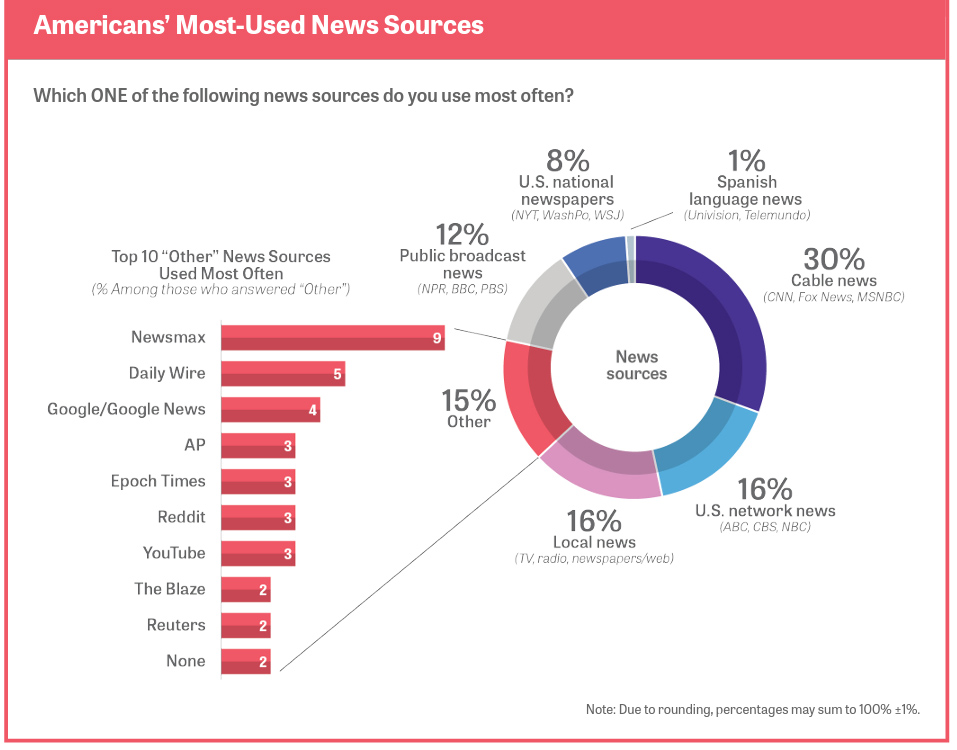
But Rosenstiel noted that the poll's respondents said the most common way they get local news is through television (32% daily), followed by social media (31% daily), with radio (including podcasts) and newspapers (including print and digital readers) lagging behind at 20% and 15%, respectively. “Having studied local TV news extensively over the years, I can tell you that they don’t cover a lot of local government,” he said. He noted that TV-station consultants consider local government coverage a ratings loser and steer stations away from it.

Only 15% of respondents said they read local newspapers daily, while 29% said they read them weekly, and 39% said they never read them. The survey was conducted for the Medill School by the National Opinion Research Center at the University of Chicago from April 27 thgrough May 1.

Thursday, February 16, 2023

Dismal report on public trust in news is not so bad for local news, but has many warning signs – and some guidance


By Al Cross
, Director and Professor
Institute for Rural Journalism and Community Issues, University of Kentucky

The national headline on stories about the latest poll on the news media and democracy were about its finding that half of Americans believe national news organizations deliberately "mislead, misinform or persuade the public to adopt a particular point of view through their reporting," as Associated Press media writer David Bauder put it. "In one small consolation," Bauder reports, "Americans had more trust in local news."

For people in local news, it's not a small consolation. The survey by Gallup and the Knight Foundation, of 5,593 Americans aged 18 and older between May 31 and July 21, 2022, shows a much higher level of trust in local news organizations, driven in large measure by a belief that they care about the impact of their reporting; 53% agreed with that statement and 19% disagreed with it. "The biggest differentiator is that the public feels local news organizations care about the impact of their reporting while national news does not," Knight says in its report.

Graphs by Gallup Inc. from Knight Foundation report; click any image to enlarge
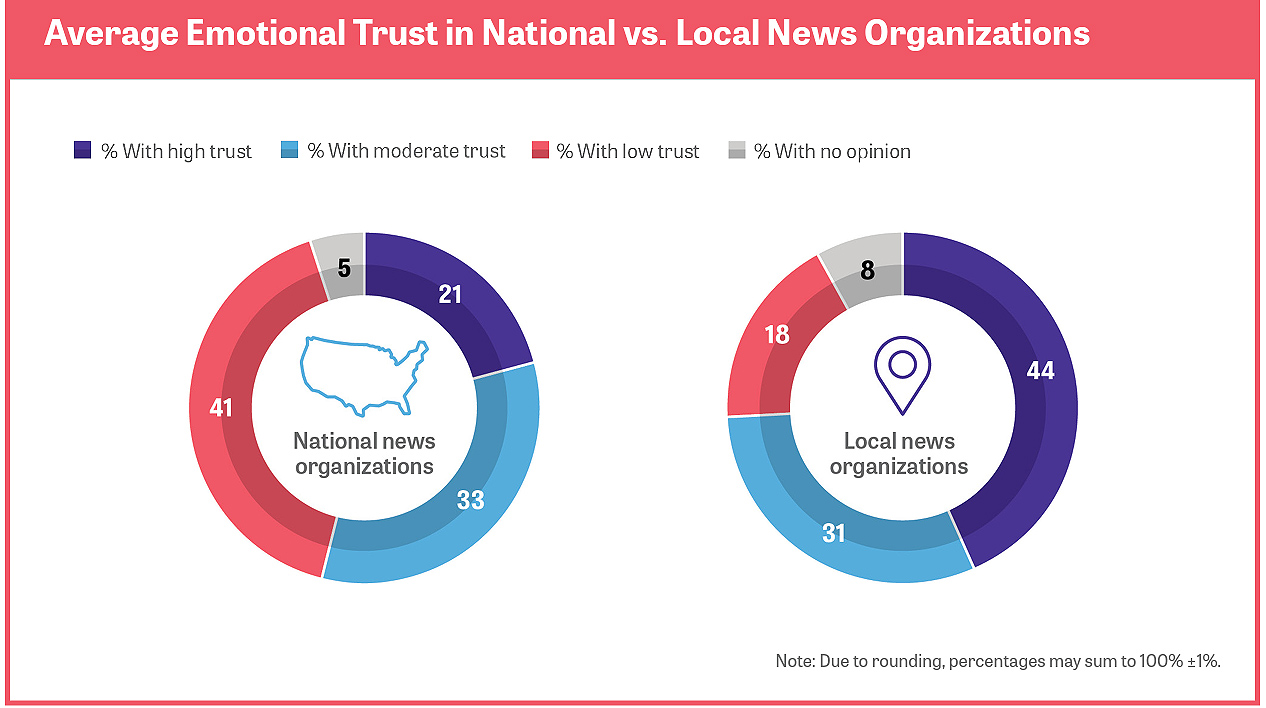
"While past investigation of trust in news has focused on issues of transparency and credibility, recent research has emphasized the affective or emotional aspects of trust — that is, how trust in news is related to how people feel about news outlets," Knight repots. "Emotional trust in news is driven by the belief that news organizations care, report with honest intentions and are reliable. More than twice as many Americans report high emotional trust in local news than in national news; 44% have high emotional trust in local news organizations, compared with 21% who have high emotional trust in national news organizations. . . . Greater emotional trust in local news is consistent across various demographic groups. Variation in levels of emotional trust in local news organizations is less pronounced across demographic groups. For example, 31% of Republicans and 58% of Democrats express high levels of emotional trust in local news — a narrower gap than with emotional trust in national news. This finding is consistent with findings from previous Gallup/Knight studies."

So, Americans trust their local news organizations, but do they really know them? The poll found that 65% agreed with the statement "In general. most local news organizations have the resources and opportunity to report the news accurately and fairly to the public," but the question left much to be desired. Most Americans are not familiar with "most local news organizations," and many if not most of those organizations are having difficulty reporting as much news as they once did or would like to do. Accuracy and fairness are essential, but audiences notice gaps in coverage, and that could have been measured, too.

Bauder describes one other hopeful finding: "If Americans believed local news organizations didn’t have the resources or opportunities to cover the news, they would be more likely to pay for it." Knight reports, "Americans who think local news organizations lack the resources and opportunity to report the news accurately and fairly are more likely to pay for news. . . . Among those who agree, 23% report having paid for news in the past. This percentage nearly doubles (45%) among those who disagree. Those who say local news organizations do not have the resources and opportunity to report the news accurately and fairly are more than twice as likely to be willing to pay for news in the future as those who agree (32% vs. 14%, respectively). These findings mirror previous Gallup/Knight research on local news, which found that Americans who are exposed to information about the financial challenges of local newspapers are more likely to donate to a nonprofit organization that supports local journalism."

Knight says journalists need to go beyond emphasizing transparency and accuracy to show the impact of their reporting on the public. That recommendation is directed to national news organizations, but it's good advice for local news organizations, too. And the study reaffirms that they need to do that online, because that's where most of the audience is. The poll found that 58% of Americans in mid-2022 reported getting most of their news online, up from 46% in 2019. Television was named by 31%, down 10 points from 2019. Only 3% named printed newspapers or magazines, down from 5%.

Another interesting finding, described by Bauder: "The ability of many people to instantly learn news from a device they hold in their hand, the rapid pace of the news cycle and an increased number of news sources would indicate that more Americans are on top of the news than ever before. Instead, an information overload appears to have had the opposite effect. The survey said 61% of Americans believe these factors make it harder to stay informed, while 37% said it’s easier." That finding doesn't differentiate between national and local news, but the poll seems to confirm a trend pointed out by many observers, that people are paying less attention to local news than they once did. Local news providers must give them reasons to seek it out, make it easy to do so, and make clear its value.

Thursday, December 15, 2022

Poll of rural adults finds them more aware of, and more willing to discuss, opioid problems; 47% still see stigma

Morning Consult graph compares 2017 and 2022 responses to question about access to care. Click it to enlarge.

Rural Americans say they are more aware of, and more willing to talk about, the opioid problem in the nation and their communities than they were five years ago, according to an online poll of rural adults sponsored by the American Farm Bureau Federation and the National Farmers Union.

Sixty percent said adults are more aware of the crisis than they were five years ago, and 77% said they would comfortable having a conversation about opioids, but 47% said there is stigma or shame associated with opioid abuse in their community.

Rural adults increasingly regard drug addiction as a disease. Asked if addiction to opioids is a disease or is due to a lack of will power or self-control, 57% said it's a disease and 21% said otherwise. In 2017, the numbers were 46% and 26%, respectively. Likewise, 78% said someone can accidentally or unintentionally get addicted to opioids; five years ago, 71% said that.

The poll found that more rural adults than five years ago believe there is a higher rate of opioid misuse in rural communities than in urban and suburban areas), and 48% said they know someone who is or has been addicted to opioids or prescription painkillers.

Asked if they had taken an opioid or prescription painkiller without a prescription, 5 percent said yes. The same percentage said they had abused opioids or prescription painkillers or been addicted to them. Asked how comfortable they would feel talking about that, 70% said they would feel very or somewhat comfortable discussing it with friends, 52% with siblings and 46% with parents. Beyond their immediate families, most said they would be not too comfortable, or not comfortable at all.

The margin of error for that subsample of 110 people is plus or minus 9.3 percentage points. The error margin for the whole sample of 2,010 rural adults is 2.2 percentage points. The poll was conducted online Oct. 6-13 by Morning Consult and the results were weighted to reflect gender, age, race, ethnicity, census region and education. The results are available from Farm Bureau here.

Farm Bureau and NFU, long rivals in representing farm interests, "have consistently worked to publicize and compile useful material to help address rural stress, mental health challenges and opioid misuse," they said in a press release. NFU President Rob Larew said, “We must continue to reduce the stigma to connect our loved ones with health care and treatment they may need. I thank AFBF for being a teammate on this project, and the survey results show what is possible when farm organizations work together.”

Tuesday, October 25, 2022

Rural voters are the most enthusiastic about the midterms

"Interest in the midterms is at an all-time high, but Republicans and Rural America are more enthusiastic than Democrats and Urban America are," NBC News reports on its latest poll. The more rural a part of the poll sample was, the more enthusiasm voters showed; the more urban, the less.

"Urban voters prefer a Democratically-controlled Congress by 34 points (64%-30%), suburban voters prefer a GOP-controlled Congress by 4 points (48%-44%) and rural voters prefer a Republican-controlled Congress by a whopping 53 points (75%-22%)," Chuck Todd, Mark Murray, Ben Kamisar, Bridget Bowman and Alexandra Marquez of the NBC News Political Unit report.

They summarize major results of the poll: "Yes, Democrats had closed the enthusiasm gap in the recent months. Yes, rural voters make up a smaller share all of voters (about 15% in our poll). And, yes, the fight for Senate control remains a Toss Up. But that GOP/rural intensity, those GOP/rural margins and President Biden’s 45 percent job rating (it was 46 percent in the VA-GOV exit poll) sure look like what we saw a year ago." They conclude, "Democrats are fired up. It’s just that Republicans are fired up a lot more."

“This is what Virginia looked like,” said NBC's Republican pollster, Bill McInturff, referring to Virginia Gov. Glenn Youngkin’s overwhelming margins with rural Republicans that drove his Virginia gubernatorial win a year ago.

Monday, October 24, 2022

Rural voters in 11 battleground states more worried about economy than rest of nation, pessimistic about long term

Graph from The Daily Yonder Rural Poll by Lake Research Partners; click on it to enlarge.

Rural voters in 11 key battleground states in the midterm elections are more concerned about the economy than the rest of the nation, and are convinced things will be worse for the next generation.

Those are major findings of the Daily Yonder Rural Poll, commissioned by the Center for Rural Strategies and conducted by Celinda Lake of Lake Research Partners, a Democratic pollster.

Almost three-fourths of the 400 rural voters polled said the economy is not working for them, half said they don’t expect their finances to improve in the next year and 77% said they think things will be worse, not better, for the next generation of Americans.

“I was stunned by these numbers” on the economy, Lake told the Yonder. “They are really different than what we’ve seen in the past, and really different from what we’re seeing in the rest of the country, as pessimistic as the rest of the country is.”

Rural America has trended more Republican in the last 20 years, and that hasn't changed. The poll found 59% intend to vote for Republicans in congressional races and 32% said they intend to vote for Democrats. "That’s roughly the margin by which Donald Trump won the rural battleground in 2020," the Yonder notes.

“Rural America’s in a pretty Republican mood,” Lake said. “There’s no doubt about it.”

"Lake said she thinks rural voters’ economic concerns, coupled with dim views of wealthy corporations and corporate CEOs, mean that rural America is ripe for a populist message," the Yonder's Tim Marema and Sarah Melotte report.

Asked to name their top two values, Republican rural voters named freedom and faith and Democrats named equality and kindness/compassion. Members of both parties selected accountability and family as either their third or fourth most important value.

Wednesday, February 16, 2022

Rural residents, Republicans and white evangelicals report being less vaccinated than their counterparts

Pew Research Center graphs; click any image  to enlarge.
Rural Americans are significantly less vaccinated against Covid-19 than other Americans, according to the latest Pew Research Center poll.

Only 68 percent of rural residents in the Jan. 24-30 online survey said they were vaccinated, compared to 80% of suburbanites and 82% of urbanites.

White evangelical Protestants, who live disproportionately in rural areas, show a similar pattern; only 62% of them reported being vaccinated. The figure was 77% for non-evangelical white protestants, 80% for the religiously unaffiliated and 85% for Roman Catholics.

Rural residents are disproportionately Republican, and another big difference in the results was seen by party affiliation. "Democrats and those who lean to the Democratic Party are 26 percentage points more likely than Republicans and Republican leaners to say they’ve received a Covid-19 vaccine (90% vs. 64%)," Pew reports. Among Democrats, ruralites are only slightly less vaccinated; among Republicans, the differences are similar to the overall sample. (See bottom of chart.)

Tuesday, February 15, 2022

Rural residents are more likely to doubt Covid-19 science

CSP graph, with place-type rates highlighted; to enlarge, click on it.
Residents of the rural United States are more likely than other Americans to doubt scientifically proven statements about the coronavirus, says an online poll by the Covid States Project, a consortium of Northeastern University, Harvard University and its medical school, Rutgers University and Northwestern University.

People in the poll were asked to identify vaccine misinformation statements as true or false, and were given the option of "not sure." They were later asked if they thought most scientists or health experts would consider the statements true or false. If they said "not sure" about a statement but thought experts would support it, they were counted as doubting science. If they said a statement was true but experts would say it was false, they were counted as disbelieving science.

Among rural residents, 25% doubted at least one of the misinformation statements; in suburbs, that figure was 21%, and in cities, 20%. The "disbelieving" results differed little by type of area.

The poll surveyed 18,782 people in all 50 states and the District of Columbia, with state-level quotas. The results were weighted to reflect demographic characteristics: race/ethnicity, age, gender, education, and living in urban, suburban, or rural areas. The researchers reported that they found a decline in belief of misinformation since early 2021, when Covid-19 vaccines became widely available, but "16 percent of Americans still hold vaccine misperceptions. Close to half (46%) are uncertain about the veracity of at least one vaccine misinformation statement."

Wednesday, October 06, 2021

Poll: Vaccine holdouts come around for four big reasons, which are most effective in combination, not independently

Kaiser Family Foundation chart; click the image to enlarge it
A recent Kaiser Family Foundation poll of people vaccinated against the coronavirus since June 1 showed the reasons people who weren't sure about it finally got their shots. The biggest were the Delta variant, worries about hospitals filling up, seeing an acquaintance or friend get seriously ill or die from Covid-19, and wanting to take part in activities that required vaccination.

What's most interesting in the poll is that "none of these approaches work very well in isolation," says Yale University physician and public-health lecturer James Hamblin. "Hesitant people don't get vaccinated because of one 'main' reason, so much as because of a gradual accretion of reasons. They add up to eventually create the necessary urgency and eventually tip us toward responsible action."

That's no different than how most people make major life decisions, he writes, and it's reason for optimism: "Point being, small things matter, even if you don't see the impact right away. If you've had conversations with friends or family—or even just shared an article or study, or sent simple notes to people you know saying you care about them and hope they'll reconsider—and yet you don't feel it helped, you're not alone. And ultimately it still may help. You just might not know what part you played."

Thursday, September 16, 2021

Rural residents in 4 of 5 countries studied, including U.S., are less trusting of the news media than city dwellers are

How the general trust in news media differs among four major nations.
Reuters Institute chart; click the image to enlarge it.
It's not just an American phenomenon: the Reuters Institute's latest Trust in News report found that, in four of the five countries studied, rural residents trust the news significantly less than city dwellers. But that distrust may be part of a larger pattern, since rural residents are generally less trusting (as are older people, those without college degrees, and whites, groups that are more prevalent in the rural U.S.).

In the U.S., 40 percent of rural residents were "generally untrusting toward news" compared to 16% of urban residents. Conservative political affiliation is an especially significant indicator of news media distrust in the U.S. as well, according to the report.

However, it's worth noting that most respondents said they trust some news sources more than others, and definitions of what qualifies as "news" vary.

Americans who generally don't trust news media were much less likely than other Americans to agree that familiarity with a news brand affects how much they trust it. In short, that suggests "that the generally untrusting as a group are somewhat less confident in their ability to differentiate between sources, and that may contribute to a lack of trust overall," the report says. "The untrusting not only say they pay less attention to journalists’ backgrounds and the editorial practices individual news outlets embrace, they also put less stock in the way brands present themselves or whether familiarity is even a useful indicator of trustworthiness. On average they trust few or no brands, not because they are particularly discerning but because they are less knowledgeable about what separates one brand from the next and may lack the motivation or interest to find out."

Monday, August 23, 2021

Digital divide narrows; fewer than 1/3 of rural adults in poll said government should get all connected in pandemic


"Rural Americans have made large gains in adopting digital technology over the past decade and have narrowed some digital gaps. However, rural adults remain less likely than suburban adults to have home broadband and less likely than urban adults to own a smartphone, tablet computer or traditional computer," reports Emily Vogels of the Pew Research Center, citing its latest polling on the topic.

"While broadband adoption has not significantly increased for urban and suburban Americans in the last five years, rural residents have seen a 9-percentage-point rise in home broadband adoption since 2016," Vogels reports, but "rural residents are still less likely than those living in suburban areas to report having home broadband," by 72% to 77%.

They are also less likely to have internet-connected devices, and less likely to have multiple devices, Vogels reports: "Three in 10 adults who live in rural communities report owning or having a desktop or laptop computer, a smartphone, a home broadband connection and a tablet computer, compared with 44% of urban and 43% of suburban adults."

Also, "Rural residents go online less frequently than their urban counterparts. Eight in 10 adults who live in rural communities say they use the internet on at least a daily basis, compared with roughly nine in 10 of those in urban areas (88%)."

While much of the talk about the digital divide has focused on what federal and state governments can do about it, "Only 29% of rural adults say the government has a responsibility to ensure that all Americans have a high-speed internet connection at home during the coronavirus outbreak," Vogels reports. "In comparison, 50% of urban residents and 35% of suburbanites say the same, according to previously unexplored data from an April 2020 Pew Research Center survey."

Friday, April 16, 2021

Study: Readers' attitudes about news media driven by moral values; suggests ways to better connect with audiences

Media Insight Project graph
A major study by the Media Insight Project, a collaboration of the American Press Institute and The Associated Press-NORC Center for Public Affairs Research, opens up a new way of looking at the issue of media trust and may offer new avenues to address it," API reports. "The study finds that not all Americans universally embrace many of the core values that guide journalistic inquiry. And uneasiness with these core values of journalism is more connected to people’s underlying moral instincts than to politics. When journalists say they are just doing their jobs, in other words, the problem is many people harbor doubts about what the job should be."

The study tested public sentiment about five core journalistic values:
  • Oversight: How strongly a person feels there is a need to monitor people in power and know what public officials are saying and doing. The flip side of this value is concern about intrusiveness or oversight becoming a hindrance or placing too much importance on insignificant events.
  • Transparency: The idea that transparency is usually the best cure for what's wrong in the world, and that on balance it's usually better for things to be public than for things to be kept secret. The flip side is that sometimes the need to keep things secret is more important than the public's right to know, and the notion that most problems can be solved without embarrassing facts being aired publicly.
  • Factualism: This value measures whether on balance more facts are always better and facts are the key to knowing what is true. The flip side is that the truth is more than just a matter of adding facts and that this emphasis on factualism can mask bias.
  • Giving voice to the less powerful: This value measures whether people want to amplify the voices of people who aren’t ordinarily heard and if a society should be judged on how it treats the least fortunate. The inverse instinct is that inequalities will always exist and favoring the least fortunate does not always help them.
  • Social criticism: This value measures how important people think it is to put a spotlight on a community’s problems in order to solve them. The flip side puts more emphasis on the value of celebrating things that are going right or working well in order to reinforce them and encourage more of them.
Only 11 percent of those surveyed embrace all five principles and they're mostly liberal. But the widespread distrust goes beyond partisanship. Some groups that tend to be liberal (Democrats, women, or people of color) are skeptical about some core journalism values, while some values resonate with conservatives.

"How people view those core values of journalism, moreover, is closely associated with deeper feelings they have about what moral values are important generally," API reports. "People who put more emphasis on the moral values of loyalty and authority, for example, tend to be more skeptical of some of the core values journalists try to uphold, or at least worry that these values could be taken too far. People who put more emphasis, by contrast, on the moral values of fairness for all and caring for the less fortunate tend to be more aligned with core press values. These differences persist even when we control for a person’s political partisanship and ideology."

Only two in 10 people they surveyed strongly support core journalism principles, which "suggests that some of the traditional framing journalists bring to stories, and many of the traditional marketing appeals journalism organizations use that trumpet traditional journalism values, will only reach so far in rebuilding trust or winning new subscribers," API reports. "If stories are rewritten to broaden their moral appeal, they become more interesting to people in all groups—both those more trusting of media and those more skeptical."

Messaging to reflect readers' core values can help bring in more subscribers, the study found. "To woo subscribers, the media will need to vary its messaging beyond traditional appeals about journalism being a watchdog. The survey also tested different messages asking respondents to financially support a local news organization," API reports. "The findings suggest people’s moral leanings definitely influence what kind of messaging about journalism they find appealing. People who most emphasize care or fairness, for instance, were more motivated by a message that highlighted the outlet’s commitment to protecting the most vulnerable through their news coverage. People who emphasized authority and loyalty preferred a message about the outlet’s long-term service to the local community.

Sunday, April 11, 2021

Many reasons why faith affiliation is at low ebb, pastor says

The following is one pastor's explanation of a phenomenon reported recently on The Rural Blog. A week later, he wrote another column giving more reasons for it and putting it into historical context: "It wasn’t until 1906 that membership reached a slim majority of 51 percent." As reader reaction kept pouring in, he wrote a third column lamenting the "anger and arrogance" of his correspondents.
Read more here: https://www.kentucky.com/living/religion/paul-prather/article250690999.html#storylink=cpy

By Paul Prather

For the first time since Gallup began tracking church membership in 1937, Americans’ membership in houses of worship has dropped to below 50 percent of the population, the polling organization announced recently.

In 2020, just 47 percent of Americans said they belonged to a church, synagogue or mosque. That’s a decline from 50 percent in 2018, and a precipitous fall from as recently as 1999, when 70 percent of us were members.

Membership has declined across all religious, demographic, political and geographic categories: men and women; young and old; Black, white and Hispanic; Republicans, Democrats and Independents; well-educated and less-educated; Protestant and Catholic; conservatives, moderates and liberals; people from the Midwest, South, East and West.

Paul Prather
Additionally, the number of people who say religion is very important to them has fallen to 48 percent, reported Sarah Pulliam Bailey of The Washington Post. That’s another unprecedented low.

This ongoing decline in the role and influence of American houses of worship has become all but unstoppable.

What’s causing the waning of religious allegiance?

I’m no sociologist. But having been a minister for 40 years and a religion writer for roughly 30 years, I do have some theories.

It’s not just one thing, I believe. It’s the perfect storm of things. Here are multiple factors I see, and this isn’t an exhaustive list:

▪ The rise of the internet has made it easy to pick and choose beliefs from around the planet, and to chat informally, even anonymously, with those who see the cosmos—or faith, or God—as you do. The internet exposes us to an endless variety of traditionalists, skeptics and alternative faiths. Connecting live, in-person with the Baptist or Episcopal congregation down the street can, by comparison, feel frustrating and limiting and boring. It requires commitment. It’s messy. For many folks, the internet has become their house of worship. They create their own boutique faith.

▪ As one author pointed out to Bailey in the Post, we’re living in a period in which younger Americans, especially, are distrustful of all types of institutions, including police and pharmaceutical companies. That distrust carries over to religious institutions. Young adults are the least religious of all Americans.

▪ Skepticism and even atheism have become more acceptable, and in some circles de rigueur. The number of atheists is growing and well-documented, and a small subsection of atheists have turned evangelistic themselves in advancing their cause, publicly attacking religion at every opportunity. The unsayable has become sayable. This growing, organized pushback has created embarrassment and disillusionment among some who used to be churchgoers, but weren’t well-versed in their faith to begin with.

▪ Roman Catholic child-abuse scandals have shaken people’s trust in organized religion. Here’s a hint of that: since the late 1990s—roughly about the time the sex-abuse scandals became widely known—Catholic membership has declined at twice the rate of Protestant membership, 18 percent versus 9 percent, respectively.

▪ A seemingly endless succession of big-time Protestant leaders behaving badly has had a similar, if statistically less dramatic, effect on that branch of Christianity.

▪ The alliance of white evangelical Christianity with right-wing politics has appalled some people, who say the congregation or denomination they grew up is now merely a mouthpiece for the Republican Party. They are turned off by a church that they see as less concerned about the gospel of Jesus Christ than the pronouncements of Donald Trump or Sean Hannity.

▪ On the opposite pole of the ideological scale, some liberal churches have gotten so caught up in social do-goodism and wokeism they’ve become indistinguishable from secular charities and community action groups. They’re not distinctively Christian enough (or Jewish enough, or whatever enough) to engage people’s faith.

▪ Sundays are no longer sacred. We play golf. We take hikes. Youth sports leagues suck away parents and kids from church services. Once, youth teams didn’t practice or play on Sundays. Many formerly churchgoing parents find their kids’ soccer or baseball success more important than their spiritual development.

▪ A lot of churchgoers were never that serious about their faith to begin with. Even among active church members, probably no more than 10 to 20 percent really shape their lives around their religion, rather than the other way around. When all the other contributing factors listed above start tugging at these less-dedicated folks, it’s easy for them to simply drift away.

To me, the future doesn’t look promising for organized religion of any variety. We’re riding a downward trend, and it’s hard to see it reversing.

In addition, the pandemic has given everyone new paradigms for worship, and lots of practice staying home from services.

It’s not clear to what extent last year’s voluntary and state-mandated church shutdowns affected Gallup’s 2020 numbers. But I suspect the pandemic will, in the end, prove to have been detrimental long-term. Significant numbers of those who’ve had to sit out for the past year may never return.

In the future, Christianity—historically the country’s largest faith by far—will have to adjust to becoming an ever-smaller slice of the spiritual pie. That’s not necessarily a bad thing. The earliest Christians were barely more than an obscure splinter group, but they were serious, and they persevered, and they changed the world.

Paul Prather (pratpd@yahoo.com) is pastor of Pentecostal Bethesda Church near Mount Sterling, Ky. This was first published in the Lexington Herald-Leader, for which he was the religion reporter.

Monday, March 15, 2021

Rural people more hesitant to get shots or follow pandemic guidelines, but finding trusted messengers may help

deBeaumont Foundation chart; for details, see ChangingTheCovidConversation.org.

Rural Americans are less likely to practice coronavirus-prevention measures and less likely to get vaccinated, but education and messaging from trusted people may change their minds, according to recent research.

A Texas A&M University study "found that rural American were less likely than those who lived in urban areas to wear masks and work from home," Liz Carey reports for The Daily Yonder. "While 52 percent of urban residents reported working from home, only 36% of rural residents reported working from home. And while 82% of urban residents reported wearing a mask, only 73% of rural residents said they had worn one.

"Rural residents were also less likely to avoid restaurants, change travel plans and disinfect their homes and work areas. But, the researchers also found that there wasn’t a big difference between rural American and their urban counterparts when it came to social distancing, hand washing and canceling social engagements."

Timothy Callaghan, a health-policy professor who helped lead the study, said political trends and the remoteness of rural communities may explain their differences in behavior, Andy Krauss reports for KBTX-TV in Bryan and College Station, Texas. "People in rural America tend to be a little bit more conservative. The Trump administration and others on the Republican right have at various times downplayed the severity of the virus. . . . Conservative individuals across the country are going to listen to that message and might take things like wearing a mask less seriously."

Callaghan told Krauss that rural residents may also disregard health guidelines because their isolation gives them a false sense of security. "They’re not as concerned as being densely packed together for the possibility of spread to happen," he said.

"The study also found other personal characteristics that correlated with a higher or lesser likelihood of listening to public health guidelines," Krauss reports. "For example, older Americans, those who are more highly educated, and women were more likely to adopt certain behaviors. Those who said they trusted experts or were worried about contracting the virus were also more likely to follow guidelines."

The researchers said that those who don't trust medical experts must receive education and messaging about pandemic health guidelines from a different source, Carey reports.

Mistrust has also led rural residents to be more hesitant about getting the coronavirus vaccine, and finding trusted messengers may be the key to overcoming that disparity as well. "Another study from the de Beaumont Foundation found that one in five rural Americans do not want the vaccine against Covid-19, and that finding those trusted communicators will be key in making sure they do get it," Carey reports. The foundation has published a cheat sheet with communication tips that could improve vaccine acceptance, including language that vaccine-hesitant people may find more convincing.

deBeaumont Foundation chart


Thursday, February 25, 2021

Pew report on how Americans got news about 2020 election and pandemic illustrates a deepening partisan divide

A newly published report from Pew Research Center showing how Americans navigated news about the presidential election and the coronavirus pandemic in 2020 shows a deepening partisan divide. 

The American News Pathways project "finds there have consistently been dramatic divides between different groups of Americans based on where people get their information about what is going on in the world," Pew reports. "For example, Republicans who looked to former President Donald Trump for their news about the 2020 election or the coronavirus pandemic were more likely to believe false or unproven claims about these events. And while Americans widely agree that misinformation is a major problem, they do not see eye to eye about what actually constitutes misinformation. In many cases, one person’s truth is another’s fiction."

Some of the findings from the study, conducted from November 2019 through December 2020:
  • About a quarter of Democrats and Republicans consistently got their news from "partisan news media bubbles" with audiences of like-minded people.
  • Those who got their news only from such echo chambers were generally more ideological than others in their parties, and more likely to hear about and believe false or unproven claims.
  • Just under half of Republicans who got their news from echo-chamber sources are 65 and older.
  • Trump was a major source of election and/or pandemic news for 32% of Republicans and conservative independents. People who relied on Trump for information were more likely than other Republicans to think the pandemic was overblown, more likely to believe voter fraud was a significant threat to election integrity, and more likely to believe the news media had covered both issues poorly.
  • In November 2019, the vast majority of Americans surveyed said they were "very" (48%) or "somewhat" (34%) worried about the impact of fake news on the election. Liberals and conservatives were equally concerned about this. A year later, 60% of respondents said they felt fake news had had a major impact on the election.
  • Overall, older Americans, people who paid more attention to the news, and people with greater knowledge of politics were more worried than average about the impact of fake news.
  • People who relied mostly on social media for political news were less likely to worry about the impact of fake news.
  • What people deemed "fake news" varied widely; many identified factual news as fake because it didn't fit with their perceptions of reality.
  • News diets within parties played a big role in commonly held partisan beliefs. That phenomenon was more pronounced among Republicans because they tended to rely on a smaller mix of news outlets (especially Fox News and talk radio).
  • About 18% of people surveyed said in November 2019 that they relied mainly on social media for political news. Such respondents were the youngest group overall by far, with nearly half under age 30 (compared to 21% of respondents who get their news from news websites or apps, for example). People who relied primarily on social media for news were also less likely to be white.
  • Social media was a major source of news for many Americans, but it was not widely trusted by Republicans or Democrats.
  • Those who got their news mostly from social media were less likely to pay attention to other news sources such as print or cable TV, less likely than most others to be knowledgeable about current events, and more likely to have heard unproven claims and theories.
  • Similar percentages of liberals and conservatives paid attention to pandemic news coverage in March 2020. In late November, liberals reported about the same numbers, but far fewer conservatives were paying attention to the news.
  • Over 2020, Republicans perceptions shifted on pandemic-related issues. They generally paid less attention to news coverage, became more critical of the news media, and grew more likely to say the pandemic was being exaggerated. They also appeared to have less favorable views about the Centers for Disease Control and Prevention and other public-health officials. Democrats responses on those issues remained largely unchanged over 2020.

Tuesday, October 27, 2020

Rural voters' approval rating for Trump's job performance is 53%, according to Zogby poll done for Progressive Farmer

A recent poll of rural American voters shows that just over half (53%) approve of President Trump's job performance, including how he's handling the pandemic, and 50% plan to vote for him—a lead of 18 percentage points over Democratic challenger Joe Biden, Dan Miller reports for DTN/The Progressive Farmer. The poll also provides a snapshot into rural voters' lives and what they care about most in the election.

"Support for the president is strongest in the critical Central Great Lakes region of the United States (55% of rural adults support him there), among those 65 years of age and older (60% support him), rural white people (55%) and married rural adults (57%)," Miller reports. Meanwhile, 42% of respondents somewhat or strongly disapprove of the president's job performance.

Here are some other findings, which Miller also discusses in this piece. Among respondents:
  • 40% identify as Republicans, but 49% say they'll vote for Republicans in congressional races.
  • 23% identify as Democrats, but 31% say they'll vote for Democrats in congressional races.
  • 62% said the strength of the economy is the issue that will most influence their vote; 48% said health care, and 39% said protection of Second Amendment rights.
  • Health care is the top issue for rural Democrats, with 64% saying it's the most important factor in their vote. That's the only demographic where health care has a significant edge over other issue. They are also the only rural demographic that considers climate change one of the top issues: 48% said it's important, compared to 27% overall.
  • 11% said they're undecided about their choice for president.
  • 29% are farmers or have family members who farm.
  • 39% said agriculture is worse off than it was four years ago; 23% said it's better off, and 17% are undecided.
  • Republicans (40%) and Southerners (29%) are more likely than other groups to believe agriculture is better off.
  • 56% of farmers believe Trump's trade deals with China, Mexico and Canada have led to higher income potential for their farm.
  • 59% said their farm would be struggling if not for direct federal aid given because of the pandemic and the trade war.

The DTN/Progressive Farmer Zogby Analytics Election poll surveyed 1,008 adults in rural counties and 120 completed surveys from the Progressive Farmer subscriber list; the margin of error is 2.9%. The article includes more details on respondents' demographics and political affiliations. Click here to read more findings from the poll.

Wednesday, June 17, 2020

Study highlights rural health disparities for non-senior adults

A new report from the nonprofit Transamerica Center for Health Studies highlights disparities in rural health and rural health care. Left Behind: Health Care in Rural America is the insurance company's seventh annual study of the topic; it uses answers from its annual consumer survey of people 18 through 64 in August 2019.

Among the study's key findings:
  • Fewer rural respondents in the poll reported being in good health than their urban or suburban counterparts. Almost seven in 10 rural residents (69 percent) described their health as good or excellent, compared to 80% of urban residents and 78% of suburban residents.
  • Rural people were more likely to report poor health, with 69% saying they had at least one underlying condition, compared to 66% of urban respondents and 64% of suburbanites. 
  • Rural respondents were more likely to report having a mental health condition (31%) compared to 29% of urban respondents and 24% of suburban respondents.
  • Rural respondents, at 38%, were far less likely to receive health insurance through an employer, compared to 53% of urban respondents and 59% of respondents. The report notes that 19% of rural residents said they have no health insurance. 
  • Rural (12%) and urban (13%) respondents were about twice as likely as suburban residents (6%) to receive health care through Medicaid or another state-funded program.
  • Rural respondents were less likely to report being able to afford health-care costs; 75% said they could afford routine health expenses, compared to 82% of urban respondents and 85% of suburban respondents.

Wednesday, March 25, 2020

March survey of rural bankers shows largest one-month drop in economic confidence since poll began 14 years ago

Creighton Univ. chart compares current month to last month and a year ago; click here to download it and Table 2 (below)
More than six in 10 rural bankers surveyed for the latest Rural Mainstreet Index say they expect a recession because of the coronavirus pandemic, marking the largest one-month decline in the confidence index since the survey began in January 2006, and its lowest point since October 2016. About 32 percent of bankers surveyed said they expect little economic impact from the virus.

The index, compiled by Creighton University economist Ernie Goss, is a monthly survey of bankers "in approximately 200 rural communities with an average population of 1,300" in 10 states where agriculture and energy are critical to the economy: Colorado, Illinois, Iowa, Kansas, Minnesota, Missouri, Nebraska, North Dakota, South Dakota and Wyoming.

The overall index for March fell from 51.6 for February to 35.5 in March. Anything below 50 is "growth negative." This marks the first month below neutral after six months straight above 50, Goss reports. The only three measures on the index above 50 were loan volume, checking deposits, and home sales (see Table 1, above).

The survey says it is "an early snapshot of the economy of rural, agriculturally and energy-dependent portions of the nation." This edition is more like time-lapse photography, because the situation changed rapidly in March. "Over the last two weeks, the coronavirus has resulted in almost one-half, or 47.6%, of bankers surveyed reporting a decline in client or customer visits," Goss writes. Also, 14.3% of banks reported an increase in staff absences due to the virus.
Creighton University chart; click here to download it and Table 1.

Thursday, March 19, 2020

Rural skepticism about coronavirus and covid-19 driven by ideology, not geography, NBC-Wall St. Journal poll shows

Rural Americans' greater skepticism about the coronavirus threat is driven by ideology, not geography, Chuck Todd, Mark Murray, Carrie Dann and Melissa Holzberg of NBC News report in this morning's "First Read."

"Our recent NBC News/WSJ poll turned some heads when it showed WIDELY different partisan reactions to the coronavirus, with Democratic voters much more concerned about the outbreak than Republican respondents," they write. "But couldn’t the difference also be geographical – that all voters in urban areas (regardless of party) are more concerned about the coronavirus than rural voters (regardless of party)?"

The answer is no, they say, giving breakdowns form the poll, which was taken March 11-13:

Are you worried that someone in your immediate family with catch the coronavirus?
All voters: 53 percent
Urban Democrats: 70 percent
Suburban Democrats: 68 percent
Rural Democrats: 65 percent
Urban Republicans: 44 percent
Suburban Republicans: 37 percent
Rural Republicans: 41 percent

Have you stopped or do you plan to stop attending large public gatherings?
All voters: 47 percent
Urban Democrats: 59 percent
Suburban Democrats: 63 percent
Rural Democrats: 59 percent
Urban Republicans: 32 percent
Suburban Republicans: 28 percent
Rural Republicans: 30 percent

Tuesday, February 18, 2020

Poll underlines rural/urban partisan divides, but suggests possible bridges in worldviews and values

A new Axios/Survey Monkey poll explores the notion that some of the rural-urban divide is driven by suspicion that people in other types of communities look down on them. "Sizable minorities from both cities and rural areas said they're worried about how the other perceives them, and partisan politics explains a lot of those divisions," Stef Kight reports for Axios.

According to the survey, 43.1 percent of rural residents surveyed said they think people living in a major urban city view them negatively, Kight reports. About one-third of respondents who live in a major city, 34.6%, said they believe rural residents think of them negatively.

Questions about partisan politics revealed the largest rural-urban differences: "For example, half of those living in major cities said they 'strongly disapprove' of Trump's presidency," Kight reports, while "41% of rural respondents said they 'strongly approve.'"

But the poll also revealed that rural and urban values and worldviews are often similar, suggesting that it's possible to bridge the gap.

For example, 53% of urban respondents said they often feel like a stranger in their own country, compared to 55% of rural respondents. "The economy, health care and the environment were the three most important issues — in that order — regardless of where respondents lived. Kight reports. "Rural and urban respondents are equally likely to attend a religious service once a week — or to never attend. Rural areas, however, have a higher share who attend more than once a week."