Showing posts with label highways. Show all posts

Friday, January 13, 2023

Electric school buses going rural; Missouri plans fall rollout

Row of electric buses (Photo by Bill O'Leary, The Washington Post)
Electric vehicles don't have a high profile in rural Missouri, but that's about to change. "Come this fall, dozens of electric school buses will hit Missouri roads thanks to a new federal rebate program that enables school districts to switch their diesel-powered bus fleets to electric," reports Claire Carlson of The Daily Yonder. "A Missouri school district superintendent says the electric buses will lower fuel costs, allowing them to invest the savings elsewhere."

Heath Oates, superintendent of western Missouri’s El Dorado Springs R-II School District, told Carlson, “Our district’s diesel-fuel costs are tremendous. My initial estimates show we’re going to save around $200,000 a year, which is the cost of four beginning teachers with benefits.” Carlson notes, "Rural school districts’ longer bus routes and lower population density mean they can have higher transportation costs than urban districts. Reducing fossil-fuel dependency will lower those costs, say electric-bus advocates."

Since rural areas lack electric-vehicle infrastructure, knowledge and planning will proceed the bus launch. "According to First Student, the largest school-bus company in North America, electric buses will need to be equipped with batteries that hold enough power to transport students morning and afternoon through remote areas," Carlson reports. "Bus providers will need to know the mileage, local topography, and average speeds of the school districts’ bus routes to determine battery size."

The Environmental Protection Agency is managing the switch to electric buses through its Clean School Bus program, and school districts were awarded funds in the program’s 2022 funding cycle. Carlson writes, "There are four more Clean School Bus award cycles planned over the next four years. While rural communities were a priority in this round of funding, more districts will be included in the next rounds, according to the EPA."

Wednesday, November 30, 2022

Photo essay: A bypassed town tries to keep going

The big road in Crab Orchard, Kentucky, is US 150, which began as the northwest leg of the Wilderness Road blazed by Daniel Boone and others. But now the federal route bypasses the town of 700-plus, leaving KY 39 as Main Street.
Story and photos by Richard Yarmy

Kentucky Route 39 is a two-track strip of pavement running out of horse country near Lancaster, Ky., that cuts right through the heart of Crab Orchard — one of the bypassed villages scattered all across the country.

There's still a place to eat, on the former US 150 (now KY 2750).
No Trader Joe’s, no Sam’s Club or Costco — just an abandoned movie house, and some closed cinder block storefronts. I’ve passed by several times, but decided to stop the other day.

I was kneeling in the middle of the highway, framing the movie house when a car pulled up behind me. It was a police cruiser. The window came down and the officer said: “Did you get your shot?” I said I did, and he said: “OK, I thought you might want me to stop traffic while you worked.”

He was the first car I had seen in the 20 minutes I had been there.

Later when focusing on a faded wall with a Coca-Cola sign rapidly disappearing, another gentleman stopped by in an older pick-up.

“Whatcha doin’?”
The theater still advertises its last movies. To enlarge any image, click on it.

“I’m documenting the town, “ I said.

“Well, if you need anything, let me know, I’m on the town council and I can show you around.”

I told him about meeting the police officer.

He said: You didn’t meet an officer — you met the entire Crab Orchard police force.

Nice people, nice town. Glad I stopped.

I hope they get the funds to restore the theater. I will send a check.

Crab Orchard is in Lincoln County, where the Bluegrass gives way to Appalachia. Yarmy told The Rural Blog, "Little adventures like this one is what I think is meant by the cliché 'stop and smell the roses'." More photos from his sojourn in Crab Orchard are at https://www.flickr.com/photos/140962699@N06/albums/72177720304074291.

Wednesday, November 02, 2022

States giving rural road work a boost with new federal aid

US 50 near Delta, Colo., below Grand Mesa, after rehabilitation (Colorado Department of Transportation photo)

Some states are using last year’s federal infrastructure law make up for deferred maintenance on rural roads, Jenni Bergal reports for Stateline. "Many rural roads carry heavy trucks and farm equipment, and some haven’t been repaved in decades, transportation officials say. With many state budgets healthy and new money arriving . . . states are spending more.

Bergal's first example is 19 miles of US 50 south of Grand Junction, Colo. It "was filled with bulges and dips, making it unpleasant to drive and sometimes downright dangerous," Bergal repports. "Colorado transportation officials decided to target the stretch, spending $15 million in state and federal money on it as part of a statewide rural road improvement initiative," completed in July.

Other examples: Democratic Gov. Janet Mills of Maine "touted a $9.2 million project to revitalize the rural highway corridors that lead to the state’s western mountains, where several ski slopes are located. In Texas, the Department of Transportation plans to invest $14 billion over the next decade on rural projects. That’s a 600% hike in planned rural funding compared with just seven years ago, according to Alvin New, a Texas Transportation Commission member. And in Oklahoma, transportation officials received a $41.5 million federal loan earlier this year; it will fund nearly half the cost of a rural safety improvement project in eight counties. . . . In Kansas, officials have doubled the amount they’re spending on rural road safety upgrades."

Rocky Moretti, director of policy and research at nonprofit research organization TRIP (formerly The Road Information Program), funded by highway-construction interests, told Bergal, “Rural areas are absolutely critical to the functioning of the nation’s economy, and you need a safe, reliable transportation network. If the system deteriorates to the point that it becomes difficult to move trucks that carry food and products, that’s a big problem.” Also, “The worse the shape the roads are in, the more the cost of operating a vehicle increases.”

Bergal notes an October report by TRIP saying that the U.S. has a $109 billion backlog of rural road and highway rehabilitation and a $36 billion backlog of rural roadway enhancements, such as safety: "The report said that in 2020, 12% of major rural roads were rated in poor condition, 19% in mediocre condition and 17% in fair condition."

The infrastructure bill has $2 billion "over five years for state and local governments to improve and expand transportation infrastructure in rural areas," Bergal notes. "Part of that funding is aimed at making roads safer. Nearly half of fatal crashes in the U.S. occur on rural roads, even though only 19% of the population lives on them, according to a September report by the Governors Highway Safety Association, which represents state highway safety offices. Transportation experts say higher speeds, narrow shoulders, lack of lighting and lots of curves contribute to the high number of rural road deaths. So does the fact that emergency responders might be some distance away and can take longer to arrive at the scene and transport injured drivers and passengers to hospitals."

Monday, March 21, 2022

Deadly Texas crash with 13-year-old driver draws attention to rural custom of allowing young teens behind the wheel

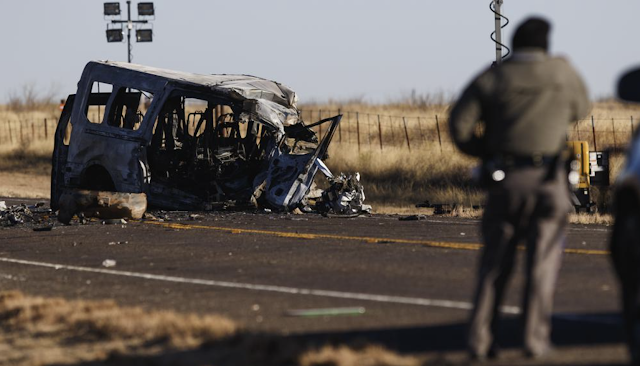
Texas state troopers survey the wreckage from a fatal March 16 crash in west Texas caused by a 13-year-old driver. (Associated Press photo by Eli Hartman)

A deadly crash is drawing renewed attention to the common rural practice of allowing young teenagers and even younger children to drive. Nine people died in West Texas last week when a 13-year-old driving a pickup truck blew a tire and overcorrected, striking a van carrying members of the men's and women's golf teams of the University of the Southwest, a private Christian school in Hobbs, N.M. The teen and his 38-year-old father were killed, along with a golf coach and six students, Gene Johnson reports for The Associated Press. The crash occurred in Andrews County, about 30 miles east of the New Mexico border.

"At a news conference in Odessa, Texas, on Thursday, National Transportation Safety Board Vice Chairman Bruce Landsberg said the dangers of underage driving put it on the agency’s 'most-wanted list'," Johnson reports. "Along with drunk and distracted driving, Landsberg said 'youthful driving' and excessive speed on rural roads are among the problems that make highway driving the most dangerous form of transit in the United States."

In 2020 alone, drivers aged 13 and under were involved in 47 fatal crashes and 1,057 crashes that caused injuries, according to National Highway Traffic Safety Administration data. And though there aren't specific statistics on where such underage drivers live, rural roads are nearly twice as deadly overall: "In 2019, the fatality rate per 100 million vehicle miles traveled was 1.9 times higher in rural areas than in urban areas," Johnson reports. Put another way: nearly half the nation's traffic fatalities in 2019 happened on rural roads, though less than one-fifth of the population is rural.

There were other risk factors: The crash happened at night, on a road with a 75 mile-per-hour speed limit, the tire that blew was a spare not meant for high-speed use, and the driver was a teenage male—one of the highest-risk segments of the driving population, Johnson reports. Several people he interviewed recalled learning to drive on the family farm when they were as young as 10, but also said their parents emphasized safety and refused to let them to drive on public roads until they were legally allowed. One man observed that the road where the crash happened had heavy traffic from nearby oil fields, and said no 13-year-old should have been driving on it to begin with.

William Van Tassel, who manages the American Automobile Association's driver training programs, told Johnson that, while rural teens frequently start driving at a younger age than their suburban and urban peers, that doesn't mean they're ready to hit the highway: "When it comes to public roads, the laws are pretty clear: You can’t be out there until you’re legally eligible."

Monday, March 14, 2022

State of Wyoming has an new app to claim roadkill

Jaden Bales provided this picture showing the outline of a mule deer doe that was struck by a friend's car on US 287 near Lander, Wyo. He claimed the carcass for food using Wyoming's new roadkill app. (Photo via The Associated Press)
About 30 states have laws allowing residents to collect roadkill for food, but we've only heard of one that has an app for that. It's a new feature in the Wyoming Department of Transportation's app, which "helps people quickly claim accidentally killed deer, elk, moose, wild bison or wild turkey after documenting the animal and reviewing the rules for collecting roadkill to eat," reports Mead Gruver of The Associated Press. "Unlike in other states such as Alaska, roadkill meat in Wyoming can’t be donated to anybody, including charities."

"Another purpose is to help people follow the rules," Gruver reports. "For safety reasons, roadkill in Wyoming may not be collected after dark, along interstate highways or in construction zones." And it helps collect data for the state: "By geotagging roadkill with their phones and documenting the species, app users will contribute to the data that help Wyoming wildlife biologists and highway officials decide where to install wildlife crossing signs and other ways of reducing critter deaths."

Tuesday, March 08, 2022

Rural America faces challenges in adopting electric vehicles

Electric vehicles are increasingly popular, but it may be a while before they're feasible in rural America. It depends a great deal on whether rural areas are able to snag federal money for charging stations. 

"How rural communities will fare in the battle for electric vehicles funds comes down to a sort of chicken and egg scenario, officials said," Liz Carey reports for The Daily Yonder. "Without acceptance of electric vehicles in rural areas, federal funding for charging stations will go elsewhere. But without the charging stations, fewer rural residents will buy electric vehicles."

The Transportation Department recently released a toolkit aimed at helping rural communities leverage infrastructure funding for charging stations. Widely available stations are the key to widespread adoption of EVs, the toolkit says.

"In rural parts of the country—home to 20% of Americans and almost 70% of America’s road miles—EVs can be an especially attractive alternative to conventional vehicles," the toolkit says. "Rural residents drive more than their urban counterparts, spend more on vehicle fuel and maintenance, and often have fewer alternatives to driving to meet their transportation needs. Over the long run, EVs will help residents of rural areas reduce those costs and minimize the environmental impact of transportation in their communities."

Carey notes that increasing adoption of EVs is making governments reconsider how they fund roads, since their taxes on gasoline and diesel fuel are the main source of such funds.

Tuesday, November 09, 2021

Infrastructure bill has much for rural America

One square equals $1 billion. (Washington Post chart; click to enlarge)
The $1.2 trillion infrastructure package Congress passed on Friday has much for rural America. Here's some of what we found, and more will likely be forthcoming later as we continue to comb through the gargantuan bill, which has:
  • $550 billion in new spending, which is mostly paid for but would add $256 billion to $350 billion to the deficit over the next decade without raising taxes. Most of the funding comes from unspent pandemic relief and tightening enforcement on reporting gains from cryptocurrency investments. (The National Association of Counties has a more detailed breakdown of the bill's funding sources.) Moody's Analytics estimates it could add as many as 660,000 jobs by 2025.
  • $110 billion for roads and bridges, with specific earmarks for Appalachian and Alaskan highways (Sens. Joe Manchin, D-W.Va., and Lisa Murkowski, R-Alaska, "were instrumental" in crafting the bipartisan package, according to The Washington Post.)
  • $66 billion for railroads. Passenger rail gets a lot of that money (the Post says Amtrak's expansion would be the largest ever, but the bill also has funding for freight-train safety.
  • $65 billion to expand broadband to under-served communities, including rural areas, including $14 billion for subsidizing internet bills for the poor, and $2 billion for the Agriculture Department's Reconnect Loan and Grant Program for rural areas.
  • $65 billion to update power lines and cables and invest upgrades to protect utilities from cyberattacks. It also has funding for renewable energy development.
  • At least $55 billion for water infrastructure, including $10 billion to clean up the "forever chemicals" per- and polyfluoroalkyls, and money for drinking water in tribal communities.
  • $47 billion for "resilience," mainly for cybersecurity upgrades to infrastructure and for addressing droughts, floods, coastal erosion and other extreme-weather issues.
  • $21 billion for cleanup of abandoned wells and mines.
  • $10 million over five years for the new Rural and Tribal Assistance Pilot Program through a new Build America Bureau. "The program would provide financial, technical and legal assistance; assistance with development-phase activities; and information on innovative financing practices to rural and Tribal communities. It would sunset after five years," NACo reports.
  • $2 billion over five years to fund the newly established Rural Surface Transportation Grant program for road and bridge projects. Under the new program, counties can apply directly to the Transportation Department for projects. The federal government will cover 80% of the costs for approved projects.
  • The Digital Equality Act of 2021, which prioritizes federal broadband funding for rural and other underserved communities.
  • Additional counties for the Appalachian Regional Commission service area; also, ARC is eligible for new funding initiatives. Manchin's wife Gayle is ARC's federal co-chair.
  • Three more years for the Secure Rural Schools program, which the Forest Service funds to make up for losses in timber revenue.
Post Fact Checker Glenn Kessler debunks claims that the bill isn't mainly for infrastructure.

Friday, August 20, 2021

Infrastructure bill's roads focus is on rehabilitation, but more than 1/3 of states' capital spending on roads is for new ones

Washington Post chart
While Congress moves an infrastructure bill, many states are still focused on building new roads or expanding existing ones, The Washington Post reports.

"The Federal Highway Administration estimates a $435 billion backlog of rehabilitation needs, while an analysis of agency data by The Washington Post shows a fifth of the nation’s major roads, stretching almost 164,000 miles, were rated in poor condition in 2019. That figure has stayed mostly unchanged for a decade," Ian DuncanMichael Laris and Kate Rabinowitz report. "Yet more than a third of states’ capital spending on roads that year, $19 billion, went toward expanding the road network rather than chipping away at the backlog."

Washington Post chart
That "reflects a desire to connect growing communities and battle congestion at the local and state level in a nation where most people rely on cars," the Post reports. "That appetite for expansion is clashing with new transportation priorities in Washington that seek to bolster existing highways while promoting other modes of travel."

Transportation for America, which lobbies for more spending on road maintenance, "concluded in a 2019 report that many states were continuing to build new roads regardless of whether they could afford to maintain them," the Post reports. "The problem compounds over time, according to the group, which estimated that each lane of new road adds $24,000 in annual maintenance costs per mile."

Wednesday, August 04, 2021

Infrastructure bill has funds for Appalachian highways, wildlife corridors, rural weather-resilience grants, more

The Rural Blog has already listed some of the rural-interest features in the bipartisan infrastructure package, but here are some more, as noted by PBS NewsHour. The 2,700-page bill is a daunting meal for journalists to digest, so more details will undoubtedly come to light.

Here's what reporter Lisa Desjardins found in the bill, along with the page number so you can read more:

  • Resilience improvement grants (p. 356) to help communities upgrade infrastructure to better prepare for climate-change fueled disasters such as flooding, wildfires, hurricanes, and more. At least 25 percent of the funds must go to rural areas, and at least 2% must go to Native American tribal areas.
  • Full funding for what the federal government owes in dozens of lawsuits over water rights of Native American tribes. (p. 2192)
  • A $350 million pilot program (p. 34) to make safe corridors for wildlife to pass through private lands.
  • Funding to potentially complete the Appalachian Highway System (p. 81), a network of roads and bridges begun in 1965 to connect some of the most remote parts of Appalachia.

Thursday, July 29, 2021

What's in the bipartisan infrastructure bill? How's it funded?

What's in the bipartisan infrastructure bill pending in the Senate? The Wall Street Journal reports:

"According to the White House, the bill will include $110 billion in funding for roads, bridges and major projects, as well as $39 billion to modernize and make public transit more accessible to the disabled and elderly. The deal also includes a $66 billion investment in rail maintenance, modernization and expansion. The legislation will provide $11 billion in funding for highway and pedestrian safety programs. A total of $7.5 billion will go to implementing a network of electric vehicle chargers, and another $7.5 billion will be used for zero-emission or low-emission buses and ferries. Ports and airports will be boosted with $42 billion in new spending."

The next paragraph of the WSJ story has more rural resonance: "$50 billion to bolster the country’s infrastructure generally against climate change and cyberattacks," which threaten rural water systems. "$55 billion will go toward clean drinking water and $65 billion will go toward broadband infrastructure and development. The deal invests $21 billion in removing pollution from soil and groundwater, job creation in energy communities and a focus on economic and environmental justice. The legislation will include $73 billion to update and expand the power grid," which will have much rural construction.

And how will it be paid for? "a variety of revenue streams, including more than $200 billion in repurposed funds originally intended for coronavirus relief but left unused; about $50 billion will come from delaying a Trump-era rule on Medicare rebates; and $50 billion from certain states returning unused unemployment insurance supplemental funds. The negotiators also expect about $30 billion will be generated from applying information-reporting requirements for cryptocurrency; nearly $60 billion will come from economic growth spurred by the spending; and $87 billion from past and future sales of wireless spectrum space. A series of smaller pay-fors are expected to make up the difference."

And what's next? "House Majority Leader Steny Hoyer of Maryland said Tuesday that House Democrats may want to tweak the bill to include more climate provisions. But he has also acknowledged such a move could put the bill’s chances in jeopardy in the Senate. If the House changes the bill and passes its own version, the Senate will need to vote on the House version. If they cannot pass the House version, the chambers could also go to a conference committee where they would try to bridge the gap."

Wednesday, July 28, 2021

Senators reach apparent deal on infrastructure package

"Senate Democrats and Republicans on Wednesday appeared to clinch a deal that would invest roughly $1 trillion into the nation’s infrastructure," reports Tony Romm of The Washington Post. "The political breakthrough appeared to put the Senate on track to hold a key procedural vote Wednesday that would allow the chamber to begin debating the infrastructure measure. Senate Majority Leader Charles E. Schumer (D-N.Y.) has said he hopes to pass the package before the August recess."

The apparent breakthrough was "announced separately by two of its lead negotiators, Sens. Rob Portman (R-Ohio) and Kyrsten Sinema (D-Ariz.)," Romm reports. "It came just days after talks appeared to have run aground. Lawmakers found themselves at a stalemate over how to spend money to improve the nation’s railways, water pipes and Internet connections, as well as the exact means by which to pay for it. The disagreements ultimately scuttled an attempt last week to open debate on the infrastructure proposal, which Republicans blocked unanimously since the proposal hadn’t yet been finished."

The Associated Press reports that Republican senators met this morning with their leader, Mitch McConnell of Kentucky, "who appears to have given his nod to proceed." Ohio Sen. Rob Portman, the lead GOP negotiator, "said McConnell 'all along has been encouraging our efforts'."

Even if the agreement proceeds, it is only the beginning of a battle "over a massive measure that would touch nearly every part of the economy," Romm writes. "To shepherd it through the Senate, Democratic leaders must ensure the measure remains attractive to those in their own party as well as Republicans, without whom they do not have the 60 votes to overcome a filibuster."

Also, the plan "is only one component of Biden’s broader economic agenda, and Democrats plan to try to move a second, roughly $3.5 trillion package essentially in tandem," Romm notes. "Party lawmakers plan to rely on a legislative maneuver known as reconciliation to adopt it using 51 votes, rather than the typical 60, allowing Democrats to bypass what is likely to be overwhelming GOP opposition to the budget deal."

Wednesday, May 26, 2021

Senate's bipartisan $300 billion infrastructure proposal includes new rural surface transportation grant program

"Lawmakers on a Senate committee that deals with infrastructure on Saturday released a bipartisan, $303.5 billion draft proposal to reauthorize the main federal program that provides funding for highways, roads and bridges," Bill Lucia reports for Route Fifty. "In addition to supplying bedrock federal dollars for roads, the legislation would provide new grant funding in a number of areas—including for electric vehicle infrastructure, efforts to make the nation's infrastructure more 'resilient' to extreme weather, climate change and natural disasters, and for projects in rural regions."

The current package that governs infrastructure spending will expire Sept. 30. The Biden administration is trying to get support for a much broader infrastructure package that will cost about $2 trillion and include funding for areas like water utilities and broadband, but has been unable to get Republican support thus far, Lucia reports.

The bipartisan bill would cover five fiscal years, from 2022 to 2026, and would greenlight a more than 34% increase in funding compared tot the last such authorization. Democrats highlighted parts of the bill meant to reduce emissions, build resilience and improve pedestrian and bicycle infrastructure," Lucia reports. "Republicans touted provisions in the draft bill plan intended to provide funding to rural areas and to give states flexibility with federal guidelines. Notably, the bill would establish a rural surface transportation grant program, with a total of around $2 billion in grants available over the five years covered by the bill."

Monday, December 07, 2020

Less highway traffic in pandemic may have boosted rural car-wreck mortality rate by encouraging speeding

There were fewer traffic fatalities in 2020's second quarter than in 2019's, but that's because fewer vehicles were on the road during the pandemic. The traffic fatality rate, however, has increased. 

According to recent state and national data compiled by the National Highway Traffic Safety Administration, several factors contributed to the fatality-rate increase. "First, there is evidence of an increase in ejection rates among people who were in crashes, suggesting a decrease in the seat-belt use rate of vehicle occupants. This increase was heavily tilted toward males, people 18 to 34 years old, and people in rural areas," the report says. "Second, according to state data and other reports, speeding was more prevalent on the roads. The reduction in traffic volume coupled with community efforts to reduce law enforcement personnel exposure by implementing changes in law enforcement activity provided drivers a greater opportunity to speed."

Moreover, there is evidence of higher usage of alcohol and drugs such as marijuana and opioids among 2020 crash victims compared to those who died in 2019. Survey research indicates that this may be because many people have begun to use such substances or increased their use to cope with pandemic-related stress, the report says.

Tuesday, February 25, 2020

Idaho Statesman investigation reveals some private contractors cheated the state on tests of road repairs

Here's a great example of watchdog journalism: The Idaho Statesman recently published an investigation revealing that private contractors meant to repair infrastructure were fleecing the state.

"Companies that are responsible for checking the quality of Idaho’s road materials have altered the results of their asphalt tests thousands of times, government documents show. Those changes may have allowed contractors that repair and build Idaho’s highway infrastructure to get bonus payments when they should have been penalized for substandard work — or even forced to tear up the asphalt and replace it," Audrey Dutton reports for the Statesman.

According to a Statesman analysis of four highway projects, the state paid contractors about $8 million, including $190,000 in bonuses, for asphalt whose test results were altered "dozens or hundreds of times," Dutton reports.

"For decades, Idaho has paid private contractors to repair and build the state’s vast system of highways, roads and bridges. They are trusted to be good stewards of taxpayer dollars and to ensure the state’s infrastructure is built to last and is safe for drivers," Dutton reports. "Most of Idaho’s tests are performed by private contractors, since the state cut back on resources it needed to run them in-house."

Tractor-trailers and farm equipment have become much larger over the past few decades, which causes increased wear and tear on the nation's roads. Since many of those road miles are in rural areas, states can pay disproportionate amounts of money to fix rural infrastructure. The bottom line: road upkeep is expensive enough without the added cost of shady contractors.

Friday, November 22, 2019

Study: mobile apps could better measure rural road damage, help decide where repair money goes

Rural roads are a vital resource, but many states have decreased funding for rural road upkeep, so it’s important to find cost-effective, reliable ways to keep tabs on their condition. A project from the Illinois state government, spearheaded by college researchers from universities in the state, aims to change that by creating a mobile app to measure road conditions, McCall Macomber reports for the University of Illinois’ Grainger College of Engineering.

Researchers found that most county and town officials were only able to assess road damage by the 'windshield method': looking out the windshield when driving. "This highly subjective method leads to overspending on road repairs. To explore more cost-effective measures and reliable assessments, investigators put two techniques to the test — manual and automatic assessment methods," Macomber reports. "The manual methods involved evaluating both the new Seal-coated Road Condition Index and the Unsurfaced-road Condition Index, which measure seal-coated road surfaces and surfaces on gravel and dirt roads, respectively."

But the manual methods were time-consuming, expensive, and often meant closing lanes to traffic. "The researchers then shifted their focus to automated methods, where they used three mobile apps to measure the roughness of rural roads. They tested several variables to determine the effectiveness of the apps, including road material, vehicle type, speed and even the cellphone mount," Macomber reports. "Ultimately, researchers found that apps were an effective, cost-saving real-time technique to determine road roughness conditions."

The research team is working on creating an app to report on rural road conditions. "This project is a first stepping-stone to automate low-volume or rural road condition data. The use of cellphones to collect pavement distress data is currently state of the art, and the state of Illinois is at the forefront," said researcher Mohammad Imran Hossain, a Bradley University professor.

Tuesday, October 08, 2019

Wisconsin may join states that teach commercial truck drivers how to keep an eye out for human trafficking

A bill in the Wisconsin state Senate would give more long-haul truck drivers the tools to help fight human trafficking. A similar bill was introduced in 2017 but stalled in the Senate.

"At least eight other states have enacted similar policies, which one group says has led to a dramatic uptick in the number of trafficking reports from truckers—from sporadic calls to the National Human Trafficking Hotline to more than 2,300 reports and counting," Katie Queram reports for Route Fifty. "Those calls opened 635 cases of sex trafficking involving 1,186 victims, according to the nonprofit organizationTruckers Against Trafficking."

In Wisconsin, "Senate Bill 25, introduced in February and recently approved by a committee, would require commercial motor vehicle driver education classes include information on how to recognize and prevent human trafficking," Queram reports. "Proponents said the measure makes sense because human trafficking regularly occurs along highways and at truck stops and rest areas, places populated primarily—and sometimes only—by truck drivers."

Many private truck-driving schools already warn drivers to be on the lookout for human trafficking, but students at state technical colleges may not get that training, according to Dan Johnson, vice president of the Wisconsin Motor Carriers Association. Johnson testified in favor of the bill in March, telling lawmakers, "Education is the key to [fixing] this problem."

Wisconsin's more than 312,000 licensed commercial drivers are in a unique position to keep an eye out for human trafficking, according to Sen. LaTonya Johnson, a Milwaukee Democrat who is the bill's main sponsor. "This is a huge network of eyes and ears within the interstate trade industry that can support law enforcement in the investigation, arrest, and prosecution of traffickers," she said in a recent public hearing.

Monday, August 19, 2019

North Dakota Highway Patrol and a sheriff's department in the state get federal permission to fly drones over people

The Federal Aviation Administration has granted the North Dakota Highway Patrol and the Burleigh County Sheriff's Department in North Dakota the permission to fly drones over people and populated areas. "The North Dakota patrol is the first state highway patrol agency in the country to receive the permission," Blake Nicholson reports for the Bismarck Tribune. "The Burleigh County Sheriff's Department is only the second county law enforcement agency in the nation to obtain it." In June, the North Dakota Transportation Department became the first state government agency to get an FAA permit to fly drones over people.

According to Col. Brandon Solberg, the highway patrol's superintendent, the waiver will allow troopers to safely document complicated vehicle crash scenes. The agency says the drones will also aid in finding missing people and fleeing suspects, Nicholson reports.

The patrol is in the process of buying a drone, and has already bought a parachute recovery system that makes it safer to fly over populated areas; if the drone falls, the system deploys a parachute, shuts down the rotors, and emits a buzzer to warn bystanders. If the patrol is satisfied with the drone, it plans to buy three more and base one in each quadrant of the state, Nicholson reports. The state legislature approved one-time funding of almost $100,000 for the program over the next three years.

Thursday, August 01, 2019

Administration poised to relax truck driver safety rules; critics say deadly truck crashes up 40% since 2009

The Trump administration is expected to relax trucking safety rules that many drivers see as too restrictive, but safety advocates disagree and point to a sharp rise in deadly truck crashes in the past decade, Frank Morris reports for NPR.

The Federal Motor Carrier Safety Administration is expected to issue a notice that “will open a two month comment period on hours of service changes. Then the administration can move forward with new rules,” Morris reports. The agency is considering exceptions to the rule that caps driving time at 11 hours a day and requires at least 30 minutes of rest during that time. If the changes go through, the government would ease some regulations, including allowing drivers to break up their required sleep time.

Driver Michael Whitaker told Morris that tweaks in the regulations would make it easier for drivers to avoid rush-hour traffic. "We don't want to interact with cars during rush hour traffic. We want to stay as far away from you all as possible," he said.

Another driver, Carmen Anderson, said, “It's kind of like when you're in kindergarten and they're sitting there saying, OK, it's nap time. You have to take a nap.” Recalling a time when she was stranded in an industrial area, Anderson said she once spent 17 hours parked in a spot with no restrooms and no security because she had no flexibility in the regulations for hours of service.

Safety advocates disagree with the proposed changes. Dawn King, volunteer president of the Truck Safety Coalition, told Morris that the trucking industry has not produced data to show relaxed standards would increase safety. King said her father was killed by a tired trucker in 2004.

"We really should not be considering weakening the regulations we should be considering enhancing them," said Cathy Chase, president of Advocates for Highway and Auto Safety. "The safety of everyone traveling on our roads is at stake." Chase said deadly truck crashes are up 40 percent since 2009.

Tuesday, July 30, 2019

State officials urge senators to consider needs of rural areas in highway and infrastructure funding

The head of the Wyoming Department of Transportation urged Congress this month to take account of rural roads and what they mean for the country overall when passing an infrastructure bill, Liz Carey reports for The Daily Yonder.

“Significant federal investment in highways and transportation in rural states is a sound policy that must be continued, for many reasons,” K. Luke Reiner said in prepared testimony to the Senate Environment and Public Works Committee on July 10. “Consider truck movements from West Coast ports to Chicago or the East Coast. These and other movements traverse states like ours and benefit people and commerce in the metropolitan areas at both ends of the journey. In Wyoming, about 90 percent of trucks on Interstate 80 have origins and destinations beyond Wyoming’s borders. This is clearly national transportation and warrants federal investment.”

Reiner said rural states have a dwindling tax base for road and bridge work, and their residents have a high per-capita expense for the country’s transportation system; he noted that Wyoming's is highest at $312 per person, followed by the Dakota and Montana. The national average is $117.

President Trump once talked about passing an infrastructure bill, but that seems unlikely anytime soon because of Republican resistance to the taxes that would be needed to fund it. However, the law that funds and provides oversight for the Highway Trust Fund expires Sept. 30, 2020, so Congress will have to take some action on that front in the next 14 months.

Part of that debate will be environmental policy for highway projects. Wyoming Sen. John Barrasso, who chairs the committee, favors streamlining the environmental permit approval process for major projects. but Sen. Tom Carper, D-Maryland, the committee’s ranking Democrat, said climate-change policy should be part of the legislation.

Wildlife migration is another consideration in rural areas, said Carlos Braceras, president of the American Association of State Highway and Transportation Officials. “The infrastructure system that we’ve built over the last 100 years is not the infrastructure system that we’re going to need for the next 100 years,” Braceras testified. “It needs to change and we need to help it adapt.”

Wednesday, April 10, 2019

Thousands of U.S. bridges need repair; look up local data

About 178 million vehicles daily cross more than 47,000 U.S. bridges urgently in need of repair, according to the 2019 Bridge Report compiled by the American Road & Transportation Builders Association, Kate Queram reports for Route Fifty. The report is based on an analysis of the Department of Transportation's National Bridge Inventory database, and has data for states and congressional districts. (The database has local data.)

QUream writes, "Structurally deficient bridges are not 'imminently unsafe, but they are in need of attention,' according to the report. In addition to the 47,052 bridges considered in poor condition, an additional 69,000 are operating under weight limits or other protective measures designed to reduce stress on the structures. In total, there are nearly 235,000 bridges across the country that need structural repair, rehabilitation or replacement . . . Completing all the necessary repairs would cost nearly $171 billion."

The number of structurally deficient bridges declined steadily over the last five years, and very slightly over the last two – from 7.7% of the nation's bridges in 2017 to 7.6% in 2018 – partly because of the Federal Highway Administration's recent redefinition of the term "structurally deficient." The new definition is narrower, and no longer includes "bridges where the overall structural evaluation was rated in poor or worse condition, or with insufficient waterway openings," Queram reports.

Alison Premo Black, chief economist for the road and bridge builders' group, conducted the analysis. He said, "At the current pace, it would take more than 80 years to replace or repair the nation's structurally deficient bridges."