Showing posts with label BLM. Show all posts

Friday, March 15, 2024

Interior Dept. proposes restrictions on mining, energy work, grazing in 'sagebrush sea' to protect greater sage-grouse

Bureau of Land Management map; for a larger version, click on it. For more maps and the whole plan, click here.
The bird's mating dance (Photo by Bob Wick, BLM)
The Bureau of Land Management proposed Thursday to save the greater sage-grouse "by limiting oil and gas drilling, mining, livestock grazing and other activities across much of the American West," reports Maxine Joselow of The Washington Post. That "sets up a fierce clash with the fossil-fuel industry, which has long seen the bird as a barrier to extracting some of the richest oil and gas reserves in the region."

The BLM's draft plan "outlines several alternatives for managing nearly 67 million acres of the birds’ habitat across 10 Western states," the Post reports. "The 'preferred alternative' would restore some restrictions on drilling and other activities that the Obama administration imposed in 2015, although it would maintain some elements of the Trump administration’s 2019 strategy." Those plans weren't fully implemented because of court action.

The greater sage-grouse — known for its mating dance — numbers as many as 200,000 and is not listed as threatened or endangered but there were once a million. In 2015, the Fish and Wildlife Service, another arm of the Interior Department, said that was unnecessary because the Obama-era plan would protect it enough. "Since then, congressional Republicans have inserted provisions into must-pass spending bills to prevent a future listing," the Post reports. "Much of the birds’ habitat, known as the 'sagebrush sea,' has been destroyed by huge wildfires and an invasive plant called cheatgrass. Climate change has hastened the habitat loss, since fires have spread more easily through a warmer, drier landscape parched by a two-decade megadrought.”

Publicly at least, energy groups took a wait-and-see attitude, noting variations among areas, while "Conservation groups offered a mixed reaction to the draft plan," the Post reports. "Aaron Weiss, deputy director of the Center for Western Priorities, called it the 'last best hope' to save the sage grouse. But Vera Smith, senior federal lands policy analyst at Defenders of Wildlife, said the proposal does not go far enough. . . . . Although sage grouse regulations have rankled the oil and gas industry, they could also curtail clean-energy projects essential to the nation’s transition away from fossil fuels. Such projects include wind farms, solar installations, and mines for minerals used in electric vehicles and other green technologies. That poses a conundrum for the Biden administration, which has set a goal of permitting 25,000 megawatts of renewable energy on federal lands by 2025 — a key pillar of its climate agenda."

Thursday, May 18, 2023

Feds want to allow leasing of federal land for conservation; critics call it a back-door attack on grazing, mining, drilling

Cattle graze along a section of the Missouri River in the Upper Missouri River Breaks National Monument near Fort Benton, Montana. Much federal land in the West is used for grazing. (Photo by Matthew Brown, The Associated Press)
The Biden administration's plan to sell leases of federal land for conservation, just like it does for "oil drilling, livestock grazing and other interests," has drawn "pushback from Republicans and ranchers," reports Matthew Brown of The Associated Press

"The proposal is stirring debate over the best use of public land, primarily in the West," Brown writes. "Opponents . . . are blasting it as a backdoor way to exclude mining, energy development and agriculture. Tracy Stone-Manning, director of the Bureau of Land Management, said the proposed changes address rising pressure from climate change and development. She said it would make conservation an 'equal' to grazing, drilling and other uses while not interfering with them."

The bureau, part of the Interior Department, "has a history of industry-friendly policies for the 380,000 square miles it oversees, an area more than twice the size of California," Brown writes. "Those holdings put the agency at the center of arguments over how much development should be allowed." At the first virtual public meeting about the proposal, "There was no opportunity for public comment, and the agency screened questions . . . Officials acknowledged receiving numerous queries about grazing and drilling potentially being excluded. Brian St. George, acting assistant director for the bureau, said the conservation leases would not 'lock up land in perpetuity'."

Stone-Manning said conservation-leased property could still be used for hunting or recreation. "Democratic U.S. Sen. Catherine Cortez Masto of Nevada — where the federal land bureau controls about two-thirds of the land — urged the administration to work with ranchers and farmers before finalizing the proposal."

Tuesday, January 24, 2023

Moving USDA research units from D.C. to K.C. made them less productive, cost them many veteran staff, GAO says

The General Accounting Office has found that the Trump administration damaged the research agencies of the Department of Agriculture by moving them out of Washington.

The number of journal articles by the Economic Research Service fell by more than half, and the National Institite of Food and Agriculture "took longer to process grants," GAO reports. By fall 2021, "productivity had largely recovered," but "the agencies’ workforce was composed mostly of new employees with less experience."

The moves of the agencies to Kansas City were also somewhat haphazard, GAO indicated, saying USDA did not follow some "leading practices for effective agency reforms and strategic human-capital management. For example, USDA minimally involved employees, Congress, and other key stakeholders in relocating the agencies. In addition, both agencies partially followed, or did not generally follow, many of the leading practices related to strategic workforce planning, training and development, and diversity management."

Then-Agriculture Sonny Perdue promised “a rigorous site selection process” that would lead to “attracting highly-qualified staff,” but GAO says the process “excluded estimated employee attrition rates” and “limited the ability of USDA leadership to ensure that it was making an appropriately informed decision on relocating.”

"Instead of attracting employees as Perdue promised, the move quickly decimated the workforce, trashed employee morale, shunned employee input and slashed the number of Black employees at the agencies," reports Joe Davidson of The Washington Post. The relocations “resulted in a significant loss of institutional knowledge, talent, and diversity on staff that will take time and intentionality to fully rebuild,” USDA press secretary Marissa Perry told Davidson.

"USDA officials told GAO auditors the relocation decision, which President Biden has not reversed, 'was the sole decision of the secretary'," Davidson reports. "Perdue, now chancellor of the University System of Georgia, and its media office did not respond to questions submitted by email."

Davidson notes, "During the Trump administration, the Interior Department also moved an agency headquarters west and received similarly negative reviews" from GAO. The Bureau of Land Management headquarters moved to Grand Junction, Colo., but is moving back to Washington, D.C.

Friday, November 11, 2022

Showdown in Wyoming may define the rights of public access to checkerboarded public lands in the Western U.S.

Elk Mountain is a hunter's paradise. The 11,000-foot peak in southern Wyoming is home to hundreds of elk, deer and antelope. But there's a catch: "You can't get there from here," writes Michael Allen of The Wall Street Journal. "The sprawling mountain is surrounded by private ranchland. While the prime hunting ground is checkerboarded with federal and state property, a pattern created when railroads and settlers came, access is limited by an age-old Western doctrine. Ranchers consider it unneighborly for outsiders to hopscotch through their land by crossing over public sections that meet only at a corner."

Allen writes about four hunters from Missouri who got inventive. "Using a special stepladder, they climbed between two parcels owned by the federal Bureau of Land Management, taking care not to set foot on the private property on either side," reports Allen. But then things got sticky. "The local sheriff got involved, and before long the four hunters found themselves facing criminal-trespassing charges in state court. The prosecutor argued that it wasn’t enough that the defendants didn’t physically touch the private property," because they were in its airspace, Allen explains. The case is still in litigation.

"The courtroom clash is drawing attention to an anomaly of Western land ownership dating back to the 19th century," Allen said. "The digital navigation company onX says it has identified more than 8 million acres of state and federal land in Western states that are blocked from public access due to the legal gray area around corner-crossing. . . .That doesn’t stop some eager hunters, who are resorting to ever-more-exotic lengths to get past the legal barriers."

Wednesday, July 27, 2022

Wild-horse advocacy group puts numbers on slaughter buys

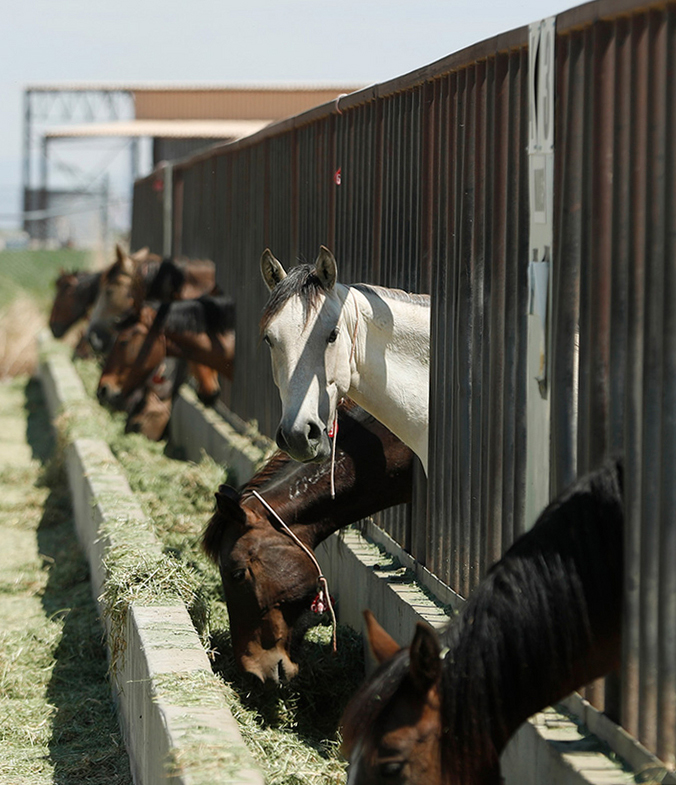
Wild horses in a holding/adoption yard in Delta, Utah
(Photo by George Frey, Getty Images, via Greenwire)
The American Wild Horse Campaign says that since 2019, at least 840 horses and burros adopted from federal rangelands were sold at auctions that included known buyers from slaughterhouses in Canada and Mexico, based on records it obtained through the Freedom of Information Act "and from affiliated wild horse rescue groups that attended the auctions," Scott Streater reports for Greenwire. It has long been presumed that foreign abattoirs were buying at U.S. auctions, but this appears to be the first documentation, with numbers of animals.

The federal Bureau of Land Management "offers $1,000 to people who adopt one of the nearly 60,000 wild horses and burros removed from federal rangelands and held in off-range holding corrals and pastures," Streater notes. "Participants receive $500 up front and an additional $500 per adopted animal a year later, after a follow-up review determines the adopter is properly caring for the horse or horses and title has been transferred to the private party. Since the program started in late 2019, it has helped adopt more than 8,200 wild horses and burros into private care."

The BLM declined to comment on the AWHC report. After complaints from wild-horse advocates, last year the agency added "steps to better screen adoption candidates and to help ensure that wild horses and burros transferred into private care through the adoption program are not later sold at auctions with known kill buyers in attendance," Streater reports. "BLM also visits adopted animals six months after adoption, instead of 12 months later."

AWHC reports says of the 840 “BLM-branded wild horses and burros identified in kill pens,” at least 312 were adopted through the incentive program. “The whereabouts of these animals remain unknown.” The group said it “identified 24 groups of related individuals” that it says have adopted multiple wild horses and burros “to the same address, then flipped all the animals to kill pens as a group after receiving the full incentive payments. . . . At least 130 BLM wild horses or burros were sent to kill pens as part of such coordinated schemes.” AWHC said the numbers “represent the tip of the iceberg, as many kill pens directly ship horses and burros to slaughter without advertising them.”

The BLM said last year that it adopted 7,369 wild horses and burros into private care in the fiscal year that ended Sept. 30, "the most in at least two decades," Streater reports, noting roundups aimed at making the range population "closer to the level BLM considers sustainable without damaging the rangelands, or placing the animals at risk of starvation or dying due to a lack of water — a growing concern as much of the West is experiencing extreme drought conditions. As of March 1, there are now an estimated 82,384 wild horses and burros roaming 27 million acres of federal herd management areas in 10 Western states — down from a record 95,114 in 2020."

Tuesday, October 05, 2021

Manning-Stone OKd to lead Bureau of Land Management

Tracy Stone-Manning during Senate testimony
(Associated Press photo by Graeme Sloan)
"The Senate narrowly approved Tracy Stone-Manning on Thursday to lead the Bureau of Land Management, capping months of efforts by Republican lawmakers to block her confirmation because of her connection to a decades-old tree spiking incident," Lisa Friedman reports for The New York Times. "Stone-Manning steps into an agency that has been stretched thin ever since the Trump administration moved the BLM headquarters to Colorado last year, and will soon be faced with decisions over the future of oil and gas leases on federal land in Western states."

As part of its mission to protect natural resources, the Interior Department agency manages grazing, logging, drilling and mineral rights on public lands. "It is responsible for balancing oil, gas and coal extraction with recreation and the protection of natural resources," Friedman reports. "It also is key to President Biden’s goal of phasing out oil and gas drilling on federal lands. That plan has been in limbo since a federal judge ruled in June that the administration did not have the authority to suspend leases."


Monday, September 20, 2021

Bureau of Land Management headquarters will move back to Washington, D.C., but new Colorado office will remain

"The Interior Department will summon the far-flung headquarters of the Bureau of Land Management back to Washington from the mountains of western Colorado, reversing a move by the Trump administration that caused upheaval within the agency and led to nearly 90 percent of the former headquarters staff to retire, quit or leave for other jobs," Joshua Partlow reports for The Washington Post. The Interior Department will retain the Grand Junction office as a "Western headquarters," Interior Secretary Deb Haaland said when she announced the decision Friday.

The Trump administration announced the move to Grand Junction and other Western cities in 2018, saying it would save money and put the agency closer to regional stakeholders in the 245 million acres of federal land and energy reserves the bureau oversees in 12 Western states. "But current and former employees have said they believe the intention was to weaken the agency that does environmental assessments and regulates fossil fuel and other energy interests," Partlow notes.

In March 2020 a Government Accountability Office report found the move was based on faulty assumptions with little supporting evidence, and in September 2020 Interior's Office of Inspector General found that top Interior officials misled Congress about the move and overemphasized irrelevant issues in its cost-benefit analysis while ignoring important factors.

By the time the move was completed last year, 87 percent of BLM headquarters staff had quit or retired, leaving more than 80 vacancies. The bureau moved 328 of its 388 headquarters jobs west, but only 41 employees made the transfer, and Haaland noted in July that only three of them relocated.

The Grand Junction office will "remain and grow" and continue to host "important policy functions and senior personnel," according to Haaland. She didn't say how many jobs would be in each place. The agency's director and "key leadership positions" will return to Washington, D.C., she said Friday, but employees who have moved out west won't be required to relocate again, Partlow reports.

Tuesday, May 18, 2021

Wild horses adopted under U.S. program being slaughtered

Population numbers for wild horses and burros are out of control in the West. But popular sentiment against culling the animals has led the federal government to pursue other options, such as paying people to give the horses adoptive homes. But records show that some people who were paid $1,000 a head to adopt the horses are sending them to slaughterhouses once they get the money.

"The Bureau of Land Management, which is in charge of caring for the nation’s wild horses, created the $1,000-a-head Adoption Incentive Program in 2019 because it wanted to move a huge surplus of mustangs and burros out of government corrals and find them 'good homes.' Thousands of first-time adopters signed up, and the bureau hailed the program as a success," Dave Philipps reports for The New York Times. "But records show that instead of going to good homes, truckloads of horses were dumped at slaughter auctions as soon as their adopters got the federal money. A program intended to protect wild horses was instead subsidizing their path to destruction." 

A BLM spokesperson denied allegations that the practice is allowed, and noted that all adopters must sign affidavits promising not to resell horses to slaughterhouses or their middlemen. But the spokesperson also acknowledged the bureau has no authority to enforce such agreements or track violators.

Monday, April 26, 2021

Interior nominees would put an environmentalist in charge of public lands, a Native American high up in Indian Affairs

Bryan Newland and Tracy Stone-Manning
On Earth Day last week, the White House announced nominees for major Interior Department positions that underscore administration goals to go greener and put more Native Americans in charge of Native American policy.

Tracy Stone-Manning, a National Wildlife Federation senior adviser for conservation policy, was nominated last week as the Bureau of Land Management director. She is NWF's former associate vice-president for public lands. "If confirmed as land bureau chief, she would preside over all of America’s onshore oil, gas and coal reserves and manage more than 244 million acres of federal public land, mostly in the West," Bobby MaGill reports for Bloomberg. "The potential for her to lead the agency drew skepticism from industry. Kathleen Sgamma, president of the Western Energy Alliance, a trade group representing oil and gas companies operating on land bureau land, said the choice showed environmental activists were running the Interior Department."

Before working at NWF, Stone-Manning was former Montana Gov. Steve Bullock's chief of staff and was an adviser and regional director for Sen. Jon Tester, D-Mont, Magill reports.

Former Ojibwe chair Bryan Newland was nominated for assistant interior secretary for Indian affairs. Newland was tribal president of the Bay Mills Indian Community in Michigan and served as a policy adviser for Indian affairs at Interior under former President Barack Obama. He also served as the chief judge of the Bay Mills Tribal Court. "In February the Interior announced Newland's appointment to principal deputy assistant secretary of Indian Affairs," Indian Country Today and the Associated Press report. "The next step is for the Senate Committee on Indian Affairs to confirm Newland. If he is confirmed by the committee, the vote moves to the full Senate."

Tuesday, February 02, 2021

Bureau of Land Management lost more than 87% of staffers in move; it's unclear whether Biden will bring it back to DC

Moving most of the Bureau of Land Management headquarters staffers to Grand Junction, Colo,, "prompted more than 87 percent of the affected employees either to resign or retire rather than move, according to new data obtained by The Washington Post," Juliet Eilperin reports for the paper. "The exit of longtime career staffers from the agency responsible for managing more than 10 percent of the nation’s land shows the extent to which the Trump administration reshaped the federal government." 

Of the 388 jobs at BLM headquarters, it moved 328, and "287 BLM employees either retired or found other jobs," according to the Department of the Interior. Only 41 went to Colorado. The move was "designed to shift power away from the nation’s capital," Eilperin reports. By shedding longtime employees, the agency could hire employees more loyal to the administration.

Interior communications director Melissa Schwartz declined to comment to Eilperin on how the move had affected the bureau's operations, "but several experts, including former high-ranking Interior officials, said the shake-up has deprived the agency of needed expertise and disrupted its operations. The bureau oversees all oil and gas drilling on federal lands, which has emerged as a flash point in the early days of the Biden administration."

It's unclear whether the Biden administration will—or should—move headquarters back to D.C. Though the 287 employees who didn't make the move either retired or found new jobs, "a key justification for undoing the move to Grand Junction is that a significant number of the Washington-based staffers who left the bureau are still in the D.C. area, and Biden administration officials have said privately that Interior will try to rehire some of these employees," Scott Streater reports for Energy & Environment News.

Steve Ellis, an Obama-era BLM deputy director of operations, told Streater that some of the staff would likely return to BLM if the agency headquarters were moved. That would help the agency, he said, since many employees with institutional knowledge had been lost.

Friday, January 29, 2021

Quick hits: local investors saved two rural California papers; report showcases rural economic success stories

Here's a roundup of stories with rural resonance; if you do or see similar work that should be shared on The Rural Blog, email us at heather.chapman@uky.edu.

Local investors saved one rural California paper and then bought another. Read more here.

After the Trump administration relocated the Bureau of Land Management headquarters out West, more than 87 percent of the headquarters employees quit rather than move. Read more here.

A proposed bill aims to make sure rural critical-access hospitals are able to maintain that status to maintain access to higher Medicare reimbursements and special grant programs. Read more here.

Rural hospital closures not only hurt patients' ability to access health care, but also result in fewer providers and poorer health outcomes, according to a recent Government Accountability Office report. Read more here.

A report shows how three rural areas leaned on their strengths to survive and thrive. Read more here.

Dairy consumption is up during the pandemic. Read more here.

Data from the past three presidential elections in the Sun Belt and the Frost Belt states illustrates the widening rural-urban political gap. Read more here.

Rural communities are getting nationwide attention, but what should they do with it? Read more here.

Amazon employees in a town near Birmingham, Ala., are trying to unionize. Read more here.

While U.S. agricultural exports rose in the second half of 2020, mounting evidence suggests shipping companies are sending empty containers back to China instead of loading them up with American ag products. Read more here.

Burn Awareness Week is next week; here are some tips for parents and kids on how to stay safe around the home and the farm. Read more here.

A new non-fiction book, Big White Ghetto, takes a fairly unsympathetic tour of impoverished areas in the U.S., including many rural locales. Read more here.

An Obama fellow wants to boost the arts in small towns through theater. Read more here.

The pandemic is hurting the availability of child care, and parents are paying the price. Read more here.

Monday, November 30, 2020

Bureau of Land Management releases plan to reduce Western sagebrush wildfires, protect sage grouse habitat

"Officials on Friday released an overarching plan for removing or changing vegetation over a huge swath of the U.S. West to stop devastating wildfires on land used for cattle ranching, recreation and habitat for imperiled sage grouse," reports Keith Ridler of The Associated Press. "The plan released by the U.S. Bureau of Land Management aims to limit wildfires in a 350,000-square-mile area of mainly sagebrush habitat that includes parts of Idaho, Oregon, Washington, California, Nevada and Utah."

The Obama administration came up with the program, which originally cost about $2 million, as a way of protecting sage grouse habitat without formally listing the birds as an endangered species. That could have hindered mining, ranching and recreation, Ridler reports. 

"Giant rangeland wildfires in recent decades have destroyed vast areas of sagebrush steppe ecosystems that support some 350 species of wildlife," Ridler reports. "Experts say the blazes have mainly been driven by cheatgrass, an invasive species that relies on fire to spread to new areas while killing native plants, including sagebrush on which sage grouse depend." Cheatgrass expansion is driven not only by wildfires but by unsustainable populations of wild horses and burros. 

"The plan released Friday does not authorize any specific projects. Instead, its analysis can be used to OK treatments for projects involving prescribed fires, fuel breaks and other measures to prevent or limit massive blazes that have worsened in recent decades," Ridler reports. "Specifically, the agency said the document can be used to help local land managers comply with an environmental law, the National Environmental Policy Act, when land managers seek approval for specific projects."

Erik Molvar, executive director of the Western Watersheds Project, an environmental watchdog group, worries the plan is essentially a BLM "blank check" that will help ranchers and harm wildlife without further input or detailed analysis. "This is an agency whose track record of vegetation manipulation has overwhelmingly resulted in habitat destruction," Molvar said in a press release.

Thursday, November 26, 2020

Emotional battle over wild horses on federal lands in the West continues as their numbers double every four years

Wild horses in the Nevada desert (Photographs by Melissa Farlow for The Washington Post)

The saga of wild horses and burros on federal land in the West has rarely been told as well as it was recently for The Washington Post by reporter Britta Lokting and photographer Melissa Farlow. Several real-life examples are wrapped around this description of the problem:

A mare named Shoshone, in South Dakota
"The question of what to do with America’s wild horses is an emotional battle over livelihood, freedoms and how humans view animals. Many ranchers see the mustangs as an overpopulated invasive species that competes for the public land their livestock grazes. Animal rights activists see an icon of the American West that deserves better protection.

"There are over 100,000 wild horses and burros on 26.9 million acres of Bureau of Land Management land, according to the agency. This doesn’t include mustangs on Native American reservations, national parks, several U.S. Forest Service territories and lands managed by the U.S. Fish and Wildlife Service. The BLM has failed to keep populations at what it considers a sustainable level. To deal with the so-called excess horses, the agency rounds them up, usually using helicopters, puts them in short-term holding pens, tries to adopt them out, and then sends the unwanted ones — currently over 47,000 — to private, grassy pastures in the Midwest.

A herd of wild horses on the move in the Nevada desert
"With unchecked herds doubling every four years, the program is now in crisis mode. 'We’re at a point that we’ve never been before,' says Jenny Lesieutre, a spokeswoman for wild horse and burro issues at the bureau’s Nevada office. “It’s more than three times what the land can sustainably support in the long term, and we are a multiuse agency. That land is shared by all kinds of wildlife and plants.”

"It’s illegal for the bureau to euthanize healthy horses, though it euthanizes ones that have such ailments as blindness or club feet. Officials also can’t ship horses to slaughter or sell them to someone who intends to ship them to slaughter. (Though widely taboo, eating horsemeat is technically legal federally; some consider it a cheap source of protein.) The agency is at a standstill, partly because options like euthanasia or slaughter face intense backlash. . . . The BLM has been interested in spaying wild mares for at least a decade, but various approaches have failed or been blocked by wild-horse activists in court. Two attempts in recent years were met with such public outcry that the agency’s university research partners backed out of studies."

Thursday, October 22, 2020

Judge invalidates ousted Bureau of Land Management chief's decisions in Montana; could set precedent elsewhere

"A federal judge in Montana has once again handed the Bureau of Land Management and its embattled former de facto acting chief, William Perry Pendley, another major legal defeat," Scott Streater reports for Energy & Environment News.

Last week, Montana Chief District Judge Brian Morris ruled that three major land-use plans revisions in the state were invalid because Pendley had been unlawfully leading BLM for more than a year, Streater reports. All three of the plan revisions would have opened more federal lands to oil and gas drilling. 

The ruling could jeopardize the BLM's decisions in other states, Rebecca Beitsch reports for The Hill. Environmental groups have a list of at least 30 land-management plans overseen by Pendley they'd like to see reversed.

"Morris also issued what appeared to be a warning to Pendley and the Interior Department that they better abide by his previous order from last month barring Pendley from performing the duties of BLM director," Streater reports.

The ruling is another coup for Montana Gov. Steve Bullock, whose lawsuit against the U.S. Postal Service forced the agency to reverse recent changes that slowed mail delivery nationwide. Bullock filed suit against the BLM in July, Streater writes.

Friday, October 02, 2020

Interior secretary to lead Bureau of Land Management for now; Trump administration may appeal Pendley's ouster

The Interior Department will not name a new acting director for the Bureau of Land Management "after its leader was ousted by a federal judge, top officials told employees in an email obtained by The Hill. Instead the job will be left to Interior Secretary David Bernhardt," Rebecca Beitsch reports

A federal judge in Montana ruled Friday that the BLM's controversial acting director, William Perry Pendley, had served unlawfully for 424 days. "The decision was in response to a suit from Montana Gov. Steve Bullock (D), who argued Pendley, whose nomination to lead the BLM was pulled by the White House last month, was illegally serving in his role through a series of temporary orders," Beitsch reports.

"The president cannot shelter unconstitutional 'temporary' appointments for the duration of his presidency through a matryoshka doll of delegated authorities," wrote Judge Brian Morris in a 34-page ruling.

An Interior Department spokesperson said an appeal is planned but did not give a timeline, Kirk Siegler reports for NPR.

Monday, September 28, 2020

Acting Bureau of Land Management director has served unlawfully for over a year, federal judge rules

William "Perry" Pendley
"A federal judge in Montana has ordered William Perry Pendley, the acting director of the Bureau of Land Management, to leave the position after finding that he had served unlawfully as acting director for 424 days," Maria Cramer reports for The New York Times. He was also barred from using any authority to make decisions about federal lands, according to the 34-page ruling issued Friday by Judge Brian Morris of the U.S. District Court for the District of Montana.

The ruling hits at a core tactic of President Trump, who prefers to appoint directors in a temporary capacity so they don't have to be confirmed by the Senate and are more beholden to Trump for their jobs. The last Senate-confirmed BLM director, Neil Kornze, left in January 2017, Cramer reports. Since then, Trump has appointed five acting directors, with Pendley as the latest one in July 2019. He nominated Pendley to fill the position permanently in July, but soon withdrew the nomination after the move drew attention to Pendley's controversial views about public lands, the environment, and other issues.

However, even after Pendley's name was withdrawn over concerns that he might hurt Republicans in tight Senate races out West, Pendley continued to run the BLM. That violates the Federal Vacancies Reform Act, which limits acting officers from serving for more than 210 days without Senate confirmation, the judge ruled. "The ruling also prevented Interior Secretary David Bernhardt, who appointed Mr. Pendley, from picking another person to run the bureau," Cramer reports.

Gov. Steve Bullock of Montana, who is in a tight race with Republican incumbent Steve Daines for a Senate seat, filed the lawsuit in July against Pendley and Bernhardt, Cramer reports. His is one of the races most likely to be affected by Pendley's tenure at the BLM. Colorado Sen. Cory Gardner, a Republican also in a tough race, could also be put in a politically inconvenient spot if forced to vote on Pendley's confirmation.

Friday, September 04, 2020

Interior misled Congress about BLM move, watchdog finds

"Top Interior Department officials misled Congress when they claimed high office rent in Washington, D.C., was a factor in the need to move the Bureau of Land Management to a new headquarters in Colorado, the agency’s internal watchdog found," Rebecca Beitsch reports for The Hill. "A report on Tuesday from Interior’s Office of Inspector General found that two officials overplayed the cost of BLM’s M Street SE lease near Nationals Park as a motivating factor in the move, as the agency already had plans underway to return to office space owned by the government."

The report found that the claims were misleading and that the future lease cost of the property was irrelevant. "Interior announced in July of last year that it would move more than 200 of BLM’s Washington-based employees to existing offices across the West, while putting nearly 25 of its top-ranking leaders at a new headquarters in Grand Junction, Colo. The move would leave just 61 of BLM’s 10,000 employees in Washington."

Interior's cost-benefit analysis was a two-page document that "did not weigh the costs of finding a new lease elsewhere in D.C. or within existing government office space, nor did it evaluate other potential locations," Beitsch reports.

Thursday, September 03, 2020

EPA creates new Office of Mountains, Deserts and Plains to focus on Western issues such as mine cleanup

The Environmental Protection Agency announced Wednesday the creation of the Office of Mountains, Deserts and Plains to focus on Western issues, including mine cleanup.

"The move comes as the Interior Department is trying to ramp up its presence in the West, having recently completed a controversial move of the Bureau of Land Management's headquarters to Grand Junction, Colo.," Hannah Northey reports for Energy & Environment News. "It's unclear how the new office will interact with EPA's existing regional office system, and if it will require new employees or draw staffers from elsewhere. Details about costs and official duties are also unknown."

The office headquarters will be in the Denver Federal Center, part of the General Services Administration and already home to more than 6,000 federal employees, Northey reports.

EPA Administrator Andrew Wheeler wrote in a guest column in The Gazette in Colorado Springs that the new office will allow the agency to better address regional issues and move away from a "one-size-fits-all approach to environmental remediation."

Friday, August 21, 2020

Quick hits: baby chicks DOA because of mail delays; rural legal deserts a critical health determinant, study finds

Here's a roundup of stories with rural resonance; if you do or see similar work that should be shared on The Rural Blog, email us at heather.chapman@uky.edu.

Legal experts question move that leaves William Pendley in power at the Bureau of Land Management. Read more here.

Mail delays cause chicks, ducklings and seedlings to be delivered dead, and "Replacement parts for farm machines are late in coming. Prescription refills are taking a week or more to reach mailboxes, a particular threat because rural communities are older than most of America," The New York Times reports.

Rural legal deserts are a critical health determinant, study finds. Read more here.

Traditional farming releases carbon from the soil into the air; a practice known as "regenerative agriculture" could help put it back. Read more here.

Monday, August 17, 2020

Controversial nominee pulled, but he will keep running BLM

William "Perry" Pendley
"The Trump administration withdrew the controversial nomination of William 'Perry' Pendley to head the Bureau of Land Management on Saturday amid signs that the choice would hurt the re-election prospects of Republican Sens. Cory Gardner (Colo.) and Steve Daines (Mont.)," Steven Mufson reports for The Washington Post. "Earlier this month, the Senate Energy and Natural Resources Committee received the materials needed to hold hearings on the nomination. But Democrats were planning to press Daines, who sits on the committee and is in a tight race with Montana Gov. Steve Bullock (D). It was not clear whether Gardner or Daines would vote for Pendley."

Senate Republicans have taken pains to help Gardner and Daines' re-election prospects, including passing a bill they co-sponsored that permanently protects public lands and addresses part of the national park system's maintenance backlog. Public-lands preservation has been a major campaign platform for both senators.

Pendley, BLM's deputy director for policy and programs, has been acting director since July 2019. He has been criticized for controversial views about public lands, the environment, and other issues. Before his tenure at BLM, he was the longtime president of the conservative Mountain States Legal Foundation. During that time, he wrote that there should be no public lands and said repeatedly that climate change lacks credible scientific evidence. Also while at the MSLF, "he had sued the Interior Department on behalf of an oil and gas prospector, sought to undermine protections of endangered species such as the grizzly bear, and pressed to radically reduce the size of federal lands to make way for development," Mufson reports.

However, just because Pendley's nomination has been withdrawn, he isn't out of the picture. "White House and Interior officials said that Pendley would continue to serve in his current, lower-level deputy director position at the Interior Department, a job that effectively lets him continue to act as head of the BLM. Pendley was the only person nominated to head the BLM under Trump," Mufson reports. "Several federal agencies are being run by the Trump administration using similar arrangements."