Showing posts with label global warming. Show all posts

Friday, April 10, 2026

Quick hits: New 'Product of USA' seal launched; mistaken inventions; farming worms win; a new weed killer

The label will require an affidavit be provided to the 
meatpacking company. (Photo via DTN)
Born. Raised. Harvested. Processed. That's the tagline for the new, voluntary USDA seal for U.S. meatpackers, intended to highlight "Product of USA" labeling for meat, poultry and egg products from U.S. farmers, Jennifer Carrico of Progressive Farmer reports. Unlike the previous "Product of USA" label, which only indicated that packaged food passed USDA inspections, the new label states that the meatpacker has proof that animals or eggs are in the U.S. throughout their life cycle. Labels can also be state-specific. Ethan Lane, from the National Cattlemen's Beef Association, told Carrico, "You can now do a born, raised and harvested in Iowa label, through a USDA facility in Iowa." 

Goofs, flubs and unexpected outcomes are all part of inventions in the making, but in some cases, the mistakes turn into success. "From cornflakes to the pacemaker, some of our most beloved — and useful — products were born of blunders," reports Zlati Meyer of The Wall Street Journal. "The U.S. has repeatedly proved itself to be the land of luck. Harnessing happenstance has led to inventions that have changed the world." Read about 10 of the best mistaken inventions here

As earthworms move lime through farming soil, they help
 balance soil pH. (Photo by Blake Vince via Farm Journal)
Blake Vince is a Canadian farmer working to spread the word about no-till farming practices supported by worms. Vince likes to think of worms as "some of the most highly-valued help on his 1,200-acre Ontario, Canada, farm that never show up on a payroll sheet," reports Rhonda Brooks of Farm Journal. The well-known soil conservationist sees "earthworms as more than a sign of good soil — they’re central characters in how he farms, evaluates risk and stays profitable. . . . In a production system shaped by no-till, planting green and cover crops, he sees earthworms as the quiet workforce that’s helping hold the whole thing together."


The Herbert family in northern Iowa had old tractors that needed technology, but the upgrades that could take their machinery into the modern age weren't yet on the market. So, the Herbert family "developed the Cab Radio Upgrade Kit, a solution designed to bring modern connectivity to legacy equipment," reports Eduardo Morales of Farm Journal. "The project was a collaborative effort between T.L. Herbert, his wife, Rochelle, and their three teenage sons: Thomas, Mason and Colin. The idea sparked when Mason and Thomas grew tired of subpar audio options while working on their row-crop and cattle operation."

Part of being a farmer is battling weeds, and despite the perseverance of many farmers, sometimes the weeds seem to be winning, which explains why herbicides are so popular. This summer, one of the world’s biggest chemical companies, Syngenta, is releasing a new herbicide aimed at annihilating weeds in soybean and cotton crops. Patrick Thomas of The Wall Street Journal reports, "Syngenta will begin selling a new weedkiller capable of eradicating grass weeds that have evolved to resist other common crop sprays." The chemical, called Virestina, will be sold and applied in South America first. 


After an unseasonably warm winter and spring, western states are heading into summer facing an "above-normal threat of wildfires," reports Grist. Predictive maps from the National Inter-agency Coordination Center show areas in the Rockies, Pacific Northwest, and northern California as high-risk for wildfires this summer based on "snow drought, rapid snowmelt, and a recent unprecedented heat wave." 

Friday, August 01, 2025

When temperatures sizzle, outdoor laborers often continue to work; a new OSHA rule could help keep them safe

To help outdoor workers stay healthy amid U.S. heat waves, last year the country took steps "towards protecting millions of workers from the impacts of extreme heat on the job," reports Frida Garza of Grist. In July 2024, the Occupational Safety and Health Administration published "its first-ever draft rule to prevent heat illness in the U.S. workforce."

OSHA's proposed rule would "require employers to provide access to water, shade, and paid breaks during heat waves," Garza writes. "In the U.S., the Environmental Protection Agency estimates that 986 workers died from heat exposure on the job from 1992 to 2022, or about 34 per year."

While the Trump administration has sought to undo several workplace regulations, the drafted heat protection rule has moved forward. "The agency is currently in the middle of soliciting input from the general public about the proposed policy."

Some labor experts say the proposal is moving through the process quickly, but labor advocacy groups "focused on workers along the food supply chain, say workers have waited too long for basic life-saving protections," Garza reports. "Even in a best-case scenario, regulations would not be on the books for another 12 to 14 months." In some cases, it takes several more years for a rule to be fully implemented.

Given the lengthy timeline, several advocacy groups are working to educate employers and give outdoor workers a voice in public forums. The group "WeCount" in South Florida "has spearheaded multiple campaigns to draw public attention to how sweltering temperatures impact outdoor workers in the region, including plant nursery workers," Garza explains. "WeCount members are trying to publicize the risks that agricultural workers take on."

Getting consumers to care about their workforce enough to take action is one of the best ways outdoor employees can lobby for heat protections. Garza reports, "The Fair Food Program, first established by tomato pickers in 2011 in Florida, has won stringent heat protections for farm workers in part by building strong support for laborers’ demands among consumers."


Friday, January 31, 2025

Seeking the safety of higher ground, Kentucky builds new homes on its abandoned mountaintop mines

Coal mining can leave land with a "lunar surface"
atmosphere. (Adobe Stock photo)
Kentucky families looking for respite from repeated flooding look to make mountaintop mines their new home. "In 2022, apocalyptic flooding swept across eastern Kentucky," reports Austyn Gaffney of The New York Times. "Now, instead of rebuilding in the floodplain, the state is permanently lifting residents onto safer land."

Kentucky is two years into a $800 million plan to reinvent long stretches of barren land left behind from mountaintop strip mining into neighborhoods perched away from valley flooding. "Seven communities across four counties have been designed for 665 brand-new properties," Gaffney writes. "Fourteen houses have been completed and about a dozen people have moved into two communities."

Kentucky isn't the only state exploring climate migration. It has "already reached places like Louisiana, where low-lying communities like the Isle de Jean Charles are being forcibly abandoned," Gaffney explains. The state's mountaintop relocation approach "is the largest known housing project on reclaimed mine sites in the country."

Strip-mined mountaintops offer the safety of higher elevation and flat ground for construction. "Mark Arnold, a landscape architect who designed five of the high-ground sites. . .plans to incorporate the place-based culture of floodplain communities," Gaffney writes. "His vision — small clusters of houses, eventually enveloped by reforested land — would emphasize the importance of family and neighborliness."

Even with the benefits the new community offers, some residents may find it hard to leave the land their families have lived on for generations. "It can be difficult to adjust to life on higher ground," Gaffney reports. "But residents want to escape future floods and keep their families safe."

Tuesday, January 28, 2025

More U.S. homeowners no longer have home insurance, 'leaving them exposed to financial ruin'

National Association of Insurance Commissioners and Federal Insurance Office, Department of the Treasury map

Whether it's tornadoes, wildfires, torrential rains, flooding or atmospheric rivers, extreme weather has carved a path of destruction across the United States. The collective losses caused drastic increases in home insurance costs, leaving some Americans unable to pay, "threatening what is, for many people, their most valuable asset," report Christopher Flavelle and Mira Rojanasakul of The New York Times.

New government data shows how increasing numbers of Americans have "given up on paying their insurance premiums, leaving them exposed to financial ruin," Flavelle and Rojanasakul explain. "The rising cancellation rates are part of a broader trend captured by the Treasury Department, which analyzed information for 246 million insurance policies issued by 330 insurers nationwide from 2018 through 2022."

How and when home policies get dropped depends on a variety of factors. For instance, some homeowners don't have a bank or lien-holder, so they can take the risk and drop their insurance. When policyholders fails to pay their premiums, their insurance company will cancel their policy for non-payment. Other homeowners lose coverage when their insurance company refuses to renew their policy. Without home insurance, homeowners are exposed to possible financial ruin and homelessness.

The rates of cancellations and nonrenewals "are increasing, and those increases are most pronounced in high-risk areas," the Times reports. "In more than 150 ZIP codes around the country, insurers canceled at least 10 percent of home insurance policies in 2022, the most recent year for which numbers are available because homeowners failed to pay their premiums."

While the new information doesn't explain why homeowners have stopped paying for their insurance, "Nellie Liang, the Treasury Department’s under secretary for domestic finance, said her team viewed it as an indicator of families facing growing financial stress worsened by climate change," Flavelle and Rojanasakul write. 

Friday, January 17, 2025

Earth's methane levels began to spike in 2020; a new study may have uncovered the 'culprit.'

Wetlands and cow stomachs have similar
environments. (Adobe Stock photo)
In 2020, Earth's methane levels started to climb the charts at an inexplicable rate, putting the planet on a crash course with greenhouse gases that could eventually heat oceans and land to life-threatening temperatures, reports Shannon Osaka of The Washington Post. Researchers have been baffled by the cause -- until now. Scientists say a study released last month reveals why methane levels are spiking.

"The culprits, scientists believe, are microbes — the tiny organisms that live in cows’ stomachs, agricultural fields and wetlands," Osaka writes. "That could mean a dangerous feedback loop — in which these emissions cause warming that releases even more greenhouse gases — is already underway."

Sylvia Michel, lead author of the paper published in the Proceedings of the National Academy of Sciences, told Osaka, "The changes that we saw in the last couple of years — and even since 2007 — are microbial." Oska adds. "The new paper points to microbes as the biggest source of the methane spike."

In clarifying the source of rising methane levels, the study ruled out fossil fuels and geological causes. Stanford University professor Rob Jackson, who is part of the Global Methane Budget, explained how cow stomachs and swampy places are alike. He told Osaka, "Methane forms biologically in warm, wet, low-oxygen environments. The wetlands of a rice paddy and the gut of the cow are all similar.”

Microbe methane output may be a chemical reaction to a warming planet. Osaka reports, "Michel says it’s too early to say whether this is the beginning of a vicious cycle. 'Are these coming from human-caused changes in freshwater systems, or are they a kind of scary climate feedback?' she said. 'I want to be careful about what we can and cannot say with this data.'"

Friday, January 10, 2025

Is the weather really abnormally cold? That depends on which years are used as a baseline for 'normal.'

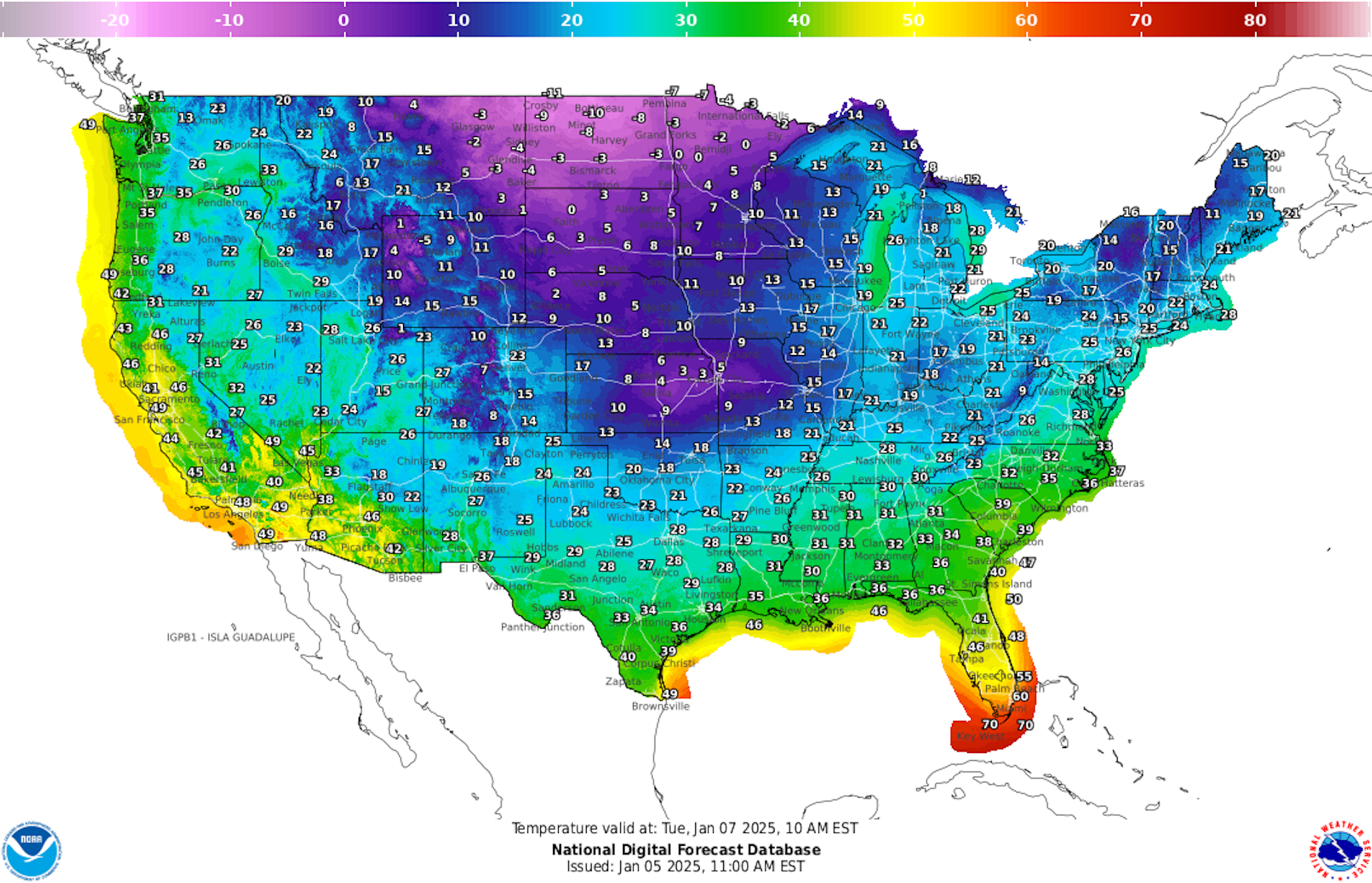
When winter fills the air with cold and bone-chilling gusts, and ice and snow bow down even the sturdiest looking of evergreen branches, it's easy to think that the weather is so much colder than normal. But is it? Using what's "normal" compared to what isn't normal can be confusing. "While temperature forecasts are important to help people stay safe, the comparison to normal can be quit misleading," writes Richard B. Rood for The Conversation. "That’s because what qualifies as normal in forecasts has been changing rapidly over the years as the planet warms."

Who determines what normal temperatures are? "One of the most used standards for defining a science-based normal is a 30-year average of temperature and precipitation," Rood explains. "Every 10 years, the National Center for Environmental Information updates these normals, most recently in 2021."

Over the past century, the planet's temperatures have increased. Rood writes, "Because global temperatures are warming, what’s considered normal is warming, too. So, when a 2025 cold snap is reported as the difference between the actual temperature and normal, it will appear to be colder and more extreme than if it were compared to an earlier 30-year average."

How U.S. temperatures considered normal have changed over the decades. Each 30-year period is compared to the 20th-century average. (NOAA Climate.gov graphic via The Conversation)
To get a better picture of our warming planet, "NASA scientists use 1951-1980 as a baseline," Rood explains, "The reason becomes evident when you compare maps. For example, January 1994 was brutally cold east of the Rocky Mountains. If we compare those 1994 temperatures to today’s normal – the 1991-2020 period – the U.S. looks a lot like maps of early January 2025’s temperatures: Large parts of the Midwest and eastern U.S. were more than 7 degrees Fahrenheit below normal, and some areas were much colder. . . . But if we compare January 1994 to the 1951-1980 baseline instead, that cold spot in the eastern U.S. isn’t quite as large or extreme."

Despite global warming, cold air outbreaks will continue, "but as the Arctic and the rest of the planet warm, the most frigid temperatures of the past will become less common," Rood adds.

Friday, November 08, 2024

Forty-eight states face moderate drought, which affects groundwater supplies, agriculture and river transportation

Drought caused this sunflower crop to fail.
(Adobe Stock photo)
This summer's scorching heat may be over, but across the United States a lack of soil-absorbed rainfall has left most states facing drought conditions. "More than 150 million people in the country – and 149.8 million in the 48 contiguous states – are in a drought this week. That is about a 34% increase since last week and an over 150% increase since last month," reports Marina Dunbar of The Guardian. Drought is present in every state except Alaska and Kentucky, in fact, this is the greatest number of states in drought in U.S. Drought Monitor history.

Drought conditions aren't just about lack of rainfall, they "are driven and exacerbated by abnormally high temperatures that can quickly suck moisture from the atmosphere and the earth," Dunbar explains. "Droughts can occur even when there is slightly more rain than usual, depending on the frequency of rainfall. If there is a lot of rain all at once, it’s difficult for the water to be properly absorbed into the ground."

National Integrated Drought Information System data

When droughts occur, groundwater supplies get tapped, which can take weeks, months or centuries to replenish. "According to the National Integrated Drought Information System, droughts will increase an area’s reliance on groundwater. Groundwater provides more than 40% of the water used for U.S. agriculture and domestic water supplies. Increased pumping during droughts can reduce the future availability of those supplies."

Meanwhile, dry conditions have a domino effect on water sources, agriculture production and commodities trading. "Low water levels on rivers and other waterways [can cause] ports and other water-borne transportation to become limited due to a reduction in available routes and cargo-carrying capacity, which increases transportation costs. . . That cost increase is ultimately transferred to consumers, who see it in the form of higher-priced products, groceries and other commodities."

Friday, October 04, 2024

Simply adding ground limestone to rivers and oceans could decrease global warming, but the challenges are many

Rivers
naturally
deliver
carbon
to
the
ocean,
preventing
it
from
entering 
the
atmosphere.
(CarbonRun graphic)
Scientists aim to fight global warming by adding ground limestone to oceans and rivers, report Brad Plumer and Raymond Zhong of The New York Times. The Earth's water sources "contain carbon dioxide that is constantly escaping into the air, where it traps heat and warms the planet. Adding limestone converts some of that carbon dioxide into a stable molecule that instead stays underwater and washes into the sea, where it should remain trapped for thousands of years."

Oceans already play a big part in removing carbon dioxide from the atmosphere. "By speeding up that process, scientists believe even more carbon could be packed into those watery depths," the Times reports. "One idea is known as alkalinity enhancement, which involves adding limestone, magnesium oxide or another alkaline substance to rivers and oceans, changing their chemistry in a way that makes them soak up more carbon dioxide."

The company, CarbonRun, is putting the new science to the test, with its first limestone silo under construction in Nova Scotia. Later this year, "the machine will grind up limestone inside a tall green silo and release the powder into the nearby West River Pictou, creating a chalky plume that should dissolve within minutes," Plumer and Zhong explain. With the addition of powdered limestone, the water will do the rest. "Scientists estimate that similar methods deployed in oceans could remove billions of tons per year."

Despite its promise, the technology faces challenges from nature and unanswered questions. While dumping ground limestone in a river may be successful, full-scale drops into oceans would be more complex and require massive amounts of ground limestone. The Times reports, "toying with ocean chemistry also carries unknown risks. Some environmental groups worry that even early experiments with these techniques could threaten fish and other aquatic life."

To mitigate environmental pushback, CarbonRun’s founders are "proving that adding limestone to rivers doesn’t just take carbon out of the air — it can also safely benefit local ecosystems," Plumer and Zhong add. "It’s relatively straightforward for CarbonRun to show that adding limestone to rivers converts some carbon dioxide into a stable bicarbonate. . . .The harder part is mining and moving the limestone cheaply."

Tuesday, September 17, 2024

Rural co-ops are slated for a $7.3B federal cash infusion to help them shift from coal to cleaner energy

Map indicating the wide geographic reach of the co-ops awarded funding.
(Map by Jeremy Fisher, Sierra Club Law)

Creating cleaner energy sources for communities in the more remote parts of the United States means helping rural co-ops afford the switch from coal to renewables. To help make the change possible, the Biden Administration "announced $7.3 billion in financing for 16 rural co-ops serving about 5 million households across 23 states, reports Jeff St. John of Canary Media. The Department of Agriculture will manage the funds, which "will also be matched by more than $29 billion in private investments."

The $7.3 billion infusion won't all go toward moving sparsely populated areas to renewables. Instead, some of it will cover the costs of closing coal plants, which are a "particularly thorny financial challenge for co-ops, which can’t raise financing the same way that investor-owned utilities can," St. John explains. For the Tri-State Generation and Transmission Association, [the funds] "will help accelerate the closing of 1,100 MW of coal-fired generation in Arizona, Colorado, and New Mexico."

The federal assistance means more rural cooperatives can afford to drastically shrink their energy reliance on coal. St. John reports, "A 2023 analysis by researchers at the Sierra Club, Energy Innovation, and the Department of Energy found that federal funding could help co-ops secure enough wind, solar, and battery resources to retire their entire coal capacity by 2032. . . . That would be a huge shift."

Much of the federal money deal-making is still in process. Of the 16 awards announced last week, "only one has been finalized by USDA — nearly $573 million to Dairyland Power Cooperative, which serves 24 distribution cooperatives and 27 municipal utilities in Wisconsin, Illinois, Iowa, and Minnesota. . . . Dairyland will use the funding to back a total investment of $2.1 billion to build and contract for 1,080 megawatts of clean power."

Thursday, August 22, 2024

Rural Minnesota town will be 'guinea pig' for long-duration solar batteries. It's a big change for this community.

Upon completion, Sherco will be the biggest solar farm
in the Upper Midwest. (Photo by APPA, Unsplash)
Becker, Minnesota, is covered with viny potato fields and endless rows of corn that go as far as the eye can see. But in this small community of 5,000 residents, solar panels by the thousands are about to be added, replacing three of the town's coal mines in a test of long-duration batteries, reports Ivan Penn of The New York Times. "Becker is also one of two sites where Xcel Energy is installing demonstration battery systems from Form Energy, a Massachusetts company. The systems — using readily available materials like water, air and iron — can store solar and wind-generated energy as a backup, with a capacity to power 2,000 homes for up to five days."

The Sherburne County Generating Station, known as Sherco, is a massive example of what Minnesotans are doing to meet the state's goal of "100 percent carbon-free electricity by 2040," Penn writes. "And it tests how the energy transition could unfold on a nationwide scale for jobs at decades-old fossil fuel facilities, local tax revenues and agricultural businesses. . . . Sherco will stand as the largest solar farm in the Upper Midwest — replacing three coal units in Becker with three solar sites on the town’s outskirts along the Mississippi River."

Becker is in Sherburne County, Minn.
(Wikipedia map)
The closing of the coal plants has been met with distrust and some past-employee grumblings. "Among skeptics of the energy transition, suspicion about solar runs as deep as the town’s cornfields are long. . . . Xcel [has] promises no layoffs," Penn reports. "'We are the guinea pig for the whole group,' said Tracy Bertram, the mayor of Becker, acknowledging the anxiety some have felt about the loss of an economic anchor. 'People don’t like change. It’s the unknown.'"

Despite the positives that Xcel's development offers, some Becker residents are sad to see coal go. Rob Miller, a journeyman who has worked at the Sherco [coal] plant for 20 years, told Penn, “There’s a lot of pride, blood, sweat that has gone in here. It’s sad to see it coming to an end.”

Friday, August 16, 2024

Rural lands are cooler than urban spaces; a study suggests a new way to reduce sizzling urban temperatures

Strategic use of rural land and water bodies could
help cool cities. (Adobe Stock photo)
The heat is on cities to do something about sweltering and unhealthy urban temperatures. Researchers looked at the problem and said, "Rural can cool," and began work on configurations where city heat could be mitigated by country cool, reports Erin Blakemore of The Washington Post. "Rural land surrounding urban areas could reduce city temperatures by up to half a degree Celsius, an analysis in Nature Cities suggests, hinting at a way to cool increasingly scorching urban areas."

Scientists studied 30 cities in China "to understand how rural land cover affects urban heat islands — a phenomenon in which cities become significantly warmer than the areas surrounding them." Blakemore explains. "Researchers concluded neighboring rural land cover can explain about 30 percent of such regions’ effect on urban heat. . . . Air warms in cities, leaving a low-pressure zone near the ground that then helps transport cooler air from surrounding rural areas. The rural areas then go on to absorb the heat."

The study's analysis concluded with specific recommendations on how to "use less dense, less expensive rural land to increase cities’ cooling capacities," Blakemore reports. "Planting woodland around cities and consolidating bodies of water in rural areas are potential ways to cool cities. . . . By better regulating rural land, the researchers suggest, it could be possible to both maintain rural landscapes and boost rural economies while making urban areas cooler and more sustainable."

Friday, August 02, 2024

Flora & Fauna: Bee slaps ant off the plank; grasshopper sparrows are back; boars aren't boring -- they're dangerous

This bee has had enough of ants trying to sneak into
her hive. (Popular Science photo)

Humans aren't the only ones who reach maximum tolerance and get slap-happy -- animals do it, too. How about this real-life wing-drop-swing-swipe maneuver a bee puts on an unsuspecting ant? The Night at the Museum's smack-it-out scene between Capuchin monkey "Dexter" and Ben Stiller's night guard character is a play-by-play theatrical version of living creatures being frustrated. We all get frustrated. For people, humor and possibly catharsis can help.

A steer and a cow crossed the road to munch on grass on the other side. The traveling adventure of two curious bovines from rural western New York may sound harmless. It wasn't. When they "strayed from their pasture, they set off a chaotic chain of events involving death threats, chicken rustlers and Joaquin Phoenix," reports Christopher Maag of The New York Times. "The town of Newfane, N.Y., hasn’t been the same since."

Very hungry spined sea urchins 'clean' coral by eating
harmful algae growth. (University of Florida photo via Hakai)
A spiky sea animal is helping Caribbean coral reefs recover from an onslaught of smothering algae. "Long-spined sea urchins (Diadema antillarum) play a vital role in Caribbean coral ecosystems," reports Lisa S. Gardiner of Hakai magazine. "Dark and rotund with spines radiating in all directions, some as long as knitting needles, the urchins eat massive amounts of algae that would otherwise smother corals or prevent coral larvae from affixing to rocks and growing into colonies." Some experts call these busy creatures the "janitors of the reef because they're so efficient at cleaning reef surfaces."

Birds can be incredibly resilient, but in the case of Florida's grasshopper sparrow, scientists intervened. "Numbers of the Florida grasshopper sparrow, seen only in prairies in central regions of the state, dwindled so severely by 2015, mostly through habitat loss, that authorities decided to remove remaining breeding pairs into captivity," reports Richard Luscomb of The Guardian. "Their gamble was rewarded." Experts released their 1,000th bird back into the wild . . . "adding to an increasingly stable population that researchers believe has turned the tide towards the species’ survival."

Feral pigs are fierce and carry diseases.
(Graphic by Adam Dixon, Ambrook Research)
Worried about shark season? Maybe another animal is a bigger danger. "Scientists determined feral pig attacks are more than three times deadlier to humans than sharks worldwide," reports Emma Glassman-Hughes of Ambrook Research. "That, coupled with feral hogs’ capacity for carrying disease, has raised their profile from farm pest to existential threat. But not enough people seem to understand the gravity of the situation, according to experts — and municipalities are struggling to control it."

Silver carp jump in the Fox River in Illinois.
(Photo by Ryan Hagerty, Fish  & Wildlife Service via the Louisiana Illuminator)

Winner, winner, Asian carp for dinner. Sound yummy? Midwesterners working to keep the invasive fish from establishing itself in the Great Lakes hope so. "Silver carp particularly represent a huge threat to the fisheries in the Great Lakes. . . . One way to get the silver carp population under control seems relatively simple – eat the carp," reports Elise Plunk of the Louisiana Illuminator. Americans aren't convinced Asian carp is a great dinner entre, but marketers are working to change consumer opinion. "Creative cooking, such as making carp burgers with dill pickles and cheddar or New Orleans-style carp po’boys, when paired with the knowledge that eating carp helps the environment, could be more palatable to Americans."

Friday, June 07, 2024

Expert explains how to use the heat index and other weather tools to stay safe and healthy this summer


The start of summer is an excellent time to create schedules and workloads based on heat safety. To get started, risk communication researcher Micki Olson reviews heat index warnings, including what they mean and how they can be used to understand how heat impacts the human body. She also gives tips on how to avoid heat-related illnesses.

What is the heat index?
The heat index is the combination of the actual air temperature and relative humidity. "It tells you what it 'feels like' outside when you factor in the humidity. For example, if it's 98 degrees Fahrenheit (36.7 Celsius) with 55% relative humidity, it might feel more like a scorching 117 F (47.2 C)," Olson explains. "But there's a catch: Heat index is measured in shady conditions to prevent the sun's angle from affecting its calculation. This means if you're in direct sunlight, it will feel even hotter.

Apparent temperature is another "feels like" indicator; however, it factors in temperature, humidity and wind speed. "This means it can tell us both the heat index and wind chill – or the combination of the temperature and wind speed," Olson writes. "When conditions are humid, it feels hotter, and when it's windy, it feels colder."

Another term meteorologists use is the "wet bulb globe temperature," which includes temperature, humidity, wind and sunlight. Olson reports, "It's especially useful for those who spend time outdoors, such as workers and athletes, because it reflects conditions in direct sunlight."

Signs of extreme heat illnesses
(CDC sign via The Conversation)
HeatRisk
is a forecasting tool the National Weather Service uses to provide a seven-day outlook for hot weather. The tool uses a five-level scale to indicate how risky the heat level is in a specific area. Each level uses a color and number to represent risks from heat exposure.

To stay safe during summer's sultry and sometimes oppressive heat, Olson recommends:
  • Stay cool: Use air conditioning in your home, or spend time in air-conditioned spaces, such as a shopping mall or public library. Limit or reschedule your exercise and other outdoor plans that occur in the middle of the day when it is hottest.
  • Stay hydrated: Drink more water than you might otherwise, even if you don’t feel thirsty, so your body can regulate its temperature by sweating. But avoid sugary drinks, caffeine or drinks with alcohol, because these can cause you to become dehydrated.
  • Stay informed: Know the signs of heat illness and symptoms that can occur, such as dizziness, weakness, thirst, heavy sweating and nausea. Know what to do and when to get help, because heat illnesses can be deadly.

Micki Olson
Micki Olson is a senior researcher in emergency and risk communication at the State University of New York. This excerpt was pulled from her contribution to The Conversation, a platform for journalism by academics. Her entire article and research can be found here.

Friday, May 31, 2024

Climate change has creatures and plants moving or expanding territories, including mangroves in Georgia

A salt marsh on Sapelo Island, McIntosh County, Georgia.
(Adobe Stock photo)

As the planet warms, flora and fauna are on the move. Sometimes, when animals or plants enter new territory, nothing much changes. Far more often, these moves can cause undesirable consequences. A few movers are shared below, but more can be found here and here.

As temperatures increase along the Gulf Coast, mangroves have spread into the idyllic beauty of Georgia's salt marshes, writes Dan Chapman for the Fish and Wildlife Service. "Mangroves? The tropical plant that shrouds the coastlines of Florida, the Caribbean, and Central America in shadowy, impenetrable greenery? . . . Yup. Mangroves aren't bad. Ironically, one of their major benefits is keeping at bay one of the more insidious effects of a warming world by buffering coasts from ever-rising seas. . . . Mangroves, though, aren't necessarily good either. Georgia's famously beautiful salt marshes. . . could be replaced with mangroves. And the already fragile ecosystem that nourishes migratory birds, fish, crabs, and other animals could be at risk."

Black-legged ticks are moving to climates that have not previously been hospitable to the Lyme-disease-spreading insect. "It's true that the ticks that pass along Lyme disease — which afflicts more than 475,000 Americans each year — are expanding their geographical range, and climate change is one reason why," reports Jeffrey Kluger of Time magazine. Dr. Vishnu Laalitha Surapaneni, an assistant professor of internal medicine at the University of Minnesota Medical School, told him: "We're observing that the tick is moving more into Canada, and higher temperatures do appear to be a key factor. We also see Lyme disease cases in Norway, as well as in the Arctic."

Bumblebees are heading to cooler zones. "There are over 250 species of bumblebees, and they are some of our planet's most important pollinators — without them, we wouldn't have many of our vegetables, fruits, legumes, and other crops," reports the International Fund for Animal Welfare, a global non-profit helping animals and people thrive together. "But due to climate change, rising temperatures are forcing bumblebee populations further north to cooler climates. These temperature changes are also causing spring flowers to bloom earlier than normal, leaving less time for the bees to pollinate them."

Friday, April 26, 2024

Learning practices and knowledge from Native Americans can help support nature, farming and more

Native Americans have worked with nature to support themselves and the land for centuries. "These time-honored practices work with the natural world’s rhythms," reports Samuel Gilbert of The Washington Post. "Some might even hold the key to a more resilient future." Below are five of Gilbert's indigenous practices that can help humans tend to Mother Nature while caring for their communities.
Zuni waffle gardens look like an 'earthen waffle.'
(Photo by Curtis Quam via Civil Eats)
Zuni waffle gardens
are made with rows of sunken squares "surrounded by adobe walls that catch and hold water like pools of syrup in a massive earthen waffle," Gilbert writes. "The sustainable design protects crops from wind, reduces erosion and conserves water."

Controlled or "cultural burns" were used by Indigenous people "to improve soil quality, spur the growth of particular plants," Gilbert adds. "Prescribed burning has returned as state and federal agencies recognize the importance of fire in managing forests."

The use of acequias, which are ancient irrigation systems dating back to the 1600s. "The name can refer to both the gravity-fed ditches filled with water and the farmers who collectively manage water," Gilbert explains. "The earthen ditches mimic seasonal streams and expand riparian habitats for numerous native species."

Learn from dryland farmers. "The Hopi nation in Arizona receives an average of 10 inches of rain per year — a third of what crop scientists say is necessary to grow corn successfully," Gilbert adds. "Yet Hopi farmers have been cultivating corn and other traditional crops without irrigation for millennia, relying on traditional ecological knowledge rooted in life in the high desert."

Some seeds are 'arid-adapted.'
(Adobe Stock photo)

Find and cherish diverse, resilient seeds
. Gilbert writes, "Aaron Lowden, a seed keeper and traditional farmer from the Acoma Pueblo, a village west of Albuquerque, has successfully returned dozens of varieties of traditional arid-adapted seeds such as Acoma blue corn, Acoma pumpkin, Acoma melon and other crops to his pueblo."

To read Gilbert's additional suggestions, which include clam gardens and jaw-dropping indigenous architecture, click here.

Tuesday, March 26, 2024

Coal markets remain robust as Asia increases reliance on coal to fill supply gaps; output set a record in 2023

Coal will remain an energy source for many decades
to come. (Photo by Dominik Vanyi, Unsplash)

Despite coal's reputation as the "dirtiest fossil fuel," it is still considered a reliable form of energy, and its removal from global energy systems looks to be a slow ride. "Thanks to a combination of China’s energy insecurity. . . and rising Indian demand, the continued fallout from the war in Ukraine and faltering international programs to wean developing economies off fossil fuels, coal is proving remarkably resilient," reports Bloomberg News. "Output hit a record last year."

Coal prices remain steady as the Asian market returns to coal as a more reliable energy source. "By 2026, China and India will comprise more than 70% of global coal use," Bloomberg reports. Those two countries, along with Indonesia, which opened new coal power plants last year, use about 93% of the world’s coal power, according to Global Energy Monitor.

Rob Bishop, chief executive officer of Australian miner New Hope Corp., told Bloomberg, "You look at Asia, the demand and the build-out of coal-fired power plants, particularly in India — coal’s not going anywhere anytime soon." Bloomberg reports, "In 2022, Russia’s invasion of Ukraine and blackouts during heatwaves in India further bolstered coal demand. By last year, output had risen to a record 8.7 billion tons, according to the International Energy Agency."

As nations work to transition from coal to renewables, coal will play a vital role. Global change to cleaner sources depends on multiple variables, particularly in countries such as China and Indonesia. Bloomberg reports, "Coal phaseouts, however, have proved far more challenging than anticipated. . . .The transition tests years-long expectations of rapid peaks and subsequent steep declines." Bishop told Bloomberg, "We see that the world needs more operators to mine coal and support the transition over many decades to come."

Tuesday, March 19, 2024

Natural wonders: Mt. Rainer's glaciers; wacky animals decline; the little bat that could; repurposing waste wool

Mt. Rainer is an active volcano. (Photo by Tiffany Von Arnim
via the National Park Service, CC image)
At 14,410 feet, Mount Rainier is the highest volcanic peak in the contiguous United States. It boasts the largest alpine glacial system outside of Alaska and contains the world's largest volcanic glacier cave system. It is the Mount's unearthly "frozen labyrinth tucked within the majestic volcano's east crater" that scientists are now daring to explore, reports Rebecca Dzombak of National Geographic. "The glaciers atop Mount Rainer, which towers to the southeast of Seattle, Washington, contains clues about the volcano, the inner workings of glaciers, and even icy worlds far from Earth."

In 2002, America's wacky animals -- think the great American llama, ostriches and emus -- flourished in the lower 48 states, Alaska and even Hawaii. Today that is no longer the case. All our "looney" animal populations have collapsed while other farm animals continue to thrive, reports Andrew Van Dam of The Washington Post. "From 2002 to 2022, we lost 83 percent of our ostriches, 79 percent of our llamas, 74 percent of our emus and 63 percent of our elk. Over that period, cattle were down just 8 percent, poultry was up 16 percent, and hogs were up 22 percent." The farms in Alaska and Hawaii no longer exist.

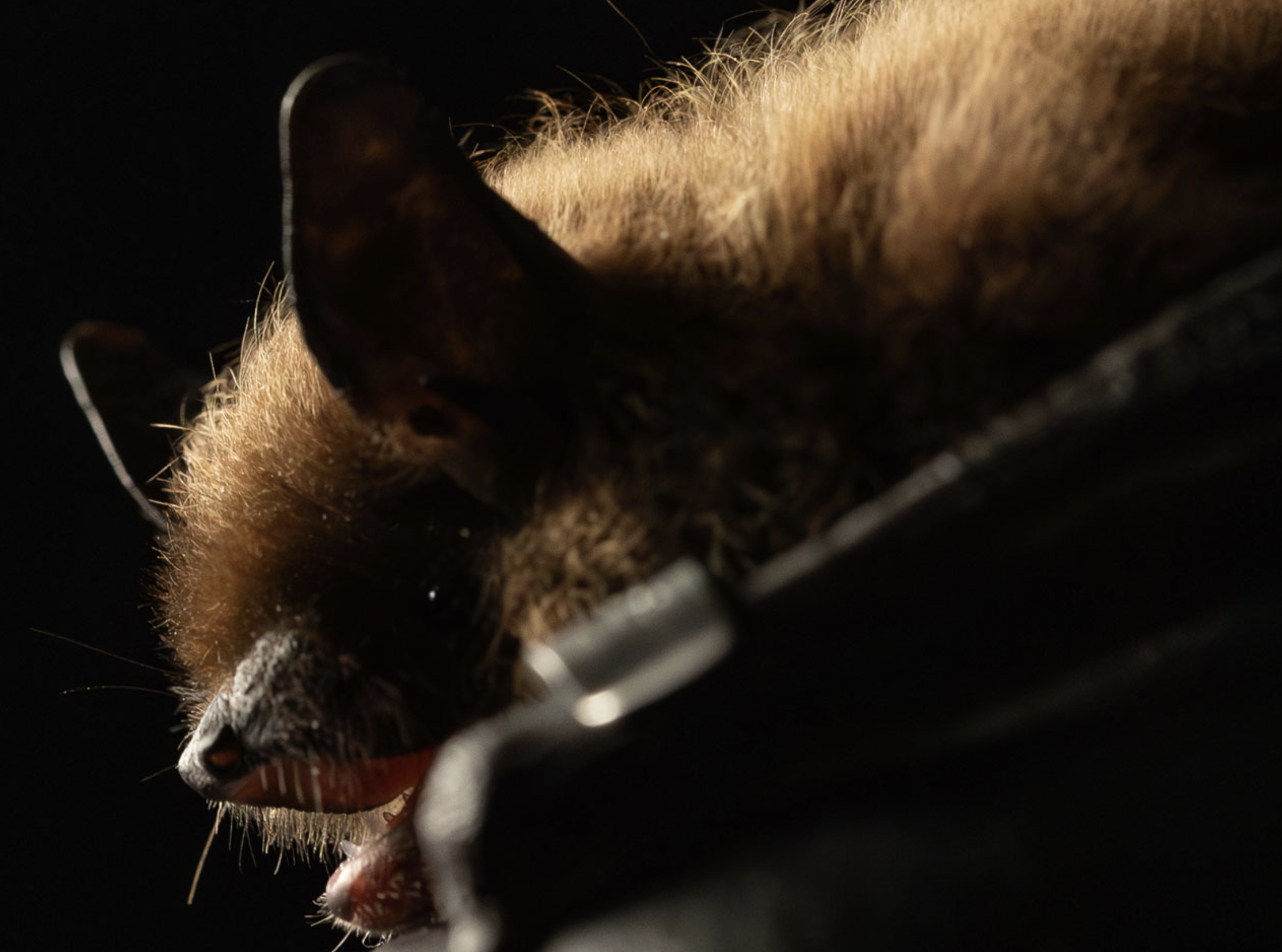
Little brown bat weigh less than 10 grams.
(Photo by Michael Code, Ambrook Research)
Cute as a button and confounding to scientists, Alaska's little brown bats have escaped white-nose syndrome. Can their "niche" in nature save them? "Meet Myotis lucifugus, commonly referred to as the little brown bat," reports Trina Moyles for Hakai magazine. Or, as chiropterologist (bat researcher) Jesika Reimer fondly calls it, 'the flying brown bear.'. . . Scientists know little about where [these bats] live at this far northern margin of the species' range."

Across North America, stands of trees of all different species are struggling to survive climate change. In response, scientists from the Cutfoot Experimental Forest are introducing some southern tree species to more northern regions, reports John H. Tibbetts of Knowable Magazine for Inverse. The survival of a grove of bitternut hickory trees, common to Illinois but transplanted to north-central Minnesota, is an example. "Normally, if a southern-adapted seedling is planted in an unsuitably cold climate like this one, it can risk frost damage, and its survival is threatened. . . . Today [scientists]can see the success of almost all the southern trees they planted."
Not all wool is usable for textiles, but it can make
'sweaters for the soil.' (Photo by Sam Carter, Unsplash)
Sheep farmers have developed a new way to repurpose coarser wool or "waste wool" that would have been thrown away by using a wool pelleting machine, reports Elise Konig for Ambrook Research. "A pelleting machine transforms the fleece’s long strands into cylinders that can more easily be handled. The pellets are then sold as soil amendments, providing water retention, nutrient recycling, and soil aeration."

Are you ready to clean, prune, test your soil, pick the plants and snuggle them in some soil? March is get-ready to garden month, and there's lots to do. "If you’ve been itching to get out and get gardening, we’re on the cusp of the season. This is the time to get organized and get ready because by the time we talk again in April, we will be in it, writes Amanda Blum for Lifehacker. From tidying the garden to splitting bulbs to fertilizing shrubs, Blum has a list of all the jobs to do before planting begins.

Wednesday, March 06, 2024

Geologic naming body rejects Anthropocene proposal

Sediment history from Crawford Lake, Ontario, is part of 
the Anrthropocene epoch proposal. (Wikipedia photo)
"Monday night, the group of scholars responsible for delineating the past 2.6 million years of geologic history rejected a proposal that would mark the start of the Anthropocene epoch in the mid-20th century, when global trade, nuclear weapons tests and rampant fossil-fuel consumption radically altered the Earth," reports Sarah Kaplan of The Washington Post.

"But Anthropocene advocates — including two leading members of the panel that just voted — say the decision by the Subcommission on Quaternary Stratigraphy violated the rules for naming new geologic time spans. Subcommission chair Jan Zalasiewicz and vice-chair Martin Head on Wednesday called for an investigation into the voting process that could lead to the decision being overturned.

"The contested vote, which was first reported by The New York Times, has exposed a deepening rift in the hidebound world of stratigraphy — the science of measuring geologic time. Researchers overwhelmingly agree that people have transformed the climate and put ecosystems in peril. But most members of the Subcommission on Quaternary Stratigraphy felt this 'Age of Humans' should not be rigidly defined as an epoch — a stretch of geologic time that typically spans thousands or even millions of years."

The International Commission on Stratigraphy could overturn the decision, sending it to the International Geological Congress. But they could also define the Anthropocene "as a geologic event — a looser term that can describe phenomena that unfold in multiple places at different times," Kaplan notes.

Tuesday, January 23, 2024

Flora and Fauna: A working mouse; this hasn't happened since 1803; 'Wicked' the amazing dog

Welsh Tidy Mouse is reporting for the night shift.
(Photo by Rodney Holbrook, Animal News Agency via WP)
A clean shed is a happy shed. At least Welsh Tidy Mouse thinks so. He has been organizing everything from nails to cable ties in 75-year-old Rodney Holbrook's outdoor shed, reports Jennifer Hassan of The Washington Post. "Most of the time, the rodent works alone, though sometimes it has accomplices, Holbrook said. In one clip, he spotted two other mice joining the nightly cleanup."

How can animals survive in an ever-warming world? Adaptation is one way, but can they do it fast enough? "Maybe," writes Brian Owens for Hakai magazine. "Research conducted over the past couple of decades has shown that evolution can occur on timescales similar to those of climate change. . . .There are things animals can do to stack their decks — and people can help."
Cicadas' vibrating noise can reach 100
 decibels. (Photo by B. Nino, Unsplash)

What genus of this insect is exclusive to North America, spends 99.5% of its life underground and becomes one of nature's loudest bugs once it emerges above ground? Magicicada -- also known as periodical cicadas. This spring, much of the eastern United States will experience a cicada extravaganza as "two cicada broods erupt in states from Virginia to Illinois come late April through June," reports Clare Marie Schneider of NPR. "Periodical cicadas have the longest known insect life cycle. . . . The last time the two broods — Brood XIX and Brood XIII — emerged simultaneously was in 1803."

With family grocery bills often topping off at more than $1,000 a month, this spring is a great time to consider growing a garden. "Because we humans developed into thriving species (well... somewhat thriving) when we learned how to grow our own food," writes Nicole Burke of Grow Yourself Podcast. "I'm about to convince you that growing some of your own food is not that hard to do." Don't have the energy or room to plant? Many plants can "breathe" life into indoor living spaces, Janece Maze and Christopher Michel of Country Living report. "The best part of houseplants? The weather's always fine."

Cartoon by Marina Wang, Hakai

How do penguins tell each other apart when they all have the same outfit on? By their spots! "African penguins develop a distinct constellation of spots on their chests, which remain the same throughout their lives," reports Marina Wang for Hakai magazine. "Zookeepers often use these spots to identify individuals. . . To find out if the birds do the same, Luigi Baciadonna, a psychologist at the University of Turin in Italy, and his colleagues designed an experimental series."

Once common in the West, the whitebark pine tree is struggling to survive. "Warmer temperatures, a fungal disease called white pine blister rust, and swarms of mountain pine beetles have killed hundreds of millions of whitebark pines across the West," reports Jim Robbins of Yale Environment360. "Wildfires are taking an increasing toll, and other conifer species are moving upslope in the rapidly changing environment, outcompeting the whitebark for nutrients and moisture."

Wicked is calm, cool and commanding.
(Photo by Stephaniellen Photography, AKC)
Wicked isn't just the name of a blockbuster musical. It's also is the name of a rock-star-quality dog. "Meet Wicked, a three-year-old Doberman Pinscher who clinched the win for the American Kennel Club's 2023 Working Group competition last month," reports Liz Langley of National Geographic. "Exactly the opposite of what her name might suggest, Wicked has a calm but commanding presence. Even when she won Best of Breed earlier in the day, which put her in the Working Group competition, Wicked seemed to be a crowd favorite — every ounce of her compact, muscular body brimmed with energy."