Showing posts with label OSHA. Show all posts

Tuesday, June 25, 2024

Report: Chicken plant in West Virginia has recorded a number of serious injuries; immigrants 'shoulder' more risks

Chicken segmentation line (Adobe Stock photo)
Working in any U.S. factory comes with some risk of injury, but immigrant workers at Pilgrim’s Pride’s chicken factory in Moorefield, West Virginia, have faced compounded dangers, according to a report.

"Over the past 30 years, thousands have left their homelands and come to Moorefield to work at West Virginia’s only industrial poultry plant," reports Allen Siegler of Mountain State Spotlight. "Seeking safety and a better life, they’ve often faced unsafe working conditions. . . . Throughout the last decade, Pilgrim’s Moorefield plant has been one of the most dangerous non-coal industrial workplaces in West Virginia."

Large knives, saws and automated equipment make poultry production inherently dangerous. This plant has had a number of documented injuries. "From 2015 to late 2023, 12 factory employees had workplace injuries that led to amputations or overnight hospitalizations, according to data from the Occupational Safety and Health Administration," Siegler writes. Debbie Berkowitz, a former OSHA chief of staff, told Siegler, "This is a red flag on safety conditions in the plant."

Federal data doesn't include all injuries. Siegler explains, "In 2022 and 2023, local paramedics responded to calls to the Moorefield factory 138 times — about once every five days — according to the Hardy County Emergency Ambulance Authority. . . . In a state in which 91% of residents are white, a disproportionate amount of the danger is shouldered by the plant’s large immigrant workforce."

Immigrant workers often fear deportation should they speak up about workplace dangers or ask questions about how a job should be done. Others don't speak English, so a job at the Moorefield plant is one of their few options, Siegler reports. 

Despite efforts to get local or corporate Pilgrim's Pride officials to comment, "they didn’t answer a letter with over a dozen questions related to this story," Siegler writes. "A recent lawsuit against major American poultry corporations, including Pilgrim’s Pride, alleged the companies recruited vulnerable immigrant workers to staff some of the most dangerous jobs in the U.S. . . . Pilgrim’s denied these allegations and said the workers’ lawyers were selectively pulling unflattering quotes from various reports and people."

Friday, March 01, 2024

Florida lawmakers work to ban local governments from implementing temperature protections for outdoor workers

Summer temps in Florida are regularly in the 90s.
(Photo by Xavier Coiffic, Unsplash)
Some Florida lawmakers are working to pass a bill that removes temperature protection regulations for employees. That same bill also would ban local "living wage" ordinances, which create higher minimum wage standards than the state requirement. "A measure that will ban local governments from passing heat-protection ordinances inspired strong emotions from the public . . . ," reports Mitch Perry for the Florida Phoenix. "The bill also eliminates living wage ordinances that require companies that receive government contracts to pay their employees more than the state's minimum wage (currently $12 an hour)."

This past fall, the Miami-Dade County Commission had planned a vote on a local ordinance that "would protect outdoor workers in the agriculture and construction industries, which, if passed, would be the first law of its kind in the South," Perry adds. "That proposal was introduced after at least two farmworkers died from excessive heat in South Florida earlier last year."

The Florida chapter of Associated Builders and Contractors pushed back against the local heat protection ordinance, saying regulation "inconsistencies" could cause more accidents. Meanwhile, local businesses "lined up behind the provision that would prohibit cities and counties from creating 'livable wage' ordinances for their contractors and subcontractors," Perry explains. "[These] ordinances are now in effect in 11 local governments in the state to combat higher living costs."

North Miami-Dade County Democratic Rep. Dotie Joseph "blasted the proposal, saying that her GOP colleagues were being negligent in taking away Miami-Dade's or any other local government's ability to protect outdoor workers," Perry reports. Joseph told reporters, "When local governments try to do something about it so that it doesn't happen again, here we show up at the state level and say, 'no, we don't mind a couple of more people dying.' That's basically what we're saying, functionally. So we're okay with workers dying."

Thursday, May 12, 2022

House panel says big meatpackers uses baseless claims of shortages to get federal green light early in pandemic

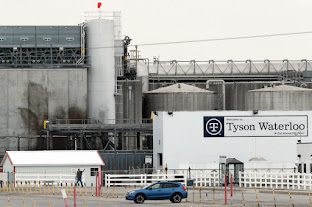
A Tyson Foods plant in Iowa (AP photo by Charlie Niebergall)
A House committee investigating the nation's response to the pandemic has found that leading meatpackers used “baseless” claims of shortages to persuade the Trump administration to let them "keep processing plants running, disregarding the coronavirus risks that eventually killed at least 269 workers," Taylor Telford of The Washington Post reports.

"In a report released Thursday, the committee alleges that Tyson Foods’s legal team prepared a draft with input from other companies that became the basis for an executive order to keep the plants open the Trump administration issued in April 2020, making it difficult for workers to stay home," Telford reports.

The report says, “Meatpacking companies knew the risk posed by the coronavirus to their workers and knew it wasn’t a risk that the country needed them to take. They nonetheless lobbied aggressively — successfully enlisting USDA as a close collaborator in their efforts — to keep workers on the job in unsafe conditions, to ensure state and local health authorities were powerless to mandate otherwise, and to be protected against legal liability for the harms that would result.”

The report from the House Select Subcommittee on the Coronavirus Crisis is based on government documents, calls with former federal officials, state and local health officials and meatpacking workers' union representatives. The documents showed that “despite awareness of the high risks of coronavirus spread in their plants, meatpacking companies engaged in a concerted effort with Trump Administration political officials to insulate themselves from coronavirus-related oversight, to force workers to continue working in dangerous conditions, and to shield themselves from legal liability for any resulting worker illness or death,” the report says.

Friday, April 08, 2022

Labor Dept. watchdog says USDA and OSHA should have better protected meatpacking workers during pandemic

The Agriculture Department’s Food Safety Inspection Service and the Labor Department’s Occupational Safety and Health Administration should have worked together more, and done more in general, to make sure meatpacking workers were better protected during the pandemic, says a new report released Tuesday by the DOL's Office of Inspector General.

Then-USDA Secretary Sonny Perdue "made clear he saw no role for the agency in protecting workers and mostly put it off on OSHA," Sky Chadde reports for the Midwest Center for Investigative Reporting. But "OSHA has been roundly criticized for failing to protect meatpacking workers from the coronavirus. In the pandemic's first year, the agency doled out small fines to only a handful of plants, and it failed to inspect every plant where cases were publicly reported."

OSHA “entered the pandemic with its fewest number of inspectors in its history. At the same time, the number of workplaces it has to oversee has increased,” Chadde reports. “Still, according to the inspector general's report, OSHA should have identified what federal agencies oversaw high-risk industries — including meatpacking — and provided training to on-the-ground employees in how to assist with worker safety.”

It was critical for OSHA and FSIS to work together because of the risky conditions in meatpacking plants, the report said, but “OSHA and FSIS had some history that made collaborating challenging … Before the pandemic, when FSIS inspectors would make a referral about potential worker safety violations to OSHA, OSHA would investigate FSIS, not the plant, according to the report. Because of this, FSIS inspectors were hesitant to refer possible violations.” Read more here.

Tuesday, November 16, 2021

USDA to allow faster line speeds at some pork plants

The Agriculture Department "will again allow faster line speeds in a select few pork processing plants as part of a pilot project after a federal court in Minnesota vacated a USDA rule earlier this year," Todd Neeley reports for DTN/The Progressive Farmer. The court "struck down a provision of USDA's New Swine Inspection System, or NSIS, allowing for faster harvest-facility line speeds. NSIS was initiated during the Clinton administration and was evaluated at five pilot plants over the past 20 years." USDA told DTN it will let "existing NSIS facilities to apply for up to a one-year trial to operate at increased line speeds." Existing NSIS plants are in Pennsylvania, Michigan, Nebraska, Minnesota, and Oklahoma.

Faster line speeds not only increase injury concerns, but also probably help spread the coronavirus. USDA said participating plants must implement extra worker safety measures as part of the deal. The pilot facilities would experiment with different ergonomics, automation and crewing approaches to see how they can increase productivity without sacrificing safety for workers or the food they process. USDA said it will collect that data from the facilities and share it with the Occupational Safety and Health Administration for input on future rulemaking, Neeley reports.

Friday, November 05, 2021

Meatpacking deaths from Covid-19 are three times worse than thought; new OSHA rule requires vaccination or testing

new federal rule will mandate that employers of more than 100 must "require vaccinations or test everyone regularly and enforce mask-wearing includes meatpacking plants, which have been linked to tens of thousands of Covid-19 cases and hundreds of deaths," Sky Chadde reports for the Midwest Center for Investigative Reporting. The rule "is the kind of enforcement that advocates of meatpacking workers and unions representing plant employees had been asking for since the early days of the pandemic." The rule is set to take effect Jan. 4.

The House Select Subcommittee on the Coronavirus Crisis obtained data from the five largest meatpacking companies and discovered far more infections and deaths among workers than previously known, Chadde reports: "In roughly just the first year of the pandemic, 269 people who worked for Tyson Foods, JBS, Smithfield Foods, Cargill and National Beef died due to complications from the coronavirus . . . Combining the subcommittee’s data with Investigate Midwest’s tracking shows that, across the industry, about 86,000 workers tested positive during the pandemic and that 423 died."

Meatpacking workers have received little mandatory protection during the pandemic. President Trump declared meatpackers essential to keep them open during the pandemic, but his administration did not require the industry to take specific precautions to protect workers, Chuck Abbott reports for the Food & Environment Reporting Network. And though President Biden asked OSHA to better protect workers earlier this year, meatpackers were exempted from workplace safety rules published in April.

Labor unions applauded the new rule, though they worried it doesn't go far enough, Abbott reports. However, the National Council of Farmer Cooperatives denounced it, saying that, though the Jan. 4 deadline "does take farmer co-ops past harvest and does exempt employees working exclusively outdoors, implementing this standard will be disruptive, and it contains no provisions included to help ensure the integrity of the food and agriculture supply chain."

Thursday, September 16, 2021

Covid-19 toll on meatpackers may be worse than thought; House panel asks processors for data on deaths

"The toll the coronavirus has taken on the meatpacking industry may be greater than currently thought, said a House panel on Wednesday in asking Cargill and National Beef, two of the largest U.S. meat processors, to disclose how many of their workers had contracted Covid-19 and how many had died," Chuck Abbott reports for the Food and Environment Reporting Network (FERN). "South Carolina’s James Clyburn, chair of the panel, the House Select Subcommittee on the Coronavirus Crisis, said one study suggested that the infection rate for National Beef was three to five times higher than for other large processors."

At least 298 meatpacking workers have died from Covid-19 and more than 59,000 have been infected with the coronavirus, according to FERN's Covid-19 Mapping Project, which halted on Sept. 2 because it was so difficult to gather info. "Most meat companies never released information about Covid-19 in their workforces, public sources of that information withered over time, and there is no federal count," Abbott reports.

The hearing is part of a larger House investigation of major meatpackers. In February the sub-committee began it with letters to JBS USA, Tyson Foods, and Smithfield Foods. "Like the letters to Cargill and National Beef, those letters asked the companies how many of their employees had fallen ill or died of Covid-19 and what safeguards they had put in place to protect them. In addition, the subcommittee asked Occupational Safety and Health Administration what it had done to protect workers," Abbott reports.

The committee also apparently sought to uncover how much sway meatpackers had in an April 2020 order from President Trump declaring them essential and ordering them to stay open during the pandemic, Abbott reports. Besides information on worker illnesses and deaths, Cargill was asked for all communications with the administration regarding the order. Emails obtained by ProPublica in September 2020 showed that meatpackers essentially wrote Trump's order.

Wednesday, May 26, 2021

Virus outbreak at Smithfield plant was worse than known, killed two, Midwest Center reveals via OSHA documents

Milan, in Sullivan County (Wikipedia)
"The Covid-19 outbreak at Smithfield Foods' Milan, Missouri, plant — the focus of a worker safety lawsuit that garnered national attention last year — resulted in two worker deaths and was worse than previously thought," according to newly obtained documents from the Occupational Safety and Health Administration, Madison McVan reports for the Midwest Center for Investigative Reporting.

It's been difficult to get clear numbers about infections at the plant. Early on, the Sullivan County Health Department told a local TV station that there were 14 cases, and later a local hospital told the St. Louis Post-Dispatch there were 35 cases tied to the plant, but since then the news media hasn't been given updates, McVan reports. A health-department administrator told the Midwest Center that it doesn't track coronavirus cases by employer. 

OSHA "found the total number of cases was likely more than double what has been previously reported. By the end of May 2020, at least 77 workers were presumed to be positive for the virus, and more than 300 were either suspected to have the virus or had been in close contact with a positive case. Also, at least two workers at the plant died from the virus last year, according to the OSHA inspections obtained by the Midwest Center for Investigative Reporting," McVan reports. "Smithfield, which employs about 1,100 people at its Milan facility, told OSHA inspectors the company determined that the employees who died had contracted the virus from close contacts outside of work, rather than in the plant."

Smithfield Chief Administrative Officer Keira Lombardo said in a statement that the company has spent more than $800 million to respond to the coronavirus pandemic and has seen a "sustained period of extremely low reported cases across our employee workforce." 

The real case numbers are likely much higher than even the OSHA reports found, said Axel Fuentes, executive director of the Rural Community Workers Alliance. The group advocates for better working conditions for Smithfield employees and has been in contact with Milan plant workers during the pandemic. The group sued Smithfield last spring, claiming the company's pandemic safety measures were inadequate. "The judge dismissed the case, ruling that it was OSHA’s job, not the court’s, to ensure that Smithfield was adequately protecting its employees," McVan reports. "OSHA inspectors found few issues with the virus mitigation measures at the plant during in-person inspections that took place in May and November 2020. OSHA closed the investigations without issuing any penalties."

Some workers told the Midwest Center they thought Smithfield's safety measures didn't go far enough, and said the production line moved so quickly that they couldn't step away to cough or sneeze. But "Smithfield didn’t start distributing masks to its employees in Milan until mid-April 2020, after hundreds of employees at its Sioux Falls plant had already tested positive," McVan reports.

There are no federal emergency standards to protect meatpackers during a pandemic, which Fuentes said makes it harder to hold employers accountable. The day after his inauguration, President Biden ordered OSHA and other federal agencies to come up with emergency standards by March 15, but the agency has yet to publish one. "On April 26, OSHA said in a press release that it had sent a draft of the standard to the White House for review. It’s unclear how long that process could take," McVan reports.

The Midwest Center has done an outstanding job reporting on the meatpacking industry during the pandemic. Click here for a recent package that looks back on how the pandemic has affected workers, what's happening now, and what they predict for the future.

Friday, February 05, 2021

House panel investigates major meat companies for hundreds of Covid-19 deaths among meatpacking workers

"A key congressional panel launched an investigation this week into the wave of Covid-19 infections that killed hundreds of workers at meatpacking plants nationwide last year and highlighted longstanding hazards in the industry," Bernice Yeung and Michael Grabell report for ProPublica. "The congressional investigation, opened by the House Select Subcommittee on the Coronavirus Crisis, will examine the role of JBS, Smithfield Foods and Tyson Foods, three of the nation’s largest meat companies, which, the subcommittee said, had 'refused to take basic precautions to protect their workers' and had 'shown a callous disregard for workers' health.'" The inquiry will also scrutinize the federal government's failure to protect meatpacking workers.

Meatpacking plants have been a major vector for the spread of the coronavirus in rural America. Employees, many of them immigrants, must work packed in close quarters, and many don't speak English or have paid sick leave. "To date, more than 50,000 meatpacking workers have been infected and at least 250 have died, according to a ProPublica tally," Yeung and Grabell report.

JBS and Tyson representatives said the companies have spent hundreds of millions of dollars to temporarily increase pay and benefits and implement coronavirus protections in their plants. A Smithfield statement said the company took "extraordinary measures" to protect workers, and spent more than $700 million on testing, equipment, and workplace modifications, Yeung and Grabell report.

The House subcommittee noted that reports from a variety of news organizations had illuminated problems with how the meatpacking companies handled the pandemic, and with the Occupational Safety and Health Administration’s enforcement efforts. The subcommittee cited ProPublica’s reporting on how meat companies blindsided local public health departments, and on Nebraska Gov. Pete Ricketts’ efforts to intervene when local health officials tried to temporarily shutter a JBS plant amid an outbreak," Yeung and Grabell report. "ProPublica has also documented how meat companies ignored years of warnings from the federal government about how a pandemic could tear through a food processing facility, and chronicled the role that meatpacking plants like a Tyson pork facility in Waterloo, Iowa, have played in spreading the virus to the surrounding community."

Monday, November 09, 2020

Some farmworkers, with little or no financial security, must decide whether to keep working or risk dangerous infection

The Trump administration declared farm laborers "essential workers" in the spring, but hasn't provided much guidance on how to keep them from getting sick or spreading the infection to others, and that has forced some of them to make tough choices between working and risking infection, Frank Hernandez reports for the Midwest Center for Investigative Reporting.

"While some people work from home during the covid-19 pandemic, agricultural workers pick and pack the fruits and vegetables Americans rely on," Hernandez writes. "They do so in potentially dangerous conditions — they often live in cramped housing, ride in crowded buses to job sites and work close to others — and without the federal government guaranteeing coronavirus protections," 

Some counties and "states such as VirginiaOregon and Washington have created their own enforceable rules to control, prevent and mitigate the spread of the virus among farmworkers," Hernandez reports. "But federal mandates are necessary to ensure that employers are doing enough to protect workers, advocates said."

At least 16 farmworkers have died from covid-19, but there could be many more because of weak monitoring. The Occupational Safety and Health Administration doesn't keep track of covid-19 reports involving agricultural workers, who are mostly migrants with temporary H-2A visas. But OSHA does track such complaints from farm-labor contractors who hire such workers and transport them to job sites, Hernandez reports.

"As of Sept. 6, OSHA has closed nine complaints about covid-19 that involve farm-labor contractors," Hernandez reports. "Twelve complaints about farm-labor contractors remain open. There have also been two COVID-19 complaints related to migrant camps, where some workers live; one has been closed."

Among farmworkers, the virus has disproportionately hit Latinos, who make up more than 60 percent of farm labor. About three-quarters of the nation's 3 million farmworkers were foreign-born as of 2018, most  of them from Mexico, Hernandez reports.

The Mexican government says nearly 2,400 Mexican nationals had died from covid-19 in the United States as of Sept. 14, but didn't keep track of job descriptions for the deceased, Hernandez reports.

Tuesday, September 15, 2020

Smithfield and JBS face federal fines for failing to protect slaughterhouse workers from pandemic

"The U.S. Labor Department has cited Smithfield Foods and JBS for failing to protect employees from the coronavirus, making them the first two major meatpackers to face a federal fine after outbreaks at slaughterhouses infected thousands of workers," Tom Polansek and P.J. Huffstutter report for Reuters. The Labor Department's Occupational Safety and Health Administration proposed fining Smithfield $13,494 and JBS $15,615."

Specifically, Smithfield's plant in Sioux Falls was cited for "failing to provide a workplace free from recognized hazards that can cause death or serious harm," OSHA's complaint said. At least 1,294 plant workers were sickened and four died from the coronavirus this spring, Polansek and Huffstutter report.

OSHA cited JBS's plant in Greeley, Colorado, where six workers have died from the virus and 290 have tested positive. According to the complaint, employees were unable to remain socially distant at work. JBS has already been fined twice for coronavirus-related safety violations at Minnesota plants: $28,000 for four violations a Pilgrim's Pride chicken processing plant in Cold Spring, and another $29,400 for five violations at a pork plant in Worthington, Polansek and Huffstutter reports.

Both companies said the citations were undeserved. They have until about the end of the month to respond and put safety measures in place, Polansek and Huffstutter report. The citations "did little to quiet complaints from labor unions and safety advocates, who said the Trump administration needs to do more to protect workers critical to the nation's food supply," they report. David Michaels, a George Washington University environmental and occupational health professor, who was the assistant labor for OSHA in the Obama administration, said the fines are "not even a slap on the wrist."

Tuesday, July 28, 2020

Three meatpacking workers sue OSHA, accuse government of not protecting essential workers from coronavirus

"Frustrated by the lack of response to their complaint of the 'imminent danger' posed by covid-19," three workers at the Maid-Rite Specialty Foods plant near Scranton, Pa., filed suit against the Occupational Safety and Health Administration and Labor Secretary Eugene Scalia, Bernice Yeung and Michael Grabell report for ProPublica. The suit "accuses the government of failing to protect essential workers from dangerous conditions that could expose them to the coronavirus. It relies on a rarely used provision of the Occupational Safety and Health Act that allows workers to sue the secretary of labor for 'arbitrarily or capriciously' failing to counteract imminent dangers."

The three workers worked with Pennsylvania labor organization Justice at Work to help them file an anonymous complaint with OSHA May 19, saying they had only been given masks three times, and there was no social distancing on the production line or in restrooms where washed their hands, Yeung and Grabell report. Meatpacking plants have been infection hotbeds during the pandemic.

According to the lawsuit, two of the workers who filed suit have contracted covid-19, though ProPublica was not able to verify whether anyone at Maid-Rite has been infected, Yeung and Grabell report. An anonymous complaint to OSHA in April alleged that about half of the plant was out sick, and that the plant was simply hiring more people and not taking prevention or containment measures.

The lawsuit says the workers were filing suit because they could no longer wait for OSHA to act, and "argues that OSHA’s failure to respond effectively to workers’ covid-19 concerns is part of a larger pattern," Yeung and Grabell report.

A Labor Department spokesperson declined to comment to ProPublica, but wrote in an email that OSHA opened an inspection at Maid-Rite on June 2, has six months to complete it, and no further details will be made public until the inspection is complete, the spokesperson wrote.

"ProPublica has previously reported that despite receiving thousands of complaints, OSHA has not prioritized essential workers like meatpackers in its covid-19 enforcement efforts," Yeung and Grabell report. "Public health departments across the country have found themselves overwhelmed by the flood of cases linked to the meat industry, which has sometimes stymied the efforts of local officials to curb the spread of the virus."

Farm and meatpacking workers at high risk for covid-19, says documentary that will follow up with online talk Thur.

Rural counties with many farmworkers are likely to have higher death rates from covid-19, according to a study from the University of California, San Diego. Those most at risk in such counties are those who don't speak English, farmworkers, and those living in poverty. That puts migrant farmworkers in the bullseye, Rosa Tuirán and Nick Roberts report for the PBS program "Frontline."

Though the Trump administration declared farm laborers as essential workers, there hasn't been much federal guidance on how to keep them from getting sick, leaving states and employers to figure it out. "The federal Occupational Safety and Hazard Administration has issued workplace guidance to protect employees from covid-19, including encouraging employees to stay home if they’re sick, promoting frequent hand washing, and implementing regular sanitation procedures. None of the guidance is mandatory," Tuirán and Roberts report. OSHA declined to speak with the journalists, but said in a statement that the voluntary guidelines were enough to protect workers from covid-19. However, covid-19 cases have been spiking among farmworkers and meatpacking workers.

The workers, who often live in crowded housing, say they work sick because they need the money; one said he was not told that he would still get paid if he went into quarantine. His employer didn't respond to multiple requests for interviews, but "a company update said it is following local, state and federal guidance to stem the spread of the virus, and that its worksites have always had gloves and hand washing stations available," Tuirán and Roberts report. Many workers who work for other agri-businesses reported that they were not given masks.

For more information about the pandemic's impact on farmworkers and PBS's work to uncover it, "Frontline" has a documentary called "Covid's Hidden Toll," and a podcast discussion about what the documentary reveals about the dangers to workers on farms and at meatpacking plants. On Thursday at 6:30 p.m. ET, the filmmakers will have an online discussion; click here for more information.

Friday, April 24, 2020

Probe reveals more coronavirus outbreaks in meat plants than previously thought, offers database and seeks tips

Coronavirus outbreaks among meatpacking workers are far more extensive than previously thought, and it could get worse, according to an investigation by USA Today and the Midwest Center for Investigative Reporting. See the database for updated information. The reporters seek tips from meatpacking workers, saying "Visit our page on how to contact us securely."

"More than 150 of America’s largest meat processing plants operate in counties where the rate of coronavirus infection is already among the nation’s highest, based on the media outlets' analysis of slaughterhouse locations and county-level covid-19 infection rates," Kyle Bagenstose, Sky Chadde and Matt Wynn report. "These facilities represent more than 1 in 3 of the nation’s biggest beef, pork and poultry processing plants. Rates of infection around these plants are higher than those of 75 percent of other U.S. counties, the analysis found."

There aren't any shortages yet, because the nation still has plenty of meat in storage, but meatpackers are operating at 60 percent of capacity, the reporters found. Shortages could come if workers continue to sicken and plants continue to close, they write, "but experts say there's little risk of a dwindling protein supply because, given the choice between worker safety and keeping meat on grocery shelves, the nation’s slaughterhouses will choose to produce food."

The meatpacking plant outbreaks shed an uncomfortable light on working conditions that can encourage the spread of infectious diseases, especially among undocumented immigrant workers who are loathe to report safety violations for fear of losing their jobs, Bagenstose, Chadde and Wynn report: "The meatpacking industry already has been notorious for poor working conditions even before the coronavirus pandemic. Meat and poultry employees have among the highest illness rates of all manufacturing employees and are less likely to report injuries and illness than any other type of worker, federal watchdog reports have found. And the plants have been called out numerous times for refusing to let their employees use the bathroom, even to wash their hands – one of the biggest ways to reduce the spread of the coronavirus."

Lax state and federal oversight hasn't helped. "Amplifying the danger is that, in many places, meat processing companies are largely on their own to ensure an outbreak doesn’t spread across their factory floors," the reporters write. "Factory workers, unions, and even managers say the federal government – including the U.S. Centers for Disease Control and Prevention and the Occupational Safety and Health Administration – has done little more than issue non-enforceable guidance. On its website, for example, the CDC has released safety guidelines for critical workers and businesses, which primarily promote common-sense measures of sanitization and personal distancing. State health departments have also taken a backseat role in all but a few places."

Thursday, May 18, 2017

Feds suspend rule requiring injury and illness reports to be filed electronically; blocks disclosure

On Wednesday, the U.S. Department of Labor suspended an Occupational Safety and Health Administration rule, issued late in the Obama administration, "requiring that companies electronically report their injury and illness records, a move that effectively keeps these records from being publicly disclosed for the immediate future," Juliet Eilperin reports for The Washington Post.

"Companies have been required to maintain worker injury and illness logs since 1971, and between 1995 and 2012, OSHA had required about 180,000 establishments in high-hazard industries such as manufacturing and nursing homes to submit the summary data by mail," Eilperin writes. "But the program cost $2 million a year to run, and officials decided to expand the requirement and transition it to an electronic system instead."

"The rule, which covered nearly 441,000 workplaces, took effect Jan. 1 and employers were obligated to send in their summary data by July 1," Eilperin notes. "But OSHA never launched the website for companies to submit the information, and it posted language Wednesday with an existing fact sheet saying it 'is not accepting electronic submissions of injury and illness logs at this time, and intends to propose extending the July 1, 2017 date by which certain employers are required to submit the information' to the agency."

Several business groups, led by the Associated Builders and Contractors, Associated General Contractors of America and the National Association of Home Builders, sud to overturn the rule "and lobbied the administration to jettison it on the grounds that it could unfairly damage the reputation of some of their members," Eilperin reports.

Friday, August 14, 2015

Major chicken supplier cited by OSHA for 55 health and safety violations

Case Farms—a leading fast-food and supermarket chicken supplier—faces a $816,500 fine for being cited Thursday for 55 health and safety violations by the Occupational Health and Safety Administration, Lydia Wheeler reports for The Hill. Case Farms operates seven facilities in Ohio and North Carolina, including one in Goldsboro, N.C., that was awarded the 2014 Plant of the Year by The National Provisioner in a poll voted on by readers. (National Provisioner photo: Case Farms facility in Goldsboro, N.C.)

"The citations are the result of a February inspection in which the agency found amputation hazards; non-functioning fall-arrest systems, unprotected platforms and wet work surfaces that could result in falls; lack of personal protective equipment and emergency eye wash stations; and improperly stored oxygen cylinders," Wheeler writes. Fueled by worker injuries and complaints OSHA has inspected the facilities 66 times since 1988.

OSHA assistant secretary of labor David Michaels said in a statement: “Case Farms is an outrageously dangerous place to work. In the past 25 years, Case Farms has been cited for more than 350 safety and health violations. Despite committing to OSHA that it would eliminate serious hazards, Case Farms continues to endanger the safety and health of its workers. This simply must stop.”

Case Farms, which processes 2.8 million chickens per week and has more than 3,200 employees, said in a statement: "Case Farms values its employees and is committed to ensuring a safe and healthy work environment for its associates." OSHA has given Case Farms 15 days to respond to the latest citations. (Read more)

Wednesday, April 29, 2015

OSHA averages eight years to issue a new rule; lacks funds, ability to enforce rules

The Occupational Safety and Health Administration, the nation's top safety watchdog, lacks the resources or ability to set and enforce rules in a timely matter, Lydia DePillis reports for The Washington Post. "A Government Accountability Office report in 2012 found that it takes nearly eight years on average to issue a new rule because of the heavy burden of documentation needed to withstand inevitable industry lawsuits. It's difficult to run many of those processes at once, with a budget that has declined significantly since 2010."

Meatpacking is one of the most dangerous jobs in America, with 28,100 reported injuries in 2013 and high rates of stress conditions such as carpal tunnel syndrome, DePillis writes. But OSHA says it doesn't have the resources or ability to set and enforce rules. OSHA does not specifically regulate meat processing, but "There are voluntary guidelines, and there's a blanket protection, which says that companies have a 'general duty' to protect their workers using the best available information."

OSHA has been pushed to set standards for the speed of production lines, especially after the U.S. Department of Agriculture wanted to allow poultry plants to raise speeds from 140 birds per minute to 175, a move that critics said could pose safety concerns, DePillis writes. While USDA backed down, protestors "pushed the agency to answer a petition lodged in 2013 that laid out why the problem was so dire and how OSHA could help." In March OSHA denied the petition, citing lack of resources to conduct a thorough study.

OSHA's inability to set or enforce rules is nothing new. Peg Seminario, executive director for safety and health at the American Federation of Labor and Congress of Industrial Organizations, told DePillis, "When you look at the hazards OSHA has been working on, most of them have been ones that OSHA has been working on for decades. The process is so slow that there is always a huge backlog. To even take it on, they’d have to not do one of these other ones. It’s a zero-sum game." (Read more)

Monday, March 25, 2013

Fines continue to be slashed in grain-bin deaths

Alex T. Paschal/Sauk Valley Newspapers photo
Fines for 60 percent of the 179 deaths caused by grain entrapment since 1984 were cut, often hugely, report Howard Berkes of NPR and Jim Morris of the Center for Public Integrity in a series that will continue. "More than $9 million in initial fines were slashed nearly 60 percent. The five biggest fines ever in grain death cases were cut from 50 percent to 97 percent. Department of Labor criminal referral records show that criminal prosecutions are rare in grain deaths."

Ron Hayes, who became a grain-bin-safety activist after his 19-year-old son suffocated in a grain bin in Florida in 1993, told NPR: "If this was the first time that this had ever happened in this country, I could see leniency. But because this happens time and time again, year after year after year, they should pay the full fines, somebody should be prosecuted, and until we do this, until OSHA has the backbone to stand up to do this, we will never see this stop." (Read more)

Saturday, February 16, 2008

OSHA goes easy on poultry processors, paper says

"Poultry processors face few consequences when they ignore hazards that can kill and injure workers. Weak enforcement, minimal fines and dwindling inspections have allowed companies to operate largely unchecked," The Charlotte Observer reports in the main runner of a six-day series that is worth reading -- especially if you are a journalist in an area with a poultry processing plant.

Ames Alexander, Kerry Hall, Ted Mellink and Franco Ordoñez write of their work, "An Observer investigation found workplace safety inspections at poultry plants have dropped to their lowest point in 15 years. The industry has kept steady employment over that time and has leaned heavily on illegal immigrants to fill jobs."

The team also found that "Fines for serious violations -- including conditions that could cause deaths and disabling injuries -- are usually cut by more than half, to an average of about $1,100. It has been a decade since OSHA fined a poultry processor for hazards likely to cause carpal tunnel syndrome, tendinitis and other musculoskeletal disorders (MSDs) that are common to the industry. The federal government has made it easier for companies to hide those MSDs. Regulators in 2002 stopped requiring companies to identify injuries associated with repetitive trauma."

The other side? "Officials with the U.S. Occupational Safety and Health Administration say poultry plants are safer than ever, pointing to a decade of declining rates of reported injuries. They credit enforcement programs and a growing recognition among industry leaders that reducing injuries is good for business. But the Observer found that the official injury statistics aren't accurate and that the industry is more dangerous than its reports to regulators suggest. Current and former OSHA officials say the agency has made it easier for companies to hide injuries, and has all but abandoned its mission to protect workers."

And there's a strong immigration angle: "It's happening at a time when poultry workers are particularly vulnerable. Unlike some other manufacturers, which have largely automated their plants, poultry processors still depend heavily on manual labor to cut and package meat. Most line workers are immigrants, and many are afraid to complain about injuries for fear of being fired or deported." The listing of Ordoñez's name notes that he speaks Spanish. (Read more)