Showing posts with label disabilities. Show all posts

Tuesday, November 04, 2025

Changes to Social Security disability benefits will affect 50 to 60-year-old applicants

ProPublica graphic, with data from SSA, Master Beneficiary Record, 100% data; USPS geographic data; and Census Bureau, Population Division, 2023 estimates of resident population.

Changes made to Social Security disability benefits by the Trump Administration could harm 50 to 60-year-old applicants “without a high school or college education who have, for decades, toiled in physically grueling jobs,” Eli Hager reported for ProPublica.

“The five states where the highest proportions of people rely on these benefits are West Virginia, Arkansas, Kentucky, Mississippi and Alabama,” Hager wrote.

Currently, applicants who are at least 50 years old are given priority to redeem disability benefits due to their age. The changes made to the program would mean that age would no longer be a factor in determining eligibility for the benefits.

A senior administration official (who requested anonymity) explained that the current rules reflected the job economy of the 1970s, which mostly relied on manual labor. Now that the internet has created more sedentary jobs, 50-year-olds have more options.

Another change would “modernize the job listings that Social Security’s disability adjudicators and judges use to decide if there’s work available in the U.S. economy that a manual laborer could do despite physical impairments — like a low-skilled desk job at a computer or driving for Uber or DoorDash,” Hager wrote.

But Hager added that Michelle Aliff, who provides expert testimony for Social Security disability hearings, said in an interview that “an oil field roustabout in his 50s isn’t going to just sit down at a computer for work without additional training.”

Friday, March 28, 2025

Social Security recipients can still use phone to contact SSA; however, no paper checks after Sept. 30

SSA had planned to disallow several types of
customer service phone calls. (Farm Journal photo)

In a quick turnabout, the Social Security Administration changed its "plan to demand more in-office visits from beneficiaries after leaders said they would no longer allow benefit recipients to use telephone services to confirm their identification or change direct-deposit information," reports Chris Clayton of Farm Journal. The changes were planned to begin on March 31, but SSA delayed any changes until April 14. Recipients can still contact SSA customer service by phone.

The reversal is a relief for "elderly and disabled residents in rural America who were about to face hours-long drives to Social Security offices if they don't know how to use the internet or have access to the Social Security Administration's website," Clayton explains. "The changes were set to affect millions of rural residents, including roughly one in five farm households."

Lee Dudek, acting commissioner of Social Security, told Farm Journal, "We are updating our policy to provide better customer service to the country's most vulnerable populations. . . . Medicare, Disability, and SSI applications will be exempt from in-person identity proofing because multiple opportunities exist during the decision process to verify a person's identity."

When the updated policy begins on April 14, "individuals applying for Social Security Disability Insurance, Medicare, or Supplemental Security Income who cannot use a personal my Social Security account can complete their claim entirely over the telephone without the need to come into an office," Clayton adds. "The decision to change requirements for Social Security beneficiaries also comes as the Department of Government Efficiency is pressing to close at least 47 Social Security offices nationally."

"There is little hard data breaking down percentages of rural residents who rely on Social Security," Clayton reports. "A 2011 study by the Center for Rural Strategies showed rural counties rely on Social Security benefits nearly twice as much in terms of total personal income than urban counties."

There is a separate Social Security change that some beneficiaries may need to plan for soon. Clayton adds, "People will have to stop receiving their payments by check and provide some details for electronic payment. The SSA will stop issuing paper checks at the end of September." 

Tuesday, July 18, 2023

Ruralites have higher rates of disability, especially in South

Data includes civilian non-institutionalized population.
(Map by Katrina Crankshaw, from Census Bureau data; click it to enlarge)

Rural residents have higher rates of disability than their urban counterparts, with the South having the highest regional rate. The reasons could include older populations and limited access to medical care, reports Katrina Crankshaw for the Census Bureau's Health and Disability Statistics Branch. 

Crankshaw overlooks another possible reason. Education levels tend to be lower in rural areas, which makes it easier for injured manual laborers without high-school diplomas to win disability benefits.

Crankshaw reports rural residents "were more likely (14.7%) than their urban counterparts (12.6%) to experience disability. . . . The South had the nation's highest rates of disability (13.8%), followed by the Midwest (13.1%), the Northeast (12.3%), and the West (12.1%) . . . according to the American Community Survey 1-year estimates." The ACS is the bureau's ongoing poll of the U.S. population.

Reporting distinctions can help government and community planners learn what services residents need and where especially when it comes to rural medical care or broadband access. "It is important to understand how regional and urban/rural differences in disability contribute to the unique challenge of addressing health disparities in the United States," Crankshaw adds. "Identifying where people with disabilities are concentrated can help inform where there may be shortages of specialized providers or limited transportation options."

Dan Kessler, interim executive director of the Association of Programs for Rural Independent Living, told Kristi Eaton of The Daily Yonder, that one reason could be health-care accress: "Looking at primary care, where you may see a physician for several issues, for example, your diabetes or some other condition, which, if left untreated, could very well result in someone acquiring a long-term disability." Eaton writes, "Kessler added that the digital divide also impacts access to medical care," making telehealth impossible and online scheduling for appointments or transportation more difficult.

Crankshaw notes, "Many states in the South are part of what is known as the Stroke Belt, defined by the National Heart Lung and Blood Institute as a cluster of states (including Alabama, Arkansas, Georgia, Indiana, Kentucky, Louisiana, Mississippi, North Carolina, South Carolina, Tennessee and Virginia) that have a higher incidence of stroke than the rest of the country. . . . . Stroke is one of the nation's primary causes of long-term disability, and half of stroke survivors age 65 years and older experience reduced mobility as a result. The higher stroke incidence is just one factor that may contribute to the southern region's overall higher disability rates."

What constitutes a disability? Crankshaw explains, "ACS considers people to have a disability if they have difficulty with one or more of the following: Seeing, hearing, concentrating or remembering (age 5 and older), walking or climbing stairs (5 and older); dressing or bathing (5 and older); doing errands alone, such as buying groceries or going to the doctor (15 and older).

Wednesday, November 30, 2022

Rural roads in Minn. giving tests to autonomous vehicles

Cruising across rural Minnesota, the autonomous
vehicle. (Photo by Jiahong Pan, The Daily Yonder)
There's a new way to get across rural Grand Rapids, Minnesota. It's called the 'goMARTI' autonomous vehicle. Five goMARTIs will be hitting North American roads for the next 18 months, and Grand Rapids is the first U.S. community to get them. Here's a "first ride" experience from Jiahong Pan of The Daily Yonder:"

"A Toyota Sienna, looks different from a regular Sienna. It has a cylinder mounted just above the windshield. Someone is in the driver's seat, but they aren’t actually driving. Instead, they are outfitted with a headset, ready to take over in case something goes wrong. To their left, a mobile device shows where the vehicle is going. It also plays the baseball charge tune every time the vehicle goes through an intersection."

Five of the autonomous vehicles were sent out for testing in September, and "for the following 18 months they will navigate around Grand Rapids," writes Pan. "In conditions unfamiliar to them: snow, extreme cold, and lots and lots of trees. If it works out, it could prove to be a solution to help those with limited mobility who live in remote, rural areas get around. It could also affect the workforce for good, and for bad."

The shortage of transportation alternatives in Grand Rapids and other rural communities is striking, and it is amplified if an individual is handicapped. "Today, more people with limited mobility are living in rural America," Pan reports. "For rural counties across the United States with no concentrated core population of 10,000 people or greater, 18% lived with a disability in 2019, up from 17.71% in 2014. In Itasca County, which contains Grand Rapids, 17% of residents lived with a disability in 2020, up from 15% in 2012."

This is where Myrna Peterson, a retired teacher who uses a wheelchair, comes in. "She founded Mobility Mania, which partnered with the Minnesota Department of Transportation, the city of Grand Rapids, May Mobility, New York City-based transportation technology company Via, and a St. Paul, Minnesota-based consulting firm called The Plum Catalyst, to deploy the project, called goMARTI," Pan writes. "MARTI stands for Minnesota’s Autonomous Rural Transit Initiative, the project cost $3.5 million to deploy, with a share of this funding coming from the state."

The autonomous vehicle may be paving the way for rural future. And likely there will be multiple challenges. "There may be more autonomous vehicle systems — and more workforce changes and development opportunities — to come for rural communities," Pan reports. "The Bipartisan Infrastructure Law passed last year includes $500 million over the next five years for public agencies to develop autonomous vehicle systems. Pending rulemaking as of this writing, applicants might not need to comply with Buy America provisions, potentially allowing them to work with providers overseas to deploy projects across the nation."

Wednesday, November 09, 2022

Squadrons of all-terrain wheelchairs arrive at U.S. parks

 Action Trackchair (Aimee Copeland Foundation photo)
"Georgia and South Dakota are the latest states to provide off-road wheelchairs on public trails," report Andrea Sachs and Natalie B. Compton of The Washington Post.

The arrival of "Action Trackchairs" in Georgia's Cloudland Canyon State Park is a game changer for travel blogger and Georgia native Cory Lee. Lee has cruised 40 countries on seven continents in his wheelchair but was unable to explore Cloudland trails. “I’ll finally be able to go on these trails for the first time in my life,” Lee said. “The trails are off-limits in my regular wheelchairs."

Georgia's Department of Natural Resources and the Aimee Copeland Foundation partnered to "unveiled a fleet of all-terrain power wheelchairs for rent at 11 state parks and outdoorsy destinations, including Cloudland Canyon. Action Trackchairs are equipped with tank-like tracks capable of traversing rocks, roots, streams and sand; clearing fallen trees; plowing through tall grass; and tackling uphill climbs," write Sachs and Compton.

Each program has its own reservations system and requirements. For Georgia’s service, visitors must provide proof of their disability and a photo ID, plus complete an online training course available through All Terrain Georgia. Once certified, the organization will forward the rental request to the park. People are encouraged to plan ahead: The certification course takes about an hour; the foundation needs 72-hour advance notice, and the park requires a 48-hour heads-up.

Tuesday, May 31, 2022

Many seniors may still lack transport despite $2 billion investment; Rural Transit Fact Book has much local data

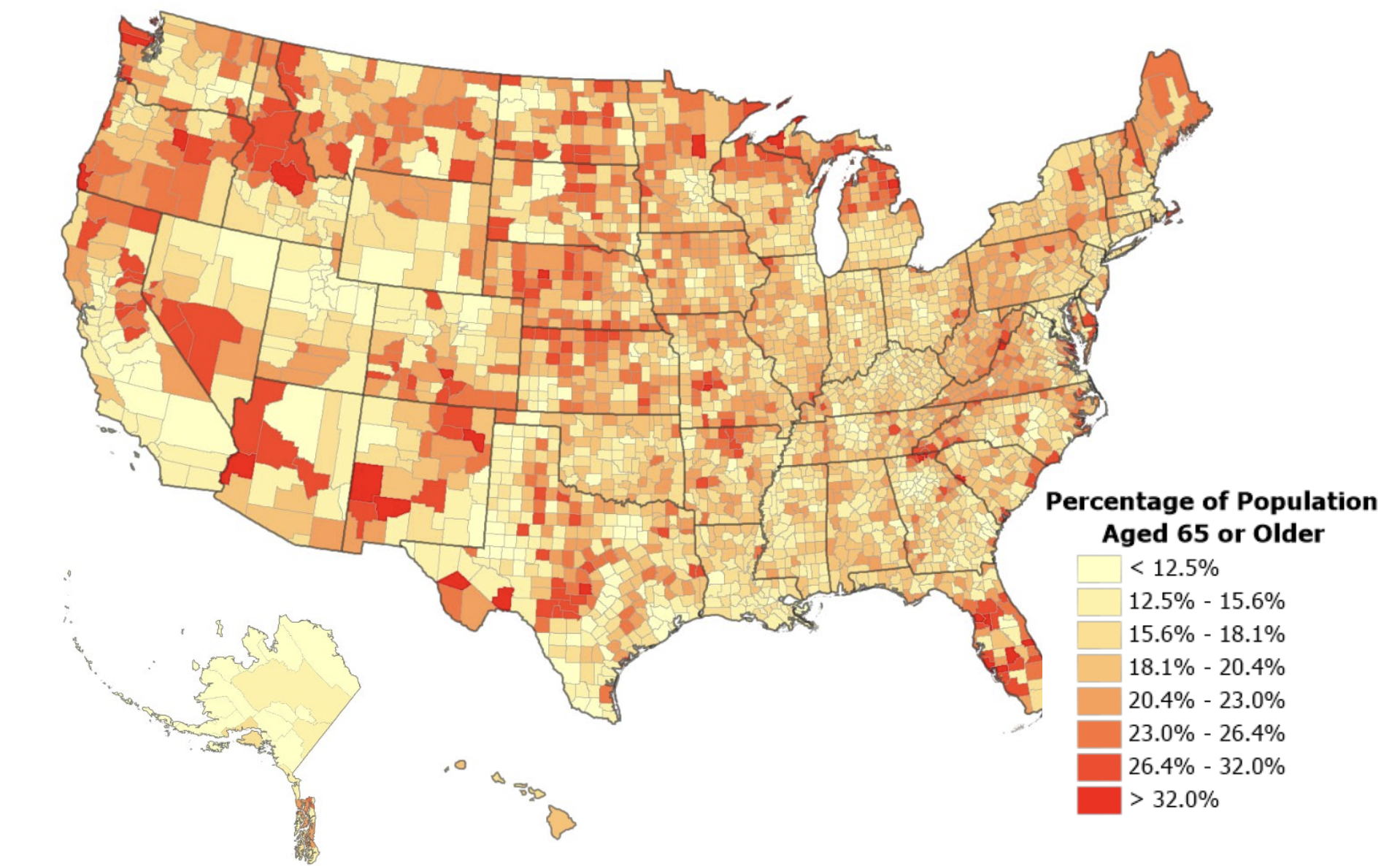
Estimated percentage of county population aged 65 or older in 2019
(Rural Transit Fact Book map from Census Bureau's American Community Survey data)

"Millions of older adults living in rural America no longer drive and don’t have adequate access to alternative transportation that can assist them with rides to banks, pharmacies and other important places, "Deon Hampton reports for NBC News. "President Joe Biden’s infrastructure law is set to unlock $2 billion in federal money for various rural transit projects. But it still may not be enough to solve the seemingly intractable problem of inadequate transportation for rural older adults."

An estimated 3 to 9 million rural Americans depend on transit programs to get around; they're disproportionately senior citizens, people with disabilities, Appalachians, and/or people living in low-income households, Hampton reports. Some can't drive anymore, some don't want to drive, and some can't afford their own vehicle, according to the Rural Transit Fact Book published earlier this year by the Upper Great Plains Transportation Institute's Small Urban and Rural Center on Mobility at North Dakota State University. (The report has a wealth of maps and county- and state-level data.)

Lack of access to mass transit can exacerbate food insecurity and make it harder for vulnerable populations to access health care, especially during the pandemic. Rather than the buses and subways that characterize urban mass-transit services, rural services tend to rely on volunteers driving vans or small buses that pick up riders on-demand rather than operating on a fixed route. Such rural transit services could get a share of the transportation funding, but much will likely go to infrastructure projects such as highways, bridges and dams. "The Transportation Department will award up to $300 million in grants this year and $2 billion over the next five years as part of the program," Hampton reports.

Friday, March 04, 2022

Quick hits: Appalachian businesses sought for local food guide; webinar covers public transit's role in rural health-care access; exposé prompts Ala. police chief resignation

Here's a roundup of stories with rural resonance; if you do or see similar work that should be shared on The Rural Blog, email us at heather.chapman@uky.edu.

The Agriculture Department has announced 11 regional positions, including three Farm Service Agency state executive directors and eight Rural Development state directors. Read more here.

Here's a great example of a metro paper doing due diligence in rural accountability reporting: In Brookside, Ala., pop. 1,253, a police chief hired in 2018 spearheaded an effort to bring in more revenue through fines and civil forfeitures. Revenue from such tactics increased by 640% from 2018 to 2020. Meanwhile, the town's part-time municipal judge and prosecutor also got outsized pay raises. The police chief resigned in January after AL.com published the first story about the issue. Read more here.

Appalachian Sustainable Development is seeking farmers, food producers, breweries, wineries, restaurants, farmer's markets, food pantries, small businesses, and more to add a free listing to its Local Food Guide. Read more here.

A recent Rural Health Information Hub webinar explored the role of public transportation in rural health-care access, especially for seniors and those with disabilities. Listen to the recording here.

Friday, February 26, 2021

Inequality-research organization says rural public transit needs more investment during pandemic

"With the pandemic taking a devastating toll on local budgets, the U.S. public transit system is battling to survive. For much of the country, this funding crisis jeopardizes an already withering lifeline," Kayla Soren writes for the Institute for Policy Studies, a nonprofit that studies structural inequalities. "For many Americans, public transit is the only option to get to work, school, the grocery store, or doctor’s appointments. But nearly half of us have no access to public transit. And those that do are now confronting limited routes, slashed service times, and limited disability accommodations."

More than a million rural households lack a vehicle and must depend on informal arrangements, ride-hailing services such as Uber, and/or public transit services to get around. The need is especially acute for rural residents who can't drive because they have a disability. "Over 80 percent of young adults with disabilities are prevented from doing daily activities due to a lack of transportation. And there aren’t enough resources to properly train transit workers for accommodating people with disabilities."

Rural public transit services are also critical for essential workers, the elderly and those who serve them, and survivors of domestic abuse. Dozens of transit riders and workers, many rural, testified at a recent two-day national community hearing about their needs for public transit. It's "unacceptable" that millions of rural Americans must get by with inadequate or no public transit, Soren writes.

"Congress can help. Public transit needs at least $39 billion in emergency relief to avoid service cuts and layoffs through 2023. But more broadly, we need to revise the '80-20' split that’s plagued federal transit funding since the Reagan era — with 80% going to highways and less than 20% to public transit," Soren writes. "Part of the justification for this disparity is that only people in dense, urban areas use transit. This is upside-down logic. The hearings reveal that when people don’t use transit, it’s because it is nonexistent, unreliable, or inaccessible."

Some inequalities go even farther than rural vs. urban: A new fact sheet published by the Appalachian Regional Commission illustrates disparities in public transit between not just rural and urban counties, but between rural counties outside of Appalachia vs. within Appalachia. As the report notes, only 7% of rural Appalachian counties served by fixed-route transit services have evening service, compared to 50% of non-Appalachian rural counties in Appalachian states.

Monday, September 14, 2020

Rural people with disabilities, at higher risk and with fewer resources, struggle to remain independent during pandemic

Rural Health Information Hub map based on U.S. Census Bureau's American Community Survey data from 2014-2018; click the image to enlarge it.
"From mental health strain caused by social isolation to life threatening circumstances, people with disabilities living in rural America are exposed to higher-than-average risks during the covid-19 pandemic," Jan Pytalski reports for The Daily Yonder. But some of those risks aren't from the virus itself, but from the lack of available medical supplies, staffing, or transportation difficulties. Rural residents with disabilities face higher risks during the pandemic, often with fewer resources.

Read more here.

Tuesday, February 11, 2020

Trump budget calls for steep cuts to many programs that benefit rural areas

President Trump's proposed $4.89 trillion budget for Fiscal Year 2021 won't get passed as-is, especially in the Democrat-led House, but it's instructive to see what his priorities are as he attempts to woo rural voters for his reelection campaign. Here are some of the details with rural resonance:

The proposed budget "once again calls for steep cuts to federal spending that supports rural communities," Bryce Oates reports for The Daily Yonder. That includes an 8 percent cut in the U.S. Department of Agriculture's discretionary budget—a $2 billion cut that mostly targets nutrition and food security programs, though farming, conservation and rural economic development programs are also cut.

Specifically, Trump proposes cutting funding for the Economic Research Service by 35%, from this year's $84 million to $62 million. The Rural Business and Cooperative Programs would lose 97% of funding, from $94 million to $3 million. The budget would also eliminate the USDA Single Family Housing Direct Loans program, funded this year at $90 million, and would provide the Farm and Ranch Stress Assistance Network only $2 million for local farm financial stress counseling—$8 million less than the 2018 Farm Bill's minimum, Oates reports.

"The budget proposes $44 million in distance learning and telemedicine grants, with 20% dedicated to projects that 'combat the opioid crisis and keep rural communities safe,''' Oates reports. "It provides $614 million in funding for water and wastewater grants and loans, $5.5 billion in electric loans, and $690 million in telecommunications loans, $2.5 billion for community facility direct loans and $500 million for guaranteed loans. The budget also provides $1.5 billion for business and industry guaranteed loans, a $500 million increase over current levels paid for by increased lending fees."

The budget calls for spending reductions over the next decade by cutting spending on school meal programs for the poor, large cuts to the Supplemental Nutrition Assistance Program through work requirements, more than $9 billion in cuts to farm conservation programs, and increasing user fees for food safety inspections, Oates reports.

The Department of Education would lose nearly 8%, or $5.6 billion, under the budget. Trump proposes cutting student loan spending by $170 billion and ending subsidized loans, in which the government covers interest for borrowers who are still in school or experiencing economic hardship. "It would also reduce the number of repayment options for borrowers and nix the popular, if challenged, public service loan forgiveness program," Annie Nova reports for CNBC. Losing the forgiveness program could make it harder for rural areas to attract doctors and teachers.

The budget aims to reduce Social Security spending by $75 billion over the next decade. Some of the savings would come from terminating more people from the Social Security Disability Insurance program. And "$10 billion of this reduction comes from reducing the amount of retroactive benefits someone can receive after they’ve been found to be disabled," Elena Botella reports for Forbes.

The budget isn't clear where much of the proposed Social Security savings over the next decade will come from. Over the next 10 years, $47 billion in savings is meant to come from an Office of Management and Budget proposal to "test new approaches to labor force participation," which essentially amounts to experimenting with policy until they save money, Botella reports.

Trump hopes to cut Medicare spending by 7%, or $756 billion, over the next decade. "Part of this reduction in spending comes from initiatives that the White House says are intended to reduce Medicare fraud," Botella reports. "For example, they've proposed requiring patients and doctors to ask for prior authorization from Medicare before certain procedures could be performed. And the budget hopes to lower Medicare spending through changes that would encourage more seniors to see nurse practitioners or physician’s assistants as their primary care providers. Medicaid spending would be cut by 16% over the next 10 years, possibly by shifting program funding to block grants.

The administration also wants to "cut down on reimbursement rates to healthcare providers, reducing how much doctors, hospitals, and hospices are paid for providing healthcare," Botella reports. The administration "highlights specific instances where they believe reimbursement rates for doctors are excessive: for example, they cite the fact that doctor’s offices owned by hospitals are often paid more for performing the same procedures than independent physicians."

The budget seeks to save $135 billion over the next decade by enacting comprehensive drug pricing reform. "The Trump budget does not include specific policies to reduce costs, but rather states the administration is supportive of capping out-of-pocket pharmacy drug costs for Medicare recipients, and improving incentives to reduce costs," Andrea Noble reports for Route Fifty.

The budget also eliminates the Department of Housing and Urban Development's HOME Investment Partnerships Program, which provided $1.3 billion in grants last year to 600 state and local governments to help pay for affordable housing for the poor, Noble reports. For the third year in a row, Trump has proposed eliminating most USDA rural affordable housing programs and many of its HUD programs, though the budget aims to fund some efforts to repair existing affordable properties, according to the Housing Assistance Council, a nonprofit that offers low-cost rural housing development loans.

The proposed budget would cut overall domestic federal spending by 5% and forecasts $4.6 trillion in deficit reduction over the next decade as long as the economy continues growing at around 3% per year, Jeff Mason and Richard Cowan report for Reuters.

However, the Congressional Budget Office projects the economy will grow 2.2% in the current fiscal year and will grow less than 2.0% per year afterward. "While Trump campaigned on a promise of eventually eliminating the country’s huge debt, each year of his plan projects significant budget deficits that actually would add to the $22 trillion debt," Mason and Cowan report.

Monday, February 10, 2020

Proposed changes to Social Security disability determinations would hurt rural residents, researchers write

Map shows the percentage of the population in each county that receives Social Security Disability Insurance payments;
click on the image to enlarge it; click on the story to view an interactive version with data for each county.
"Changes to the Social Security Disability Insurance program proposed in January by the Trump administration could make it harder for over 8 million Americans with disabilities to maintain federal benefits. That’s particularly true for those in rural communities, where we have worked and studied for the past 35 years," Lillie Greiman and Catherine Ipsen write for The Conversation.

Almost 8.4 million people receive an average of $1,200 a month in Social Security disability benefits. In each case, a judge has ruled that the person is unable to hold a job because of a mental or physical impairment, but they must undergo periodic reviews to prove that they're still unable to work. Reviewers classify recipients into one of three groups: Medical Improvement Expected, Medical Improvement Possible, and Medical Improvement Not Expected. Recipients deemed more likely to improve get more frequent reviews, Greiman and Ipsen write.

The Trump administration is proposing a fourth category, which would be called "Medical Improvement Likely." The government expects that about 1 million now categorized "Medical Improvement Possible" would probably move to the new category and get more frequent reviews, leading to more benefit terminations and saving about $200 million a year. "These proposed changes are based on research from the Office of Research, Demonstration and Employment Support showing that, after losing benefits based on a review, 70 percent of people had some earnings within the next five years. However, this research also shows that a majority continue to live below the poverty line," Greiman and Ipsen write.

They say adding the fourth category would disproportionately affect rural residents, who would have a harder time appealing terminations and finding work. Appealing a benefit termination is a lengthy process that often requires travel to a Social Security office or court. That can be a barrier for those without access to transportation, especially for in rural areas, where there are fewer offices.

Rural residents who lose benefits are more economically vulnerable than their urban counterparts overall, Greiman and Ipsen write. Not only are rural residents 5 percentage points more likely to be disabled than urban residents, but they tend to develop disabilities at a younger age. On top of that, "access to economic opportunity is not equally distributed across the U.S. Our research group’s work shows that rural Americans with disabilities are still trying to recover from the recession," they write. "Overall, fewer rural people with disabilities have jobs now than did in 2008 – this at a time when the U.S. unemployment rate is at historic lows. The drop in employment is particularly pronounced across a few geographic areas, including the Mid-Atlantic, Southern, Mountain and Pacific regions."

Monday, July 29, 2019

526 Western communities of 15,000 or fewer are at higher wildfire risk than Paradise was; is your town one of them?

Wildfire hazard potential of towns with fewer than
15,000 households (Arizona Republic map)
The small California town of Paradise made national headlines when it was destroyed by wildfire last November. But 500 small towns in the West have conditions that put them even more at risk of wildfires than Paradise was, according to an in-depth, multimedia report from the Arizona Republic and USA Today.

According to an analysis of fire hazards in 4,784 communities across 760 million acres of the 11 Western states, 526 towns with fewer than 15,000 households face a greater potential risk of wildfire than Paradise, and hundreds more are also at great risk, Pamela Ren Larson and Dennis Wagner report. The story includes a searchable database. 

The Republic analyzed U.S. Forest Service data, weighing 65 risk factors such as previous fires, topography, precipitation, vegetation, and more, then simulated tens of thousands of possible fire seasons. They assigned wildfire hazard potential on a scale of 1 to 5, with 5 being the highest. The median was 2.07 and Paradise was at a 3.81, Larson and Wagner report.

There are other factors in assessing human risk, though, including the number of mobile homes in a community; such homes pose a greater fire risk. The number of easily accessed exit roads also matters in an evacuation, and in Paradise the risk was greater because several of those routes away from the Camp Fire were effectively inaccessible. If a town has many older or disabled residents, that may increase the time needed for evacuation. "The median age of Camp Fire victims was 72. Among the 85 who died, at least 62 were age 65 or older; 36 were over age 75," Larson and Wagner report. "Across the West, 101 small communities have both a higher wildfire potential than Paradise and a larger percentage of residents with a disability."

Towns that lack an effective emergency notification system, or whose residents can't receive such messages by cell phone, also have a harder time evacuating. Phillip Levin, a researcher at the University of Washington and lead scientist for the Nature Conservancy, told the Republic: "Fire is natural. But the disaster happens because people didn't know to leave, or couldn't leave. It didn't have to happen."

Friday, May 24, 2019

Research increasingly links depression and suicide to chronic disease, especially among seniors in rural U.S.

"Rural America has some of the highest rates of chronic disease in the nation – the more remote a community, the more heart disease, cancer and diabetes. And there’s a side effect from having a chronic condition many people don’t think about – depression, anxiety and even suicide," Lisa Gillespie reports for Louisville's WFPL. "This is especially true for older adults, who’ve lived their entire lives in places with little access to places to exercise, with diets high in fat and sugar and in a culture that still hasn’t given up tobacco."

To compound the problem, rural residents often have a hard time accessing medical care for their chronic conditions and psychiatric care for the attendant mental health issues. That contributes to the increased risk of suicide in rural areas, which are already at higher risk because of a lagging economy and substance abuse. For example, "suicide rates in 2017 were 30 percent higher in Appalachia than in the rest of the country." Within the region, suicides were concentrated in Eastern Kentucky, West Virginia and East Tennessee, areas that struggle with high opioid-addiction rates and poverty. 

Gina Piane, a professor at National University in San Diego, was one of the first researchers to link chronic disease and mental health. Giving rural youth more health and nutrition education is a key way to prevent such issues, she told Gillespie. Psychologist John Fulton, who works in a rural Kentucky hospital, said he tries to teach his patients coping skills and recommends that they develop a support system of friends and family if they don't already have one.

"I try to say, you know, you’re sitting there focusing on the bad things, and all that’s going to do is drag you down deeper,” Fulton told Gillespie. "[I] try to get them to, you know, turn around and start thinking about, 'Well, I’ll go outside and look at dogs or I’ll watch wrestling on TV' — get their mind off the illness and how bad they feel."

Tuesday, May 21, 2019

Most rural Americans, broadly defined, are happy with their quality of life, but many face problems getting health care

Most rural Americans, broadly defined, are satisfied with their quality of life. But most also say their local economy isn't in good shape, and 40% say they've had trouble affording food, housing or medical bills in the past few years. So says the second part of the "Life in Rural America" survey by NPRHarvard University's T.H. Chan School of Public Health, and the Robert Wood Johnson Foundation, released today. The first part was released last October.

The second survey was conducted via cell phones and landlines from Jan. 31 to March 2, among a nationally representative sample of 1,405 adults living in the rural U.S. The poll defined rurality as areas outside a Metropolitan Statistical Area, which must have a city of at least 50,000 people.

Almost half of the survey respondents reported being financially insecure: 49% said they couldn't afford to quickly pay off an unexpected $1,000 expense. 

Health-care access remains a problem in rural America, too. Though most rural Americans have health insurance, about a quarter of respondents said they haven't been able to get health care they needed at some point in the past few years. And nearly one in 10 said their local hospital has closed in the past few years. 

Homelessness and inadequate housing are also recurring issues for rural Americans. One in three respondents said homelessness is a problem in their local community, and more than one in 10 have experienced problems with their housing such as mold or unsafe drinking water. 

One-fifth of respondents said they have difficulty accessing broadband internet. Most respondents who use the internet said they mostly used it to get health-related information, for personal finance, and for job-related activities. 

People with disabilities, racial/ethnic minorities, people with a lower education level and people with disabilities all reported greater difficulties across many parts of their lives.

Though the survey found many areas of concern in rural America, it also reflected a populace that is highly civically and socially engaged, who value their rural lifestyle and see their communities as safe. 

Thursday, January 31, 2019

Rural people with disabilities are still struggling to recover from the Great Recession, researchers find

It's well known that rural areas have been slower to recover from the Great Recession than urban areas, but University of Montana researchers have identified another demographic still struggling: people with disabilities, especially those in rural areas.

The researchers, who work for the university's Research and Training Center on Disability in Rural Communities, analyzed data from the Census Bureau's latest American Community Survey, which was released in December with 2013-17 data, compared to data from the 2008-2012 edition. They included people with sensory, physical and mental disabilities.
Employment of "people without disabilities increased by 1.7 percentage points, while those with disabilities increased by just 0.8" points, and declined by 0.6 percent in small towns and rural areas, the researchers report in The Conversation. "What’s more, people with disabilities are already much less employed than people without disabilities. We found that this difference is widening over time."

Employment rates among people with disabilities varied widely in different parts of the country; those in New England, West South Central, Mountain, and Pacific states (as defined by the Census Bureau) had a particularly hard time finding employment. Those lower employment rates mean the rural disabled have less access to health insurance, retirement benefits and other financial resources, the researchers report.

Tuesday, October 16, 2018

Poll shows rural Americans are worried about opioid addiction and the economy but remain optimistic

Rural Americans believe that drug addiction or abuse and economic issues are the biggest problems facing rural areas, but most say they value rural life and are optimistic about the future, according to the 'Life in Rural America' survey by NPR, Harvard University's T.H. Chan School of Public Health, and the Robert Wood Johnson Foundation.

Key findings:
  • 57 percent of respondents agreed opioid addiction is a serious problem in their community, and 49 percent personally know someone who has struggled with it.
  • 23 percent of rural adults said drug addiction or abuse is the biggest health problem in their community, followed by cancer (12 percent) and access to care (11 percent).
  • Appalachian residents, especially were more likely to say that drug abuse is the biggest problem in their community (41 percent) than respondents from other rural areas.
  • White Appalachians are more worried about the opioid epidemic: 52 percent said the opioid epidemic has gotten worse in their community in the past five years, compared to 32 percent of African-Americans and 30 percent of Latinx respondents.
  • Nationwide, 48 percent of respondents said the opioid epidemic has gotten worse in their community in the past five years, and 40 percent said it has remained about the same; 5 percent said it has gotten better in the past five years.
  • 55 percent of respondents rated the local economy as only fair or poor.
  • 64 percent said the most helpful thing for the local economy would be better long-term job creation. Good ways to do that? 61 percent believe improving local schools would help, 55 percent believe improving access to health care would help, and 51 percent recommend making sure advanced job training is available. 
  • 52 percent said they're active in solving their community's problems, with younger adults participating more.
  • 81 percent said they feel attached to their community, and 67 percent said neighbors have helped them in times of need.
  • 42 percent said their lives are turning out as they expected, and 41 percent said their lives are turning out better than they expected. 15 percent said their lives are worse than they thought they would be.
  • 54 percent said they're better off financially than their parents were at the same age.
  • 55 percent of rural parents said they think their children will be better off financially compared with themselves.
  • 42 percent of parents with children over 18 said their children have moved out of their hometown, and another 16 percent said some of their children moved away and some stayed.
  • Of the grown children who moved away, 61 percent went to a city, 17 percent moved to a suburb and 21 percent moved to another rural area.
  • 52 percent of parents whose grown children who moved away said they did so for a job, and 13 percent said their children had a hard time finding a good job in their hometown.
  • 36 percent of younger rural respondents said the overall number of good jobs available in their community has increased over the past five years, compared to 25 percent of older rural Americans.
  • Most respondents said minorities don't face discrimination in their community with some exceptions: 30 percent said they believe transgender people are discriminated against, 29 percent said recent immigrants to the U.S. are, and 27 percent said gay and lesbian rural residents are discriminated against. Only 9 percent of respondents believe that whites are discriminated against, while 10 percent believe Asian-Americans and discriminated against, and 12 percent believe disabled people are discriminated against.
  • White rural Americans are less likely to believe that minorities are discriminated against than minorities do.
  • Half of the respondents believe their town's problems will be solved in the next five years, and most think the government, especially the state, will play a major role in solving them.

"'Life in Rural America' illustrates that rural Americans have strong ties to local communities and value life, family, and jobs in rural America, On one level, rural Americans express concern about challenges facing local communities, such as money/financial problems, health and health care, and in particular, drug addiction/abuse and troubled local economies. At the same time, residents also report numerous reasons for valuing life in rural communities, and a majority report feelings of attachment to their local communities," the Robert Wood Johnson Foundation summarizes.

The survey was conducted June 6-Aug. 9 with cellphone and landline phone numbers among a nationally representative sample of 1,3000 adults age 18 and up living in the rural U.S. Interviews were conducted in English and Spanish. Results have a margin of error of 3.6 percentage points at the 95 percent confidence level. Rural areas are defined in this survey as areas that are not part of a metropolitan statistical area, as defined in the 2016 National Exit Poll.

Thursday, February 22, 2018

SNAP benefits don't cover food expenses for the poorest in most counties; how does your county stack up?

Urban Institute map; click on the image to enlarge, or see the interactive map here.
An Urban Institute study released this week found that, in 99 percent of U.S. counties, food-stamp benefits are not enough to cover the full cost of an inexpensive meal, even for those who have no net income. In President Trump's proposed 2019 budget, the Supplemental Nutrition Assistance Program would lose $213 billion in funding over the next decade.

"The average cost of a low-income meal, which is defined as part of the study, was $2.36. That cost is 27 percent higher than the maximum SNAP benefit per meal of $1.86," Bill Lucia reports for Route Fifty. "Over the course of a month, benefits were shy of average meal costs by $46.50 per person."

SNAP benefits aren't meant to cover the full cost of meals for a household except those that have no net income, usually because of a lifelong disability. But for those households, which totaled about 37 percent of SNAP recipients in fiscal year 2016, SNAP is the only way to pay for meals.

The study found that the biggest gap between SNAP benefits and food prices were in expensive urban areas like San Francisco and smaller rural counties, some with tourist attractions. The report concludes that SNAP will be more effective if the government can better match up benefits to the local cost of food. The Department of Agriculture's Food and Nutrition Service, which oversees SNAP, told Lucia that the agency will review the study and consider its recommendations.

Friday, March 31, 2017

Disability rates highest in rural, white, working-class counties; see your county's since 2004

Washington Post maps; click on them to enlarge
Rural America has "experienced the most rapid increase in disability rates over the past decade," with 100 of the 102 counties with the highest rates—where more than one in six working-age adults receive disability—being rural, Terrence McCoy reports for The Washington Post. Of those counties, all but 18 were, on average, 87 percent white.

McCoy's report includes an interactive chart that allows users to track each county's disability rate since 2014.

From 1996 to 2015, the number of working-age adults receiving disability rose from 7.7 million to 13 million and "the federal government this year will spend an estimated $192 billion on disability payments, more than the combined total for food stamps, welfare, housing subsidies and unemployment assistance," McCoy writes.

"The rise in disability has emerged as yet another indicator of a widening political, cultural and economic chasm between urban and rural America," McCoy writes. "In the 2016 presidential election, the majority-white counties voted overwhelmingly for Donald Trump, whose rhetoric of a rotting nation with vast joblessness often reflects lived experiences in these communities."

"Most people aren’t employed when they apply for disability—one reason applicant rates skyrocketed during the recession," McCoy writes. "Full-time employment would, in fact, disqualify most applicants. And once on it, few ever get off, their ranks uncounted in the national unemployment rate, which doesn’t include people on disability. The decision to apply, in many cases, is a decision to effectively abandon working altogether. For the severely disabled, this choice is, in essence, made for them. But for others, it’s murkier. Aches accumulate. Years pile up. Job prospects diminish."

McCoy gives a detailed example in the case of Desmond Spencer, a former roofer in Beaverton, Ala., who lost two jobs when companies left the country, before losing another during the recession, McCoy writes. At 39, Spencer, who limps from a work accident that he never sought treatment for, hasn't had a job in a year. Family members urge him to apply for disability benefits, but he doesn't want to be seen as a failure and he wonders if he is actually able to work and thus doesn't need assistance. He told McCoy, “There’s a stigma about it. Disabled. Disability. Drawing a check. But if you’re putting food on the table, does it matter?”

Spencer's situation may not be typical of all people who get disability benefits or are considering seeking them, but the Post is casting a wider net; at the bottom the story it has a questionnaire asking people to tell about their own applications.

Thursday, April 14, 2016

Walla Walla area investing in recreational activities for developmentally disabled adults

Walla Walla, Wash., is investing in recreational activities for the region's developmentally disabled adults, who have limited opportunities once they age out of the student programs and summer camps, Sheila Hagar reports for the Walla Walla Union-Bulletin. “As we call it: ‘When the school bus doesn’t come anymore’,” Susan Atkins, coordinator for Washington state’s Parent to Parent (P2P) program, told Hagar.

P2P, which "provides emotional and informational support to families with kids with developmental disabilities through local chapters and coordinators," has support from Democratic Gov. Jay Inslee, who signed into law a bill proposed by local Rep. Maureen Walsh "for increasing the statewide reach of P2P." (Union-Bulletin photo by Greg Lehman: College Buddies program)

For the first time Walla Walla is forming a co-ed softball team for players with and without disabilities, Hagar writes. "The city has agreed to some rule flexibility for the special-needs players, and there are allowances for teams that want to play half-seasons. It makes for what looks a promising marriage of need and solution," said Amy Harris, who has a special-needs daughter. She told Hagar, "I’m really excited to try something different. This has never been done before.”

The Valley Disability Network, a nonprofit founded in 2014 that runs P2P, "has been able to offer bowling, holiday parties, basketball, coffee klatches and Challenger baseball for people up to age 22," Hagar writes. Pickle ball has recently been added  and the network "also sponsors no-host dinners for parents once a month, where legal, legislative, health and educational information is dispersed, and moms and dads can talk honestly about the challenges of parenting a special-needs adult." Also, Whitman College and Walla Walla University students "participate in the local Buddies program, meeting with their developmentally disabled partners throughout the school year for various activities."

Tuesday, April 05, 2016

Lawyer, doctor, ex-judge in Central Appalachia charged with defrauding federal disability program

UPDATE, June 14: Charlie Paul Andrus, who was the chief administrative law judge in Huntington, has pleaded guilty "to scheming to retaliate against an employee who blew the whistle" on Conn, Bill Estep reports for the Lexington Herald-Leader.

In other ads, Conn called himself "Mr. Social Security."
(Lexington Herald-Leader photo)
A lawyer, doctor and former Social Security disability judge in Central Appalachia have been charged with massive fraud of the Federal Disability Insurance Program, a major source of income in the rural region.

Charged are Eric Conn of Stanville, Ky., who had the third-largest disability law practice in the U.S.; a psychologist, Dr. Alfred Bradley Adkins; and David Daugherty, who resigned his administrative law judgeship at Huntington, W.Va., in 2011 after The Wall Street Journal began probing his unusual generosity: approving all 729 appeals he considered in the first half of that fiscal year.

The Senate Committee on Government Affairs reported in 2013 that Daugherty approved virtually all the 1,823 appeals submitted to him by Conn, and that Conn paid five doctors roughly $2 million to regularly sign off on bogus medical forms that had been manufactured and filled out ahead of time by Conn's staff. The operation was the topic of a "60 Minutes" report by CBS. It reported that in Appalachian Kentucky and West Virginia, more than a quarter of a million people, or 10 to 15 percent of the population, are on disability benefits, three times the national average. Disabillity cases are prevalent in rural areas where men without a high-school diploma are injured and unable, or less able, to perform the sort of manual labor that once sustained them.

The indictment also lists three unnamed 'unindicted co-conspirators,' including two other doctors Conn used and one of Conn’s former office managers," John Cheves reports for the Lexington Herald-Leader. "The charges include mail and wire fraud, conspiracy to retaliate against a witness, making false statements and money laundering," Cheves writes. "The charges carry criminal penalties of up to 20 years in prison and up to $250,000 in fines. The government also seeks more than $5 million in forfeited assets from the defendants." Conn's clients have been awarded $500 million in claims, and he has collected at least $35 million in legal fees from the federal government, Cheves reports.

Conn was arrested Monday and is due in court today. Last year, Social Security reopened hundreds of Conn's cases and told his clients that their benefits could be suspended unless they provided more evidence of their disability. "After a request by U.S. Rep. Hal Rogers, R-Somerset, Social Security officials agreed to continue people’s disability checks while redetermining their eligibility," Cheves reports. "Those hearings are underway."
Read more here: http://www.kentucky.com/news/local/watchdog/article70011212.html#storylink=cpy