Showing posts with label fertilizer. Show all posts

Friday, March 20, 2026

U.S. seeks backup fertilizer suppliers to reduce damage to American farmers facing soaring costs and shortages

Farmers apply fertilizers just before or during spring 
planting. (Photo by Brandon Griggs, Unsplash)
With many crop fertilizers and fertilizer materials trapped by Iran's stranglehold on the Strait of Hormuz, the Trump administration has sought out countries that can produce or supply backup fertilizers for American farmers facing soaring fertilizer costs as they ramp up for spring plantings, reports Skylar Woodhouse of Farm Progress. American farmers already face economic headwinds from slowed trade with China, high fertilizer and fuel prices, high labor costs, and farm worker shortages.

White House National Economic Council Director Kevin Hassett told reporters earlier this week that the Trump administration was looking for ways to minimize U.S. fertilizer shortages. "Hassett said the U.S. has 'established licenses for Venezuela to produce more fertilizer,' and has held discussions with Morocco," Woodhouse writes.

Reuters reported that roughly 30% of the world's nitrogen fertilizer supply would normally go through the Strait of Hormuz. Woodhouse reports, "One facility in Qatar had produced so much fertilizer that it supplied 'maybe about 20%' of the U.S. market, according to Hassett. The Iran conflict has mostly shut the key Strait of Hormuz passage for ships."

A March 13 letter from the American Soybean Association, the National Corn Growers Association, and other organizations asked fertilizer manufacturers Mosaic and Simplot to rescind their support for countervailing duties on phosphate fertilizer imports from Morocco and Russia, which contributed to spiking fertilizer costs even before the Iranian conflict.

As the war with Iran continues, farming fertilizer isn't the only pivotal import that relies on transport through the Middle East. Alexander Osipovich of The Wall Street Journal reports, "A protracted conflict with Iran could curtail exports of many inputs into the global supply chain. . . ranging from agriculture to chemicals and pharmaceuticals."

Osipovich includes a list from Barclays analysts on "some key non-energy products exported from nine Middle Eastern countries affected by the conflict." It's shared below.

62% of limestone flux, which is used in construction and is primarily sent to India
47% of sulfur, used for fertilizers and chemicals
28% of acyclic alcohols and derivatives, used as industrial chemicals and as fuel additives, and mostly exported to China
23% of polymers of ethylene, used in plastics manufacturing
23% of nitrogenous fertilizers, used in agriculture
20% of diamonds, with key processing hubs in Israel and the United Arab Emirates, though they are mined elsewhere
18% of unwrought aluminum

Friday, August 15, 2025

Quick hits: More bacon; thriving town-owned grocery store; shocking fertilizer prices; drones for rural duties?

Five-month-old pigs from the latest breeding line Smithfield 
has developed. (Smithfield Foods photo via WSJ)
Just like lots of people, pork companies would like more bacon. For pigs to produce more bacon, they need bigger bellies, a trait pork industry breeders have been developing for years. "Today, slaughtered hogs weigh about 285 pounds on average, a 30-pound increase since the late 1990s," reports Patrick Thomas of The Wall Street Journal. "The increase in hog weight coincided with the explosion in popularity of bacon as more than just a breakfast item." With bacon in demand and razor-thin profit margins, the pork industry is using breeding programs to "build a better pig." 

St. Paul, Kansas, hadn't had a local grocery store for more than two decades, but in 2005, the town's new mayor challenged his community to use municipal support to plan and build a grocery store. St. Paul residents embraced the challenge and the St. Paul Area Community Development Corporation stepped in to help with planning and financial legwork, reports Kansas State University. In 2008, the St. Paul Supermarket opened, and it continues to thrive as a town-supported grocery store. Its motto is "the friendly store." Read its success blueprint here.

Fertilizer costs are high in the currency of corn. (Krista Swanson, National Corn Growers Association )

With alarmingly high fertilizer costs and falling commodity prices, U.S. farmers are grappling with how to stay afloat in today's market. "Farmers are in the middle of calling input suppliers to get quotes for fall fertilizer, and the prices are shocking," reports Tyne Morgan of Farm Journal. "The corn price to fertilizer price ratio on inputs such as phosphate is now the highest on record, and as corn prices continue to slide, it’s creating financial hurt on farmers. . . . An unnamed farmer asked U.S. Farm Report, 'How are we going to survive at these prices?'" 

After severe storms damaged crops and farming equipment across Nebraska, the state used drones to help mitigate the aftermath. "Using drones to help with disaster response shows the role they now play in the state’s economy, after years of investment and research from the state government," reports Chris Teale of Route Fifty. "Officials in the state are looking at ways drones can be used, especially to help those in rural areas. Delivery of food, medical supplies and other resources is one use case receiving a lot of attention."
A Maine roadway.
(C. Banks photo)

Among all the states, Maine remains one of the most rural and wild. "Greater Portland, Lewiston, Auburn, Bangor, and other populous areas make up just a small slice of Maine’s pie," writes Chris Sedenka in his opinion for WBLM radio in Portland, Maine. "It’s fascinating just how much of the state remains truly remote and untouched. . . . We still have territories named T2R9, you’re not going to find that in every state. . . . According to the data, Maine’s rural population makes up 61.5% of the total. That is an absolutely huge number. . . .The majority of the state is basically just pine trees and wildlife."

Living a long life could partially depend on geography. Some counties just seem to support populations who keep on keeping on. 

The map above shows which U.S. counties have an overall life expectancy above 80 years.
(Map via Brilliant Maps)

Friday, December 13, 2024

Ag round-up: Americans love butter and cheese; Brooke Rollins' nomination; toxic farm fertilizer; what to give a farmer?

Americans’ per capita consumption of dairy is up 3% over the past five years, 9% over the past
15 years, and 16% over the past 30 years. (Courtesy photo via Morning Ag Clips)

Even as U.S. milk and ice cream consumption dips, butter and cheese sales climb. "Butter and cheese consumption each surpassed all previous records, reaching all-time highs of 6.5 pounds (butter) and 42.3 pounds (cheese) per person, respectively, in 2023," reports Morning Ag Clips. "For context, a typical package of butter containing four sticks weighs 1 pound (16 ounces) and a standard bag of shredded cheese is half a pound (8 ounces)."

Synagro, a little-known company owned by Goldman Sachs, sells fertilizer made with sewage sludge to farmers who add it to crop soil. Unfortunately, Synagro's fertilizer may not be safe. It can contain biosolids, which often harbor 'forever chemicals' known as PFAS, which are linked to a range of "serious health problems including cancer and birth defects," reports Hiroko Tabuchi of The New York Times. "Farmers are starting to find the chemicals contaminating their land, water, crops and livestock." Synagro is leading a group of sludge-industry lobbyists "who argue they shouldn’t be held liable because the chemicals were already in the sludge before they received it and made it into fertilizer."

Fall and winter baking can increase
egg prices. (No Revisions photo)
The price of eggs is beginning to climb -- again. "The current spike coincides with shifts in shopping habits. Demand tends to rise in the fall and winter, says Brian Earnest, an animal protein economist with CoBank. Seasonal baking calls for increased egg use in home kitchens," reports Taryn Phaneuf of Nerdwallet. "Meanwhile, flocks of egg-laying hens are smaller because producers haven’t recovered from losses to bird flu over the past two years . . . The latest consumer price index shows that the price of eggs is up 37.5% from where it was a year ago."

When President-elect Donald Trump chose Brooke Rollins to head the Department of Agriculture, the nomination "blindsided" Robert F. Kennedy Jr., reports The Wall Street Journal. "Kennedy, the president-elect’s nominee to run the Health and Human Services Department, had been quietly compiling a shortlist of agriculture-secretary candidates in hopes of installing a like-minded disrupter in the post who would remake the food and farming sectors. . . . Brooke Rollins, a former White House aide with little prior relationship with Kennedy, wasn’t on the list."

2024 figures forecasted, USDA graph
As farmers plan for 2025 crops, many face lower profit margins for the second year in a row. "U.S. farm incomes are expected to fall again in 2024, and many farmers find themselves facing tighter budgets for next year," reports Kirk Maltais of The Wall Street Journal. "What hurt farmers the most was lower crop-cash receipts — the amount of money generated from selling crops. . . . Input costs, such as fertilizer and farm equipment, remain high. . . . Farmers are being squeezed, even after harvesting a record-size crop this year."


If you want to know what to give a farmer, ask a farmer.

Crop farmer Tom Venesky’s has a few suggestions:

  • A new tractor seat — Everyone has at least one tractor with a worn-out, busted-up seat
  • Sunglasses, hearing protection or a tractor canopy
  • A can of Freon — While being in a cab tractor shields us from the sun and noise, the glass can make it as hot as a greenhouse

Dairy farmer Taylor Pool shares some of her wish list:

  • Muck boots — waterproof to keep your feet dry
  • Hand warmers
  • Duct tape
  • Slippers
  • Candles

And finally, cattleman Matthew Mitchell says livestock wranglers want:

  • Waterproof snow pants or ski pants
  • New socket set — since parts of old sets always magically go missing
  • Utility knife/pocket knife

Friday, October 25, 2024

Researchers are modifying the DNA of corn seeds to reduce pollution and dependence on fertilizer .

Pivot Bio's microbes help nourish corn seeds in the ground and reduce their need for
chemical fertilizers. The process has a lot of unanswered questions. (Privot Bio graphic)

In a novel approach to stemming agriculture's contribution to climate change, researchers are altering bacterial DNA, so that corn seeds require less chemical fertilizer to thrive, reports Eric Lipton of The New York Times. "Globally, the manufacture, transportation, and use of chemical fertilizer is responsible for pollution with the equivalent planet-warming power of about 1 billion metric tons of carbon dioxide each year. That’s more than the combined releases from all the coal-burning power plants in the U.S."

Research on genetically modified bacteria that is sprayed on corn seeds and then planted in the U.S. corn belt is ongoing. If successful, it could revolutionize how plantings are nourished throughout their growth cycle while helping reduce carbon emissions. Lipton writes, "Just five years after they were introduced, the seeds are being used on 5% of American corn crops."

The sprayed seeds are produced by Pivot Bio, a California-based company, which "estimates that last year, its treated seeds prevented the release of an estimated 706,000 metric tons of carbon dioxide equivalent — comparable to the greenhouse gasses from burning 1.5 million barrels of oil," Lipton reports. "But it’s also producing intense pushback."

The alteration of bacteria and its application to corn seeds has some organic farming groups up in arms and "manufacturers of chemical fertilizer are also raising doubts about the new industry player," Lipton adds. "Pivot’s own advisers concede there are unanswered questions." David Kanter, a Pivot adviser who teaches environmental studies at New York University, told Lipton, "We have rarely created a solution to an environmental problem that doesn’t create other unforeseen consequences down the line."

Meanwhile, other companies are creating their own hubs of fertilizer-replacement research. "The goal is to supplant as much as half the fertilizer used today," Lipton reports. "Companies, including Ginkgo Bioworks and BioConsortia, are developing their own versions. Academics at M.I.T. and other universities are trying to make further advances. . . . At this point, scientists don’t believe they can completely eliminate the need for chemical fertilizer."

Tuesday, July 09, 2024

Conservation farming practices could help reduce the Gulf of Mexico's 'dead zone' that harms marine life and fishing

Agriculture's use of fertilizers without run-off prevention means chemicals along with nitrogen and phosphorus flow down the Mississippi River and into the Gulf of Mexico. (Adobe Stock photo)

When Midwestern farming states steer around conservation practices and use more synthetic fertilizer and manure, their crops' run-off flows into the Mississippi River and contributes to the Gulf of Mexico's 'dead zone,' reports Erin Jordan of The Gazette, which serves Cedar Rapids, Iowa. "There are thousands of U.S. farmers not growing cover crops or using other conservation practices shown to reduce runoff. . . thwarting plans to slash nitrogen and phosphorus washing down the Mississippi River to the Gulf of Mexico, where excess nutrients threaten wildlife and fishing industries." Encouraging or requiring farmers to use more conservation practices could change this trend.

What is the dead zone and why should farmers care? The zone is produced by chemicals and element run-offs of nitrogen and phosphorus that flow down the Mississippi and into the gulf. Once in the gulf, "these nutrients are required for plant and crop growth, trigger algae blooms that choke off oxygen in water and make it difficult, if not impossible, for marine life to survive," reports The Nature Conservancy. "The National Oceanic and Atmospheric Administration estimates that the dead zone costs U.S. seafood and tourism industries $82 million a year. The impact could be devastating to the gulf’s seafood industry."

Originally, the United States pegged 2025 as the year for nitrogen and phosphorus flows into the gulf to be reduced by 20%. But the country is far from reaching this goal. 

Despite government subsidies for conservation projects, "many farmers just don’t want to risk reducing their short-term yields — money they use to feed their families and pay down debt," Jordan reports. "While the Midwest has seen boosts in farming practices that reduce runoff, there’s also been an increase in practices that make the problem worse."

Some states are reconsidering "the strategy of paying farmers to implement voluntary practices to reduce nutrient loss," Jordan writes, including some lawmakers in Minnesota who "pushed for a 40-cent-per-ton fertilizer tax that would raise an estimated $1.2 million a year to be used to help southeast Minnesota residents whose drinking water wells are contaminated with nitrate, which has been linked to some forms of cancer."

Friday, August 04, 2023

Phosphorus is essential to life, not just farming, but supply is limited and many think the system for it is unsustainable

Phosphate, the most commonly used form of phosphorus,
used as fertilizer or compost enhancer (Shutterstock photo)
Phosphorus is essential to life, but "is a non-renewable resource in high demand, and supply is not abundant," reports Shea Swenson of Ambrook Research. How to make it sustainable? Researchers at North Carolina State University polled a swath of phosphorus stakeholders — including farmers, fertilizer executives, environmentalists, and policymakers — on how sustainable, or not, the current system for managing the resource is, and what could stand to change. . . . As it turns out, they are concerned."

The reserarchers' study found an overall lack of confidence in the "long-term sustainability of existing phosphorus management systems," Swenson reports. About a third of those polled "found the current mining, use, transport, recovery, recycling or disposal of phosphorus and materials containing phosphorus completely unsustainable. One respondent summed up their concerns and said, 'Relying on a mined, non-renewable resource for an essential nutrient for all life, while the excess is lost to landfills and water bodies, is just not sustainable.'"

Lack of recycling is the main reason the current system is unsustainable, the researchers concluded. The system is linear: "On a farm, phosphorus-based fertilizer is used in the field, but much of it is washed away by water. And once it's out of the fields and into the waterways, it's lost," Swenson explains. 

Farmers who use phosphate fertilizers to replenish their soil's phosphorus levels to raise crops like soybeans and corn already face challenges and extra costs to meet their needs, Swenson reports: "For an input that so many farms rely on, the phosphorus market is historically unstable. Not only is the supply finite, the suppliers aren't abundant either. In the U.S., much of the available phosphorus is sold by just one company. . . .[Other]major producers being China and Morocco, meaning its pricing can be impacted by tariffs."

The concern goes beyond those who use phosphorus in farming and other industries. "Because the resource is so crucial to the food system and overall life in general, many research projects are underway," Swenson reports. "Some suggest restoring wildlife populations to revitalize a natural cycle of phosphorus, while others dig into plant genes that could make crops more resilient to phosphorus deficiency." Moe than half of those polled "reported that new, improved, or different regulations are needed, improved management practices and procedures are needed, and new technologies are needed."

Tuesday, January 17, 2023

Repurposing sewage can be environmentally friendly, but it's objectionable to some, and has to be carefully managed

Old-time ad for Milwaukee's processed sewage sludge
Recycle. Reuse. Repurpose. Repeat. Or so goes the ever-living mantra. "The precepts of circular economy—reusing water, using biodegradable plastic, composting food leftovers so they can be returned to the soil rather than become landfill—are among the hottest ideas of our century," reports Lina Zeldovich for JSTOR Daily. "But what about recycling what our food becomes after we eat it? Yes, that means excrement, a critical substance in the thoroughly functioning circular economy, seems to be left out of the equation. . . . Our industrial treatment systems separate the so-called biosolids out of the sewage stream, purify the water, and release it back to nature, but they rarely extract these essential nutrients in the process. Instead of fertilizing the fields then, the nutrients fertilize the waterways—and wreak havoc in them."

A cycle of environmental problems ensues, Zeldovich reports: "The nutrients overfertilize the water, causing what scientists call eutrophication or nitrogen overloading, which fuels toxic algae blooms, destroys coastal marshes, kills mangrove forests, and smothers corals. What happens with the remaining biosolids—a euphemism for the malodorous, pathogen-infested black muck—is equally ugly. Sometimes it’s burned, releasing carbon dioxide in the atmosphere and contributing to greenhouse gas emissions. "

Zeldovich writes, "We must figure out how to return our sludge back to land. The necessary tools already exist to do so Even better, there are technologies that turn human waste into humanure. Zeldovich provides an surprising old example: "Milorganite: Human-Made in Milwaukee Since 1925. In 1914, the Milwaukee Sewerage Commission began to experiment with a new approach for wastewater treatment." A treatment plant that opened in 1925 was the first in the nation "to tap into nature’s power to clean wastewater. But while these bacteria decomposed excrement, the gooey and gunky end product left behind still needed to be dealt with. Agronomist Oyvind Juul Noer realized that the muck contained high levels of nitrogen, phosphorus, and potassium . . . the key fertilizers plants need to grow. Compared to manure and chemical fertilizer, this microbe-processed sludge produced superior growth results. Milwaukee sewage authorities figured out how to dry and process the muck into pellets and began churning out this human-made fertilizer."

Milwaukee's process has been copied in many places, and there have been many public objections to farmers' use of it. "The presence of potentially toxic metals is the main factor that limits such use," says a 2016 paper in the journal Circular Economy and Sustainability. "Many techniques have been employed in attempt to remove these toxic metals, including physical, chemical, and biological treatments, but the high cost of the physical and chemical treatments, as well as the risk of causing secondary pollution, makes this type of sewage-sludge treatment an unsatisfactory option. Therefore, removing toxic metals through biological treatments has become an increasingly popular choice, as such treatments have been shown to be the most economically and environmentally beneficial methods."

There are other challenges to using human waste as fertilizer, including "the number of pathogens it contained—an issue modern tech addresses," Zeldovich writes. "A newer concern is the problem of hormones, antibiotics, and PFAS. . . . But the sewage industry is already working on ways to address these. Even the most stable chemical compounds fall apart under high temperatures and pressures; called pyrolysis, one such process may be the path to their destruction." Environmental experts say proper management, including careful application, is essential to use of sewage sludge on farms.

JSTOR Daily says it is "an online publication that contextualizes current events with scholarship." Its parent platform is a "digital library of academic journals, books, images, primary sources, research reports, and other material."

Tuesday, August 02, 2022

Lightly regulated 'forever chemicals,' given out in sludge fertilizer, are so ubiquitous they're in rain at unsafe levels

Scientists are increasingly alarmed about the health risks of exposure to synthetic substances often dubbed 'forever chemicals.' Adding to those fears: A recent Stockholm University study shows that the chemicals are so ubiquitous that rainwater in most places on Earth contains amounts of the chemicals that "greatly exceed" safe levels, Matt McGrath reports for the BBC. In short, "There is no safe space on Earth to avoid them."

Polyfluoroalkyl and perfluoroalkyl substances, or PFAs, are used in everything from fast-food wrappers and water-repellent clothing to non-stick cookware and firefighting foam. They're designed to be sturdy, but that means they also last a long time in the environment, and also in the human body, and "Soil around the world is similarly contaminated, evidence suggests," McGrath reports.

There are a few reasons for that: Rainfall is one, but PFAs are present in common pesticides. Also, many farmers are offered free or inexpensive sewage sludge as fertilizer—which often happens to have unsafe levels of PFAs. Thousands of acres of farmland near Chicago has been contaminated with the chemicals. "During the past six years alone, federal records show, more than 615,000 tons of sludge from the Metropolitan Water Reclamation District of Greater Chicago has been plowed into 29,000 acres near the nation’s third largest city," Michael Hawthorne reports for the Chicago Tribune. "Only the Greater Los Angeles area distributed more sludge to farmers between 2016 and 2021." A 2011 study of Chicago-area farmland found some of the highest PFAs concentrations in the nation.

"Researchers and public health advocates are increasingly concerned because some PFAS build up in human blood, take years to leave the body and don’t break down in the environment. Others transform over time into more hazardous compounds, increasing the risk that grains, beans, hay and produce grown in sludge-amended soil could be tainted for years to come," Hawthorne reports. "Long-term exposure to tiny concentrations of certain PFAs can trigger testicular and kidney cancer, birth defects, liver damage, impaired fertility, immune system disorders, high cholesterol and obesity, studies have found. Links to breast cancer and other diseases are suspected. Yet forever chemicals remain largely unregulated."

Friday, June 17, 2022

House passes bills on meatpacking, fertilizer and biofuels; meat measure up for vote in Senate Agriculture Committee

"Democrats, struggling to maintain their tenuous control over the House amid soaring food and fuel prices," sent the Senate a raft of bills Thursday "aimed at promoting competition in the meat sector, reducing fertilizer usage and expanding the use of biofuels," reports Agri-Pulse's Philip Brasher.

"Republicans portrayed the Lower Food and Fuel Costs Act as a 'messaging bill' that would do little to address inflation while attempting to deflect attention from the Biden administration’s policies. But the bill passed, 221-204, with support from seven Midwest Republicans:" Dusty Johnson of South Dakota, Don Bacon of Nebraska, Vicky Hartzler of Missouri, Adam Kinzinger of Illinois and Iowans Randy Feenstra, Ashley Hinson and Mariannette Miller-Meeks, Brasher reports. "Five Democrats voted no: Henry Cuellar and Vicente Gonzalez of Texas, Peter DeFazio of Oregon, Seth Moulton of Massachusetts and Peter Welch of Vermont."

GOP critics focused on a plan to create a special investigator's office in USDA’s Packers and Stockyards Division to probe allegations of unfair trade practices in meatpacking, Brasher reports: "Other provisions are intended to allow year-round sales of E15; fund additional biofuel infrastructure; increase payments under the Environmental Quality Incentives Program for nutrient management practices; increase funding for precision agriculture; establish a USDA-run Agricultural and Food System Supply Chain Resilience and Crisis Response Task Force; and authorize loan guarantees for meat and poultry processing expansion. A Democratic amendment adopted during floor debate would authorize USDA to spend $100 million to increase domestic fertilizer production, an effort Agriculture Secretary Tom Vilsack is already undertaking."

The Senate Agriculture Committee is scheduled to vote Wednesday on the its version of the investigation measure, "along with legislation to mandate minimum levels of cash trading in the cattle sector," Brasher notes. "Both measures have Senate GOP sponsors." House Agriculture Committee Chair David Scott said the need for the probe was illustrated by JBS USA CEO Tim Schellpeper's response when asked at a hearing whether packers had colluded to fix prices: “Not that I'm aware of.”

UPDATE, June 23: The Senate panel approved both bills, Successful Farming reports.

Monday, May 02, 2022

Scientists say modern farming methods and climate change have made modern produce and grains less nutritious

The advent of modern farming methods has caused fruits, vegetables and grains become less nutritious over the past 70 years, Stacey Colino reports for National Geographic. Multiple scientific studies show that many current crops have "less protein, calcium, phosphorus, iron, riboflavin, and vitamin C than those that were grown decades ago," Colino writes.

Climate change and rising carbon-dioxide levels are partly to blame, but the biggest problem is "modern agricultural processes that increase crop yields but disturb soil health," Colino reports. "These include irrigation, fertilization, and harvesting methods that also disrupt essential interactions between plants and soil fungi, which reduces absorption of nutrients from the soil."

Nutritional decline could make it harder for people to get the nutrients they need to fight off chronic illnesses, said David R. Montgomery, a professor of geomorphology at the University of Washington and co-author with Anne Biklé of What Your Food Ate. It's increasingly important to grow nutritionally dense foods, he told Colino: "We can’t afford to lose arable land as population grows. We need to prevent further damage and work to restore fertility to already degraded lands."

Montgomery and other experts still encourage people to eat more fresh produce and less-processed foods, but told Colino they hope this knowledge will inspire more people to care about how their food is grown.

Monday, April 25, 2022

Wall Street Journal video explains many reasons why fertilizer prices are so high and might go higher in 2023

The Wall Street Journal has a new video that clearly lays out the reasons for today's record fertilizer prices, how that affects agriculture and food prices worldwide, and why the cost could go higher.

An array of global supply-chain shortages have made it more difficult and expensive to manufacture fertilizer. In 2021, China halted exports of phosphate, a key ingredient. In December, the U.S. and the European Union imposed trade sanctions on Belarus, the world's third-largest potash producer, for alleged human-rights violations. Those and other trade restrictions involving Russia, Turkey, and Egypt slowed global exports. The U.S. imports nearly all of its potash—83% from Canada—but residents near at least one potential mining site in the U.S. have rebuffed the idea, Grist reports.

Recent trade sanctions on Russia have worsened the strain, since Russia is the world's largest fertilizer exporter and one of the top five potash producers. Even countries without sanctions against Russia must pay sky-high prices to insure the vessels carrying potash or fertilizer, since the war makes transportation much riskier. Meanwhile, "Rising natural gas prices have prompted some European factories to scale back fertilizer production," the WSJ reports. "Natural gas is another major Russian export and a key ingredient in making nitrogen-based fertilizer."

That all makes fertilizer nearly three times more expensive for American farmers as it was in early 2021, Joel Brinkmeyer, CEO of the Agribusiness Association of Iowa, told the WSJ. Farmers operate on tight profit margins, and fertilizer is already one of their biggest expenses. Higher costs get passed on to buyers such as grocery chains and animal-feed companies, and meat gets costlier.

Some farmers have delayed planting in hope fertilizer prices will fall, but later harvests could create more supply-chain snags. Some have cut back on fertilizer use; that could lower crop yields. Some are planting crops that need less fertilizer, such as soybeans, not corn. Some are considering alternatives to such as biologicals, natural fertilizers with microorganisms that boost soil fertility, but most aren't willing to alter such a basic production factor without good hope of better results.

The worst-case scenario, Brinkmeyer said, is that the shortage causes widespread shortages of crops and feed: "If we don't produce the crops, we can't probably produce the livestock and the poultry, and we get into actual food challenges in the U.S., and that would be a much, much greater concern than what we have today."

Wednesday, April 13, 2022

Maine House passes bill banning sewage sludge that can have 'forever chemicals' and is commonly used as fertilizer

Known PFAS contamination sites in 2021. Blue dots denote samples from drinking water, purple from military sites, and orange from other sites. (Environmental Working Group map; click image to enlarge or click here for interactive version.)
Maine's House of Representatives has sent its Senate a bill banning the spread, use or sale of sludge from sewage treatment plants and septic tanks, since the sludge (called septage) is often contaminated with "forever chemicals" linked to numerous health problems. The bill would also ban the sale of crops grown where septage was spread, and the material would go to landfills instead. "It would be one of the most aggressive actions to date in Maine, which has been ramping up its efforts to respond to the presence of per- and polyfluoroalkyl substances, or PFAS, in farmland, water and food after several farms have discovered unsafe levels of the chemicals," Caitlin Andrews reports for the Bangor Daily News.

Map shows sites where septage was spread in southern Maine. (Click to enlarge)
That includes Songbird Farm, 90 miles northeast of Portland. Adam Nordell and Johanna Davis bought the 44-acre farm in 2014 and established a thriving organic farm. But in 2021 state wildlife officials found dangerously high levels of PFAS in deer that hunters had harvested in nearby Fairfield. The state warned people not to eat the deer in that area, Keith O'Brien reports for The Washington Post: "Several farms there had been fertilized in the 1990s with municipal or industrial sludge — essentially, treated sewage — that contained an unknown amount of PFAS. The deer had ingested it over time and should now be avoided, the state announced."

Nordell and Davis suspended sales from their farm after voluntary testing revealed that their soil, water and spinach crops were all contaminated with PFAS. The farm's last owner had died of pancreatic cancer, so they got themselves tested for PFAS too, and discovered their levels were 250 times higher than the average American, O'Brien reports.

"It would be comforting to dismiss the story of Songbird Farm as a one-off calamity — a confined case of PFAS contamination. The reality is far more disturbing. According to the nonprofit Environmental Working Group, more than 2,800 sites nationwide are contaminated by PFAS — and that’s only what’s documented," O'Brien reports. "The real total is unknown, and possibly much higher. In Maine alone, the state Department of Environmental Protection is investigating 700 sites once fertilized with the same sort of sludge that likely contaminated Songbird Farm. Many cases are lurking beneath the surface, undetected and often unregulated by an official watchdog."

PFAS, invented in 1938, are nearly impossible to avoid: They're in everything from food packaging and non-stick cookware to baby bibs, and they have a habit of rubbing off on whatever they touch. Once they're in your body, they're around for the long haul. "It can take four to 15 years for levels of PFAS to reduce by half in the human body, and it can take centuries for the substances to disappear from the environment," Isabella Grullón Paz reports for The New York Times, citing a Consumer Reports investigation revealing how prevalent PFAS are (in fast-food packaging, for example).

Maine is taking some of the most aggressive regulatory actions of any state towards PFAS to date. The state government "advanced a first-in-the-nation phaseout of most consumer products containing PFAS last year. They are on track to approve a $100 million fund to aid farmers and address health effects and have also advanced a phaseout of pesticides containing the chemicals," Andrews reports.

Tuesday, March 22, 2022

War in Ukraine threatens worldwide food shortage, rise in social and political upheaval; millions more could go hungry

"The war in Ukraine has delivered a shock to global energy markets. Now the planet is facing a deeper crisis: a shortage of food," reports Jack Nicas of The New York Times. The greatest upheaval since World War II "is compounded by major challenges that were already increasing prices and squeezing supplies, including the pandemic, shipping constraints, high energy costs and recent droughts, floods and fires," That could bring more global hunger and social/political upheaval.

"A crucial portion of the world’s wheat, corn and barley is trapped in Russia and Ukraine because of the war, while an even larger portion of the world’s fertilizers is stuck in Russia and Belarus," Nicas reports. "The result is that global food and fertilizer prices are soaring. Since the invasion last month, wheat prices have increased by 21 percent, barley by 33% and some fertilizers by 40%. Ukrainian farms are about to miss critical planting and harvesting seasons. European fertilizer plants are significantly cutting production because of high energy prices. Farmers from Brazil to Texas are cutting back on fertilizer, threatening the size of the next harvests."

The smaller supply of basic commodities will push grocery bills up even higher, and could push food-insecure people over the edge to outright hunger, Nicas writes. In the U.S., where grocery prices were up 8.6% in February over the year before and most pandemic assistance programs have ended, more and more Americans are turning to food banks, Laura Reiley reports for The Washington Post.

"Food-bank officials are reporting growing lines at their distribution centers nationwide. Rates of reported hunger have been increasing since early August, when nearly 8% of respondents said they 'sometimes' or 'often' did not have enough to eat, according to data from the Census Household Pulse Survey," Reiley reports. "In early February, 10% of those polled said their household sometimes doesn’t have enough to eat. That uptick is more significant for households with children, rising to 13%, although off from pandemic peaks." Also in February, 35% of U.S. adults in households with children said they struggled to cover their bills. (On Friday, the U.S. Conference of Mayors pleaded with Congress to extend federal pandemic food aid, currently set to expire in July.)

Worldwide, "After remaining mostly flat for five years, hunger rose by about 18% during the pandemic to between 720 million and 811 million people. Earlier this month, the United Nations said that the war’s impact on the global food market alone could cause an additional 7.6 million to 13.1 million people to go hungry," Nicas reports. "The World Food Program’s costs have already increased by $71 million a month, enough to cut daily rations for 3.8 million people."

If the war ended very soon, Ukraine's agricultural exports would still likely fall by a fifth from 2021, Alistair MacDonald reports for The Wall Street Journal. Damaged land, equipment and infrastructure, along with a scattered populace, will make it difficult for farmers to get back to work right away. But that's the best-case scenario, a Ukrainian agriculture official told MacDonald; the reality will probably be far worse.

Nearly half of rural heartland bankers surveyed say inflation won't change farm income much; only 11% say it will fall

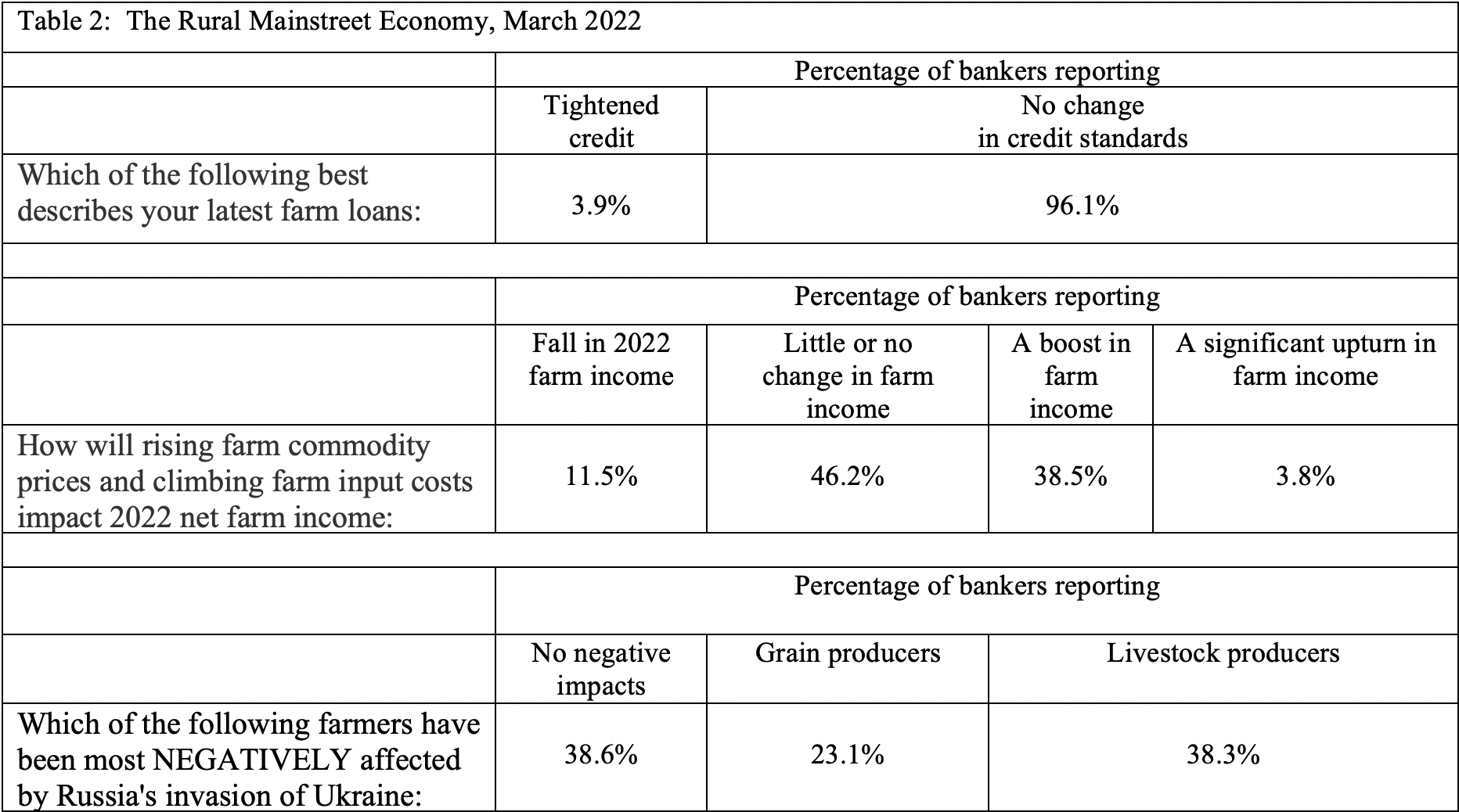
Creighton University chart compares this month to last month and year ago; click here to download it and chart below.

Rural bankers in 10 Midwestern states that rely on agriculture and energy saw the 16th straight month of positive economic growth in a monthly survey in March, despite concerns about increased production costs and the Russian invasion of Ukraine. The Rural Mainstreet Index polls bankers in about 200 rural places averaging 1,300 population in Colorado, Illinois, Iowa, Kansas, Minnesota, Missouri, Nebraska, North Dakota, South Dakota and Wyoming.

"A 25 percent gain in farm commodity prices over the past 12 months, near-record-low short-term interest rates and growing agricultural exports have underpinned the Rural Mainstreet Economy," writes Creighton University economist Ernie Goss, who compiles the index.

The overall index for March rose to 65.4 from last month's 61.5; anything over 50 is growth-positive. Though retail sales dipped to 51.9 from February's 57.7, indexes for home sales and bank loan volume increased sharply, and farmland prices, farm equipment sales, and checking deposits remained strong. And, the confidence index, which measures how healthy they believe the economy will be in six months, ticked upward to 54 from February's 51.9. 

"Even with the rapidly rising farm input costs, 42.3% of bank CEOs expect 2022 net farm income to expand from 2021’s healthy level. Only 11.5% of bankers anticipate a decline in 2022 net farm income from 2021’s value. The remaining 46.2% of bankers expect no change in 2022 net farm income from 2021 levels," said the report. "Approximately 38.4% of bankers expect Russia’s invasion of Ukraine to have negative impacts on net farm income. Of bankers projecting negative impacts, damages are expected to be higher for livestock producers than for grain producers."

Wednesday, March 16, 2022

Fertilizer price increases gobble up agricultural profits; advocates for farmers blame consolidation of the industry

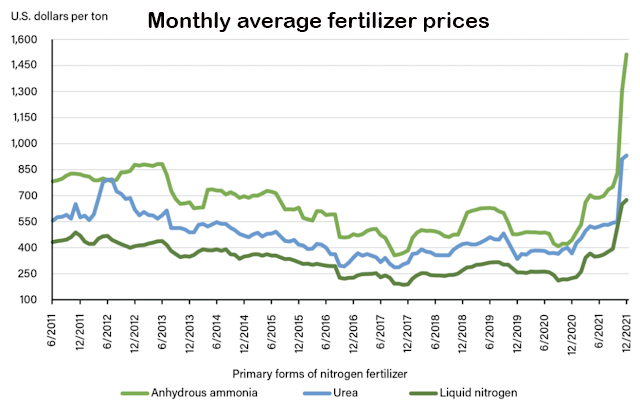
Graph by Economic Research Service, U.S. Department of Agriculture. Click the image to enlarge it.

"Farm advocates say that record-breaking fertilizer prices are decimating farmer profits and pulling wealth out of rural communities for the benefit of a handful of corporations that control the market," Claire Carlson reports for The Daily Yonder. "Groups such as Farm Action are calling on the federal government to enforce antitrust laws against the small number of fertilizer manufacturers that remain in the industry."

The price of most fertilizers has skyrocketed since 2020, but crop prices aren't, so farmers are eating the difference. The fertilizer industry blames pandemic supply-chain issues and increased natural gas prices, but many farming advocates blame fertilizer industry near-monopolies. "Four corporations supply 75% of the nitrogen fertilizer in the U.S.: CF Industries, Nutrien, Koch, and Yara-USA," Carlson reports. "Two corporations supply all of North America’s potash, a potassium-based fertilizer: Nutrien Limited and the Mosaic Company. Between 1980 and the mid-2000s, the number of fertilizer producers for the U.S. dropped from 46 to 13 firms, according to Farm Action."

The war between Russia and Ukraine could affect fertilizer prices as well, since both countries are major exporters of natural gas and fertilizers. But the full impact may take a few months to become clear, according to an executive at the Federal Reserve Bank of Kansas City, Carlson reports.

Tuesday, March 01, 2022

Leaky gas system and major meat processors more issues than cows' methane, says livestock farmer and dairy expert

Cows at O'Daniel's Foxhollow Farm (Photo by Kendra Lynne)
People are more concerned than ever about climate change and greenhouse-gas emissions. Much of that comes from the oil and gas industries, but some stakeholders worry about cow burps. That's silly, Kris O'Daniel writes for the Louisville Courier Journal. O'Daniel, a Denmark native who operates a farm with her husband near Springfield, Ky., has a master's degree in dairy science and engineering and worked for the United Nations Food and Agricultural Organization.

"Natural gas made up 37 percent of U.S. electricity generation in 2021, but there are no reliability standards for pipelines moving energy," O'Daniel writes. "That’s because the fossil fuel industry, supported by congressional conservatives, is opposed to legislation directing the Federal Energy and Regulatory Commission to develop reliability and cybersecurity standards for natural gas and other pipelines. The Transportation Security Administration oversees it. The Fossil fuel industry finds any regulation a waste of taxpayers’ money. Contrary to natural gas leaks, cattle’s methane belching is accounted for. But their unique ruminating ability to digest feed from which humans cannot benefit adds value and turns simple forage into high-quality human food. The methane and manure from grazing livestock are sequestered and part of the carbon cycle. That’s how nature is designed."

Also, O'Daniel notes, grazing animals, including cattle, can contribute to healthy ecosystems. "Byproducts from processing food for humans are part of livestock forage, thereby reducing what is going to landfills. Landfills are the third-largest emitter of methane, so taking away ruminating livestock would dramatically increase methane from landfills," she writes. "Incorporating alternative industrial by-products like 'spent grain from distilleries' with high sugar and protein content reduces methane belching. It is a valuable feed input and a win-win as it further reduces waste going to landfills."

O'Daniel says cattle only hurt the environment when they're finished in concentrated animal feeding operations, which benefit big meat processors but can hurt farming communities and farmers.

"A conversation on improving agriculture is needed, but it’s not beef versus beans or cheese versus corn," O'Daniel writes. "We need a transformation based on bio-diverse farming principles, restoring and regenerating soil as we use it. Cropped lands producing corn and soybeans would benefit from livestock eating crop spills, reducing hazardous fertilizers and restoring the soil."

Monday, February 28, 2022

Trade wars etc. already have fertilizer prices sky high; sanctions on Russia and Belarus could boost them more

"In the past year and a half, the fertilizer industry has seen a multitude of challenges. Impacts stemming from winter freezes, Hurricane Ida, Covid-19, production costs, trade sanctions on various countries, and supply chain disruptions have hoisted the price of fertilizer up. On top of all those factors, producers are looking at potential price impacts from Russia’s invasion of Ukraine," Madelyn Ostendorf reports for Successful Farming.

Trade disputes with major exporters are mostly blame for sky-high fertilizer prices, one industry stakeholder said last week. "Brooke McMullin, vice president of International Raw Materials Ltd., said while agriculture groups, Midwest lawmakers, governors and others are calling for investigations into fertilizer prices, they need to look no further than ongoing trade disputes with major fertilizer-exporting countries," Todd Neeley reports for DTN/The Progressive Farmer. "A combination of consolidation in U.S. fertilizer production capacity and countervailing duties slapped on fertilizer imports from Russia, Morocco, Trinidad and Tobago have contributed to higher fertilizer prices, he said."

Meanwhile, Russia's invasion of Ukraine could take prices even higher. "With its most fervent ally in Europe, Belarus, Russia has a 40 percent market share in global production and export of potash fertilizer. The two autocracies form an informal cartel in the potash market, made up of Uralkali and Belaruskali, with the Belarusian Potash Company being the latter’s export arm," Garphil Julien reports for The Washington Monthly. The U.S. imposed sanctions on Belarus last year for a migrant crisis on the Polish border. 

"U.S. sanctions on Belarus are likely to exacerbate the issue, with Belaruskali announcing last week that it wouldn’t be able to meet its contracts. One of the world’s largest fertilizer companies, Yara International, headquartered in Norway, announced it would reduce its sourcing of Belarusian potash by April. Other corporations in the potash industry are not planning on increasing production and would face challenges in their attempts."

Thursday, February 03, 2022

Rural Midwestern air has fewer, but more potent, pollutants

Most people believe that air out in the country is cleaner than city air. But a study recently published in the Journal of Hazardous Materials shows that's not necessarily so.

"Traditionally, air quality has been measured by the size of pollution particles or, more scientifically, particulate matter with a diameter of 2.5 micrometers or less. Considered that way, urban air tends to be more polluted than rural air because the size of pollution particles is generally larger," Dana Cronin reports for Illinois Newsroom. "But a University of Illinois team looked at the toxicity of those particles, scientifically known as the oxidative potential, and found that pollution particles in rural areas can be twice as toxic even though they may be smaller."

That means that the polluted rural air has almost the same impact on health as polluted urban air, said Vishal Verma, one of the study authors. The team also found that rural air toxicity increased in the summer, when there is intense agricultural activity. "Air pollution on a farm mostly stems from livestock production (which generates methane) and fertilizer (which, when it breaks down, produces nitrous oxide). Verma says there’s been a trend away from measuring air pollution based on particle mass, and that his team’s study supports that," Cronin reports. "He argues federal agencies that track air quality, like the Environmental Protection Agency, should use different measurements to paint a more accurate picture of air pollution across the United States."

Friday, December 10, 2021

Quick hits: farmers brace for inflation; bipartisan bill to help rural opioid crisis passes Senate; food supply-chain loans

Here's a roundup of stories with rural resonance; if you do or see similar work that should be shared on The Rural Blog, email heather.chapman@uky.edu.

The Senate has passed a bipartisan bill targeting the rural opioid epidemic. The bill now goes to the House. Read more here.

A Purdue University poll found that more than half of farmers are bracing for inflation-triggered production cost increases over the next year. Read more here.

The Biden administration is providing up to $1 billion in loan guarantees to expand food supply-chain capacity; the program is mean to result in fairer prices for farmers and greater consumer access to healthier foods. The application window opened Thursday and will remain open until Feb. 7. Read more here.

A new stem-cell study paves the way for manufacturing cultured meat. Read more here.

Friday, December 03, 2021

Fertilizer washed from Midwestern fields slowly poisoning Gulf of Mexico; latest story uses Illinois county as example

Excess nitrogen fertilizer washing into the Mississippi River is slowly poisoning the Gulf of Mexico, Ignacio Calderon reports for USA Today and the Midwest Center for Investigative Reporting in the latest take on an old story.

The fertilizer fuels the growth of toxic algae blooms that suck the oxygen from the water and create massive dead zones. "The environmental devastation – increasing blooms and a consistently growing dead zone – has been well documented for decades," Calderon reports. "But changes in the way rain falls, as explained in a yearlong USA Today investigation, have set the stage for things to get much worse, many scientists now believe. The warming planet is bringing more precipitation overall, and more downpours in particular, to the same U.S. regions that grow a majority of America’s fertilizer-dependent crops."

Champaign County, Illinois
(Wikipedia map)
The investigation focused on Champaign County, Illinois, which sheds some of the most surplus nitrogen fertilizer in the nation. After analyzing spring precipitation and nitrogen levels in the nearby Spoon River between 2014 and 2020, "the analysis found that the kinds of extreme rainfall events made more common by a warming planet cause three times as much fertilizer runoff than other rain events and contribute to an outsized share of it in the waterways," Calderon reports.

Most of the nitrogen spikes in the river happened after a rainfall, and the three heaviest storms alone accounted for one-third of all the nitrogen measured in the seven-year period. "The findings mirror a larger study conducted by several researchers that found heavy rain across the Mississippi River Basin also contributed to one-third of the nitrogen flushed to the Gulf of Mexico. This heavy rain happens in just nine days per year.," Calderon reports.

Though the Gulf of Mexico dead zone is the best-known example, runoff-fueled algae blooms are happening in rivers and lakes all over the U.S. The algae not only hurt people and aquatic life, but also emit the greenhouse gas methane. The Environmental Protection Agency "recently found the emissions from blooms could increase 30% to 90% in the next century," Calderon reports. "It’s a devastating feedback loop. Algae blooms contribute to global warming, which increases rainfall [east of the Mississippi River], which then exacerbates fertilizer runoff."