Showing posts with label campaign contributions. Show all posts

Wednesday, August 09, 2023

Metric Media 'pink slime' news sent to Ohio voters backed losing effort to make abortion-rights measure harder to pass

Front page of the Buckeye Reporter's 'inaugural print edition'
(Photo by George Shillcock via X and NiemanLab)
Ohio voters rejected the Republican-backed constitutional amendment that would have required a 60 percent vote to pass future amendments and tightened petition requirements for getting them on the ballot. The proposal, which lost by about 57 to 43 percent Tuesday, was intended make an abortion-rights measure on the November ballot more difficult to pass.

In the days before the referendum on Issue 1, many Ohio voters received a newsprint publication called the Buckeye Reporter, which until then had been a partisan information site. The print edition had a Chicago return address and was mailed from Dallas, reports Laura Hazard Owen of NiemanLab, who classifies it as "pink slime," the term for ultra-processed meat filler that has come to describe partisan information masquerading as journalism.

The county-by-county vote showed a significant rural-
urban divide. (NPR map, adapted by The Rural Blog)
The publisher, Metric Media, is a publisher that sometimes turns to print campaigns near elections, Owen reports. It is "overseen by Brian Timpone, a TV reporter turned internet entrepreneur who has sought to capitalize on the decline of local news organizations for nearly two decades," The New York Times reported three years ago. Priyanjana Bengani of Columbia Journalism Review, who has done in-depth reporting on Metric Media, "told The Associated Press that 'Metric Media has printed similar mailers ahead of other recent high-stakes elections, such as a referendum on abortion last year in Kansas'," Owen reports.

Cleveland.com described the mailer as "A motley combination of content. Most of it consists of positive articles about Issue 1 . . . while unsubtly describing the measure's opponents as communists and allies of the LGBTQ community. It also includes calendar listings of unremarkable community events," which were an apparent effort to make it look more like a local newspaper.

Wednesday, May 17, 2023

Churches donated to candidates with conservative agendas; town rejected their picks; donations are under investigation

Campaign signs outside polling location at Willis Church of
Christ in Abilene, Texas. (Photo by Johnathan Johnson, ProPublica)
The issue of local churches' involvement in elections, often present but rarely highlighted, has come to the forefront in Abilene, Texas, Jessica Priest of ProPublica reports. While the Internal Revenue Service has consistently looked away from churches donating or even sermonizing in support of candidates, some in this city of 125,000 did not. "Voters in West Texas decisively rejected three conservative Christian candidates who campaigned on infusing religious values into local decision making. . . . But the support the candidates received from local churches during the race has prompted calls for state and federal investigations and triggered a local political reckoning," Priest reports. Weldon Hurt, who was elected mayor over one of the candidates, told Priest, "I think there should definitely be some penalties. . . . I think there has to be a way to curtail this from happening again. . . . I think there should be some discipline to these churches."

ProPublica and The Texas Tribune reported a day before the May 6 election that "three churches had donated a total of $800 to the campaign of Scott Beard, a pastor who was running for City Council," Proest writes. The donations violate The Johnson Amendment, a measure named after its author, former president Lyndon B. Johnson, when he was Senate majority leader, which prohibits nonprofits from intervening in political campaigns. "Beard, a senior pastor at Fountaingate Fellowship, said the donations were a mistake and that he would be returning the money. But within days after Beard's defeat to retired Air Force Col. Brian Yates, a national group that espouses the separation of church and state demanded that the IRS revoke the churches' tax exemptions."

Among the three conservatives who lost "touted their involvement in an effort to get abortion outlawed in Abilene. . . . . And all three candidates spoke about the need to prohibit family-friendly drag shows within the city limits and establish community standards. . .   [to] protect children. Beard said in interviews that those standards should be based on 'Judeo-Christian principles' that he believes serve as the nation’s foundation," Priest reports. "Yates, Beard’s opponent, said it was overly simplistic to cast the election as a fight between religious conservatives and fiscal ones. He said he too is a Christian who opposes abortion. A key difference, he said, was that he and his allies don’t believe that establishing community standards is the role of government. . . . .The local Republican Party endorsed Beard. . . In the end, the three candidates each lost by at least 29 percentage points, according to unofficial final results."

While Beard's Johnson Amendment violations may go unchecked -- there is only one publicly known example of the IRS revoking a church's tax exemption -- "The church donations may also violate Texas election law, which prohibits both nonprofit and for-profit corporations from making political contributions to candidates or political committees," Priest notes. "The Texas Ethics Commission is charged with investigating such violations and can assess a civil penalty of up to $5,000 or triple the amount at issue, whichever is greater, said J.R. Johnson, the commission's executive director. . . . Violations are considered third-degree felonies. Beard has had at least two pending state ethics complaints filed against his campaign."

Tuesday, July 14, 2020

New Yorker magazine writer takes a look at the poultry processing industry, and one company in particular

President Trump is helping poultry-processing companies like Mountaire Farms put the squeeze on their workers, even during the pandemic, Jane Mayer reports for The New Yorker magazine.

"Unlike meatpackers, two-thirds of whom belong to unions, only about a third of poultry workers are represented by organized labor—and those who are unionized face mounting pressure," Mayer writes. The industry, which is dominated by large multinational corporations such as Mountaire, has grown increasingly concentrated, expanding its political influence while replacing unionized employees with contract hires, often immigrants or refugees. These vulnerable workers are technically hired by temp agencies, relieving poultry plants of accountability if documentation is lacking. Trump has weakened federal oversight of the industry while accepting millions of dollars in political donations from some of its most powerful figures, including Ronald Cameron, Mountaire’s reclusive owner. In 2016, Cameron gave nearly three million dollars to organizations supporting Trump’s candidacy."

Wikipedia base map
Mayer's story begins in Selbyville, Delaware, where the National Labor Relations Board ordered an election among Mountaire workers on a petition to decertify the United Food and Commercial Workers as their bargaining agent. (The election is being held by mail, and ballots are due today.) "When the union protested that this would violate the customary bar on overturning contracts before three years, the NLRB decided to broaden the case, reëxamining the entire concept of barring challenges to settled union contracts," Mayer reports. "The move has shocked labor-law experts. By statute, the NLRB has five members and is bipartisan, but the Trump Administration has filled only three seats, all with Republicans."

Meanwhile, "On April 28, 48 hours after Tyson Foods, the world’s second-largest meat company, ran a full-page ad in several newspapers warning that 'the food supply chain is breaking,' Trump issued an executive order defining slaughterhouse workers as essential. The White House had appointed Cameron to an advisory board on the pandemic’s economic impact. The executive order commanded meat-processing facilities to 'continue operations uninterrupted to the extent possible.' The Labor Department released an accompanying statement that all but indemnified companies for exposing workers to covid-19. It assured employers in essential industries that the agency wouldn’t hold them responsible if they failed to follow the CDC’s health guidelines, as long as they made a 'good faith' effort. Meat and poultry workers had to keep working and risk infection—or lose their jobs. By July 7, OSHA had received more than six thousand coronavirus-related workplace complaints but had issued only one citation, to a nursing home in Georgia."

Mayer's 8,565-word story has a lot more about Mountaire and the poultry-processing industry.

Wednesday, July 08, 2020

Black progressive who nearly won Senate nod in Ky. says liberals must listen to rural conservatives, find commonality

Charles Booker in Pikeville, Ky. (Lexington Herald-Leader photo)
First-term state Rep. Charles Booker of Louisville, an African American who nearly won the nomination to face Senate Majority Leader Mitch McConnell in Kentucky, told The New York Times that progressives need to "show up and listen" to rural conservatives who like President Trump if they want to build a winning coalition in the Democratic Party.

"What I tell folks is that, honestly, we should take some notes from a Donald Trump — being careful when you do," Booker said in a transcribed interview. "He called out that the system is broken, and he spoke to people that, for a long time, felt like nobody even knew they existed. Now, he was stoking hatred and racism and weaponizing it, but one of the truths there is that the system is broken. And if we go to those places that are deep red, and we show up and listen, but lean into our values, you can build relationships that way."

He prefaced that by saying, "Regardless of what your political ideology is, especially in a place like Kentucky, everybody’s broke and everybody’s struggling and everybody’s trying to figure out how to keep food on the table, keep the lights, take care of their family and protect their livelihood."

Kentucky is only 8.4 percent Black, and has many rural areas with hardly any African Americans, but Booker said he had no problem "building support in rural parts of Kentucky. I spent the majority of my campaign explaining how a Black person can win in rural parts of Kentucky and how the issue of rationing insulin is not partisan. And so when I tell my story of nearly dying from diabetic ketoacidosis, and explaining that’s why I fully support Medicare for all — because nobody should die because they don’t have money in their pocket — people get it."

Booker got 42.6% of the vote in a 10-way primary won by Amy McGrath, who got 45.4% after raising more than $41 million, the most of any Senate candidate this year. "The real determinant in our race was money," he told the Times. Many political observers said Booker would have won if most the votes had been cast on primary-election day; most were absentee due to the pandemic, which also caused the election to be delayed for five weeks. During that period, Booker's campaign caught fire due to the police killing of George Floyd in Minneapolis and resulting protests, which in Kentucky focused on a police killing during execution of a no-knock warrant in Louisville.

Wednesday, March 20, 2019

Rural electrics in Pa., heavily invested in nuclear power, want ratepayers to help it compete with gas-fired power

Pennsylvania Rural Electric Association map shows its members and their service territories
"They are talking about nuclear power across rural Pennsylvania," Marc Levy reports for The Associated Press, because rural electric cooperatives "in the nation's No. 2 nuclear-power state have perhaps the biggest stake in what critics call a bailout" of the industry, which is pending in the state legislature.

"Every opportunity that we have, I encourage our member-owners to bring this up," Frank Betley, president and CEO of the Pennsylvania Rural Electric Association, told Levy. "I hope that our people are talking to (lawmakers) at every turn to let them know that, 'Hey, this is important to us.'"

Nuclear power plant owners warn that they are "being driven into unprofitability, primarily by a flood of cheap natural gas plants entering competitive electricity markets," Levy writes. They want "the same favorable treatment in Pennsylvania as wind farms, solar installations and other 'carbon-free' energy sources," and that would raise Pennsylvanians' electric bills an average of about 3 percent.

The co-op association's 14 members, including one in northern New Jersey, own 10 percent of a nuclear plant that supplies about 60 percent of their 230,000 member-owners' electricity. "That, they say, has helped them keep their rates well below what for-profit utilities charge ratepayers," Levy reports. If the plant is shut down because of low rates, "members of the cooperatives can expect a big increase in their electric bills. But if the bailout bill passes, it "would shield members of the cooperatives from the rate increases that most of Pennsylvania's other electric customers will pay."

Levy offers a political analysis: "Passing a complicated, heavily lobbied and politically thorny bill won't be easy. Securing the backing of Gov. Tom Wolf and his fellow Democrats in the Legislature will likely require adding clean-energy concessions and limiting nuclear power subsidies. At the same time, swinging the votes of rural lawmakers behind it could be the difference between its success and failure in the Republican-controlled Legislature. Some rural lawmakers may have divided loyalties if Pennsylvania's considerable natural-gas industry maintains its opposition to any nuclear-friendly legislation. And the cooperatives aren't prominent campaign donors. But nearly 70 House and Senate members have cooperative service territory in their districts, the cooperatives say. Some of the cooperatives' employees and board members are well known to lawmakers, and the cooperatives are involved in civic causes and donate to local organizations."

Monday, December 03, 2018

Ex-reporter who says party must appeal to rural areas elected to head House Democrats' campaign operation

Cheri Bustos
Illinois Democrat Cheri Bustos, who has repeatedly urged her party to appeal more to rural voters, was elected by her House colleagues to serve as the Chair of the Democratic Congressional Campaign Committee next year, the Canton Daily Ledger in Illinois reports. The DCCC is a political action committee that supports Democratic House candidates, so Bustos could influence the party to fund candidates sympathetic to rural concerns.

"With an incoming class of 62 Democratic freshmen, 31 of which come from districts that President Trump won, this is a task that Bustos is uniquely qualified for," the Daily Ledger reports. "During the last election, Bustos won Illinois’ 17th Congressional District by 24 points; this was the largest margin of victory of any Democrat from a Trump district. Bustos, who first won her seat in Congress by defeating a Republican incumbent in 2012, is now just the second woman ever to lead the DCCC."

Bustos, a former reporter for the Quad City Times in Davenport, Iowa, recently commissioned a study to find out how Democrats could better serve rural America, seeking advice from 72 elected Democratic officials in rural areas. 

Monday, November 05, 2018

Farm bureaus and other ag lobbies were selective and bipartisan in campaign contributions, with an edge to GOP

Big agricultural lobbying groups "have been selective — and bipartisan — in handing out cash to candidates in the many competitive midterm races in farm states and districts this cycle," Ryan MacCrimmon reports in Politico's Morning Agriculture newsletter.

"Farm bureaus in the top 10 agricultural states spent more than $1 million through federal PACs ahead of Tuesday's elections," MacCrimmon writes, citing reporting by Liz Crampton. "Most contributions went to Republicans, but nearly all the farm bureaus donated to both parties." Many state farm bureaus do not make political contributions; Politico surveyed only 10 states.

"The top individual recipient among the 'Big Four' agriculture committee leaders was Senate Agriculture ranking member Debbie Stabenow, who took in about $18,000 in donations from six of the 10 states," MacCrimmon writes. "The Michigan Democrat is seeking reelection in a state President Donald Trump won in 2016, though Stabenow is widely favored to prevail."

Most contributions from ag lobbies were made to in-state candidates, "but ag policymakers and party leaders in competitive races — like Senate Ag member Deb Fischer (R-Neb.) and House Rules Chairman Pete Sessions (R-Texas) — also raked in campaign funds from farm bureaus elsewhere," Politico reports.

Tuesday, October 09, 2018

Tracking money and issues in the midterm elections

This year's midterm elections are being particularly closely watched, which means there's plenty of news coverage and armchair quarterbacking from pundits. But everyday citizens can get informed about political races by asking a few questions. ProPublica's Cynthia Giwa reports:

Where's the money? From whom does your representative or candidate take campaign money? How do they spend it? What percentage of money does a candidate take from political action committees versus individual donors? The PACs with the most money are often funded by corporations and interest groups. "A reliance on PACs, versus individual donors, can tell you something about a candidate’s institutional support versus grassroots support," Giwa reports. "A higher percentage of funds from PACs means a candidate’s donor money comes mostly in fairly large checks, as opposed to donations from individuals. A higher percentage of individual donations, on the other hand, is a sign of grassroots enthusiasm about the campaign."

What do the numbers mean? Campaign donations are the lifeblood of a political campaign; they can't air ads or pay staffers without it. The more competitive races tend to attract more money; a race listed as a Toss-Up by the Cook Political Report will likely be well-funded on both sides. Money tends to win races, too; with some notable exceptions, the candidate who brings in more money is more likely to win. But Giwa notes, "Money is important, but it’s not the only factor."

What about the issues? Candidates address issues on their websites and in press releases, but some candidates' claims can be misleading, so look at nonpartisan fact checkers like FactCheck.org and Politifact. Another good source is the League of Women Voters' Vote411.org project. The League reached out to every state and local candidate for office with a set of identical questions and recorded the answers in a database.

Sunday, September 30, 2018

SPJ convention closes with tributes to local journalism; less reporting leads to corruption, veteran Fla. reporter says

Tributes to local journalism were a big part of the evening as the Society of Professional Journalists wrapped up its annual convention in Baltimore Saturday night.

"The power of local journalism is what I'm most concerned about, and have been most inspired about tonight," said Chuck Todd, host of NBC's "Meet the Press," who was honored as an SPJ Fellow, the society's highest honor.

Mary Ellen Klas
SPJ Sunshine Awards went to Mary Ellen Klas of the Miami Herald for 30 years of reporting about the influence of money in Florida politics and Rachel LaCorte of The Associated Press for reporting that led to a successful lawsuit invalidating the Washington Legislature's secrecy of email and text messages. The Eugene S. Pulliam First Amendment Award and $10,000 went to the Kansas City Star for its series about secrecy in state government in Kansas, which resulted in passage of laws, including one to open records on children who died of abuse or neglect. The Arizona Republic and other Gannett Co. newspapers won the New America Award for "The Wall," a series about past, present and possible future along the Mexican border.

Klas, a Harvard University Nieman fellow this year, said she is researching how the decline in local reporting leads to increases in corruption. She said Florida has seen "a general and persistent erosion" of government ethics, but the number of complaints to state ethics agencies "have declined dramatically" and officials there blame a reduction in journalism. LaCorte said the full-time state-capital press corps in Olympia, Wash., is down to five from 20.

Todd, who grew up in Miami, said SPJ leads all other journalism organizations in advocating transparency, not just of government, but of the news media. "We're all in this together, as journalists," he said. "We hold each other's credibility in our hands. I'm aware of it at NBC all the time. We make a mistake, and it reverberates across the entire journalism landscape, and vice versa -- especially in these times, when we have people who have weaponized the First Amendment, right? Started organizations that claim to be journalistic organizations but really are designed to undermine us. Undermine democracy, undermine many things. . . . We've never had more pressure on us to get it right."

Thursday, February 15, 2018

Nation's largest maker of 'glider' trucks wins EPA exemption; in defense, cites its hundreds of rural manufacturing jobs

UPDATE, Feb. 22: The president of Tennessee Tech asked EPA not to use or refer to the study until its investigation is completed. EPA said it did not use the study as a basis for withdrawing the rule.

When the Environmental Protection Agency restored an exemption for big trucks made from old engines and new chassis called "gliders," it helped a fast-growing manufacturer in rural Tennessee that had pulled political and academic strings to make its case. But it was bad news "for an array of businesses and environmentalists," because the old engines "spew 40 to 55 times the air pollution of other new trucks, according to federal estimates," Eric Lipton reports for The New York Times.

Fitzgerald's locations; the firm plans to build a research facility in
Sparta for Cookeville-based Tennessee Tech. (Google map, adapted)
Under the Obama administration, EPA tried to close the loophole, but before that move could take effect, Tommy Fitzgerald of tiny Byrdstown, Tenn., hosted President Trump and lobbied EPA Administrator Scott Pruitt, and got help from U.S. Rep. Diane Black (whom he helped by rounding up $225,000 in contributions to her campaign for governor) and Tennessee Technological University, which took Fitzgerald's money to do a study that minimized the loophole (and is doing a “misconduct in research” investigation at the demand of faculty) and may build a research center with Fitzgerald money.

In their defense, Fitzgerald and Black wave the rural flag. “I don’t know why anyone would want to kill all these jobs,” he told Lipton, who notes "the several hundred people he said he employs at his dealerships, many of them in rural areas." A Black spokesman told Lipton, “There are very few companies willing to try and keep manufacturing jobs in rural Tennessee today, and Diane fights hard to support the few that do.” An EPA spokeswoman said Pruitt accepted Fitzgerald and Black's argument that EPA lacked authority to regulate the trucks and his decision was unrelated to politics.

Fitzgerald is the nation's largest glider maker, Lipton reports: "The trucks, originally intended as a way to reuse a relatively new engine and other parts after an accident, became attractive for their ability to evade modern emissions standards and other regulations. . . . The trucks, which Fitzgerald claims burn less fuel per mile and are cheaper to repair, have been on the market since at least the 1970s. But after the federal government moved to force improvements in truck emissions, with standards that were first enacted during the Clinton administration and took full effect by 2010, gliders became a way for trucking companies to legally skirt the rules." For an analysis by the Environmental Protection Network, which favors the standards, click here.

Lipton adds, "The glider trucks take advantage of other regulatory loopholes. Since most of the engines were manufactured before 1999, the trucks are exempt from a federal law that went into effect in December intended to prevent accidents caused by fatigued drivers. The law requires commercial truck drivers to use an electronic logging system to track how many hours they spend behind the wheel, and to take mandatory breaks. The law covers truck engines manufactured after 1999." Some gliders "are not subject to a 12 percent federal excise tax imposed on truck sales, because they are not considered new trucks. Ms. Black intervened with the Internal Revenue Service last year, along with three other members of Congress, to protect that tax break."

Chet France, former director of assessment and standards at EPA's Office of Transportation and Air Quality, told Lipton that U.S. salvage yards have enough truck engines to supply the glider market for decades. "Truck manufacturers, as well as shipping companies like UPS, fear that a permanent loophole would encourage other truck dealers to enter the glider business, further undermining efforts to reduce health hazards associated with diesel exhaust and creating unfair competition for them," Lipton reports. "The National Association of Clean Air Agencies, representing state regulators, and the attorneys general from 12 states have joined in protesting the rollback." Terry Dotson, owner of Kentucky-based Worldwide Equipment, which makes trucks that comply with current emissions rules, told Lipton, “I want Mr. Fitzgerald to make a fortune and be a happy man. But everybody ought to play by the same set of rules.”

Friday, September 23, 2016

Rise in 'dark money' political contributions fuel House, Senate races in battleground states

Political spending of "dark money," from donors whose names do not have to be disclosed, is on the rise, especially in hotly contested races in battleground states such as Nevada and Arizona, Paige Blankenbuehler reports for High Country News. An analysis by the Center for Responsive Politics found that more than $308 million in dark money was spent during the 2012 election, compared to $102.4 million in 2008. Numbers are 10 percent higher this year, with more than $30 million in dark money—more than $19 million on Republicans, more than $11 million on Democrats—spent on Western candidates. (High Country News graphic: dark-money contributions)
More than $4 million in dark money has been spent on the Nevada race to replace retiring Democratic Sen. Harry Reid, Blankenbuehler writes. Republican Joe Heck, who holds a slight lead in most polls, has received $2,028,671 in dark money, while Democrat Christine Cortez Masto has received $1,520,364. The race ranks fifth in dark-money spending, behind the presidential election and Senate races in Ohio, Pennsylvania and Florida, which also are battleground states.

The U.S. House race in Nevada between Republican Danny Tarkanian and Democrat Jacky Rose has attracted more than $1.8 million in anonymous funding, ranking it eighth in dark money spending, Blankenbuehler reports. Arizona’s Senate seat, between Republican incumbent John McCain and Democratic House Rep. Ann Kirkpatrick, has attracted more than $1.5 million—10th among all races.

More than half of all dark money in the West—$18,724,079—has been spent to attack opponents, Blankenbuehler writes. "Nevada and Arizona's Senate races stand out not only in the West but also on a national scale. For both states, this election season is crucial: Since 2012, Democrats have held sway in Nevada and Republicans are vying for more influence in the important battleground state; Arizona, while securely red historically, may be trending more purple this year."

Friday, June 12, 2015

Political money growing; study finds contributors much more likely to get meetings with Congress

A New York Times/CBS News poll published in 2015 showed that 84 percent of respondents think too much money is spent on politics, and 85 percent believe the system of campaign finance needs to be significantly reformed. "Overall, scholars continue to worry that this level of spending by wealthy donors and corporations has the potential to diminish the average citizen's role even further in the democracy," reports Journalist's Resource, a service of the Shorenstein Center on Media, Politics and Public Policy at Harvard University.

Money came from a various of new sources during the 2012 election cycle, and according to the Center for Responsive Politics, $6.3 billion was spent in total—$3.7 billion in congressional races and $2.6 billion on the presidential election. The advent of "dark money," the sources of which are not revealed, makes the effects of these expensive campaigns harder to trace.

For voters, the most obvious evidence of more money in campaigns is more negative advertising, but for scholars, the more worrying issue is the long-term effect on government and public policy. Evidence of a causal link between contributions and policymakers' behavior hasn't been as easy to pin down, but a recent study at the University of California shows that money talks.

In the study, members of the group CREDO Action tried to schedule meetings between its members and high-level officials in 191 congressional districts. Sometimes the CREDO members revealed that they were donors when trying to schedule a meeting, and sometimes they didn't. The researchers wrote: "Only 2.4 percent of offices arranged meetings with a member of Congress or chief of staff when they were told the attendees were merely constituents, but 12.5 percent did so when the attendees were revealed to be donors. In addition, 18.8 percent of the groups revealed to be donors met with any senior staffer, whereas only 5.5 percent of the groups described as constituents gained access to a senior staffer." (Read more)

The Washington Post's Bob Woodward observed that the news media should take a greater interest in money in politics. "It is important that the next president be able, unfettered and unbought, to find and move the country to the next stage of good," he writes.

Thursday, July 31, 2014

Coal company facing 266 violations; billionaire owner tight with governor of Ky., site of 129

The billionaire owner of coal mines in Kentucky, Tennessee, West Virginia, Virginia and Alabama is facing at least 266 pending coal mining violations, including 129 in Kentucky, a state where he has contributed $400,000 to Gov. Steve Beshear's political causes since early 2011, Tom Loftus and Jim Bruggers report for The Courier-Journal in Louisville. (Forbes photo: Jim Justice)

Alleged violations in Kentucky against Jim Justice, owner of The Greenbrier resort in West Virginia, "include failing to submit water monitoring reports, failing to live up to promises after previous enforcement actions, failing to pay fines and failing to meet requirements for reclaiming mined land, including eliminating highwalls," Loftus and Bruggers write. "Civil penalties owed by Justice companies in Kentucky increased to $2 million from $1.6 million between April and June."

Natural Resources Commissioner Steve Hohmann informed Justice that five of his companies in Eastern Kentucky would be stopped form mining, effective June 30, but the suspensions were suspended until Aug. 11, with no reason given publicly for the decision, Loftus and Bruggers write.

Justice and his family gave $50,000 to the Kentucky Democratic Party in April 2011, then $121,600 to the Democratic National Committee later that year "at a time when the DNC was transferring large amounts to the Kentucky Democratic Party during Beshear's 2011 re-election campaign," Loftus and Bruggers write. They also "gave $100,000 to the committee that paid for Beshear's 2011 inauguration festivities. And since then, the Justices have given at least $140,000 to the Kentucky Democratic Party — the most recent $40,000 contributed on June 27 — the day after Hohmann's letter suspending Justice mining permits, according to a report filed with the Federal Election Commission."

"Besides the contributions, Beshear was among the dignitaries Justice invited to help cut the ribbon at the 2010 opening of the casino at The Greenbrier," Loftus and Bruggers write. "And, at Justice's invitation, Beshear played in the pro-am golf event at The Greenbrier Classic in 2012 and 2013." (Read more)

Thursday, April 03, 2014

Mining interests prevail in Wisc. county election

Taconite deposit appears in red; mine site is circled
"In a sparsely populated northern Wisconsin county where residents are split over a proposed open-pit iron mine, five pro-mining candidates prevailed in Tuesday’s county board election after receiving last-minute help from a well-funded national conservative group," while four others lost, Steven Verburg reports for the Wisconsin State Journal.

All received "aggressive support from the Wisconsin chapter of Americans for Prosperity, which was founded by billionaire businessmen David and Charles Koch," Verburg writes. "The Madison-based group sent a field organizer to Iron County after a strongly pro-mine candidate for the board was defeated in a three-way primary in February," and ran a direct-mail campaign.

Bob Seitz, a spokesman for Gogebic Taconite, which wants to open the mine, "said the most vocal anti-mine challengers lost. Seitz said the current board has been cooperative."

Opponents of the mine pointed out that "three other AFP-supported incumbents lost along with one challenger who had the group’s backing," Verburg reports. "AFP didn’t indicate a preference in the other contested race. Losses by incumbents are unusual in a county where the election clerk can’t remember the last time anyone even filed to challenge a board member in an election." (Read more)

Monday, January 13, 2014

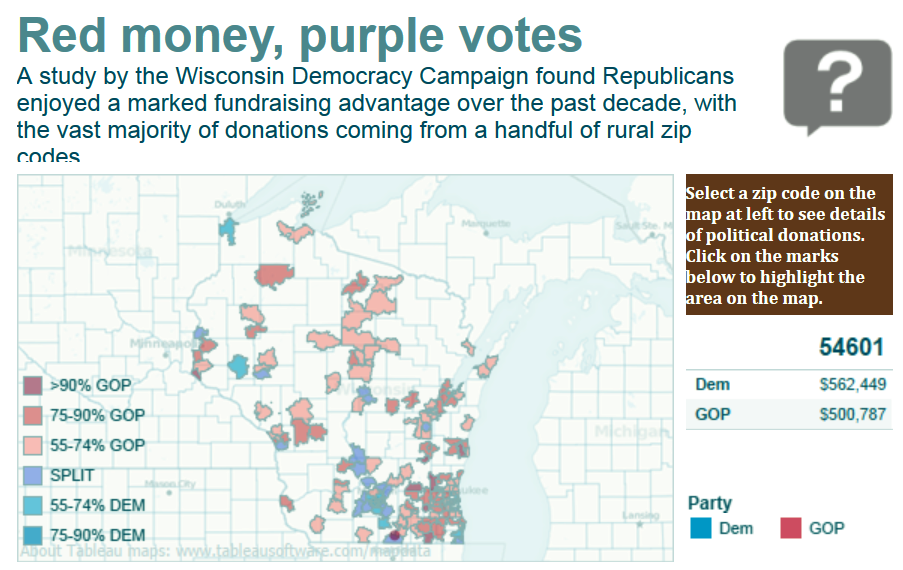
Only about 10 percent of Wis. political contributions come from rural areas, one-third of the state

Here's a study that is easy to replicate in your state as log as it has a searchable database of political contributions: In Wisconsin, nearly 90 percent of the $94.4 million in contributions of $100 or more over the past 10 years have come from five urban and suburban areas, according to a report by the nonpartisan Wisconsin Democracy Campaign.
A third of the state's population lives in the rural areas outside the five contributing areas, which are heavily dominated by Republican contributions, reports Chris Hubbuch of the LaCrosse Tribune, which produced an interactive map with the WDC data and Tableau mapping software. “Most of the money is coming from urban and suburban zip codes. That goes a long way to explaining why neither party has much of a rural agenda,” a WDC spokesperson told Hubbuch. “The bottom line is politicians are not talking about rural issues because they can’t raise money talking about rural issues.”

Hubbuch writes, "Between 2003 and 2012, Republicans raised about 60 percent of the money from Wisconsin’s largest donors, according to the report. Only 29 of the state’s zip codes — most near Madison, Milwaukee and Kenosha — were predominantly blue, while 132 were red. In La Crosse County, where Democrats have lately prevailed in balloting, the GOP out-raised Democrats — by as much as 84 percent — in four zip codes. The Wisconsin Democracy Campaign report found the GOP enjoyed a three-to-one advantage when it comes to the nearly $29 million in out-of-state donations." (Read more)

Sunday, January 12, 2014

Your local legislative election could be influenced by money and strategies of national organizations

Elections for seats in a state legislature — especially House seats, which have smaller districts than Senate seats — are often essentially local elections, based in large measure on personal knowledge of the candidates. The more that state issues and outside money become involved, the more likely the election results are to follow state and national trends. In the last few years, a flood of national money has nationalized these local elections and created more single-party control of state legislatures and governments, The New York Times reports in the first of a series of articles on one-party states.

Writer Nicholas Confessore's object examples are three states: "Alabama’s transformation was the product, in part, of a sophisticated political apparatus designed to channel political money from around the country into states where conditions were ripe for Republican takeover. In 2010, the effort achieved striking success, moving a dozen states to sole Republican control, including presidential swing states like Ohio and Pennsylvania. In 2012, a resurgent Democratic version — financed chiefly by labor unions and wealthy liberal donors rather than corporations — began to catch up, spearheading Democratic takeovers in Minnesota and Colorado. Their combined work has helped remake the nation’s political landscape. Republicans or Democrats control both the legislature and the governor’s office in 36 states, the most in 60 years." (NYT graphic; click on it to enlarge; for interactive version, click here)
Confessore acknowledges the influence of many other factors, but reports that "The strategic deployment of campaign cash has helped consultants and donors accelerate or arrest states’ natural drift toward one party or the other, defying national election trends or voter registration advantages." He quotes Republican strategist Ed Gillespie: “People who want to see policies enacted, and see things tried, are moving their activity to the states, and away from Washington. There is a sense that you can get things done.” That includes redistricting, which has probably allowed Republicans to ensure GOP control of the U.S. House through 2022.

Almost every state has legislative elections this year. If your state has a legislature where a switch in party control is more that theoretically possible, the elections in your legislative districts could be targets for outside money, strategies and tactics. Confessore's article explains in detail how that works. Read the story.

Friday, May 17, 2013

Political ads enrich TV stations, which do little political reporting and fatten themselves for sale

Atlantic Wire graphic shows advertising
buys for the past three presidential elections;
Television Bureau of Advertising chart below
shows political ad spending on local stations.
Every election season it's impossible to watch television without being bombarded with commercials from candidates or interest groups, and TV stations cash in. But a recent report finds that smaller-market stations do very little reporting on elections.

Swimming in the record-breaking revenues of the 2012 elections, smaller companies "primarily used the political windfall to clean themselves up to be acquired," Carl Salas, of Moody's Investor Services, which issued a report on the phenomenon. "The revenues from political advertising really improved companies’ balance sheets, and they’re using that to dress them up to be sold.”

And it's unlikely that the large corporations buying those small stations are any more interested in local news content than about stuffing their pockets, reports Sasha Chavkin for the Columbia Journalism Review.

Mergers and acquisitions among pure-play TV firms — those devoted entirely to television and not owned by major networks — will likely range from $3.5 billion to more than $6 billion in 2013-2014, reports Chavkin.

In 2008 the Institute for Rural Journalism and Community Issues, which publishes The Rural Blog, studied ads and news coverage about the U.S. Senate race on the TV stations in Lexington, Ky. We found that ads costing about $3 million consumed 115 hours of broadcast time on the four stations, which devoted only 3 hours and 50 minutes of air time to news coverage of the race, almost all of it superficial, usually with fewer issue details than the ads. For a report on the study, click here.

No Lexington station analyzed the ads for accuracy. The Moody's report on the 2012 elections concluded that "although many stations were producing valuable fact check segments that scrutinized the ads themselves, there was scant evidence that they were using any of the ad revenues to pay for additional political or investigative reporting," reports Chavkin.

Chavkin asked how consolidation affects the quality of local news. Advocates claim there's an increase in local programming, but detractors call that a myth, citing a new trend called shared-service agreements, where stations in the same market agree to share information, including broadcasting entire segments from other stations. In some cases, one station's newsroom does news programming for two stations. The end result, some say, is lesser quality in local news, Chavkin reports.

Thursday, October 11, 2012

Ohio Democrats allege Murray and his coal company illegally forced employees to donate to Republicans

The Ohio Democratic Party asked federal and state prosecutors Monday to investigate whether the CEO of the largest privately owned coal company in the U.S. illegally coerced employees to contribute to Mitt Romney and other Republican candidates, Jim Provance of the Toledo Blade reports. ODP Chairman Chris Redfern asked that Murray Energy Corp. and Robert Murray, left, be investigated for extortion, money laundering and racketeering.

The complaint claims Murray contributed $720,000 to Ohio candidates and millions to federal candidates through the company's political action committee, including Romney, U.S. Senate candidate Josh Mandel and Gov. John Kasich. The Blade said it could not reach Murray Energy's attorney for comment. The complaint also alleges Murray and the company forced employees to contribute to the company's political action committee through automatic payroll deductions and required attendance at fundraisers.

Murray hosted a rally for Romney on Aug. 14 at his company's Century Mine in Beallsville in southeast Ohio. Romney was surrounded by miners as he spoke. Some of those miners later told a West Virginia radio talk show host that Murray closed the mine for the day and required miners to attend the rally without pay. The company said there was no requirement. (Read more)

Wednesday, October 10, 2012

All journalists should take apart those misleading political ads; here's another tool to help you do it

By Al Cross
Institute for Rural Journalism and Community Issues

With less than a month until the hugely important Election Day for federal, state and local offices, the airwaves are being clogged with commercials from campaigns, party committees, so-called "super PACs" and other outside players, and most of them are playing fast and loose with the truth.

Pointing out lies and misrepresentations is the duty of journalists, including rural journalists. You may think that you need to stick to local coverage, but you should should remember that many if not most of your audience has no easy access to daily newspapers that pick apart the ads for federal and state office -- and that there and many sources from which to glean facts and analysis about ads that are running on your local airwaves. The voters you serve deserve the best possible information, and you are the only source for many of them to get it. Please do not forsake this responsibility.

Previously, we have noted the services FactCheck.org, Politifact.com and The Washington Post's Fact Checker column, which we have found reliable, with only very rare and minor errors. In addition to fact-checking, now there is a service that can help you track the volume and sponsors of ads: Political Ad Sleuth, a searchable database of political ad buys across the nation, as well as a crowd-sourced research tool for journalists. The site has data on where presidential, congressional and issue ads are running and who is paying for them.

The site is based on online ad files from the Federal Communications Commission, which cover the top 50 media markets, plus files uploaded by volunteers in smaller markets. If you are in such a market, you can become one of those volunteers and return the favor. Learn how you can help here.
A tutorial about political ad files and the site itself is here. To contact the nonpartisan Sunlight Foundation, which operates the site, click here.

Thursday, February 09, 2012

In new Wild West of campaign finance, interests give big; Consol Energy is one, and some are secret

A breakdown of the federal campaign-finance regulation system, topped off by a year-old Supreme Court decision that gave corporations the same rights as people, has opened the doors to large-scale funding of campaigns by interests, some of them secret, that have much to gain or lose at the hands of the government. "Some are already in trouble with the government," note Jack Gillum, Richard Lardner and Stephen Braun, reporters for The Associated Press, who recently produced some examples of contributions that might create expectations that the favors will be returned.

A prime case was the $150,000 given by Consol Energy, which is the top producer of underground-mined coal and also has natural-gas interests, to a group supporting Republican presidential candidate Mitt Romney. Consol, formerly Consolidation Coal Co., "paid a $5.5 million fine last year for violations of the Clean Water Act at six of its mines," AP notes. "It is lobbying to prohibit the federal government from regulating greenhouse gas emissions. Weeks after the company gave money to support Romney, who previously had agreed that humans are contributing to climate change, the candidate appeared to back off that position and said he would oppose spending high amounts of federal money to reduce carbon dioxide emissions, like those from coal plants."

The pro-Romney committee, Restore Our Future, "spent $8.8 million on ads in Florida alone, more than Romney's own campaign," AP reports. "A Romney campaign spokeswoman, Andrea Saul, dismissed any suggestion that wealthy donors are motivated by their private interests to fund the committee's operations." As long as the committee doesn't consult with the Romney campaign, it can accept unlimited contributions. The story deals with other candidates, in both parties. To read it, click here.

Not all the givers in the presidential race will be public. "More than a third of the advertising tied to the presidential race has been funded by nonprofit groups that will never have to reveal their donors, suggesting that a significant portion of the 2012 elections will be wrapped in a vast cloak of secrecy," Dan Eggen reports for The Washington Post. "The bulk of the secret money spent so far has come from conservative groups seeking to propel a Republican into the White House, advertising data show. . . . Crossroads GPS, a nonprofit group backed by GOP political guru Karl Rove, has spent more than $10 million on ads targeting Obama over the federal deficit, energy policies and other issues in the 2012 cycle." (Read more)