Showing posts with label obituaries. Show all posts

Wednesday, September 02, 2026

Wendell Berry, champion of natural places and agrarian life, has died at 92

Wendell Berry, Kentucky poet, novelist, essayist and farmer, died at his home in Henry County on
Monday, Aug. 31. He was a naturalist, staunchly advocating for and supporting returning land to its natural state, and encouraged an off-grid lifestyle that would do as little harm to the natural world as possible. He was also a fierce advocate for rural places. 

"Mr. Berry wrote more than 50 volumes of poetry, fiction and argument that championed small family farms, the environment, local foods and interdependent communities, and railed against chemicals, most technologies, agribusiness and distant government," reports Robert D. McFadden for The New York Times.

McFadden continues: "He never became a household name but, as his oeuvre grew over a half-century, advocates of agrarian and ecological causes embraced his work as an eloquent, if sometimes didactic, expression of their own hopes. Some critics likened his landed exhortations to those of Thoreau or Thomas Jefferson."

He studied English at the University of Kentucky, writing at Stanford and taught at New York University for two years before being called back to his Henry County, Ky., homeplace, "an old two-room cabin on the Kentucky River at Port Royal... where his ancestors had lived since 1803," McFadden writes. 

"Returning to his home as a place to write for the rest of his life was a way to insure, to himself, that he would always be bound by the truth, Mr. Berry said in a phone interview in 2018 ...," McFadden writes. "The landscape was there to check me if I was wrong. I could never go away and make up stuff at cocktail parties about the backwoods of Kentucky," Berry said during the interview. "I worked with people here in all walks of life and learned from them. It’s been a very rich experience.”

Sunday, October 08, 2023

Loyal Jones, interpreter of Appalachian culture, dies at 95

Loyal Jones
Loyal Jones, whose Kentucky pastor called him "the indefatigable and beloved interpreter of Appalachian life and culture," died Saturday morning in Black Mountain, N.C. He was 95.

The author and co-author of several books and dozens of published articles about Appalachian culture, people and humor, Jones wrote about the resiliency of mountain people and their culture and said the region should be judged by its own values—family, land, and traditionalism—rather than mainstream values of accumulation, wealth and power, said Ron Eller, former director of the Appalachian Center at the University of Kentucky.

When he received the top award from the East Kentucky Leadership Foundation in 2017, Jones said, "We have a viable culture here. We have a lot of problems, but we have a lot of people with great values."

Jones, a native of western North Carolina, held degrees from the University of North Carolina and Kentucky's Berea College, where he ran its Appalachian center in 1970-93. It is named for him. Jones "had been diagnosed with cancer, and earlier this year had decided that he didn’t wish to continue treatment," center Director Chris Green, who is editing Jones's memoirs, said on Appalnet, the list-serve for Appalachian academics, whose discipline Jones helped create. "Despite this, he kept up correspondence, worked on his memoir, and was only occasionally down with his afflictions."

The Rev. Kent Gilbert, pastor of Union Church in Berea, wrote, "He loved good dry and wry humor, music of all kinds, a lively conversation, and was a craftsman, musician, and an appreciator of the arts in every form. Truly a man of many talents! A fierce champion for those whom the world had handed a bad hand, he worked hard against the causes of poverty and injustice. If he had impatience with anything it was the too-evident arrogant hypocrisy of politicians who said much but did little to improve other’s lives."

George Brosi, another Appalachian academic who lived in the same retirement community as Jones, wrote on Appalnet, "Nobody devoted more of their life to Appalachia than Loyal Jones, and he contributed as much as anyone to Appalachian studies. He set the tone for our field with humor, grace, integrity, erudition, and wisdom."

Tuesday, August 29, 2023

Ogden Nutting, longtime head of Ogden Newspapers, dies

Ogden Nutting
G. Ogden Nutting, who watched his family newspaper chain spread from West Virginia to 17 other states, died Friday, Aug. 25, at age 87.

Nutting was the grandson of H.C. Ogden of Wheeling, who founded Ogden Newspapers in 1890. Nutting became president of the company in 1970, when it owned seven daily and two weekly newspapers in West Virginia and 19 other newspapers across the country, reports The Intelligencer, the chain's flagship. It now has more than 50 dailies and 80 weeklies, mostly in small markets, and is run by his son, CEO Robert Nutting, who also owns the Pittsburgh Pirates.

Ogden Nutting was the “last of the great publishers in the history of newspapers in West Virginia,” West Virginia Press Association Executive Director Don Smith told The Intelligencer.  “Ogden Nutting symbolized the family newspaper ownership that served as the structure of our association during the last century and ensured a free and independent press across West Virginia.”

Nutting received many awards and established a scholarship fund at West Virginia University for juniors and seniors studying print media, as well as a library endowment, multimedia studio, visiting professorship and semimar series. He was part of an effort by publisher Kevin McClatchy to keep the Pirates in Pittsburgh and build PNC Park. He "was chronicled in Ski magazine for likely skiing at more ski resorts than anyone had skied before," The Intelligencer reports.

Nutting is survived by his wife, Betty Woods “Snookie” Nutting; his brother, William C. Nutting; sons William and Robert Nutting; six grandchildren; and three great-grandchildren. "There will be no visitation or public service," The Intelligencer reports. "Those desiring to do so should make contributions to the church or charity of their choice."

Friday, July 28, 2023

Warren Wheat, who showed how and why small daily newspapers can make political endorsements, dies at 83

Warren Wheat, who helped start USA Today and ended his career as editor of a small daily newspaper that took the unusual step of endorsing candidates in almost every local election, died Sunday in Lexington, Ky. He was 83.

He retired as editor of The News-Enterprise in Elizabethtown, Ky., in 2009 after 55 years as a reporter and editor at newspapers in Kentucky, Ohio, Washington, D.C., and South Carolina. He was Columbus bureau chief for The Cincinnati Enquirer, worked in the Enquirer's and Gannett News Service's Washington bureaus, and was part of the initial team that launched USA Today in 1982, serving as deputy Washington editor and later reader editor for the editorial page. He was governance and national editor at The State in Columbia, S.C., before becoming editor in Elizabethtown in 2002.

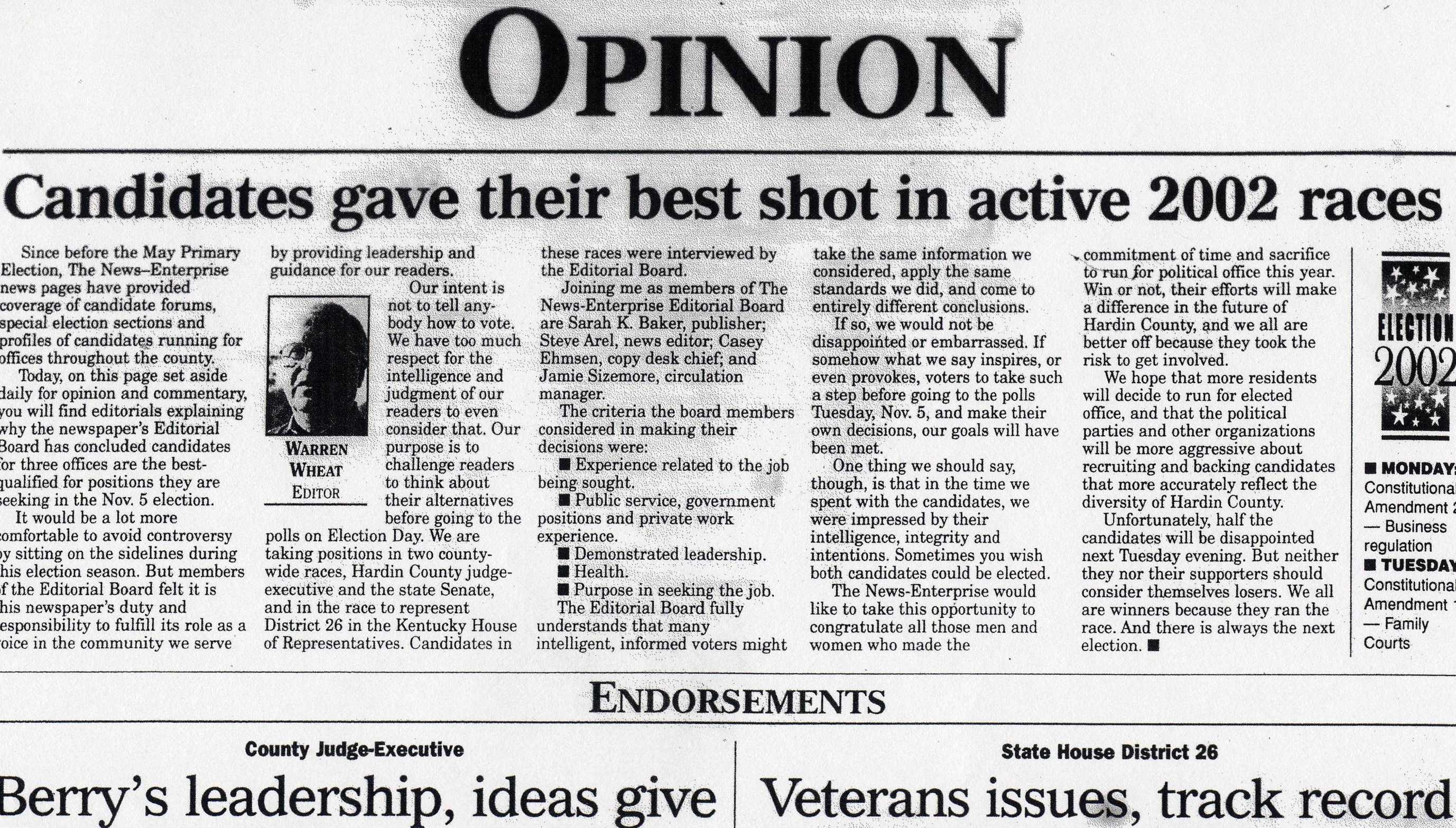
The page on which Wheat began election endorsements; click to enlarge
Soon after he arrived, Wheat concluded that the newspaper should make endorsements in local elections, because growth in Hardin County had limited citizens' personal contact with candidates and created more partisan competition. He told readers, “It would be a lot more comfortable to avoid controversy by sitting on the sidelines during this election season. But members of the editorial board felt it is this newspaper’s duty and responsibility to fulfill its role as a voice in the community we serve by providing leadership and guidance for our readers.” The News-Enterprise gradually expanded the number of races in which it made endorsements, including even those with small constituencies, such as school-board member. But as its staff shrank after he left, it was less able to do that, and finally stopped.

A brief service for Wheat will be held at 11 a.m. Saturday, July 29, at First United Methodist Church in downtown Lexington. Pictures will be on display at 10:30 a.m. The family requests that instead of flowers, donations be made to the scholarship established in Wheat's honor at the journalism school of his alma mater, the University of Kentucky, at this site, or by checks to College of Communication and Information, Attn: Director of Philanthropy, 308 Lucille Little Library, Lexington KY 40506.

Thursday, July 13, 2023

New to the trade, Jeremy Gulban has more former Gannett papers than anyone; he says success is up to communities

By Al Cross
Director and Professor, Institute for Rural Journalism and Community Issues, University of Kentucky

The owner of dozens of "ghost newspapers" bought from Gannett Co. says he is trying to revive them by returning editorial decision-making to local people while still taking advantage of the economies of scale that have led to consolidation of newspaper ownership. But he says his new chain's fate is not in its own hands.

"The success or failure of these rural newspapers is on the local people," CherryRoad Media CEO Jeremy Gulban said Friday at the National Summit on Journalism in Rural America, sponsored by the Institute for Rural Journalism and Community Issues, publisher of The Rural Blog. His remark fit the Summit's research question: "How do rural communities sustain local journalism that supports democracy?"

One example of a community sustaining rural journalism was the first paper Gulban started, the Rainy Lake Gazette in International Falls, where the paper had closed, and he reached out to the local Chamber of Commerce because he had recently bought his first paper in Grand Marais, also in northern Minnesota. "They got a whole bunch of different stakeholders in town, and we all met, and it was really kind of an amazing meeting for me, because I had never seen that kind of enthusiasm, that kind of spirit, to solve a problem," Gulban said. Three weeks later, they had a paper. "People really embraced it," he said. "We quickly got to more subscribers than, you know, the old paper had."

CherryRoad Media map, adapted by The Rural Blog
That brought the information-technology entrepreneur to the attention of the nation's biggest newspaper company, which is trying to unload small papers that add little, if anything, to its bottom line. "Gannett was looking for an organization that was strong enough technically to be able to do these migrations that would have to happen, and probably blissfully ignorant enough to take on this challenge of selling their worst papers, basically. So we took the leap." Now his company, less than three years old, has 77 papers in 17 states, more than 50 of them former Gannett papers, and many of them "ghost newspapers," he said.

Making the papers substantial and sustainable began with returning control to local people. "When we took over, the editors would say, ‘We send in a few articles, and we don't see the paper until it winds up coming to the office after it's printed.’ . . . I think the biggest thing that that happened is they eliminated all the local publishers, so there is no one ... you can call to talk about the paper. There's literally no one. Everything flows up in these vertical silos, which leads to a lack of integration, a lack of working together. And, as you all know, you can't have your salespeople off doing one thing and editorial people doing another. There's got to be that collaboration which, you know, really doesn't exist. . . . If people want to place an ad. They'll call an 800 number, and they'll go online and do it. And we all know in small towns that won't happen."

The downward spiral of news, ads and circulation has left ghost papers with two kinds of subscribers and regular single-copy buyers, Gulban said: "People who just like the ritual of getting the paper and really don't care what's in it ... and people who hold a position in town where they feel like they need to get the paper. . . . People who were truly looking for news had just given up and kind of moved on."

That caused most retail advertising to vanish, and "dependence on legal [ads] and obituaries," Gulban said. "When we looked at at these financials, the revenue from obits, legal and classified, was nearly double the display advertising in a lot of cases, you know, which is totally upside down. . . . So really, what you have is you got a ghost newspaper, right? It really has no relevance in the community. And you know that's a vicious cycle, right? The the less relevant it is. So. This is kind of the cycle that we found most of these papers to be in."

In addition to returning editorial control, "We tried to take out all of the regional or national content that was being put in there primarily as filler," Gulban said. "We still have some national content in some of the more-than-once-a-week frequencies. But anything weekly really has nothing but local content in it. We invested more in editorial positions. . . . We've actually been able to find someone in every one of those markets which has not been easy."

Jeremy Gulban
On the business side, "We've really tried to make sure we have a local ad rep in every market, with some success," he said. "That's not an easy position to hire for, particularly if you've got a tough product that you're trying to sell into. So we've had a hard time getting people. . . . Our biggest source of talent, believe it or not, is just people who used to work at the paper, and see that it's improved and want to come back." As staffs are rebuilt, Gulban said, "some people are going to step up and be leaders in this. And some people aren't. And so there's a direct correlation between the leadership ability of the local usually editor, sometimes the salesperson."

But local has its limits. Local ad and page designers are "a luxury that we can't afford," Gulban said. "And we've built our own circulation platform. That's entirely web-based so that we can have people in different locations serve circulation needs across markets." All printing is outsourced, but he said the company might build a plant because so many are closing: "We do believe that a printed product has to be part of the long-term solution" to the problems of local papers.

One way to define a ghost newspaper is that it has no local office open to the public, or is open only a few hours a week: "That just leads to no community goodwill efforts, no sponsoring events, no joining the Rotary Club, none of that," Gulban said. "That's so essential in a small-town newspaper." But not so essential that he has offices in some small markets. In Stephenville, Texas, rent was too high, so "We're trying to pioneer like a shared office, you know, with a Chamber of Commerce, maybe even a local restaurant, you know, we're open for lunch. Three days a week we go in there, the editor's there, the circulation person's there, you can go meet with them. We're trying to be as creative as possible just to keep that physical real estate cost down." The Google listing for the Stephenville Empire-Tribune says it's "temporarily closed."

Sites of two of the Texas papers discussed (Google map)
Just east of Stephenville on US 67 south of Fort Worth, the Glen Rose Reporter serves a town of 900 people with 320 print subscribers, "which was under 200 when we took over, and 108 digital subscribers, which was zero because there was no paywall," Gulban said. "This paper was absolutely horrible. It had literally nothing in it. When we took over, two really dedicated freelancers stepped up and said, 'We will make this paper be successful, and so they produce all the content between the two of them. They take it upon themselves to go around town, try to get people to advertise, try to drive additional subscribers. . . . This is so much better of a paper than it was a year ago, and the results show. And while those numbers are small, in percentage-increase terms, they're really huge. . . . Truthfully, if we didn't take this paper over, it wouldn't be there anymore, because the markets, too small for anybody to really be interested in doing anything here."

Gulban's other example was the Hamburg Reporter, in Iowa's southeast corner. Fremont County "had a catastrophic flood in 2019 and basically half the town's population left, so the population is now 890. We have 132 print subscribers and two digital, but we just put the paywall up two weeks ago," Gulban said. But its ad revenue averages $9,200 a month, and "this is the best revenue per population of anything in our whole organization." The paper's mothership is the Nebraska City News-Press, across the Missouri River; the one person "who was basically doing everything" died last month, "so we have to figure out how to handle that. But the model here still holds. . . . We have one person who is about town, knows everybody, is able to do a lot of different things," Gulban said. Our vision, which is a little bit out there, is: If you want to advertise in Hamburg, Iowa, we're the place you should be doing it through, not through Facebook, not through any other technical solution. Because we know Hamburg, Iowa. . . . We want to leverage our local staffs and their credibility to drive revenue in this new digital world."

And America's newest newspaper-chain owner had one broad thing to say about consolidation of newspaper ownership: "I believe strongly in distributed ownership of the news, because I don't think the country is founded on the idea that three or four groups or people would control all the information. The vision was thousands of individual people controlling the flow of information."

Gulban was the concluding speaker at the Summit's morning session. The video is here.

This story has been edited to give the correct genesis of Gulban's paper in International Falls.

Sunday, June 18, 2023

Man who cut a wide swath gets a frank, widely read obituary


James Loveless's obit photo
From the beginning, readers knew that the obituary of James Loveless was not the usual tribute. It read in part, "Jamie, a divorcee, father, grandfather and proud owner of a few lots in the trailer park, had had enough and up and died on us on June 14." It said he had "clogged his arteries" with fried foods, chili dogs and snack cakes, and when he had a stroke in 2015, "in the ER at the hospital, he was heard saying, 'Let's make a break for it!'"

Perhaps the most remarkable passages were: "We don't know if he was married, but he definitely was a lady's man. There was Kathy, Mary Lou, Tammy, Debra, Carrie, Tina, etc., etc.," then designating favorite and "second favorite" sons and concluding, "He will be moderately missed."

“All of those women’s names, those are all women that really happened,” Rocky Loveless told Michael Berk of Lexington's WLEX-TV. “He would’ve liked for people to talk about the fun stuff.” Berk reports, "Rocky was told by the people at the Pulaski Funeral Home that his obituary generated more page views for them than the home has ever had before."

As for the obit's closing line, anchor Marvin Bartlett of Lexington's WDKY-TV told viewers, "It's obvious by reading the sons' social media posts that they loved their dad."

James Loveless's body was cremated. A barbecue was held in his honor Saturday.

Thursday, May 25, 2023

Singer Tina Turner, native of tiny Nutbush, Tenn., dies at 83

Tina Turner was born into poverty in rural West Tennessee. She first achieved musical success with her abusive husband Ike Turner, and later became a mid-life, single-act musical icon who earned the title "Queen of Rock 'n' Roll." She died Wednesday at age 83.

Born Anna Mae Bullock in the crossroads hamlet of Nutbush, Tenn., she met St. Louis band leader Ike Turner and married him in 1962. Turner was the lead singer in the Ike & Tina Turner Revue, and the band released bold R&B tunes like "Nutbush City Limits" and famous covers like Creedence Clearwater Revival's "Proud Mary." The couple achieved notable success opening for the Rolling Stones U.S. tour in 1969 and gaining a "certified gold" album in 1974 for "What You Hear Is What You Get." Still, the relationship soured as Ike became heavily addicted to cocaine. Tina divorced Ike in 1978.

Turner in 1970 (Wikipedia photo)
If the first half of Turner's performance career was dynamic, the second half, which began in the early 1980s, was a dynamite explosion of talent and musical energy that surprised the industry and rocketed Turner to her iconic status. In 1984, she crooned, churned and blasted audiences with her album Private Dancer, which sold over 10 million, won three Grammy awards. The album included her only number one hit, "What's Love Got to Do With It," a song that personified much of the Turner's saga of struggle and triumph.

Turner became a global star also known for her acting role alongside Mel Gibson in "Mad Max Beyond the Thunderdome." In 2018, she received the Grammy Life Achievement Award. As Turner aged, she kept creating music, writing a musical, several books and collaborating with international artists. In October 2021, she was inducted into the Rock and Roll Hall of Fame. She spent her last years in Zurich, Switzerland.

Here is The New York Times' list of Turner's "11 essential songs." From across the Atlantic, The Economist sees one state: "There are very few living American singers whose work springs from a distant, lost past. Dolly Parton, a titan of country music, was born in a one-room cabin by Little Pigeon River in Tennessee. Tina Turner, born Anna Mae Bullock, grew up in Nutbush, Tennessee, where her father oversaw sharecroppers; she had childhood memories of working in the cotton fields. Before she died on May 24, she was a link to the forces that shaped the blues and country and rock’n’roll." Here's Nutbush on a Google map:

Sunday, May 14, 2023

Hodding Carter III, rural journalist, diplomatic spokesman, documentarian and journalism foundation chief, dies at 88

Hodding Carter III (2003 Associated Press photo by Susan Walsh)
Hodding Carter III, a small-town editor-publisher who became best known as the State Department's spokesman during the Iran hostage crisis, then produced award-winning documentaries and ran the nation's largest journalism foundation, died Thursday in Chapel Hill, North Carolina. He was 88 and had suffered strokes.

Carter was the son of Hodding Carter Jr., who won a 1946 Pulitzer Prize for editorials that decried racial, religious and economic intolerance. He worked at the family's Delta Democrat-Times in Greenville, Miss., for 17 years, keeping a gun in his pocket and his desk because of threats the family received for their editorial stances, and won the Sigma Delta Chi Award for editorial writing in 1961. In 1968 he headed "a racially diverse group that won a credentials fight at the 1968 Democratic National Convention in Chicago, unseating the all-white delegation by Mississippi’s governor, John Bell Williams," The Associated Press notes. He worked on the 1976 presidential campaign of Jimmy Carter (no kin), which led to his administration job. He resigned after the failed raid to rescue the hostages, following Secretary of State Cyrus Vance, who had opposed it.

The Carter family's 1980 sale of the paper to a conservative chain angered some of their liberal readers, reports Harrison Smith of The Washington Post. But Carter returned to journalism as a columnist and broadcast journalist and won four Emmy Awards for documentaries on foreign policy and civil rights. He liked to say, "Power never likes to be questioned, analyzed or covered at all critically." From 1998 to 2005, he was president of the John S. and James L. Knight Foundation, and "grew the organization’s endowment to more than $1.9 billion and more than doubled its grants to journalists and news organizations, to some $90 million annually," Smith notes.

One of Carter's last grants was $250,000 to the University of Kentucky to help start the Institute for Rural Journalism and Community Issues, which publishes The Rural Blog and is dedicated to the sustainability of rural journalism. Carter told those seeking the grant that despite his history, the foundation had never done anything for rural journalism, so he was giving them the most he could without running the plan past a foundation committee, according to Al Smith, a retired Kentucky newspaper publisher who was an editor at one of the New Orleans papers when Carter was an intern there. "He taught me how to drink martinis for lunch," Carter said of Smith, who drank himself out of jobs at both New Orleans papers but kicked alcohol in 1962 and was chairman emeritus of the institute's advistory board when he died in 2021.

Carter served two years in the Marine Corps, was a professor at the universities of Maryland and North Carolina, and wrote two books, The South Strikes Back, in 1959, and The Reagan Years, a 1988 collection of essays published from 1981 through 1987. He "held deeply the notion of service — to his country, to justice and equity and to his family — throughout his life, instilling in those he knew personally and professionally 'this incredible sense of social responsibility'," stepson Mike Derian told The News & Observer of Raleigh.

His survivors include his wife, Patricia O'Brien of Brookline, Mass.; four children from his first marriage, to Margaret Ainsworth Wolfe: Hodding Carter IV of Camden, Maine, Catherine Carter Sullivan of Jackson, Miss., Margaret Carter Joseph of Brevard, N.C., and Finn Carter of Worcester, Mass.; three stepchildren from his marriage to Patt Derian: Mike Derian of Takoma Park, Md., and Craig Derian and Brooke Derian of Chapel Hill; a brother, Philip Dutarte Carter; and 12 grandchildren. He will be buried in Greenville. Sullivan told the News & Observer that the family will hold a celebration of life in Chapel Hill at a date to be determined.

Wednesday, February 15, 2023

Jim Boone, who built a chain of newspapers, dies at 87

Jim Boone
James B. “Jim” Boone Jr., who built the ninth largest newspaper company in America, by number of newspapers (about 70), died Feb. 13 in Birmingham after a brief illness. He was 87.

Boone succeeded his father, Buford Boone, as publisher of The Tuscaloosa News in 1968 and built "a community media company that now owns or manages 91 newspapers and related print and digital products in Alabama, Georgia, Kentucky, Louisiana, Michigan, Minnesota, Mississippi, North Carolina, Ohio, Tennessee, Texas and Virginia," the Boone Newsmedia Inc. obituary said, adding that he "remained active in BNI and with its affiliate newspapers until his death."

"He worked until 5 p.m. on Friday of this past week," his youngest daughter, Vicksburg Post Publisher Catherine Boone Hadaway, told the News. "He believed in the mission of newspapers, to make the community better; to be an advocate and voice for the community."

A 1958 graduate of the University of Alabama, Boone received many honors, including the Alabama Business Hall of Fame, the Lifetime Achievement Award from the Alabama Press Association; the Casey Award from the University of Minnesota for leadership in the newspaper industry; and the Frank Mayborn Award from the Southern Newspaper Publishers Association for leadership.

“Jim Boone, by his example, set the highest bar for so many for how to lead and serve a community, civic organization, church, a business organization or his family,” said Todd Carpenter, president and CEO of Boone Newsmedia and Carpenter Newsmedia. “Put simply, he made doing the right thing the main thing and that guided his every choice and decision. He was also dedicated to recognizing talent in every person that perhaps they did not know they had, then with sincere determination he dedicated himself to guiding, leading and driving them to reach their highest potential. All who knew Jim benefitted from his benevolent interest, first in their welfare as a human being, followed by wisdom and guidance he gave generously to all that is both uncommon and special.” 

Boone is survived by his wife, Carolyn, and five children. His funeral is set for 1:30 p.m. Saturday, Feb. 18, at the Lowndesboro Methodist Church, followed by a graveside service at Oakview Cemetery in Lowndesboro and a gathering at The Marengo House, 100 N. Broad St., Lowndesboro.

Monday, February 06, 2023

Joe Edwards, a Corn Belt native who went on to chronicle country music in Nashville for The Associated Press, dies

Loretta Lynn and Joe Edwards (AP photo, undated)
Joe Edwards, who "documented the ascent of country music through interviews with stars ranging from Dolly Parton to Taylor Swift," died Friday in Nashville after a lengthy illness, reports The Associated Press, for which he worked for 42 years, retiring in 2012. He was 75.

Edwards was a product of rural America who worked his way south. Born in Crawfordsville, Indiana, in the Eastern Corn Belt, he worked in Vincennes and Cincinnati before graduating from Eastern Kentucky University and joining AP in Nashville in 1970, working most of the jobs in the bureau. But his byline soon became familiar to country-music fans, and he had superb entré into the music industry.

Edwards had influence in Tennessee. "In 1982, a story Edwards wrote about the popularity of the song 'Rocky Top' led the General Assembly to declare it a state song," AP reports. "He got the ball rolling," said Boudleaux Bryant, who wrote the song in 1967 with his wife Felice at The Gatlinburg Inn (Rocky Top is a peak in the Great Smoky Mountains National Park, not the Tennessee town that adopted its name 50 years later). It was first recorded by the Osborne Brothers, a Kentucky-born duo; a more mainstream version by Lynn Anderson in 1970 led to its adoption by the University of Tennessee band and finally to Edwards' September 1981 story, which said the song "has become as beloved in Tennessee as the immortal, but more sedate, 'Tennessee Waltz'."

Edwards "specialized in writing obituaries, including those for music stars Johnny Cash, Porter Wagoner, Roy Orbison, Bill Monroe and Carl Perkins," AP reports. "In 2010, he wrote extensively about the Nashville flooding that left much of the city submerged for several days. But he preferred reporting about more light-hearted topics, such as the taster at the Jack Daniel’s distillery in Lynchburg, Tennessee."

UPDATE, Feb. 7: Former AP Tennessee staffer Beth Miller tells Connecting, the newsletter for AP retirees and friends: "I cannot even begin to stress how huge of a force Joe Edwards was for the AP both in Tennessee and afar, even in his always unassuming demeanor. He was a masterful interviewer, and he could tell a story like none other (and boy, did he have the stories!)"

Monday, January 30, 2023

Former CEO of one of largest employee-owned corporations in U.S. dies at 81; business started with one rural grocery

Jimmie Gipson
Jimmie Gipson, who helped transform Kentucky's Houchens Industries from a rural grocery chain into a $3-billion-dollar conglomerate that is one of the largest employee-owned companies in the nation, died Saturday in Bowling Green. He was 81.

Gipson "spent 55 years with Houchens, the last 27 as the chief executive officer. He retired in March 2020, the Bowling Green Daily News reports. He was only the third CEO, following the nephew of the founder: "Ervin Houchens started the company in 1917 with a single grocery store."

Houchens offered stock to its employees long ago, when it was just a grocery chain, and since 1988 they have fully owned it. The company "owns over 25 operating companies in various industries including retail, manufacturing, construction, and insurance," its website says. Its most unusual purchase may have been in 2008, when it acquired the Louisville-based Hilliard Lyons brokerage firm and shared ownership with its employees until 2019.

“We never bought a company just to get bigger, and we never intended to buy a company that wasn’t run by good people,” Gipson told the Daily News in 2020. “If you do that, you’ll generally do well.” He called employee ownership “very gratifying. Years ago, we had a lady who worked in a Houchens store for 40 years. She had more than $480,000 in her retirement account. That’s life-changing for common people.”

Visitation for Gipson will be from 2 p.m. to 8 p.m. Wednesday at J.C. Kirby & Sons Lovers Lane Chapel, and from 10 a.m. to noon Thursday at Hillvue Heights Church, where the funeral will begin at noon. Entombment will follow at Bowling Green Gardens.

Wednesday, November 30, 2022

David Sawyer, who built an international consulting career on his work in rural Kentucky and Appalachia, dies at 71

David Hartwell Sawyer (Photo via Legacy.com)
David Sawyer, who built an international consulting career on his work in rural Kentucky and Appalachia, died Nov. 25 in of heart failure in Portland, Oregon, after a year of declining health. He was 71.

Sawyer was president of Context, a consultancy on strategy, leadership and culture, and a cofounder of Converge, a network of consultants who help form social-impact networks. He worked in many fields, including sustainable agriculture, education reform, national service, social entrepreneurship, venture philanthropy, the emerging green economy, and multisector collaboration.

For a decade, Sawyer directed leadership and service-learning programs at Berea College in Kentucky, earning him the nation's highest award for voluntary service from the White House. He designed Save the Children's Appalachian Teen Leadership Program and traveled to India to meet with the Dalai Lama to help design a Tibetan refugee education program at Berea. He worked with the Clinton administration to help launch Americorps and facilitated The New Generation Training Program and other national leadership programs.

Sawyer spent four years working with BP, coaching senior leaders, designing the cultural dimension of the BP-ARCO merger, and facilitating a conference on global climate change in Washington, D.C. He was executive-in-residence for the Kauffman Foundation, promoting citizen engagement and civic innovation; first executive director of Social Venture Partners Portland, and was chief culture officer for gDiapers, maker of the world's first flushable and compostable diaper.

"Though Sawyer's professional accomplishments are vast, his lasting impact lives in his deep love for his people, his community, and our planet," his obituary says. "Sawyer was a dedicated and generous friend to many. He was clever and wise, fun and funny, deeply serious, and eternally committed to creating positive futures for all. His life's work could perhaps be summed up by a simple tattoo on his arm that read: 'maximum positive impact'."

Sawyer, whom his Kentucky family called "Buzz," is survived by his brother, religious artist Stephen Shelby Sawyer of Versailles, Ky. Their cousins include Diane Sawyer of ABC News.

UPDATE, Dec. 4: A memorial service will be held at 2:30 p.m. Saturday, Dec. 17, at Union Church in Berea. Live streaming will be available and a reception will follow; details to come. Organizer Peter Hille writes, "In lieu of flowers we request that you consider making a contribution in David's honor to an organization of your choice. Or, if you prefer, send flowers to someone you love."

Tuesday, October 04, 2022

Loretta Lynn, a coal miner's daughter who spoke strongly for women, dies after a music career that lasted 64 years

UPDATE, Oct. 5: "She was a theme on which other artists did variations," David Von Drehle of The Washington Post writes in perhaps the best tribute to Lynn that we at The Rural Blog have read. "Life threw everything it could scrape up at Loretta Lynn, and for 90 years she used it all to be bigger and stronger and more magnificent."

Loretta Lynn in 2000 (Photo by Christopher Berkey, Associated Press)
When a headline in The New York Times calls you a "symbol of rural resilience," you were more than a singer, songwriter and a coal miner's daughter. That was Loretta Lynn, died in her sleep Tuesday at her home in Hurricane Mills, Tenn., her family told The Associated Press. She was 90 years old.

"Her powerful voice, playful lyrics and topical songs were a model for generations of country singers and songwriters. So was her life story," says the Times' subhead, under which Bill Friskics-Warren writes: "Lynn built her stardom not only on her music, but also on her image as a symbol of rural pride and determination. . . . She became a wife at 15, a mother at 16 and a grandmother in her early 30s, married to a womanizing sometime bootlegger who managed her to stardom."

Lynn began her career in 1958. Songs like "Coal Miner's Daughter" reflected her pride in her rural Kentucky upbringing and "she crafted a persona of a defiantly tough woman, a contrast to the stereotypical image of most female country singers," writes AP's Kristin Hall. "She was the first woman ever named entertainer of the year at the genre’s two major awards shows, first by the Country Music Association in 1972 and then by the Academy of Country Music three years later.

“It was what I wanted to hear and what I knew other women wanted to hear, too,” Lynn told the AP in 2016. “I didn’t write for the men; I wrote for us women. And the men loved it, too.” Walter Tunis of the Lexington Herald-Leader writes, "The pride of Butcher Hollow redefined forever the role, and especially the power, of women in all corners of the entertainment industry."

Friskics-Warren writes, "Her songwriting made her a model for generations of country songwriters. Her music was rooted in the verities of honky-tonk country and the Appalachian songs she had grown up singing, and her lyrics were lean and direct, with nuggets of wordplay: 'She’s got everything it takes/to take everything you’ve got,” she sang in 'Everything It Takes,' one of her many songs about cheating, released in 2016."

The Academy of Country Music named Lynn the artist of the decade for the 1970s and she was elected to the Country Music Hall of Fame in 1988. Oliver "Doolittle" Lynn, her husband of nearly 50 years, died in 1996. They had six children, 17 grandchildren and four step-grandchildren.

Friday, June 17, 2022

Quick hits: Rural entrepreneurs well-placed to be climate leaders; Kansas faces dire foster-parent shortage

Here's a roundup of stories with rural resonance; if you do or see similar work that should be shared on The Rural Blog, email us at heather.chapman@uky.edu.

Much of rural Kansas has so few foster parents that the loss of just one can leave a huge hole in a county, reports Kansas City's KCUR.

How to prepare for, and react to, storms that knock out your electricity, from The Daily Yonder.

The last line of the paid obituary for a man who was a major paper-company executive in Idaho reads: "The best tribute you can give to Lee [Gill] is to pick up a piece of trash." His funeral is today.

The Guardian digs up a 1977 climate memo to Jimmy Carter "that should have changed the world."

Through simple measures, rural entrepreneurs can become climate leaders, says the Nebraska-based Center for Rural Affairs. Read more here.

Thursday, February 03, 2022

When should vaccination status of Covid-19 victims be reported? Consider relevance, context; show compassion

Before seatbelt laws were the standard, many reporters used to disclose whether a person who died in a car wreck had been wearing a seatbelt. Not out of a desire to shame the victims, as many families felt, but because it was relevant. Today the same debate rages about whether to disclose the vaccination status of someone who died from Covid-19. "In addition to family members being offended at perceived shaming and blaming, citizen vigilantes are now harassing the relatives of unvaccinated Covid-19 victims. That is forcing standards editors in newsrooms around the country to think through when and how to reveal that particular detail," Kelly McBride reports for Poynter.

McBride surveyed a few standards editors this week on the issue. None had come up with a formal guideline, but all were aware of the issue. "In general, journalists are leaning on the value of relevance as they decide whether to include vaccination status. It’s also helpful to think about like cases around public-health matters that might be relevant when reporting on a death," McBride reports.

"Clearly, the public is interested in the vaccination status of those who have died of Covid-19 because they seek to answer both noble and not-so-noble questions," McBride reports. "Given that journalists have no control over which mindset consumers carry as they approach a story about a person who had died of Covid-19, the best tool storytellers have is context."

She suggests several considerations in deciding whether or not to disclose, including the person's local prominence, the availability of data to illustrate a trend, and compassion. 

Monday, December 27, 2021

J.D. Crowe dead at 84; 'none finer on the five-string banjo'

J.D. Crowe, right, accepted an honorary degree from University of Kentucky
President Eli Capilouto in 2012. Faculty Trustee Robert Grossman is at left.
J.D. Crowe, a maestro of the banjo and bluegrass music, died Saturday at 84.

"His place in the pantheon of banjo players is certain," John Lawless writes for Bluegrass Today, which says there was "none finer on the five-string banjo."

"Among those who followed the example of Earl Scruggs, Crowe was perhaps the first to rise as a disciple of the new style who not only made it his own, but did so with a precision and power that set him apart from the herd," Lawless writes. "No one ever played bluegrass banjo more passionately, more inventively, or more interestingly than he did. Two generations of pickers have studied his playing, and even those who are taking the three-finger style in new directions, like Béla Fleck, Tony Trischka, and Noam Pikelny, will readily acknowledge Crowe as a major influence and an unmistakable stylist in his own right. If Earl Scruggs was a machine, J.D. Crowe was a carnival ride. His playing was fun, lighthearted, and even frivolous at times, all coming from his own distinct personality."

After playing with Jimmy Martin & The Sunny Mountain Boys, Crowe formed the Kentucky Mountain Boys, which had on mandolin and vocals Doyle Lawson, another member of the Bluegrass Music Hall of Fame. They became J.D. Crowe and The New South, and in 1975 their album The New South "changed the sound of the music forever," Lawless writes, noting that the record was better known by its number, Rounder 0044. "With Tony Rice on guitar and lead vocal, Ricky Skaggs on mandolin and tenor vocal, Crowe on banjo and baritone vocal, Bobby Slone on bass, and Jerry Douglas on reso-guitar, 0044 announced to the world that a new generation of bluegrass music had arrived, with an aggressive, take-no-prisoners sound. . . . The combination of Rice’s Clarence White-inspired rhythm guitar with Crowe’s driving and dynamic banjo defined a novel sound that remains with us today." 

“That particular record from 1975 was what really gave me a passion for wanting to play music,” Allison Krauss says in "A Kentucky Treasure: The J.D. Crowe Story," the 2008 documentary by Russ Farmer. Krauss, Crowe and Rice were later in the Rounder All-Stars Bluegrass Band.

Lawless says Crowe rivaled bluegrass founder Bill Monroe "with the number of stellar artists he brought to prominence as members of The New South. Not long after the departure of Tony Rice and Ricky Skaggs, Crowe brought in Keith Whitley on guitar, and Gene Johnson on mandolin, both of whom saw huge success in country music in a few years’ time. Other noted grassers who worked for J.D. would include Don Rigsby, Phil Leadbetter, Rickey Wasson, Richard Bennett, and Ron Stewart." Crowe's aptly named "Fireball" won the 1983 Grammy for country instrumental.

Crowe's funeral will be held at 1 p.m. Thursday at Jessamine Christian Church in Nicholasville, Ky., near his native Lexington, with visitation there from 4 to 8 p.m. Wednesday.

Thursday, December 16, 2021

bell hooks, a Kentucky native and rural advocate, dies at 69

bell hooks (Washington Post photo by Margaret Thomas)
bell hooks, a rural Kentucky native whose writings on race, feminism, and the environment brought her international acclaim, died Dec. 15 at her home in Berea, Linda Blackford reports for the Lexington Herald-Leader.

hooks, 69, was born Gloria Jean Watkins in Hopkinsville and attended segregated schools in Christian County as a child. She took her great-grandmother Bell Blair Hooks' name as a pen name, using lower-case letters to emphasize the importance of the writing over the author. After graduating from Stanford University, she went on to earn a master's degree in English at the University of Wisconsin and a Ph.D. in literature from the University of California at Santa Cruz. In 2004 she began teaching at Berea College in Kentucky, and in 2010 the school opened the bell hooks Institute, attracting visitors such as Gloria Steinem and Emma Watson.

Though hooks is best-known for her intersectional treatment of race and feminism, she was also a steadfast rural advocate and questioned why academics and activists discounted her voice when she spoke up for her home. In her essay "Connecting Appalachia to the World," she wrote: "As a Black woman writing about Appalachia, I receive little notice. I can talk race, gender, class, and be heard, but when I speak on environmental issues and all the ways agrarian Black folks hold the earth sacred few listen. As a voice for Appalachia, Wendell Berry is heard. Suddenly, I listened to his words and learned. Fervently, he teaches me. But like a mighty giant, a goliath, as a Kentucky Black female writer I stand always in his shadows. I am not considered a companion voice." (Berry is not from Appalachia but has been a voice for it.)

Her writing frequently addressed the intersection of rurality, race, and gender, especially in her 2009 book "Belonging: A Culture of Place," where she noted that mainstream urban Americans often dehumanized rural Kentuckians and saw their Appalachian subculture as a threat, "creating the notion that folks who inhabited these spaces were ignorant, stupid, inbred, ungovernable. By dehumanizing the hillbilly, the anarchist spirit which empowered poor folks to choose a lifestyle different from that of the state and so called civilized society could be crushed."

Though hooks' death is mourned the world over, Kentucky writer Silas House perhaps said it best: "bell hooks was one of the most interesting, remarkable, and complicated people I've ever known. . . .  I will miss her, and the world is less fierce without her."

Saturday, August 28, 2021

The latest American dead in Afghanistan reflect small towns' ties to the military and the diversity of the United States

The Pentagon has released the names, ranks, ages and hometowns of the 13 service members killed by the suicide bomber in Afghanistan. The list reflects the disproportionate share of U.S. service members that come from small towns and rural areas, and also the geographic and cultural diversity of our huge country. In the order listed by The Washington Post, which has brief profiles of each one, the heroes are:
  • Marine Corps Lance Cpl. Rylee McCollum, 20, of Jackson, Wyo., population 11,000, a resort town next to Grand Teton National Park. He was a newlywed expecting a baby next month.
  • Marine Corps Lance Cpl. Jared Schmitz, 20, of Wentzville, Mo., a St. Louis suburb in St. Charles County.
  • Marine Corps Lance Cpl. David Espinoza, 20, of Rio Bravo, Texas, pop. 4,800, on the Rio Grande, which folks on the other side of the river call Rio Bravo del Norte.
  • Navy Hospital Corpsman Max Soviak, 22, of Berlin Heights, Ohio, a village near Lake Erie with an estimated population of 636 in 2019.
  • Marine Corps Cpl. Hunter Lopez, 22, of Indio, Calif., a date-growing city of 80,000 in the Sonoran Desert and home of the Coachella Valley Music and Arts Festival.
  • Marine Corps Lance Cpl. Kareem Nikoui, 20, of Norco, Calif., in Riverside County. The town of 27,000 requires buildings to "reflect a desired Western theme," including qualities "described as rural, informal, traditional, rustic, low-profile and equestrian oriented."
  • Marine Corps Staff Sgt. Darin Taylor Hoover, 31, of Utah. The Pentagon listed no town, but his Facebook page says he attended high school in Midvale, a near suburb of Salt Lake City.
  • Marine Corps Cpl. Daegan William-Tyeler Page, 23, of Omaha, at 475,000 by far the largest hometown on the list.
  • Army Staff Sgt. Ryan Knauss, 23, of Corryton, Tenn., a Knoxville suburb, also the hometown of several country musicians, including Kenny Chesney. In second grade, he wrote in his yearbook, “I want to be a Marine,” the Post reports.
  • Marine Corps Sgt. Johanny Rosario, 25, of Lawrence, Mass., a Boston suburb of 80,000 that was one of America's first manufacturing centers. She was of Dominican heritage.
  • Marine Corps Cpl. Humberto Sanchez, 22, of Logansport, Ind., a town of 18,000 in the north-central part of the state that is a suburb of Kokomo, pop. 58,000.
  • Marine Corps Sgt. Nicole Gee, 23, of Roseville, Calif., pop. 141,000 and the largest town in Placer County, which extends across the Sierra Nevada to the state line.
  • Marine Corps Lance Cpl. Dylan R. Merola, 20, of Rancho Cucamonga, Calif., pop. 180,000. The second word of its name is a Native American term meaning "sandy place." Many young Americans have died in sandy places in the last 20 years.

Friday, March 19, 2021

Al Smith was exemplar, advocate for rural journalism

By Al Cross
Director and Professor, Institute for Rural Journalism and Community Issues, University of Kentucky

If you're a regular reader of The Rural Blog, you understand the sort of rural journalism exemplified by Al Smith, who died Friday, March 19.

It's rural journalism that keeps public service at top of mind, providing insight and leadership to the community, and going beyond the county line to help the audience understand state, regional and national issues and actors that affect their communities.

Al Smith accepts the first Al Smith Award
Award from IRJCI Director Al Cross in 2011.
That's the sort of journalism Al Smith and I practiced when I worked for him. I learned how to write about controversial people in a way that you could hold your journalistic head high and still look them in the eye and exchange a greeting the next day. That was the basis for what I teach students today, that the key to real success in community journalism is managing the ever-present conflict between your professional obligations and your personal comfort. It's not for everybody, but Al Smith knew how to do it, and even make it fun.

His newspapers campaigned for better schools, which didn't sit well with farmers who didn't want higher taxes. When one who was upset with Al's crusading walked into his office one day and started giving him a lecture, Al turned to his typewriter, recorded the visitor's thoughts, whipped out the paper, handed it to the farmer and said something like this: "You just wrote a letter to the editor. Sign it and we'll put in in the paper." He loved the clash of ideas.

He had a preternatural curiosity that was more than a journalist’s quest for a story, or knowledge of how things worked; it was a human curiosity that reflected true care about humanity and its condition, and it brought him a wide circle of friends. One called him “a collector of humans.” 

Several years ago he reflected on his approach as small-town editor and publisher: "Because I have a certain combativeness about social issues, it didn’t take me long to decide that part of my job was to conduct the paper with an urgency rooted in a conviction that if we didn’t build more jobs, there would be grass in the streets instead of people on sidewalks. I became a total resource person, devoted to all kinds of proposals for bettering the community—all of them, I liked to think, of a progressive nature."

When I started working for Al, he was president of the Kentucky Press Association, which was halfway through a campaign to give Kentucky some of the nation's best open-meetings and open-records laws. He went on to be Kentucky's greatest public citizen, leading, guiding and supporting a wide range of causes, and left a national legacy with the Institute for Rural Journalism and Community Issues. He liked to say that "It has a long name because it's the caboose that drives the train: the issues."

Always remembering Al's example, the Institute stands for the proposition that rural Americans deserve good journalism as much as urban Americans. I would like to think that his example, and the Institute, have raised the bar for rural journalism in Kentucky and the nation.

Al was chairman emeritus of the Institute advisory board, now co-chaired by community journalist Jennifer P. Brown of Hopkinsville, Ky., and retired daily newspaper executive Nancy Green.

Nancy wrote: "Al Smith was a first-rate journalist, publisher, mentor, coach, friend, lover of his adopted state of Kentucky. The Institute for Rural Journalism and Community Issues encouraged and established recognition programs for smaller community editors doing good work, not just in Kentucky but around the nation. So many small newspaper publishers like Al successfully address serious issues with limited resources. Al believed in recognizing these successes.  . . . Thanks to Al's tenacious attention to the good work of rural journalists, we are able to have a better picture of what is happening in rural America."

Jennifer wrote, "More than anyone I know, Al Smith made it possible for rural journalists to see the merit and meaning of their work. He set an example to pursue stories about people and issues in small towns with the same purpose and drive as a reporter working for a metropolitan paper. Al treated rural communities as places worthy of our best efforts in storytelling and watchdog reporting. More than ever, I think we need his example to strengthen rural newsrooms and the communities they cover. Knowing Al made me a better journalist. I was fortunate to know him and to have his support."

We welcome other recollections and tributes to Al Smith, to be added to this post. Click the Comment pencil at the bottom of this post, or send an email to al.cross@uky.edu. Here's a start:

Steve Beshear, Democratic governor of Kentucky from 2007 to 2015, told the Lexington Herald-Leader that most people considered Smith an icon in journalism, “but he also actively worked to make life better for Kentuckians.”

Senate Republican Leader Mitch McConnell said in a press release, "Al Smith was the gold standard of community journalism in the Bluegrass. On radio, on television and in print, he covered everyone from Kentucky’s most famous to those who wouldn’t be known outside their small town. In short, Al told our story. . . In writing about his human vulnerability, he became an inspiration for his readers to face their own. It’s my hope others will follow Al’s path of integrity and professional excellence."

The first quote in the Louisville Courier Journal's obituary was from a foreword to one of Al's books, buy O. Leonard Press, founding director of Kentucky Educational Television: "The essence of Al Smith is that he was born to be a public figure, in print and in person. And in one way or another, he always has been."

KET Public Affairs Managing Producer Renee Shaw, who co-produced "Comment on Kentucky" with Smith for 11 years, told the Herald-Leader that Smith was “my personal hero who saw my potential, nurtured it, and at times challenged it, convincing me to bloom where I was planted. Often a stem-winder orator, Al, to me, was gentle in his mentoring pep talks and believed more for me than I could see. . . . I, and others, will cling to memories of his feisty spirit, fervent intellectual curiosity and deep passion to connect our experiences and elevate rural communities.”

Retired Kentucky journalist Art Jester wrote, "It can’t be overstated that Martha Helen was crucial in Al’s getting his life back together from his worst days as an alcoholic, and was truly his partner in everything, most notably running their newspapers. I have always thought that Martha Helen stayed anchored —cheerfully and skillfully so — thus enabling Al to sail around to his many interests, meetings, interviews, and obligations, not to mention his endless, long telephone conversations. (I was just one of many who benefitted from his unselfish chats and advice.) In short, Al could not have become the man that he was without Martha Helen’s love, support and partnership in everything they did. Al had the talent and drive, but Martha Helen’s steadfastness made his greatest accomplishments possible. They were an incredible team."

Former Paducah Sun political writer Bill Bartleman wrote, "Al Smith truly understood the role and importance of community journalism. He overcame challenges in his life to be one of Kentucky’s most influential leaders who never held public office. He worked tirelessly to improve education at all levels, to demand accountability of elected officials and demand that reporters work diligently to be aggressive and honest in their work and maintain the highest level of integrity. As moderator of “Comment on Kentucky,” he did more to influence a positive state agenda than any person or group. He used his show to inform Kentuckians from Paducah to Pikeville of state news and called on journalists from throughout the state to give perspectives on major events. Even though he was friends with presidents, senators, congressmen, governors and the rich and famous, he never forgot his rural roots and days in poverty. I, like many others, was a better journalist and a better Kentuckian because I knew Al Smith."

Alice Brown, former president of the Appalachian College Association, was one of many people outside journalism but in other forms of public service whom Al helped: "Al called me "a beggar for beggars." He sent me to DC to beg at the Appalachian Regional Commission. After the Appalachian College Program became an independent association, Al guided me in the area of personnel development; as I hired new employees for that new office, Al reminded me about the importance of hiring people familiar with the culture of Appalachia and about the importance of giving them a lot of praise to soften whatever negative criticism I might need to share with them. . . . Like a guardian angel, he seemed to appear at many right moments in my life. And he always came with subtle suggestions about where I might find funding to support my work or how I might better communicate the mission of that association. While I remember only a few of the specific actions Al took on my behalf, I will never forget his spirit intent on helping all those with whom he came into contact. And I will always be grateful that I was one of those with whom he came into contact.'

Mark Neikirk, former managing editor of The Kentucky Post, wrote that Smith was "Kentucky's poet laureate of public policy. By his marshaling words, whether in print or broadcast, he guided his adopted state toward a better Commonwealth."

David Thurmond writes, "One of the first people to befriend Al Smith when he moved to Russellville in 1958 was my dad, Hal Thurmond Sr., who grew up in Russellville and had set himself up in a pretty successful business in Hopkinsville, two counties to the west. They found themselves to be kindred spirits. Both were die-hard, gregarious liberals swimming in a sea of Southern Kentucky conservatism. . . . My dad had great admiration for Al, for kicking the bottle and for his open expression of liberal thought in his newspaper. The admiration was mutual, as Al couldn't believe how a businessman could be so successful while aggressively pushing a Western Kentucky civil-rights agenda from Hopkinsville. They say one measure of a truly great man is honest humility. So in the summer of 1968, I find myself the subject of an unsolicited public apology from this man that I so looked up to.  As the war in Vietnam was raging, I had asked him for his help when, as the newly self-appointed, 18-year-old chairman of the Christian County Citizens for McCarthy, I privately reached out to him for advice and support. He very politely, being the gentleman he was, brushed me off. Then, a week or so later, he published an apology for it in The Logan Leader, came out in favor of Senator McCarthy, and against the war in Vietnam, all at once! Needless to say, we became fast friends, and I followed him to this very day. Common sense, high intelligence,  compassion, remarkable leadership, an easy, "front porch" way of conversing,  and  remarkable journalistic  skill are some of the qualities by which I will remember him. Al Smith embodied what is truly the best of Kentucky.

By Keith Runyon
Retired opinion editor, The Courier-Journal (posted Nov. 11, 2021)

When I was a young journalist in the early 1970s, Barry Bingham Sr. often said that three things hold the Commonwealth of Kentucky together: the governor, University of Kentucky basketball, and The Courier-Journal. Before much longer, there was a fourth – Kentucky Educational Television, and most of all, its foremost newsman, Al Smith.

The influence of The Courier-Journal would, before Al died earlier this year, wane, but KET’s role became even more important. “Comment on Kentucky,” which Al and Len Press created in November 1974, has become the glue of commentary that manages to meld all 120 counties. Or at least it tries to. And under the remarkable leadership of Ginny Fox and then Shae Hopkins, it has matured, expanded and now become must-viewing for us all.

My friendship with Al and Martha Helen began a few months before “Comment” made its debut. We were part of a weekend hiking trip to the Red River Gorge, a few days after the Great April 3 Tornado, along with a band of now legendary Courier-Journal staffers including Carol Sutton and Charles Whaley, John Finley and Linda Stahl, Chris Doughty Johnson, and Jean Howerton.

During the day we hiked in the woods, but at night we ate lasagna, sat by a roaring fire in a cabin at Natural Bridge State Park. Sang. Played Pictionary. Charades. And drank way too much. All of us but Al. His personal victory over alcohol was an inspiration, one that I, a 23-year-old guy, dazzled with all of this energy and fun and talent, couldn’t comprehend.

Al was liberal.
Al was literate.
Al was loving.Al was loaded with righteous indignation.
Al made life real, and honest, and it is still hard for me to turn on Comment without expecting to see him there…and once in a while, me with him. Reading from that damned teleprompter…Al, never Keith!

More comments appear in the Comment section of this post.

Saturday, December 12, 2020

Charley Pride, country music's first major Black star and writer of a song about a weekly newspaper, dies of Covid-19

Charley Pride in 2008 (Rogelio D. Solis, AP)
One of the greatest voices in country music is silent. Charley Pride, its first major Black star, died Saturday in Dallas of complications from Covid-19. He was 86.

Pride's talent was husbanded by early stars of modern country music. Red Sovine "was struck by Mr. Pride’s magnetism and the enthusiastic response he evoked from the White audience," reports Terence McArdle of The Washington Post. "He suggested that Mr. Pride take his chances in Nashville," where racism stood in his way. "Country guitarist Chet Atkins, who was also an RCA Records executive, saw promise in the singer. Radio stations received his first singles, credited to Country Charley Pride, without publicity photos, a cautious move by Atkins. Disc jockeys latched onto the records, and country fans listened" to his deep baritone. At one point, he was RCA's top-selling country artist.

He had 30 No. 1 hits, including “Kiss An Angel Good Mornin’,” “Is Anybody Goin’ to San Antone” and “Mountain of Love.” He was the Country Music Association’s entertainer of the year in 1971, and its top male vocalist that year and the next. The CMA gave him a lifetime achievement award in 2020, after he was featured in the Ken Burns documentary series, "Country Music." He "shattered a show-business barrier, paving the way for subsequent black entertainers — Stoney Edwards, Big Al Downing and Darius Rucker, among them," McArdle notes.

Pride was born March 18, 1934, in Sledge, Miss., one of 11 children. He wrote many songs about his native area, two of particular interest to rural journalists: "Hickory Hollow Times and County News," recorded in 2011, about "our tiny hometown paper" sent to him by a childhood friend who'd married one of Pride's former girlfriends; and "Guntersville Gazette," a Richie McDonald song on the same album, with a similar line. The refrain to "Hickory Hollow Times and County News" goes:
Got the farm report, the high school sports
Fishing news and bowling scores
The weather and the ladies' gossip too
Who's left town and who's come home
Who's been born and who's passed on
Who's divorced and who's married who
In the Hickory Hollow Times and County News.