Showing posts with label sheep. Show all posts

Tuesday, September 23, 2025

New World screwworm detected roughly 70 miles from the Texas border as USDA efforts intensify

New World screwworm was found roughly 70 
miles from Laredo, Texas. (USDA photo)
 
The New World screwworm and its flesh-eating larvae have made their way through Mexico to hover fewer than 70 miles from the U.S.-Mexico border. "The case was reported near Sabinas Hidalgo in Nuevo Leon," reports Joshua Baethge of Farm Progress. "That city is close to a major highway connecting Monterrey, Mexico’s second-largest metro area, and Laredo, Texas."

Screwworm larvae were discovered in "an 8-month-old cow that was moved to the area from southern Mexico, which has active NWS cases," Baethge writes. Concerned lawmakers and livestock owners would like Agriculture Secretary Brooke Rollins to persuade the Mexican government to restrict cattle movement to contain the pest.

While NWS larvae will eat the flesh of any warm-blooded animal, female screwworm flies most often lay their eggs in the open wounds or scratches of sheep or cattle. The larvae are considered a threat to U.S. livestock and rancher economies as well as the U.S. food supply.

Rollins said "protecting the U.S. from New World screwworm is a 'national security priority," Baethge reports. Rollins added that "U.S. farmers and ranchers should know that the U.S. 'will not rely on Mexico' to defend the cattle industry, the food industry or 'our way of life.'"

State of Nuevo León within Mexico
(Wikipedia map)
The USDA and Mexican authorities have been working together to push the NWS away from both countries' livestock herds through sterile fly releases, animal surveillance and fly trapping and testing work. 

Since July, the USDA and Mexico "have been monitoring almost 8,000 traps across Texas, Arizona, and New Mexico," reports Jennifer Carrico of Progressive Farmer. "Currently, all the 13,000-plus screening samples have detected no NWS flies."

While the latest detection in Nuevo Leon, Mexico, appears to be limited to one cow, the USDA is still investigating. "Rollins said the U.S will be 'taking no chances,'" Baethge reports.

Tuesday, April 09, 2024

Flora & Fauna: A new flower in town; traveling worms; ants go for global domination; what's in a single drop of water?

Firefly Petunia flowers emit light.
(Light Bio photo via Lancaster Farming)
With spring and summer come abundant flowers and plants, but in the botanical world, there's a new flower in town -- a bloom that will delight and surprise. "It's called the Firefly Petunia, the first commercially available bioluminescent plant," reports Therese Ciesinski of Lancaster Farming. "The scientists at Light Bio, Inc., a biotechnology firm in Sun Valley, Idaho, created it by genetically modifying herbaceous plants using genes from bioluminescent mushrooms. . . .These flowers don't reflect the light. The leaves and flowers of this plant have been bred to emit the light."

As a parody of the 1970s sci-fi craze, The Muppet Show put its own space crew, "Swinetrek," into orbit in its famous comedy sketch, "Pigs in Space!" While no pigs have been sent into space yet, aeronautic companies are testing ways to put an equally unusual animal into orbit -- earthworms. "With several national space agencies hoping to establish permanent bases on the moon, humans may find themselves sharing the lunar surface with some unexpected fellow explorers: worms," reports Adam Kovac of Ambrook Research. "Many species of worms can break organic waste into vital nutrients. . . . The critters have proven in the past to be resilient to the stresses of space travel."
Symplocarpus foetidus or skunk cabbage
can melt snow. (Wikipedia photo)

As spring emerges early this year, nature's wonders bloom in glory and subtle delight. For wary nature lovers, the Earth's warming trend can remind them of how vulnerable life is. From thawing frogs to self-heating and somewhat stinking skunk cabbages, writer Daryln Brewer Hoffstot of The New York Times looks at spring and wonders how much of nature is in danger of disappearing.

Humans aren't the only species seeking global domination. Ants are right there with us. "Global ant societies are not simply echoes of human struggles for power. They are something new in the world, existing at a scale we can measure but struggle to grasp: there are roughly 200,000 times more ants on our planet than the 100bn stars in the Milky Way," reports John Whitfield of The Guardian. "Ants form what the ecologist Mark Moffett calls 'anonymous societies,' in which individuals from the same species or group can be expected to accept and cooperate with each other even when they have never met."

Phaeodarians are a type of single-celled protist—not animal, plant, or fungus, which can be found
in deep sea water. (World Register of Marine Species photo)

The phrase "a drop in the ocean" may refer to something unimportant, but in fairness, it is inaccurate. A lot is going on in a single seawater drip: "Drops of seawater teem with life. Scientists estimate that some may contain as many as a million organisms, most too small to see with the naked eye," reports Annie Roth of National Geographic. "But put a drop under a microscope, and you will likely find free-swimming fish larvae, crawling copepods, and peculiar protists."

Ilene is a F3 Valais Blacknose ewe.
(Photo by Dan Sullivan, Lancaster Farming)
"Question: What's cute and cuddly, mows your lawn and costs $20,000? Answer: An F5 domestic purebred Valais Blacknose sheep," reports Dan Sullivan of Lancaster Farming. With their fluffy curling hair and expressive faces, the Valais Blacknose Sheep might deserve to be at the top of your lovability list. Betsy Myers of Valais at Grateful Acres farm in Berk County, Pennsylvania, told Sullivan: "There are only about 19,000 purebred Valais Blacknose sheep in the world. The domestic breed originates from the Valais region of Switzerland." Sullivan adds, "Myers, who works full time as a USDA plant health safeguarding specialist, did not get into sheep breeding for the cash. . . . It was more the cute factor."

Tuesday, March 19, 2024

Natural wonders: Mt. Rainer's glaciers; wacky animals decline; the little bat that could; repurposing waste wool

Mt. Rainer is an active volcano. (Photo by Tiffany Von Arnim
via the National Park Service, CC image)
At 14,410 feet, Mount Rainier is the highest volcanic peak in the contiguous United States. It boasts the largest alpine glacial system outside of Alaska and contains the world's largest volcanic glacier cave system. It is the Mount's unearthly "frozen labyrinth tucked within the majestic volcano's east crater" that scientists are now daring to explore, reports Rebecca Dzombak of National Geographic. "The glaciers atop Mount Rainer, which towers to the southeast of Seattle, Washington, contains clues about the volcano, the inner workings of glaciers, and even icy worlds far from Earth."

In 2002, America's wacky animals -- think the great American llama, ostriches and emus -- flourished in the lower 48 states, Alaska and even Hawaii. Today that is no longer the case. All our "looney" animal populations have collapsed while other farm animals continue to thrive, reports Andrew Van Dam of The Washington Post. "From 2002 to 2022, we lost 83 percent of our ostriches, 79 percent of our llamas, 74 percent of our emus and 63 percent of our elk. Over that period, cattle were down just 8 percent, poultry was up 16 percent, and hogs were up 22 percent." The farms in Alaska and Hawaii no longer exist.

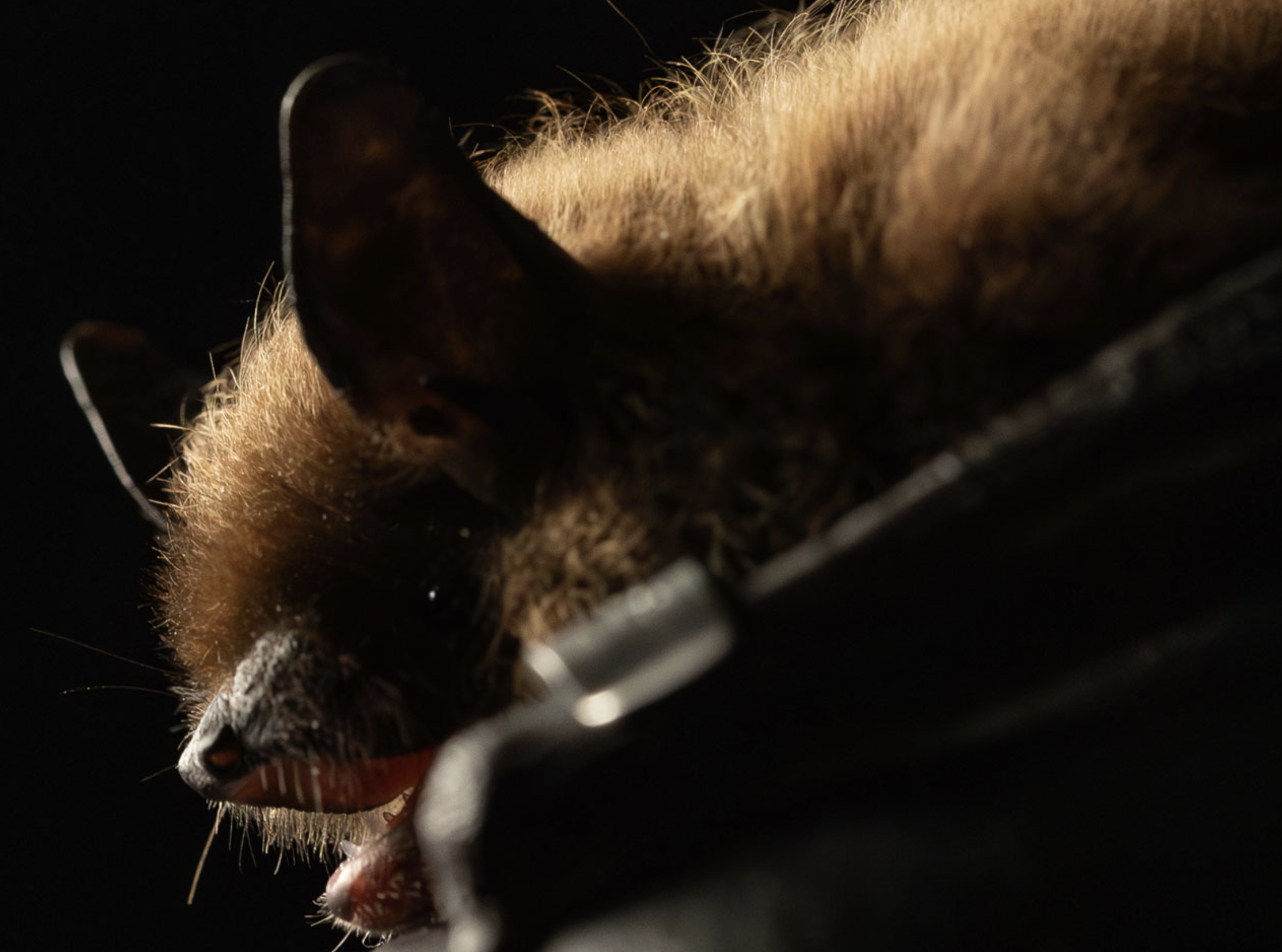
Little brown bat weigh less than 10 grams.
(Photo by Michael Code, Ambrook Research)
Cute as a button and confounding to scientists, Alaska's little brown bats have escaped white-nose syndrome. Can their "niche" in nature save them? "Meet Myotis lucifugus, commonly referred to as the little brown bat," reports Trina Moyles for Hakai magazine. Or, as chiropterologist (bat researcher) Jesika Reimer fondly calls it, 'the flying brown bear.'. . . Scientists know little about where [these bats] live at this far northern margin of the species' range."

Across North America, stands of trees of all different species are struggling to survive climate change. In response, scientists from the Cutfoot Experimental Forest are introducing some southern tree species to more northern regions, reports John H. Tibbetts of Knowable Magazine for Inverse. The survival of a grove of bitternut hickory trees, common to Illinois but transplanted to north-central Minnesota, is an example. "Normally, if a southern-adapted seedling is planted in an unsuitably cold climate like this one, it can risk frost damage, and its survival is threatened. . . . Today [scientists]can see the success of almost all the southern trees they planted."
Not all wool is usable for textiles, but it can make
'sweaters for the soil.' (Photo by Sam Carter, Unsplash)
Sheep farmers have developed a new way to repurpose coarser wool or "waste wool" that would have been thrown away by using a wool pelleting machine, reports Elise Konig for Ambrook Research. "A pelleting machine transforms the fleece’s long strands into cylinders that can more easily be handled. The pellets are then sold as soil amendments, providing water retention, nutrient recycling, and soil aeration."

Are you ready to clean, prune, test your soil, pick the plants and snuggle them in some soil? March is get-ready to garden month, and there's lots to do. "If you’ve been itching to get out and get gardening, we’re on the cusp of the season. This is the time to get organized and get ready because by the time we talk again in April, we will be in it, writes Amanda Blum for Lifehacker. From tidying the garden to splitting bulbs to fertilizing shrubs, Blum has a list of all the jobs to do before planting begins.

Thursday, October 26, 2023

Fauna Thursday: Sheep are lawn care experts; learn more about this invasive bug; beavers get their own conference


Sheep on the White House lawn in 1919. (Photo by Harris & Ewing, Library of Congress via The Washington Post)

Tired of mowing your grass? Consider this: Sheep are lawn care experts. They are gentler grazers than goats or horses, clipping grass tops and nibbling weeds homeowners would like removed. They leave about four inches of the blade: just the right height, says Michigan State University Extension, to maximize root growth and shade out weeds. Any lower, as some lawn companies mow, and the grass will grow even faster to reach the sun, necessitating more mowing.

Michael J. Coren of The Washington Post reports: "'Sheep love the sweet tips of grass, and biodiverse diets like the weeds in your yard' including bittercress, chickweed and onion grass, says Cory Suter, owner of Lamb Mowers, who grew up farming on a Mennonite homestead in the Shenandoah Valley of Virginia. 'That’s a perfect buffet for our sheep.'”

Scientists working to prevent another devasting global avian flu outbreak have found a possible solution. They "used gene editing to identify and change parts of chicken DNA that could limit the spread of the bird flu virus in the animals," reports Norrie Russell of Lancaster Farming. "Researchers were able to restrict — but not completely block — the virus from infecting chickens by altering a small section of their DNA. The birds showed no signs that the change in their DNA had any impact on their health or well-being."
A spotted lanternfly egg mass and
an adult. (USDA photo)

The spotted lanternfly, Lycorma delicatula, has indeed been spotted in multiple states. The invasive pest is a rapacious feeder that can severely affect crops. The insect "feeds on a wide range of fruit, ornamental and woody trees, with tree-of-heaven being one of the preferred hosts," according to the Department of Agriculture. To learn how to spot, report, and prevent infestations, click here.
 

Photo by Braedon McLeod, Unsplash
Busy beavers will be the focus of an upcoming global conservation effort in Oregon, a.k.a, "The Beaver State." Robert Leo Heilman of The Daily Yonder reports: "So, it is appropriate that Canyonville, Oregon, a small town with a population of 1,660 located in the Klamath Mountains of Southern Oregon, is the global locus of efforts to restore beavers throughout their traditional range in the wild. The 2023 State of the Beaver conference (November 13-15, 2023) will draw up to 300 beaver restoration advocates and re-wilding movement activists from all over North America and Europe."

Gerkin-colored sea cucumber
(Nautilus Minerals photo via Hakai)
Just how many undiscovered creatures live in our oceans? Countless as the stars? Maybe. "Nautilus Minerals, a seabed mining company, is tight-lipped about whether Neptune’s expedition across nearly 15 square kilometers of remote seabed revealed the bounty of desirable metals it sought," reports Chris Baraniuk of Hakai magazine. "But the 4,000 photographs, likely the first ever taken in the region, did uncover something else: an array of colorful sea life including a big gray octopus with Dumbo-like ears, pale white anemones, bright orange prawns, and sea cucumbers an appropriate gherkin-shade."


Thursday, October 12, 2023

Quick hits: Learning about guns the rural way; making 'pain-free' horseradish; inspiration from a farm girl; rugged art

Horseradish can have a mighty kick! "Making it from fresh roots is easy and rewarding, but the oil released during processing can be an assault on the senses if you're not careful," writes Eric Hurlock of Lancaster Farming. "Follow this quick guide to reap the pleasure of homemade horseradish. . . without melting your face."

Drawing by Navied Mahdavian, L.A. Times
When an urbanite cartoonist and writer moves to very rural Idaho, lessons about a different way of living and thinking abound in this Op-Comic, "What I learned about guns when I moved to rural America," by Navied Mahdavian of the Los Angeles Times. "Ironically, many people here expressed fear of cities because of perceived gun violence. . . . They view it as a city problem."

In rural Norway, the wool trade has thrived for centuries. "Viking life must have been like this — frigid, wild days in an open boat, constantly watching the waves and clouds to avoid disaster," writes Claire Eamer for Hakai magazine. "Wool was as much a part of that life as the sea and the ships. The Vikings were great sailors and fearsome warriors but couldn't have left port without wool. It provided the raw material for their clothes, their blankets, even the sails that harnessed the wind for their ships."

In the age of Amazon, it's good to see that some golden brick-and-mortar stores, such as Ranch-Land Western Store in the Sandhills of Nebraska, have managed to thrive, reports Natalia Alamdari of Flatwater Free Press. "Three generations of the McBride family have outfitted customers from Nebraska and beyond with boots and hats. . . . The store is filled to the brim with history and memories. It has survived a fire that threatened its existence, booms and busts in the cattle market, the economic strain of a global pandemic."
Brynn loves taking care of 'her' cows.
(Photo via DH)


"Sometimes the biggest inspiration comes in the smallest packages. This certainly holds true for Brynn Grewe from Cumberland, Wis. The pint-size dairy farm girl is not only well-known in the industry but also serves as a true inspiration, as she embodies strength, grit and perseverance," reports Karen Bohnert of Dairy Herd Management. When Brynn was 18 months old, she contracted an infection that went septic, and she eventually had to have amputations. But she has not lost her spunk. "Brynn is a true farm girl—she helps lead heifers, feed hay, and wash cattle as they prepare for shows. She has even called dibs on which heifers she wants to show in the future."


"Man With a Hoe" (1860-62) by Jean-François Millet
(The J. Paul Getty Museum photo via WSJ)
Rural life can be diverse, beautiful and brutal. Jean-François Millet's monumental "Man With a Hoe" (1860-62) "has enjoyed popular acclaim as an empathetic image of hardscrabble labor in a rugged, agrarian landscape," reports Mary Tompkins Lewis of The Wall Street Journal. Lewis offers inquiry and thoughts on the work and the artist who grew up in a small town. "Millet's painting of a beleaguered farmworker shocked viewers when it was first shown in 1863 Paris, but it has proved to be an enduring image of relentless toil."


Tuesday, August 01, 2023

Flora and fauna: Cat is a shepherd; your fruit is sweeter; the American Serengeti; wild boar for dinner; Vt. prefers cats

Bodacious loves his sheep.
(Photo by Jesse Hirsch, Modern Farmer)
You heard it here first. A cat in Ireland is a shepherd. "If you've ever owned (or met) a cat, the idea of using one like a sheepdog is absurd. Cats hate to be bossed, they're too puny to scare a sheep, and they'd much rather take a sunshine nap than run around doing farmwork. Even though they have evolved to recognize their owner's voices, studies say that they just don't care," yarns Jesse Hirsch for Modern Farmer. "Still, as cat shepherds go, Bodacious is at the top of his field. He's assisted in lamb births, barbed wire sheep rescues and hypothermia resuscitations, to name a few. His owner, Irish farmer Suzanna Crampton, says she could not function without him."

Do your "cotton candy" grapes taste as sweet as cotton candy? Is fruit sweeter now? "Yes, though the longer answer is more complicated. Some of the most powerful evidence that fruit is sweeter than before comes from zoos," reports Bee Wilson of The Wall Street Journal. "In 2018, it was reported that Melbourne Zoo in Australia had stopped giving fruit to most of its animals because cultivated fruit was now so sweet that it was causing tooth decay and weight gain. . . . Among fruit breeders, the word 'quality' is now routinely used as a synonym for 'high in sugar.'"

Where the buffalo roam: Charles M. Russell National Wildlife Refuge.
(Photo by Katie Butts, Fish and Wildlife Service, via the Revelator)
Efforts to bring back the American version of Africa's Serengeti Plain are underway. The project is "a call to protect and restore the northern Great Plains and the biodiversity it once held in great numbers. That includes swift foxes, beavers, river otters, bison, elk, pronghorn, black-footed ferrets, grizzly bears, wolves and numerous species of grassland birds," reports Tara Lohan of The Revelator. "In 2002, Curtis Freese helped launch the nonprofit American Prairie, which aims to establish a preserve of 3.2 million acres in northeast Montana. . . .The group's about halfway to its goal."

Wild hogs in a swamp near Slidell, Louisiana.
(Photo by Laura Prieto, Alamy via The Guardian)
Tired of wild boar committing rampant land destruction? Warm up the golden pipes, sing the ultimate Christmas carol, and then get ready for a feast. Here it goes: The boar's head in hand bring I, Bedeck'd with bays and rosemary. And I pray you, my masters, be merry, Quot estis in convivio ("As many as are at the feast"). "Some chefs, farmers and meat purveyors in southern wild-boar hotspots are bringing feral hogs into the food chain," reports Sara Ventiera of The Guardian. "They're transforming a nuisance species into a sustainable protein for human consumption. Chef Jesse Griffiths, co-owner of Dai Due and author of James Beard-winning The Hog Book and Afield, is one of the hospitality industry's biggest advocates for consuming wild hog." Menu ideas here.

It's raining cats and dogs. Well, maybe not raining, but there's a lot of 'em. "In most states, the percentage of households with pets is higher than the percentage of voters who voted in the last election. Dogs hold the lead in every state but Vermont," reports State Legislatures News. "And the percentages of cats and dogs don’t add up to 100% in any state due to the ownership of other pets that are neither feline nor canine. All those pets cost money, to the tune of $136.8 billion in 2022, according to the American Pet Products Association. Click meow to get the map.

Tuesday, June 06, 2023

Shepherds aim to put 'Kentucky spring lamb' back on U.S. menus and truly reclaim Appalachian strip-mined land

Lester Brashear is one of 300 sheep farmers in southeastern Kentucky who are hoping to use reclaimed strip mines to create a new market for Kentucky spring lamb. (Photos by Sam Adams, The Mountain Eagle)

Small ruminants are domesticated animals like sheep and goats; they also might be the answer to restoring productivity to strip-mined Appalachian lands that once were forests, reports Sam Adams of The Mountain Eagle in Whitesburg, Ky.. Adams reports on Lester Brashear, "a retired coal miner and former biomedical equipment technician, and his brother, Larry, and his cousin Patrick Angel, who holds a bachelor's degree and a master's degree in forestry and a doctorate in soil science, and has farmed sheep for 43 years. The three formed the Southeast Kentucky Sheep Producers Association, which now boasts about 300 members across 56 counties in Appalachian Kentucky."

A curious ewe lamb peeks out.
(Photo by Sam Adams, The Mountain Eagle)
SEKSPA is working to rebuild some of the region's agricultural legacy. Adams explains, Angel, who is retired from the federal Office of Surface Mining Regulation and Enforcement, "called it a 'tragedy' that strip mines were reclaimed as grassland instead of forest, and said there are now about 750,000 acres of grassland in Appalachian Kentucky that used to be forests," Adams reports. "Only a fraction of that land has ever been used for agriculture, because even though some farmers have placed cattle and horses on strip mines, much of the land is too steep for large animals, and the ground dries out too quickly to support large-scale grazing of that size livestock."

That's where nimble-footed lambs and sheep come in handy. Angel explained, "The only way to correct that is by reforesting and/or doing large-scale, small-ruminant grazing as it's done in the Rockies, in the Carpathians in Central Europe." Adams reports, "And, he said, there is historical precedence for that working in the Appalachian Mountains of Eastern Kentucky. . . . It used to be known for lamb. He said customers at 'five-star, white-tablecloth restaurants' in New York, Boston and up and down the eastern seaboard depended on the lamb from this region from the 1880s until just after World War II. . . . 'At the top of the menu, you could see the three words "Kentucky spring lamb" and Eastern Kentucky was the supplier of Kentucky Spring Lamb,'" Angel said.

Eastern Kentucky's Cumberland Plateau can be divided into four sections,
increasingly mountainous the farther southeast. (University of Kentucky map)
Lester Brashear, of Letcher County, "has now obtained a trademark on a logo on behalf of the SEKSPA that capitalizes on the Kentucky spring lamb name," Adams reports. "The trademark will be on the packaging of lamb sold by members of the association, and members of the association must be in the 56 counties in Eastern Kentucky. Brashear said that most of the 'lamb' sold in supermarkets comes from Australia and is actually mutton."

What's the difference between lamb and mutton? Brashear explains: "A sheep 14 months or younger is a lamb, and after that, they become a hogget, and then after that, they become a sheep or a mutton." Adams adds, "Brashear explained that people who aren't used to the meat . . . assume that they won't like lamb because they had mutton and didn't like it. . . . SEKSPA members have been "cooking lamb at trainings and meetings across the region to give people a taste of what they've been missing. . . .This year, they plan to put a large flock of sheep on a strip mine in Perry County to see how it will fare. . . . . Both say if it works, it could give new life to strip mines that don't have trees and show other farmers they can make money from the practice."

Tuesday, April 25, 2023

Flora/fauna: The grizzly bear may return to the Cascades; revelations in 'chicken-speak,' how to repel mosquitoes . . .

U.S. Fish and Wildlife Service map via National Geographic shows
current grizzly range in dark brown, historic range in light brown.
Grizzly bears may return to the Pacific Northwest. "Across 6.3 million acres of forest home to the nation’s most imperiled grizzly-bear population, there has not been a confirmed sighting of Ursus arctos horribilis since 1996," reports Craig Welch of National Geographic. "So the Biden administration is working on a last-ditch effort to bring grizzlies back. Much as federal agencies reintroduced wolves to Yellowstone National Park, scientists hope in coming years to pluck grizzlies from healthy populations in Canada or Montana and transplant them to the Pacific Northwest. . . . The government has a plan to bring these animals back to an ecosystem that needs them." The bears are top predators, but 90 percent of their diet is plants.

Image courtesy of Agate Surrey
"Chill Phyllis" was a backyard chicken who moaned and muttered a lot -- in chicken-speak, of course. . . . People said Chill Phyllis was simply exhausted from laying eggs, but they really weren't sure. . . . Now there's a book that might share some clues about such fowl. "Clucking, trilling, grumbling: The language of chickens was just one of the revelations that struck Tove Danovich as she raised three chicks in her Portland yard," Rebekah Denn writes for The Seattle Times. Danovich's book, Under The Henfluence: Inside the World of Backyard Chickens and the People Who Love Them began as a "quest for eggs," but the project hatched into research and a resource with "with notes on hatchery ethics, therapy chickens, and rescued battery hens."

Why do mosquitoes buzz in people's ears? Because they're obnoxious (unless you're a bird; then they're dinner). Here are some nature-friendly tips on plants such as rosemary and lavender that can keep the buzzing, biting and disease-carrying party crashers at bay.

Wool can be a magical material for warmth, dryness and the general coziness, but in some places it needs a little more recognition. "There isn’t a great market for much of the wool produced in the Upper Midwest. The price per pound of raw (greasy) wool is unlikely to cover the cost of raising and shearing the animal. . . . Some farms just compost or burn their clip," reports Donna Kallner of The Daily Yonder. "The Fibershed movement is working to change that. The non-profit organization’s mission is to transform regional fiber systems through climate-beneficial agriculture, rebuilding regional manufacturing, and reconnecting end-users with the source of their fiber."

"Massive," "font of life" and "wild ox" are all names for the bison. "The American bison stands at the crossroads of the animal, plant, and human worlds. It is part of an integrated ecosystem that includes people as much as it does bobcats, finches, and sunflowers," reports Nathan Beacom for Plough magazine. "In the Great Plains, scientists and small farmers bring back a mythic beast and a lost ecosystem. . . . Finding the right way to relate to this, our national mammal, might show the way to a healthy relationship with the natural world of the American West."

Photo by Matthew Modoono,
Northeastern University

Parrots are fun, social pets but also intelligent and need social interactions. These parrots participated in video chats with fellow feathered friends. For many, it turns out "Polly does want to video chat. . . . a lot," reports Emily Athens of The New York Times. "They mirrored each other's behavior grooming together . . . and singing together. . . . Some of the birds quickly made favorite friends."

Not all cats hate water. This story recalls "The forgotten history of cats in the navy. . . . Sailors embraced their feline colleagues, giving them tiny uniforms and their very own hammocks," reports Scot Christenson of National Geographic. "But cats are natural outlaws—so it couldn’t last forever."

Tuesday, December 13, 2022

USDA funds 71 climate-related projects at less than $5 million, many of them to 'figure out what works,' Vilsack says

The Department of Agriculture has funded 71 more five-year "projects to develop climate-smart commodities and a money-making market for them," reports Chuck Abbott of Successful Farming. The $325 million is the second round of funding in its Partnerships for Climate-Smart Commodities program, which now totals 141 projects and $3.1 billion, a USDA press release said.

The latest round of grants were for less than $5 million each, to focus on "small and under-served producers and work by minority-serving institutions to measure, monitor, report, and verify the results of climate-smart practices," Abbott reports. Agriculture Secretary Tom Vilsack said, "We believe that this program will allow us to figure out what works and, frankly, what doesn't work. . . . There are some amazing projects here." For a list of the first- and second-round projects, click here.

"Republicans in Congress say the White House exceeded its authority in creating such a large program on its own, and some critics in the scientific community say more detail is needed to judge the value of the projects," Abbott notes. Republicans don't like that the money comes from "a $30 billion reserve at USDA that also pays for crop subsidies," the Commodity Credit Corp. "Vilsack tripled the size of the program in September after USDA was deluged with proposals, all of which promised private-sector funding."

The 71 projects include agroforestry in New York, hemp in Tennessee, organic eggs in Ohio and Kentucky, specialty crops in California, cattle in Virginia and West Virginia, removing nuisance seaweed from Puget Sound for use as fertilizer, and cover crops for orchards in and near food deserts. There is also "a test of buffalo to mitigate global warming and to market buffalo meat as a climate-smart food," involving 79 tribes and 20,000 head of bison, Abbott reports. "They are the original climate regulator," said Troy Heinert of the InterTribal Buffalo Council. The grant's "funding ceiling," USDA says, is $4,950,000.

Vilsack announced the grants at Tuskegee Institute in Alabama, which will get a grant with a funding ceiling of $4,999,999 "to support small-scale and other under-served producers . . . transform their traditional production into a multi-pronged agroforestry-based climate-smart, sustainable production system," USDA says. Identical amounts were allocated to the University of Illinois, which will work with Tuskegee and other partners "to scale up robotic cover crop planting and verification of soil carbon" in Alabama, Illinois, Indiana, Missouri and Iowa; University of Maryland Eastern Shore to "promote climate-smart cover crops as a feedstock" for anaerobic digesters that process chicken litter; Foodshed Inc. and other partners for "incentives to small and socially disadvantaged specialty crop farmers in San Diego County" in California; the University of Guam "to market climate-smart commodities and achieve greenhouse gas emission reductions in Pacific Island agriculture and forestry systems while improving affordable food and nutrition security of disadvantaged, at-risk, island communities;" and Whitaker Grain "to provide a market platform for rice growers producing premium rice that is certified sustainably grown" in Arkansas.

Getting an allocation of $2 less than those, The Nature Conservancy is in line for $4,999,997 to "grow a set of climate-adapted tree species resilient to the projected climate futures of Minnesota’s Midwest Broadleaf Forest." Other grants near the limit: $4,999,900 to the Coalition for Food Security "to implement climate-smart practices related to indoor hydroponic vertical farming;" the same amount to Regeneration International; the Regenerative Agriculture Alliance to support poultry producers who follow diversified regenerative climate-smart grain production methods" in the Midwest; the same to Working Landscapes and other North Carolina partners to promote climate-smart practices "among small and underserved producers, including tribal producers, principally by equipping food hubs to finance and advise on-farm climate-smart practice implementation and marketing to wholesale and direct-to-consumer channels;" $4,999,800 to Chico State University to launch a "food hub for climate-smart agriculture" in the northern Sacramento River valley; and the same to Western Landowners Alliance "to empower New Mexico Latino and under-served beef and pork producers and their trusted partners to collectively develop, implement, monitor, quantify and broker climate-smart livestock projects."

Friday, February 19, 2021

Quick hits: Firefighters face lies, biased studies when trying to uncover truth about carcinogenic chemicals in their gear

Here's a roundup of stories with rural resonance; if you do or see similar work that should be shared on The Rural Blog, email us at heather.chapman@uky.edu.

Firefighters face lies and biased studies when trying to uncover the truth about carcinogenic chemicals used to make their firefighting gear flameproof. Read more here.

Members of Congress are calling on the Treasury Department and the Small Business Administration to clarify Paycheck Protection Program guidelines to make more farmers and ranchers eligible for forgivable loans, but it may be too late. Read more here.

New York Times contributing author Margaret Renkl will speak at the Rural Assembly Everywhere conference in April. Read more here.

Book review: Robert Gipe's Pop, the latest in a trio of illustrated novels set mostly in Eastern Kentucky, "shows the power of telling our own stories." Read more here.

Here are eight novels with rural settings that you can curl up with while the weather outside is frightful. Read more here.

Some experts say the new crop-insurance supplemental option is worth considering even if it's pricey. Read more here.

An initiative is helping farmers market products from heritage livestock sheep breeds. Read more here.

Wednesday, May 20, 2020

USDA releases details for pandemic-related aid to farmers

On Tuesday the U.S. Department of Agriculture released long-awaited details about its $16 billion direct payment program for farmers and ranchers struggling economically amid the pandemic. Farmers and ranchers can start applying for aid Tuesday, May 26; USDA says checks will begin going out as soon as a week later.

"USDA maintained the payment limit of $250,000 per farmer, but the initial $125,000-per-commodity cap was lifted following bipartisan backlash from Congress. Corporations and other entities can get up to $750,000 based on the number of shareholders who spend at least 400 hours on farm labor or management," Ryan McCrimmon reports for Politico's Morning Agriculture. "Because of high demand for aid and a limited pot of money (which Secretary Sonny Perdue, lawmakers and industry groups virtually all agree is too little), the department will send producers 80 percent of their payment and distribute the rest later if the funds haven’t been depleted."

Some crops and livestock aren't eligible for aid because their prices didn't drop by at least 5% since January, including some kinds of wheat, rice and peanuts, older sheep and egg-laying hens, and more. "But the department left the door open to 'reconsider' if those producers can demonstrate their market damage, except for two crops: hemp and tobacco," McCrimmon reports.

Monday, December 23, 2019

Can mutton make a comeback in the United States?

A number of dishes are likely to appear on American tables this holiday season: turkey, ham, dressing, mashed potatoes, latkes, kugel and more. Mutton, not so much.

Mutton and lamb are popular dishes worldwide, including in the United States, but around World War II it essentially dropped off American menus, Lisa Fogarty reports for NPR.

That's no coincidence: American soldiers in WWII were given canned mutton from Australia, which was apparently terrible, according to Bob Kennard, author of Much Ado About Mutton. "Wherever he travels, the Welsh mutton expert says he hears a similar story," Fogarty reports.

"I am told that someone's uncle or father came home from the war and wouldn't allow sheep meat in the house — they never wanted to see it again. It just went completely out of fashion," Kennard told Fogarty.

A number of other factors influenced the downfall of mutton in the U.S., including tech advances in railroads and refrigeration, Fogarty reports. Can it make a comeback? Unclear, but marketers and food influencers are trying.

Tuesday, July 02, 2019

Rainy spring boosts invasive cheatgrass in Western U.S., increasing risk of wildfires on rangelands

Map shows types of reports of cheatgrass. Click on the image for a larger version, or click here for an interactive version with number of reports by county. (Map by University of Georgia's Center for Invasive Species and Ecosystem Health)
"After a wet spring, Western states are experiencing a massive bloom of cheatgrass, a yellowish, knee-high and highly flammable grass that carpets rangelands across 13 states," Sophie Quinton reports for Stateline. "Experts say there’s a clear link between cheatgrass, which covers more than 100 million acres across the West, and rangeland megafires." Rangeland fires don't usually threaten homes like forest fires do, but they affect farms, watersheds, wild animals' habitats, and air quality. 

Cheatgrass in Nevada (Photo by Elizabeth Leger)
Federal, state and local officials are trying to figure out how best to fight cheatgrass, but success will require them to cooperate on a sustained, well-funded effort. "It can be hard to muster political will to spend money on addressing an invasive species that typically fuels wildfires in remote areas, far from major towns and cities," Quinton reports.

Ken Mayer, a former Nevada Department of Wildlife director who's working on a cheatgrass action plan on behalf of the Western Association of Fish and Wildlife Agencies, acknowledged that it's difficult to help people understand the issue's urgency. "We have an uphill battle trying to get the attention of the public," he told Quinton.

"The Western Governors’ Association is forming a cheatgrass working group and has agreed to address the issue with the U.S. Department of Agriculture, Quinton reports. "Mayer’s fish and wildlife group has been rallying state agency associations and nonprofits to support an invasive species action plan they will present to members of Congress and federal officials this fall."

Range managers spray cheatgrass with herbicides, try to crowd it out by planting more native vegetation, or bring in more cows and sheep to graze it down, Quinton reports.

Friday, June 14, 2019

Quick hits: Cycling helps rural economies; Maine islands get health care by boat; rainbow tailgate goes viral

Here's a roundup of stories with rural resonance; if you do or see similar work that should be shared on The Rural Blog, email us at heather.chapman@uky.edu.

Health care comes by boat to Maine's most remote islands, Modern Healthcare reports.

Last week thousands of cyclists from all over the world "set off on a grueling 200-mile race across gravel roads in Emporia, Kansas. The sport has grown to such a level that there are now 600 such events across the country — and they're lifting rural economies," Jay Price reports for WUNC FM in North Carolina.

Check out "This Land," a true-crime podcast from journalist and Cherokee Nation citizen Rebecca Nagle, about a high-stakes murder investigation that triggered big questions about Native American land rights and sovereignty: https://deadline.com/2019/05/crooked-media-this-land-1202621176/

A group looks to mountain biking to give rural New England an economic boost:
https://bangordailynews.com/2019/05/27/news/new-england/group-looks-to-mountain-biking-to-give-rural-new-england-an-economic-boost/

Here's a viral social-media post from a rural Oklahoma man who decorated his truck's tailgate with a duct tape rainbow in honor of Pride Month:
https://journaltimes.com/news/national/how-a-duct-taped-tailgate-from-rural-oklahoma-touched-people/article_6ee011bf-2bbe-57e1-bdc7-ba7233ed6440.html

Could returning to sheep farming help the Appalachian economy? Read more here: https://www.saveur.com/appalachian-sheep-farmers-lamb/

Monday, January 07, 2019

Increasingly popular practice of pasturing livestock in woodlots could reduce producers' carbon footprint

Photo by Lela Nargi, Civil Eats
The ancient practice of silvopasture, or pasturing animals among trees, is becoming more popular in the U.S. If more farmers and ranchers start doing it, it could help shrink our carbon footprint.

"If you have an overgrown woodlot, a strong back, a chainsaw, a small tractor with a mower, a pile of grass and clover seed, and a rake, then you can start establishing a small silvopasture on your land," Carl Fraccarolli of Cornell University writes for the land-grant school's Small Farms Program.
Here's how it works: trees absorb and keep a lot of carbon over time, and they're even better at it when planted among grazing animals on land that isn't suitable for growing crops, Lela Nargi reports for Civil Eats. Worldwide, silvopasture accounts for about 15 percent of all grazing land; though researchers know the number is low, it's unknown exactly how much land is dedicated to silvopasture in the U.S.

"Project Drawdown, a group of international scientists and policymakers that modeled the 80 most effective ways to battle climate change, ranks silvopasture number nine on its list, reporting that it could reduce CO2 emissions by over 31 gigatons by 2050 if it were ramped up from its current 351 million acres to 554 million acres worldwide," Nargi reports.

Tuesday, December 11, 2012

Sheep farmers hit by drought, high feed prices, low lamb prices and maybe market manipulation

The last few years have been particularly difficult for Western sheep farmers. "Skyrocketing feed costs, a brutal drought and plunging lamb prices have battered" the 80,000 sheep ranchers across the U.S., from small producers to large, Jack Healy of The New York Times reports. "It is the latest threat to shadow a Western way of life that still relies on the whims of summer rains, lonely immigrant sheep herders and old grazing trails into the mountains." (NYT photo by Matthew Staver: feedlot sheep)

Many ranchers have been forced to lay off workers, cut flocks and sell at a loss. Industry groups told Healy that many ranchers have left the business altogether. Colorado rancher John Bartmann told Healy he hass trimmed his 2,000-sheep flock by a third, and he expects to lose $100 on every lamb because of high fuel and feed prices.

The drought and economics take most of the blame, Healy reports: "The drought withered grazing grounds, killed off young lambs and dried up irrigation ditches, and a glut of meat and imported lambs from New Zealand helped send prices plummeting." But some ranchers and federal officials believe "The deck was stacked against the sheep ranchers by the small number of powerful feedlots that buy lambs, slaughter them and sell them to grocery stores and restaurants," Healy reports. As prices for ranchers fell to 85 cents a pound, consumers were paying $7 or more a pound.

The top four meatpacking companies control 65 percent of the lamb market, and "that kind of concentration makes it easier for a few powerful companies to manipulate prices to their advantage,"  Patrick Woodall, research director at Food and Water Watch, and environmental advocacy group, told Healy. Several Western senators and ranchers' groups lobbied the U.S. Department of Agriculture to investigate meatpackers that they suspected were hoarding sheep and keeping prices artificially low. The Grain Inspection, Packers and Stockyards Administration said it would investigate. (Read more)

Monday, November 19, 2012

Lamb prices plummet one year after record highs

Wholesale lamb prices are at an all-time low. A pound of lamb chops costs about $16 and ground lamb costs about $10; but ranchers are being paid less than 90 cents a pound, "far below what they need to break even," reports Emily Guerin of High Country News. Ranchers say slaughterhouses are fixing prices because lamb was selling at record high prices of more than $2 a pound last year. Senators from Montana, the Dakotas and Wyoming have asked the Grain, Inspection and Packers and Stockyards Administration to investigate. (HCN photo)

But Guerin writes there are a lot of other theories for the sudden price drop. Increasing amounts of African and Middle Eastern immigrants who favor lamb meat caused prices to soar for almost a decade. Last year's record-high prices have likely created this year's bust because prices eventually got too expensive for consumers, Guerin writes. Consolidation of meatpacking companies had a big impact, too. There are only a few major lamb packers in the U.S., and one company's decision to reduce buying can have a major impact on prices. Greater imports of cheaper lamb from New Zealand and Australia, which now account for almost half the lamb on the U.S. market, also hit ranchers hard.

The drought this year, though, "really crippled the sheep industry," Guerin writes. Nearly 60 percent of the country was in drought by mid-July, and since sheep ranchers rely heavily on pasture because lambs are rarely "finished" in feedlots, drought hit the industry hard. Feed prices rose at the same time, forcing many sheep ranchers to sell off flocks early because they couldn't afford to feed them. (Read more)

Thursday, August 02, 2012

House passes drought-aid bill, as outlook for overall Farm Bill remains unclear

The House passed a disaster aid package today to help cattle and sheep ranchers who are running out of pasture and up against high feed prices. The vote was 223-197. While the $383 million measure "promises some political cover for Republican candidates in farm states," reports David Rogers of Politico, the standoff over the five-year Farm Bill "remains a serious liability for the GOP going into November’s elections."

The current Farm Bill expires at the end of September, when Congress is likely to recess for campaigning. Congress has relatively little time to legislate before that, because it is starting a recess that will run through Labor Day. The chairmen of the House and Senate agriculture committees were scheduled to meet tonight "to begin negotiations toward a potential compromise that could be called up in September if the political winds shift enough in favor of action," Rogers writes.

Thursday, February 17, 2011

'Farm animals are not pets,' we are reminded

Peter Davies, one of the owners of Turkana Farms in Germantown, N.Y., writes a farewell story about his very special ram, Suleyman the Magnificent, on the AgriCulture blog of Rural Intelligence, a news site for four counties in New York and Connecticut. Its headline, "Farm animals are not pets," is a useful reminder to urbanites who migrate to rural areas. (Rural Intelligence photo)

Suleyman, sire of 20-plus lambs a season, must leave the farm, "not because of any problem with him," Davies writes. "Indeed, we do not want to let him go. But to avoid inbreeding we need to bring a new ram in to increase the genetic diversity of the herd. Suleyman is that rare ram who has been gentle—a quiet, dutiful presence who has never seriously challenged us."

That was in contrast to previous rams, who were downright mean. Both animals were taken to the auction house after they attacked their owmers, apparently unprovoked and unexpected. One had to be beaten back with a feed bucket, and the other was struck repeatedly with a heavy oak stick until Davies could retreat to the barn. "There was no doubt now that he was out to kill me," he writes.

Saturday, April 24, 2010

Volcanic ash poses threat to Iceland's livestock

It's not just the airlines that are feeling the fallout from the erupting volcano in Iceland. The toxic ash is also affecting livestock on the island.  Fifteen percent of Iceland's cattle, 6 percent of its sheep and 17 percent of horses are in the vicinity of the volcano, reports The Land. The lambing season has begun on some farms, and sheep cannot be let out due to volcanic ash in the atmosphere and on the ground. A few poultry and pig farms are in the area, but ash fall can create major problems for those farms because they rely on air conditioning. The greatest emphasis has been placed on guaranteeing livestock access to clean water and sufficient food. Iceland's Ministry of Fisheries and Agriculture has established a special task force to respond to the impact of the eruption on agriculture and to organize efforts in case livestock cannot be let out in the coming spring. (Read more)