Showing posts with label abortion. Show all posts

Tuesday, December 09, 2025

A small university town in southern Illinois 'leads the nation in out-of-state abortion patients'

Adobe Stock photo

Surrounded by farmland and the vast wooded expanses of the Shawnee National Forest, Carbondale, Illinois, has become a central hub for abortion access. 

The small-sized town, which is home to Southern Illinois University Carbondale, is within “driving distance of 10 states with abortion bans,” reports Elizabeth Williamson of The New York Times. “Last year, there were nearly 11,000 abortions in this city of 21,000.”

After the Supreme Court overturned Roe v. Wade, 14 states have banned the procedure. Those bans made “geography an all-important factor in access to the procedure,” Williamson explains. “And placed Carbondale, a liberal enclave in a deeply conservative region, in a complicated position.”

Unlike many of its neighboring states, abortion remains legal in Illinois. Carbondale's location near the southern tip of Illinois makes travel from states such as Missouri, Indiana, Kentucky, Mississippi and even Louisiana possible for women seeking the procedure. Williamson writes, “Illinois now leads the nation in out-of-state abortion patients.”

Although many Carbondale residents support “its status as a safe harbor. . . the sheer number of abortions has also created some unease and worry about a backlash,” Williamson explains. 

One community member told Williamson she was concerned about the negative attention the high number of abortions could bring to the otherwise “quiet community.”

Carbondale has three women’s clinics that perform abortions, but two of the three provide other women’s health services. “Alamo Women’s Clinic only does abortions, both procedural and medication, all on-site,” Williamson reports. “Fewer than five percent of Alamo patients are from Illinois.”

Friday, August 15, 2025

Telemedicine provides abortion access for rural women in states where the procedure is restricted or banned

Graph by the Society of Family Planning (click to enlarge)
Women living in rural areas with abortion-restrictive state laws are using telehealth and doctors in other states to access abortion medications. State shield laws currently protect out-of-state medical professionals who prescribe abortion medications, but that protection may not remain a guarantee.

Asynchronous telemedicine abortion medication provision rates "were higher in states with abortion restrictions and poorer counties far from clinics," reports Rachael Robertson of MedPage Today. "Of the 118,338 medication abortion pill packs Aid Access provided over a 15-month period, 84% went to states with near-total restrictions or bans on telemedicine abortion," reported Abigail Aiken, PhD, at the University of Texas, in the Journal of the American Medical Association.

When the U.S. Supreme Court overturned Roe v. Wade in 2022, some states followed the decision with abortion bans; however, if the bans were meant to stop abortions, they had limited success. Robertson writes, "Some data suggest that abortion rates remained steady despite these challenges."

Aiken's research points to medication abortions and the shield law as a reason abortion rates remained level, even in states with the most stringent restrictions. Aiken explains, "One plausible contributor is the rise of online asynchronous telemedicine abortion services -- particularly those operating under shield laws, which allow U.S.-licensed clinicians to provide abortion medications to patients in ban states with protection from legal liability."

"Before Roe was overturned, telehealth only accounted for 4% of abortions; that has increased to 25% as of December 2024, and disproportionately to ban states, according to Society of Family Planning data," Robertson adds.

Shield law protections will be tested by a Texas lawsuit "against a New York physician operating a nonprofit delivering telemedicine abortion," Robertson reports. "In the past, states tended to honor and assist other states' law enforcement, but the post-Roe era is different."

Tuesday, May 21, 2024

New doctors are avoiding abortion ban states, new analysis shows. Restrictions may add to mutiple-care shortages.

Fewer new doctors are applying for residency in
abortion ban states. (Hush Naidoo Jade photo, Unsplash)
States with significant restrictions or bans on  abortions may be inadvertently discouraging graduating medical students from applying for residency in their state, which could exacerbate regional physician shortages. Julie Rovner and Rachana Pradhan of KFF Health News report, "According to new statistics from the Association of American Medical Colleges, for the second year in a row, students graduating from U.S. medical schools were less likely to apply this year for residency positions in states with abortion bans and other significant abortion restrictions."

State battles over abortion aren't limited to uncertainties for doctors and pregnant patients; the tensions have "also bled into the world of medical education, forcing some new doctors to factor state abortion laws into their decisions about where to begin their careers," Rovner and Pradhan write. "Fourteen states, primarily in the Midwest and South, have banned nearly all abortions. . . . A preliminary review of a new analysis by the AAMC found that the number of applicants to residency programs in states with near-total abortion bans declined by 4.2%, compared with a 0.6% drop in states where abortion remains legal."

The AAMC's analysis shows that when new doctors start avoiding certain states, those states gain fewer doctors, which adds to regional physician shortages in many specialties. KFF Health News reports, "The organization tracked a larger decrease in interest in residencies in states with abortion restrictions not only among those in specialties most likely to treat pregnant patients, like OB-GYNs and emergency room doctors, but also among aspiring doctors in other specialties."

The number of new doctors applying for OB-GYN and internal medicine residency slots in those states "dropped 6.7%, compared with a 0.4% increase in states where abortion remains legal," Rovner and Pradhan explain. "For internal medicine, the drop observed in abortion ban states was over five times as much as in states where abortion is legal."

Wednesday, December 06, 2023

Rural and urban residents share many views on politics and the economy, a new survey shows

American Communities Project chart, from americancommunities.org data

Even though rural and urban residents remain divided on some issues, a new study found they have a lot more political and economic concerns in common, reports Liz Carey of The Daily Yonder. "The American Communities Project survey questioned more than 5,000 people across 15 different community types to show a more complex picture of how rural and urban residents view issues."

The survey yielded several surprising results. "What was interesting," researcher Dante Chinni told Carey "is how much rural residents' opinions were similar to those of urban residents. . . . The study found that residents in rural communities felt that the biggest issue in their lives locally was inflation." Carey reports: "Only in communities in the African American South, a rural subcommunity within ACP's 15 community categories, did anything else come close to inflation as an issue." Guns and crime topped their list.

Nearly 70 percent of those surveyed "agreed with the statement 'Americans have much more in common with each other than is generally believed,'" Carey writes. Commenting on the shared responses, Chinni told Carey: "I think people really want this to be true. They want there to be more in common, whether or not there actually is."

When asked about abortion, most survey respondents in rural and urban communities "agreed with the statement 'Obtaining an abortion should be a decision made by a woman in consultation with her doctor, without government's involvement,'" Carey reports. Ari Pinkus, one of the project researchers, told Carey: "What's interesting is how abortion was widely accepted by at least 50% of the population, across the community types, even in (more rural conservative areas) where you would think that they would be less okay with abortion. . . . It could be the way we asked the question because people don't like to get in the way of a woman and her doctor, but it's still notable that abortion is a topic of unity in the population."

Survey respondents did voice differing ideas about gun ownership. Carey reports, "When asked if 'the right to own a firearm is central to what it means to be an American,' residents in more rural communities were more likely to agree, whereas those in urban counties were more likely to disagree."

Wednesday, November 08, 2023

Rural voters in Ohio shift from Republican party policies; many who favored Trump supported abortion rights

Graph compares the vote by county type for Trump in 2020 to the 'no' vote on the
constitutional amendment. (The Daily Yonder graph, created with Datawrapper)

Republicans' strict anti-abortion position had wide-reaching ramifications in Tuesday's Ohio referendum vote, with rural voters pivoting away from the party's hard-line reproductive policies. "Rural voters in Ohio were part of a general shift away from Republican Party priorities, resulting in a victory for a state constitutional amendment protecting abortion rights," reports Tim Marema of The Daily Yonder. "Statewide, the measure protecting access to abortion and other reproductive rights passed 56% to 44%."

The outcome suggests that voters are paying attention to the abortion rights debate and weighing in. Tuesday's outcome in Ohio "represents a dramatic departure from Republican performance in the 2020 presidential election," Marema notes. "That year, former President Donald Trump won the Ohio vote by a margin of 8 points. This week, the constitutional amendment protecting abortion rights, which the Republican Party opposed, won by nearly 13 points.

"Rural voters were part of that shift. In 2020, Ohio voters in rural counties supported Trump 72% to 28%, a margin of over 40 points," Marema adds. "In Tuesday's referendum, rural voters opposed the abortion-rights amendment. But they did so by a margin of 18 points, less than half the margin that Trump racked up in the 2020 presidential election."

The graph shows that "in every county type, opposition to the amendment (the Republican position) trailed support for Trump in 2020," Marema explains, "Rural voters were the group with the second-biggest shift from 2020. The biggest shift occurred in the suburbs of major metropolitan areas such as Cincinnati, Cleveland, and Columbus. Those counties shifted 15 points from supporting Trump in 2020 to supporting the abortion-rights amendment in 2023."

Friday, August 25, 2023

Rural commentators on PBS, from right and left, agree Haley had strongest peformance in Republican debate

Gary Abernathy and Sarah Smarsh (PBS image)
The commentary section of "PBS NewsHour" Friday night was all rural, as former southern Ohio editor Gary Abernathy and Kansas author and freelance journalist Sarah Smarsh filled in for their conservative and liberal counterparts, respectively. They agreed on most things, including a belief that former South Carolina Gov. Nikki Haley did best in the first presidential debate, among eight Republicans,

After a clip of Haley telling Mike Pence that a federal abortion ban won't fly because of the Senate, Abernathy said, "Republicans have overstepped on abortion. I think the Supreme Court was right to send it bach to the states. Nikki Haley was right . . . I felt she was the strongest in that debate."

Smarsh agreed. Noting last year's Kansas referendum in favor of abortion rights, she said Democrats are "reclaiming the notion of freedom or liberty and applying that to bodily automony. . . . The post-Roe landscape seems to have affected voter behavior in ways pre-Roe models can't necessarily predict."

Butg that hasn't changed how GOP candidates approach the issue in their race, Abernathy said: "You can't be too pro-life for the Republican electorate."

When host Geoff Bennett played Ohio biotech entrepreneur Vivek Ramaswamy's declaration that "The climate-change agenda is a hoax" and said "Climate change is settled science," Abernathy said, "It's not settled among Republicans, Geoff. . . . Ramaswamy was playing right to that base."

Asked about the Atlanta booking of former president Donald Trump. Smarsh said, "Millions of Americans are aghast that this person facing all these indictments and criminal charges is still the eminent front-runner." Abernathy, describing the widely circulated mug shot, said "That's a portrait Trump may have commissioned and sat for himself, the way it turned out."

Friday, June 23, 2023

State supermajorities, at highest level in 40 years, mean one party's agenda moves forward and the other is powerless

North Carolina state Rep. Tricia Cotham changed her party
affiliation to Republican. (Photo by Hannah Schoenbaum, AP)

Supermajorities are once again more common in the states, and their influence can be so powerful that the minority party becomes irrelevant, reports David Lieb of The Associated Press. "In North Carolina, a new supermajority of Republicans enacted abortion restrictions. In Vermont, a new supermajority of Democrats imposed a climate-sensitive home heating law. And in Montana, a GOP supermajority booted a transgender lawmaker from the House floor."

While there is no generally accepted definition of a supermajority, "The term generally is equated with whatever threshold is needed to override a gubernatorial veto," Lieb explains. "In many states, that's a two-thirds majority. In some, that's a three-fifths majority. In six states — Alabama, Arkansas, Indiana, Kentucky, Tennessee and West Virginia — it takes only a simple majority to override a veto. But those states all have Republican majorities around 70% or greater."

"Republicans or Democrats hold majorities so large in 28 states that they could override gubernatorial vetoes without any help from the minority party," with 19 Republican supermajorities and nine Democratic ones, Lieb reports. The total is the most since 1982, according to Saint Louis University political scientist Steven Rogers, an expert on elections and state legislatures.

Simply put, supermajorities have the votes to enact their agenda, and some members join them to gain leverage or make a difference.. "In April, North Carolina state Rep. Tricia Cotham switched from Democrat to Republican to give the GOP another supermajority," Lieb notes. "Six weeks after Cotham's switch, she provided a pivotal vote as the new GOP supermajority overrode Democratic Gov. Roy Cooper's veto of legislation banning most abortions after 12 weeks of pregnancy." 

Increases in supermajorities stem from two trends, Lieb reports: "Americans have increasingly voted along party lines, picking state lawmakers and even local officials who align with their party choice for president or the top of the ticket, Rogers said. At the same time, politicians in power in many states have gerrymandered voting district boundaries to give their party's candidates an advantage in legislative elections. . . . As parties gain more seats in House and Senate chambers, the political ideology of their middle members often shifts further to the right or left, reducing the need to appeal to moderates and virtually eliminating the need to compromise with the opposing party."

Depending on a voter's political leanings, "Some may be pleased by the sweeping policies that get enacted," Lieb points out. "Others may feel like their priorities are ignored." Carlos Algara, an assistant professor of government and politics at Claremont Graduate University in California, told Lieb: "On behalf of the voters, it might be a good thing, because it helps clarify responsibility. If you are a voter in California, you know explicitly which party owns policy; it's the Democratic Party. . . . So if you don't like the direction of policy in California, you have a very easy choice."

Wednesday, June 21, 2023

Abortion clinic opens in Wyoming, where state constitution and 'hands-off conservatism' make it possible, for now

Abortion opponents protest in front of the new Wellspring clinic.
(Photo by Rachel Woolf, The Washington Post)
An abortion clinic in Casper, Wyoming, has opened despite the state's deep-red history and Roe vs. Wade reversal. Wyoming law and Western self-determination beliefs have made Wellspring Health Access' surgical clinic possible, reports Karin Brulliard of The Washington Post. "Most of Wyoming is an abortion desert, and most lawmakers in America's reddest state — having passed laws restricting nearly all abortions as well as the nation's first explicit prohibition on abortion pills. . . . Yet with the state's restrictions tied up in court, Wellspring. . . represents a dramatic abortion standoff and a stark expansion of abortion services in a region of wide-open range and sky." 

Originally scheduled to open in May 2022, the clinic was burned down by an arsonist who "was opposed to abortion," Brulliard writes. The new building opened in spring of 2023. It is a rarity "in what may be the unlikeliest abortion clinic in the country. . . . Wyoming's only other provider, 280 miles away in Jackson, offers just abortion pills. Wellspring's four physicians have already seen patients from South Dakota, Utah and Nebraska, neighboring states with limited or no abortion services. The clinic serves a dozen patients a week on average. Nearly half receive abortions, the rest reproductive health care."

"Wellspring's ability to operate is rooted in the hands-off brand of conservatism that characterized Wyoming politics before hard-liners began gaining influence," Brulliard explains. "In 2011, lawmakers worried about the Affordable Care Act potentially mandating enrollment in an 'Obamacare' plan approved a resolution that put a constitutional amendment to a public vote. It passed, giving adults the right to make their own health-care decisions."

If abortion is health care, the state cannot control an adult's health-care choices. "In court filings, the state has said its policy 'is and has always been to criminalize abortion' and argues that abortion is not health care. . . In March, a state judge in Jackson issued a temporary restraining order on the ban, which makes most abortions a felony punishable by as much as five years in prison. Later this month, she is scheduled to consider a similar order for the medication abortion ban just before it is slated to take effect."

Locations of Wyoming's abortion clinics (Wikpedia, adapted)
The town of 60,000 people on the edge of the Rocky Mountains has tried to keep a level approach, Bruillard reports: "The nonpartisan city council has mostly avoided debate over the clinic, though it has been a flash point." The town's mayor, Bruce Knell, "who describes himself as a 'literal Bibleist,' is not heeding calls for a city resolution condemning abortion." Knell told Bruillard: "They are a legal, law-abiding business, so they have a right to be here. We will allow this to play out in the courts. And I do think the pro-life folks will see a result that they're happy with."

Sunday, June 18, 2023

North Country Public Radio wins 3 Sigma Delta Chi awards; coverage of wildfires, prisons, Uvalde shooting also win

A disabled mother and daughter in northern New York lived
in this tent and in their car. (North Country Public Radio)
Several of the Sigma Delta Chi Awards for excellence in journalism, announced Saturday night by the Society of Professional Journalists, had rural resonance.

The rural media standout was North Country Public Radio, based in Canton, the seat of St. Lawrence County, New York. Its report on affordable housing, or the lack of it, won the award for public service in radio, and its report on uninspected housing for dairy workers won the award for small-market radio feature reporting. NCPR also won the contest's new award for regional political reporting with its profile of U.S. Rep. Elise Stefanik, chair of the House Republican Conference, whose district coves most of NCPR's coverage area, where it has 33 transmitters.

A prison in rural Illinois was the topic of "How the newest federal prison became one of the deadliest," a two-part story by NPR and The Marshall Project, which advocates criminal-justice reform. The package won the award for radio investigative reporting. The Intercept's five-part report on the effect of global warming and climate change on prisons and inmates won the award for science, environment or climate reporting.

Coverage of two major wildfires won awards. CBS's "60 Minutes" won the award for television investgative reporting for “What Happened at Grizzly Flats,” a California town destroyed by a mismanaged forest ifre; and KUSA-TV of Denver won the award for TV documentaries in large markets for “The story behind the Marshall Fire” near Boulder. 

Also in broadcasting, Virginia Public Media won the award for small-market television feature reporting for its story on black descendants of Thomas Jefferson; Scripps News and the Center for Investigative Reporting won the award for narrative podcast or radio documentary for their six-part "Inside the global fight for white power;" and NPR won the radio feature reporting award for interviews with the mother of one of the victims of the 2012 Sandy Hook, Conn., school shooting.

Journalism about the mass shooting at Robb Elementary School in Uvalde, Texas, last spring, received two SDX awards. KPRC-TV in Houston won for deadline reporting, and the San Antonio Express-News won the large-market editorial award for its "Standing with Uvalde" series. David Plazas of The Tennessean won the smaller-market award for a collection of editorials. Jake May of the Flint Journal was a double winner for feature photo and small-circulation breaking-news photo.

Other awards of general interest included:
Fact checking: Glenn Kessler of The Washington Post for "The truth about Hunter Biden."
Washington correspondence: Nick Grube of Honolulu Civil Beat, for coverage of Hawaii's congressional delegation.
Editorial cartooning: Michael Ramirez, Las Vegas Review-Journal (small markets), and Gary Markstein, Creators Syndicate.
Magazine writing: Lizzie Presser of ProPublica and The New York Times Magazine for "I was never ready for this," a profile of a teenager from Copperas Cove, Texas, who became the mother of twins after a judge refused to let her get an abortion.
General column writing: Melinda Henneberger of The Sacramento Bee, for five columns.

Monday, May 22, 2023

Rural communities are becoming abortion battlegrounds

Anti-abortion activists are seeking local bans on the procedure, especially in rural towns "by borders between states that have restricted abortion and states where laws preserve access," Jazmin Orozco Rodriguez reports for KFF Health News. "They are crossroads where abortion advocates and providers have looked to establish clinics to serve people traveling from the large swaths of the U.S. where states have banned or severely restricted abortions."

Rodriguez's object example is Wendover, Nevada, a town of 4,500 on the Utah border, just over and hour and a half from Salt Lake City and two and a half hours from Twin Falls, Idaho. Mark Lee Dickson, director of Right to Life of East Texas "and founder of another organization that has spent the last few years traveling the United States trying to convince local governments to pass abortion bans," asked the City Council in April to restrict abortion in Wendover, saying “Sixty-five cities and two counties across the United States” have passed similar restrictions. Most are in Texas, "but recent successes in other states have buoyed Dickson and his group."

Dickson made his pitch after the council "voted against issuing a building permit to California-based Planned Parenthood Mar Monte in March," Rodriguez reports. "Mayor Jasie Holm vetoed the council’s decision, leaving the request for the permit in limbo." Dickson's proposal "has drawn support from the town’s more conservative residents, but brothers Fernando and Marcos Cerros have challenged the anti-abortion efforts. In addition to wanting to protect and expand access to abortion, they both saw the primary care clinic that Planned Parenthood Mar Monte was seeking to establish as a potential victory in their rural community, which is designated a medically underserved area by the federal Health Resources and Services Administration."

Monday, April 10, 2023

As abortion heads for the high court again, battles among states will provide even more conflicts on the issue

Federal judges recently issued conflicting abortion rulings that will likely send the issue back to the U.S. Supreme Court, the conservative majority of which thought it had left the issue to the states, but conflicts among states over abortion will provide even more court battles, report Geoff Mulvihill and John Hanna of The Associated Press.

Idaho now has a law "making it illegal to provide help within the state’s boundaries to minors seeking an abortion without parental consent," AP reports. "The new law is obviously aimed at abortions obtained in other states, but it’s written to criminalize in-state behavior leading to the out-of-state procedure – a clear nod to the uncertainty surrounding efforts by lawmakers in at least half a dozen states to extend their influence outside their borders when it comes to abortion law.

"At the same time, Democrat-controlled states are advancing and adopting laws and executive orders intended to shield their residents against civil lawsuits and criminal investigations related to providing abortions for women from states where there are bans. But there is no legal precedent giving good guidance about whether states can influence their residents getting abortions outside their borders."

One part of the U.S. Constitution "requires states to respect the laws of other states while another recognizes the right to travel among states and a third restricts the ability of states to impair interstate commerce," AP notes. "Legal experts say that no prior cases are exactly comparable, though state laws have conflicted in weighty ways in the past."

Wednesday, April 05, 2023

Wis. puts on top court a judge who broke norms by taking positions on big issues; some rural counties shifted her way

Janet Protasiewicz, center, celebrates her victory.
(Photo by Mike De Sisti, Milwaukee Journal Sentinel)

In the latest twist on Wisconsin politics, "Voters on Tuesday chose to upend the political direction of their state by electing a liberal candidate to the State Supreme Court, flipping majority control from conservatives, reports The Associated Press. Thus, the court is likely to reverse the state's 1849 abortion ban and "end the use of gerrymandered legislative maps drawn by Republicans," reports Reid J. Epstein of The New York Times. "Janet Protasiewicz, a liberal Milwaukee County judge, overwhelmingly defeated Daniel Kelly, a conservative former Wisconsin Supreme Court justice who sought a return to the bench."

The race was officially nonpartisan but Democrats lined up for Protasiewicz and Republicans for Kelly. Some rural communities that voted for Barack Obama in 2012 and then twice for Donald Trump returned to the "Democratic" column. Abortion-rights supporters credited the U.S. Supreme Court's overturning of Roe v. Wade, which reactivated the state's old abortion law, for the shift. "Rural voters moved 5 points toward the Democratic candidate compared to the 2020 presidential and 2022 U.S. Senate elections," The Daily Yonder reports. But that was not as much a shift as was seen in metropolitan areas.

"Judge Protasiewicz, 60, shattered long-held notions of how judicial candidates should conduct themselves by making her political priorities central to her campaign," Epstein writes. "She made explicit her support for abortion rights and called the maps, which gave Republicans near-supermajority control of the Legislature, 'rigged' and 'unfair.'. . . The contest, which featured over $40 million in spending, was the most expensive judicial election in American history. Early on, Democrats recognized the importance of the race for a swing seat on the top court in one of the country's perennial political battlegrounds."

"Justice Kelly, 59, evinced the bitterness of the campaign with a testy concession speech that acknowledged his defeat and portended doom for the state," and said Protasiewicz was "not a worthy opponent," Epstein reports. "In an interview at her home before the results were known, Judge Protasiewicz (pronounced pro-tuh-SAY-witz) attributed her success on the campaign trail to the decision to inform voters of what she called 'my values,' as opposed to Justice Kelly, who used fewer specifics about his positions."

Thursday, January 12, 2023

New abortion clinics change blue-state towns near borders

A sign installation for Choices, a new abortion clinic in Carbondale,
Ill. (Photo by Erin Schaff, The New York Times via Redux Pictures)
Since the overturning of Roe v. Wade, small blue-state border towns are experiencing an increase in abortion clinic openings and an influx of visitors as women seek abortion services. Carbondale, Illinois, is one blue-state town where a Tennessee-based provider opened a clinic named Choicesreports Shia Kapos of Politico. "Choices is seeing a steady stream of abortion patients from Arkansas, Tennessee, Mississippi and Texas since it set up space in a shuttered dermatology office last fall, its only location outside Memphis."

Choices CEO Jennifer Pepper told Kapos, “For towns like Carbondale in states that continue to have access to abortion and border states that don’t, how can you not be impacted by having two, three or four clinics pop up? There are thousands of people traveling through your town.”

Carbondale, Ill. (Google map)
Kapos writes: "For Carbondale, a college town of 22,000 people, geography had a lot to do with Choices’ new site: Illinois is bordered by five states that all have abortion laws more restrictive than its own, turning the Democratic-controlled state into a destination for those seeking the procedure since Roe v. Wade fell in June. . . . And with the influx of patients has come more customers at local restaurants, booked up hotels and other early measures of economic change, particularly in the Midwest and the West."

Alison Dreith of the Midwest Access Coalition, a fund that helps people access abortion care across the region, told Kapos, “The current hotel infrastructure can’t handle the needs of the university community, let alone the new and emerging abortion community. It’s something we know we have to face down the line.”

Conservatives have voiced worry over the phenomenon. Jeanne Ives, a former state representative who sits on the Illinois Right to Life board, told Kapos, "They come in for a quick in-and-out procedure, and a lot of abortions are not easy decisions. It basically makes it a drive-thru service decision and I think that’s shameful."

Meanwhile, border towns will continue to experience a higher demand for services. Mayor Rachel Medina of Cortez, Colo told Kapos, “What’s tough about border towns is that they’re rural and don’t have a lot of funding. Small towns take the brunt of it and can barely meet the needs of their own residents."

Tuesday, January 03, 2023

Some anti-abortion states consider extending Medicaid to likely increasing number of pregnant women

Viola's House in Dallas provides housing and services to young,
expectant mothers. (Photo by Allison V. Smith, The Washington Post)
After Roe v. Wade was reversed, many states further restricted abortion. Now some of them are thinking cause and effect, and considering extending Medicaid coverage to pregnant women, reports Molly Hennessy-Fiske of The Washington Post.

Usha Ranji, associate director for women’s health policy at the Kaiser Family Foundation, told Hennessy-Fiske, "There’s a discussion among Republicans and those who are anti-choice about, 'What should we be doing to support mothers?'"

Texas is one red state with coverage and care dilemmas: "The limits on Medicaid coverage after the emergency insurance lapses hinge on Texas’s long-standing rejection of the Affordable Care Act, which included provisions for expanded Medicaid," Hennessy-Fiske writes. "And it has set up an uncomfortable dynamic: While Texas and nearly a dozen other red states have resisted expanding Medicaid for those who are pregnant, many of them have also restricted access to abortion, leading to more new mothers needing coverage."

Steve Aden, general counsel and chief legal officer for Americans United for Life, told Hennessy-Fiske, “On our side, there is an awareness and a very strong move after Roe’s overturn toward caring for women. I think the whole movement is looking for ways to implement policy on the state level to support the increasing number of women who will have children.”

John Seago, president of Texas Right to Life, told Hennessy-Fiske, “We want Texas to be abortion-free, but we also want Texas to be pro-life. We want these mothers to be healthy and to have access to the care they need.” The group wants postpartum coverage: “Don’t call it Medicaid expansion, just ensuring insurance for moms up to a year after birth.”

Thursday, December 22, 2022

News-media roundup: 2022 opinion and research gems, predictions and advice for journalism; Alaska weeklies die

Nieman Reports has picked its five best opinion pieces of 2022: Gilbert Gaul on the need to cover land-use decisions that worsen disasters, and how arduous rebuilding after a disaster really is; Isaac Bailey's argument that objectivity is less important than transparency, accuracy and fairness; Gary Langer on the need for better vetting of poll data; Anne Garrels on the courage of Ukrainian journalists; and the argument by Mardi Link of the Traverse City Record-Eagle that media coverage of adoption (especially in the context of abortion) lacks voices of adoptees: “Adoption is a parenting decision and abortion is a reproductive decision,” wrote Link, an adoptee herself. “For reporters to equate one as a solution for the other provides nothing of value to readers and perpetuates a false equivalency.” NR also gives its 10 most-read stories of 2022.

NiemanLab collected several predictions and advice for journalism in 2023, including: Sarabeth Berman of the American Journalism Project says nonprofit news can work in smaller markets with a network model; Sue Cross of the Institute for Nonprofit News predicts more collective action among varied interests to "save the news;" Lisa Heyamoto of LION Publishers says the "independent news industry" has a roadmap to sustainability; Pia Frey and Torsten Schlegel of Opinionary say publishers should ask more questions of users as cookies die out; Kerri Hoffman of PRX says podcasting is going local; Ayala Panievsky of the University of Cambridge says "It's time for PR for journalism;" and Julia Beizer of Bloomberg says news and subscription fatigue should make publishers "focus on the value we provide our users. We must learn everything we can about who they are and what they need. And then we provide it through journalism that helps them navigate their world."

The Reuters Institute for the Study of Journalism at the University of Oxford, which does research in the U.K, the U.S. and other countries, says 22 of the findings from its research in 2022 are still relevant for 2023. They include: Many people see misinformation and harassment as big problems for digital platforms; they make snap judgments about trustworthiness of sources; people who know more about the news media use social media differently; young people increasingly use TikTok for news; and newsroom leaders are still betting on more revenue from readers.

Citing losses, Wick Communications has stopped printing the Anchorage Press and two other area weeklies, The Arctic Warrior and the Chugach Times. The anchoragepress.com website will continue, as will the Mat-Su Valley Frontiersman, a big weekly in an area north of Anchorage.

Wednesday, November 09, 2022

Voters expand Medicaid in S.D., reject abortion restriction in Ky., approve recreational marijuana in Mo. and Md.

Among the many referenda on Tuesday's ballots, Kentucky voters rejected a proposal that would have kept state courts from finding a right to abortion in the state's constitution. That clears the way for the state Supreme Court to hear arguments next week in a lawsuit by the state's two abortion clinics against some of the nation's most restrictive abortion laws, one of which kicked in when Roe v. Wade was overturned. Both clinics are in Louisville, so rural access to abortion is difficult.

Voters in Michigan added abortion rights to their constitution. Voters in California and Vermont approved similar measures that would have little effect on existing law in those states, Lou Jacobson reports for U.S. News and World Report.

Voters in South Dakota expanded Medicaid to an estimated 42,000 people under the provisions of the Patient Protection and Affordable Care Act. "The Republican-controlled state, where lawmakers have long resisted Medicaid expansion, is the seventh in the last five years to do so at the ballot box — and likely the last to do so for some time," reports Megan Messerly of Politico.

"A different health care proposal, in Oregon, was losing narrowly in early returns," Jacobson reports. "This measure was more vague.” It would add language to the constitution that says the state will "ensure" that every resident "has access to cost-effective, clinically appropriate and affordable health care as a fundamental right."

Missouri voters approved a constitutional amendment to legalize recreational marijuana, while those in Arkansas and the Dakotas defeated similar measures. Voters in Maryland also approved the idea, which carried every county except Allegany, at the state's western end.

"By a 2-1 margin, Iowa approved adding language to the state constitution affirming the right to own and bear firearms and require strict judicial scrutiny of any alleged violation, Jacobson reports. "Oregon voters were on their way to approving a measure to keep state lawmakers from running for reelection if they had 10 or more unexcused absences. The minority party – most recently Republicans – had used the state’s two-thirds quorum rule to shutter chamber business by not showing up for sessions. The measure was winning by a 2-1 margin. In Michigan, voters approved by a 2-1 margin a measure that would set 12-year term limits for state legislative service, as well as stiffen financial disclosure rules for legislators and statewide elected officials. And in North Dakota, voters approved an eight-year term limit for the governor and eight years in each legislative chamber. The measure passed with nearly two-thirds of the vote."

Nebraska and Nevada voters raised their states' minimum wages. "One blue state and one red state went their expected directions on ballot measures affecting labor unions," Jacobson reports. "By a 3-2 margin, Illinois appears to have passed a measure that would create a state constitutional right to collective bargaining. But in Tennessee, a right-to-work measure that makes it illegal for workplaces to mandate labor-union membership passed with 70%."

Voters in Jonesboro and the rest of Craighead County, Arkansas, cut the local library's property-tax rate in half. The vote "stemmed from protests over a gay pride book display in the library last year and a transgender author’s visit there earlier," Kenneth Heard writes for the Arkansas Advocate.

This story may be updated.

Wednesday, October 05, 2022

Rural turnout has lagged in recent special elections, but Republicans say that's not a good predictor for the midterms

In special elections held since the Supreme Court's June decision that struck down Roe v. Wade, poll watchers have seen an uptick in voter participation in urban and suburban counties, but rural voter participation flatlined in those elections, report from Holly Otterbein and Jessica Piper of Politico. That worries Republicans trying to take a House majority in the midterm elections on Nov. 8.

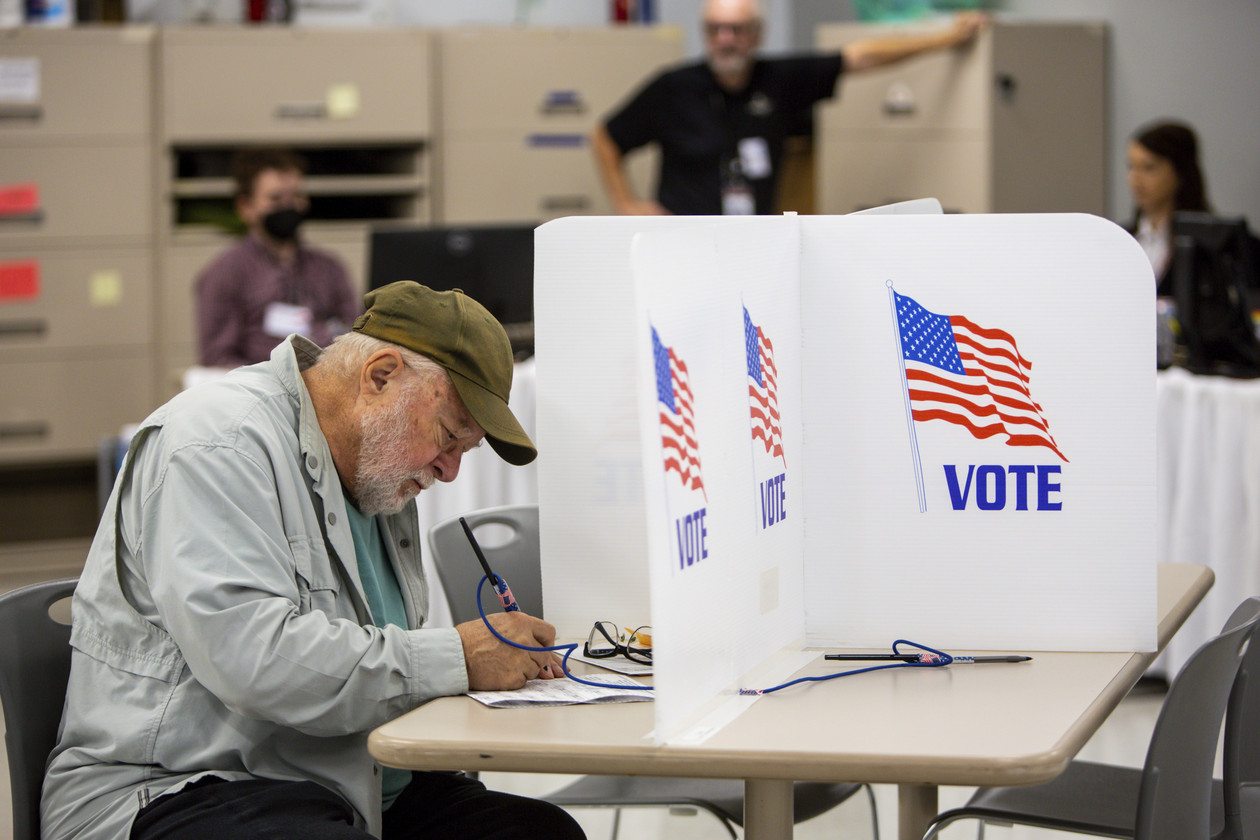
A man votes in Minneapolis (Photo by Nicole Neri, AP)
In four special elections held since the decision in Nebraska, Minnesota and New York, "The portion of registered voters who cast ballots averaged 27 percent in suburban and urban counties, compared to 22 percent in rural counties," Politico reports. Before the decision, rural turnout rates were 18 percent. Suburban and urban rates were 19 and 20 percent respectively.

“Republicans are not as energized as they want or expected, and Democrats are very energized right now,” said Chris Walsh, campaign manager for U.S. Rep. Pat Ryan of New York, who defeated his Republican challenger in an August special election. Democratic operatives largely told Politico that the court decision energized Democrats, while Republican campaign workers dismissed the theory. Will Dawson, campaign manager for the Republican candidate who lost to Ryan, said Democrats have created a "false narrative" claiming the midterms are a referendum on abortion. “The midterm elections are and always have been a referendum on the White House.”

Otterbein and Piper write that the GOP is "still the odds-on favorite to win a majority in the House, and inflation and dissatisfaction with Biden continue to be a drag on every Democrat running for office." John Couvillon, a pollster who typically works for Republicans, said Washington state's all-party primary in early August was a better predictor for the November elections. In that primary, there were no major differences in turnout between rural areas and bigger counties.

Tuesday, September 06, 2022

Group that helps with abortion access in Midwest, including flights from small, rural airports, sees a spike in interest

A group called Elevate Access arranges transportation to abortion clinics from small airports. (Photo via The Daily Yonder)

"An organization that facilitates safe abortion access in the Midwestern United States says that it will most likely double the number of clients they support this year compared to last year," Kristi Eaton reports for The Daily Yonder. "Midwest Access Coalition assists with the costs of obtaining an abortion, including transportation, gas, food, medication and child care. . . . In 2021, the organization supported 800 people seeking abortions. This year, that number was reached in mid-July, meaning that they will more than likely double the number for 2022." So says Alison Dreith, the organization's director of strategic partnerships.

Dreith told Eaton that while Midwest Access serves rural and urban residents alike, rural clients often have the hardest time getting care because they live far from clinics. Many don't have the time or money to travel such long distances; in the wake of the overturn of Roe v. Wade, more are getting abortion pills online and self-managing their abortions at home because of travel difficulties.

"Midwest Access Coalition recently started a partnership with Elevated Access, which works with volunteer pilots to provide flights to patients seeking abortions and gender-affirming care," Eaton reports. Most Americans live within 30 minutes of a municipal airport, though many don't realize it because the airfields are so small, Dreith said. 

An Elevated Access employee told Eaton that these small airports offer clients privacy not found at larger airports. "There’s no TSA, there’s nobody asking you all these questions," she said. "When you drive up to the plane, the pilot welcomes you on board, flies you to where you need to go, you do your medical procedure."

"Currently, Elevated Access works with 800 volunteer pilots, but is hoping to recruit additional volunteers. Some may be more concentrated in certain areas, like California," Eaton reports. "They are specifically looking for pilots who can fly out of rural communities with patients."

Wednesday, August 24, 2022

Democrat wins U.S. House seat in largely rural N.Y. district; Republican wins the other, but Dems seem more motivated

Democrat Pat Ryan won a special House election in a largely rural district in New York Tuesday, suggesting that the midterm elections will not be a disaster for his party after all.

Ryan, the executive of Ulster County and a combat veteran, defeated Republican Dutchess County Executive Marc Molinaro by 1.8 percentage points in the 19th District, which President Biden won by 2 points in 2020 and Donald Trump won by 7 in 2016.

"This is not the result that you would expect to see in a strongly Republican political climate," NBC News analyst Steve Kornacki said on MSNBC as the race was called. "For Democrats you could not get more encouraging signs in a political landscape that looked terrible for them a few months ago." He called the 19th "a truly bellwether district."

Wikipedia maps, adapted
In a somewhat less rural New York district that is more Republican, the southwestern 23rd, GOP nominee Joe Sempolinski got just over 53% of the vote Democrat Max Della Pia in another special election, Jeff Smith of the Elmira Star-Gazette reports.

Denis Slattery and Dave Goldiner of the New York Daily News write, "Special elections tend to be an accurate assessment of the overall political climate because they attract the most engaged voters from each party, political data crunchers say."

Ryan campaigned hard against the Supreme Court's reversal of the 1973 Roe v. Wade decision that established abortion rights. "Molinaro, meanwhile, tried to focus on other issues," reports Amy Wang of The Washington Post. "The special election was closely watched as a possible bellwether for other midterm races around the country, as Democrats attempt to channel voters’ anger over the Supreme Court decision, as well as other abortion restrictions that Republican-led state legislatures have imposed since."

Grace Ashford of The New York Times looks ahead: "Mr. Ryan will be seeking a full term in Congress in November, but — in a confusing redistricting-year twist — it will not be in the 19th District. His home lies within the new boundaries of the 18th District, where he is running in November. His Republican opponent in that race will be Assemblyman Colin Schmitt of New Windsor. Despite Mr. Molinaro’s loss in the 19th District, he, too, will be seeking a full term in Congress in November — in the district’s new contours."

Based on Ryan's "impressive" win, political scientist Larry Sabato of the University of Virginia changed his ratings on the two districts, based on Ryan's win. The new 18th went from tossup to leans Democratic and the 19th went from leans Republican to tossup. "Higher Democratic voter enthusiasm likely explains Ryan’s victory," wrote Kyle Kondik, editor of Sabato's Crystal Ball.

Tuesday, August 23, 2022

In post-Roe America, some teenagers are stepping up to get and give sex education when their schools are hamstrung

Chart compares states by their required emphasis on abstinence in sex education and the availability of abortion, with squares sized for each state's population of women of reproductive age. (New York Times chart)

A growing number of teenagers nationwide "are stepping up to demand more comprehensive lessons on reproduction, contraception and abortion — and . . . if the adults refuse, are teaching each other instead," Hannah Natanson reports for The Washington Post.

Pregnancy prevention has become more important since the Supreme Court overturned Roe v. Wade, but only 29 states require schools to teach sex education; 30 states require schools to emphasize abstinence as a method of contraception; and 16 states only teach abstinence. But abstinence doesn't work on a broad scale, and many states that have restricted or outlawed abortion are the same ones that emphasize abstinence. That's a problem when about 79% of girls and and 77% of boys have had sex by age 20, and 75% of teen pregnancies are unplanned.

Sex education in the classroom is often "too little, too late," says Rutgers University public-health professor Laura Lindberg, an expert on it. Her research indicates that fewer than half of U.S. teens are told where to get birth control before they have sex for the first time, "and she noted that the teen birthrate in the United States — 16.7 births per 1,000 females in 2019 — is consistently among the highest in the developed world, though it has been declining in recent years," Natanson reports.

Social conservatives have been trying to restrict or remove sex ed for decades, Natanson reports. "And they’re especially fired up now, post-Roe and amid raging education culture wars that have delivered new laws restricting what teachers can say about race, racism, sexuality, gender identity and LGBTQ issues." Tiffany Justice, co-founder of parent group Moms for Liberty, told Natanson that teenagers advocating for better sex ed "are being pushed by activist organizations, whose purpose is making children politically literate rather than actually literate so they can become social justice warriors."

But most teens are "starved for information" and "intensely curious," according to a Utah teen who educates others. Some teens create their own programs, while others work through existing initiatives such as the Planned Parenthood Teen Council program. "The initiative, begun in 1989 in Washington state, trains teens to teach other schoolchildren sex education, then partners with willing private schools, school districts or community groups to host peer-led lessons on topics ranging from consent to contraception, depending on state law and school policy. Since its founding, it has expanded to 15 states, and last year 300 teens volunteered on 31 councils," Natanson reports. "The end of Roe appears to have driven more interest in the Teen Council program, which is poised to expand." One community health educator in Utah's Planned Parenthood chapter said they have had unprecedented interest from rural parts of the state.