Showing posts with label local food. Show all posts

Wednesday, October 22, 2025

Farm-to-prison programs can provide inmates with healthier food, support area farmers and cut some state food costs

Farm-to-prison food can sometimes help states save money.
(Graphic by Adam Dixon, Offrange)
A small but growing number of programs are working to create farm-to-prison pipelines that provide fresher food to inmates while supporting area farmers. "Using nutritious, local ingredients in a prison setting to cook food from scratch is far from the norm," reports Liz Susman Karpfor for Offrange. "A handful of correctional facilities throughout the country are reshaping the unhealthy, tasteless, even toxic diet that has historically been served to people in prison."

In states such as Vermont and Maine where department of corrections are using farm-to-prison and made-from-scratch programs, the objectives are better inmate rehabilitation outcomes, overall inmate health improvements and food cost savings. 

DOC offices that want to begin farm-to-prison initiatives should start by getting support to work through procurement processes. Karpfor explains, "Each state possesses different, often cumbersome, and poorly understood procurement policies."

While some DOC officials may believe farm-to-prison food will be expensive, many times it saves the state money. The Mountain View Correctional Facility in Maine uses flour milled in the Northeast and bakes many of its bread items from scratch. Karpfor reports, "Baking a sub roll in-house costs 5.8 cents, versus 33 cents for one purchased via a state contract."

Kyle Moore, who is the food service manager at the Marble Valley Regional Correctional Facility in Rutland, Vermont, "sometimes purchases seconds or an oversupply at lesser cost," Karpfor writes. "His staff is testing products from Salvation Farms, an enterprise using agricultural surplus to build a resilient food system in Vermont."

Michigan and Oregon have "developed high-quality kitchen and gardening apprenticeships in which participants receive certifications and can sometimes be paid," Karpfor adds. While the list of states using farm-to-prison models is small, over the past five years it has grown "exponentially."

Friday, March 14, 2025

USDA says Covid era is 'over' and cuts $1 billion program connecting schools, food banks and local farmers

Awarded USDA LFS funds for 2025 were canceled.
(Adobe Stock photo)
The Department of Agriculture has cut $1 billion in pandemic-era funding that helped schools and food banks purchase fresh food from local farmers. "About $660 million went to schools and childcare centers to buy food for meals through the Local Foods for Schools program," reports Annie Ma of The Associated Press. "A separate program provided money to food banks."

The USDA explained the cuts as a move away from pandemic-era programs that "no longer support the agency’s priorities," Ma explains. "A USDA spokesperson said in a statement, 'The Covid era is over — USDA’s approach to nutrition programs will reflect that reality.'"

Regardless of why the funding has been cut, schools, children and farmers will now do with less. "The cuts will hurt school districts with 'chronically underfunded' school meal budgets, said Shannon Gleave, president of the School Nutrition Association," Ma writes. Gleave told Ma, “In addition to losing the benefits for our kids, this loss of funds is a huge blow to community farmers and ranchers."

With student lunch money drastically cut, some school districts will have to scramble to feed hungry students. Beyond that problem, the USDA's new priorities have left some teachers and administrators frustrated and disappointed. Patrick Tutwiler, Massachusetts state’s education secretary, told AP, "There’s a clear misalignment around what is important and what matters. We are seeing this cut of the LFS program as a first step towards deeper cuts.”

Some Washington lawmakers have proposed restricting free school meals. Ma reports, "Proposed spending cuts to fund Republican’s tax bill include raising the poverty level needed for schools to provide universal free meals without an application," Ma adds. "Restricting eligibility for food assistance programs and requiring income verification for free or reduced-price school meals, two proposals for cutting costs, would also likely cut out eligible families from accessing food."

Friday, July 05, 2024

Friday quick hits: Rural top-flick picks; dairy funds; heat can kill; racial voting division; bread debate; hop on a new train

Eita Okuno, Anna Sawai, and Hiromoto Ida in 'Shōgun.' (FX /IMDb image via The Daily Yonder)

On steamy days when the pool is too crowded and you can't handle any more of Mother Nature's energy-sucking heat, it might be time to chill indoors and take in a rural flick. From the "Mad Max Saga" to wrestling's fierce Von Erich family drama to the stunning "craftsmanship and costuming" in "Shōgun," Adam B. Giorgi of The Daily Yonder has some fine movie picks that will make relaxing in the AC much more fun.

In states with the highest number of drug overdose deaths, patients in treatment for mental illness often live with an opioid use disorder that mental health clinics are unable to treat, a study showed. "Despite high rates of opioid use disorder among people with mental health disorders, only a third of community outpatient mental health treatment facilities in 20 high-burden states offered medications for OUD," reports Shannon Firth of MedPage Today. "Among the 450 community outpatient mental health treatment facilities surveyed, weighted estimates showed that 34% offered medications for OUD, reported study co-author Jonathan Cantor, PhD. JAMA Network Open published the study in June.
Jersey Scoops capitalized on the USDA's new small
dairy initiative. (Jersey Scoops photo)

What's better than locally made ice cream or homestead cheeses? More of both. At least that's what the Department of Agriculture seems to think. The USDA is funding a new initiative that "aims to transform and diversify the dairy industry, one small producer at a time," reports Naoki Nitta of Civil Eats. "At 'Jersey Scoops' in Loleta, a small, unincorporated community in Northern California’s Humboldt County, the ice cream is as fresh as it gets. From pasture to parlor, its organic, butterfat-rich milk travels less than 10 miles, produced by a herd of Jerseys pasture-raised on the misty coast. . . . But Jersey Scoops didn’t get here on their own; they leveraged a $60,000 grant from the Pacific Coast Coalition’s Dairy Business Innovation Initiative to secure both the space and equipment." Learn about how local cheese ventures are leveraging this funding here.

As global temperatures continue to spike, awareness of heat-related illnesses is especially vital for outdoor workers and their employers. Heat can make workers sick, but it can also be deadly, reports Seth Borenstein of The Associated Press. "With much of the United States, Mexico, India and the Middle East suffering through blistering heat waves. . . several doctors, physiologists and other experts explained what happens to the human body in such heat." To find out how heat kills, click here.
Handmade bread is much different than mass produced
loaves. (Bluegrass Baking Company photo)

Bread is considered a U.S. family staple for affordable nutrition, but the processing that creates a uniform and stay-fresh loaf has landed "packaged bread in the middle of a fraught debate over 'ultra-processed food,'" reports Jesse Newman for The Wall Street Journal. "Less-processed foods tend to be more expensive and quicker to spoil. . . . For bakers like Jim Betts, owner of Bluegrass Baking Company in Lexington, Ky., most packaged bread is a far cry from the food that has been sustaining humanity for at least 10,000 years." To read why homemade bread is so dramatically different and more pricey than store-bought loaves, click here.

The U.S. rural-urban voter divide primarily exists among whites, a new study published in Politics, Groups, and Identities found. Kate Blackwood for PHYS.org reports, "When it comes to politics, Black and Latino residents of rural America differ far less, if at all, from their urban counterparts than do non-Hispanic white residents, the researchers report." One of the study's authors, Suzanne Mettler, told Blackwood, "Rural and urban Americans began moving apart politically in the late 1990s, and the division has widened and deepened since then. . .We wanted to know whether all Americans, regardless of race and ethnicity, are swept up in this growing cleavage.

A Borealis Amtrak train rounds the corner
surrounded by Midwestern fall colors. (Amtrak photo)
Midwestern states have been busy working to add more train services to their transportation portfolios. The new Amtrak Borealis service between Chicago and St. Paul opened last month after 12 years of planning, reports Daniel C. Volk of Route Fifty. "The new service was also a breakthrough. It is the first new passenger route launched in Minnesota since 1975, and the first in Wisconsin in more than two decades. . . . Officials in both states — like dozens of others across the country — are now planning for even more new passenger routes, because of incentives in President Joe Biden’s 2021 infrastructure law." Borealis trains include wide reclining seats, ample legroom, free Wi-Fi and views of the Mississippi River between St. Paul and La Crosse, Wisc., in daylight in both directions across Wisconsin.

Friday, May 03, 2024

Healthier school lunches with locally grown food is more of an option after USDA 'tweaks' standards

Schools will be able to request 'locally grown, raised or caught food' for student meals.
(Adobe Stock photo)
The Department of Agriculture recently released its long-anticipated school meal nutritional standards, including new guidelines focused on lowering sodium and limiting added sugar in students' meals. The standards also include a "small tweak [with] big implications for the increasing number of schools working to get more fresh fruits, vegetables, and meats produced by nearby farmers onto students' trays," reports Lisa Held of Civil Eats. "Starting July 1, when districts put out a call for an unprocessed or minimally processed food — whether it's tomatoes, taco meat, or tuna—they'll be able to specify that they'd like it to be 'locally grown, locally raised, or locally caught.'"

The USDA's change aims to allow schools to specifically request food from regional growers so that farmers and educational communities can work together to provide students with healthier meals produced closer to home. Held explains, "Karen Spangler, the policy director for the National Farm to School Network, said the change has long been a priority for the group because it often hears how the shift will simplify the process for school nutrition directors while also making it possible for more farmers to get involved in the first place."

Connecting school meals and area food has been a work in progress since 2010. "When Congress passed the Healthy, Hunger-Free Kids Act . . . . It was the first Child Nutrition Reauthorization to push nutrition to the forefront of school meal programs, and it included the first federal farm-to-school grants," Held writes. "Since then, the federal government has supported the efforts in additional ways, alongside numerous state incentives and grant programs as well as work done by nonprofit organizations."

Part of the local-to-school push includes making the bidding process easier for schools and local farming businesses to collaborate. Apple procurement is one example. Held reports, "If the district is confident that plenty of in-state orchards have enough Macintosh and Granny Smiths to satisfy their students' appetites, it could specify up-front that it only wants bids from in-state orchards."

While advocates for more local food are celebrating the change, some feel it is long overdue. "Previously, Rep. Chellie Pingree (D-Maine) attempted to go the Congressional route to make [local food to schools] happen, introducing the Kids Eat Local Act multiple times with bipartisan support," Held writes. "But the bill never went anywhere because the overall Child Nutrition Reauthorization process is now nine years overdue. . . . Pingree plans to continue to reintroduce the bill so that it will eventually be set in law and therefore be more likely to stick."

Tuesday, March 26, 2024

Rural residents often have limited retail choices for groceries and staples; when dollar stores close, they have even less

In some small towns, dollar stores add grocery and staple options in remote areas with few or no alternatives. In other cases, dollar stores were built right next to the local grocery store, slowly chipping away profits and eventually closing the local business. In both scenarios, rural residents rely on dollar stores for affordable staples. When they close, rural people have fewer options.

"Even though inflation is cooling, prices are still higher than they were pre-pandemic. They've hit low-income consumers the hardest, which is why many shop at dollar stores," report Bianca Facchinei and Emily Grossberg of Scripps News. "Dollar stores aren't just about saving money; sometimes, they're the only option." Consumer Reports deputy editor Brian Vines told Scripps News, "So many smaller mom-and-pop and independent stores have had to shutter because of competition from dollar stores, and those very communities now are faced with the very real threat of having no retail."

Last week, Dollar Tree said, "It plans to close 600 underperforming Family Dollar locations between now and June," Facchinei and Grossberg add. "An additional 370 Family Dollar and 30 Dollar Tree stores will close at the end of each store's current lease term."

Vines hopes the closures may offer opportunities for new growth. Vines told Scripps: "We're thinking about independent grocery stores or other folks who can really provide robust offerings. They see fertile ground now that those value retailers who've undercut them in the past aren't operating in the space."

Larger retailers used their dominance to push suppliers and squeeze competitors during pandemic, FTC report shows

Larger retailers used the pandemic to 'come
out ahead.' (Photo by S. Lee, Unsplash)
American grocery prices remain usually high, and many smaller-scale grocers still struggle to recover from pandemic setbacks. A new Federal Trade Commission report sheds some light on how larger retailers used their power to push suppliers to deliver to them first, which caused more struggles for smaller competitors and may be partially to blame for why grocery costs have remained high even as overall inflation has cooled.

"Federal regulators said large grocery chains used their size and scale to keep shelves stocked during the pandemic, edging out smaller rivals when most stores struggled with product shortages and distribution bottlenecks," reports Liz Young of The Wall Street Journal. Many larger retailers put "stricter delivery requirements into place and fined vendors that didn't comply. . . The demands led many suppliers to route more goods toward those retailers to avoid the fines."

FTC Chair Lina Khan told the Journal, "Dominant firms used this moment to come out ahead at the expense of their competitors and the communities they serve." Young reports, "The agency said revenue growth at grocers outpaced the cost increases many of them faced from suppliers, suggesting that higher profits 'warrant further inquiry by the commission and policymakers.'"

While supply bottlenecks thwarted smaller grocers during the pandemic, "Some of the largest U.S. retailers, including Walmart, Home Depot, Costco and Target, chartered their own cargo ships in 2021 to import goods and get around the chokepoints," Young writes. "Small grocers say the pandemic exacerbated their longtime struggles to compete with bigger retailers." Robert Buche, chief executive of South Dakota grocery chain G.F. Buche, told Young, "Covid just made it more obvious what's been happening for years with us independents."

Friday, November 03, 2023

Finally Friday quick hits: Top rural restaurants, the 70-ingredient sandwich; farmer side hustles, Snoopy therapy

Amano’s in Caldwell, Idaho. L.A. Birria Tacos, left,
(braised beef & quesillo); right: Chef Salvador Alamilla
What's for dinner tonight? Consider one of these gems, or take a peek at their menus for inspiration. Here's the 13 Best Restaurants in Rural America 2023.

To help fill in money gaps, many farmers find creative ways to bring in additional income. "Many turn to the online resale market to buy items for cheaper prices or a place to sell quality items for extra money when economic times are uncertain," reports Marion Kirkpatrick of RFD-TV News, which covers rural America. "While it takes hard work and dedication to pick up this 'side hustle,' it can be a great outlet for farmers and rural Americans to help make ends meet." Here are six things farmers can sell online.

While research into beef consumption isn't always encouraging for meat eaters, it can be good to stay informed on what science is telling us now. Even if we're still going to have steak tonight.
Illustration by TCD, Prod.DB, Alamy via The Atlantic

If you're overwhelmed by extreme weather, war, corruption, elections and life in general, reading Snoopy can help, advises Elise Hannum of The Atlantic. "Snoopy can’t help but feel overwhelmed in a tumultuous world. Sound familiar?"

As the world’s beaches and oceans have become one giant ashtray, research has accelerated on what many are calling a global crisis: cigarette butts, reports Jude Isabella of Hakai magazine. "Researchers have published a number of studies in 2023 on the problem of cigarette butt littering, from a review of studies on environmental contamination to a global analysis of the crisis. In fact, the number of studies is on the rise, with researchers publishing twice as many in 2022 compared with 2021."

Yes, it’s back. It always comes back. (McDonald's photo)
The strange and surprising journey of McDonald's McRib begins in a Nebraska lab and ends with a 70-ingredient sandwich. "Roger Mandigo is an emeritus University of Nebraska animal science professor credited with the technology that made the McRib possible," reports Peggy Lowe of NPR. "And here's its story, straight from the meat scientist's mouth." For fans, the McRib is coming back to select restaurants in November 2023, reports Mary Walrath-Holdridge of USA Today.

Tuesday, May 16, 2023

The heart of homesteading is gleaning from the land, creating community and meeting life on your own terms

Natalie Bogwalker's daughter steals a bite before preparing
a wild salad. (Photo by Travis Dove, The Washington Post)

Since the 1960s, farmsteading has been an option for people who want to meet life on their own terms through farming, animal husbandry and lifestyle choices that lean on nature and community bonds for support, reports Chris Moody of The Washington Post. "It’s a common misconception that the goal of homesteading is total self-sufficiency, says Natalie Bogwalker, 44, owner of Wild Abundance, a hands-on education center that teaches homesteading skills near Asheville, N.C. She defines homesteading simply as 'living in a way that meets a lot of your needs from the land.' That can include gardening, permaculture, carpentry, building infrastructure. . . . A veteran homesteader who has been living largely off the land for more than 20 years, Bogwalker says community is a crucial part of making the lifestyle sustainable."

Jess McClelland and Alex O'Neill didn't pursue the homesteading life; it's more like they discovered it. McClelland told Moody, "We had never even thought about homesteading seriously until Covid. . . . It made traveling around and moving seem not like an option anymore. We were finally stopped somewhere long enough where we realized we could do this and have a garden. And once we started, it was like, 'Oh my God, this is the best thing in the world.' In January 2022, McClelland and O'Neill bought a two-bedroom, one-bath white country house tucked in the Appalachian high country." Moody adds, "They are modern-day homesteaders who have traded contemporary conveniences such as Uber Eats deliveries and a reliable internet connection to grow much of their own food and — as much as possible — live off the land in rural Appalachia."

Each homesteader individual has their own story. "Homesteaders are motivated by a range of forces, from a longing to take more control over life to wanting to seek a better diet, says Jessica Shelton, editor of Homestead.org. Most of all, it provides an opportunity to pursue a home life on your own terms," Moody reports. Shelton, who grew up on a 300-acre cattle farm in the Ozark mountains, told him, "Some are sick of the hustle and bustle of modern life. Others want to move away from commercialism and all the plastic packaging that comes with it."

"Bogwalker says she initially had a purist attitude. . . . Focusing on developing wild survival skills while foraging food and growing what she couldn't find. When she moved to North Carolina, she lived in a bark hut she constructed herself. . . . In 2011, she bought a seven-acre piece of mountain land. . . . She built a 12-by-16-foot log cabin from white pine trees on the land. . . .Hundreds of people visit the property each year. They learn carpentry, permaculture gardening, foraging and natural building in open-air pavilions while camping on the property or staying in rental homes nearby."

Beginning life as a homesteader can be expensive and daunting. "For newcomers to homesteading, Bogwalker offers sound advice: Go slow. Instead of immediately investing thousands of dollars in building projects and agricultural tools, observe the land carefully for a full year before diving in," Moody reports. She told him, "Burnout happens when you don't do things like take a Sabbath or associate your self-worth with your productivity and purism. The idea that you're a failure if you don't grow 90 percent of your own food? That's when people quit."

Monday, May 15, 2023

Texas starts Willie Nelson Endowment to help rural places and gives him the LBJ Liberty and Justice for All Award

Willie Nelson keeps bringing rural back into the conversation.
(Photo by Jay Janner, Associated Press)

Through song and advocacy, Willie Nelson knows about traveling long country miles to help farmers through Farm Aid. Even when an evening is in his honor, he takes the stage to rally for rural America, and showcase a new endowment to support it.

"A lot of people don’t realize where their food comes from, Willie Nelson said Friday night on the front porch of the Lyndon B. Johnson Presidential Library," reports Robert T. Garrett of The Dallas Morning News. "Nelson asked the crowd, 'When they had breakfast this morning, did your food come from a farmer out here who raised his own? Is he feeding you? Are you getting it from some farm-to-market? These are things that you need to think about. . . . How you can help the local communities, help the local farmer – because he’s trying to make it.'”

Nelson was at the library to get the LBJ Liberty and Justice For All Award for his work advancing equal opportunity for all, and to celebrate the new Willie Nelson Endowment for Uplifting Rural Communities in the LBJ School of Public Affairs at the University of Texas, which "will fund research and student fellowships on sustainable agriculture and water, food insecurity, resilient energy and natural disaster recovery," Garrett reports. "Just as Farm Aid raised popular awareness of rural America’s crisis, the new Nelson endowment hopes to plant seeds about overlooked regions with rising public-policy intellectuals, explained Sheila Olmstead, a professor of public affairs at the LBJ School."

Nelson was born in the small town of Abbott, north of Waco. Garrett writes, "Over the past half-century, Nelson probably has done more than any other political or cultural figure to raise awareness that rural areas need help, Johnson’s two daughters, Lynda Johnson Robb and Luci Baines Johnson, said in interviews." Robb told Garrett, “He made a difference in the whole country’s recognizing how we need to support all parts of it and not just people who live in the cities." Her sister said, "Willie Nelson came and shook this country to its senses and said, ‘By gosh, we’ve got to care for the hand that feeds us.’ He reminded us how important they [farmers and ranchers] are."

Nelson launched Farm Aid with Neil Young and John Mellencamp in 1985, and is clearly proud of it. He told the crowd, "Farm Aid maybe had a lot to do with taking care of some of the farmers when they really needed help. . . . Somebody had to do it. We were there. We did it."

Thursday, May 04, 2023

Secret of sushi's success, from a Southern California farm

Los Angeles Times photo
A little meme said, "It's not all about avocado toast anymore; it's all about protein bowls and sushi; sushi is always in." But why? It's the rice, reports Daniel Miller of the Los Angeles Times: "Koda Farms played a key role in the spread of sushi in Los Angeles in the 1960s, said Atsuko Kanai, daughter of Noritoshi Kanai, who helped popularize the cuisine in the Southland. Without Kokuho Rose, the farm's special strain of medium-grain rice, his sushi gambit might have failed. Atsuko, whose father visited Koda Farms in 1963 and struck a distribution deal to wholesale the Kokuho Rose rice to L.A. restaurants, told Miller, "There were a few things that made sushi possible — No. 1 and most pivotal was the rice Koda Farms … [made. It was] a more palatable rice that could be served in sushi."

"Launched in 1962, Kokuho Rose was developed by Koda Farms in conjunction with rice breeder Arthur Hughes Williams. The heirloom variety, Koda said, crossed a California medium-grain rice with a Middle Eastern long-grain to create a new, higher-quality medium-grain offering," Miller explains. "The rice was a revelation: Until the invention of this medium-grain strain, what had been available to make sushi in California was 'tasteless, couldn't retain moisture, and would get brittle as it cooled down,' said Anthony Al-Jamie, editor in chief of the Japanese culture magazine Tokyo Journal."

One might not have happened without the other. "It isn't just Atsuko Kanai who has touted the significance of Koda Farms' contribution to L.A.'s sushi supply chain. Al-Jamie said that the creation of Kokuho Rose was 'essential' to the spread of sushi across the region," Miller reports. "Without the heirloom rice, Al-Jamie said, 'I don't think [sushi] would have taken off' when it did. . . . In more recent years, Koda Farms' rice has won acclaim from chefs and food publications. In 2020, Sunset magazine dubbed it the 'Holy Grail of California Rice.'. . . But, in a twist, Kokuho Rose is no longer a sushi bar staple, with chefs now preferring short-grain rice. In the 1980s, Koda said, more Japanese short-grain rice became available in the U.S. market, which may explain the change. That rice, she said, is 'more sticky' than Kokuho Rose, and 'it seems to be a preference' among sushi chefs."

Thursday, February 23, 2023

Ohio derailment and chemical burn 'upended' farm and rural life and businesses, and left big questions about future

Pam Mibuck is thinking about leaving her 14 acres.
(Photo by Brian Kaiser, The New York Times)
What is it like to return your home, your farm, your animals, wildlife and the creek, all perhaps chemically altered by a controlled burn of toxic liquids? The Norfolk Southern train derailment East Palestine, Ohio, "upended an area where generations of families could afford to buy acres of land, raise horses and plant gardens, hunt deer and birds, and build lives undisturbed by the chaos of bigger cities nearby," writes Emily Cochrane of The New York Times. "Although farming provides only a small number of jobs in the immediate area, many residents say that raising livestock and working the land are profoundly important to their way of life."

Farmer Pam Mibuck's land was blanketed by post-burn chemical film. "After the chemicals were released, Tina, the amiable white turkey that Milbuck bought less than a year ago for $3, was put on antibiotics for respiratory problems, and her chickens laid eggs with an unsettling purple hue," Cochrane writes. "Her son in California is urging her to move away, offering to build a barn on his land for her two horses, Samuel and Razor. Mibuck, who works as a custodian at a university, is seriously thinking about leaving the 14 acres that she considers a slice of heaven."

Despite state and federal assessments and testing, "Farmers determined to weather the unknown remain fearful about whether their customers will continue to trust their product," Cochrane reports. Greenhouse operators Dianna and Don Elzer "had predicted that this would be their first normal Valentine’s Day. Even when they were required to evacuate for a few days, driving to Pittsburgh, they came back daily to water and care for their plants — the palms, the herbs, the succulents — and returned as soon as they could. On Feb. 14, they had one customer: a man who bought a single red hibiscus tree. Mr. Elzer, 67, told Cochrane, “No one wants to come here. There’s no way to counterattack the publicity and perception.”

The explosion has permanently altered futures. "Michael McKim had a business dream he shared with his wife: an affordable destination winery in East Palestine. . . . The winery’s grand opening is still set for St. Patrick’s Day. . . .Yet the family business has been rattled by the derailment: Most of the bridal showers, wedding receptions and events scheduled for this year have canceled. Mr. McKim told Cochran, "It’s a tragedy. I could make the best wine in the United States, in the world, and someone could say, ‘Hey, isn’t that where the train derailed?’"

Last night on CNN, in a conversation with a few East Palestine residents, Norfolk Southern CEO Alan Shaw pledged "apologized and vowed to make it right through proper cleanup and reimbursing residents," as well as helping rebuild the town's reputation.

Monday, February 13, 2023

Opinion: Vilsack finally acknowledges UDSA's failings, but seems not to recognize that there are two rural Americas

Agriculture Secretary Tom Vilsack, left, at a beef processing plant
in Omaha, Nebraska. (Photo by Josh Funk, The Associated Press)
While this year's Farm Bill debate takes shape, commentators Bryce Oates and Jake Davis take Deparment of Agriculture Secretary Tom Vilsack's "sales pitch" to task in their opinion for The Daily Yonder.

"Vilsack says he will help make the case for additional local food, climate change, and conservation investments," Oates and Davis write. "His advice is to frame the debate around a basic question: 'Do we want a system that benefits the few, or do we want a system that benefits the many and most? . . . There’s got to be a system in which the many and most have a fair shot.' . . . While there are certainly strong points to Vilsack’s public-relations strategy — particularly the acknowledgment that USDA has done a poor job of supporting anyone but the largest and most wealthy row-crop and livestock operations — the rhetoric fails to resonate with the realities of life in the trenches for many of us doing farm-and-food-system reform work."

The lack of policy depth is a problem, they write: "Vilsack’s 'We support farmers of all sizes' balancing act fails to address the very real and interrelated issues of corporate control over markets, manure pollution from industrial livestock factories, continued increases in climate emissions from agriculture, and massive economic inequities between government support of farming operations. Vilsack is talking a big game but failing to deliver the actual policies that will get to the root of key farm and food system challenges."

In the meat of it, they opine: "After a decade of experience on the job, Vilsack finally gets the problem right. But once again, he is getting the politics for the solutions all wrong. Whether he wants to admit it or not, there are two rural Americas. There are the chosen few in every community currently thriving in the corporate-dominated system — primarily those same commodity producers that continue to be propped up by federal farm policy —and then there is everyone else."

What are some solutions? "Without serious reforms, Wall Street investors will continue to press for more giant farms dependent on low-wage workers increasingly difficult to hire," Oates and Davis write. "The rural places we love in farm country will continue to hollow out until little is left of community identity, local institutions, or public services.  . . . Like the thousands of advocates and organizers we regularly work with on farm and rural policy and analysis, it’s time we admit that the Vilsack approach is a political loser."

Oates and Davis offer some final thoughts: "There are, of course, many provisions in the Farm Bill we support that could help the majority of rural America, but that would mean reshaping who has the power in our food system. That would mean funding the right tools and opportunities so that rural people have a better life and some kind of vision of a potential economic future. That would mean taking on the Farm Bureau and their allies in the Agribusiness C Suites, the exact kind of place where Secretary Vilsack spends his time between presidential appointments."

Wednesday, January 18, 2023

Smaller produce growers wary of proposed Kroger-Albertson's merger; groups try to block it and similar deals

(Photo by Scott Olson, Getty Images)
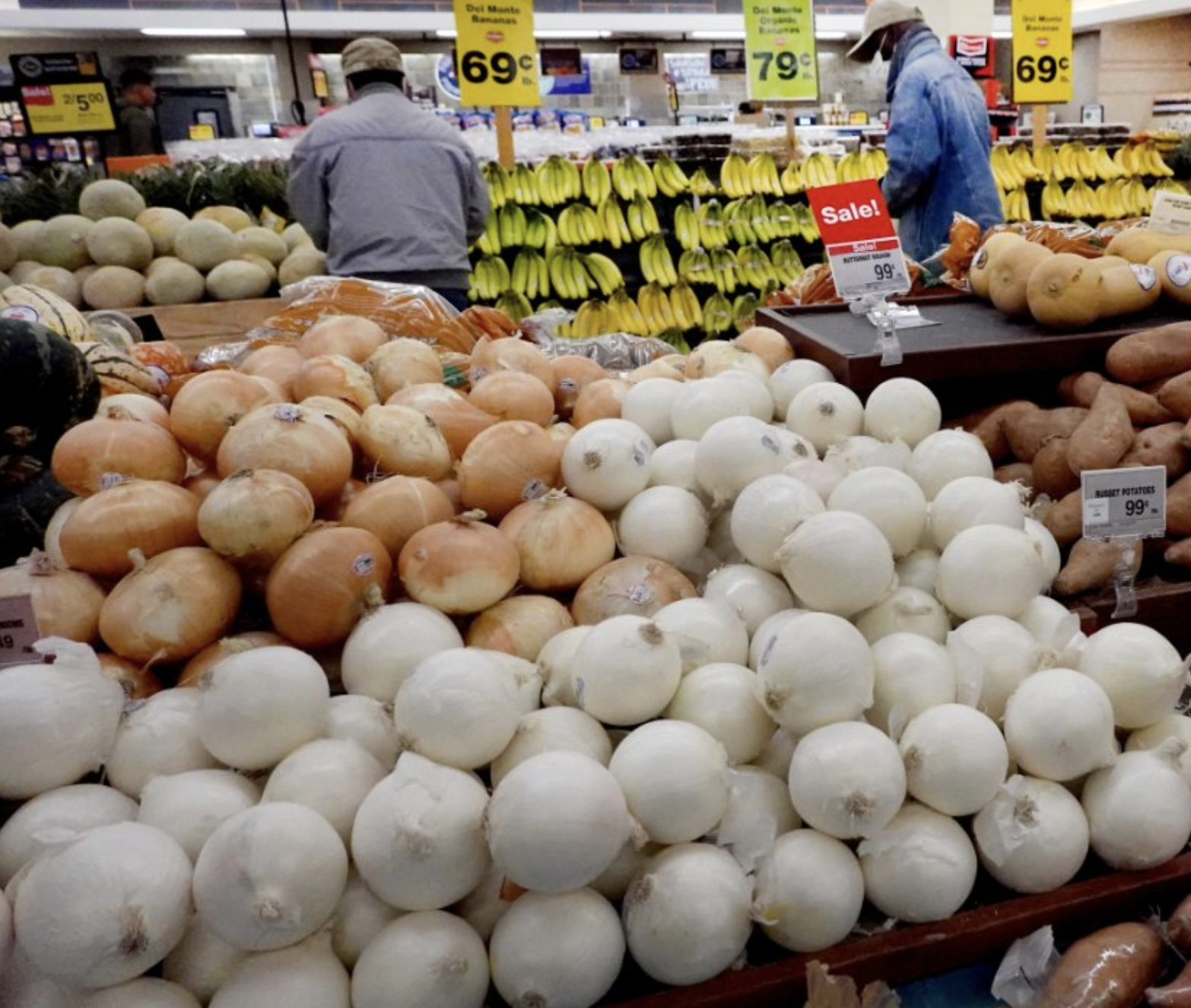
For many small to mid-sized produce farmers, dealing with corporate squeezing has been an increasing struggle for the past 30 years, but the potential sale of Albertson's to Kroger could further pinch their limited access to markets, possibly wedging out some farmers while giving consumers fewer options, reports Lisa Held of Civil Eats. 

Case in point is Shad Dasher, a self-described "onion man," who is a "third-generation Vidalia grower in Glennville, Ga., a small town in one of the 20 counties where the special sweet onions are produced. But unlike his father and grandfather before him, he’s urging his five children to consider other professions," Held writes. "That’s because with 40 acres he can’t make a profit selling his onions to supermarkets anymore. Dasher told Held, "It used to be that a small to medium-sized farmer could carry his produce to a mom-and-pop grocery store chain and bicker with the produce manager, and you’d have your fresh produce sold within 20 miles of the farm. . . . the circle is getting smaller and smaller to sell to.”

Vidalia onion farmers are an example of the challenge huge retailers present. Held reports: "Cliff Riner, chairman of the Vidalia Onion Committee, said that in the mid-2000s, there were about 200 Vidalia farmers. Now, about half of them are gone, he estimates, but the 100 that are left are farming the same number of total acres in addition to bringing in onions from South America. It’s a familiar story seen all over the country: there are fewer, larger farms, and the smaller ones are being squeezed out."

The Kroger-Albertson's merger "would be one of the biggest deals in grocery history," Held writes. "While a wide range of advocacy groups have been pushing back on the merger based on claims it will hurt workers and consumers, less attention has been paid to the impact on farmers, who, along with advocacy groups are speaking out about how the deal could worsen what has already become an impossible retail market for many small- and mid-size producers."

Held says farmers have been given two choices: grow big to compete, or throw in the towel. She writes, "Susan Pavlin, a food system expert who has worked with various food hubs and cooperatives, labeled the current options 'two parallel systems,' and explained that most food-system reform has been focused on building regional markets that support smaller farms, but those markets are still comparably tiny." Pavlin told Held, "The cost of things will never come down in the regional, small farm system if there’s not some scale, and to have scale you have to have a certain number of buyers. If there are a few big grocers that have 100 percent carte blanche, then there’s never going to be pressure to merge the models.”

The support of regional farming needs multiple prongs, Held writes: "It’s why advocates support the Biden administration’s recent initiatives to invest in regional food systems, but say those actions must be paired with more aggressive antitrust regulation, including blocking mergers like the Kroger-Albertson’s deal and more continuous attention to policing corporate concentration in the food system."

Thursday, December 22, 2022

On-farm slaughter growing in rural Vermont, but depends on services of itinerants; USDA rejects requests to relax rules

Itinerant slaughterers load a quartered beef carcass after an on-farm slaughter.
The meat will be taken to a slaughterhouse to be processed and packaged.
(Photo by Alex Driehaus, Report for America/Valley News)

Since the intense meat shortages and processing-plant closings of the early pandemic, itinerant slaughterers in rural Vermont have become an increasingly popular way for farmers to kill animals for personal consumption, reports Frances Mize of the Valley News of West Lebanon, N.H., and White River Junction, Vt. Now, as a means to ease backlogs in those abattoirs, Vermont livestock producers are looking for ways on-farm slaughter meat could be sold more broadly.

Last year, Vermont's farm and ranch community asked the U.S. Department of Agriculture "to allow meat from on-farm slaughters to be sold in small 'animal shares,' which would operate like community-supported agriculture," which lives on annual subscriptions from consumers. USDA declined, "but before the refusal, and with renewed force since, Rural Vermont, a Montpelier-based nonprofit focused on bolstering community-scale agriculture, has continued advocating that the rules be relaxed so consumers and farmers alike have more choices," Mize reports.

Mize gives readers an up-close description of on-farm slaughter. She attended a kill at the home of farmer who had hired an itinerant slaughterer, and wrote: "Tom Havill’s herd of cattle watched from a hillside as one of their own — secured in a holding pen — lost its life to a single shot fired by Chet Miller," Mize reports. Havill told Mize that he still can’t watch his animals being killed.

Miller told Mize he also has mixed feelings about his work: "It’s not a glorious occupation. I have a lot of people who appreciate me, and my calendar is full of people that need my help. But sometimes I wake up in the middle of the night, and what I’m doing lays heavy on me.” Mize writes, "Some are advocating that the service Miller offers farmers through his work — doing the difficult job, which many of his customers couldn’t do themselves, of killing the animal that they’ve raised — should be reconsidered as a tool toward a more versatile, modernized food economy."

Caroline Gordon, Rural Vermont’s legislative director, told Maze, “People are feeling that the need for more resilient food systems has become apparent. The trust and transparency of our current economic system was called into question during the pandemic. . . .On-farm slaughtered meat allowed to be sold as a product, even within a small market, could alleviate some of the stresses on the slaughterhouses, some of which are booked up for many months."

Monday, December 19, 2022

Delicious, nutritious and nutty, Low Country heirloom Carolina Gold rice has been revived and is again for sale

South Carolina's St. Helena Island offers a glimpse into our country's
crop heritage. (Photo by David McLain, National Geographic)
Ingredients for dishes like smoky collards and New Year's favorite Hoppin’ John were introduced to American tables by enslaved Africans. The West African diet has "a long tradition of eating plant-based whole foods—so-called blue-zones-type foods—has been handed down from generation to generation," reports Dan Buettner of National Geographic. "The Gullah Geechee people are descendants of enslaved West Africans captured in places such as Senegal and Angola and brought to the Low Country of South Carolina and Georgia to cultivate Carolina Gold rice."

Carolina Gold is "a unique heirloom grain. A West African strain, it was first grown, cultivated, and cooked on American soil by enslaved peoples on plantations," Buettner writes. "In the 19th century, it became the dominant rice in the U.S. market, only to all but completely disappear after the Great Depression. Though you couldn’t find it on grocery store shelves for decades, it was legendary in the Low Country for its unique starchiness and earthy, nutty flavor."

BJ Dennis, a South Carolina chef, told Buettner he was on a mission to bring back the cuisine of his rice-growing ancestors. “We took the rustic soul of the Africans and the Native American techniques and made this special mash-up,” Dennis told Buettner. "The resulting cuisine is uniquely American, explosively delicious, and as I’ve been discovering, it draws from ingredients that support longevity."

In Savannah, Georgia, Buettner met "Roosevelt Brownlee, a 75-year-old dreadlocked Gullah chef who has cooked for the likes of Stan Getz and Nina Simone," Buettner reports. "In a backwoods kitchen, he and his cousin Rollen Chalmers whip up 'pink-eyed soup,' hoecakes and red peas—all accompanied by Carolina Gold cracked rice. As his T-shirt proclaims, 'Rice Is Life.'"

Thanks to the efforts of people Dennis and Chalmers, Buettner writes, "You can now find Carolina Gold rice again on grocery store shelves and online."

Friday, September 10, 2021

Quick hits: Docuseries explores why people live in rural areas; Biden drops nominee to head ATF after pushback

Here's a roundup of stories with rural resonance; if you do or see similar work that should be shared on The Rural Blog, email heather.chapman@uky.edu.

A seven-part docuseries called "Rural by Choice" tells the story of why people choose to live in rural Minnesota. The first episode will premiere on Sept. 12, with the rest of the episodes premiering each week afterward. Click here for more details, including how to watch.

The White House has withdrawn David Chipman's nomination for director of the Bureau of Alcohol, Tobacco, Firearms and Explosives after sustained pushback over his record of gun-control advocacy. Read more here.

As cell-cultured meat gets ever closer to hitting store shelves, the Agriculture Department's Food Safety and Inspection Service is seeking consumer comments on how such products should be labeled. Suggestions will be accepted until Nov. 2. Read more here.

"In summer 2020, a federal court ruled the Environmental Protection Agency showed too much deference to Bayer when it approved the company’s dicamba herbicide. This invalidated the approval. But, weeks later, Bayer began working the EPA again, according to newly obtained emails," Jonathan Hettinger reports for the Midwest Center for Investigation. Read more here.

Mountain Valley Pipeline developers have filed a subpoena seeking to find out the names and phone numbers of the people who run a Facebook group critical of the project. Read more here.

Local food is all the rage, but what makes food local? Read more here.

A recently published study found that single rural residents with heart disease face more hopelessness. Read more here.

A tech business owner and Columbia University professor discusses why rural students need to learn about artificial intelligence in school and what kind of education and training is needed so they can compete with their suburban and urban peers for high-paying tech jobs. Read more here.

Registration is open for a symposium on sustainable ranching practices. The event will be held Oct. 14-15 in Kingsville, Texas, and online. Read more here.

Scientists are trying to control emerald ash borers with tiny parasitic wasps. The strategy will hopefully go better than previous attempts to kill pests by using other natural predators (see: cane toads) because the wasps they're testing can't sting people and only go after the borers. Read more here.

The Rural Health Information Hub has updated its guide to critical-access hospitals to include two new FAQs on 340B eligibility and Rural Emergency Hospitals. There is also updated info on reimbursement, eligibility, funding, legislation, and more. Read more here.

Friday, July 17, 2020

Quick hits: rural Wisconsin embraces hyperlocal food production; judge blocks rollback of methane emissions rule

Here's a roundup of stories with rural resonance; if you do or see similar work that should be shared on The Rural Blog, email us at heather.chapman@uky.edu.

As pandemic batters rural African-Americans in the South, a doctor and her plant biologist husband make house calls, offer herbal remedies to ease symptoms. Read more here.

Rural Wisconsin embraces hyperlocal food production in community spaces: Read more here.

Federal judge blocks Trump administration move to ease methane emissions for drillers on federal or tribal lands: Read more here.

As economy dips, producing more food at home might help, writes one author. Read more here.

Project to explore digital agriculture's impacts on rural America: Read more here.

Monday, July 13, 2020

Coal-communities transition plan calls for 'restorative economic development' like that undertaken by Ky. nonprofit

By Peter Hille
President, Mountain Association for Community Economic Development

The coalfields of Appalachia—like coal-producing communities around the country—literally fueled the growth of the entire nation. Despite that, the coal economy didn’t create lasting prosperity in these communities. In fact, today, these are some of the most economically disadvantaged places in the US. These places that have given so much now bear the brunt of changes in global energy markets. They sacrificed lives, health, water, prosperity, ecosystems—and there is a debt to be paid.

Justice demands that we bring new investment to these places. That investment is needed to build a new economy, revitalize these communities, educate people of all ages to be prepared for new opportunities, and create demonstrations of what the new economy can look like – whether that is local food, health care, the creative economy, sustainable forestry, tourism, affordable housing or clean energy.

From here in Appalachia to Wyoming to the Navajo Nation, leaders from communities that once relied on coal are developing and implementing promising solutions to create inclusive, equitable and sustainable economic growth, driven from the ground up. These leaders need supportive public policy and investment at the local, state and federal level to accelerate this work of building a new economy.

Over the past year, the Mountain Association for Community Economic Development worked with 17 public, private and nonprofit partners from throughout Appalachia and across the country to develop a platform of seven pillars that policy makers and leaders should understand in order to support our communities. The National Economic Transition platform is based on community-driven solutions, crafted by local, tribal and labor leaders living and working in America’s coal communities. It serves as a guide for legislators and philanthropic leaders, and encourages them to develop policies and make investments that support the just and equitable national transition our communities need and deserve.

One pillar of the National Economic Transition platform calls upon policymakers to invest in restorative economic development in our communities. Here are just a few examples of how MACED has been supporting that approach in Kentucky:

We have invested more than one million dollars in solar installations for small businesses and non-profits in the coalfields of Eastern Kentucky, saving money for these vital local enterprises, making them more resilient as energy prices rise and reducing their carbon footprint.

We’ve invested in a local wood products manufacturer, helping them double in size, adding good jobs with benefits and using sustainably harvested timber.

We’ve helped addiction recovery centers get established and grow—meeting a critical need.

We’ve trained former coal miners to work in the new clean energy economy and helped them start their own businesses in this growing market.

There’s a lot more work to be done, but there is hope and determination in these places, and a fierce commitment to a brighter future. These communities can thrive again, they just need a fair chance, and that’s what the National Economic Transition platform is all about. The livelihoods of Eastern Kentuckians, and tens of millions of people across the country, rely on us getting this transition right. Our leaders must make the decision to engage and make big, bold investments in an ambitious national community and worker transition program.

MACED is based in Berea, Ky. Information on the NET platform is at nationaleconomictransition.org or by contacting Peter Hille at peter@maced.org.

Friday, June 05, 2020

Quick hits: Evangelicals vary in response to Trump's Bible photo op; Tyson reinstates policy penalizing absent workers

Here's a roundup of stories with rural resonance; if you do or see similar work that should be shared on The Rural Blog, email us at heather.chapman@uky.edu.

Op-ed advocates making investing in resilient, localized food system part of next stimulus. Read more here.

Critics say small rural businesses left out of Paycheck Protection Plan funds; Reuters analysis shows how much PPP money went to big businesses that ducked paying taxes. Read more here.

Evangelicals vary in response to Trump's Bible photo op. Read more here.

Op-ed touts solar power as economic engine in rural eastern Kentucky. Read more here.

Webinar discusses news media perspectives on mental health during the pandemic. Read more here.

Tyson reinstates policy penalizing absentee workers, but says workers with covid-19 symptoms won't be penalized. Read more here.

Friday, March 20, 2020

Economic disruption from coronavirus could cost small farmers and ranchers dearly, new research says

The closure of restaurants, farmers' markets, and other local and regional customers of farmers and ranchers could cause up to a $688 million decline in sales from March to May, according to a new analysis by a former official in USDA's Local Food Research and Development Division, along with researchers at Colorado State University and the University of Missouri. The researchers predict a payroll decline of up to $103.3 million and a total loss to the economy of up to $1.32 billion during that time period. The paper has been circulating on Capitol Hill, Philip Brasher reports for AgriPulse.

About 159,000 farms and ranches sold food to local and regional markets in 2017. The vast majority, 85 percent, are small farmers, and one-quarter are beginners, according to the study. "Congress or USDA should waive limitations on the ability of feeding programs to procure locally and regionally produced foods, and farmers should be encouraged to integrate online ordering and sales into their businesses, the paper says," Brasher reports.

"The latest Senate stimulus does not cover USDA programs or farmers, but that could change," Catherine Boudreau reports for Politico's Morning Agriculture. The National Cattlemen's Beef Association requested direct financial aid for ranchers in the next emergency aid package, and the National Corn Growers Association plans to make a similar request.

Farmers might soon face a different kind of squeeze, too: the U.S. recently closed its consulates in Mexico, which processes migrant farmworker visas under the H-2A program, Geoffrey Mohan reports for the Los Angeles Times.