Showing posts with label surface mining. Show all posts

Friday, January 12, 2024

Work is under way to create a 'significant' mountaintop renewable energy project in KY to power 170k homes

A BrightNight Starfire Renewable Power Simulation. The area is as big as Disney World.
(BrightNight image via YouTube)

As Appalachian coal production continues to decline, the region is looking at renewable energy production to fill the gap. For one mountaintop mining location, Eastern Kentucky's Starfire Mine, carefully repurposing its sprawling 27, 000 miles is already under way "with one of the most significant renewable energy projects in development in the eastern U.S," reports Kim Kobersmith of The Daily Yonder. "The success of the pilot project happening on the Starfire Mine site could change possibilities for these sorts of mines moving forward."

The pilot project offers significant promise in the short and long term. "BrightNight is a global integrated power company that designs, develops, owns, and operates large-scale renewable power projects," Kobersmith explains. "Its ambitious plan to create an 800-megawatt solar energy project, enough to power 170,000 homes annually, on a 7,000-acre brownfield could tip the scales toward future similar projects."

Developing an expanse the size of Disney World with the unique characteristics of mined land takes time, leaving BrightNight with a lot of work to complete before construction begins in 2026. "The challenges are three-fold: the physical characteristics of the site itself, the number of partners involved, and the complexity of the engineering," Kobersmith writes. BrightNight is collaborating with Rivian, a company that "designs, develops and manufactures electric vehicles and is working towards a net zero operation by 2040," and The Nature Conservancy."

Mindful of Eastern Kentuckians' history with extractive mining, BrightNight's leadership is working to connect the project to Star Mine's surrounding community. "The company is hoping to partner with area educational centers like Hazard Community and Technical College to provide training for the 250 construction jobs that will be created by the project," Kobersmith reports. "They hope to support electricity, road construction, and engineering needs for the Olive Branch Community, a state-supported flood recovery housing development slated to be built on the mine, adjacent to the renewable energy project."

Kobersmith writes, "In the case of Starfire Mine, the BrightNight Starfire Renewable Energy Center will create a taxable asset where there would not otherwise be one, generating an estimated $150 million tax revenue over the life of the project."

Adam Wells, Regional Director of Community and Economic Development for Appalachian Voices, told Kobersmith: "The narrative of renewable energy is powerful in an energy-producing region. It sends a positive message to people, not grasping at the past but looking to the future."

Thursday, August 10, 2023

When coal is no longer king in Appalachia, what's next? Symbolic funeral in new film has both pride and remorse

Elaine McMillion Sheldon's film depicts growing up
in the shadow of coal. (Sundance Film Festival Photo)
Not every place has a king, but in Appalachia, one lives, more humbly than ever: Coal. Film-maker Elaine McMillion Sheldon gives the world an enigmatic look at a fossil fuel's kingdom and its people in her movie, "King Coal."

Sheldon grew up "roving around West Virginia. Like many children of Appalachia, her world was shaped by coal – her father worked for a mining company, and the family moved to seven coal fields in 12 years for his job," reports Adrian Horton of The Guardian. "Her brother became a fourth-generation miner." Sheldon told Horton: "Everybody in my community worked in the coal mines. If you were going to stay there and work, if you weren't a doctor or a lawyer, that's what you did." Only when Sheldon left the region to study abroad, did she realize how much coal infiltrated Appalachian life. "Not everywhere has a king," she told Horton. "Not everywhere is completely dominated by this industry that controls everything from our rituals to the ways we live our life."

Sheldon's documentary "blooms in the resource's shadow," Horton writes. "It's a lyrical and visually lush ode to a region of immense richness, to mountains riven by extractive industry, to identity-shaping labor and unions, to the inheritance of coal culture. There are no location markers, no delineation between towns, states, mines, mountains." Sheldon told him, "We just define it as the kingdom," a common culture and economy without strict borders.

Sheldon shot all over the Appalachian coalfield, from Pennsylvania to Tennessee. She told Horton, "I'm very aware of how people perceive Appalachia. . . . . I grew up feeling that the place I was from was somewhere to be embarrassed of, and I don't want people to feel that. . . . I want people to see that it's a beautiful place, that there's actual hope here and resilience here." Sheldon says in the film, "Maybe you've heard a story about us. . . . This story is about what it's like to live under King Coal."

The film follows two Appalachian girls, one white and one black, through their lives under coal's reign. "The girls harken to Sheldon’s bygone youth and also point forward, to a life less molded by coal," Horton writes. "As Sheldon puts it in the film, coal has been leaving Appalachia for as long as she’s been alive – in barges downriver, in profits reaped elsewhere, in flattened mountaintops and contamination, in lost jobs." Sheldon told Horton: “If you just look at the facts and figures of mining employment, none of this makes any sense. . . . People just want to work. They’re happy to do other work if it pays the same and provides the same amount of stability, but the coal industry hasn’t provided that stability for many years. And so the question now is, what’s next?”

"To begin answering the question, Sheldon staged a symbolic funeral for King Coal, which serves as the film’s conclusion," Horton writes. "She invited real people with real connections to mining to send off the resource economy as they saw fit, in song or in prose." Sheldon told Horton: “To some people, King Coal is the greedy industrialists, and to some people, he’s the person that provided their jobs." Horton adds, "To Heather Hannah, a singer from Thomas, W.Va., who offered a gut punch of a coal eulogy, it was 'the paradox of pride and remorse. How my daddy was proud to do what needed to be done, to work the mines and provide for our family. I learned that you can be proud of your life, and want better for them that come after you.'”

Tuesday, July 25, 2023

World's largest hard-rock lithium deposit lies unmined in Maine; geologists think New England may have many more

Mary Freeman holds a spodumene crystal, which contains lithium.
(Photo by Garrick Hoffman, The Maine Monitor)
Gem hunters Mary and Gary Freeman found the world's largest lithium deposit in Newry, Maine, "at a time when the material is desperately needed for the clean energy transition," but it will remain unmined for now because of state law, report Alana Semuels of Time magazine and Kate Cough of The Maine Monitor. The deposit sits in the Plumbago North reserves; it is spodumene, crystals rich in lithium. "This is one of the few lithium deposits in the U.S. currently found in hard rock, which means it is higher-quality and faster to process than lithium mined from brine. . . . Geologists say there's also likely a lot more lithium in spodumene deposits across New England. Communities that haven't had working mines in years may soon find themselves a key source for lithium and other minerals needed for car batteries, solar panels, and many of the objects people will need more of to transition themselves off fossil fuels."

In Silver Peak, Nev., lithium is extracted with brine evaporation
pools. (Photo by David Calvert, The Nevada Independent)
For the U.S. to exit a fossil-fuel economy, massive amounts of lithium are needed, and yet, "There is only one operational lithium mine in the U.S., in Nevada, and one operational rare-0earth element mine, in Mountain Pass, Calif., meaning that the U.S. is dependent on other countries for the materials essential for clean energy technologies like batteries, wind turbines, and solar panels," Semuels and Cough write. "Even after they're mined, those materials currently have to be shipped to China for processing since the U.S. does not have any processing facilities." Corby Anderson, a professor at the Colorado School of Mines, told Time: "If we're talking about critical metals and materials, we're so far behind that it's crazy. . . . The only one we mine and refine in this country is copper."

Newry (Wikipedia map)
The Freemans would like to mine their lithium. "Though it is five miles from the nearest town, Maine is going through an extensive review process to decide whether to let the couple keep digging," Semuels and Cough report. "Many geologists agree that the Freemans’ proposal would not be as disruptive as other proposed mines across the country. Other metals (like nickel, silver, and zinc) typically occur in bands of rock deep below the surface that contain iron sulfides, which create sulfuric acid when exposed to air and water, polluting waterways for decades, a phenomenon known as acid mine drainage. . . . But like just about everywhere in the U.S. where new mines have been proposed, there is strong opposition. Maine has some of the strictest mining and water quality standards in the country and prohibits digging for metals in open pits larger than three acres. There have not been any active metal mines in the state for decades, and no company has applied for a permit since a particularly strict law passed in 2017. As more companies begin prospecting in Maine and searching for sizable nickel, copper, and silver deposits, towns are beginning to pass their own bans on industrial mining."

Tuesday, June 06, 2023

Shepherds aim to put 'Kentucky spring lamb' back on U.S. menus and truly reclaim Appalachian strip-mined land

Lester Brashear is one of 300 sheep farmers in southeastern Kentucky who are hoping to use reclaimed strip mines to create a new market for Kentucky spring lamb. (Photos by Sam Adams, The Mountain Eagle)

Small ruminants are domesticated animals like sheep and goats; they also might be the answer to restoring productivity to strip-mined Appalachian lands that once were forests, reports Sam Adams of The Mountain Eagle in Whitesburg, Ky.. Adams reports on Lester Brashear, "a retired coal miner and former biomedical equipment technician, and his brother, Larry, and his cousin Patrick Angel, who holds a bachelor's degree and a master's degree in forestry and a doctorate in soil science, and has farmed sheep for 43 years. The three formed the Southeast Kentucky Sheep Producers Association, which now boasts about 300 members across 56 counties in Appalachian Kentucky."

A curious ewe lamb peeks out.
(Photo by Sam Adams, The Mountain Eagle)
SEKSPA is working to rebuild some of the region's agricultural legacy. Adams explains, Angel, who is retired from the federal Office of Surface Mining Regulation and Enforcement, "called it a 'tragedy' that strip mines were reclaimed as grassland instead of forest, and said there are now about 750,000 acres of grassland in Appalachian Kentucky that used to be forests," Adams reports. "Only a fraction of that land has ever been used for agriculture, because even though some farmers have placed cattle and horses on strip mines, much of the land is too steep for large animals, and the ground dries out too quickly to support large-scale grazing of that size livestock."

That's where nimble-footed lambs and sheep come in handy. Angel explained, "The only way to correct that is by reforesting and/or doing large-scale, small-ruminant grazing as it's done in the Rockies, in the Carpathians in Central Europe." Adams reports, "And, he said, there is historical precedence for that working in the Appalachian Mountains of Eastern Kentucky. . . . It used to be known for lamb. He said customers at 'five-star, white-tablecloth restaurants' in New York, Boston and up and down the eastern seaboard depended on the lamb from this region from the 1880s until just after World War II. . . . 'At the top of the menu, you could see the three words "Kentucky spring lamb" and Eastern Kentucky was the supplier of Kentucky Spring Lamb,'" Angel said.

Eastern Kentucky's Cumberland Plateau can be divided into four sections,
increasingly mountainous the farther southeast. (University of Kentucky map)
Lester Brashear, of Letcher County, "has now obtained a trademark on a logo on behalf of the SEKSPA that capitalizes on the Kentucky spring lamb name," Adams reports. "The trademark will be on the packaging of lamb sold by members of the association, and members of the association must be in the 56 counties in Eastern Kentucky. Brashear said that most of the 'lamb' sold in supermarkets comes from Australia and is actually mutton."

What's the difference between lamb and mutton? Brashear explains: "A sheep 14 months or younger is a lamb, and after that, they become a hogget, and then after that, they become a sheep or a mutton." Adams adds, "Brashear explained that people who aren't used to the meat . . . assume that they won't like lamb because they had mutton and didn't like it. . . . SEKSPA members have been "cooking lamb at trainings and meetings across the region to give people a taste of what they've been missing. . . .This year, they plan to put a large flock of sheep on a strip mine in Perry County to see how it will fare. . . . . Both say if it works, it could give new life to strip mines that don't have trees and show other farmers they can make money from the practice."

Wednesday, May 31, 2023

Justice sues Justice, again: Feds try to collect $5 million in mining penalties from West Virginia governor's businesses

Gov. Jim Justice (Official photo)
For more than a decade, Jim Justice, now West Virginia's governor, has been behind in paying fines for violations at his coal mines. Wednesday the Department of Justice sued 13 of his businesses to collect $5 million in penalties the Department of the Interior levied on them for strip-mine violations.

It's not the first time Justice has sued Justice, but it's the first time the former Democrat has been a candidate for the U.S. Senate seat now held by Democrat Joe Manchin of West Virginia. “The Biden administration is aware of the fact that, with a win for the U.S. Senate and everything, we could very well flip the Senate,” Justice said. “Government agencies sometimes can surely react, and this could be something in regard to that.” U.S. Attorney Christopher Kavanaugh of Virginia's Western District "said in a news release the violations posed health and safety risks to the public and the environment," the Charleston Gazette-Mail reports.

In 2020 ProPublica reported that creditors of Justice's businesses had often sued to collect what they were owed, and often had to fight to get paid, even after being ordered to do so by courts. That story was written by Ken Ward Jr., who reported for Mountain State Spotlight May 5 that "by late 2020, the total in judgments and settlements for Justice family businesses had reached $140 million. . . . Since then, his family business empire has faced more turmoil. Lenders are trying to hold him personally responsible for hundreds of millions in debt. Courts are ordering payment of long-standing environmental penalties. . . . For years, Justice had been considered West Virginia’s richest man and listed by Forbes as a billionaire. But in 2021, Forbes removed that listing. The magazine cited a dispute over $850 million in debt to the now-defunct firm Greensill Capital. The Justice companies settled that dispute with a payment plan. But last week a longtime banking partner of Justice’s, Carter Bank & Trust, filed documents seeking to collect on a separate $300 million debt. Justice’s son, Jay Justice, said in a statement that the bank had refused a reasonable repayment plan."

E. Ky. was in a housing crisis before last year's record flood; slow recovery shows how disasters hit poor areas hardest

Shirley Howard's household is one of more than 100
still in temporary housing. (Associated Press photo)
More than 10 months after the most devastating flood many Eastern Kentucky communities have seen, many families "still haven't returned home," reports Dylan Lovan of The Associated Press. At least 100 families "are living in trailers and hundreds more remain displaced, living with relatives or in damaged homes while they rebuild."

Nearly 9,000 homes in 13 Eastern Kentucky counties "were severely damaged or destroyed by the intense four-day storm that dumped up to 16 inches of rain" last July, "ravaging one of the poorest places in the country. Homeowners in the mountainous region . . . live in flood-prone valleys that offer the only flat land for building homes, an area already suffering a housing crisis before the flood hit. . . . One study estimates it could cost nearly $1 billion to recover the region's housing losses."

Lovan points out, "The challenges in Kentucky are replicated in disasters that strike poor areas nationwide. Low-income families can't qualify for disaster loans, and conflicting rules and separate thresholds for an array of federal aid can slow and complicate recovery, according to national experts." Sally Ray, director of domestic funds for the Center for Disaster Philanthropy, told him, “There’s food insecurity, there's lack of affordable housing, there's lack of access to resources ... and those things are just exacerbated after a disaster.”

"Only about 5% of affected homeowners carried flood insurance, according to a report by the Ohio River Valley Institute and the Appalachian Citizens Law Center," Lovan reports. "Traditional homeowner’s insurance does not cover damage caused by flooding. The report said 60% of the households damaged had annual incomes of $30,000 or less. . . . A single inch of water inside a house can cause more than $26,000 in damage, according to the Federal Emergency Management Agency. . . . FEMA has doled out about $106 million to victims of the Kentucky flood for repairs, cleanup, storage, moving costs and other short-term needs. The maximum FEMA payout is $39,700, but the average grant was closer to $20,000, said Scott McReynolds, executive director of the Housing Development Alliance, a nonprofit that provides housing and repairs for needy residents in southeastern Kentucky. The group was working with 400 families even before the flood."

A $298 million grant is coming from the U.S. Department of Housing and Urban Development for long-term infrastructure and housing needs in the region, but it "could be slow to arrive, and it is unclear how much of it will go to housing, said Rebecca Shelton with the Appalachian Citizens Law Center, who co-authored the Kentucky flooding study." She told Lovan, “The big concern is really the timeline. It will be many months before these (federal) funds are implemented and I don’t know how much longer folks who are still inadequately housed can hang on.”

A fundamental problem in the region is the lack of land suitable for housing. Coal companies still haven't provided any from former surafce-mine sites, but some other private owners have given 125 acres for two sites, and the state has hired engineering firms to design and manage developments.

Friday, May 26, 2023

Toyota says its biggest plant will use power from 2,500-acre solar installation on old strip-mine site in Eastern Kentucky

By Liam Niemeyer
Kentucky Lantern

Toyota says it plans to purchase half the electricity from a 200-megawatt solar installation being built on a former surface coal mine and brownfield site in Eastern Kentucky.

Toyota said it would use the solar power to offset some of its carbon emissions, and plans to make all its North American operations carbon-neutral by 2035. Its factory complex in Georgetown, Ky., about 110 miles west of the minesite, is is the Japanese company’s largest vehicle manufacturing plant. (There won't be a transmission line between them; the power will go to the regional electric grid, with Toyta acting as a wholesaler.)

The solar installation is being constructed by Savion, a subsidiary of the oil and gas company Shell, with the support of a Kentucky-based renewable energy company founded by former state Auditor Adam Edelen.

“A blockbuster announcement literally years in the making,” Edelen, a Democrat, said on Twitter. “The promise of renewable energy is coming to Appalachian coal country.”

The 2,541-acre project will be built on the former Martiki Mine site in Martin County, which borders West Virginia. Toyota said it expects the installation to be operational in 2024.

The solar development has been in the works for years, with developers previously saying the project could bring hundreds of temporary jobs to the county and state during construction and a few dozen long-term jobs. In a 2021 filing before the state Public Service Commission, the developers also said the project could raise approximately $9 million in local taxes over its lifetime.

David Absher, senior manager of environmental sustainability at Toyota Motor North America, said in a prepared statement that power-purchase agreements such as this one in Martin County can help bring “new opportunities to former coal and energy communities.”

Absher added, “It is important that renewable power is more available to large-scale U.S. energy buyers, and converting brownfields like this offers a path forward for former energy communities to take advantage of the infrastructure they already have with transmission lines while providing clean energy to the grid.”

Wednesday, April 26, 2023

In the coal industry's bankruptcy game of musical mines, preventing environmental damage takes a back seat

Unreclaimed strip mine on the Kentucky-Virginia border, 2014 (Associated Press photo by David Goldman via ProPublica)
If your industry is declining, bankruptcy can be a business strategy. And if you're in the business of strip-mining coal, bankruptcy can relieve you of many of your environmental obligations. That's the upshot of a deep dive into the surface coal mining industry by Ken Ward Jr. of Mountain State Spotlight and Scott Pham and Alex Mierjeski of ProPublica.

Their object example is Blackjewel Mining, which became the nation's sixth-largest coal producer "partly by accumulating mines ... that had gone bankrupt," they report. "By 2018, it boasted more than 500 mining permits in Kentucky, Virginia, West Virginia and Wyoming. Then, in July 2019, Blackjewel stunned the industry by declaring bankruptcy, with claims against it later estimated at $7.5 billion." Other companies have followed a similar strategy, they report.

Environmental groups and state regulators "warned the bankruptcy judge that, while he was focusing on what they called the company’s 'significant financial mismanagement,' he should also be aware of 'severe environmental mismanagement problems'," including reclamation of mines that were causing damage downstream, the story says. "But, citing longstanding case law, the judge rejected their request. Instead, bankruptcy trustees began divvying up the company’s assets among preferred creditors such as banks and hedge funds. . . . By mid-2020, there were more than 600 outstanding violations of state mining and reclamation standards at the company’s mines in Kentucky, including 450 since the bankruptcy filing."

Bankrupt coal companies have long been bad environmental actors, but ProPublica and Mountain State Spotlight say they have documented for the first time "that mines that have gone through multiple bankruptcies also tend to create more environmental damage," based on bankruptcy court filings and state regulatory records. "We found that the median number of environmental violations for surface and underground mines that had been through multiple bankruptcies between 2012 and 2022 in Kentucky was almost twice the median number for mines that had not, and almost 40% higher in West Virginia."

Federal and state laws require coal companies to buy reclamation bonds, insurance that will cover the cost if the government has to clean them up. "But the required bond amounts often aren’t enough to cover all potential costs," Ward, Pham and Mierjeski note. "Cleanup costs have soared, partly due to larger surface mines that blew up or chopped off entire mountaintops, and partly because modern studies have increasingly identified water pollutants requiring lengthy and expensive treatment. According to a 2021 legislative audit, West Virginia’s reclamation bonds have covered only one-tenth of cleanup costs. . . . State officials are reluctant to revoke permits and take on the financial responsibility for cleanup. What often ensues instead is a game of musical mines. Knowing that they won’t end up on the hook for reclamation, other coal companies buy mines out of bankruptcy — and then often go bankrupt themselves."

Tuesday, February 14, 2023

Advocacy group asks Interior Department to investigate connection of Kentucky flood deaths to surface coal mining

Screenshot of Kentuckians for the Commonwealth interactive map; streamflow is generally NW
Four inches of rain in a single hour. And the rain just kept on falling. Now, "A Kentucky advocacy group is calling on the federal government to launch an investigation into whether a legacy of surface coal mining in Eastern Kentucky exacerbated the catastrophic, deadly flooding the region faced last July," Liam Niemeyer reports for Kentucky Lantern. "Kentuckians For The Commonwealth, a progressive, grassroots organization known for lobbying on environmental issues, made public Monday a letter it was sending to federal surface-mine regulators. The letter not only requests an investigation into whether a relationship exists between surface coal mining and the severity of floods but also calls on federal officials to investigate a state agency charged with inspecting surface coal mines."

"At least 44 deaths have been attributed to the floods by the governor's office," reports Connor Griffin of the Louisville Courier Journal. The group's letter to the U.S. Department of the Interior, which includes the Office of Surface Mine Reclamation and Enforcement, "pointed out the proximity of 35 flood-related deaths, and one missing person, to land that has been used for mining. Even after reclamation, strip-mined land often cannot absorb flood runoff as it would naturally." 

KFTC accuses the Kentucky Department of Mine Reclamation and Enforcement "of failing to properly investigate complaints and requests for inspection, even after Eastern Kentuckians filed more than 100 of them with the regional office in Hazard after the floods hit." In response, the state Energy and Environment Cabinet "defended its record of mining-regulation enforcement, and cited its extensive work on the ground in the hours and days following the floods, and said the Division of Abandoned Mine Lands responded to 400 complaints of flooded areas in the months after," but said it "would welcome any DOI analysis of any surface mining contribution to the flooding."

Tuesday, October 18, 2022

Large coal firms shed mine-cleanup responsibilities by selling old mines to smaller firms less able to do reclamation

Some mines owned by Lexington Coal (Bloomberg)
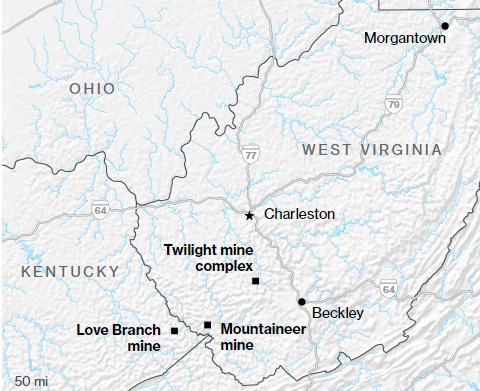
Facing bankruptcy and looking to avoid the cost of mine cleanup, larger coal companies offload older mines in need of reclamation onto smaller companies with little resources, reports an investigation by Bloomberg and NPR. Those smaller companies often can't foot the bill for reclaiming the old mine land, "raising the risk that taxpayers, rather than industry, will eventually be stuck with the cost."

The unreclaimed mines are also hazards to the environment and local communities. A man who lived near the Love Branch mine near the Kentucky border with West Virginia told the news organizations that red water running off from the mine flooded his property, causing him to fall through his floor and ruining his septic system. Lexington Coal Co., the company that owns the mine some in West Virginia, has the second-most violations of any coal operator in the country this year. Lexington acquired the mines from Alpha Metallurgical Resources, one of the largest coal companies in the U.S. 

Since 2015, when an industry-wide downturn pushed Alpha and other large coal companies into bankruptcy, the company has transferred more than 300 mining permits to smaller companies like Lexington. It also shed its pension and health-care obligations, went through bankruptcy, and saw its share price increase over 700% since 2016, Bloomberg and NPR report. 

Bloomberg graph
Of the 232 mostly idle mining permits that Alpha transferred to Lexington Coal, only 41 have been cleaned up, the investigation found. The company has also only authorized the release of about 13% of the reclamation bonding needed to pay for restoring the mines.

Tuesday, October 04, 2022

County where John Prine was once controversial now has a park named for him, at the place he wanted his soul to be

A crowd gathered at the park on the Green River for the dedication. (Hoptown Chronicle photos by Jennifer P. Brown)
When I die let my ashes float down the Green River. Let my soul roll on up to the Rochester dam. I’ll be halfway to Heaven with Paradise waitin’, just five miles away from wherever I am. 
—John Prine, "Paradise"

"Few places in rural America are so cherished for their connection to a song as Muhlenberg County is to people who revered the singer-songwriter John Prine for his blend of country and folk music. His song 'Paradise' — about the tiny coal town on the Green River that was wiped out by strip mining — immortalized the community for generations of listeners," writes Jennifer P. Brown of the Hoptown Chronicle, in Hopkinsville in adjoining Christian County, Kentucky.

Muhlenberg County, Kentucky
(Wikipedia map, adapted)
But when the song came out in 1971, and for many years afterward, it and Prine (whose Chicago parents were from Muhlenberg County) were controversial because the county's economy was based largely on coal. Those days have passed, and the Tennessee Valley Authority steam plant named for the vanished town now makes electricity from natural gas, not coal. And now there's a memorial to Prine, who died in April 2020 of Covid-19.

It's the John Prine Memorial Park at Rochester Dam. Prine fans "came from across Kentucky and from as far away as San Francisco and Seattle" for Saturday's dedication, Brown writes. "Parking their cars and trucks in a field where corn had recently been harvested, they carried lawn chairs, guitars, cameras and dogs up to the park. Numerous John Prine concert T-shirts, many faded and worn with age, were scattered throughout the audience. Some of his fans leaned on canes."

Prine's widow, Fiona Whelan-Prine, spoke at the dedication. (JPB photo)
Reinforcing the official acceptance of Prine, "County Judge-Executive Curtis McGehee announced at the dedication that every October will be celebrated as John Prine Month in Muhlenberg County. A committee of local volunteers and the Muhlenberg County Tourism Commission led efforts to improve the park ahead of the dedication. A new pavilion with a red roof was built and picnic tables were installed. There are plans for a viewing deck at the river’s edge and for a new boat ramp. . . . The audience sang 'Paradise' to close the dedication. Some of them stayed to eat banana pudding, John Prine’s favorite dessert, under the new pavilion bearing his name."

Monday, August 29, 2022

Southeastern Ky. is 'Climate Zero,' forest hydrologist says

The forks of Troublesome Creek gather at Hindman, Ky. It flows into the North Fork of the Kentucky River near Haddix and Lost Creek. Google Maps image shows much surface mining; the Mine Made Adventure Park is a reclaimed mine. 

America has eight creeks named Troublesome, none as troublesome lately as the one that flows into the North Fork of the Kentucky River. Those two streams and many others rose far out of their banks last month, killing 39 people and leaving thousands homeless. The catastrophe has often defied description, and now journalism must look forward, to what can and should be done. Austin Horn does both today in the Lexington Herald-Leader.

Trouble along Troublesome Creek (Herald-Leader photo)
He starts in Fisty, where Clear Creek flows into Troublesome and the only business on Google Maps is Smith's Scrap Yard, one of several businesses owned by Kelly Smith “I’ve lost 50 years here,” Smith, 67, told Horn. “The flood destroyed everything I got.” Horn sums it up: "A little kingdom in Fisty, mostly gone because of a flood that far exceeded any he’d ever seen. Smith had no insurance. . . . You’ll see dozens more patches of bottomland like Smith’s. Little communities cut off from the road because a bridge washed out, a baseball field whose fences are completely caked."

And the cause? Torrential rains (Including four inches in five hours), likely fueled by climate change; hillsides that couldn't absorb any more water; surface mining and inadequate reclamation, which abound in the watershed; and streams filled with silt and debris from earlier floods. It's too early to quantify each of those, which will take study, but Nicolas Zegre, an associate professor of forest hydrology at the University of West Virginia, points to climate change, in two ways.

"Zegre called Appalachia 'climate zero,' like Patient Zero, or the first person to get a disease in a pandemic," Horn reports. "The region is among the first to face the consequences of a carbon-extractive economy, he said, and that economy fueled by coal in this region fed many families and lined many wallets before suffering a downturn in recent decades." Zegre said, “It’s climate zero because we’re not only the source of part of the carbon, but we’re also disproportionately vulnerable to the impacts of more carbon in the atmosphere because our people live in mountainous watersheds. Our entire built environment is within reach of a stream.”

Zegre and Chris Barton, a professor of forest hydrology and watershed management at the University of Kentucky, said the impact of surface mining is uncertain because it leaves flat land that can absorb water instead of flowing down a slope, but reclamation usually compacts rock and soil, limiting absorption. Barton is part of a project that is trying to reforest the Star Fire mine site, midway along the length of Troublesome. Residents of one community in the area have sued a coal company "for the alleged failure of its silt ponds, which they claim led to mass destruction in their community and contamination of their drinking water," Horn reports.

Some officials have called for dredging to clear the streams, "but rules around when groups can dredge are stringent" and the two hydrologists are skeptical, Horn reports: "Natural streams in general have a way of regulating themselves more efficiently than humans, they said. Barton said that it simply isn’t an option in many creeks like Troublesome. Very often, the bottom of those streams aren’t far from bedrock as is. 'The streams are going to naturally cut in floods. When they cut down and get to bedrock, then they start to widen, and that means you’re losing even more of that precious floodplain,' Barton said. 'In a system like this – a mountainous stream system – that wouldn’t be an option. Nature’s taking care of that one.' Zegre said that in certain instances, dredging could be beneficial, but the larger problem is land use – surface mining, road building, tree removal and farming – that changes the natural equilibrium of the watershed."

Tuesday, August 23, 2022

Eastern Kentucky residents say strip miners worsened flood

For decades, people in Central Appalachia have said floods have been worsened by surface mining and inadequate reclamation. Now last month's record floods in Eastern Kentucky have prompted a lawsuit making that claim.

"Nearly 60 residents of the Lost Creek community in Breathitt County are suing coal mining companies which operate nearby, alleging the companies’ negligence contributed to the devastation of historic flooding last month that caused death and the destruction of homes and personal property," reports Taylor Six of the Lexington Herald-Leader.

"The residents are suing Blackhawk Mining and Pine Beach mining companies, alleging that the two companies knew they were sitting on “ticking time bombs” by failing to properly construct and maintain silt ponds, which are artificial bodies of water created through coal operations that collects pools of water, waste and sediment. An attorney representing the residents says debris, sediment and fish flowed out from the silt ponds and came onto their properties, according to the lawsuit."

Some of the people filing suit have mixed emotions because the coal industry provides jobs, Phil McCausland of NBC News reports: "Residents here said that they were raised, fed and clothed by the jobs created by coal mining but that they believed the companies operating the mines have acted irresponsibly and without regard for those who have called the area home for generations. Many of those displaced by the storm are living with family or neighbors, in travel trailers or in tents pitched on the cleared patches of dirt where their homes once stood."

Monday, August 08, 2022

Appalachians ask: How do we prepare for floods bound to come as climate change appears to be making them worse?

Flooding aftermath in Neon Junction, Kentucky. (Mountain Eagle photo by Ben Gish)
"Devastating floods that killed at least 37 people in Kentucky and recent damage in other parts of Appalachia, including Virginia and West Virginia, are fueling urgent questions about how to mitigate the impact of hazardous flooding that is only expected to increase as climate change fuels more extreme weather," report Chris Kenning of USA Today, Connor Giffin of the Louisville Courier Journal and James Bruggers of Inside Climate News.

The damage is nearly indescribable. Ben Gish, publisher of The Mountain Eagle in Whitesburg, Ky., told The Rural Blog after a trip to Neon and McRoberts: "I keep looking for a way to put it into words, but can’t think of any that would do it justice, except annihilated. People are still living in the ruins of their homes, and some who don’t have a home are somehow sleeping in the remains of their flooded cars. Double-wide mobile homes, which is often the symbol of success for many since the banks rarely finance new housing, have crashed into each other and worse. . . . At this point, I think it would be much easier to count the people whose homes were not flooded than those homes that were." The Eagle is being distributed free again this week, in print and on its website.

Solutions for the flooding are elusive for many reasons, including "the region’s mountainous landscape, high poverty rates, dispersed housing in remote valleys, coal-mining scarred mountains that accelerate floods and under-resourced local governments," Kenning, Giffin and Bruggers report. "Measures such as floodwalls, drainage systems or raising homes are expensive for cash-strapped counties. Buyouts or building restrictions are difficult in areas where safer options and new home construction are limited. Many are unable or unwilling to uproot. And tamping down extreme weather by reducing climate-changing emissions nationwide is a goal that is politically fraught, including in a region with coal in its veins, that promises no quick relief."

Former mining regulators say decades of surface mining have left Central Appalachia uncommonly vulnerable to such flooding and made the floods deadlier, Bruggers reports for ICN. Coal companies are supposed to reclaim the land when they shutter, making it more resistant to flooding, but some states and judges have not forced them to do so. Billions of dollars will be required to full reclaim abandoned mines, and though the infrastructure bill had $11.3 billion for the task, President Biden, who is in Eastern Kentucky today, has not nominated a director for the Office of Surface Mining. Bruggers reported in April that very few Kentucky coal mines are current on reclamation.

Meanwhile, Appalachians have one advantage in the fight: each other. Neil Middleton, vice president and general manager of WYMT-TV in Hazard, said in a recent commentary: "That's what we mountain folk do. We survive, we rebuild, we take care of our own, whatever it takes, in any way possible." Jessica Tezak of The Washington Post has a feature story on one of the helpers, Pastor Brad Tezak of Clay County. If you want to contribute to flood relief, The Daily Yonder has a list.

Wednesday, April 20, 2022

Weakened coal industry piles up environmental violations at surface mines in Kentucky and perhaps other states

Permits and violations at surface coal mines in Kentucky, 2013-February 2022
(Inside Climate News graph from Ky. Energy and Environment Cabinet data)
"As the coal industry has collapsed in Kentucky, companies have racked up a rising number of violations at surface mines, and state regulators have failed to bring a record number of them into compliance, internal documents show," James Bruggers reports for Inside Climate News.

"Environmental advocates fear lax enforcement could also be happening in other coal mining states, such as West Virginia, Virginia and Pennsylvania, due to similar pressures on the industry and regulators, despite a recent uptick in coal mining," Bruggers reports. "And they are calling on federal regulators to make sure slowed, idled or bankrupt mines are not left to deteriorate."

Kentucky enforcement data from 2013 through February and recent internal emails "reveal an agency struggling to enforce regulations designed to protect the public and the environment from some of the industry’s most destructive practices amid mining company bankruptcies and an overall industry decline that has also seen the shedding of thousands of coal mining jobs in the state," Bruggers writes.

The data show there are many "zombie mines" that are no longer operating but have not been reclaimed as the law requires. "In one Dec. 15 email, a state official noted that the number of notices of noncompliance with surface-mining regulations statewide had reached a record high of 810 the previous month," Bruggers reports. "The increase came even though the number of active mining permits had declined 28 percent since 2013, a year when there were roughly half as many unresolved violations despite more mining activity."

Courtney Skaggs, a senior environmental scientist in the state Department for Natural Resources, warned a state official in a December email that the zombie-mine situation is "completely out of control" and will "blow up in someone's face." In another email to an official in the state Energy and Environment Cabinet, which oversees environmental regulations, Skaggs said the state was not addressing the problems and warned: "Something has to give/change before we have a major problem on our hands." A department spokesperson told Bruggers the enforcement lag was because of "an unprecedented number of bankruptcies caused by market forces in the coal industry that are outside of the control of (the cabinet)."

More than half the unresolved violations in Kentucky are for mines operated by companies that have gone bankrupt. The violation notices kept piling up after December, hitting 1,219 by the end of February. An attorney who represents a landowner affected by an unreclaimed mine told Bruggers he believes the agency doesn't have much power over mining companies that are going bankrupt or not expanding much. That's because the state's main enforcement power is to deny new mining permits; if mining companies aren't seeking new permits, they might not care much.

Tuesday, March 15, 2022

Nature Conservancy says it will build six solar power plants on old coal-mine sites it owns in southwest Virginia

Site of one of the proposed solar farms (Photo from the Nature Conservancy)
Six former surface coal mines in Southwest Virginia "are being transformed into solar installations that will be large enough to contribute renewable energy to the electric grid," Zoeann Murphy reports for The Washington Post. The sites "owned by The Nature Conservancy will be some of the first utility-scale solar farms in the region — and the nonprofit group hopes it’s creating a model that can be replicated" at other sites in Appalachia and nationwide.

Several thousand acres of old mines came with 253,000 acres of forest the Conservancy acquired in 2019, which it calls the Cumberland Forest Project. Why develop solar on an old coal mine? It's not just for the irony. Murphy reports: "Solar developers partnering with the Nature Conservancy, such as Dominion Energy and Sun Tribe, say the mine sites have vast flat areas exposed to sunlight that are a rarity in the mountains, and the sites offer advantages like being close to transmission lines." Sun Tribe and Sol Systems are partnering on the first two, the Conservancy announced last year.

Solar farms need a lot of ground, and "It would be better to build on a lot of these mine sites than some prime farmland or some areas that maybe don't want solar in their community," said Daniel Kestner, innovative reclamation manager for the Virginia Department of Energy.

Most of the project area is in Wise County, on the Kentucky border, The Coalfield Progress in Norton reported last year; some is in Dickenson County, to the northeast; some is Russell County, to the southeast. “We’re very proud to be an energy-producing community,” said Lou Wallace, chair of the Russell County Board of Supervisors. “This is helping us to reimagine how we produce the energy. So we’re still able to say we’re keeping the lights on somewhere.”

Tuesday, February 22, 2022

Magazine's 'short, selective biography' of Berry has lines from forthcoming book, which will 'offend most everyone'

Wendell Berry (Guy Mendes photo)
Wendell Berry, advocate of the largely rural fundamentals that formed humanity before the Industrial Revolution, gets a big write-up in the Feb. 28 issue of The New Yorker, from none other than the magazine's executive editor, Dorothy Wickenden. For her, it completes a cycle of nearly 60 years.

The daughter of Berry's first commercial editor, Wickenden draws on his and Berry's correspondence from 1964 to 1977, when the writer, as he acknowledged then, was still discovering himself. But it also offers glimpses of his next book and looks at his legacy, which includes The Berry Center, which promotes “prosperous, well-tended farms serving and supporting healthy local communities” and the Wendell Berry Farming Program of Vermont's Sterling College, which offers a tuition-free college degree in sustainable family farming.

Wickenden's expansive, 9,384-word article amounts to a short, selective biography of one of America's most loved and yet also scoffed-at writers. She sums up what we know: "Berry’s admirers call him an Isaiah-like prophet. . . . Critics see him as a utopian or a crank, a Luddite who never met a technological innovation he admired." But this is not just history; it offers insight into the land, culture and neighbors that made Wendell Berry, now 87, who he is -- and why he is what he is.
 
After visiting Berry at his Kentucky farm, Wickenden wrote, "From this sliver of vanishing America, Berry cultivates the unfashionable virtues of neighborliness and compassion. He divides his time between writing and farmwork, continuing his vocation of championing sustainable agriculture in a country fueled by industrial behemoths, while striving to insure that rural Americans—a mocked, despised, and ever-dwindling minority—do not perish altogether."

Berry let Wickenden read, and quote from, his forthcoming book, due this summer: The Need to Be Whole, in which "He argues that the problem of race is inextricable from the violent abuse of our natural resources, and that 'White people’s part in slavery and all the other outcomes of race prejudice, so damaging to its victims,' has also been 'gravely damaging to white people.'"

Wickenden says the book "contains something to offend almost everyone," and her major example is a man Berry calls “one of the great tragic figures of our history,” Confederate Gen. Robert E. Lee. "He presents Lee as a white supremacist and a slaveholder, but also as a reluctant soldier who opposed secession and was forced to choose between conflicting loyalties: his country and his people." She quotes from the book: “Lee said, ‘I cannot raise my hand against my birthplace, my home, my children.’ For him, the words ‘birthplace’ and ‘home’ and even ‘children’ had a complexity and vibrance of meaning that at present most of us have lost.”

Wickenden writes, "If readers were incredulous about Berry’s [1977] claim that a pencil was a better tool than a computer, it’s not hard to imagine how many will react to his plea that we extend sympathy to a general whose army fought to perpetuate slavery in America. Several of Berry’s friends urged him to abandon the book, anticipating Twitter eruptions and withering reviews."

“My friends, I think, were afraid, now that I am old, that I am at risk of some dire breach of political etiquette by feebleness of mind or some fit of ill-advised candor,” Berry writes. “They are asking me to lay aside my old effort to tell the truth, as it is given to me by my own knowledge and judgment, in order to take up another art, which is that of public relations.”

Berry's politically incorrect truth-telling does not extend to his Trump-voting neighbors, 30 miles northeast of Metro Louisville, because that wouldn't be neighborly. He writes, “If two neighbors know that they may seriously disagree, but that either of them, given even a small change of circumstances, may desperately need the other, should they not keep between them a sort of pre-paid forgiveness? They ought to keep it ready to hand, like a fire extinguisher. . . . A society with an absurdly attenuated sense of sin starts talking then of civil war or holy war.”

Wickenden probably didn't realize it, but for some readers those lines will echo in another part of her story, about Berry's connections to Appalachia and the town of Whitesburg, including Tom and Pat Gish, who published The Mountain Eagle every week for 52 years, even after their office was firebombed by a local policeman who state police said was hired by coal operators. But even as the Gishes revealed the Tennessee Valley Authority's role in strip mining and helped visiting journalists explore the region's ills, they were always careful not to publish demeaning pictures of local residents like those that typically illustrate such national stories.

That's community journalism. Berry once defined "community" this way: “A community is the mental and spiritual condition of knowing that the place is shared, and that the people who share the place define and limit the possibilities of each other's lives. It is the knowledge that people have of each other, their concern for each other, their trust in each other, the freedom with which they come and go among themselves.”

Wednesday, January 05, 2022

New movement calls damage from abandoned coal mines 'ecocide,' framing it as a harm to rural people

Bankrupt coal companies often fail to reclaim abandoned mines, leaving cash-strapped rural communities to suffer devastating environmental consequences. A growing coalition of activists is calling such a move "ecocide" and wants to make it and other widespread ecological damage a crime before the International Criminal Court, James Bruggers reports for Inside Climate News. Such a declaration would have no legal bearing, since the United States isn't a member of the ICC, but the notion could help frame such "crimes against nature" in terms of the harm they do to people—especially the rural residents who live nearby and suffer the worst consequences.

The damage from abandoned mines could last millennia, according to Duke University ecologist Emily Bernhardt, who has studied Appalachian strip mines and the long-term impacts of coal mining for nearly two decades. "There are coal mines from the Roman Empire that are still emitting acid pollution," she told Bruggers.

Coal companies buy bonds that are supposed to cover the cost of reclamation if they go bankrupt or suffer a disaster. But many states don't require them to buy enough to do the job, and coal companies are increasingly leaving rural communities holding the bag. The phenomenon is rampant in Central Appalachia: "Mountaintop removal and other forms of surface mining have scarred an area of more than 2,300 square miles in Kentucky, West Virginia, Virginia and Tennessee," Bruggers reports. "Nationwide, over a million acres of land used by still operating, idle or abandoned mines need to be cleaned up and reclaimed—a job President Biden’s new $1.2 trillion infrastructure bill can only begin to address."

A recent report found that it will cost as much as $9.8 billion to reclaim coal mines in Central Appalachia. The infrastructure bill passed in November reauthorized the Abandoned Mine Land Program and allocated $11.3 billion to clean up abandoned mines.

Tuesday, December 14, 2021

Biden recently nominated a mine-safety chief, but still no one to run Interior Department's Office of Surface Mining

"Congress approved $11.3 billion to clean up abandoned mine lands in the $1.2 trillion infrastructure bill, but environmental groups are worried that President Biden hasn’t chosen anyone to oversee how that money is spent on coal mines," Jael Holzman reports for Energy & Environment News.

President Biden hasn't nominated anyone to run the Office of Surface Mining Reclamation and Enforcement, which hasn't even had an acting director, Holzman concludes from the website of the agency, part of the Interior Department.

Tuesday, the Sierra Club and other activists, mainly from Appalachian states, urged Biden to nominate an OSM director to see that the money is “carefully administered.” They also asked, among other things, that the new money be spent on mines that closed before 1977. That's when Congress passed the federal strip-mine law, which included a severance tax on coal to fund reclamation of abandoned mines.

"This letter comes after Biden recently made picks for posts at other mining-related government agencies, including Christopher Williamson, a labor attorney and former staffer for West Virginia Democratic Sen. Joe Manchin, to run the Mine Safety and Health Administration," a Labor Department agency, Holzman reports, without making the departmental distinction.

Friday, September 03, 2021

Study: W.Va. mining cuts aquatic species biodiversity by 40%, with some loss even in streams meeting EPA rules

Map from study, adapted by The Rural Blog; click on it to enlarge.
Appalachian streams are some of the most biologically diverse in the world, home to many species that can't be found anywhere else on Earth (like the hellbender salamander, for example). But surface mining threatens that diversity as downstream pollution hurts or destroys many species' habitats, according to a newly published study in the journal Ecological Applications.

A Duke University team led by Marie Simonin of France's National Research Institute for Agriculture examined 93 streams in southern West Virginia and found a clear link between coal mining and species loss: streams in heavily mined watersheds have 40 percent fewer species than streams with cleaner water. That includes fish, insects, crustaceans, mollusks, algae, fungi, bacteria, and more. They were able to tell what species had vanished by collecting and comparing DNA from scraps left in the streams such as scales, skin and excrement.

Pollution threatens the hellbender.
 (Fish and Wildlife Service photo)
The study is significant not just for its findings but for its breadth; other studies have noted the link between surface mining and species loss, but this study looked at all species in the same streams at the same time.

The study highlighted another concern: Pollutants hurt aquatic species at much lower concentrations than previously known, since the team found significant diversity loss in streams whose pollution was still well within Environmental Protection Agency disturbance standards. Duke biology professor Emily Bernhardt, the senior author of the paper, summed it up in a recent interview about the study: "By the time you get to the EPA’s reference point, you've already lost most of the species you're going to lose."