Showing posts with label narcotics. Show all posts

Monday, August 14, 2023

Demon Copperhead author Barbara Kingsolver talks about the opioid epidemic and Appalachia's difficulty with it

Barbara Kingsolver
Barbara Kingsolver says she intended her Pulitzer Prize-winning novel Demon Copperhead to be her "great Appalachian novel" that told the story of how the opioid epidemic has ravaged the region, and its impact on children.

Ezra Klein of The New York Times interviewed Kingsolver, who grew up in Nicholas County, for his podcast, "The Ezra Klein Show." The Times transcribed the interview. It is wide-ranging, but a big chunk has her telling Klein how the opioid epidemic has impacted a whole generation of children who have become orphans and are being raised by grandparents and the foster system — and getting the bulk of their social services at school.
 
"We have a generation of orphans coming up through our schools," Kingsolver said, adding later, "There’s so many more kids in need than there are social networks to catch them — but the caseworkers are so overloaded and so pathetically underpaid. . . . This is something that I think the world needs to know about, this country — voters — need to know about. We need to know how this epidemic has left a generation of innocents that nobody’s taking decent care of. . . . These kids have been left behind. Our burdened public school systems are being asked to raise these kids." 

Klein and Kingsolver also talked about how Central Appalachia was targeted by Purdue Pharma with a drug that was so addictive and with doctors who were told otherwise. "This was done to them," Kingsolver said of her neighbors in southwest Virginia and southeastern Kentucky. "Nobody wants to be addicted."
 
Kingsolver also talked about the stigma associated with addiction and how people have been brainwashed to think it is a moral failing, instead of the brain disease that it is. 

"We have been trained, culturally trained, to think of addiction in this way, as a personal failing that needs to be punished. Incarceration does not cure addiction any more than it cures cancer. Addiction is a disease," she said. "It’s impossible to describe how terrible this disease is, not just the dope sickness of it but the fact that your entire life has to become just a really difficult, hard work in process of, every morning, getting your means, getting your fix, getting through another day. And nobody wants to live like that." 

Kingsolver told Klein that she hopes her novel will help people have more compassion and think of people with addiction as having a disease and to get rid of the idea that you don't treat a person with addiction until they "hit bottom." 

"That’s how we treat the disease of addiction. And it’s incredibly inhumane. And effective treatment will only happen after we switch over from putting this in the hands of the police and the prisons to medical workers who can meet addicted people where they live and offer them the first steps of clean needles and fentanyl test strips so that they won’t die in the weeks that it will take for them logistically, physically, emotionally, to get to the beginnings of treatment," she said. 

And to those who maintain a moral objection to such "harm reduction" programs, she said, "It’s as if people feel that addicted people deserve to die. Imagine if we looked at any other disease that way."

Wednesday, July 05, 2023

DEA chief says U.S. needs laws to keep social-media platforms from being used to promote and sell fentanyl

CDC graph shows large increases in deaths from fentanyl; click on it to enlarge.
The U.S. needs laws to force social-media companies to keep their platforms from being used to promote and sell fentanyl, DEA Administrator Anne Milgram said on NBC's “Meet The Press” Sunday, in a program that was devoted entirely to the drug and the problems it is causing, such as overdoses.

“The border’s an important part of this conversation because most of the fentanyl that we see coming into the United States is coming in through the southwest border,” Milgram said, but “Social media is also a vital part of the conversation. It is what I call the last mile. Because what the cartels need – they’re selling the deadliest poison we’ve ever seen – they need that to … be able to expand and sell more, they need to be able to reach people at massive rates. And that’s what social media’s doing,” The Daily Wire reports.

Host Chuck Todd asked Milgram asked if social-media companies were cooperating with federal law enforcement in trying to fix the problem. She said, “We have not, until recently, gotten nearly as much cooperation as we need. . . . The deputy attorney general convened all of us in April of this year and made it very clear, number one, that the companies have to comply with their own terms of service, which say, ‘This is illegal. You cannot be selling fake pills. You cannot be selling drugs on social media websites’.”

Milgam also said law enforcement needs to be able to get information from social-media companies. Asked if there was something the DEA does not have that Congress could give them that would help them address the issue, she said, “So we talk a lot with Congress about social media. We talk a lot about the need for these platforms – essentially, one of the main ways we see Americans dying right now is through social media, the purchase of pills, fake pills on social media. So, again, if we’re after, how do we stop 110,000 Americans from dying?” She said Congress was “a place to start.”

Wednesday, May 31, 2023

Appeals court OKs plan that shields owners of Purdue Pharma from future lawsuits; they must give it up, donate

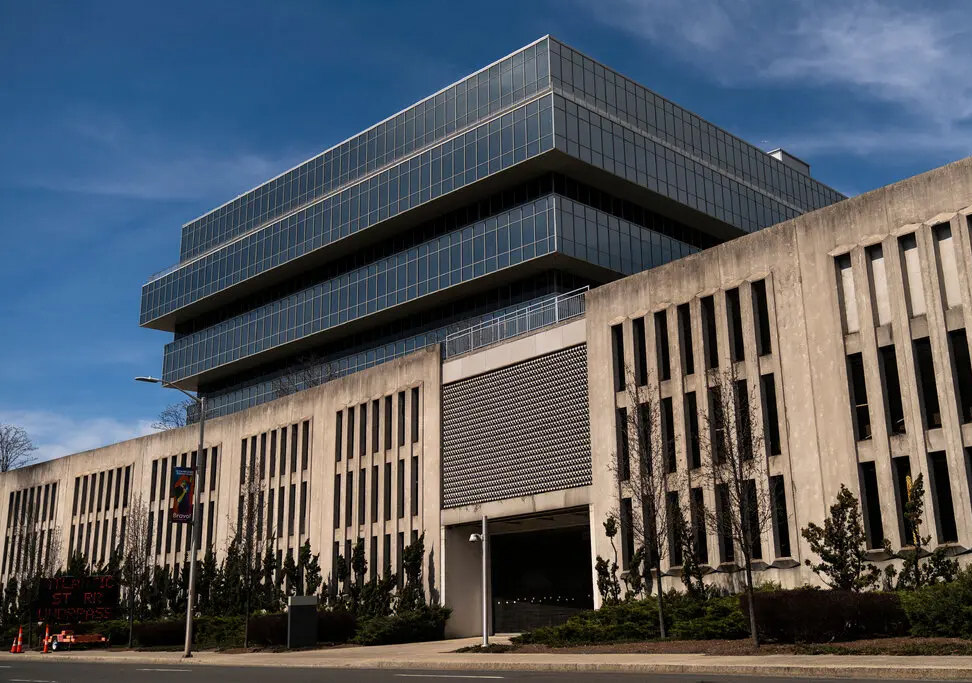
Purdue Pharma's headquarters in Stamford, Connecticut
(Photo by Drew Angerer, Getty Images, via The New York Times)
A federal appeals court has approved a settlement by Purdue Pharma, the maker of OxyContin, that protects its billionaire owners, the Sackler family, from future lawsuits. The Sacklers would give up the company, which would take the new name Knoa, "with its profits being sent to a fund to prevent and treat addiction," reports Geoff Mulvihill of The Associated Press.

"Family members would also contribute $5.5 billion to $6 billion in cash over time, or about half of what the court found to be their collective fortune, much of it held offshore. At least $750 million of that money is to go to individual victims of the opioid crisis and their survivors. Payments are expected to range from about $3,500 to $48,000."

Tuesday’s decision by The U.S. 2nd Circuit Court of Appeals in New York also protects the family from lawsuits "over the toll of opioids, even though they did not file for bankruptcy," AP notes. "The court’s ruling reversed a 2021 ruling that found bankruptcy court judges did not have the authority to approve a settlement that would offer bankruptcy protections for those who have not filed for bankruptcy."

The deal "would end claims filed by thousands of state, local and Native American tribal governments and other entities," AP reports. "Sackler family members have been clear that without the protections, they won’t hold up their part of the deal. . . . Several states had withheld support for the plan, but after a new round of negotiations last year, all of them came on board."

The sole remaining objector was the Office of the Bankruptcy Trustee in the Justice Department, which "did not immediately say whether it would appeal Tuesday’s ruling to the U.S. Supreme Court, ask the Circuit Court to review its decision or accept the ruling as is," AP reports. "Even without an appeal, it could be months before the bankruptcy plan takes effect."

Friday, March 31, 2023

Over-the-counter Narcan will save lives by stopping drug overdoses. It'll be available this fall; price remains a hurdle.

Doses of Narcan brand of naoloxone in a vending machine
(Photo by Erin Schaff, The New York Times)
Every first-aid kit and family medicine box will need this: Narcan. That's the brand name of a prescription nasal spray, naloxone, that reverses opioid overdoses. The Food and Drug Administration approved the medication for over-the-counter sales, a move long sought by public-health officials and treatment experts, reports Jan Hoffman of The New York Times. "With overdoses and overdose fatalities occurring in college dorms, public libraries, households, night clubs and restaurants, public-health advocates hope that naloxone nasal sprays will soon become a staple. . . . By late summer, over-the-counter Narcan is expected to be for sale in big-box chains, supermarkets, convenience stores, gas stations and online retailers. New York City plans to install Narcan vending machines later this year."

Narcan is easy to give, works quickly, and has no adverse side effects. Hoffman explains, "Bystanders who see that a person slumped over is unresponsive to shaking and shouting, with slowed breathing — signs of a possible overdose — only have to unwrap the palm-size device, insert the tip into the person's nostril and depress the plunger. In most situations, the medication revives the person within two or three minutes. . . . Narcan will not work if the person has taken nonopioid drugs like methamphetamines or xylazine, an animal tranquilizer that has been infiltrating street drug supplies."

Price could be a hurdle. "Although over-the-counter status will make Narcan more widely available, the cost of the medicine could deter many. Currently, a two-dose pack of prescription Narcan is often free to people covered by Medicaid or private insurance or has a co-pay of less than $10," Hoffman reports. "But public and private insurance programs do not cover most over-the-counter medicines. Whether an exception will be made for Narcan could take months to resolve," Hoffman writes, "The company that makes Narcan, Emergent BioSolutions, declined to disclose the price it plans for an over-the-counter version, which will take several months to relabel and repackage."

The FDA is aware of the cost barrier, and is "urging other manufacturers of prescription naloxone to apply for over-the-counter approval, which could make pricing more competitive," Hoffman reports. Dr. Patrizia Cavazzoni, director of the FDA's Center for Drug Evaluation and Research, told Hoffman, "We will work with any sponsor seeking to market a nonprescription naloxone product. . . . [they urged manufacturers] to contact the agency as early as possible to initiate discussions."

Dennis Cauchon, president of Harm Reduction Ohio, a nonprofit group that distributes free naloxone doses, told Hoffman: "All naloxone should have been moved over the counter. . . . Now you have the expensive version available without a prescription, but the cheaper versions need a prescription. It's important that the brand name Narcan be priced much lower over the counter than it is now. The price needs to be less than $30 for a two-dose kit, preferably much lower."

Thursday, December 15, 2022

Poll of rural adults finds them more aware of, and more willing to discuss, opioid problems; 47% still see stigma

Morning Consult graph compares 2017 and 2022 responses to question about access to care. Click it to enlarge.

Rural Americans say they are more aware of, and more willing to talk about, the opioid problem in the nation and their communities than they were five years ago, according to an online poll of rural adults sponsored by the American Farm Bureau Federation and the National Farmers Union.

Sixty percent said adults are more aware of the crisis than they were five years ago, and 77% said they would comfortable having a conversation about opioids, but 47% said there is stigma or shame associated with opioid abuse in their community.

Rural adults increasingly regard drug addiction as a disease. Asked if addiction to opioids is a disease or is due to a lack of will power or self-control, 57% said it's a disease and 21% said otherwise. In 2017, the numbers were 46% and 26%, respectively. Likewise, 78% said someone can accidentally or unintentionally get addicted to opioids; five years ago, 71% said that.

The poll found that more rural adults than five years ago believe there is a higher rate of opioid misuse in rural communities than in urban and suburban areas), and 48% said they know someone who is or has been addicted to opioids or prescription painkillers.

Asked if they had taken an opioid or prescription painkiller without a prescription, 5 percent said yes. The same percentage said they had abused opioids or prescription painkillers or been addicted to them. Asked how comfortable they would feel talking about that, 70% said they would feel very or somewhat comfortable discussing it with friends, 52% with siblings and 46% with parents. Beyond their immediate families, most said they would be not too comfortable, or not comfortable at all.

The margin of error for that subsample of 110 people is plus or minus 9.3 percentage points. The error margin for the whole sample of 2,010 rural adults is 2.2 percentage points. The poll was conducted online Oct. 6-13 by Morning Consult and the results were weighted to reflect gender, age, race, ethnicity, census region and education. The results are available from Farm Bureau here.

Farm Bureau and NFU, long rivals in representing farm interests, "have consistently worked to publicize and compile useful material to help address rural stress, mental health challenges and opioid misuse," they said in a press release. NFU President Rob Larew said, “We must continue to reduce the stigma to connect our loved ones with health care and treatment they may need. I thank AFBF for being a teammate on this project, and the survey results show what is possible when farm organizations work together.”

Tuesday, December 13, 2022

In many states, opioid settlement funds going to local governments do not reflect communities' extreme losses

Rural America was the first to herald the incoming opioid crisis: "In the 1990s, misleading marketing by opioid companies helped drive up prescription rates, particularly in coal, lumber, and manufacturing towns across Appalachia and Maine," report Aneri Pattani and Rae Ellen Bichell of Kaiser Health News. "As painkillers flooded communities, some residents became addicted. Over time, they started using heroin and fentanyl, and the deadly epidemic spilled into suburbs and cities across the nation."

Now that settlements of lawsuits over the epidemic are being paid out, the award calculations in many states seem skewed against rural areas gaining a share that reflects their losses. Pamlico County, North Carolina, pop. 12,000, is an example Pattani and Bichell cite: "Over the past decade, it’s had the highest rate of opioid overdose deaths in North Carolina. . . . Now, the county is receiving money from national settlements with opioid manufacturers and distributors to address the crisis. But by the time those billions of dollars are divided among states and localities, using formulas partially based on population, what trickles down to hard-hit places like Pamlico County can be a trifling sum."

The disparities are born out in the numbers. They report, "Out of one multibillion-dollar national settlement, Pamlico County is set to receive about $773,000 over nearly two decades. By contrast, Wake County, home to the capital city of Raleigh, is set to receive $36 million during the same period, even though its opioid overdose death rate for the past decade ranked 87th in the state."

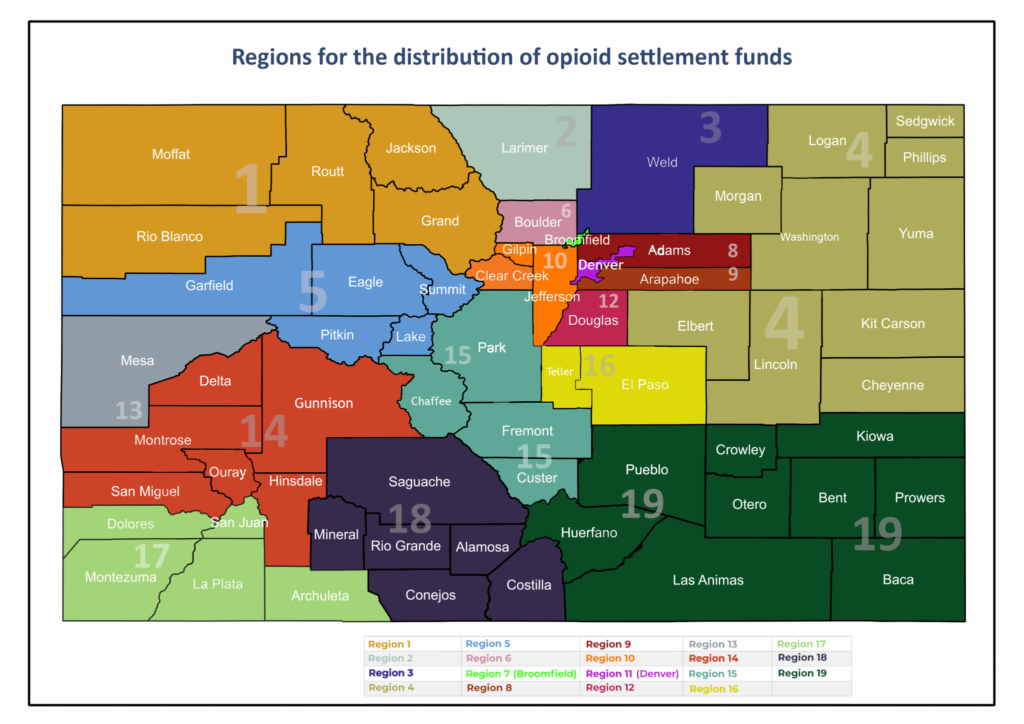
Some states do it differently. Pennsylvania considers "opioid-related hospitalizations and first responders’ administration of naloxone, an overdose reversal medication," Kaiser reports. "When that formula left 11 rural counties without 'enough money to make an impact,' the state decided each county would receive a minimum of $1 million over the 18-year settlement period, said Glenn Sterner, an assistant professor at Penn State who helped develop the state formula and co-authored a paper on it. In Colorado, pooling funds is built into the state’s model for managing opioid settlement money. The lion’s share of funds is going to 19 newly formed regions, about half of which comprise multiple counties."

Many rural communities are grateful for any financial assistance and are working creatively to make the most of what they do receive, Pattani and Bichell write. "But others worry such an approach misses an opportunity to use that money to make a difference in rural communities that have been disproportionately affected for decades."

Friday, December 02, 2022

Officials, advocates push more rural health-care providers to prescribe Suboxone (buprenorphine) for drug addiction

Bonnie Purk, left, meets with nurse practitioner Andrea Storjohann at the
Primary Health Care clinic in Marshalltown, Iowa. (Photo by Tony Leys, KHN)
More than 150 people a day die of overdoses related to synthetic opioids such as fentanyl, and disproportionate share of the dead will be from rural areas, according to the Centers for Disease Control and Prevention. Given the magnitude of loss and the prevalence of fentanyl in most illicit drugs, more rural medical providers are prescribing buprenorphine for patients struggling to end their addictions, and treatment advocates are pushing them to do more, Tony Leys reports for Kaiser Health News: "The number of U.S. health care providers certified to prescribe buprenorphine more than doubled in the past four years. Treatment advocates hope to see that trend continue."

Buprenorphine, best known by the brand Suboxone, "does not cause the same kind of high as other opioid drugs do, but it can prevent the debilitating withdrawal effects experienced with those drugs," Leys notes. "Without that help, many people relapse into risky drug use.

Such “maintenance treatment” has been done mainly with methadone, but it "is tightly regulated, due to concerns that it can be abused," Leys explains. "Only specialized clinics offer methadone maintenance treatment, and most of them are in cities. Many patients starting methadone treatment are required to travel daily to the clinics, where staffers watch them swallow their medicine."

Federal approval of Suboxone in 2002 helped smaller towns, but physicians have been slow to get certified to prescribe it. Recently, "Federal regulators have made it easier for doctors, nurse practitioners, and physician assistants to become certified," and "have encouraged more front-line health care professionals to prescribe Suboxone and other medications containing buprenorphine." Congress could relax the rules even further in must-pass legislation next week.

The spread of fentanyl has complicated the effort to expand the treatment. Patients "can suffer severe withdrawal symptoms when they begin taking buprenorphine, so health practitioners must be careful when starting the treatment," Leys reports. "In Iowa, officials designated $3.8 million from the state’s initial share of opioid lawsuit settlement money for a University of Iowa program that helps health care providers understand how to use the medications.

Andrea Storjohann, a nurse practitioner in Marshalltown, Iowa, a town of 27,000, works in a repurposed grocery building, with "no signs designating it as a place for people to seek treatment for drug addiction, which is how Storjohann wants it," Leys writes. Until recently, “We were kind of a unicorn in this part of the state, but that is changing,” Storjohann told Leys.

Still, treatment may be hard to find. The public database of providers certified to prescribe buprenorphine treatment "lists only providers who agree to include their names," Leys reports. "Many do not do so. In Iowa, only about a third of providers with the certification have agreed to be listed on the public registry, according to the Iowa Department of Health and Human Services."

Tuesday, August 16, 2022

Meth use dramatically increases odds of nonfatal overdose among rural drug users, whether used with opioids or alone

Nearly 80 percent of recreational drug users in rural areas have taken methamphetamines in the past month, according to a newly published study in the Journal of the American Medical Association. That's concerning, because meth use greatly increases the risk of non-fatal overdose—whether it's used alone or with opioids—and because rural drug users are more likely to suffer consequences from meth use but less likely to have access to treatment or prevention measures. Other studies have found that opioids were involved in about two-thirds of overdose deaths, and that fentanyl contamination increasingly drives opioid and meth-associated overdose deaths.

Overall, 22% of survey participants who co-used opioids and meth had survived an overdose in the past six months, compared to 14% of those who used opioids alone and 6% who used meth alone. Participants who co-used most often (44%) were also more likely to have tried and failed to access drug treatment measures than those who used opioids alone (36%) or meth alone (30%).

The researchers noted that meth use has been endemic in rural areas for decades, and that meth-related hospitalizations nationwide skyrocketed 270% from 2007 to 2015. Even so, not much research has focused on the characteristics of purely rural meth use, or meth use combined with opioid use.

Researchers gathered data for the study from January 2018 to March 2020, surveying drug users in rural communities in the 10 states participating in the Rural Opioid Initiative Research Consortium: Illinois, Kentucky, Massachusetts, New Hampshire, North Carolina, Ohio, Oregon, Vermont, West Virginia, and Wisconsin. The findings suggest that harm reduction and drug treatment programs must address meth use as well as opioids to decrease overdoses in rural communities, the researchers write.

Thursday, August 04, 2022

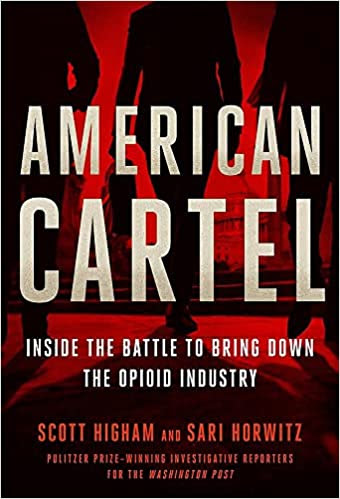
Book: American opioid industry operated like a drug cartel

In the new book American Cartel, Washington Post journalists Scott Higham and co-author Sari Horwitz "make the case that the pharmaceutical industry operated like a drug cartel, with manufacturers at the top; wholesalers in the middle; and pharmacies at the level of 'street dealers,'" Terry Gross reports for NPR. "What's more, Higham says, the companies collaborated with each other — and with lawyers and lobbyists — to create legislation that protected their industry, even as they competed for market share."

"Higham says that big pharma fought to create legislation that would limit the DEA's ability to go after drug wholesalers," Gross reports. "The efforts were effective; more than 100 billion pills were manufactured, distributed and dispensed between 2006 and 2014, during the height of the opioid epidemic. Meanwhile, both federal and state DEA agents are frustrated by the ways in which their enforcement efforts have been curtailed." Read more here.

Tuesday, July 05, 2022

Judge rejects claim by W.Va. community that nation's three largest opioid distributors should pay for public nuisance

A federal judge has rejected claims by Cabell County, West Virginia and the county seat of Huntington that the nation's three opioid distributors caused a public nuisance by sending millions of pain pills into the community and should pay for the damage they caused.

U.S. District Judge David Faber said "The opioid crisis has taken a considerable toll" on the county, and "While there is a natural tendency to assign blame in such cases, they must be decided not based on sympathy, but on the facts and the law."

Faber tried the case 11 months ago after the three companies, AmerisourceBergen, Cardinal Health and McKesson Corp., waived their right to a jury trial, Courtney Hessler reports for The Herald-Dispatch in Huntington. 

Cabell County (Wikipedia map)
"Following the trial, the three distributors finalized a $21 billion national deal with a vast majority of states, counties and cities to resolve most of the lawsuits against them. Communities in West Virginia were not part of that deal," Meryl Kornfield, Scott Higham and Sari Horwitz report for The Washington Post. "Lawyers for the plaintiffs said they are considering an appeal."

Hessler reports, "Faber said the city and county failed to prove the defendants did not maintain effective controls against diversion of the opioids into the illicit market," or that they lacked due diligence in stopping suspicious orders. "It was good-faith prescribing that drove the increased volume of prescription opioids, he ruled."

"Finally, he ruled that the plaintiffs failed to devise a detailed abatement plan outlining how the communities would spend any money they received if they did prevail at trial," the Post reports. "In the end, Faber ruled that public nuisance statutes had been wrongly applied in the case."

The plaintiffs showed that company officials "made light of the public health crisis in emails. They questioned AmerisourceBergen executive Chris Zimmerman about a parody song about “pillbillies” addicted to OxyContin when he testified in May. Public outrage over the news of the email spurred death threats, according to the company’s lawyers," the Post reports. Zimmerman testified that he shouldn't have sent the email, "but he added that the exchange was cherry-picked and that the corporate culture at AmerisourceBergen was the 'highest caliber'."

Mountain State Spotlight reports, "Another trial, with dozens of West Virginia cities, towns and counties suing the same three big drug distributors, is scheduled to begin Tuesday in Charleston. Although this trial is in state court and being handled by Mercer Circuit Judge Derek Swope, many of the other participants, including the lawyers, are the same."

UPDATE, July 12: MSS's Ian Karbal explains how the drug distributors prevailed at the trial.

Wednesday, June 29, 2022

Health-care roundup: Providers in N.D. discuss challenges; regulations boosting telehealth expansion will expire soon

Here's a trio of stories about rural health care:

At a roundtable discussion Monday, rural health-care providers in North Dakota spoke to state and federal officials about the difficulties they face. Participants "cited workforce issues, regulations and rising costs as three challenges to provide services in rural areas," Masaki Ova reports for The Jamestown Sun. Officials in attendance included Sen. John Hoeven, R-N.D.; Xochitl Torres Small, the Agriculture Department’s undersecretary for Rural Development; and Erin Oban, her North Dakota director.

Rural hospitals had to adapt to survive during the pandemic, aided by federal funding. Some hospitals hope to keep some of those new capabilities, but may not be able to when the federal public-health emergency order expires—drying up funding with it.

Donald Lloyd, CEO of St. Claire Regional HealthCare system in Morehead, Ky., said the shift to telehealth is likely here to stay. "Before the pandemic, telehealth visits weren’t common at his hospital. Now telehealth visits account for nearly 20% of hospital visits," Liz Carey reports for The Daily Yonder. That goes especially for behavioral health, he said, since more than 80% of such visits to the hospital are via telehealth these days.

Speaking of telehealth: Relaxed regulations during the pandemic allowed health-care providers to more easily prescribe buprenorphine for opioid-abuse disorder. Studies have shown that telehealth prescription visits are at least as effective as in-person visits in keeping patients on their medication, but those regulations will expire along with the federal public-health emergency order. "That could come as soon as October, and the Drug Enforcement Agency, which has sought to clamp down on buprenorphine’s misuse, has already missed deadlines to facilitate virtual access," Krista Mahr and Ben Leonard report for Politico. "The expansion across sectors has been critical in rural areas, where access to licensed clinicians is scarce and social stigma runs high."

Saturday, June 11, 2022

'Dopesick' movie wins a Peabody; author of book says her next one, about solutions to opioid crisis, will be out Aug. 15

"Dopesick" co-writers Ben Rubin, left, and Eoghan O’Donnell,
right, with star Michael Keaton and book author Beth Macy
"Dopesick," the streaming-video series starring Michael Keaton and based on the novel by Beth Macy of Roanoke, won the first Peabody Award announced this week the University of Georgia.

In accepting, Keaton said “Tackling such an important issue as the opioid crisis in America was not only daunting but well worth it. “To address the devastation that has been brought on by the Sackler family and big Pharma, and still honor the people in Appalachia, which in this case is what we chose as the location, and still show enormous respect for these people, all this is really gratifying for me.”

Meanwhile, Macy tells her readers via email, "My fourth book, Raising Lazarus: Hope, Justice, and the Future of America’s Overdose Crisis, will publish on Aug. 16, and it’s available for pre-order now. . . . If Dopesick was about the origins of the overdose crisis, Raising Lazarus is about the solutions—some of them quite surprising. The book features a fascinating chorus, from gritty activists willing to risk arrest to creative treatment providers, harm reductionists and peer specialists who are flat-out miracle workers. "

Tuesday, May 24, 2022

Fentanyl drove record number of drug-related deaths in 2020; teens often score the pills on social media

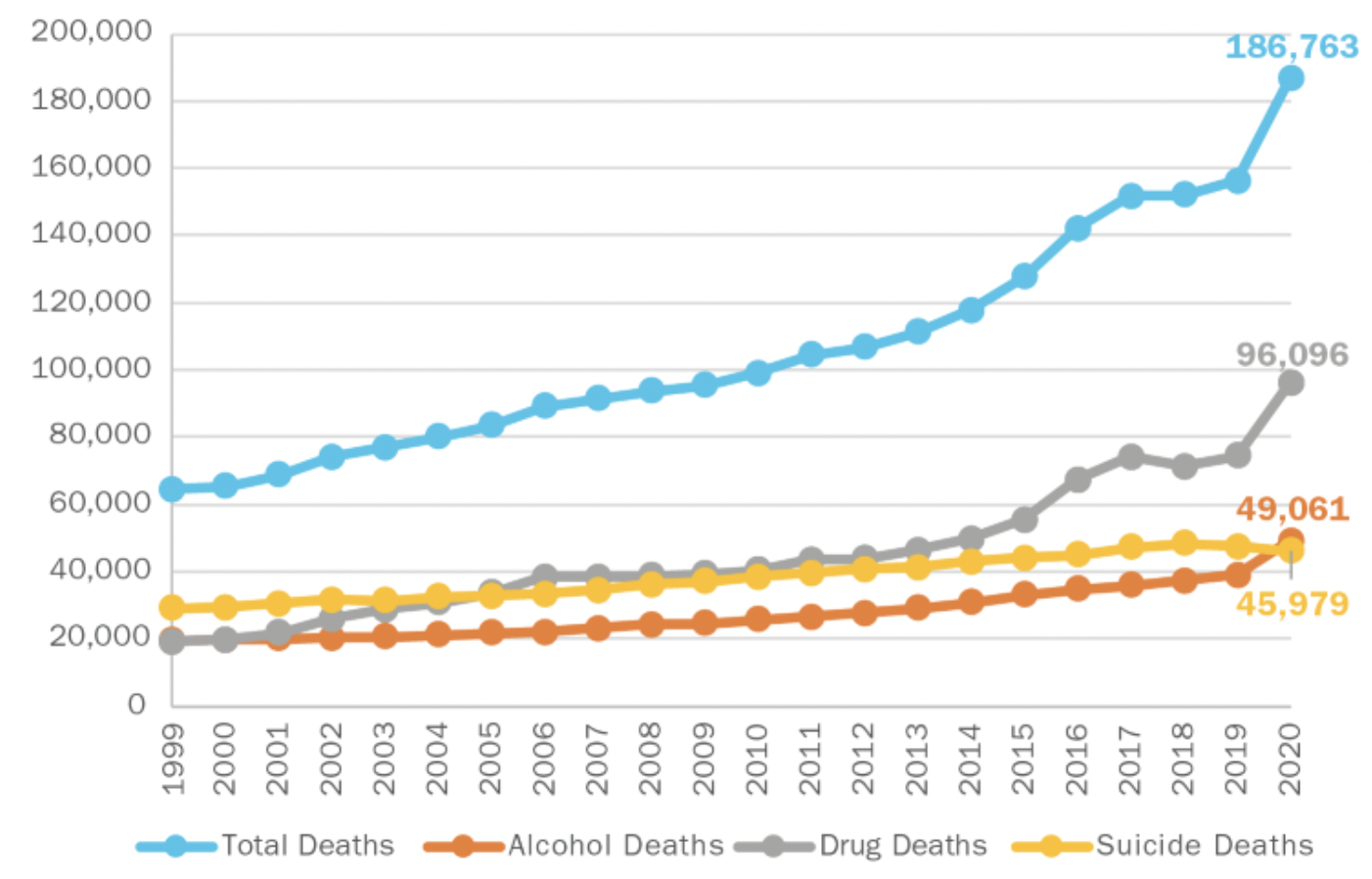
Annual deaths from alcohol, drugs and suicide in the United States, 1999-2020
(Chart by Trust for America's Health and Well Being Trust; click on the image to enlarge it.)

So-called deaths of despair—those related to alcohol, drugs, and suicide—hit an all-time high in 2020, claiming the lives of nearly 182,000 Americans, according to the Trust for America's Health and Well Being Trust. The 2020 total is 20 percent more than 2019, and mark the highest number of substance-misuse-related deaths recorded in any year; 2020 was dominated by the pandemic.

"While alcohol, drug, and suicide deaths have been increasing for decades, the 2020 increase was unprecedented and driven by a 30 percent increase in the rate of drug-induced deaths and a 27 percent increase in the rate of alcohol-induced deaths," Rhea Farberman and Amy Shields report for the Trust. "Combined rates of alcohol, drug, and suicide deaths increased in all 50 states except New Hampshire, and for the first time two states – West Virginia and New Mexico – surpassed 100 deaths per 100,000 state residents from alcohol, drugs, and suicide combined in a single year."

Synthetic opioids such as fentanyl and psychostimulants drove the increase in substance-misuse deaths. Rates for such deaths increased among all population groups except for people over age 75. People of color, youth aged 17 and under, and people 18-34 years old saw particularly high increases, as well as people who live in the South and West, the report says.

Fentanyl-related deaths have at least doubled in every state in the nation during the pandemic, and the report projects that such deaths will continue to rise. One big problem is that most people who overdose from fentanyl had no intention of taking it. Street drugs are often cut with fentanyl to stretch them further and make dealers more money, but the synthetic opioid is so potent that even adding a tiny bit more to a pill can be lethal. Teens often score fentanyl-laced drugs on social media.

The report calls for a comprehensive nationwide strategy that focuses on prevention, early identification of mitigating factors, harm reduction, and effective treatment.

Wednesday, May 11, 2022

Documents show how top opioid maker Mallinckrodt drove the epidemic by getting doctors to prescribe more pills

Average number of pain pills distributed per person, per year, by county, 2006-2014
(May by The Washington Post; click the image to enlarge it or click here for the interactive version.)

Even as the opioid epidemic raged across the U.S. in 2013, the nation's top opioid manufacturer, Mallinckrodt Pharmaceuticals, continued to aggressively court and lavishly reward doctors who prescribed more pain pills, even after sales reps cautioned the company that some doctors were running illegal pill mills, according to a treasure trove of newly released documents mined by Maryl Kornfield, Scott Higham and Steven Rich for The Washington Post.

The company also "played a key role in an industry-wide effort to convince the health-care industry that addiction was rare among opioid users and marketed its drugs to specific segments of society" such as seniors, the Post reports. "The Mallinckrodt documents are part of a cache of 1.4 million records, emails, audio recordings, videotaped depositions and other materials the company turned over as part of its $1.7 billion bankruptcy settlement in 2020. Several state officials with claims against the company, led by Massachusetts Attorney General Maura Healey (D), urged that the documents be made public."

The Post was granted exclusive access to the files, which are part of the Opioid Industry Documents Archive, a digital vault of records created or obtained by state and federal opioid lawsuits and managed by Johns Hopkins University and the University of California at San Francisco; it's the largest repository of such evidence from an opioid company to date.

"For the first time in a long time, industry secrets are going to be turned over to the public and millions of documents will live online in an archive forever,” Healey told the Post. "Making this evidence available to the public will hopefully pave the way for important reforms that will stop dangerous conduct and save lives."

Though OxyContin maker Purdue Pharma has been the prime bogeyman of the opioid epidemic, Mallinckrodt produced more narcotics because its pills were often more potent. "Between 2006 and 2014, Mallinckrodt accounted for 27 percent of the opioid market compared with 18% for Purdue Pharma, measured by the potency of the pills they produced," the Post reports.

Mallinckrodt's 30-milligram Exalgo pill quickly became the opioid of choice on the street, and in Massachusetts supplied to more than half of the people who died from opioid overdoses in the past 12 years—far more than Purdue and its affiliate Rhodes Pharmaceuticals supplied, the Post reports.

Retired Drug Enforcement Administration supervisor Jim Geldhof, who investigated Mallinckrodt before his 2016 retirement and now consults with cities in opioid lawsuits, told the Post: "Everybody thinks of Purdue when they think about the opioid epidemic, but Mallinckrodt was far worse."

In videotaped depositions from 2018 to 2020, top Mallinckrodt executives "took little or no responsibility for the opioid epidemic. Several skirted questions about whether an opioid epidemic even existed," the Post reports. "For years, drug companies have argued they were simply filling orders written by medical professionals for legitimate patients. But the Mallinckrodt files show that the company had detailed knowledge of the prescribing patterns of doctors and bemoaned their loss when they fell into trouble with regulators." Sales representatives whose clients prescribed more Exalgo were showered with perks like free trips to Hawaii and Europe.

In six months in 2013, company sales representatives contacted the top 239 Exalgo prescribers more than 7,000 times. "More than a quarter of those prescribers — 65 — were later convicted of crimes related to their medical practices, had their medical licenses suspended or revoked, or paid state or federal fines after being accused of wrongdoing," The Post reports.

One of those top prescribers was Cincinnati orthopedic surgeon George Griffin, whom the company knew was in legal trouble for overprescribing pain pills. "For one patient, he prescribed 640 mg a day of OxyContin — despite warnings from a pharmacist that the patient was a drug dealer with a history of drug-related felonies, according to the board," the Post reports. In 2019 Griffin was convicted of unlawful distribution of controlled substances and sentenced to 40 months in prison.

A former Massachusetts doctor, Fathalla Mashali, who was convicted of health-care fraud and more, complained that the companies have not faced the same consequences as the doctors they influenced. "We got prosecuted criminally and we lost all our money, lost everything," Mashali said. "The Sacklers get to keep their money, Mallinckrodt to keep their money. All the companies get to keep their money."

As part of its 2020 bankruptcy settlement, Mallinckrodt turned over $1.725 billion to a trust serving communities affected by the opioid epidemic, the Post notes.

Thursday, April 14, 2022

Some pain patients and doctors worry the CDC's revised opioid-prescription guidelines won't help patients enough

Opioid prescriptions have fallen more than 40 percent over the past decade in response to the opioid overdose and addiction crisis. The Centers for Disease Control and Prevention has played a role in that by encouraging doctors to prescribe fewer painkillers, but that has made it more difficult for patients with chronic pain to get the medication they need. The CDC has drafted a new version, on which the public-comment period just ended, "but some worry it doesn't protect patients enough," Will Stone reports for NPR.

New CDC guidelines in 2016 encouraged doctors to be wary of opioid addiction and advised them to start at a low dose and avoid prescribing high doses. Amanda Votta, a Rhode Island graduate student who has rheumatoid arthritis, told Stone that it became much harder for her to get any kind of opioid prescription at all, and that she was often in great pain.

"There's broad agreement now that the 2016 guidelines were misapplied to pain patients like Votta," Stone reports. Dr. Roger Chou, who helped write the 2016 guidelines, told Stone the guidelines were only meant to guide doctors, not stop them from prescribing appropriate medication to patients with chronic pain. But many states used the guidelines as the basis for new laws, some of which limited doctors' ability to prescribe opioids, Stone reports.

The CDC's new prescribing guidelines show promise, some experts say. "The top-line recommendations no longer include specifics about the dose or duration a patient shouldn't exceed when taking opioids. The draft also warns up front that the guidelines should not be used as inflexible standards of care," Stone reports. But the lack of specific guidance could make some doctors uncomfortable and cause them to stop prescribing opioids at all, another expert said.

Thursday, March 24, 2022

Study: Alcohol-related problems jumped during pandemic

Alcohol-related health issues and deaths spiked during the first year of the pandemic, according to a newly published study by researchers at the National Institute on Alcohol Abuse and Alcoholism in the National Institutes of Health.

"The startling report comes amid a growing realization that Covid’s toll extends beyond the number of lives claimed directly by the disease to the excess deaths caused by illnesses left untreated and a surge in drug overdoses, as well as to social costs like educational setbacks and the loss of parents and caregivers," Roni Caryn Rabin reports for The New York Times.

The researchers looked through death certificates and included all deaths where alcohol was listed as an underlying or contributing cause. "Among adults younger than 65, alcohol-related deaths actually outnumbered deaths from Covid-19 in 2020; some 74,408 Americans ages 16 to 64 died of alcohol-related causes, while 74,075 individuals under 65 died of Covid. And the rate of increase for alcohol-related deaths in 2020 — 25 percent — outpaced the rate of increase of deaths from all causes, which was 16.6 percent," Rabin reports. "The alcohol-related deaths went up for everybody — men, women, as well as every ethnic and racial group. Deaths among men and women increased at about the same rate, but the absolute number of deaths among men was much higher." Adults aged 25-44 saw the largest increases in alcohol-related deaths that year, increasing nearly 40% from the previous year.

The authors believe many who died were recovering alcoholics who relapsed after losing easy access to support, even as they needed it more than ever due to the pandemic. "Stress is the primary factor in relapse, and there is no question there was a big increase in self-reported stress, and big increases in anxiety and depression, and planet-wide uncertainty about what was coming next," lead researcher Aaron White told Rabin. "That’s a lot of pressure on people who are trying to maintain recovery."

Similarly, "drug overdose deaths also reached record levels during the first year of the pandemic, with more than 100,000 Americans dying of overdoses during the 12-month period that ended in April 2021, a nearly 30 percent increase over the previous year, according to reports issued in November," Rabin reports. "The number of deaths from opioids in which alcohol played a role also increased."

Friday, March 04, 2022

Purdue Pharma owners agree to raise OxyContin settlement to $6 billion after 9 states said $4.5 billion wasn't enough

Oxycodone (John Moore, Getty Images)
"Nine state attorneys general have agreed to drop their objection to a deal granting immunity from opioid lawsuits to members of the Sackler family who own Purdue Pharma, the maker of OxyContin," Brian Mann and Martha Bebinger report for NPR. "In exchange, the family has agreed to increase the amount it pays from personal holdings from roughly $4.5 billion under a previous settlement to $6 billion."

A federal judge overturned a prior deal in December after the Justice Department and some states filed an appeal, saying the Sacklers should pay more and shouldn't get immunity from current and future suits. "States demanding more money from the Sacklers — California, Connecticut, Delaware, Maryland, New Hampshire, Oregon, Vermont and Washington — have among the highest overdose death rates in the country," Mann and Bebinger report.

The extra $1 billion would go toward programs aimed at mitigating the opioid crisis, and the balance would still be divided among state, local and tribal governments, Mann and Bebinger report. The new deal must be approved by U.S. Bankrupty Judge Robert Drain, who has signaled strong support for it.

The Sacklers released a statement that admitted no wrongdoing but said they "sincerely regret" that OxyContin "unexpectedly" became part of the opioid crisis. The epidemic began in the 1990s, but until 2016, Purdue paid doctors kickbacks for public speaking and consulting services, and those who prescribed more OxyContin were most likely to get such fees. Sales reps for Abbott Laboratories, which partnered with Purdue to market OxyContin to doctors, was told to downplay the threat of addiction when promoting the drug. Purdue pleaded guilty in federal court in 2007 and 2020 for such fraudulent marketing practices, and didn't stop marketing OxyContin to doctors until 2018.

Monday, February 21, 2022

Opioid treatment programs are inaccessible for many rural Americans, and many don't offer the full range of treatment

Percentage of opioid treatment programs than accept Medicaid coverage, by state
Map by The Pew Charitable Trusts; click the image to enlarge it.

Opioid overdose deaths have shot up during the pandemic, topping a record-setting 100,000 in the 2021 fiscal year. But only 11 percent of the 2.7 million Americans with opioid-use disorder received medication-assisted treatment in 2020, and opioid treatment programs remain out of reach for many Americans with opioid-use disorder, including those in rural areas, Sheri Doyle and Vanessa Baaklini report for The Pew Charitable Trusts. Not only are OTPs scarcer in rural areas—Wyoming, one of the most rural states, had none at all as of 2020—but rural programs may not do much good if they don't accept Medicaid, offer buprenorphine, or have mental-health care that goes beyond drug treatment,

Pew found significant disparities among the states. OTPs are the only health-care facilities that may offer patients all three types of medication-assisted therapy for opioid addiction, but 60.5% didn't offer injectable naltrexone and 24.2% didn't offer buprenorphine.

Buprenorphine availability may have been hampered because medical providers once had to obtain special training and a waiver to prescribe it, but in April 2021 the Department of Health and Human Services largely did away with the waiver. However, the treatment still may be hard to get because the Drug Enforcement Administration also began cracking down on pharmacies suspected of improperly dispensing it, so many pharmacies subsequently refused to dispense it all.

Medicaid acceptance among OTPs also varied widely, from 100% in several states to none in Mississippi and South Dakota; 83.2% of OTPs overall accept Medicaid, Doyle and Baaklini report. When Medicaid is not accepted, the poor must pay out of pocket or seek charity.

Mental-health issues are common among those with opioid-use disorder, and treating such problems—which are often at the heart of opioid misuse—can help make drug treatment stick. But only 46.1% of OTPs offer mental-health treatment, Doyle and Baaklini report.

The study found wide disparities in the availability of OTPs that cater to specific populations: 64.1% offer treatment in other languages, 56.9% offer treatment specially for pregnant people, 24% for LGBTQ Americans, 24% for veterans, and 4.7% for adolescents.

Pew has recommendations for improving access, including a re-conception of the programs. OTPs have "punitive rules that reflect a distrust of patients—such as observed daily dosing, regular urine drug screens, and limits on access to take- home medication—rather than encouraging a collaborative setting in which the provider and patient work in partnership," says a Pew brief published with the study.

Also, state laws "prevent or discourage new OTPs, such as prohibiting OTPs near schools, requiring new OTPs to obtain a certificate of need (a legal document demonstrating public need for new facility services), or requiring licensure by the state board of pharmacy, a level of oversight not required by the federal government," Pew reports. "West Virginia law even prohibits new clinics from opening at all."

To increase access, Pew recommends that all OTPs accept Medicaid, that states should encourage mobile methadone clinics, and that more OTPs in general should be opened.

Friday, February 11, 2022

Fentanyl deaths have at least doubled in every state during pandemic; see state-level data and maps

Increase in number of fentanyl-related deaths from May 2019 to May 2021
(Families Against Fentanyl map; click the image to enlarge it.)

Fentanyl deaths have risen sharply during the pandemic, and some states have been particularly hard-hit, according to a new analysis of Centers for Disease Control and Prevention data by advocacy group Families Against Fentanyl. Fentanyl is a cheap but powerful synthetic opioid often added to street drugs; it causes more fatalities because it's deadly at tiny, easily misjudged doses.

The study measures recent state-level trends in fentanyl fatalities in several ways: rate of increase in fentanyl deaths during the pandemic, number of fentanyl deaths per capita in 2021, total number of fentanyl deaths in 2021, and total number of fentanyl deaths since 2015.

For instance, between May 2019 and May 2021, "Fentanyl fatalities more than doubled in 30 states in just two years, and more than tripled in 15," according to the report. Fatalities increased nearly five-fold in six states: Alaska, California, Colorado, Louisiana, Mississippi, and Texas. Florida had the highest number of total fentanyl deaths in 2021, a total that more than doubled in two years.

The shortage of overdose mitigation drug naloxone since April 2021 is likely causing more deaths, many of them rural; one organizer estimated that the back-order could lead to at least 11,000 more overdose deaths.

Wednesday, February 02, 2022

Over 400 Native American tribes agree to $665 million opioid deal with Johnson & Johnson, other drug companies

"Hundreds of Native American tribes, devastated disproportionally in the opioid epidemic, tentatively agreed to settle with the country’s three major drug distributors and Johnson & Johnson for $665 million," Meryl Kornfield reports for The Washington Post. "McKesson, Cardinal Health and AmerisourceBergen would pay $515 million over seven years and Johnson & Johnson would contribute $150 million in two years to the federally recognized tribes, resolving litigation in dozens of states with tribal reservations, according to documents filed Tuesday in federal court in Cleveland . . . The settlement with distributors includes $75 million they agreed in September to pay the Cherokee Nation in Oklahoma."

The settlement is the first of its kind for Native American tribes, and is similar to the July 2021 settlement in which the four companies agreed to pay states, counties and cities $26 billion for their role in the opioid pandemic. "The deal comes months before the first federal opioid trial for a Native American tribe, with the Cherokee Nation’s lawsuit against CVS, Walgreens and Walmart being heard in September in Oklahoma federal court. A bankruptcy plan for Purdue Pharma, which is under negotiation, would also set aside settlement money for tribes."

The settlement buttresses the "public nuisance" strategy that has been prominent in opioid tort litigation. That tactic has been called into question in recent months after two state courts threw out settlements predicated on claims that drug companies created a public nuisance by encouraging the opioid epidemic. Still, plaintiffs remain skittish, and the Cherokee Nation recently dropped its public-nuisance claim in the Oklahoma suit, Adam Lidgett reports for Law360.

"This resolution speeds up the process of getting funds, as the sprawling opioid litigation throughout the country has taken years to reach courtrooms," Kornfield reports. "Overseen by a panel of tribal health experts, the money from this deal would go toward programs that aid drug users and their communities — a help to tribal governments bearing severe financial burdens for the health care, social services, child welfare and law enforcement resources expended during the opioid crisis. About 15 percent of funds will go toward attorneys’ fees." Native Americans were nearly 50% more likely to die from an opioid overdose than non-natives from 2006 to 2014.