Showing posts with label highway safety. Show all posts

Friday, September 08, 2023

Roadkill is a 'rural reality;' these tips plan for safety, removal and even alternative uses for carcasses

Photo by Tor Styger, Unsplash
"There's not much that's sweeter, after the hot, muggy dog days of summer, than opening your windows to a cool breeze of country-fresh air, except when that breeze carries the stench of carrion. Unless you're a turkey vulture, there's not much to love about dead stuff that's been overcooked on hot pavement. But roadkill is a reality on country roads, so it's good to know how to deal with it," reports Donna Kallner of The Daily Yonder. A gently edited list of Kallner's roadkill best practices is below.

For drivers. After hitting an animal, find a safe place to pull over and catch your breath. Consider potential hazards to other motorists. Note the location. If you have cell service, report the collision to the county sheriff’s office. If you plan to continue driving, text your planned route and ETA to a trusted contact in case damage to the vehicle causes problems later. Consider what other issues might arise. For example, a driver who swerved to miss a deer and ran off the road was able to drive out of the ditch. But his car took out the electric fence for a horse pasture, and horses on the highway are a huge hazard.

First things first. "Managing" often begins by determining (cautiously) whether the animal is alive. A wounded animal can be dangerous and unpredictable. Non-fatal injuries to protected species like raptors might require a call to a wildlife rehabilitation facility for guidance. Sometimes, though, the kindest thing may be to put it out of its misery. That job may fall to a deputy if you advise law enforcement that the animal appears to be fatally injured and suffering. Don't be surprised if the driver of the truck that pulls over to see if you need help is carrying a firearm when they approach. Also, don't be surprised if a gun-toting Good Samaritan has to blow their nose and wipe their eyes after ending an animal's suffering.

Who cleans up? While state laws vary, in Wisconsin local government is charged with the removal of large carcasses on the road or the shoulder if they could present a hazard to motorists. So, for a large animal, it's advisable to notify your county sheriff’s department so they can assess the situation. But things can get pretty whiffy before the county highway department or its carcass contractor shows up. So able-bodied people with rural addresses tend to manage mostly on their own for smaller critters or with help from neighbors for bigger ones.

Tools of the trade. For most small critters, we manage removal from the road with just a shovel and perhaps a nudge from a booted toe. The shovel is convenient for carrying a small animal to a final resting place, digging a hole, and covering the carcass with enough dirt to tamp down the smell. Sometimes, a rake is handy for gathering up parts – especially when you don't want your boots to smell of skunk. For handling remains, you will want gloves – especially where Chronic Wasting Disease or other potential contagions may be present. Webbing straps or ropes and pulleys may be helpful when you need to get a larger animal into a truck bed to haul far enough away to let scavengers manage clean-up. When there's snow on the ground, a sled can be used. Calling a neighbor with an end-loader is always an option.

Doggone it. As soon as we know there's roadkill by our place, we assume our dog will follow her nose to it. For her own safety, she gets put inside while we manage the mess. We keep a close eye on the dog for a few days to keep her from following the scent trail. Never underestimate the distance at which a dog can pick up a foul scent when you have company coming.

But is it a bad thing? Some people who raise chickens or ducks ask friends to be on the lookout for roadkill of the fox or coyote persuasion. Nailed up nearby, a rotting carcass acts as a deterrent to other predators. And the birds appreciate the maggots that drop as nature takes its course.

Other uses. I know basket makers who are happy to pick up roadkilled porcupines to harvest their quills. Wildlife rehabilitation facilities feed it to their patients.

Roadside abandonment. Hauling away roadkill is probably less common in rural areas than simply letting nature take its course – preferably off the pavement and at least a quarter-mile away from a residence. It also provides food for birds of prey and other wildlife. It's not pretty, and it sure can stink. But it doesn't last forever. And watching a bald eagle feed on a deer carcass in the ditch is a sight to behold.

This article first appeared on The Daily Yonder and is republished here under a Creative Commons license.

Wednesday, August 03, 2022

Deadly traffic accidents are still far more likely to be rural

Traffic death rates (rural, urban and overall) per million vehicle miles traveled (NHTSA graph)

Though only 19 percent of Americans live in rural areas, rural roads account for 31% of miles traveled in vehicles, and 43% of motor vehicle traffic fatalities in 2020 happened in rural areas, according to the latest figures published by the Transportation Department's National Highway Traffic Safety Administration.

The frequency of fatal accidents per mile traveled increased markedly in 2020, more so in urban areas than rural, but 2020 was the second consecutive year that the rural rate increased, after two years of decline. Here are detailed findings from the report:
  • Of the 38,824 motor vehicle traffic fatalities in 2020, 16,665 (43%) happened in rural areas, compared to 21,650 (56%) in urban areas, and 509 (1%) in areas of unknown land use.
  • Rural traffic fatalities increased by 2% from 2019 to 2020, while urban traffic fatalities increased by 9% in the same time period.
  • Speeding was a major factor in 28% of rural traffic fatalities in 2020, compared to 30% of urban traffic fatalities that year.
  • Fatalities related to alcohol-impaired driving increased by 9% in rural areas from 2019 to 2020, compared to a 17% increase in urban areas in the same time period.
  • Alcohol-related traffic fatalities in both rural and urban areas increased from 28% in 2019 to 30% in 2020.
  • Front-seat passengers in rural and urban areas had similar rates of seatbelt use, with about 89.9% of passengers in rural areas vs. 90.5% of urban passengers.
  • Vehicle passengers in rural traffic fatalities were slightly less likely than their urban counterparts to be wearing a seatbelt in the wreck that killed them, at 52% vs. 49%.

Monday, March 21, 2022

Deadly Texas crash with 13-year-old driver draws attention to rural custom of allowing young teens behind the wheel

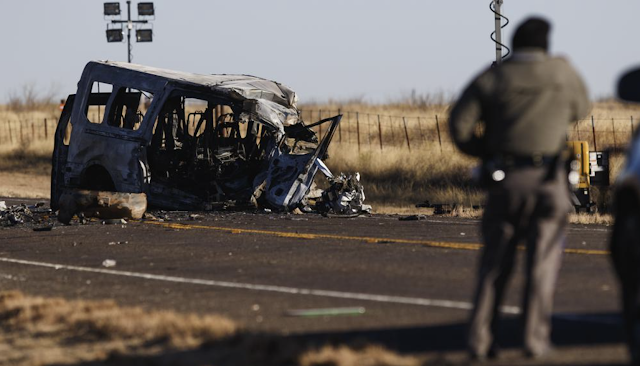
Texas state troopers survey the wreckage from a fatal March 16 crash in west Texas caused by a 13-year-old driver. (Associated Press photo by Eli Hartman)

A deadly crash is drawing renewed attention to the common rural practice of allowing young teenagers and even younger children to drive. Nine people died in West Texas last week when a 13-year-old driving a pickup truck blew a tire and overcorrected, striking a van carrying members of the men's and women's golf teams of the University of the Southwest, a private Christian school in Hobbs, N.M. The teen and his 38-year-old father were killed, along with a golf coach and six students, Gene Johnson reports for The Associated Press. The crash occurred in Andrews County, about 30 miles east of the New Mexico border.

"At a news conference in Odessa, Texas, on Thursday, National Transportation Safety Board Vice Chairman Bruce Landsberg said the dangers of underage driving put it on the agency’s 'most-wanted list'," Johnson reports. "Along with drunk and distracted driving, Landsberg said 'youthful driving' and excessive speed on rural roads are among the problems that make highway driving the most dangerous form of transit in the United States."

In 2020 alone, drivers aged 13 and under were involved in 47 fatal crashes and 1,057 crashes that caused injuries, according to National Highway Traffic Safety Administration data. And though there aren't specific statistics on where such underage drivers live, rural roads are nearly twice as deadly overall: "In 2019, the fatality rate per 100 million vehicle miles traveled was 1.9 times higher in rural areas than in urban areas," Johnson reports. Put another way: nearly half the nation's traffic fatalities in 2019 happened on rural roads, though less than one-fifth of the population is rural.

There were other risk factors: The crash happened at night, on a road with a 75 mile-per-hour speed limit, the tire that blew was a spare not meant for high-speed use, and the driver was a teenage male—one of the highest-risk segments of the driving population, Johnson reports. Several people he interviewed recalled learning to drive on the family farm when they were as young as 10, but also said their parents emphasized safety and refused to let them to drive on public roads until they were legally allowed. One man observed that the road where the crash happened had heavy traffic from nearby oil fields, and said no 13-year-old should have been driving on it to begin with.

William Van Tassel, who manages the American Automobile Association's driver training programs, told Johnson that, while rural teens frequently start driving at a younger age than their suburban and urban peers, that doesn't mean they're ready to hit the highway: "When it comes to public roads, the laws are pretty clear: You can’t be out there until you’re legally eligible."

Thursday, December 09, 2021

Though traffic was down in 2020 due to the pandemic, deaths in auto accidents hit the highest number since 2007

Even as  pandemic restrictions drastically reduced traffic, 2020 saw 38,680 deaths on U.S. roadways, the most since 2007. Road fatalities were up in rural and metropolitan areas, on all types of roads, at all times of day, and in every age group of drivers, according to the most recent figures from the Transportation Department's National Highway Traffic Safety Administration.

"The latest evidence suggests that after decades of safety gains, the pandemic has made U.S. drivers more reckless — more likely to speed, drink or use drugs and leave their seatbelts unbuckled," Emily Baumgaertner and Russ Mitchell report for the Los Angeles Times. "The rise in motor vehicle deaths lines up with other pandemic-era trends: Alcohol sales have soared, drug overdoses have set new records, and homicides have seen their biggest increase on record."

Some researchers believe pandemic depression is the culprit, and note that car accident deaths for Black people were more than triple the overall death rate. The disparity "could reflect a deeper sense of despair in the poorer communities hit hardest by the pandemic," Baumgaertner and Mitchell report.

However, Shannon Frattaroli, a researcher at Johns Hopkins' Bloomberg School of Public Health, wondered if the disparity "was related to a disproportionate number of Black people in the essential workforce, including delivery drivers who are 'paid by how fast you can move'," Baumgaertner and Mitchell report.

Jonathan Adkins, director of the nonprofit Governors Highway Safety Association, told the Times the trend indicates "aggressive" and "very selfish" behavior. Many governors offices, he said, have told the organization that the increase in crashes is "a symptom and a sign of the overall lack of consideration we’re showing for other citizens, whether it be wearing masks, or not getting vaccinated, or how we drive."

Monday, November 08, 2021

Wolves may reduce frequency of car collisions with deer, not just by killing them but keeping them away from roads

Indigenous tribes and wildlife advocacy groups are suing the state of Wisconsin to stop the state wolf hunt, which was set to begin last week until a judge blocked it. Their concerns center on the wolves' lives, but there's another good reason to halt the hunt, Ed Yong writes for The Atlantic: New research shows that wolves can cut down on serious or fatal car collisions with deer, and not just by killing them.

Wolves "tend to prowl along human-made corridors such as trails and roads. By killing deer near these areas, or simply intimidating them into staying away, wolves could keep the animals far from cars," Yong reports. By analyzing 22 years of data, researchers found "Wisconsin’s wolves have reduced the frequency of deer-vehicle collisions by a quarter. They save the state $10.9 million in losses every year—a figure 63 times greater than the total compensation paid for the loss of livestock or pets."

Tuesday, August 17, 2021

Senate infrastructure bill has $300 million for rural road safety; some states are already focusing on the problem

The recently-passed Senate infrastructure bill has funding for a longstanding problem: unsafe rural roads. More than 16,000 people died on rural roads in the U.S. in 2019, according to the most recent National Highway Traffic Safety Administration data available. That's nearly half of the nation's annual traffic fatalities, though only about one-fifth of the population lives in rural areas, Jenni Bergal reports for Stateline.

The Senate bill "would require a study of the issue and launch a new rural road grant program that includes $300 million for high-risk rural road safety programs. And safety analysis should be part of the many individual projects funded by the package, advocates say," Bergal reports. "Relatively simple engineering changes, such as rumble strips, median barriers, pavement markings, better lighting and wider shoulders could make a big difference in rural road safety, transportation experts and advocates say." Another issue that contributes to higher rural road fatality rates: emergency responders often take longer to arrive at the scene and longer to get patients to a hospital.

Some state transportation departments are already tackling the problem.

"South Carolina, for example, is investing $124 million over 10 years to make rural roads safer by installing rumble strips, wider pavement markings, brighter signs, high-friction surface treatments, guardrails and other improvements," Bergal reports. "In Minnesota, the state transportation department has installed technology at dozens of rural intersections to give motorists real-time warnings about traffic conditions."

And in Kansas, "where about 90% of the roads are rural and most are owned by counties, state Department of Transportation officials decided to change the way they viewed crash data and how and where to make changes," Bergal reports. Data showed that roadway departures, or anything that makes drivers unintentionally leave the road, were the biggest contributors to serious or fatal accidents.

The department has allotted $4 million in federal funds each year for the program, including $1 million a year for a consultant to help the state's 105 counties create safety plans for their rural roads. "The plans will recommend engineering changes that local governments can make to prevent crashes, such as flattening slopes, widening shoulders, installing pavement markings and rumble strips and removing trees that may be too close to the road. The state is paying for 90% with federal dollars; local governments are picking up the rest," Bergal reports. "When the program started in 2016, Kansas was averaging 207 severe crashes a year on rural roads ... That number dropped to 189 as of 2018, the latest year data is available."

Monday, December 07, 2020

Less highway traffic in pandemic may have boosted rural car-wreck mortality rate by encouraging speeding

There were fewer traffic fatalities in 2020's second quarter than in 2019's, but that's because fewer vehicles were on the road during the pandemic. The traffic fatality rate, however, has increased. 

According to recent state and national data compiled by the National Highway Traffic Safety Administration, several factors contributed to the fatality-rate increase. "First, there is evidence of an increase in ejection rates among people who were in crashes, suggesting a decrease in the seat-belt use rate of vehicle occupants. This increase was heavily tilted toward males, people 18 to 34 years old, and people in rural areas," the report says. "Second, according to state data and other reports, speeding was more prevalent on the roads. The reduction in traffic volume coupled with community efforts to reduce law enforcement personnel exposure by implementing changes in law enforcement activity provided drivers a greater opportunity to speed."

Moreover, there is evidence of higher usage of alcohol and drugs such as marijuana and opioids among 2020 crash victims compared to those who died in 2019. Survey research indicates that this may be because many people have begun to use such substances or increased their use to cope with pandemic-related stress, the report says.

Friday, October 09, 2020

States allowing online driver-license renewals, written tests

The pandemic has prompted many states to allow online renewals of driver and motor-vehicle licenses, and now some are even allowing driver-licensing tests to go online, another boon for rural residents in states where the licensing function is regionalized and requires out-of-county travel.

"Prospective drivers in Minnesota can go online at home to take their knowledge tests for a learner's permit," which is required before a road test for a license, which must still be done in person, Kate Elizabeth Queram reports for Route Fifty. "Test takers can’t consult manuals or online resources, and the test will close and record an automatic failure if another browser window is opened during the 30-minute window. Proctors are required to check a box before the test launches pledging that they won’t allow the use of other study materials, though that will be entirely on the honor system."

Queram notes similar measures in other states: states "Wisconsin and North Carolina, allowed certain teenage drivers to apply for a waiver for the road test. Georgia implemented a similar policy in April, but amended it a month later to require a modified road test instead. Others, including California and Massachusetts, extended the expiration dates for learner's permits, allowing teens to continue practicing their driving until road tests resumed."

Thursday, September 19, 2019

Deadliest rural N.Y. wrecks involve tractors, combines, etc.

In rural New York state, wrecks involving farm vehicles were five times more likely to be fatal than other collisions, and more severe overall in terms of injuries and number of vehicles, according to a newly published study by the New York Center for Agricultural Medicine and Health.

The researchers studied motor vehicle crash data from 2010 to 2012 from the state Department of Motor Vehicles, and were able to pick out agriculture-related crashes by selecting for vehicle registration type and vehicle body type. Of the 203 ag-related crashes, which involved 381 vehicles and 482 people, 91.6 percent caused property damage and 36% caused injury, according to the report.

"Accidents involving tractors and other ag-related equipment on rural roads occurred most often on straightaways with a grade, according to the data analyzed. Erika Scott, the center’s deputy director, speculates that this is due to motorists attempting to pass slower-moving tractors or agricultural machinery," The Altamont Enterprise reports.

Rural roads are overall more dangerous than suburban or urban roadways: though less than 20% of the population lives in rural areas, more than half of all fatal road accidents happen in rural areas. Perhaps related: "The Centers for Disease Control and Prevention data have shown that agriculture, forestry, and fishing as an occupational group has the third highest rate of work-related roadway crashes," the Enterprise reports.

Monday, August 19, 2019

North Dakota Highway Patrol and a sheriff's department in the state get federal permission to fly drones over people

The Federal Aviation Administration has granted the North Dakota Highway Patrol and the Burleigh County Sheriff's Department in North Dakota the permission to fly drones over people and populated areas. "The North Dakota patrol is the first state highway patrol agency in the country to receive the permission," Blake Nicholson reports for the Bismarck Tribune. "The Burleigh County Sheriff's Department is only the second county law enforcement agency in the nation to obtain it." In June, the North Dakota Transportation Department became the first state government agency to get an FAA permit to fly drones over people.

According to Col. Brandon Solberg, the highway patrol's superintendent, the waiver will allow troopers to safely document complicated vehicle crash scenes. The agency says the drones will also aid in finding missing people and fleeing suspects, Nicholson reports.

The patrol is in the process of buying a drone, and has already bought a parachute recovery system that makes it safer to fly over populated areas; if the drone falls, the system deploys a parachute, shuts down the rotors, and emits a buzzer to warn bystanders. If the patrol is satisfied with the drone, it plans to buy three more and base one in each quadrant of the state, Nicholson reports. The state legislature approved one-time funding of almost $100,000 for the program over the next three years.

Wednesday, March 06, 2019

Roadkill ratatouille? Why not? More states encourage use

Roadkill cuisine sounds unappetizing to most, but more states are recognizing that it can make a perfectly good meal. Officials in several states are allowing, even encouraging, people to salvage roadkill in an effort to reduce collisions with carcasses and keep good meat from going to waste.

"Between 1 million and 2 million large animals are hit by vehicles every year in the United States in accidents that kill 200 people and cost nearly $8.4 billion in damages, according to estimates from the Federal Highway Administration," Matt Vasilogambros reports for Stateline. Why not use some of that meat?

Some supporters of the notion say it's a good way to feed the hungry; others say it makes sense from a conservation aspect. Idaho restaurateur Nate Lindskoog told Stateline that eating roadkill venison is the "most respectful thing to do if wild game dies. It's the best way to dignify its death." He stressed that he only eats roadkill at home, and does not serve it in his restaurant.

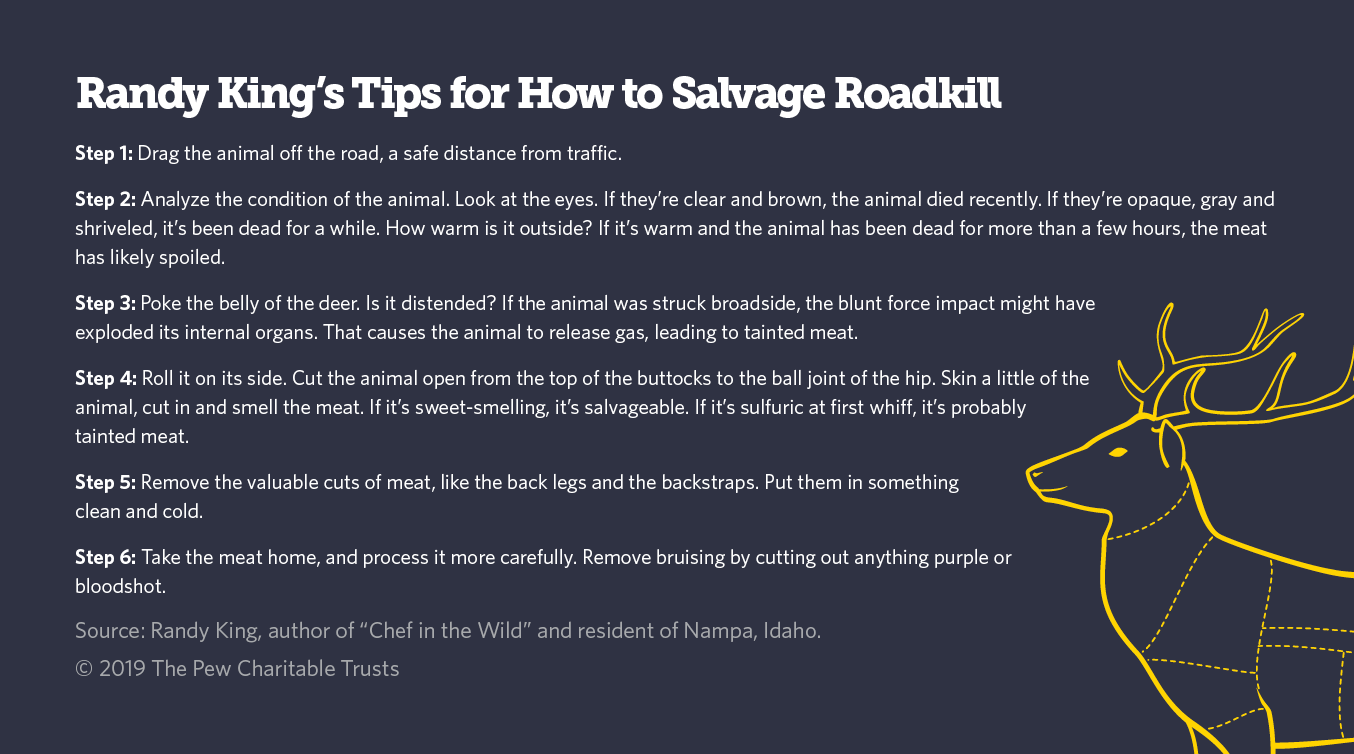
Within 24 hours of butchering roadkill, Idaho law requires salvagers to visit the state Fish and Game website to describe it. "State officials use the information to identify animal migration patterns, feeding areas and dangerous stretches of road. Their goal is to protect animals, but also people and their vehicles," Stateline reports. Click here for tips on how to safely harvest roadkill.

Tuesday, December 11, 2018

Copper theft from state highways dangerous to drivers and an expensive headache for state transportation departments

"Thieves have been stripping copper wire from abandoned houses, commercial buildings and construction sites for years. But they also have taken aim at public rights of way, creating a rash of headaches for public safety and transportation officials," Jenni Bergal reports for Stateline.

Copper wire is found in boxes at the base of light poles and on highway barriers, which make attractive targets for thieves. Some dress in fake safety gear to make them look like utility workers. Many thieves are drug addicts looking for cash; they take the copper to scrap recycling yards, where copper can net more than $2 a pound, Bergal reports. Some states have enacted laws that require scrapyards to document the name and license plate of would-be copper sellers, and some have increased penalties for stealing metal.

The state highway department in Missouri has paid $850,000 on light repairs because of copper theft, as much as it spent in 2016 and 2017 combined. But the expense is only one part of the problem. Lack of lighting (until the state can repair the light poles) makes driving more dangerous for motorists. "Roadway lighting can reduce night-time crashes by about 35 percent, according to a Federal Highway Administration study," Bergal reports.

Wednesday, September 19, 2018

Transportation agencies' electronic messaging devices may feature some of the best one-liners in America

Electronic billboard slogans from the Utah Department of Transportation (Photo by Utah DOT)
On long stretches of rural road in states that limit billboards, sometimes the most entertaining signs are the official messaging devices of state highway departments. "As summer car travelers are noticing, state transportation officials have become a bit of a trip," Jennifer Levitz reports for The Wall Street Journal. "Traffic specialists who once stuck to dispatches like 'Westbound I-70 left lane closed at Wentzville Parkway' are spicing up electronic billboards with snark, dad jokes and the occasional eyebrow-raiser."

Examples include an admonition to "Get your head out of your apps" or warnings that "Santa sees you when you're speeding". It's unclear how well the eye-catching slogans help with road safety, but in a Federal Highway Administration-sponsored survey, respondents said roadside safety messages are more likely to change their driving behavior than other kinds of messages, Levitz reports.

Electronic message screens were originally used for more staid reminders about lane closures and reminders to use your seatbelt. But about five years ago, an Iowa Department of Transportation employee helped start the trend toward wit, Levitz reports. Traffic-safety engineer Willy Sorenson was assigned to come up with slogans for times no urgent messages were needed, and decided to have some fun. He and colleague Tracey Bramble brainstorm slogans twice a year, then run their ideas past a committee to make sure the slogans are suitable for use.

Other states' highway agencies decided to get in on the fun, and now have a Facebook group to trade ideas, according to Sam Cole, the traffic safety communications manager for the Colorado Department of Transportation. The Missouri DOT recently solicited ideas from the public. Spokesperson Taylor Brune said "Don't be a tool, buckle up, fool," was one entry rejected. "That was was an obvious no for us," he told Levitz.

Thursday, May 17, 2018

MIT project helps self-driving cars navigate rural roads

How MIT's car sees the world with a LiDar sensor (MIT illustration)
Self-driving cars are already on the streets in a few urban areas, but they face a significant barrier to driving rural roads: there may not be detailed three-dimensional maps available (think Google Street View maps), and the roads can be twisty with few or no buildings nearby to help the car assess landmarks or road edges. But researchers at the Massachusetts Institute of Technology have come up with a way to help autonomous cars navigate rural roads, and "their strategy involves teaching cars to drive like humans," Rob Verger reports for Popular Science.

Though self-driving cars rely on detailed maps to help them figure out where they are in a city, many have a LiDAR (Light Detection and Ranging) sensor that helps it see curbs and other obstacles. The MIT team juiced up their test vehicle's LiDar sensor to help it detect the difference between the asphalt and the grass. The LiDAR's 64 lasers each spun around 10 times per second, providing constant feedback on what the car's surroundings look like and where it was on the road.

That’s how the car perceived where the road was in front of it, but it still had to know how to drive to its destination without a great 3D map in its silicon brain (although it did have GPS)," Verger reports. "To do that, it picked a 'local goal'—a point in the road up ahead that the car could see, and drove towards it. But it didn’t just drive to that point and stop. The vehicle constantly refreshed that goal as it approached it, like paddling towards a point on the horizon on a big, flat lake."

Christoph Mertz, a scientist at Carnegie Mellon University's Robotics Institute, admires the project because he says rural areas are sometimes neglected by scientists, and this project could help rural residents: "If these autonomous vehicles don’t drive in rural areas, then the elderly there might be stuck in their houses because nobody can drive them."

Wednesday, April 11, 2018

National Safety Council offers free course about the dangers of distracted diving, online all next week

April is Distracted Driving Awareness Month, so the National Safety Council is offering a free, 45-minute online course about the dangers of distracted driving, available Sunday, April 15 through Saturday, April 21.

Distracted driving caused 3,477 deaths nationwide in 2015. A Centers for Disease Control and Prevention study found that people in rural areas are less likely to wear a seat belt and more likely to die in car crashes. For more information or to register for the online course, click here.

Even without factoring in distraction, rural drivers face additional dangers on the road: because inebriated people can't call a taxi or Uber in a rural area, they may be tempted to drive home. Fewer traffic lights means more room to speed. Rural drivers have older cars on average that may be prone to mechanical failure. Deer are more likely to jump out in front of drivers in rural areas. And when a crash happens, it can take much longer for an ambulance to arrive and take the victim to the hospital. Common sense dictates that combining any of those factors with distracted driving makes for even greater danger.

Thursday, September 28, 2017

Study: rural drivers more likely to die in car wrecks, less likely to wear seatbelts

The Centers for Disease Control and Prevention released a study last week saying that people in rural areas are less likely to wear a seat belt, and more likely to die in car crashes. "The report said that America’s most rural counties had motor-vehicle death rates 'three to 10 times higher than those in the most urban counties.'  It found that 44.4 percent of drivers and passengers were not buckled at the time of a fatal crash in urban counties, compared with 61.3 percent in rural counties," Jason Nark reports for the Philadelphia Inquirer. The rural West had the highest death rates, with 40 per 100,000 caused by car wrecks, while the rural Northeast had the lowest with only 10.8 per 100,000.

Philadelphia Inquirer map; click on the image to enlarge.
Click here to use the interactive version.
Laurie Beck, an epidemiologist in the CDC’s Division of Unintentional Injury Prevention, told Nark that what's most interesting about the study is that it shows that the more rural the area is, the higher the risk of crash-related death. "Seat belt laws have a lot to do with those rates. People buckle up more in 'primary enforcement' states, where a police officer can pull over and ticket drivers and passengers for not wearing one," Nark reports. "In secondary enforcement states, a passenger or driver can be ticketed only if another offense has occurred. A large swath of Western states are secondary enforcement states."

The reasons for the trend are numerous, besides the seat belt issue: In rural areas, inebriated drivers can't call a taxi or an Uber, and may be tempted to drive home. There are fewer traffic lights and stop signs, giving drivers more room to speed. Drivers in rural areas drive older cars on average, which may be more prone to mechanical failure. Deer are more likely to jump out into the road in rural areas. And when a crash does happen, it could take a lot longer for an ambulance to get there and drive the victim to a hospital.

Thursday, August 10, 2017

Eclipse could cause historic traffic jams, hazards

The nation is gearing up for the Monday, Aug. 21, solar eclipse, which will cross 14 states from Oregon to South Carolina in about 90 minutes. As excited citizens buy eclipse glasses and book hotel rooms, communities are preparing for the huge influx of visitors and the strain they could place on local infrastructure such as cell phone networks. But another big problem to watch out for? Traffic. About 200 million people live within a day's drive of the path of totality – the narrow cross-country line where the sun will be completely hidden for up to two minutes and 40 seconds.

Officials are expecting millions to clog the roads, Jenni Bergal reports for Stateline, the the nonpartisan, nonprofit news service of the Pew Charitable Trusts. Dave Thompson, a spokesperson for the Oregon Department of Transportation, told her: "People are thinking they're just going to pop in, see it, and then turn around and head back home. They're not. They need to be prepared for long backups and have a full tank of gas and stuff in their car like water and food and medications they might need."

States are doing what they can to mitigate traffic issues. Many plan to suspend construction projects for the day. Idaho officials are identifying potential bottlenecks and ways to manage traffic. Missouri will monitor capacity at interstate rest areas and welcome centers so they can be closed to new entries when they fill up. Geographic information systems expert Michael Zeiler, who operates GreatAmericanEclipse.com, a great one-stop source of eclipse information, created a map of potential traffic bottlenecks for the eclipse:

FiveThirtyEight.com map; click to view a larger version
Transportation officials are concerned about wrecks that could be caused by the congestion, confusion and people pulling onto road shoulders to observe the eclipse. They're particularly worried that drivers might take pictures while driving, or look up at the sun instead of at the road. Looking up at the sun is a no-win scenario: drivers who aren't wearing eclipse glasses could damage their eyes and become temporarily blinded, and those who are wearing eclipse glasses won't be able to see the road. Federal Highway Administration spokesperson Doug Hecox has simple advice for drivers: "Don’t stand on the interstate. Don’t pull your car over. Don’t take a selfie from a bridge. The risk of driver distraction from this once-in-a lifetime event has never been greater. We don’t want anyone to have an 'eclipse in judgment'."

Wednesday, June 28, 2017

State-by-state rural roads fatality report released

(Oregon Public Broadcasting photo)
A state-by-state report of traffic fatalities on rural roads released Tuesday finds that deaths on rural roads are about 2.5 times higher than on urban roads.

The study, prepared by the nonprofit traffic research group TRIP, shows that South Carolina, California, Kentucky, Mississippi and Montana are the top five states, respectively, with the deadliest rural roads. Researchers measured fatalities as a rate for every 100 million miles traveled on rural, non-interstate roads.

Some states, particularly in the West, have large populations that are heavily centered in cities, which leaves vast, sparsely populated rural areas. One such example is Nevada, which ranks sixth in the report. "Statistics can 'appear skewed when the majority of Nevada roads lie outside of urban areas,'" Nevada Transportation Department spokesman Tony Illia told Ben Botkin of the Las Vegas Review-Journal.

"Clark County (Las Vegas) now accounts for two-thirds of the state's population," Illia told Botkin. "As a result, one or two fatal crashes along rural roads can suggest a disproportionate trend. However, there is a great distance between major urban areas across the state, which covers a whopping 110,577 square miles. Nevada is the country’s seventh-largest state by real estate but ranks 42nd in density. Rural drivers are subsequently susceptible to weather, wildlife and fatigue, among other things."

The report also warned that the nation's rural transportation system needs improvements to boost safety and increase economic opportunities, Botkin writes.

Wednesday, May 31, 2017

Study finds that 2/3 of wrecks that kill children occur on rural roads

New York Times photo
Unintentional injury is the most common cause of death in children under the age of 15; car wrecks are the most common cause of unintentional injury; and rural roads were the most deadly: 67 percent of deaths among children occurred on roads classified as rural by the Federal Highway Administration. Possible culprits include poor lighting, distance to trauma centers and urban residents’ lack of familiarity with rural roads.

Between 2010 and 2014, 2,885 children died in car wrecks nationwide, an average of 11 kids per week, Nicholas Bakalar writes in The New York Times. That figure does not include pedestrians, those who died in motorcycle or bicycle wrecks or those who died riding in an unenclosed cargo area or trailer. "Most of the children who died were not wearing seat belts — nationwide, 43 percent were unrestrained or improperly restrained. Another 15 percent were sitting inappropriately in the front seat, and 13 percent were riding in cars driven by somebody under the influence of alcohol," Bakalar notes.

Researchers at Brigham and Women’s Hospital in Boston and at the University of Texas Southwestern Medical Center in Dallas carried out this research, which was published in The Journal of Pediatrics.

Researchers also found significant variations in children’s deaths from state to state, Bakalar writes. In New Hampshire, all of the five children who died during the study period were properly restrained. In Mississippi, however, 56 of the 99 who died were not wearing seat belts, or weren't wearing them properly. There were 0.25 deaths per 100,000 children in Massachusetts, compared with 3.23 per 100,000 in Mississippi.

Similarly, a 2005 study published in Injury Prevention found that rural roads have an overall higher percentage of fatal wrecks than do urban roads: 0.9 percent of wrecks on rural roads are fatal, while only 0.2 percent are fatal in urban areas, according to data gathered from the Federal Highway Administration.

Thursday, April 27, 2017

Michigan to raise speed limits on rural highways to 75; studies show increased speeds more deadly

About 600 miles of rural freeways in Michigan will soon see speed limits increased to 75 mph and 65 for semis and school buses, reports The Associated Press. New signs are expected to be installed on three major freeways next month. Also, 900 miles of roads will have limits increased from 55 to 65. 

"The higher speeds are required under a new law that Gov. Rick Snyder signed in January. It allows the new limits only if engineering and safety studies indicate it is OK and if 85 percent of traffic survey already is traveling at those speeds on the affected highways," reports AP. Col. Kriste Kibbey Etue, director of the state police, said "The 85th-percentile speed analysis is a 'national scientifically proven method to determine and establish safe speed limits.'"

Last year in Michigan traffic accidents 1,021 people were killed, the most since 2007 when there was 1,084, Robert Allen reports for Detroit Free Press. "Since dipping to a record low of 817 in 2009, the number of traffic fatalities in Michigan has increased, gradually, by about 15 percent during the six years that followed, according to data from Michigan State Police." In 2016, 963 people died in traffic fatalities in Michigan, 11th most in the U.S.

An April 2016 report by the Insurance Institute for Highway Safety (IIHS) showed that nationally increasing speed limits led to 33,000 traffic deaths from 1993 to 2013, including 1,900 deaths in 2013. (Michigan State Police map: Traffic fatalities from 2010-14)