Showing posts with label clean energy. Show all posts

Friday, May 01, 2026

A 10-year solar project in California aims to 'harvest the sun'


The Valley Clean Infrastructure Plan delivers economic value to growers, 
local governments and residents. (Map by Binh Nguyen, Canary Media )

Directors of the largest agricultural water agency in the U.S. are creating a plan to save California farmland from a decades-long water crisis, reports Jeff St. John for Canary Media.

The Valley Clean Infrastructure Plan will transform 136,000 acres of farmland that's no longer irrigable into 21 gigawatts of battery-back solar power, enough to power nine million houses, St. John explains.

The planned build will be the largest project not just in California or the U.S., but in the world, said Jeff Fortune, a third-generation farmer and the board president of the Westlands Water District.

The plans were approved in December, and the project may take 10 years or more, St. John reports. 

"The way we look at it is a new crop," a fifth-generation farmer and another director of the district, Jeremy Hughes, told St. John. "We're harvesting the sun and producing electricity."

In the next 20 years, the state will require four to five times as much new clean energy as the project will provide, according to another director, Ross Franson. 

Tuesday, February 10, 2026

U.S. grid needs operators to plan now with a blend of energies including batteries, gas and coal


North American Electric Reliability Corporation graph

Fueled by increased demand and shrinking power options, the U.S. electricity grid is headed toward a reliability crisis. "Tens of millions of people face a growing risk of blackouts over the next five years, according to an annual assessment by the North American Electric Reliability Corporation, a nonprofit organization that works closely with federal regulators," reports Brad Plumer of The New York Times.

As AI data center builds have continued to demand more grid power, many "utilities are retiring older coal- and gas-burning plants and aren’t adding enough generation to dependably meet growing demand," Plumer explains. The report lists regions in Texas, the upper Midwest, the Mid-Atlantic region and the Pacific Northwest as most "at risk of electricity shortfalls."

How electricity is produced is at the heart of electricity reliability and a contentious point of national political debate. "President Trump has said that policies to fight climate change and promote wind and solar energy have weakened the reliability of electric grids, since wind turbines and solar panels can’t run at all hours," Plumer writes. But renewable energy advocates say that "Trump administration efforts to hinder wind and solar projects are depriving the grid of a fast-growing source of power."

Battery build-outs can help regional power operators create a more resilient grid that can meet demand even during extreme heat or cold snaps. "In MISO, a grid spanning 15 states in the Midwest and South, more than one-third of coal plants are set to retire by 2030," Plumer reports. "But the grid operator recently instituted a plan to speed up the connection of new gas plants and batteries over the next five years."

The report offers a list of recommendations for operators to start planning now, including "speeding up permitting processes for new power plants and transmission lines, and policies to ensure that large new sources of demand, such as data centers, don’t overwhelm the grid," Plumer adds. "It also suggests that utilities and grid operators should be careful about shutting down older coal and gas plants too quickly."

Tuesday, July 29, 2025

Opinion: As the Trump administration puts the brakes on clean energy support, many rural farmers will feel the loss

Solar panels can help cut energy costs for farm operations like dairies. 
(Photo by S. Patrick, Portland Herald, Getty via The Conversation CC)
Wind and solar power add grid support and help farmers maintain steady incomes when weather, bugs or market upheavals make farming less profitable. Particularly for rural communities, taxes generated by renewable energy help local budgets pay for schools, roads and health care. "But some of that opportunity is now at risk as the Trump administration cuts federal support for renewable energy," writes Paul Mwebaze in his opinion for The Conversation.

In areas with wind turbines, farmers lease their land in return for payments. "Those historically were around $3,000 to $5,000 per turbine per year, with some modern agreements $5,000 to $10,000 annually, secured through 20- to 30-year contracts," Mwebaze explains. Roughly a third of the $3.5 billion paid out on wind turbine leases goes to rural landowners.

Solar energy adds to a farmer's bottom line by providing cheaper electricity throughout an agricultural operation. "Farmers use rooftop panels on barns and ground-mounted systems to power irrigation pumps, grain dryers and cold storage facilities, cutting their power costs," Mwebaze writes. 

In some rural communities, renewable energy is the "largest new source of economic activity, helping stabilize local economies otherwise reliant on agriculture’s unpredictable income streams," Mwebaze adds. The Iowa turbine blade factory, TPI Composites, serves as an example of how clean energy stimulates rural manufacturing. TPI "just reopened its plant in Newton, Iowa. Tax benefits in the 2022 Inflation Reduction Act helped boost [the industry] and the jobs and local tax revenue they bring in."

The Trump administration has "rolled back many clean energy incentives. It phased down tax credits for distributed solar projects, particularly those under 1 megawatt, which include many farm‑scale installations, and sunsets them entirely by 2028," Mwebaze explains. "It also eliminates bonus credits that previously supported rural and low‑income areas."

Renewable energy is one way the federal government could continue to invest in rural America, providing energy for communities and generating a reliable income source for farmers and smaller municipal budgets. "I believe homegrown renewable energy offers a practical path forward," Mwebaze writes. "Wind and solar aren’t just fueling the grid; they’re helping keep farms and rural towns alive."

Tuesday, July 01, 2025

West Virginia's waterway 'reclamation' yields cleaner water, rare earth metals and a growing outdoor industry

Deckers Creek is flowing with fresh water and 
wildlife again. (Wikipedia photo)
Coal mines left waterways across West Virginia polluted by sulfuric acid and metals, but that’s not the end of their story. "Set on a quiet hillside, a series of cascading ponds are doing their small part to fix a big problem," reports Mira Rojanasakul of The New York Times. The three-pond system slowly "reclaims" the state's waterways for wildlife and people to enjoy once again, and it comes with a side benefit of rare earth elements.

The three-pond system works to reduce water acid and then remove metals. The first pond allows water to "percolate through limestone and organic matter," Rojanasakul explains. The second pond completes more filtration, allowing the aluminum to drop out. By the time the water flows from the third pond, the iron has dropped out. "Fish and sensitive species like salamanders and frogs are returning to Deckers Creek, which for decades flowed rust-orange and lifeless from iron and other pollution."

Deckers Creeks is "one of dozens of cleanup sites being installed across West Virginia, helping the state make progress on a global environmental issue: waterways poisoned from coal mining," Rojanasakul reports. "A few miles downstream, a new, higher-tech version of this cleanup process is yielding an unexpected bonus: 'Rare earth' elements, essential for clean energy technologies and military equipment, are being recovered from the pollution."

Decreasing water acidity and removing metals isn’t just helpful for wildlife and biodiversity -- acid mine drainage "can corrode pipes and threaten drinking water for many residents of rural West Virginia who rely on backyard wells," Rojanasakul writes. 

Federal and state officials help guide West Virginia's waterway reclamation efforts, but the "boots on the ground" are often small nonprofits. Rojanasakul adds, "They monitor sprawling watersheds and build relationships within communities, even talking private landowners into opening up their backyards for cleanup work."

Many locals view their reclaimed waterways as a potential path to a new revenue source for residents and the state. Rojanasakul reports, "Employment in the state’s outdoor recreation economy is starting to rival other industries, with 20,300 jobs in 2023 compared with 17,700 workers in mining and support activities that same year."

Friday, May 30, 2025

Policy director for Rural Democracy Initiative warns of budget bill’s ‘devastating’ impacts

Members of the 119th House applaud the passage of the One Big Beautiful Bill Act. (The Hill video reel photo)
After weeks of wrangling, the U.S. House of Representatives passed President Donald Trump's "one big, beautiful bill" on May 22. The bill, which has moved to the U.S. Senate, includes massive spending cuts to support tax cut extensions and additional tax cuts.

Michael Chameides, the communications and policy director for the Rural Democracy Initiative, in an opinion piece published in Iowa's Times-Republican, points out six ways the bill could hurt rural residents. He writes, "I’ve been hearing from rural leaders across the country about the devastating impacts this bill would have. . . .The good news is it’s not too late. But there’s little time to spare." 

Here are the six concerns Chameides cited:

1. The bill "guts" rural health care. "It would take health care away from 13.8 million Americans and increase the cost for millions more. In some states, 50% of rural children get healthcare from Medicaid. Millions more rely on access to clinics and hospitals that would likely close because of these cuts."


2. It cuts federal Supplemental Nutrition Assistance Program spending. "More than 15% of families in small towns and rural areas rely on this support to feed their families."


(The Department of Agriculture canceled "about $660 million in funding this year for the Local Food for Schools program, which is active in 40 U.S. states," reports Aimee Picchi of CBS News. The cuts were announced in March and have left schools and farmers scrambling.)


3. The bill shifts more costs onto state and local governments. "Slashing federal funding to states would create new burdens for rural states that are already struggling to provide critical public services like health care, transportation, and emergency response services to local communities."


4. It takes away local land control. "Landowners have fought to stop the use of eminent domain for carbon pipelines by passing bans and moratoria. . . .This bill would overrule state and local laws and ordinances. . . and deprive residents of a fair opportunity to evaluate the adverse impacts of pipelines."


5. The bill phases out clean energy and infrastructure spending, including tax credits. "It would also take away $262 million in funding for energy efficiency and conservation grants as well as transportation infrastructure. . . .Ending these tax credits will increase household energy costs, which are already higher in many rural communities."


6. The bill favors bigger agribusiness companies and mega-farms. "Leaders in Congress are using the budget reconciliation process to give big farms a $50 billion windfall. Add the heightened pressures and instability caused by the Trump administration’s erratic trade policy and more family farmers would lose their farms — while Big Ag consolidates more of the market."

Chameides calls on rural residents and businesses to speak up: “Lawmakers have already heard from the giant corporations who helped write the bill. Now they need to hear from the rest of us. It’s up to us to alert our communities and tell our lawmakers: Don’t sell rural America out to big corporations and the wealthy.”

A longer version of the Times-Republican op-ed was originally published by Barn Raiser. To learn more about what could happen to the bill in the Senate, click here

Friday, November 22, 2024

The U.S. is developing wave energy, and its success could help remote areas with no access to electricity

Waves could be a constant source of clean energy. (Photo by Todd Diemer, Unsplash)

In the simplest of terms, waves are energy moving through water. Given their existence as flowing energy, it's surprising that up until the past two decades, waves were untapped as a possible U.S. electricity source.

"At a moment when large offshore wind projects are encountering public resistance, a nascent ocean industry is showing promise: wave energy," reports Sarah Raza of The Washington Post. Off the coast of Newport, Oregon, "a $100 million effort with funding from the Energy Department aims to convert the power of waves into energy. . . . PacWave, a project of Oregon State University, represents a necessary step for commercializing wave energy."

Located about seven miles from shore, PacWave's site spans 2.65 square miles of ocean, where most testing is done underwater and unseen by Newport's residents. Raza explains, "Subsea connectors are waiting to be plugged in like extension cords to wave energy converters. . . . With deep-sea offshore testing, companies will see how much power these energy converters can produce, whether they can hold up in rough ocean conditions, what environmental impacts they might have and how the devices will interact with each other."

Once the technology undergoes more experimentation and decision-making by scientists, its potential success could be a "game-changer." Raza writes, "There’s enough energy in the waves off America’s coasts to power one-third of all the nation’s homes, said Matthew Grosso, the Energy Department’s director of the water power technologies office."

Wave energy could be particularly appealing for rural areas with high energy costs and little to no access to electricity. "In small, remote communities that depend on more expensive diesel fuel, wave power could ease energy woes," Raza reports. PacWave Director Dan Helli told Raza, "There are remote communities in Alaska where everyone is running on diesel generators, they’re not on the grid, they have no electrical system."

Tuesday, September 24, 2024

A huge U.S. lithium mine needed for EV battery production vs. a flower found nowhere else in the world

Rhyolite Ridge lithium mine site (ioneer photo)
Step by step, the Biden administration inches closer to green-lighting ioneer's Rhyolite Ridge lithium mine in Nevada, reports Ernest Scheyder of Reuters. Last week, it "published a key environmental report [which is] the last step needed before approving what would become one of the largest U.S. sources of the electric vehicle battery metal." But some conservationists are adamantly against the mine opening despite its cleaner energy purpose.

Ioneer's path to opening has been ongoing for at least six years while the project was reviewed. "The Bureau of Land Management published a final environmental impact statement, that sets in motion a review period of at least 30 days before a record of decision -- essentially a mine's permit -- can be issued," Scheyder explains. "BLM also published an opinion on how a rare flower at the mine site can best be protected."

The rare Tiehm's buckwheat flower (CBD photo)
The site is home to Tiehm's buckwheat flower, "which is found nowhere else on the planet and was declared an endangered species in 2022," Scheyder reports. "The Center for Biological Diversity and some other conservation groups thus oppose ioneer's project." Patrick Donnelly of CBD called Tiehm's buckwheat flower a "linchpin of the local ecosystem, harboring a highly diverse pollinator community."

It's hoped the mine's lithium production can help the U.S. combat Chinese metal production. Scheyder writes, "The U.S. Geological Survey has labeled lithium a critical mineral vital for the U.S. economy and national security. The proposed mine, roughly 225 miles north of Las Vegas, contains enough lithium to power roughly 370,000 EVs each year."

Tuesday, September 10, 2024

'On the Front Porch' conversation will explore rural clean energy transitions and how communities can benefit

Tony Pipa and Sarah Mills will discuss energy transitions
in rural America. (Brookings photos)
"On the Front Porch" host Tony Pipa will discuss the ways, means and challenges of energy transitions in rural America with Sarah Mills, an energy policy and land-use expert from the University of Michigan. The event is on Sept. 18 at 4 p.m., E.T. Register here to watch online.

To take an "on the ground look" at rural energy decisions in action, Pipa and Mills will examine the benefits and pitfalls of a wind farming venture led by a small group of farmers in rural Michigan. Their conversation also will examine:

  • The centrality of rural America in the country's transition to clean energy
  • Trade-offs rural communities face when considering energy projects
  • How community-centered approaches can help rural places maximize the community and economic development benefits

This event is a part of Election ’24: Issues at Stake, a Brookings initiative aimed to bring public attention to consequential policy issues confronting voters and policymakers in the run-up to the 2024 election.

Earlier conversations from On the Front Porch can be found here.  

Friday, August 30, 2024

In a first, the Conservative Energy Network hosts a national conference to promote 'eco-right' agenda

Participants at this year's Conservative Energy Summit.
(CEN photo via USA Today)
These "going green" supporters aren't touting climate change as their reason for supporting renewable energy. Instead, they are making a case for solar, wind and nuclear power because they believe those energy sources will help make and save Americans money, reports Elizabeth Weise of USA Today. "Conservative voices have never been absent from discussions around clean energy, but the Conservative Energy Network is part of a new 'eco-right' that's emerged."

The CEN sponsored the Conservative Energy Summit in Houston, Texas, this month, which was the first time "it brought together more than 200 people from around the country to discuss how best to champion energy sources they believe will restore American energy leadership, save people money, create jobs and secure the power grid," Weise explains. "That doesn't necessarily mean believing in climate change, speakers said. Anyone who supports free markets can see that cheap, renewable energy is the future."

Pat Wood of the Hunt Energy Network in Dallas told Weise, "We need to get the politics out of the energy business." Weise reports, "Speaker after speaker argued that free market competition, consumer choice, private property rights and cutting government overregulation are fundamentally Republican values. If those principles prevail, clean energy will thrive in the U.S., they believe."

Marshall Conrad, vice president of government relations at Strata Clean Energy in North Carolina, told Weise, "In rural, red areas, we’ve got to repudiate the feeling that Democrats are trying to force clean energy projects down our throats." Weise adds, "The Conservative Energy Network came into existence to help provide an alternative view of renewable energy at the state and county level."

Some of the CEN and its offshoots efforts include "championing the property rights of farmers and ranchers to build solar or wind on their property, fighting over-regulation and getting power projects built that bring significant revenue to rural communities without raising taxes, said Bradley Pischea, national director of the Land & Liberty Coalition," Weise explains. "They also spend a lot of time fighting misinformation about new kinds of energy."

Friday, August 02, 2024

Battle over mining in Arizona is about U.S. green energy needs, religious rights and land use

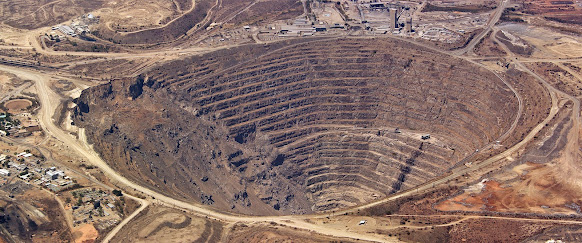
A view of Palabora, a South African copper mine, which was partially developed by Rio Tinto. Palabora's mine crater is roughly 1.24 miles across. Resolution's crater is expected to be 2 miles across. (Adobe Stock photo)

Resolution Copper wants to dig 5,000 to 7,000 feet into Arizona's Oak Flat desert to mine the region's vast copper-molybdenum deposit. The resistance to the project by Native American tribes and religious groups goes just as deep.

The Resolution Project has been under development by mining behemoths Rio Tinto and BHP Group since 2002. The companies and project supporters insist extracting the region's copper deposit is vital to shore up the mineral competition with China and for the U.S. transition to renewable energy. The opposition sees the mine and its expected 2-mile-across crater as exploitation of tribal holy ground.

Overall, the project has powerful backers: "It has generally been supported by the Obama, Trump and Biden administrations, though the latter has asked for more study as it seeks to balance its desire for clean-energy supplies with protections for the environment and the interests of Native Americans. The project can’t advance until that study is completed," report Phred Dvorak and Rhiannon Hoyle of The Wall Street Journal. "Many state and local officials [also] back the project."

Resistance to the project centers on Oak Flat, a stretch of land many Apaches consider sacred ground. The entrance to the mine is on Oak Flat, with the copper thousands of feet below. The main Apache opposition group, known as Apache Stronghold, was formed by the Apache San Carlos tribe and is represented by the Becket Fund, "a high-powered Washington, D.C., law firm known for championing conservative causes," Dvorak and Hoyle write. "Becket said it is planning to take its fight to the Supreme Court, where it has an 8-0 record."

Once Apache Stronghold and Becket joined forces the cause gained "a host of new religious allies. . . . Scores of religious groups have also submitted amicus briefs supporting Apache Stronghold’s suit," the Journal reports, "including organizations representing Mennonites, Seventh Day Adventists, Sikhs and Muslims."

Meanwhile, Resolution developers say "they have invested in an extensive monitoring network for groundwater, springs and other bodies of water that will be checked by regulators and a community working group," Dvorak and Hoyle add. "Resolution’s owners are trying to honor that commitment by consulting and joining with local tribes in good faith for the duration of the project, said Gare Smith, a lawyer who focuses on human rights and advises the project’s owners."

Not all regional tribes oppose the mine. "Other local tribes are attracted by potential economic benefits in a state where the tribal poverty rate is 29%," the Journal reports. "Among the ones with ties to Oak Flat, most have at some time officially opposed the mine."

To read more about U.S. copper needs, click here.
To find out more about the animals and plants that are native to Oak Flat, click here.

Friday, July 26, 2024

Rural Nevada leaders seek a voice in massive energy builds, but almost 80% of their land is federally managed

Across western federal lands, some renewable energy expansion is going at such a frenetic pace that rural county officials in Nevada can't keep up with the requests, reports Jeniffer Solis of the Nevada Current. "Several rural counties are now asking state lawmakers to establish a policy requiring federal agencies to coordinate all their land use planning and management decisions with state and county governments when considering massive utility-scale energy projects. . . . As of June, there are over 130 pending applications to build renewable energy projects across Nevada’s public lands. Most of those projects are in rural counties, where as much as 80% of land is federally managed."

NV Energy photo
Currently, Nevada lacks a statewide utility-scale solar plan, which exacerbates the problem for local governments.  In fact, county officials from Eureka and Lander County told state lawmakers that managing the sheer number of clean energy projects coming to their offices isn't workable because they lack staff and management capacity. Solis writes. "Rural governments told lawmakers that the intensity and scale of utility-scale energy proposals they are seeing in their counties will require targeted state policy to support and protect rural economies."

Eureka and Lander County lands are included in the "proposed Greenlink North Transmission Project — a 235-mile transmission line along Highway 50, which is expected to attract more solar projects in the coming years," Solis explains. And while the project is expected to bring thousands of good-paying jobs to the state, county officials want their offices and residents to have a say in local installations and time to prepare for the profound changes the builds are sure to bring.

Eureka County’s natural resources manager, Jake Tibbitts, "proposed amending state policy to clarify that federal agencies are expected to enter formal agreements with local governments in Nevada when considering projects on public land in their county," Solis reports. "Under the proposed amendment, those agreements would need to include a detailed coordination plan. . .especially when addressing conflicts between local land use plans and federal plans."

Solis adds, "But like Nevada as a whole, land in Eureka County is largely administered by the Bureau of Land Management and the Forest Service, leaving the county at the whims of federal land use policy."

Tuesday, June 25, 2024

Large rural cooperative is adding solar projects in Colorado in an effort to expand 'cleaner power' options

Tri-State service territory in blue (Tri-State photo)
Once a stalwart provider of coal-powered energy, Tri-State Generation and Transmission Association will purchase Axial Basin Solar, a 145-megawatt project in Moffat County, Colorado, and Dolores Canyon Solar, a 110-​megawatt project in Dolores County, Colorado, reports Julian Spector of Canary Media. The acquisitions are part of the company's new commitment to providing cleaner energy to its "massive western service territory."

Tri-State is one of the largest rural cooperative utilities in the United States, and it provides power to customers in Colorado, New Mexico, Wyoming and Nebraska. "The customer base spans 200,000 square miles, more land than the entirety of California," Spector writes. "Just a few years ago, two member cooperatives quit Tri-State to seek cheaper, cleaner power elsewhere. Since then, Tri-State has rolled out a series of clean energy commitments."

Benefit changes within the Inflation Reduction Act have made switching to renewable energy more financially doable for cooperatives. Spector explains, "Chief among them is a ​'direct pay' option that lets nonprofits access the same generous clean energy tax credits as their for-profit peers — even with little to no tax burden. Once Tri-State’s leadership saw clarity on the tax rules, they decided this was the time to strike."

Tri-State is working to provide a balance of energy that will be dependable, affordable and as clean as safely possible. "Now the utility sees ample savings and benefits for its customers in maximizing low-cost renewable generation while ensuring it has enough ​'firm' power — today provided by coal and fossil gas plants — to keep the lights on," Spector reports. "The utility recently hit a new record for instantaneous renewable production on May 24, when wind and solar delivered 87% of its generation for half an hour."

Friday, June 14, 2024

Latest round of federal grants focuses on communities with less than 10k population; helps with energy bills, projects

Workers in Washington preparing to place underground
electrical lines. (Washington State DOT photo, CC)
The federal government's newest round of grants will invest in communities with less than 10,000 people, with projects aimed at lowering residential energy bills and helping smaller communities transition to renewable energy. "The money will help fund 19 projects in Alaska, Oklahoma, Alabama, Maine and elsewhere," reports Will Wright of The Daily Yonder. "The amount of money being pumped into renewable energy sources over the last few years — particularly in rural communities — is 'game changing,' said Scott Vlaun, executive director of the Center for an Ecology-Based Economy, one of the grant recipients."

The energy installations will reach some areas that have never had electrical power before. Wright explains, "In Washington's Ferry and Okanogan counties, part of a $5 million grant is dedicated to extending underground electrical lines to about 135-190 homes that will gain access to electrical service for the first time." The Northeastern Washington counties are some of the state's poorest.

Money for rural solar will help residents and educational facilities save money. "Maine will receive about $3 million to install small solar projects that will help local families get cheaper electricity and, in some cases, allow families to move away from other, more harmful heating sources like kerosene," Wright reports. "At Mississippi's East Central Community College, a $2.8 million grant will help pay for solar installations that can provide clean power to 38 campus facilities."

This latest round of grants represents a shift in the way the applications were designed to help rural communities — especially those with a lower capacity to apply for grants — get through the grant-request process. "But in communities like those in western Maine serviced by the Center for an Ecology-Based Economy, Vlaun said this round of grants could have a big impact on the everyday lives of many rural residents," Wright adds. "Whether the current enthusiasm to spend federal dollars on renewable energy will continue may depend on the outcome of the November election, he said, and the effectiveness of propaganda aimed at reducing confidence in renewable energy."

Friday, May 24, 2024

Solar companies are offering many farmers more than $1,000 per acre for land leases, survey shows

Purdue Center for Commercial Agriculture producer survey
graph via Farm Journal

Solar companies need a tremendous amount of open land to achieve their installation goals, which means asking farmers for acreage leases. "A survey of farmers shows the majority of farmers are being offered more than $1,000 per acre by companies for solar leasing, which could also drive up the price of cash rental rates," reports Tyne Morgan of Farm Journal. "As the Biden administration works to accelerate their 'clean energy' plan across the U.S., land is in high demand, especially for future solar projects."

Michael Langemeier, an agricultural economist with Purdue University, says the Ag Economy Barometer is revealing "the sticker shock of solar leasing rates," Morgan writes. "The survey of 400 agricultural producers is now asking farmers how many have actively engaged in discussions with companies about leasing farmland you own for solar installation, and the response was surprising."

April's survey showed a substantial increase in the number of farmers who engaged in talks with a solar company representative over the past six months. Morgan reports, "In April, 19% of farmers said they’ve had discussions, up from 12% in March. The bigger surprise may be in the high rates solar companies are offering farmers."

According to the survey, 58% say the rates were more than $1,000 per acre. Survey percentages were tallied for the entire U.S., but the offers ranged from around $750 in the Great Plains to more than $1,200 in the eastern Corn Belt.

While top-dollar solar lease prices may offer a good return for landowning farmers, the cost of cash-rent agreements will also increase. Langemeier told Morgan, "That's going to put upward pressure on cash rents, and it's probably going to put upward pressure on land values, given that it's local. . . . And so it probably impacts a fairly local area, depending on whether your area has solar leasing or not, but it certainly has pretty wide ramifications on what's going on in agriculture.”

Crop prices that don't meet production inputs also tempt farmers to consider solar leases.