 |
Bald eagle that was captured and believed to be ill. (Photo by
Wilson's
Creek National Battlefield via The Guardian) |
People thought this raptor was wounded because he couldn't fly. As luck would have it, this bird was not ill, but he had gobbled up his Thanksgiving dinner early. "Wildlife officials in
Missouri
rescued what they thought was an injured and flightless bald eagle,
only to discover it had gorged itself on a roadkill raccoon and was 'too
fat to fly,'"
reports
Richard Luscombe of
The Guardian. "The eagle was released, completely
healthy and full of energy, after a short period of 'rehabilitation' at
the zoo’s wildlife hospital."
Among stretches of corn and beans in Midwestern Iowa, swaths of pollinator-loving plants and flowers grow. These "prairie strips" were sown by farmers and "they are part of a growing movement to reduce the environmental harms of farming and help draw down greenhouse gas emissions,"
reports Cara Buckley of
The New York Times. "While giving fauna a much-needed boost and helping to restore the land. . . .The aim is to reduce nutrient runoff from cropland, and help birds and bees."
Black-legged ticks are small, wingless, bloodsucking arthropods that spread diseases, such as lyme and babesiosis, by latching onto wildlife or human hosts. "Lyme is the most commonly reported illness spread by ticks,"
reports Kevin Loria of
The Washington Post. "But it is far from the only one: The black-legged ticks that carry Lyme can spread at least six different illnesses. Babesiosis is a parasitic illness, spread by
Babesia microti parasites, which can live inside black-legged ticks. . . . It can be serious, especially for people who are immunocompromised."
 |
Runnels the hound dog, reporting for duty.
(Texas A&M photo via Ambrook Research) |
Livestock can die from bovine respiratory disease, which is notoriously difficult to detect. To help farmers avoid the pain and expense of losing cattle, scientists are exploring how canines can help identify BRD. "At Texas A&M University, a cross-discipline pilot study set out to discover whether working dogs, with their superior olfactory senses, could be used as early BRD detectors,"
reports Jesse Hirsch of
Ambrook Research. "After many trials. . . researchers got up to 82% accuracy with one dog, and 65% with the other. But. . . the dogs didn’t fare nearly as well when given only two chances to distinguish between a BRD-infected swab and a clean one."
 |
| Kate McCulloh |
Flora have secret lives of their own. Although they can't ambulate, they find ways to move, morph and adapt to everything humans and Mother Nature "hurl their way,"
writes Kate McCulloh, an associate professor of botany at the
University of Wisconsin. "Their complex physiology responds to each of these threats in often quite subtle ways. The solutions that plants employ differ among species, varying with the climate in which those species evolved."
Colorado mountain lions should be protected from hunts, writes Dan Ashe, a former director of the U.S. Fish and Wildlife Service, in
his opinion for
Writers on the Range. "Emerging science tells us that these apex predators aren’t the enemy, they’re allies. They are likely providing an important ecosystem service in checking the spread of chronic wasting disease, CWD, an existential threat to healthy deer and elk populations, by targeting animals weakened by the disease." Mountain lions should be left alone to "do their job as predators."
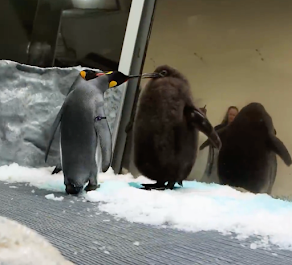 |
Pesto and his "short" parents. (Sea Life
Melbourne Aquarium photo via CNN News)
|
Taller and decidedly fluffier than his parents, "Pesto" the baby king penguin is adorable and famous. "Photos of Pesto – who is 90 centimeters tall (about three feet) – towering over his parents have gone viral online. He has also provided opportunities for people to learn more about penguins,"
reports Lilit Marcus of
CNN News. "Although most people recognize the adult black-and-white birds, king penguins are born covered in brown feathers. Once they learn how to swim, they will begin shedding those feathers – a process known as fledging. . . . Pesto’s biological father, Blake, is one of the aquarium’s oldest and
largest penguins. But he’s being raised by Tango and Hudson, younger
penguins whom Sea Life keepers wanted to try out as parents."


