Showing posts with label food animals. Show all posts

Friday, July 24, 2026

USDA is sounding the alarm regarding a nationwide shortage of veterinarians that is impacting rural America

Rising concerns about a nationwide veterinarian shortage is alarming rural communities. (Photo by Michael on Unsplash)    
Rising concerns about a nationwide veterinarian 
shortage is alarming rural communities.
(Photo by Michael on Unsplash)

A nationwide veterinarian shortage involving 243 areas across 46 states has been identified by the U.S. Department of Agriculture. The record shortage is hitting rural communities particularly hard. According to a report produced by Iowa PBS, “The list of disciplines in need is a long one and includes rural mixed-animal practices, food-animal and livestock medicine, USDA and public health veterinarians, and some positions in animal rescue shelters.”

The report blames the shortage on a pandemic pet-ownership surge, rising educational costs and debt, professional burnout, and the benefits of life in urban versus rural environments. Laurel Bower interviewed several professors and professionals for the Market to Market show on the station. The recruitment issues were the same as those often mentioned when recruiting doctors for humans: the desire for personal time, time with families, low pay, lifestyle, or generally “work life balance.”

Minnesota veterinarian Dr. Jessica Fox reminded viewers that vet school grads are just starting out in life, maybe getting married and starting a family, and usually they are living in a city. “So, even if you had ideas of moving back home, maybe your partner doesn’t want to,” she said.

The report offered the surprising statistic that the U.S. has lost 90% of its large-animal veterinarians since World War II. Dr. Jennifer Quammen, President of the American Veterinary Medical Association told Bower, “Having veterinarians as the primary health care authority is very important to all of us …” not only locally but globally, with a “giant” economic impact. According to the USDA, just 4% of graduates are looking toward a large-animal practice.

Dr. Dan Grooms, dean of the Iowa State University College of Vet Medicine, summed the problem up by saying there is “no magic bullet” and that a variety of stakeholders will have to come together, including colleges, communities and state departments of agriculture. “Each of them probably have a little piece of the solution,” he said.

Tuesday, June 09, 2026

New World Screwworm enters the U.S.

NWS infestations were discovered just days apart on calves that grazed
roughly 5.6 miles from each another. (Photo via Hoosier Ag News
Despite ongoing efforts from the U.S. Department of Agriculture, the Mexican government and on-the-ground teams along the U.S.-Mexico border, last week the USDA's Animal and Plant Health Inspection Service (APHIS) confirmed two cases of New World screwworm in Texas livestock, reports Jennifer Carrico of Progressive Farmer. In both cases, the flesh-eating blowfly larvae were discovered in young calves about 6 miles apart in Zavala County, Texas.

After the second case was confirmed, Texas Governor Greg Abbott "issued an updated statewide disaster declaration for the NWS infestation," Carrico writes. At a news conference, Abbott encouraged the use of "all state resources to combat the NWS." Additionally, the executive director of the Texas Animal Health Commission, Budd Dinges, reminded the public that NWS isn't a threat to consumer food safety but rather poses a threat to livestock production. 

In response to the infestations, APHIS has "deployed mobile response trailers, and sterile fly releases are underway with 2 million aerially and 4 million released on the ground per week," Farm Journal reports. "Movement control zones have been activated at a 20-kilometer (12.4-mile) radius around each site."

Both NWS cases were found in Zavala, Texas, 
in red above. (Wikipedia map)
The discovery prompted the Canadian Food Inspection Agency to place "temporary restrictions on livestock imports from Texas," reports C.J. Miller of Hoosier Ag Today. "Under the order, cattle, horses and other livestock that originated in Texas or were present in the state within 21 days before entering Canada will be denied entry."

Although the USDA intensified its battle to prevent the NWS from reentering the U.S. including banning Mexican livestock from entering the U.S. beginning in July 2025, some ranchers don't think the government's response was enough.

"On Friday, about 100 ranchers in mud-splattered boots and cowboy hats packed a small high school cafeteria for a Texas Animal Health Commission briefing on screwworm, peppering officials with questions and venting frustration over what they saw ​as a slow federal response,” reports Heather Schlitz of Reuters

Even as the USDA works to contain NWS infestations, they are likely to spread throughout the summer months, Miller reports. Prior to last week, the NWS hasn't been found in the U.S. for at least 60 years.

Friday, May 01, 2026

Many chicken farmers want out, but the off-ramp isn't an easy path

Poultry farmers often end up feeling like indentured
servants. (Graphic by Adam Dixon, Offrange)
Fueled by the industry's long-held "contract system," many poultry farmers end up shouldering mountains of debt and endless workloads. Farmers looking to exit the profession, despite dire financials, can get help from a "growing network of advocates," reports Lela Nargi for Offrange.

In the contract system, the poultry company pays producers for most start-up costs and animal care by providing chicks and covering additional costs, such as feed and medicine. They also dictate contract terms. Farmers provide the barns, land and labor.

While it sounds like a reasonable arrangement, farmers often take on big debts to build the required chicken houses, and they have to work as many hours as their flocks require. Many farmers end up feeling like indentured servants, which is why the Socially Responsible Agriculture Project developed the Contract Grower Transition Program, Nargi reports. The program helps cash-strapped chicken farmers forge a path to "break free" financially, including a plan that repurposes expensive chicken houses.

Through media and major farming events like Farm Aid, the Transfarmation Project, which helps industrial livestock farmers switch to specialty crops, uses stories from former chicken farmers to support and educate poultry farmers looking for a way out, as well as those considering the profession. Nargi writes, "Transfarmation has been documenting every transition they’ve worked on, in order to provide detailed models farmers can replicate on their own."

Despite efforts to help poultry farmers develop an off-ramp, not all farmers feel financially able to leave the profession. "Some advocates hope legislation passed under the Biden administration, updating 1921’s Packers and Stockyards Act in three phases, would create a more equitable playing field," Nargi adds. However, the USDA "is seeking to delay implementation of the third update from July 2026 to December 2027 . . . ."

Tuesday, April 14, 2026

Boaters are wearing helmets for protection against 'flying fish'

Asian carp are invading the Mississippi River and
boaters' personal space. (Photo by Megs Harrison, Unsplash)
Asian carp, or "flying fish," are injuring boaters throughout the Midwest and eating up the food supply of native fish in the Mississippi River, reports Jeanne Whalen of The Wall Street Journal.

Able to jump as high as 10 feet out of the water, these carp are easily spooked by motors and have given boaters black eyes
and broken noses, Whalen reports.

Asian carp came to the U.S. from China and Russia in the ‘70s to regulate algae blooms in ponds and wastewater treatment plants, Whalen explains. Due to flooding, they escaped confinement, spread into the Mississippi River Basin, and exponentially reproduced into dozens of rivers.

If they breach the Great Lakes, they threaten the region’s walleye, bass and trout, which provide the fishing industry $5 billion annually, Whalen adds.

The governors of Michigan and Illinois are urging the federal government to unfreeze the funding for a river barrier to keep the fish out of Lake Michigan, reports Whalen. An additional deterrent could be blaring speakers underwater to distract the carp.

While the public waits for federal help to detain the carp, they have been creating their own solutions such as wearing helmets while boating, competing in contests to catch the jumping fish, or creating new recipes to eat them, explains Whalen.

The Illinois Department of Natural Resources has officially rebranded the fish as Copi, short for copious, in hopes consumers find them more appealing. “Fisherman and chefs report that Asian carp are actually delicious, though they are so bony they don’t make good filets. Chefs often grind them up and turn them into fish cakes,” Whalen adds.

Tuesday, February 24, 2026

High beef prices are 'the new normal' for Americans

After years without profits, U.S. cattle ranchers resist
growing their herds. (Photo by K. Sikkema, Unsplash)
Even as U.S. consumers keep complaining about high beef prices and government officials, including President Donald Trump, have pressured cattle ranchers to lower their prices, American livestock owners have a message for both groups: Get used to paying more for red meat. Patrick Thomas of The Wall Street Journal reports, "High prices are the new normal in the U.S. beef market."

Roughly five years ago, livestock owners were barely scraping by as they contended with high input prices, drought, wildfires and paltry payments from meatpacking companies. To cut costs, they reduced their herd sizes.

Now that beef prices have consistently risen, and consumer demand has remained robust, "ranchers are reluctant to erode their strongest profits in decades by increasing the size of their herds," Thomas explains. "As a result, the U.S. cattle herd is at its lowest level in 75 years."

In January, "ground-beef prices were up 17% from a year earlier, compared with a 2.1% rise for all other groceries over that time," Thomas writes. Beef remains a protein favorite for many Americans who continue to purchase it despite price hikes.

Cattle ranchers, who are finally seeing some profits, have opted to channel money into long-stalled repairs and paying down debts. Other ranchers are investing in breeding plans "that could yield juicier steaks — and possibly land them bigger paydays," Thomas explains. But most don't plan to increase their herd sizes.

All told, U.S. consumers can expect to pay more for beef in the foreseeable future. Thomas adds, "Meatpacking companies have signaled that a smaller beef supply is here to stay."

Opinion: Goat could be added to American diets as a mild, versatile lean protein

Graphic by Adam Dixon, Offrange
Goat is one of the most internationally consumed types of animal meat, but Americans seem to have skipped goat on the menu. And while there's a list of reasons why Americans are much more likely to eat beef often and goat never, that may be changing, reports Laurel Miller for Offrange. "Goat is increasingly finding favor amongst white consumers in the U.S., primarily those seeking a lean, high-protein or more sustainable meat source."

Part of the reason many Americans don't eat caprine is their uninformed ideas about what goat meat tastes like. Miller explains, "Many Americans avoid goat because of the widespread perceptions that the meat is rank, gamy, or tough." While goat, like other meats, has a distinct flavor, in many cultures, their meat is considered a delicacy.

Brian Palmer, a goat farmer in Salinas, California, told Miller, "There is an understated goat aroma and flavor. But fresh, high-quality goat meat is approachable." Miller adds, "He prefers ethnic recipes like curries or braises that take that flavor into account."

In an age where beef prices are soaring, it might be time for goat meat to emerge as a competitor. Miller writes, "It’s lower in calories, fat, and cholesterol than chicken, pork, beef, and lamb, and, at 27.1 grams of protein per 100 gram serving, falls just behind conventional beef, which is 28.6 grams per serving."

Right now, the U.S. goat meat sector is small, but growing. Miller adds, "Consumer demand and accessibility vary by region, but even with a ready customer base, the numbers aren’t sufficient to galvanize government and other agencies to fund research."

But raising goats is cheaper, easier, and better for the soil than raising cows or sheep. "Goats are low-impact, non-selective browsers, meaning they eat diverse vegetation, including plants that sheep and cows can’t or won’t eat, like noxious weeds," Miller writes. "Because they’re small and nimble, goats can access areas other species can’t, and they’re well-suited to land that won’t support cattle or crops."

Friday, February 13, 2026

Carbon credits create a way for farmers falling into debt to keep their land

Carbon credits can provide cattle farmers with a new
source of income. (Photo by Bernd Dittrich, Unsplash)
Farmers facing drought, inflation or labor shortages often sell their generational land rather than go into debt, reports Yusuf Khan of The Wall Street Journal. In some states, cattle producers are filling financial gaps by using regenerative farming techniques that generate farm income through carbon credit payments. 

Frates Seeligson, who farms outside of Nixon in south Texas, told Khan he has seen cash-strapped ranchers sell their land to developers rather than go into the red.

“If you look at the business model of agriculture it’s somewhat broken,” Seeligson told Khan. “It’s capital and labor intensive with a very small return, and then you’re subject to the whims of nature." Texas has been facing drought conditions in many regions since 2021.

To combat ranchers' ongoing financial struggles, a carbon credit developer Grassroots Carbon is paying cattle farmers like Seeligson to use regenerative agriculture techniques aimed at trapping carbon in their soil, Khan explains. Backed by companies like Microsoft, Nestle and Chevron, Grassroots sells carbon credits for between $40 and $65 per ton, which have a lifetime of 100 years. 

One of the techniques Grassroots promotes is rotational grazing to keep livestock from overgrazing, Khan explains. “Rotational grazing is a common practice in farming, but Grassroots suggests ranchers rotate more often, sometimes daily and on smaller properties, multiple times a day.” For example, Seeligson now uses 28 temporary pastures, as opposed to his previous nine permanent ones.

The benefits aren’t limited to just storing carbon, though, according to Allen Williams, a researcher and rancher studying regenerative agriculture. Healthier grasses also make for healthier herds, growing herd pregnancy rates. Additionally, a “1% increase in soil organic matter can help soils to hold up to roughly 20,000 additional gallons of water per acre, an important factor in avoiding flooding,” a study from 2021 shows.

Friday, February 06, 2026

First animal case of New World screwworm in 10 years discovered in Florida

An animal wound with New World screwworm eggs,
larvae and an adult. (Photo by Samantha Gibbs, FWS)

The first New World screwworm animal case in 10 years was discovered in Florida earlier this week, prompting farm leaders and state officials to acknowledge that, although current protocols prevented this infected animal from entering the U.S., the noxious pest's reentry may be inevitable.

The blowfly larvae rode in on a horse "from Argentina [that] presented for routine inspection at an import quarantine facility in Florida," report Chris Torres and Joshua Baethge of Farm Progress. Larvae samples collected from a wound during the horse's examinations were "shipped to the National Veterinary Services Laboratories in Iowa, and it was confirmed that the larvae were New World screwworm."

Sid Miller, Texas agriculture commissioner, said "the detection is proof of the importance of USDA’s import inspection and quarantine protocols," Torres and Baethge write. According to Miller, "Our federal inspection system is working exactly as designed and is an additional biosecurity tool that will protect our industry."

At the annual Lancaster Cattle Feeders Day in late January, Colin Woodall, the CEO for the National Cattlemen's Beef Association, told fellow cattle producers, "You should be worried about [NWS] because no doubt there will be a market impact." Torres and Baethge add, "Woodall said beef producers should be prepared for an outbreak."

Using millions of sterile male NSW blowfly dispersals, the USDA and Mexican authorities have been trying to get ahead of the pest's travel through Mexico and into the U.S., where it's most likely to cross into Texas. Farm Progress reports, "The USDA also announced a new dispersal area for sterile flies going as far as 50 miles into Texas to stop the insect’s northern spread."

Female screwworm flies most often lay their eggs in the open wounds or scratches of sheep or cattle, but the larvae will feed on the flesh of any warm-blooded animal, which should leave more than cattle producers worried. Torres and Baethge explain, "Miller says screwworms can infest any of the 200 mammal species in Texas. That’s bad news for pet owners, not to mention the state’s multibillion-dollar wildlife industry."

Friday, January 30, 2026

The Northern Cheynne Tribe reaches for sovereignty with its buffalo herd and a new solar array that provides energy

The Northern Cheyenne Tribe's buffalo roam on more 15,000 acres
in southeastern Montana. (Photo via The Daily Yonder)
The Northern Cheyenne Reservation in southeastern Montana is home to the Northern Cheyenne tribe, a growing herd of buffalo and a new solar installation that will allow the tribe to expand its buffalo restoration program while providing a better path to tribal food and energy sovereignty. 

The buffalo herd roams on a vast swath of land that covers more than 15,000 acres and "has no transmission lines crossing it, meaning there’s no way to get electricity out to the land unless the electricity is completely off the grid," reports Ilana Newman of The Daily Yonder. "Last year, the Northern Cheyenne buffalo program received a solar array that will allow it to expand the herd and processing capacity of the facility."

Although all Native American tribes are said to be sovereign nations, in practice, many tribes have been forced to rely on the U.S. federal government for some form of support. Newman explains, "But sovereignty is still the goal for every tribal nation. And asserting independence around how they manage their food, health, and energy are some main ways indigenous communities are reclaiming sovereignty."

Bringing back buffalo herds can be key for tribes like the Northern Cheyenne, who have been working on plans to improve tribal members' health while caring for tribal lands. Newman reports, "Tribes and researchers are proving that buffalo are the key to healthier ecosystems and food sovereignty for northern plains tribes."

The Northern Cheyenne's buffalo herd is around 300 head and not cheap to care for; however, the "solar array brings the buffalo program closer to self-sufficiency," Newman writes. "It currently powers a small bunkhouse. . . Starlink internet, and a freezer that holds processed bison meat. It also powers electric fences and gates to keep out intruders."

Even with the buffalo and the solar panels, the Northern Cheyenne must plan carefully. Brandon Small, who runs the buffalo restoration program, told Newman, "We wanted to do it in such a way that we could still get meat processed and donated out to the communities, but still have enough money to keep our operation going and keep growing and expanding."

Friday, January 16, 2026

New World Screwworm inches closer to the Texas border; flesh-eating larvae can be deadly to cattle

Brahman cows graze near Mercedes, Texas, about 11 miles 
from the Mexico border. (Photo by J. Carrico, Farm Journal)

After a few months of reduced sightings, the New World Screwworm is making news again. "Mexican authorities confirmed an NWS case in a seven-year-old bovine and a 6-day-old calf both on Jan. 5," reports Jennifer Carrico of Progressive Farmer. Both infected animals were less than 220 miles from the U.S.-Mexico border.

Despite efforts by the U.S. Department of Agriculture and Mexican authorities, NWS has inched closer to the Texas border. The parasite has spread north even as Mexico has strictly limited cattle movement across the country.

Texas Agricultural Commissioner Sid Miller told Carrico, "The screwworm now may be moving closer on its own, with no apparent link to commercial animal movement. Texas producers must act now -- stay informed, stay vigilant, and prepare immediately. We cannot drop our guard for even a moment."

NWS flesh-eating larvae can be deadly to cattle and other warm-blooded animals, including sheep, horses and dogs. Female NWS deposit their eggs in an animal's open wound, and once the larvae hatch, they eat away at the host's flesh, which can cause infection and decay. "The larvae can kill an animal in just four to seven days if not quickly detected and treated," reports Stump Denton of Farm Journal.

Since female NWS mate only once in a lifetime and store their fertilized eggs, releasing millions of sterile male NWS has been the best way to eradicate harmful larvae production. Carrico explains, "The USDA eradicated NWS from the United States in 1966 using the sterile insect technique, and it was used successfully again in 2016 in the southern Florida Keys when found in deer."

A sterile fly distribution facility at Moore Airbase in Edinburg, Texas, is expected to be up and running early this year.


Hunter program provides food for local food banks in Georgia

Donated deer meat feeds thousands of Georgians through the 
Hunters for the Hungry program. (Photo by E. Jones, Grist)
By participating in Hunters for the Hungry, Georgia hunters use their harvested deer to feed their own families and help local food banks address food insecurity, which is often concentrated in the state's rural counties.

Sponsored by the Georgia Wildlife Federation, the program allows hunters who harvest more meat than they need to donate the extra. Emily Jones for Grist reports, "This year, the program has set a goal of collecting 140,000 pounds of donations, which the state Department of Natural Resources estimates can feed 560,000 people."

While not all donated meat is used to feed rural residents, a large percentage stays in the rural community where the deer were harvested. "Across Georgia, nearly 15% of families are food insecure," Jones explains. "Rural Hancock County, nestled between Atlanta and Augusta, has the highest rate in the country of children facing food insecurity, at 47%."

Many people outside of rural systems tend to think that because rural areas have large farms, everyone has plenty of food. But that isn't how the U.S. food industry works. Most of the peanuts, chickens and eggs produced on Georgia farms supply "the wider U.S. food system. . . which means the majority of people who grow food and farm animals have to rely on grocery stores to buy their food just like people in big cities."

So far, the Hunters for the Hungry program has proved successful, and its state-sponsored support is growing. Jones reports, "The state recently increased funding to $350,000 annually, allowing the program to expand from six processors to 56 and add freezer trailers to store additional meat."

Wednesday, January 07, 2026

Small Nebraska town tries to steady itself after Tyson Foods announces meat processing plant closure

The Tyson Foods beef processing plant in Lexington, Nebraska, wasn't just a slaughterhouse that offered good wages and steady employment; it was the rural town's hub. The company's announcement in November that it would be closing the plant due to financial losses in the meatpacking industry in early 2026 shocked the community," report Scott Calvert and Patrick Thomas of The Wall Street Journal

Once a town of roughly 6,600 residents, with a small Hispanic population, the 35-year-old Tyson plant helped Lexington's population grow and its demographics change. Calvert explains, "By 2000, its population rose to 10,000, half of them Hispanic, a share that now stands at 65%."

Once the plant closes later this month, an economic and social domino effect is likely to change the town again. "An exodus of residents would slash local school enrollment and the customer base for area businesses," the Journal reports. "Truckers, feedlot operators and cattle ranchers face hits to their bottom line without the Lexington facility." 

Location of Lexington within Nebraska 
and Dawson County (Wikipedia map)
Lexington’s city manager, Joe Pepplitsch, remains optimistic that the town can rebound from Tyson's closure. He told the Journal, "There’s a hell of a lot of positives here."

Government officials want Tyson to retrofit or sell the plant. They don't want the sprawling buildings sitting idle. Calvert writes, "A Tyson spokeswoman said the company is assessing how it can repurpose the facility."

Some plant workers have already quit and relocated to work at the JBS meatpacking plant about 90 miles east in Grand Island, Neb., while others have taken packing positions at Sustainable Beef in North Platte, Neb.

Friday, November 21, 2025

Managing cattle manure can prevent antibiotic-resistant bacteria from contaminating crops, new study finds

Unmanaged cow manure can cause antibiotic-resistant bacteria
to proliferate. (Adobe Stock photo)

Manure and antibiotic management on cattle ranches can help prevent the growth of more antibiotic-resistant bacteria, a new study finds.

Researchers have uncovered substantial evidence that unmanaged livestock manure poses a global health risk by transmitting antibiotic-resistant genes (ARGs) when spread in fields or used to water crops.

When antibiotics are used to treat livestock, resistant bacteria and their resistance genes "can build up in cattle guts, which is then excreted into manure," reports Pragathi Ravi for Offrange. Antibiotic-resistant bacteria and their genes "reduce the effectiveness of critical medicines on humans." 

Giving farm animals antibiotics only when they are ill -- not as a way to promote growth -- is one way to prevent antibiotic-resistant bacteria and genes from multiplying, according to the World Health Organization

One problem with antibiotic-resistant bacteria or genes is that once they have sickened a human, there is no viable treatment. Ravi adds, "In 2021, a study published in The Lancet estimated that 4.71 million deaths were associated with antimicrobial resistance between 1990 and 2021."

Humans can become ill from contact with untreated manure or from ingesting food fertilized or watered with unprocessed manure that contains bacteria. Ravi explains, "Salmonella can grow inside a tomato, which means washing it externally is not going to help when the tomato is consumed raw."

Study researcher and professor Xun Qian told Ravi: "Livestock manure carries antibiotic resistance genes that can defeat every major class of antibiotics used in human medicine — including those considered ‘last resort.'" 

Implementing programs that support proper manure composting before it is applied to farmland can help prevent ARGs from spreading.

Tuesday, September 16, 2025

U.S. ranchers finally see profits: Thin herds and high demand have beef prices climbing

There's no quick fix for low herd numbers pushing beef prices higher.
(Graph by Derrell Peel, Oklahoma State University)

After years of hard work and economic struggle, U.S. ranchers are making bank on beef.  "Business hasn’t been this good for cattle ranchers in decades, maybe ever," reports Patrick Thomas of The Wall Street Journal. "Cattlemen are now making a record profit of more than $700 per animal, up from $2 five years ago, according to some industry estimates."

Demand for beef is high and herd counts are at historic lows, creating a market where prices have surged for "everything from ground beef to steaks," Thomas explains. "Retail ground-beef prices set a record in August, up about 13% from the same month last year."

U.S. beef cattle numbers began shrinking during recent droughts that decimated grazing lands, and pandemic-era meatpacking backups. Ranchers couldn't afford their herds and opted to thin them to stem their losses.

Farmers are using their new income to reinvest in their herds, pay off debts and purchase more sophisticated equipment. But no one knows how long higher prices will continue. Thomas reports, "Executives of Tyson Foods and JBS — two of the world’s largest meat companies — have projected that cattle supplies could tick up in 2027 or 2028."

Some ranchers don't think increasing herd size is a good business model and are choosing to invest in better genetics instead of more cattle. Thomas writes, "The idea is to produce cattle that can yield juicier steaks — and fetch higher prices."

Friday, August 15, 2025

Analysis: Rural Coloradans feel ignored and 'looked down on.' A policy expert looks at how and why.

Colorado ranchers asked the state’s wildlife commission to delay wolf releases in 2024. 
Their petition was denied. (Photo by Hyoung Chang, Getty Images via The Conversation CC)

In a tale as old as the American West, farming and ranching Coloradans resent being ignored and dismissed as "dumb" by city folk. "Many rural Coloradans, especially in agricultural communities, feel looked down on by their urban counterparts," writes policy scholar Kayla Gabehart for The Conversation. "One cattle rancher I spoke to put it plainly: 'It’s an attitude. . .We are the idiots. . .We are the dumb farmers . . . We don’t really matter.'"

To help understand attitudes and cultural differences between rural and urban Coloradans, she began by looking at each group's response to certain policies. Gabehart explains, "A designated day to forgo eating meat. . . and the ongoing wolf reintroduction. . . .These policies, while specific to Colorado, are symptoms of something larger. Namely, an ever-urbanizing, globalized world that rural, agricultural citizens feel is leaving them behind."

The "MeatOut Day" was declared by Colorado's governor as a way to draw attention to the health and environmental impacts of farming food animals by abstaining from a day of eating meat. The day received minimal attention from more urban Coloradans, but those from rural areas were incensed. Gabehart writes, "Neighbors in Elbert County promptly responded with outrage, flying banners and flags declaring their support for agriculture and a carnivorous diet. . . . There are nearly 36,000 cattle in Elbert County. This is relatively typical of a rural Colorado county."

Wolves were hunted into extinction in Colorado during the 1940s. And yet, in 2020, urban voters, who were by geography unlikely to encounter or be economically impacted by wolves, voted for wolf reintroduction. "Rural residents voted decidedly against the initiative. Despite much legislative and grassroots action to oppose it, wolves were reintroduced in December 2023," Gabehart adds. "Several cattle have since been killed by wolves."

"Rural residents in Colorado have told me they feel excluded. This is not new or exclusive to Colorado, but a story as old as America itself,” Gabehart explains. The American caste system "is entirely constructed and designed by the American upper class to intentionally exploit resentment of working-class white people. . . .The result is what sociologist Michael M. Bell calls a 'spatial patriarchy' that characterizes rural America as dumb, incapable, racist, poor and degraded."

When it comes to who American rural voters support, maybe part of it is tied to which candidate mirrors some of the resentment and isolation of rural living. "Rural communities have the distinct feeling that urban America doesn’t care whether they fail or flourish," Gabehart writes. "Nearly 70% of rural voters supported Trump in the 2024 presidential election. He won 93% of rural counties. Rural Americans feel left behind, and for them, Trump might be their last hope."

Tuesday, June 24, 2025

A rural community bets on a beef slaughterhouse dedicated to changing the industry to attract American workers

The Sustainable Beef plant is the size of 10 football fields.
(Sustainable Beef photo)

In a bid to oust the slaughterhouse industry's bad reputation and attract American workers, Sustainable Beef opened a brand new plant in rural North Platte, Neb. 

The old rail town needed the financial lift and the "company believes the gleaming plant will appeal to locals who never would have considered doing such work," report Scott Calvert, Arian Campo-Flores and Patrick Thomas of The Wall Street Journal. "Town officials are pinning their hopes on [the] slaughterhouse, which promises an economic jolt but represents a risky bet. . ."

A shiny building isn't the only benefit Sustainable Beef offers -- the company has upended some slaughterhouse mainstays to increase its appeal. "The facility’s single daytime shift lets employees attend their children’s sports games after work," the Journal reports. "The company touts ergonomic work stands and individual lockers — even the plentiful toilets are an upgrade from typical meat plants." Pay starts at $22 per hour, which is average for the area.

Even with its upgrades and no third shift, Sustainable Beef faces stiff competition, possible worker shortages and a tight beef market. The company is "taking on the Big Four meatpackers —JBS, Tyson Foods, Cargill and National Beef — that control 85% of the beef industry," according to the article. "Nebraska faces persistent labor shortages, as workers age out or leave. . . . Cattle herd sizes have hit a 75-year low."

Location of North Platte, Neb.
(Wikipedia map)
But the company's investors have a shared goal of giving the industry's "Big Four" a run for their money. The new plant is "the size of 10 football fields, aims to process 1,500 head of cattle daily, with most of the beef going to Walmart, a minority stake investor in the project," the Journal reports. "The plant expects to hire about 850 workers by year’s end, which would make it the city’s third-largest private employer."

Fearing the possibility of crime brought on by immigrant workers, some North Platte residents pushed against the deal, but city leaders planned for predictable changes. Calvert, Campo-Flores and Thomas write, "The city is offering developers incentives to build housing, and up to 2,000 units are in the pipeline. Schools are boosting English as a Second Language instruction. The police department has outfitted officers with portable translation devices."

WSJ's full story includes Sustainable Beef's colorful beginnings in North Platte and details on how this plant is pushing competitors to upgrade their employment offerings.

Wednesday, April 23, 2025

Forest plants and resources can help feed more marginalized people while supporting biodiversity conservation

Policies recognizing the value of
forests have multiple benefits.
(Photo by Ruta Celma, Unsplash)
The first humans didn’t have a Walmart or a convenience store, but they did have the forest, which has provided food, medicine and life since the dawn of time.

In an article for the Great Lakes Echo, Victoria Witke wrote that a “notable” number of people in the United States rely on “public forests for food and medicine.” Witke acknowledged that this is a low-cost option.

Jimmy Chamberlain, a researcher in a study conducted in the journal Trees, Forests and People, told Witke that, “policies should be created to recognize forest foods as valuable, thus supporting food production and biodiversity conservation.”

According to Witke's report, "A notable proportion of the U.S. population relies on public forests for food and medicine, but the forest products industry is 'not well served by institutions that set forest management policies,' according to a new study in the journal Trees, Forests and People."
 
Chamberlain said that if public land agencies don’t manage the plants and resources, there will be less food security for the people using them. However, “If we can begin to manage for food and medicine, then we meet the needs of a larger constituency. That constituency is typically economically marginalized – poor people.”

Not only would caring for the forest increase its value and help people, but it is also a meaningful practice that encourages giving care to what provides our resources and discourages greed.

Roger LaBine, of the Lac Vieux Desert Band, told Witke, "his tribe is taught that plants and animals sacrifice for humans, and it’s mankind’s responsibility to protect them."

Friday, October 25, 2024

Piles of dead dairy cows in California show an industry that wasn't prepared for H5N1 bird flu's aggressive spread

H5N1 can be more deadly for younger cows.
(Adobe Stock photo)
After the H5N1 bird flu virus was detected in California in August, the virus spread aggressively and has infected at least 124 dairy herds and 13 dairy workers, reports Susanne Rust of the Los Angeles Times. "And according to dairy experts, the spread of the virus has yet to abate." The virus has killed dairy cattle at an "unexpected rate," which has left some dairies with roadside piles of dead cows awaiting rendering service pickup.

While roadside patches of dead cows are grisly, John Korslund, a retired Department of Agriculture veterinarian epidemiologist, said "there was probably very little risk to public health in having the animals piled up," because the virus doesn't last long in a carcass. 

Anja Raudabaugh, chief executive of Western United Dairies, "said although the dairy farmers she represents had been reading about the virus for months before it hit, no one was prepared for the devastation and unevenness with which the virus has struck California’s dairy herds," Rust reports. "She said on some farms, the cows seem virtually unaffected, despite being infected. While on others, the animals are dying in droves."

The virus' biggest toll has been on younger dairy cows, but farmers are doing what they can to keep them alive. Raudabaugh told Rust, “given the extreme rearing and raising and just expenses that go into raising these animals, there’s hope that on the other side of the virus, they will come back into production that’s sustainable for the farmer. So it’s definitely a last resort if they are culling them.”

Dairy farmers are concerned that even if a cows survive the virus, their milk production could indefinitely decrease. Rust reports, "The Department of Agriculture has a program to pay back farmers for production loss due to the virus. The program covers the three weeks of production lost by a cow when it is removed from the milking herd to recover, as well as the seven days afterward when production is still low." There is no protection for permanent production loss.

Tuesday, October 08, 2024

Flora & Fauna: Flightless eagle mystery solved; beware of black-legged ticks; secret lives of plants; Pesto the Penguin

Bald eagle that was captured and believed to be ill. (Photo by
Wilson's Creek National Battlefield via The Guardian)
People thought this raptor was wounded because he couldn't fly. As luck would have it, this bird was not ill, but he had gobbled up his Thanksgiving dinner early. "Wildlife officials in Missouri rescued what they thought was an injured and flightless bald eagle, only to discover it had gorged itself on a roadkill raccoon and was 'too fat to fly,'" reports Richard Luscombe of The Guardian. "The eagle was released, completely healthy and full of energy, after a short period of 'rehabilitation' at the zoo’s wildlife hospital."
 
Among stretches of corn and beans in Midwestern Iowa, swaths of pollinator-loving plants and flowers grow. These "prairie strips" were sown by farmers and "they are part of a growing movement to reduce the environmental harms of farming and help draw down greenhouse gas emissions," reports Cara Buckley of The New York Times. "While giving fauna a much-needed boost and helping to restore the land. . . .The aim is to reduce nutrient runoff from cropland, and help birds and bees."

Black-legged ticks are small, wingless, bloodsucking arthropods that spread diseases, such as lyme and babesiosis, by latching onto wildlife or human hosts. "Lyme is the most commonly reported illness spread by ticks," reports Kevin Loria of The Washington Post. "But it is far from the only one: The black-legged ticks that carry Lyme can spread at least six different illnesses. Babesiosis is a parasitic illness, spread by Babesia microti parasites, which can live inside black-legged ticks. . . . It can be serious, especially for people who are immunocompromised."
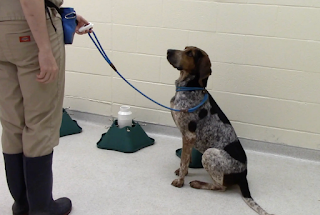
Runnels the hound dog, reporting for duty.
(Texas A&M photo via Ambrook Research)
Livestock can die from bovine respiratory disease, which is notoriously difficult to detect. To help farmers avoid the pain and expense of losing cattle, scientists are exploring how canines can help identify BRD. "At Texas A&M University, a cross-discipline pilot study set out to discover whether working dogs, with their superior olfactory senses, could be used as early BRD detectors," reports Jesse Hirsch of Ambrook Research. "After many trials. . . researchers got up to 82% accuracy with one dog, and 65% with the other. But. . . the dogs didn’t fare nearly as well when given only two chances to distinguish between a BRD-infected swab and a clean one." 

Kate McCulloh
Flora have secret lives of their own. Although they can't ambulate, they find ways to move, morph and adapt to everything humans and Mother Nature "hurl their way," writes Kate McCulloh, an associate professor of botany at the University of Wisconsin. "Their complex physiology responds to each of these threats in often quite subtle ways. The solutions that plants employ differ among species, varying with the climate in which those species evolved."

Colorado mountain lions should be protected from hunts, writes Dan Ashe, a former director of the U.S. Fish and Wildlife Service, in his opinion for Writers on the Range. "Emerging science tells us that these apex predators aren’t the enemy, they’re allies. They are likely providing an important ecosystem service in checking the spread of chronic wasting disease, CWD, an existential threat to healthy deer and elk populations, by targeting animals weakened by the disease." Mountain lions should be left alone to "do their job as predators."
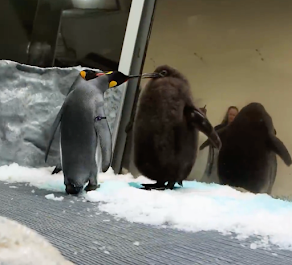
Pesto and his "short" parents. (Sea Life
Melbourne Aquarium photo via CNN News)

Taller and decidedly fluffier than his parents, "Pesto" the baby king penguin is adorable and famous. "Photos of Pesto – who is 90 centimeters tall (about three feet) – towering over his parents have gone viral online. He has also provided opportunities for people to learn more about penguins," reports Lilit Marcus of CNN News. "Although most people recognize the adult black-and-white birds, king penguins are born covered in brown feathers. Once they learn how to swim, they will begin shedding those feathers – a process known as fledging. . . . Pesto’s biological father, Blake, is one of the aquarium’s oldest and largest penguins. But he’s being raised by Tango and Hudson, younger penguins whom Sea Life keepers wanted to try out as parents."

Tuesday, September 17, 2024

Opinion: New farmers with 'can-do' attitudes learn the trade from older farmers and agriculture support systems

Josh Pearson and Esme Martinson
(Turner Road Farm photo)
The life of U.S. farmers is often depicted by some "experts" as difficult, solitary and lacking many services, but that view only offers one slice of the profession. For many farmers, especially those new to farming, the career is full of learning, abundance and people helping people, writes Jason Maloney in his opinion piece for Agri-View.

Commentators and politicians often "talk of young people leaving rural areas, saying those rural areas have poverty and unemployment, and lack emergency services and nutritious food," Maloney adds. "But in the countryside of far-northern Wisconsin, where broadband and cellular service can be spotty. . .the outlook can be quite different. . . . There’s a sense of optimism that comes from building community and having a can-do attitude. . . . There are young people on the land who are making remarkable progress."

In northern Bayfield County, Wisconsin, Josh Pearson and Esme Martinson, who own Turner Road Farm, are learning how to be food and animal farmers, and they enjoy sharing their knowledge. Pearson told Maloney, "Esme and I are first generation; we didn’t grow up on farms. We read. A lot is possible if you put your mind to it.. . . . People have an experience coming up to our farm. We bring a lot of school groups to our farm – kindergartners, high schoolers, and even some college classes come out. It’s fun to see them react to the animals."

Location of Bayfield in Wisconsin
(Wikipedia map)
Turner Road Farm slowly purchased its livestock from a nearby cattle ranching family who wanted to retire. Part of Pearson's approach to the "generational transition of agriculture" is to learn from those leaving the profession. Pearson told Maloney, "Now they are done with their beef herd, and their beef herd is here on our farm. . . . I’m making hay in Port Wing, Wisconsin, with Dale Peacock of Red Hoof Farm. I’m helping him as he’s getting out of the business, and he’s mentoring me as I am going in."

Pearson and Martinson credit the USDA’s Natural Resource Conservation Service and Farm Service Agency as great support sources. Pearson told Mahoney, "My first suggestion to [new homesteaders] is to develop a relationship with the FSA office. There are programs out there to help us. We didn’t do this all on our own."

Right now, there are "things happening in places that aren’t seen by 'experts,'" Mahoney adds. "The important work that solves problems like hunger, environmental disasters, dying communities. . . is happening all around us. . . . Young people are grabbing hold and pulling us forward. If that doesn’t provide one with optimism, nothing else will."