Thursday, August 23, 2018

U.S. Department of Education may let states use its grant funds to buy guns for teachers

The U.S. Department of Education is considering whether to allow states to use federal grant funding set aside for educational purposes and student services to buy guns for teachers.

"Such a move would reverse a longstanding position taken by the federal government that it should not pay to outfit schools with weapons," Erica Green reports for The New York Times. "And it would also undermine efforts by Congress to restrict the use of federal funding on guns. As recently as March, Congress passed a school safety bill that allocated $50 million a year to local school districts, but expressly prohibited the use of the money for firearms. But the department is eyeing a program in federal education law, the Student Support and Academic Enrichment grants, that makes no mention of prohibiting weapons purchases. That omission would allow the education secretary, Betsy DeVos, to use her discretion to approve any state or district plans to use grant funding for firearms and firearm training, unless Congress clarifies the law or bans such funding through legislative action."

Education Week reports that rural Arkansas teachers told the Federal School Safety Commission that sheriffs were 20 to 30 minutes away from their schools, and they felt arming teachers was the best way to keep their students safe.

But one Texas school says it and other rural schools can have a harder time getting grant money to add security measures to protect against active shooters. At Granger Independent School District in Williamson County, leaders say using funding for such measures means diverting scarce funding from educational needs, Steffi Lee reports for KXAN-TV in Austin. Supt. Randy Willis told Lee that rural schools are sometimes ignored when federal and state officials discuss grant options.

"I have two principals and I have two people in central administration that help me with counseling, our accountability and our testing," Willis told Lee. "So when you have to write a . . . grant application and you have to put all this stuff in to write that grant, it takes time and it takes expertise."

Volunteer firefighter says controlling traffic after a wreck can be scarier than fighting fires, gives tips for motorists

Firefighters and deputies clean off a road after an accident.
(Photo by Donna Kallmer)
Rural areas often depend on volunteer firefighters to battle the blazes spreading over the western and southern U.S. this summer, but that's not all they do. According to Donna Kallner in an essay for The Daily Yonder, she and her fellow rural volunteer firefighters also play a vital part in helping EMTs, sheriff's departments and professional firefighters respond to car wrecks. That includes not just cleaning up the roadway afterward so it's safe for traffic, but sometimes controlling traffic. That can be scarier than fighting a fire:

"Traffic control takes grit, whether you’re a Good Samaritan with an angel on your shoulder or a trained volunteer. Believe me, it’s scary out there. Folks who are good about pulling over for emergency vehicles running with lights and sirens can’t resist taking a quick peek as they drive past the scene of a wreck. They want to see what happened, what’s happening now, if anyone they know is involved. It’s human nature. But it’s scary to be on an accident scene trying to do your job when motorists are moving through with their heads on full swivel," Kallner writes. "It’s even scarier to be the person holding a sign on a pole a quarter mile away trying to stop traffic before it reaches a scene. You’d be surprised how many people don’t seem to notice the flashing lights, the high-visibility gear, or the person holding the sign who looks like he’s ready to dive for the ditch — which he is."

Kallner wants readers to keep three things in mind if they approach a roadside emergency, for the safety of first responders and drivers: First: there's often very little room to maneuver past a wreck on a country road, so drive carefully and watch for first responders and their vehicles. Second: resist the urge to rubberneck and pay attention to first responders' signs and directions to avoid getting into a secondary accident. Third: remember that the scene of a wreck is very loud, what with idling diesel trucks, sirens, and radios, so don't assume a first responder can hear your vehicle approaching.

"As a passing motorist, you have an important role on the scene," Kallner writes. "We need you to watch out for any and all unexpected movement, and be prepared to stop on a dime or move along briskly if you’re waved at to do so. We’re counting on you. And if you happen to be stopped by traffic control on a hot day and you happen to have a cold bottle of water or Gatorade handy, pass one out the window to the person doing the scariest and most thankless job. They like cookies, too."

Appalachian agency says personal income down in E. Ky. coalfield; no significant increase in coal jobs under Trump

"Personal income has gone down in several Eastern Kentucky counties where coal employment has been decimated in recent years, according to a report from the Appalachian Regional Commission," Bill Estep reports for the Lexington Herald-Leader. "Studies have cited competition from cheap natural gas for electricity generation as the biggest factor in coal’s decline, though other factors have played a role, including efforts to beef up environmental rules in the Obama administration and the rise of renewable energy such as wind power."

There has been no significant increase in coal jobs in Kentucky during President Trump's tenure, and the report "shows that the average unemployment rate went down across the region over the last three years, but that the gap widened between the rate in Appalachia and the rest of the country, showing employment in the region is not improving as quickly as in the nation," Estep reports. 

Trump's newly announced replacement for the Obama-era Clean Power Plan aims to narrow that gap that by softening regulations on coal-fired power plants, but experts are skeptical that it will have much impact because gas and renewables are increasingly competitive with coal.

Rural caregivers face more financial challenges

Rural caregivers have more financial barriers to their service work than those in urban areas, according to a study of 2011-13 data from Arkansas, Illinois, Indiana, Iowa, Maine, Mississippi, Missouri, New Jersey, West Virginia, and Wisconsin, published in The Journal of Rural Health. Caregivers were defined as people "providing care to a family member or friend because of a long‐term illness or disability."

Though they were more likely to report financial barriers to their work, rural caregivers were less likely "to report that caregiving created any difficulty" for them, either financially or health-wise, the study report said. "Rural caregivers’ coping strategies or skills in identifying informal supports may explain this difference, but additional research is needed to explore this hypothesis."

We'll bet "coping strategies" would be found to include a dedication to the work that overrode financial concerns, and a feeling that if they didn't do it, no one else would. That seems more likely in rural areas.

After rural opioid roundtables, USDA official sees need for creativity, use of assets, small actions that can turn big

Anne Hazlett
Since March, U.S. Department of Agriculture officials have held roundtables with state and local leaders in seven largely-rural states to learn more about the impact of the opioid epidemic. Assistant to the Secretary for Rural Development Anne Hazlett, who led these roundtables, spoke with Kay Temple of the The Rural Monitor about what she learned from the tour through Pennsylvania, Utah, Nevada, Kentucky, Oklahoma, Missouri and Maine.

"One key lesson is that an effective response in rural America takes creativity in harnessing existing community assets, and limited resources mean we have to get creative. For example, in the context of prevention, we can’t always just turn to school districts or sheriff’s deputies who already have strapped resources and are stretched thin," Hazlett told Temple. "What are the assets in a community that can be used as a platform for prevention? It’s the 'who': those who are already touching the lives of people living and working in rural America. When we take that creative lens, the sky is the limit in these rural areas. There are opportunities in churches, in the Cooperative Extension, in the Rotary, in the Lions Club."

Another thing Hazlett saw was how small actions can have a big impact in a way that wouldn't happen in a larger community. One example she saw was in Talbot County, Maryland: the county launched a campaign called "Talbot Goes Purple" in which community leaders and organizations partnered to use the color purple everywhere possible as a message of support to families hurt by substance abuse. Stigma is a powerful barrier to getting help in rural communities, but the campaign helped reduce that and let people know it's okay to get help, Temple reports.

Hazlett's final takeaway was that rural communities must become more prosperous to fight the opioid epidemic and keep people from becoming addicted. "This rural epidemic has been fueled by hopelessness and despair, stemming through lack of economic opportunity, feelings of isolation, and so to remedy that we can’t just look at prevention, treatment, and recovery," Hazlett said. "Rural leaders really need to double down on addressing some of these deeper, systemic issues in rural communities — things like lack of broadband and the need to improve the quality of life, develop the next generation of the workforce, drive innovation, and increase economic development." 

Hazlett acknowledged that rural broadband access is a critical ingredient in rural prosperity, and touted the USDA's $600 million broadband pilot program. The program has not yet been implemented, but is open to public comment until Sept. 10.

Baptist preacher, Buddhist swami team up to fight pipeline

Natural-gas pipelines are lightning rods for controversy, drawing protests from environmentalists, musicians, disgruntled land owners, and even nuns. They have made for some strange-at-first-glance bedfellows too: Two longtime friends, a Southern Baptist preacher and a Buddhist swami, joined together to fight a proposed compressor station in rural Virginia for the Atlantic Coast Pipeline.

The compressor station is slated to be built just down the road from one of the two Baptist churches where the Rev. Paul Wilson preaches in Union Hill, a rural community founded by freed slaves. Dominion Energy says the station will generate as much as $1 million a year in tax revenue for the low-income county. Though state regulators say Dominion has promised to take great pains to make the station safe, "federal documents say such stations — which keep the gas flowing — emit toxic chemicals that can harm health. They can be noisy, and they light up at night. Once in a great while, such facilities explode — causing damages and fatalities for a significant distance all around," Gregory Schneider reports for The Washington Post.

Wilson's friend, Swami Dayananda, was also concerned. The pipeline would go under the James River next to the yoga shrine and retreat where she has worked for more than 30 years. Both feel that Gov. Ralph Northam, a Democrat, has failed to adequately oppose the project despite proclaiming himself an environmentalist. Dayananda and Wilson have led local resistance to the pipeline and hope to convince the Virginia State Air Control Board to deny a necessary permit next month.

The Federal Energy Regulatory Commission's impact report says "compressor station emissions could include carbon monoxide, carbon dioxide, methane, nitrous oxide and volatile organic compounds, and it notes that African American populations are more susceptible to related asthma. But it concludes that Union Hill is not populous enough to be of concern," Schneider reports.

Dominion Energy says it has appointed a community liaison to make sure the town's concerns are heard: Basil Gooden, a Union Hill native who served as state agriculture secretary under former governor Terry McAuliffe, a Democrat.

Wednesday, August 22, 2018

Nearly 2 million U.S. acres on fire; effects widespread

Time-lapse map of wildfires and smoke this summer
(National Oceanic and Atmospheric Administration images compiled into a GIF by The Washington Post)
Smoke from wildfires in the western and southern U.S. and western Canada has blanketed a large percentage of both countries, Christopher Ingraham reports for The Washington Post

Weather observers at the Mount Washington Observatory in New Hampshire even reported seeing the smoke, Adres Picon reports for The Boston Globe.

The smoky state of things may not improve in years to come: experts say wildfires are burning longer and spreading faster since at least 2005, Jake Whittenberg reports for KING-TV in Seattle. Those increased fires coincide with increased temperatures fueled by climate change, Seth Borenstein reports for The Associated Press.

California legislature is on the verge of virtually eliminating money bail, an increasing problem in much of rural U.S.

Both houses of the California State Legislature have voted to "virtually eliminate the payment of money as a condition for release from jail," Jazmine Ulloa and Maya Lau report for the Los Angeles Times. Senate Bill 10 passed the Assembly 41-27 and returns to the Senate for approval of amendments, including one "that gave judges greater power to decide who should remain incarcerated ahead of trial."

The virtual end of money bail in the nation's largest state would be likely to spur similar efforts across the country, drive partly by overcrowding in jails, especially in rural areas.

Most inmates can't afford their bail bonds, raising questions about how bonds are set, the policies and lobbying of the commercial bail-bond industry, and the decisions of prosecutors and judges, which may be harsher on the accused in rural areas, Cherise Fanno Burdeen, CEO of the nonprofit Pretrial Justice Institute, said at a conference for journalists on rural jails last month.

Research shows that money bonds have no discernible impact in terms of improving outcomes and public safety, Burdeen said: “Money bonds only detain people who are too poor to post that bond, and they let bad guys who can afford to post bond get out without being assessed or having conditions that would improve public safety.”

Some inmates stay in jail because they can't afford even “incredibly small bail amounts,” said G. Larry Mays, Regents Professor Emeritus of Criminal Justice at New Mexico State University and author of Trouble in the Heartland: Challenges Confronting Rural Jails.

The California bill, much like one Indiana passed two years ago, would require counties to create pretrial services agencies that would use a risk-assessment tool analysis, "to evaluate people booked into jail to determine whether, and under what conditions, they should be released," the Times reports.

Because of the Assembly amendments giving judges more discretion, some "criminal justice reform groups have rescinded their support and are actively working to kill the legislation — landing on the same side as a bail industry that has worked to sink the bill from the beginning," the Times reports. "The American Civil Liberties Union became the latest major supporter to move its stance from neutral to opposed on Monday. Three of its executive directors said the new bill fell short of its intended goals and would compromise the right to fair court proceedings for criminal defendants."

With SNAP and subsidies being negotiated in Farm Bill, how much does each have at stake in districts of negotiators?

As the House pushes for a Farm Bill that would put the first work requirements on the Supplemental Nutrition Assistance Program, once called food stamps, The Daily Yonder did a deep data dive to see how many SNAP recipients and farm-program beneficiaries are in each district of the 48 House members on the conference committee that is reconciling the House and Senate versions.

"One of the key sticking points is SNAP," Bryce Oates and Tim Marema write. "The Senate bill calls for more oversight but does not expand the work requirement. . . . Some rural districts, particularly those with high volumes of row-crop production, had high levels of government payments to farmers. Many other predominantly rural districts had very low levels of government payments to farmers, documenting the somewhat limited geographic reach of farm support payments as economic stimulus. In non-farm dependent communities, SNAP benefits dwarf government payments to farmers and also reach a significantly higher number of households."

Daily Yonder maps; click on either one to view a larger version

Rural Mainstreet Index shows impact of tariffs; nearly 1/3 of bankers say they're turning down more farm loans

Creighton University's latest Rural Mainstreet Index is above growth-neutral for the seventh straight month because of an expanding economy outside of agriculture. "However, the negative impacts of recent trade skirmishes have begun to surface, weakening already anemic grain prices," said Ernie Goss, the economist who compiles the RMI. The RMI is a monthly survey of small bank CEOs in rural areas of 10 states with agriculture and energy-dependent economies: Colorado, Illinois, Iowa, Kansas, Minnesota, Missouri, Nebraska, the Dakotas and Wyoming.
Creighton University graphic; click on the image to view a larger version.
Citing weak commodity prices and farm income, almost a third of bank CEOs reported rejecting more farm loans, and more than half support cutting the recent tariffs on Chinese products that prompted China to retaliate with tariffs on U.S. products such as soybeans and corn. Bankers also reported a decline in the sale of agriculture equipment, and expect sales to decline another 7.8 percent over the next year.

Jim Stanosheck, CEO of State Bank in Odell, Neb., told Goss: "The tariffs have and are costing our ag customers on grain prices and items they must purchase. Talking to one of my customers this morning, he thought that maybe the tariffs would bring about better prices in the future."

Creighton University graphic; click on the image to view a larger version.

California jury says Monsanto should pay $289 million to dying man who said Roundup helped cause his cancer

On Aug. 10 a San Francisco jury found that the Roundup helped cause a man's terminal cancer and slapped manufacturer Monsanto with $39 million in compensatory damages and $250 million in punitive damages. Dewayne Johnson applied the herbicide 20 to 30 times a year while working as a school groundskeeper and was accidentally doused in it twice. Two years after the first such accident, he was diagnosed with non-Hodgkin's lymphoma, Holly Yan reports for CNN

It's impossible to prove what causes someone's cancer, but under California law Johnson only had to prove Roundup was a significant factor, and that Monsanto failed to warn consumers about its cancer risk. The World Health Organization ruled in 2015 that there is limited evidence to suggest that glyphosate is probably carcinogenic to humans. Monsanto said in a statement after the verdict that many studies suggest Roundup, or its main ingredient glyphosate, do not cause cancer. Roundup is the most-used herbicide in the world and has been on the market for more than 40 years, Yan reports.

Though more than 800 people have filed such lawsuits against Monsanto, Johnson's is the first to go to trial because California allows plaintiffs to get an expedited trial if they are near death. The verdict may have spurred a flurry of new lawsuits against Monsanto and other companies, Yan reports.

Less than a week after the San Francisco verdict, a Scottsdale, Ariz., man sued Monsanto, claiming that the Roundup he used on his property for 23 years caused his non-Hodgkins lymphoma, Nick Hytrek reports for the Sioux City Journal in Iowa. A class-action lawsuit was filed against General Mills in Florida a few days ago on the grounds that the company should have warned consumers about the presence of glyphosate in Cheerios, Elaine Watson reports for Food Navigator USA.

Tuesday, August 21, 2018

Rural influence could keep Dems from gaining the Senate even with a 'Blue Wave' in the midterm elections

New York Times map; click the image to enlarge it.
In the upcoming November elections, the battlegrounds for the House and Senate lie in different arenas. Only 14 of the most competitive House races are in states with highly competitive Senate races. "The Senate hinges on red, rural states where Democrats are on defense. But the House will be decided by swing, suburban seats where Republicans are highly vulnerable," David Wasserman writes for The New York Times. Wasserman is an editor at The Cook Political Report

That dichotomy could yield strange results in the midterms: "If every state’s and district’s election results on Nov. 6 were a uniform eight-point swing in the Democrats’ direction from the 2016 presidential result, Democrats would gain 44 House seats — almost twice the 23 they need to control the chamber," Wasserman writes. "But with that same eight-point swing, the party would lose four Senate seats, leaving them six seats short of a majority."

Wasserman concludes with a reference to the Senate as the rural chamber: "Whereas most House seats have roughly the same number of constituents, a majority of the Senate now represents just 18 percent of the nation’s population. And this fall, the Senate will come down to seats that are much whiter, more rural and pro-Trump than the nation as a whole. In effect, geography could again be Mr. Trump’s greatest protector: After all, the Senate — not the House — would have the final say on any impeachment proceedings."

Trump replacement for Clean Power Plan rolls back anti-coal rules, at its predicted price of more premature deaths

President Trump announced in West Virginia today the details of his new "Affordable Clean Energy" rule, which replaces President Obama's "Clean Power Plan." The new rule would help the coal industry by giving states more power to achieve lower emissions goals, but acknowledges that it would lead to more health problems and deaths.

Under ACE, states have three years to develop their own plans to reduce emissions to federal target levels, which are much less ambitious than those in Obama's CPP. It also allows states to establish emissions standards for coal-fired power plants. The Environmental Protection Agency "estimates that the measure will affect more than 300 U.S. plants, providing companies with an incentive to keep coal plants in operation rather than replacing them with cleaner natural gas or renewable energy projects," Juliet Eilperin reports for The Washington Post.

"Trump administration officials say the Clean Power Plan, in its effort to reduce carbon emissions, illegally tried to force electric utilities to use greener energy sources," Lisa Friedman reports for The New York Times. "The new plan, they said, would achieve many of the benefits sought by the Obama administration but in a way that is legal and allows states greater flexibility." The plan would take effect after a 60-day comment period.

EPA's impact analysis acknowledges that the plan will allow more emissions of carbon dioxide and other pollutants than under the Obama plan. In the regulatory scenario that it deems most likely, EPA "predicts its plan will see between 470 and 1,400 premature deaths annually by 2030 because of increased rates of microscopic airborne particulates . . . which are dangerous because of their link to heart and lung disease as well as their ability to trigger chronic problems like asthma and bronchitis," Friedman reports. "The Trump administration analysis finds that own its plan would see 48,000 new cases of exacerbated asthma and at least 21,000 new missed days of school annually by 2030 because those pollutants would increase in the atmosphere rather than decrease."

The premature mortality estimates come from a Harvard University study that "formed the backbone of federal air pollution regulations," but EPA is considering a separate rule that would restrict the use of studies for which raw data, including identifying personal details, can't be published. "Scientists overwhelmingly oppose the move, pointing out that participants in long-term health studies typically agree to take part only if their personal health information won’t be made public," Friedman notes. Because the Harvard study and many others are based on confidential health records, the EPA would not have to use them and in future studies would be able to claim a far lower estimated number of premature deaths from the energy plan, Friedman reports.

Feds to work more closely with states to combat wildfires

Agriculture Secretary Sonny Perdue announced last week that the Forest Service will work more closely with states to combat wildfires. The plan, possible because of increased funding from Congress, "focuses on working with state and tribal stakeholders to target localized preventive treatments, including prescribed burns, to areas most likely to benefit from them," Kate Queram reports for Route Fifty.

The plan says wildfires have become a bigger problem partly because efforts to prevent and fight them have not been "uncoordinated, and not at the right scale." The plan also acknowledges that climate change is partially responsible, though "Perdue himself declined Thursday to attribute the growing risk of wildfires to man-made climate change," Queram reports. "Interior Secretary Ryan Zinke did as well, noting at a cabinet meeting that the cause is unimportant because the Forest Service has to address the increased risk either way."

The Forest Service will begin enacting the plan by meeting with state and local stakeholders nationwide to see what their needs are and get feedback on the plan, Queram reports.

Rural Georgia faces doctor shortage; state legislature considers ideas but won't increase Medicaid reimbursement

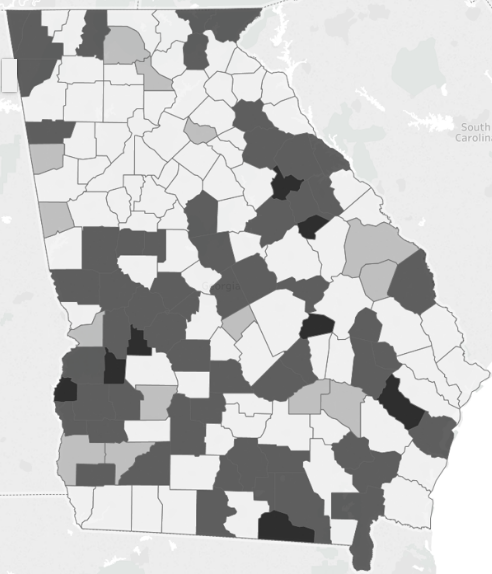
Counties in black have no doctors; dark gray means no
pediatrician and no obstetrician/gynecologist; light gray
means no pediatrician or no ob/gyn. (AJC map)
As in many other states, rural Georgia is facing a doctor shortage: nine of its 159 counties have no doctor, 64 have no pediatricians, and 79 have no obstetrician-gynecologists. Georgia has more counties than any state but Texas, but is "worse than the national average for needy areas short of primary health-care providers, according to federal data assembled by the Kaiser Family Foundation," Ariel Hart reports for The Atlanta Journal-Constitution. "Health outcomes for Georgia patients lag accordingly, with the state ranked among the worst 10 states for most measures." Lack of a nearby doctor means some of Georgia's 2.4 million rural residents don't have the time, money, or transportation to access medical care in a neighboring county. 

Though state legislators have formed health-care study committees and passed some laws, the shortage is still a problem. Rural medical providers often struggle because Medicare and Medicaid (with disporoportionately rural rolls) reimburse at lower rates than private insurance. The state's Republican-led legislature did not expand Medicaid under the Patient Protection and Affordable Care Act, saying the state couldn't afford it long-term. Some GOP legislators have said they would consider Medicaid expansion with a work requirement, Hart reports. 

Daniel Singleton, a rural doctor from Buena Vista in southwestern Georgia, told Hart that there would be more rural doctors if they were decently paid. But state Rep. Terry England, a Republican who chairs the House Appropriations Committee and leads a two-year task force on rural development, said the state doesn't have the money to raise the Medicaid and Medicare reimbursement rates so that doctors don't lose money when they take such patients.

The money isn't the only problem, according to Singleton. Working in a rural area may not appeal to doctors who didn't grow up in rural areas. "Medicine is an elite profession," he told Hart. "Unless you’re a country boy from South Georgia, it’s very very difficult to motivate someone to come back and live in a place like this."

Monday, August 20, 2018

Farm Belt states squeezed by Trump policies may spell trouble for Republican candidates in November

Though President Trump is more popular in Farm Belt states than in the nation overall, his approval rating has fallen there as well because of the trade war with China and the administration's failure to adequately boost corn-based ethanol. That may hurt Republican party candidates in November, Jarrett Renshaw reports for Reuters.

In Iowa, the first state to vote in the primaries, Republican Gov. Kim Reynolds told Renshaw, "The anxiety is starting to escalate. They are willing to give him some more time, but the window is closing and they have to see some movement somewhere to alleviate the pressure."

Farmers are getting squeezed several ways by Trump policies: tariffs on metal and aluminum have increased the price of equipment, and the tariffs China slapped on products such as hogs, corn and soybeans have caused farm export prices to drop. Iowa is the nation's top exporter of corn and pork, and the second-highest exporter of soybeans; it's also the top producer of corn-based ethanol.

Also, "Refiners are required by law to blend 15 billion gallons of biofuels yearly into the fuel supply, but the government has not increased that level for several years, causing domestic ethanol demand to flatline. To increase demand, farmers have asked Washington to rescind a ban on selling E15, a gasoline with higher levels of ethanol, in the summer, Renshaw reports. "That has not happened yet. Instead, over the last year, the industry has become embroiled in a related dispute with Washington. The White House has become more aggressive than the Obama administration in granting numerous requests from refiners seeking relief from having to blend, or pay for, the cost of adding biofuels to the nation's fuel supply. That undercuts demand for ethanol, farmers say."

Hospital management companies sued for Medicare billing schemes at five rural Oklahoma hospitals

Two hospital-management companies have been sued for allegedly fraudulent billing schemes run through five rural Oklahoma hospitals. Small rural hospitals are tempting targets for health-care companies looking to make extra money. It works like this: Medicare and some insurers reimburse hospitals for laboratory services at higher rates to help them stay open, so a company might buy a struggling rural hospital or sign up to manage it for a fee, and issue bills for laboratory services through that hospital, even if the lab services were done elsewhere.

Insurance giant Aetna has filed suit against People's Choice Hospitals, a management company that in May 2016 bought Newman Memorial Hospital in Shattuck, Okla. The hospital believed it had been tricked into an illegal billing scheme and sued People's Choice; the case was settled out of court. Aetna's lawsuit alleges fraud that it says cost it millions, Meg Wingerter reports for The Oklahoman.

Health Acquisition Co. is involved in several different lawsuits stemming from its billing practices at four hospitals it had a controlling interest in: Drumright Regional Hospital, Fairfax Community Hospital, Prague Community Hospital, and Haskell County Community Hospital. All four left Blue Cross Blue Shield of Oklahoma's provider network in February after the insurance company objected to their billing practices, Wingerter reports in a different article for The Oklahoman. 

One lawsuit names Empower HMS, a management company that shares ownership with HAC; lawsuits in other Florida and Missouri accuse Empower HMS owner Jorge Perez of fraud and other illegal conduct because of billing schemes. Perez has a stake in HAC and was once an executive in People's Choice, Wingerter reports.

West Virginia newspapers look for new owners to keep them going; WVU College of Media trying to help

Many aging editors of small rural newspapers, in West Virginia at least, are holding off retirement because they have no successor and don't want the paper to fold. In the Mountain State, which has 19 dailies and 54 weeklies, West Virginia Press Association Executive Director Don Smith said he'd received many phone calls from long-time owners looking for someone to take over, Mark Jurkowitz writes for Nieman Lab.

Smith and others didn't want to see these papers go out of business for lack of an editor. "So with some help from the state and a partnership with Reed College of Media at West Virginia University, the WVPA is launching an effort to replenish the shrinking pool of independent community publishers at a time when newspapers aren’t exactly flourishing family businesses to be passed through generations," Jurkowitz reports. "The plan has two basic components. One is to prepare veteran newspaper operators to effectively market and sell their properties. The flip side is to create a pipeline of younger, committed buyers who would become the next wave of community publishers. Most notably, that effort involves the creation of a college curriculum at WVU that might be the first 'publisher’s track' program offered in an academic setting."

WVU is also creating a master's degree program in Media Innovation and Solutions with a year-long fellowship in an effort to lure and train prospective editors. Smith said the problem isn't limited to West Virginia, but as far as he knows no one else has tried such an approach to help solve it, Jurkowitz reports.

Rural journalism institute director promoted to full professor

Al Cross
Al Cross, the director of the Institute for Rural Journalism and Community Issues, which publishes The Rural Blog, has been promoted to full professor at the University of Kentucky. He had been a tenured associate professor in the college's School of Journalism and Media since 2011 and has directed the institute since its pilot phase ended with his hiring 15 years ago.

The former national president of the Society of Professional Journalists and winner of its Wells Key, Cross has won numerous awards for his journalism and is a member of the Kentucky Journalism Hall of Fame. He is frequently quoted in national news stories about political issues, rural issues, and journalism, the Kentucky Press Association reports. He writes a fortnightly political column for the Louisville Courier Journal, where he was politicial writer before coming to the institute.

Cross is a professor in the university's Extension Title series, meaning most of his work is directed off campus, like College of Agriculture, Food and Environment specialists who help extension agents. He is the university's only full extension professor outside that college; he is in the College of Communication and Information. He says his short job description is "extension agent for rural journalists."

In addition to The Rural Blog, Cross edits and publishes Kentucky Health News, funded by the Foundation for a Healthy Kentucky, and the Midway Messenger, with stories and photography by students in his community-journalism classes.

Dr. Mike Farrell, interim director of the journalism school, said the rural institute has been "a boon to journalism throughout Kentucky and rural communities everywhere, including Africa and Asia," referring to Cross's trips to Zambia, Botswana, India and China.

Cross is the author of several book chapters, most recently "Trump and non-metropolitan America: An urbanite saw a rural base where pollsters and journalists didn’t," in The Trump Presidency, Journalism and Democracy, a book published by Routledge in February. He is a graduate of Western Kentucky University and lives with his wife Patti in Frankfort.

Friday, August 17, 2018

What does rural culture mean?

Howard Sacks
Howard Sacks is a former Kenyon College sociology professor and former director of its Rural Life Center. His family has operated a farm in central Ohio for decades, and though Gambier in Knox County still has plenty of rural character, city folk have been attracted to the housing development down the road. "The new influx of residents to this rural community like the idea of living in the country, but don’t care much of the scents of farm life, or the sounds of machinery during harvest time, that are a practical part of living in the country," Sacks writes for WXVU-FM in Cincinnati.

Locals, alarmed about all the new residents, held a public discussion about how to preserve the town's rural character. But what does rural character mean?

Sacks answers, "For most Americans, 'rural' means little more than the absence of what we associate with urban life, from cultural amenities to social diversity. The federal government defines rural simply as low population density. But, these definitions fail to capture the distinctive elements that constitutes a rural way of life. In simple terms, rural character means seeing the night sky, working the land, knowing your neighbors, and valuing community. We’ve lost much of this in modern society, at a great cost to our individual and collective well-being." Read more here.

Farmers must work together to prosper, writes Mary Berry, Wendell Berry's daughter

The high turnout in rural areas for Donald Trump in 2016 reflects not just the growing rural-urban cultural divide, but also the fading of a culture in which farming communities cooperate for their betterment, Mary Berry and Debbie Barker write for Civil Eats. Berry's father and Barker's friend, Kentucky author-farmer Wendell Berry, called attention to the phenomenon in 1978 in The Unsettling of America:
"We see the hideousness and the destructive-ness of … the kind of mind that can accept and even applaud the 'obsolescence' of the small farm and not hesitate over the possible political and cultural effects; that can recommend … tillage of huge monocultures … massive use of chemicals … and not worry at all about the deterioration or loss of soil. For cultural patterns of responsible cooperation we have substituted this moral ignorance, which is the etiquette of agricultural 'progress'."
Mary Berry
Mary Berry and Barker say dismantling small-farm economies and communities in favor of large-scale farming is part of the reason for the high suicide rate and opioid addiction among farmers. To build better local food and farm economies, landscapes, and cultures, they recommend that smaller farmers band together the way tobacco growers once did. In eight Southern states, the Burley Tobacco Growers Cooperative Association helped keep income stable and equitable in rural communities from the mid-1930s until the federal tobacco program of production quotas and price supports ended in 2004.

"The program—led by John Berry Sr. and later John Berry Jr. (father and brother of Wendell Berry)—organized regional cooperatives and established essential tenets of production control and parity pricing, which meant that farmers received enough money to cover the price of production and provide an equitable, fair profit. It allows for pricing to be adjusted based on farm input costs, which can go up or down from year to year," Berry and Barker write. "The government provided powerful backing for the farmer co-ops, which had struggled mightily against the tobacco industry cartel. Federal and state governments worked with and on the behalf of farmers of all sizes to provide long-term stability."

Mary Berry and Barker founded The Berry Center in 2011 in an attempt to recapture the alliances among farmers, processors, distributors and retailers that once helped rural America prosper. "A healthy American democracy requires rural communities with vibrant local economies and environmental stewardship, and farming is at the heart of this vision," they write. "And we won’t become a nation that treats each other and the land well as long as we are willing to accept an economy that allows people and land to be sacrificed for quick profit."

Berry will speak at the Oct. 18 Al Smith Awards Dinner of the Institute for Rural Journalism and Community Issues, publisher of The Rural Blog.

Anti-press rhetoric may have boosted J-school enrollment

The Trump administration's anti-journalist rhetoric has triggered a wave of pushback from the news media, as we reported yesterday, but it may be inspiring more students to go into journalism.

Though it's difficult to find hard nationwide data, knowledgeable sources at several universities told Adam Harris of The Atlantic that they were seeing increased enrollment in their journalism schools. Gail Wiggins, interim chair of North Carolina A&T University's journalism department, said it saw a 6 percent jump in enrollment from 2016 to 2017. And because Wiggins requires incoming students to write about why they want to major in journalism, the source of the bump is clear. More and more write that "They want to tell their own stories . . . they want to provide truthful information to improve their communities," Harris reports.

Madeline Purdue, editor-in-chief of The Nevada Sagebrush at the University of Nevada at Reno said the attacks on journalism make her want to be a better journalist. "I want to protect what I love by doing my absolute best work," she told Harris. And though she acknowledges that the news media aren't perfect, she and her classmates agree that "honest, hardworking" journalists do a good job.

Coal town in Southwest Virginia passes resolution supporting Black Lung Disability Trust Fund

The City Council of Big Stone Gap in Southwest Virginia (pop. 5,643) unanimously passed a resolution supporting the federal Black Lung Disability Trust Fund, the first in the nation to do so.

"At the July 10 council meeting, concerned residents of Big Stone Gap, Pennington Gap and Whitesburg, Ky., came together to ask council to support the Black Lung Disability Trust Fund," Terran Young reports for The Post in Big Stone Gap. "The per-ton excise tax that currently supports the fund will be cut in half at the end of the year if Congress doesn’t act. This would leave more that 20,000 people uninsured, 8,000 of those in central Appalachia."

The resolution notes that Central Appalachia is economically distressed because of the coal industry's decline, that black-lung rates are surging among coal miners, and that those coal miners need the benefits provided by the trust fund, Young reports.

Thursday, August 16, 2018

Small town of Muscle Shoals made Aretha Queen of Soul

Franklin helps open the 2017 Tribeca Film Festival
at Radio City Music Hall. (Photo: Rebecca Smeyne, NYT)
Aretha Franklin, who died today at 76 of pancreatic neuroendocrine cancer, may have been the greatest singer we ever heard. But in the music trade, talent does not guarantee success. You need good evaluators, collaborators and promoters. And she got the collaborators she needed in the small town of Muscle Shoals, Alabama, then less than 7,000 souls and now about 14,000. It was the career "pivot point" that sent her to stardom, says The New York Times:

"Jerry Wexler, the producer who brought Ms. Franklin to Atlantic [Records], persuaded her to record in the South. Ms. Franklin spent one night in January 1967 at Fame Studios in Muscle Shoals, Ala., recording with the Muscle Shoals Rhythm Section, the backup band behind dozens of 1960s soul hits. Ms. Franklin shaped the arrangements and played piano herself, as she had rarely done in the studio since her first gospel recordings," Jon Pareles writes. "The new songs were rooted in blues and gospel. And the combination finally ignited the passion in Ms. Franklin’s voice, the spirit that was only glimpsed in many of her Columbia recordings." Franklin was born in Memphis and was living in Detroit.

Rick Hall's studio in Muscle Shoals (Photo by Carol M. Highsmith)
"The Muscle Shoals session broke down, with just one song complete and another half-finished, in a drunken dispute between a trumpet player" and Franklin's husband, Ted White, whom she would divorce two years later, Pareles writes. "But when the song completed in that session, 'I Never Loved a Man (the Way I Love You),' was released as a single, it reached No. 1 on the R&B charts and No. 9 on the pop charts, eventually selling more than a million copies. Some of the Muscle Shoals musicians came north to complete the album in New York. And with that album, I Never Loved a Man the Way I Love You, the supper-club singer of Ms. Franklin’s Columbia [Records] years made way for the “Queen of Soul.”

For The Bitter Southerner, Chuck Reece recounts the Muscle Shoals sessions with the help of David Hood and Spooner Oldham, two of the musicians (all of whom were white). "Coming to Muscle Shoals probably resonated the Southern experience in her brain, even though she had been gone forever," Oldham said. "And then, when she was allowed to turn loose with all that Southern expression, we just played our hearts out, because we were used to that stuff."

Poynter Institute writing guru Roy Peter Clark recalls how Franklin helped him understand, as a musician and a young writer, "the rhythm of sentences and the voice of the writer," and how an artist can take over a song, just as Franklin seized Otis Redding's "Respect," much as Redding had turned the 1933 Bing Crosby standard "Try a Little Tenderness" into a whole 'nother thing: "The same text can be delivered to different audiences at the same time with different effects."

Rural newspapers defend the importance of a free press

This North Dakota paper's home page highlights its editorial.
This week hundreds of newspapers joined The Boston Globe in defending the importance of a free press and standing up to President Trump's assertions that journalists are enemies of the people. Here's what some rural papers said:

Terri Lynn Oldham House writes in The Pagosa Springs Sun in Colorado: "We are not your enemy. We are your ally." His concern with President Trump calling the media enemies of the people isn't about "whether you’re a conservative or a liberal. Heck, on any given day we have been called both conservative and liberal two or three times over. That doesn’t matter to us. What matters to us is keeping the public informed. We agree with the president that 'fake news' is irresponsible and dangerous. You find it everywhere on social media these days, but you won’t find it in this community newspaper."

Editor Jeff Neal of the Commonwealth-Journal in Somerset, Ky., writes that, like all professions, "there are a few journalists out there who don't need to be in the business. But about 90 percent of us are hard-working and invested in what we do." Far from trying to promote an agenda, the reporters at the Commonwealth Journal "strive, day in and day out, to report the news fairly and accurately. And we do so even with supporters of these politicians screaming 'fake news' at every piece of information they don't want to see."

Co-publisher and general counsel Jack Clark of the Idyllwild Town Crier in California questions the source of allegations that the news media is unreliable: "When President Trump attempts to brand these institutions as 'enemies of the people,' he tells us far more about himself than he does them. When — as he did regarding the Charlottesville incident — he states one opinion on Saturday, says the opposite on Monday, returns to his original statement on Tuesday, and then on Thursday denies any contradictions at all, he marks his own statements as unreliable — even as to his opinions. He has repeatedly, virtually daily, made misrepresentations to the American people. The Washington Post publishes a running report on Trump’s spoken and tweeted falsehoods, which to date tally more than 4,000, just since becoming president."

The Van Buren County Democrat in Arkansas says local newspapers are part of the community, though "not everybody likes it when their business is put out for public review, even when it’s public business, even when it deserves review, even when it’s done by the guy from the paper."

The Valley News in Lebanon, N.H., says Trump isn't the first president who has tried to intimidate news organizations, but "the language he employs is different in quality and quantity, and poses the very real danger that it will incite some troubled soul to an act of appalling violence. Emotions are running high these days, and Trump’s rhetoric fuels that fire not only at home but also abroad, where authoritarian leaders have seized on his 'fake news' condemnation to undermine independent journalism in their own countries."

Some other headlines: "Stand against president's slur" —The News-Enterprise, Elizabethtown, Ky.
"Committing an act of journalism is not a crime" —The Kentucky Standard, Bardstown, Ky.
"Make no mistake: This attack on our free press — your free press — is deliberate and calculated." —The Commons, Brattleboro, Vt.
"Join America’s free press in defense of freedom: Every size publication plays a role in democracy." —The Daily Astorian, Astoria, Ore.
"Perspective on truth, lies, respect and hate" —The Lakeville Journal, Falls Village, Conn., and The Millerton (N.Y.) News
"Anger and Divisiveness Are the Enemy—Not the Free Press" —Coachella Valley Independent, Cathedral City, Calif.
"We are not your enemy" —The News and Farmer (The Augusta Chronicle), Louisville, Ga.
"We are the people" —Hays Free Press and News-Dispatch, Kyle and Dripping Springs, Texas
Thanks to The New York Times, from whose compilation most of these examples were drawn. The Globe has its own compilation from "editorial boards both conservative and liberal."

Package deep dives into local rural slaughterhouse job stats

Mean hourly wages for slaughterhouse workers in different areas of the country (MCIR chart)
Slaughterhouses and meatpacking plants employ more than half a million rural Americans, making them one of the biggest sources for steady, full-time employment in places were jobs can be scarce, Christopher Walljasper reports for the Midwest Center for Investigative Reporting.

Though wages tend to be fairly high compared to other non-professional rural jobs, the average pay at slaughterhouses varies widely from state to state. The Midwest Center has put together an excellent package with interactive graphs and maps that gives a granular look at the industry, from regional wages to locations. Take a look here.

U.S. farm export prices drop most since 2011

U.S. Labor Department graph
Prices for U.S. farm exports fell 5.3 percent from June to July, the biggest drop since October 2011, according to Labor Department figures. Soybean prices fell 14.1 percent, and prices for corn, wheat, fruits and nuts also slumped. China has targeted all of those products and others with tariffs in retaliation for U.S. tariffs. 

"The report also showed that import prices were unchanged from the previous month, matching the median estimate of economists. Prices were up 4.8 percent from a year earlier, the biggest advance since 2012, driven by a 40.7 percent rise in fuel import prices," Jeff Kearns reports for Bloomberg

Declining coal industry hits Appalachia twice: fewer jobs and 'crippling' bills for more expensive power as demand falls

"As coal mining has collapsed across Appalachia, residents in Eastern Kentucky and West Virginia have been socked with a double whammy—crippling electric bills to go along with a declining economy," James Bruggers reports for Inside Climate News.

American Electric Power subsidiaries Wheeling Power and Appalachian Power requested permission from the West Virginia Public Service Commission in May to increase residential bills 11 percent because of declining sales. That's on top of a 29 percent increase between 2014 and 2018, in a region where many residents live in poverty. Residential bills for another AEP subsidiary, Kentucky Power, have nearly doubled in the past decade and are among the highest in the country for an investor-owned utility, Bruggers reports.

One reason for the increasing power bills is that, as mines and other businesses shut down, residents move away in search of other jobs. That means utilities must spread their fixed costs among fewer residents, including the expense of closing old coal-burning power plants and cleaning up the toxic coal ash they leave behind. And many Appalachian utilities keep buying coal when though it is more expensive than natural gas, Bruggers reports.

Kentucky Power spokesperson Allison Barker told Bruggers that last winter's unusually cold weather was partly to blame for high bills , and said customers could save money by turning their thermostats down when the weather turns cool. But she acknowledged that losing thousands of customers since 2014 caused the utility's demand to drop 15 percent, and said it must pay new costs to comply with environmental regulations.

Some Appalachians blame coal's decline on such rules, but James Van Nostrand, a West Virginia University law professor and director of its Center for Energy and Sustainable Development, told Bruggers that's not the case: "These people have been sold a bill of goods for the last 10 years that everything in the coal industry would have been fine if the (U.S. Environmental Protection Agency) had just left us alone. It's been cheap natural gas and it's been cheap renewables."

Wednesday, August 15, 2018

Plan to move Economic Research Service out of USDA's HQ draws critics, including a former chief economist

Screenshot of ERS Amber Waves home page
The Daily Yonder is sounding the alarm about Agriculture Secretary Sonny Perdue's plan to move the Economic Research Service out of USDA headquarters in Washington and put it under the direction of the department's chief economist.

USDA says moving the center to ERS "will reduce the cost of operations, make it easier to attract staff, and put researchers in closer contact with 'stakeholders'," the Yonder reports. USDA also cited “significant turnover” at ERS and the National Institute of Food and Agriculture, which is also being relocated: “It has been difficult to recruit employees to the Washington, D.C., area, particularly given the high cost of living and long commutes.”

"Critics say the change is an effort to shake up the research agency and diminish ERS’s role in providing data that informs decision making," the Yonder reports. "They also say that moving ERS into the Office of the Chief Economist (where it was located once before) will increase the political pressure placed on the agency’s researchers."

Eric Katz reports for Government Executive, "The transition has raised eyebrows in the agriculture and statistics communities, with some experts questioning the Trump administration’s motives. The White House proposed slashing the Economic Research Service budget nearly in half in the president's fiscal 2019 budget," and cutting NIFA "a comparatively modest 8 percent."

The Yonder and The Rural Blog regularly use ERS research and publications such as Amber WavesRural America at a Glance and the Atlas of Rural and Small-Town America. As the Yonder says, "There is no comparable public source of information about the economic and social conditions of rural America." It has compiled a list of comments that it received or that were published in other news outlets about the ERS move and the related relocation of NIFA.

One comment is from Dee Davis, president of the Center for Rural Strategies, which publishes the Yonder: "ERS may be the last stand of reliable information in this government that has not been nudged, fudged, or sawed up for some special interest. You can trust the work product from ERS. You can’t always say that about other parts of the government.”

Joseph Glauber, who was chief economist from 2007 through 2014, told Government Executive, “I don’t think the independence is compromised by reporting to a chief economist,” but relocation of ERS would cause problems. “My fear is it will just result in a big loss of personnel,” he said, adding that he would “want my economists close by.” He said they would miss important meetings, and it “just doesn’t make a lot of sense” for chief economists to travel hundreds of miles to visit employees.

Columnist: We must fight back in the war on journalism

Dan Gillmor
Journalism is under attack from President Trump and some of his allies, and journalists are speaking out, but it's not enough, author and Arizona State University journalism professor Dan Gillmor writes for Medium.

"Here’s a plea to my friends who work in journalism’s non-commentary operations: If you don’t follow up on this collective complaining with real muscle, your organizations will have demonstrated the kind of weakness that Trump and his supporters are convinced — maybe correctly — rests at the core of the craft," Gillmor writes. "You — and probably free speech — can’t play constant defense. You can’t win if you rise to Trump’s bait and start calling him an enemy. And as my friend Jay Rosen said the other day, you need to go way, way beyond Washington Post Editor Marty Baron’s famous but too-facile admonition: 'We’re not at war. We’re at work.'"

Journalists must fight not against Trump, but for a free press and freedom of expression, Gillmor writes. One way they can do that is to partner with other news outlets to produce bigger pieces than one alone would be capable of. Another is to dig deep into topics to provide critical context for topics so that readers can understand the big picture.

"The kinds of collaborations I’m talking about would be difficult to set up and manage, to put it mildly. Certainly the international consortium proves it can be done brilliantly on certain kinds of stories. Can it be done right on the bigger and broader ones? Why not at least try?" Gillmor writes. "Do this right, and you’ll achieve something we all need right now: an affirmation of why journalism still matters."

Survey: Americans think internet media help inform people, but should be more regulated, less filtered

Just a few days after Alex Jones' ouster from most social media platforms, the Knight Foundation and Gallup teamed up to dig into Americans' attitudes about the media's role as content gatekeepers.

"For the survey, 'Major Internet Companies as News Editors,' Knight and Gallup asked more than 2,000 U.S. adults for their opinions on whether the platforms are doing a good job of delivering the news, whether they need to change, and if so, how," Mathew Ingram reports for Columbia Journalism Review. "The good news is that more than half of those surveyed said they believe internet companies in general help people become better informed about the world around them. The bad news is that about 85 percent feel the platforms aren’t doing enough to stop the spread of misinformation."

Respondents worried that platforms needed to stop fake news, but more than 60 percent said they were concerned that removing any content from news feeds gives people a biased picture of the news and restricts the expression of some viewpoints, and 80 percent said internet platforms should show all users the same news information without filtering it.

"Then there’s the real kicker: Almost 80 percent of those who responded to the survey said they believe internet companies should be regulated like traditional media—although it’s not clear exactly what they meant by this," Ingram reports. "Newspapers aren’t subject to a lot of regulation about what kind of content they can publish, apart from obscenity rules. Broadcasters are regulated and licensed by the FCC, but in general, the mainstream press are free to publish misinformation in much the same way that Facebook is, with one very important difference: They can be sued for slander or defamation, and Facebook can’t." Section 230 of the Communications Decency Act protects internet platforms from such lawsuits.

Proposed Alaskan gold mine, which could be world's largest, clears regulatory hurdles; some local tribes oppose it

Donlin Creek Project as mapped by the developer, Nova Gold
A proposal for a huge, open-pit gold mine in western Alaska cleared a major regulatory hurdle Monday, but still faces opposition from Alaska Natives. After six years of environmental review, the Donlin Gold Project, which will be one of the biggest gold mines in the world, received permits from the U.S. Army Corps of Engineers and the Bureau of Land Management.

Corps approval was needed because the project because it would affect thousands of acres of wetlands. BLM approval was needed because the plans include a 315-mile gas pipeline that crosses over BLM-managed federal land, Krysti Shallenberger reports for the Fairbanks Daily News-Miner.

The mine would bring jobs to the impoverished rural area, which mainly consists of Native Alaskan tribes who live a subsistence lifestyle "heavily subsidized by government checks," Suzanne Downing reports for Must Read Alaska. "During operations, some 434 jobs would be filled in the first year, increasing to 1,000 jobs annually for the life of the mine, which is estimated to be 27 years. Total payroll would be $98 million per year. Mine closure and reclamation would require fewer workers."

But many Yukon-Kuskokwim Delta Native Alaskans oppose the project. "Nearly a dozen have passed anti-mine resolutions in the past two years. The tribes fear the mine would damage their subsistence lifestyle. And they fear a mine accident could contaminate the Kuskokwim River, a vital food source," Shallenberger reports.

The mine is far from a done deal. It will require more than 100 other permits, and a ballot initiative in November could kill the project. The measure would designate all Alaskan water bodies as salmon habitat unless proven otherwise, and would require tougher standards for developers to prove that an area isn't a habitat. Opponents say it's so strict it would stymie development, Downing reports.

ProPublica program helps local papers tell big stories without parachuting in; apply for next year by Sept. 14

ProPublica has announced it will continue its grant-funded Local Reporting Network program for another year. The foundation-funded nonprofit will pay salaries and benefits allowances for full-time reporters at seven local or regional news organizations, and give them professional support in an investigative reporting project. Though the projects for this first round of the LRN have covered diverse subjects, the second round will have a special focus on state-government accountability reporting. The deadline to apply is Sept. 14. Click here for more information.

The seven local news outlets participating this year say they like the way ProPublica has helped them tell in-depth stories without overshadowing them, Christine Schmidt reports for the nonprofit.

Ken Ward Jr., an environmental reporter at the Charleston Gazette-Mail in West Virginia, told Schmidt that "It’s nice when you’re in a small newspaper in a little place like Charleston to feel like you’ve got a literal army of people at ProPublica that are on your side, trying to help you take these stories to the next level."

Carbondale, Ill.., reporter Molly Parker said "We’re really proud of our work at the Southern Illinoisan, but we have a flashlight, not a lighthouse . . . Giving some of these issues that we’ve been seeing a national spotlight or introducing them to a national audience might help change the nature of the conversation."

First year after childbirth deadly for opioid-addicted women

For low-income women addicted to opioids, the first year after childbirth can be deadly. According to a study published this month, opioid overdose deaths decline during pregnancy, then peak between seven and 12 months after delivery.

 "Sleep deprivation, dramatic hormonal shifts and the day-to-day realities of caring for an infant create enormous stress for all women, but especially for those who are struggling to stay in recovery from drug use. And yet most medical protocols and social safety net programs are set up to shift attention away from the mother after delivery and focus exclusively on the new baby," Christine Vestal reports for Stateline, the news outlet of the Pew Charitable TrustsRead more here.


Tuesday, August 14, 2018

Rural residents less likely to get HIV testing; researchers say rural health-care providers should routinely offer it

Rural residents are less likely to have had an HIV test than their urban counterparts, according to a study of responses to a continuous national poll conducted by the federal Centers for Disease Control and Prevention.

The study of the the Behavioral Risk Factor Surveillance System found that HIV tests for rural people were less likely in the past year and over the course of their lives. That's worrisome because rural America is experiencing an increased incidence of HIV, especially in the South and Midwest.

The research used data from 2015. Out of about 250,000 respondents, 24.5 percent of urban residents said they had received an HIV test within the past year, while 20.2 percent of rural residents did. Overall, 26.9 percent of urban residents reported having ever had an HIV test, compared to 21.5 percent of rural residents.

The researchers also dug into where people tend to get HIV tests. In rural areas, people tended to get tested in hospitals, emergency rooms and clinics, and are less likely to get tested in their doctor's office.

The study's authors conclude that rural medical providers should routinely offer HIV testing to patients, and that "targeted interventions are needed to remove structural barriers in rural communities such as long distances to clinics and low availability of free HIV testing at clinics serving the un- or under-insured."