| A gray wolf in Montana (Getty Images photo by Dennis Fast) |
A digest of events, trends, issues, ideas and journalism from and about rural America, by the Institute for Rural Journalism, based at the University of Kentucky. Links may expire, require subscription or go behind pay walls. Please send news and knowledge you think would be useful to benjy.hamm@uky.edu.
Friday, February 11, 2022
Judge restores endangered-species status for most gray wolves, but not in wolf-hunting hotbed of northern Rockies
From a weekly in the Texas Panhandle, and close to the Okla. Panhandle, a blend of weather news and photo art
Quick hits: $725 million released to clean up old coal mines; National FFA Week is Feb. 19-26
The Society of Environmental Journalists is accepting submissions for the SEJ 2022 Awards through March 1. Read more here.
Thursday, February 10, 2022
Growers see Okla. medical marijuana industry as a model for other states, but detractors warn against lax regulations
Medical marijuana is booming in Oklahoma, and growers say other states considering legalization should consider its example. But critics say lax regulations are causing big problems.
"While Oklahoma has become a kind of nirvana for growers and producers, who enjoy a relatively low start-up cost in comparison to other states, it has some lawmakers leery because of lax regulation," Graham Lee Brewer and Alicia Victoria Lozano report for CBS News.
In the four years since Oklahoma voters legalized medical marijuana, "dispensaries have become as ubiquitous as gas stations and churches in much of Oklahoma, where state officials have licensed more than 12,000 marijuana-related businesses and about one in 10 people now own medical-marijuana cards," CBS reports. "Officials with the overwhelmed Oklahoma Medical Marijuana Authority said they’ve been able to inspect only a quarter of licensed marijuana businesses so far."
Gov. Kevin Stitt said this week that the language of the ballot initiative—which he believes misled voters—has made it difficult to regulate the cannabis industry: "This is causing major problems in our communities, and we must get it under control."
"Stitt said the relatively low cost of getting a business license and the lack of a cap on the number of growers has fueled a black market in Oklahoma that may require legislation to reform," CBS reports. "Rep. Rusty Cornwell, a Republican, has introduced legislation to place a temporary moratorium on issuing licenses, citing concern that out-of-state and foreign growers are exploiting loopholes in Oklahoma’s in-state residency requirements and taking advantage of the state’s limited enforcement resources, which has opened the door for organized crime." Another issue is the strain marijuana farms put on utilities.China fell short on trade agreement promises, but American farm exports hit record in 2021; farmers pessimistic
"The 2020 agreement that de-escalated the Sino-U.S. trade war set unrealistically high goals for U.S. exports to China and failed to deliver on them by large margins, say analysts. Overall, China bought just 57% of the goods and services it committed to buying as part of the 'phase one' agreement. The agriculture sector, at 83%, came closest to reaching its export goal," Chuck Abbott reports for the Food & Environment Reporting Network. "The phase one agreement expired at the end of 2021, with China clearly far from compliance. The Commerce Department released the year-end trade figures this week. The trade deficit with China widened to $355 billion, an increase of $45 billion from 2020. Overall, the U.S. trade deficit was a record $859 billion in 2021."
Texas program shows how to care for teens' mental health
| Brooks County, Texas (Wikipedia) |
Apply for mental-health journalism fellowships by April 6
The Carter Center is now accepting applications for the 2022-2023 Rosalynn Carter Fellowships for Mental Health Journalism. From the website: "The yearlong, nonresidential fellowships aim to equip journalists with resources to produce compelling and balanced reporting on mental health and substance use issues and to develop a diverse cohort of journalists who can effectively report on the topics across evolving and emerging platforms."
Each fellow will receive a $10,000 stipend, intensive training on behavioral health reporting, and networking opportunities with advisors and other fellows. Fellows from across mediums pursue a range of innovative journalism projects that tackle some of society’s biggest behavioral health challenges and seek to drive change in their communities and help reduce stigma through storytelling.
Journalists who are U.S. citizens and residents are invited to apply online. The deadline is April 6, and fellows will be announced in July on the Center's website. The fellowship begins in September.
Lack of child care is still keeping many women out of the workforce; a newly increased tax credit could help
Though the job market has largely recovered, child-care issues still prevent many women from returning to work. Most of those who do work outside the home say child-care costs are overwhelming, and that financial support during the pandemic has been critical. One thing that may help such families: Congress beefed up a child-care tax credit to help families afford it.
The U.S. added about 467,000 jobs in January, but women still lag men in employment, according to a National Women's Law Center analysis. "Early into the third year of the pandemic, male workers regained all the jobs they had lost since February 2020. But the same could not be said of women: Since February 2020, 1.1 million women who left the labor force have yet to return," Anne Branigin reports for The Washington Post. The numbers point to long-standing structural inequities that still make it harder for women to return to work at the same rate as men, said Emily Martin, vice president for education and workplace justice at NWLC. And this will continue to affect women’s workforce participation for months, experts say, even as some aspects of American life return to 'normal.'"
Child care is a massive problem. In a September poll of 2,000 parents, 84% said the cost was overwhelming, 70% said they spent their stimulus money on it, and 40% said they had gone into debt over it just to retain a job or a rare space in a center, according to personal finance website The Penny Hoarder. "A majority reported spending at least $750 per month on child care, and half said child-care expenses represented at least 25% of their monthly income," Nicole Dow reports.
The expanded child tax credit was a boon to working parents, but those payments ended in December. However, a less well-known tax credit might also help, Aimee Picchi reports for CBS News. The child and dependent care credit has been around since the 1970s, but it didn't keep pace with the cost. By 2018, the maximum $2,100 credit only covered about 10% of the typical cost of care for two children. But the 2021 American Rescue Plan nearly quadrupled the credit, bumping up the ceiling to $8,000.
Wednesday, February 09, 2022
House passes bipartisan postal reform bill that serves the interests of rural residents and their newspapers
| Postmaster General Louis DeJoy, left, didn't like the much higher sample-copy limit pushed by Rep. James Comer, right; Comer won. |
National Newspaper Association Chair Brett Wesner lauded the bill in a news release: "We greatly appreciate the hard work of Rep. Carolyn Maloney, D-New York, and James Comer, R-Kentucky, in crafting a bill that drew wide bipartisan support, despite some unaccountable resistance. These two leaders came up with a complex bill that will give USPS some financial running room and, more importantly, demonstrate to the nation that we value this national treasure, the U.S. Postal Service."
New rural Covid-19 infections fell 40% last week, but metro cases fell 54%; rural deaths rose 13% as metro deaths fell
| New cases of the coronavirus, in ranges by county, Jan. 30-Feb. 5 Map by The Daily Yonder; click the image to enlarge it or click here for the interactive version. |
As the Omicron surge wanes nationally, it is doing likewise in rural counties. New rural coronavirus infections fell 40 percent from Jan. 30 to Feb. 5. "That’s the biggest single-week drop in cases (both as a percentage and in raw numbers) since the start of the pandemic. But even with the decline, new infections were more numerous last week in rural counties than they were at the previous peak of the pandemic in January 2021," Tim Marema reports for The Daily Yonder. "In metropolitan counties, new cases fell at an even greater rate – declining by 54% for the week."
Deaths, a trailing indicator, "increased by 13% last week, climbing to 2,895 from 2,567 two weeks ago," Marema reports. "Covid-related deaths in metropolitan counties declined slightly. Metro counties reported 13,208 Covid-related deaths last week, down about 2% from two weeks ago."
Even with the decrease in new infections, almost all rural counties remained in the red zone, which the federal government defines as more than 1 daily case per 1,000 residents over a week, so the task force has urged such counties to take extra precautions to contain the virus, Marema reports.
Click here for more charts, regional analysis, and county-level interactive maps from the Yonder.
Covid roundup: Child-care programs with mask mandates less likely to close for quarantine; beware of antibody tests
New X-ray techniques show how Covid-19 can damage the body—especially the lungs—with shocking clarity. Read more here.
Though the Omicron surge seems to be waning, rural hospitals have had a tough time with it and resources are still stretched thin. One Missouri hospital built a makeshift intensive care unit for a critical patient with supplies from Walmart after failing to find a single ICU bed at 19 larger hospitals in the region. And monoclonal antibody treatments are in such short supply that many hospitals use a lottery system to determine who gets them.
Four hospitals in rural Maine were too small to qualify for a federal relief program that sent ambulance teams to help transport patients. So the hospitals banded together and applied as a region, and the tactic worked. Read more here.
Free land programs in rural towns have iffy success rates
Towns in Kansas—and other rural areas—are offering free land in an attempt to lure new residents amid a nationwide housing shortage. But many of those towns have had such programs since the 1990s, and few have been successful. That's because they face a self-perpetuating problem: "Towns can’t survive without enough people, and people are hard to recruit when the local economies are in shambles," Mark Dent reports for The Hustle, which covers business and technology.
It's a pattern that goes back to the Homestead Act of 1862: over a million white settlers flocked to rural Kansas in the decades following, but increasing mechanization and consolidation of farms reduced the need for farmworkers, and many rural Kansans moved to cities with more opportunities, Dent reports. And in the past decade, rural areas mostly lost population because of out-migration. Between 2010 and 2020, for example, Kansas saw 123,792 births, but 118,086 Kansans moved away. The state only netted 60,000 in population growth because of immigrants.
Bottom line, the people who tend to stick around (or move there in the first place) are those who value small-town life, and those who move based on dollar signs could just as easily reverse that decision later when it's advantageous, Dent reports. That's reflected in a recent Pew Research Center survey that found that, though the pandemic has influenced where many Americans want to live, it hasn't really changed what they're looking for in a community.
Tuesday, February 08, 2022
Coronavirus may be widespread in white-tailed deer; it could mutate and spread to humans and other animals
| A researcher swabs a white-tailed deer's saliva. (New York Times photo by Sergio Flores) |
Dallas Morning News editorial on Journalism Competition and Preservation Act says it would also help rural publishers
| Clip from Texas Press Messenger; click on it to enlarge. |
Apply for competitive National Press Foundation statehouse reporting fellowships by Feb. 27; rural journalists sought
Statehouse reporting is increasingly thin but more important right now, with almost all state legislatures involved in elections this year. To help local and regional reporters suit up for the task, the National Press Foundation will hold a week of journalism training in Austin, Texas, from March 27-31. The fellowship will be held in person, barring a new Covid-19 flare-up or other emergencies, and attendance of all sessions is mandatory.
The foundation will cover airfare, ground transportation, hotel costs, and most meals for the up to 25 fellows selected. Only U.S. journalists are eligible; the foundation particularly invites applications from from local and nonprofit news organizations; journalists covering communities that have been disproportionately hurt by the pandemic; Black, Indigenous and other journalists of color; and those attempting to do public-interest reporting about news deserts, which are increasingly rural.
From the website: "In addition to gerrymandering and voting rights, key topics will include the future of democracy, handling misinformation, copycat legislation, Covid as a public health and political issue, campaign finances, how federal stimulus money is being spent locally, and voter-motivating issues such as race and abortion. Expert instructors will help journalists with sources and nuanced background, as well as fact-checking, community engagement, accountability journalism and other skills."
The application deadline is Feb. 27. Click here for more information or to apply.
USDA announces new school-lunch nutritional standards
The Agriculture Department has announced updates to school meal nutrition standards for the 2022-23 school year, aimed at making meals healthier while acknowledging the supply-chain difficulties schools expect to face in recovering from the pandemic. "These transitional nutrition standards -- set to be implemented in the next two school years -- are intended to give 'schools time to transition from current, pandemic operations, toward more nutritious meals,' according to USDA. These standards include updates to milk, whole grains and sodium requirements for school meals," Liz Stark reports for CNN.
USDA said in a press release that the nutritional requirements will allow schools to "gradually transition from the extraordinary circumstances caused by the pandemic to normal program operations and meal standards that are consistent with the latest nutrition science."
Here are some of the updated guidelines:
- Schools can offer flavored 1% low-fat milk in addition to other non-fat and low-fat milk options
- At least 80 percent of grains in school meals each week must be rich in whole grains
- Beginning in the 2023-2024 school year, the weekly sodium limit for lunches only will decrease by 10%
Studies illustrate the effectiveness of mask-wearing in slowing the pandemic, especially in rural counties
| Centers for Disease Control and Prevention graphic; click the image to enlarge it. |
A pair of studies illustrates the effectiveness of mask-wearing in slowing the spread of the coronavirus.
The first, released Friday by the Centers for Disease Control and Prevention, showed real-world evidence that masks work, and that what kind of mask you wear matters.
"In addition to being up to date with recommended Covid-19 vaccinations, consistently wearing a comfortable, well-fitting face mask or respirator in indoor public settings protects against acquisition of [Covid-19] infection; a respirator offers the most protection," says the early release report.The study assessed face-mask or respirator use among 652 people who tested positive for the virus and 1,176 who tested negative from Feb. 18 to Dec. 1, 2021 and self-reported being in indoor public settings during the two weeks preceding their test, with no known contact with any confirmed or suspected Covid-19 infection. The samples were randomly selected residents of California.
A second study showed that rural counties with mask mandates saw fewer coronavirus cases than rural counties without such mandates in late 2020. "The study from researchers in Kansas and Missouri and published in the Journal of Osteopathic Medicine looked at Covid-19 cases across 38 rural counties in Missouri, Iowa, Tennessee and Florida, half of which implemented mask mandates. It found in the month after counties enacted mask requirements, cases were 16.9 percent lower than in counties without mandates," Jessica Piper reports for Bangor Daily News.
Monday, February 07, 2022
CherryRoad Media continues its expansion, promises not to mine rural papers for profit
CherryRoad Media, a division of New Jersey-based tech company CherryRoad Technologies, has expanded its newspaper holdings recently, including several Gannett Co. papers in Texas and Oklahoma. The company also revived a Minnesota rural weekly, the Lake County Press, that folded in 2020.
Since 2020, CherryRoad has been on a "newspaper buying spree, largely in the Midwest and the South," and now owns 49 papers in 10 states, Pat Borzi reports for MinnPost.
CherryRoad CEO Jeremy Gulban told Borzi, the company plans to invest in local news, not mine it for profits, which Borzi notes is "a refreshing change from the shark-tank world of corporate journalism."
"As I’ve gotten more involved with it, I have really come to realize how [important to] a small community the newspaper really is," Gulban told Borzi. "When you go out into these smaller, rural communities, there really is no other real source of news. People really do count on the local newspaper to provide that. It’s really an institution in the community."USDA sees farm profits falling but still well above average
| USDA chart; click the image to enlarge it. |
- Net farm income, a broad measure of profits, is predicted to hit $113.7 billion in 2022, down from $119.1 billion in 2021 in inflation-adjusted dollars. If the projection holds true, net farm income would be 15.2% above its 2001-2020 average of $98.7 billion in inflation-adjusted dollars.
- Net cash farm income, a more precise measure of profits, is projected to hit $136.1 billion, a $2.9 billion (2.1%) decrease from 2021. If the projection holds true, net-cash farm income in 2022 would be 13.6% above its 2001-2020 average of $119.8 billion.
- Cash receipts from commodities sales are forecast to increase by $29.3 billion (6.8%) from 2021 to $461.9 billion.
- Total crop receipts are expected to increase by $12 billion (5.1% from 2021 because of higher receipts for soybeans, corn, cotton, and wheat.
- Total receipts for animals and animal products are predicted to increase by $17.4 billion (8.9%) from 2021 because of higher receipts for milk, broilers, cattle and calves.
- Total cash receipts are expected to increase, but lower direct government payments and higher production expenses are predicted to counteract their net effects.
- Total farm household income is predicted to remain relatively flat, increasing 2.2% in inflation-adjusted dollars from $83,311 in 2021 to $88,234 in 2022.
Nonprofit newsroom covering Nebraska statehouse and rural issues has launched, with top reporter Paul Hammel
| Paul Hammel |
USDA using $1 billion from Commodity Credit Corp. for pilot conservation projects related to climate change
At least 499 U.S. counties have seen above-average temperature increases over the past century
| Change in average temperature from 1895 to 2021 Map by The Guardian; click the image to enlarge it or click here for the interactive version. |
"More than a third of the American population is currently experiencing rapid, above-average rates of temperature increase, with 499 counties already breaching 1.5C (2.7F) of heating," Oliver Milman reports for The Guardian. "The U.S. as a whole has heated up over the past century due to the release of planet-warming gases from burning fossil fuels, and swathes of the US west, northeast and upper midwest – representing more than 124.6 million people – have recorded soaring increases since federal government temperature records began in 1895."
Friday, February 04, 2022
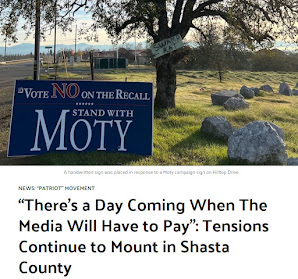
Militia appears to have won Northern California county in recall vote; one leader threatened journalists on podcast
| Screenshot from Shasta Scout story about militia podcast |
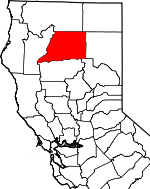
Militia members recently collected enough signatures to force a recall vote Tuesday for three supervisors, and apparently enough votes to out Supervisor Leonard Moty, a lifelong Republican and former Redding police chief. "With all 23 precincts reporting Tuesday night, recall supporters had 52.78% of the 'Yes' vote, while 47.22% of voters cast ballots against the effort to remove Moty from office. The tally remained unchanged on Wednesday," Benda and Arthur report.
As of Thursday evening, nearly 2,000 votes remained uncounted, and the elections office said it will continue receiving ballots from the post office through next Tuesday. "Moty is expected to continue serving as chair of the Board of Supervisors at next Tuesday's meeting, as elections workers continue to count mail-in ballots," Benda and Arthur report. Moty said in a statement that the recall was funded by "an out-of-state millionaire who is seeking revenge against the county" and that it had "done nothing more than sow hate and division in our community."
| Shasta County (Wikipedia map) |
The photo, which Facebook labeled false, actually shows Nazi war criminals being hung in Ukraine, Reuters reports. The Holocaust Encyclopedia reports that the Nuremberg defendants included the head of the radio division of the German propaganda ministry and the editor of a racist, anti-Semitic newspaper, who was the only "media" member executed, Agence France-Presse reports.
Alden ramps up efforts to take over Lee Enterprises; in last quarter, subscription revenue slipped but digital rose 65%
"Hedge fund Alden Global Capital’s attempt at a hostile takeover of Lee Enterprises is heating up again," Rick Edmonds reports for Poynter. There are four new developments:
Alden had nominated sympathetic people for Lee's board of directors slots but Lee rejected the nominations. On Feb. 7, a trial begins in Delaware (where the company is incorporated) to decide whether the nominations were valid. "Unless the court sides with Alden, its effort to gain leverage on Lee’s board appears stymied for now," Edmonds reports.
On Jan. 27, Alden issued a statement to Lee shareholders badmouthing the holders of the two seats it's now seeking (the third candidate dropped out). The statement said that former CEO Mary Junck and Herbert Moloney III "are past 70, entrenched for more than 20 years and unwilling to consider alternatives for running the company," Edmonds reports.
Lee has slated its annual meeting for March 10, and issued its own statement seeking shareholders' approval of its slate of nominees.
Lee announced its fourth-quarter 2021 financials Thursday, which Edmonds noted was not directly related to the takeover fight, but would show whether Lee is making rapid progress on digital transformation as management has claimed. Lee reported that total operating revenue increased for the second consecutive quarter. And, though total subscription revenue decreased 1.6% from the previous year, digital-only subscriptions at the end of the quarter totaled 402,000, a 65% increase from last year.
If Alden bought out Lee, a "clear majority" of U.S. dailies would be owned by hedge funds, Sara Fischer reports for Axios. Moreover, it would "essentially create a local news duopoly between Alden and Gannett/Gatehouse," which was created by the two huge chains' merger in 2019.
Quick hits: Church sues town over new limits on days for feeding hungry; new resources on rural hunger for journalists
Here's a roundup of stories with rural resonance; if you do or see similar work that should be shared on The Rural Blog, email heather.chapman@uky.edu.
A church in rural Oregon is suing the town over a new local ordinance restricting how many times a week the church can give free meals to the needy. Read more here.
The Rural Health Information Hub has updated its resource guide for journalists for rural hunger and access to healthy food. Read more here.
The chief justice of the Iowa Supreme Court says she'd like to see more programs encouraging lawyers to live and practice in rural Iowa. Student loan debt is an impediment to that, she noted. Read more here.
Mayfield, Ky., faces long-term psychological damage from the recent tornado. Read more here.
Rural adults are more likely to be pessimistic about cancer and feel overwhelmed by information about cancer prevention, a new study shows. Read more here.
Coal expected to remain significant global power source until at least 2050, but demand shifting from U.S. to Asia
Thursday, February 03, 2022
Sunshine Week is March 13-19; if you're doing something for it, the News Leaders Association wants to know — now
By the News Leaders Association
Sunshine Week is a non-partisan, non-profit national initiative begun in 2005 by the American Society of News Editors — now the News Leaders Association — to promote a dialogue about the importance of open government and freedom of information. Participants have included news media, civic groups, libraries, nonprofit organizations, schools and individuals concerned about the public's right to know.
To mark Sunshine Week, organizations and nonprofits pressing for greater transparency have held forums addressing specific open government issues, presented research reports focusing on secrecy problems, and surveyed state compliance with open records laws and the incompleteness of local government websites, showing increasing citizen distrust spawned by government opaqueness.
News media have produced special reports and series for print, online and broadcast that featured not only the information gleaned by open records access, but also the process that they had to undergo to get the information.
Public officials have taken notice of Sunshine Week by issuing open-government proclamations, introducing laws, ordinances and policy changes designed to increase transparency, and by announcing website improvements that expanded the public’s access to government information.
If your organization is holding an event to highlight this year’s Sunshine Week, and you would like to have it considered for submission on our events calendar, click here.
News Organizations: If you would like to submit stories, editorials, columns, cartoons or graphics for public use during Sunshine Week, email your content links to sunshineweek@newsleaders.org. Please include a brief description and/or headlines suitable for posting on the Sunshine Week website.
We invite you to join the News Leaders Association in this annual nationwide celebration of access to public information and what it means for you and your community. It’s your right to know.
When should vaccination status of Covid-19 victims be reported? Consider relevance, context; show compassion
Before seatbelt laws were the standard, many reporters used to disclose whether a person who died in a car wreck had been wearing a seatbelt. Not out of a desire to shame the victims, as many families felt, but because it was relevant. Today the same debate rages about whether to disclose the vaccination status of someone who died from Covid-19. "In addition to family members being offended at perceived shaming and blaming, citizen vigilantes are now harassing the relatives of unvaccinated Covid-19 victims. That is forcing standards editors in newsrooms around the country to think through when and how to reveal that particular detail," Kelly McBride reports for Poynter.
McBride surveyed a few standards editors this week on the issue. None had come up with a formal guideline, but all were aware of the issue. "In general, journalists are leaning on the value of relevance as they decide whether to include vaccination status. It’s also helpful to think about like cases around public-health matters that might be relevant when reporting on a death," McBride reports.
"Clearly, the public is interested in the vaccination status of those who have died of Covid-19 because they seek to answer both noble and not-so-noble questions," McBride reports. "Given that journalists have no control over which mindset consumers carry as they approach a story about a person who had died of Covid-19, the best tool storytellers have is context."
She suggests several considerations in deciding whether or not to disclose, including the person's local prominence, the availability of data to illustrate a trend, and compassion.
Rural Covid-19 vaccination rate nears 50%; up 1¼% in Jan.
| Vaccination rates as of Jan. 27, compared to national average and adjusted to account for vaccinations not assigned to a county. Map by The Daily Yonder; click the image to enlarge it or click here for the interactive version. |
About 585,000 rural Americans—1.25 percent of the rural population—completed their coronavirus vaccinations in the second half of January, bringing the rural vaccination rate to 49% as of Jan. 27, Tim Murphy and Tim Marema report for The Daily Yonder. In contrast, 62.5% of the metropolitan population is fully vaccinated."Six states have vaccinated more than two-thirds of their rural population. These are Massachusetts (79.1%), Arizona (74.1%), Connecticut (73.8%), Maine (69.6%), Hawaii (66.7%), and New Hampshire (66.5%)," Murphy and Marema report. And in four states, rural vaccination rates are higher than the metro rate: Alaska, Arizona, Massachusetts, and New Hampshire.
Senate subcommittee clashes over bill to waive antitrust laws to let publishers negotiate with Google and Facebook
Bill would give farmers right to repair their own equipment
President Biden issued an executive order last year supporting Americans' right to repair items themselves instead of having to pay for time-consuming, expensive repairs from the manufacturer. "Now, Sen. Jon Tester, D-Mont., wants legislative action to address the situation. His Agriculture Right to Repair Act will guarantee farmers the right to repair their own equipment and end current restrictions on the repair market," Jacqui Fatka reports for FarmProgress.
"I’ve been a farmer my whole life, and I’ve seen the unfair practices of equipment manufacturers make it harder and harder for folks to work on their tractors themselves—forcing them to go to an authorized mechanic and pay an arm and a leg for necessary repairs," Tester said in a statement. "Manufacturers have prevented producers from fixing their own machines in order to bolster corporate profits, and they’ve done it at the expense of family farmers and ranchers, who work hard every day to harvest the food that feeds families across the country."- Make available any documentation, part, software, or tool required to diagnose, maintain, or repair their equipment.
- Provide means to disable and re-enable an electronic security lock or other security-related function to effect diagnostics, repair, or maintenance.
- Permit third party software to provide interoperability with other parts/tools, and to protect both the farmer’s data and equipment from hackers.
- Ensure that when a manufacturer no longer produces documentation, parts, software, or tools for its equipment that the relevant copyrights and patents are placed in the public domain.
- Ensure parts are replaceable using commonly available tools without causing damage to the equipment, or provide specialized tools to owners or independent providers on fair and reasonable terms.
- Return data ownership to farmers. Manufacturers currently collect and sell all the data generated by farmers, and this data is the farmers’ “secret sauce” for how they conduct their business.
Rural Midwestern air has fewer, but more potent, pollutants
Wednesday, February 02, 2022
Over 400 Native American tribes agree to $665 million opioid deal with Johnson & Johnson, other drug companies
Two studies aim to expand understanding of rural colleges and the challenges they face
The first step in helping rural colleges and universities is figuring out how which schools count as rural, but rurality is complicated; definitions can conflict. Two new reports aim to provide clarity. Essentially, the first report focused on identifying and mapping rural schools, while the second report focused on schools that may not be located in a rural area but serve a significant number of rural students commuting.
"Both studies received funding from Ascendium Education Group. Though it might seem like the mapping projects would overlap, researchers say they are complementary, like salt and pepper," Josh Moody reports for Inside Higher Ed.
The first report, released in December by the University of Wisconsin, "Mapping Rural Colleges and Their Communities," discovered some rural institutions were not reflected as such in the commonly-used Integrated Postsecondary Education Data System. Education professor Nicholas Hillman and his team cross-referenced schools on that list with those on the Database of Accredited Postsecondary Institutions and Programs, which contains more detailed information, and "turned up programs in far-flung corners of the U.S. as well as educational partnerships serving students in unexpected locations, such as hotels and conference centers," Moody reports.
Civilian Climate Corps could help provide a brighter future for American youth, writes policy analyst
Many disadvantaged American youth face a rocky economic future, in terms of employment and increasingly disruptive and expensive natural disasters fueled by climate change. "The economic and climate challenges young adults face may not seem related, but one program could address both: the Civilian Climate Corps, which would put young people to work addressing a range of environmental problems while also offering structure and a paycheck," senior fellow Martha Ross writes for the Brookings Institution. "The need for a Civilian Climate Corps at this crucial moment could not be clearer. Science shows that we need to take action now to address climate change. Meanwhile, for decades, the United States has profoundly failed to provide sufficient guidance and support to millions of young people transitioning to adulthood, leaving them with two bad choices: an expensive, confusing postsecondary landscape or a labor market largely offering low-wage jobs."
The Civilian Climate Corps, part of President Bidne's "Build Back Better" bill that is stalled in the Senate, is modeled on the Civilian Conservation Corps, which employed 3 million disproportionately rural young men during the the Great Depression. "As part of the CCC, young people would work on a range of projects, earn a decent wage, and get valuable opportunities to build their skills and networks," Ross reports. "Corps members could work in urban, rural, and suburban settings on projects such as trail maintenance, forest management, home weatherizing, electronic waste recycling, green infrastructure to reduce stormwater runoff and flooding, and more."
The program—or some sort of economic intervention—is badly needed, Ross writes. A soon-to-be-released analysis from Brookings and Child Trends shows that one-third of disadvantaged teens in recent decades went on to make only $19,000 a year at age 30. Even more teens will someday be in the same boat because of the economic disruptions brought on by the coronavirus pandemic, Ross writes: "At the end of 2021, the unemployment rate among 20- to 24-year-olds was double that of 25- to 54-year-olds (7.1% and 3.5%, respectively). Remote learning has led to serious learning loss among K-12 students, and college enrollment is down sharply, especially at community colleges. Teachers note they have not been able to provide the same level of college and career readiness counseling as before the pandemic, and many recent high school graduates report overwhelming levels of uncertainty, anxiety, and confusion about their future."
The CCC could help the most at-risk youth prepare for good jobs later in life, help them develop supportive relationships with adults, and provide support to help them stay on track, Ross writes.
New rural Covid-19 infections fell slightly as deaths surged
| New cases of the coronavirus, in ranges by county, Jan. 23-29 Map by The Daily Yonder; click the image to enlarge it or click here for the interactive version. |
New coronavirus cases in rural counties fell slightly Jan. 23-29 after several weeks of record highs, indicating the surge has peaked. But deaths, a trailing indicator, jumped 20 percent in rural America last week and are 17% higher than the metropolitan rate, Tim Marema reports for The Daily Yonder.
In raw figures, rural counties reported 640,000 new infections last week, down about 14,000, or 2%, from the previous week. Meanwhile, rural counties reported 2,567 Covid-19-related deaths, up 431 from the previous week and bringing the total number of rural Covid deaths to 150,400. New infections in metropolitan counties fell 16% over the past week, while Covid-related deaths increased 12%.
Click here for more charts, regional analysis, and county-level interactive maps from the Yonder.