Tuesday, April 05, 2022

Canadian study links living near hydraulic-fracturing wells before and during pregnancy to poor birth outcomes

Hydraulic-fracturing wells in relation to
communities in Alberta, 2013-2018
(University of Calgary map)
A newly published study adds to growing evidence that living near hydraulic fracturing wells can harm infants and children. University of Calgary researchers studied nearly 35,000 pregnancies in rural Alberta from 2013 to 2018, and found that people who lived within 10 kilometers of 100 or more fracking sites in the year before getting pregnant were significantly more likely to give birth to infants who were premature and/or small for their gestational age.

"Past studies conducted in California and Pennsylvania have linked exposure to fracking sites and risk of spontaneous preterm birth," Lei Lei Wu reports for MedPage Today. "In addition, previous U.S. studies have suggested that living near fracking sites is associated with greater risk of mortality among the elderly, as well as heightened risk of heart failure.

Several factors could explain the link between fracking wells and adverse birth outcomes, the researchers said. "The quality of water and air may be lower near fracking sites due to contamination and the constant activity of heavy trucks, they noted, adding that around 90% of rural Albertans rely on groundwater for drinking," Wu reports. "They also noted that of the 240 chemicals in fracking fluids with toxicity information available, 103 are linked to reproductive toxicity."

News media roundup: How to reach audiences that mistrust the news; media literacy podcast; a fact-checker's toolkit

Six cues used to make snap judgements about whether to trust a news source (Trust in News Project graphic)

Here's some recent news about media literacy, misinformation, and disinformation:

It's possible to reach people who mistrust the news, but you can't just relying on good reporting and writing, according to a recent Trust In News Project study by the Reuters Institute and the University of Oxford. Great headlines, graphics, photos, and more are essential too. The study also categorizes six cues audiences use to make snap judgements about which sources to trust (see graphic above). Here's a write-up about the study from Poynter and here's the study itself.

A fact-checker for Snopes discusses how she tells real news from fake and shares the toolkit she and colleagues use. Read more here.

Last year, Illinois became the first state to require all high school students to be taught media literacy skills. NPR podcast "In Case You Missed It" takes a deep dive into why media literacy is an essential skill today, as well as what people need to know who didn't learn about it in school. Listen to it here.

Here's a reminder to consider your source's motives and fact-check outrageous "trends" before reporting: Facebook parent company Meta hired GOP consulting firm Targeted Victory to help turn the public against social-media rival TikTok and draw attention away from Meta's privacy and antitrust issues. The nationwide media and lobbying campaign "includes placing op-eds and letters to the editor in major regional news outlets, promoting dubious stories about alleged TikTok trends that actually originated on Facebook, and pushing to draw political reporters and local politicians into helping take down its biggest competitor," Taylor Lorenz and Drew Harwell report for The Washington Post. Internal emails obtained by the Post show that the firm wanted to portray "the fast-growing app, owned by the Beijing-based company ByteDance, as a danger to American children and society." Facebook has already been under fire for engineering its algorithm to push users toward false and inflammatory news.

Thursday AgriPulse webinar will explore how beefing up the electrical grid can help rural economic development

Agri-Pulse will host a free, one-hour webinar at 11 a.m. ET Thursday, April 7, to explore how investing in the national electricity grid can create more rural jobs, "in addition to improved electricity affordability, reliability and sustainability," the Washington, D.C., newsletter says.

Agri-Pulse founder and editor Sara Wyant will moderate a panel of experts, including:
  • Agriculture Department Undersecretary for Rural Development Xochitl Torres Small
  • Rep. Frank Lucas, R-Okla.
  • Rural Utilities Service Administrator Chris McLean
  • Rob Gramlich, executive director, Americans for a Clean Energy Grid (sponsor of the webinar)
  • Denise Bode, a partner with lobbyist consulting firm Michael Best Strategies LLC
Click here for more information or to register.

Pioneering study says Renewable Fuel Standard has steadied commodity markets and boosted farmers' income

"In a first-of-its kind study, researchers at Purdue University have illustrated the impact of the Renewable Fuel Standard on the production of biofuels," Madelyn Ostendorf reports for Successful Farming. "The study evaluates the long- and short-term economic impacts of market forces and policies on the biofuels industry, and successfully identified the impact of each market driver."

The federal policy requires transportation fuel to have a minimum (increasing over time) amount of renewable fuels, such as ethanol and biodiesel made from corn and soybeans. RFS and market forces have caused biofuel production and consumption to increase in the U.S. since it was enacted in 2005. "Farzad Taheripour, the agricultural economist who led the study, says RFS played a critical role in reducing uncertainties in commodity markets," Ostendorf reports. "Most significantly, RFS helped farmers use their resources more efficiently."

Taheripour told Ostendorf, "With producing more corn and soybeans, over time farmers were able to bring fallow land back to production, and U.S. annual farm income increased by $8.3 billion between 2004 and 2011, with an additional annual income of $2.3 billion between 2011 and 2016."

The researchers used a complicated computation model that sorts commodities into categories by use (vegetable oils vs. grain meals, for example), and factors in variables such as production rate, consumption rate. "The model takes into account the use of commodity feed stocks for food and fuel, and the competition or trade-offs between those and other market uses," Taheripour told Ostendorf. "It also traces land use and handles intensification in crop production due to technological progress, multicropping, and conversion of unused cropland to crop production. This is the first biofuels study to be able to piece out all these factors individually and to combine that information with short-term models to capture finer and shorter-term impacts."

Monday, April 04, 2022

The Storm Lake Times becomes the Storm Lake Times Pilot with purchase of longtime competitor, thanks to big donation

The new nameplate, with the same logo and motto that were used by the Storm Lake Times 

One of rural America's most famous weekly newspapers has a new name because it has bought its local competitor, with the help of a big donation from a philanthropist who says he wants to preserve the free press. The Storm Lake (Iowa) Times has become the Storm Lake Times Pilot, with its purchase of the Pilot-Tribune, formerly owned by Rust Communications of Cape Girardeau, Mo.

Rust sold the Pilot-Tribune and its other northwest Iowa papers (including the Le Mars Daily Sentinel, the Cherokee Chronicle Times, the Dickinson County News and the Spencer Daily Reporter) to Hallmark II Publishing of Charles City, owned by Gene Hall and his son Chris, who immediately sold the Pilot-Tribune, its shopper publication and the Cherokee weekly, in adjoining Cherokee County, to Times owners John and Art Cullen, the Times Pilot reports.

Art Cullen's 2017 Pulitzer Prize for editorial writing led to a book by him, Storm Lake, and a documentary of the same name by Beth Levison and Jerry Risius. It presented the brothers and their family as an object example of community newspapers trying to stay alive in the digital age, but in its 90 minutes did not mention one of their biggest challenges, that they had an entrenched competitor, which is an unusual situation in rural journalism today. (Dick Tofel writes about that on Substack.)

Art Cullen, left, and his brother John, right, with the 2017
Tom and Pat Gish Award for courage, integrity and
tenacity in rural journalism, presented by Al Cross of
the Institute for Rural Journalism and Community Issues
The Times Pilot tells the story: "For the Cullens, it marks the end of a 32-year contest with Storm Lake’s oldest continuous business, the Pilot. John Cullen founded The Storm Lake Times in 1990 in competition with the Pilot-Tribune," after its owners wouldn't sell to him. "The launch of the weekly started a mini-newspaper war that escalated into both The Times and the Pilot-Tribune going to daily publication — Storm Lake was the smallest town in America with competing daily newspapers — and then reverting to twice weekly. The competition was fierce."

Rust bought the Pilot-Tribune in 2003. The paper's print circulation was below 1,000 last year, the Times Pilot reports: "The Times, likewise, hemorrhaged money during the pandemic, although it was able to hold its circulation near 3,000 copies." It also benefited from donations spurred by Art Cullen's national profile and the documentary, and the Western Iowa Journalism Foundation, created by them and other publishers.

John Tu (via Forbes)
But the big difference was made by John Tu, a Taiwanese-American billionaire who made a "large" donation to the foundation after hearing Art on the NPR "Fresh Air" interview show, and that made the purchase possible, reports Courtney Crowder of the Des Moines Register. The purchase price and the amount of the donation were not disclosed, and the Times Pilot story didn't mention the donation, but Art Cullen did a column about it and discussed it with Crowder. He said Tu seems to have no agenda other than keeping the newspapers and their staffs going "and that the free press flourishes – at least in this part of northwest Iowa," Crowder reports. Cullen said, “The only thing he’s told me is, ‘Believe in your dream; it will come.’”

John Cullen said in the Times Pilot story, “We’re grateful to Gene and Christopher Hall, longtime friends, for the opportunity to purchase the Pilot-Tribune and Ad Guide. This concentration of resources will allow us to put out an even stronger newspaper that helps build The City Beautiful. It’s been a long time coming.” The Cullens will move their printing to the Halls' plant. Gene Hall said, “We’re happy that we could help the Cullens realize their ambition to consolidate the local newspapers into one product that better serves Buena Vista County and is locally owned. We look forward to working together in Northwest Iowa to strengthen communities through better journalism.” The county has one other paper, the Buena Vista County Journal, in the small town of Newell in the southeast corner of the county.

Writers and loved ones share stories about bell hooks, 'little country girl from the hills,' at hometown memorial service

UPDATE, April 13: Berea College is hosting a livestream of its memorial service for bell hooks from 2 to 4 p.m. Thursday, April 14. Guest speakers include Gloria Steinem, Imani Perry and others.

Wendell Berry speaks at a memorial service for
Gloria Jean Watkins, who wrote under the name
bell hooks. (Hoptown Chronicle photos by Tony Kirves)
"People came from across town, from other parts of Kentucky and from as far away as New York to pay their respects Saturday to the feminist author and activist bell hooks, who was born Gloria Jean Watkins to a working-class Hopkinsville family on Sept. 25, 1952," Jennifer P. Brown reports for the Hoptown Chronicle. "They sat shoulder to shoulder in the Alhambra Theatre, a crowd of about 400 — childhood friends, literary luminaries, relatives, historians, high school classmates, civil rights activists, hometown admirers, clergy and scholars. Each one was a testament to the profound impact of hooks, the author of more than 30 books, who died Dec. 15 of renal failure at her home in Berea. She was 69."

A host of Kentucky writers paid tribute. Crystal Wilkinson, a state poet laureate and like hooks a Black woman, said hooks "had this way of turning the concepts and ideology of feminism into brilliant common sense," Brown reports. When Wilkinson first met her at a writing conference in 1993, she and the others "were listening to bell that day the way that my family used to listen to country preachers back down home."

Hopkinsville Mayor Wendell Lynch presided
at the memorial for his childhood friend.
Wendell Berry, the state's most famous author, said he felt a connection to hooks since they were both raised in rural Kentucky. "As a member of the disappearing class of agrarians," Brown writes, "Berry said he reads bell hooks with a sense of not only being spoken to, but also of being spoken for."

Novelist Silas House, who was also hooks' friend, told of when "he went to a country café with hooks. He had to wait while she went to every table and spoke to each diner. She shook hands. She patted their shoulders. She talked to them about cars and how much she liked to shop at Goodwill stores," Brown reports. When House and hooks sat down, he remarked that she must know everyone there. "She said, 'I don’t know a single one of them," said House. "'I wanted every one of them to have to speak to a Black woman today.'"

Home counties: bell hooks' Christian; Crystal Wilkinson's Casey;
Silas House's Laurel; and Wendell Berry's Henry. (Wikipedia, adapted)
House noted that hooks often called herself "a little country girl from the hills" and said she was proud of that, even though it sometimes caused her pain. "She talked about both the joy and the pain," said House. "She was troubled by Kentucky, but she also loved it fiercely. Most of all I keep thinking of that little girl — about the burst of all of that intelligence and fierceness and bravery, as she played in the hills of Christian County, Kentucky, or sat against the tree and read, or wrote in her notebooks. I keep seeing that little girl and think about the way she changed the world."

Vilsack rejects calls to open conservation land for crops to help avert global food shortage, says it would help little

The United States and allies have pledged to plant more crops this spring to avert a global food shortage from the war in Ukraine. But Agriculture Secretary Tom Vilsack "poured cold water on Republican and industry calls to pull land out of the Conservation Reserve Program and put it back into production," Ximena Bustillo reports for Politico's Weekly Agriculture.

Vilsack, a former governor of Iowa, wrote in a March 31 letter to the National Grain and Feed Association: "Quickly converting this land to crop production is clearly unfeasible, even if we were to overlook the negative consequences of increased erosion and reduced water quality, wildlife habitat reduction, and decreased carbon sequestration and storage."

Conservation Reserve, once called "the soil bank," pays farmers a yearly rate to allow land subject to erosion and other damage to go fallow for at least a decade to improve its health. "They can receive higher payments by adopting certain climate-friendly practices that improve water quality, increase carbon sequestration or protect wildlife habitats," Bustillo reports.

Vilsack said only 1.3 percent of land in the program is prime farmland ready for planting, much is experiencing "significant levels of drought," and most is grassland far better suited to grazing than crops. Not only would it be impossible to get all of it ready to plant this year, he said, but most of it would produce poorly, and growing crops would create a "significant and detrimental impact on producers’ efforts to mitigate climate change and maintain the long-term health of their land."

U.N. report: The world is running out of ways to reach its climate goals and avert catastrophic environmental changes

"The world is on track to blaze past a crucial climate target within eight years, some of the planet’s top researchers, economists and social scientists said in a sober assessment Monday," Sarah Kaplan and Brady Dennis report for The Washington Post. "Whether humanity can change course after decades of inaction is largely a question of collective resolve, according to the latest report from the U.N. Intergovernmental Panel on Climate Change. Governments, businesses and individuals must summon the willpower to transform economies, embrace new habits and leave behind the age of fossil fuels — or face the catastrophic consequences of unchecked climate change."

"Governments agreed in the 2015 Paris accord to keep global warming well below 2 degrees Celsius (3.6 Fahrenheit) this century, ideally no more than 1.5 degrees Celsius (2.7 Fahrenheit)," The Associated Press reports. "Yet temperatures have already increased by over 1.1 C (2 F) since pre-industrial times, resulting in measurable increases in disasters such flash floods, prolonged droughts, more intense hurricanes and longer-burning wildfires, putting human lives in danger and costing governments hundreds of billions of dollars to confront."

Unless wealthy nations (which produce most pollution) take the threat seriously and cut greenhouse gas emissions, the report's authors said they have "high confidence" that the world's average temperature will be increase another 2 to 4 degrees by the end of the century, "a level experts say is sure to cause severe impacts for much of the world's population," Jordans and Borenstein report. Though it's still possible for nations to curb their pollution in time to meet the goal (and could be economically viable), the authors say it's only possible through immediate, widespread action. 

"Monday’s report represents the IPCC’s first analysis of humanity’s remaining paths for climate action since the landmark Paris Agreement, in which world leaders committed to prevent dangerous warming," Kaplan and Dennis report. "The several thousand page document details how coordinated efforts to scale up renewable energy sources, overhaul transportation systems, restructure cities, improve agriculture and pull carbon from the air could put the planet on a more sustainable path while improving living standards around the globe."

Ever more partisan, vicious school-board races in Wisconsin (on ballot tomorrow) may presage nasty races nationwide

"Voters in Wisconsin and three other states head to the polls Tuesday in what are some of the nation’s earliest school board elections this year. In a harbinger of what voters across the country will see in coming months, many of the traditionally nonpartisan school board races have become increasingly polarized. Outsiders who have traditionally stayed out of local races are now trying to influence school board contests across the country, using tactics more typical of elections with higher stakes," Megan O'Matz reports for ProPublica. "Republicans, and particularly the wing of the party that still supports former President Donald Trump, have come to see local races as a way to energize their base and propel voters to the polls — part of what some leaders have called a 'precinct strategy.' Sen. Ron Johnson, the Wisconsin Republican, last year encouraged residents to 'take back our school boards, our county boards, our city councils'."

School-board races in Wisconsin have been a bit partisan in the past, but have mostly centered on local taxation and education issues, O'Matz reports: "Today, school board elections are more heated and personal — framed in terms of saving schools, saving children and saving America. Also mentioned: Covid-19 protocols, critical race theory, equity, 'divisive curriculum,' library book bans and parental rights. Parents, who during the pandemic saw their children struggle with remote learning and other issues, are demanding more control over school management and curriculum decisions. The backlash against mask-wearing by students has played neatly into conservative themes of parental freedom."

Former Trump adviser Steve Bannon warned on his podcast last May that concerned parents would revolt against the "cultural Marxism" being introduced in schools, O'Matz notes. "The path to save the nation is very simple," Bannon said. "It’s going to go through the school boards."

In Wisconsin and elsewhere, "School board members and other school officials have quit without finishing their terms, saying that the anger directed their way has made serving untenable. Others have declined to run for reelection," O'Matz reports. "Some political observers and academics worry that the politicization of local offices will make it harder to deliver essential school services."

Thursday, March 31, 2022

Society of Environmental Journalists offers free livestreams of Friday and Saturday sessions at its annual conference

The Society of Environmental Journalists' annual conference is underway in Houston. For those who can't make it in person, the organization is live-streaming its plenary sessions and offering audio recordings of most sessions. Here are sessions that may be of interest (note Central Time):

The Energy Transition and Environmental Justice, Friday, April 1, from 12:15 to 2 p.m. CT. From the website: "Scientists have shown that using clean electricity to power as much of the economy as possible — from cars and trucks to kitchen stoves — may be the cheapest, easiest way to fight climate change. But doing that equitably, while keeping the lights on, is another story. Will the push to “electrify everything” currently underway in California and other states raise energy costs and force low-income families to spend money they don’t have on new vehicles and appliances? And what happens when fires, floods and heat waves made worse by climate change inevitably cause chaos on the electric grid?" Click here to register.

Environmental Protection Agency Press Conference and Q&A Session, Friday from 3:30 to 5 p.m. CT. From the website: "The Biden Administration and Regan EPA are focusing money and energy on environmental justice issues and toxic release monitoring like never before. With our host city plagued with industry-related explosions, a cancer cluster and some of the highest levels of cancer-causing air stemming from industrial pollution, we’ll hear from EPA leaders on how they’re addressing these issues on multiple fronts. Get your questions ready! Following a brief pre-recorded video from EPA Administrator Michael Regan and moderator-led discussion with the panelists, we’ll take questions from the audience." Click here to register.

Solutions Journalism and Environmental Justice, Saturday from 12 to 2 p.m. CT. From the website: "Environmental reporting in communities of color often lacks depth and nuance. Stereotypes of who cares about the environment abound. Narratives about environmental injustice present frontline communities as victims, devoid of agency. These stories often omit communities’ efforts to organize and find solutions. From framing a story to the ethics of maintaining relationships with BIPOC communities, panelists will discuss the common pitfalls of reporting in communities of color, the role of evidence-based solutions journalism in environmental justice reporting and how reporters can provide smart and informative coverage for underrepresented communities." Click here to register.

Rate of new rural coronavirus infections falls for 9th straight week; rural New England, Ky. and Va. still have hotspots

New coronavirus infections, in ranges by county, March 20-26
Map by The Daily Yonder; click on the image to enlarge it or click here for the interactive version.

New coronavirus infections declined for the ninth week straight and fell to a 10-month low last week. Nonmetropolitan counties reported about 25,200 new infections from March 20 to 26, a 17 percent drop from the week before, Tim Marema reports for The Daily Yonder.

"Meanwhile, the infection rate in metropolitan counties headed in the opposite direction. New cases of Covid-19 grew about 28% last week, to a total of about 174,000," Marema reports. "The result is that the metropolitan infection rate is higher than the rural infection rate for the first time since mid-January. The difference is slight – the metro rate is just 12% higher than the rural rate – and is still low compared to rates during the Delta and Omicron surges of fall 2021 and winter 2021-22 respectively."

The rural death rate remained significantly higher than the metro rate last week. "Last week’s rural death rate of 2.53 deaths per 100,000 residents was nearly twice that of the metropolitan death rate of 1.29 per 100,000," Marema reports.

The national map shows several rural hotspots, including Appalachian Kentucky, but state officials told Kentucky Health News that those numbers didn't match their numbers, and that local and district health departments may have had trouble switching from daily to weekly reporting.

Click here for more charts, regional analysis, and county-level interactive maps from the Yonder.

Rapid City hotel owner gets big backlash after banning all Native Americans in the wake of a recent shooting

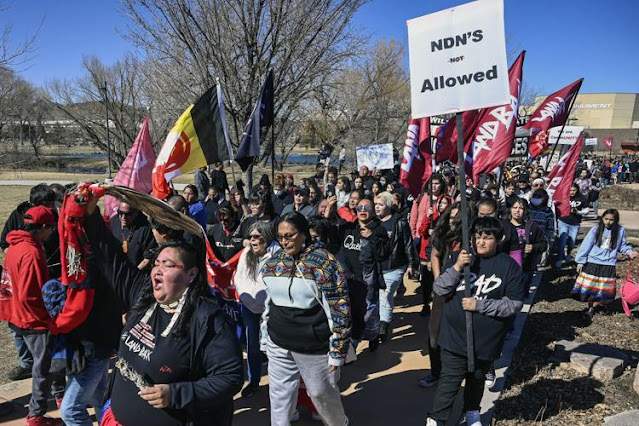
Hundreds of protesters marched in Rapid City, South Dakota, on March 23, angered at the Grand Gateway Hotel's ban on Native Americans after a recent shooting. (Rapid City Journal photo by Matt Gade)
 A hotel owner in Rapid City, South Dakota, is seeing widespread backlash after barring all Native American customers in the wake of a shooting two weeks ago.

It started March 19 when a Native American teen was seriously injured in a shooting at the Grand Gateway Hotel. The next day, owner Connie Uhre posted on Facebook that Native Americans would no longer be allowed in the hotel or the bar and casino attached to it, Sindhara Bonnet reports for the Rapid City Journal. Native Americans are 10 percent of the city's population.

Within days, the indigenous advocacy group NDN Collective sent two members to attempt to book rooms at the hotel. Both were denied service. The group then filed a federal civil rights class action lawsuit against the Retsel Corp., the hotel's parent company which Uhre owns, saying the company had violated the members' legal rights, Bonnet reports.

Meanwhile, the entire staff of the bar and many of the hotel's employees quit after word got out about the ban, Arielle Zionts reports for South Dakota Public Radio.

Connie Uhre's now-deleted Facebook comments,
as tweeted by Mayor Steve Allender
A little over a week after the shooting, several Sioux tribes collaborated in posting what they called a trespassing notice and a cease-and-desist order on the front window of the hotel. The notice, signed by the leaders of the Oglala Lakota, Cheyenne River, Crow Creek, Rosebud, and Standing Rock Sioux, "states the Great Sioux Nation made an investigation that showed the hotel and Uhre are in violation of the April 29, 1868 Treaty with the Sioux," Bonnet reports. "The notice further states the Great Sioux Nation can, without further notice and liability, take possession, destroy, or remove the property at the owners' expense."

The tribal leaders weren't done. In a statement, they said the tribes "are prepared to boycott the entirety of Rapid City, boycott the hotel and its subsidiaries, pressure the Rapid City Council to revoke the hotel's business license, discuss moving the Lakota Nation Invitational elsewhere, move the Black Hills Pow Wow to another location, file hate-crime charges against the owner, push ordinance tax for mental health, address the open-carry law, create a rating system on businesses to track quality of service to Indians and serve the notice of trespassing," Bonnet reports.

Nick Uhre, Connie Uhre's son and the hotel's manager, told SDPR that the hotel isn't accepting any new bookings right now because they're receiving threats of violence, Zionts reports. Nick Uhre is also in hot water with the public after sending an email out to area hospitality managers alerting them about the shooting, encouraging them to stop paying taxes, and blaming a rise in crime on a MacArthur Foundation-funded program that aims to reduce jail misuse and overuse in Pennington County. His mother responded with an email proposing a ban on all Native Americans since "We do not know the nice ones from the bad natives . . . so we just have to say no to them!!"

Other hoteliers responded to the email chain with horror, calling the email "disgusting" and "racist." Mayor Steve Allender also distanced himself from the Uhres in a tweet, saying that "neither the shooting or Grand Gateway’s response to it reflect our community values." 

Nick Uhre got no warmer a reception after appealing to Gov. Kristi Noem, asking her in an email to remove the mayor from office, Nathan Thompson reports for the Journal. Noem's communications chief said the office can't comment on the issue because of the civil suit, but said Noem "is opposed to all racial discrimination – there is no room for racial discrimination in South Dakota."

Study proves that people who were raised in rural areas have a better sense of direction than city dwellers

A player navigates a boat in Sea Hero Quest
"People who grew up in the country have a better sense of direction and navigational skills than those raised in cities, a study has found," Agence France-Presse reports. This is something many rural people have long believed about urbanites; now we have proof.

"To find out how childhood environment influences navigation ability, scientists looked at how almost 400,000 people from 38 countries played a mobile video game designed for neuroscience research," AFP reports.

According to the study, which was published in Nature, players of the Sea Hero Quest game navigated a boat to find checkpoints on a map. The game was created in 2016 to study Alzheimer's disease, but has since been played by nearly 4 million people, AFP reports.

"We found that growing up outside cities appears to be good for the development of navigational abilities, and this seems to be influenced by the lack of complexity of many street networks in cities," lead researcher Hugo Spiers of University College London told AFP.

Co-lead author Antoine Coutrot of France's University of Lyon noted that people from cities with complicated layouts such as Paris and Prague fared much better than those from grid-based cities like Chicago: "Growing up somewhere with a more complex layout of roads or paths might help with navigational skills as it requires keeping track of direction when you’re more likely to be making multiple turns at different angles, while you might also need to remember more streets and landmarks for each journey."

That has implications in the United States, where most of the landscape is overlaid with rectangular grids, but not most of the Eastern U.S. -- except the states north of the Ohio River that were part of the Northwest Territory, governed by the Northwest Ordinance, which divided the land into grids of townships, a system used as Americans migrated west. Next time you fly over the Ohio, notice the difference in how the landscape is laid out. Here's a Google map example:
The researchers also developed and tested users on a new game called City Hero Quest to see how well rural and urban people navigated in cities. "People raised in cities did manage better in grid street plans than those who grew up in the country – but the difference was nowhere near as stark as the other way around," AFP reports. Coutrot noted that adult urbanites can improve their sense of direction if they work at it, but said it's much easier when one is young.

Learn about impact of transportation on rural health care

The Rural Health Information Hub has a new information guide and toolkit on rural transportation.

The guide focuses on the importance of transportation in rural health care: "The availability of reliable transportation impacts a person’s ability to access appropriate and well-coordinated healthcare, purchase nutritious food, and otherwise care for themselves," says the RHIHub website. "This guide focuses on how communities can provide transportation services to support access to rural healthcare, which may also benefit healthcare providers by decreasing inappropriate use of EMS services, improving utilization of healthcare services, decreasing no-show rates, and increasing access to health-supporting services. The guide also highlights transportation as a community-based service that can allow the elderly and people with disabilities to live successfully in a community rather than entering a long-term care facility or leaving the community."

Rural residents most likely to need transportation services to maintain their health include seniors, people with disabilities, low-income individuals and families, veterans, and people with special health-care needs who often must travel long distances to access care, the guide notes.

The toolkit, meanwhile, "provides guidance, resources, and model programs to aid the development, implementation, and evaluation of transportation programs to support rural communities."

Wednesday, March 30, 2022

Lee cuts jobs following takeover bid, boosts executive compensation amid lackluster revenue; NewsGuild objects

"Lee Enterprises has been quietly laying off top editors and other staff across its local papers. The cost-cutting moves come after an unsolicited takeover bid from Alden Global Capital, a hedge fund known for consolidating local news for profit," Sara Fischer and Kerry Flynn report for Axios. "Journalists at Lee-owned papers across the U.S. say that at this point, they don't know whether staying independent or a hedge fund takeover is worse. 'If Alden is a cancer on journalism, Lee is Covid, MRSA and SARS,' one former editor told Axios."

Over the past two months, at least eight journalists have been laid off from five newsrooms: the Richmond Times-Dispatch, the Bristol Herald Courier, the Omaha World-Herald, the Greensboro News & Record, the Winston-Salem Journal, and the Free Lance-Star, Axios reports.

The NewsGuild unit at the World-Herald released a fiery statement after top editors Randy Essex and Connie White were laid off in February. They called Essex "a champion of enterprise pieces, longform journalism and anything that gets people talking" and White "the best city editor we've ever had," working 70-hour weeks for the paper even after her husband was paralyzed a few years ago.

According to the NewsGuild statement, Lee regional news director Marc Chase told Guild representatives that Essex and White couldn't be replaced, "but that doesn't mean we won't grow and become stronger. We will." The Guild responded that Lee has done nothing to grow their operation in the 43 months it has run the paper, and asked: "How do we grow and become stronger when all Lee does is continually cut?" They also asked him: "How do you — how do we — work for a company that lays off Connie White and just paid CEO Kevin Mowbray a $1.1 million bonus?"

"Lee laid off at least 70 staffers, many in editorial, across several states amid the pandemic, in addition to implementing furloughs and cost-cutting measures, according to Poynter," Axios reports. "Former Lee employees told Axios and have publicly expressed their frustration over payouts to Lee management amid the newsroom cuts."

The Omaha NewsGuild tweeted, "Rational folks would be right to question why Lee is dolling out that much money to executives during a hostile takeover attempt, let alone while they gut newsroom and newspapers. . . . Lee has increased executive compensation even as the company's quarterly revenues "have either declined or grown modestly compared to the prior year."

New interactive map shows county-level data on uptake of emergency pandemic benefit for broadband access

Rural enrollment in Emergency Broadband Benefit by eligibility
(Rural LISC map; click the image to enlarge it or click here for the interactive version)

"A new mapping tool shows where households have taken advantage of a federal stimulus program that defrays some of the cost of broadband for lower-income Americans," Kristi Eaton reports for The Daily Yonder. "The tool, which was created through a partnership between Rural Local Initiatives Support Corporation and the nonpartisan nonprofit Heartland Forward, was designed to help target families that may qualify for the Affordable Connectivity Program but who aren’t participating."

The program provides several benefits: a one-time discount of up to $100 to buy a laptop, tablet, or desktop computer; and a monthly discount of up to $30 a month for internet service. Those living on tribal lands can get up to $75 per month toward their internet service, Eaton reports.

"The interactive map overlays enrollment data from the previous iteration of the discount program (called the Emergency Broadband Benefit, or EBB) with data on the communities that have the highest levels of eligibility for the program. The result shows where there are large proportions of households who qualify for the program but didn’t enroll," Eaton reports. The tool "could help identify communities where families are likely eligible for the program but haven’t enrolled."

The map reflects Census data showing which households are at or below 135% of the federal poverty rate, which is one of the qualifiers for EBB. "According to the map’s estimate, the national average of EBB enrollment for households that were eligible was just 17%. In the new ACP program, eligibility increases to 200% of the federal poverty level," Eaton reports. "There are plans to update the map with data from ACP."

Peers can help first responders with mental-health support

First responders work long shifts and routinely see the worst day of someone's life. It's a stressful job, but many don't want to seek help for mental health needs. Peer groups can help, Peter Andrey Smith reports for Undark., which says it is "a digital magazine exploring the intersection of science and society."

First responders don't often seek mental-health support for many reasons. Part of it is shame, but part stems from a more practical concern: "There is also the threat of losing one’s livelihood. Many physicians fear that state boards could suspend their license or revoke its renewal if they seek mental-health care," Smith reports. "The threat of formal sanctions can reinforce a workplace culture that stigmatizes mental health. Seeking treatment may be seen as a career-ending decision — that a person is unfit for duty, both in the eyes of their colleagues and their profession."

Smith tells the story of a former EMT in Colorado who joined a peer support group last year, and how the program has helped him cope. 

The concept of peer support groups for EMTs "has resonated with administrators and staff alike. But sources say that, in part because it is predicated on patients’ trust, and in part because of its ambiguous definition, peer support lags in one key respect: Research on its effectiveness is limited. Proponents also caution that these programs cannot necessarily replace reform that addresses systemic problems plaguing the workforce," Smith reports. "Peer supporters are nonetheless forging ahead. In recent years, the U.S. Health Resources and Services Administration has invested millions in peer support programs. Leading medical organizations and practicing physicians have called for implementation in health care settings, where a staggering number of workers have quit since the pandemic began. All in all, experts are suggesting: Who better to care for caretakers than one of their own?"

Pandemic child-nutrition waivers are scheduled to end June 30; schools worry that some kids will go hungry

"Child nutrition waivers issued during the pandemic have been a boon for meal programs, allowing them to continue distributing food while also adapting to the spread of Covid-19. The waivers provide more federal funding for each meal distributed, and also provide flexibility from rules meal programs normally operate under. But without congressional action, they’re set to expire June 30," Liam Niemeyer reports for Ohio Valley ReSource.

Some school districts say they're worried low-income kids will go hungry without the waivers. In Mayfield, Ky., a community of 10,000 ravaged by a tornado last December, things are hard enough: "Mayfield Independent School District is already facing challenges in the years ahead. Community leaders are worried about keeping their community together, and schools are worried about losing enrollment and therefore state funding for the district," Niemeyer reports. 

In addition, district nutrition director Leah Feagin "said she’s dealing with inflation and spiking fuel prices, making the food she budgets for even more expensive," Niemeyer reports. Because of the sky-high food, supplies and fuel costs, there's "no way" the district could afford the summer meal program, Feagin said. But cancelling it would likely mean children would go hungry.

"Federal lawmakers on both sides of the aisle have pointed fingers at each other over why the waivers weren’t extended. Democrats have accused Republican Senate Minority Leader Mitch McConnell [of Kentucky] of pushing to exclude the waivers to rein in pandemic-era costs. His office denies that and says President Joe Biden didn’t include the waivers in his budget proposal," Niemeyer reports. "Regardless of the blame, child nutrition advocates in the Ohio Valley are facing the consequences of it. And advocates are frustrated that months of lobbying to extend the waivers didn’t pan out."

About 3% of U.S. egg layers lost to bird flu

"Nearly 11.8 million egg-laying hens — three of every 100 in the U.S. flock — have died in outbreaks of highly pathogenic avian influenza (HPAI) in less than a month, USDA data released on Tuesday show. The latest losses were 1.46 million hens in Guthrie County in central Iowa," Chuck Abbott reports for the Food & Environment Reporting Network.

"The number of commercial and backyard detections of highly pathogenic avian influenza in Iowa this year is less than a 10th of the nation’s total, yet the state accounts for about 43% of the total birds affected, according to U.S. Department of Agriculture data," Jared Strong reports for Iowa Capital Dispatch. "That’s because Iowa’s infected flocks have been much larger than those of other states."

"Laying hens account for most of the 17 million chickens, turkeys, and other domestic poultry lost to HPAI in the first U.S. outbreak of the viral disease in two years," Abbott reports. "More than 50 million birds, mostly chickens and turkeys in Iowa and Minnesota, died in an HPAI epidemic in 2014-15. Iowa is No. 1 in eggs and Minnesota is the top turkey-producing state. The 2014-15 epidemic created egg shortages in grocery stores."
    The virus is commonly spread by the droppings and feathers of migratory birds flying overhead. Cornell University's Lab of Ornithology has an interactive map with bird migration forecasts and live updates.

    Tuesday, March 29, 2022

    Misinformation stalling rural renewable energy projects

    Anti-wind turbine sign in the front yard of a farmhouse in Glenville,
    Minn., in January 2018 (Associated Press photo by Charlie Neibergall)
    Climate experts worldwide say it's critical to shift away from fossil fuels to avoid the worst consequences of climate change. But in the U.S. and abroad, dozens of grassroots efforts oppose utility-scale wind and solar projects. "Researchers say that in many groups, misinformation is raising doubts about renewable energy and slowing or derailing projects," Julia Simon reports for NPR.

    Such opposition could slow efforts to wean the nation's electrical grids off fossil fuels, especially since 60 percent of electricity in the U.S. still comes from carbon-based fuels. "For the Biden administration to hit its target of an electricity sector free of fossil fuels by 2035, the country has to double or triple the wind and solar power capacity it installs over the next few years and maintain that higher level of deployments for about a decade," Simon reports. "Yet every single rural utility-scale wind and solar project needs local or state approval to get built, says Sarah Mills, who researches rural renewable energy at the University of Michigan. And she says it's in those often-fractious discussions about approval that misinformation is sometimes halting and stalling the installation of the renewables the climate needs.

    "At the end of the day, if local governments are not setting rules that allow for the infrastructure to be sited, those policies cannot be achieved," Mills told Simon.

    Regulations on rural utility-scale solar and wind projects are determined at the local level in about half of U.S. states. So local opposition groups, many flooded with misinformation, can have an outsized impact. "These local officials are not necessarily experts in energy," Mills told Simon. "And so when you have people coming and stating things as facts, especially if there's nobody fact-checking everything, right, it's difficult. They're certainly making decisions based on what they're hearing."

    Some popular misinformation about renewable energy comes from former President Donald Trump, who frequently repeats false and misleading anti-wind claims. Groups with ties to the fossil fuel industry are another source, such as the Texas Public Policy Foundation, Simon reports. And anti-renewable lawmakers can drive suspicion as well as bar rural utility-scale projects. Several states have proposed bills to restrict them this year, including Washington, Iowa and Kansas.

    Facebook is one of the biggest sources of misleading content, according to University of Minnesota Duluth researcher Josh Fergen. He and colleagues published a paper last year examining two citizen-led groups that opposed local wind projects. The paper found that posts in the groups' Facebook pages amped up fears about health and safety with lopsided coverage of disasters and frequent posts with false or misleading claims, many of which Facebook had not tagged with warnings. At least one of the projects was rejected, partly because of local opposition.

    An Energy Department spokesperson said they're trying to do more local outreach to combat misinformation about utility-scale renewable energy projects, but Dahvi Wilson, spokesperson for renewable energy developer Apex Clean Energy, said the company is finding local engagement increasingly difficult nationwide because so many people are already suspicious about renewable energy, Simon reports.

    "I think for a long time, and maybe still in some places, developers thought, 'Well, we just need to give better information. We just need to give more information.' And it's like, 'It's so not about that at all!'" Wilson told Simon. "It's about who you trust, and if anybody's going to believe you if you're a company."

    Climate change effects increasingly drive U.S. migration

    U.S. counties that would be affected by a six-foot sea-level rise are in blue, based on a 2020 study. Inland counties are shaded in red according to how many migrants they would likely receive from coastal areas. (PLOS ONE map)

    "Worsening climate effects, including heat waves, wildfires, floods, droughts, and sea-level rise, are leading a growing number of Americans to have second thoughts about where they are living and to decide to move to places that are perceived to be less exposed to these impacts . . . such as New England or the Appalachian Mountains. Researchers say this phenomenon will intensify in the coming decades," Jon Hurdle reports for Yale Environment 360. Some are forced to move because of current or frequent threats, while others choose to move before disasters force them to.

    The phenomenon will become increasingly common in the coming years, and temperate Northern states will see the most incoming migration, according to researchers like Jesse Keenan, an associate professor of real estate in Tulane University's architecture school. "Keenan, who studies the intersection of climate change adaptation and the built environment, estimated that 50 million Americans could eventually move within the country to regions such as New England or the Upper Midwest in search of a haven from severe climate impacts," Hurdle reports. "He predicted that migration driven by increasingly uninhabitable coastal areas is likely to happen sooner rather than later, citing the latest federal estimate that U.S. coastal sea levels will rise by as much as a foot by 2050. Another projection, by Matthew Hauer, an assistant professor of sociology at Florida State University, is that 13.1 million Americans will relocate because of sea-level rise alone by 2100, based on projections that seas along the U.S. coast will rise by an average of 1.8 meters — nearly six feet — by then."

    However, not everyone is as concerned about climate change (or at least not concerned enough for it to change where they move), since many Americans have moved to disaster-prone states such as Texas and Florida during the pandemic, Hurdle reports.

    Small farms, those making under $350K, now have less than half of U.S. farmland and 1/5 of production by value

    USDA chart shows production by size of farm; to enlarge, click on it.
    Small family farms, defined by the U.S. Department of Agriculture as those with gross cash farm income under $350,000 a year, now have less than half of U.S. farmland and only a fifth of agricultural production by value, according to a report from USDA's Economic Research Service

    "In 2020, small family farms operated 48 percent of U.S. farmland, down from 52% in 2011. However, they accounted for only 20% of production by value, a decline from 26% in 2011," write ERS's Christine Whitt, Jessica E. Todd, and Andrew Keller

    "Large-scale family farms, with $1 million or more in gross cash farm income, experienced an increase in the total value of production to 46% in 2020 from 35% in 2011." They also had an greater share of land being farmed, 24%, a big jump from 16% in 2011. The numbers are skewed slightly by "higher prices and sales in 2020," which pushed some formerly "small" farms above the $350,000 threshold, ERS says.

    Profits: ERS says 42% of small farms lost money in 2020, 39% in 2011; that was true of only 17% or 18% of larger farms. However, many small farmers "do not consider farming their primary occupation and receive little or no income from farming," ERS notes. "These small farms receive much of their income from off-farm sources, which are not reflected in the operating profit margin. . . . During the past decade, most small family farms had an operating profit margin of less than 10 percent," which "indicates a higher risk."

    Direct sales: The pandemic seemed to prompt small farms to make more direct sales to consumers or "intermediary supply chains" such as retail outlets, restaurants and wholesale distributors, ERS reports: "Farmers sold almost $10.7 billion in commodities through direct marketing channels in 2020, a nearly $2.8 billion (35%) increase" from 2019. Of the total, 42% went to restaurants and grocery stores; "sales to institutions declined 86% in 2020 compared with 2019 as the pandemic led to closures or other restrictions."

    In poll, most (more Rs than Ds) say they've had coronavirus, but concern about serious illness in their family declines

    Most Americans say they have contracted the coronavirus, and the infected are more likely to be Republicans, says a new poll by Monmouth University in New Jersey. "This appears to be the first poll to show a majority of Americans saying they’ve been infected at some point," reports Aaron Blake of The Washington Post. "Other polls from recent months have shown a sharp uptick in those who report testing positive — particularly during the rise of the omicron variant — but Monmouth’s poll brings in those who believe they’ve contracted the virus but lack a diagnosis."

    In the March 10-14 telephone survey, 52 percent of respondents said they had contracted the virus, up from 40% in late January, and 57% percent of Republicans said they had been infected, but only 38% of Democrats said they had. In January, the numbers were 50% and 28%. "This tracks with polls that more narrowly surveyed self-reported positive tests. It also suggests the gap has grown since the pandemic began," Blake notes.

    Blake casts a skeptical eye: "Is the gap really this big? Polls asking people to self-report things like an infection are prone to response bias. Democrats might be less willing to acknowledge falling ill: Given the emphasis on mitigation on their side of the political aisle, they might view infection as some kind of moral failing. Republicans, by contrast, have long been more likely to argue that mitigation efforts have gone overboard and the virus is overblown. What better way to prove that than to say you personally contracted the virus and lived to tell the tale?

    "But if that were a major factor, you might expect the gap between Republicans and Democrats to be greater when it comes to one specific self-reported measure: non-diagnosed cases. This would seem a prime opportunity for Republicans to say they believe they’ve had the virus even if they might not have, and for Democrats to downplay their infection status. On both sides, though, about 1 in 5 who say they’ve had the virus lacked a diagnosis.

    "Notably, this gap in self-reporting didn’t always exist. Early in the pandemic, the percentage of Republicans and Democrats reporting positive tests was roughly equal — and for much of 2021, the gaps weren’t nearly as wide as they are now. Of course, this difference may be inflated by self-reporting. But the fact that even that self-reporting gap has grown is important. And it provides even more evidence that, as the pandemic has progressed, the virus has hit Republicans harder."

    Despite the greater prevalence of infection, "The number of people who are very concerned about a family member becoming seriously ill from the virus (23%) has dropped to its lowest point since last June (also 23%)," Monmouth reports. "This marks a 15-point decrease over the past two months." The biggest drop was among Democrats: 30% in March, compared with 61% in January,

    Health-care workforce shortages starting to affect patient safety

    "Years of progress reducing medical errors and preventable hospital-acquired infections were reversed in medical centers and skilled nursing facilities during the pandemic," Tina Reed reports for Axios. "But ongoing health care workforce disruptions — including early retirements, nurses shifting to travel positions and increased workloads for those who remain — threaten hospitals' ability to get back on track."

    Several recent studies have outlined the trend. A recent study of two hospitals (one urban, one suburban) found a link between increased reliance on traveling nurses and increased infection rates. Rural hospitals often use travel nurses too. Another recent study, this one from the New England Journal of Medicine, found that the pandemic erased years of improvements in patient safety at hospitals and skilled nursing facilities, Reed reports. Staffing shortages and workers' mental health were the two biggest concerns for patient safety in 2022, according to a recent report by healthcare safety organization Emergency Care Research Institute.

    A big part of the problem is that many older nurses retired earlier in the pandemic, taking with them important institutional knowledge and experience. Though travel nurses can fill critical staffing gaps, the constant moves disrupt employee dynamics. "You trust each other. You know each other. You're able to call each other out. You have the confidence to say when you think something is wrong, which is critical to safety in medical care," Michael Ramsey, CEO of the Patient Safety Movement Foundation, told Reed.

    More than half of Americans in a recent poll said they've directly felt the effects of health-care worker shortages. Some hospitals are trying to retain staff by increasing pay and benefits, as well as addressing workforce concerns like a lack of personal protective equipment, Reed reports.

    Monday, March 28, 2022

    Journalists and audiences need to understand line attributed to Thoreau: 'Never ignore a fact; it may flower into a truth'

    By Al Cross, Director and Professor
    Institute for Rural Journalism and Community Issues, University of Kentucky

    Most Americans can't discern professional journalism from provocative opinion-mongering, so it's important for journalists and their paymasters to explain the difference, and often. One way is to put tried-and-true journalism values into the modern context, as Editor John Nagy of The Pilot in Southern Pines, N.C., does in his latest column for the award-winning weekly newspaper.

    Nagy's Ur-text is a speech that former Pilot owner Sam Ragan gave long ago, titled “The Role of a Newspaper.” Ragan laid the groundwork with lines from a previous owner, novelist and poet James Boyd: “Wherever there seems to be an occasion to use our influence for the public good, we will try to do it. And we will treat everybody alike.” Ragan recalled saying on NBC's "Today" show, “If you are on the side of humanity and the humane, you won’t go wrong.”

    Nagy writes, "Much has changed in all the intervening years since Mr. Ragan delivered those words, but the sentiments and the power of those thoughts ring true, whether addressing local matters or global. We remain engaged today in a battle between information and misinformation, competing agendas that contort some facts, embellish others and ignore still others. . . . We live in an age, increasingly, where some resources that claim to uphold the mantle of journalism practice not objectivity so much as advocacy, a belief that the truth is what they deem it to be. These are people who see the world as black and white, rather than the gradations of gray that it really is."

    Nagy again quotes Ragan: “The whole basis of our democratic society is that an informed people can be depended upon to make the right decisions about their lives. We would like to continue to believe this. We also believe, as did Thoreau, that one should ‘never ignore a fact; it may flower into a truth.’” (We can't find that Thoreau ever said this, but it's not bad advice.)

    “If you are of a conservative mind and see this as an indictment of ‘wokeness’ — or if you are of a progressive leaning and read into these words an indictment of cancel culture — you are both right,” Nagy writes. “The objective truth does not fall neatly into one camp or another, Mr. Ragan told us all those years ago. If you are following someone who espouses otherwise, I have a copy of a speech I’m happy to share with you anytime.”

    Isn't objectivity impossible? In most cases, yes, but objectivity in journalism isn't supposed to be about the outcome; it's about the method: testing all the available facts and reporting them accordingly. We think Sam Ragan, who was executive editor of the Raleigh News and Observer before buying The Pilot, knew that, too. It's a good standard for journalists to follow, and they need to keep explaining it on all platforms, to reach beyond current readers to potential ones.

    Application process streamlined for rural infrastructure grants, but soaring materials costs raise project price tags

    The Transportation Department is trying to make it easier for states and communities to get federal money for major infrastructure projects, so it's simplifying the application process for three major grant programs that dole out a combined $2.9 billion. But soaring costs could delay projects.

    State and local governments will be able to apply for three programs with one application, Daniel Vock reports for Route Fifty. Two are geared more toward larger or urban projects; the other is for rural areas. It is meant to fund projects that "improve and expand the surface transportation infrastructure in rural areas to increase connectivity, improve the safety and reliability of the movement of people and freight, and generate regional economic growth and improve quality of life," the agency says.

    "In supporting documents, the department said that it is looking for projects that reduce greenhouse-gas pollution, address environmental injustice, advance equity ('including automobile dependence as a form of barrier') and create 'good-paying' union jobs," Vock reports.

    Inflation is driving up the price tag for such projects, "threatening to sap the spending power of money flowing to states and localities from Washington in President Biden’s signature infrastructure law," Vock reports. "The cost of highway and street construction materials has increased by 21% in the last year, according to the American Road & Transportation Builders Association, compared with 7.9% for ordinary consumer goods. The climbing cost of road construction is in line with increases in the broader construction industry, where prices have gone up 20% in the last year." Specifically, costs are up for diesel fuel, lumber, steel, and copper components. There is also a shortage of trucks and truck drivers.

    However, putting off long-needed projects for too long could lead to infrastructure deteriorating and needing even more expensive fixes later, Vock notes.

    Federal funding of Covid tests for uninsured Americans running dry; nation's largest lab to charge $125/test

    "As the White House pleads with Republicans in Congress for emergency aid to fight the coronavirus, the federal government said that a fund established to reimburse doctors for care for uninsured Covid patients was no longer accepting claims for testing and treatment 'due to lack of sufficient funds'," Ellen Barry reports for The New York Times. Some U.S. health-care providers are informing uninsured people they can no longer be tested for the virus free of charge, and will have to pay." People with private insurance, Medicare or Medicaid are not affected.

    Quest Diagnostics, one of the nation's largest networks of testing sites and labs, began telling uninsured clients last week that they must pay $125 per test, Barry reports. "On Wednesday, the federal Heath Resources and Services Administration stopped accepting claims for testing and treatment for uninsured patients. On April 6, the agency will stop reimbursing providers for vaccinating uninsured people." Those include pharmacies. Coronavirus infections often lack Covid-19 symptoms, so without free testing, uninsured people could unknowingly infect others in vulnerable populations. Around 31.2 million Americans were uninsured in 2020.

    "Early this year, during the Omicron wave, the program allowed leading laboratories to perform 500,000 tests a month free of charge to uninsured individuals, according to the American Clinical Laboratory Association," Barry reports. "In 2021, the program spent $130 million to reimburse providers for testing, treating and vaccinating uninsured people. The White House recently requested $22.5 billion in emergency Covid aid, but Republicans in Congress have said they will not approve another aid package unless the White House finds another way to source the funds. . . . An initial deal to use about $7 billion in state-government coronavirus aid to help pay for a smaller, $15.6 billion package collapsed earlier this month when rank-and-file House Democrats and governors objected to clawing back that money."

    U.S. and allies pledge aid, increased planting among farmers, to forestall food shortages from Ukraine war

    Russia's invasion of Ukraine is sending shockwaves through global trade networks. The U.S. and some allies are taking concrete steps to try to avoid food shortages.

    President Biden acknowledged the possibility Thursday while meeting with the G7 and the European Commission. "Western leaders, including European Commission President Ursula von der Leyen, joined Biden in saying they would step up their hunger-relief programs and encourage their farmers to grow more food," reports Chuck Abbott of the Food & Environment Reporting Network.

    In the joint statement with the EC, Biden announced the U.S. will contribute an additional $1 billion in humanitarian aid for people around the world affected by the war in Ukraine, and said they are also "identifying tools in the U.S. government’s existing food security tool kit and determining whether programs are fit for purpose for this situation and will make strategic adjustments as needed."

    "Leaders of the House Agriculture Committee urged the administration to use money from a USDA hunger reserve, the Bill Emerson Humanitarian Trust," Abbott reports. The trust had more than $260 million last year. "Supply shortages or increased prices will disproportionately impact developing and middle-income countries that rely heavily on imports of food," the panel's leaders said.

    The EC "decided this week to allow European farmers to plant crops on fallowed land to, in the words of Agriculture Commissioner Janusz Wojciechowski, 'respond to the global needs for food'," Abbott reports. "Seven U.S. farm and food processing groups suggested that the USDA allow crops on 4.1 million acres of high-quality land now idled in the Conservation Reserve."

    Rural Ky. paper perseveres after Dec. 10 tornado decimates town, demonstrating unique service of a local news outlet

    Taylor West, the sole reporter for the Mayfield Messenger, reacts after walking into the Mayfield First United Methodist Church for the first time after the Dec. 10 tornado. (Courier Journal photo by Matt Stone)
    Tessa Duvall of the Louisville Courier Journal has a profile of the sole reporter at the twice-weekly Mayfield Messenger and what it's been like for her and her colleagues to keep the newspaper going in the aftermath of a Dec. 10 tornado in her hometown in far Western Kentucky.

    The disaster was a baptism by fire for Taylor Shea West, 23. This was her first full-time journalism job, and she was just finishing her second week when the tornado hit the community of 10,000. She and general manager Areia Hathcock (the paper's only other staffer) "face a herculean task: Serving as the eyes and ears of a community desperate for information and good news — even as they cope personally with the aftermath of the destruction," Duvall reports. "They were there when journalists from around the country descended . . . to put newly houseless residents on camera and captured awe-inspiring photos of the rubble. The difference is, they still remain long after other media have gone, telling the stories of a community still trying to chart its course of recovery."

    The staff faced incredible difficultiesin the aftermath, especially since the newspaper's building had also been destroyed in the storm, and most of the town had no electricity, cellular, or internet service. But they knew it was important to put the paper out, both online and in print. "My main worry, and Areia’s main worry, was trying to get out what people needed," West told Duvall. "Because no one had internet or power, so our paper was all that people had."

    "Their Paxton Media Group sister publications — The Paducah Sun and the local NBC affiliate, WPSD Local 6 — had to handle posting everything online," Duvall reports. Meanwhile, "For the first four issues after the storm, the Messenger, which typically prints about 3,000 copies, added an extra 2,000 and made them available for free around town. The staff wanted those issues, full of information about donation centers and where to get a hot meal, to be accessible to anyone who needed them."

    In the first weeks after the tornado, West chose to focus coverage more on facts and resources for survivors and less on telling personal stories of loss. "I think me being local and native, I’ve been able to put my foot down on my work brain and be like, these are people, and a lot of the times, we forget that," West told Duvall. "If someone starts crying and breaking down during an interview, I’m fine with stopping. … No story is worth me having to push you to relive through that."

    West made the right call, said Al Cross, director of the Institute for Rural Journalism and Community Issues at the University of Kentucky. Though outside news outlets often tell stories about the breadth of the devastation and the challenges that follow, the local paper "has to be more focused on service journalism, giving people the information that they need," he told Duvall. "You know, when something like that hits, a lot of the old standard business rules don't apply. Journalism is a public service business, and when something like this happens, the public service has to take priority. I think that it's good business in the long run because people appreciate it."