![]() |
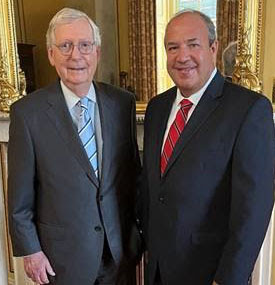
| Sen. Mitch McConnell and new TVA Director Wade White |
![]() |
| Beth Prichard Geer |
A digest of events, trends, issues, ideas and journalism from and about rural America, by the Institute for Rural Journalism, based at the University of Kentucky. Links may expire, require subscription or go behind pay walls. Please send news and knowledge you think would be useful to benjy.hamm@uky.edu.
![]() |
| Sen. Mitch McConnell and new TVA Director Wade White |
![]() |
| Beth Prichard Geer |
![]() |
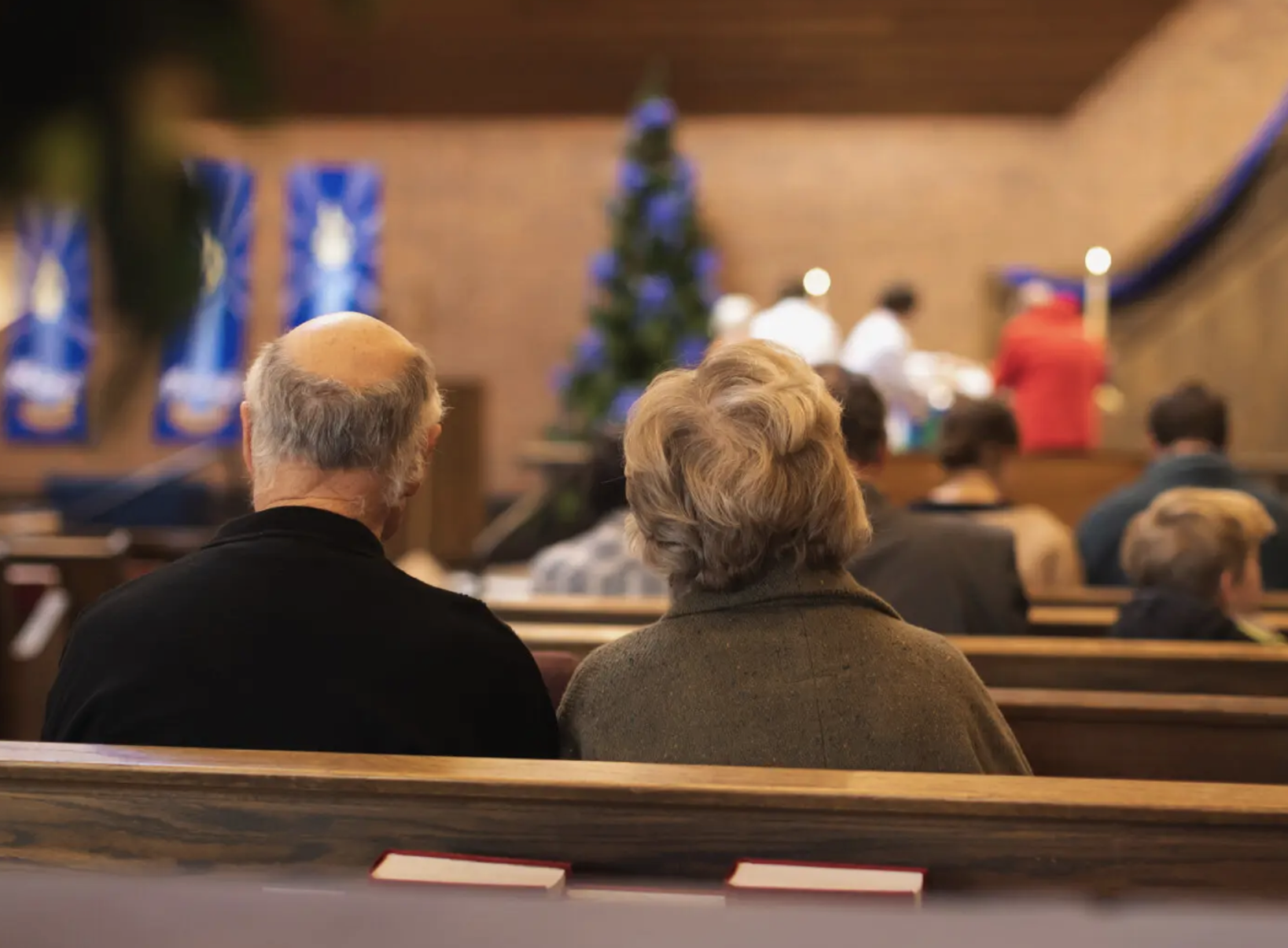
| Most Protestant churches will meet in some fashion on Christmas, but an increasing number appear to be opting out. (Photo by Joanna Kulesza, The New York Times) |
Timothy Beal, a professor of
religious studies at Case Western Reserve University in Cleveland, told Graham, "Christmas morning and Sunday morning are
sort of in tension with each other. Most people who
are churchgoers think of Christmas morning not as a religious time but
as a family time: stockings and brunches and staying in your pajamas
until midday or later." Beal's wife, a Presbyterian pastor, plans a "more relaxed" Sunday service in a smaller sanctuary, perhaps because she expects fewer congregants to attend, and that seems to be the approach of many Protestant congregations; others are dropping Sunday school and other activities.
"The Catholic Church considers attendance at Sunday Mass nonnegotiable,
and the same goes for Christmas Day, no matter the inconvenience of the
calendar," Graham notes. "Among nondenominational evangelical pastors, who tend to be informal and pragmatic in their approach to church matters,
the numbers hosting Christmas Day services are significantly lower:
Only 61 percent say they will do so, according to Lifeway research survey."
Some pastors disagree with canceling Christmas Day services. Kevin DeYoung, the pastor of Christ Covenant Church in Matthews, N.C., told Graham, "If anything, with an extra-special day we ought to be more eager to worship, not less eager. It’s one more time to sing those Christmas songs before they go away for a while.”
![]() |
| The yard (Photo by Jason Andrew, The New York Times) |
Since the intense meat shortages and processing-plant closings of the early pandemic, itinerant slaughterers in rural Vermont have become an increasingly popular way for farmers to kill animals for personal consumption, reports Frances Mize of the Valley News of West Lebanon, N.H., and White River Junction, Vt. Now, as a means to ease backlogs in those abattoirs, Vermont livestock producers are looking for ways on-farm slaughter meat could be sold more broadly.
Last year, Vermont's farm and ranch community asked the U.S. Department of Agriculture "to allow meat from on-farm slaughters to be sold in small 'animal shares,' which would operate like community-supported agriculture," which lives on annual subscriptions from consumers. USDA declined, "but before the refusal, and with renewed force since, Rural Vermont, a Montpelier-based nonprofit focused on bolstering community-scale agriculture, has continued advocating that the rules be relaxed so consumers and farmers alike have more choices," Mize reports.
Mize gives readers an up-close description of on-farm slaughter. She attended a kill at the home of farmer who had hired an itinerant slaughterer, and wrote: "Tom Havill’s herd of cattle watched from a hillside as one of their own — secured in a holding pen — lost its life to a single shot fired by Chet Miller," Mize reports. Havill told Mize that he still can’t watch his animals being killed.
Miller told Mize he also has mixed feelings about his work: "It’s not a glorious occupation. I have a lot of people who appreciate me, and my calendar is full of people that need my help. But sometimes I wake up in the middle of the night, and what I’m doing lays heavy on me.” Mize writes, "Some are advocating that the service Miller offers farmers through his work — doing the difficult job, which many of his customers couldn’t do themselves, of killing the animal that they’ve raised — should be reconsidered as a tool toward a more versatile, modernized food economy."
Caroline Gordon, Rural Vermont’s legislative director, told Maze, “People are feeling that the need for more resilient food systems has become apparent. The trust and transparency of our current economic system was called into question during the pandemic. . . .On-farm slaughtered meat allowed to be sold as a product, even within a small market, could alleviate some of the stresses on the slaughterhouses, some of which are booked up for many months."
![]() |
| Wreckage of Billy Barton's dump truck (Kansas City Star photo) |
Dangerous crossings: What happened near Mendon is not unique. Hundreds of unprotected crossings across the country have raised the fears of residents and been put on lists for safety improvements that, tragically, sometimes come too late. The Star spoke with families of victims.
Blocked crossings cost lives: Trains don’t have to be in motion to cause deaths. States can’t limit how long a train can block motor vehicle and pedestrian traffic at public crossings, the courts have said. The results have been deadly for people like Gene Byrd, who died after a train blocked EMTs’ access to his Oklahoma house. The problem is only getting worse.
Workers endangered on the job: Railroad workers, in the news lately because of a possible strike, worry that changes in the industry are making their jobs even more dangerous. Companies have slashed their workforces and in their pursuit of profits have cut back on safety training and, employees say, equipment maintenance. Trains have gotten longer and crews smaller. Employees share their stories.
Worry about rail companies' merger: In towns up and down rail lines where a merged Kansas City Southern-Canadian Pacific Railroad would operate, residents fear the increased traffic and longer trains the deal would bring. The merger, which could come early next year, forever change the way of life in small towns like Camanche, Iowa, along the Mississippi River, the Star reports.
![]() |
| (Photo by Mathew Schwartz, Unsplash) |
A chronically underfunded system riddled with egregious conflicts of interest. That's one way to describe the state-by-state system that governs U.S. coroners, reports Samantha Young of Kaiser Health News. The meshwork is so sticky, one physician shared this observation with Young: "If you ever want to know when, how — and where — to kill someone, I can tell you, and you’ll get away with it. No problem."
Nancy Belcher, chief executive officer of the King County Medical Society in Seattle, told Young that in Washington, "A coroner doesn’t have to ever have taken a science class in their life. These are the people that go in, look at a homicide scene or death, and say whether there needs to be an autopsy. They’re the ultimate decision-maker."
How suspicious death is investigated varies from state to state, and even within states. "The job can be held by an elected coroner as young as 18 or a highly trained physician appointed as medical examiner," Young reports. "Some death investigators work for elected sheriffs who try to avoid controversy or owe political favors. Others own funeral homes and direct bodies to their private businesses. . . . It’s a disjointed and chronically underfunded system — with more than 2,000 offices across the country that determine the cause of death in about 600,000 cases a year."
The cost to hire medical examiners or properly train coroners is
disproportionately difficult for rural areas, Young reports: "Many Illinois counties
also said they would shoulder a financial burden under legislation
introduced last year by state Rep. Maurice West, a Democrat. His more
sweeping bill would have replaced coroners with medical examiners. Rural
counties, in particular, complained about their tight budgets and
killed his bill before it got a committee hearing. West told Young,
“When something like this affects rural areas, if they push back a
little bit, we just stop."
Dr. Jeffrey Jentzen, a former medical examiner for Milwaukee, told Young, “When you try to remove them, you run into a political wall. You can't kill them, so you have to help train them." Young notes that a 2011 study by the National Association for Medical Examiners "found that 82% of the forensic pathologists who responded had faced pressure from politicians or the deceased person’s relatives to change the reported cause or manner of death in a case."
Lawmakers have made some progress by allowing counties to "pool their resources and hire shared contract coroners in exchange for ending the dual role for prosecutors by 2025," Young writes. Belcher told Young, “We were just trying to figure out a system that I think anybody would agree needed to be overhauled."
![]() |
| Lindsey Buegler at the Little Sprouts child-care center in Warren, Minn. (Photo by Dan Gunderson, MPR) |
What was once a childcare challenge is now a crisis, with rural families feeling more of the pinch to secure affordable, healthy childcare.
Warren, Minnesota, pop. 1,500, was one city that decided to address its shortage of childcare with innovation. In November, Warren voters became the first to approve a local sales tax dedicated to supporting a childcare center. The approval was unexpected since the tax is for a service many Warren citizens won't use, reports Dan Gunderson of Minnesota Public Radio.
Lindsey Buegler was a Warren parent who needed childcare. She told Gunderson: "It was either get involved and beg and plead with people to somehow keep the daycare open or we would have had to move. There were seven of us directly involved with the center that would have had to move. . . . I would say that's huge for this small city of Warren to lose seven families."
City officials "partnered with the First Children’s Finance Rural Child Care Innovation Program" and found "a shortage of 187 childcare slots within a 20-mile radius of Warren," Gunderson reports. "The research also found more than 30 percent of survey respondents had turned down a job, or withdrawn from the workforce because of childcare issues."
![]() |
| Map from City-Data.com |
![]() |
| This subdivision on a reclaimed strip mine has had no problems with home foundations because they were properly engineered, the developer said. (Photo by Ryan C. Hermens, Lexington Herald-Leader) |
![]() |
| Senate Majority Leader Chuck Schumer speaks with reporters as he walks to a vote at the U.S. Capitol. (Photo by Francis Chung, Politico) |
![]() |
| Zonelle Rainbolt |
![]() |
| William Noel has DNA that links back to the first man. (Photo by Tristan Lorei, The Free Lance-Star) |
Uphaus shares Royster's research announcement: “Mr. Noel, you are the only person living in these United States with this particular DNA type. You have the same haplogroup as the first human man. Adam is with us today.”
Noel's DNA results "were so exciting that they kept her awake at night," Royster told Uphaus. Royster is a scholar of the African diaspora and founder of the Center for African American Genealogical Research, a nonprofit whose mission is to reunite African-descended Americans with their distant African relatives.
Mr. Noel's "DNA is part of a group known as A000, which predates modern humans and has as its common ancestor the man from whom all other human men are descended—a person genealogists call 'Y-line Adam,'" Uphaus writes. Royster explained to the group: "That type of DNA is extremely rare outside of Africa and was not even known to exist until 2012, when it was discovered in a South Carolina man. [Mr. Noel's] DNA is 40,000 years older than his. . . . We all have these ideas about who came first. You, Mr. Noel, represent the beginning of all creation.”
According to Uphaus, Royce referred to the slave auction block that stood at the intersection of William and Charles streets in Fredericksburg before it was moved to the Fredericksburg Area Museum, saying “You can see that our history didn’t begin with that 1,000-pound block on the corner."
![]() |
| (Washington Post graph from Centers for Medicare and Medicaid Services data) |
![]() |
| Image by NIAID on Unsplash |
![]() |
| (Photo by Alison Marras on Unsplash) |
![]() |
| Habiba Hmadi, a native of Tunisia, lives in Hérouxville. (Photo by Nasuna Stuart-Ulin of The New York Times) |
![]() |
| New York Times map |
![]() |
| A spotted lanternfly adult and nymphs. (Photo by Stephen Ausmus, USDA) |
![]() |
| South Carolina's St. Helena Island offers a glimpse into our country's crop heritage. (Photo by David McLain, National Geographic) |
Carolina Gold is "a unique heirloom grain. A West African strain, it was first grown, cultivated, and cooked on American soil by enslaved peoples on plantations," Buettner writes. "In the 19th century, it became the dominant rice in the U.S. market, only to all but completely disappear after the Great Depression. Though you couldn’t find it on grocery store shelves for decades, it was legendary in the Low Country for its unique starchiness and earthy, nutty flavor."
BJ Dennis, a South Carolina chef, told Buettner he was on a mission to bring back
the cuisine
of his rice-growing ancestors. “We took the rustic soul of the Africans
and the Native American techniques and made this special mash-up,” Dennis
told Buettner. "The resulting cuisine is uniquely American, explosively
delicious, and as I’ve been discovering, it draws from ingredients that
support longevity."
In Savannah, Georgia, Buettner met "Roosevelt Brownlee, a 75-year-old dreadlocked Gullah chef who has cooked for the likes of Stan Getz and Nina Simone," Buettner reports. "In a backwoods kitchen, he and his cousin Rollen Chalmers whip up 'pink-eyed soup,' hoecakes and red peas—all accompanied by Carolina Gold cracked rice. As his T-shirt proclaims, 'Rice Is Life.'"
Thanks to the efforts of people Dennis and Chalmers, Buettner writes, "You can now find Carolina Gold rice again on grocery store shelves and online."