Taco Bell, one of the last major fast food franchises to commit to improving animal welfare practices, announced on Monday that it will switch to cage-free eggs by the end of 2016, Roberto Ferdman reports for The Washington Post. "Taco Bell, which has more than 6,000 restaurants throughout the U.S., sells close to 150 million eggs each year, which could be a boon for the cage-free egg industry. The shift will improve the lives of more than 500,000 hens, according to estimates by the Humane Society of the United States."
"The chances of Taco Bell committing to use only cage-free eggs seemed particularly unlikely given how the promise might affect its breakfast menu, which was first introduced last year," Ferdman writes. "The strategy has centered around novelty—there was a waffle taco, then a biscuit taco—and convenience: All of their offerings are easily eaten on the go, many with only a single hand. But its appeal has been predicated on price. Switching to cage-free eggs could compromise that, and with it, the chain's chance of elbowing out some room in the fast-food breakfast space." (Read more)
Tuesday, November 17, 2015


Rural residents say relocating Guantánamo Bay inmates to Southern Colorado will hurt tourism

Colorado prisons are already home to unabomber Ted Kaczynski, Boston Marathon bomber Dzhokhar Tsarnaeva, a Sept. 11 conspirator and 10,000 other inmates, Healy writes. "While some people here say the prisoners would be safely locked away, like the thousands of others who are already here, other residents worry their community could become a target. And some have legal objections to imprisoning dozens of detainees who have not been convicted criminally."
Sheriff James Beicker of Fremont County, which is home to the United States Penitentiary, Administrative Maximum Facility in Florence, one of the locations being considered for Guantánamo Bay detainees, was one of 40 Colorado sheriffs who signed a letter to Obama last week opposing any Guantánamo transfers to Colorado. He told Healy, “It just doesn’t make sense to bring these dangerous people to our ground. Why put any extra level of threat to our state or my county?”
Residents say "they do not want the added notoriety of housing 61 Guantánamo detainees," Healy writes. "The tourism-reliant county recently lost out on an effort to attract a call center, and a recent sexting scandal at the high school in nearby Cañon City scared away a business looking to relocate." Keith Ore, mayor of Florence, told Healy, “Something of that magnitude could just come in and destroy this town.”
"While state and federal corrections officers handle security inside prison walls, the police and sheriff deal with any issues outside the gates," Healy writes. "They geared up when protesters gathered to condemn a 60-year prison term for a Colombian rebel leader. They investigated last year when two middle-school girls got Facebook messages from a stranger asking them for photos of their school." (Read more)
Monday, November 16, 2015
Adult obesity rates, a major concern in rural areas, are on the rise, especially among women
Obesity, a major concern in rural areas, is on the rise among American adults, especially women, says a report by the federal Centers for Disease Control and Prevention. The obesity rate among U.S. adults was 37.7 percent in 2013-14, up from 32.2 percent in 2003-2004. While obesity rates have long been similar among adult male and females, CDC says that 38.3 percent of women are now obese, compared to 34.3 percent of men. The obesity rate among youth ages 2 to 19 was 17.2 percent, up from 17.1 percent from 2003-2004. (CDC graphic)
 Obesity has plagued rural areas, especially the South, the nation's most rural region in terms of population. According to the 12th Annual State of Obesity report released in September by Trust for America's Health and the Robert Wood Johnson Foundation seven of the top 10 states with the highest rates are in the South and 23 of the 25 states with the highest rates of obesity are in the South and Midwest.
One of the main concerns is that "for the past several years experts thought the nation's alarming, decades-long rise in obesity had leveled off," Mike Stobbe reports for The Associated Press. Dr. William Dietz, an obesity expert at George Washington University, told Stobbe "This is a striking finding," and suggested that a situation that was thought to be stable is getting worse.
The study, which consisted of 5,000 participants, found that "the prevalence of obesity was higher among non-Hispanic white, non-Hispanic black, and Hispanic adults and youth than among non-Hispanic Asian adults and youth." Also, "the prevalence of obesity was higher among middle-aged (40.2 percent) and older (37 percent) adults than younger (32.3 percent) adults."

One of the main concerns is that "for the past several years experts thought the nation's alarming, decades-long rise in obesity had leveled off," Mike Stobbe reports for The Associated Press. Dr. William Dietz, an obesity expert at George Washington University, told Stobbe "This is a striking finding," and suggested that a situation that was thought to be stable is getting worse.
The study, which consisted of 5,000 participants, found that "the prevalence of obesity was higher among non-Hispanic white, non-Hispanic black, and Hispanic adults and youth than among non-Hispanic Asian adults and youth." Also, "the prevalence of obesity was higher among middle-aged (40.2 percent) and older (37 percent) adults than younger (32.3 percent) adults."
Texas closes 12th rural hospital since 2010, after residents vote down tax district; 58th in U.S.

Bowie is the 12th rural hospital that has closed in the state since 2010, Matt Goodman reports for D Healthcare Daily in Dallas. "It will be the 58th in the country, according to the North Carolina Rural Health Research Program. No other state has had more rural closures than Texas; Alabama, Georgia, and Tennessee all trail with five total." Texas did not expand Medicaid under federal health reform.
Rural students learning agriculture and business skills by raising turkeys to sell this Thanksgiving

Students, who have been with the turkeys since they hatched in July, taught the turkeys "to eat, drink and get grit into their diets. They clipped their wings to make sure they did not fly away. They provided them with clean bedding and made sure they stayed safe from roaming coyotes." This week the turkeys will be taken to Kentucky State University to be processed and sold to customers.

Some states fear Clean Power Plan will cost them millions in revenue from severance taxes
Some coal states are concerned that the Environmental Protection Agency's Clean Power Plan will cost them much-needed severance taxes that many communities rely on to fund services such as schools or local government agencies, Sophie Quinton reports for Stateline. "In 2013, Montana’s tax revenue from severance taxes was nearly 12 percent. In West Virginia it was 13 percent and in Wyoming it was 39 percent," according to a Stateline analysis. The regulations take effect in December, but could be blocked by court action.
The rules could spell bad news for some small towns, like Colstrip, Mont., whose coal "operations contributed 4.5 percent of all state tax revenue and $104 million in state and local taxes," according to a 2010 University of Montana study, Quinton writes. "The electricity-generating plants consume almost all the coal mined at the Rosebud Mine, the second largest coal mine in Montana. When the mine removes—or 'severs'—coal from the earth, the mining company pays the state a severance tax on the value of the coal. Some of the money is invested into state trust funds, and some goes to support statewide services, such as public schools." (Stateline map; for an interactive version click here)
 State Rep. Duane Ankney, a Republican who represents Colstrip, said the regulations would have a major financial impact on the state. He told Quinton, “We’re talking a $700 million to $800 million fiscal impact to the state, county and local governments.” Puget Sound Energy, a part-owner of the Colstrip operation, already wants to close part of it, a threat to the town of 2,300.
In West Virginia last month, "Democratic Gov. Earl Ray Tomblin announced a 4 percent, across-the-board budget cut to compensate for a deficit driven by a $190 million drop in severance tax collections," Quinton notes. "Wyoming’s Republican Gov. Matt Mead announced $200 million in budget cuts, citing falling energy prices."
"The U.S. Energy Information Administration expects coal-fired power plants to continue to shut down and for very few new coal-fired plants to replace them, even without the Clean Power Plan," Quinton reports. "That’s a big deal, because more than 90 percent of the coal mined in the U.S. is burned to produce electricity, according to the EIA." (Read more)
The rules could spell bad news for some small towns, like Colstrip, Mont., whose coal "operations contributed 4.5 percent of all state tax revenue and $104 million in state and local taxes," according to a 2010 University of Montana study, Quinton writes. "The electricity-generating plants consume almost all the coal mined at the Rosebud Mine, the second largest coal mine in Montana. When the mine removes—or 'severs'—coal from the earth, the mining company pays the state a severance tax on the value of the coal. Some of the money is invested into state trust funds, and some goes to support statewide services, such as public schools." (Stateline map; for an interactive version click here)

In West Virginia last month, "Democratic Gov. Earl Ray Tomblin announced a 4 percent, across-the-board budget cut to compensate for a deficit driven by a $190 million drop in severance tax collections," Quinton notes. "Wyoming’s Republican Gov. Matt Mead announced $200 million in budget cuts, citing falling energy prices."
"The U.S. Energy Information Administration expects coal-fired power plants to continue to shut down and for very few new coal-fired plants to replace them, even without the Clean Power Plan," Quinton reports. "That’s a big deal, because more than 90 percent of the coal mined in the U.S. is burned to produce electricity, according to the EIA." (Read more)
Rural settlement with no broadband installs its own

Reedy Creek Property Owners Association President Joe Snyder told Amhara, "The pole that I'm sitting on right now was bought and paid for by the Reedy Creek Property Owners Association. The investment that the property owners made in all this is roughly about $5,000." Snyder, who said when prospective home owners are told the area has no broadband it drives them elsewhere, told Amhara, "Without Internet, basically Louisa and this whole place becomes irrelevant."
The first step was convincing the county to create a process to apply for a permit for neighborhoods to purchase their own Internet service, Amhara writes. Two years later, CVA Link "dug a hole to put the pole purchased by the neighborhood into the ground and the Ethernet cable will run alongside the pole and pass power and data through the antennas. CVA technician Andrew Hollins told Amhara, "The ultimate result of installing these antennas is that we would go to a customers house and install one of these (Customer Premises Equipment) relay to the antenna which would pass bandwidth to it. You would run the cable into the house and you have unlimited internet."
CVA's Brian Gilbreth told Amhara that what normally takes a company months to provide, his can do in hours: "The key difference is wireless. Our wireless link will link back instead of having to lay all those miles and [use] manpower to bury the cable in the ground." (Read more) Louisa County is in the Piedmont, with no mountains to obstruct wireless networks.
Go west, young bear! Or east, as Md. town finds out
 Black bears are becoming a common sight for many western Appalachian towns, as the species continues its comeback and spreads out, largely via younger males. But bears are also heading east, as the 1,500 residents of Hancock (Best Places map) have discovered, reports the Herald-Mail in Hagerstown.
Reporter Tamela Baker writes that Pete Jayne, associate director for game management for the state Department of Natural Resources, "said there is a resident bear population in Washington County, and it's becoming a little less unusual for one of them to stray into traffic. Three such incidents were reported in 2012, four in 2013 and six last year, he said."
 |
| Herald-Mail photo illustration |
Meanwhile, Jayne said residents are being told to learn to "get along with bears," reports Herald-Mail. Jayne said, "We tell them to be ‘bear aware’ and to make sure they're not creating attractions. They're crazy about bird seed. If you feed birds in fall or summer, you can attract them. We tell people to wait until December" when the bears are hibernating. (Read more)
Friday, November 13, 2015
Ruralites less likely to be screened for cancers of private parts, thus more likely to die from them
 Poor, minority and rural residents are less likely to be screened for breast, colorectal and cervical cancers and more likely to have high mortality rates from the diseases because they are detected too late, says a state-by-state study by USA Today and the North American Association of Central Cancer Registries, Laura Ungar reports for USA Today. (USA Today maps)
The South, especially the Mississippi Delta, has some of the highest rates of deaths, given evidence, from screenable cancers by incident-to-mortality rate, Ungar writes. Using data from 2008 to 2012, the study found that Alabama has the highest level of deaths for cervical cancer, Mississippi has the highest levels for breast cancer and Arkansas, which has the highest rates for colorectal cancer, is third in cervical and breast cancer.

And it isn't expected to get better any time soon, she writes. "Federal funding for cancer screening is in flux. A nationwide program that has provided more than 12 million mammograms and Pap tests for low-income women since 1991 lost $8 million in federal funds in the last five years. And President Obama’s proposed budget for next year cuts $42 million from breast, cervical and colorectal cancer-screening programs on the assumption the ACA will improve access to screening. A bipartisan spending deal hasn't yet determined specific allocations for particular programs, but previous House and Senate bills restored at least some of the money."

Farmland prices, farm incomes in Midwest continue to fall, Federal Reserve Banks report
Farmland prices in parts of the Midwest continue to tumble. The Federal Reserve Bank of St. Louis reported Thursday that the average price of quality farmland in its district—parts of Illinois, Indiana and Missouri—dropped 2.6 percent from a year earlier, Jesse Newman reports for The Wall Street Journal.
"In the Kansas City Fed’s district, which includes Kansas and Nebraska, irrigated-cropland values declined 1 percent, while the average price of non-irrigated land rose 0.4 percent, the bank said. Irrigated farmland depends on man-made water systems rather than rainfall," Newman writes. "In the Chicago Fed’s district, which includes Illinois and Iowa, prices for farmland remained largely the same in the third quarter compared with a year ago and rose 1 percent versus the second quarter of this year, the bank said."
The reports showed "that farm households were continuing to cut back on both household expenses and capital spending for their operations—and were expected to keep trimming costs in the coming months," P.J. Huffstutter reports for Reuters. "The rural economy has been hit by recent bumper harvests that have pushed grain prices to five-year lows and by a strong dollar that has hurt exports. As a result, farmers have curtailed spending on their businesses, which has sent ripple effects across the agricultural sector and affected everyone from tractor makers to seed companies."
The U.S. Department of Agriculture "projected farm incomes this year would drop by 36 percent from 2014 to $58.3 billion because of declining crop and livestock prices," Huffstutter writes. "The forecast is down 20 percent from the USDA's February estimate of $73.6 billion."
"In the Kansas City Fed’s district, which includes Kansas and Nebraska, irrigated-cropland values declined 1 percent, while the average price of non-irrigated land rose 0.4 percent, the bank said. Irrigated farmland depends on man-made water systems rather than rainfall," Newman writes. "In the Chicago Fed’s district, which includes Illinois and Iowa, prices for farmland remained largely the same in the third quarter compared with a year ago and rose 1 percent versus the second quarter of this year, the bank said."
The reports showed "that farm households were continuing to cut back on both household expenses and capital spending for their operations—and were expected to keep trimming costs in the coming months," P.J. Huffstutter reports for Reuters. "The rural economy has been hit by recent bumper harvests that have pushed grain prices to five-year lows and by a strong dollar that has hurt exports. As a result, farmers have curtailed spending on their businesses, which has sent ripple effects across the agricultural sector and affected everyone from tractor makers to seed companies."
The U.S. Department of Agriculture "projected farm incomes this year would drop by 36 percent from 2014 to $58.3 billion because of declining crop and livestock prices," Huffstutter writes. "The forecast is down 20 percent from the USDA's February estimate of $73.6 billion."
Nepotism alive and well when it comes to hiring by elected officials in many Kentucky counties
 |
| Parts of westernmost counties not shown |
While nepotism statistics don't exist in Kentucky, the reporting center "confirmed 50 instances of full-time family hiring in various county offices across the state," including in Butler County, where Sheriff Scottie Ward hired his wife, Jamie, to be his secretary. Butler County is the state's only county that excludes spouses from its definition of family, so Ward was legally able to give his wife the job.
Many county officials say they hired family members because they trusted them to do the job or there was little public interest in the position, McNair writes. But the hiring of family members has led to a myriad of arrests across the state, mostly for stealing money. Still, nepotism is rarely frowned upon in Kentucky, said Dee Davis, president of the Center for Rural Strategies, based in Eastern Kentucky. Davis, who called it an “accepted, forgivable form of corruption,” told McNair, “If somebody says, ‘such-and-such hired his nephew,’ do you have time to take that message to the village and to organize against it or to write a letter to the editor when your own economic future might be dangling by a thread? It takes a bit of courage to speak out.”
"As a model for dealing with nepotism, Kentucky’s state government sends mixed signals to local jurisdictions," McNair writes. "The executive branch forbids its workers from having anything to do with the hiring of family members into jobs they supervise. All other means of entry are fine. Moreover, the ban is in the state Executive Branch Ethics Code, not state law, so offenders face no more than a maximum $5,000 fine and a recommendation that they be removed from office or transferred. At the very least, a public scolding." (Read more)
Older rural residents have more chronic diseases, earlier deaths than urban counterparts, study says
Rural residents 85 and older "have significantly higher levels of chronic disease, take more medications and die several years earlier than their urban counterparts," says a study by researchers at Oregon State University and the Oregon Health & Science University published in The Journal of Rural Health, reports OSU.
"The research confirms some of the special challenges facing older populations in rural or remote areas, who often have less access to physicians, long distances to travel for care, sometimes a lower socioeconomic and educational level and other issues," reports OSU. "It also reflects health problems that might have been reduced if they were treated earlier or more aggressively, researchers say." Lead researcher Leah Goeres said while an urban resident might seek immediate care for a condition, a rural resident is more likely to choose to wait for care or to be forced to wait for care, which could lead the condition to worsen or lead to more illnesses.
Researchers, who studied 296 people, found that rural residents 85 and older took an average of 5.5 medications, and urban residents took an average of 3.7. Use of medication can be risky for older people, especially those who take more than five per day, researchers said. Also, rural residents were more likely to use pain-killing opioids, as opposed to valuable medications to aid bone mineralization, and "medication use for high blood pressure went up significantly over time for rural populations, but not urban ones, in which their use had already been higher." Researchers also found that "the median survival time of the rural cohort was 3.5 years, compared to 7.1 years for the urban older adults," and "the rate of disease accumulation was significant in the rural cohort and negligible in their urban counterparts."
"The research confirms some of the special challenges facing older populations in rural or remote areas, who often have less access to physicians, long distances to travel for care, sometimes a lower socioeconomic and educational level and other issues," reports OSU. "It also reflects health problems that might have been reduced if they were treated earlier or more aggressively, researchers say." Lead researcher Leah Goeres said while an urban resident might seek immediate care for a condition, a rural resident is more likely to choose to wait for care or to be forced to wait for care, which could lead the condition to worsen or lead to more illnesses.
Researchers, who studied 296 people, found that rural residents 85 and older took an average of 5.5 medications, and urban residents took an average of 3.7. Use of medication can be risky for older people, especially those who take more than five per day, researchers said. Also, rural residents were more likely to use pain-killing opioids, as opposed to valuable medications to aid bone mineralization, and "medication use for high blood pressure went up significantly over time for rural populations, but not urban ones, in which their use had already been higher." Researchers also found that "the median survival time of the rural cohort was 3.5 years, compared to 7.1 years for the urban older adults," and "the rate of disease accumulation was significant in the rural cohort and negligible in their urban counterparts."
Hillary Clinton unveils $30B plan to revitalize coal communities hurt by shift to cleaner energy
 |
| Hillary Clinton |
Clinton also said she will partner with local entrepreneurs, community leaders, foundations and labor groups to make federal investments to help people find good jobs locally that don't require them to move. Her plan is to: build infrastructure for the 21st century; repurpose mine lands and power plant sites; expand broadband access; expand clean energy on federal lands and from existing dams; increase public investment in research and development; and attract private investment through an improved New Markets Tax Credit and zero capital gains taxes.
"In the 2008 Democratic primary race, Clinton had strong support among working-class white voters and overwhelmingly won coal-dependent states such as West Virginia, Kentucky and Pennsylvania," Laura Meckler and Amy Harder report for The Wall Street Journal. "But backing for her in Appalachia could be tested this year by her strong push for clean energy."
As part of her plan, Clinton said she "would fight coal companies that she says use bankruptcy proceedings to shirk health-care and pension commitments to retirees and overhaul the troubled black-lung benefit program so it properly awards benefits due," Meckler and Harder write. She "said she would use certain federal lands for clean-energy projects such as wind generation, to make up for the loss of coal mining there" and said "she would increase the amount of federal research and development money going toward technology the industry dubs 'clean coal,' which captures and stores carbon dioxide from coal instead of emitting it into the atmosphere."
UPDATE, Nov. 17: The Lexington Herald-Leader wasn't excited about Clinton's plan to spend $11 billion to complete the Appalachian Development Highway System, but the Kentucky paper said, "Just having a leading presidential contender talking about the need for investing in the coalfields is a welcome addition to the national debate."
Monarch butterflies expected to rebound this winter, Mexican environment secretary says

Insecticides and illegal logging in designated habitats are largely blamed for destroying milkweed plants, which are the main source of food for the butterflies, and Monarch numbers fell 90 percent in recent years after reaching 1 billion in 1996. The U.S. Fish and Wildlife Service in February started a conservation fund for the butterfly and in September announced the first round of grants totaling $3.3 million from the fund.
Thursday, November 12, 2015
Nine most at-risk rural Mississippi hospitals employ 2,600, have $289M economic impact, study says

"To arrive at their findings, researchers focused on three financial indicators: profitability, uncompensated care and Medicaid shortfalls," Clay Chandler reports for The Clarion Ledger. "The nine hospitals the study identified as having the highest risk got to that point for several reasons, it said. Among them: the national recession that hit in 2008, population loss in rural areas, a reduction in disproportionate share payments under the Affordable Care Act that were not replaced when the (Republican Gov. Phil Bryant) did not expand Medicaid, rising cost of providing care, small size and lack of capital."
"To improve, the study offers a list of recommendations that include creation of freestanding emergency departments, integration of existing services, using hybrid delivery models that focus on preventive outpatient care and bolster primary care networks and the expansion of telehealth opportunities," Chandler writes. Researchers wrote: “The findings suggest that although rural hospitals in Mississippi face a host of challenges, there is also ample opportunity for hospitals to leverage a broad base of federal and state initiatives and self-help actions that ensure rural communities can meet the health needs of their local populations."
Torture allegations put rural Ohio town's drug epidemic back in the spotlight

Arthur Hamlin said convicted drug dealer Earnest Moore III and others "seared him with red-hot kitchen utensils, poured boiling water on him and pummeled him, according to a police report," Caniglia writes. Moore, who some have suggested is involved in the disappearances of the six women, denied the torture allegations. A resident who declined to give her name told Caniglia, "It was vicious and terrible and something that you hear about in a Third World country, not in Chillicothe, Ohio. I'm scared, and I'm ready to move.''
Moore, who has a long history of drug infractions, is largely believed to be behind the town's drug woes, Caniglia writes. He was incarcerated from 1995 to 2000 for drug abuse and attempted abduction and from 2007 to 2011 for cocaine trafficking. His current business "appeared to take root in 2014 in Gallia County, one of Ohio's smallest and poorest." Located 60 miles southeast of Chillicothe, Gallia County county is part of a region that has battled a heroin plague for years. Charges against Moore in 2014 in Gallia County were dismissed so that a federal case could be made. Investigators have called Moore "a 'person of interest,' in a general way, in the peddling of drugs and the sex trafficking of women in Chillicothe." Moore is being held on the torture charges in lieu of a $750,000 bond. (Read more)
Rural-urban exchange program teaches Montana students about local businesses, diversity

At a later date, students from Billings West will visit Ashland, which has a population of 406, Hoffman writes. As part of that trip, students will "learn about local businesses and act as marketing consultants to a new school store operated by St. Labre students. They’ll also participate in an event to learn more about Native American culture." About a dozen schools have either participated in the program or are scheduled to participate. (Read more)
Rural churches struggling to compete with 'megachurches' for young pastors, resources

Another problem is that "denominations sometimes focus more resources on bigger, urban congregations." Kaylor writes. Most of America's churches are small, with about 50 percent averaging less than 75 in attendance and 90 percent averaging less than 350. "Many of the smaller churches are found in more rural settings than the flashy megachurches that steal attention away from the typical congregations." Part of the problem is that rural churches tend to be more traditional, while societal trends have become geared more toward modern churches that offer such amenities as live bands playing contemporary music.
Melody Pryor, pastor of First Baptist Church of Stanton, Mo., said rural churches offer a more personal touch that larger churches are less likely to provide, Kaylor writes. For instance, many church members know each other on a personal level, there are more opportunities to participate in rural church groups such as the choir and rural churches are often more involved in community events. (Read more)
First in a series by The Guardian visits America's 'poorest white town' in E. Kentucky coal country
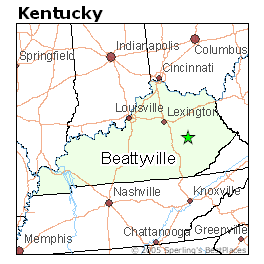
"Five of the 10 poorest counties in the U.S. run in a line through Eastern Kentucky, and they include Lee County," McGreal writes. "Life expectancy in the county is among the worst in the U.S., which is not unconnected to the fact that more than half the population is obese. Men lived an average of just 68.3 years in 2013, a little more than eight years short of the national average. Women lived 76.4 years on average, about five years short of national life expectancy."
With many coal jobs long gone, "the largest employer in the county is now the school system," McGreal writes. "There are five times as many healthcare workers in Eastern Kentucky as miners. Coal country is today little more than a cultural identity." The few remaining mines of Ed Courier’s Sturgeon Mining Company involve people digging coal out of hillsides. He told McGreal, “I’ve been in the coal business since ’78, and the last five years I’ve been trying to get out of the coal business. There’s no future for it here . . . Things were really good when I came here in ’72, and I ended up staying. When I came here there were three new car dealerships. There hasn’t been a new car dealership here since ’89. There’s no future here. I have a sense of sadness. I wish people had a better life.”

Dee Davis, whose family was from Lee County, and now heads the Center for Rural Strategies, told McGreal, “There’s this feeling here like people are looking down on you. Feeling like it’s OK to laugh at you, to pity you. You’re not on the same common ground for comparison as someone who’s better off or living in a better place. That doesn’t mean it’s always true; it just means we feel that burden quickly. We’re primed to react to people we think are looking down on us. That they judge us for our clothes, judge us for our car, judge us for our income, the way we talk."
Since the 1960s stereotypes of the area have shifted away from "The Beverly Hillbillies" attitude to one of rampant prescription drug abuse, McGreal writes. "In 2013, drug overdoses accounted for 56 percent of all accidental deaths in Kentucky" with numbers even higher in Eastern Kentucky. Steve Mays, Lee County’s judge executive, told McGreal, “When I worked as a police officer and chief there were drugs here, and we made a lot of busts, but things are getting worse."
"We don’t have a lot of jobs here. Some people look for a way out," he said. "They haven’t accomplished what they wanted to, and they’re just looking for that escape, I guess. They get that high, and once it gets a hold of you they have a hard time getting away from it. They don’t think the future looks good for them, or they don’t feel there’s any hope, so they continue to stay on that drugs. It’s people of all ages. You feel sorry for them. Good people. It takes their lives over. They do things you wouldn’t normally think they’d do. Stealing, writing bad cheques, younger girls prostitute themselves out for drugs.” (Read more)
Kentucky election shows 'rural America is Republican,' former congressman says

The rural-urban split is clear when the state's counties are sorted by metropolitan and rural classifications. Republican Matt Bevin got 61.5 percent of the vote in the counties that are most rural in the U.S. Department of Agriculture's nine-point scale or urbanity and rurality. Democrat Jack Conway got 35.2 percent of the vote in those counties.
Conway carried the most urban counties, but barely: 49.3 percent to 47.2 percent. Overall, in the face that included a minor independent candidate, Bevin won by 8.7 percentage points.
Subscribe to:
Posts (Atom)