Friday, December 27, 2019

Christian magazine editorial denouncing Trump continues roiling evangelical community

A Dec. 19 editorial in a Christian magazine denouncing President Trump has prompted heavy backlash from many in the evangelical community. The Christianity Today piece, written by outgoing editor-in-chief Mark Galli, called on readers to support President Trump's impeachment.

On Dec. 22, nearly 200 evangelical leaders slammed the editorial in a co-signed letter to Christianity Today president Timothy Dalrymple, Melissa Barnhart reports for The Christian Post. The Post published the full text of the letter.

"The signatories include Jerry Falwell Jr., the president of Liberty College; Tony Perkins, the president of the Family Research Council; Ralph Reed, the president of the Faith and Freedom Coalition; and Paula White Cain, Trump's longtime spiritual adviser who recently joined the White House staff," Veronica Stracqualursi reports for CNN.

"Your editorial offensively questioned the spiritual integrity and Christian witness of tens-of-millions of believers who take seriously their civic and moral obligations," the letter read. "We are proud to be numbered among those in history who, like Jesus, have been pretentiously accused of having too much grace for tax collectors and sinners, and we take deeply our personal responsibility to render unto Caesar what is Caesar's --- our public service." 

The Christian Post, an evangelical website, published its own editorial on Dec. 23, criticizing the Christianity Today piece and accusing Galli's writing of coming from a "toxic emotional and spiritual stew."

The Post editorial "apparently proved too much for an editor at The Christian Post, Napp Nazworth, who wrote on Twitter on Monday that he was 'forced to make the difficult choice' to leave the site, where he had worked since 2011, most recently as politics editor," Karen Zraick and Elisha Brown report for The New York Times.

Galli said that, though the editorial prompted some readers to unsubscribe, the magazine has gained many more new subscribers than it lost. "We have lost subscribers but we’ve had three times as many people start to subscribe," he told MSNBC on Dec. 22.

The Rural Blog's publisher stands up for journalism, and helps it; you can help us in honor of one who helped you

Writing some year-end checks or clicking some online buttons to make charitable contributions? Please consider The Rural Blog's publisher, the Institute for Rural Journalism and Community Issues at the University of Kentucky. Our online donation site is here.

No one else does what we do: a daily digest of events, trends, issues, ideas and journalism, from and about rural America, to thousands of rural journalists who want to look beyond the county line and help their audiences understand broader issues and how they affect them.

The institute does much more than the blog; it serves as a resource for rural journalists all over the country and for metropolitan journalists doing rural stories; conducts seminars and workshops on covering issues, most recently on substance abuse; conducts research on rural journalism; makes presentations at national and state news-organization meetings and universities; does an "Into the Issues" column for the National Newspaper Association and state press associations; co-sponsors with Investigative Reporters and Editors a fellowship to IRE's Data Journalism Boot Camp (for 2020, in March and August); presents the annual Tom and Pat Gish Award for courage, integrity and tenacity in rural journalism; co-hosts the hotline of the International Society of Weekly Newspaper Editors and stands up for the essential role of journalism in democracy.

At a time when some people question the very concept of independent journalism, the institute takes opportunities to explain, defend and promote it. One example is our bumper sticker that makes the point that someone has to pay for journalism. In The Rural Blog, we write about the challenges facing community newspapers and journalism, including ways to explain and defend the profession.

Some of our contributors make donations in honor of those who helped them in their careers. Sheila Hagar of the Walla Walla Union-Bulletin donated in honor of her high-school journalism teacher, Darrell Gomsrud. "He really believed in me," she wrote. "He walked our class through Watergate in a completely unbiased way. He bought me books about writing. When I worked on the school paper (co-editor in my junior year), Mr. Gomsrud taught me I should expect to be treated with equality. When I wrote fiery op-eds, he gave me fair warning of the reaction I could expect. When I got what I asked for, he told me no tears allowed for those able to put their opinions in front of readers. He retired just before my own kids got to high school and I was devastated." When she made the gift in his honor, the University of Kentucky notified him, and he wrote Hagar a letter of thanks, saying "I assure you that many readers enjoy your writing and trust your byline." She told us, "I'm not sure any award could be sweeter."

The institute's work is only partly supported the university. We're able to publish The Rural Blog because we have an endowment that generates money for year-round travel, programming and a half-time assistant. But we rely increasingly on gifts that go directly into our operating budget of about $200,000 a year, so we need your support. Please give here.

Thursday, December 26, 2019

Spending bill erases potential problem for electric co-ops

The omnibus spending bill that passed Congress last week eliminated a potential threat to the tax-exempt status of rural electric cooperatives.

Federal law has long required co-ops to get 85 percent of their income from their customer-members. Assistance from governments and other nonprofits wasn't counted in the remaining 15%, but the 2017 tax law changed that. Co-ops called that a "glitch" in the law, because many of them need outside help to recover from disasters, expand renewable energy sources or build broadband networks, a service many of them have been moving toward.

"Some co-ops would have had to raise their electric rates to pay new taxes," wrote Chris Perry, CEO of the Kentucky Association of Electric Cooperatives, in an op-ed thanking the state's congressional representatives who voted for the omnibus. "In standing up for Kentucky’s local communities, these lawmakers proved that Congress still works for the people. Notably, the legislation drew the bipartisan support of more than 300 representatives in the House and more than half of the Senate before it was passed. That’s a rarity in Washington these days."

Tuesday, December 24, 2019

Energy agency sides with coal and gas over other sources for electricity, says it's leveling the field; consumers will pay

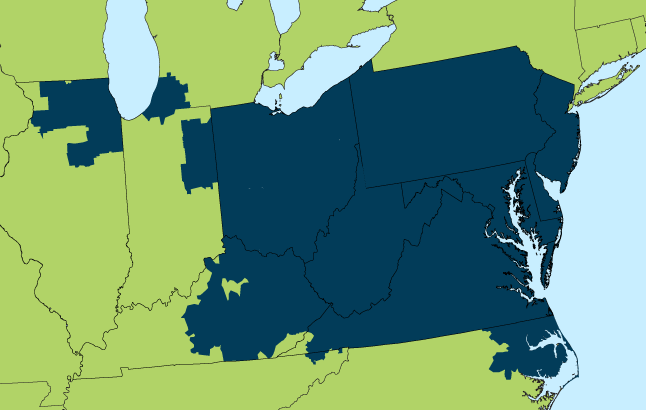
PJM Interconnection's service areas
The Federal Energy Regulatory Commission has approved rules "for the nation's largest electricity market that effectively prop up fossil-fuel power plants and discourage new investments in renewable power, demand-response and energy-storage projects," Rod Kuckro and Jeremy Dillon report for Energy & Environment News.

FERC changed the rules for PJM Interconnection, the largest electric-power manager in North America, "508 days after the agency issued a decision calling the current market rules unjust and unreasonable and directing PJM to devise a fix," E&E reports. "The decision is among the most consequential by the commission since it created regional power markets 20 years ago this week. It's certain to be challenged. . . .The agency gave PJM 90 days to file a response on how it will comply."

The vote was 2-1, along party lines. Dissenting Commissioner Richard Glick called it "a bailout, plain and simple" to the power industry and its suppliers of coal and natural gas. The PJM area has more electric-generating capacity than it needs, and "cheaper renewables and nuclear plants have been crushing conventional fossil fuel resources on price" there, E&E notes. PJM had asked FERC not to force it to buy electricity from aging coal plants.

FERC Chair Neil Chatterjee denied that the move favors fossil fuels over renewables. He and the other Republican commissioner, Bernard McNamee, "argued that state subsidies for nuclear and renewables artificially give those resources a leg up," and said FERC was "leveling the playing field," E&E reports. Glick said the move would cost the 65 million consumers in PJM's area $2.4 billion a year; other estimates were as high as $8 billion.

Journalists and other readers reply to NYT's request to tell how the loss of local papers has hurt their communities

This item has been expanded from its original version.

“Over the past 15 years, more than one in five newspapers in the United States has closed or merged with another paper, and the number of journalists working for newspapers has been cut in half, according to research by the University of North Carolina’s School of Media and Journalism. That has led to the rise of hollowed-out ’ghost papers’ and communities across the country without any local paper,” Lara Takenga reports for The New York Times.

The Times asked those who live in such communities about how the loss of local coverage has affected them. Mount Dora, Florida, a town of 14,000 northwest of Orlando, lost the weekly Mount Dora Topic in 2006 because local advertisers chose to buy as space in larger nearby metro papers. But financial pressures have caused those metro papers like The Orlando Sentinel to pull back coverage of outlying; a small part of Mount Dora is in Orange County, whose seat is Orlando.

“After years without a strong local voice, our community does not know itself and has no idea of important local issues or how the area is changing and challenged by growth and the impact of climate change. We are a nameless and faceless town defined only by neighborhoods,” wrote Mount Dora resident David Cohea. “A few local blogs pick up commercial events that are relayed on Facebook, but aside from that, we only hear of murders and fires and hot-button controversies — the stuff of TV news.”

Most closed or merged papers are in suburbs, but include than 500 rural weeklies. In Sidney, N.Y., a town of 5,800 on Interstate 88 between Binghamton and Oneonta, The Tri-Town News "ended publication a year ago," Barbara Renton reports from Bainbridge. "There is no way to reliably learn about decisions of local governments, or even about the issues being raised. School news, religious news and upcoming and recent events are all lost. Even local advertisements that were helpful in planning for home improvements and gift-giving, not to mention posting local jobs, are gone."

In Millbrook, N.Y, between Poughkeepsie and the Connecticut border, The Millbrook Independent "closed its print operation after an eight-year run," editor-publisher Stephen Kaye wrote. "We started two weeks after the preceding paper closed, taking local news to a higher plane. We found circulation shrinking and tried migrating to the web, which worked for us but not for readers who didn’t regularly go to our web pages. School boards, town and village boards, county news, local news — it all disappeared. We were a check on governments, on endless environmental and zoning hearings, on budgets that we often published in detail, on misdoings and good doings. There is now a void. No one took up the slack."

Some rural papers are on the verge. "I’m on the cliff, about ready to close," wrote Caroline Titus, "the editor, publisher, reporter and office manager for probably one of California’s smallest newspapers, The Ferndale Enterprise," on the state's northern coast. "We’ve won a boatload of state and national awards, but I, too, am spitting into the wind. We’ve been through costly First Amendment battles, been told we were fake news long before you-know-who started muttering those two words. We’re currently cleaning toilets at two Airbnbs at our newspaper office to keep the presses printing. If we decide to shut the doors after 141 years, it’ll take us a year to wind down, we figure. We have to run out people’s subscriptions: can’t afford to give refunds!"

Monday, December 23, 2019

Outdoorsy clothing brand based in Morehead, Ky., gets recognized for spreading 'Appalachian chic' worldwide

Jesse Wells, a fiddle player for Tyler Childers, wore
the yellow trucker hat seen here during their recent
performance on "Late Night with Seth Meyers."
A clothing company based in Eastern Kentucky received an Excellence in International Trade Award on Dec. 12 from the Kentucky World Trade Center, an organization that promotes Kentucky-made products abroad.

New Frontier Outfitters, "started by brothers Jared and Josh Ravenscraft, has been spreading Appalachian chic worldwide thanks in part to the brand’s popularity among country music artists and a surprising following in the Netherlands," Alfred Miller reports for the Louisville Courier Journal. The company has also shipped orders to U.S. soldiers in Afghanistan.

Celebs spotted wearing the retro-inspired clothing include country music star Tyler Childers and actor Channing Tatum.

Josh Ravenscraft said they were surprised by the award. "From our mom’s kitchen table to being on stage with the former governor — it was a surreal moment," he told Miller.

Increase in rural jail population disproportionately female

Hamblen County, Tennessee
(Wikipedia map)
A story in The New York Times reports that the increase in rural jail populations is often driven by incarceration of women, and discusses some of the reasons rural jails are full, using data from The Vera Institute of Justice. The article illustrates the trend with a portrait of the jail in Morristown, Tenn.

"The Hamblen County Jail has been described as a dangerously overcrowded 'cesspool of a dungeon,' with inmates sleeping on mats in the hallways, lawyers forced to meet their clients in a supply closet and the people inside subjected to 'horrible conditions' every day," Richard Oppel Jr. reports for the Times. "Like a lot of Appalachia, Morristown . . . has been devastated by methamphetamine and opioid use. Residents who commit crimes to support their addiction pack the 255-bed jail, which had 439 inmates at the end of October, according to the latest state data. Many cities have invested in treatment options and diversion programs to help drug users. But those alternatives aren’t available in a lot of small towns."

'Meet the Press' to air special episode Sunday, Dec. 29, about spread and weaponization of 'fake news'

This coming Sunday, Dec. 29, NBC's "Meet the Press" with Chuck Todd will air a special episode about the role of "fake news" in politics.

"The use of 'alternative facts,' a term first heard on Meet the Press in 2017, has become a common occurrence in American politics. From 'whataboutism' and gaslighting to unsubstantiated claims of fake news and attacks on the Fourth Estate, 'Meet the Press' will take an in-depth look at the techniques of spreading disinformation, how it’s designed to create chaos and confusion, and its negative effects on the public," says an NBC news release.

Click here to see which guests will weigh in on the issue and for more information about the episode.

Can mutton make a comeback in the United States?

A number of dishes are likely to appear on American tables this holiday season: turkey, ham, dressing, mashed potatoes, latkes, kugel and more. Mutton, not so much.

Mutton and lamb are popular dishes worldwide, including in the United States, but around World War II it essentially dropped off American menus, Lisa Fogarty reports for NPR.

That's no coincidence: American soldiers in WWII were given canned mutton from Australia, which was apparently terrible, according to Bob Kennard, author of Much Ado About Mutton. "Wherever he travels, the Welsh mutton expert says he hears a similar story," Fogarty reports.

"I am told that someone's uncle or father came home from the war and wouldn't allow sheep meat in the house — they never wanted to see it again. It just went completely out of fashion," Kennard told Fogarty.

A number of other factors influenced the downfall of mutton in the U.S., including tech advances in railroads and refrigeration, Fogarty reports. Can it make a comeback? Unclear, but marketers and food influencers are trying.

Friday, December 20, 2019

Poverty rate grew in 30% of counties in 2019, most of them in the rural South; up 8.5 percentage points in a Ky. county

Despite a relatively strong economy, the poverty rate grew in 30 percent of U.S. counties between 2016 and 2018, especially in the rural South, says an analysis of new Census Bureau estimates.

"The poverty rate is the percentage of people in households earning less than the poverty threshold, currently $25,750 for a family of four," Tim Henderson reports for Stateline. "While the overall poverty rate dropped between 2016 and 2018, from 13% to 12%, states varied widely. In New Jersey and Rhode Island, the poverty rate grew in only one county, compared with 83 in Texas."

There was no overall trend as far as the political leanings or demographics of counties that fared the worst. The rural South saw most of the biggest increases in the poverty rate because those areas generally had industries that suffered economically and residents who lacked job training and/or skills. "For many counties, rising poverty rates underscore the importance of fully counting residents in next year’s census, since a count of low-income residents will help determine funding available to help them," Henderson reports.

The poverty rate in Carter County, Kentucky, saw one of the biggest increases, rising 8.5 percentage points to 31.1%. Longtime state Sen. Robin Webb, a Democrat who lives in the county, said the problem isn't an unwillingness to work. "This is rural America. We’re rich in self-sustaining nature and neighbors helping neighbors, but we don’t have resources," she told Henderson. The county is in northeastern Kentucky, between Ashland and Morehead; its coal and factory jobs have shrunk.

What other nations can learn from Finns' war on fake news

Americans have increasingly struggled with media literacy in the past few years as sources of false information, many of them Russian, have found ever trickier ways of aping news. But Finland, which has a long history with Russia, has been leading the charge against fake news for much longer. Its government launched a media literacy initiative in 2014 that aims to teach residents from all walks of life, including students, journalists and politicians, how to spot and counter false information meant to mislead the public, Eliza Mackintosh reports for CNN.

Though it's difficult to assess the results, the program appears to be working, and officials from all over Europe and as far away as Singapore are looking to copy Finland's success because they're worried about Russia and other potential disruptors. However, a Finnish school director told Mackintosh the curriculum might not work as well in other countries.

"The small and largely homogenous country consistently ranks at or near the top of almost every index – happiness, press freedom, gender equality, social justice, transparency and education – making it difficult for external actors to find fissures within society to crowbar open and exploit," Mackintosh reports. And, "Finland tops the charts for media trust, which means its citizens are less likely to turn to alternative sources for news."

That's far different than the landscape in many European countries, as well as in the United States. The U.S. has reason to worry about media literacy too; misleading and incendiary social media ads and posts were a key part of Russia's strategy to manipulate the 2016 presidential election.

A rural recap of the latest Democratic presidential debate

Last night, seven top-ranking Democratic presidential candidates met for the final debate of 2019 in Los Angeles. One notable facet of the debate: U.S. Sen. Amy Klobuchar of Minnesota, who often touts her competitiveness in rural areas—including in this debate—enjoyed more time in the spotlight than she's had in previous debates.

Klobuchar "was given a lot of time in the beginning of the debate and she used it well to make her case. In the end, she did what she needed to do: give centrist Democrats a third option after Biden and Buttigieg. In doing so, she changed her campaign in a way no other candidate did," James Pindell writes for The Boston Globe, giving her the only 'A' grade among the debaters.

Here's what the candidates had to say about some issues with rural resonance (along with some comments on journalism), according to The Washington Post transcript:

Sen. Bernie Sanders of Vermont argued for a trade policy that helps farmers, and disparaged the newly approved NAFTA replacement for not discussing climate change.

Mayor Pete Buttegieg of South Bend, Ind., said any plan to fight climate change must include farmers as part of the solution, not "beating them over the head and telling them they're part of the problem."

Klobuchar said the Midwest saw unprecedented flooding in 2019 because of climate change. She said she had helped negotiate three farm bills and was responsible for major provisions in each of them.

Former Vice President Joe Biden said the economy isn't doing well for many people, and noted that 40 percent of Midwestern farmers "couldn't pay their bills last year."

Sen. Elizabeth Warren of Massachusetts said her plan to increase taxes on billionaires would increase productivity and improve small-town and rural economies. She also said she would invest in more affordable housing in rural areas.

Businessman Andrew Yang noted that more people now die by suicide or drug overdose than die in car accidents. Yang said Americans can't agree on impeaching President Trump because "we're getting news from different sources, and it's making it hard for us even to agree on basic facts. Congressional approval rating, last I checked, was something like 17 percent, and Americans don't trust the media networks to tell them the truth."

Buttegieg said Trump's views on the news media are a problem: "When the American president refers to unfavorable press coverage as the product of the "enemy of the people," democracy around the world gets weaker. Freedom of the press not just here at home but around the world gets weaker."

Klobuchar said press freedom is "deep in my heart" since her father was a journalist. She criticized Trump's attorneys general for not promising they wouldn't jail journalists for doing their jobs.

EPA backs off on promised ethanol rule, angering farmers

On Thursday the Environmental Protection Agency released the final update to the Renewable Fuel Standard, which mandates that increasing amounts of ethanol are blended into the nation's fuel supply over time. However, the rule didn't include a provision—which President Trump had promised farming and ethanol interests—to increase the amount of ethanol in the fuel mix to offset waivers his administration had granted to oil refineries.

"Instead the final rule says EPA will base oil refinery exemptions on Energy Department recommendations," David Pitt reports for The Associated Press. "Ethanol and corn industry groups said language in the rule leaves too much at the whim of federal bureaucrats and could cause ethanol use to fall short."

Monte Shaw, executive director of the Iowa Renewable Fuels Association, accused Trump of turning his back on farmers. "Every farmer and biofuel supporter I have talked to is deeply disappointed, frustrated, and quite frankly angry," Shaw told Pitt. "I don’t think the White House truly understands the depth of discontent in farm country."

An EPA spokesperson said the agency withdrew the proposed provision because it needs to consider more options, Liz McCrimmon reports for Politico's Morning Agriculture.

Evangelical magazine supports Trump impeachment

Prominent evangelical magazine Christianity Today, founded in 1956 by the Rev. Billy Graham, published an editorial Thursday calling for readers to support President Trump's impeachment. The magazine's editor-in-chief, Mark Galli, noted that CT normally stays "above the fray" but said Trump has engaged in "profoundly immoral" behavior and urged Christians to stop supporting him.

Galli writes that Trump clearly tried to use his political power for personal gain, which is not only illegal but immoral. That dovetails with Trump's personal and professional track record, Galli wrote: "He himself has admitted to immoral actions in business and his relationship with women, about which he remains proud. His Twitter feed alone — with its habitual string of mischaracterizations, lies, and slanders — is a near perfect example of a human being who is morally lost and confused."

Many evangelical Christians were urged to vote for Trump on the promise that he would appoint conservative, anti-abortion judges. But, Galli writes, such victories don't outweigh the damage Trump is doing to the office of the presidency and our nation's reputation and future. Galli further says that a nation of Trump-supporting Christians damages the reputation of evangelicals, and asks readers to consider how their support of Trump will hurt their ability to convert others to Christianity.

President Trump criticized the editorial in a pair of tweets this morning. Billy Graham's son, Franklin Graham, an ardent Trump fan, said his father "would have been disappointed."

Thursday, December 19, 2019

Study: methane leaks eclipse climate benefits of natural gas

The DCP Pegasus gas plant in Midkiff, Texas, on Nov. 5, shot with a regular camera (left) and with an infrared camera (right) to reveal methane leaks. (Screenshots from NYT video by Jonah Kessel)
Natural gas, which is mostly methane, has been touted as a bridge that can help wean the world from other fossil fuels. But a new study from the Massachusetts Institute of Technology says extractors must reduce the leakage of methane to reduce its impact on climate change.

"The study shows that in order for natural gas to be a major component of the nation’s effort to meet greenhouse-gas reduction targets over the coming decade, present methods of controlling methane leakage would have to improve by anywhere from 30 to 90 percent," David Chandler reports for MIT News. "Given current difficulties in monitoring methane, achieving those levels of reduction may be a challenge. Methane is a valuable commodity, and therefore companies producing, storing, and distributing it already have some incentive to minimize its losses. However, despite this, even intentional natural gas venting and flaring (emitting carbon dioxide) continues."

For instance, in February 2018 a hydraulically fractured gas well in eastern Ohio had a massive methane leak that took 20 days to control and put more methane into the atmosphere than all but three European nations emit in one year, Steven Mufson reports for The Washington Post.

Chandler reports, "The study also finds policies that favor moving directly to carbon-free power sources, such as wind, solar, and nuclear, could meet the emissions targets without requiring such improvements in leakage mitigation, even though natural gas use would still be a significant part of the energy mix."

Methane is a potent greenhouse gas that traps far more heat in the atmosphere than carbon dioxide, but dissipates much more quickly. Leaks of it can be difficult to detect and assess because it's colorless. A crew from The New York Times recently videotaped natural gas processing plants with an infrared camera to show the scope of methane leaks (see above).

Low-carb diet advocates aims to alter feds' nutrition advice

A group of people who advocate low-carbohydrate diets is trying to persuade the federal government to lower the recommended daily intake of "carbs." The Department of Agriculture and the Department of Health and Human Services are set to update federal nutrition advice in 2020.

"The Low-Carb Action Network — launched on Wednesday by a small group of doctors, researchers and consumers . . . said scientific research shows the diet can help prevent diseases, particularly Type 2 diabetes, and should be included in the Dietary Guidelines for Americans," Ryan McCrimmon reports for Politico's Morning Agriculture. "The network does not receive funding from industry and plans to set up a donation page on its website to raise money, a spokesperson said."

Nutrition guidelines are updated every five years, based on a scientific report from an independent 20-member committee. The guidelines shape federal nutrition programs like school meals and the Women, Infants and Children nutrition program, McCrimmon reports.

"The committee last year signaled it would review low-carb (and high-fat) diets, a move welcomed by a disparate group of nutrition experts, Atkins and keto followers, and the livestock sector," McCrimmon reports. "The research on low-carb diets that the advisory committee includes in its review is a top concern among the leaders of the Low-Carb Action Network."

Proponents of low-carb diets say they're a good way to lose weight and can help reverse and prevent diseases. The American Diabetes Association seemed to support this view with a report earlier this year saying low-carb diets have been shown to reduce the need for diabetes medication, McCrimmon reports. However, some nutrition experts say the long-term health impacts of low-carb diets are unclear and that research on them is so new that it's too early to base firm recommendations on it.

Rural Virginians assert gun rights after Democratic control

Gun-control laws have become an increasingly partisan issue over the past few decades. Perhaps no state illustrates that so clearly right now as Virginia. In November, Democrats took control of both houses of the state legislature for the first time since 1995, so with Democrat Ralph Northam as governor, the party controls state government for the first time since 1993.

Rural Virginians, fearing that Democrats will introduce tighter gun laws, have taken measures to assert their right to own firearms since then. "At least 60 of Virginia’s 95 counties have declared themselves Second Amendment sanctuaries in recent weeks. They follow counties in states such as Colorado and New Mexico," The Economist reports. "They have borrowed from the left the rhetoric of the 'sanctuary cities' movement, where local governments limit their co-operation with federal immigration authorities in an attempt to protect illegal immigrants from deportation. But, in practice, for a county to declare itself a Second Amendment sanctuary is little more than a howl of rage from rural gun owners."

Gun control was a big issue in Virginia's November elections; a gunman killed 12 people in Virginia Beach in May. Gov. Northam called a special legislative meeting on gun control soon afterward, but Republicans, who then controlled both chambers, ended it in 90 minutes.

Northam proposed modest gun-control measures in the special session, and Democrats say they plan to introduce tighter background checks and ban the purchase of some types of guns when they take office in January. "Yet what is popular in Virginia’s fast-growing cities and suburbs, where well-educated and immigrant newcomers have settled, is anathema in rural areas," The Economist reports.

"The problem is the people who have moved into the cities," Gary Colvan told The Economist at a recent Augusta County meeting on a "sanctuary" proposal. He said city dwellers didn't understand that guns aren't just a cultural issue, but that rural Virginians may need to protect their families. "Out here a police officer can be half an hour away," he told The Economist. He said mass shootings pained him but that armed citizens make for a safer country.

As 'The Rise of Skywalker' hits theaters, a reflection on the rural spirit of Star Wars

Luke Skywalker on the Tatooine moisture farm where he grew up. (Screenshot from Star Wars: A New Hope)
Star Wars: The Rise of Skywalker hits theaters tonight, concluding the nine-film arc that began in 1977 with A New Hope. In honor of the occasion, Adam Giorgi takes a moment to reflect on the rural underpinnings of the Star Wars universe. Giorgi is the director of digital strategy at the Center for Rural Strategies, which publishes The Daily Yonder.

"There is a rural spirit at the core of Star Wars," Giorgi writes for the Yonder. Much of the scenery in the Star Wars movies is rural (when not in space, of course). Iconic settings like Tatooine, Hoth, Dagobah, Endor and Jakku are all "patently rural," Giorgi writes. "They’re frontier settlements, farmsteads, distant refuges and, in the character’s own words, 'backwater planets.' I for one can’t hear the indelible John Williams theme for 'the Force' without immediately picturing young farm boy Luke, set against the sprawling horizon and twin suns of Tatooine."

The planetside scenes often feel "pastoral, hardscrabble and, as many fans have noted, covered in a certain soot and grime," Giorgi writes, noting that this illustrates how Star Wars pulls heavily from Western and samurai story genres, which have their own rural tropes. That's especially apparent in the new Disney+ series The Mandalorian, which essentially plays out like a spaghetti Western in space.

Giorgi's essay has more insights, but the bottom line, he writes, is that Star Wars reminds us "how rural people, places and stories are pretty inspiring and indispensable too, here at home and in a galaxy far, far away."

The 2019 agricultural year in review

'Tis the season for articles looking back on the year behind us. Here's one discussing agriculture in 2019 and conjecturing where things could go next.

The biggest story of the year is likely the U.S.-China trade war, which continued to roil ag markets in 2019. "China occasionally decided to waive ag tariffs and import some goods, but by and large, the ag trade between these two countries ground to a halt," Brent Gloy and David Widmar report for Agricultural Economic Insights. "Then, an early Christmas present arrived as word came out that a partial phase-one agreement appears to be moving forward. For agriculture, the package is the big shiny box under the tree, but we will have to wait a bit to find out exactly what’s in it."

The spread of African Swine Fever is arguably the second-biggest story of the year, Gloy and Widmar write. China generally accounts for a bit under half of the world's production and consumption of pork, but the U.S. Department of Agriculture estimates that Chinese pork production dropped 14 percent from 2018 to 2019 and predicts it will fall another 25% next year. The disease is spreading across Asia and threatening other nations, which is impacting other nations' meat markets.

The article rates other important agriculture issues such as trade bailout payments, farm bankruptcies and the overall farming economy, record wet weather, and the impending U.S.-Mexico-Canada trade deal. Click here to read more.

Wednesday, December 18, 2019

Study finds cooperatives deployed most rural fiber broadband, recommends ways to help co-ops do more

Institute for Local Self-Reliance map; click the image to enlarge it.
New research has found that cooperatives are responsible for deploying nearly three-quarters of the fiber-optic broadband in the rural United States. Most of the co-ops were formed decades ago to provide electric or telephone service, but a few were established recently for building out broadband, Joan Engebretson reports for the trade publication Telecompetitor.

The report is an update of a 2017 report from the Institute for Local Self-Reliance, which advocates for local-government solutions. "According to ILSR, there are approximately 260 telecom cooperatives and 900 electric cooperatives in the U.S. and they serve much of rural America. While telecom cooperative fiber deployments are quite common, such deployments are becoming increasingly common among electric cooperatives as well," Engebretson reports. "Currently, about 10 percent of electric cooperatives have a fiber internet access project and many more are considering such projects, according to ILSR. More than 110 rural electric cooperatives in the U.S. have embarked on fiber projects, according to the researchers."

In its report, ILSR provides several recommendations for policymakers to encourage more co-ops to build out broadband, including:
  • Designing funding programs with cooperatives in mind.
  • Encouraging partnerships with cooperatives and remove barriers to broadband implementation.
  • Talking to people in the community and make it clear that broadband isn't just about entertainment; it's important for farming and other jobs.