In a recession, the thought of Christmas shopping may produce more anxiety, but that shouldn't keep reporters from doing holiday features, and may be all the more reason to do them. One of the oldest is the cost of the items in "The Twelve Days of Christmas," but if localized it can be a fresh story.
The Lebanon Democrat reminded its readers that Wilson County, Tennessee, can provide everything they need to make the 12 days perfect, and for a whole eight-tenths of 1 percent less than the cost calculated in 2007. J.R. Lind reports for that the gifts would cost the recipient's chivalrous (or excessively desperate) "true love" $64,376.18 if bought locally.
Among the more expensive gifts are 12 partridges in a pear tree (one per day), which run a full $11 more in 2008 than 2007. Two turtle doves for 11 days straight cost $220 more this year, as well as the four calling birds, which run $1 more per bird this year. But on the third, fifth and sixth days of Christmas "True Love" can save a small bundle. Lind reports that Publix in Lebanon is selling 30 French hens for $300 less than in 2007, and golden rings are down by $19, saving $760. Finding six geese a-laying is particularly troublesome for True Love, who could easily just poach 42 wild geese, Lind writes, but "poaching wild geese is not really in the spirit of the holidays and we wouldn't want True Love to end up in the Criminal Justice Center his sales tax dollars are funding." Even after paying $1,255.80 for them at the Kroger in Lebanon, he saves more than $200.
In the latter days of the celebration, seven swans a-swimming become the biggest purchase of them all, setting True Love back $42,000 for 42 electric swan light-ups. (Guess Lind couldn't find any other type of swan in the county, just east of Nashville.) Eight maids a-milking all earn minimum wage, which increased this year to $6.55, so True Love uses $2,096 there, but as Lind writes, "Explaining to his girlfriend why he hired eight women to milk cows in the living room for five days is True Love's problem." Nine ladies dancing, ten lords a-leaping (substitute county commissioners here), eleven pipers piping and the final twelve drummers drumming equal a cool $13,360. Read the details here.
Wednesday, December 10, 2008


Deaths from overdoses of prescription drugs exploding in rural U.S., especially in West Virginia
"Prescription painkillers account for most fatal overdoses from legal drugs in West Virginia and contribute to an exploding problem of overdoses across the United States that is most pronounced in rural areas, U.S. government researchers said on Tuesday," writes Julie Steenhuysen of Reuters. The study points out that in 63 percent of those overdoses the victim had not been prescribed the medication.
Overdose rates in rural areas have been on a dramatic rise in the last decade. In West Virginia, one of the few primarily rural states, overdose rates rose 550 percent between 1999 and 2004. "Now in the United States, drug overdoses are the second-leading cause of unintended deaths behind motor-vehicle deaths," adds Steenhuysen. Methadone, which is increasingly being used to treat pain, accounted for 40 percent of the overdose deaths.
Researchers hope the study will help public health officials understand the role of prescription drugs in fatal overdoses and encourage doctors to administer drugs in a responsible manner.(Read more) Click here for a full version of the study.
Overdose rates in rural areas have been on a dramatic rise in the last decade. In West Virginia, one of the few primarily rural states, overdose rates rose 550 percent between 1999 and 2004. "Now in the United States, drug overdoses are the second-leading cause of unintended deaths behind motor-vehicle deaths," adds Steenhuysen. Methadone, which is increasingly being used to treat pain, accounted for 40 percent of the overdose deaths.
Researchers hope the study will help public health officials understand the role of prescription drugs in fatal overdoses and encourage doctors to administer drugs in a responsible manner.(Read more) Click here for a full version of the study.
USDA faults its own inspections of meatpackers
The U.S. Department of Agriculture's inspector general said this week that USDA inspectors are not doing a thorough job inspecting meat-processing plants. The investigation found no evidence of animal abuse, but "Inspectors don't watch all areas of plants continually and could miss instances of abuse," writes Phillip Brasher of The Des Moines Register. The investigation was sparked after video footage surfaced early this year of cattle being abused at a Hallmark-Westland slaughterhouse in Chino, Calif. That video prompted the largest meat recall in history.
USDA veterinarians said they are forced to take short cuts in some of their inspections in order to complete assigned tasks. "The report recommended USDA's Food Safety and Inspection Service take steps to improve its oversight, including analyzing plants to determine where more frequent or in-depth reviews are needed," writes Brasher. (Read more)
USDA veterinarians said they are forced to take short cuts in some of their inspections in order to complete assigned tasks. "The report recommended USDA's Food Safety and Inspection Service take steps to improve its oversight, including analyzing plants to determine where more frequent or in-depth reviews are needed," writes Brasher. (Read more)
Soybean groups at odds over use of checkoff funds
"The board of the American Soybean Association has asked the Secretary of Agriculture and the U.S. Inspector General to investigate what it calls 'serious allegations' of wrongdoing at the United Soybean Board," writes Dan Piller of The Des Moines Register. The allegations include "whistleblower complaints of an improper employee relationship, a whistleblower complaint of receiving direction [to] break overseas laws and American regulations, whistleblower complaints regarding the awarding of no-bid contracts, wasteful or fraudulent feeding trails and more," adds Piller.
The USB is in charge of administering a 0.5 percent checkoff fee applied to the market price of every bushel of soybeans. The growth in the amount of soybeans sold has seen the checkoff fee raise to $140 million this year, up from $41 million in 1992. The revenues from the checkoff fee are supposed to be spent on education, soybean promotion and to boost exports. The USB was created in 1990 to administer the revenues from the checkoff fee. (Read more)
The USB is in charge of administering a 0.5 percent checkoff fee applied to the market price of every bushel of soybeans. The growth in the amount of soybeans sold has seen the checkoff fee raise to $140 million this year, up from $41 million in 1992. The revenues from the checkoff fee are supposed to be spent on education, soybean promotion and to boost exports. The USB was created in 1990 to administer the revenues from the checkoff fee. (Read more)
Village can't decide between rural and urban
A group of 28 alpacas have stirred up a considerable controversy in Kane County, Illinois, at the edge of metropolitan Chicago. Jack and Denise McGarels keep their animals on their 10-acre plot, but that land that now lies in Campton Hills, a newly incorporated village where livestock are not allowed. When faced with the threat of $750-a-day fines if the alpacas were not removed, the McGarels sued the town. They are not the first to take legal action against the town on the Lincoln Highway west of St. Charles.
"Before, during and after Campton Hills incorporated, a flood of landowners have sought to disconnect from the village, many of them seeking to preserve a rural lifestyle or resisting another layer of government," writes Russell Working of the Chicago Tribune. "At least 2,600 residents have or are seeking to disconnect some 3,500 acres from the new town of 12,000, which covers 20 square miles." Resistance to a more urban lifestyle is strong enough in Campton Hills that a proposal to disband Campton Hills failed by only 367 votes.
(Read more)
"Before, during and after Campton Hills incorporated, a flood of landowners have sought to disconnect from the village, many of them seeking to preserve a rural lifestyle or resisting another layer of government," writes Russell Working of the Chicago Tribune. "At least 2,600 residents have or are seeking to disconnect some 3,500 acres from the new town of 12,000, which covers 20 square miles." Resistance to a more urban lifestyle is strong enough in Campton Hills that a proposal to disband Campton Hills failed by only 367 votes.
(Read more)
Passage of California law on animal confinement makes industry fear similar measures in Congress
At annual gatherings of agriculture groups this winter, one of the hottest topics is the prospect of new laws or regulations aimed at animal welfare, reports Ken Anderson of Brownfield Network. After voter approval of a proposition in California this November, setting new rules for animal confimement, an expert on the livestock industry expert and the animal-rights movement says the latter will seek similar legislation at the federal level.
“They're feeling empowered and emboldened to take very real, immediate steps that would increase the cost of animal agriculture," Wes Jamison, a researcher on the animal rights movement at the University of Florida, tells Anderson. "They see now a method by which they can win at the state level, and they are going to try to translate that to the federal level.”
Jamison said that he believes President-elect Barack Obama would sign amendments to federal animal welfare laws: "[His administration] won’t be proponents for animal welfare, but they’re not going to be opponents." (Read more)
“They're feeling empowered and emboldened to take very real, immediate steps that would increase the cost of animal agriculture," Wes Jamison, a researcher on the animal rights movement at the University of Florida, tells Anderson. "They see now a method by which they can win at the state level, and they are going to try to translate that to the federal level.”
Jamison said that he believes President-elect Barack Obama would sign amendments to federal animal welfare laws: "[His administration] won’t be proponents for animal welfare, but they’re not going to be opponents." (Read more)
New study promotes coal to fuel automobiles, but gets criticism from environmentalists and industry
A new study says coal could provide 15 percent of U.S. transportation fuel by 2030, but a pair of unlikely allies say the study ignores the best hope for alternative fuel. Bill Caylor, president of the Kentucky Coal Association, and Tom FitzGerald, executive director of the Kentucky Resources Council, say developing batteries for plug-in hybrids is a much better approach to creating energy independence.
The study, released Wednesday by the Rand Corp., a non-profit organization focused on energy issues, says the capabilities to make liquid fuel from coal already exist, but require support from the government to get the industry moving. However, many say that using coal to fuel automobiles could boost the greenhouse effect. Without new technology to caputure and store carbon dioxide released by processing and burning, "A coal-to-liquid industry could double the amount of carbon being put into the atmosphere," writes Andy Mead for the Lexington Herald-Leader. (Read more)
The study, released Wednesday by the Rand Corp., a non-profit organization focused on energy issues, says the capabilities to make liquid fuel from coal already exist, but require support from the government to get the industry moving. However, many say that using coal to fuel automobiles could boost the greenhouse effect. Without new technology to caputure and store carbon dioxide released by processing and burning, "A coal-to-liquid industry could double the amount of carbon being put into the atmosphere," writes Andy Mead for the Lexington Herald-Leader. (Read more)
Tuesday, December 09, 2008
GM not targeting rural dealers in reorganization
Auto dealers "believe they are on the chopping block, whatever happens to the Detroit automobile companies," reports Clifford Krauss of The New York Times. "But instead of closing small town dealerships, it's the big city dealerships that are being targeted," at least by General Motors, reports Kevin Davis of WXXV-TV, News Channel 25, in Waco, Tex.
"All three carmakers have told Congress they need to cut their dealer networks as a fundamental element of their survival plans," Krauss notes. General Motors, for example, says it plans to cut its dealer numbers to 4,700 from 6,400. Eight years ago, it had 8,150. "That network is a legacy of the era when GM controlled 60 percent of the domestic market, instead of 20 percent or so today. The high number of dealerships means too little business for each, and it also means General Motors is paying higher transportation costs to send vehicles and spare parts to multiple dealerships."
 Davis, left, reports, "Given the financial apocalypse GM is facing, it would make sense to consolidate dealers into big cities And yet GM has announced it's doing the exact opposite. ... In a plan drafted to members of Congress, GM states the reduction 'will occur primarily in metropolitan and suburban areas where GM has too many dealers to serve the market. ... GM's distribution strength in rural areas, which is a significant competitive advantage, will be largely preserved.'" Why? The manager of a GM dealership Lampasas, Tex., told Davis that GM has an advantage in rural areas that have no import dealers. (Read more)
Nationally, dealers "argue that they invested millions of dollars in their dealerships, buying the land, building the facilities and providing services for customers. They also said that they build good will for automobile companies by supporting local Little League teams and other charities," Krauss writes. "But while leaders of dealer associations want to keep the number of dealers as high as possible, they see no other option than to support the Detroit companies’ efforts in Congress, even when those plans explicitly call for fewer dealers." (Read more)
"All three carmakers have told Congress they need to cut their dealer networks as a fundamental element of their survival plans," Krauss notes. General Motors, for example, says it plans to cut its dealer numbers to 4,700 from 6,400. Eight years ago, it had 8,150. "That network is a legacy of the era when GM controlled 60 percent of the domestic market, instead of 20 percent or so today. The high number of dealerships means too little business for each, and it also means General Motors is paying higher transportation costs to send vehicles and spare parts to multiple dealerships."
 Davis, left, reports, "Given the financial apocalypse GM is facing, it would make sense to consolidate dealers into big cities And yet GM has announced it's doing the exact opposite. ... In a plan drafted to members of Congress, GM states the reduction 'will occur primarily in metropolitan and suburban areas where GM has too many dealers to serve the market. ... GM's distribution strength in rural areas, which is a significant competitive advantage, will be largely preserved.'" Why? The manager of a GM dealership Lampasas, Tex., told Davis that GM has an advantage in rural areas that have no import dealers. (Read more)
Nationally, dealers "argue that they invested millions of dollars in their dealerships, buying the land, building the facilities and providing services for customers. They also said that they build good will for automobile companies by supporting local Little League teams and other charities," Krauss writes. "But while leaders of dealer associations want to keep the number of dealers as high as possible, they see no other option than to support the Detroit companies’ efforts in Congress, even when those plans explicitly call for fewer dealers." (Read more)
Obama may give cities more say-so with federal money; repeats vow to expand rural broadband
How will Barack Obama, the first thoroughly urban president since John F. Kennedy, deal with the often competing interests of urban, suburban and rural areas? Perhaps by giving cities more authority, but making them coordinate more with suburbs. And rural areas should get more high-speed Internet access.
Timothy Farnam reports in The Wall Street Journal that mayors will gather in Washington Monday to ask the administration to "distribute funds directly to cities" rather than through state agencies, which often have disproprtionately rural influences. "Tom Cochran, executive director of the U.S. Conference of Mayors, which is organizing Monday's event, said the next administration has signaled that it will coordinate financing for projects for an entire metropolitan area instead of dealing with cities and suburbs separately."
 Farnam suggests that Obama owes more to cities and suburbs than to rural areas. Despite his "campaign rhetoric of bridging the country's divides, the 2008 election actually saw a widening in the gap between urban and rural voters, according to a Wall Street Journal analysis of the returns. Mr. Obama won 56 percent of the vote in metropolitan areas, up from the 51 percent that voted Democratic in the previous two presidential elections. But he won only 42 percent of votes in exurbs and rural areas, a much-smaller advance over his predecessors." (Read more) To illustrate the point, the Journal ran this map showing county margins in North Carolina, which hadn't voted Democratic for president since 1976.
For rural voters, Obama's most common promise was more access to broadband, and he repeated his focus on that in his Saturday broadcast address. "It is unacceptable that the United States ranks 15th in the world in broadband adoption," he said. "Here, in the country that invented the Internet, every child should have the chance to get online, and they’ll get that chance when I’m President – because that’s how we’ll strengthen America’s competitiveness in the world." For Obama's full remarks, click here.
Expanding broadband in many rural areas should be cheaper and easier because the Federal Communications Commission voted, ironically on Election Day, "to open the unused radio airwaves between broadcast TV channels for wireless broadband service," reports David Ho of Cox Newspapers. "Supporters say these airwaves are ideal for broadband because they can penetrate walls and carry more data over greater distances than wi-fi can." Michael Dell, chief executive of Dell Computer, told Ho, "The applications of this spectrum are nearly limitless. There will be more expansive Internet access available in all communities, urban and rural, with laptop computers and other wireless devices." (Read more) Hat tip: Daily Yonder
Timothy Farnam reports in The Wall Street Journal that mayors will gather in Washington Monday to ask the administration to "distribute funds directly to cities" rather than through state agencies, which often have disproprtionately rural influences. "Tom Cochran, executive director of the U.S. Conference of Mayors, which is organizing Monday's event, said the next administration has signaled that it will coordinate financing for projects for an entire metropolitan area instead of dealing with cities and suburbs separately."
 Farnam suggests that Obama owes more to cities and suburbs than to rural areas. Despite his "campaign rhetoric of bridging the country's divides, the 2008 election actually saw a widening in the gap between urban and rural voters, according to a Wall Street Journal analysis of the returns. Mr. Obama won 56 percent of the vote in metropolitan areas, up from the 51 percent that voted Democratic in the previous two presidential elections. But he won only 42 percent of votes in exurbs and rural areas, a much-smaller advance over his predecessors." (Read more) To illustrate the point, the Journal ran this map showing county margins in North Carolina, which hadn't voted Democratic for president since 1976.
For rural voters, Obama's most common promise was more access to broadband, and he repeated his focus on that in his Saturday broadcast address. "It is unacceptable that the United States ranks 15th in the world in broadband adoption," he said. "Here, in the country that invented the Internet, every child should have the chance to get online, and they’ll get that chance when I’m President – because that’s how we’ll strengthen America’s competitiveness in the world." For Obama's full remarks, click here.
Expanding broadband in many rural areas should be cheaper and easier because the Federal Communications Commission voted, ironically on Election Day, "to open the unused radio airwaves between broadcast TV channels for wireless broadband service," reports David Ho of Cox Newspapers. "Supporters say these airwaves are ideal for broadband because they can penetrate walls and carry more data over greater distances than wi-fi can." Michael Dell, chief executive of Dell Computer, told Ho, "The applications of this spectrum are nearly limitless. There will be more expansive Internet access available in all communities, urban and rural, with laptop computers and other wireless devices." (Read more) Hat tip: Daily Yonder
Timber industry decline means higher costs to maintain national forests
 Timber is another industry that has been badly hurt by the struggling economy. Another ramification is that taxpayers will have to pay more to maintain national forests. "The years of experience as the industry faded around much of the West — mainly as a result of reduced timber sales in the national forests — has also given people here in Montana a glimpse of what can happen when an industry does go away," writes Kirk Johnson of The New York Times. "In Arizona, Colorado and New Mexico, for example, once-formidable forest industries have all but disappeared over the last decade, leading to higher costs for forest management and fire protection; a recent study at the University of Montana said that forest costs to taxpayers and landowners could quadruple in Montana in coming years if the industry is lost." (Times photo)
In Montana politicians, environmentalists, and business leaders are looking for solutions. The real concern is that the decline of the timber industry, coupled with mounting environmental and economic problems, could mean much higher costs to maintain forests. "Climate change, for example — how to manage state and federal forest lands as new diseases and insects threaten them in a warmer future — and the soaring costs of fighting wildfires in the West have both become part of the discussion," Johnson writes. "If the state loses its base of roughly 200 interconnected sawmills, pulp buyers and family-owned tree-cutting contractors, advocates say, who will be left to work in the woods to make them usable, beautiful and safe, and at what cost?"
In Montana "almost 20 percent of the state’s lumber-mill jobs have disappeared since 2005, according to state figures," notes Johnson. (Read more)
Monday, December 08, 2008
Most-viewed stories on The Rural Blog last week
Even without restructuring of automakers, which could hurt rural areas, dealers are in big trouble
Madeline Pickens offers to foster wild horses and burros that are too numerous for federal land (still strong more than a week after posting)
Cracker Barrel returns to original corporate name
Bush pardons include many who just want to shoot
Madeline Pickens offers to foster wild horses and burros that are too numerous for federal land (still strong more than a week after posting)
Cracker Barrel returns to original corporate name
Bush pardons include many who just want to shoot
Doctors push for heart-attack drugs in rural areas, to be prescribed by doctors reading remote data
Doctors at West Virginia's Charleston Area Medical Center want to make "clot-busting" heart attack drugs available in rural areas. These doctors "want to establish a network of sites, most likely community health centers, where clot-busting drugs would be available for rural West Virginians who suffer a specific type of heart attack called a segment-elevation myocardial infarction, or STEMI," writes Eric Eyre of The Charleston Gazette.
"The clot busters, called thrombolytics, dissolve clots and restore blood flow to the heart," adds Eyre. Thrombolytics can be administered within the first few hours of a heart attack can prevent much heart damage. In rural settings, the drug could be administered after a doctor at CAMC or another remote facility reviews a transmitted electrocardiogram to prove the victim is indeed having a heart attack. (Read more)
"The clot busters, called thrombolytics, dissolve clots and restore blood flow to the heart," adds Eyre. Thrombolytics can be administered within the first few hours of a heart attack can prevent much heart damage. In rural settings, the drug could be administered after a doctor at CAMC or another remote facility reviews a transmitted electrocardiogram to prove the victim is indeed having a heart attack. (Read more)
Rural areas in Southeast see spike in HIV cases
Rural ares in the Southeast have become one of the fasting growing areas of cases of HIV in the U.S. "As groups gathered recently across the country to recognize National HIV/AIDS Day, new cases were popping up with little fanfare in Georgia and South Carolina," writes Ray Chandler of the Independent Mail in Anderson, S.C. "Cases in these mostly-rural areas are growing faster than anywhere else in the country, experts say."
These experts blame the increase on the lack of resources for prevention and treatment. State health and human resource departments are developing plans to slow the spread of the virus. “In the rural areas, in particular, we have tried to initiate more opportunities for rapid HIV testing so that people can know their status,” adds Raphael Holloway, HIV director for the Georgia Department of Human Resources. “But also what we’re trying to do is ensure that people receive the prevention counseling that comes along with the rapid testing. The biggest way to have an impact with people is going to be to promote behavior change." (Read more)
These experts blame the increase on the lack of resources for prevention and treatment. State health and human resource departments are developing plans to slow the spread of the virus. “In the rural areas, in particular, we have tried to initiate more opportunities for rapid HIV testing so that people can know their status,” adds Raphael Holloway, HIV director for the Georgia Department of Human Resources. “But also what we’re trying to do is ensure that people receive the prevention counseling that comes along with the rapid testing. The biggest way to have an impact with people is going to be to promote behavior change." (Read more)
Bad economy is bad for horses; more abandoned
Sandy Gilbert of Spring Valley, Wis., is witnessing another ugly consequence of the economic downturn. Her Refuge Farm takes in abandoned horses, and Gilbert is seeing horse abandonment, already at crisis levels in some places, rise at an alarming rate.
"Some of those horses were dropped off at her doorstep when she wasn't home," reports Scott Seroka of KARE-TV in nearby Minneapolis-St. Paul. "One was found tied to a stop sign in the middle of the night, in the middle of Hammond. Others have been found by financial workers, after they've assessed foreclosed properties."
The cost of keeping a horse has increased significantly in the last year. "The cost of feed is up more than 50 percent," adds Seroka. "The cost of a bale of hay is $10 to $20 more this year." Gilbert admits she is having trouble finding homes for all the abandoned animals. So far this year homes have been found for 150 horses. But, Gilbert tells Seroka that "she has never seen so many abandoned." (Read more) For the video report, click here.
"Some of those horses were dropped off at her doorstep when she wasn't home," reports Scott Seroka of KARE-TV in nearby Minneapolis-St. Paul. "One was found tied to a stop sign in the middle of the night, in the middle of Hammond. Others have been found by financial workers, after they've assessed foreclosed properties."
The cost of keeping a horse has increased significantly in the last year. "The cost of feed is up more than 50 percent," adds Seroka. "The cost of a bale of hay is $10 to $20 more this year." Gilbert admits she is having trouble finding homes for all the abandoned animals. So far this year homes have been found for 150 horses. But, Gilbert tells Seroka that "she has never seen so many abandoned." (Read more) For the video report, click here.
New FDA dog-food rules affect dead-cow disposal
New Food and Drug Administration standards to prevent the spread of mad-cow disease have some worried about other health risks. In an effort to stop the disease from entering the U.S. food supply, the FDA has enacted a ban on using cow brains or spines in dog food, which will go into effect this April.
Some rendering plants and pet-food manufacturers now say they will not accept dead cows, because of the increased costs associated with removing these parts. This means that the price of disposing of dead cows could more than double, leading many to worry that farmers will simply bury the animals or leave them to decompose in the open.
"According to the FDA's own environmental assessment of the new rule, abandoning dead cattle or improperly burying or composting them can cause foul odors; pollute soil, groundwater and streams; and attract insects and scavengers," says an The Associated Press reports. "Moreover, the infectious agent that carries mad cow disease may survive burial or composting." (Read more) Thanks to Ryan Craig of the Todd County Standard in Elkton, Ky., for the tip on this story.
Some rendering plants and pet-food manufacturers now say they will not accept dead cows, because of the increased costs associated with removing these parts. This means that the price of disposing of dead cows could more than double, leading many to worry that farmers will simply bury the animals or leave them to decompose in the open.
"According to the FDA's own environmental assessment of the new rule, abandoning dead cattle or improperly burying or composting them can cause foul odors; pollute soil, groundwater and streams; and attract insects and scavengers," says an The Associated Press reports. "Moreover, the infectious agent that carries mad cow disease may survive burial or composting." (Read more) Thanks to Ryan Craig of the Todd County Standard in Elkton, Ky., for the tip on this story.
Sunday, December 07, 2008
Subsidies encourage sodbusting on fragile land
About 425 square miles of South Dakota grassland became farmland between 2002 and 2007, and the phenomenon is occuring in adjoining states, thanks to "federal subsidies and two years of surging commodity prices," Dan Morgan reports in The Washington Post. That has raised "concerns among cattle ranchers, hunters and environmental groups [about] whether U.S. taxpayers should be underwriting these changes has emerged as a controversial issue in farm country and in Washington."


In the South Dakota stretch of the glacier-carved Prairie Pothole reigon, where about 17 inches of rain falls in the average year, "Conservation groups say most farmers would not risk the start-up costs of plowing and preparing the ground without crop insurance, on which the federal government pays close to 60 percent of the premium," Morgan writes. The House and Senate voted to delay or deny crop insurance for land that had never been farmed, but in final negotiations on the new Farm Bill, crop-growing lobbies won out. A restriction passed for the Prairie Pothole states, but won't take effect in any state unless the governor wants it. None have, and they seem unlikely to do so.
"Farm groups argue that it would be a serious mistake to cut insurance on land conversions at a time of rising food prices and growing worldwide demand for commodities," writes Morgan, one of the best reporters on the farm-subsidy beat. (Read more)
"Farm groups argue that it would be a serious mistake to cut insurance on land conversions at a time of rising food prices and growing worldwide demand for commodities," writes Morgan, one of the best reporters on the farm-subsidy beat. (Read more)
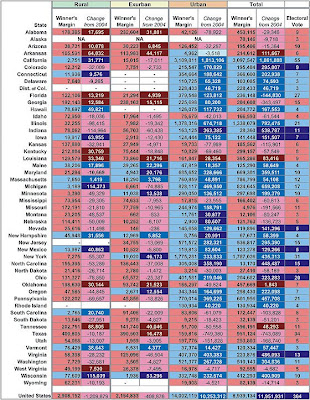
Slicing and dicing the actual election returns, by state and by urban, exurban and rural
Tim Murphy and Bill Bishop analyze election returns and report in the Daily Yonder that Barack Obama carried the rural vote in 12 states: California, Connecticut, Hawaii, Iowa, Maine, Massachusetts, Michigan, New Hampshire, New Mexico, South Carolina (the only Southern state in the list), Vermont and Wisconsin. To read the report, click here.
One of the story's excellent, color-coded tables also shows the partisan shift in rural, exurban and urban areas in each state from 2004. The only state in which all three categories had a Republican "red shift" was Louisiana. The only two states in which rural voters were the sole category with such a shift were Kentucky and West Virginia.
The state-by-state table shows Republican gains in dark red. Categories in pink (Alabama urbanites, for example) went Republican by a smaller margin than in 2004. Democratic gains appear in dark blue. Sorry the numbers aren't plain; for a larger image, click on the table. You may still have to increase the zoom view in your browser to get it to full, readable size.
One of the story's excellent, color-coded tables also shows the partisan shift in rural, exurban and urban areas in each state from 2004. The only state in which all three categories had a Republican "red shift" was Louisiana. The only two states in which rural voters were the sole category with such a shift were Kentucky and West Virginia.
The state-by-state table shows Republican gains in dark red. Categories in pink (Alabama urbanites, for example) went Republican by a smaller margin than in 2004. Democratic gains appear in dark blue. Sorry the numbers aren't plain; for a larger image, click on the table. You may still have to increase the zoom view in your browser to get it to full, readable size.

Saturday, December 06, 2008
Big bank says it won't lend to coal firms that mine mainly by mountaintop removal; are there any?
 Bank of America said this week it will "phase out financing of companies whose predominant method of extracting coal is through mountaintop removal." However, the new policy "may be little more than show," reports Vicki Smith of The Associated Press, who reviewed annual reports of major coal producers and deduced that "few get more than half their coal from mountaintop mines, and few borrow significant amounts" from the bank. (AP photo of West Virginia's Kayford Mountain, with Coal River Mountain in the background, by Jeff Genter)
"I think it was a bit of a public relations ploy at a time when there's a lot of press attention on mountaintop removal," Carol Raulston, spokeswoman for the National Mining Association, told Smith. She said no NMA members had contacted her about it. A bank spokeswoman "refused to elaborate on how the phase-out would work, how many companies it would affect or how much of its business involves coal industry financing," Smith reports. There could also be questions about how the bank defines "mountaintop removal," which can differ in legal terms and practice.
Still, a worried West Virginia Coal Association Vice President Chris Hamilton told Smith the announcement could be "precedent-setting," and others agreed. Smith notes, "Earlier this year, three investment banks announced new non-binding environmental standards to help lenders evaluate risks associated with investments in coal-fired power plants."
The bank's statement was part of a broader coal policy the bank announced on its Web site in conjunction with a $1 million grant to Harvard University for research on capturing and storing carbon dioxide from power plants. The bank said the grant is part of its effort "to address climate change through lending, investing, the creation of new products and services, operations and philanthropy." (Read more)
Meanwhile, Scott Finn of West Virginia Public Broadcasting reports for National Public Radio on the reaction in the main mountaintop-removal state to the new federal rules that will ease the practice. To read and listen, click here.
Weekly doesn't shy from reporting on hard times
 As the economy worsens and more people fall into dire straits, that's news. But in our experience, most rural newspapers shy away from enterprise reporting about hard times. Some are reluctant to shine the spotlight on neighbors; some think there's enough bad news already. But if a newspaper is to be what it should be, a mirror of the community, it needs stories like the one published in The Coalfield Progress of Norton, Va., this week.
"While many of us looked forward to sumptuous Thanksgiving feasts and holiday gift bargain shopping on Black Friday, others worried about simply getting enough food to fill their families’ bellies," Jeff Lester began his story about a surge in clients at the Wise County Food Bank. He didn't include material from any interviews with clients, but Melanie Lane took this photo of unidentified clients at the facility. (The paper often runs photos showing the Appalachian county's natural beauty.)
Lester reported that the food bank "could find itself hurting within a month," and told readers how they could donate. He gave the hours of the bank's two locations and its eligibility rules. (Read more; subscription may be required)
UPDATE, Dec. 8: The Progress was ahead of the curve. Today Michael Sluss and Rob Johnson of The Roanoke Times report that some area food banks are running out of food and may need state aid.
Gore, environmental groups start TV ads to remind Americans that 'clean coal' remains only a concept
"The phrase 'clean coal' was repeated by virtually every major presidential candidate this year," writes Steven Mufson of The Washington Post. "Now the battle over what it means is heating up," with a television advertising campaign to counter long-running ads from the coal industry and electric utilities that burn coal. The ads are being financed by former Vice President Al Gore and organizations such as Sierra Club, the Natural Resources Defense Council and the National Wildlife Federation.
The ads, one of which will run on this weekend's TV talk shows, note that the concept of "clean coal," removing pollutants including carbon dioxide from power-plant emissions, has not been commercially proven. "The ad battle is part of a fight over the future of coal plants, which has been thrown into doubt by Supreme Court and Environmental Protection Agency rulings about carbon dioxide being subject to regulation under the Clean Air Act," Mufson reports. "Environmentalists say that it will be difficult, if not impossible, to retrofit plants with carbon-capture equipment once they're built. But coal industry advocates hold out hope." (Read more)
The ads, one of which will run on this weekend's TV talk shows, note that the concept of "clean coal," removing pollutants including carbon dioxide from power-plant emissions, has not been commercially proven. "The ad battle is part of a fight over the future of coal plants, which has been thrown into doubt by Supreme Court and Environmental Protection Agency rulings about carbon dioxide being subject to regulation under the Clean Air Act," Mufson reports. "Environmentalists say that it will be difficult, if not impossible, to retrofit plants with carbon-capture equipment once they're built. But coal industry advocates hold out hope." (Read more)
Concealed guns allowed in national parks, refuges
Loaded and concealed weapons will be allowed in national parks and federal wildlife refuges, as long as the holders comply with state laws, under a regulation finalized by the Bush administration yesterday. "The rule replaces a Reagan administration policy that first allowed guns in parks but required them to be safely stowed and unloaded," reports Jesse Nankin of ProPublica.
The Department of the Interior said in a press release that it was responding to requests by 51 senators and the passage in 48 states of laws allowing possession of concealed deadly weapons. For our May item on the proposal, click here.
The Department of the Interior said in a press release that it was responding to requests by 51 senators and the passage in 48 states of laws allowing possession of concealed deadly weapons. For our May item on the proposal, click here.
North Dakota is a bright spot in the U.S. economy
It's a tough time to look for a job in most states, but not in North Dakota, one of the brightest spots in the American economy, reports Monica Davey of The New York Times. Why? "A recent surge in oil production ... a mostly strong year for farmers ... and a conservative, steady, never-fancy culture that has nurtured fewer sudden booms of wealth like those seen elsewhere," she writes.
“Our banks don’t do those goofy loans,” Bismarck car dealer Justin Theel told Davey. At when dealer closings are common, 27 percent more vehicles have been sold in North Dakota than at this time last year, Davey reports. "One of the state’s biggest worries right now is precisely the reverse of most other states: North Dakota has about 13,000 unfilled jobs and is struggling to find people to take them."
The recession has recently put a drag on the state's economy, but it is still expected to keep groing in the next few months. Bob Stenehjem, leader of the state Senate's Republican majority, told Davey, “North Dakota never gets as good as the rest of the country or as bad as the rest of the country, and that’s fine with us.” (Read more)
“Our banks don’t do those goofy loans,” Bismarck car dealer Justin Theel told Davey. At when dealer closings are common, 27 percent more vehicles have been sold in North Dakota than at this time last year, Davey reports. "One of the state’s biggest worries right now is precisely the reverse of most other states: North Dakota has about 13,000 unfilled jobs and is struggling to find people to take them."
The recession has recently put a drag on the state's economy, but it is still expected to keep groing in the next few months. Bob Stenehjem, leader of the state Senate's Republican majority, told Davey, “North Dakota never gets as good as the rest of the country or as bad as the rest of the country, and that’s fine with us.” (Read more)
57 firms, groups ally to push action on broadband
Barack Obama often talked on the campaign trail about the need to expand high-speed Internet access in rural America. Now a diverse coalition of broadband promoters has organized to make sure he keeps his promise in the face of economic and budget challenges. A Call to Action for a National Broadband Strategy comprises 57 firms and organizations, "some of which generally don’t get along too well," reports Carl Weinschenk of Business Communications Examiner. "There are other influential voices being raised that are asking Obama to deliver on his promises, perhaps as part of the stimulus package that he promises to sign into law when he takes office."
Weinschenk writes that broadband is especially important to small and medium-sized businesses because they depend on the same type of Internet service that consumers use: "If its capacity is low or service is spotty, they suffer. There also is a geographic element. In general, the lack of an overriding federal broadband plan encourages the big cable and phones companies to concentrate advanced services in urban and suburban areas. These businesses naturally focus on where people are, and tend to bypass rural areas. ... While there are great examples of rural telephone companies and cooperatives doing cutting edge things, the reality is that without help from the states and Washington, rural businesses are at the mercy of purely profit-and-loss based corporate decisions and, therefore, are at a big disadvantage." (Read more)
Weinschenk writes that broadband is especially important to small and medium-sized businesses because they depend on the same type of Internet service that consumers use: "If its capacity is low or service is spotty, they suffer. There also is a geographic element. In general, the lack of an overriding federal broadband plan encourages the big cable and phones companies to concentrate advanced services in urban and suburban areas. These businesses naturally focus on where people are, and tend to bypass rural areas. ... While there are great examples of rural telephone companies and cooperatives doing cutting edge things, the reality is that without help from the states and Washington, rural businesses are at the mercy of purely profit-and-loss based corporate decisions and, therefore, are at a big disadvantage." (Read more)
Friday, December 05, 2008
Pastor's piece answers question for rural readers: It was wrong to refuse to vote for Obama on race
Last month, at least three weekly newspapers in west-central Kentucky ran a column by Dr. Jerry Adamson, a Baptist minister, counselor and seminary instructor, asking, “Was it wrong if someone refused to vote for Senator Obama because he was black?”
He answered, “If a person refused to vote for Senator Obama because he was black then I believe they are a racist. Also if somebody voted for Obama because he was black then they are racists as well. Both groups would be guilty of prejudice because they judge a person based upon a factor which has no bearing upon their qualifications for a specific task. To pre-judge a subject before obtaining facts is the mark of prejudice.”
Adamson said in an interview with The Rural Blog that he hadn't heard any overt expressions of racist voting, but felt that it was a factor. "There were a lot of people who were afraid to even mention race," he said, despite the historic significance of the first black president. "It was the day after the election and I needed to write a column." He said he voted for John McCain.
Adamson said he has received no reaction from his column, which ran in The Record of Leitchfield, the Breckinridge County Herald-News and the Butler County Banner. To read it, click here.
He answered, “If a person refused to vote for Senator Obama because he was black then I believe they are a racist. Also if somebody voted for Obama because he was black then they are racists as well. Both groups would be guilty of prejudice because they judge a person based upon a factor which has no bearing upon their qualifications for a specific task. To pre-judge a subject before obtaining facts is the mark of prejudice.”
Adamson said in an interview with The Rural Blog that he hadn't heard any overt expressions of racist voting, but felt that it was a factor. "There were a lot of people who were afraid to even mention race," he said, despite the historic significance of the first black president. "It was the day after the election and I needed to write a column." He said he voted for John McCain.
Adamson said he has received no reaction from his column, which ran in The Record of Leitchfield, the Breckinridge County Herald-News and the Butler County Banner. To read it, click here.
College students help small Vt. town chart its path
Many small towns struggle to balance economic growth with preservation of their community's spirit. One community is turning to the local college to help with the task.
Starksboro, Vt., population 1,900, is home to Middlebury College. City leaders have asked students to spend a semester interviewing residents to help determine what makes the town unique. “Our hope is to create enough consensus to then drive the plan’s language,” Bill Roper, president of the Orton Family Foundation, one of the groups funding the project, tells Abby Goodnough of The New York Times. “Then they can move forward with how to protect what they’ve all agreed is most important.”
The students are part of a class entitled "Portraits of a Vermont Town." The project is aimed not only at helping the town plan how they want to grow, but also at helping students understand the realities of rural life. “I’m guilty, like most of us, of really romanticizing Vermont life and Vermont towns,” said Max Kanter, a junior from Phoenix. “Now I have a sense of the challenge they have to stay afloat.” (Read more)
Starksboro, Vt., population 1,900, is home to Middlebury College. City leaders have asked students to spend a semester interviewing residents to help determine what makes the town unique. “Our hope is to create enough consensus to then drive the plan’s language,” Bill Roper, president of the Orton Family Foundation, one of the groups funding the project, tells Abby Goodnough of The New York Times. “Then they can move forward with how to protect what they’ve all agreed is most important.”
The students are part of a class entitled "Portraits of a Vermont Town." The project is aimed not only at helping the town plan how they want to grow, but also at helping students understand the realities of rural life. “I’m guilty, like most of us, of really romanticizing Vermont life and Vermont towns,” said Max Kanter, a junior from Phoenix. “Now I have a sense of the challenge they have to stay afloat.” (Read more)
Automaker bailout plan wrinkles Southern brows
With talk of a bailout for the Big 3 automakers dominating this week's news these days, Michigan and some other Rust Belt states are getting a lot of attention. But some are saying that the future of the auto industry is not in the Great Lakes region, but in the South.
"States like Alabama, with the second-largest per capita concentration of auto-related jobs, as well as South Carolina, Tennessee, Kentucky, Georgia and Mississippi, have been growing these high-wage jobs for a new generation," writes Joel Kotkin for Forbes.com. "And the fact that the region will likely be producing the majority of the most low-mileage and low-emission cars certainly cannot hurt their future prospects." (Read more)
Sylvia Lovely, executive director of the Kentucky League of Cities and president of the New Cities Foundation, explains the region's appeal to car manufacturers. "The easy answer is that they came for cheaper land and labor," she writes on newgeography.com, but "They came also for laborers eager to find the good paying auto jobs that had escaped the South for too long." She also says the region contains a strong work ethic often ignored in stereotypes.
"Of course, we don’t want to see any part of America fail, including Detroit," she writes, "but others do see the bailout as undermining a trend that favors efficiency in manufacturing." But whatever Congress decides, they would do well to recognize that the auto industry isn't just about Detroit anymore. (Read more)
Japanese automakers have a stake in the fate of their American competitors, Coco Masters of Time magazine reports from Tokyo: "The bankruptcy of one or more of the Big Three could create havoc among parts suppliers that sell to Japan's carmakers; job losses would send more shock waves through the U.S. economy, deepening the recession in what is by far the largest single market for Japanese cars." (Read more)
UPDATE, Dec. 6: In an op-ed piece for the Los Angeles Times, Jonathan Cutler of Wesleyan University examines the failure of the United Auto Workers to unionize Japanese plants in the U.S. and build a relationship with Japan's auto workers union.
"States like Alabama, with the second-largest per capita concentration of auto-related jobs, as well as South Carolina, Tennessee, Kentucky, Georgia and Mississippi, have been growing these high-wage jobs for a new generation," writes Joel Kotkin for Forbes.com. "And the fact that the region will likely be producing the majority of the most low-mileage and low-emission cars certainly cannot hurt their future prospects." (Read more)
Sylvia Lovely, executive director of the Kentucky League of Cities and president of the New Cities Foundation, explains the region's appeal to car manufacturers. "The easy answer is that they came for cheaper land and labor," she writes on newgeography.com, but "They came also for laborers eager to find the good paying auto jobs that had escaped the South for too long." She also says the region contains a strong work ethic often ignored in stereotypes.
"Of course, we don’t want to see any part of America fail, including Detroit," she writes, "but others do see the bailout as undermining a trend that favors efficiency in manufacturing." But whatever Congress decides, they would do well to recognize that the auto industry isn't just about Detroit anymore. (Read more)
Japanese automakers have a stake in the fate of their American competitors, Coco Masters of Time magazine reports from Tokyo: "The bankruptcy of one or more of the Big Three could create havoc among parts suppliers that sell to Japan's carmakers; job losses would send more shock waves through the U.S. economy, deepening the recession in what is by far the largest single market for Japanese cars." (Read more)
UPDATE, Dec. 6: In an op-ed piece for the Los Angeles Times, Jonathan Cutler of Wesleyan University examines the failure of the United Auto Workers to unionize Japanese plants in the U.S. and build a relationship with Japan's auto workers union.
Ban on road construction in national forests is narrowed to only 10 Western states
The ban on creating new roads in national forests, enacted during the Clinton administration, has been narrowed by a federal court decision. The ban now affects only a fourth of the states initially affected.
The 2001 "Roadless Rule" has been subject to judicial tug-of-war over the past few years. the Bush administration overturned the decision in 2005. Judge Elizabeth Laporte invalidated that repeal in 2006, after challenges from environmental groups. But another federal judge invalidated the original rule this August, says a recent Associated Press article.
In an attempt to reconcile the two rulings, Laporte reduced the scope of her decision. While the measure initially covered national forests in almost 40 states, it now only applies to 10 western states. (Read more)
The 2001 "Roadless Rule" has been subject to judicial tug-of-war over the past few years. the Bush administration overturned the decision in 2005. Judge Elizabeth Laporte invalidated that repeal in 2006, after challenges from environmental groups. But another federal judge invalidated the original rule this August, says a recent Associated Press article.
In an attempt to reconcile the two rulings, Laporte reduced the scope of her decision. While the measure initially covered national forests in almost 40 states, it now only applies to 10 western states. (Read more)
Daddy, won't you take me back to Muhlenberg County? Mr. Martin's money train is hauling it back
 Rural America gets the short end of the stick from the nation's foundations and other philanthropies, but many of its natives have wealth that could greatly benefit their old hometowns. The latest example is Felix Martin Jr., right, who died just over a year ago. When the retired investor and lifelong bachelor returned to his native Greenville, Ky., in 1996, "People knew him but they didn't know the extent of his wealth. He was private about it," his friend Roderick Tompkins said yesterday -- when the wealth became very public, with the announcement that Martin had left $50 million to create a foundation or trust "for the benefit of the education, civic and cultural needs" of Muhlenberg County.
The county of 32,000 is synonymous with the Western Kentucky Coal Field, where mining has been an up-and-down industry that has brought temporary prosperity to many, wealth to a relative few, and lasting human and environmental damage to some. Many know it best as the locale of John Prine's 1967 song "Paradise," from which the title of this item is taken.
 "C. Dennis Riggs, president and CEO of the Community Foundation of Louisville, which is administering the trust, said the gift may be one of the largest bequests to a community in the country," reports Emily Udell of The Courier-Journal. (C-J map) "He said the money will be a resource to help retool the county's work force." Yesterday the foundation, headed by Tompkins, announced a $150,000 grant to help establish an arts extension agent through the University of Kentucky and a $110,000 grant to boost a scholarship program for local students at nearby Madisonville Community and Technical College. Half a million dollars will be available for "nonprofits serving Muhlenberg County residents during an initial application period," Udell writes. (Read more)
For more background on rural philanthropy, click here.
Byron Crawford, chronicler of rural Kentucky, writes his last column for The Courier-Journal

Our longtime friend and colleague Byron Crawford, who traveled Kentucky to do rural features for Louisville's WHAS-TV, then spent 29 years as the state columnist for The Courier-Journal, wrote his last column yesterday. It's in the Louisville paper today. He was among the employees who applied for and received a buyout as the Gannett Co. Inc. paper did its part in the company's latest downsizing. He has become an institution, and The C-J won't be the same without him.
Crawford, a native of Lincoln County in the rural heart of the state, thanked readers and subjects "for trusting me with some of your most personal stories," and "for giving me directions when I was lost on the backroads along the Mississippi or on Pine Mountain. . . . My assignment has been to roam Kentucky from end to end, telling the stories of its fascinating people, places and folklore. I have tried always to remember that my voice and my opinion were never as important as those of my story subjects." And he apologized "to those whose important stories I never got to tell. There were just too many roads and not enough time."
Crawford carries a reminder of those roads. He noticed this summer that the left side of his face had more age lines, and figured that "a million miles of sun on the driver's side has left its mark. So, if these lines represent roads I have traveled and stories I have written, then I suppose they are also a part of each person who I have met along the way, and all of you who have read the lines I have left on this page. There is something intrinsically comforting to me in that thought as I reach the end of this line." (Read more)
Thursday, December 04, 2008
NAA's "20 under 40" hotshots include four who serve rural America with newspapers
The Newspaper Association of America's 2008 20 Under 40 list features four employees from rural newspapers and a company that owns many rural papers.
Assembled by the NNA magazine Presstime, the list includes executives under 40 who represent creative and progressive work relevant to their respective publication and the newspaper industry. Individuals who received the honor include editors, advertising directors and online staff and feature writers, among others
The honorees were Dan Cox, president of the The World Co., publishers of the Lawrence Journal-World in Lawrence, Kan.; Shannon Dunnigan, vice president of human resources at GateHouse Media in Fairport, N.Y.; Mike Fuhrman, editor of the Statesville Record & Landmark in Statesville, N.C.; and David Sickle, circulation director for The Republican & Herald and The News-Item in Pottsville and Shamokin, Pa.
Fuhrman, editor of the Statesville Record & Landmark, has been recognized for helping create partnerships with four other daily papers to improve reporter training and an implement an emergency response plan. He has also introduced his paper to a new Web publishing system this past August. Publisher Tim Dearman says Fuhrman “understands the role the newspaper needs to serve in a changing environment. He is the best hire I’ve ever made, and I’ve been in the business a long time.”
Presstime says that the goal of the list “is to assemble a group of people, under the age of 40, who represent the innovative work being done at today's newspapers, and tell their stories through profiles in the magazine and enhanced content online at www.naa.org."
See the profiles of the winners here.
Assembled by the NNA magazine Presstime, the list includes executives under 40 who represent creative and progressive work relevant to their respective publication and the newspaper industry. Individuals who received the honor include editors, advertising directors and online staff and feature writers, among others
The honorees were Dan Cox, president of the The World Co., publishers of the Lawrence Journal-World in Lawrence, Kan.; Shannon Dunnigan, vice president of human resources at GateHouse Media in Fairport, N.Y.; Mike Fuhrman, editor of the Statesville Record & Landmark in Statesville, N.C.; and David Sickle, circulation director for The Republican & Herald and The News-Item in Pottsville and Shamokin, Pa.
Fuhrman, editor of the Statesville Record & Landmark, has been recognized for helping create partnerships with four other daily papers to improve reporter training and an implement an emergency response plan. He has also introduced his paper to a new Web publishing system this past August. Publisher Tim Dearman says Fuhrman “understands the role the newspaper needs to serve in a changing environment. He is the best hire I’ve ever made, and I’ve been in the business a long time.”
Presstime says that the goal of the list “is to assemble a group of people, under the age of 40, who represent the innovative work being done at today's newspapers, and tell their stories through profiles in the magazine and enhanced content online at www.naa.org."
See the profiles of the winners here.
Small-town docs face challenges, but reap rewards
Small towns often struggle to find family-care physicians, because of lower pay and higher medical school debts, as well as schools' push for students to specialize and a more frequent schedule of being on night call. But family physicians say that these are all worth it for the benefits of small-town medical practice, where doctors really get to know their patients and their families.
According to the American Academy of Family Physicians, the nation needs 41.6 family physicians per 100,000 people, but had only 31.2 per 100,000 in 2005. AAFP spokeswoman Leslie Champlin said medical schools can help by enrolling students from rural areas who might not have perfect test scores or research experience: "They want to go home and practice medicine." John Weiss of the Post-Bulletin in Rochester, Minn., writes that the organization "wants Congress to increase money to help ease the financial burden of those who practice in rural areas." (Read more)
According to the American Academy of Family Physicians, the nation needs 41.6 family physicians per 100,000 people, but had only 31.2 per 100,000 in 2005. AAFP spokeswoman Leslie Champlin said medical schools can help by enrolling students from rural areas who might not have perfect test scores or research experience: "They want to go home and practice medicine." John Weiss of the Post-Bulletin in Rochester, Minn., writes that the organization "wants Congress to increase money to help ease the financial burden of those who practice in rural areas." (Read more)
Kansas governor, congressmen from Colo., Ga. lead list of speculation on agriculture secretary
UPDATE, Dec. 6: Sebelius "shocked the Kansas political establishment Saturday by abruptly withdrawing from consideration" for any Cabinet post," report Steve Kraske and Dave Helling of the Kansas City Star. (Read more)
The three leading candidates for secretary of agriculture in the Obama administration are Kansas Gov. Kathleen Sebelius and U.S. Reps. John Salazar of Colorado and Sanford Bishop of Georgia, according to sources of Agri-Pulse, a Washington-based newsletter on agriculture. It is subscriber-based, but offers a four-week trial subscription. Yesterday, The Washington Post listed Sebelius, former Rep. Charles Stenholm of Texas and Pennsylvania Secretary of Agriculture Dennis Wolff, who is a dairy farmer.
"Later in the day, responding to reporters' inquiries, Sebelius indicated she was not interested in the job. Salazar and Bishop may have moved to front-runner status with that development," reports John Walter of Agriculture Online. Here are condensed versions of Agri-Pulse's brief biographies of the three Democrats, with our additions:
Sebelius, a popular governor in her second and final term, has long been on the list because she is viewed as a rising star in Democratic politics. She served eight years in the Kansas legislature and two terms as state insurance commissioner. (She was also on the list of potential Obama running mates, comes from his late mother's home state and is the daughter of former Ohio Gov. John Gilligan.)
Salazar, one of only a handful of active farmers in Congress, serves on the House Agriculture Committee and was recently re-elected to his third term. As the congressman from Colorado's Western Slope, Salazar has developed a strong interest in rangeland and national forest lands. Salazar pushed for fruit and vegetable grower funding as well as funding for renewable fuels research during the 2008 Farm Bill debate. (He is the brother of Sen. Ken Salazar.)
Bishop was a co-chairman of Obama's Georgia campaign, but his name surfaced in speculation only recently. He was first elected in the Black Belt district in 1992, and has been on the House Appropriations Committee since 2003 and its agriculture subcommittee since 2006. He has been especially active on peanut issues, securing committee approval of $74 million for peanut storage in the supplemental spending bill. His voting record has been the most conservative in the Congressional Black Caucus. (He would be the second black secretary of a department that has a checkered record at dealing with African American farmers.)
Meanwhile, seven former agriculture secretaries offered advice about USDA and perspectives on the future of agriculture today in Washington at the Food and Agriculture Policy Summit, sponsored by Farm Journal and Farm Foundation. For an introductory story by Farm Journal's Jeanne Bernick and a video, click here.
The three leading candidates for secretary of agriculture in the Obama administration are Kansas Gov. Kathleen Sebelius and U.S. Reps. John Salazar of Colorado and Sanford Bishop of Georgia, according to sources of Agri-Pulse, a Washington-based newsletter on agriculture. It is subscriber-based, but offers a four-week trial subscription. Yesterday, The Washington Post listed Sebelius, former Rep. Charles Stenholm of Texas and Pennsylvania Secretary of Agriculture Dennis Wolff, who is a dairy farmer.
"Later in the day, responding to reporters' inquiries, Sebelius indicated she was not interested in the job. Salazar and Bishop may have moved to front-runner status with that development," reports John Walter of Agriculture Online. Here are condensed versions of Agri-Pulse's brief biographies of the three Democrats, with our additions:
Sebelius, a popular governor in her second and final term, has long been on the list because she is viewed as a rising star in Democratic politics. She served eight years in the Kansas legislature and two terms as state insurance commissioner. (She was also on the list of potential Obama running mates, comes from his late mother's home state and is the daughter of former Ohio Gov. John Gilligan.)
Salazar, one of only a handful of active farmers in Congress, serves on the House Agriculture Committee and was recently re-elected to his third term. As the congressman from Colorado's Western Slope, Salazar has developed a strong interest in rangeland and national forest lands. Salazar pushed for fruit and vegetable grower funding as well as funding for renewable fuels research during the 2008 Farm Bill debate. (He is the brother of Sen. Ken Salazar.)
Bishop was a co-chairman of Obama's Georgia campaign, but his name surfaced in speculation only recently. He was first elected in the Black Belt district in 1992, and has been on the House Appropriations Committee since 2003 and its agriculture subcommittee since 2006. He has been especially active on peanut issues, securing committee approval of $74 million for peanut storage in the supplemental spending bill. His voting record has been the most conservative in the Congressional Black Caucus. (He would be the second black secretary of a department that has a checkered record at dealing with African American farmers.)
Meanwhile, seven former agriculture secretaries offered advice about USDA and perspectives on the future of agriculture today in Washington at the Food and Agriculture Policy Summit, sponsored by Farm Journal and Farm Foundation. For an introductory story by Farm Journal's Jeanne Bernick and a video, click here.
Farm Foundation study identifies challenges in the next 30 years of agriculture
Agriculture faces a number of challenges in the next thirty years and public policy must change if they are to be adequately addressed, says a new report released today by Farm Foundation.
"The 30-Year Challenge: Agriculture's Strategic Role in Feeding and Fueling a Growing World" identifies six areas that will shape agriculture in the next three decades: global financial markets and recession, global food security, global energy security, climate change, competition for natural resources and global economic development.
"It is not clear that today's policies -- designed to deal with issues of the last century -- will provide appropriate tools and incentives to address the 30-year challenge," said Neilson Conklin, the foundation's president. "This is what one project participant termed 'a generational opportunity' to begin new discussions on public policies for the 21st century." (Read the press release or full report)
"The 30-Year Challenge: Agriculture's Strategic Role in Feeding and Fueling a Growing World" identifies six areas that will shape agriculture in the next three decades: global financial markets and recession, global food security, global energy security, climate change, competition for natural resources and global economic development.
"It is not clear that today's policies -- designed to deal with issues of the last century -- will provide appropriate tools and incentives to address the 30-year challenge," said Neilson Conklin, the foundation's president. "This is what one project participant termed 'a generational opportunity' to begin new discussions on public policies for the 21st century." (Read the press release or full report)
Amid dire forecasts in industry, community papers remain stable, and want to make sure you know it
UPDATE, Dec. 6: The prediction is extreme, and newspapers have other steps available to them, such as becoming nonprofit organizations or donating themselves to such groups, media-business analyst Lauren Rich Fine writes on paidContent.org.
Several cities are likely to lose their daily newspapers in the next two years because the recession will deepen and some newspaper companies will default on debt and go out of business, Fitch Ratings said in a report on media companies yesterday. But just as the report was coming out, a group of community newspaper publishers went public with their plan to boost their sector of the industry, which is doing much better than metropolitan papers.
First, the bad news: Fitch, a subscriber-based credit rater, said in its 2009 outlook for the U.S. media and entertainment industries, "Fitch believes more newspapers and newspaper groups will default, be shut down and be liquidated in 2009 and several cities could go without a daily print newspaper by 2010."
Mark Fitzgerald of Editor & Publisher writes, "Fitch is generally pessimistic across the board, assigning negative outlets to nearly all sectors from Yellow Pages to radio and TV and theme parks. But the newspaper industry is the most at risk of defaulting, it says. . . . Fitch rates the debt of two newspaper companies, The McClatchy Co. and Tribune Co. as junk, with serious possibilities of default. It also assigns a negative outlook to both the companies and the newspaper sector, meaning their credit ratings are likely to deteriorate further." (Read more)
But to such observers, the newspaper industry generally means daily, metropolitan papers. Circulation and advertising declines have been much less at weekly papers and smaller dailies, the sort of papers that belong to the National Newspaper Association. The NNA Foundation wants to help members "meet current circulation and revenue challenges," but some in the group also think they "need help in changing the public's perception that ... the newspaper industry is dying," Foundation President Peter Wagner writes in the December issue of Publishers' Auxilary, NNA's member newspaper.
Wagner says the foundation board is planning efforts to "promote the community newspaper industry as growing and effective and certainly not in the downward spiral being reported by the larger chains and major metro papers," pay for promotion of public-notice advertising, an important revenue source and public service of most rural weeklies, and meetings to help younger members of newspaper-owning families run their companies. About 40 percent of weekly newspapers are still independently owned; for dailies, the figure is about 20 percent.
The foundation is looking for donations to do its work, and for suggestions. The current Pub Aux isn't yet online, but Wagner can be reached at pww@iowainformation.com or P.O. Box 160, Sheldon IA 51249. He is publisher of the N'West Iowa Review, one of the best weeklies in the nation. (He would want us to capitalize the last word in the paper's name, as he does.) We strongly endorse his efforts.
 UPDATE: In the INA Bulletin out today, the Iowa Newspaper Association announced the theme for its 2009 convention, to be held Feb 5-6 in Des Moines, is "Learning to Survive and Thrive." Note that the logo puts the emphasis on "survive."
Several cities are likely to lose their daily newspapers in the next two years because the recession will deepen and some newspaper companies will default on debt and go out of business, Fitch Ratings said in a report on media companies yesterday. But just as the report was coming out, a group of community newspaper publishers went public with their plan to boost their sector of the industry, which is doing much better than metropolitan papers.
First, the bad news: Fitch, a subscriber-based credit rater, said in its 2009 outlook for the U.S. media and entertainment industries, "Fitch believes more newspapers and newspaper groups will default, be shut down and be liquidated in 2009 and several cities could go without a daily print newspaper by 2010."
Mark Fitzgerald of Editor & Publisher writes, "Fitch is generally pessimistic across the board, assigning negative outlets to nearly all sectors from Yellow Pages to radio and TV and theme parks. But the newspaper industry is the most at risk of defaulting, it says. . . . Fitch rates the debt of two newspaper companies, The McClatchy Co. and Tribune Co. as junk, with serious possibilities of default. It also assigns a negative outlook to both the companies and the newspaper sector, meaning their credit ratings are likely to deteriorate further." (Read more)
But to such observers, the newspaper industry generally means daily, metropolitan papers. Circulation and advertising declines have been much less at weekly papers and smaller dailies, the sort of papers that belong to the National Newspaper Association. The NNA Foundation wants to help members "meet current circulation and revenue challenges," but some in the group also think they "need help in changing the public's perception that ... the newspaper industry is dying," Foundation President Peter Wagner writes in the December issue of Publishers' Auxilary, NNA's member newspaper.
Wagner says the foundation board is planning efforts to "promote the community newspaper industry as growing and effective and certainly not in the downward spiral being reported by the larger chains and major metro papers," pay for promotion of public-notice advertising, an important revenue source and public service of most rural weeklies, and meetings to help younger members of newspaper-owning families run their companies. About 40 percent of weekly newspapers are still independently owned; for dailies, the figure is about 20 percent.
The foundation is looking for donations to do its work, and for suggestions. The current Pub Aux isn't yet online, but Wagner can be reached at pww@iowainformation.com or P.O. Box 160, Sheldon IA 51249. He is publisher of the N'West Iowa Review, one of the best weeklies in the nation. (He would want us to capitalize the last word in the paper's name, as he does.) We strongly endorse his efforts.
 UPDATE: In the INA Bulletin out today, the Iowa Newspaper Association announced the theme for its 2009 convention, to be held Feb 5-6 in Des Moines, is "Learning to Survive and Thrive." Note that the logo puts the emphasis on "survive."
Reforms at USDA could prove difficult for Obama
As the Obama administration nears many believe that drastic changes are needed in the U.S. Department of Agriculture. Such changes may prove difficult. "In cash-strapped times, the challenges of mounting new initiatives are daunting," writes Kimberly Kindy of The Washington Post. "And the USDA is still battling long-running problems: subsidy programs that give huge sums to ineligible, millionaire farmers; a food inspection system that puts Americans at risk for food-borne illnesses; and nutrition programs that fail to identify more than 30 percent of Americans who live in poverty and are at risk of hunger every month."
Obama has criticized farm policy in the U.S. for focusing on large farms, and last week he noted a Government Accountability Office finding that "USDA continued to give federal subsidies to ineligible, wealthy farmers despite a series of congressional reforms," notes Kindy. "Between 2003 and 2006, more than 2,700 farmers who were earning more than the cutoff of $2.5 million annually continued to receive subsidies." But changing the farm policy to strengthen support for smaller farms has met with opposition from both Democrats and Republicans.
USDA also handles food safety, and many argue those inspections need to be drastically improved. Kindy writes, "The USDA and 14 other departments and agencies administer a patchwork of food safety laws that often overlap and do not always make public safety the first priority. The department also handles nutrition, and another Obama campaign pledge -- to end childhood hunger by 2015 -- also presents immediate challenges. The nation's economic crisis has pushed the number of families relying on food stamps to 30 million, an unprecedented high expected to climb as unemployment rates continue to rise," adds Kindy. (Read more)
Obama has criticized farm policy in the U.S. for focusing on large farms, and last week he noted a Government Accountability Office finding that "USDA continued to give federal subsidies to ineligible, wealthy farmers despite a series of congressional reforms," notes Kindy. "Between 2003 and 2006, more than 2,700 farmers who were earning more than the cutoff of $2.5 million annually continued to receive subsidies." But changing the farm policy to strengthen support for smaller farms has met with opposition from both Democrats and Republicans.
USDA also handles food safety, and many argue those inspections need to be drastically improved. Kindy writes, "The USDA and 14 other departments and agencies administer a patchwork of food safety laws that often overlap and do not always make public safety the first priority. The department also handles nutrition, and another Obama campaign pledge -- to end childhood hunger by 2015 -- also presents immediate challenges. The nation's economic crisis has pushed the number of families relying on food stamps to 30 million, an unprecedented high expected to climb as unemployment rates continue to rise," adds Kindy. (Read more)
U.S. ethanol production down, imports up in Sept.
The Energy Information Administration reports that U.S. ethanol production was down in September while imports, "largely from Brazil, increased," writes Janie Gabbett of MeatingPlace.
"EIA said the 806.3 million gallons produced in September, or 640,000 barrels per day, was a slight decline from August but an increase of nearly 200,000 barrels per day from a year ago," Gabbett wites. "The slight reduction in ethanol production in September reflects some of the economic difficulty ethanol producers have experienced as a result of higher input costs, lower ethanol values and the evaporation of credit in the market." (Read more)
"EIA said the 806.3 million gallons produced in September, or 640,000 barrels per day, was a slight decline from August but an increase of nearly 200,000 barrels per day from a year ago," Gabbett wites. "The slight reduction in ethanol production in September reflects some of the economic difficulty ethanol producers have experienced as a result of higher input costs, lower ethanol values and the evaporation of credit in the market." (Read more)
Wednesday, December 03, 2008
Small-town radio station gets awards, attention for public-service work in Indiana community
Radio stations can be an important part of a small community, and one in Southern Indiana has recently been recognized twice for its public service. WMPI in Scottsburg, population 6,000, was recently named small-market station of the year by the Indiana Broadcasters Association and received a write-up in The Courier-Journal of nearby Louisville.
 J.R. Ross, left, and his father bought the station almost 20 years ago, and since then, have made sure it is an integral part of the community. "I think people are hungry for customer service," Ross says. C-J Indiana columnist Dale Moss writes that Ross "missed a shift recently after dental work, and listeners called, worried what was wrong." (Photo by Moss)
The station also works hard at giving back to the community. This weekend is its 19th annual "We Care" holiday auction, which provides warm clothing for children in the community. With priorities like that, we think they deserve all the attention they can get. (Read more)
 J.R. Ross, left, and his father bought the station almost 20 years ago, and since then, have made sure it is an integral part of the community. "I think people are hungry for customer service," Ross says. C-J Indiana columnist Dale Moss writes that Ross "missed a shift recently after dental work, and listeners called, worried what was wrong." (Photo by Moss)
The station also works hard at giving back to the community. This weekend is its 19th annual "We Care" holiday auction, which provides warm clothing for children in the community. With priorities like that, we think they deserve all the attention they can get. (Read more)
Kentucky lieutenant governor wants to link ATV trails in Eastern Kentucky with those in W. Ky.
Coal-mining counties in Central Appalachia are capitalizing on the region's rough terrain as a tourist attraction for owners of four-wheel-drive and all-terrain vehicles. Now Kentucky Lt. Gov. Daniel Mongiardo is promoting a statewide adventure trail that would connect local trails from the eastern part of the state with the western part.
“We will have something that no one else on earth has. It will transform our economy and especially transfer the economy of rural Kentucky because that is our strength,” Mongiardo told state and local leaders this week in Harlan County, reports John Middleton of The Harlan Daily Enterprise.(Read more)
Mongiardo is a physician from adjoining Perry County and once represented Harlan in the state Senate. For earlier coverage of the adventure trail on The Rural Blog, click here and here.
“We will have something that no one else on earth has. It will transform our economy and especially transfer the economy of rural Kentucky because that is our strength,” Mongiardo told state and local leaders this week in Harlan County, reports John Middleton of The Harlan Daily Enterprise.(Read more)
Mongiardo is a physician from adjoining Perry County and once represented Harlan in the state Senate. For earlier coverage of the adventure trail on The Rural Blog, click here and here.
Election tipped along the edges of metro areas
Barack Obama will become president on Jan. 20 not because he altered the electoral map, as he said he could uniquely do, but because he boosted the Democratic vote in swing-state suburbs, political scientist Michael Harrington writes on newgeography.com. His election "had to do with headway with specific voters – especially suburbanites and key swing states – rather than any overthrow of anticipated urban/rural voting divides," the site's editors write.
While Obama drive up black turnout, got two-thirds of the vote among other minorities and more than two-thirds of voters under 30, none of those shifts reflect "the electoral geography that drives the Electoral College results," Harrington writes. "The true shift from red to blue was actually driven by a slight shift at the margins of the divide. The tipping point was in the suburbs where middle and upper class suburbanites congregate and 49 percent of the electorate resides." The result, he says: Nevada, Colorado, New Mexico, Iowa, Indiana, Ohio, Virginia, North Carolina and Florida changed from red to blue.
To prove his point, Harrington uses these maps prepared by Mark Newman, showing the range of the partisan vote in a spectrum from red to blue, county-by-county (click below to enlarge): "Not a big difference, is there?" Harrington asks. The key differences, he writes, were on the edges of metropolitan areas: "Obama captured more suburban counties outside the urban core than either Gore or Kerry. These counties not only have lower population densities but also higher incomes and more white inhabitants. So much for race. . . . Obama won handily in the mature suburbs where Bush and Kerry had evenly split. This is also where much of the non-black minority support for Obama resides."
As for the rural vote, Harrington writes, "We again see a consistent monotonic relationship between party preference and population density. As we move outward from the urban core, voting preferences shift from blue to purple to red. This suggests that the urban-rural split in American politics is still very much with us. This should not surprise us if these political differences are based on lifestyle preferences that do not change from election to election or candidate to candidate." (Read more)
While Obama drive up black turnout, got two-thirds of the vote among other minorities and more than two-thirds of voters under 30, none of those shifts reflect "the electoral geography that drives the Electoral College results," Harrington writes. "The true shift from red to blue was actually driven by a slight shift at the margins of the divide. The tipping point was in the suburbs where middle and upper class suburbanites congregate and 49 percent of the electorate resides." The result, he says: Nevada, Colorado, New Mexico, Iowa, Indiana, Ohio, Virginia, North Carolina and Florida changed from red to blue.
To prove his point, Harrington uses these maps prepared by Mark Newman, showing the range of the partisan vote in a spectrum from red to blue, county-by-county (click below to enlarge):
 "Not a big difference, is there?" Harrington asks. The key differences, he writes, were on the edges of metropolitan areas: "Obama captured more suburban counties outside the urban core than either Gore or Kerry. These counties not only have lower population densities but also higher incomes and more white inhabitants. So much for race. . . . Obama won handily in the mature suburbs where Bush and Kerry had evenly split. This is also where much of the non-black minority support for Obama resides."
As for the rural vote, Harrington writes, "We again see a consistent monotonic relationship between party preference and population density. As we move outward from the urban core, voting preferences shift from blue to purple to red. This suggests that the urban-rural split in American politics is still very much with us. This should not surprise us if these political differences are based on lifestyle preferences that do not change from election to election or candidate to candidate." (Read more)
Bush administration enacts rule to ease mountaintop-removal strip mining of coal
UPDATE, Dec. 4: In approving the rule, EPA apparently ignored findings of its own studies, reports Joaquin Sapien of ProPublica.
"The Environmental Protection Agency on Tuesday approved a last-minute rule change by the Bush administration that environmentalists fear will lead to coal companies burying more Appalachian streams with excess rock and dirt from surface mining," report Renee Schoof, Bill Estep and Andy Mead of the Lexington Herald-Leader.
The rule proposed by the Interior Department and its Office of Surface Mining was revised at EPA's request, but will still "revoke parts of a key water quality rule that could have been used [in lawsuits or action by the Obama administration] to limit the burial of streams by mountaintop-removal coal-mining operations," writes Ken Ward Jr. of The Charleston Gazette.
The old "buffer zone" rule, enacted 25 years ago, bans mining activities withing 100 feet of streams, including those that occasionally dry up. That complicates mountaintop-removal mining, which deposits the rock and dirt from the mined area in fills at the heads of hollows, or narrow valleys below the mined ridges. Federal and state agencies routinely grant coal companies variances from the rule, supposedly by showing that they won't "adversely affect the water quantity and quality, or other environmental resources of the stream," as the current rule states.
Under the final version of the new rule, "EPA would consider mining valley fills incompliance with water quality standards if mining operators obtained 'dredge-and-fill' permits from the U.S. Army Corps of Engineers," Ward reports. "But the standard for obtaining such a permit allows a greater level of damage than would be permitted under OSM's previous version of the buffer zone rule." The new rule "would also require coal operators to minimize fills and consider alternatives." (Read more)
 Juliet Eilperin of The Washington Post reports, "A senior administration official, who spoke on the condition of anonymity because the rule has not been published, said new safeguards in the regulation will reduce the amount of waste deposited in Appalachian mountain waterways and is 'going to impose costs on the coal industry.' But coal officials, who had lobbied for the change, said it would not burden the industry and would help protect Appalachia's 14,000 mountaintop-mining jobs." (Photo: Mountaintop mine near Mud River, W. Va., by Michael Williamson of the Post.)
The Obama administration could try to overturn the new rule, which would be a complicated and lengthy process. "Obama's transition team declined to comment on its plans on Tuesday," the Herald-Leader reports. "Another option would be for opponents to go through the courts. Opponents have argued that the rule change is illegal." Also, the administration could propose a broader regulation or legislaiton that would place new limits on mountaintop removal, a step Obama has said he favors.
The governors of Kentucky and Tennessee asked EPA to reject the new rule, but Kentucky "state legislators, including several from coal-mining regions ... sent their own letter to the EPA supporting the change," the Herald-Leader notes. The state's Democratic congressmen opposed the rule, and Rep. Ben Chandler, D-Versailles, said yesterday, "This decision ignores Kentucky's landscape and merely rewards bad behavior." (Read more)
"The Environmental Protection Agency on Tuesday approved a last-minute rule change by the Bush administration that environmentalists fear will lead to coal companies burying more Appalachian streams with excess rock and dirt from surface mining," report Renee Schoof, Bill Estep and Andy Mead of the Lexington Herald-Leader.
The rule proposed by the Interior Department and its Office of Surface Mining was revised at EPA's request, but will still "revoke parts of a key water quality rule that could have been used [in lawsuits or action by the Obama administration] to limit the burial of streams by mountaintop-removal coal-mining operations," writes Ken Ward Jr. of The Charleston Gazette.
The old "buffer zone" rule, enacted 25 years ago, bans mining activities withing 100 feet of streams, including those that occasionally dry up. That complicates mountaintop-removal mining, which deposits the rock and dirt from the mined area in fills at the heads of hollows, or narrow valleys below the mined ridges. Federal and state agencies routinely grant coal companies variances from the rule, supposedly by showing that they won't "adversely affect the water quantity and quality, or other environmental resources of the stream," as the current rule states.
Under the final version of the new rule, "EPA would consider mining valley fills incompliance with water quality standards if mining operators obtained 'dredge-and-fill' permits from the U.S. Army Corps of Engineers," Ward reports. "But the standard for obtaining such a permit allows a greater level of damage than would be permitted under OSM's previous version of the buffer zone rule." The new rule "would also require coal operators to minimize fills and consider alternatives." (Read more)
 Juliet Eilperin of The Washington Post reports, "A senior administration official, who spoke on the condition of anonymity because the rule has not been published, said new safeguards in the regulation will reduce the amount of waste deposited in Appalachian mountain waterways and is 'going to impose costs on the coal industry.' But coal officials, who had lobbied for the change, said it would not burden the industry and would help protect Appalachia's 14,000 mountaintop-mining jobs." (Photo: Mountaintop mine near Mud River, W. Va., by Michael Williamson of the Post.)
The Obama administration could try to overturn the new rule, which would be a complicated and lengthy process. "Obama's transition team declined to comment on its plans on Tuesday," the Herald-Leader reports. "Another option would be for opponents to go through the courts. Opponents have argued that the rule change is illegal." Also, the administration could propose a broader regulation or legislaiton that would place new limits on mountaintop removal, a step Obama has said he favors.
The governors of Kentucky and Tennessee asked EPA to reject the new rule, but Kentucky "state legislators, including several from coal-mining regions ... sent their own letter to the EPA supporting the change," the Herald-Leader notes. The state's Democratic congressmen opposed the rule, and Rep. Ben Chandler, D-Versailles, said yesterday, "This decision ignores Kentucky's landscape and merely rewards bad behavior." (Read more)
Tuesday, December 02, 2008
AIDS Day forum in N. Dakota spotlights need to increase knowledge of the disease in rural areas
As part of World AIDS Day yesterday, an organization supporting HIV/AIDS survivors in Minnesota and North Dakota addressed the importance of spreading awareness of the disease in rural communities.
While more dispersed populations may make it seem that AIDS isn't a pressing issue in such areas, “If there’s one person in our community living with this disease, then we’re all living with it,” Clinton Lende, the executive director of Minnkota Health Project, said at the organization's World AIDS Day Community Forum.
Kim Winnegge writes for The [Fargo] Forum: "Geneva, who gave only her first name, said the stigma attached with HIV/AIDS can make it difficult to fully identify herself – even though she’s been HIV-positive for 18 years." Geneva, who lives in rural Minnesota, said that stereotypes of people living with HIV/AIDS ignore the reality: "This is a human disease ... People think it’s a gay man’s disease, or a drug user’s disease. I’m neither, and I got it." (Read more)
While more dispersed populations may make it seem that AIDS isn't a pressing issue in such areas, “If there’s one person in our community living with this disease, then we’re all living with it,” Clinton Lende, the executive director of Minnkota Health Project, said at the organization's World AIDS Day Community Forum.
Kim Winnegge writes for The [Fargo] Forum: "Geneva, who gave only her first name, said the stigma attached with HIV/AIDS can make it difficult to fully identify herself – even though she’s been HIV-positive for 18 years." Geneva, who lives in rural Minnesota, said that stereotypes of people living with HIV/AIDS ignore the reality: "This is a human disease ... People think it’s a gay man’s disease, or a drug user’s disease. I’m neither, and I got it." (Read more)
Colo. utility helps customers generate solar power
High energy costs have put a dent in household budgets, but one energy company is working to make renewable energy more affordable. The Delta Montrose Electrical Association in Montrose, Colo., population 12,500, is helping area residents install solar energy systems in their homes. Kati O’Hare writes in the Montrose Daily Press that, through a $25,000 matching grant from the Governor's Energy Office, DMEA is offering a $2/watt rebate on solar photovoltaic systems. So far, 12 systems have been installed. (Read more)
 Jim and Sharen Branscome, right, have one of those systems. They write for the Daily Yonder: "After 48 days of operation, we have generated 2.470 megawatt-hours of power and saved ourselves $246 in power we didn't have to buy from DMEA at 10 cents per kwh." (That's a kilowatt-hour, 1,000 of which make a mwh.)
The Branscomes still owe DMEA $108, thanks to a recent cold snap and the fact their system was finished during fall, leaving them unable to "bank" energy for later. However, they write, "Come spring and summer, we'll be in the 'banking' business. That is, we'll be selling excess power back to DMEA at the same ten cents per kwh they charge us." They write that they will have to live to 120 to recoup their capital costs, but the project was "the right thing to do." Maybe it's like planting a tree. (Read more)
 Jim and Sharen Branscome, right, have one of those systems. They write for the Daily Yonder: "After 48 days of operation, we have generated 2.470 megawatt-hours of power and saved ourselves $246 in power we didn't have to buy from DMEA at 10 cents per kwh." (That's a kilowatt-hour, 1,000 of which make a mwh.)
The Branscomes still owe DMEA $108, thanks to a recent cold snap and the fact their system was finished during fall, leaving them unable to "bank" energy for later. However, they write, "Come spring and summer, we'll be in the 'banking' business. That is, we'll be selling excess power back to DMEA at the same ten cents per kwh they charge us." They write that they will have to live to 120 to recoup their capital costs, but the project was "the right thing to do." Maybe it's like planting a tree. (Read more)
Walking-horse interests get a spot among the exhibits at the 2010 World Equestrian Games
Despite controversy surrounding practices of the Tennessee walking horse industry, industry leaders have talked their way into the Alltech 2010 World Equestrian Games at the Kentucky Horse Park with promises of better behavior.
Breeders of Tennessee walkers have faced criticism over the practice of "soring" in which a horse's front legs are intentionally injured to exaggerate the gait in competitions. As The Rural Blog has reported in the past, the American Association of Equine Practitioners has called this practice "one of the most significant welfare issues affecting any equine breed or discipline."
The World Equestrian Games Foundation told Janet Patton of the Lexington Herald-Leader that the inclusion of the breed in exhibits (not competition) will help improve industry practices. "There can't be one unsound horse here because this is going to have the whole world looking at them," said John Long, WEG Foundation chairman and CEO of the U.S. Equestrian Federation. "This is an opportunity to change the image if they get this right, and I think they will. This is what might be the beginning of the solution to the places they need to go." (Read more)
To read other Rural Blog posts on Tennessee walkers click here and here.
Breeders of Tennessee walkers have faced criticism over the practice of "soring" in which a horse's front legs are intentionally injured to exaggerate the gait in competitions. As The Rural Blog has reported in the past, the American Association of Equine Practitioners has called this practice "one of the most significant welfare issues affecting any equine breed or discipline."
The World Equestrian Games Foundation told Janet Patton of the Lexington Herald-Leader that the inclusion of the breed in exhibits (not competition) will help improve industry practices. "There can't be one unsound horse here because this is going to have the whole world looking at them," said John Long, WEG Foundation chairman and CEO of the U.S. Equestrian Federation. "This is an opportunity to change the image if they get this right, and I think they will. This is what might be the beginning of the solution to the places they need to go." (Read more)
To read other Rural Blog posts on Tennessee walkers click here and here.
Monday, December 01, 2008
Virginia commission will study uranium mining
As the demand for alternatives to imported energy sources keeps rising, many are looking to lift existing bans that would allow for exploration of domestic sources. This year has already seen the ban on offshore drilling lifted in many areas, and now Virginia may lift a statewide ban that prevents mining for uranium. Anita Kumar of The Washington Post writes, "Despite opposition from the General Assembly, a state commission will study whether more than 60,000 tons of uranium can be safely mined in rural south-central Virginia in what is thought to be the nation's largest undeveloped uranium deposit."
The state Coal and Energy Commission does not have the authority to lift the 25-year-old ban on uranium mining. That would have to be done by the legislature, which in March killed a study proposal. "The issue divided legislators along geographic lines rather than partisan ones," Kumar writes. "Many who represent areas where uranium has been found or whose drinking water could be affected voted against it, and many from other regions, including Northern Virginia, voted for it."
The deposits are found along Virginia's border with North Carolina. "Tests indicate that about 60,000 tons of uranium, worth $10 billion, are below the surface, the company says," adds Kumar. "That would be enough to supply all the country's nuclear power plants for about two years." Virginia Uranium has spent $100,000 to lobby for the project. Environmentalists and other advocates of the ban believe that the rainy climate and high population densities of the areas near the deposits make mining in the area too risky. (Read more)
The state Coal and Energy Commission does not have the authority to lift the 25-year-old ban on uranium mining. That would have to be done by the legislature, which in March killed a study proposal. "The issue divided legislators along geographic lines rather than partisan ones," Kumar writes. "Many who represent areas where uranium has been found or whose drinking water could be affected voted against it, and many from other regions, including Northern Virginia, voted for it."
The deposits are found along Virginia's border with North Carolina. "Tests indicate that about 60,000 tons of uranium, worth $10 billion, are below the surface, the company says," adds Kumar. "That would be enough to supply all the country's nuclear power plants for about two years." Virginia Uranium has spent $100,000 to lobby for the project. Environmentalists and other advocates of the ban believe that the rainy climate and high population densities of the areas near the deposits make mining in the area too risky. (Read more)
Bush pardons include many who just want to shoot
As George W. Bush's presidency comes to a close, he has begun issuing pardons. "On the surface, the list of the 14 people pardoned by the president this week shows few common denominators in terms of time served, geographic location or even type of crime, except that the felonies were non-violent, writes Amir Efrati of The Wall Street Journal. "But a closer look at some of the newly pardoned shows many of them are church-going, blue-collar workers from rural areas (and ardent Bush supporters) who had little trouble finding jobs after their convictions. There is another common thread: the important role firearms once played in their lives."
Bush has been a strong advocate of gun ownership during his tenure as president. This support may or may not have played a role in the decision to pardon some of the people on the list. Presidents do not typically discuss their reasons for issuing a pardon. "Coincidentally or not, at least seven of the 14 pardoned on Monday are former hunters or shooting enthusiasts," adds Efrati. "In interviews, five of them said they wrote in their petitions to the government that a desire to win back the right to bear arms was a chief reason for wanting a pardon." (Read more)
Bush has been a strong advocate of gun ownership during his tenure as president. This support may or may not have played a role in the decision to pardon some of the people on the list. Presidents do not typically discuss their reasons for issuing a pardon. "Coincidentally or not, at least seven of the 14 pardoned on Monday are former hunters or shooting enthusiasts," adds Efrati. "In interviews, five of them said they wrote in their petitions to the government that a desire to win back the right to bear arms was a chief reason for wanting a pardon." (Read more)
Retirement-age newcomers, still active, bring a variety of useful skills to rural communities
Rural America could get a welcome boost as more active people of retirement age move into their communities. A report from the Carsey Institute at the University of New Hampshire shows that rural areas are getting more than their share of new residents over age 60. Cornell University researchers Nina Glasgow and David Brown write, "While young people are much more likely than older adults to move, almost 10 percent of Americans aged 60+ migrated between counties during 1995 to 2000, with a disproportionate share moving to rural communities."
"Older in-movers are active in a wide range of social, civic, religious, and service organizations, and they are especially likely to volunteer," Glasgow and Brown report. "Community leaders we interviewed reported that through their labor, technical expertise, and financial contributions, older in-movers are a driving force in community activities and organizations."
It appears that the trend is rising as baby boomers approach retirement age. "If new cohorts of older persons maintain the migration behavior of current retirees, older in-migration to rural areas will persist into the future," write Glasgow and Brown. "There seems little question that this will be the case, given the fact that nonmetropolitan areas have experienced net in-migration at ages 60+ during three of the last five decades, with the rate of in-migration at these ages being particularly high during the rural growth decades of the 1970s and 1990s."
Glasgow is a senior research associate in the Department of Development Sociology at Cornell, in Ithaca, N.Y., and Brown is a professor of development sociology, director of the univresity's Community and Rural Development Institute and associate director of the Cornell Population Program. Click here to read their full report.
"Older in-movers are active in a wide range of social, civic, religious, and service organizations, and they are especially likely to volunteer," Glasgow and Brown report. "Community leaders we interviewed reported that through their labor, technical expertise, and financial contributions, older in-movers are a driving force in community activities and organizations."
It appears that the trend is rising as baby boomers approach retirement age. "If new cohorts of older persons maintain the migration behavior of current retirees, older in-migration to rural areas will persist into the future," write Glasgow and Brown. "There seems little question that this will be the case, given the fact that nonmetropolitan areas have experienced net in-migration at ages 60+ during three of the last five decades, with the rate of in-migration at these ages being particularly high during the rural growth decades of the 1970s and 1990s."
Glasgow is a senior research associate in the Department of Development Sociology at Cornell, in Ithaca, N.Y., and Brown is a professor of development sociology, director of the univresity's Community and Rural Development Institute and associate director of the Cornell Population Program. Click here to read their full report.
Cracker Barrel returns to original corporate name
Cracker Barrel Old Country Store became a huge success by marketing rural food and culture. Now, after mixed results in its first attempt at diversifying, and selling off the Logan's Roadhouse chain last year, its corporate name is returning to the original we all know and leaving one known only to investors. The company "announced Wednesday that its shareholders overwhelmingly approved changing the corporation's name" from CBRL Group to the old name, reports The Lebanon Democrat, in the company's hometown of Lebanon, Tenn. (Read more)
Michael A. Woodhouse, the company's chairman, president and CEO, said in a release, "With our return to a single-concept company and to further build on our strong and highly-differentiated brand, we are pleased to return to the company's original name of Cracker Barrel Old Country Store Inc." The company's stock will continue trading as CBRL on NASDAQ. It topped $50 a share in March 2007 but dropped to $25 by January 2008 and is trading today at just under $20.
Michael A. Woodhouse, the company's chairman, president and CEO, said in a release, "With our return to a single-concept company and to further build on our strong and highly-differentiated brand, we are pleased to return to the company's original name of Cracker Barrel Old Country Store Inc." The company's stock will continue trading as CBRL on NASDAQ. It topped $50 a share in March 2007 but dropped to $25 by January 2008 and is trading today at just under $20.
Maryland getting tougher on chicken manure
Chicken farmers in Maryland are being blamed for increased pollution in Chesapeake Bay, as unregulated chicken manure is being washed into streams that flow into the arm of the Atlantic. The state is proposing new regulations for manure storage and disposal by one of the largest agricultural industries in the state.
Opponents of the regulations say farmers "are already doing their part to protect the environment and that the proposed regulations come as the industry is reeling from record-high energy and feed prices," reports Ian Urbina in The New York Times. Supporters say the rules would merely bring the industry in line with other livestock groups in the state. “We don’t let hog or dairy farms spread their waste unregulated, and we wouldn’t let a town of 25,000 people dump human manure untreated on open lands,” said Gerald W. Winegrad, former state senator and a public policy professor at the University of Maryland. “So why should we allow a farm with 150,000 chickens do it?” (Read more)
Opponents of the regulations say farmers "are already doing their part to protect the environment and that the proposed regulations come as the industry is reeling from record-high energy and feed prices," reports Ian Urbina in The New York Times. Supporters say the rules would merely bring the industry in line with other livestock groups in the state. “We don’t let hog or dairy farms spread their waste unregulated, and we wouldn’t let a town of 25,000 people dump human manure untreated on open lands,” said Gerald W. Winegrad, former state senator and a public policy professor at the University of Maryland. “So why should we allow a farm with 150,000 chickens do it?” (Read more)
Wyoming folks unite to get best wind-power deals
With developers flocking to Wyoming to take advantage of the rising popularity of wind power, residents are banding together to get the most from their land.
Elsie Bacon, a 71-year-old widow who owns a ranch in Wheatland, population 3,500, told Felicity Barringer of The New York Times that she saw firsthand how wind-power companies are working to get cheap access rights to her land. A landman came by her house in July, offering her only a fraction of what her neighbors were receiving: “He said, ‘You sure I can’t write you out a check?’ He was really pushy.”
"While ranchers have always been ready to help their neighbors, they have been less willing to discuss their financial affairs," Barringer writes. "That has made it easier for wind developers to make individual deals and insist that the terms be kept secret." But Wyoming residents are finding that it is to their benefit to have these difficult conversations.
“I thought we could use collective bargaining strategies to maybe have a little more leverage in negotiating with wind developers," said Grant Stumbough, who worked for the Agriculture Department's Resource Conservation and Development office and helped develop one of the first associations in Wyoming, If we could all get together and work together cooperatively and do some cost sharing and maybe share some of the profits, I think it’s going to be a benefit to everybody.” (Read more)
Elsie Bacon, a 71-year-old widow who owns a ranch in Wheatland, population 3,500, told Felicity Barringer of The New York Times that she saw firsthand how wind-power companies are working to get cheap access rights to her land. A landman came by her house in July, offering her only a fraction of what her neighbors were receiving: “He said, ‘You sure I can’t write you out a check?’ He was really pushy.”
"While ranchers have always been ready to help their neighbors, they have been less willing to discuss their financial affairs," Barringer writes. "That has made it easier for wind developers to make individual deals and insist that the terms be kept secret." But Wyoming residents are finding that it is to their benefit to have these difficult conversations.
“I thought we could use collective bargaining strategies to maybe have a little more leverage in negotiating with wind developers," said Grant Stumbough, who worked for the Agriculture Department's Resource Conservation and Development office and helped develop one of the first associations in Wyoming, If we could all get together and work together cooperatively and do some cost sharing and maybe share some of the profits, I think it’s going to be a benefit to everybody.” (Read more)
Oklahoman stops circulating statewide; Charleston Daily Mail switching to a.m. in bid for state sales
Today The Oklahoman became the latest, and one of the last, metropolitan daily newspapers to stop statewide circulation. The family-owned Oklahoma City paper announced Nov. 6 that it would stop distribution "in the four corners" of the state after Nov. 30 but "remains committed to covering news throughout the state, including in areas affected by the cutbacks of the print product, through a variety of digital products, some of which are newly developed." The paper cited rising nesprint costs and "the worst advertising climate for all media since World War II."
We're not sure if anyone keeps track of which papers still have statewide circulation, but The Oklahoman reported that "it was one of the last daily newspapers in the United States to deliver its product throughout its home state. About 7,000 households, most of them 100 miles or more from Oklahoma City, will be affected by the changes in daily home delivery. In a handful of communities, including Tulsa, home delivery will be discontinued, but the daily paper will be available from news racks and in retail stores. Despite the cutbacks, the redrawn circulation area of The Oklahoman still covers roughly two-thirds of the state." We asked Pat Dennis, The Oklahoman’s vice president of operations, for a map of its new circulation area but got no reply.
The Oklahoman's cutback follows similar measures in many other states, increasing the need for smaller daily and even weekly newspapers to fill the gaps in regional coverage.
In a possible exception to the trend, the Charleston Daily Mail will switch from evening to morning publication on Jan. 5 and try to extend its circulation beyond West Virginia's capital city over a six-month period. Editor and Publisher Nanya Friend said the change also would save distribution costs, since the paper has a joint operating agreement with The Charleston Gazette. "Our mission stays the same: Aggressive coverage of local news; a conservative editorial philosophy," Friend said. The paper and the Gazette, which has a liberal philosophy, have competing staffs and publish a combined edition on Saturdays and Sundays. Circulation is about 75,000 on Sunday and 61,000 on Saturday. The Gazette's daily circulation is 47,000; the Daily Mail's is 22,000, down from 29,000 two years ago.
The Gazette's owner, Charleston Newspapers Inc., handles business operations for both papers, including advertising, printing and delivery. The Justice Department filed suit last year, arguing that the papers "lost the protection of antitrust laws" when they changed the agreement in 2004, notes Daily Mail Business Editor George Hohmann. "Friend said the lawsuit has nothing to do with the Daily Mail's switch." (Read more) In the 2004 change, the Gazette's local owners bought the controlling interest in the agreement from Media News Group, which once owned the Mail and is now paid a fee to manage its editorial operations. The suit alleges that the Gazette intends to close the Mail, which the Gazette denies. (Read more)
We're not sure if anyone keeps track of which papers still have statewide circulation, but The Oklahoman reported that "it was one of the last daily newspapers in the United States to deliver its product throughout its home state. About 7,000 households, most of them 100 miles or more from Oklahoma City, will be affected by the changes in daily home delivery. In a handful of communities, including Tulsa, home delivery will be discontinued, but the daily paper will be available from news racks and in retail stores. Despite the cutbacks, the redrawn circulation area of The Oklahoman still covers roughly two-thirds of the state." We asked Pat Dennis, The Oklahoman’s vice president of operations, for a map of its new circulation area but got no reply.
The Oklahoman's cutback follows similar measures in many other states, increasing the need for smaller daily and even weekly newspapers to fill the gaps in regional coverage.
In a possible exception to the trend, the Charleston Daily Mail will switch from evening to morning publication on Jan. 5 and try to extend its circulation beyond West Virginia's capital city over a six-month period. Editor and Publisher Nanya Friend said the change also would save distribution costs, since the paper has a joint operating agreement with The Charleston Gazette. "Our mission stays the same: Aggressive coverage of local news; a conservative editorial philosophy," Friend said. The paper and the Gazette, which has a liberal philosophy, have competing staffs and publish a combined edition on Saturdays and Sundays. Circulation is about 75,000 on Sunday and 61,000 on Saturday. The Gazette's daily circulation is 47,000; the Daily Mail's is 22,000, down from 29,000 two years ago.
The Gazette's owner, Charleston Newspapers Inc., handles business operations for both papers, including advertising, printing and delivery. The Justice Department filed suit last year, arguing that the papers "lost the protection of antitrust laws" when they changed the agreement in 2004, notes Daily Mail Business Editor George Hohmann. "Friend said the lawsuit has nothing to do with the Daily Mail's switch." (Read more) In the 2004 change, the Gazette's local owners bought the controlling interest in the agreement from Media News Group, which once owned the Mail and is now paid a fee to manage its editorial operations. The suit alleges that the Gazette intends to close the Mail, which the Gazette denies. (Read more)
Sunday, November 30, 2008
Even without restructuring of automakers, which could hurt rural areas, dealers are in big trouble
A week ago today, we reported that restructuring of the Big 3 automakers could lead to closure of many small-town auto dealerships, and even without laws to override franchise agreements, almost 1,000 of the 20,000 or so U.S. dealers are expected to close next year. Today, The New York Times has its version of the story. If you're a journalist thinking about doing a similar story, this story and last Sunday's item are two places to start.
"At least 70 percent of the dealerships that have closed so far this year sell American cars, and better than 60 percent of the remaining dealerships sell the troubled Detroit brands," Clifford Krauss reports. "Even if Ford, Chrysler and G.M. survive, many believe a comeuppance is inevitable among dealerships; indeed, for years the nation has had more dealers for domestic brands than warranted by the sales volume of the Detroit automakers. ... In October alone, 20,000 employees of auto dealerships lost their jobs nationwide, more than half of those who were newly unemployed in the retail trade, according to the Labor Department. ... And now the credit market — the lifeblood of any car dealership — is frozen."
Reporting from Quincy, Fla., Krauss gets the rural angle: "The auto dealers are not just businesses, of course. Most of them are deeply rooted in their communities, and each is a slice of Americana — their big flags flying, their radio advertisements compelling attention and their Little League sponsorships and other charity helping to improve the lives of local people." But he also notes, "Car dealers are not entirely blameless for their fate. Auto analysts say they did not push Detroit hard enough to build better-quality, more efficient cars. They note that the dealers lobbied hard in state capitals for laws to protect their franchises from the Detroit manufacturers who wanted to limit their numbers and determine their locations." (Read more)
The Big 3 get little sympathy a few hours up the Chattahoochee River valley from Quincy, in West Point, Ga., where a Kia plant will start making light SUVs next fall. "In West Point, disdain for Detroit commingles with gratitude for Kia," a Korean company, reports Richard Fausset of the Los Angeles Times. "The new jobs will counter the devastating collapse of the textile industry in this border region of Alabama and Georgia." (Read more)
"At least 70 percent of the dealerships that have closed so far this year sell American cars, and better than 60 percent of the remaining dealerships sell the troubled Detroit brands," Clifford Krauss reports. "Even if Ford, Chrysler and G.M. survive, many believe a comeuppance is inevitable among dealerships; indeed, for years the nation has had more dealers for domestic brands than warranted by the sales volume of the Detroit automakers. ... In October alone, 20,000 employees of auto dealerships lost their jobs nationwide, more than half of those who were newly unemployed in the retail trade, according to the Labor Department. ... And now the credit market — the lifeblood of any car dealership — is frozen."
Reporting from Quincy, Fla., Krauss gets the rural angle: "The auto dealers are not just businesses, of course. Most of them are deeply rooted in their communities, and each is a slice of Americana — their big flags flying, their radio advertisements compelling attention and their Little League sponsorships and other charity helping to improve the lives of local people." But he also notes, "Car dealers are not entirely blameless for their fate. Auto analysts say they did not push Detroit hard enough to build better-quality, more efficient cars. They note that the dealers lobbied hard in state capitals for laws to protect their franchises from the Detroit manufacturers who wanted to limit their numbers and determine their locations." (Read more)
The Big 3 get little sympathy a few hours up the Chattahoochee River valley from Quincy, in West Point, Ga., where a Kia plant will start making light SUVs next fall. "In West Point, disdain for Detroit commingles with gratitude for Kia," a Korean company, reports Richard Fausset of the Los Angeles Times. "The new jobs will counter the devastating collapse of the textile industry in this border region of Alabama and Georgia." (Read more)
Subscribe to:
Posts (Atom)