It is a "Rooseveltian call to arms," one writer says, but another says it does not "describe a comprehensive rural broadband strategy," which is what Congress directed the Federal Communications Commission to do. It is a 77-page report by Michael Copps, acting chair of the FCC, and it was issued last week.
"The report does, however, acknowledge the still-large deficit in rural broadband coverage (even though Copps states that nobody knows who in rural America has broadband access and who doesn’t)," writes Bill Bishop, co-editor of the Daily Yonder. "And in the ongoing discussion about who is best suited to provide rural broadband — the telcos? local government? — Copps gives his support and encouragement to government."
From his bully pulpit, Copps delivers a strong message: "For years, large parts of rural America have languished on the sidelines of the digital revolution. Home to the homesteaders, pioneers, and the rich and diverse Native American cultures that contribute so much to our national identity, rural America has for most of our history been deemed too remote, too sparsely populated, or too inaccessible to be fully connected with our nation’s infrastructures. ... As long as a grade-school child living on a farm cannot research a science project, or a high school student living on a remote Indian reservation cannot submit a college application, or an entrepreneur in a rural hamlet cannot order spare parts, or a local law enforcement officer cannot download pictures of a missing child without traveling to a city or town that has broadband Internet access, we cannot turn back from these challenges.”
"It reads like it was actually written by somebody," writes Matthew Lasar in ars technica. Maybe that's because it represents Copps' views, not those of the FCC, whose chair-designate, Julius Genachowski, has yet to get a schedule for his Senate confirmation. Lasar and Bishop wonder of the new chair will be as friendly to rural areas; the view from here is that if Obama keeps one promise to rural America, it will be this one, which he repeated most in his campaign.
Monday, June 01, 2009


A child dies, and a voice cries out on the Web
Good citizen journalism, via blogs and otherwise, can amplify stories and give them greater depth, especially if the journalism comes from a thoughtful observer and talented writer like our friend Randy Speck of Albany, Ky., whose Web handle is The Notorious Meddler. That title has a hint of apology in it, perhaps because citizen journalism in rural areas can get more personal than some of the subjects would like. But when a chronic problem is displayed in freshly horrific fashion, it calls for citizen commentary like Randy just published about the death of a toddler in the next county who drank a chemical used to make methamphetamine.
"She had a baby when she was barely 13. He would have been 2 in July," he writes. "She is 14 now, and charged with murder, same as the 19-year-old father. Why hasn't this been fixed? It's my fault. I haven't demanded it be fixed. Have you? Tonight, we will sleep safe and snug in our bed while this drug problem rages on, and it is because I haven't screamed STOP! loud enough and neither have you. Today, my heart is heavy. I hope yours is, too. Maybe the two of us will start to yell loud now. When the children cry let them know we tried 'cause when the children sing then the new world begins. What have we become ... just look what we have done. God PLEASE help us."
That's the whole post, but it takes up much more space on Randy's blog because each sentence or phrase gets its own line, widely separated by white space. The spaces make you think, and make the prose seem like poetry, which, of course, it also is. For a news report on the tragedy, from WKYM of Monticello, Ky., click here. There's nothing on The Wayne County Outlook's site as of this posting, but the weekly's lead story last week was about the busting of six meth labs. UPDATE, June 2: Bill Estep of the Lexington Herald-Leader has an excellent story with plenty of details.
"She had a baby when she was barely 13. He would have been 2 in July," he writes. "She is 14 now, and charged with murder, same as the 19-year-old father. Why hasn't this been fixed? It's my fault. I haven't demanded it be fixed. Have you? Tonight, we will sleep safe and snug in our bed while this drug problem rages on, and it is because I haven't screamed STOP! loud enough and neither have you. Today, my heart is heavy. I hope yours is, too. Maybe the two of us will start to yell loud now. When the children cry let them know we tried 'cause when the children sing then the new world begins. What have we become ... just look what we have done. God PLEASE help us."
That's the whole post, but it takes up much more space on Randy's blog because each sentence or phrase gets its own line, widely separated by white space. The spaces make you think, and make the prose seem like poetry, which, of course, it also is. For a news report on the tragedy, from WKYM of Monticello, Ky., click here. There's nothing on The Wayne County Outlook's site as of this posting, but the weekly's lead story last week was about the busting of six meth labs. UPDATE, June 2: Bill Estep of the Lexington Herald-Leader has an excellent story with plenty of details.
As suburbs eat up fund created to help poor school districts, Georgia governor and legislature cut it
"A fund designed to help poor school districts provide an education comparable to what’s available in wealthier systems was slashed $112 million this year by Georgia lawmakers looking for ways to balance an unsteady state budget," reports James Salzer of the Atlanta Journal-Constitution, calling it "just the latest blow to poor school systems already slashing staff and salaries, crowding classrooms and killing extracurricular programs."
The cuts are making some districts considering reactivating a lawsuit contending that the state has "an inadequate school funding system that leaves children behind in poor and rural areas of Georgia," Salzer reports. “It looks to me with the lawsuit still out there, you would think this equalization cut would become Exhibit A,” Herb Garrett, executive director of the Georgia School Superintendents Association, told Salzer. “If you’re going to cut, why not do it across the board? Why do it to the 75 percent of districts who can least afford it?” The suit, similar to those that have won more funding for property-poor districts in other states, was withdrawn in 2008 when a new judge was assigned to the case.
Supporters of the cut say the cost of the extra aid has ballooned lately, and is increasingly going to fast-growing suburban districts. Gov. Sonny Perdue, who leaves office next year and proposed the cuts, has said he wants to change the funding formula. Salzer's story has plenty of details about the process and examples from rural counties; to read it, click here.
The cuts are making some districts considering reactivating a lawsuit contending that the state has "an inadequate school funding system that leaves children behind in poor and rural areas of Georgia," Salzer reports. “It looks to me with the lawsuit still out there, you would think this equalization cut would become Exhibit A,” Herb Garrett, executive director of the Georgia School Superintendents Association, told Salzer. “If you’re going to cut, why not do it across the board? Why do it to the 75 percent of districts who can least afford it?” The suit, similar to those that have won more funding for property-poor districts in other states, was withdrawn in 2008 when a new judge was assigned to the case.
Supporters of the cut say the cost of the extra aid has ballooned lately, and is increasingly going to fast-growing suburban districts. Gov. Sonny Perdue, who leaves office next year and proposed the cuts, has said he wants to change the funding formula. Salzer's story has plenty of details about the process and examples from rural counties; to read it, click here.
College students learn about farming this summer
As farmers struggle with a squeeze in prices and costs and such issues as climate-change legislation and the National Animal Identification System, it often seems like food is produced in a world not seen by the general public. Going against the grain are students who see food and food policy as the "political movement of their time" and are using their summers to learn the ways of agriculture.
From Barnard College in New York to Kenyon College in Ohio, farms will be getting a helping hand or two from liberal-arts students seeking something different, Kim Severson reports for The New York Times.
Katherine L. Adam, who runs the National Sustainable Agriculture Information Service, financed by the Department of Agriculture, said 1,400 farms sought interns this year, almost three times the number in 2007. Jamie Katz, an English major at Kenyon, will plant peach trees in Virginia this summer and sees his contribution as simply doing his part. "Everyone eats, and everyone has a vested interest in this." (Read more)
From Barnard College in New York to Kenyon College in Ohio, farms will be getting a helping hand or two from liberal-arts students seeking something different, Kim Severson reports for The New York Times.
Katherine L. Adam, who runs the National Sustainable Agriculture Information Service, financed by the Department of Agriculture, said 1,400 farms sought interns this year, almost three times the number in 2007. Jamie Katz, an English major at Kenyon, will plant peach trees in Virginia this summer and sees his contribution as simply doing his part. "Everyone eats, and everyone has a vested interest in this." (Read more)
Rangers see complications in legislation allowing loaded guns to be carried in national parks
Congress passed legislation last week allowing people to carry loaded weapons in the nation's 391 national parks and 550 national wildlife refuges beginning next February. But while supporters praise the law and cite it as a step for the right to self defense, Scott Streater writes for The New York Times that its passage will not end the debate over private gun rights and public safety in national parks and wildlife refuges.
Most of the opposition is concerned with the ability of law enforcement to protect the public from unsafe firearm holders. "Instances of directed violence or just careless gun-wielding continue to draw attention from law enforcement agencies and the courts," Streater reports, beginning his story with the tale of a man who fired at least nine shots in a campground at a black bear foraging for table scraps. The varied locations of national parks, from rural Yellowstone to New York Harbor and the Statue of Liberty, will also increase how long it will take to implement the new law. The Interior Department says it will take nine months.
National Park Service statistics show the crime rate in national parks is the lowest it has been since 1995, but Streater reports that there are also fewer park rangers than a decade ago. Approximately 1,500 are responsible for ensuring the safety of 300 million annual visitiors spread out over 85 million acres. Add to that discrepancy the exisiting incidents of vandalism and wildlife poaching, and park rangers seem particularly overwhelmed. This new legislation adds another layer of complexity to the issue. "The biggest fear is people will be wandering around in the woods with firearms," said Doug Morris, a former NPS chief park ranger in California. "Now we'll have our backcountry filled with morons carrying guns." (Read more)
Most of the opposition is concerned with the ability of law enforcement to protect the public from unsafe firearm holders. "Instances of directed violence or just careless gun-wielding continue to draw attention from law enforcement agencies and the courts," Streater reports, beginning his story with the tale of a man who fired at least nine shots in a campground at a black bear foraging for table scraps. The varied locations of national parks, from rural Yellowstone to New York Harbor and the Statue of Liberty, will also increase how long it will take to implement the new law. The Interior Department says it will take nine months.
National Park Service statistics show the crime rate in national parks is the lowest it has been since 1995, but Streater reports that there are also fewer park rangers than a decade ago. Approximately 1,500 are responsible for ensuring the safety of 300 million annual visitiors spread out over 85 million acres. Add to that discrepancy the exisiting incidents of vandalism and wildlife poaching, and park rangers seem particularly overwhelmed. This new legislation adds another layer of complexity to the issue. "The biggest fear is people will be wandering around in the woods with firearms," said Doug Morris, a former NPS chief park ranger in California. "Now we'll have our backcountry filled with morons carrying guns." (Read more)
Sunday, May 31, 2009
Family selling 'Extreme Makeover' home; weekly covers story, prompts letters, defends sellers
 "It was the true story of how small-town people really do know their neighbors and really will do anything for them. And it played beautifully on TV on a Sunday night in spring of 2006. Three years later, it's a test of the meaning of generosity and, maybe, its limits." That's how Amy Wilson of the Lexington Herald-Leader begins her story today about a Kentucky family, saddled with debt and illness, selling the house it got from the generosity of neighbors and ABC-TV's "Extreme Makeover: Home Edition." (Herald-Leader photo by David Stephenson)
The controversy went public with publication of a story in The Cynthiana Democrat, which noted said the family wanted to be closer to its doctors in Lexington and would not be the first "Extreme Makeover" homeowners to sell the house they had been given. That prompted a letter to the Landmark Community Newspapers weekly, calling the events "a disgrace and a humiliation to this community" and telling the family to rely on God to provide health-related transportation from their isolated home.
That prompted several letters defending the family, and the paper's longtime editor, Becky Barnes, weighed in on the family's side in an editorial: "Whether the Hassalls choose to sell their home or remain in it and struggle day to day is entirely up to them. In their time of need, they were given a gift. That gift didn’t come with stipulations. That gift may still be the answer to their prayers. Not one of us knows God’s plan and this just might have been it all along." (Read more)
Saturday, May 30, 2009
Rural, urban legislators in Texas join forces
In the Texas Legislature, "Rural and urban lawmakers have stood together in this session, a surprising alliance driven by changing demographics that yield common interests," reports Marcus Funk of the Dallas Morning News. "Rural lawmakers have seen their clout steadily decline as cities and suburbs have grown."
The latest example of rural-urban cooperation is "a bill that would use taxes on smokeless tobacco to lure doctors to underserved areas by helping pay off their student loans," Funk reports. "The bill helped both rural and inner-city Texans, and without one another's support, it could have faced longer odds in a chamber controlled by suburban lawmakers and the first House speaker from a metropolitan area in years."
The leading example of cooperation has been the rule that guarantees high-school graduates in the top 10 percent of their class admission to the state university of their choice. "Rural communities see it as a way for students from small communities to get into big state schools such as the University of Texas at Austin," Funk writes. "Urban lawmakers fiercely defend the law as an important factor in ensuring diversity at state colleges." Today, Christy Hoppe of the Dallas paper reports, the Senate sent Gov. Rick Perry a bill allowing UT-Austin to limit such automatic admissions to 75 percent of its 2011 frshman class. The rural-urban coalition successfully thwarted the original bill, which would have set a 60 percent limit at all state universities.
Ken Collier, professor of political science at Sam Houston State University in Nacogdoches, told Funk, "The rural interests did run the state for years, and sometimes I think that Texas is not really comfortable with its increasingly suburban nature. But legislators live in a world where the next issue brings a new best friend." (Read more)
The latest example of rural-urban cooperation is "a bill that would use taxes on smokeless tobacco to lure doctors to underserved areas by helping pay off their student loans," Funk reports. "The bill helped both rural and inner-city Texans, and without one another's support, it could have faced longer odds in a chamber controlled by suburban lawmakers and the first House speaker from a metropolitan area in years."
The leading example of cooperation has been the rule that guarantees high-school graduates in the top 10 percent of their class admission to the state university of their choice. "Rural communities see it as a way for students from small communities to get into big state schools such as the University of Texas at Austin," Funk writes. "Urban lawmakers fiercely defend the law as an important factor in ensuring diversity at state colleges." Today, Christy Hoppe of the Dallas paper reports, the Senate sent Gov. Rick Perry a bill allowing UT-Austin to limit such automatic admissions to 75 percent of its 2011 frshman class. The rural-urban coalition successfully thwarted the original bill, which would have set a 60 percent limit at all state universities.
Ken Collier, professor of political science at Sam Houston State University in Nacogdoches, told Funk, "The rural interests did run the state for years, and sometimes I think that Texas is not really comfortable with its increasingly suburban nature. But legislators live in a world where the next issue brings a new best friend." (Read more)
Tenn. governor vetoes bill that would allow concealed guns in bars; override predicted
UPDATE, June 4: The legislature overrode the veto. For a report from Tom Humphrey of the Knoxville News-Sentinel, click here.
Tennessee Gov. Phil Bredesen has vetoed a bill that would allow concealed deadly weapons to be carried into businesses that serve alcohol, prompting gun-rights groups to say he broke a promise he made when running for re-election in 2006. Bredesen said at the time that he would support legislation for holders of concealed-carry permits "as long as they contained provisions to adequately protect the safety of the public."
Supporters of the bill predicted that it would still become law because it passed the House 66-23 and the Senate 24-7, and the veto can be overridden with simple majority votes in the House and Senate. Republicans have majorities in both houses; Bredesen is a Democrat who cannot seek re-election next year.
"The Tennessee Firearms Association is seeking to publicly identify each law enforcement officer and prosecutor who attended" Bredesen's veto event, Eric Schelzig of The Associated Press reports. A Bredesen spokeswoman said the group was inappropriately trying "to intimidate and retaliate against law enforcement officers." (Read more)
Tennessee Gov. Phil Bredesen has vetoed a bill that would allow concealed deadly weapons to be carried into businesses that serve alcohol, prompting gun-rights groups to say he broke a promise he made when running for re-election in 2006. Bredesen said at the time that he would support legislation for holders of concealed-carry permits "as long as they contained provisions to adequately protect the safety of the public."
Supporters of the bill predicted that it would still become law because it passed the House 66-23 and the Senate 24-7, and the veto can be overridden with simple majority votes in the House and Senate. Republicans have majorities in both houses; Bredesen is a Democrat who cannot seek re-election next year.
"The Tennessee Firearms Association is seeking to publicly identify each law enforcement officer and prosecutor who attended" Bredesen's veto event, Eric Schelzig of The Associated Press reports. A Bredesen spokeswoman said the group was inappropriately trying "to intimidate and retaliate against law enforcement officers." (Read more)
Paper runs ad calling for assassination, apologizes
A small daily newspaper in rural northwestern Pennsylvania has apologized for a classified advertisement that implicitly called for the assassination of President Barack Obama and says it is assisting the Secret Service investigation of the person who placed the ad.
The ad in the personals section of the Warren Times Observer's classifieds read, "May Obama follow in the footsteps of Lincoln, Garfield, McKinley and Kennedy!" Those are the four presidents who were assassinated, but the newspaper reported, "The ad representative didn't make the connection. . . . Upon realizing the mistake early Thursday morning, the ad was immediately discontinued and the identity of the person who placed the ad was turned over to Warren City Police as per newspaper policy." The short short story ended with the apology.
The 10,000-circulation paper reported in a slightly longer story yesterday that a Secret Service representative was in town "to investigate the circumstances surrounding the placement" of the ad, and interviewed the person who took the ad and Publisher John Elchert. The service "requested that the paper not publicly reveal the name of that person because it would hamper their investigation," the paper reported. "The Times Observer, in an effort to cooperate with those law enforcement officials, is honoring that request. It has also been the long-standing policy of this newspaper not to publish the names of people who are under investigation, but have not been either charged with a crime or named in criminal indictment." The paper is owned by Ogden Newspapers of Wheeling, W.Va.
The ad in the personals section of the Warren Times Observer's classifieds read, "May Obama follow in the footsteps of Lincoln, Garfield, McKinley and Kennedy!" Those are the four presidents who were assassinated, but the newspaper reported, "The ad representative didn't make the connection. . . . Upon realizing the mistake early Thursday morning, the ad was immediately discontinued and the identity of the person who placed the ad was turned over to Warren City Police as per newspaper policy." The short short story ended with the apology.
The 10,000-circulation paper reported in a slightly longer story yesterday that a Secret Service representative was in town "to investigate the circumstances surrounding the placement" of the ad, and interviewed the person who took the ad and Publisher John Elchert. The service "requested that the paper not publicly reveal the name of that person because it would hamper their investigation," the paper reported. "The Times Observer, in an effort to cooperate with those law enforcement officials, is honoring that request. It has also been the long-standing policy of this newspaper not to publish the names of people who are under investigation, but have not been either charged with a crime or named in criminal indictment." The paper is owned by Ogden Newspapers of Wheeling, W.Va.
Friday, May 29, 2009
Legislation passed to protect Nevada's foreign doctors, many of whom serve rural areas
Final approval was granted in Nevada Thursday to a bill that would allow the state Health Department to "stop the exploitation of foreign doctors who have come to practice in the state’s blighted urban areas and rural towns," Marshall Allen writes for the Las Vegas Sun.
The exploitation occurs in the J-1 visa waiver program. Investigations found that many bosses overworked and underpaid J-1 doctors, or reassigned the physicians from practicing in underserved areas to larger hospitals where they made more money for their employers.
The shortage of physicians and mental health professionals has long been a concern in rural areas, prompting loan forgiveness programs across the country, as well as foreign doctor incentives. If passed the legislation would closely monitor and punish violations, protect whistleblowers and charge participating employers a fee to cover the cost of enforcement. (Read more)
The exploitation occurs in the J-1 visa waiver program. Investigations found that many bosses overworked and underpaid J-1 doctors, or reassigned the physicians from practicing in underserved areas to larger hospitals where they made more money for their employers.
The shortage of physicians and mental health professionals has long been a concern in rural areas, prompting loan forgiveness programs across the country, as well as foreign doctor incentives. If passed the legislation would closely monitor and punish violations, protect whistleblowers and charge participating employers a fee to cover the cost of enforcement. (Read more)
Smokeless tobacco tax for Texas doctor shortage
In Texas, a weight-based tax on smokeless tobacco was passed by the Senate this week, approximately 450 young doctors in exchange for their commitment to work in parts of the state that have a dire shortage of health professionals. Jim Vertuno reports for the Houston Chronicle that federal guidelines call for one doctor per 3,500 people. In Texas, 114 of the 254 counties do not meet that standard and more than 5.5 million Texans live in underserved rural and border areas.
Opponents of the bill argue its intrusion on personal rights and unfairly targeting smokers. "It sounds to me like we're interfering in the free marketplace, and that destroys competition," Republican Sen. Mike Jackson said Tuesday night. Rep. Juan "Chuy" Hinojosa, who carried the bill in the Senate, argued that it makes tobacco companies equally accountable for taxes. Earlier in May, he told Robert T. Garrett and Christy Hoppe of the Dallas paper that the physician shortage is the priority. "We need 4,000 doctors out there right now. If we don't start helping them repay their huge college loans, we'll never satisfy that need. And instead, all these sick people end up going to the big cities and using their emergency rooms."
Opponents of the bill argue its intrusion on personal rights and unfairly targeting smokers. "It sounds to me like we're interfering in the free marketplace, and that destroys competition," Republican Sen. Mike Jackson said Tuesday night. Rep. Juan "Chuy" Hinojosa, who carried the bill in the Senate, argued that it makes tobacco companies equally accountable for taxes. Earlier in May, he told Robert T. Garrett and Christy Hoppe of the Dallas paper that the physician shortage is the priority. "We need 4,000 doctors out there right now. If we don't start helping them repay their huge college loans, we'll never satisfy that need. And instead, all these sick people end up going to the big cities and using their emergency rooms."
Shortage of rural mental-health professionals noted as Mental Health Awareness month ends
At the close of National Mental Health Awareness Month, the Nebraska-based Center for Rural Affairs has released a report titled "Mental Health: Overlooked and Disregarded in Rural America." The study supports the shortage of physical and mental health professional in rural areas. Carolyn Lee writes for the Imperial Republican that "over half of the counties in the United States have no mental health professionals, a situation that has changed little in 45 years."
In Nebraska in 1972, a federal law was passed that guaranteed everyone access to mental health services, but the vast majority of states still lack such measures. KimPreston , one of the authors of the report, told Farm Futures that rural Americans remain undeserved in terms of mental health care providers and health insurance coverage despite the fact rural Americans suffer just as much from mental illness.
In Nebraska in 1972, a federal law was passed that guaranteed everyone access to mental health services, but the vast majority of states still lack such measures. Kim
Most new roads in national forests banned for now
"The Obama administration waded into a nearly decadelong debate over roadless areas in national forests Thursday, announcing what amounts to a timeout from most new logging and development in pristine areas across the West," Jim Tankersley reports for the Los Angeles Times.
In ordering a one-year delay of proposed roads, a delay that be extended for another year, Agriculture Secretary Tom Vilsack shifts "decisions about development in roadless areas away from U.S. Forest Service officials and requires that he approve all new projects," Tankersley writes. "Agriculture Department officials cast the order as a procedural timeout and said they expected Vilsack to approve some projects that meet the administration's standards for responsible forest practices. They noted that the move exempted national forests in Idaho, which has developed its own plan to manage roadless areas." (Read more)
In ordering a one-year delay of proposed roads, a delay that be extended for another year, Agriculture Secretary Tom Vilsack shifts "decisions about development in roadless areas away from U.S. Forest Service officials and requires that he approve all new projects," Tankersley writes. "Agriculture Department officials cast the order as a procedural timeout and said they expected Vilsack to approve some projects that meet the administration's standards for responsible forest practices. They noted that the move exempted national forests in Idaho, which has developed its own plan to manage roadless areas." (Read more)
Organic dairy farmers' boom turns to bust
 The bad dairy business is worse for organic dairies. Caught between doubled prices for organic feed and a recession-driven drop in demand for their products, many have gone out of business, The New York Times reports. (Times photo by Caleb Kenna: Vermont dairy farmer Craig Russell and a calf)
The situation seems worst in New England, because of costs of transporting feed from the Midwest. "In Vermont, 32 dairy farms have closed since Dec. 1, significantly altering the face of New England’s dairy industry," Katie Zezima writes, quoting state Agriculture Secretary Roger Allbee: “We expect to lose a lot more farms this year.”
The U.S. Department of Agriculture "says sales of organic whole milk in February were 2.5 percent lower than in February last year, with sales of organic reduced-fat milk 15 percent lower," Zezima reports. That represents a big reversal; sals of organic milk more than doubled from 2006 to 2008.
Some farmers are trying to stay afloat by selling directly to the public. The Vermont House of Representatives passed a bill this month to increase the amount of raw, unpasteurized milk a farmer can sell to consumers, Zezima notes. (Read more)
Thursday, May 28, 2009
Pediatricians, environmental health experts say well water should be tested at least once a year
Notice to rural residents on well water who have children: The American Academy of Pediatrics recommends that you test your well water at least annually, "especially for nitrate and microorganisms such as coliform bacteria, which can indicate that sewage has contaminated the well," reports TerraDaily. "Researchers at the National Institute of Environmental Health Sciences, part of the National Institutes of Health, took a lead role in working with the AAP to develop these recommendations and draft a new AAP policy statement about the things parents should do if their children drink well water."
About one in six Americans drink water from private wells, which in most states are lightly regulated if at all. "Because children drink relatively more water than adults, they are more susceptible to the waterborne illnesses that can result from contaminated wells," the AAP said in a press release. The June issue of the group's journal Pediatrics has extensive background information on well water, sources of contamination and their effects. The journal is subscription-based, but the full article was available at the time of this blog posting. The authors are Drs. Michael T. Brady and Walter J. Rogan, an epidemiologist at the institute, and the AAP committees on Environmental Health and Infectious Diseases.
About one in six Americans drink water from private wells, which in most states are lightly regulated if at all. "Because children drink relatively more water than adults, they are more susceptible to the waterborne illnesses that can result from contaminated wells," the AAP said in a press release. The June issue of the group's journal Pediatrics has extensive background information on well water, sources of contamination and their effects. The journal is subscription-based, but the full article was available at the time of this blog posting. The authors are Drs. Michael T. Brady and Walter J. Rogan, an epidemiologist at the institute, and the AAP committees on Environmental Health and Infectious Diseases.
Wednesday, May 27, 2009
Vilsack calls for carbon credits for agriculture and forestry, with USDA oversight, and disagrees with EPA on measuring ethanol's carbon footprint
 Agriculture Secretary Tom Vilsack said today he would push Congress to add carbon credits for agriculture and forestry to the climate bill now moving through the House, and to give his department, not the Environmental Protection Agency, authority to oversee those segments of the proposed "cap and trade" system.
"We will be advocating forcefully" for both provisions, Vilsack said at a community forum in Central Kentucky. He also said he agreed with House Agriculture Committee Chairman Collin Peterson (D-Minn.) that calculations of the carbon footprint of ethanol should not include "indirect land use," such as the conversion of forest land to agriculture when expansion of corn acreage for ethanol pushes production of other crops elsewhere, including other countries.
That position seems at odds with a recent finding by EPA, but Vilsack told reporters that EPA's proposal is still "subject to peer review," and he is confident that a final rule on the topic will find him and EPA Administrator Lisa Jackson in agreement. Peterson said he and at least 26 other rural Democrats will oppose the Waxman-Markey climate bill unless EPA's position on indirect land use is not reversed.
Vilsack said agriculture emits 7 to 10 percent of U.S. greenhouse gases but could be as much as "25 percent of the solution" via farming practices that prevent carbon dioxide from entering the atmosphere. He said USDA is better suited than EPA to monitor those practices, since it has more than 2,000 offices, and employees "in virtually every county in the country."
During the forum, which lasted about an hour and a half, Vilsack touched on many issues facing his department. For the rest of the story, click here.
Creativity can be a big part of rural economies, but you might have to look a bit harder for it
Reports by the Regional Technology Strategies and its partner in the Alliance for Creative Advantage, Mt. Auburn Associates, have found that rural areas in at least some states boast a booming creative economy, contrary to many urbanites' expectations.
Dan Broun reports for the Daily Yonder that “creativity” is defined as “a select group of businesses that produce and distribute goods and services and for which the aesthetic, intellectual and emotional engagement of the consumer adds value to products in the marketplace.” The study in Arkansas, Colorado, Wyoming and North Carolina indicated that creative enterprises are vital to helping rural regions develop effective economies.
Creative economies are often under-reported since they can be difficult to quantify and analyze. “Much of the wealth that the creative economy produces falls just under the radar screen of conventional economy analyses,” Broun writes. Microenterprises, proprietorships without employees, part-time businesses and supplementary sources of income are often the structures that house creative economies in rural areas.
When someone goes to the trouble and expense to count them, though, creative enterprises such as arts and crafts take on more significance than many observers might expect. In Arkansas, the study found that without artists and design workers, the estimated employment would have increased by only 15 percent between 1990 and 2000 instead of the 24 percent growth that actually occurred.
The research may refute or at least downplay notion that the “creative class” exists only metropolitan areas, with high concentrations of advanced-degree holders. To stimulate creative growth, RTS wants rural areas to recognize arts and creativity as an economic-development engine. Broun says chambers of commerce, tourism promotion agencies and city officials are in positions to publicize the success of rural creativity and its contribution to the economy. (Read more)
Dan Broun reports for the Daily Yonder that “creativity” is defined as “a select group of businesses that produce and distribute goods and services and for which the aesthetic, intellectual and emotional engagement of the consumer adds value to products in the marketplace.” The study in Arkansas, Colorado, Wyoming and North Carolina indicated that creative enterprises are vital to helping rural regions develop effective economies.
Creative economies are often under-reported since they can be difficult to quantify and analyze. “Much of the wealth that the creative economy produces falls just under the radar screen of conventional economy analyses,” Broun writes. Microenterprises, proprietorships without employees, part-time businesses and supplementary sources of income are often the structures that house creative economies in rural areas.
When someone goes to the trouble and expense to count them, though, creative enterprises such as arts and crafts take on more significance than many observers might expect. In Arkansas, the study found that without artists and design workers, the estimated employment would have increased by only 15 percent between 1990 and 2000 instead of the 24 percent growth that actually occurred.
The research may refute or at least downplay notion that the “creative class” exists only metropolitan areas, with high concentrations of advanced-degree holders. To stimulate creative growth, RTS wants rural areas to recognize arts and creativity as an economic-development engine. Broun says chambers of commerce, tourism promotion agencies and city officials are in positions to publicize the success of rural creativity and its contribution to the economy. (Read more)
Rural Democrats want EPA stand on 'indirect land use' reversed before they will support climate bill
The Waxman-Markey bill, which would caps on carbon emissions and a system for trading them, is being threatened by rural Democrats who say they won’t vote in favor of it unless proposed federal policy is made more favorable to ethanol made from corn.
Lisa Lerer reports for Politico that the debate intensified when the Enivronmental Protection Agency said “indirect land use” issues should be considered when calculating the carbon footprint of ethanol over its life cycle. Critics argue that the global effects of indirect land use of biofuels hold farmers responsible for economic factors far beyond their control. “Assume that those soybeans grown in Brazil are processed into animal feed and used to produce pork that ends up on someone’s dinner plate in China,” Bob Dinneen, CEO of the Renewable Fuels Association, told the House Agriculture Committee last week.
House Agriculture Committee Chairman Collin Peterson of Minnesota and 26 other Democrats have introduced a bill that would exclude indirect land use from the life-cycle definition and would have the evaluations done by the departments of Energy and Agriculture, not EPA. Peterson said, “There’s just enough concerns that the committee members have pretty much decided to stick together — that unless we get a resolution here that we think we can live with, we don’t see how we can support this.”
Mark Gaede, a lobbyist for the National Association of Wheat Growers, told Dan Looker of Agriculture Online that the climate-change bill could be more attractive to farmers if it included agricultural offsets and they could be traded. However, Gaede told Looker he was frustrated with some groups that have opposed the bill too early before any changes have been made. "Agriculture can never make its case for this unless we're united,” he said.
Lisa Lerer reports for Politico that the debate intensified when the Enivronmental Protection Agency said “indirect land use” issues should be considered when calculating the carbon footprint of ethanol over its life cycle. Critics argue that the global effects of indirect land use of biofuels hold farmers responsible for economic factors far beyond their control. “Assume that those soybeans grown in Brazil are processed into animal feed and used to produce pork that ends up on someone’s dinner plate in China,” Bob Dinneen, CEO of the Renewable Fuels Association, told the House Agriculture Committee last week.
House Agriculture Committee Chairman Collin Peterson of Minnesota and 26 other Democrats have introduced a bill that would exclude indirect land use from the life-cycle definition and would have the evaluations done by the departments of Energy and Agriculture, not EPA. Peterson said, “There’s just enough concerns that the committee members have pretty much decided to stick together — that unless we get a resolution here that we think we can live with, we don’t see how we can support this.”
Mark Gaede, a lobbyist for the National Association of Wheat Growers, told Dan Looker of Agriculture Online that the climate-change bill could be more attractive to farmers if it included agricultural offsets and they could be traded. However, Gaede told Looker he was frustrated with some groups that have opposed the bill too early before any changes have been made. "Agriculture can never make its case for this unless we're united,” he said.
Agriculture writer says farmers would benefit most from reform of the health-care system
If you need a face for health-care reform, look no further than the weathered ones of ranchers and farmers, writes widely circulated agriculture columnist Alan Guebert. "Just nine percent of the nation’s doctors serve 17 percent of its citizens scattered across 80 percent of its geography," he writes.
In addition to severe doctor shortages, rural areas also suffer from a lack of health insurance access and competition. Health insurance can also be problematic in uban areas, but Guebert says rural residents are in more danger because they are employed by smaller businesses (including themselves) and make lower wages. Also, he says the demographic of rural Americans — older, poorer and less educated — indicates greater use of the health-care system.
Jon Bailey, director of rural research and analysis at the Nebraska-based Center for Rural Affairs, told Guebert, “Health insurance coverage and cost is an ‘anything goes, Wild West show’ across rural America," because of little regulation and little competition. (Read more)
In addition to severe doctor shortages, rural areas also suffer from a lack of health insurance access and competition. Health insurance can also be problematic in uban areas, but Guebert says rural residents are in more danger because they are employed by smaller businesses (including themselves) and make lower wages. Also, he says the demographic of rural Americans — older, poorer and less educated — indicates greater use of the health-care system.
Jon Bailey, director of rural research and analysis at the Nebraska-based Center for Rural Affairs, told Guebert, “Health insurance coverage and cost is an ‘anything goes, Wild West show’ across rural America," because of little regulation and little competition. (Read more)
Tuesday, May 26, 2009
Dust storms in West indicate climate change, raise concern about reduced water supplies
A series of dust storms in Western Colorado and south of the Rocky Mountains has some worried about the causes (climate change?) and the effects (faster snowmelt?). Nicholas Riccardi reports for the Los Angeles Times that levels of dust in the region are five times the historic norm, and more 12 dust storms have occurred so far this year, compared to eight annually in the last three years. "Something's been going on, and I don't think we're exactly sure what,"Jason Neff, a hydrologist at the University of Colorado, told Riccardi.
The dust, which has been a reddish-brown color, has not yet begun adversely affecting operations like ski resorts, but further testing has been called for. The increased dust may speed up snowmelt and cut water supply; mountains that usually remain snow-covered until midsummer are already almost bare in western Colorado.
Even without the current storms, forecasters predict that global warming will decrease soil quality in the western U.S. to dust-bowl levels by 2050, Riccardi reports. Jayne Belnap, a scientist with the U.S. Geological Survey, told him, "This is the kind of world we need to imagine we're going to be living in and decide if we can afford this dust." (Read more)
The dust, which has been a reddish-brown color, has not yet begun adversely affecting operations like ski resorts, but further testing has been called for. The increased dust may speed up snowmelt and cut water supply; mountains that usually remain snow-covered until midsummer are already almost bare in western Colorado.
Even without the current storms, forecasters predict that global warming will decrease soil quality in the western U.S. to dust-bowl levels by 2050, Riccardi reports. Jayne Belnap, a scientist with the U.S. Geological Survey, told him, "This is the kind of world we need to imagine we're going to be living in and decide if we can afford this dust." (Read more)
FDA trying to cut deaths from painkillers, a leading cause of death in West Virginia
OxyContin, sometimes called "Hillbilly heroin," gets a lot of attention but is only the tip of the prescription-drug iceberg in West Virginia, where deaths from accidental painkiller overdoses have been rising. Scott Finn reports for National Public Radio and West Virginia Public Broadcasting that the Food and Drug Administration is seeking ways to decrease fatalities.
Death by prescription pain medication is becoming a nationwide problem. Finn reports that in 1999, 11, 000 deaths were a result of painkiller overdoses; by 2005, that number had grown to 22,000. It is a major problem in West Virginia. In 2007, deaths from accidental painkiller overdoses in the state outnumbered those from car accidents, homicide and suicide combined, Finn reports. "If these people had died of the swine flu, we'd probably make national headlines," Wyoming County funeral director Michael Goode told Finn.
Now, the FDA has begun to step up efforts to combat the rising figures with a strategy for each painkiller, aimed at ensuring that the benefits of a prescription outweigh its risks. Additional measures like physician training and prescription limitations, patient drug tests and pill counts could be required to decrease abuse. But some are worried that such regulations could make life harder for legitimate pain sufferers and think the Drug Enforcement Administration is better equipped to handle illicit drug use. Mary Baluss, a pro bono attorney for ethical pain management issues, commented, "The simple fact [is] that pain is disabling and that many sources of pain cannot be cured, only treated and that opiods are the difference between life and death for many." (Read more; to listen to Finn's report, click here)
Death by prescription pain medication is becoming a nationwide problem. Finn reports that in 1999, 11, 000 deaths were a result of painkiller overdoses; by 2005, that number had grown to 22,000. It is a major problem in West Virginia. In 2007, deaths from accidental painkiller overdoses in the state outnumbered those from car accidents, homicide and suicide combined, Finn reports. "If these people had died of the swine flu, we'd probably make national headlines," Wyoming County funeral director Michael Goode told Finn.
Now, the FDA has begun to step up efforts to combat the rising figures with a strategy for each painkiller, aimed at ensuring that the benefits of a prescription outweigh its risks. Additional measures like physician training and prescription limitations, patient drug tests and pill counts could be required to decrease abuse. But some are worried that such regulations could make life harder for legitimate pain sufferers and think the Drug Enforcement Administration is better equipped to handle illicit drug use. Mary Baluss, a pro bono attorney for ethical pain management issues, commented, "The simple fact [is] that pain is disabling and that many sources of pain cannot be cured, only treated and that opiods are the difference between life and death for many." (Read more; to listen to Finn's report, click here)
New programs rely on Internet to connect small farmers with consumers
Some food activists are creating systems that could bring local produce closer to home. The tool of choice: the Internet. Rona Roberts reports on her blog Savoring Kentucky that new tools for informing consumers where their food comes from appear to be cropping up across the nation. She cites Wired magazine, where Alexis Madrigal outlines the latest: FarmsReach, a system that would create an online food marketplace to directly connect farms with restaurants. "In other words, middlemen beware: Food could undergo a transition like the one that swept through classified ads, air travel and dozens of other industries," Madrigal writes. Other locally based programs are in the works to connect small farms, consumers and retailers.
Advocates say such systems could give consumers more information about the original sources of their food and help them eat healthier, reducing problems with food safety and obesity. "The current system does a remarkably good job of concealing how food is grown and by whom ... [and] farmers have a hard time showing the value they add and being recognized for innovative practices," Madrigal writes.
Roberts points out the biggest hurdle to projects like FarmsReach is lower Internet use in rural areas. She says a farmer "will not go several times a day and struggle with poor or slow connections to post breaking news about how many eggs, black raspberries, and fryer-sized rabbits he has for sale. He does not have time for bad infrastructure." The Obama administration is putting billions into bringing high-speed broadband to rural areas, but Roberts says for now, "Slow Technology is not a bright hope to set alongside Slow Food."
Advocates say such systems could give consumers more information about the original sources of their food and help them eat healthier, reducing problems with food safety and obesity. "The current system does a remarkably good job of concealing how food is grown and by whom ... [and] farmers have a hard time showing the value they add and being recognized for innovative practices," Madrigal writes.
Roberts points out the biggest hurdle to projects like FarmsReach is lower Internet use in rural areas. She says a farmer "will not go several times a day and struggle with poor or slow connections to post breaking news about how many eggs, black raspberries, and fryer-sized rabbits he has for sale. He does not have time for bad infrastructure." The Obama administration is putting billions into bringing high-speed broadband to rural areas, but Roberts says for now, "Slow Technology is not a bright hope to set alongside Slow Food."
Monday, May 25, 2009
'Minicows' offer more cost-efficient beef and milk
 Increasing feed prices have some farmers such as Nebraska's Ali Petersen trading down to "minicows," reports the Los Angeles Times. (Times photo by Chris VanKat)
Writing from Tekamah, Neb., a farming village of 1,900 about 40 miles north of Omaha, P.J. Huffstutter reports that many farmers who once raise normal-sized bovines have turned to minicows because of cost effectiveness and convenience. Researchers have argued that minicows consume roughly half of what a full-size bovine does, and yet produce 50 to 75 percent of the rib-eyes and fillets. "We get more sirloin and less soup bone," farmer Ali Petersen said. "People used to look at them and laugh. Now, they want to own them." The farmers have already sold some of their herd to others in Missouri, Indiana, and Texas, and they say the phone keeps ringing.
Huffstutter writes that dairy farmers too "brag how each animal provides 2 to 3 gallons of milk a day, though they complain about having to crouch down on their knees to reach the udders." Weighing approximately 500 to 700 pounds, mini-Herefords and Angus cows have been around for centuries. Huffstutter reports that big cows emerged in 1950s and '60s, when farmers were more focused on meat and not efficient use of animal feed or land. Today, more than 300 miniature-Hereford breeders are in the U.S., up from fewer than two dozen nine years ago, according to the International Miniature Cattle Breeds Registry. The growth of smaller farms has also promoted the use of minicows, which require less space; one animal needs less than an acre to graze. (Read more)
Sunday, May 24, 2009
Credit crunch finally reaches agricultural lenders
"The credit crunch is trickling down to the farm as agricultural lenders tighten credit standards, leaving some farmers short of money to feed their animals or put in crops as the planting season nears its end," Lauren Etter reports for The Wall Street Journal. "Deepening slumps in the livestock, dairy and ethanol industries have contributed to mounting troubles for rural lenders. That is making it harder for some growers to borrow money they need to buy seed, fertilizer, equipment and animal feed."
In some places, local bank failures, takeovers or other difficulties have left farmers without lines of credit. USDA's Farm Service Agency, a lender of last resort, "made about $728 million of direct operating loans for the fiscal year ending Sept. 30, up nearly 70 percent from a year earlier" and the highest in 20 years, Etter reports."The Farm Credit System, a federally chartered network of five banks and 90 borrower-owned associations, reported a nearly 20 percent decline in its first-quarter 2009 combined net income." The system's Omaha-based bank set aside $29.5 million for potential loan losses, up exponentially from $583,000 last year. Bank President Douglas Stark told Etter, "Certainly, we would look at new requests for credit with a much more critical eye." (Read more)
In some places, local bank failures, takeovers or other difficulties have left farmers without lines of credit. USDA's Farm Service Agency, a lender of last resort, "made about $728 million of direct operating loans for the fiscal year ending Sept. 30, up nearly 70 percent from a year earlier" and the highest in 20 years, Etter reports."The Farm Credit System, a federally chartered network of five banks and 90 borrower-owned associations, reported a nearly 20 percent decline in its first-quarter 2009 combined net income." The system's Omaha-based bank set aside $29.5 million for potential loan losses, up exponentially from $583,000 last year. Bank President Douglas Stark told Etter, "Certainly, we would look at new requests for credit with a much more critical eye." (Read more)
Saturday, May 23, 2009
White House goes out of its way to thank coalfield congressman who helped move climate-change bill
 Transportation Secretary Ray LaHood returned a favor Friday, calling the largest newspaper in the Southwest Virginia district of Democratic Rep. Rick Boucher, left, to praise him for helping the Obama administration's climate-change bill through the House Energy and Commerce committee. "I want to give a shout out to Rick Boucher," LaHood said. "It was unclear going into the hearings how Rick was really going to vote on this. His support means a lot to the administration."
Reporter Mason Adams' story this began way: "No one in The Roanoke Times newsroom could remember a time that the White House called, unsolicited, to offer comment. That happened on Friday morning, sending several signals: There is a new media relations/political strategy on Pennsylvania Avenue, and the American Clean Energy and Security Act of 2009 is a big deal." And that is especially true in a coalfield district like Boucher's. (UPDATE, May 24: LaHood also called The Courier-Journal of Louisville to praise Rep. Baron Hill of Southern Indiana, another Democrat who backed the bill, reports C-J Washington reporter James R. Carroll.)
Adams noted that the bill passed "based largely on compromises worked out by Boucher. He said he has spent the past several months working on one side with electric utilities, coal companies and the United Mine Workers, and on the other with committee chairman and bill sponsor Rep. Henry Waxman, D-Calif., to soften the bill into a version that might be able to win congressional approval. LaHood's call underscores Boucher's importance to the bill's chances of passing. It also emphasizes just how much the congressman from Abingdon has stuck his neck out for President Obama." (Read more)
 Too much, says the conservative From Oh High blog. "There is no clearer indication that Washington politicians know and appreciate the fact that Rick Boucher abandoned the people of Southwest Virginia to its fate and sided with environmental special interest lobbyists and tax enthusiasts," Jerry Fuhrman writes, saying the call was made "to try to cushion the blow that is surely -- and deservedly -- going to come down on him like. an avalanche." (Read more) Boucher is getting flak from both sides; in an earlier post, Fuhrman ran this photo of environmentalists protesting outside Boucher's office for his weakening of the bill.
Friday, May 22, 2009
Different strokes for different folks: Covering election of first black mayor in Philadelphia, Miss.
When a town most widely known for the murder of three civil-rights workers in 1964 elects its first African American mayor, it poses questions for the local newspaper. Play up that angle, as outside news media have? Downplay it, to avoid controversy? Neither, The Neshoba Democrat decided, in a well-measured treatment of an important and sensitive story.
The main headline was the basic fact, reflecting readers' familiarity with the players: "Young certified as winner in mayoral election, unseating incumbent Waddell." Then there was the deck, "Philadelphia elects first African-American mayor," reminding them of the larger significance of the event. The story, by Editor and Publisher Jim Prince and Managing Editor Debbie Myers, mentioned the racial angle in the third paragraph.
 Several paragraphs below, winner James Young (in center foreground of photo), a former four-term county supervisor, is quoted: "Philadelphia, I think has finally begun to move into the age where we need to -- not just because I am a black man, but I have served this community well. I've been honorable. And I will continue to do that. And I want to say to everybody, as I said during my campaign, I want to do what's right. I want to prove that the office of mayor can be done with some integrity and with righteousness and fairness for everyone in this city -- red, yellow, black or white. This is the bottom line. This is the beginning of a new era in Philadelphia, Miss., and everybody is going to see that change has come to Philadelphia, Miss." (Read more)
That was the local news. A CNN feature story today by Ed Lavandera begins with Young's tearful memory of his father keeping a gun handy during the struggles for civil rights, has him calling his victory "an atomic bomb of change" and notes that Philadelphia, population 8,000, is 55 percent white. And it quotes Prince, who along with previous owner Stanley Dearman campaigned for justice and racial reconciliation: "Philadelphia will always be connected to what happened here in 1964. But the fact that Philadelphia, Mississippi, with its notorious past, could elect a black man as mayor, it might be time to quit picking on Philadelphia, Mississippi." (Read more) Prince provided The New York Times a photo of Young that ran with Robbie Brown's story.
The main headline was the basic fact, reflecting readers' familiarity with the players: "Young certified as winner in mayoral election, unseating incumbent Waddell." Then there was the deck, "Philadelphia elects first African-American mayor," reminding them of the larger significance of the event. The story, by Editor and Publisher Jim Prince and Managing Editor Debbie Myers, mentioned the racial angle in the third paragraph.
 Several paragraphs below, winner James Young (in center foreground of photo), a former four-term county supervisor, is quoted: "Philadelphia, I think has finally begun to move into the age where we need to -- not just because I am a black man, but I have served this community well. I've been honorable. And I will continue to do that. And I want to say to everybody, as I said during my campaign, I want to do what's right. I want to prove that the office of mayor can be done with some integrity and with righteousness and fairness for everyone in this city -- red, yellow, black or white. This is the bottom line. This is the beginning of a new era in Philadelphia, Miss., and everybody is going to see that change has come to Philadelphia, Miss." (Read more)
That was the local news. A CNN feature story today by Ed Lavandera begins with Young's tearful memory of his father keeping a gun handy during the struggles for civil rights, has him calling his victory "an atomic bomb of change" and notes that Philadelphia, population 8,000, is 55 percent white. And it quotes Prince, who along with previous owner Stanley Dearman campaigned for justice and racial reconciliation: "Philadelphia will always be connected to what happened here in 1964. But the fact that Philadelphia, Mississippi, with its notorious past, could elect a black man as mayor, it might be time to quit picking on Philadelphia, Mississippi." (Read more) Prince provided The New York Times a photo of Young that ran with Robbie Brown's story.
Energy panel OKs bill aimed at climate change; Agriculture Committee much more skeptical
The House Energy and Commerce Committee passed the American Clean Energy and Security Act yesterday on a 33-25 vote, but the bill still faces scrutiny from several committees.
John Broder reports for The New York Times that the bill still faces "a tortuous path" through several more House committees before it can be voted on this year. Among the biggest committee hurdles facing the bill is Agriculture, whose chairman, Rep. Collin Peterson (D-Minn.), has the support of as many as 28 Democrats who say they will vote against the bill without significant changes. Republicans cite the bill as the largest energy tax ever considered, and Jared Allen writes for The Hill that several Democrats who represent the rural areas said to be most in jeopardy of seeing their local utility rates increase, are skeptical.
John Broder reports for The New York Times that the bill still faces "a tortuous path" through several more House committees before it can be voted on this year. Among the biggest committee hurdles facing the bill is Agriculture, whose chairman, Rep. Collin Peterson (D-Minn.), has the support of as many as 28 Democrats who say they will vote against the bill without significant changes. Republicans cite the bill as the largest energy tax ever considered, and Jared Allen writes for The Hill that several Democrats who represent the rural areas said to be most in jeopardy of seeing their local utility rates increase, are skeptical.
VA adds $215 million to rural veterans' programs
The Department of Veterans Affairs is providing $215 million in competitive funding to support and improve services specifically targeting veterans in rural areas.
VA Secretary Eric Shinseki said, “This funding signals a substantial expansion of services addressing the health care needs of our rural veterans. These funds will allow VA to establish new outpatient clinics, expand collaborations with federal and community partners, accelerate the use of telemedicine deployment, explore innovate uses of technology, and fund innovative pilot programs.”
Seventy-four programs were selected by the Office of Rural Health to receive funding. They were evaluated based on the methodology, feasibility and intended impact on rural veterans, and include programs like Effective Rural Health Communications and Low Health Literacy Program, Rural Women Veterans Health Care Program and Mental Health and Substance Abuse Coordination.
Jamie Hartman of OhMyGov.com reports that veterans groups and advocates are heartened by the projects. Many programs are a collaboration between private and public sectors to improve their reach and efficiency. A comment on Hartman's report read, "This commitment from the VA to try new an innovative approaches to care for those of us in remote locations through out America says a lot. Kudos to the VA!" (Read more).
VA Secretary Eric Shinseki said, “This funding signals a substantial expansion of services addressing the health care needs of our rural veterans. These funds will allow VA to establish new outpatient clinics, expand collaborations with federal and community partners, accelerate the use of telemedicine deployment, explore innovate uses of technology, and fund innovative pilot programs.”
Seventy-four programs were selected by the Office of Rural Health to receive funding. They were evaluated based on the methodology, feasibility and intended impact on rural veterans, and include programs like Effective Rural Health Communications and Low Health Literacy Program, Rural Women Veterans Health Care Program and Mental Health and Substance Abuse Coordination.
Jamie Hartman of OhMyGov.com reports that veterans groups and advocates are heartened by the projects. Many programs are a collaboration between private and public sectors to improve their reach and efficiency. A comment on Hartman's report read, "This commitment from the VA to try new an innovative approaches to care for those of us in remote locations through out America says a lot. Kudos to the VA!" (Read more).
Hearings under way on National Animal ID System
The U.S. Department of Agriculture has been holding hearings across the country for the past week, welcoming livestock producers and others to share their thoughts on the National Animal Identification System, which is voluntary but could become mandatory. Most information exchanged at such meetings has usually been said before, but in the Daily Yonder Richard Oswald gives a thoguhtful take on the situation.
Oswald writes that agriculture "is already an open book." The National Agricultural Statistics Service and USDA conduct a public census of agriculture producers each year, complete with tracking of what is grow, how much is grown, and the number of acres used. The key argument for an animal ID system appears to be food safety and accountability, but Oswald scoffs at that logic, because of USDA's Animal and Plant Health Inspection Service and the Food and Drug Administration. "If they can’t find bacteria in a packing plant, what difference will a radio frequency tag on a live chicken make?"
Animal owners object to the cost of tagging and claim a mandatory system would invade privacy. Oswald sees the program as a partnership between government and business, one is that is "looking more and more like big brother peeking over our shoulder. As government employees leave regularly for high paying corporate jobs and administrations regularly make government appointments to corporate insiders ... you just have to wonder how many keys there are to the vault." (Read more)
Hearings have been held in Harrisburg, Pa.; Pasco, Wash.; Austin, Texas; Birmingham, Ala.; and one is being held in Louisville, Ky., today. Others will be held in Storrs, Conn., May 27; Loveland, Colo., June 1; Jefferson City, Mo., June 9; Rapid City, S.D, June 11; Albuquerque, N.M., June 16; Riverside, Calif., June 18; Raleigh, N.C., June 25; and Jasper, Fla., June 27.

Oswald writes that agriculture "is already an open book." The National Agricultural Statistics Service and USDA conduct a public census of agriculture producers each year, complete with tracking of what is grow, how much is grown, and the number of acres used. The key argument for an animal ID system appears to be food safety and accountability, but Oswald scoffs at that logic, because of USDA's Animal and Plant Health Inspection Service and the Food and Drug Administration. "If they can’t find bacteria in a packing plant, what difference will a radio frequency tag on a live chicken make?"
Animal owners object to the cost of tagging and claim a mandatory system would invade privacy. Oswald sees the program as a partnership between government and business, one is that is "looking more and more like big brother peeking over our shoulder. As government employees leave regularly for high paying corporate jobs and administrations regularly make government appointments to corporate insiders ... you just have to wonder how many keys there are to the vault." (Read more)
Hearings have been held in Harrisburg, Pa.; Pasco, Wash.; Austin, Texas; Birmingham, Ala.; and one is being held in Louisville, Ky., today. Others will be held in Storrs, Conn., May 27; Loveland, Colo., June 1; Jefferson City, Mo., June 9; Rapid City, S.D, June 11; Albuquerque, N.M., June 16; Riverside, Calif., June 18; Raleigh, N.C., June 25; and Jasper, Fla., June 27.
Thursday, May 21, 2009
Seeing need for local ownership, former owner buys back small daily paper he sold 21 years ago
 Gene Hall of Charles City, Iowa, sold the Charles City Press 21 years ago. About a month ago, he and his wife Cathy bought it back, along with the New Hampton Tribune and associated publications. This week, in the Iowa Newspaper Association Bulletin, he explains why, and it's a terrific testimony to the value of local newspaper ownership. There are good chain-owned papers, but Hall has seen the bad side of both forms of ownership, and with the newspaper business in turmoil, his reflections are quite timely.
"I am coming more to the realization that in order for community papers to be the best they can be they must be locally operated and better yet, locally owned," Hall writes. "I repurchased the paper I sold some 21 years ago because this is my paper in my community and I care. I’m essentially a private owner of a public trust and I feel good about that." With a circulation of 2,800, the Press is one of the smallest daily newspapers in the country. (Encarta map)
Hall opines, "The business model of community/local newspapers is still strong and will remain so. What is broken is the capital structure caused by way too much debt; unrealistic profit goals set by private equity owners; operational plans put in place by “Wall Street” analysts whose lack of knowledge and experience in the business is only exceeded by their shortsightedness."
 Hall notes that he was "a corporate officer in a publicly traded media company for more than 15 years." His piece doesn't name the companies, but he told us that they were, in succession, Hollinger, Liberty Group and GateHouse Media. "Never was there a meaningful discussion about the product being germane to the community. Never a sentence about putting something back into the product or community," he recalls. "What has and is ruining American media is that, like even baseball, it came to be run solely as a business. Newspapers are more than a business. They have obligations and responsibilities far beyond what a big box retail store or a widget manufacturer has. ... Big business has corrupted a sacred covenant. Care must be taken with a commodity so central to democracy." (Read more)
American Idol backed by local votes, celebration
 In Conway, Ark., population 50,000, they knew. And they voted.
Kris Allen, arguably the town's most famous resident, took home the "American Idol" crown Wednesday night despite a celebrity judge "who long ago crowned his opponent the heir apparent," (From left: Runner-up Adam Lambert, Allen, host Ryan Seacrest, AP Photo/Fox)
The community support of Allen was strong and rural voters likely got in more than their two cents worth on Tuesday night when votes were cast. Kaylie Felty of Maumelle told Dickerson, "He's going to win. It took me four hours to get the first four votes in, and then I voted constantly until 11:45" p.m. At a party in Simon Park Wednesday night, other fans brought signs to show their support that said things like "Blister on my thumbs, Voted 250,000 times."
When Allen was announced as the winner, a local celebration began, coordinated by the Conway Area Chamber of Commerce and the Kris Allen Kick Awesome Task Force. For people like Julie Ivy, who ran a fan page, painted her car, passed out business cards, promoted Allen on the radio, among endless hours of voting, the prize was worth it. "That two seconds when he announced (Allen's) name all four months I would do it all again in a heartbeat," she said. "It's a great feeling to know that we supported him from the beginning. I'm thrilled." (Read more)
UPDATE, May 28: Fox Television and the show's producers deny "reports that a major TV sponsor of the show -- AT&T -- may have skewed results" by giving free phones to viewing parties in Arkansas and giving instructions on how to send 10 votes at once, reports Wayne Friedman of Media Daily News. "AT&T said this promotion was only for two local viewing parties." (Read more)
Organic farmer reflects on 30 years, reminding readers of the labor of love that goes into food
 As summer approaches, the season of fresh fruit is ripe and reflective for California farmer David Masumoto. After 30 years of raising organic peaches, nectarines and raisins in the San Joaquin Valley, Masumoto gives the Los Angeles Times a perspective on such a life: the patience and hard work, the hopes and dreams of people embedded in the land, and a reminder to urbanites of the work that goes into their food. Any newspaper, even a rural one, could use an article like this one. (Photo by Gary Kazanjian)
For Masumoto, the longer days of late spring mean more time to worry about crops and weather, funds and flavor. "My blood pressure rises with the temperature," he writes. "Each dark cloud on the horizon has my name written on it. We need rain but not too much; the orchards will love a cleansing shower, but that, in turn, will cause mildew to grow in the grapevines. I can't help but think of the worst and anticipate things will go wrong. It's part of my daily work ritual."
As harvest looms closer, farmers collect their apprehension in a "poker game of 'all in' and bank on their labor for success," the farmer foresees. Amid the ripe fruit that gives him purpose, Masumoto is concerned about the recession and market prices for his crops, discovering once again that "Farming requires sacrifices, most often of ourselves." (Read more).
Rural radio station with one of best community-service records in U.S. to mark 50th birthday
One of the nation's most community-oriented radio stations celebrates its 50th anniversary tomorrow. WGOH of Grayson, Ky., population 3,800, will mark its anniversary of the station with a reception at the GO Radio Gazebo in Veterans Park in Grayson during the town’s Memory Days celebration.
WGOH went on the air June 1, 1959 and is still owned by the same local stockholders. It has a sister FM station, WUGO. It is one of only three stations in the country to have won four or more National Association of Broadcasters Crystal Radio awards for community service and programming. WUGO won the award 2003, 2005 and 2008; WGOH won it in 1999.
In giving WUGO the award last year, NAB said the station airs 220 minutes of news daily and in 2007 had 32 live broadcasts, plus 70 local high-school games and 10,320 minutes of public-service announcements. The station's news and public-affairs programs, such as "County Conversations," featured 320 local residents. In its description of its 2007 accomplishments, the station said it produced a 22-part series on county history and a 75-page book to accompany it, and distributed 2,100 free copes of the book; played an active role in local charity efforts, and donated $9,850 to local causes.
 General Manager Francis Nash, left, and the other eight staffers average 32 years of service at the station. Nash is author of Towers Over Kentucky, a history of broadcasting in the state. Click here for the station's Web site.
WGOH went on the air June 1, 1959 and is still owned by the same local stockholders. It has a sister FM station, WUGO. It is one of only three stations in the country to have won four or more National Association of Broadcasters Crystal Radio awards for community service and programming. WUGO won the award 2003, 2005 and 2008; WGOH won it in 1999.
In giving WUGO the award last year, NAB said the station airs 220 minutes of news daily and in 2007 had 32 live broadcasts, plus 70 local high-school games and 10,320 minutes of public-service announcements. The station's news and public-affairs programs, such as "County Conversations," featured 320 local residents. In its description of its 2007 accomplishments, the station said it produced a 22-part series on county history and a 75-page book to accompany it, and distributed 2,100 free copes of the book; played an active role in local charity efforts, and donated $9,850 to local causes.
 General Manager Francis Nash, left, and the other eight staffers average 32 years of service at the station. Nash is author of Towers Over Kentucky, a history of broadcasting in the state. Click here for the station's Web site.
Justice Department to stop buying newspaper ads notifying neighbors of planned property seizures
Saying it would save $6.7 million over five years, the Justice Department is phasing out "its practice of buying newspaper ad space to publish property forfeiture notices," in favor of notifications on a new Web site, reports Brent Kendall of Dow Jones Newswires.
"Federal regulations require the department to advertise all pending court actions in which the government is seeking to seize private property as part of criminal and civil proceedings," Kendall writes. The White House said the notices would still appear in local newspapers "for a period of time."
"The advertising phase-out was listed as one of 121 government programs targeted for cuts and reductions," Kendall notes. But it seems to us that a notice in a local newspaper is a lot more likely to inform people who need to know, such as creditors or adjoining property owners, than a Web site that will be visited only by people looking for forfeitures. And we think that's especially true in rural areas, where use of the Internet is lower.
Of a similar mind is Tom Larimer, executive director of the Arkansas Press Association, lamenting in today's Arkansas Publisher Weekly passage in Nevada of the latest state law allowing legal ads to be replaced by Internet postings. He raises an interesting point: "In 1991, some stealth legislation was successfully promoted through the U.S. Congress to remove the requirement that federally chartered banks publish quarterly 'statements of condition.' The act removed a layer of transparency in banking. It’s hard to say if maintaining this transparency on the solvency or lack of it of banks would have blunted the current banking crisis and the huge economic mess in which we currently find ourselves, but the costs involved are minor compared to the damage that’s been done. Banks put these reports on their Web sites. When was the last time you saw one? This will be the case if other public notices are allowed to be squirreled away in some obscure Web site where they can be hidden in plain sight. This is hardly a formula for promoting open government." (Read more)
"Federal regulations require the department to advertise all pending court actions in which the government is seeking to seize private property as part of criminal and civil proceedings," Kendall writes. The White House said the notices would still appear in local newspapers "for a period of time."
"The advertising phase-out was listed as one of 121 government programs targeted for cuts and reductions," Kendall notes. But it seems to us that a notice in a local newspaper is a lot more likely to inform people who need to know, such as creditors or adjoining property owners, than a Web site that will be visited only by people looking for forfeitures. And we think that's especially true in rural areas, where use of the Internet is lower.
Of a similar mind is Tom Larimer, executive director of the Arkansas Press Association, lamenting in today's Arkansas Publisher Weekly passage in Nevada of the latest state law allowing legal ads to be replaced by Internet postings. He raises an interesting point: "In 1991, some stealth legislation was successfully promoted through the U.S. Congress to remove the requirement that federally chartered banks publish quarterly 'statements of condition.' The act removed a layer of transparency in banking. It’s hard to say if maintaining this transparency on the solvency or lack of it of banks would have blunted the current banking crisis and the huge economic mess in which we currently find ourselves, but the costs involved are minor compared to the damage that’s been done. Banks put these reports on their Web sites. When was the last time you saw one? This will be the case if other public notices are allowed to be squirreled away in some obscure Web site where they can be hidden in plain sight. This is hardly a formula for promoting open government." (Read more)
Obesity, higher in rural areas, may raise flu risk
 A report just released by the Centers for Disease Control and Prevention suggests linkages between swine flu cases and underlying medical conditions. David Brown and Robin Shulman of The Washington Post report that a survey of Californians hospitalized for swine flu raises the possibility that a significant rural health problem, obesity, is as much an influential risk factor for serious complications of the flu as diabetes, pregnancy and heart disease. (Associated Press photo: A 240-pound high school sophomore in 2005.)
Researchers speculate that obesity compresses parts of the lungs, hindering breathing and blood flow in the chest, which makes flu symptoms more damaging. Anne Schuchat, a CDC epidemiologist, told Brown and Shulman, "We were surprised by the frequency of obesity among the severe cases that we've been tracking," and said scientists are considering whether obese people should be included with other high-risk groups and be first in line if a swine flu vaccine becomes available.
For rural areas and obese states such as Kentucky, where there are 20 confirmed cases of swine flu, obesity may be an underlying factor, especially since the virus has been targeting younger people -- who have higher than average obesity rates. In a 2005 study in rural Pennsylvania, 20 percent of students were considered obese, 4 percent more than the national average. Because obesity is highly correlated with diabetes, another risk factor for acquiring swine flu, rural areas may be at an increased risk. (Read more).
Wednesday, May 20, 2009
Obama expected to sign legislation, on credit-card bill, allowing loaded guns in national parks
 President Obama is expected to sign a bill allowing loaded guns to be carried in national parks "rather than derail a consumer-friendly credit card measure that Mr. Obama is eager to sign as Congress heads off for a Memorial Day recess," reports Carl Hulse of The New York Times. The gun measure was attached as an amendment by Sen. Tom Coburn, R-Okla., who told reporters, "Timing is everything in politics."
Most congressional Democrats favor some sort of gun control, and the party has majorities in the House and Senate, but those ranks "include senators and House members who represent Western states and more rural areas where gun ownership is popular and deemed sacrosanct," Hulse writes. "When those Democrats team up with Republicans, they constitute a clear majority in the House and Senate."
Coburn says the measure is less about the right to bear arms than about the rights of states in the federal system. "Under the proposal," Hulse writes, "people who are otherwise authorized under state law to have firearms would be entitled to have them in national parks and wildlife refuges unless a state law prohibited it. Currently, firearms must be unloaded and secured on those national lands, creating what backers of the bill say is a situation where someone passing through a park with a firearm can be charged with a violation." (Read more)
Arizona bill would entice teachers to rural schools
Facing teacher shortages, an Arizona lawmaker is encouraging a loan-forgiveness program to be implemented in rural and inner-city schools in the state. James King reports for The White Mountain Independent in Show Low, Ariz., that the bill approved by the House Education Committee this week would expand a law that forgives loans of teachers who commit to staying in Arizona to teach in public schools. The new application would forgive student loans for teachers of any specialization "who commit to work in a geographic area deemed by the state to have a serious teacher shortage." Significant areas that could benefit from the law include the American Indian reservations and several rural towns in the state.
Rep. David Schapira, D-Tempe, told King, "Some districts are experiencing across-the-board shortages that aren't just math and science teachers." Since its initial conception in 2008, more than 140 teachers have taken advantage of the program and rural education administrators are hopeful that they will see positive results. Pat Koury, superintendent of the Hyder School District and president of the Arizona Rural School Association, faces many obstacles when recruiting teachers. "Young people don't want to come out and live in the middle of nowhere," he told King, adding that every rural school district should support the program because it addresses several areas. "When you get out in the rural areas where I am, there are teacher shortages in every area, not just math and science. We need English teachers too." (Read more).
Rep. David Schapira, D-Tempe, told King, "Some districts are experiencing across-the-board shortages that aren't just math and science teachers." Since its initial conception in 2008, more than 140 teachers have taken advantage of the program and rural education administrators are hopeful that they will see positive results. Pat Koury, superintendent of the Hyder School District and president of the Arizona Rural School Association, faces many obstacles when recruiting teachers. "Young people don't want to come out and live in the middle of nowhere," he told King, adding that every rural school district should support the program because it addresses several areas. "When you get out in the rural areas where I am, there are teacher shortages in every area, not just math and science. We need English teachers too." (Read more).
Rural sociology is a fading field at universities, even those with land-grant missions
Critics are seeing a disturbing trend eliminating rural sociology departments from land-grant universities. Scott Jaschik writes for Inside Higher Ed that the field has lost its roots. Rural research may still be occurring, but Jaschik reports the context has changed: "Many professors in the field say that they have seen a slow erosion in support and expertise as retiring professors in these departments are replaced with sociologists who focus on other areas."
Washington State University is the latest land-grant institution to target its rural sociology department, prompting an angry outcry from supporters across the country. An advertisement published Friday in two Washington newspapers featured signatures from 21 leaders of the Rural Sociological Society to faculty at Cornell University and North Carolina State University, all chastising the WSU administration. A primary concern is how WSU, as a land-grant institution, is setting an example, which the advertisement argues "sends a powerful negative message ... that applied research and outreach focused on problems and opportunities experienced by rural people and communities is expendable."
The university's decision to end the program was influenced by steep budget cuts, but critics argue that the discipline should have higher priority. At Cornell, David L. Brown, a sociologist, says,"Our work is always grounded in these [rural] places," and adds that the people who are the focus of rural sociologists "are those who are easily overlooked in the higher education system, in which the land-grant universities are the only ones with a clear brief to focus on them." Kenneth Pigg, a rural sociologist at the University of Missouri at Columbia, one of the few institutions left with a freestanding program, agrees. "There aren't very many rural sociology programs around. There's a general perception that rural doesn't matter anymore." (Read more).
Washington State University is the latest land-grant institution to target its rural sociology department, prompting an angry outcry from supporters across the country. An advertisement published Friday in two Washington newspapers featured signatures from 21 leaders of the Rural Sociological Society to faculty at Cornell University and North Carolina State University, all chastising the WSU administration. A primary concern is how WSU, as a land-grant institution, is setting an example, which the advertisement argues "sends a powerful negative message ... that applied research and outreach focused on problems and opportunities experienced by rural people and communities is expendable."
The university's decision to end the program was influenced by steep budget cuts, but critics argue that the discipline should have higher priority. At Cornell, David L. Brown, a sociologist, says,"Our work is always grounded in these [rural] places," and adds that the people who are the focus of rural sociologists "are those who are easily overlooked in the higher education system, in which the land-grant universities are the only ones with a clear brief to focus on them." Kenneth Pigg, a rural sociologist at the University of Missouri at Columbia, one of the few institutions left with a freestanding program, agrees. "There aren't very many rural sociology programs around. There's a general perception that rural doesn't matter anymore." (Read more).
House Republicans create rural-issues group, which finds life in attack on climate-change bill
When the 100th day of the Obama administration passed without a summit on rural issues, as the president had promised in his campaign, Republicans in the House announced creation of the Rural American Solutions Group. This week, the project became more animated as Republicans launched a coordinated attack on the House Democratic bill that would start a "cap and trade" system for carbon emissions to thwart climate change.
"This national energy tax, under consideration this week by the Energy and Commerce Committee, would disproportionately spike rural American energy bills, harm agriculture production and threaten small businesses," the group said in a press release yesterday. To see segments of the group's press conference, via its YouTube channel, click here.
"This national energy tax, under consideration this week by the Energy and Commerce Committee, would disproportionately spike rural American energy bills, harm agriculture production and threaten small businesses," the group said in a press release yesterday. To see segments of the group's press conference, via its YouTube channel, click here.
Farm Bureau opposes climate-change bill; Farm Foundation schedules carbon-policy forum June 2
The American Farm Bureau Federation declared its opposition to the Waxman-Markey climate change bill this week, saying it "ignores the complex needs of American agriculture." AFBF President Bob Stallman said the bill "is laden with so many policy prescriptions that its impact on the U.S. is almost impossible to measure and evaluate. We can be certain of some things, however – it will increase our operating costs and reduce our competitiveness abroad.”
More specifically, Farm Bureau said the bill "does not adequately provide for alternative sources of energy that will 'plug the hole' created when fossil -fuel costs escalate dramatically. Farm Bureau is also concerned about the potential impact on fertilizer prices, given their sensitivity to natural gas costs." (Read more) Farm Bureau and the National Corn Growers Association "have come out against the bill for failing to provide mechanism for farmers to sell carbon credits on the market and for not adequately providing for alternative sources of energy when fossil fuel costs escalate," reports Rita Jane Gabbett of MeatingPlace. (Read more)
The next Farm Foundation Forum, 9 to 11 a.m. June 2 at the National Press Club in Washington, will be on carbon polucy options and implications for agriculture. Presenters will include Iowa farmer Varel Bailey and Jon Scholl of the American Farmland Trust. Invitations have been extended to the energy industry, the livestock industry and greenhouse-gas researchers. To attend, RSVP by noon CDT Friday, May 29, to Mary Thompson, Farm Foundation communication director. There is no charge to participate.
More specifically, Farm Bureau said the bill "does not adequately provide for alternative sources of energy that will 'plug the hole' created when fossil -fuel costs escalate dramatically. Farm Bureau is also concerned about the potential impact on fertilizer prices, given their sensitivity to natural gas costs." (Read more) Farm Bureau and the National Corn Growers Association "have come out against the bill for failing to provide mechanism for farmers to sell carbon credits on the market and for not adequately providing for alternative sources of energy when fossil fuel costs escalate," reports Rita Jane Gabbett of MeatingPlace. (Read more)
The next Farm Foundation Forum, 9 to 11 a.m. June 2 at the National Press Club in Washington, will be on carbon polucy options and implications for agriculture. Presenters will include Iowa farmer Varel Bailey and Jon Scholl of the American Farmland Trust. Invitations have been extended to the energy industry, the livestock industry and greenhouse-gas researchers. To attend, RSVP by noon CDT Friday, May 29, to Mary Thompson, Farm Foundation communication director. There is no charge to participate.
Tuesday, May 19, 2009
Iowa State cuts Extension and a local editor howls; some other states also cutting it due to recession
Iowa State University's plan to cut the number of county extension directors in Iowa by more than 75 percent is bringing protests in rural counties that have depended on the Cooperative Extension Service.
University President Gregory Geoffroy "presented a previously unannounced plan to the Iowa Board of Regents ... without public input and just hours after the Legislature adjourned," writes Jay Howe, field editor of the Adair County Free Press. "Surprisingly, the regents OK'd the restructuring plan as a done deal without taking opportunity to gauge public views on it. Is this a model of how ISU Extension has sought to foster the process of engaging the public in making serious public-policy decisions?"
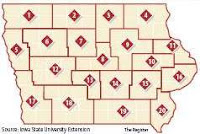 Howe's column also appeared in The Des Moines Register, which reported, "There will be 20 regional directors and one supervisor. Currently, there are 97 county directors and five regional directors. The reorganization and program cuts would reduce Extension's $100 million annual budget by about $4.3 million, officials said." Jack Payne, vice president for extension and outreach, told the Register's Erin Jordan, "It's a structure that is 100 years old that we cannot support anymore with the budget cut" from the Legislature. (Register map shows new extension regions, with county lines in white.)
Regent Michael Gartner, former editor of the Register and other papers, asked why more director positions weren't cut. Geoffroy said, "We did consider going to 10 directors, but decided that would be too much territory to cover." He said each director would oversee an average of about five counties and spend about a day a week in each county.
Minnesota made similar changes five years ago, and other states are doing likewise as the recession forces states and universitis to cut budgets. Ralph Otto, an associate extension administrator in the U.S. Department of Agriculture, told teh Register, "I hope that we survive this and come out more resilient than before. I say that with a certain amount of emptiness, because it doesn't help the folks right now who are having to do so much." (Read more) For the university's detailed explanation of its budget-cutting plan, click here.
University President Gregory Geoffroy "presented a previously unannounced plan to the Iowa Board of Regents ... without public input and just hours after the Legislature adjourned," writes Jay Howe, field editor of the Adair County Free Press. "Surprisingly, the regents OK'd the restructuring plan as a done deal without taking opportunity to gauge public views on it. Is this a model of how ISU Extension has sought to foster the process of engaging the public in making serious public-policy decisions?"
 Howe's column also appeared in The Des Moines Register, which reported, "There will be 20 regional directors and one supervisor. Currently, there are 97 county directors and five regional directors. The reorganization and program cuts would reduce Extension's $100 million annual budget by about $4.3 million, officials said." Jack Payne, vice president for extension and outreach, told the Register's Erin Jordan, "It's a structure that is 100 years old that we cannot support anymore with the budget cut" from the Legislature. (Register map shows new extension regions, with county lines in white.)
Regent Michael Gartner, former editor of the Register and other papers, asked why more director positions weren't cut. Geoffroy said, "We did consider going to 10 directors, but decided that would be too much territory to cover." He said each director would oversee an average of about five counties and spend about a day a week in each county.
Minnesota made similar changes five years ago, and other states are doing likewise as the recession forces states and universitis to cut budgets. Ralph Otto, an associate extension administrator in the U.S. Department of Agriculture, told teh Register, "I hope that we survive this and come out more resilient than before. I say that with a certain amount of emptiness, because it doesn't help the folks right now who are having to do so much." (Read more) For the university's detailed explanation of its budget-cutting plan, click here.
Colorado paper wins $50,000 in legal fees from school board that illegally closed a meeting
The school board in Steamboat Springs, Colo., has agreed to release the transcript of an illegal meeting and pay $50,000 in legal fees to the local daily newspaper, which warned the board not to hold the meeting and challenged it in court afterward.
The state Court of Appeals ruled in March that the board violated the state open-meetings law in 2007 by holding a closed session to discuss staff surveys of administrators and the performance of the superintendent, saying the session was "to discuss a personnel matter regarding 'access to information' and failing to say it would consult its attorney during the session, Jack Weinstein reports for the Steamboat Pilot & Today.
Three of the five board members at the time are no longer on the board. One of them cast the only vote against the deal with the newspaper, saying "I look at this as an in-your-face move by them to take $50,000 away from our students." The paper's editor, Brent Boyer, "said it’s the former School Board, not the newspaper, that has cost the district and taxpayers," Weinstein writes. Reader comments were running 4-1 in favor of the paper at 5 p.m. EDT today. (Read more)
The state Court of Appeals ruled in March that the board violated the state open-meetings law in 2007 by holding a closed session to discuss staff surveys of administrators and the performance of the superintendent, saying the session was "to discuss a personnel matter regarding 'access to information' and failing to say it would consult its attorney during the session, Jack Weinstein reports for the Steamboat Pilot & Today.
Three of the five board members at the time are no longer on the board. One of them cast the only vote against the deal with the newspaper, saying "I look at this as an in-your-face move by them to take $50,000 away from our students." The paper's editor, Brent Boyer, "said it’s the former School Board, not the newspaper, that has cost the district and taxpayers," Weinstein writes. Reader comments were running 4-1 in favor of the paper at 5 p.m. EDT today. (Read more)
Beekeepers want EPA to ban pesticides they blame for colony collapses
Beekeepers and environmentalists are supporting a proposed ban of pesticides developed by Bayer CropScience Inc., suggesting that two of its most prolific products, imidacloprid and clothianidin, are responsible for the recent phenomenon of bee colony collapse.
Julia Scott writes for Salon that since 2006, when colony collapse was first identified, American beekeepers have lost at least a third of their bees, threatening the food supply. In response, the National Honeybee Advisory Board, which represents the two biggest beekeeper associations in the U.S., requested that the Environmental Protection Agency ban imidacloprid. Clint Walker, a co-chairman of the board told Scott, "We believe imidacloprid kills bees -- specifically, that it causes bee colonies to collapse."
Critics argue that the EPA's initial decision to allow imidacloprid on the market in 1994 was careless. Current EPA literature calls it "very highly toxic" to honeybees and other beneficial insects. In 2003, Scott reports, EPA described clothianidin as "highly toxic to honeybees on an acute contact basis," and suggested that chronic exposure could lead to effects on the larvae and reproductive effects on the queen. Despite such claims, the EPA authorized the chemicals for market. "If the EPA had sufficient concern about harm to bees that they would insist on other studies, it seemed unwise to approve it anyway and ask for research after the fact," says Aaron Colangelo, an attorney with the Natural Resources Defense Council. "The EPA's job is to make a decision about whether a chemical is safe or not."
As EPA began pesticide studies this year, it announced that review of clothianidin and other chemicals in the same family would not start until 2012. Beekeepers and environmentalists are hoping the U.S. will follow France and Germany and ban the products. But Scott suggests that is unlikely for imidacloprid, because it is used under the Bayer label in more than 120 countries "on more than 140 crop varieties, as well as on termites, flea collars and home garden landscaping. And the product's patent expired a few years ago, paving the way for it to be sold as a generic insecticide by dozens of smaller corporations. In California alone, imidacloprid is the central ingredient in 247 separate products sold by 50 different companies." (Read more).
Julia Scott writes for Salon that since 2006, when colony collapse was first identified, American beekeepers have lost at least a third of their bees, threatening the food supply. In response, the National Honeybee Advisory Board, which represents the two biggest beekeeper associations in the U.S., requested that the Environmental Protection Agency ban imidacloprid. Clint Walker, a co-chairman of the board told Scott, "We believe imidacloprid kills bees -- specifically, that it causes bee colonies to collapse."
Critics argue that the EPA's initial decision to allow imidacloprid on the market in 1994 was careless. Current EPA literature calls it "very highly toxic" to honeybees and other beneficial insects. In 2003, Scott reports, EPA described clothianidin as "highly toxic to honeybees on an acute contact basis," and suggested that chronic exposure could lead to effects on the larvae and reproductive effects on the queen. Despite such claims, the EPA authorized the chemicals for market. "If the EPA had sufficient concern about harm to bees that they would insist on other studies, it seemed unwise to approve it anyway and ask for research after the fact," says Aaron Colangelo, an attorney with the Natural Resources Defense Council. "The EPA's job is to make a decision about whether a chemical is safe or not."
As EPA began pesticide studies this year, it announced that review of clothianidin and other chemicals in the same family would not start until 2012. Beekeepers and environmentalists are hoping the U.S. will follow France and Germany and ban the products. But Scott suggests that is unlikely for imidacloprid, because it is used under the Bayer label in more than 120 countries "on more than 140 crop varieties, as well as on termites, flea collars and home garden landscaping. And the product's patent expired a few years ago, paving the way for it to be sold as a generic insecticide by dozens of smaller corporations. In California alone, imidacloprid is the central ingredient in 247 separate products sold by 50 different companies." (Read more).
Carbon bill unfairly targeting rural poor, foe says
A foe of the Waxman-Markey "cap and trade" bill to limit carbon dioxide emissions claims the legislation is targeting poor, rural communities that rely on cheap, coal-fired electricity and going easy on states that have higher energy consumption but are less reliant on coal.
“Why is it that the wealthy parts of our country continue to attack the lifestyles of the rural poor?” Republican Rep. John Shimkus of Illinois said in his opening statement at the House Energy and Commerce Committee meeting Monday. "Shimkus was alluding to the bill’s sponsors, Rep. Henry Waxman, D-Calif., and Rep. Edward Markey, D-Mass., who both represent states that have higher energy costs and consume far less coal than Missouri and Illinois," Sean Rose reports for the St. Louis Post-Dispatch.
House Republicans have been criticized for opposing energy reform without presenting alternative solutions, and some, including Shimkus, have said they would never support carbon regulations. GOP leaders say the bill is confusing and claim it has not been thoroughly examined. Shimkus said a 900-plus page amendment was added to the bill an hour before the committee meeting on Monday. “If it’s really a good bill, let us read it over the week." (Read more)
“Why is it that the wealthy parts of our country continue to attack the lifestyles of the rural poor?” Republican Rep. John Shimkus of Illinois said in his opening statement at the House Energy and Commerce Committee meeting Monday. "Shimkus was alluding to the bill’s sponsors, Rep. Henry Waxman, D-Calif., and Rep. Edward Markey, D-Mass., who both represent states that have higher energy costs and consume far less coal than Missouri and Illinois," Sean Rose reports for the St. Louis Post-Dispatch.
House Republicans have been criticized for opposing energy reform without presenting alternative solutions, and some, including Shimkus, have said they would never support carbon regulations. GOP leaders say the bill is confusing and claim it has not been thoroughly examined. Shimkus said a 900-plus page amendment was added to the bill an hour before the committee meeting on Monday. “If it’s really a good bill, let us read it over the week." (Read more)
Monday, May 18, 2009
Postal Service consolidating routes in rural areas
Facing effective bankruptcy, the U.S. Postal Service is consolidating mail routes and angering rural residents. In Oconomowoc, West Bend, Oak Creek and elsewhere in Wisconsin, the recent combination of routes has residents complaining that mail is being delivered late and that they feel neglected, Scott Williams reports for the Journal Sentinel in Milwaukee. Williams reports that in Waukesha, business owners fear that cutbacks in mail collection hours will undermine their ability to conduct business.
Postal officials say the consolidation of delivery sites will save about $46,000 a year in each location and a total of $1.5 million in the 30 rural communities already affected. Mail often comes later in the day. U.S. Rep. Jim Sensenbrenner, a Republican from Menomonee Falls, told Williams he does not have an alternative plan for trimming costs, but he found that the cuts in southeastern Wisconsin will be too disruptive to customers. "You've got to remind the Postal Service repeatedly that their last name is service," he said. (Read more).
Postal officials say the consolidation of delivery sites will save about $46,000 a year in each location and a total of $1.5 million in the 30 rural communities already affected. Mail often comes later in the day. U.S. Rep. Jim Sensenbrenner, a Republican from Menomonee Falls, told Williams he does not have an alternative plan for trimming costs, but he found that the cuts in southeastern Wisconsin will be too disruptive to customers. "You've got to remind the Postal Service repeatedly that their last name is service," he said. (Read more).
Rural doctor shortages worsen in parts of Minn.
 The chronic problem of a shortage of doctors in rural areas is peaking in Minnesota, where Tom Robertson reports for Minnesota Public Radio that there are fewer family physicians in Bemidji now than five years ago, though the city's population has grown. (Photo by Tom Robertson: Dr. Suzie Human, right, is in high demand at MeritcCare Clinic in Bemidji)
Delays in care are a common side effect of the shortage in Bemidji, where, by this summer, there'll be only eight family care physicians. The MeritCare Clinic is also short on internal medicine and pediatric doctors. Patients often have to wait up to 15 months for a medical exam. "We have people coming in all the time, and there is no family practitioner available," Dr. Suzie Human told Robertson. "Every single day I have people saying, 'Can I see you at the clinic? Can you take on my family?' And every single day I have to say I can't take patients at this time."
The Minnesota Hospital Association reports that although 13 percent of Minnesota residents live in rural areas, only five percent of all physicians practice there. An underlying problem is the debt medical students face after graduation. The American Medical Association reports that only two percent of medical students are going into family practice. Many instead choose more lucrative specialties like cardiology or anesthesiology, where they can earn three or more times what a family doctor does. Students can also pay off debt more quickly by working in better-paying metropolitan communities.
Such factors puts enormous pressure on practitioners in rural areas."No one wants our job. It's a tough job," Human said. "We get torn between delivering babies and being in the clinic and being in the hospital and being in the hospital overnight, and going to the nursing homes. It's not the job that a lot of people want anymore." Medical clinics and hospitals in rural Minnesota have responded by hiring physician recruiters and offering perks like high bonuses and help paying student loans. Nonetheless, the geographic isolation, limited economy and lack of amenities makes it tough to persuade physicians at a time when their need is becoming even more crucial. (Read more)
Rural Wisc. bars worried about new smoking ban
The Wisconsin legislature approved a statewide smoking ban in all workplaces Wednesday to very mixed reactions from patrons and owners of bars, which will face their first smoking restrictions. Julian Emerson writes for the Leader-Telegraph in Eau Claire that in Chippewa County, pop. 60,456, some residents are angry at the state's intervention.
 "You go into a bar in Wisconsin, and there's going to be smoke," John Gullickson, 78, left, told Emerson while enjoying a cigar with a group of friends at the Albertville Tavern. "In this state, taverns and smoking go together." (Photo by Steve Kinderman)
Many larger cities in the state have adopted smoke-free policies, and Emerson reports that nearly 40 local governments, including Eau Claire, have passed their own anti-smoking ordinances: "Meanwhile, in most of the state's smaller cities and villages, smoke-filled bars and restaurants are as common as springtime dandelions."
The ban, which will join 25 states that already have similar laws, will begin in July 2010, giving bar owners and patrons time to create outdoor smoking areas and consider the impact it will have on their business. "The people who smoke, they don't want this," longtime Albertville Tavern owner Patti Nowak told Emerson. "A lot of the bar owners are worried that people might decide to stay home and smoke there." (Read more).
UPDATE, May 20: In a column for Lee Newspapers, Richard Mial notes that urban legislators were more likely to favor the law and rural lawmakers were more likely to oppose it.
 "You go into a bar in Wisconsin, and there's going to be smoke," John Gullickson, 78, left, told Emerson while enjoying a cigar with a group of friends at the Albertville Tavern. "In this state, taverns and smoking go together." (Photo by Steve Kinderman)
Many larger cities in the state have adopted smoke-free policies, and Emerson reports that nearly 40 local governments, including Eau Claire, have passed their own anti-smoking ordinances: "Meanwhile, in most of the state's smaller cities and villages, smoke-filled bars and restaurants are as common as springtime dandelions."
The ban, which will join 25 states that already have similar laws, will begin in July 2010, giving bar owners and patrons time to create outdoor smoking areas and consider the impact it will have on their business. "The people who smoke, they don't want this," longtime Albertville Tavern owner Patti Nowak told Emerson. "A lot of the bar owners are worried that people might decide to stay home and smoke there." (Read more).
UPDATE, May 20: In a column for Lee Newspapers, Richard Mial notes that urban legislators were more likely to favor the law and rural lawmakers were more likely to oppose it.
Chrysler cuts have big rural impact in Iowa, Neb.
Continuing media reports are making clearer the big rural impact of the auto-industry crisis. In Omaha, KETV reports that 31 Chrysler dealerships in Nebraska and Iowa are slated to lose support from the company. The automaker said last Thursday that it does not have the funds to keep all of its dealerships running.
If a bankruptcy judge approves, Chrysler's agreement with 800 dealers nationwide will end in June. However, some affected dealerships are negotiating with other automakers to keep them in business. The loss of dealerships will likely result in difficulties for consumers and small-town residents, who may lose jobs and have to drive farther for car service. (Read more).
If a bankruptcy judge approves, Chrysler's agreement with 800 dealers nationwide will end in June. However, some affected dealerships are negotiating with other automakers to keep them in business. The loss of dealerships will likely result in difficulties for consumers and small-town residents, who may lose jobs and have to drive farther for car service. (Read more).
Subscribe to:
Posts (Atom)