The Centers for Disease Control and Prevention is exploring a partnership to administer coronavirus vaccines at Dollar General stores, Nathan Bomey reports for USA Today, noting that Dollar General is one of the nation's largest retailers and has considerable rural presence.
"As of August 2020, Dollar General had more than 16,720 stores in 46 states," reports Liz Carey of The Daily Yonder. "That’s nearly twice the number of stores as the next largest private retailer working on vaccine rollout. The company said that 75 percent of all Americans live within five miles of a Dollar General store, and that 75% of its stores serve communities with fewer than 20,000 people."A digest of events, trends, issues, ideas and journalism from and about rural America, by the Institute for Rural Journalism, based at the University of Kentucky. Links may expire, require subscription or go behind pay walls. Please send news and knowledge you think would be useful to benjy.hamm@uky.edu.
Friday, March 12, 2021
Dollar General may administer coronavirus vaccines
Sunshine Week starts Sunday; here are resources, such as stories about delays getting records during the pandemic
Sunshine Week starts Sunday, March 14, so it's time to tell the public. The observance, coordinated by the News Leaders Association, is a celebration of open government and freedom of information, and an opportunity for news media to tout their role in both.
Click here to learn more or access a content toolkit with a special reporting package free for republishing. The Sunshine Week site has other tools, including op-eds, editorial cartoons, logos, story ideas, work from past Sunshine Weeks, a list of participants and a calendar of events.
Quick hits: Gray TV stations' series explores rural issues; clean energy passed coal as electricity source in 2020
A new investigative journalism project from Gray Television's local stations is exploring the extent of rural disparities in Appalachia and the Mississippi Delta, starting with health. Read more here.
A webinar series held on Tuesday evenings in March offers guidance on managing the everyday stressors of rural life. Read more here.
Here's a good backgrounder with updated information about rural emergency medical services and trauma. Read more here.
Going to daylight saving time this weekend could be especially hard because of pandemic-related sleep loss
Scientists are increasingly concerned about how the twice-yearly time change affects people's bodies. "The American Academy of Sleep Medicine, the largest scientific organization that studies sleep, in October 2020 suggested nixing daylight saving time and moving to a year-round fixed time," Jaffee reports. "That way, our internal circadian clocks would not be misaligned for half the year. And it would eliminate the safety risk from sleep loss when transitioning to daylight saving time."
Jaffee, the vice chair of neurology ay the University of Florida, has studied how the lack of sleep can impair the brain, and believes we have cause for concern: "In the 1940s, most American adults averaged 7.9 hours of sleep a night. Today, it’s only 6.9 hours. To put it another way: In 1942, 84% of us got the recommended seven to nine hours; in 2013, it was 59%. To break it down further, a January 2018 study from Fitbit reported that men got even less sleep per night than women, about 6.5 hours."
Lack of adequate sleep can cause more problems than being tired, Jaffee reports. It's associated with higher rates of heart disease, diabetes, obesity, asthma, depression, and lowered memory retention, attentiveness, and ability to fight off infections.
"States advocating for permanent daylight saving time are typically those that rely on tourism," Jaffee reports. "Environmentalists, favoring less energy consumption from morning heating and evening air conditioning, often support permanent standard time. Religious groups, whose prayer times are linked to sundown and sunrise, also tend to prefer permanent standard time. So do many educators, opposed to transporting children to school during mornings when it’s still dark."
Thursday, March 11, 2021
Will enough of us get a shot to create herd immunity? That depends partly on media messages; here's some advice
![]() |
| Shutterstock illustration via American Medical Association |
Director, Institute for Rural Journalism and Community Issues, University of Kentucky
We're about to get all the coronavirus vaccine we need. Will enough of us take it for herd immunity? Or will the politics of the pandemic, atop already widespread skepticism about vaccines, thwart that?
The answers to those questions will depend partly on local news media, the most trusted part of the news business, especially in rural areas, where vaccine hesitancy may be greater. Journalism to address vaccine hesitancy is tricky, Aspen Digital Executive Director Vivian Schiller writes for Columbia Journalism Review, after discussing it with many experts.
They came up with 10 things to do, which I've boiled down to five major points for rural journalists:
Address the unfounded public concern that the speedy development of vaccines means they’re not safe. "Operation Warp Speed" wasn't the best name for a process that used technology that had already been developed and was waiting for a big funding stream, Schiller writes: "Decades of research informed the development of these breakthrough gene-based vaccines, which have been shown to be remarkably effective, and come with comparatively low levels of risk." Also, the vaccines' different efficacy rates aren't exactly comparable, and even less so when it comes to mutated strains, and "Overemphasizing the rare instances of adverse reaction undermines trust," she writes.
Vaccine hesitancy is normal and natural. "Respond with compassion and information," Schiller advises. "After a year of mixed messages — many of which came from the highest levels of government and were amplified through social media — it’s entirely reasonable for people to have legitimate questions and concerns . . . The key is to debunk claims without repeating them. Also: Don’t conflate “vaccine hesitancy” with “anti-vaxxers,” she writes. "One is a reasonable emotion; the other is a harmful ideology."
Leverage trusted, local voices. "All news outlets should consider voices beyond national public health experts who can build trust and acceptance of the vaccine, such as clergy members, veteran groups, service clubs, and other community leaders," Schiller advises. "Varying your sources of reliable information can be more persuasive for wary populations. Building vaccine trust with audiences means trying and sharing new ways to engage."
Don’t accidentally undersell vaccine effectiveness. Warnings "that vaccinated individuals shouldn’t alter their pandemic routines — social distancing, wearing masks, avoiding indoor spaces — may inadvertently encourage vaccine hesitancy, as the advice appears to conflict with the benefits touted around the vaccine," Schiller writes. "The science is still unsettled on whether vaccinated people can transmit the disease to the unvaccinated. . . . The message needs to be: Get the vaccine for your own protection — and the sooner enough of us make that critical, individual decision, the sooner all of us can go back to something approximating our pre-pandemic lives."
Fill the data voids. "News organizations might consider the practice of 'pre-bunking'—that is, actively debunking or anticipating public questions and concerns rather than only reacting once false narratives have been popularized," Schiller suggests. "Publish explainers in advance to protect against misinformation; explain the safety of the vaccine for children or pregnant women; share the commonality of side effects that most people experience, especially after a second dose. There is a growing body of evidence that it works."
FCC finalizes new broadband subsidy plan; who qualifies?
- Households with at least one member who qualifies for the FCC's existing Lifeline support program, which serves low-income Americans, including those on Medicaid or the Supplemental Nutrition Assistance Program (formerly food stamps);
- Households whose children qualify for free or reduced-price school meal programs during the current or previous school year;
- Recipients of Pell grants for postsecondary education;
- Households that have suffered a substantial loss of income since Feb. 29, 2020, if their total income for last year fell below $99,000 for single filers and $198,000 for joint filers;
- Households that meet eligibility criteria for another low-income or coronavirus-discount program from a participating provider.
USDA extends free school meals through September; meal providers say they need more money to cover packaging
The U.S. Department of Agriculture announced this week it will extend several waivers to allow all children, regardless of income, to receive free school meals through Sept. 30 via the Summer Food Service Program and the Seamless Summer Option program. The waivers had extended only to June 30. The programs allow meals to be served outside of the normally required group settings and meal times, and allow parents or guardians to pick up meals, including in bulk to cover several days, USDA says.
"However, Tuesday’s announcement did not come with increased per-meal reimbursements for providers," Laura Reiley reports for The Washington Post. "During the pandemic, most school-meal programs have operated at a loss, with significantly higher costs and no increased per-meal reimbursement."National Rural Health Association announces 2021 awards
The National Rural Health Association has announced its 2021 Rural Health Awards, to individuals and organizations in rural health care who have "dedicated their time and talents to improving the health and well-being of others."
![]() |
| Jennifer McKenney |
Coalfield Health Care in Logan County, West Virginia, was named this year's Outstanding Rural Health Organization. "Coalfield helps bolster the health of a community that has some of the worst outcomes in the country. Coalfield has served not just as a primary care center for patients regardless of ability to pay, but as an educational, research, and community outreach hub for more than 10 years," NRHA said.
NRHA's Outstanding Rural Health Program award went to Northeast Kentucky Substance Use Response Coalition, a formal network of health care and social service organizations that represents 18 counties and is focused on building a community-based approach to address the region’s opioid crisis. The organization aims to create educational, clinical, and preventive interventions for those who struggle with substance use disorder.
Alana Knudson won NRHA’s Outstanding Researcher Award. She leads the NORC Walsh Center for Rural Health Analysis, and has become a nationally recognized leader in developing and evaluating demonstration projects for the Federal Office of Rural Health Policy and the Centers for Medicare and Medicaid Services. Her teams' research helps improve sustainable rural access to high-quality services.
Douglas Snow won this year’s NRHA/John Snow Inc. Student Leadership Award. The Michigan State University medical student plays an integral role in student leadership for NRHA as chair of the association’s Student Constituency Group. One medical school official said: "At national, state, and local levels, he has made a lasting impression on rural health leadership and student involvement as well as community and public health."
The NRHA/John Snow Inc. Student Achievement Award went to Kelly Dougherty. The University of Missouri medical student has re-established the university’s rural medical interest group and highlighted the need for rural providers, and is also an active member of the Rural Scholars Advisory Board.
Pat Schou is NRHA’s Volunteer of the Year. The executive director of the Illinois Critical Access Hospital Network, Schou is also a longtime NRHA member and past president of the association. She helped guide and represent the association during the pandemic and ensured rural America's voice was heard on a national level. "She is a role model for how to lead in the worst of times in the most honorable way," according to the NRHA.
Wednesday, March 10, 2021
Thinking about news, citing 'problem solvers and pioneers charting new ways to live up to enduring responsibilities'
![]() |
| Tom Rosenstiel |
One of his questions was, How do journalists contend with public officials who are lying? That's nothing new, but has been elevated to new levels in recent years, he notes, and gives one example of how to confront the liars: WITF, the public radio and television station in Harrisburg, Pa., which
"has promised it will regularly hold accountable those who played a role in perpetuating the falsehood that the presidential election was stolen." One way: Identify “how elected officials’ actions are connected to the election-fraud lie and the insurrection.” For example, if a legislator introduces a bill, WITF will note that they “signed a letter asking members of Congress to delay certifying Pennsylvania’s electoral votes despite no evidence to call those results into question.”
Another key point was, "One story now is more important than any other. Sarah Alvarez, the founder of Outlier Media in Michigan, has developed criteria for deciding where to apply her limited reporting resources. She asks: 1) What is affecting the most people? 2) What is the level of harm? 3) Where are there gaps in what people need to know? By Alvarez’s smart criteria, one story matters most today: the pandemic. The coronavirus threatens everyone in the country. . . . People are misinformed about it, and the economy cannot recover until it is under control. . . . Cover it for what it is — the defining story of our generation, and focus on what the public needs. Get inside local health-care systems, identify possible solutions and not just problems, tell stories we have not heard. To survive in a networked world, journalism must be a service — not just a product — one that meets people where they are and helps them make their lives better."
Studies highlight social-media platforms' misinformation problem, reminding us of the key role of the news media
New rural coronavirus infections, deaths fell 20% last week
![]() |
| Rates of new coronavirus infections, Feb. 28 through March 6 Daily Yonder map; click the image to enlarge it or click here for the interactive version |
Click here for more data, analysis and graphics from the Yonder, including an interactive map with county-level data.
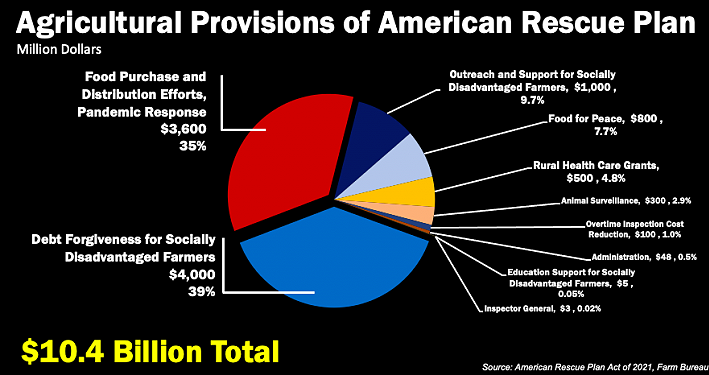
What's in final relief-and-stimulus package for rural America
![]() |
| American Farm Bureau Federation chart |
- The $15-per-hour minimum wage hike was scrapped. after the Senate parliamentarian ruled that it couldn't be included in a bill passed by reconciliation.
- A new provision would provide $1.5 billion over two years to counties with large swaths of federal public land not subject to property taxes. The funding would be distributed based on the county's economic needs.
- Expanded federal unemployment benefits would be extended through Sept. 6, but at the current rate of $300 a week, not $400, as in the House version. The first $10,200 of benefits would be tax-free for households earning under $150,000 a year.
- Eligibility requirements were tightened for the $1,400 stimulus checks.
- Struggling rural health-care providers who have not yet received their share of pandemic relief money would get $8.5 billion.
- 100% of health-care premiums under the COBRA law would be subsidized through September, to ensure that laid-off workers can keep their health insurance. The House version capped premium subsidies at 85% of the cost.
- The $350 billion in direct aid for state and local governments can only cover costs incurred by the end of 2024, and that money can't be used to offset tax cuts or create a pension fund.
- Restrictions on aid to governments were broadened to give them more flexibility to pay some workers more hazard pay.
- Small states must get at least as much direct aid as they got from the relief package passed in March 2020.
- States, territories and tribal governments will receive $10 billion under a new "critical infrastructure projects" program.
- Funding for the Economic Development Administration would rise to $750 million to help communities hurt by job and revenue losses related to the decline in tourism, travel and outdoor recreation.
- The Senate greenlit $510 million more than the House to fund the Federal Emergency Management Agency's program for homeless services programs and food banks.
- The extra FEMA funding would also provide one month's rent or mortgage payment to help prevent evictions, as well as one month's utility payments to prevent service cutoffs.
- Increased funding for the United States Digital Service would help meet high demand from agencies that need help providing services such as vaccine distribution, unemployment assistance and stimulus checks.
- Any student loan forgiveness law passed between Dec. 31, 2020 and Jan. 1, 2026 would be tax-free, ensuring that the forgiven debt could not be treated as taxable income.
Nearly a third of rural family caregivers say they won't take their older relatives to get a coronavirus vaccine
The survey's findings overlap with recent polls underlining Republicans' greater hesitance about the vacccine, as rural areas tend to be more conservative. Though overall resistance to vaccination is waning, it remains "relatively high" among Republicans, The Washington Post reports; over a third of Republicans in a recent survey said they will definitely not get vaccinated.
Tuesday, March 09, 2021
Investment firms buy trailer parks, squeeze them for profit
![]() |
| Mobile homes as a share of each county's housing units as of 2017. Washington Post map; click the image to enlarge it. |
Mobile-home parks are a critical source of affordable housing, especially in rural areas. Increasingly, investment companies are buying them up and, in efforts to extract maximum profits, making it harder for the poor to afford living in them.
About 20 million Americans, many seniors, veterans, and people with disabilities, live in mobile homes. Manufactured housing, common in rural America, is one of the largest sources of unsubsidized low-income housing in the U.S. Sheelah Kolhatkar reports for The New Yorker.
Victims of Eastern Kentucky flooding will benefit from telethon held Monday, Facebook fundraiser set Wednesday
"Love Thy Neighbor: An Appalachians for Appalachia Flood Relief Show" is set for 7 p.m. ET March 10 on Facebook Live and will feature performances and readings from Silas House, Senora May, SG Goodman, Robert Gipe, and more. All proceeds will go to the Southeast Kentucky Flood Relief Fund.
Nonprofits say redefinition of metro areas could hurt rural funding, mount campaign to urge a delay and more study
![]() |
| Proposed changes to the Office of Management and Budget's metropolitan/nonmetro definition Daily Yonder map; click the map to enlarge it or click here for the interactive version. |
"A group of researchers, service organizations, and nonprofit leaders are organizing a national campaign to urge the Office of Management and Budget to delay redefining metropolitan statistical areas, the county categorization system that underlies many rural-focused federal programs,” Tim Marema reports for The Daily Yonder. The change would increase the minimum population of core cities for an MSA from 50,000 to 100,000, classifying of about 140 metropolitan areas as "micropolitan," which now applies to areas with core cities of 10,000 to 49,999. That would "about 250 counties with 18 million residents, according to an OMB estimate based on 2010 census data," Marema reports.
The proposal is open for comments through Friday, March 19, The OMB's Federal Register announcement about the proposed change, made in the closing days of the Trump administration, says federal agencies shouldn’t use its classification system to determine program and funding eligibility, but many federal agencies use the classification system, as well as other ways of categorizing places.
The Aspen Institute’s Community Strategies Group and a senior fellow at the Brookings Institution are asking groups to sign a joint letter highlighting concerns about the proposal. "The letter says that increasing the number of nonmetropolitan counties could increase competition for scarce rural funding,” Marema reports. “The sign-on letter says OMB should take a comprehensive look at the metropolitan definition, instead of changing just the population criterion. That would give the agency the opportunity to review the non-statistical consequences of any changes.”
USDA: Supermarket prices spiked in 2020 but might go back down some in 2021
The average cost of prices at grocery stores and in restaurants spiked in 2020 but might go back down some in 2021, according to a new report by the Agriculture Department's Economic Research Service.
"According to USDA data released last week, the Consumer Price Index for grocery store or supermarket food purchases last year was up 3.5 percent: That's not only a significant jump from 2019, where these retail "food-at-home" prices were up only 0.9% from the year before, but also well above the 20 year annual average of 2.0% and the highest annual increase since 2011," Mike Pomranz reports for Food & Wine. "Meanwhile, the cost of restaurant purchases saw a similar spike, up 3.4% over the past year, meaning Americans were likely paying more for food wherever they went."
The price increases were driven partly by the pandemic's affect on supply chains and labor, but also by changes in consumer habits. "Stay-at-home mandates in 2020 increased demand for several food products in retail stores, rather than at restaurants and schools," said the report. "Supply chains struggled to adapt to this transition, which put upward pressure on retail prices."
Meat prices showed an especially dramatic increase, though almost all other food categories went up in price except fruit, the report says. Meatpacking plants were hard-hit during the pandemic and were often obliged to temporarily close or reduce production for safety reasons, Pomranz reports.
Monday, March 08, 2021
Herd immunity may depend on reluctant Republicans; could mean complications for rural areas, and thus for the nation
![]() |
| Timothy Shea showed his fishnet mask at the recent Conservative Political Action Conference. (Washington Post photo by Jabin Botsford) |
Describing the reluctance of an elderly Trump voter in Oklahoma who would be interviewed only if her last name wasn't used, Diamond notes, "Polls have repeatedly found that nearly one-third of Republicans share her staunch resistance to the coronavirus vaccines, although for a variety of reasons. Some, like Margaret, worry they were developed too quickly. Others argue without evidence that many vaccines are unsafe or will make them sick. Still more echo Trump’s repeated contention that the coronavirus threat is overblown and simply don’t trust the government’s involvement."
Public-health experts have focused persuasion efforts on communities of color, "worried their historical distrust of the medical establishment might lead to low vaccination rates," Diamond reports. "But there’s been less focus on winning over Republicans." The de Beaumont Foundation has hired Republican pollster Frank Luntz to "crack the code" for Republicans, as Luntz put it. He said the most common thread is “They simply don’t trust the government to do the right thing.” But Diamond writes, "Vaccine-hesitant Republicans defy easy categorizations," and gives examples.
"The Biden administration is also researching how to reach holdout Republicans, said a senior administration official, speaking on the condition of anonymity to discuss in-progress efforts," Diamond writes, quoting the official: “The most trusted messengers are doctors, nurses, faith leaders. We want to talk to everybody.”
Robert Coon, a Republican political consultant in Arkansas who has polled on the subject, todl Diamond, “I don’t think you’re going to end up with 70 percent adoption in some states, where you’re not going to have the majority of the biggest political party.” Diamond writes, "The proportion of people who need to be immune to reach herd immunity with covid-19 isn’t known, but experts estimate it between 70 to 85 percent."
Diamond offers an important caveat: "It’s too early to see those views play out. Health officials in eight rural counties that Trump won handily — in states ranging from Georgia and Pennsylvania to Texas and West Virginia — said that demand is still outpacing scant supply." Deborah Baker, health director in Missouri’s Pulaski County, which Trump carried by 46 points told Diamond, “We’ve had a huge outpouring of people wanting the vaccine here. . . . I don’t think the political environment has mattered.”
Biden taps director of Wisconsin's Office of Rural Prosperity as one of his key agriculture and rural policy advisers
![]() |
| Kelliann Blazek |
Blazek was appointed first director of Wisconsin's Office of Rural Prosperity in April 2020. But "before returning to Wisconsin, Blazek worked as counsel to U.S. Rep. Chellie Pingree, D-Maine, and helped include provisions in the 2018 Farm Bill that supported local food economies, organic agriculture and food-waste reduction," Mitchell Schmidt reports for the Wisconsin State Journal. "She also taught food law and policy at the Antonin Scalia Law School and spent time at the Harvard Food Law and Policy Clinic and the National Sustainable Agriculture Coalition. She grew up on a small beef farm outside of Bangor in La Crosse County, which her family still runs."
Blazek's appointment will likely be welcome news to those who want more rural voices in the Biden administration. A recent panel of rural policy experts at Kenyon College, for instance, agreed that not having such voices has resulted in "major structural problems" in nationwide policy.
Natl. Newspaper Assn. postpones Community Newspaper Summit and Country Editors Forum that were set this week
Sunshine Week is next week; here are resources, including a Ken Paulson column: 'Let government know who's boss'
Click here to learn more or access a content toolkit with a special reporting package free for republishing. The Sunshine Week site will provide other tools, including op-eds, editorial cartoons, logos and a list of open-government questions that journalists can ask federal candidates. The site also features freedom-of-information story ideas and work from past Sunshine Weeks, a list of participants and a calendar of events.
Hazardous 'forever chemicals' found in common pesticides
Study: Wildfire smoke worse than car pollution for the lungs
![]() |
| 2021 wildfire risk map from Wildfirerisk.org Click the image to enlarge it or click here for interactive county- and state-level data |
Wildfires are more harmful to human lungs than many other sources of air pollution, including car exhaust. That's according to newly published research from the University of California, San Diego's Scripps Institution of Oceanography. "The research, published in the journal Nature Communications Friday, paints a worrisome picture for Americans living on a fire-prone continent, especially as climate change amplifies fire risk worldwide," Nathan Rott reports for NPR.
Sunday, March 07, 2021
Weekly honored after filling revenue gap with sponsorships, grants and relief money, and collaborating with J-schools
![]() |
| Chatham County is next to the Research Triangle of Raleigh, Chapel Hill and Durham, N.C. (Click on map to enlarge it.) |
"This is the story of a $120,300 juggling act involving human capital, dollars and sense," University of Kentucky journalism professor Buck Ryan writes in the latest installment of his case study of the Chatham News + Record, a 3,800-circulation weekly.
Horner filled the gap with $37,300 in grants from Facebook and Google, $18,000 from local sponsorships and $60,000 in a forgivable Covid-19 relief loan, "plus $5,000 in underwriting from the Missouri School of Journalism to support an innovation intern." The paper has also worked with the Hussman School of Journalism and Media at the University of North Carolina-Chapel Hill. Ryan gives details in a narrative and an interview with Horner, available here.
Friday, March 05, 2021
W.Va. supports nonprofit news site, suggesting business model based on philanthropy and rural readers can work
![]() |
| Ken Ward Jr., left, and most of his colleagues at Mountain State Spotlight, in a photo from its About page. |
About a year ago, Ken Ward Jr. decided that his considerable and frequently proven talents as a reporter needed a better platform, so he followed his editor Greg Moore out the door of the Charleston Gazette-Mail and they soon co-founded with ProPublica a nonprofit news organization, Mountain State Spotlight, to serve one of the nation's most rural states.
Can Biden deliver on promises to coal country, especially Central Appalachia? Residents and experts weigh in
Study examines why some LGBTQ+ Americans prefer rural; some say urban gay culture is too focused on sexuality
Pop culture portrays LGBTQ+ Americans as urban dwellers, but between 15 and 20 percent of them live in rural areas, a greater share than the rural population. A new study delves into why some choose to be ruralites and what life is like for them. Christopher T. Conner, assistant sociology professor at the University of Missouri-Columbia, has conducted in-depth interviews with 40 rural LGBTQ+ Americans since 2015 and analyzed various survey data to augment his research.
Many view their sexual identity very differently than their urban counterparts and "question the merits of urban gay life," Conner writes for The Conversation, a site for academics to write journalistically about their research. The stereotype is that LGBTQ+ young adults who grow up in rural areas escape to large cities with thriving "gayborhoods" so they can feel normal and accepted, but research by Conner and others shows that many who flee to the cities ultimately return home. His interview subjects commonly downplayed their sexual or gender identities and focused on other parts of their lives such as sports, music, nature or games. They said they found urban gay culture to be shallow and too focused on sexuality as the defining characteristic of life.
Rural LGBTQ+ Americans are often shown as lonely and less able to live openly, "but my analysis of a 2013 Pew survey of LGBTQ Americans – the latest available comprehensive national survey data on this population – showed that LGBTQ rural residents are actually more likely to be legally married than their urban counterparts: 24.8% compared with 18.6%. This aligns with what I’ve heard in interviews. The rural LGBTQ people I spoke with placed a high value on monogamy – on what many of them consider a 'normal' life," Conner writes. "Those who returned home from urban gayborhoods also told me they found gay city living rarely delivered on its promises of companionship and inclusion. Many said they had experienced rejection while trying to date or develop a social circle. And they had missed the charm of small-town life."
However, Conner notes, rural Black and Latino LGBTQ+ people tend to face more difficulties because, according to a 2019 report, "discrimination based on race and immigration status is compounded by discrimination based on sexual orientation, gender identity and gender expression."
Some interview subjects said they'd rather live in rural areas because they would face discrimination no matter where they are, and living in small towns allows them to focus on other parts of their lives they feel are more important. "For some LGBTQ Americans, then, rural life allows them to more fully express themselves. Given the variety of issues facing LGBTQ Americans, from health care access to work problems, the rural world is not an escape from discrimination," Conner writes. "But neither are urban areas."
Quick hits: Solutions needed for overdue utility bills; Maine 'hackathon' aims to boost rural economic recovery . . .
Sinclair Broadcast Group, big in rural TV, plans to lay off hundreds of employees, citing economic impact of pandemic
Thursday, March 04, 2021
N.C. weekly editor Tom Boney, jailed after seeking access to court hearing, receives NNA's First Amendment Award
![]() |
| Tom Boney Jr. |