Tuesday, October 05, 2021

Rural hospitals that joined chains were more likely to stop maternal and neonatal services, limit mental-health access

Average number of hospital stays for maternal/neonatal care, surgical services and mental health/substance-use disorder, for merged and independent hospitals (Health Affairs graph; click on the image to enlarge it)
Rural hospitals that were acquired in mergers from 2009 to 2016 were more likely than their independent peers to shutter their maternal, neonatal and surgical services, and more likely to limit access to mental-health care, on-site diagnostic technologies, and non-emergency outpatient services, according to a newly published study in the journal Health Affairs.

In essence, the researchers found, a merger might save a hospital from closing, but make it less responsive to community needs. Merged hospitals were also less likely to be critical-access hospitals, and more likely to be privately owned, have more beds than average, and be located in the South.

The study compared 172 rural hospitals that merged with larger systems between 2009 and 2016 and compared them with 549 hospitals that remained independent, using data from annual American Hospital Association surveys. In the year after hospitals were acquired, the average number that provided any maternal or neonatal services fell 6.7 percentage points more than independent hospitals. Two years afterward, that gap increased to 7.2 percentage points, but at three years post-merger and beyond, the gap virtually vanished.

One year after being acquired, merged hospitals were 5 percent less likely like to offer surgical services than independent hospitals. The statistical gap became insignificant two and three years after merger. Analysis showed that locals weren't accessing those services elsewhere nearby, so the data suggests that the merger didn't generally hurt patient access to inpatient care.

Admissions for patients with mental-health issues or substance-use disorders stayed about the same for the first two years after hospitals were acquired, but increased during the same time period for independent hospitals. That and other data suggests that communities with merged hospitals may have reduced access to behavioral health care.

The study is the second from the federal Agency for Healthcare Research and Quality and IBM Watson Health to examine the benefits and consequences to health-care access for people whose local hospital was acquired. The first one found that merged rural hospitals had lower overall lower death rates, especially from heart attacks.

USDA launches $500 million loan guarantee program for small meatpackers in hopes of easing supply-chain woes

The U.S. Department of Agriculture is offering new loan guarantees for small, independent meatpackers, Secretary Tom Vilsack announced Monday. The $500 million program is meant to expand capacity for meat and poultry processors and alleviate supply-chain bottlenecks caused by the pandemic. 

"The Agriculture Department, along with the White House, has been targeting the meat and poultry sector for months, blasting the industry for heavy concentration that contributed to supply chain disruptions during the pandemic and following other shocks, such as the recent hack of JBS beef plants by Russian cybercriminals," Ximena Bustillo reports for Politico's Weekly Agriculture.

"A loan guarantee often means lower interest rates for a project because the USDA promises to repay most, but not all, of a loan if the borrower defaults," Chuck Abbott reports for the Food & Environment Reporting Network. "Often, the USDA guarantees 90 or 95 percent of a loan. Lenders may be more willing to extend financing since they have assurance of repayment. Loan guarantees are a way to magnify the power of USDA funding because comparatively little money is expended for each project; the borrower has to compile the funding for the project."

New coronavirus vaccinations in rural counties fell 20% last week; rural rate stays 11.8 percentage points below metro

Vaccination rates as of Sept. 30 compared to the national average, adjusted to account for vaccinations not assigned to specific counties, Map by The Daily Yonder; click the image to enlarge it or click here for the interactive version.

"After increasing for five out of the last six weeks, the pace of new vaccinations in rural counties fell last week by about 20%. The number of new vaccinations in metropolitan counties was down by nearly a third," Tim Murphy and Tim Marema report for The Daily Yonder. During the week of Sept. 24-30, about 348,000 rural Americans completed their coronavirus vaccinations, down from about 448,000 the week before. About 2.2 million Americans in metropolitan counties completed their vaccinations, down from about 3.1 million the week before.

"As of September 30, 42.1% of the nation’s rural population was fully vaccinated. In metropolitan counties, 54.0% of the population is fully vaccinated," Murphy and Marema report. "The gap between the rural and metropolitan vaccination rates remained steady at about 11.8 percentage points."

Click here for more charts, maps and regional analysis from the Yonder, including an interactive map.

Manning-Stone OKd to lead Bureau of Land Management

Tracy Stone-Manning during Senate testimony
(Associated Press photo by Graeme Sloan)
"The Senate narrowly approved Tracy Stone-Manning on Thursday to lead the Bureau of Land Management, capping months of efforts by Republican lawmakers to block her confirmation because of her connection to a decades-old tree spiking incident," Lisa Friedman reports for The New York Times. "Stone-Manning steps into an agency that has been stretched thin ever since the Trump administration moved the BLM headquarters to Colorado last year, and will soon be faced with decisions over the future of oil and gas leases on federal land in Western states."

As part of its mission to protect natural resources, the Interior Department agency manages grazing, logging, drilling and mineral rights on public lands. "It is responsible for balancing oil, gas and coal extraction with recreation and the protection of natural resources," Friedman reports. "It also is key to President Biden’s goal of phasing out oil and gas drilling on federal lands. That plan has been in limbo since a federal judge ruled in June that the administration did not have the authority to suspend leases."


Monday, October 04, 2021

Rural Covid death rate spikes to more than twice urban rate

University of Iowa College of Public Health graph, adapted by The Rural Blog
Rural deaths from Covid-19 have spiked to the point that the latest rural death rate is twice that of the overall rate in metropolitan areas, according to a report from the Rural Policy Research Institute.

Fred Ullrich and Keith Mueller of the College of Public Health at the University of Iowa tracked Covid-19 mortality rates from the beginning of the pandemic and found that counties outside metro areas began showing higher rates in June, with a wider separation beginning in August.

Over the course of the pandemic, the non-metro mortality rate, 231 deaths per 100,000 residents, has been only moderately higher than the metro rate, 195 per 100,000, Ullrich and Miller report.

The researchers also tracked the rates in micropolitan areas, which are outside metros but have cities with populations between 10,000 and 50,000. Their death rates were usually about the same as those in rural areas until last month, when the rural rate clearly exceeded it.

Ullrich and Mueller's report also tracks the rate of new cases since the start of the pandemic. It shows that on Sept. 15, the seven-day average of new cases in metro areas was 43.3 per 100,000 residents, and in non-metro areas (rural and micropolitan) it was 66.8 per 100,000.

The overall non-metro vaccination rate is 41.4 percent, while the metro rate is 53.3%.

Some rural states that got a fast start on vaccination against the coronavirus have hit a wall of resistance

Stateline chart, based on Centers for Disease Control and Prevention data
Some states with large rural populations got off to a fast start getting their residents vaccinated, but recently "have hit a wall," reports Stateline, a service of the Pew Charitable Trusts.

"Those less populous states outhustled bigger ones using innovative distribution schemes such as flying vaccines on small airplanes to remote areas, tapping into existing rural health systems and eschewing the county-by-county model that slowed larger states’ distribution," Elaine Povich writes., noting Alaska and West Virginia. "The plummet is a combination of the unsustainability of early distribution methods and less demand for vaccines among the remaining, largely rural population, experts say."

Jennifer Tolbert, state health reform director for the Kaiser Family Foundation, told Povich, “More recently, what you are coming up against are ideological issues in more conservative states. Vaccines are available, but absent mandates and requirements for people to get vaccinated, if there is hesitation or reluctance in large sectors of the population, the vaccines are going to plateau.”

William Galston, a senior governance-studies fellow at the Brookings Institution, a nonpartisan think tank, "noted that white people without a college degree, who generally make up more of the vaccine-resistant U.S. population, are a higher share of the rural population." He told Povich, “I won’t say demography is destiny, but when you are looking at vaccines, it’s way up there.”

The wall is also political. Several research reports have noted the negative correlation between states' vaccination rates and their percentage of vote for Donald Trump last year. Here's one graph, from The Washington Post:


U.S. Postal Service is charging more for poorer service; you can look up the predicted effect in your postal area

Washington Post chart; for a larger version, click on it.
This week, the U.S. Postal Service starts operating on new delivery standards this week, and it's not good news. On top of recent postage-rate increases, USPS is giving itself more time to deliver the mail.

Just how much more time, where you're concerned? You can find out on an interactive site created by The Washington Post. The contractions and shifts in speedy-delivery areas can be fascinating; this comparison for Pike County, Kentucky, shows that the USPS is making it part of West Virginia, in postal terms. The changes appear to have a disproportionate effect on many rural areas.
Washington Post maps, based on software by Mapbox; for a larger version of the image, click on it.
"Seventy percent of first-class mail sent to Nevada will take longer to arrive, according to The Post’s analysis, as will 60 percent of the deliveries to Florida, 58 percent to Washington state, 57 percent to Montana, and 55 percent to Arizona and Oregon," The Post's Jacob Bogage reports. "In all, at least a third of such letters and parcels addressed to 27 states will arrive more slowly under the new standards.
Bogage notes that the changes are "core components of Postmaster General Louis DeJoy’s 10-year plan for the agency, a program designed to cut costs and raise new revenue to fix its many financial problems."

Sunday, October 03, 2021

Reports of anti-vaccine preachers spur weekly to use its 'bully pulpit' and forswear 'neutrality in times of moral crisis'

Crittenden County, Kentucky (Wikipedia map)
Some newspapers are making extra efforts to increase vaccination against the coronavirus, by fighting misinformation with the facts. Chris Evans, the editor and publisher of the only paper in Crittenden County, Kentucky, population 9,000, reported to colleagues what he and his wife Allison have done:

"The Crittenden Press has published a first-person article from a local M.D. encouraging vaccines; an article about a nurse practitioner whose husband was hospitalized and unvaccinated and she changed her tune on the vaccine in a hurry; and we have had a couple of recent op-ed pieces, too. Allison wrote a very well-received column a couple of weeks ago comparing it to smallpox and polio." (See below.)

The Crittenden Press spotlighted the Covid-19 deaths of a local couple.
"Last week, we began a front-page feature where businesses and/or agencies, including local government, are encouraged to tell us how many of their folks are vaccinated. Then we publish what they tell us. City council went first. We have had good response to that so far. Today I attended the funeral of a husband and wife, both unvaccinated, who died last week. The wife previously worked for us for several years."

Evans concludes, "If Covid hasn’t hit your doorstep yet, it’s coming, and we have heard about pastors who are preaching against the vaccine from the pulpit. I told Allison today, they may have a big audience, but ours is bigger. You probably know that I am a church-going conservative, but it’s time to use my bully pulpit. I have been somewhat reluctant until now to stick my nose squarely into the middle of this, but I think it is time. I am reminded of the phrase in Dante’s Furnace that 'The darkest places of hell are reserved for those who maintain their neutrality in times of moral crisis.'"

Allison Mick-Evans
The column by Allison Evans, headlined "Polio to Covid," noted the "greater public acceptance of and willingness to receive the polio inoculation" in the 1950s. "One of the reasons, historians say, was that Americans had a deep respect for science. A chorus of social media opinions did not exist back then to confuse the public. A campaign of disinformation and skepticism about the Covid vaccine has clearly created pockets of deep-rooted resistance, doubt and insecurity." She addressed one source of doubt, the much quicker development of Covid vaccines, which "was the result of years and years of research in the scientific archives on SARS vaccines. Because Covid and SARS are both coronaviruses diseases, scientists has a head start on dealing with the new strain, which led to the relatively quick creation of a Covid-19 vaccine."

Evans concluded, "I understand the fear of the unknown. It’s a weakness I share. Being fearful of making the wrong decision is what creates hesitancy, sometimes with serious consequences. But we trusted scientists in the 50s to protect our children from polio. Science worked. And now it’s time to let science protect us again. The rollout of a life-saving vaccine is something we might only see once or twice in our lifetime. Hopefully no more. Folks in the '50s who trusted the process of eradicating polio should be our guide. It’s time we do the same so our kids and grandkids won’t live with Covid-19, but instead will need to Google it."

The Rural Blog invites other editors to share their recent special efforts to battle the pandemic. Email al.cross@uky.edu and heather.chapman@uky.edu.

Friday, October 01, 2021

Weekly editor in Tennessee follows through on his public promise to report on drug addiction, and does it prominently

Bradley Martin
Rural weekly editor Brad Martin of Centerville, Tenn., is following through on his commitment to report on the crippling impact of drug addiction in his Tennessee county, holding up an uncomfortable mirror to his community on a topic that most rural newspapers pigeonhole as crime news.

Drug overdose deaths in Hickman County nearly doubled from 2019 to 2020, Martin recently reported in an above-the-fold story in the Hickman County Times. In addition to a sensitive, in-depth treatment of the phenomenon, he also showed the increasing danger of fentanyl by running a huge chart with an annual breakdown of what caused all county overdoses from 2017 to 2020.

On the opinion page, Martin's "From the porch" column reported that a local drug detective had heard this chilling scenario, not confirmed locally: "Fentanyl parties, 'where six or seven people get together,' with the lethal drug along with some Narcan and what he described as a 'designated driver.' That’s the person who does not partake but is prepared to apply Narcan 'to bring someone in the group back after an overdose'."

Hickman County (Wikipedia map)
That may be a myth, but the drug epidemic is fact, and Martin's column encourages readers to attend tonight's meeting of a local foundation "where addiction is front and center." He recalls how the county favorably responded to a rash of suicides in 2003. "I don’t think drug addiction is quite the same thing, but when a community comes together (witness: floods), things have been known to improve," he writes. "We have nothing to lose, and I must reiterate here that our absent friend, Superman, still is not expected to show up and save us."

Martin has been writing stories and columns on the topic since at least last December. In late January, he told readers that he intended to report on an aspect of drug addiction once a month this year. to download pages with his latest work on the topic, click here.

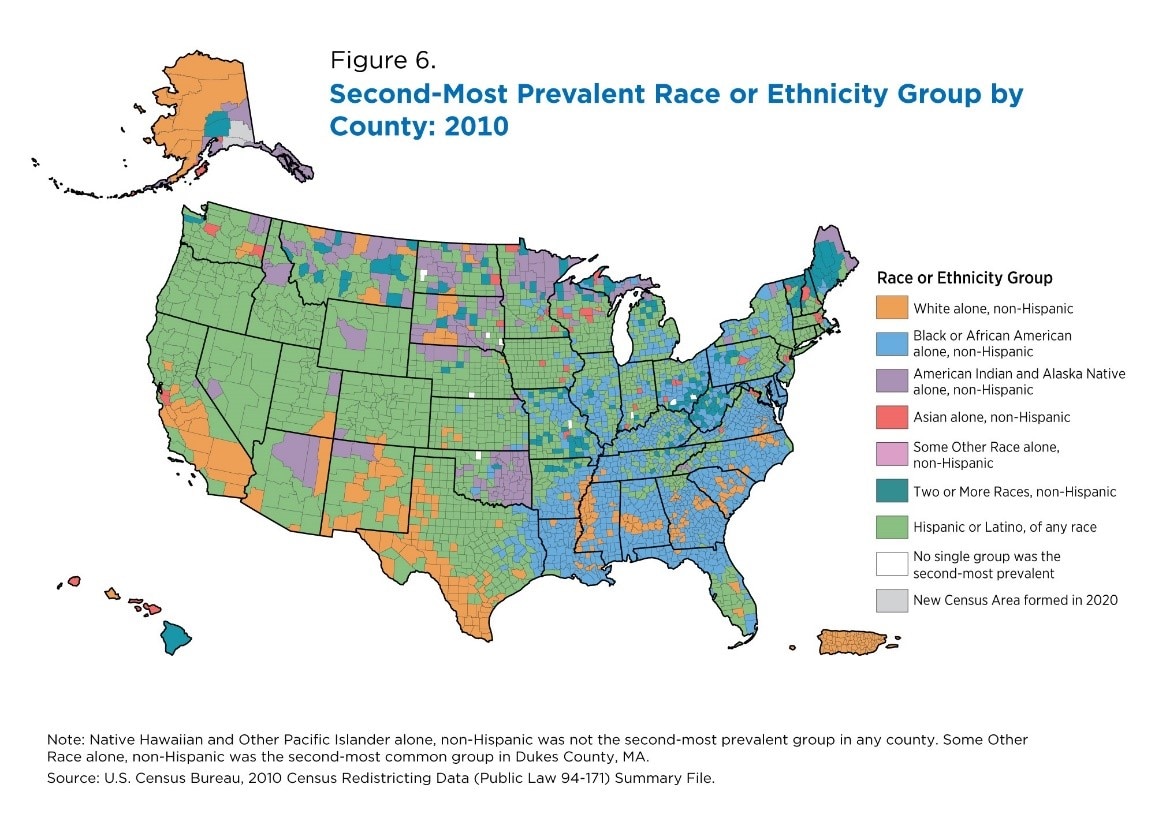
Census shows rural America becoming more racially diverse

Second-most prevalent race or ethnicity in U.S. counties, 2010 and 2020
Census Bureau maps for 2010 and 2020, adapted by The Rural Blog; click to enlarge.

Rural America is becoming more racially and ethnically diverse, and Latinx and multi-ethnic people drove almost all rural population growth, recently released Census Bureau data show.

"Traditionally, rural communities have not been as racially or ethnically diverse as the nation overall. The 2020 Census reported that approximately 74.8% of the rural population is White non-Hispanic, compared to 57.8% for the United States as a whole. Hispanics are the second most prevalent racial or ethnic group in rural America comprising 10.4% of the rural population. It is important to note that Hispanics may be of any race. With a population count of 4.5 million, Black residents make up 7.4% of the rural population, and are the third most prevalent racial or ethnic group in rural areas," Lance George, Natasha Moodie and Keith Wiley report for The Daily Yonder. "Both nationally and in rural areas, some of the largest growth among racial and ethnic groups were among residents who identified themselves as being of two or more races. In rural communities in 2020, approximately 2.4 million or four percent of the rural population were of two or more races. Persons of two or more races surpassed Native Americans as the fourth most prevalent racial or ethnic group in rural areas. Native Americans, identified as American Indians or Alaska Natives, comprised roughly two percent of the rural population in 2020 – which is more than twice the rate of Native Americans nationally."

Celebrate News Engagement Day on Tuesday, Oct. 5; you can make it part of National Newspaper Week, Oct. 3-9

Tuesday is News Engagement Day, a time to encourage people to get more involved with the news by reading, watching, liking, sharing and commenting on news stories.

The day is an opportunity for local news outlets to remind readers (and potential readers, on social-media platforms) why it's important to read the news, and how local journalism and news literacy affects democracy and the wellbeing of communities.

Click here for more information, resources or ideas about how to promote News Engagement Day. The program is sponsored by the Association for Education in Journalism and Mass Communication.

Though it's not affiliated with National Newspaper Week, which goes from Oct. 3-9, the two observations can easily be combined.

Quick hits: PG&E charged with wildfire manslaughter; meatpacking workers say their injury reports were ignored

Grasshoppers in the Field, created by artist Gary Greff in 1999, is one of seven sculptures along the "Enchanted Highway" (which has no road number) near Regent, North Dakota. (Photo provided)

Here's a roundup of stories with rural resonance; if you do or see similar work that should be shared on The Rural Blog, email heather.chapman@uky.edu.

An artist has single-handedly turned a 32-mile stretch of highway in North Dakota into a tourist mecca of art called the Enchanted Highway. It started in 1990 in Regent, a farming town struggling from economic troubles and a declining population. Local teacher-turned-artist Gary Greff decided to try to make the town into a tourist destination, so he began erecting large metal sculptures by the roadside. See how things are going for Regent now.

A social-justice activist raised in rural Montana has launched a project to train white people who have never thought of themselves as activists to organize and confront racist policies in their communities. It's not an issue of white guilt, he says, but rather because most people don't benefit from our current social structure. Read more here.

California utilities giant Pacific Gas & Electric has been charged with four counts of manslaughter and other felonies for allegedly causing 2020's deadly Zogg Fire. PG&E is accused of not properly maintaining the vegetation around equipment, which allowed a sickly tree to fall onto power lines and start the fire. This isn't the first time PG&E has been found responsible for a wildfire: In 2020, PG&E pleaded guilty of 84 counts of involuntary manslaughter in the 2018 Camp Fire, after it was discovered the company did not maintain electrical equipment in rural areas. Read more here.

Native American tribes demand 'immediate action' from the Biden administration to restore the boundaries for Bears Ears National Monument after Donald Trump shrank it by 85%. Read more here.

At one of the nation's largest meatpacking plants, workers say their complaints of serious injuries were ignored or downplayed, reports the Midwest Center for Investigative Reporting. One man was pushed to work with what turned out to be a fractured vertebra. Read more here.

Pandemic roundup: Covid the leading cause of death among law enforcement; Mississippi hires retired extension agents to get rural areas vaccinated

Here's a roundup of recent news stories about the pandemic and vaccination efforts:

In Mississippi, which has one of the nation's lowest (but also one of the fastest-rising), vaccination rates, the state is hiring retired extension agents to help get rural residents vaccinated. Read more here.

Covid-19 is the leading cause of death among law enforcement. Read more here.

Covid is killing rural Americans at twice the rate of urban residents. Read more here, and read The Daily Yonder's more in-depth coverage here.

The vaccines on the market don't protect as well against the Delta variant, but Pfizer and Moderna have updated Delta-specific vaccines already created and in clinical trials. Read more here.

Meanwhile, Merck says a preliminary trial of their antiviral Covid treatment pill showed promising results. Read more here.

Vaccination misinformation is an epidemic in its own right, especially among Republicans and evangelical Christians. YouTube is banning all anti-vaccine content, but pandemic misinformation groups on Facebook continue to flourish.

Covid patients who refused the vaccine have largely embraced experimental monoclonal antibody treatments. That may seem contradictory, since many refused the vaccine because they believed not enough was known about it. But it's also important to realize that most people who refused the vaccine did not believe they were at a high risk of hospitalization. That's why treatments in general are more widely accepted than preventatives: there's no doubt medical intervention is needed. Read more here.

Despite clinical data indicating the Pfizer vaccine is safe for children, many say they won't get their child vaccinated right away if it becomes available, a recent poll showed. Read more here.

Thursday, September 30, 2021

USDA has $3 billion to help farmers adopt green practices, help school meal programs with supply-chain problems

The Agriculture Department announced Tuesday a $3 billion investment in large-scale pilot projects to create new markets for sustainably produced agricultural products. The programs, set to go into effect next year, would provide incentives for producers who adopt climate-friendly practices. Here's the breakdown:

  • $500 million to help farmers recover from drought and encourage the adoption of thriftier water management practices.
  • Up to $500 million to prevent the spread of African Swine Fever.
  • $500 million in relief from agricultural market disruption such as supply chain difficulties.
  • Up to $1.5 billion to help school food programs deal with supply chain disruptions.

The money will be released in a series of pilot projects funded by the Commodity Credit Corp., a Depression-era program that allows the federal government to borrow as much as $30 billion from the federal treasury for programs meant to stabilize farm income.

In a University of Colorado speech, Agriculture Secretary Tom Vilsack stressed that the programs are primarily about increasing commodity production and trade, and were not carbon banks, carbon markets, or conservation programs. Such a distinction allows the CCC to pay for the programs, Chuck Abbott writes for the Food and Environment Reporting Network.

USDA will accept public comments on the funding until Nov. 1.

In rural counties, Covid-19 infections fall, but deaths rise

New coronavirus infections, in ranges by county, Sept. 19-25
Daily Yonder map; click the image to enlarge it or click here for the interactive version.

Rural coronavirus infections fell during the week of Sept. 19-25, but Covid-19 deaths rose.

"New infections fell by 14% last week in rural (nonmetropolitan) counties, from about 210,000 new cases two weeks ago to 181,000 new cases last week. It was the biggest single-week drop in the number of new cases since winter," Tim Murphy and Tim Marema report for The Daily Yonder. "Covid-related deaths increased by 10% last week, to 3,197. That’s the largest number of deaths in nonmetropolitan counties since early February. Deaths are a trailing indicator of Covid-19 and could continue to rise for weeks. This winter, the rural death rate did not begin to fall substantially until about a month after new infections began to wane."

Nearly two-thirds of rural counties had fewer new infections last week than two weeks ago, but 94% remain in the red zone, meaning they had at least 100 new infections per 100,000 residents last week. Click here for an interactive county-level map, regional analysis and charts from the Yonder.

23 species to be declared extinct, including ivory-billed woodpecker, Bachman's warbler and eight mussels

Bachman's warbler (Whatbird.com)
Ivory-billed woodpecker (Getty Images)
The U.S. Fish and Wildlife Service proposed Wednesday that 23 species should be declared extinct and taken off the endangered species list. The delisting would include:
  • The ivory-billed woodpecker, one of North America's largest woodpeckers, which briefly brought tourists trying to find it in rural Arkansas.
  • Bachman's warbler, a songbird that once lived in the Southeast but fell prey to habitat destruction.
  • The San Marcos gambusia, a tiny fish in Central Texas killed off from dry weather, pesticide runoff, and factory pollution.
  • A catfish species native to Ohio, thought to be highly intolerant of water pollution.
  • Eight freshwater mussels. It's not known why they went extinct, but freshwater mussels are among the most-endangered species in North America, possibly because of habitat destruction or disease.
  • Eight Hawaiian bird species due to invasive predators.
"Many of them were likely extinct, or almost so, by the time the Endangered Species Act passed in 1973, officials and advocates said, so perhaps no amount of conservation would have been able to save them," Catrin Einhorn reports for The New York Times. However, "without conservation, scientists say, many more species would have disappeared. Eleven species have been declared extinct since the Endangered Species Act became law in 1973, but 48 have recovered enough to be listed as threatened rather than endangered, and 54 species were removed from the list altogether.

The announcement offers a possible "glimpse of the future. It comes amid a worsening global biodiversity crisis that threatens a million species with extinction, many within decades," Einhorn reports. "Human activities like farming, logging, mining and damming take habitat from animals and pollute much of what’s left. People poach and overfish. Climate change adds new peril."

Starting today, FWS will accept public comments on the proposal for 60 days before making a final ruling.

Drought has put U.S. forests into a 'state of emergency,' chief of the Forest Service tells Congress

"The government needs to quicken the pace of its fuel reduction work in public forests at the same time that it marshals enough crews to fight wildfires, said Forest Service Chief Randy Moore at a House hearing on Wednesday," the Food and Environment Reporting Network reports. "So far this year, nearly 46,000 wildfires have burned 5.9 million acres and more than 4,500 homes, commercial properties, and outbuildings."

About 63 million acres in national forests are rated at high hazard or very high hazard for wildfires that would be difficult to contain, he said. That represents a third of national forest land, and includes communities in the forests' proclamation boundaries, where the Forest Service can buy land.

"This is in part a result of 110 years of overly aggressive fire suppression policies as well as climate change," Moore said. "The sobering takeaway: America’s forests are in a state of emergency, and it’s time to treat them like one."

One problem with protecting forests and communities against firefighters: sometimes property owners and agricultural interests are fighting back against proposed wildfire mitigation policies. That's what's happening in Oregon, Cassandra Profita reports for NPR.

Another problem: Moore said firefighters often aren't paid enough, and the turnover rate is high, the FERN reports. "We must ensure a stable, resilient firefighting force," Moore said. "We are in a constant mode of training new employees." The Biden administration gave many full-time federal firefighters a 10% pay bonus this year and tried to ensure all federal firefighters make at least $15 an hour.

Killings were up a record 29.4% in 2020; first-time gun ownership rose from 32% to 39%, biggest rise in decades

Gun deaths by county type, 2015-21 (Washington Post chart; click image to enlarge)

"Killings in the United States jumped nearly 30 percent last year, according to Federal Bureau of Investigation data released Monday that indicate a growing number of gun-related slayings amid the pandemic," Devlin Barrett and David Nakamura report for The Washington Post. "While different places saw different rates of increase in killings, the rise was nearly universal across the country, occurring in small towns, big cities, and many places in between."

The 29.4 percent increase in murder and manslaughter is "the largest one-year increase since such the federal government began compiling national figures in the 1960s," Barrett and Nakamura report. "That historic increase has been known for some time, and has sparked concern from police officials and prosecutors. But the FBI release of data compiled from thousands of law enforcement agencies formally confirms the trend. Overall, violent crime rose 5.6 percent in 2020, while property crimes fell 7.8 percent, the FBI said. Assaults increased 12 percent, according to the bureau."

First-time gun ownership jumped from 32% of Americans to 39% last year, the largest such increase in decades. It's unclear how much that trend contributed to the increase in gun violence and deaths, but an analysis "found the higher the jump in gun sales between 2019 and 2020, the higher the jump in gun violence that resulted in at least one death," the Post reports.

Wednesday, September 29, 2021

Cropland values hit record highs, but skyrocketing prices for equipment and other inflation boost production costs

Agriculture Department chart; click to enlarge it
The Farm Belt is in a revival, with cropland values hitting record highs this year, but farmers worry about inflation and supply-chain disruptions, Jesse Newman and Bob Tita report for The Wall Street Journal.

"A months-long rally in prices for major agricultural commodities such as corn and soybeans is pushing up incomes for U.S. farmers and unleashing spending and investment that had been subdued for years, according to agricultural economists and executives," the Journal reports. The run-up in land and equipment prices that has followed could leave farmers exposed if big harvests send crop prices lower again, some economists said. Until recently, U.S. farmers were in the grips of an agricultural recession brought on by a world-wide crop glut. Starting last year, however, strong demand from China and poor weather in key growing regions fueled a sharp rise in prices for crops like corn and soybeans, which touched their highest levels in eight years during the spring. U.S. agricultural exports are expected to hit records in fiscal 2021 and 2022, according to U.S. Department of Agriculture forecasts."

The department's most recent Farm Income Forecast projected that net farm income would increase 20% this year to its highest level since 2013. But "inflation is also hitting the Farm Belt, boosting almost all farmers’ production expenses this year, including fertilizer and fuel," Newman and Tita report. "The USDA expects production expenses to rise by more than 7% in 2021, the agency said. Farmers’ bills for supplies such as seed and fertilizer bought for next year will be the highest ever," an agricultural economist at major farm lender Wells Fargo said.

National Newspaper Week, which starts Sunday, is a reminder of the value of newspapers to their communities

National Newspaper Week is coming up Oct. 3-9. This year marks the 81st year of the observance, a recognition of the value of newspapers to communities. It is sponsored by Newspaper Association Managers, the consortium of North American trade associations representing the industry.

This year's theme is "Community Forum," inspired by the work of NAM's Relevance Project, an advocacy program that touts the benefits of journalism to a community. The National Newspaper Week website has free commentaries, cartoons and house ads you can use in your publication. The organizers also encourage you to make it local by writing an editorial about your paper's unique relevance.

Expanded tax credit, which expires Dec. 31, helped rural children most; spending bill would make eligibility permanent

Percent of children likely to benefit from tax-credit changes
(Daily Yonder map; click the image to enlarge it or click here for the interactive version)

The recently expanded child tax credit struck the biggest blow to poverty in decades, and has disproportionately helped rural children, but the benefit could go away soon unless Congress acts.

"An analysis of census data shows that about 49% of rural children were likely to have received increased child tax credits because of changes affecting low-income families. In metropolitan areas, about 39% of children were likely to have benefited from those changes," Tim Marema reports for The Daily Yonder.

The credit was expanded by the American Recovery Plan Act, which Democrats passed early this year. "Under the changes, the maximum per-child credit rose from $2,000 per child to $3,600 for children under 6 and $3,000 for children 6 and up," the Yonder explains. "The credit was also expanded to include to 17-year-olds for the first time."

The expansion reached more children in poverty because new rules made it newly accessible to the poorest families. However, it will expire at the end of the year unless Congress cements it in law permanently. One spending package before Congress would make the eligibility changes permanent and "extend the increased per-child payment through 2025," Marema reports.

Iowa State professor gets 'genius grant,' will study water quality, sustainable row crops, biodiversity, soil conservation

Lisa Schulte Moore
Lisa Schulte Moore, an Iowa State University professor of natural resource ecology and management, has won a MacArthur Fellowship, sometimes called a "Genius grant." As a 2021 fellow, Schulte Moore will get $625,000 to spend as she pleases to further her study of sustainable agriculture. The MacArthur Foundation website says she'll use those funds to implement "locally relevant approaches to build soil, improve water quality, protect biodiversity, and strengthen the resilience of row-crop agriculture."

At Iowa State, Schulte Moore has "conducted groundbreaking research as a landscape ecologist working closely with farmers to build more sustainable and resilient agricultural systems," says an Iowa State press release. "She pushes the boundaries of her field by incorporating other disciplines traditionally thought of as beyond the scope of ecology – economics, engineering and sociology, for instance – to address critical challenges such as climate change, biodiversity loss, water quality and rural depopulation."

A prairie strip on an Iowa farm (Iowa State University photo)
Much of her work addresses integrating native prairie plants into farms to improve production and conserve resources and species. She has been instrumental in the university's Prairie STRIPS program, which aims to protect soil and water while providing narrow bands of habitat for prairie species. "She and her team's research have shown that strips of native prairie in agricultural fields can tremendously reduce soil loss and runoff of nitrogen and phosphorous by having more roots in the ground to hold soil and nutrients in place," Phillip Sitter reports for the Ames Tribune. "Prairie strips are now used on more than 115,000 acres of fields in 14 states, and the conservation practice has been federally recognized as eligible for government financial support by the 2018 Farm Bill."

Schulte Moore said, "I think of my work as putting together a puzzle, and I’m always looking for the missing puzzle piece. Where do I have to go or what do I have to learn to get the next piece? I’ve found that sometimes you have to build and paint the puzzle piece yourself, and that’s part of the fun of science."

Pandemic roundup: In-depth portrait of an Appalachian hospital; U.S. sees biggest drop in life expectancy in developed countries; vaccine mandates cut hospital staffs

A TV meteorologist of 33 years in the Upper Peninsula of Michigan was fired after refusing to take a coronavirus vaccine. Read more here.

The Daily Yonder has an in-depth profile of how the surge in Covid patients is hammering the hospital in Morehead, Kentucky. Read more here.

What it's like working for Walmart, the nation's top rural employer, in a pandemic. Read more here.

The pandemic has caused one of the biggest global drops in life expectancy since World War II. A study of 29 developed countries revealed that Americans saw the largest drop, especially in men and people of color. The advanced nations that didn't see a drop (Denmark and Norway) both have comprehensive, universal health-care systems and implemented widespread, early "non-pharmaceutical interventions" with high compliance, such as social distancing and masking. Read more here.

Though 99% of its employees complied, North Carolina hospital system Novant Health fired about 175 people for not getting vaccinated. The company has 15 hospitals and 800 clinics, some in rural areas. Last week, 375 workers were suspended and given five days to comply. Nearly 200, including some who had been approved for exemptions, got their first dose by Friday and were reinstated. Novant's compliance numbers jibe with recent data that suggests employees who say they'll quit rather than get vaccinated aren't likely to follow through. However, dozens of state troopers in Massachusetts quit following a vaccine mandate, and hundreds of New York health-care workers have been suspended after its vaccine mandate went into effect. And meanwhile, leaders in a rural Colorado county are asking the governor for an exception to the vaccine mandate because too many health-care workers are quitting, worsening workforce shortages. Without local control of the vaccine mandate, they say many health-care facilities won't be able to stay open.

Tuesday, September 28, 2021

Some small towns refuse pandemic aid; why is that?

"Congress in March authorized $19.5 billion in aid for cities and towns with fewer than 50,000 residents ... Lawmakers wanted to help every town cover the cost of fighting a pandemic and recovering from last year’s recession," Sophie Quinton reports for Stateline. "But in some small, rural or conservative towns, local leaders are refusing the cash. They say they don’t need it, and in some cases, don’t feel comfortable accepting it."

Stateline highlights Bingham Township, Pennsylvania, as an example. The quiet community has mostly dirt-and-gravel roads, and many of its residents are Amish. Local leaders turned down about $69,000 in federal aid because they couldn't think of a way to spend it. "That’s the main reason why we opted not to do it,” Cheryl Young, the township's secretary, told Quinton. "There’s no sense having [the money] sit here for two years, then turn around and send it back, because you can’t spend it."

Most places take the money. "Across 14 states where data is available, just 171 communities out of 7,975 that have fewer than 50,000 residents rejected the funds, according to the National League of Cities, a Washington, D.C.-based group that advocates for cities and towns," Quinton reports. "The average community that rejected the money has 540 residents, according to the group."

Another reason some communities may not take the money: they may need to work with states, municipal associations and/or local accountants to manage the grants, but such communities may not have enough staffing to handle that, Quinton reports.

"More established towns also have declined the funds. Town leaders who refused the latest federal grants say they lack infrastructure, struggling businesses, essential workers or public health efforts to spend the money on," Quinton. "Some local leaders refused the funds partly for ideological reasons." A leader in Algoma Township, in western Michigan, told Quinton they mainly said no because the nation is "going $29 trillion in debt, and we wanted to do our part to say: Hey, enough's enough."

Killer of 5 at Capital Gazette sentenced to life without parole

"An Anne Arundel County judge on Tuesday sentenced the man who blasted his way into the Capital Gazette newsroom and killed five people to six life sentences, five without the possibility of parole, plus 345 years — all to be served consecutively," Alex Mann and Lilly Price report for the Gazette in Annapolis, Maryland. "Judge Michael Wachs handed down the sentence after hearing from survivors of the mass shooting and the family members of Gerald Fischman, Rob Hiaasen, John McNamara, Rebecca Smith and Wendi Winters, who died in the attack."

At the hearing this morning, survivors of the 2018 attack and the loved ones of the victims delivered emotional impact statements as shooter Jarrod Ramos watched, Emily Davies and Katie Mettler report for The Washington Post. Reporter Selene San Felice, who hid under a desk during the shooting, spoke first. "There were days I wondered why I lived or if I should live at all ... I live to spread the truth," she said. "We will press on."

"This summer, a jury found Ramos had the mental and emotional capacity to be held criminally responsible for the mass shooting. Although Ramos had pleaded guilty to the murders, he had argued he was not legally sane at the time and should be sent to a psychiatric hospital with the potential for release instead of prison," the Post reports. "The jury had arrived at its verdict in less than two hours." The judge made a brief but heartfelt statement before announcing the sentence, the Gazette reports: "To say the defendant showed a callous and cruel disregard for the sanctity of human life is simply an understatement," Wachs said. "What I impose is what the defendant deserves."

Rural coronavirus vaccination grows at fastest rate since June, but the rural-urban vaccination gap also grows

Vaccination rates as of Sept. 23 compared to the national average, adjusted to account for vaccinations not assigned to specific counties. Map by The Daily Yonder; click the image to enlarge it or click here for the interactive version.

Nearly 450,000 rural Americans became fully vaccinated against the coronavirus during the week of Sept. 17-23; that's the largest single-week total since early June, and the rural vaccination rate is now 41.4 percent, a 1-point increase from the week before, Tim Murphy and Tim Marema report for The Daily Yonder. The metropolitan vaccination rate rose 1.1 points, to 53.3% of the metro population, meaning the rural-urban vaccination rate gap grew slightly, to 11.9 points.

"The number of vaccinations completed each week has been on the rise since mid-August. Rural counties reported completing 50% more vaccinations in September than in August. In metro counties, completed vaccinations were up 30% in September over August," Murphy and Marema report.

Click here for more charts, maps and regional analysis from the Yonder, including an interactive map.

DEA issues public warning about deadly black-market pain medications laced with fentanyl and methamphetamine

"The Drug Enforcement Administration issued a public warning Monday that a growing number of pain medications bought on the black market are laced with the synthetic opioid fentanyl or the stimulant methamphetamine, driving overdose deaths to record levels," Devlin Barrett reports for The Washington Post. "Officials said the DEA hasn’t issued such a public safety alert since 2015, when the agency warned that agents were seeing an alarming amount of heroin laced with fentanyl. Fentanyl, even in much smaller amounts, is deadlier than street heroin."

Drug overdose deaths in 2020 surpassed a record 93,000, up nearly 30 percent from 2019. "In recent years, the death toll has risen sharply, fueled in large part by fentanyl, a synthetic opioid that is relatively cheap to manufacture and distribute," Barrett reports. "Last year, drug overdoses killed more than twice as many Americans as car crashes."

Illegal drug trafficking is increasingly shifting from plant-based drugs such as cocaine and heroin to chemical-based drugs such as meth and fentanyl. "The DEA has seized 9.6 million counterfeit pills already this budget year, which is more than it seized in the previous two years combined, officials said. The number of seized counterfeit pills found to contain fentanyl has jumped 430 percent since 2019," Barrett reports.

The drug epidemic, mostly fueled by opioids, has been getting worse since 1999. "At first, that drug abuse centered around prescription pain pills, such as Oxycodone, Vicodin or Percocet," Barrett reports. "In recent years, the death toll has risen sharply, fueled in large part by fentanyl, a synthetic opioid that is relatively cheap to manufacture and distribute. Last year, drug overdoses killed more than twice as many Americans as car crashes."

Rural Mississippi paper sheds light on previous allegations against former deputy who led a deadly raid

A former deputy in Monroe County, Mississippi, who helped lead a deadly no-knock raid in a rural area, had previously faced allegations of false arrest, racism and theft, reports Caleb Bedillion of the Daily Journal, as part of an investigative series about the raid. The Daily Journal, formerly the Northeast Mississippi Daily Journal, is one of America’s largest rural newspapers and serves 17 counties in the northeastern part of the state. 

During the 2015 raid, Monroe County sheriff's deputies broke down the door to Ricky Keeton's Smithville mobile home, only identifying themselves as they were breaking through with a battering ram. They fired at least 49 gunshots toward Keeton, who was struck six times and died at the scene.

Monroe County narcotics officers had been investigating Keeton and believed he was using and selling drugs. And though methamphetamines were found in Keeton's home and in his body, his loved ones say the no-knock warrant unnecessarily resulted in his death. "In a federal lawsuit scheduled to go to trial in Greenville early next year, the daughters of Keeton say Monroe County law enforcement wrongfully killed their father and violated his constitutional rights," Bedillion reports. "The lawsuit names Monroe County and former deputy sheriff Eric Sloan as defendants."

Keeton's longtime girlfriend, Wanda Stegall, was present the night of the raid and said Keeton believed the deputies were intruders trying to break in. "All they had to do was knock on the door," she told Bedillion.

No-knock warrants have come under increasing scrutiny, especially since the 2020 death of Louisville, Ky. resident Brionna Taylor. Critics say such warrants are more likely to lead to violence and injury, from officers or the targets of the warrants. Some cities, states, and federal law enforcement arms have restricted or banned their use, but Mississippi has not.

Keeton's case is also under scrutiny because of questions whether Sloan, then the head of the narcotics division, was fit to be on the job at all. "At the time local law enforcement agents had Keeton staked out, Sloan was under investigation by the Mississippi Bureau of Investigation over misconduct allegations raised by an informant involving extortion," Bedillion reports. "Amid this investigation, Sloan resigned from the sheriff’s office by December 2015."

Sloan changed his story several times about what happened the night of Keeton's death, and failed to show that the legal authority existed for a no-knock warrant that night. A judge also found that the warrant didn't explicitly authorize no-knock entry, Bedillion reports. And though the sheriff's department had recently received body cameras, they had not yet been put into use and deputies were not wearing them.

Monday, September 27, 2021

As solar projects become more feasible in states like Ky., battle lines are drawn between farmers and preservationists

For the past six years, renewable energy companies have been approaching Kentucky farmers about leasing their land for three solar-power projects in different stages of development. "Solar energy represents a change for a commonwealth whose economic prospects have long been tied to labor-intensive industries like coal and tobacco. But that change is coming, through tax credits, infrastructure deals and climate change incentives," Melina Walling reports for Louisville's Courier Journal.

But not everyone is on board with the prospect. "As the projects move forward and more people learn about them, questions tend to arise — questions that the solar companies, which do not have a permanent liaison in this rural area, are not always on hand to answer," Walling reports.

That often leaves farmers who have signed up for solar leasing to educate and convince their neighbors that such a venture is legitimate—sometimes a difficult job when the projects aren't yet live and bringing in profits for farmers. But it's more than a question of whether solar power is viable. Many farmers feel that leasing their land is tantamount to losing it, Walling reports. Others just don't know enough about the process and say they need more input.

Solar is a winning idea, arguies Jim Waters of free-market think tank Bluegrass Institute for Public Policy Solutions. In a Courier Journal op-ed, he writes: "By embracing such plentiful but inexpensive power, Kentucky would have a clean, renewable supply of energy, allowing it to continue – as it’s did with coal – boasting some of the nation’s cheapest energy rates, keeping utility costs low and rendering ineffective calls for economically harmful policies like raising gas taxes for needed revenues."

However, the notion brings iffy rewards and needs more study, writes Will Mayer, the executive director of Clark Coalition, a land-use advocacy organization. "While the developers are quick to paint a picture of struggling farmers needing the income (that supposedly only solar can provide) the truth is somewhat more complex. In fact, many of those under-contract for solar development are absentee landowners, not farmers. By contrast, many of the farmers who actually make their living from the land will invariably suffer from the loss of their farm leases," Mayer writes in an op-ed for the Lexington Herald-Leader. "The uneven consequences of large solar facilities are further brought to focus by their impact on adjoining property owners. Contrary to developers’ claims that their facilities do not negatively affect nearby properties, independent valuation studies demonstrate they cause a decline of up to 30%. Industrial solar proposals are neither uniformly bad nor good – rather they are complex and demand a transparent analysis to ensure that they are sited appropriately, and that the associated benefits do not disproportionately accrue to the developers and outside interests while the real financial and environmental costs are borne by Kentuckians."

Some local election officials buy into fraud-and-conspiracy theories; many election officials say they feel unsafe

America’s decentralized election system depends on the professionalism and integrity of local and state election officials. Now some worry that some of their colleagues have become a threat to the system.

In Grand Junction, Colo., Mesa County Clerk and Recorder Tina Peters and her top deputy have allegedly embraced debunked right-wing conspiracy theories about elections. In April she required her employees to attend an after-hours gathering and listen to a speech by well-known conspiracist Douglas Frank. Also: "Over the course of the past month, in a lawsuit filed by the state’s top elections official, Peters and her deputy have been accused of sneaking someone into the county elections offices to copy the hard drives of Dominion Voting Systems machines," Emma Brown reports for The Washington Post. "Those copies later surfaced online and in the hands of election deniers. The local district attorney, state prosecutors and the FBI are investigating whether criminal charges are warranted."

UPDATE, Oct. 14: Peters and her deputy "cannot be involved in the administration of her county’s November election, a judge ruled Wednesday," Alex Burness of The Denver Post reports. "This means that former Republican Secretary of State Wayne Williams will oversee Mesa County elections this year. He was appointed by the Mesa County commissioners, under a temporary agreement that pays him $180 an hour. The commissioners supported Griswold’s suit."

Now that the audit of Arizona's Maricopa County ballots has failed to turn up evidence of fraud, conspiracists are looking to Peters' report, which she says she commissioned because it proves election irregularities. "The report, which Peters’ attorney, Scott Gessler, also included as part of defending her and Deputy Clerk Belinda Knisley [from state efforts] to block the two from overseeing the fall elections, alleges that nearly 29,000 election files were deleted during a routine upgrade of the county’s now-decertified election equipment," Charles Ashby reports for Grand Junction's Daily Sentinel.

"I’ve always worried, working in this space, about people who want to harm our elections or sabotage them from the outside — the foreign actors trying to hack elections," Mike Beasley, a lobbyist for the Colorado County Clerks Association, told Brown. "I’ve never until now had to worry about what goes on on the inside. And now we’ve crossed that threshold."

Recent polling from The Brennan Center for Justice found that one in three election officials feel unsafe in their job, and one in five are worried about death threats. In recent months, Donald Trump "has endorsed several proponents of the 'big lie' to become secretaries of state in key battlegrounds. And experienced election administrators at the local level have been fleeing their jobs amid skyrocketing stress and threats to their personal safety," Brown reports.

Farm roundup: Bankruptcy map; anti-consolidation campaign; trafficking in farmworkers; suit targeting paraquat

Total Chapter 12 bankruptcy filings by county, 2013-2020
(Midwest Center for Investigative Reporting map; click on the image to enlarge it)

Here's a six-pack of farm news:

The nation's second-largest farm group, the National Farmers Union, is launching a campaign to expose how consolidation in agriculture hurts family farms and rural towns. "The campaign, which it said will include a public relations blitz and lobbying, is part of an effort to push Washington to crack down on monopolistic behavior in the industry as lawmakers propose legislation to bring more price and market transparency to highly consolidated farm markets," Reuters reports. Read more here.

Farm bankruptcies have been on the rise over the past decade, Sky Chadde reports for The Midwest Center for Investigative Reporting. Many factors contribute: climate change, increasing production costs, decreasing income, the trade war, high debt levels and suicide. Chapter 12 of the bankruptcy law is used to reorganize debts and save family farms through debt reorganization, but research shows it may be harder to reorganize debts under Chapter 12 than under other bankruptcy types. Read more here.

Farmworker and environmental groups have sued the Environmental Protection Agency for reapproving the weed killer paraquat, which they say puts farmworkers at an increased risk of developing Parkinson's disease. Read more here.

Farmworkers are trafficked by employers using the H-2A program, which "provides scaffolding for the agricultural system, allowing farms to bring in enough labor to pick fruits and vegetables Americans rely on," according to experts and activists, Amanda Perez Pintado reports for the Midwest Center. They "fear the Covid-19 pandemic has allowed the situation to grow."  Read more here.

A newly published study showed farmworkers in California's Salinas Valley had coronavirus infection rates four times higher than the rest of the local population. Read more here.

The Agriculture Department is launching an Equity Commission to address racial discrimination within the USDA and its programs. Read more here.

Education, political bent, skepticism, economic bases correlate with differences in rural vaccination rates: study

Rural/urban vaccination rates as of Aug. 12, compared to national average and adjusted to account for vaccinations not assigned to specific counties. (Map by The Daily Yonder; click the image to enlarge it or here for the interactive version.)

It's well known that coronavirus vaccination rates are generally lower in non-metropolitan counties, but a new data analysis cross-referenced rural vaccination data with other demographic markers, including votes for Donald Trump. to create a more granular picture of vaccination rates within rural counties.

According to the study, published in The Journal of Rural Health, "lower rural rates are explained by a combination of lower educational attainment and higher Trump vote share. Within rural counties, rates are lowest in farming and mining-dependent counties and highest in recreation-dependent counties, with differences explained by a combination of educational attainment, health care infrastructure, and Trump vote share." And, though vaccine resistance and hesitancy are primary reasons for the lower rural vaccination rates, the researchers note that lack of access is also frequently a problem.

"Differences in perceptions of risk and virus severity and differences in attitudes about personal choice versus collective responsibility may also be related," the researchers write. "Consistent with this explanation, rural residents have been less likely to adopt Covid-19 prevention behaviors, such as physical distancing, avoiding dining out, and wearing face masks. Smaller shares of rural residents report being worried about getting sick, and larger shares say that the severity is exaggerated, getting vaccinated is a personal choice, and believe in at least one myth about the vaccine."

The researchers assessed vaccination rates as of Aug. 11, 2021, for people ages 18 and up in the 2,869 counties for which Centers for Disease Control and Prevention data is available. For comparison's sake, here is The Daily Yonder's write-up on rural vaccination rates from that week (map above). The Yonder's numbers include all vaccinations, not just those for ages 18 and up, as this study does.