Thursday, January 27, 2022

Pandemic has worsened rural child-care crisis; researchers who looked at two N.C. counties propose solutions

Daily Yonder map shows two counties studied.
A study of two North Carolina counties puts a spotlight on how the pandemic has exacerbated the rural childcare crisis. In 2020, the William R. Kenan Jr. Charitable Trust challenged the professional schools at the University of North Carolina at Chapel Hill to do a "deep dive" on Edgecombe and Robeson counties, where rural-urban disparities—including childcare availability—have hurt the local economies, James H. Johnson Jr. and Jeanne Milliken Bonds report for The Daily Yonder. Johnson and Bonds co-lead the Whole Community Health Initiative at UNC-Chapel Hill with support from the trust, an initiative that seeks to improve childcare access in those counties using the results of their study.

Decent, affordable childcare is critical for millions of families. Without it, a parent (almost always the mother) must stay home, hurting families' budgets and local economies. Rural areas have long faced childcare shortages, but the pandemic has exacerbated it, as the researchers found in those North Carolina counties. "The mandatory shutdown of the U.S. economy idled many workers with young children, eliminating in the process their need for childcare services," Johnson and Bonds report. "This in turn forced some childcare facilities to furlough workers and close; and others to lay-off workers and close permanently. In our rural counties, low vaccination rates combined with the closures has eliminated more than 90% of the available childcare providers."

Most permanent childcare closures have been small, in-home businesses, mostly in low-income areas. The vast majority didn't apply for Paycheck Protection Program loans because the paperwork was overwhelming, or they worried they'd have to pay it back. The remaining facilities must figure out how to remain open and pay workers while dealing with enhanced health and safety protocols and lower teacher-child ratios that improve childcare quality but reduce revenue, Johnson and Bonds report. Parents struggling with poverty themselves can't pay more for childcare, especially since the expanded Child Tax Credit has lapsed. 

Essentially, daycares have nowhere to cut the fat, budget-wise, and most childcare workers live on poverty wages as it is. A recent poll found that, of the nearly 1 million childcare workers in the U.S., just over 31% reported being food-insecure in 2020, which is 8 to 20 points higher than the national average, Colin Page McGinnis reports for The Conversation.

Daycare facilities that remain open also take a financial hit from mandatory quarantines when children or staff become infected with the coronavirus. "About 1 in 6 parents told pollsters they had experienced either a school or a day care shutdown in the past few weeks, in a national poll from Axios and Ipsos released on Jan. 11," Anya Kamenetz reports for NPR.

The quarantines hurt working parents, too. "Even as schools and daycares have attempted to return to in-person learning, working women have found it difficult to either return to work or maintain employment because any randomly occurring infection outbreak in a school requires mandated at-home quarantine for all exposed children," Johnson and Bonds report. "And a child in quarantine requires adult supervision, which makes maintaining a job very difficult, if not impossible, for women who are the sole or primary caregiver." Some women are able to parlay experience into home-based businesses, but broadband disparities mean rural women are less likely to be able to do so.

State and federal funding can help childcare facilities stay open, but the U.S. spends far less on childcare than most other developed nations and even some developing countries. "Because of inadequate investments, far too many American youth enter elementary school ill-prepared to learn—a situation that, unfortunately, has long-term negative consequences for their overall health and wellbeing," Johnson and Bonds report. "Nowhere is this more evident than in rural counties where funding for services is jeopardized by population loss and an aging population on fixed incomes unable to pay for improvements."

The American Rescue Plan Act authorized $39 billion for childcare, but that money expires in 2024, and childcare providers and advocates warn that such infusions "won’t solve the industry’s fundamental, long-term challenge: how to provide quality services and pay workers a competitive wage while keeping prices affordable," Sophie Quinton reports for Stateline.

Johnson and Bonds recommend a raft of policy changes to address the rural childcare crisis, based on their study. Those include:

  • Encourage family-friendly business policies that support employees with children.
  • At all levels of government and the economy, frame childcare as a "business imperative."
  • Lobby the federal government to guarantee universal preschool.
  • Invest in childcare entrepreneurs. 
  • Call for more and better continuing education for childcare workers, which will help them provide better care to children.
  • Advocate for childcare workers to receive a living wage.
Through their Whole Community Health Initiative, Johnson and Bonds are implementing interventions in Edgecombe and Robeson counties: "The three-pronged strategy includes a Child Care Business Accelerator to equip existing and aspiring childcare entrepreneurs with business acumen and skills; a Childhood Equity Fellows Program to train childcare workers in the best “whole community health” child development practices; and a Child Care Wage Accelerator that will use cash transfers as a means of compensating childcare workers and addressing the low wage conundrum." If it proves successful, they'll try to scale it up and roll it out statewide.

California Rep. Ro Khanna advocates for rural tech jobs, criticizes social-media giants for prioritizing traffic over truth

Information-technology jobs in Silicon Valley make Rep. Ro Khanna's Northern California district one of the nation's wealthiest, but the Democrat is a longtime champion of rural economies and rural newspapers, and wants rural areas to get a piece of the tech economy.

In his new book, Dignity in a Digital Age, Khanna "proposes sweeping fixes for what, in his view, ails America: too much wealth concentrated in too few hands, and too many digital jobs crowded into a handful of tech hubs. He wants to decentralize those opportunities so that places like Paintsville, Ky., or Jefferson, Iowa, can also thrive," Blake Hounshell and Leah Askarinam report for The New York Times.

Rep. Ro Khanna
He conceived the book after veteran Republican Rep. Hal Rogers invited him to visit his southeastern Kentucky district, perhaps the nation's poorest. Khanna saw the devastation brought by the coal industry's slow demise, and met former blue-collar workers who, thanks to Louisville tech start-up Interapt, have launched second careers as software developers, Hounshell and Askarinam report. He realized that remote tech jobs could transform rural economies and wants to make sure they can capitalize on the increasing normalization of remote work.

The federal government could encourage rural tech jobs with a host of initiatives, including "building 'digital grant colleges' inside the country’s 112 land-grant universities to teach applied technology skills, underwriting apprenticeship programs at tech companies, [and] creating a 'national digital corps' as a kind of Peace Corps for rural America," Hounshell and Askarinam report. "What if the government required, say, software companies that wanted federal contracts to employ at least 10 percent of their workers in rural areas?"

Khanna hopes boosting rural economies through tech jobs would also reduce political polarization, noting that it's often a product of resource inequality. But Silicon Valley can do more than provide jobs, he believes; Khanna criticizes tech companies in his home district, especially Facebook, for algorithms that drive users to false and inflammatory content: "I think Silicon Valley overall is an extraordinary place of innovation, of entrepreneurship, of high achievement. But I don’t think it has lived up yet to its responsibilities in a democratic society."

Redistricting could reshape House Agriculture Committee

"At least six members of the House Agriculture Committee face tough reelections under new Ccongressional maps approved by 26 states, while four have plans to leave the House and several more depend on maps that have not yet been approved," Noah Wicks reports for Agri-Pulse. "Under the newly drawn districts, two Illinois Republicans — Mary Miller and Rodney Davis — will battle for control of a seat; Virginia Democrat Abigail Spanberger must navigate her way through a largely unfamiliar district; and Arizona Democrat Tom O'Halleran will need to win the votes of a Republican-leaning constituency. Iowa Democrat Cindy Axne and Nebraska Republican Don Bacon will continue to sit in highly competitive swing districts."

Congressional districts are redrawn after each census to equalize their population. A few states create new maps through independent commissions, but most leave it to state legislatures. "Republicans are counting on redistricting to help them wrest control of the House, which would put [Pennsylvania Rep. Glenn] Thompson in line to become the committee's chairman," Wicks reports. "Democrats currently control the House 221-212, with two vacancies." Agri-Pulse takes a deep dive into how redistricting is playing out for each Agriculture Committee member. Read more here.

Kaiser Health News opening a rural reporting desk for Midwest and Mountain West, supported by $3.9 million grant

Kaiser Health News is establishing a rural health reporting desk to cover the Midwest and Mountain West, planning to hire journalists and social-media experts to cover Iowa, Minnesota, Montana, Nebraska, Nevada, North Dakota, South Dakota, and Wyoming.

KHN's parent organization, the Kaiser Family Foundation, is able to fund the expansion through a $3.9 million grant from the Leona M. and Harry B. Helmsley Charitable Trust., which aims to improve lives by promoting health- and place-based initiatives.

"The team of journalists will provide unbiased, accurate, and trusted reporting on a wide range of complex issues, including the ongoing pandemic, access to health coverage and care, the burden of health care costs on consumers, housing and education, the opioid epidemic, mental health, hospital closures, the lack of critical lifesaving equipment, and burgeoning changes in telehealth and medicine. KHN will partner with local media throughout the region to produce deeply sourced stories that shed light on underreported issues," according to the press release. "As with all its journalism, KHN stories produced by the Rural Health Desk will be made freely available for publication by media outlets across the country, published on khn.org and distributed through KHN’s social media platforms."

Public librarians are the latest pandemic 'frontline workers,' dispensing masks and coronavirus tests

"As public libraries across the nation begin handing out Covid-19 testing kits and N95 masks, librarians have become the latest frontline workers,"Andrew Claudio reports for Route Fifty.

Libraries enjoy a unique position of public trust, Public Library Association Melanie Huggins told Claudio: "Libraries are one of the most-trusted entities and organizations in communities since we're accessible, friendly, welcoming and all the things that you would want people to be during this crisis. ... I think that it is a positive thing, and people are noticing how critical libraries are to responding to crises."

Public libraries have long been a major resource in rural communities, and during the pandemic many have stepped up to facilitate telehealth in areas where many don't have broadband access. So perhaps it was only natural that many have begun handing out coronavirus testing kits and masks.

"Although passing out at-home tests in libraries has caused some librarians to be overwhelmed with the added workload, Huggins said libraries are willing-and-able partners to combat crises in communities, and they are doing the best they can under the circumstances," Claudio reports.

Wednesday, January 26, 2022

Study finds these factors bring college grads back to rural hometowns: schools, friends, rurality, fewer degree holders

"Many academics and journalists have written about rural 'brain drain,' the migration of talented and bright young people who leave their communities, usually in search of better economic opportunities. Now Iowa State University researchers "have identified three significant factors that draw people back to their hometowns a decade or two after leaving: public schools, population density and other college-degree-holders in the community," says an ISU press release.

The study, recently published in Rural Sociology, found that college graduates between 34 and 43 were more likely to return to their rural hometowns after graduation if they had a strong attachment to their public K-12 school, felt like their teachers cared about them or that they were part of their school's community, and/or had close friends there. 

The researchers also found that grads were more likely to come back to hometowns with lower population density and fewer postsecondary degree holders. They speculated that grads felt they could have a bigger impact in such a town, through employment, volunteering, and local leadership.

The findings are an interesting counterpoint to conventional wisdom that pins brain drain on economic factors. While those are surely a factor—a rocket scientist has to go where there are rocket scientist jobs—the study highlights the importance of community and social relationships.

High court reconsiders 'significant nexus' ruling on wetlands

Here's the latest development in a longstanding debate over how much power the government has to regulate water on private land: The Supreme Court has agreed to decide whether Michael and Chantell Sackett can build a house on their northern Idaho property that has a disputed connection to wetlands. In considering the case, the Supreme Court said it would decide whether the Ninth Circuit Court of Appeals used the proper test to determine whether wetlands are 'waters of the United States'," and thus subject to federal regulation, Chuck Abbott reports for the Food & Environment Reporting Network.

The conservative nonprofit Pacific Legal Foundation, which represents the Sacketts, "said the case would give the Supreme Court the opportunity to revisit a 2006 ruling that said that if a wetland has a 'significant nexus' with navigable waters, it is covered by the Clean Water Act. There have been repeated arguments over how to identify that connection," Abbott reports. Pacific Legal attorney Damien Schiff said the Sacketts' property lacks a surface water connection to any body of water and shouldn't be subject to federal regulation.

This isn't the Sacketts' first trip to the Supreme Court over the 0.5-acre plot near Priest Lake. When they bought the property in 2004, they were told it had wetlands so they would need federal permits before building on it. "The Supreme Court ruled unanimously in 2012 that the Sacketts had the right as landowners to challenge the EPA’s wetlands determinations. The Pacific Legal Foundation represented them in that case, too," Abbott reports.

Vilsack to speak at webinar Monday on the supply-chain crisis in U.S. agriculture exports and how to fix it

Agri-Pulse will host a free webinar at 1 p.m. ET Monday, Jan. 31 to discuss how supply-chain problems are hurting American agriculture exports and what can be done about it.

The webinar includes two discussion panels: one featuring policy experts and one featuring industry experts. Krysta Harden, president and CEO of the U.S. Dairy Export Council, which Vilsack headed between stints as USDA secretary, will moderate a panel featuring the following policy experts:
  • Agriculture Secretary Tom Vilsack
  • White House Ports Czar John Porcari
  • Rep. John Garamendi, D-Calif.
  • Rep. Dusty Johnson, R-S.D.
Jaime Castaneda, executive vice president of policy development and strategy at the National Milk Producer Federation will moderate an industry panel featuring the following guests:
  • Mike Durkin, president and CEO of Leprino Foods
  • Andrew Hwang, manager of business development and international marketing at the Port of Oakland in California
  • Jon Eisen, director of the Intermodal Motor Carriers Conference at the American Trucking Association
The event is sponsored by the National Milk Producers Federation and the U.S. Dairy Export Council. Click here for more information or to register.

New coronavirus infections jumped 20% in rural counties last week, to record, as infections in metro counties fell 8%

New coronavirus infections, in ranges by county, Jan. 16-22
Map by The Daily Yonder; click the image to enlarge it or click here for the interactive version.
Rural counties reported a record 654,000 new coronavirus infections from Jan. 16-22, a 20 percent increase from the previous week, while metropolitan counties fell by about 8% to just under 4 million. The coronavirus "is now spreading in rural counties faster than in metropolitan areas for the first time since the start of the Omicron surge in mid-December," Tim Marema reports for The Daily Yonder.

Covid-related deaths in rural counties rose 2% to 2,136 last week while metropolitan deaths increased nearly 20%. "The rural death rate remained slightly higher than the urban death rate, but the gap has narrowed during the Omicron surge," Marema reports. "The rural rate was about two times that of metropolitan areas before December. Currently the rural death rate is just 9% higher than the metropolitan rate."

Click here for more charts, regional analysis, and county-level interactive maps from the Yonder.

Tuesday, January 25, 2022

In a small, rural community, you can hold a position of influence and service without ever running for office

Another death of an informal leader in a small community in Clinton County, Kentucky, population 10,000, prompted a local attorney (and brother of The Rural Blog's editor and publisher) to write this essay for the weekly Clinton County News.

By David Cross

Sometimes people achieve a position in life based solely on who they really are. Not because they’ve asked anybody, or not because they made a conscious effort to be in that position, but just because they were the one that people trusted and went to for help.

Larry Hurst was 77.
Larry Hurst died last week. Larry lived all of his adult life in the Cave Springs community, where he was once just known as “Anthel Riddle’s son-in-law.” By the time he died, he had long stood tall, on his own.

Larry was born at Browns Crossroads, and as a young man married Edalene Riddle, the first of Anthel and Wilma Riddle’s four girls, in 1964. They had three children of their own. Larry farmed for a living. He milked cows for over 40 years, but when the milk business started playing out, he converted to a beef cattle operation, as every dairyman in Clinton County has had to do.

But Larry wasn’t known for being a farmer. He was known as an “All A” guy. By “All A” we mean advice, assistance and accommodation.

Larry has given more advice to young (and not so young) men in Clinton County than most preachers – and some of the things he advised them on, they weren’t too comfortable talking to the preacher about anyway. He was an encourager, and if you were his friend, he would stand by you and try to get you through whatever problem you had.

If you needed to borrow a piece of farm equipment in that country, you called Larry Hurst. No charge. If you were down and needed help getting a crop in, you didn’t have to call. Larry was there. Again, no charge. If you were stuck and needed pulled out of a ditch (physically or otherwise) Larry was there. Again, no charge. Many times Larry would forget about his own work to help a neighbor in need.

He and Edalene helped more people in that part of the county than any two people in their neighborhood. That’s just the way they were. They were members of the Cave Springs Baptist Church - but they were church people seven days a week, not just on Sunday. Larry was one of those fellows that every community needs – a “go-to” person who people could get that advice, assistance and accommodation from.

Mike Owens (Mikki Simmons photo)
We lost another notable one of those men, Mike Owens, a few months back. Mike lived in the Irwin community, but his influence and advice exceeded anybody else we know in that entire part of the county. It’s not just that they gave advice when asked–their advice was sound. When people such as this pass, they are, at least for a time, irreplaceable.

We can go back in time and think of a handful other men who filled that role in their community over the years, all now gone – Roscoe York of Cartwright. Howard Maupin in Guinn Valley. Eugene Groce on Speck Ridge. There were others, of course, and we can think of a couple of outstanding men in the county today who would certainly fit in that exceptional category.

Clinton County in Kentucky (Google map, adapted)
These fellows all had one thing in common – none ever held public office. Eugene was the only one to try it one time, lost, and returned to the farm. They were all good to people because that’s just what you’re supposed to do.

These men were the folk that didn’t ask for anything in return when you needed something from them (This would not apply to money – some of them would occasionally make loans in the community, as was the common custom, and they did expect to be paid back). All they wanted you to do was make good decisions and do the right thing.

The position that Larry Hurst and Mike Owens held in their community wasn’t anything that you ran for. But to have that status in the eyes of your neighbors is a better position than any elected office ever can be.

Study: Rural hospitals that closed had 3 common factors; no surprises, but it helps to know what to look or ask for

Rural hospitals are often the lifeblood of their communities, in terms of jobs provided and lives saved, but hundreds have shuttered in recent decades and the pandemic has accelerated that trend. A recently published study found three common financial factors that most often heralded the 56 rural hospital closures between 2017 and 2020.

"In the year before their closure, most of the now-closed rural hospitals nationwide had low cash on hand, negative operating margins, and negative total margins, compared to rural hospitals that stayed open," Clarissa Donnelly-DeRoven reports for North Carolina Health News. Those last two factors means they lost money. Though buyouts from larger health systems and subsequent consolidation might be responsible for a few closures, the researchers found that the vast majority closed for financial reasons. Though this study didn't examine the role of Medicaid expansion in keeping rural hospitals open, a 2018 study out of Colorado found that it makes a big difference in keeping rural hospitals open.

The study was a collaboration between the North Carolina Rural Health Research Program and the Cecil G. Sheps Center for Health Services Research at the University of North Carolina Chapel Hill. UNC researcher George Pink, one of the authors, said the study is the first he's seen that analyzes a hospital's finances immediately before its closure, Donnelly-DeRoven reports. How does your local hospital score? If it won't tell you, trouble may be brewing.

Farm Bureau backs bipartisan cattle market reform bill but opposes making packers buy certain share on cash market

The American Farm Bureau Federation says it supports a bipartisan Senate bill that aims to increase price transparency in regional cattle markets, except for a key portion that would require meatpackers to buy slaughter cattle on the cash market.

"Two sponsors of the Senate bill, Republicans Deb Fischer of Nebraska and Chuck Grassley of Iowa, said the Farm Bureau supported the overall goals of the bill — more competition and fair prices — despite its call for revisions to, or even elimination of, the language allowing the USDA to set regional mandatory minimum thresholds for cash and related 'grid' purchases," Chuck Abbott reports for the Food & Environment Reporting Network. "Their bill, S 3229, also would create a cattle contract library and require packers to report how many cattle are scheduled for slaughter in each of the next 14 days. Backers say those provisions would help producers know if they are being offered fair terms for their stock and the best time to ship cattle to market." The bill would also increase fines for meatpackers that violate the Packers and Stockyards Act.

Delegates at the recent annual Farm Bureau convention voted to oppose government mandates that force meatpackers to buy a certain percentage of their slaughter cattle on the cash market. Farm Bureau President Zippy Duvall said in a statement Sunday that, while the organization appreciates the work being done to increase transparency, "we cannot support mandatory cash sales." However, Abbott reports, Grassley noted that "the market clearly isn't working."

The bill is a response to complaints from cattle farmers and their advocates that the major meat processors Cargill, JBS, Tyson Foods and National Beef, which control over 80 percent of the beef processed in the U.S., have colluded to raise meat prices by limiting supply. The Agriculture Department is investigating claims against the Big Four, and President Biden recently announced $800 million in support for smaller meatpackers in an effort to increase competition.

Pew study says pandemic hasn't boosted Americans' desire to live in rural areas, but has made suburbs more desirable

"A study from the Pew Research Center showed that the percentage of Americans who prefer to live in rural areas has remained virtually unchanged during the Covid-19 pandemic. This is in comparison to more people wanting to live in suburbs vs. cities, according to the research," Kristi Eaton reports for The Daily Yonder. "The report found that about one in five U.S. adults now express a preference for living in a city, down from about a quarter in 2018. The share of Americans who would like to live in the suburbs has increased from 42% to 46% during this time. Meanwhile, the preference for rural areas is virtually unchanged – 35% in 2021 compared to 36% in 2018."

The study also examined Americans' sentiments about the health and economic impacts of the pandemic. About 45% of urban residents say the economic impact of the pandemic is a major problem in their community, and 37% say the health impact is a major problem. "By comparison, 31% of those in the suburbs and 33% of rural dwellers say the economic impact of the pandemic is a major problem in their local area, and about a quarter each say the health impact is a major issue," Pew reports.

Across community types, Black and Hispanic Americans are more likely than White or Asian Americans to say the pandemic has a major effect on their local economy, and Black Americans are most likely of any ethnic group to say the pandemic has had a major effect on their community's health, Pew reports. Adults with lower incomes are more likely than other income brackets to say the pandemic has had a major impact on their community's health and economy.

About half of those surveyed (49%) say affordable housing is a major problem in their community, up 10 percentage points from 2018, Pew reports.

Cash aid to poor mothers benefits babies' brains, study finds

"A study that provided poor mothers with cash stipends for the first year of their children’s lives appears to have changed the babies’ brain activity in ways associated with stronger cognitive development, a finding with potential implications for safety net policy," Jason DeParle reports for The New York Times. "The differences were modest — researchers likened them in statistical magnitude to moving to the 75th position in a line of 100 from the 81st — and it remains to be seen if changes in brain patterns will translate to higher skills, as other research offers reason to expect. Still, evidence that a single year of subsidies could alter something as profound as brain functioning highlights the role that money may play in child development and comes as President Biden is pushing for a much larger program of subsidies for families with children."

Monday, January 24, 2022

Millions of rural properties seen to be at higher risk of severe flooding than FEMA estimates; see county-level maps

Hidden flood risk, estimated by county, 2020
(Map by Jeremy Ney, American Inequality; click image to enlarge or click here for the original.)

Many rural areas of the U.S. are at a far higher risk of severe flooding than Federal Emergency Management Agency maps reflect, according to the First Street Foundation, a nonprofit that charts property flooding risks. FEMA maps may be inaccurate because they don't adequately assess flood risk that comes from rainfall only. The Pacific Northwest and Central Appalachia in particular are hotbeds of hidden flood risk, which is "the discrepancy between how much flooding FEMA claims happens versus how much flooding actually happens," Alex Acquisto and Brian Simms report for the Lexington Herald-Leader.

Read the report with state-level data here, and see the Herald-Leader article about Eastern Ketucky for an interactive county-level map.

Practices of insurance companies, pharmacy benefit managers (middlemen) lead to closures of rural pharmacies

Rural residents depend on local pharmacies more than ever during the pandemic, seeking masks, home coronavirus tests and vaccinations. "But even with that increased business, retail pharmacies, big and small, are closing their doors ... straining small towns where options were already limited," April Ehrlich reports for NPR affiliate Oregon Public Broadcasting.

Two major factors are creating the trend, said Rick Chester, owner of Medicap Pharmacy in Talent, a town of 6,500 between the Cascades and the Coast Range near the California line. First, insurance companies are pushing people to get prescriptions by mail, taking business from already struggling rural pharmacies and, because of slower mail service, is often impractical for rural residents.

The other issue is profit-seeking policies from lightly regulated pharmacy benefit managers, the middlemen that stand between pharmacies and insurance companies. "Basically, when someone gets a prescription through an insurance or Medicare plan, the PBM is supposed to reimburse the pharmacy for the drug cost and some overhead. But in recent years, PBMs started decreasing the amount they reimburse when pharmacies don't meet certain sales markers," Ehrlich reports. "According to a report by the U.S. Centers for Medicare and Medicaid Services, PBMs have increased their fees for Medicare plans by more than 91,000% in the last two years. PBM reimbursements have gotten so low that sometimes pharmacies say they actually lose money when they fill prescriptions from certain insurers. And some pharmacies ... just can't make it work financially. The PBM Trade Association disputes that PBMs are the reason for rural pharmacy closures.

Some states, such as Kentucky, have cracked down on PBMs; one big one is owned by CVS Health, a pharmacy chain. Sen. Ron Wyden (D-Ore.) wants Congress to increase oversight of PBMs because he believes current laws are vague and inconsistent. "They can kind of decide, gee, we really weren't making enough money, but we'll say the pharmacy's inefficient and just throw some more costs at them," Wydeon told Ehrlich.

Meanwhile, rural residents are having a hard time getting pharmacy services, especially people with busy schedules or chronic illnesses. In Baker City, Ore., for example, one of the town's four pharmacies closed last year. The other three pharmacies are often overwhelmed now, with lines sometimes going out the door, Ehrlich reports. The lines are so long that some people bring dinner to eat in line, and store clerks bring out wheelchairs for old or sick people who can't stand in line for long.

Thursday webinar will discuss rural infrastructure policy

A free webinar at 1 p.m. CT Thursday, Jan. 27, will discuss rural infrastructure laws and policy. It's part of the Rural Reconciliation Project, a University of Nebraska College of Law initiative that seeks to cut through popular narratives on both sides of the rural/urban divide and assess the past, present and future of big structural issues in rural America. Previous sessions have addressed rural jobs and power. Upcoming sessions will address broadband and water.

In Thursday's webinar, University of Iowa law professor Greg Shill will examine questions about rural infrastructure policy including:

  • What were original infrastructure goals and choices?
  • Who benefited and who did not?
  • Were those goals met and why?
  • Where should we invest now?
Click here for more information or to register.

Nursing homes in crisis as many low-wage employees quit

"Frustration is surging among the low-wage workers who make up the backbone of the nursing-home industry, as tens of thousands of their colleagues call out sick with Covid-19, inflaming shortages that already were at crisis levels," Rebecca Tan reports for The Washington Post. "Hailed as 'heroes' during the early months of the pandemic, these workers, most of whom are women and people of color, say they’re facing untenable levels of pressure. Government support has failed to end the crisis, advocates say, allowing care for the elderly and the infirm to worsen, forcing facilities to limit admission or close entirely and clogging up hospital beds. According to the U.S. Bureau of Labor Statistics, the nursing-home industry has lost more than 420,000 jobs since the start of the pandemic, reducing its workforce to the size it was 15 years ago."

There are many reasons for the shortages. Many workers retired early rather than deal with the pandemic, and others quit for higher-paying jobs that nursing homes can't compete with. That has compounded the temporary shortages caused by staff illnesses and resulted in a pressure cooker of stress for remaining workers, Tan reports. The problem has become so bad that many nursing homes and hospitals are telling Covid-infected workers to come back even if they may still be contagious.

"Even as the Omicron variant retreats, the staffing crunch will persist, nursing home leaders and unions say," Tan reports. "At community colleges, interest in skilled nursing courses has plunged, with some class sizes dropping to half what they were before the pandemic. Of those training to become nursing assistants, many are avoiding nursing homes, where they would earn a median annual wage of $30,120, according to federal data, and are looking instead for jobs as travel nurses or home health aides." That's particularly concerning as more Baby Boomers require skilled nursing.

"This is a crisis on steroids," David Grabowski, a Harvard Medical School researcher who studies the economics of aging and long-term care, told Tan. "The long-standing issue of underinvesting and undervaluing this workforce is coming back to bite us."

Despite relaxed pandemic telehealth rules, rural patients still have difficulty getting medication for opioid-use disorder

Experts agree that medication-assisted treatment is the best way to treat opioid-use disorder, but only one in nine people with OUD receive such treatment. Telehealth can increase access to medication-assisted treatments such as buprenorphine, especially since the federal government relaxed telehealth regulations during the pandemic.

However, OUD patients in rural and other under-served areas still face many barriers to access. In an interview with Stateline, emergency medicine physician Elizabeth Samuels discusses those barriers, how pandemic-era policy changes have helped overcome them, and what policymakers must consider to further increase access to underserved areas. Read the interview here.

Friday, January 21, 2022

Smaller communities worry they'll miss out on cybersecurity grant money from feds due to lack of expertise to ask for it

Many leaders of smaller city and county governments are excited about a new $1 billion federal cybersecurity grant program, but they're worried they'll miss out on the money because they don't have the resources or expertise to create proposals, Jenni Bergal reports for Stateline.

The funding comes from the $1.2 trillion infrastructure law, and will be distributed to states over the next four years through the Federal Emergency Management Agency. States must ensure that 25 percent of the money goes to rural areas, and 80 percent overall to local governments, Bergal reports.

The need for funding is dire in rural areas. "Ransomware has wreaked havoc on local governments in the past several years. It typically spreads when hackers email malicious links or attachments that people unwittingly click on. Malware then hijacks the computer system and encrypts data, holding it hostage until victims either restore the system on their own or pay a ransom, usually in bitcoin, in exchange for a decryption key," Bergal reports. "Last year, there were at least 77 successful attacks on local and state governments and another 88 on school districts, colleges and universities."

Local governments, particularly in rural areas, are far less equipped to deal with a cyberattack. Their computer systems tend to be older, and their staff tend to have less training in how to deter such attacks, Bergal reports.

"In rural communities, the IT person, who is probably also the public works director or the city recorder, is expected to know what software they need to buy or how at risk they are," Brenda Wilson, executive director of the Lane Council of Governments in Oregon, told Bergal. "They just don’t know. How can they put together a plan to submit to the state?"

Poll shows mental-illness stigma starting to decline in rural America, but remains a significant barrier to getting help

Rural adults on whether the above factors are obstacles to seeking help or treatment on a mental-health condition. (American Farm Bureau Federation chart; click the image to enlarge it)

An American Farm Bureau Federation poll shows that the stigma surrounding mental health issues and getting help for them is declining in rural and farming areas, though it's still a significant obstacle. "AFBF conducted the survey of rural adults and farmers/farmworkers to measure changes and trends in stigma, personal experiences with mental health, awareness of information about mental health resources and comfort in talking about mental health with others," it says. "The poll results were compared with previous surveys AFBF conducted in 2019 and 2020 focusing on farmer mental health, and the impacts of the Covid-19 pandemic on farmer mental health, respectively."

Here are some of the top-line findings:

  • Rural stigma around seeking help or treatment for mental health has decreased over the past year, particularly in agriculture, but it's still an issue. Over the past year, there was a 4 percent decline in rural adults saying their friends and acquaintances attach stigma to such actions, and a 9% decline in saying people in their local community did so. But 59% of rural adults and 63% in farming communities say some stigma remains.
  • 83% of rural adults say they'd be comfortable talking about mental-health solutions with a friend or family member in need. And 92% of farmers or farmworkers say they'd be willing to do so—a 22% increase since April 2019.
  • 52% of rural adults and 61% are experiencing more stress and mental health challenges than they were a year ago, and many are seeking help for it. Younger rural adults are more likely to say they're experiencing mental health challenges, and they're more likely to seek help from a mental-health professional.
  • Rural adults cited cost as the biggest barrier to seeking help from a mental-health professional (see chart).

Pandemic roundup: Free N95 masks and at-home tests coming soon; rural hospitals overwhelmed with Covid-19 patients; rural kids have a harder time accessing vaccines

Here's a roundup of recent news stories about the pandemic and vaccination efforts:

Rural hospitals are struggling under influx of Covid-19 patients, and say they're having a hard time transferring critical patients to larger hospitals since those are also full. Read more here and here.

Labor and delivery services are already difficult to access for many rural Texans, but many hospitals are considering cutting those services because of staff shortages and exploding Covid-19 case counts. Read more here.

The White House will begin distributing 400 million free N95 masks starting next week. Read more here.

The U.S. Postal Service is taking orders for at-home coronavirus test kits. Each household can order up to four free rapid tests, which will be shipped for free in late January. Delivery will be prioritized to zip codes with high Covid infection and death rates. Read more here.

Rural kids can have a hard time accessing coronavirus vaccinations. Read more here.

Officials are struggling to regulate pop-up coronavirus testing sites, and warn patients to beware of fraudsters. Read more here.

A new podcast from the News Literacy Project discusses the politicization of the pandemic. Listen to it here.

Don't just rely on rapid tests to gather safely. Read more here.

Though the Omicron variant is milder, it's still a huge threat to immunocompromised people. Read more here.

A rural Alabama pharmacy became a frontline in the fight against Covid-19. Read more here.

Quick hits: Carhartt faces boycott over vaccine mandate; lead ammo hurts bald eagles' comeback

Here's a roundup of stories with rural resonance; if you do or see similar work that should be shared on The Rural Blog, email heather.chapman@uky.edu.

Popular rural brand Carhartt is facing a boycott after the CEO mandated that staff be vaccinated against the coronavirus. Read more here.

The pandemic has been especially devastating to migrant farmworkers. A new state program in North Carolina is trying to improve their broadband access so they can better access vaccines and other community support measures. Read more here.

Rural Californians confront growing risks from extreme weather. Read more here.

A new Slate podcast discusses how JD Vance's political aspirations typify a new strain of conservatism. Listen to it here.

Lead ammo hampers the bald eagle's rebound in the Northeast U.S. Read more here.

Thursday, January 20, 2022

Exclusive data show rural Americans least likely to wear a mask, less likely to know which masks are most effective

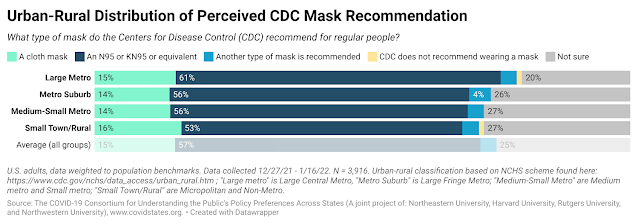
Rural Americans are less likely than urban and suburban Americans to wear any kind of mask, less likely to understand what type of mask offers the most protection against coronavirus infection, and less likely to know what type of mask the Centers for Disease Control and Prevention recommends, according to exclusive Covid States Project data provided to The Rural Blog.

The findings reflect rural Americans' overall more skeptical attitude about the pandemic and underscore the need for more public education about masking and other preventative measures (though lack of trust in the news media can make that more difficult).

Researchers surveyed over 17,000 individuals nationwide about their mask usage between Dec. 27, 2021 and Jan. 10, 2022. When asked what type of mask they wear, rural Americans—like all other population groups—were most likely to wear a cloth mask or other fabric barrier. But rural Americans were more than four times as likely as city dwellers to wear no mask at all.

Covid States Project charts here and below; click the image to enlarge it

Though 63% of rural Americans knew that N95 of equivalent masks offer more protection than cloth masks, that was the lowest percentage of any population group. Rural Americans were the most likely (29%) to be unsure about whether cloth masks or N95 masks offer more protection.


Rural Americans were the least likely (53%) to know that the CDC recommends an N95-type mask, but the most likely (16%) to believe the CDC recommends cloth masks and the most likely to be unsure of which type is recommended.


The Covid States Project is a joint effort of Harvard, Northeastern, Northwestern, and Rutgers universities. It receives support from the National Science Foundation, the Knight Foundation, the Russell Sage Foundation, the Peter G. Peterson Foundation and Amazon.

Jan. survey of rural Midwest bankers shows strong economy but worries about inflation, supply-chain problems

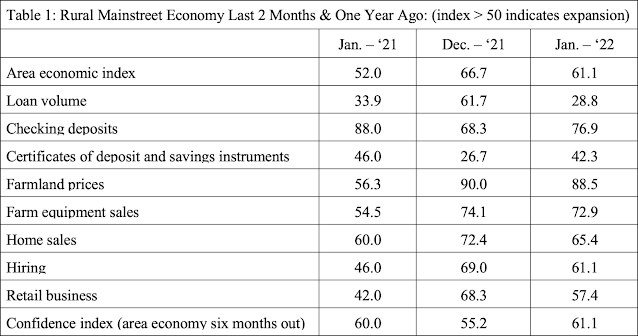
Creighton University chart compares current month to last month and year ago; click here to download it and chart below.
Rural bankers in 10 Midwestern states that rely on agriculture and energy saw the 14th straight month of positive economic growth in a monthly survey, though they voiced concerns about supply-chain problems and federal financial policy. The Rural Mainstreet Index polls bankers in about 200 rural places averaging 1,300 population in Colorado, Illinois, Iowa, Kansas, Minnesota, Missouri, Nebraska, North Dakota, South Dakota and Wyoming.

"Solid grain prices, the Federal Reserve’s record-low short-term interest rates, and growing agricultural exports have underpinned the Rural Mainstreet Economy," said Creighton University economist Ernie Goss, who compiles the index.

The overall Rural Mainstreet Index fell to 61.1 from December's 66.7; anything over 50 is above growth-neutral. However, the confidence index, which measures predictions of the area's economy six months out, rose from 55.2 to 61.1.

Bankers cited rising farm input prices as the greatest threat to the economy this year, followed by delivery disruptions of farm inputs, rising interest rates, a drop in federal financial support, tariffs and trade restrictions, and disrupted delivery of farm products.

Rural new-infection rate breaks records for second week

New coronavirus infections, in ranges by county, Jan. 9-15
Map by The Daily Yonder; click the image to enlarge it or click here for the interactive version.

"The rapid spread of the Omicron variant of Covid-19 in rural America abated a bit last week, but for the second week in a row, rural counties broke the record for the largest number of new cases in a seven-day period," Tim Marema reports for The Daily Yonder. From Jan. 9-15, "new infections in rural America grew by 36 percent, with 534,000 new cases being reported. Two weeks ago new rural infections grew by nearly 110%. This week’s lower rate of increase may indicate that rural counties are starting to recover from the Omicron surge." New infections in metropolitan counties grew only 2% last week, with 4.3 million new cases reported.

Covid-related deaths in rural counties—a trailing indicator—fell by about 8% last week to 2,090. "Metropolitan counties, which began seeing higher new infection rates about six weeks ago, had a 20% increase in deaths, to just over 10,000 for the week," Marema reports.

Click here for more charts, regional analysis, and county-level interactive maps from the Yonder.

Vilsack highlights record agriculture exports, climate-change mitigation efforts in report to House on the rural economy

Agriculture Secretary Tom Vilsack testified today before the House Agriculture Committee about the state of the rural economy over the past year. He acknowledged pandemic-related supply-chain disruptions and said they're proof that the ag sector must be diversified; he noted that the Agriculture Department will disburse $1 billion from the American Rescue Plan to expand meat and poultry processing capacity, Jerry Hagstrom reports for DTN/The Progressive Farmer.

"On climate change, USDA pointed to a new ten-year strategy for forests to reduce fire risk. USDA also began the Climate Smart Agriculture and Forestry Partnership Initiative to finance 'climate-smart commodity production.' Vilsack also cited USDA had 'overhauled' the Conservation Reserve Program and enrolled 5.3 million acres, surpassing a goal of adding 4 million acres to the program," Hagstrom reports. "USDA's Risk Management Agency also offered more flexibility for producers with prevented planting coverage to hay and graze cover crops as well. USDA Rural Development also provided over $1.6 billion in various funds for renewable energy programs."

Kentucky farmers are increasingly caught up in a debate over a new use for farmland, solar energy 'farms'

"With the push for renewable energy and the increased federal funding available for it, many in Kentucky are concerned about an onslaught of solar power farms. Some county officials say 'big solar' is moving in, getting huge tax credits while taking some of the very best farmland due to the premium leases they can offer aging farmers," Bobbie Curd reports for The Farmer's Pride, the statewide agricultural newspaper. "But with many companies coming in from out of the country and expecting local county governments to issue millions in bonds for the projects, county officials are worried about taking high risks and believe the issue will divide communities."

Henry County Judge-Executive John Logan Brent told Curd that he doesn't oppose solar energy, but feels that rural areas should not have to sacrifice prime farmland and viewsheds. "I don’t know too many folks who truly value the beauty of the countryside who want to look out their front window and see several hundred acres of black panels," he said.

Though there isn't much planned solar buildout in his county yet, Brent worries that proposed projects will cause discord among locals. Farmers will likely be tempted by high offers for land, he said, but he believes international companies will put profit before the interests of the community, Curd reports. A proposal in Clark County, just west of Lexington, already has caused conflict.

Larry Foxworthy, the judge-executive in Fleming County, said the solar projects may be too big a financial risk. Solar companies want counties to issue revenue bonds to finance the solar farms, and say counties would not be liable if a project fails, he remains skeptical because of the lack of details or guarantee, Curd reports. He and others also worry that the projects won't really create new local jobs. The issue has already caused division in the county; its governing body, the Fiscal Court, has refused to issue the bonds, which has angered local farmers who want solar projects on their land.

Wednesday, January 19, 2022

National News Literacy Week, Jan. 24-28, is needed more than ever; here are tools to help your newsroom participate


National News Literacy Week is Jan. 24-28 this year, an annual initiative that the News Literacy Project and E.W. Scripps Co. designed to raise awareness of the importance of news literacy for students and the general public. It differs from Media Literacy Week in October. 

From the website: "This annual event underscores the vital role of news literacy in a democracy and provides audiences with the knowledge, tools and abilities to become more news-literate. It also aims to inspire news consumers, educators and students to practice news literacy and to strengthen trust in news media by reinforcing the role of credible journalism."

The site has free ads and social-media graphics you can share with readers, along with a host of other resources for teachers, the news media, and the general public.

The need for news literacy has never been greater. Only 29% of Americans said they trust the news, dead last among the 46 counties surveyed for a 2021 Reuters Institute report. Finland, which has dedicated considerable resources to increasing news literacy, had the highest percentage of news consumers who trust the press.

Conservative Americans were by far the most likely to mistrust mainstream news coverage in the study, with 75% who identified as conservative saying they believed coverage of their views was unfair. A recent study from Columbia University's Tow Center for Digital Journalism sought to better understand, through focus groups and interviews, about conservatives' disproportionate mistrust of the news media, especially regarding pandemic coverage. Researchers found that the mistrust was "fueled by misinformation or fostered by insular media echo chambers." Even participants who were exposed to accurate information did not believe it because they were primed to view it with suspicion.

Webinar at 2 p.m. ET today to discuss how real or perceived biased news coverage can mislead the public

Just in time for National News Literacy Week next week, the News Literacy Project is hosting a free webinar at 2 p.m. ET today to discuss the effects of bias in news coverage and how it can mislead and misinform the public. Hosts John Silva and Elizabeth Price will also discuss how unfounded perceptions of bias can cause people to dismiss credible reporting or mistrust established news media outlets altogether. From the website: "This session will help you think more clearly about what causes bias in reporting, what it looks like in coverage and what you can do when you encounter it in your news diet."

The webinar is the final in a series of four webinars called "Understanding Misinformation and How to Talk to People Who Believe It," aimed at fostering more productive, fact-based conversations among friends and family members. The series is meant to "help participants understand what misinformation is, how people come to believe it and how to effectively and compassionately communicate and debunk those beliefs. While older adults play a critical role in sorting fact from fiction and helping others to do so, everyone can benefit from resources and support to help prevent harm from mis- and disinformation."

Recordings of the first three webinars in the series are available on the website. They are:

  • The Misinformation Landscape, which discusses how to move beyond the unhelpful term 'fake news' to more precisely identify the many types of misleading, inaccurate and false information that we encounter regularly. The session explores how propagators of misinformation use our emotions and cognitive biases to manipulate us.
  • Essential Fact-Checking Skills shares tools and skills needed to fact-check and verify information.
  • Productive Conversations Without Confrontation discusses the skills needed to have a productive, non-confrontational conversation with someone whose beliefs are fueled by misinformation.

Growth in rural Covid-19 vaccination rate has slowed in the past month, even as new infections have skyrocketed

Vaccination rates as of Jan. 13, compared to national average and adjusted to account for vaccinations
not assigned to a county. Map by The Daily Yonder; click the image to enlarge it or click here for the interactive version.

Even as new coronavirus infections have skyrocketed over the past month, "The number of rural Americans newly vaccinated for Covid-19 fell to its lowest level since vaccines became broadly available to the public in spring 2021," report Tim Murphy and Tim Marema of The Daily Yonder. "Since mid-December, an additional 500,000 rural residents completed their vaccination regimen for Covid-19. That’s a weekly average of 125,000 newly completed vaccinations. Previously, rural counties logged their smallest number of vaccinations the week before Thanksgiving 2021, when about 144,000 rural people completed their vaccination."

The metropolitan vaccination rate also fell, but not as much. As of Jan. 13, about 48 percent of rural Americans were vaccinated against the coronavirus, compared to about 61% in metro counties. "That makes the rural rate about 22% lower than the urban rate (on a percentage-point basis, the difference is 13.2 points)," Murphy and Marema report. "Currently, the death rate from Covid-19 is about 30% higher in rural counties than in metropolitan counties, according to a Daily Yonder analysis. The rate of new infections is about 25% lower in rural counties compared to metropolitan ones."

Click here for more charts, regional analysis, and county-level interactive maps from the Yonder.

Wireless carriers delay 5G rollout near airports amid safety concerns; smaller airports could be more susceptible

AT&T and Verizon are launching their 5G (fifth generation) cellular service today, but have agreed to delay the rollout near some airports amid concerns that the new technology could interfere with some airplanes' navigational systems. Smaller and rural airports may be disproportionately affected, since 5G tech is more likely to interfere with old altimeters in the smaller planes that use them, CBS News reports. Other nations have rolled out 5G networks without issue, but 5G towers in the rural U.S. are permitted to emit stronger signals than those in other countries.

The Federal Aviation Administration and major airlines have repeatedly warned wireless carriers that 5G signals could interfere with older altimeters, critical instruments that measure a plane's altitude. AT&T and Verizon delayed the rollout twice in the past month or so, but said that regulators and airlines have had years to prepare for 5G, Niraj Chokshi and David McCabe report for The New York Times.

The FAA will allow planes with newer, more accurate altimeters to operate around 5G, but planes with older altimeters won't be allowed to make landings under low-visibility conditions. Airlines canceled or delayed flights at dozens of U.S. airports today in response to the rollout, CBS reports. Reuters has an excellent explainer on 5G and whether it threatens airline safety.

Retaliatory tariffs during trade war led to $27 billion in lost agricultural exports by end of 2019, USDA report concludes

Percent share of estimated annual losses caused by
retaliatory tariffs, by commodity. (USDA chart)
The Trump administration's trade wars with China and other nations led to a significant reduction in U.S. agricultural exports, a loss of more than $27 billion from 2018 through the end of 2019, according to a new report from the Agriculture Department's Economic Research Service.

The federal government tried to make up for the loses with $28 billion in payments, but the payouts weren't always equitable; corn farmers were paid too much, the Government Accountability Office concluded. Yet, soybeans were the hardest-hit commodity, accounting for nearly 71% of losses, or $9.4 billion annually, the ERS report says. The next largest annualized losses came from sorghum ($854 million), and pork ($646 million).

China accounted for about 95 percent of the losses, or $25.7 billion, followed by the European Union ($0.6 billion), and Mexico ($0.5 billion). Tariffs from Canada, Turkey and India accounted for smaller losses. The U.S. and China signed a trade agreement in January 2020, but China did not fulfill its commitment to buy $80 billion in U.S. agriculture, seafood and other food exports by the end of 2021. Through November 2021, China had only purchased $56.3 billion.

Tuesday, January 18, 2022

Indigenous newsrooms, nonprofits, bring deeper coverage of Native American news

"Native American communities have seen more robust news coverage in recent years, in part because of an increase in Indigenous affairs reporting positions at U.S. newsrooms and financial support from foundations," Katie Oyan reports for The Associated Press. "Journalism-focused philanthropy quadrupled from 2009 to 2019 as traditional newspaper revenue shrank, according to a Media Impact Funders report. At the same time, an increasingly diverse population and a renewed focus on social injustice have commanded greater media attention."

Nonprofit news organizations have been leading the way with an increased focus on Indigenous affairs, and some newsrooms are entirely dedicated to Indigenous affairs. "Colorado-based High Country News created an Indigenous affairs desk in 2017 that has published dozens of stories from journalists, authors and experts across Indian Country. Other non-Native outlets followed with new beats and staff," Oyan reports. "National service program Report for America provides funding to many outlets, including The Associated Press, and is helping finance temporary Indigenous affairs reporting positions at 10 U.S. newsrooms. They’re part of a corps of journalists the organization established in recent years to bolster coverage of underserved communities."

The increased focus is helping build trust with Indigenous communities that have historically had poor relationships with the news media after being ignored or misrepresented for years. "Despite the growing interest, advocates say much more needs to happen. Many mainstream news organizations still lack Indigenous affairs reporting positions, including some of the country’s largest," Oyan reports. "And there have been missteps. In 2020, CNN received backlash for an elections graphic that displayed returns by race as white, Latino, Black, Asian and 'something else' — a label that outraged many Native Americans."

Advocates also note that tribal media needs more attention and protection, since many such newsrooms are owned by their tribes and don't have free press protections, Oyan reports.

Trucking companies trying to attract young, new drivers, but they must be 21; infrastructure package funding could help

Truck drivers have been in short supply for years, "but the situation has exacerbated supply chain disruptions during the pandemic, resulting in congested ports and empty shelves at stores," Amanda Perez Pintado writes for the Midwest Center for Investigative Reporting. "The American Trucking Associations estimated that the U.S. is short 80,000 drivers, a record high, and the number could surpass 160,000 by 2030." That's partly because it's a demanding job, and partly because of an aging workforce. The average truck driver in 2019 was 46, and many retired at the beginning of the pandemic.

Trucking companies bumping up wages to attract and retain more drivers. The median pay for semi drivers in 2020 was $47,130, Pintado reports. But higher pay "increases the cost to the employer, and they have no choice but to pass along those costs to both consumers and small businesses," said Illinois Chamber of Commerce CEO Todd Maisch. 

Companies are also trying to attract younger, more diverse workers who might not have considered truck driving as a career, Pintado reports. But, as the International Foodservice Distributors Association noted in a statement, "A key barrier to developing a pipeline of young professional drivers is that high-school graduates cannot immediately pursue a trucking career due to the federal regulations that prohibit them from operating across state lines or in interstate commerce until they turn 21."

The $1 trillion infrastructure package President Biden signed in November could help bring in younger drivers. "The package establishes a three-year pilot apprenticeship program allowing commercial truck drivers between the ages of 18 and 20 to drive across state lines. Though people under 21 can receive a commercial driver’s license in most states, federal regulations prohibit them from driving commercially across state lines," Pintado reports. "The White House in December announced a series of actions intended to recruit new drivers to bolster the trucking industry. The Truck Action Plan includes expediting the commercial driver’s license, a 90-day challenge to expand registered apprenticeships, and outreach and recruitment focused on veterans."

Survivors of mass killing at Capital Gazette were called journalism heroes, then the buyouts came; most are gone

Three and a half years ago, reporters at the Capital Gazette in Annapolis, Maryland, became First Amendment heroes after putting out the newspaper on its regular schedule the same day five staff members were killed by a gunman who was upset with the paper. Today, their collective and individual stories echo the challenges to local journalism, which seem greater than ever.

"In the years since the shooting, these journalists had become family — and not just because of what they had survived," write Emily Davies and Elahe Izadi of The Washington Post. "They had helped each other through a series of attacks: the physical one in their newsroom and the PTSD that made it hard to get through each day. And together they had faced the existential threat to their industry that compelled longtime colleagues to take buyouts, permanently shuttered their newsroom and, finally, led to their newspaper’s acquisition by a hedge fund with a reputation for deep cost-cutting."

Former reporter Selene San Felice, who had hidden under a desk during the attack, told the Post, “It felt like death all over again in a lot of ways when people would leave to take buyouts. We could feel each other being ripped apart when all we wanted to do was stay.”

"The survivors have confronted these intersecting traumas daily," the Post reports, but perhaps never as directly as throughout the criminal responsibility trial of Jarrod Ramos, which took place in Annapolis three years after he attacked their newsroom and days after Alden Global Capital acquired their paper. . . . The reporters who have stayed at the paper continue to struggle. Rachael Pacella, an education reporter who survived the shooting, had to take a second job at a restaurant in Baltimore to make ends meet. She said she is one of nine full-time newsroom employees left." She told the Post, "That number is so close to how many people died. If five people were gone today from the Capital, there is no way it would be able to move forward."

Alden's reply to the Post was a single sentence: 'The Capital Gazette is a prized jewel in American journalism and we are proud supporters and owners of its critical mission to provide valued local news and information that subscribers rely on.'"

Army Corps of Engineers announces it won't use relaxed Trump-era waters definition when making permit decisions

"The Biden administration last week quietly and abruptly announced that developers can no longer rely on decisions made under a high-profile Trump-era Clean Water Act rule about which waters are federally protected to obtain new permits," Hannah Northey reports for Energy & Environment News. "Legal experts say the move could have far-reaching effects throughout the building, mining and agricultural sectors."

At issue is how regulations define the Clean Water Act's definition of "waters of the United States," those regulated by the act. The Environmental Protection Agency under President Obama had expanded that term to include intermittent and seasonal waterways. Farmers and developers were unhappy with the move, saying it was government overreach and unnecessarily burdensome. The Trump administration scaled back the WOTUS definition but a federal judge tossed it on the grounds that it could harm the environment. "Notably, some argue the rule is still in effect until EPA completes the regulatory process of replacing the Trump rule with pre-2015 regulations updated to reflect consideration of Supreme Court decisions," Northey reports.

Conflicting rulings in federal district courts have sown confusion, so on Jan. 5 the Army Corps of Engineers posted on its website a new rule meant to clarify the matter. "Going forward, the Army Corps in its announcement explains that it will make new permit decisions based on the pre-2015 regulatory regime — not the Trump rule — and that the agency will talk to applicants about any pending or future permit action that relies on an approved jurisdictional determination made under the Trump rule," Northey reports. "Specifically, the Army Corps said they would talk to applicants about whether they want to receive a new determination based on pre-2015 regulations or proceed with a preliminary determination or none at all, according to the post."

The new policy could affect people who were told they had no WOTUS jurisdictional areas on their land. It could also affect developers. "Ellen Gilinsky, a former wetlands consultant and associate deputy assistant administrator for water at EPA under the Obama administration, said the Army Corps’ decision could affect anyone who had an approved jurisdictional determination under the Trump rule but figured they had five years to apply for a permit using that decision," Northey reports. "Developers that fit into that bucket, she said, are going to be surprised when they go in for a permit and are told their development plans are going to have to change."

Developers, mining companies, and farmers have objected to the Jan. 5 policy update; several legal experts told Northey the change will likely lead to multiple lawsuits. Meanwhile, EPA and the Army Corps are seeking farmers' input on a new rewrite of the definition.

Monday, January 17, 2022

Jenay Tate, who was the 'tough as nails' publisher of The Coalfield Progress in southwest Va., dies of cancer at 64

Jenay Tate (File photo)
Jenay Tate, the last journalist in an entrepreneurial newspapering family that told the stories of southwest Virginia for 95 years, died Saturday after a two-year battle with lung cancer. She was 64.

Until 2019, Tate was publisher of The Coalfield Progress in Norton, a title held by her grandfather, Kentucky native Presley Thornton "Pres" Adkins, and her father, Carroll Tate. Under her leadership, the twice-weekly paper was a frequent winner of awards from the Virginia Press Association, which honored her with its D. Latham Mims Award for editorial leadership in 1988. She was a founding member of the Virginia Coalition for Open Government and a graduate of the University of Kentucky journalism school.

Tate stayed with the newspaper for 40 years despite numerous adversities. At her younger brother Michael's behest, the siblings sold the Progress to Tennessee-based American Hometown Publishing Co. in 2005, but she continued with the paper as both editor and publisher, also holding the latter title with other papers the family had owned, The Post of Big Stone Gap and The Dickenson Star. When AHP liquidated in 2019, the papers were bought by Missouri-based Lewis County Press, which eliminated her position two months later. "Tate said she was stunned . . . but she admitted she had struggled with and objected to some of the new company's direction so, in the end, should not have been entirely surprised," the Progress reported at the time.

"Simply put, newspapering was her life," her obituary says. "She wrote extensively about the coal industry, including the historic regional coal camps, and the importance of coal to the local economy. She professed the value of higher education through her coverage of happenings at regional colleges. She built contacts and sources and friendships across countless industries and experiences. And she advocated for the region with leaders and elected officials for 40 years. . . . She loved being involved in her community, defending its interests, and telling the important stories of the region." Her longtime friend Joyce Payne said, "She was tough as nails in searching the truth for a story and managing the paper, but she had a soft gold of heart for her friends."

Tate was preceded in death by her parents and her brother, and is survived by a sister, a niece and three nephews. Her visitation and funeral will be held Thursday at Hagy & Fawbush Funeral Home in Norton. Memorial gifts may be made to PAWS of SWVA, PO Box 576, Coeburn VA 24230.